Rupert Murdoch’s secret moves to destroy public broadcasting in Australia
 In hours, Murdoch could secure his stranglehold on the Australian media by acquiring our public international TV news network — and rob a struggling ABC of $223 million in funding. Communications Minister Stephen Conroy is under pressure to give control over the network to Murdoch instead of the ABC – Murdoch’s mouthpiece The Australian has been leaking details of insider support for Murdoch in a blatant attempt to force Labor into backing his bid. Conroy knows that giving the network to Murdoch would greatly increase the media mogul’s corrupting influence and hurt the ABC, and is looking for a way out.
Rupert Murdoch already owns 70 percent of Australia’s newspapers. Now he’s on the hunt for more media control, and he’s hoping we won’t notice. Through his stake in Australian News Channel, he’s been pushing hard to take over the crucial but low-key ‘Australia Network’: an Australian international public broadcaster that’s available in 44 countries. Murdoch has shown that his empire ruthlessly puts profits above all else — even hacking a murdered school girl’s phone to increase sales. With this extra network, Murdoch would vastly increase his power and take control of Australia’s public image abroad.
The move is also a key part of his strategy to destroy public broadcasting and silence independent voices. Murdoch knows that the loss of $223 million in funding would severely weaken an already stretched ABC. It would mean the loss of many ABC journalists, and potential closures of overseas news offices. If we let Murdoch win, Australia will become the first country in the world to privatise its international news service…. Continue reading
Quiet wind turbine for decentralised energy systems
Suited to grid and non-grid connections, the turbine is extremely versatile and has great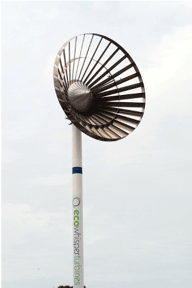 appeal for commercial sites, urban environments, such as industrial parks, airports, community groups, universities, councils, ports and manufacturing facilities…..
 VIDEO
VIDEO
http://www.azocleantech.com/news.aspx?newsID=15749 Australian Company Launches World’s Quietest Wind Turbine, AZO CleanTech October 26, 2011 Australian renewable energy innovation continues to lead the way with the launch of the worlds’ quietest wind turbine, released to market this week. The cutting edge turbine stands 21 metres high and features a unique, intuitive blade design that is virtually silent.
The Eco Whisper Turbine is set to revolutionise delivery of renewable electricity supply for urban and rural applications, Continue reading
Australia’s media sleeps as governments pander to uranium miner BHP Billiton
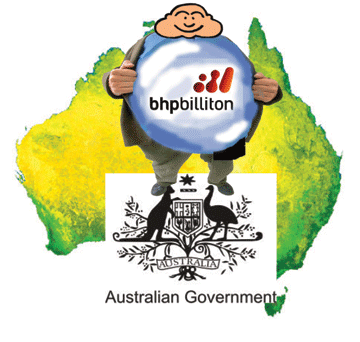 Today, October 19, the multinational mining giant BHP will get its own way, as a subserviant South Australian government rushes through a Bill – giving BHP open slather to set up the world’s biggest man made hole – a uranium mine.
While the Australian mainstream media remains silent, both National and State governments have swiftly given approval, including the continuance of BHP’s exemptions from laws.
- it will be an open-cut mine 4km long by 3km wide by 1km deep.

- The tailings are radioactive and carcinogenic.
- These tailings will be dumped in a gigantic slag heap the size of a mountain range, above ground.
- Around 70 million tonnes of finely pulverised tailings will be dumped on open ground every year The dump will eventually cover an area of 44 sq. km and soar 150 metres high.
Under the Roxby Downs Indenture Ratification Act 1982, BHP was given legal authority to override important state legislation, including the:
- Aboriginal Heritage Act 1988
- Development Act 1993
- Environmental Protection Act 1993
- Freedom of Information Act 1991
- Mining Act 1971
- Natural Resources Act 2004 (including the Water Resources Act 1997)…..
Australia joins international initiatives to address climate change
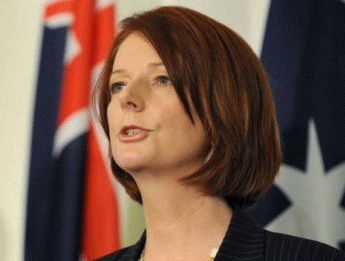 The passage of this initiative is still hugely important, if for no other reason than that it shows Big Coal can be rolled. The coal industry is an even larger part of the Australian economy than it is of the American, and it has an enormous amount of political power. And just like here in the U.S., there are plenty of shrill politicians in Oz who claim that any new tax will lead to economic ruin.
Gillard told Members of Parliament that they would be judged on their vote by every Australian, “because the final test is not are you on the right side of the politics of the week, or the polls of the year.”
“The final test is this: are you on the right side of history?“

 Australian Carbon Tax Vote: A Very Big Deal, ROLLING STONE, : OCTOBER 13, By JEFF GOODELL So maybe there is hope for us yet. After what one Aussie columnist calls“the dirtiest and most dishonest campaign ever waged before the Australian public,” with millions of dollars spent on media ads and climate skeptics flown in from around the world, Australia’s House of Representatives voted yesterday, 74 to 72,to levy a tax on carbon pollution. Continue reading
In water-scarce Australia, uranium miner BHP guzzles it for free
 Public resources for private profit: free water for the largest open-pit mine in the world Coober Pedy Regional Times, by: Nectaria Calan, 13 Oct 11 In August mining giant BHP Billiton announced record financial results for the 2011 financial year, recording a total net profit of US$23.95 billion, nearly double its 2010 figure of US$13.01 billion.
Australian Aboriginal response to BHP’s plan for world’s biggest uranium hole

 THE LIZARDS REVENGE, DLF – Desert Liberation Front, Response to the governments decision to expand Olympic Dam mine. Sleeping underneath the ground there is an old lizard, Kalta the sleepy lizard. The lizard ain’t so sleepy anymore.
BHP is mining right into that Lizards body. The government has just approved an expansion of the Olympic Dam uranium mine, making it the biggest uranium mine in the world.
Kalta is angry and wants revenge. Arabana elder Kevin Buzzacot is calling the people of the world to help the lizard shut down the mine. He is calling for people to come and heal the land in the name of peace and justice for the next 10,000 generations to come.
The land is being irreversibly poisoned in and around Roxby Downs by the tailings dam causing dust and ground water contamination, and contamination of its workers.
The uranium is taken all over the world and used to kill the land and all its creatures. It’s destroying lives not only in Fukashima, with the reactor meltdown, but in the depleted uranium shells that children play with in the streets of Iraq and Kosovo.
With the governments numerous attempts to put a nuclear waste dump at Muckaty in the Northern Territory there is a danger that radioactive waste will be brought back, opening Australia up to accepting nuclear waste from all over the world. Lets stop the deadly cycle where it starts.
The land the lizard and the creatures of this earth are summoning everybody who gives a shit to the gates of Roxby Downs on the 14th of july 2012 for The Lizards Revenge – This is an open invitation to all people and a special call out to artists, musicians and activist community groups and media to get involved in the creation of this autonomous zone for the peace and healing of this land.
Party in a Dangerous Planet with Theatre, Cabaret and Art installations. Over 20 musical acts. Solar Powered sound system extravaganza and wind powered cinema. More to be anounced.. Stand up and boogie down at the Gates of Olympic Dam 14th July 2012for more info email- izzybrown@live.com
Australian government deceiving public on nuclear waste
“The claim that a waste facility is required to support nuclear medicine is mischievous scare-mongering,”
 Muckaty dump justification ‘nonsense, Channel 9 TV News 12 sept 11,A nuclear expert has taken aim at claims a planned waste dump in remote Australia is needed to house low level radioactive waste from hospitals. Speaking ahead of a Senate debate this week on the National Radioactive Waste Management Bill, Dr Peter Karamoskos was critical of plans for the proposed dump. Continue reading
Grim outlook for Australia’s uranium mining industry
 Investor support has evaporated and the share prices of most ASX-listed uranium plays have fallen more heavily than the wider market. The share price falls have eroded any chance of capital raisings to fund drilling programs or project development while continued production problems experienced by market leader Paladin Energy have added to the negative sentiment hanging over the sector.
The Merrill Lynch uranium equity index, which tracks global listed stocks, is down 19 per cent over the past month and 23 per cent in the past year.
More pain for uranium sector as price dips, PETER KLINGER, The West AustralianSeptember 7, 2011 Already battered by headwinds, including strong opposition from environmentalists, WA’s fledgling uranium sector is set for more grief amid expectation the nuclear fuel’s low price will fall another 6 per cent within the next few months. Continue reading
Murdoch’s media monopoly misinforms Australia on Climate Change
Nowhere has the reliance on spin been more apparent than during the coverage of the climate “debate” by the Murdoch media and allied shock jocks.
Australia’s climate scientists expose shock-jock distortion tactics, Academics catalogue the deluge of spin and misinformation of climate science by various Murdoch-owned papers, Stephan Lewandowsky 1 September 2011, Guardian UK, Australia has unwittingly become a social experiment. A ruthless experiment on the fate of a society when a single media conglomerate, Rupert Murdoch’s News Corp, owns 167 newspapers and controls around 70% of the printed media market. Continue reading
Deepening gloom for Australia’s uranium industry
 Uranium prices plunge causing issues for Australian producers, Herald Sun, Greg Roberts ,September 07, 2011 URANIUM prices have fallen back to levels last seen after Japan’s nuclear accident in March, causing further grief to struggling Australian producers.
The uranium spot price is $US48.85 ($A46.04) a pound, having plummeted from $US67.75 to $US49 immediately after the earthquake and tsunami on March 11.
The spot price had recovered to about $US56.50 after the Fukushima accident. Analyst group Resource Capital Research says the dynamics driving the sector have changed in the aftermath of the meltdown, with Germany planning to close all 17 of its nuclear power reactors by 2022.
The “fund implied price” – an indicator of market price expectations – is signalling a further fall in the spot price to $US45.95. The Merrill Lynch Uranium Equity Index, which measures the performance of uranium equities, has fallen 19 per cent over the past month.
It is down 27 per cent over the past three months and 23 per cent over the past year, according to the latest quarterly report by Resource Capital Research. Shares in Australia’s largest uranium producer, the Rio Tinto-backed Energy Resources of Australia, have fallen 13 per cent in the past month and 73 per cent in the past year.
A year ago, ERA shares were $13.49, compared with $3.65 now, with the company posting a $122 million half-year net loss. http://www.heraldsun.com.au/business/uranium-prices-plunge-causing-issues-for-australian-producers/story-fn7j19iv-1226130940686
Australia’s uranium industry losing confidence?
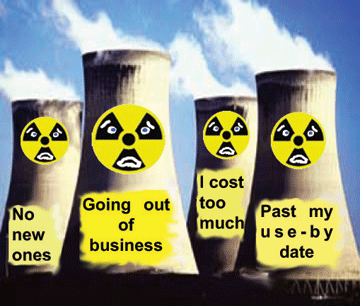 “…an extended period of uncertainty…..A mistake by one operator or explorer or project developer in our industry affects all of us.”
Fukushima puts Australia’s uranium industry on the defensive Independent Australia, 2 Sept 11, The Australian nuclear industry feels the heat after the Fukushima calamity, but spins on gamely. Noel Wauchope reports.
With plummeting uranium prices, and increasinglybad news about Fukushima radiation, Australia’s uranium industry is well and truly on the back foot. But the industry battles on with religious fervour in its belief in the future uranium boom. Continue reading
Wikileaks reveals plotting by USA and Australia to remove atomic energy chiefve

 US, Australia ‘schemed against IAEA chief’, SBS World News, 31 August 2011 Source: AAP, The United States and Australia schemed unsuccessfully in 2005 to block Mohamed ElBaradei’s election to a third term as head of the International Atomic Energy Agency, a newly leaked US diplomatic cable shows.
Both countries were unhappy with ElBaradei’s “unhelpful” response to Iran’s nuclear program, but the bid to prevent his re-election to the nuclear regulatory agency’s leadership ultimately failed for lack of international support. Continue reading
Research to help atomic downwinders now perverted into pro nuclear spin
They [Pam Sykes, Bobby Scott etc] are the “radiation sceptics”, very much comparable to “climate change sceptics”. Their belief in “radiation hormesis” is comparable to “intelligent design” — as opposed to evolution.
Their common funding sources are nuclear energy agencies — in particular the USA Department of Energy (DOE)…..
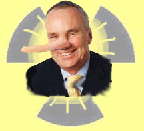 After Fukushima: the rise of nuclear radiation denialists Independent Australia 22 Aug 11, After the Fukushima disaster, the nuclear industry has urgently redoubled its efforts to convince the world that nuclear radiation is safe. Now it seems they are trying to say that radiation is actually good for us. Noel Wauchope reports.
— In 2001, President Bill Clinton authorised funds to research the effects of radiation on the “downwinders” from the Nevada and Utah atomic bomb tests. The funds went to the Department of Energy, who designed the research project. They then allocated the project to Flinders University in South Australia, under the leadership of Professor Pam Sykes.
But the original intention of the research has taken a strangely perverted course. Pam Sykes has joined the proponents of “adaptive radiation” and “radiation hormesis” – the theory that “low level ionising radiation is good for you” It’s quite an old theory, but now, after Fukushima, it has suddenly become very useful to the nuclear and uranium lobbies…….. Continue reading
Australian anti uranium protestors walking 1250 km
 WA uranium protest to cover 1250km, Narelle Towie , PerthNow , August 21, 2011 ANTI-URANIUM protesters will begin their 1250km march from Wiluna to Perth today in their fight to have mining of the ore banned.Walk Away From Uranium Mining protesters will travel through two proposed uranium mining sites – in Wiluna and Yeelirrie – before arriving in Perth nearly a month later on October 27….
WA Senator Scott Ludlam, who will take part in the march, said WA should joining a growing list of countries around the world, including Germany, Switzerland, Austria, Portugal, Greece and Ireland, who were walking away from nuclear power.
“This is an extraordinary moment for our state and for the future. The nuclear industry is in decline around the world and public awareness of the dangers of uranium mining and nuclear power is growing,: Mr Ludlam said.
“This march is a powerful statement from Western Australians who do not want uranium mining in WA and who do not want their state to support the nuclear industry in any way.” http://www.perthnow.com.au/news/special-features/wa-uranium-protest-to-cover-1250km/story-e6frg19l-1226118950758
Australian soldiers to wear portable solar power
 Super slim solar cell a success, The Age, Ben Cubby August 12, 2011 ’A typical solar cell is about 0.2 millimetres thick, which is 200 micrometres thinner than a human hair or a sheet of paper, will soon be used by Australian soldiers on patrol in Afghanistan as a portable power source. The solar cells, invented by researchers at the Australian National University, can be used to cover helmets, tents or clothing and recharge electronic gear such as night vision goggles.
They also have extensive potential in civilian applications, including recharging phones and computers, because a square metre of lightweight solar panel can generate 140 watts of power and yet be rolled up into a ball afterwards. ’A typical solar cell is about 0.2 millimetres thick, which is 200 micrometres – that’s too thick to bend, it would shatter,” the project’s chief investigator, Andrew Blakers, said. ”But these cells are about 45 microns thick, so they are flexible and also about the same efficiency as commercial solar cells. By comparison, really fine quality merino wool is about 18 microns thick.” In practice, many square metres of panel could be unfurled from a box about the same size as a wine cask http://www.theage.com.au/national/super-slim-solar-cell-a-success-20110811-1iot3.html
1 This Month



26 September – International Day for the Total Elimination of Nuclear Weapons


PLEASE OPPOSE HR 8255 AND S.3639 – bills would accelerate satellite deployment, with no environmental review or safeguards – https://ncstd5li.quorum.us/campaign/169331/
To see nuclear-related stories in greater depth and intensity – go to https://nuclearinformation.wordpress.com
-
Archives
- September 2026 (257)
- August 2026 (330)
- July 2026 (355)
- June 2026 (287)
- May 2026 (306)
- April 2026 (356)
- March 2026 (251)
- February 2026 (267)
- January 2026 (308)
- December 2025 (358)
- November 2025 (359)
- October 2025 (375)
-
Categories
- 1
- 1 NUCLEAR ISSUES
- business and costs
- climate change
- culture and arts
- ENERGY
- environment
- health
- history
- indigenous issues
- Legal
- marketing of nuclear
- media
- opposition to nuclear
- PERSONAL STORIES
- politics
- politics international
- Religion and ethics
- safety
- secrets,lies and civil liberties
- spinbuster
- technology
- Uranium
- wastes
- weapons and war
- Women
- 2 WORLD
- ACTION
- AFRICA
- Atrocities
- AUSTRALIA
- Christina's notes
- Christina's themes
- culture and arts
- Events
- Fuk 2022
- Fuk 2023
- Fukushima 2017
- Fukushima 2018
- fukushima 2019
- Fukushima 2020
- Fukushima 2021
- general
- global warming
- Humour (God we need it)
- Nuclear
- RARE EARTHS
- Reference
- resources – print
- Resources -audiovicual
- Weekly Newsletter
- World
- World Nuclear
- YouTube
-
RSS
Entries RSS
Comments RSS
 nuclear-news