Disappearance of secret files on Australia’s nuclear weapons plans
Treasures of Australia’s past lost from the National Archives by:Herald Sun Patrick Lion From:The Daily Telegraph December 13, 2011 HUNDREDS of rare files – including secret plans for nuclear weapons and personal files of prime ministers – have gone missing from the library responsible for preserving Australia’s history.
Over the past two decades the National Archives has lost at least 748 historic items, some dating back more than 150 years, from its official collection of documents, government files, letters, recordings and photographs.
Among the missing files on nuclear weapons and uranium from the middle of last century is a 1956 report, The Clandestine Introduction Of Nuclear Weapons In Australia…… http://www.heraldsun.com.au/news/more-news/treasures-of-australias-past-lost-rare-items-missing-from-the-national-archives/story-fn7x8me2-1226220439496
Australia wrong to sell uranium to India, says former conservative Prime Minister
A reason India wants access to nuclear trade including uranium is precisely to further its nuclear proliferation. Senior Indian military leaders have publicly said so…..
India reserves the right to classify future reactors as civilian or military. It was not required in return to commit to significant positive measures – indeed, it has made no nuclear disarmament commitments, it has not ratified the Comprehensive Nuclear Test Ban Treaty
Why Gillard’s uranium-to-India policy is dangerously wrong, SMH Malcolm Fraser, December 12, 2011 Canberra’s abject submission to US pressure is shameful. ON SELLING uranium to India, Julia Gillard is wrong, dead wrong. Ramming the policy change through a deeply divided ALP national conference last weekend was not smart politics, but a failure of leadership.
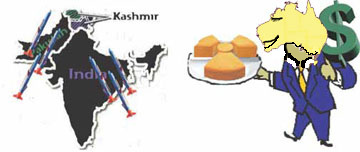
The unequivocal longer-term consequences of this policy backflip are aggravating India’s nuclear arms race with Pakistan and eroding the already failing brakes on proliferation of nuclear weapons. A nuclear war between India and Pakistan is not some theoretical possibility, but a real and growing danger. …. Continue reading
Australia’s hypocrisy on uranium exporting and nuclear disarmament
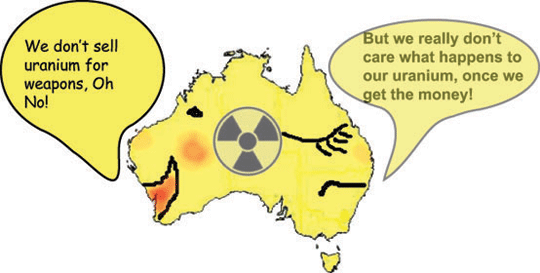
states – the U.S., U.K., China, France, Russia – although not one of them takes seriously its obligation under the Non-Proliferation Treaty (NPT) to pursue disarmament in good faith.
policy and binding Labor platform policy. That’s pretty low. Continue reading
Australian Labor Party trashes Nuclear Non Proliferation in rush to make uranium money out of India
 Indeed, proponents of the platform change [to sell uranium to India] generally made no acknowledgment that India was the first and only state in the world to acquire nuclear weapons as a result of international cooperation on the basis of it being for peaceful purposes – nor her belligerent testing in the mid-1990s; her rather public nuclear arms race with Pakistan; her failure to fully comply with international safeguards and monitoring initiatives; her problems with the US despite a comparable bilateral agreement in place concerning technology and expertise. Nor the rather significant point that none of the cited measures are enforceable under international law – they are considerably difficult to monitor, verify and enforce.
Australian Labor Party downplay arms control considerations, Crikey.com, December 5, 2011 , by NAJ Taylor On Sunday, the Australian Labor Party voted 206 to 185 in favour of changing one part of the party’s longstanding and non-negotiable platform on uranium exports: that recipient states must be members of the Nuclear Nonproliferation Treaty (NPT).
The express intention of the change in policy platform is to lift the ban on uranium sales to India, who are among those three states globally that remain outside – and have no intention of joining – the NPT. With the opposition Coalition having been in support of such a move for some time, the vote is expected to have immediate policy ramifications.
Of little consequence now, the Greens do have a well-known policy position on uranium that clearly states: “The Australian Greens will […] prohibit the exploration for, and mining and export of, uranium”.
Misrepresenting India’s record – it is a grave error to cite India’s nuclear weapons record – which is sub-optimal, not “exemplary”, as is often recycled – as evidence in support of a policy change that is predominately driven by political, commercial and diplomatic pressures. Continue reading
Australia breaking international law if selling uranium to India
PLANS to sell uranium to India could hit a legal snag because of an anti-nuclear treaty Australia helped create. Herald Sun, 29 Nov 11Australian National University treaty law expert Don Rothwell says the South Pacific Nuclear Free Zone treaty, known as the Rarotonga treaty, stops Australia trading the nuclear material with India.
Prof Rothwell, who questioned the legality of the Malaysian solution before it was rejected by the High Court, has provided advice to the International Campaign to Abolish Nuclear Weapons.
“If India does not agree to Article III.1 Non-Proliferation Treaty safeguards and Australia were to export uranium to India, Australia would be in violation of its Treaty of Rarotonga obligations,” the legal advice says.
This could lead to a challenge from other countries that are part of the treaty.
Prime Minister Julia Gillard wants the ALP to agree to change its platform to allow sales of uranium to India, which she has said would create jobs in Australia and would still have safeguards attached.
A vote will be put to members at the party’s national conference this weekend.
The Coalition already has a policy to allow uranium sales to India.
Tim Wright, the Australian director of ICAN, said the Prime Minister had failed to consult her lawyers. “Not only is the sale of uranium to India illegal, it is also highly dangerous given that India is rapidly bolstering its nuclear forces,” Mr Wright said….http://www.heraldsun.com.au/news/more-news/rarotonga-treaty-may-prevent-sale-of-uranium-to-india/story-fn7x8me2-1226208772517
Australian uranium companies further down the drain
Oz Minerals pulls out of Toro uranium JV,9 News, 19 Nov 11 OZ Minerals has pulled out of a uranium exploration joint venture with Toro Energy in South Australia, saying no economic uranium has yet been found at the Mt Woods project.
The Toro board has accepted a $3.75 million cash offer from OZ Minerals as consideration for the termination, Toro said in astatement on Friday. ”No potentially economic uranium results have been reported from the Mt Woods project,” Toro said…. Shares in Toro were down 3.41 per cent at 8.5 cents at 1540 AEDT while OZ Mineral shares were 1.89 per cent weaker, compared to losses in the broader market of about 1.8 per cent.
http://finance.ninemsn.com.au/newsbusiness/aap/8376270/oz-minerals-pulls-out-of-toro-uranium-jv
Australians kept in the dark on USA new military base in Darwin
 We need more details of US build-up: Brown, SMH, 17 Nov 11, Australian Greens leader Bob Brown fears nuclear submarines could be stationed off the coast of Australia as part of a US military build-up in the Top End……
The expansion of the existing collaboration between the Australian Defence Force and the US Marine Corps and US Air Force will allow America to enhance its presence in the Asia-Pacific region
Senator Brown wants to see more details of the deal, announced jointly by Prime Minister Julia Gillard and US President Barack Obama on Wednesday. He also wants a parliamentary debate on the deal. ”I object to Australian people and parliament not knowing what the details are,” Senator Brown told ABC radio on Thursday. Continue reading
Obama sets uranium policy for Australia as he flips by
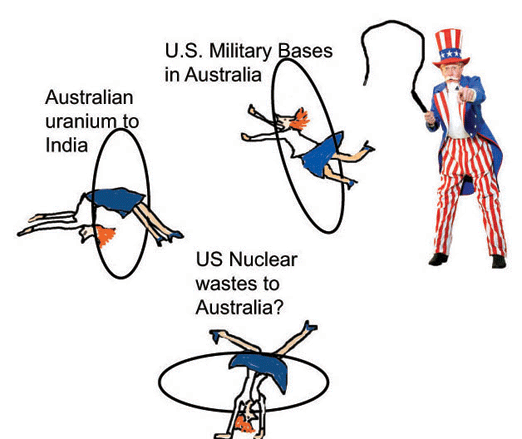 Gillard uranium move linked to US: report, Business Spectator, 16 Nov 2011 Prime Minister Julia Gillard’s move to open the door to uranium exports to India reportedly follows talks with the Obama administration. The US has been pursuing a closer partnership with India and considers Australia a key part of its strategy, The Australian reported on Wednesday.
Ms Gillard has denied that the decision was made to coincide with President Barack Obama’s visit to Australia and said it was her decision alone.The Australian, however, reported that US and Australian officials have been in intense strategic discussions about India for several months. http://www.businessspectator.com.au/bs.nsf/Article/Gillard-uranium-move-linked-to-US-report-NMLD2?OpenDocument&src=hp3
 India can thank Uncle Sam for Julia Gillard’s uranium backflip, First Post India, 16 Nov 11 Uttara Choudhury New York: Australian Prime Minister Julia Gillard’s dramatic decision to open the door to uranium exports to India came after talks with the Obama administration, which viewed the ban as a “fly in the ointment” to greater engagement between Washington, New Delhi and Australia in the Indian Ocean region…….
Gillard announced on Tuesday that she will ask the Australian Labour Party to dump its ban on uranium sales to India, at its national conference next month. The ban was imposed by former prime minister Kevin Rudd in 2008 as India wasn’t a signatory to the Nuclear Non-proliferation Treaty. Gillard has denied her decision to seek to overturn the ban is in order to fall in line with the US. She bristled when questioned on the timing of the announcement which coincided with Obama’s state visit to Australia. Gillard said the decision was hers alone…..
She did, however, point to the US-India civil nuclear agreement of 2008, which lifted the “de facto international ban” on the sale of uranium to India….. While Beijing has learned to live with American forces on its eastern periphery, the possibility of an intimate US-India military relationship, as well as India’s position astride China’s key maritime shipping lanes, has generated fears of encirclement…
USA to increase its military presence in Australia
Obama looks to counter China’s influence with Australian naval base, National Post, Peter Goodspeed: Nov 15, 2011 When Barack Obama arrives in Australia Wednesday he will announce plans to establish a permanent U.S. military presence in a move designed to reassert U.S. interest in the region and counter China’s growing influence in Asia.
In a move that is more symbolic than substantial, the U.S. President will outline plans to rotate 2,000 U.S. Marines a year through a naval base in Darwin, Northern Territory. This will be part of a deal that calls for joint training and military manoeuvres as well as allowing Washington to pre-position military supplies in Australia……
the new basing agreement marks a dramatic change in the thrust of U.S. foreign policy.As Washington prepares to withdraw from a decade-old military involvement in the Middle East and Afghanistan and braces for a possible US$500-billion in military spending cuts over the next five years, U.S. policy makers are pivoting to refocus their attention on Asia.
In an essay for Foreign Policy magazine last month, Hillary Clinton, the U.S. Secretary of State, heralded the dawn of “America’s Pacific Century,” insisting it is in Washington’s interest to reassert its influence in Asia.
Obama puts nuclear pressure on Australian Prime Minister
 Australia under nuclear pressure, Independent Australia, 15 Nov 2011 The Prime Minister announced today that Australia is set to overturn its ban on uranium sales to India, a non-signatory to the nuclear non-proliferation treaty. The reason why she’s doing this is simple, Barack Obama asked her — because it’s good for the US economy. Noel Wauchope reports……
As Australia’s biggest trading partner, one would expect that China would be receiving top consideration from the Australian government, but hey — Australia has to be nice to USA, doesn’t it? As we all know, it’s traditional that when USA yells “Jump!”, Australia responds “How high!?”
And so it is that, once again, the Australian government is in the process of jumping hurdles, as dictated by USA, however little sense that might make…..
why do we need this increased U.S. military presence in Australia? Why, to protect ourselves and the U.S.A. against China, of course! (Although Barack Obama did tell the American people that the main purpose was to provide jobs for Americans.)…
The weird part about all this is … that U.S. nuclear companies are selling technology to China to help in its nuclear weapons program….
now, Australia is coming under intense pressure from the U.S.A. to change its policy on uranium sales to India. Why? … — to enable technology sales to India. Yes, it comes back to the USA’s determination to make money out of nuclear technology. While USA’s domestic nuclear industry founders – unable to get investment for new nuclear reactors – its big hope is in selling nuclear technology to “developing” countries — India, China, anybody!….
Meanwhile, for Australia, the further development of India’s nuclear arsenal should mean some anxiety about the likely further development of Pakistan’s nuclear arsenal. Well, perhaps Australia should sell uranium to Pakistan, too?
China buys our uranium, as it is a member of the Nuclear Non Proliferation Treaty — but perhaps China will be less than delighted to see Australia stepping outside that Treaty, kowtowing to USA, and furthering the nuclear weapons of its rival, India? http://www.independentaustralia.net/2011/business/australia-under-nuclear-pressure/
To counter China, USA to set up another military base in Australia
U.S. to Build Up Military in Australia, WSJ, By LAURA MECKLER, WASHINGTON, 12 Nov 11—President Barack Obama will announce an accord for a new and permanent U.S. military presence in Australia when he visits next week, a step aimed at countering China’s influence and reasserting U.S. interest in the region, said people familiar with his plans. Continue reading
Anti nuclear, anti war protest planned against Obama’s visit to Darwin, Australia
Local activists plan Obama protest News.com.au 10 Nov 11 LOCAL activists angry at US military bases in Australia are planning to protest US President Barack Obama’s trip to Darwin next week. Justin Tutty from Darwin Residents Against War says he expects at least 20 locals to stage a peaceful protest near Parliament when Mr Obama arrives on Thursday.
“Our message is that we don’t want US bases, we don’t want US nuclear warships in Darwin Harbour and we don’t want US troops in Darwin,” Mr Tutty said. There has been speculation Mr Obama will use the visit to make an announcement relating to increasing the US military presence in the Northern Territory.
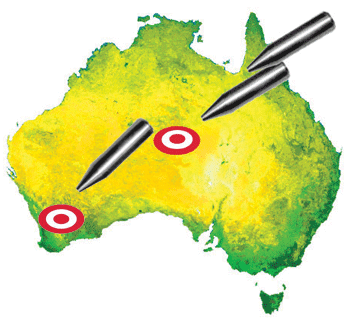 Australian Defence Minister Stephen Smith recently foreshadowed increasing the number of joint training exercises with America in Darwin and the US storing more equipment in the city for disaster and humanitarian assistance.
Already the US and Australia jointly run the Pine Gap spy base near Alice Springs in the Northern
Territory. Mr Tutty said there was little information about what a greater US presence in Northern Territory would mean.
“They have talked about a pre-positioning base and we are very sceptical about the nature of the base because of all the lies we have been told about Pine Gap,” Mr Tutty said.”For so many years they told us that Pine Gap was a communications base, but in the last few years it has come out about its offensive role and it was used to direct dozens of attacks on Iraq.” http://www.news.com.au/breaking-news/national/local-activists-plan-obama-protest/story-e6frfku9-1226190123963#ixzz1dLAjnMoG
Woes of Australian uranium miner Paladin
Will Australia afford civil rights to Julian Assange, or kow tow to USA?
 Assange’s extradition will have broad implications, not only for the exercise of
 free speech, but also for all Australians — as it will bring into stark relief our own government’s commitment to our rights as citizens…
If he is sent to Sweden, Assange’s extradition must be conditional on him not being subject to the “temporary surrender” clauses in the bilateral treaty between the USA and Sweden….
 [ Former Prime Minister]Kevin Rudd.., unlike the Prime Minister [Julia Gillard] and Attorney General, knew he was obliged to presume Julian Assange innocent
before proven guilty. Instead of threatening to cancel this Australian passport, the Foreign Minister said publicly that his responsibility was to attend to his legal and consular rights.
While the world watches events unfold in London, we have a singular responsibility here in Australia for the protection the citizenship entitlements of one of our own. The next move is squarely in the court of the Australian Government.
Why Julian Assange Could Be You, New Matilda.com, By Scott Ludlam, 3 Nov Australians should watch closely how the Gillard Government responds to Julian Assange’s extradition . It will test Labor’s commitment to all of our rights as citizens Continue reading
Downward plunge of prices and shares for uranium mining company
 Paladin chief slashes his pay, SMH, Peter Ker,November 1, 2011 PALADIN Energy boss John Borshoff has taken the knife to his $2.5 million salary, in the latest chapter of a miserable year for the struggling uranium miner.
Barely 10 months after enjoying a 5 per cent pay rise, Mr Borshoff has agreed to reduce his pay by 25 per cent as part of a drive to reduce administration costs at the Africa-focused company. The pay cut coincided with a lacklustre quarterly report from Paladin, which has earned a reputation for over-promising and under-delivering. ……… mine production targets were missed by 15 per cent over the past three months, while the company’s forecasts for the uranium price also proved too optimistic.
But the cut to Mr Borshoff’s pay was the stand-out item in the report, and comes after much agitation from investors who have watched the share price plummet since the Japanese nuclear disaster in March. Mr Borshoff’s remuneration package was worth $2.522 million in the year to June 2011, up from $1.9 million the year before.
That increase to his remuneration, which included a 5 per cent rise in fixed pay, came in a year when Paladin made an increased trading loss of $US82.3 million. The company sought to justify Mr Borshoff’s remuneration by describing him as a ”recognised global authority” on nuclear power, whose expertise was in ”extremely limited supply” around the world….
Paladin shares fell 6.5¢ to $1.50 yesterday. The stock was fetching $5 in March before the Fukushima nuclear disaster damaged investor confidence in the uranium sector…. http://www.smh.com.au/business/paladin-chief-slashes-his-pay-20111031-1ms4l.html#ixzz1cV3q88BL
1 This Month



26 September – International Day for the Total Elimination of Nuclear Weapons


PLEASE OPPOSE HR 8255 AND S.3639 – bills would accelerate satellite deployment, with no environmental review or safeguards – https://ncstd5li.quorum.us/campaign/169331/
To see nuclear-related stories in greater depth and intensity – go to https://nuclearinformation.wordpress.com
-
Archives
- September 2026 (257)
- August 2026 (330)
- July 2026 (355)
- June 2026 (287)
- May 2026 (306)
- April 2026 (356)
- March 2026 (251)
- February 2026 (267)
- January 2026 (308)
- December 2025 (358)
- November 2025 (359)
- October 2025 (375)
-
Categories
- 1
- 1 NUCLEAR ISSUES
- business and costs
- climate change
- culture and arts
- ENERGY
- environment
- health
- history
- indigenous issues
- Legal
- marketing of nuclear
- media
- opposition to nuclear
- PERSONAL STORIES
- politics
- politics international
- Religion and ethics
- safety
- secrets,lies and civil liberties
- spinbuster
- technology
- Uranium
- wastes
- weapons and war
- Women
- 2 WORLD
- ACTION
- AFRICA
- Atrocities
- AUSTRALIA
- Christina's notes
- Christina's themes
- culture and arts
- Events
- Fuk 2022
- Fuk 2023
- Fukushima 2017
- Fukushima 2018
- fukushima 2019
- Fukushima 2020
- Fukushima 2021
- general
- global warming
- Humour (God we need it)
- Nuclear
- RARE EARTHS
- Reference
- resources – print
- Resources -audiovicual
- Weekly Newsletter
- World
- World Nuclear
- YouTube
-
RSS
Entries RSS
Comments RSS
 nuclear-news