Murdoch’s media monopoly misinforms Australia on Climate Change
 Nowhere has the reliance on spin been more apparent than during the coverage of the climate “debate” by the Murdoch media and allied shock jocks.
 Australia’s climate scientists expose shock-jock distortion tactics, Academics catalogue the deluge of spin and misinformation of climate science by various Murdoch-owned papers, Stephan Lewandowsky 1 September 2011, Guardian UK, Australia has unwittingly become a social experiment. A ruthless experiment on the fate of a society when a single media conglomerate, Rupert Murdoch’s News Corp, owns 167 newspapers and controls around 70% of the printed media market. Continue reading
Deepening gloom for Australia’s uranium industry
 Uranium prices plunge causing issues for Australian producers, Herald Sun, Greg Roberts ,September 07, 2011 URANIUM prices have fallen back to levels last seen after Japan’s nuclear accident in March, causing further grief to struggling Australian producers.
The uranium spot price is $US48.85 ($A46.04) a pound, having plummeted from $US67.75 to $US49 immediately after the earthquake and tsunami on March 11.
The spot price had recovered to about $US56.50 after the Fukushima accident. Analyst group Resource Capital Research says the dynamics driving the sector have changed in the aftermath of the meltdown, with Germany planning to close all 17 of its nuclear power reactors by 2022.
The “fund implied price” – an indicator of market price expectations – is signalling a further fall in the spot price to $US45.95. The Merrill Lynch Uranium Equity Index, which measures the performance of uranium equities, has fallen 19 per cent over the past month.
It is down 27 per cent over the past three months and 23 per cent over the past year, according to the latest quarterly report by Resource Capital Research. Shares in Australia’s largest uranium producer, the Rio Tinto-backed Energy Resources of Australia, have fallen 13 per cent in the past month and 73 per cent in the past year.
A year ago, ERA shares were $13.49, compared with $3.65 now, with the company posting a $122 million half-year net loss. http://www.heraldsun.com.au/business/uranium-prices-plunge-causing-issues-for-australian-producers/story-fn7j19iv-1226130940686
Australia’s uranium industry losing confidence?
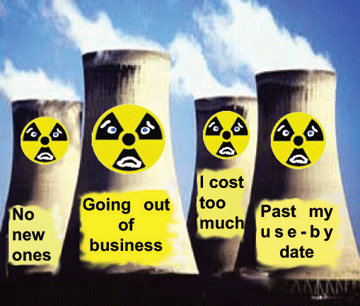 “…an extended period of uncertainty…..A mistake by one operator or explorer or project developer in our industry affects all of us.”
Fukushima puts Australia’s uranium industry on the defensive Independent Australia, 2 Sept 11, The Australian nuclear industry feels the heat after the Fukushima calamity, but spins on gamely. Noel Wauchope reports.
With plummeting uranium prices, and increasinglybad news about Fukushima radiation, Australia’s uranium industry is well and truly on the back foot. But the industry battles on with religious fervour in its belief in the future uranium boom. Continue reading
Wikileaks reveals plotting by USA and Australia to remove atomic energy chiefve

 US, Australia ‘schemed against IAEA chief’, SBS World News, 31 August 2011 Source: AAP, The United States and Australia schemed unsuccessfully in 2005 to block Mohamed ElBaradei’s election to a third term as head of the International Atomic Energy Agency, a newly leaked US diplomatic cable shows.
Both countries were unhappy with ElBaradei’s “unhelpful” response to Iran’s nuclear program, but the bid to prevent his re-election to the nuclear regulatory agency’s leadership ultimately failed for lack of international support. Continue reading
Research to help atomic downwinders now perverted into pro nuclear spin
They [Pam Sykes, Bobby Scott etc] are the “radiation sceptics”, very much comparable to “climate change sceptics”. Their belief in “radiation hormesis” is comparable to “intelligent design” — as opposed to evolution.
Their common funding sources are nuclear energy agencies — in particular the USA Department of Energy (DOE)…..
 After Fukushima: the rise of nuclear radiation denialists Independent Australia 22 Aug 11, After the Fukushima disaster, the nuclear industry has urgently redoubled its efforts to convince the world that nuclear radiation is safe. Now it seems they are trying to say that radiation is actually good for us. Noel Wauchope reports.
— In 2001, President Bill Clinton authorised funds to research the effects of radiation on the “downwinders” from the Nevada and Utah atomic bomb tests. The funds went to the Department of Energy, who designed the research project. They then allocated the project to Flinders University in South Australia, under the leadership of Professor Pam Sykes.
But the original intention of the research has taken a strangely perverted course. Pam Sykes has joined the proponents of “adaptive radiation” and “radiation hormesis” – the theory that “low level ionising radiation is good for you” It’s quite an old theory, but now, after Fukushima, it has suddenly become very useful to the nuclear and uranium lobbies…….. Continue reading
Australian anti uranium protestors walking 1250 km
 WA uranium protest to cover 1250km, Narelle Towie , PerthNow , August 21, 2011 ANTI-URANIUM protesters will begin their 1250km march from Wiluna to Perth today in their fight to have mining of the ore banned.Walk Away From Uranium Mining protesters will travel through two proposed uranium mining sites – in Wiluna and Yeelirrie – before arriving in Perth nearly a month later on October 27….
WA Senator Scott Ludlam, who will take part in the march, said WA should joining a growing list of countries around the world, including Germany, Switzerland, Austria, Portugal, Greece and Ireland, who were walking away from nuclear power.
“This is an extraordinary moment for our state and for the future. The nuclear industry is in decline around the world and public awareness of the dangers of uranium mining and nuclear power is growing,: Mr Ludlam said.
“This march is a powerful statement from Western Australians who do not want uranium mining in WA and who do not want their state to support the nuclear industry in any way.” http://www.perthnow.com.au/news/special-features/wa-uranium-protest-to-cover-1250km/story-e6frg19l-1226118950758
Australian soldiers to wear portable solar power
 Super slim solar cell a success, The Age, Ben Cubby August 12, 2011 ’A typical solar cell is about 0.2 millimetres thick, which is 200 micrometres thinner than a human hair or a sheet of paper, will soon be used by Australian soldiers on patrol in Afghanistan as a portable power source. The solar cells, invented by researchers at the Australian National University, can be used to cover helmets, tents or clothing and recharge electronic gear such as night vision goggles.
They also have extensive potential in civilian applications, including recharging phones and computers, because a square metre of lightweight solar panel can generate 140 watts of power and yet be rolled up into a ball afterwards. ’A typical solar cell is about 0.2 millimetres thick, which is 200 micrometres – that’s too thick to bend, it would shatter,” the project’s chief investigator, Andrew Blakers, said. ”But these cells are about 45 microns thick, so they are flexible and also about the same efficiency as commercial solar cells. By comparison, really fine quality merino wool is about 18 microns thick.” In practice, many square metres of panel could be unfurled from a box about the same size as a wine cask http://www.theage.com.au/national/super-slim-solar-cell-a-success-20110811-1iot3.html
Uranium company abandons acid leach plan mining in Australian National Park
Bad news for uranium sector, good news for Kakadu National Park, Scott Ludlam, August 4th, 2011. The Australian Greens today welcomed the news Energy Resources Australia have abandoned plans to introduce acid heap leaching at the Ranger Uranium Mine within Kakadu National Park.
Senator Scott Ludlam said the decision by ERA – majority owned by Rio Tinto – to ditch the plan at their board meeting yesterday was welcome news, and casts a long shadow over the viability of the controversial mine.
“The plan to build a heap leach plant on the Ranger lease was opposed by\Traditional Owners, shareholders, business analysts, environmental advocates and mining experts. This is a win for good sense. “Ranger Uranium Mine has been an ongoing debacle with water seepage ana history of accidents. The Mirarr people – Traditional Owners of the site – and the broader Australian community want Kakadu protected. Ultimately the best way to do that will be the orderly shut-down of the uranium industry,” said Senator Ludlam.
Last year the Office of the Supervising Scientist told a Senate estimates hearing that contaminated water seeping from the Ranger uranium mine in Kakadu National Park had a uranium concentration about 5,400 times the normal level. The environmental regulator told the hearing that about 100,000 litres of water was seeping from the tailings dam every day.
Australian govt to question Rupert Murdoch’s media monopoly
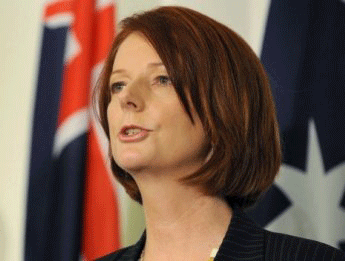 Phone hacking: Australian PM promises ‘hard questions’,BBC News, 20 July 11, The Australian branch of Rupert Murdoch’s media empire will face “hard questions” in the wake of the phone hacking scandal in Britain, Prime Minister Julia Gillard has said.
She said she was “disturbed” by revelations about his UK business.
The company dominates Australian media – it controls 70% of the newspaper readership and has extensive holdings in television, the internet, and other media….
The Greens, which hold the balance of power in the upper house, have called for a parliamentary inquiry into News Limited, Mr Murdoch’s Australian firm.,,,,, http://www.bbc.co.uk/news/world-asia-pacific-14212954
Australia sets up new renewable energy agency
Global green energy investments up as Australia consolidates action, Voxy News, NZ, 8 July, 2011 , Investments in renewable energy globally are up 32% increase in in 2010, according to a new United Nations report. Significantly, developing nations spent more on renewable energy utility projects, $72 billion, than developed ones, at $70 billion.
China led all nations with $49.8 billion in investments in 2010, ahead of German spending of $41 billion and U.S. spending of $29.6 billion.
The report has been released at the same time Australia has announced new independent statutory body, to be named the Australian Renewable Energy Agency (ARENA), to lead the Australian Government’s investments in renewable energy…. http://www.voxy.co.nz/business/global-green-energy-investments-australia-consolidates-action/5/94521
Nuclear and Uranium Policy – Western Australia Labor Party
Labor policy adopted- 25th June 2011, Chapter 4: Economics, Industry and Regional Development, Minerals and Energy, Uranium Mining and Nuclear Energy
241. Recognising the hazards and dangers of nuclear power, especially relating to:
a. The safety of the nuclear fuel cycle;
b. The unsolved problems pertaining to the reprocessing and storage of radioactive wastes and spent fuel;
c. The growing concern about the biomedical effects of even low radiation
d. The coupling of nuclear energy and nuclear weapon developments
e. The added danger of a future plutonium economy and the threats to civil liberties involved in a nuclear economy; and
f. The fact that Labor policy contained herein on fossil fuels, energy conservation and renewable resources will ensure Western Australia energy self sufficiency.
242. Labor will:
a. Reject nuclear power as an option for electricity generation in Western Australia;
b. Oppose the establishment of a nuclear enrichment facility in the State;
c. Reject the establishment of nuclear processing plants or the storage of nuclear wastes in the state;
d. allow no uranium mining or development in Western Australia; and
e. The platform recognises WA long and continuous opposition to uranium mining. The commencement and continuation of any uranium project is inconsistent with Labor Policy. Labor will accept no obligation to complete approval processes or honour contractual arrangements entered into by a previous government where such approvals or contracts are directed towards an outcome inconsistent with Labor s, restrictions and conditions applicable to the mining, processing, sale and transportation of uranium platform.
f. place thorium under the currently mines in Australia as outlines in the Resources and Energy section of the National Platform, so far as they relate to nuclear non-proliferation.
AREVA trying to stop Aboriginal land becoming World Heritage listed
 Areva formally requested Australia to withdraw its nomination for heritage listing from the agenda of the 35th World Heritage Committee meeting, which will be held in Paris this week…..
…Jeffrey Lee, the sole member of the Djok clan and senior custodian of the land that includes the 12.5 square kilometre Koongarra project area, has also travelled to Paris hoping to speak at the meeting. Mr Lee, 40, who would be one of Australia’s richest people if he allowed the mine to go ahead, told The Age he wanted to tell the story of his country, which he wanted to see protected forever in the park.
French uranium challenge to Kakadu heritage listing, Lindsay Murdoch, Darwin,The Age, June 20, 2011 A FRENCH government-owned company attempted to block countries discussing an Australian request to expand the World heritage-listed Kakadu National Park to include land that contains uranium worth billions of dollars. Continue reading
Australian uranium miner ERA pushing on despite climate extremes, and Aboriginal opposition
Prime Minister Julia Gillard has been called on by the organisation representing Mirrar people to put a stop to all plans to expand uranium mining in the national park.
The Gundjeihmi Aboriginal Corporation has called for mining to be banned at the Ranger uranium mine as it is a part of their traditional land.
– AUSTRALIAN MINING ERA MISLEADING ABOUT RANGER URANIUM PLANS: ENVIRONMENTALISTS Mining Australia, By Jessica Burke 6 June 2011 Environmentalists have accused Energy Resources Australia (ERA) of ulterior motives over plans to expand its uranium mine in the Kakadu National Park in the Northern Territory. Continue reading
Silence of Australian,and other, media on the extent of Fukushima nuclear crisis
Something similar is going on in Japan and the US. In Japan, the nuclear industry has been actively promoted by the Government since inception in the interests of Japanese nuclear security. The nuclear regulator is almost entirely made up for former Tepco employees and is described as being almost an arm of the power company. Criticism of nuclear power has long been strongly suppressed in Japan.
Independent Australia has reported before about plans for the world’s nuclear waste to be shipped to Australia and the fact this agreement with the US was actively suppressed by the Australian media, perhaps because some media proprietors have strong vested interests in the nuclear industry. It seems that Australia’s overly concentrated media industry is not only a crisis for our democracy, but can potentially even threaten our children’s health.
 (VIDEOS) Fukushima: Caldicott says Japan may become uninhabitable – media silent |Dr Helen Caldicott says that the Fukushima nuclear disaster has the potential to make Japan “uninhabitable”, yet the mainstream media in Australia continue to ignore the crisis Independent Australia, David Donovan May 31

Yesterday – the same day Germany announced it would close all its nuclear plants because of Fukushima, and dangerous levels of radiation were reported in Japanese clean-up workers – Independent Australia did a straw poll of 50 random people at a metropolitan shopping centre in Queensland. Each of them was asked: “were you aware that there had been a nuclear meltdown at Fukushima in Japan”. Almost all of these respondents recognised the name Fukushima but only 4 of the 50 – a mere 8 per cent – said they had heard of any meltdown. Continue reading
Renewable energy makes good economic sense forAustralia
Renewable energy will only get cheaper: study, Australian Broadcasting Corporation, By Michael Edwards May 26, 2011 A new study has found the future prices of wind, thermal and solar power will only keep falling as more alternative power sources are switched into the energy grid. Researchers say it proves the widespread adoption of renewable energy sources makes good economic sense. Continue reading
1 This Month
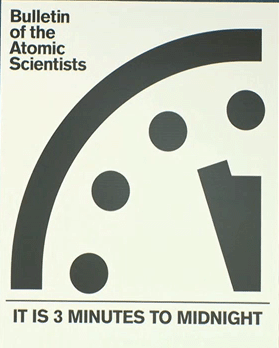
Watch the 2026 Doomsday Clock unveiling live here on January 27 at 10 a.m. EST
To see nuclear-related stories in greater depth and intensity – go to https://nuclearinformation.wordpress.com/

29 Jan. Thursday 7-8 p.m. Webinar – World’s Largest Nuclear Station in Port Hope, ON?


31st January – Challenging the War Machine – a DECLASSIFIED UK SUMMIT


Website of the Week
Now until to February 10, 2026 Radioactive waste storage in France: the debate is finally open! How to participate?
-
Archives
- January 2026 (277)
- December 2025 (358)
- November 2025 (359)
- October 2025 (376)
- September 2025 (258)
- August 2025 (319)
- July 2025 (230)
- June 2025 (348)
- May 2025 (261)
- April 2025 (305)
- March 2025 (319)
- February 2025 (234)
-
Categories
- 1
- 1 NUCLEAR ISSUES
- business and costs
- climate change
- culture and arts
- ENERGY
- environment
- health
- history
- indigenous issues
- Legal
- marketing of nuclear
- media
- opposition to nuclear
- PERSONAL STORIES
- politics
- politics international
- Religion and ethics
- safety
- secrets,lies and civil liberties
- spinbuster
- technology
- Uranium
- wastes
- weapons and war
- Women
- 2 WORLD
- ACTION
- AFRICA
- Atrocities
- AUSTRALIA
- Christina's notes
- Christina's themes
- culture and arts
- Events
- Fuk 2022
- Fuk 2023
- Fukushima 2017
- Fukushima 2018
- fukushima 2019
- Fukushima 2020
- Fukushima 2021
- general
- global warming
- Humour (God we need it)
- Nuclear
- RARE EARTHS
- Reference
- resources – print
- Resources -audiovicual
- Weekly Newsletter
- World
- World Nuclear
- YouTube
-
RSS
Entries RSS
Comments RSS
 nuclear-news