Plan for world’s biggest uranium mine scrapped
The mine would have become the world’s biggest open cut copper and uranium mine at six kilometres long and one kilometre deep.

BHP cancels $30 billion Olympic Dam expansion near Roxby Downs in South Australian Outback Business Writer Meredith Booth AdelaideNow August 22, 2012 BHP Billiton has shelved its $30 billion Olympic Dam expansion and will go back to the drawing board to find a cheaper alternative…. Continue reading
Julian Assange’s mother gets Nazi taunt on Australian radio
Assange’s mother subjected to Nazi taunts The Age August 19, 2012 – Julian Assange’s mother has hung up the phone on a Melbourne radio host after he taunted her with a Nazi slogan when she backed out of an interview.
Christine Assange was due to speak to 3AW’s Sunday morning show about her son, the founder of whistleblower website WikiLeaks, and his successful appeal for asylum in Ecuador.
But she changed her mind after hearing how co-host John-Michael Howson had treated a previous guest.
“I won’t be doing an interview with you because you’re acting like a pig,” Ms Assange said. Howson responded by screaming on air: “Sieg Heil! Sieg Heil! Sieg Heil!”
Ms Assange then hung up the phone…… http://www.theage.com.au/national/assanges-mother-subjected-to-nazi-taunts-20120819-24g2f.html
Clear that USA pursues Julian Assange, while Australian government feigns ignorance
 US in pursuit of Assange, cables reveal,The Age, August 18,
 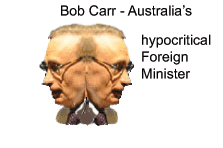 2012, Philip DorlingAUSTRALIAN diplomats have no doubt the United States is still gunning for Julian Assange, according to Foreign Affairs Department documents obtained by The Saturday Age. The Australian embassy in Washington has been tracking a US espionage investigation targeting the WikiLeaks publisher for more than 18 months.
The declassified diplomatic cables, released under freedom of information laws, show Australia’s diplomatic service takes seriously the likelihood that Assange will eventually be extradited to the US on charges arising from WikiLeaks obtaining leaked US military and diplomatic documents.
This view is at odds with Foreign Minister Bob Carr’s repeated dismissal of such a prospect. Continue reading
Australians lead the world in distributed solar energy on housetops
 Australians lead in fitting solar panels on homes, SMH, August 18, 2012 Ben Cubby AUSTRALIANS put more household solar panel systems on their roofs than anyone else in the world last year, new data from the Clean Energy Regulator and the International Energy Agency show. The statistic astonished many in the solar industry, given Australia’s small population compared with renewable energy market leaders such as European Union countries, China, Japan and the United States. Continue reading
Wikileakes revealed the collusion of USA and Australia against ElBaradei

US, Australia schemed against IAEA chief: cable BUSINESS RECORDER The United States and Australia schemed unsuccessfully in 2005 to block Mohamed ElBaradei’s election to a third term as head of the International Atomic Energy Agency, a newly leaked US diplomatic cable shows.
Both countries were unhappy with ElBaradei’s “unhelpful” response to Iran’s nuclear program, but the bid to prevent his re-election to the nuclear regulatory agency’s leadership ultimately failed for lack of international support. Continue reading
$39 billion loss for Australian uranium miner Paladin
 Uranium mine lost K39 billion in 2011 , The Maravi Post, 10 Aug 12 BLANTYRE–The Kayekelera uranium mine in Karonga, which is operated by Paladin Energy Limited of Australia, lost K39 billion in nine months of operation ending March 2012 due to fluctuating prices of the commodity on the international market, the company’s top official has said.
Greg Walker, general manager for international affairs, told the Daily Times Business that the loss was a result of the historic earthquake in Japan that produced a Tsunami in March last year. Spot price for uranium oxide dropped from $75 (some K21, 000) to $47.50 (K13, 000) after the closure of Fukushima nuclear plant in Japan.
Walker said now the price is at $49.50 -K14,000 – saying this was below the direct cost of production at Kayelekera, the country’s biggest investment. Walket told the daily that Paladin have bankrolled $145 million–K41 billion- to keep the mine afloat… http://www.maravipost.com/malawi-news/society/1486-uranium-mine-lost-k39-billion-in-2011.html#.UCbaJ6FlT4Y
Australia’s inadequate nuclear safety agencies
Inadequate Safety Practices at Lucas Heights and Inadequate Regulation by ARPANSA, Friends of the Earth 10 Aug 12 Since 2007, a saga has been unfolding regarding contamination accidents at the Australian Nuclear Science and Technology Organisation (ANSTO), ANSTO’s handling of those incidents, ANSTO’s treatment of whistleblowers, the handling of the matter by the Australian Radiation Protection and Nuclear Safety Agency (ARPANSA), and the independence or otherwise of ARPANSA.
The saga has exposed inadequate safety practices at ANSTO and an inadequate performance by the regulator ARPANSA. The problems would not have been exposed and partially rectified if not for a number of ANSTO whistleblowers.
A few snapshots of this saga are noted below and more details can be found on the Friends of the Earth website: Continue reading
Australia rejects proposal to base a US nuclear aircraft carrier group near Perth , The Independent, KATHY MARKS 03 AUGUST 2012 Australia, which tries to tread a fine line between supporting its closest ally, the US, and not upsetting China, its biggest trading partner, yesterday rejected a proposal to base a US nuclear aircraft carrier group near Perth,saying it did not want American bases in the country.
The idea was raised in a Pentagon-commissioned report by the influential Washington-based Centre for Strategic and International Studies, which suggested relocating a carrier and its support fleet from the US east coast to HMAS Stirling, an Australian naval base south of Perth, as part of a new strategic focus on Asia. Continue reading
Nuclear study unveiled ( Why did The Age remove this story from the Internet?)
The Australian government finally declassifies its most secret study of the potential impact on Australia of a nuclear war between the US and the former Soviet Union.
http://www.theage.com.au/opinion/political-news/nuclear-study-unveiled-20120803-23l9y.html
Nuclear study unveiled http://www.centralwesterndaily.com.au/story/169021/nuclear-study-unveiled/?cs=8 By Philip Dorling Aug. 4, 2012 More than three decades after it was written, the Australian government last week finally declassified its most secret study of the potential impact on Australia of a nuclear war between the US and the former Soviet Union.
Australia’s peak intelligence agency largely dismissed any danger to Australia from global radioactive fall-out or stratospheric distribution of smoke from burning cities.
In the top secret intelligence assessment released by the National Archives of Australia, the Office of National Assessments also questioned whether Australian cities would be targets for Soviet missiles, suggesting the US’ southern hemisphere ally would be a ”low priority” in a global nuclear exchange. But it acknowledged that direct attacks were a possibility.
USA to put nuclear weapons in Australia, and make the Australians pay for them?
 Nuclear drumbeat grows as US eyes Australia, Crikey, by
  Harley Dennett , 2 August 2012 Australian policymakers could not be getting a clearer picture of what our US ally expects of us. Nuclear weapons and joint military bases aimed at containing our largest trading partner will, sooner or later, be put in our backyard — and we’ll be expected to pay for the privilege.
The Center for Strategic and International Studies report making headlines over a proposal to establish a US base in Perth to host nuclear-powered aircraft carriers and manned and unmanned ISR (intelligence, surveillance and reconnaissance) drones is but the first report commissioned by this Congress. The second — as revealed by Crikey in May — will focus on positioning nuclear force in the Pacific.
Defence Minister Stephen Smith’s denials overnight were revealed as word trickery by the comments of the US Deputy Assistant Secretary of Defense for Plans Robert Scher in Congressional hearings early this morning, who pointed out that “no US bases” really means they expect Australia and other allies to share the costs of hosting large numbers of American troops at these so-called “shared facilities”: Continue reading
Smith rejects proposal for US carrier base ABC Radio AM By Naomi Woodley August 02, 2012 Defence Minister Stephen Smith has flatly rejected a proposal to expand a naval base in Perth to accommodate US nuclear-powered aircraft carrier groups.
The idea for a $7 billion US carrier base on Australia’s Indian Ocean seaboard is one of many canvassed in a report commissioned by the US Defence Department from the Centre for Strategic and International Studies think tank.
Mr Smith says while increased US access to the HMAS Stirling base is on the cards in the long term, American aircraft carriers will not be based in Australia. ”The report is an independent report to the United States government. It’s not a United States government document,” he said.
“We don’t have United States military bases in Australia and we are not proposing to. What we have talked about in terms of either increased aerial access or naval access is precisely that – greater access to our facilities.” The West Australian Premier and Opposition Leader have also ruled out the aircraft carrier base idea………….
http://www.abc.net.au/news/2012-08-02/smith-rejects-us-base-proposal/4171086
How Julian Assange was framed
Australian TV Program Exposes Julian Assange Frame-up http://www.democraticunderground.com/101636930 http://www.wsws.org/articles/2012/jul2012/assa-j28.shtml “Four Corners”, an Australian Broadcasting Corporation current affairs program, this week broadcast what amounted to an exposé of the frame-up of WikiLeaks editor Julian Assange on allegations of sexual misconduct in Sweden. Assange remains inside the Ecuadorian embassy in London, seeking political asylum from the threat of being removed to Sweden, which would in turn facilitate extradition to the US.
The program provided substantial evidence that the allegations against him were false and politically motivated. The unproven accusations were used to blacken his name in Sweden and around the world, and counter the widespread public support that he and WikiLeaks had won for courageously exposing the crimes and machinations of the US and other powers.
Assange has still not been charged with any crime.
Australia finding that 3 big uranium mining projects are not economically viable
 Uranium prices halt Sandy Desert project, BY: BARRY
  FITZGERALD The Australian July 29, THE most likely of Australia’s next big uranium mine developments – the Kintyre project in Western Australia’s Great Sandy desert – has fallen victim to sluggish demand and prices for the nuclear fuel, and WA’s “hot” construction market for resource projects.
Project operator and 70 per cent owner, Canada’s Cameco, has revealed that the economics of the project are “challenging” in that a development would not be profitable at current uranium prices. Prices are 34 per cent below where they need to be for a viable project.
The sluggish demand backdrop has implications for BHP Billiton which must find a home for the additional uranium it will produce with the planned $30 billion expansion of its Olympic Dam copper/uranium/gold mine in South Australia’s outback.
The expansion would see uranium output at Olympic Dam grow massively from 9.6 million pounds a year to 40.6 million pounds a year – 17 per cent of forecast global mine output in 2020.
But the Weekend Australian revealed that BHP plans to defer a decision on the project for two years.
Sluggish uranium demand has already reported to have led to BHP becoming disinterested in moving towards developing its Yeelirrie uranium deposit in WA.
Cameco chief executive Tim Gitzel told analysts that Cameco was “not going to develop Kintyre at any cost Continue reading
Climate Science Denial – Australia’s Institute of Public Affairs (IPA)

Science denial tourism, sponsored by the IPA Want to a free trip around Australia, all expenses paid? It’s easy, just publish a book denying climate change (scientific credentials not required) then
contact the Institute of Public Affairs — they’ll take care
everything. Graham Readfearn from DeSmogBlog.com reports on the IPA —
Australia’s home of anti-science……
http://www.independentaustralia.net/2012/environment/science-denial-tourism-sponsored-by-the-ipa/
Nuclear and fossil fuel lobbies have conned Australia about wind energy
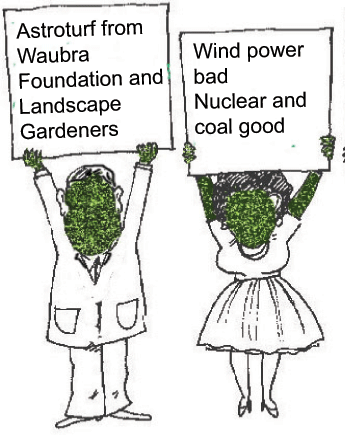 There are two main anti-wind farm groups in Australia busily fomenting anxiety and opposition. One is the Waubra Foundation, a group of mainly wealthy individuals, none of whom live in or near the town of Waubra, near Ballarat. Several of them, NIMBY style, have opposed turbines near their own properties elsewhere. They are led by an unregistered doctor, Sarah Laurie, and a wealthy mining investor, Peter Mitchell who also has connections to the Landscape Guardians. Despite their name, the Guardians have never attempted to guard our landscape from over-zealous residential developers, open cut coal or coal seam gas mining. They only target wind farm developments. All three – Waubra, the Guardians and Mitchell’s mining investment company share a South Melbourne post office box.
Wind turbine syndrome: a classic ‘communicated’ disease https://theconversation.edu.au/wind-turbine-syndrome-a-classic-communicated-disease-8318?utm_medium=email&utm_campaign=Latest+from+The+Conversation+for+20+July+2012&utm_content=Latest+from+The+Conversation+for+20+July+2012+CID_be7f8aff1000afd17cabaf558b629431&utm_source=campaign_monitor&utm_term=Simon+Chapman+investigates At the beginning of this year I started collecting examples of health problems some people were attributing to wind turbine exposure. I had noticed a growing number of such claims on the internet and was curious about how many I could find. Within an hour or two I had found nearly 50 and today the number has grown to an astonishing 155. Continue reading
1 This Month



26 September – International Day for the Total Elimination of Nuclear Weapons


PLEASE OPPOSE HR 8255 AND S.3639 – bills would accelerate satellite deployment, with no environmental review or safeguards – https://ncstd5li.quorum.us/campaign/169331/
To see nuclear-related stories in greater depth and intensity – go to https://nuclearinformation.wordpress.com
-
Archives
- September 2026 (245)
- August 2026 (330)
- July 2026 (355)
- June 2026 (287)
- May 2026 (306)
- April 2026 (356)
- March 2026 (251)
- February 2026 (267)
- January 2026 (308)
- December 2025 (358)
- November 2025 (359)
- October 2025 (375)
-
Categories
- 1
- 1 NUCLEAR ISSUES
- business and costs
- climate change
- culture and arts
- ENERGY
- environment
- health
- history
- indigenous issues
- Legal
- marketing of nuclear
- media
- opposition to nuclear
- PERSONAL STORIES
- politics
- politics international
- Religion and ethics
- safety
- secrets,lies and civil liberties
- spinbuster
- technology
- Uranium
- wastes
- weapons and war
- Women
- 2 WORLD
- ACTION
- AFRICA
- Atrocities
- AUSTRALIA
- Christina's notes
- Christina's themes
- culture and arts
- Events
- Fuk 2022
- Fuk 2023
- Fukushima 2017
- Fukushima 2018
- fukushima 2019
- Fukushima 2020
- Fukushima 2021
- general
- global warming
- Humour (God we need it)
- Nuclear
- RARE EARTHS
- Reference
- resources – print
- Resources -audiovicual
- Weekly Newsletter
- World
- World Nuclear
- YouTube
-
RSS
Entries RSS
Comments RSS
 nuclear-news