Australia clearing out Aboriginal communities to make way for mining
Ghillar Michael Anderson, leader of the Euahlayi people and ambassador of the Aboriginal Tent Embassy in Canberra, wrote an open letter to the United Nations on March 3, in which he states that the proposed closures of remote communities are to open up the land for mining.
“For the Western Australian government to now dispossess and displace the peoples of these homelands is designed to facilitate an expeditious expansion of mining interests and other developments,” he wrote.
The announcement of the closures coincides with the introduction of the Aboriginal Heritage Amendment Bill by the Barnett government last November. The bill, which is about to be debated in state parliament, proposes changes to the Aboriginal Heritage Act 1972. These simplify the process of gaining permission to develop Aboriginal sites, as the chief executive of the DAA will have sole discretion over whether to deem heritage protection. This would continue a DAA trend over recent years of site assessment which is beneficial to industry.
Are Mining Interests Behind Western Australian Remote Aboriginal Community Closures?http://www.vice.com/en_au/read/are-mining-interests-behind-western-australian-remote-aboriginal-community-closures March 20, 2015 by Paul Gregoir Yesterday, 18,000 people turned out at rallies across Australia in protest of the Western Australian government’s proposal to close up to 150 remote Aboriginal communities.

The move will see municipal and essential services provided by the government cut. Premier Colin Barnett announced the closures in November last year, claiming many of these communities are economically unviable. Continue reading
Exposing the nuclear lobby’s agenda for Australia
What does the nuclear lobby want, for South Australia?, Online Opinion,
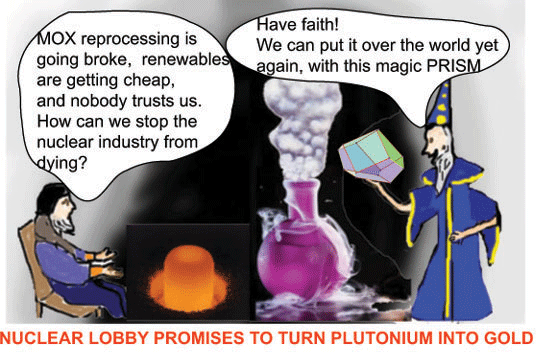
| By Noel Wauchope 19 March 2015 “….It is difficult to work out exactly what is planned in nuclear industry expansion for South Australia. The plans involve some or all of these industries: uranium enrichment, nuclear power, importation and storage of nuclear wastes, 4th Generation nuclear reactors, and expansion of uranium mining. However, we can be grateful to ABC Radio’s Ockham’s Razor programme, as it provided the nuclear lobby with a platform for setting out succinctly their intentions. Oscar Archer, a well -known voice for the nuclear industry, explains…… Australia should get a fleet of PRISM small nuclear reprocessing reactors – Archer’s plan is for “IFS+IFR: Intermediate Fuel Storage and Integral Fast Reactor, namely the commercially offered PRISM breeder reactor from General Electric Hitachi.”What he means here is the Power Reactor Innovative Small Module Archer then sets out the sequence of events that would lead to the establishment of this fleet. In Archer’s words “it goes like this. Australia establishes the world’s first multinational repository for used fuel – what’s often called nuclear waste” However, he notes that “This is established on the ironclad commitment [my emphasis] to develop a fleet of integral fast reactors to demonstrate the recycling of the used nuclear fuel”…… the sting in the tale of his plan is really exactly what he calls the first step – the overturning or weakening of Federal and State laws. The Federal Act protects against nuclear reprocessing and expanded nuclear industries. ARPANSA sets safety standards for exposure to ionising radiation. South Australian State Law would have to be overturned, too – under the Nuclear Waste Storage Facility (Prohibition) Act 2000 The central premise of Oscar Archer’s promotion of this nuclear chain of events is that Australia should go out on a limb – be the first country in the world to import nuclear wastes and to order a mass purchase of PRISM reactors….. The PRISM reactor exists only on paper and its development is decades away from completion. David Biello, in Scientific American comments “Ultimately, however, the core problem may be that such new reactors don’t eliminate the nuclear waste that has piled up so much as transmute it. Even with a fleet of such fast reactors, nations would nonetheless require an ultimate home for radioactive waste, one reason that a 2010 M.I.T. report on spent nuclear fuel dismissed such fast reactors.”
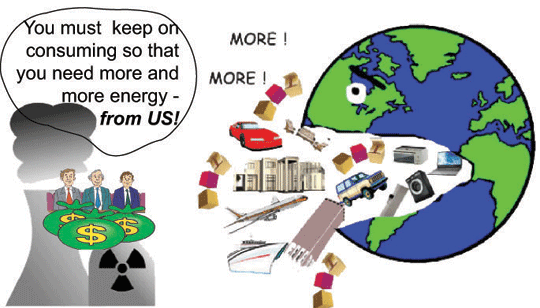
The PRISM can’t melt down in the way that conventional nuclear reactors can. However, its essential use of plutonium entails hazardous transport – vulnerability to terrorism and use as a “dirty” bomb. And – finally the PRISM reactor itself becomes radioactive waste requiring security and burial. There is another, underlying premise here that needs to be examined. This is the premise that it is OK for Australia and the world to continue to consume energy endlessly…….
The plan purports to reduce greenhouse emissions by means of thousands of little reactors, (and big ones) – but their development is so many decades away that it would be too late for climate change action. We are left with a plan that looks suspiciously as if the troubled nuclear industries of USA, Canada and UK have selected Australia as the guinea pig for a plan to reverse their industries’ present decline.
|

Asian and Pacific green Parties unite in aim for nuclear free region
 Green Parties call for a nuclear free region on anniversary of Fukushima, Global Greens 10 March, 2015 “……The Green Parties of the Asia Pacific region offer our sincere condolences for the tragedy suffered, and our solidarity with the people and Green Party of Japan.
We use this anniversary to remind the Governments of the world, that it is the responsibility of all nations to ensure the safety of our planet.
There is no doubt, the suffering for the Japanese people has been immense, especially for those living in and around Fukushima, and it is not yet over. The world has already witnessed suffering following nuclear disasters in Chernobyl (Ukraine), Khystym (Russia), Sellafield (United Kingdom), and Three Mile Island (USA). However, there are currently 71 new nuclear plants under construction around the world, the majority of which are in the Asia Pacific region (China 26, Taiwan 2, India 6, Japan 2, Pakistan 2, South Korea 5). (3)
It is time we fully committed to a nuclear-free world.
 Whether your country is listed as one of these constructing further nuclear plants or not, we are all implicated in the nuclear supply chain – through uranium mining, refining, power generation, radioactive waste, nuclear weapons, or through complicity by not discouraging the practice of our trading partners.
 Green Parties around the globe oppose the expansion of nuclear power and are working to rapidly phase it out. Nuclear energy is not the emissions-free solution that the world needs to address climate change, in fact, it is a net producer of greenhouse gases.(4)
As we have seen with Fukushima, the human and planetary costs are too high, and when examining the nuclear supply chain, it is simply ineffective at reducing emissions.
We need to stay focused on transitioning to clean renewable energy sources – these are not only safer, but offer a more equitable solution. We can achieve economic development with genuine quality of life through a sustainable smart green economy. Examples of this kind of development include community-based, co-operative, renewable energy operations complemented by reduced energy consumption through electricity saving government policies.
At this critical moment, we ask the people Asia Pacific to call on their governments to:
- Commit to a nuclear-free world.
- Move to clean equitable renewable energy solutions for your country
- Provide democratic process in citizens’ referenda on nuclear power.
- Ensure information transparency, participatory democracy, social and environmental justice for residents living near power plants and nuclear waste fields.
- Prioritise in decision-making the wellbeing of our planet and future generations.
Signatories:
The Asia-Pacific Greens Federation (APGF) Coordination Committee
The APGF’s members are:
- Australia: Australian Greens
- India: Uttarakhand Parivartan Party (UKPP)
- Indonesia: Sarekat Hijau (Indonesian Green Union)
- Japan: Greens Japan
- Korea, Republic of: Green Party Korea
- Mongolia: Mongolian Green Party
- Mongolia: Civil Will Green Party of Mongolia
- Nepal: Nepali Greens (Green Civil Society)
- New Zealand: Green Party of Aotearoa New Zealand
- Pakistan: Pakistan Green Party
- Taiwan: Green Party Taiwan http://www.globalgreens.org/news/green-parties-call-nuclear-free-region-anniversary-fukushima
Terms of Reference for South Australia’s ill-conceived rush into Royal Commission on Nuclear Power


- whether there is any potential for the expansion of the current level of exploration, extraction or milling of minerals containing radioactive materials in South Australia, any circumstances necessary for such an increase to occur and to be viable, any risks and opportunities created by expanding the level of exploration, extraction and milling, and the measures that might be required to facilitate and regulate that increase in activity.
- the feasibility of the further processing of minerals and processing and manufacture of materials containing radioactive and nuclear substances (but not for, or from, military uses) including conversion, enrichment, fabrication or re-processing in South Australia, any circumstances necessary for that further processing or manufacture to be viable, any risks and opportunities associated with establishing and undertaking that further processing or manufacture, and any measures that might need to be taken to facilitate and regulate the establishment and carrying out of further processing or manufacture
- the feasibility of establishing and operating facilities to generate electricity from nuclear fuels in South Australia, any circumstances necessary for that to occur and to be viable, the relative advantages and disadvantages of generating electricity from nuclear fuels as opposed to other sources, including with regard to greenhouse gas emissions, any risks and opportunities associated with that activity (including its impact on renewable sources and the electricity market), and any measures that might need to be taken to facilitate and regulate their establishment and operation.
- the feasibility of establishing facilities in South Australia for the management, storage and disposal of nuclear and radioactive waste from the use of nuclear and radioactive materials in power generation, industry, research and medicine (but not for, or from, military uses), any circumstances necessary for those facilities to be established and to be viable, the risks and opportunities associated with establishing and operating those facilities, and any measures that might need to be taken to facilitate and regulate their establishment and operation.
Lowest production in 16 years – uranium in Australia
 Lowest Australian uranium production for 16 years, World Nuclear Association 23 Jan 15 Due to the shutdown of ERA’s Ranger plant to June, and despite the rich Four-Mile deposit coming on line, Australia’s uranium production in 2014 at 5897 tonnes U3O8 (5000 tU) was the lowest since 1998. Two thirds of it was from Olympic Dam, where uranium is a by-product of copper. Production from Four Mile is recovered at the Beverley plant, replacing output from that mine at about double the level. http://us1.campaign-archive1.com/?u=140c559a3b34d23ff7c6b48b9&id=e08ac096b6&e=ae5ca458a0
In the interests of uranium mining, Australia’s Aborigines moved off their remote homelands
 Waging a war over land rights MEENA MENON , THE HINDU,January 19, 2015 ‘Protests are continuing in various parts of Australia over mining’
In her book of poems, Love Dreaming, aboriginal writer Ali Cobby Eckermann from Australia writes, “Every grain of sand in this big red country is a pore on the skin of my family.” Her writing and her new book, Too Afraid to Cry reflect the alienation of the ‘Stolen generation’ of children who were selectively taken away from their families and raised by white people and also the plight of her people who are waging a war over land rights.
Thousands of people from indigenous communities plan to hold massive protests over land issues on Australia Day on January 26, she says. Protests are continuing in various parts of Australia over mining uranium and minerals and even Kakadu National Park, on the UNESCO World Heritage Site is under threat.
In New Delhi to deliver the annual Navayana lecture, she told The Hindu in an interview that a serious lack of understanding between cultures persists in Australia at a political level and with mining it has expanded. “We worry for our children. Now the Western Australian government wants to use bulldozers and close 150 or 180 small aboriginal communities — they say it is not sustainable to keep these communities going. Where do these people go? They can wander to the city to become a makeshift community under tarpaulin as they are not going to rehouse them,” she says.
The sudden move, she suspects, is to do with mining and removing people from the area so that even that little bit of resistance is gone. That’s the scary part but the aboriginal people will survive. It’s all about land, the war is over land, she says and no one really articulates it like that. “Why would they want these remote areas which are mineral rich to be emptied of people. Western Australia is among the richest mining areas but why is not the government saying some percentage of that mining rights should go to the community. That doesn’t happen, the miners don’t pay tax and we watch the money fly away,” she points out.
Referring to the civil nuclear deal between India and Australia, she said, “Please consider when you support nuclear energy in India what happens to our culture. There will be a slow erosion of human rights but we will fight for the right of our children to have rights of lands.”
The government has given approvals for uranium mines in western Australia. Hailing from South Australia, she said this was a place of ancient knowledge. “In aboriginal culture we do not own the land, we belong to the land and the land does not belong to us, the land is our heart, “she says.
The struggle for land in the mid 70s when people drove to Adelaide and demanded their land back had resulted in some rights being restored. There was a strong law in place on mining but unknown to many communities the government in 2008 has sneaked in amendments which do not provide for negotiations as in the past. “So if a community agrees to exploration it has virtually given away the right to mining as well,” Ms. Eckermann adds.
In Northern Territory some ten years ago the government had proposed nuclear waste storage sites but a group of women pensioners living in old age homes got together with support from Friends of the Earth and fought the government and managed to convince them that this was not a good idea. Ms Eckermann who has learnt a lot from what she calls the “struggle of my grandmothers”, says the women essentially told the government from a cultural perspective their aversion to the nuclear waste dump on their lands and part of that was because they were young girls when the Maralinga atomic testing took place by the British in the 1950s. Many had lost their family in the nuclear fallout and for these women, it was an environmental war- and a cultural war and they were so dignified in their protest, she says.”I don’t know how they did it. They said never raise your voice except to sing traditional songs and they told the government to “get your ears out of your pockets.” It was a such a grass roots victory and there was no more room for lying and deceit. This was a jury of traditional women, against younger white men and the women won,” she grins.
Thousands of people from indigenous communities plan to hold massive protests over land issues on Australia Day on January 26 which many also call Invasion day for that’s when Captain Cook arrived on the country’s shores. ……..
“Land is like my family, that rock is like my grandfather and that sand dune is my mother. We have our ways and they can be customised to modern life but the core wisdom won’t change. We have to stop the intergenerational social impacts but every time the government meets us they have no concept of land or the people. And then we are called ungrateful, “she concludes. http://www.thehindu.com/news/national/waging-a-war-over-land-rights/article6800001.ec
Australian government trying to kill renewable energy, but funding thorium nuclear power research in China

Christina Macpherson’s websites & blogs
Isn’t this just dandy? The Australian government can’t afford to fund services to the needy in health, education, and is doing its darndest to kill clean energy, but is quietly promoting nuclear energy. And not conventional nuclear energy, which is bad enough, but the untested, hugely costly thorium experiment – the same one that was tried and found unviable 50 years ago
ANSTO-SINAP Joint Research Centre, 16 Jan 15 In December 2012, ANSTO signed a memorandum of understanding with the Shanghai Institute of Applied Physics (SINAP) for cooperation in the area of materials research and development.

Australian uranium miner Paladin will have to comply with Canada’s new tax transparency laws
Canada transparency laws force ASX companies to disclose tax bills, The Age December 26, 2014 Georgia Wilkins Business reporter Two Australian mining companies will be forced to disclose how much tax they pay in every country around the world by new transparency laws introduced in Canada.
Paladin Energy and OceanaGold, both dual-listed in Australia and Canada, will have to comply with new Canadian laws requiring all oil, gas and mining companies to report payments they make to governments overseas, including taxes, royalties, bonuses, regulatory charges and licence fees.
The Australian government is being pushed to introduce similar rules.
The legislation aims to tackle corruption and tax avoidance in poor countries, as well as payments to indigenous groups. It follows mounting global pressure by transparency organisations and the Organisation for Economic Co-operation and Development to introduce a country-by-country reporting regime.
The new rules are expected to come into force by June 2015 after passing through the Canadian parliament on December 16.
Claire Spoors, a spokeswoman for advocacy group Publish What You Pay, said the Abbott government should consider introducing similar laws in line with Canada’s.
“Australia, as a mining giant, could make a real difference in helping resource-rich but poor countries prosper by ensuring there is greater transparency,” she said.
“Well-managed and properly accounted-for resource revenues can be invested in health, education and putting countries on sustainable development pathways.”……….
the Abbott government has signalled it could water down transparency laws introduced under Labor. The tax disclosure laws would mean that from July, companies with $100 million or more in turnover would have their tax information disclosed on the Australian Taxation Office website.
Finance Minister Mathias Cormann told Fairfax Media the government would review the laws following complaints by private business owners that they could be kidnapped and held for ransom when people realised how wealthy they were from their published tax information.
Senator Cormann said the laws showed a “ham-fisted, ill-thought-out approach trying to crack a nut with a sledgehammer”.
But advocates say greater transparency will boost confidence in the broader community that large companies are paying their fair share of tax.
Australia has endorsed the OECD’s reporting regime, which is not due to be introduced until 2018.
It has also signed up to the OECD’s common reporting standard for governments sharing tax information, after criticism that it delayed the process by consulting big business.
OceanaGold has operations in New Zealand, the Philippines and Australia. Paladin Energy has projects in Namibia, Malawi, Niger, Canada and Australia. : http://www.smh.com.au/business/mining-and-resources/canada-transparency-laws-force-asx-companies-to-disclose-tax-bills-20141224-12akhd.html#ixzz3OBT5BW5V
Radioactive pollution of Lake Malawi by Australian uranium company Paladin?
 The lake provides water for drinking and domestic use to millions of Malawians. Part of the lake is protected as a national park, and it is inhabited by more than 850 cichlid fish species found nowhere else on Earth.
Malawi: Paladin Accused of Discharging Uranium-Contaminated Sludge in Lake Malawi http://allafrica.com/stories/201412301012.html A coalition of Malawi civil society organisations (CSOs) has accused Paladin Energy Ltd, a company that is mining Uranium ore at Kayerekera in the northern district of Karonga over reports the mining company is secretly discharging into Lake Malawi uranium contaminated sludge from the tailings dam at the mining site.
Renowned human rights activist, Rafiq Hajat shared a report compiled by a members of the Natural Resources Justice Network (NRJN) in which it is alleged paladin is discharging uranium sludge from Kayerekera into Lake Malawi.
“A radius of 35 km from the Boma, you will be shocked to see fish of different species dead with some communities along the lakeshore collecting [the fish]. Collectiong as part of their relish. The cause not yet known. Reports from the Beach Village Chairman indicates that this started in late November but Government was not forth coming (sich)” reads part of the post.
Paladin had aroused the wrath of the coalition of the CSOs under the banner of Natural Resources Justice Network (NRJN) over reports which emerged late November that Paladin Energy was planning of discharging uranium mining sludge into the Sere and North Rukuru rivers.
The toxic substances that would flow from the tailings pond at the Kayelekera Uranium Mine into Lake Malawi 50 kilometers (30 miles) downstream include waste uranium rock, acids, arsenic and other chemicals used in processing the uranium ore, the coalition fears.
“It is rumored that Paladin secretly have started discharging the so called purified water and the trip was one of the verification. This is terrible news and may have catastrophic ramifications if not checked immediately.” Reads the statement shared by Hajat.
However, in a statement issued last month, Paladin Energy stated that water from its tailings dam at Kayelekera uranium mine which is discharging into the North Rukuru River poses no human or environmental risks.
The process has been reviewed and agreed by relevant agencies of the Government of Malawi, which is imposing conditions regulating critical water quality parameters, including uranium, consistent with international guidelines” a statement issued in November by Paladin Energy stated.
The company also said that it plans to start discharging the water in early 2015 and that reports it is discharging the contaminated wastes are not true.
Lake Malawi in eastern Africa is the world’s ninth largest lake, some 580 kilometers (360 miles) long, and 75 kilometres (47 miles) wide at its widest point. It extends into Malawi’s neighbours Tanzania and Mozambique.
The lake provides water for drinking and domestic use to millions of Malawians. Part of the lake is protected as a national park, and it is inhabited by more than 850 cichlid fish species found nowhere else on Earth.
Paladin Africa is the Malawi subsidiary of Australian mining giant Paladin Energy Ltd, with 15 percent owned by the Government of Malawi.
Last year, Paladin Africa’s Kayelekera Mine in Karonga produced 1,066 metric tonnes of U3O8, triuranium octoxide, a compound of uranium. One of the more popular forms of yellowcake, U3O8 is converted to uranium hexafluoride to make enriched uranium for use in nuclear power plants and nuclear weapons.
Some conservation scientists misinformed by the nuclear lobby- Jim Green busts the spin
 Endorsing the wishful thinking and misinformation presented in the Brook-Bradshaw journal article is no substitute for an honest acknowledgement of the proliferation problems associated with nuclear power, coupled with serious, sustained efforts to solve those problems.
‘Wishful thinking and misinformation’: An open letter to nuclear lobbyists http://www.businessspectator.com.au/article/2014/12/18/energy-markets/wishful-thinking-and-misinformation-open-letter-nuclear-lobbyists
 JIM GREEN 18 DEC, A group of conservation scientists has published an open letter urging environmentalists to reconsider their opposition to nuclear power. The letter is an initiative of Australian academics Barry Brook and Corey Bradshaw.
USA pressure forces Auzstralia’s climate denialist PM to make one tiny concession on Climate Change, at the G20
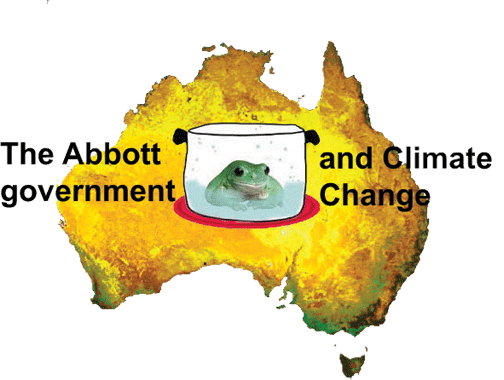 G20: Australia makes token concession on climate change after US lobbying Lenore Taylor, Guardian Australia political editor theguardian.com, Sunday 2 November 2014
Government resists calls for climate change to be listed as a major agenda item, but agrees to include in final communique Australia has reluctantly conceded that climate change can be included in a single brief paragraph of the G20 leaders’ communique after heavy lobbying by the US and European nations.
The government had resisted any discussion of climate at the Brisbane meeting on the grounds that the G20 is primarily an economic forum, but other nations argued leaders’ agreements at meetings like the G20 are crucial to build momentum towards a successful international deal at the United Nations conference on climate change in Paris next year.
The final wording of the leaders’ statement after the meeting is still being finalised but it is believed to simply recommit to addressing climate change through UN processes.
The outcome – and Australia’s resistance – have been attacked by the leading climate economist Lord Nicholas Stern, who has written for Guardian Australia that the latest “synthesis” report by the Intergovernmental Panel on Climate Change (IPCC) should be “high on the agenda” for the G20 meeting.
“The G20 is the most effective forum for the discussion of the growth story of the future, the transition to the low-carbon economy. Yet the local politics of a country of less than 25 million is being allowed to prevent essential strategic discussions of an issue that is of fundamental importance to the prosperity and well-being of the world’s population of 7 billion people,” he writes.
Australia has agreed the G20 should discuss climate-related issues as part of its deliberations on energy efficiency, but this also appears to be wrapped up in a general commitment that countries consider taking action in the future on some of a long list of areas where energy efficiency improvements might be made……
In a special “message” about the G20 release on Sunday, Tony Abbott also did not mention climate change……..
US president Barack Obama’s international adviser, Caroline Atkinson, has insisted publicly that leaders around the table at the G20 will raise climate change. http://www.theguardian.com/world/2014/nov/02/g20-australia-makes-token-concession-on-climate-change-after-us-lobbying
Heat-related deaths from climate change: Australians particularly vulnerable
 Coal exports a killer for thousands’, says ANU academic Elizabeth Hanna Sid Maher THE AUSTRALIAN NOVEMBER 04, 2014 TONY Abbott’s declaration that coal is good for humanity has been attacked by Australian National University academic Elizabeth Hanna, who warns thousands of people will be sentenced to death if Australia keeps exporting it.
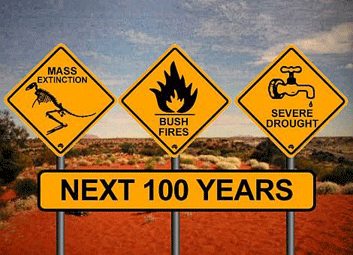
Dr Hanna, whose research was included in the latest Intergovernmental Panel on Climate Change report, predicted Australia faced days hotter than 50C within 10 or 15 years under continuing global warming and this would dramatically increase the number of heat-related deaths.
If that happens, “we are at risk of mass-death events in Australia, similar to the death tolls due to extreme heat overseas’’, she said.
“In 2003, 70,000 people died in Europe and 55,000 died in Russia in 2010 due to extreme heat.”
Asked on Radio National about the Prime Minister’s support for coal, Dr Hanna said that Mr Abbott’s government was “captive to the vested interests” and eventually would be held to account. “Now if they continue to ignore this message they are sentencing thousands and thousands to their deaths,” she said.
Dr Hanna, the president of the Climate and Health Alliance, in a following interview with The Australian, stood by her comments and went further:…….http://m.theaustralian.com.au/national-affairs/climate/coal-exports-a-killer-for-thousands-says-anu-academic-elizabeth-hanna/story-e6frg6xf-1227111379081
Black and white Australians join to document the health effects of Maralinga atomic bomb testing
http://www.pozible.com/project/187985 The story of the project At the ANFA (Australia
Nuclear Free Alliance) meeting in Oct 2014 Indigenous Elders called for documentation of the health effects from the Maralinga and other atomic bomb tests in the 1950’s and 1960’s. See https://ausnukefreealliance.wordpress.com for the meeting statement.
Permission was never sort from the Aboriginal nations.
“Just remember that the fallout at Maralinga affected the whole lot of us. Black, white, brindle; we all breathe the same air, and we’re all being affected in various ways, even though that happened a long time ago. It’s still around.” Sue Coleman-Haseldine (Kokatha Mula – Ceduna)
From 1952 to 1963 atomic testing covered vast areas of South Australia including Maralinga and Emu Fields test sites.
In November 2014 there will be a 3 week road trip to archive the stories of the people from Arabuna, Walitina, Ceduna, and Yalata country to produce film, audio and digital documentaries. We will begin a data base of the families affected, the geographical distributions of fall out and detrimental health repercussions of these unconsented tests.
Nuclear weapons are the most destructive, inhumane and indiscriminate weapons ever created. Both in the scale of the devastation they cause, and in their uniquely persistent, spreading, genetically damaging radioactive fallout, they are unlike any other weapons.
For more information on nuclear weapons, including an article on Yami Lester, one of the survivors of the nuclear tests in South Australia, see http://www.icanw.org/au/
Many Aboriginal people in South Australia still rely on bush foods – plants and animals sourced from land that still is contaminated. The possibility of bioaccumulation is very real. Certainly the stories of early death from cancer, thyroid disease and congenital deformities are continuing.
“I’ve lost a lot of my family members through early death – and a lot of it was through cancer, and I do blame the Maralinga fallout.”
Aunty Martha – Arabana (Lake Eyre) Contact us at: uraniumthesilentkiller@gmail.com
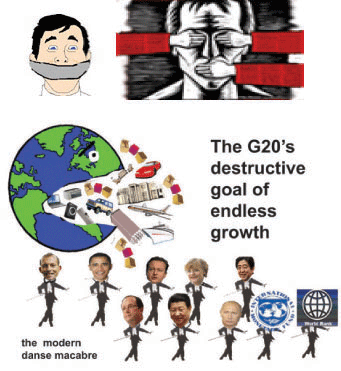
In deference to its climate denialist P.M, Australia censors G20 protest about climate change
 Brisbane G20: Airport vetoes #onmyagenda climate change billboard, Brisbane Times November 3, 2014 Tony Moore brisbanetimes.com.au senior reporter Brisbane Airport Corporation has vetoed a “political” billboard asking for climate change to be added to this month’s G20 conference.
The billboard – backed by nine national and international conservation groups – was planned for Brisbane International Airport.
A second billboard is being unveiled in Peel Street at South Brisbane on Monday.
The groups wanted world leaders and their delegates to see the billboard as they arrived in Brisbane. The #onmyagenda campaign encourages people to tweet G20 leaders asking them to include climate change as a stand-alone item on the G20 agenda.
Climate change issues have been on the agendas at eight previous eight G20 summits.
It is not on the agenda in Brisbane.
The decision comes as the United Nations Intergovernmental Panel on Climate Change on Sunday released its most recent report on the impact of climate change.
The report found that the world must stop almost all greenhouse gas emissions through a phased elimination of fossil fuels by 2100 if we are to avoid the worst impacts of climate change.
UN Secretary-General Ban Ki-moon has urged companies to disinvest from fossil fuel-based industries.
In broad terms, the UN IPCC report finds there are “multiple pathways” available to keep global warming below two degrees.
All of these pathways require “substantial” cuts to greenhouse gas emissions over the next few decades, and “near zero” emissions by the end of the century, the report’s authors concluded.
BAC told Fairfax Media the billboards were rejected last Wednesday because they were deemed to be “political”.http://www.brisbanetimes.com.au/queensland/brisbane-g20/brisbane-g20-airport-vetoes-onmyagenda-climate-change-billboard-20141103-11fzdm.html#ixzz3I9Xt6bP9
Australia sets up military style preparedness for G20 Summit
Commandos and Black Hawk helicopters stage operations in Brisbane CBD as G20 security ramps up http://www.abc.net.au/news/2014-11-03/g20-security-ramps-up/5861514 By Francis Tapim G20 security preparations are ramping up in Brisbane, as commandos and Black Hawk helicopters flooded the Eagle Street Pier area in a counter-terrorism training operation last night.
Around 50 personnel dressed like commandos, armed with semi automatic rifles and wearing body armour staged the training exercise on Sunday.
Courier Mail photographer Marc Robertson stumbled on the operation, and said there were four helicopters “only a few feet from the buildings”.

“I counted about 50 blokes wearing paramilitary uniforms, combat pants, and wearing body armour carrying full automatic weapons,” he said.
“They are not wearing any insignia at all… there was a lot of action in amongst the buildings.
There was no official information about the operation, but Queensland police confirmed they had been assisting with traffic control for a G20 training exercise in the CBD.
Meanwhile, the RAAF said the public would notice increased activity in the skies over south-east Queensland in the lead-up to the summit.
It said fighter jets, Black Hawk helicopters and surveillance planes would increase patrols, and conduct training exercises. Commander of ADF support to the G20 Major General Stuart Smith said the training period would allow the military to sharpen their response skills.
1 This Month



26 September – International Day for the Total Elimination of Nuclear Weapons


PLEASE OPPOSE HR 8255 AND S.3639 – bills would accelerate satellite deployment, with no environmental review or safeguards – https://ncstd5li.quorum.us/campaign/169331/
To see nuclear-related stories in greater depth and intensity – go to https://nuclearinformation.wordpress.com
-
Archives
- September 2026 (245)
- August 2026 (330)
- July 2026 (355)
- June 2026 (287)
- May 2026 (306)
- April 2026 (356)
- March 2026 (251)
- February 2026 (267)
- January 2026 (308)
- December 2025 (358)
- November 2025 (359)
- October 2025 (375)
-
Categories
- 1
- 1 NUCLEAR ISSUES
- business and costs
- climate change
- culture and arts
- ENERGY
- environment
- health
- history
- indigenous issues
- Legal
- marketing of nuclear
- media
- opposition to nuclear
- PERSONAL STORIES
- politics
- politics international
- Religion and ethics
- safety
- secrets,lies and civil liberties
- spinbuster
- technology
- Uranium
- wastes
- weapons and war
- Women
- 2 WORLD
- ACTION
- AFRICA
- Atrocities
- AUSTRALIA
- Christina's notes
- Christina's themes
- culture and arts
- Events
- Fuk 2022
- Fuk 2023
- Fukushima 2017
- Fukushima 2018
- fukushima 2019
- Fukushima 2020
- Fukushima 2021
- general
- global warming
- Humour (God we need it)
- Nuclear
- RARE EARTHS
- Reference
- resources – print
- Resources -audiovicual
- Weekly Newsletter
- World
- World Nuclear
- YouTube
-
RSS
Entries RSS
Comments RSS
 nuclear-news
The co-signatories “support the broad conclusions drawn in the article ‘Key role for nuclear energy in global biodiversity conservation’, published in Conservation Biology.” The open letter states: “Brook and Bradshaw argue that the full gamut of electricity-generation sources − including nuclear power − must be deployed to replace the burning of fossil fuels, if we are to have any chance of mitigating severe climate change.”
So, here’s my open letter in response to the open letter initiated by Brook and Bradshaw:
– – –
Dear conservation scientists, Continue reading →