Patrick Moore, fossil fuel and nuclear mercenary, tours Australia, courtesy of front group Galileo Movement
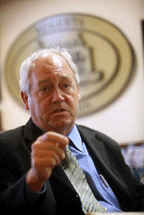 Moore’s trip to Australia has been financed through the climate science denial organisation the Galileo Movement.
.Moore has been given favourable coverage in popular rural newspaper The Land and the Rupert Murdoch-owned The Australian.
Moore is almost always described as a co-founder of Greenpeace, despite Greenpeace itself contesting that he wasn’t a co-founder.
An archive of Moore’s CV shows his work for corporations and organisations in logging, pulp and paper and mining. He has also been an advocate for the nuclear energy industry.
Climate Science Denialist Patrick Moore Tours Australia After Comparing Students to the Taliban http://www.desmogblog.com/2014/10/23/climate-science-denialist-patrick-moore-tours-australia-after-comparing-students-taliban#disqus_thread Canadian climate science denialist Patrick Moore is at the beginning of a tour around Australia speaking to audiences across the country.
But here’s a warning.
If you do find yourself in the audience and don’t want to be compared to the “Taliban” then don’t even think about walking out in protest.
Less than two weeks before flying to Australia, Moore spoke on the campus of Amherst Collegein Massachusetts.
When members of the college’s environmental group decided they had heard enough and walked, Moore said they had a “Taliban mindset”.
When he was later asked to apologise, a report in the Amherst College student newspaper says Moore instead chose to double-down on his remark.
“Fifty people walk out, and I say that’s a pretty Taliban thing to do,” Moore is reported to have said, characterizing the behavior of the young students to that of the fundamentalist regime that massacred thousands and committed brutal repression of women.
Who is Patrick Moore?
Moore has no scientific credibility on climate change and has never published a scientific paper on the issue.
Yet Moore claims there is “no scientific proof” that humans are causing global warming and that “throwing bones on the ground” would have a better predictive ability than most climate models.
His opinion on the science runs against all the major national science academies in the world and about 97 per cent of all the peer reviewed studies on climate change carried out since the early 1990s. Continue reading
How America and Britain crushed the government of Australia
THE FORGOTTEN COUP Little Darwin, John Pilger 24 Oct 14 – How America and Britain crushed the government of Australia Across the political and media elite in Australia, a silence has descended on the memory of the great, reforming prime minister Gough Whitlam, who has died. His achievements are recognised, if grudgingly, his mistakes noted in false sorrow. But a critical reason for his extraordinary political demise will, they hope, be buried with him.
Australia briefly became an independent state during the Whitlam years, 1972-75. An American commentator wrote that no country had “reversed its posture in international affairs so totally without going through a domestic revolution”. Whitlam ended his nation’s colonial servility. He abolished Royal patronage, moved Australia towards the Non-Aligned Movement, supported “zones of peace” and opposed nuclear weapons testing.
Although not regarded as on the left of the Labor Party, Whitlam was a maverick social democrat of principle, pride and propriety. He believed that a foreign power should not control his country’s resources and dictate its economic and foreign policies. He proposed to “buy back the farm”. In drafting the first Aboriginal lands rights legislation, his government raised the ghost of the greatest land grab in human history, Britain’s colonisation of Australia, and the question of who owned the island-continent’s vast natural wealth. …………………….
US diplomatic cables published last year by WikiLeaks disclose the names of leading figures in both main parties, including a future prime minister and foreign minister, as Washington’s informants during the Whitlam years……….Whitlam demanded to know if and why the CIA was running a spy base at Pine Gap near Alice Springs, a giant vacuum cleaner which, as Edward Snowden revealed recently, allows the US to spy on everyone. “Try to screw us or bounce us,” the prime minister warned the US ambassador, “[and Pine Gap] will become a matter of contention”.
Victor Marchetti, the CIA officer who had helped set up Pine Gap, later told me, “This threat to close Pine Gap caused apoplexy in the White House… a kind of Chile [coup] was set in motion.”
Pine Gap’s top-secret messages were de-coded by a CIA contractor, TRW. One of the de-coders was Christopher Boyce, a young man troubled by the “deception and betrayal of an ally”. Boyce revealed that the CIA had infiltrated the Australian political and trade union elite and referred to the Governor-General of Australia, Sir John Kerr, as “our man Kerr”…………………..
The Americans and British worked together. In 1975, Whitlam discovered that Britain’s MI6 was operating against his government. “The Brits were actually decoding secret messages coming into my foreign affairs office,” he said later. One of his ministers, Clyde Cameron, told me, “We knew MI6 was bugging Cabinet meetings for the Americans.” In the 1980s, senior CIA officers revealed that the “Whitlam problem” had been discussed “with urgency” by the CIA’s director, William Colby, and the head of MI6, Sir Maurice Oldfield. A deputy director of the CIA said: “Kerr did what he was told to do.”…………………
On 11 November – the day Whitlam was to inform Parliament about the secret CIA presence in Australia – he was summoned by Kerr. Invoking archaic vice-regal “reserve powers”, Kerr sacked the democratically elected prime minister. The “Whitlam problem” was solved, and Australian politics never recovered, nor the nation its true independence.http://littledarwin.blogspot.com.au/
Lest we forget: what was done to Australia’s greatest Prime Minister, Gough Whitlam
Whitlam, the CIA and Nugan Hand http://nuganhand.wordpress.com/2011/01/23/whitlam-the-cia-and-nugan-hand/ November 11: Coup? What coup? [Green Left Weekly], November 21, 2010 By John Jiggens“………Lest we forget.
Former Australian prime ministers Robert Menzies, Howard Holt, John Gorton, Bob Hawke and John Howard all compliantly sent Australian troops to fight US wars. But in the early 1970s, Whitlam’s government had the courage to bring Australian soldiers home from the US war in Vietnam.
For this audacious action, Labor would never be forgiven by then-US president Richard Nixon, the CIA, Rupert Murdoch, the CIA, and corrupt conservative premiers Bob Askin (NSW) and Joe Bjelke-Petersen (Queensland) — who all hated Whitlam as though he were Che Guevara.
Whitlam’s election in 1972 began a short-lived era in which the stated aims of the new Labor government were to promote equality and involve the people in decision-making processes.
Within two weeks of Whitlam’s election, conscription was abolished and draft resisters released from jail. Voting rights were extended to all Australians over 18, and university fees abolished.
Whitlam’s youth constituency also gained community radio stations, and the Whitlam government intended to decriminalise marijuana. Aborigines were granted land rights in the Northern Territory.
Whitlam was less subservient than his Liberal predecessors to Washington’s foreign policy directions. He took a more critical line in foreign policy, condemning Nixon’s 1972 bombing offensive against North Vietnam and warned he might draw Indonesia and Japan into protests against the bombing.
The People’s Republic of China was recognised and the Whitlam government spoke up in the United Nations for Palestinian rights. The French were condemned for testing nuclear weapons in the South Pacific, and refugees fleeing the CIA-backed coup in Chile were welcomed.
Nixon and the CIA found such independence intolerable. After Whitlam was re-elected in 1974, and Jim Cairns became his deputy, Nixon ordered the CIA to review US policy towards Australia. Although the CIA’s response to Nixon has never been released, it seems it began a covert operation to destabilise the Whitlam government began then.
The puppet masters who led the coup were Ted Shackley and Marshal Green. Nixon appointed Green as US Ambassador to Australia in 1973. Nick-named “the coup-master”, Green had been involved in several countries where the CIA had masterminded coups, such as Indonesia (1965) and Cambodia (1970).
Green’s goals were to maintain US bases in Australia and to protect US economic interests.
Green let it be known that if the Labor government honoured one of its key election pledges to reclaiming ownership of oil refineries and mining industries, the US would respond. Green carefully cultivated the Fairfax, Murdoch and Packer dynasties that controlled the Australian media.
Ted Shackley, known as the “Blond Ghost”, joined the CIA in 1951. Over the next two decades, he emerged as the agency’s “dirty tricks” specialist, directing the CIA’s campaign against Cuba and Fidel Castro’s government in 1962.
In 1966 he became Chief of Station in Laos and directed the US secret war there — earning his other nickname, “the Butcher of Laos”.
In 1971, he became head of the CIA’s Western Division (covering North and South America) where he plotted the overthrow of Allende. In 1974, Shackley became head of the Eastern Division of the CIA, covering Asia and Australia.
Shackley’s speciality was financing black operations through the drug trade and he learned the dark art of running drug armies during the secret war in Laos. One of his foot soldiers in Laos was Michael Hand, co-founder of the Nugan Hand bank.
Michael Hand helped forge documents used by the media to discredit the Whirtlam government, while his partner Frank Nugan was the conduit for CIA money to the Liberal Party. Millions of dollars flowed to the conservative parties via Nugan Hand.
Shackley played a key role in the security crisis of November 1975, which revolved around the US military base at Pine Gap. Whitlam had threatened that if the US tried to “bounce” his government, he would look at the presence of US bases in Australia.
The lease for Pine Gap was due for renewal in December 1975. On 10 November 1975, the day before Whitlam was sacked, Shackley sent an extraordinary cable from the CIA to ASIO’s director general, threatening to remove ASIO from the British-US intelligence agreement because he considered Whitlam a security threat.
The cable was published by the Financial Review in 1977 and has been widely reprinted. It shows Shackley’s involvement in the security crisis.
Shackley was furious that Whitlam had accused the CIA of funding the opposition conservative parties and had claimed CIA money was being used to influence domestic Australian politics. In particular, Whitlam was asking questions about the close relationship between Richard Stallings, who ran the so-called joint facility at Pine Gap, and National Party leader Doug Anthony.
“The CIA has grave concerns as to where this type of public discussion may lead”, Shackley’s cable said.
In his 1977 speech calling for a royal commission into the activities of the CIA in Australia, Whitlam called Shackley’s cable “a clear example of the attempted deception of the Australian Government by the American intelligence community … The message was offensive in tone, deceitful in intent and sinister in its implications.”
For the Australian media, the message of Remembrance Day 2010 was clear: sleeping dogs must be allowed to lie. There could be nothing nobler to aspire to than the service of our imperial overlords, and to remind the Australian people that these imperial overlords had subverted a democratically elected government was well off message.
[John Jiggens has been involved in civil liberties and anti-corruption campaigning for many years. He is the author of a number of books, including the recently released The Killer Cop & the Murder of Donald Mackay, about the drug trade, Nugen Hand Bank and the overthrow of the Whitlam government.]
Australian rare earths miner Lynas must make a plan for radioactive waste disposal, says IAEA

 IAEA reports no long-term plan for Lynas waste, Malaysian Insider 17 October 2014 The International Atomic Energy Agency (IAEA) on Friday gave a passing safety grade to a controversial Malaysia rare earths plant, but raised concerns that there was no long-term plan for properly disposing of the plant’s potentially radioactive waste.
The rare earths processing plant in the state of Pahang has generated opposition from green groups who fear radioactive contamination and have accused authorities and Lynas of overriding public concern.
In a report, the IAEA said it saw little risk of contamination due to the low-level radiation involved, and that its investigators were “not able to identify any instances of non-compliance” with international standards. “Lynas needs to demonstrate that the disposal of solid waste can be carried out in a safe manner over the long-term,” the report said.
It recommended that Malaysian authorities require Lynas to come up with a plan.
“There is a lack of a plan for managing the waste from the decommissioning and dismantling of the plant at the end of its life,” it said……
However, it also appeared to underscore environmentalists’ concerns that Australian miner Lynas Corp has no long-term plan for the disposal of waste from the plant.- http://www.themalaysianinsider.com/malaysia/article/iaea-teams-says-lynas-plant-generates-low-level-radioactive-waste-bernama#sthash.JEFk1poD.dpuf
Australian government sets up a disastrous course for nuclear weapons proliferation
 Australia–India nuclear treaty: a non-proliferation disaster, The Strategist, the Australian Strategic Policy Institute Blog 14Oct 2014 By Crispin Rovere “…….Nuclear suppliers do have a responsibility, however, for ensuring their nuclear material isn’t used to build nuclear weapons, and must maintain strict mechanisms for that purpose. If countries can access nuclear supply without the attendant responsibilities, then support for longstanding non-proliferation regimes will be undermined, countries will see less value in treaties such as the NPT, and a key pillar of the nuclear arms control regime as a whole will be weakened.
The text of the proposed Australian export deal fails that basic test. In addition to a range of other flaws, for the first time in 40 years Australia won’t be able to guarantee how the nuclear material it supplies is being used. Specifically, the agreement allows India to reprocess uranium supplied by Australia to create plutonium, potentially at weapons grade, with no direct accounting by India to Australia for that material, and unusually, no provision for the return of the material in the event of it being misused. As former Director-General of ASNO, John Carlson, explains, Australia currently allows reprocessing only by two export partners, the EU and Japan, each with direct reporting requirements and specific permission being given by Australia as to how the reprocessed material is to be used.
Accordingly, the deal with India isn’t comparable to Australia’s other nuclear export agreements. Australia is privileging India by excluding key provisions normally included to ensure a recipient of nuclear material is accountable to the supplier. Australia’s other nuclear export partners might demand similar concessions, undermining the integrity of the non-proliferation regime as a whole.
Moreover, the concessions made by Australia are unnecessary. ………Not only does this agreement undermine long established non-proliferation regimes and Australia’s credibility as a nuclear supplier, it represents a missed opportunity to strengthen it. Given that what matters most to India is being treated on a par with China and the United States, India should be expected to ratify the Comprehensive Nuclear-Test-Ban Treaty (CTBT) after the US Senate does, just as China has already agreed to do……..
The agreement marks a significant departure from Australia’s longstanding practice. By excluding the normal provisions that ensure a nuclear recipient is directly accountable to the supplier, Australia is abrogating the principle that nuclear suppliers are accountable for how their exported nuclear material is used……..Crispin Rovere is a former PhD student at the Strategic and Defence Studies Centre, ANU and co-author of Non-strategic nuclear weapons: the next step in multilateral arms control. Image courtesy of Flickr user Indiawaterportal.org. http://www.aspistrategist.org.au/australia-india-nuclear-treaty-a-non-proliferation-disaster/
Australia’s Tony Abbott government out of step on climate change
Government drops ball on climate change http://www.theage.com.au/comment/the-age-editorial/government-drops-ball-on-climate-change-20141007-3hhgq.html 8 oct 14 Two weeks ago, when Prime Minister Tony Abbott spoke before the General Assembly of the United Nations, he named four dire problems facing the world: the dangers posed by the Islamic State in Iraq and the Levant (ISIL), Russia’s destabilising influence in eastern Ukraine, the outbreak and spread of the Ebola virus in western Africa and the economic malaise that continues to afflict many countries.
But Mr Abbott did not mention climate change at all. That failure was conspicuous because just two days earlier, at the same podium, US President Barack Obama had outlined the same four threats to the world (”terrorism, instability, inequality and disease”) but added one more. Mr Obama told more than 120 leaders attending the UN Climate Summit that ”there’s one issue that will define the contours of this century more dramatically than any other, and that is the urgent and growing threat of a changing climate”. Mr Obama said the US had a duty to lead on emissions reduction strategies, and he urged other nations to do their part, saying no nation could afford to pretend climate change was not real.
Mr Abbott, though, did not even bother to attend the Climate Summit. He sent Foreign Minister Julie Bishop instead, and she chose to promote the government’s Direct Action strategy, under which businesses would be paid to cut their emissions. Sure, there are several other nations – India, for one – that obstinately shuck off any responsibility for initiating emissions-abatement strategies and which do so because they perceive their economies would be significantly disadvantaged. But Australia under the Abbott government has become an international joke on matters related to climate change. Only last year, for example, Mr Abbott suggested the UN’s climate chief, Christiana Figueres, was ”talking out of her hat” when she said bushfires in Australia were linked to climate change. Soon after, Environment Minister Greg Hunt sought to defend the PM in an interview with the BBC. During that interview, Mr Hunt said he had ”looked up what Wikipedia says”, and then sought to downplay the notion that climate change could influence the likelihood of bushfires.

But as Fairfax Media reported this week, Mr Hunt was thoroughly briefed just weeks before the interview by officials of the Bureau of Meteorology who explained the effects of climate change on weather patterns. They told the minister that a pattern of recent episodes of extreme heat was ”consistent with the general pattern of warming”. Last week, five separate studies published by Australian universities all concluded that record temperatures in Australia in 2013 were almost certainly caused by man-made climate change.
The governments of the world’s biggest economies and biggest emitters – the United States and China – are focused on emissions reduction strategies. In Australia, while the Abbott government says it supports the science indicating man’s influence on climate change, there is a distinctly grudging aspect to its attitude, a deliberate effort to minimise the scale or urgency of the problem and a clear intention to focus instead on the economic impact of emissions abatement strategies. The government has scrapped the carbon tax and it wants to wind back the renewable energy target, which is intended to ensure that one-fifth of Australia’s energy supply in 2020 will come from renewable sources.
This is a highly educated nation, whose scientists have made valuable contributions to the growing body of knowledge on climate change, and it is a wealthy nation with great economic opportunity. But it is being governed by a party that refuses to acknowledge the vital role it must play at this point in history.
Australia’s Prime Minister Abbott illiterate on both climate and Aboriginal health
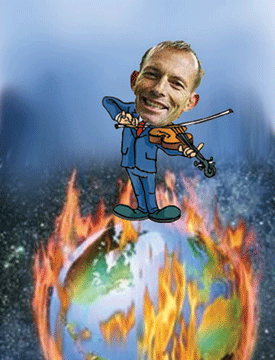
 Abbott Hasn’t Joined The Dots On Black Affairs And Climate Change, SaysActivist https://newmatilda.com/2014/09/30/abbott-hasnt-joined-dots-black-affairs-and-climate-change-says-activistThe gaping hole in Australian Prime Minister Tony Abbott’s self-declared interest in Aboriginal aspirations is his ignorance on climate change. Amy McQuire reports.
Tony Abbott’s ambition to become the “Prime Minister for Aboriginal affairs” doesn’t align with his position on climate change, with First Nations communities the most vulnerable to the disastrous effects of global warming, according to a young Bundjalung environment warrior.
Abbott drew condemnation last week after he dodged a United Nations climate change summit attended by 120 world leaders, including US President Barack Obama. Abbott jetted into New York a day later to attend UN Security Council talks on the situation in Iraq and Syria, and Western responses to militant Sunni group the Islamic State.
In a speech to the UN General Assembly, Abbott fudged on the threat to the world posed by climate change, instead elevating the “murderous rage” of the Islamic State, the “Russian aggression” in Ukraine, the Ebola crisis in West Africa and the situation of the world’s economies above it.
It came in the same week President Obama labelled climate change a greater threat to the world than terror and pointed the finger at Abbott and other heads of state absent at the talks, pointedly noting “no-one gets a pass”.
Abbott also came under fire earlier this year for taking climate change off the agenda at key G20 talks in Brisbane in November, despite the issue being on the agenda of the past three G20 meetings, which bring together the heads of the world’s 20 leading economies.
While Abbott claims to be a champion of Aboriginal rights, 20-year-old Bundjalung climate change activist Amelia Telford says the Abbott government needs to understand the situation facing First Nations communities, many of whom will be most adversely impacted by the effects of climate change.
“Abbott hasn’t connected the dots,” Ms Telford told New Matilda.
“The government is taking us backwards compared with the rest of the world. We are living in a country where Indigenous people have barely contributed to what is causing climate change….
“(But) the most vulnerable communities within Australia – Aboriginal and Torres Strait Islander communities – are going to be impacted more than any other community and we need our government to recognise that.
“We aren’t seeing that leadership and so there is an opportunity to stand up for ourselves and begin a movement lead by our people.”
Ms Telford was speaking ahead of a historic summit organised by the Australian Youth Climate Coalition, which will bring together 50 young Aboriginal and Torres Strait Islander youth from around the country to talk about climate change. Dubbed the ‘Seed summit’, it will kick off in Melbourne this weekend.
While Aboriginal youth have largely been voiceless in climate change talks and activism, Ms Telford says it is critical our young people are at the forefront. She says it’s been hard to raise awareness because of the dire social issues afflicting First Nations youth, and the influence of the fossil fuels industry within First Nations communities.
“We know that Indigenous people across Australia have been looking after our lands for tens of thousands of years and it gives us hope that we can do it again. But there are so many structural issues within our communities so it’s hard for young people to prioritise it.
“… There are more and more of us coming out and talking about climate change, sustainability and caring for country but there are so many things competing for our attention.
“It can be a tricky issue because of the fossil fuel industry and the massive impact and stress of that on our land and culture for decades.”
It becomes hard to advocate for solutions to climate change if you are forced to rely on the mining industry, Ms Telford says.
But she says rather than just targeting government, the Seed summit also hopes to put a declaration to the four leading banks asking them not to invest in coal ports on the Great Barrier Reef.
“We need to get climate change on the agenda of our politicians, but it also involves engaging with business leaders, rather than specifically government,” Ms Telford says.
“… We are calling on the CEOs of the four big Australian banks which are considering whether to fund coal ports on the reef. In this time in politics, where we are not seeing leadership from governments, we have to find ways to counteract that and figure out how we can make a difference.”
Ms Telford says she was surprised at the number of Aboriginal and Torres Strait Islander youth who wanted to get involved in climate change advocacy. The summit received 30 applications within a week of opening registrations.
“The young people are the ones with the most at stake,” Ms Telford says.
“Indigenous youth have to be at that forefront and the great thing is we are backed by thousands of young people all across the country.
“Knowing we are a part of that movement is pretty great.”
Australia’s 2013 was brought on by global warming – researchers conclude
 Australia’s 2013 heatwave due to climate change, researchers conclude http://www.theage.com.au/environment/australias-2013-heatwave-due-to-climate-change-researchers-conclude-20140930-10o1sj.html September 30, 2014 Lisa Cox National political reporter Record temperatures in Australia in 2013 were almost certainly caused by man-made climate change, five separate studies have found.
Researchers from the University of Melbourne, the Australian National University and the University of NSW have concluded it is “virtually impossible” that the heatwaves that hit Australia in 2013 would have occurred were it not for carbon emissions caused by human activity.
The reports have been published in the Bulletin of the American Meteorological Society as part of a global project examining the impact of climate change on extreme weather.
The results, which are the strongest statement yet on the impact of climate change on Australia’s weather patterns, are a wake-up call for the Abbott government a week after it was criticised for failing to take beefed-up emissions reduction targets to a special summit of world leaders in New York.
Five teams of researchers examined the heat that baked Australia for much of 2013, leading to the hottest day, month, spring and summer since records began.
They concluded that the record temperatures for the whole of that year would almost certainly not have occurred without man-made climate change and that the chance of heatwaves occurring was more than 2000 times greater because of human-caused climate change.
Professor David Karoly, one of the authors, said the results mark the first time that researchers had concluded that a specific weather event couldn’t or most likely couldn’t have occurred in Australia without the increase in greenhouse gas emissions caused by human activity.
“The Prime Minister last year said that studies hadn’t been done and the CSIRO cautioned against attributing individual extreme weather events to climate change,” Professor Karoly said.
“Now the studies have been done and the results are very clear.”
The teams of researchers used a variety of computer-based simulations that modelled 20th and early 21st century temperatures.
One set of models factored in natural variations in climate and human influences on climate, while another set showed what temperatures would have looked like without man-made climate change.
Out of 12,500 simulated years, only one result in the latter group produced temperatures higher than those seen in Australia in 2005 – the hottest year before 2013 – and none as hot as 2013.
“There was an increase in the frequency of heatwaves in 2013 and the intensity of heatwaves due to climate change,” Professor Karoly said “It was three times the frequency and two times the intensity.”
The death spiral of fossil fuel electricity: but the utilities are fighting back
“Distributed generation (DG) could be the end of utilities as we know them today,” U.S. investment research firm Morningstar said earlier this year. “Utilities’ centralized network monopolies break down when customers become self-sufficient competitors.”
Romero, the Spanish renewable energy expert, said: “Utility companies know that the future is in renewables, but they’re not going to go down without putting up a fight.”
 From Sydney To Spain, Old Energy Is Doing Everything It Can To Hold Back The Rise Of Solar, Business Insider Australia TRACY RUCINSKI, BYRON KAYE MADRID/SYDNEY (REUTERS) 29 SEPT 14
“The government wanted people to be afraid to generate their own energy, but they haven’t dared to actually pass the law,” Alonso said as he tightened screws on the panel on a sunny summer day this month. He had removed solar panels from the roof last year.
“We’re tired of being afraid,” he said.
Halfway across the globe, in the “sunshine state” of Queensland, Australia, electrical engineer David Smyth says the war waged by some governments and utilities against “distributed energy”, the term used for power generated by solar panels, is already lost.
“The utilities are in a death spiral,” he told Reuters by telephone while driving between a pub where he helped set up 120 solar panels to cut its $53,000 annual power bill and a galvanizing plant which was also adding solar panels to reduce costs.
In Australia, he said, solar panels have shifted from being a heavily subsidized indulgence for environmentally-conscious households to a pragmatic option for businesses wanting certainty about what their running costs will be next year.
“Not many people are doing it because of emissions or the environment,” Smyth said. “It’s about the cost.” Continue reading
“The nuclear industry is in decline” – a report that upsets the industry
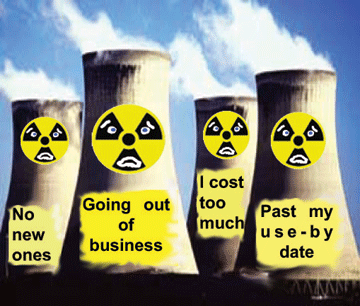 Nuclear’s fortunes on the wane THE AUSTRALIAN SEPTEMBER 29, 2014 Robin Bromby Business columnist
Sydney :……….now along comes some disquieting analysis of the nuclear electricity story. Normally, we would have seized on the annual report during the week fromManhattan Corp (MHC), which has the Ponton uranium project in Western Australia, and which coincided with yet another rise in the spot uranium price, up $US2.50 a pound to $US36.50/lb. Executive chairman Alan Eggers writes that the uranium sector has been dominated by “negative industry sentiment, falling supply and lacklustre demand among buyers of nuclear fuel”. He then outlines a reasonably cheerful outlook, and one to which Pure Speculation has been an adherent.
Until we read another report written by eight European and Japanese heavyweight thinkers in the field, headed by Paris-based Mycle Schneider. Their World Nuclear Industry Status Report 2014 has a stark and simple message: “The nuclear industry is in decline”.
There are 388 operating reactors around the world, 50 fewer than in 2002. Installed capacity is back to where it was 20 years ago.
The nuclear share of the world’s power generation declined from its peak of 19.6 per cent in 1996 to 10.8 per cent in 2013. In terms of revenue, nuclear now accounts for a lower percentage than in 1984.
In all, there are 67 “current” nuclear reactor projects, which sounds impressive until the report explains that eight of those reactors have been listed as “under construction” for more than 20 years; at least 49 have encountered construction delays, some for several years, and for the first time Chinese projects have also been delayed; for the remaining 18 reactors, either construction began within the past five years or the reactors have not yet reached projected start-up dates.
“Delays have occurred in the development of the nuclear programs for most of the more advanced newcomer countries, including Bangladesh, Jordan, Lithuania, Poland, Saudi Arabia, Turkey and Vietnam,” the report adds……..http://www.theaustralian.com.au/business/opinion/nuclears-fortunes-on-the-wane/story-fnciihm9-1227073165703
Australia most unpopular at Climate Change Summit
Australia’s climate stance savagely condemned at New York summit SMH September 27, 2014 Nick O’Malley US correspondent for Fairfax Media “…….in his address to the General Assembly, Leonardo DiCaprio sought to buttress his call for drastic and immediate action to reduce carbon emissions with a voice harder to challenge than his own.
it was Australia and to an extent Canada that were subject to most of the opprobrium, in part because they have already enjoyed the economic benefits of carbon emissions, in part because China is perceived to be on the brink of significant action.
One of the successes of Tuesday’s meeting was China’s announcement for the first time ever that it would set an emissions target, aiming to reduce its emissions of carbon per unit of GDP by 45 per cent by 2020, compared with levels in 2005.
“As a responsible major country, a major developing country, China will make even greater effort to address climate change,” Vice-Premier Zhang Gaoli said.
“All countries need to follow the path of green and low carbon development that suits their national conditions, [and] set forth post-2020 actions in light of actual circumstances.”
An adviser who attended a meeting of small island states that excoriated Australia’s inaction on climate said the group now viewed China’s commitments optimistically.
The reaction to Australia’s presence could not have been more different. Tony de Brum, the Foreign Minister of the Marshall Islands, told Fairfax that small islands states were frustrated and baffled by Australia’s stance, especially as they had regarded the nation as a “big brother down south” and advocated for its seat on the United Nations Security Council.
Asked if “betrayal” was too strong a word, he paused and said, “Now it is, maybe not soon.”
On Tuesday the Pulitzer Prize-winning climate change news website Inside Climate News published a story about the “Canada-Australia axis of carbon”. It suggested that not only were the two nations not willing to pull their weight, but that they were seeking to derail the binding agreement on emissions reductions at next year’s talks in Paris that many view as the world’s last best hope to prevent catastrophic climate change.
“Neither the prime ministers of Canada nor Australia will speak at the summit, and the subordinates they have sent will not be offering the kind of “bold” new steps that UN Secretary-General Ban Ki-moon is seeking on the way to a treaty in Paris late next year,” it reported.
“Instead, these two governments, with their energy-rich domains sprawling across opposite ends of the earth, will present strikingly similar defences against what much of the rest of the world is offering. And their stance is earning them opprobrium among advocates of strong and immediate action.”
The online magazine Slate published a story headlined, “The Saudi Arabia of the Pacific, How Australia became the dirtiest polluter in the developed world.”
It charted Australian climate politics since the last election – noting for an international audience Australia’s history as a leader in solar technology, the creation and then scrapping of a carbon trading scheme, the promotion of climate change sceptics to key advisory roles, the attacks on the solar industry, the scrapping of the mining tax, the failed bid to expand logging in Tasmanian wilderness.
“Let’s hope that the rapacious policies of the current government represent only a temporary bout of insanity,” Slate concluded. “If the Australian people cannot recover some of their earlier regard for their environment they may find in time that their great land is no longer merely apathetic toward their residence there but openly hostile.” http://www.smh.com.au/world/australias-climate-stance-savagely-condemned-at-new-york-summit-20140926-10mc0x.html#ixzz3Eac7HHfN
Kow towing to mining industry, Australia violates the Nuclear Non Proliferation Treaty (NPT)
A BLATANT VIOLATION OF Nuclear Non Proliferation Treaty–SEPTEMBER 26, 2014 By Eurasia Review By Yusra MushtaqAmongst the various accords of Arms Control and Disarmament, the Nuclear Non Proliferation Treaty (NPT) has widely been adhered to by most of the countries, which gives testament to the worth of this treaty. Nevertheless, it also has been the fate of being violated again and again by its own signatory members — most recently by Australia which signed a uranium deal with India, ade-facto, but non-signatory state. Previously, the US a big proponent of NPT, paved the way for this kind of illegal nuclear cooperation with the non-NPT state of India by signing a deal back in 2005. The blatant violation of NPT left no room for India to sign this treaty because it already enjoys full benefits as if it were a NPT member state without any restricted conditions.
Largely based on the three pillars of Non-Proliferation, Disarmament and Peaceful Uses of Nuclear Energy, the NPT serves as a central bargain. “The NPT non-nuclear-weapon states agree never to acquire nuclear weapons and the NPT nuclear-weapon states in exchange agrees to share the benefits of peaceful nuclear technology and to pursue nuclear disarmament aimed at the ultimate elimination of their nuclear arsenals”. There are 190 states which have joined the NPT club. It is extended for indefinite period of time which reflects its obligatory status. In order to make Global Nuclear Non Proliferation and NPT particularly more fruitful, many substantive initiatives have been taken. They are dominated by export controls regime like Nuclear Suppliers Group and enhanced verification measures of IAEA Additional Protocols. The sole aim of all efforts is to end every possible mean to acquire nuclear weapons. Within this context, success becomes a far off cry as NPT is in a fix between global and national interests of respective states.
Australia signed a deal to sell uranium to India to coin the natural blessing of one third of world’s uranium reserves for the sake of national interests. It is the first non-NPT signatory nation with whom Australia has inked a nuclear deal. Australia is the tenth country in the world that has signed a nuclear deal with India. Both the states are joining hands happily while violating the norms of NPT so blatantly. There is a sheer absence of handwringing editorials at the international news desks. Between the celebrations of this so-called triumph, no one is talking of the sanctity of international arms treaties…….
an irony for the Global Non Proliferation Regime that there are high voices for NPT to be adhered to, but at the same time its own vocal members have optimized national interests over the security of the whole globe. All are quiet on the sheer violence on this international violation of a treaty because it’s a matter of great powers vested national interests with a de facto state. For this Lao Tzu, a Chinese philosopher stated; “The more laws and order are made prominent, the more thieves and robbers there will be.” Yusra Mushtaq is a scholar on the issues of defense and security. http://www.eurasiareview.com/26092014-blatant-violation-npt-oped/
Australian research shows the way to 50% renewable energy by 2050
 Australia Encouraged To Set 50% Renewable Energy Target By 2030 September 25th, 2014 by Giles Parkinson RenewEconomy. Imagine a world in 2050. Everyone drives an (electric) car, homes have all the gadgets, appliances and nick-nacks. The public transport system is emissions free. Mining work and transport is electrified, and diesel is dumped. Electrification has taken place in much of the steel industry. And it is all emissions free. It might be powered by 100 per cent renewables – the sun, wind, the sea, and geothermal, hydro and biomass. And the economy is still strong.
Welcome to the zero carbon world awaiting Australia and much of the rest of the world.
Major new analysis – Pathways to Deep Decarbonisation – produced by Australia’s ClimateWorks, along with ANU, shows that 15 of the world’s biggest economies can move to “net carbon zero” by 2050, and it need impose no extra costs over business as usual. In fact, electricity bills will be lower than what they are now. Economic growth will remain more or less the same, and the benefits, in terms of health and the environment, will be enormous.
The report is timed for the New York climate summit being hosted by the UN this week, and in the 12 months leading up to the Paris event that will hopefully result in a new climate treaty next year. It is designed to help change the political rhetoric around decarbonisaion. In Australia, only one party, the Greens, talks in terms of net carbon zero by 2050, and of higher renewable energy targets. Yet this report says not only is it necessary to meet climate goals, it is eminently doable.
Anna Skarbek, the executive director of ClimateWorks, says that Australia’s political rhetoric needs to change quickly. While the Abbott government is talking of the need to “cut” the renewable energy target down to a “real” 20 per cent, for “fear” that it might reach 25 or 26 per cent by 2020, Skarbek says that to achieve climate goals, Australia’s renewable energy target needs to be at least 50 per cent by 2030 – and then carbon free by 2050.
“There are many pathways for Australia to substantially reduce emissions, but all include greatly improved energy efficiency across the economy, a nearly carbon free power system and switching to low carbon energy sources in transport, buildings and industry,” Skarbek says.
“Taking the carbon out of our electricity system provides the largest reduction in emissions. Then we can use the carbon-free electricity to replace petrol in cars, and gas in buildings and some industrial processes.”
“The move to a low emissions electricity system can be developed with technologies that exist today. But we need to move faster – this report shows we’ll need at least 50 per cent renewable electricity by 2030 to achieve a decarbonised electricity system in the time we have left to stay within the carbon budget.”….in all scenarios, even those that hope for cost-competitive carbon capture and storage, renewable energy is the dominant technology, and solar provides at least 50 per cent of all generation.
By 2030, under the renewable scenario, coal is nearly eliminated, although it plays a greater role in the other scenarios because CCS will take a decade at least to bring into production (if it can ever deliver the costs, which many think it won’t), and nuclear will not have a presence before 2030.
Even then, it is assumed that nuclear would provide no more than one-quarter of generation – and this is based on the rather generous cost estimates of past government reviews, and does not reflect the significant cost declines that can be expected of solar. Note however, that the emissions per MWh is the renewables scenario is nearly half of that entertained in the CCS or nuclear scenario – that’s because coal generators get to pollute for many years longer in those scenarios……..
The ClimateWorks report was one of 15 prepared for the UN Deep Decarbonisation Pathways Project that involves modelling teams from 15 major emitters that also include Australia, Brazil, Canada, China, France, Germany, India, Indonesia, Japan, Mexico, Russia, South Africa, South Korea, the UK and the USA.
The findings are being presented to the UN this week by leading economist Jeffrey Sachs. It shows that these countries account for 70 per cent of the world’s greenhouse gas emissions. The interim results show that all 15 countries found ways to achieve near zero carbon electricity by 2050, while sustaining economic growth……http://cleantechnica.com/2014/09/25/australia-renewable-energy-target-50-2030/
India-Australia nuclear trade will destabilise the Asia Pacific region
Australia and uranium: the pusher of the Pacifichttps://overland.org.au/2014/09/australian-and-uranium-the-pusher-of-the-pacific/ ByAdam Broinowski 19.Sep.14 “……… The new demand from India will include uranium mined from Ben Lomond near Mt Isa which is likely to be shipped from Townsville Port, and coal mined from the gargantuan Galilee Basin and shipped from Abbott Point, passing through the dredged Great Barrier Reef, or freighted by road to Darwin or Adelaide ports (which hold uranium licenses). The Australia-India uranium agreement supports this concerted and accelerated push.
In cementing a nuclear deal with India, the Abbott government has committed to selling uranium to a nation-state that barely conceals its intentions to expand its nuclear weapons arsenal and that rejects the NPT and Comprehensive Test Ban Treaty (CTBT)………..
First, the Australia-India uranium trade agreement is unsafe. If Japan’s nuclear industry and government have proven unable to properly contain the potential for serious nuclear accidents at its domestic nuclear power plants, then India’s nuclear industry, which is much less reliable and possibly even more corrupt, poses even higher risks of mismanagement.
Internally, India is also unstable, as the government fights an embedded insurgency. It maintains a violently repressive approach to imposing nuclear installations and uranium operations (such as Gorakhpur, Koodankulam, Jaitapur, Jagudoga) upon vulnerable communities, and against the wishes of civil protesters, five of whom have been killed since 2010. While guaranteed only intermittent electricity supply, such communities are experiencing higher rates of disease, congenital malformations and early deaths. In Jagudoga, Jharkhand (19,500 people), those living near the central uranium mine operated by Uranium Corp. of India Ltd. (UCIL), have suffered disproportionately high health problems……….
Second, while Tony Abbott reiterated that ‘suitable safeguards’ were in place to ensure that Australian uranium would be used for ‘peaceful purposes’ and for ‘civilian use only’, such ambiguous terms create false impressions. Nuclear technologies are inherently dual-use (both for civil energy production and military use), and it is disingenuous to claim that a water-tight separation can be ensured. In fact, ten of India’s twenty nuclear facilities do not fall under International Atomic Energy Agency (IAEA) supervisional authority, and India only selectively recognises IAEA safeguards for specific foreign supplied reactors and facilities. With no mechanism to inspect this nuclear technology to ensure that the fuel is not diverted into nuclear weapons production, safety cannot be guaranteed.
Even if the diverted fuel was discovered, neither Australia nor the IAEA could force compliance. An influx of imported foreign uranium will simply make it easier for India to reserve some of its indigenous uranium for enrichment and/or reprocessing weapons-grade plutonium, or for some of Australia’s uranium to be ‘misallocated’ toward military facilities.
In effect, Tony Abbott’s policy to treat India as the exception undermines the IAEA standards within the disarmament regime, and breaches Australia’s obligations to the Rarotonga Treaty for the South Pacific Nuclear Free Zone.
Third, and perhaps most significant, the deal will upset the ‘balance’ between India-Pakistan and in the South Asian region so as to aggravate rivalries and intensify tensions between the two nations, as well as others such as China and Bangladesh………
While leaders such as Abe, Abbott and Modi downplay the reality confronting people affected by radiation exposures from the Fukushima Daiichi nuclear power plant, we should remember that this contamination came, in part, from Australian uranium.
The refusal of executive leaders to acknowledge the dangers of the uranium trade reflects the centrality of nuclear power to the US-led security regime that seeks to dominate non-compliant nations such as China or Russia………
Dr Adam Broinowski is an ARC postdoctoral research fellow at the College of Asia and the Pacific, the Australian National University.
Australia’s blatant violation of Non Proliferation Treaty, in selling uranium to India
Australia blatantly violates the NPT, Iran held to different standard http://www.iranaffairs.com/iran_affairs/2014/09/australia-blatantly-violates-the-npt-iran-held-to-different-standard.html
As if we needed any more proof that the “Iranian nuclear threat” is just a cooked-up pretextwhich is unrelated to any actual nuclear threat, Australia (which holds about 1/3rd of the world’s uranium reserves) has decided to sell uranium to India. That such a deal violates the terms of the Nuclear Nonproliferation Treaty, doesn’t seem to be an issue to anyone. Note the absence of handwringing editorials at the Washington Post and NY Times about the sanctity of international arms treaties etc.
And why should it be a problem, considering that a few years ago the US agreed to violate the same NPT by sharing nuclear technology with India in exchange for buying India’s vote against Iran at the IAEA Board (which sent Iran’s file to the UN Security Council even though Iran had not breached the NPT?)
On the eve of his visit to New Delhi, US Under Secretary of State Nicholas Burns has said that with India voting in favour of the IAEA [International Atomic Energy Agency] resolution on Iran’s nuclear programme, Congressional opposition to the Indo-US nuclear agreement has disappeared and both sides would meet their commitments before President George W. Bush visits India next year.
Of course the US and Australia claim that this stuff is going to non-military use in India but all that means is that the deal would free-up India’s other resources to be used for non-civilian use. There’s nothing in the NPT which allows signatories to make such exceptions anyway.
Now in the meantime, while the US (and Australia) are blatantly violating their own obligations under the NPT, they’re demanding that Iran apply even greater restrictions on its nuclear program than the NPT requires, by for example giving up uranium enrichment. These excessive demands that violate Iran’s legal rights are clearly intended to scuttle the talks, and to keep the “crisis” alive. The US has no intention of peacefully resolving the nuclear dispute with Iran, no matter what.
1 This Month



26 September – International Day for the Total Elimination of Nuclear Weapons


PLEASE OPPOSE HR 8255 AND S.3639 – bills would accelerate satellite deployment, with no environmental review or safeguards – https://ncstd5li.quorum.us/campaign/169331/
To see nuclear-related stories in greater depth and intensity – go to https://nuclearinformation.wordpress.com
-
Archives
- September 2026 (245)
- August 2026 (330)
- July 2026 (355)
- June 2026 (287)
- May 2026 (306)
- April 2026 (356)
- March 2026 (251)
- February 2026 (267)
- January 2026 (308)
- December 2025 (358)
- November 2025 (359)
- October 2025 (375)
-
Categories
- 1
- 1 NUCLEAR ISSUES
- business and costs
- climate change
- culture and arts
- ENERGY
- environment
- health
- history
- indigenous issues
- Legal
- marketing of nuclear
- media
- opposition to nuclear
- PERSONAL STORIES
- politics
- politics international
- Religion and ethics
- safety
- secrets,lies and civil liberties
- spinbuster
- technology
- Uranium
- wastes
- weapons and war
- Women
- 2 WORLD
- ACTION
- AFRICA
- Atrocities
- AUSTRALIA
- Christina's notes
- Christina's themes
- culture and arts
- Events
- Fuk 2022
- Fuk 2023
- Fukushima 2017
- Fukushima 2018
- fukushima 2019
- Fukushima 2020
- Fukushima 2021
- general
- global warming
- Humour (God we need it)
- Nuclear
- RARE EARTHS
- Reference
- resources – print
- Resources -audiovicual
- Weekly Newsletter
- World
- World Nuclear
- YouTube
-
RSS
Entries RSS
Comments RSS
 nuclear-news