Production at Australia’s only nuclear reactor facility halted after ‘safety incident’
Two workers exposed to unsafe radiation dose at Lucas Heights nuclear facility, Guardian, Michael McGowan@mmcgowan 24 Jun 2019
Production at Australia’s only nuclear medicine facility halted after ‘safety incident’ Production has ceased and an urgent investigation has been launched after two employees at a newly opened Australian nuclear medicine facility at Lucas Heights were exposed to an unsafe dose of radiation late last week.Just two weeks after it was granted a licence to enter into full domestic production, the Australian Nuclear Science and Technology Organisation (Ansto) has confirmed production at its new $168m nuclear medicine facility has been halted after “a safety incident” on Friday morning.
Ansto said three of its workers were “attended to by radiation protection personnel” after the incident, in which contamination was detected on the outside of a container holding 42 millilitres of the radioisotope molybdenum-99 (Mo-99).
Two of those workers received a radiation dose above the legal limit roughly equivalent to a conventional cancer radiation therapy treatment, an Ansto spokesman said……
Located at the Lucas Heights nuclear facility in Sydney’s south, the $168m nuclear medicine facility was announced by the federal government in 2012 with the goal of tripling Australian production of Mo-99, the parent isotope of Technetium-99m. …..
It is the second contamination scare at the Lucas Heights facility in only a few months.
In March three staff at the Lucas Heights nuclear facility were taken to hospital after they were exposed to sodium hydroxide when a cap came off a pipe in the nuclear medicine manufacturing building. https://www.theguardian.com/australia-news/2019/jun/24/two-workers-exposed-to-unsafe-radiation-dose-at-lucas-heights-nuclear-facility
Australians are more likely to be scared about the costs of nuclear power, than about the Chernobyl miniseries
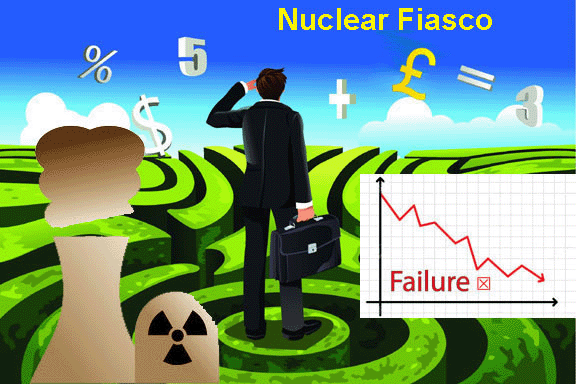
What’s more chilling: watching Chernobyl or cogitating on the cost of going nuclear? Michael West Investigative Journalism Jun 20, 2019, The sudden push by the Murdoch media and Coalition right-wingers to overturn Australia’s nuclear power ban ignores the chilling economic cost — huge public subsidies, storing radioactive waste for thousands of years, the heavy costs of decommissioning and, potentially, radiation-related health costs. Veteran nuclear writer Noel Wauchope reports on the popular TV series, Chernobyl, and the economics of nuclear power.
THE frightening TV miniseries “Chernobyl” could put a few Australians off the idea of nuclear power but nuclear economics might turn out to be the bigger scare.
It is bad news for the Minerals Council of Australia and nuclear lobbyists, that Chernobyl has now arrived on some Australian TV screens, but pro-nuclear advocates are continuing to push their campaign anyway.
The miniseries “Chernobyl” has just finished in Europe and USA, outdoing “Game of Thrones” in popularity. HBO’s Chernobyl topped film and TV database IMDB’s list of the greatest 250 TV shows of all time. The first episode was screened on 12 June, 2019 in Australia, on Foxtel.
The series has had a big impact. It was highly praised by numerous reviewers but criticised by pro-nuclear lobbyists, and infuriated some Russian politicians. ………
The Liberal Coalition’s renewed push for nuclear power……
Prime Minister Scott Morrison said he is open to considering nuclear power if it can stand on its own two feet. Energy Minister Angus Taylor told The Guardianon 12 June 2019 he wouldn’t rule out revising Australia’s nuclear ban “when there is a very clear business case which shows the economics of this can work”. Two days later, Environment Minister Sussan Ley also told TheGuardian she was open to the review considering a removal of the ban.
But — are the economics of nuclear power viable for Australia?
When even Australia’s former top nuclear promoter has doubts, it doesn’t look promising……….
How viable is nuclear power elsewhere?
Nuclear economics in America is really a tale of woe. You hardly know where to start, in trying to assess how much this industry is costing communities and tax-payers. There are the attempts to save the nuclear industry via subsidies. There are the continuing and ever-increasing costs of radioactive wastes. There are the compensation payments to workers with radiation-caused illnesses, $15.5 billion and counting, and the legal battles over where to put the wastes. Needless to say, really, America is not initiating any new nuclear “big build”. The much touted “Small Modular Nuclear Reactors” are turning out to have no market and little prospect of being economically viable……
The UK nuclear industry is in the doldrums with repeated postponement of new projects – Hinkley Point C, Wylfa Newydd, Moorside, Sizewell C, Oldbury B and Bradwell B……The 2018 forecast for future clean-up of Britain’s aging 17 nuclear power stations has blown out to £121 billion which has had to be spread across the next 120 years……
France’s Flamanville nuclear project is taking years, remains bogged down with costly problems. Electricite de France (EDF) has financial woes but hopes to save itself by switching from nuclear to renewables. France’s former nuclear giant AREVA went bankrupt and has changed its name to Orano and Framatome — and French tax-payers are still caught up in Areva/Orano costly legal corruption scandals.
Canada is up for increasing costs for managing its nuclear wastes. Interestingly, Canada abandoned its nuclear project for producing medical radioisotopes and now leads in non nuclear production of these isotopes.
India had grand plans for nuclear power, but has cut these back, and recently cancelled 57 reactors. It continues to have problems and many outages, at its huge Kudankulam nuclear station. ….
Russia keeps offering “generous” funding to the buyer countries. But will those countries end up with big debts? Reuters reports that in China, “No new approvals have been granted for the past three years, amid spiralling costs” ………. https://www.michaelwest.com.au/whats-more-chilling-watching-chernobyl-or-cogitating-the-cost-of-going-nuclear/
“Chernobyl”s warning: attempts by governments to conceal and manipulate the truth
Chernobyl (2019) – What Have They Done?
|
HBO’s Chernobyl miniseries comes with a chilling warning about the war on truth https://www.abc.net.au/news/2019-06-15/hbo-foxtels-chernobyl-carries-chilling-warning-for-our-times/11206330 By Cameron Williams 14 June 19, When HBO said goodbye to Game of Thrones, it found an unlikely replacement in Chernobyl.One of the worst man-made catastrophes in history now occupies conversations once dominated by dragons. The miniseries follows the power plant workers, first responders, Soviet Union officials, scientists, soldiers and the locals of Pripyat, Ukraine (formerly the Soviet Union) in the wake of the Chernobyl nuclear reactor exploding. As with most historical dramas, the show has been critiqued for taking liberties with the truth in service of the story. And these departures are somewhat ironic for a show whose tagline is “the cost of lies”. But the function of historical dramas isn’t pinpoint accuracy: the best ones work as allegories. And as an allegory for our times, Chernobyl could not be more fitting. Moscow has a long history of ‘fake news’The lies start early on. While most of the town sleeps through the nuclear explosion, in the control room of the power plant, denial is in full swing. The assistant chief engineer, Anatoly Dyatlov (Paul Ritter), tells his men to pump water to the core, insistent the problem can be fixed. An engineer tells Dyatlov: “there is no core”. Dyatlov insists the core is intact. From the earliest moments, the truth is in flux. The radiation leak has already begun to kill these workers; we’re in the company of the living dead. But despite the horror of watching these men slowly die, as if a needle is untethering the fabric of their DNA, it’s the words of a Soviet Union official (Donald Sumpter) that shock the most.
The next step is to seal the city and cut the phone lines to prevent the spread of misinformation. The speech is met with applause. Over the course of the series it becomes clear the Chernobyl disaster was caused by the cost-cutting measures of the Soviet Union, but the state was structured perfectly to work their way out of the problem and contain the truth. Miners and soldiers are conscripted to clean-up the mess, despite the risk to their health. Scientists are told to do their job and not ask any questions. All the while, Soviet officials work to compartmentalise the tragedy to hide the horrors of a nuclear meltdown. For scientists Valery Legasov (Jared Harris) and Ulana Khomyuk (Emily Watson) to understand what caused the meltdown they must be critical of the Soviet Union. The most intense moments are the conversations where characters weigh up the risk of telling the truth. The war on the truth continuesDecades later, Moscow continues to tightly control the flow of information both at home and abroad — its “troll farms” set up to spread misinformation and propaganda are just the latest iterations. But Australia is not immune to attempts by government to conceal and manipulate the truth. Last week, the Australian Federal Police raided the ABC and the home of News Corp political journalist Annika Smethurst over stories which exposed information the Government would rather keep quiet. Meanwhile, whistleblower Richard Boyle faces a maximum prison sentence of 161 years if found guilty for exposing the aggressive debt collection practices of the Australian Tax Office. Throw in “chilling” defamation laws, as seen in the Geoffrey Rush case, plus the ban on reporting from Australia’s offshore detention centres, and it’s a frightening time for journalists and whistleblowers. When politics wins over scienceChernobyl focuses on what happens when government policy is put before human lives. The scientists investigating Chernobyl repeatedly attempted to sound the alarm, warning Soviet Union officials that the problem was bigger than one reactor as poison spread across Eastern Europe (one study predicts by 2065 the disaster could cause 16,000 cases of thyroid cancer and 25,000 cases of other cancers). Today, scientists are trying to warn us of an existential threat to our health and safety: climate change. Once again, government drags its feet. If we take anything from Chernobyl, it should be this: put science before politics. In 2019, we may have grasped the extreme dangers of radiation, but the war on the truth is ongoing — it’s eternal. As we face another environmental catastrophe, the question will be: what is the cost of lies? |
Whistleblowers will be effectively silenced: the result of Australia’s police raids on journalists
 It sends shockwaves through your life’: how the media raids will silence whistleblowers, Guardian Christopher Knaus@knausc 9 Jun 2019
Those forces have already exacted a crippling toll.
“[My ex-wife] would probably say – and I think there’s an element of truth in it – it killed David McBride,” he says. “The man that she married was killed by the defence force, and I’m someone who’s different.
“Doing something like this, taking on the whole government, it sends shockwaves through your life, and not much survives, really.”
Wednesday’s raid on the ABC prompted outrage among civil rights groups, transparency campaigners, journalists and unions. It came just a day after federal police searched the home of the News Corp reporter Annika Smethurst, searching for documents related to her coverage of proposed new surveillance powers for the Australian Signals Directorate. 2GB host Ben Fordham’s revelation about asylum seeker boats attempting to reach Australia from Sri Lanka is also the subject of a home affairs investigation, as the department attempts to identify his source.
The raids have not occurred in isolation. Multiple whistleblowers who revealed government wrongdoing are currently being pursued through the courts with alarming vigour.
The government is prosecuting Witness K and Bernard Collaery, who revealed an unlawful spy operation against Timor-Leste during oil negotiations. Richard Boyle, the tax office worker who revealed the government’s heavy-handed approach to recovering debts, faces a long stint in jail if convicted.
Assoc Prof Joseph Fernandez, a journalism lecturer at Curtin University, has spent years studying source protection and the Australian media. He says the consequences of this week’s raids are clear, regardless of whether journalists are charged.
“Such raids, regardless of what happens here to journalists or to others, will have an immeasurable censoring effect on contact people have with journalists,” Fernandez says.
“In my research in this area over the years, it was clear that even senior public servants are apprehensive about having contact with journalists, even about mundane things, in the wake of laws that enable the authorities to track down sources.”
The McBride matter had been bubbling away for some time before Wednesday’s raid. Guardian Australia understands police have been talking to the ABC since at least September, trying to find a way to access the documents without resorting to a very public raid. …….
Denis Muller, from the University of Melbourne’s Centre for Advancing Journalism, says arguments about the police operating at arm’s length from government miss the point. “The point is that the politicians have constructed a repressive legal regime designed to protect the executive branch of government, impede accountability to the public and exert a chilling effect on the press,” Muller wrote in the Conversation………. https://www.theguardian.com/media/2019/jun/08/it-sends-shockwaves-through-your-life-how-the-media-raids-will-silence-whistleblowers
Australia’s highly regarded ABC Chair, Ita Buttrose, speaks out on media freedom
 http://about.abc.net.au/statements/statement-by-ita-buttrose-abc-chair-on-the-publics-right-to-know/
An untrammelled media is important to the public discourse and to democracy. It is the way in which Australian citizens are kept informed about the world and its impact on their daily lives.
Observance of this basic tenet of the community’s right to know has driven my involvement in public life and my career in journalism for almost five decades.
The raid is unprecedented – both to the ABC and to me.
In a frank conversation with the Minister for Communications, Cyber Safety and the Arts, Paul Fletcher, yesterday, I said the raid, in its very public form and in the sweeping nature of the information sought, was clearly designed to intimidate.
It is impossible to ignore the seismic nature of this week’s events: raids on two separate media outfits on consecutive days is a blunt signal of adverse consequences for news organisations who make life uncomfortable for policy makers and regulators by shining lights in dark corners and holding the powerful to account.
I also asked for assurances that the ABC not be subject to future raids of this sort. Mr Fletcher declined to provide such assurances, while noting the “substantial concern” registered by the Corporation.
There has been much reference in recent days to the need to observe the rule of law.
While there are legitimate matters of national security that the ABC will always respect, the ABC Act and Charter are explicit about the importance of an independent public broadcaster to Australian culture and democracy.
Public interest is best served by the ABC doing its job, asking difficult questions and dealing with genuine whistle-blowers who risk their livelihoods and reputations to bring matters of grave import to the surface. Neither the journalists nor their sources should be treated as criminals.
In my view, legitimate journalistic endeavours that expose flawed decision-making or matters that policy makers and public servants would simply prefer were secret, should not automatically and conveniently be classed as issues of national security.
The onus must always be on the public’s right to know. If that is not reflected sufficiently in current law, then it must be corrected.
As ABC Chair, I will fight any attempts to muzzle the national broadcaster or interfere with its obligations to the Australian public. Independence is not exercised by degrees. It is absolute.
___________________________________________________________
For further information contact:
Peter Munro, ABC Communications
munro.peter@abc.net.au
Australia’s Home Affairs Minister Peter Dutton ‘didn’t know anything” about police raids on media offices and home. Really???
 Peter Dutton denies prior knowledge of AFP raids on ABC and News Corp, Guardian, Sarah Martin and Kate Lyons 5 Jun 2019
Following two consecutive days of raids on journalists who had reported on defence matters, Dutton sought to distance himself from the police investigations, saying they were independent from government./////https://www.theguardian.com/australia-news/2019/jun/05/peter-dutton-denies-prior-knowledge-of-afp-raids-on-abc-and-news-corp?CMP=soc_567&fbclid=IwA
Australian Julian Assange the victim of psychological torture: Australian government no help
UN rapporteur on torture: Julian Assange subjected to psychological torture
May 31, 2019 London: Julian Assange has been subjected to intense psychological torture comparable to some of the gravest cases from “interrogation prisons” around the world, a United Nations expert says.He accuses the UK, US and Sweden of a “consistent failure” to protect Assange’s human rights – and Australia of a “glaring absence” where it should be helping one of its citizens…..Nils Melzer, a Geneva-based former Red Cross lawyer and human rights expert who is now the UN special rapporteur on torture, spent four hours with Assange in Belmarsh in early May, assessing his psychological and mental state along with two medical specialists.
In a currently confidential report submitted to the British government on Monday, along with letters to the US, Swedish and Ecuadorian governments, Melzer concluded Assange “shows all the symptoms of someone exposed to prolonged psychological ill-treatment”.
“The evidence is overwhelming and clear,” Melzer said. “Mr Assange has been deliberately exposed, for a period of several years, to progressively severe forms of cruel, inhuman or degrading treatment or punishment, the cumulative effects of which can only be described as psychological torture.
“I condemn, in the strongest terms, the deliberate, concerted and sustained nature of the abuse inflicted on Mr Assange and seriously deplore the consistent failure of all involved governments to take measures for the protection of his most fundamental human rights and dignity.”
Melzer said the ill treatment was a combination of the way Assange was confined, isolated and persecuted while inside the Ecuadorean embassy, especially in his last year there, along with death threats and public accusations, the prosecutions pursued against him and the public statements made by US government officials as to how he should be dealt with.
Torture did not just include active efforts, but also covers a situation where a State is “aware your behaviour will have these consequences and not doing anything about it”, Melzer said.
“In 20 years of work with victims of war, violence and political persecution I have never seen a group of democratic States ganging up to deliberately isolate, demonise and abuse a single individual for such a long time and with so little regard for human dignity and the rule of law.”
Melzer told The Sydney Morning Herald and The Age that in his work with the UN and before in the field with the Red Cross he had seen people in rendition for interrogation after 9/11, and prisoners of war who had been ill-treated on a daily basis.
“But [Assange] is really something I’ve never seen in 20 years,” Melzer said. “I’ve seen atrocities in war areas that were physically more horrible but I’ve never seen a single person pursued so relentlessly and with so little foundation.
He said Assange’s treatment was “very close to the intentional, purposeful infliction of coercive measures to try to break him”.
Melzer said his visit on May 9 involved a three-hour psychological and physical assessment based on the “Istanbul Protocol”, a standard manual for assessing torture victims around the world.
The assessment took place before WikiLeaks revealed, on Wednesday, that Assange had been moved to a prison hospital having “dramatically lost weight” and in such a state that “it was not possible to conduct a normal conversation with him”…….
Assange, unlike other prisoners, was exposed to multiple major pending legal proceedings with “so much political commotion”, and was not being given enough time to talk to his lawyers and get updates on his case. ……
Melzer said he had seen no sign of Australian assistance for Assange.
“Australia is a glaring absence in this case. They’re just not around, as if Assange was not an Australian citizen. That is not the correct way of dealing with that.”…..
After it was reported Assange had been taken to the hospital prison this week, the Australian government again got in contact with the prison to check on him.
“We are confident that Mr Assange is being treated appropriately in Belmarsh Prison. Mr Assange has advised us that he is being treated the same as other prisoners in Belmarsh,” the spokesperson said. “We will continue to visit Mr Assange in prison, monitor and advocate for his health, welfare and equitable treatment, and closely follow his legal proceedings.” https://www.theage.com.au/world/europe/assange-a-victim-of-torture-and-australia-shares-blame-says-un-expert-20190531-p51t1v.html
Australia’s opportunity to lead on climate action, and rejection of nuclear power
Australia is now a divided society. The Adani coal mine dispute is symbolic of this division. The majority see climate change as an urgent issue. But others see coal mining as a lifeline for rural communities.
It is now the job of the environmental movement to explain to those communities, how clean energy is economic – provides jobs, can revitalise rural areas, can play a role in conserving water, and bring this society together, in positive action.
We also need to revive Australia’s role as a good global citizen. It takes a comedian to work this out. Charlie Pickering of the ABC’s “The Weekly” pointed out that Australia emits less than 2% of global greenhouse gases. The big emitters, like China and USA emit far more. (graph – not perfectly accurate, adjusted from Charlie Pickering’s Facebook) https://www.facebook.com/officialcharliepickering/videos/295306311406255/?v=295306311406255 )

However, the countries like Australia, that emit 2% or less of the total, together make up 41% of the global total, the largest contributor. If these countries together took action on climate change, they would make a major difference. But if each decides that they’re too small to matter, – the world is in trouble,
Australia used to be a leader in so many humanitarian and environmental areas. What Australia does IS WATCHED by the world. Australia has the opportunity to act on global warming, and show itself once again to be a good global citizen.
Australia needs also to retrieve its former international respectability , by giving REAL help to Pacific Islanders, as sea levels rise. (We also might want help from other countries when we have an environmental crisis, e.g bushfires.)
The Greens get it. Labor might get it. The COALition have shown that their loyalty is to the fossil fuel industries, not to the Australian public.
In working to deal with the climate crisis, we must not fall prey to the blandishments of the nuclear industry. Their shills will be coming out from under their rocks, touting nuclear power as the cure. It’s like how the tobacco lobby might recommend smoking as a cure for obesity, ( a thought first expressed by Dr Helen Caldicott)
Australia’s Prime Minister Scott Morrison’s remorseless focus on Labor’s costs outweighed climate concerns
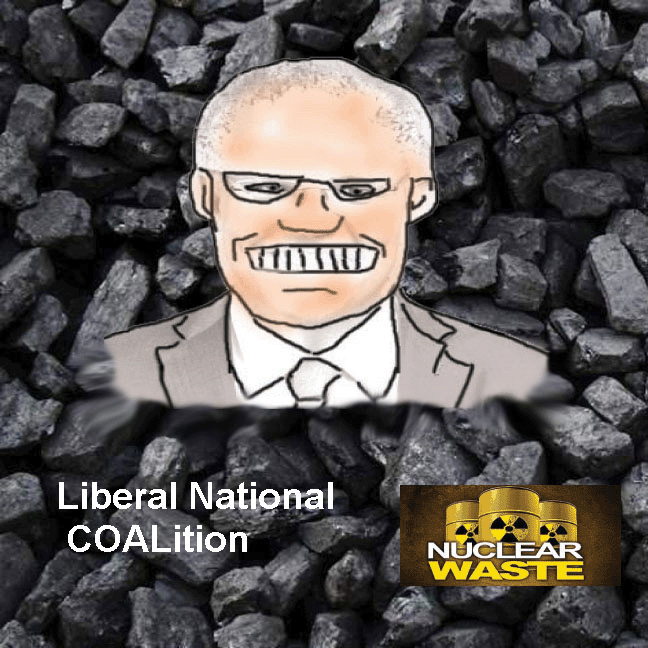 Times 20th May 2019, Australia’s jubilant conservatives have credited their unexpected election win to a remorseless questioning of the costs of Labor’s green policies. Labor went into polling day as overwhelming favourites, armed with a range of plans for emissions cuts and government spending plans designed to combat climate change.
https://www.thetimes.co.uk/article/uncosted-climate-policies-send-labor-to-shock-defeat-gc0z830pc
A record year for heat in Australia, but money tops climate in the election
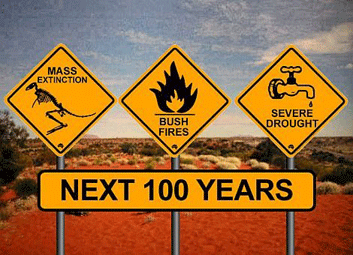 Times 20th May 2019 The environment could be a vote loser if it is associated only with economic cost. In the Australian election what happened to Tony Abbott was supposed to be a metaphor for the campaign as a whole. In Warringah, the
former Liberal prime minister lost his seat to Zali Steggall, a climate change activist. Australia has just endured its hottest ever summer and storms and dengue fever are turning up in new locations.
This was supposed to be the first election in which climate change was the decisive issue. In the event, the ruling Liberal-National coalition is close to securing the 76 seats needed for a majority in the House of Representatives. The coalition – which has been, to say the least, inactive on climate change – had been trailing for three years and the exit polls handed the victory to Labor, which had run on a programme of higher taxes and lower emissions. In the immediate aftermath of their defeat Labour strategists admitted they did not know what had hit them.
https://www.thetimes.co.uk/article/0573748a-7a5a-11e9-bed7-b51375720f1f
Australia’s election result disastrous for climate action – a negative example for the world
|
‘We have lost Australia for now,’ warns climate scientist in wake of election upset The unexpected victory of conservatives in Australia’s election is bad news for the future of global climate action. https://thinkprogress.org/we-have-lost-australia-warns-climate-scientist-scott-morrison-upset-92008fabb597/?fbclid=IwAR2pfAFrP0d2JOTKR5QaIqt8cBVZGfTE_cwjY82DyE8603QnDRp_clnc-q The unexpected victory of conservatives in Australia’s election Saturday is bad news for the future of global climate action, warn climate experts. Polls had suggested that the Labor Party, which supports strong climate action, held a narrow lead in recent days. But in the end, Prime Minister Scott Morrison won re-election as his Liberal Party (which is actually conservative) swept to victory. “Australians elected someone who once brought a lump of coal into Parliament urging us to dismiss the warnings from climate scientists, and to dig up more coal instead,” Professor Stephan Lewandowsky, an Australian cognitive scientist, told ThinkProgress in an email. “There is little doubt that his government will do precisely that.” “We have lost Australia for now,” warned Penn State climatologist Michael Mann in an email. “A coalition of a small number of bad actors now threaten the survivability of our species,” he said. These include “the fossil fueled Murdoch media empire, which saturated the country with dishonest right-wing campaign propaganda” working with a few “petrostates including Saudi Arabia, Russia, Trump’s America, and now Australia.”
In re-electing Morrison, a long-time opponent of climate action, Murdoch and his allies have triumphed again. In fact, Morrison first became prime minister back in 2015 following a party coup against then Prime Minister Malcolm Turnbull, who supported the climate action. Turnbull’s efforts to cut carbon pollution and promote clean energy rankled right-wing members of his ruling Liberal Party, whose stances were closer to President Trump’s pro-coal (and anti-immigrant) policies.
Australia is one of most vulnerable countries to climate change, since much of it is already very hot and dry — and so much of its population lives along the coast, which is threatened by rapidly rising sea levels. Morrison’s reelection is thus a disaster for the future of the country — and the world, since avoiding catastrophic climate change requires a collective effort. And so “we must redouble our efforts to make sure that the rest of the world works even harder to act on climate,” said Mann. “The stakes are too great to simply give up.” |
|
|

UK covering up the records on nuclear bomb testing in Australia and the Pacific. Why?

|
Unusual secrecy around 1950s nuclear testing , The Saturday Paper, Martin McKenzie-Murray 18 May 19 Between 1952 and 1957, Britain tested 12 nuclear weapons in Australia – on the Montebello Islands off the Pilbara coast, and at Maralinga and Emu Fields in the South Australian outback. The tests were hurried, incautious and showed extraordinary disregard for Australian assistance and the local Indigenous people who had been forcibly but imperfectly evacuated from their land. It was a clusterfuck,” says Elizabeth Tynan, an Australian historian, and the award-winning author of Atomic Thunder: The Maralinga Story. “The disregard was partly driven by the fact they were in a rush. They cut corners. They did it on the cheap – and it showed. They had very little regard for safety. Cavalier. They knew about the risks. There were international protocols. Many were disregarded. I met one man, he was a technician with the British effort in Australia, and he said of Indigenous Australians that they were ‘nothing to do with us – it was the Australian government’s responsibility’.”
For Susanne Roff growing up in Melbourne in the 1950s was uneventful. But later, living in Scotland with her husband, William Roff, an eminent historian, she developed a dogged, almost obsessive interest in this chapter of British history that remains cloaked in secrecy.
Once a month, Roff takes the train south from her home in a Scottish fishing village – to archives in London, Birmingham and Cambridge. She’s still looking for answers. “Why was the purportedly Australia-controlled Atomic Weapons Tests Safety Committee so ineffective?” she asks. “Why was the UK able to continue testing at Maralinga until barely six weeks before opening of the 1956 Olympics despite the known hazards to east coast populations? Why didn’t [Sir Mark] Oliphant ever speak out against the tests and contamination, including when he was governor of South Australia?” Late last year, Roff had another question: Why, more than 60 years after the last nuclear test in Australia, had the British government suddenly vanished previously declassified documents about the tests from its national archives? Roff wasn’t alone in her surprise. The Campaign for Freedom of Information, a British not-for-profit organisation, described it as worrying. All that was certain was that the files had been removed on the order of the Nuclear Decommissioning Authority. “WE CAN BUT WONDER WHY THE WORLD’S THIRD ATOMIC AND THERMONUCLEAR POWER HAS SUDDENLY BECOME SO NERVOUS ABOUT EVENTS THAT HAPPENED DECADES AGO.”“The secrecy is arguably even worse today,” Tynan tells me. She is working on a second book about the British tests. “British service personnel have run into brick walls at every turn [in seeking compensation and acknowledgement]. One of the clues to the attitude of the British government is that it has not really ever properly acknowledged what they did. They were nuclear colonialists and they buggered up a part of our country. One former British personnel I met burst into tears when he thought about how Britain had never said sorry. The secrecy … seems incomprehensible. They continue to be secretive.” But not all documents are closeted. Susanne Roff has some, which she shared with me – British intelligence files on Dr Eric Burhop, an Australian physicist who had worked on the Manhattan Project, which ran from 1939 to 1946. ……. Robert Menzies agreed to the testing immediately, without bothering to consult cabinet. For a time, only three people in the country knew of the agreement: the prime minister, treasurer and defence minister. He asked few questions of the British. “But it wasn’t pure patriotic sycophancy,” Tynan says of Menzies’ decision. “The pragmatic response was: vast reserves of uranium in Australia. It’s central to weaponry and power. It was completely valueless until the Manhattan Project. Then it became a valuable commodity. Australia had a lot of it. That was a very significant part of his reasoning. The other thing that would’ve informed Menzies’ thinking was that he was anxious to ensure Britain and America would protect Australia.” They were also without the counsel of the Australians who had worked on the American tests – notably, Mark Oliphant and Eric Burhop. Both Susanne Roff and Elizabeth Tynan agree Oliphant would have been a strong head of the safety authority, which was otherwise feckless. Both men were long suspected of being Communist spies, and may have been excluded to mollify US doubts about British security. The files on Burhop that I’ve seen are voluminous. The FBI, MI5 and ASIO all had records on him. In England and America, he was aggressively surveilled. His phone was tapped. Even Joseph Rotblat had his doubts about his former colleague. The British intelligence historian Andrew Brown has written: “Rotblat remained convinced that Burhop and other left-wing scientists … opposed the [proposed nuclear] moratorium not for their stated reasons but because it would perpetuate the USA’s monopoly and place the USSR at a dangerous disadvantage.”…… In 1984, Australia held a royal commission into the British tests. It found a litany of negligence and cover-ups. “Britain had to be dragged, kicking and screaming, to it,” Elizabeth Tynan says. Today, their attitude is much the same. In 2015, Fiji – frustrated by Britain’s refusal to compensate its people who suffered radiation poisoning during the Pacific tests – declared it would compensate citizens itself. “We are bringing justice to a brave and proud group of Fijians to whom a great injustice was done,” Fiji’s prime minister said. “Fiji is not prepared to wait for Britain to do the right thing.” Meanwhile, in Britain’s national archives, the nuclear files are still gone. “The UK government has always [downplayed] risks to the servicemen who took part in the tests, the Aboriginal community in the immediate vicinity of them, and the general population downwind … as well as possible genetic effects on subsequent generations,” Susanne Roff says. “We see similar responses in relation to Fukushima in Japan. All the operational and scientific documents relating to the Australian tests that have been on open access in the National Archives have suddenly gone walkabout. We can but wonder why the world’s third atomic and thermonuclear power has suddenly become so nervous about events that happened decades ago.” https://www.thesaturdaypaper.com.au/news/law-crime/2019/05/18/unusual-secrecy-around-1950s-nuclear-testing/15581016008158 |
|
Distress in Pacific Island governments, over climate change, and Australia’s inaction on this
UN secretary-general meets Pacific leaders to discuss ‘global catastrophe’ of climate change ABC By foreign affairs reporter Stephen Dziedzic , 15 May 19
- UN secretary-general Antonio Guterres said the Pacific is on the “front line of climate change”
- Pacific leaders have voiced frustration over Australia’s failure to curb its emissions
- Australian politicians say rapidly cutting emissions would be “ruinous” for Australia
Regional heavyweights had gathered at an historic climate change summit convened with the UN secretary-general Antonio Guterres.
Mr Guterres is intent on building global momentum for sharper cuts to emissions, arguing that drastic action is necessary to stave off ecological disaster.
The Pacific is on the “front line of climate change”, Mr Guterres told the meeting.
“It has a unique moral authority to speak out. It’s time for the world to listen.”
Senior Australian officials at the meeting could do little else; sent in the place of Prime Minister Scott Morrison only days before the federal election, they were bound to observer status by the caretaker conventions.
As a result, Australia did not sign up to the final statement by Pacific leaders, which declared climate change a “global catastrophe” and called for “transformative action” to stop it……
while Pacific leaders have praised New Zealand’s announcement that it wants to go carbon neutral by 2050, many are frustrated that Australia has failed to curb its emissions.
One Pacific official told the ABC the meeting’s call for radical action on climate change “really was aimed at the whole globe” but “for those in the room [it] was a message for one country”.
“Of course no-one said Australia. No-one needed to say Australia,” the official said. “What other country in the room could we be referring to?”
The outspoken Prime Minister of Samoa, Tuilaepa Sailele, went much further, wading straight into Australia’s election campaign during the post-summit press conference…….
decision makers in Canberra also know that the Pacific is increasingly impatient about Australia’s long and painful debate on climate policy.
The argument will flare up again in only months when regional leaders gather for the Pacific Islands Forum on tiny Tuvalu, which has long been a vocal champion for drastic climate action.
And this time, Australia will not be sitting on the sidelines. https://www.abc.net.au/news/2019-05-16/guterres-antonio-un-pacific-meeting-climate-change/11115816
Renewable energy and the problem of radioactive wastes from rare earths processing
 Toxic waste: Lynas Corporation and the downside of renewable energy, Independent Australia, 28 April 2019 In some cases, renewable energy can have profoundly harmful environmental effects if not managed correctly, writes Noel Wauchope. AUSTRALIA’S LYNAS CORPORATION is currently under the business and political spotlight. The current controversy over Lynas rare earth elements company is a wake-up call to an area of vulnerability in renewable technologies – the radioactive pollution produced by developing the rare earth elements essential for today’s hi-tech devices. Electric cars, batteries, energy efficient lighting, smartphones, solar panels, wind turbines and so on all need some of the 17 mineral elements classed as rare earth. The mining and processing of this produces radioactive trash.
Environmentalists, in their enthusiasm for renewable energy, seem unaware of this fact, while they rightly condemn coal and nuclear power, for their toxic by-products.
Australia’s Lynas Corporation has two major rare earth facilities — mining at Mount Weld, Western Australia, and processing at Kuantan, Malaysia. For years, there’s been a smouldering controversy going on in Malaysia, over the radioactive wastes produced by the refining facility at Kuantan.
Now, this has come to a head. On 17th April, the Malaysian Government insisted that Lynas Corp must remove more than 450,000 tonnes of radioactive waste from the country, for its licence to be renewed in September.
Australian Government legislation and policy prohibits the import of radioactive waste. However, some categories of radioactive waste are exempt from this law, if they contain very low levels of radioactivity.
Here’s where it all gets terribly complicated.
Wesfarmers wants to take over Lynas. The Australian Securities and Investments Commission (ASIC) is examining this, and especially Wesfarmers’ involvement with the Malaysian government. The Age on 16 April, reported that Prime Minister Mahathir, following discussions with Wesfarmers, announced that a company interested in acquiring Lynas had promised to extract the radioactive waste before exporting the ore to Malaysia.
All this raises the question of exactly what would an Australian company, such as Wesfarmers, do with that radioactive waste? This is a thorny problem. And what would Lynas do about their current problem?……
It is complicated to grasp the methods used and just what is required for the proper cleanup of the Lynas rare earth elements refining. Lynas CEO Amanda Lacaze maintains that the wastes left behind are only marginally radioactive. ……
culture and history really have their impact, precisely in Malaysia’s experience of rare earth processing. Even if the Lynas waste really is only slightly radioactive, Malaysians remember the environmental and health disaster of Bukit Merah; where, early this century, rare earth processing left a toxic wasteland.
China’s rare earth element processing disaster in Inner Mongolia is better known, an environmental catastrophe from the 1960s which lingers today. Modern processing has improved safety in waste management. In relation to nuclear power, there is an abundance of information on radioactive waste management, for China and for other countries. However, there’s little or no information that’s easily available to specifically discuss radioactive waste from rare earth processing.
Australia does have another, smaller, rare earth elements mining and processing operation, Arafura Resources, in Central Australia. The Northern Territory Environment Protection Authority (EPA) found this acceptable…..
What is clear, is that the production of the world’s hi-tech devices is not a simple matter as far as the environment goes. Climate change activists, anti-nuclear activists and environmentalists in general can keep on promoting renewable energy and electric cars.
But they seem to be blind to the total picture, which includes the downside. Obviously, it is necessary to ensure safer disposal of the trash from rare earth mining and processing. A better idea is to develop the design of devices so that the minerals can be retrieved from them and recycled, thus greatly eliminating the need for mining rare earth. And this is beginning to happen. …..
Energy conservation is the biggest factor in the change that is needed. Social change, however difficult that will be, is going to be the most important answer — the transition from a consumer society to a conserver society.
The Lynas radioactive trash controversy is not going to go away quickly, however much governments and corporations want to keep it under wraps. And it also could be a catalyst for discussion on that downside of renewable and hi-tech devices. This is something to think about as we throw away last year’s iPhone in favour of the latest model. https://independentaustralia.net/environment/environment-display/toxic-waste-lynas-corporation-and-the-downside-of-renewable-energy,12619#disqus_thread
Trident celebrations ignore Aboriginal victims of British nuclear weapons testing
https://www.greenleft.org.au/content/trident-celebrations-ignore-aboriginal-victims-british-nuclear-weapons-testing, Linda Pearson, April 26, 2019 Issue 1218, Scotland
Campaign for Nuclear Disarmament (CND) General Secretary Kate Hudson said the plan is “morally repugnant” and the organisation is urging supporters to convey their opposition to Defence Secretary, Gavin Williamson. Two Bishops and more than 20 priests have called on Westminster Abbey to cancel the service, which is set to take place on May 3……
The rhetoric of “deterrence” and “defence” is routinely invoked by nuclear-armed states to obscure the horrifying truth about nuclear weapons and justify national security doctrines that rely on them. Nuclear weapons are unique in their destructive power; “designed to indiscriminately kill and destroy thousands of innocent civilians”, as the Bishop of Colchester told The Times last week. This reality was recognised by most of the world’s countries, which voted to ban nuclear weapons in 2017.
Britain’s nuclear weapons program has already destroyed the lives of countless innocent civilians. More than 1200 Indigenous Australians were exposed to radiation during British nuclear weapons testing in the 1950s and 1960s, while many others were displaced. The effects continue to be experienced by their families today. Some are now calling on the British government to apologise for the testing, instead of celebrating Trident.
Nuclear testing in Australia
Britain conducted 12 major nuclear weapons tests in Australia at the Montebello Islands, and at Emu Field and Maralinga in South Australia.
After securing the agreement of the Australian government, the British established a permanent test site at Maralinga in 1955. Seven major and several hundred “minor” tests were carried out there, releasing 100kg of radioactive materials into the surrounding area.
The British and Australian governments of the day demonstrated a callous disregard for the lives of Aboriginal people that is characteristic of the settler-colonial mindset. Permission to conduct the testing was not sought from Aboriginal landowners and the Australian government decided they should not be informed of the risks.
When an Australian scientist asked British authorities about the potential danger to local Aboriginal people, the response was that “a dying race couldn’t influence the defence of Western civilisation”.
Many Aboriginal people were forcibly removed from their land prior to the tests, destroying their way of life. Others experienced serious health issues as a result of their exposure to radiation.
Yankunytjatjara man Yami Lester went blind after a “black mist” from the explosions enveloped his country. Others experienced skin rashes, diarrhea and vomiting. Today, Aboriginal communities in the area experience high rates of diseases associated with the effects of radiation poisoning.
Yami Lester’s daughter, Karina Lester, and her family played a crucial role in the International Campaign to Abolish Nuclear Weapons (ICAN). They collected and shared stories from the survivors of nuclear weapons testing that were instrumental in convincing 122 states that the only safe way to deal with nuclear weapons is to eliminate them.
ICAN won the Nobel Peace Prize for its efforts to bring about the 2017 United Nations Treaty on the Prohibition of Nuclear Weapons. The historic treaty recognises “the disproportionate impact of nuclear-weapon activities on Indigenous peoples”. The British and Australian governments boycotted the UN negotiations, however, and have ruled out signing the treaty.
No cause for celebration
Karina Lester said “survivors of the British Nuclear Tests carried out on Australian soil in the 1950’s and 1960’s in South Australia’s outback are still haunted. The Indigenous communities still suffer with high numbers of deaths, cancers, respiratory illnesses and autoimmune disease.”
Several attempts to clean up the Maralinga site have been made by British and Australian governments, thanks to the campaigning of survivors like Yami Lester, but contamination at the site remains. In 1995, Aboriginal peoples received just £7.5 million for the loss and contamination of their land. Only £110,000 has been paid to five Aboriginal people to compensate for their exposure to radiation. A class action was blocked by Britain’s Supreme Court in 2013.
Karina Lester said that the affected communities “have had no apology for the wrongdoings on our traditional lands to this day. As the British Government celebrates 50 years with nuclear weapons, Australia’s Indigenous communities in South Australia wear the scars.”
Instead of celebrating, Lester said, “we Indigenous South Australians urge the British government to own up and apologise for your actions
Aboriginal communities in South Australia now fear that they will be forced to bear the risks of radioactive contamination again. The Australian government is currently considering three sites for the location of a national nuclear waste dump, two on Barngarla land, near Kimba, and one on Adnyamathanha land at Wallerberdina Station, near the Finders Ranges.
The dump will host nuclear material currently stored at different sites in Australia, plus waste from Britain pursuant to a 2012 agreement between the British and Scottish governments. The agreement relates to waste generated by the reprocessing of Australian nuclear fuel at Dounreay. However, that waste is to remain where it is and a substituted amount will be shipped from the Sellafield nuclear reprocessing and decommissioning site, located on the coast of the Irish Sea.
The views of traditional owners have been sidelined throughout the process for choosing the dump’s location and Adnyamathanha’s traditional owners say that federal government contractors have already damaged sacred sites. As a result, two separate human rights complaints are outstanding in Australian courts.
Campaigners have called on the British and Scottish governments to halt the shipment while there is a risk that it will end up dumped on Aboriginal land without the consent of the Traditional Owners. However, the British government said the shipment “will comply with all relevant international laws” and the eventual destination of the waste is “a matter for the Australian authorities”. The British Environment Agency has so far failed to respond to requests to halt the shipment of waste from Sellafield.
The Scottish government has also failed to act to stop the shipment, despite expert advice it commissioned, which states that the Scottish Environment Protection Agency and, ultimately, Scottish ministers could refuse to authorise the shipment on human rights grounds.
Britain’s plans to celebrate 50 years of at-sea nukes erases the experience of Indigenous people affected by nuclear weapons testing. Those experiences should be front and centre in any discussion about nuclear weapons, as ICAN recognised.
Instead of celebrating, we should be looking at ways to redress the past and prevent future harm. Britain should apologise for its nuclear weapons testing and pay adequate compensation to those affected. The shipment of nuclear waste from Sellafield should be stopped.
But there is only one way we can prevent more lives being destroyed by nuclear weapons and that is by eliminating them altogether. https://www.greenleft.org.au/content/trident-celebrations-ignore-aboriginal-victims-british-nuclear-weapons-testing
1 This Month



26 September – International Day for the Total Elimination of Nuclear Weapons


PLEASE OPPOSE HR 8255 AND S.3639 – bills would accelerate satellite deployment, with no environmental review or safeguards – https://ncstd5li.quorum.us/campaign/169331/
To see nuclear-related stories in greater depth and intensity – go to https://nuclearinformation.wordpress.com
-
Archives
- September 2026 (233)
- August 2026 (330)
- July 2026 (355)
- June 2026 (287)
- May 2026 (306)
- April 2026 (356)
- March 2026 (251)
- February 2026 (267)
- January 2026 (308)
- December 2025 (358)
- November 2025 (359)
- October 2025 (375)
-
Categories
- 1
- 1 NUCLEAR ISSUES
- business and costs
- climate change
- culture and arts
- ENERGY
- environment
- health
- history
- indigenous issues
- Legal
- marketing of nuclear
- media
- opposition to nuclear
- PERSONAL STORIES
- politics
- politics international
- Religion and ethics
- safety
- secrets,lies and civil liberties
- spinbuster
- technology
- Uranium
- wastes
- weapons and war
- Women
- 2 WORLD
- ACTION
- AFRICA
- Atrocities
- AUSTRALIA
- Christina's notes
- Christina's themes
- culture and arts
- Events
- Fuk 2022
- Fuk 2023
- Fukushima 2017
- Fukushima 2018
- fukushima 2019
- Fukushima 2020
- Fukushima 2021
- general
- global warming
- Humour (God we need it)
- Nuclear
- RARE EARTHS
- Reference
- resources – print
- Resources -audiovicual
- Weekly Newsletter
- World
- World Nuclear
- YouTube
-
RSS
Entries RSS
Comments RSS
 nuclear-news