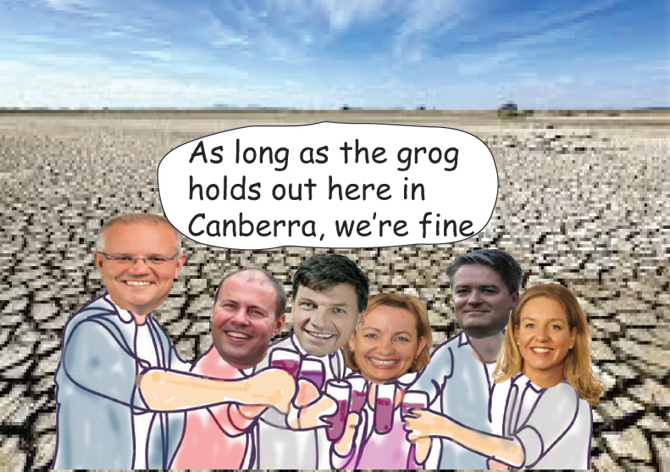
Distress in Pacific Island governments, over climate change, and Australia’s inaction on this
UN secretary-general meets Pacific leaders to discuss ‘global catastrophe’ of climate change ABC By foreign affairs reporter Stephen Dziedzic , 15 May 19
- UN secretary-general Antonio Guterres said the Pacific is on the “front line of climate change”
- Pacific leaders have voiced frustration over Australia’s failure to curb its emissions
- Australian politicians say rapidly cutting emissions would be “ruinous” for Australia
Regional heavyweights had gathered at an historic climate change summit convened with the UN secretary-general Antonio Guterres.
Mr Guterres is intent on building global momentum for sharper cuts to emissions, arguing that drastic action is necessary to stave off ecological disaster.
The Pacific is on the “front line of climate change”, Mr Guterres told the meeting.
“It has a unique moral authority to speak out. It’s time for the world to listen.”
Senior Australian officials at the meeting could do little else; sent in the place of Prime Minister Scott Morrison only days before the federal election, they were bound to observer status by the caretaker conventions.
As a result, Australia did not sign up to the final statement by Pacific leaders, which declared climate change a “global catastrophe” and called for “transformative action” to stop it……
while Pacific leaders have praised New Zealand’s announcement that it wants to go carbon neutral by 2050, many are frustrated that Australia has failed to curb its emissions.
One Pacific official told the ABC the meeting’s call for radical action on climate change “really was aimed at the whole globe” but “for those in the room [it] was a message for one country”.
“Of course no-one said Australia. No-one needed to say Australia,” the official said. “What other country in the room could we be referring to?”
The outspoken Prime Minister of Samoa, Tuilaepa Sailele, went much further, wading straight into Australia’s election campaign during the post-summit press conference…….
decision makers in Canberra also know that the Pacific is increasingly impatient about Australia’s long and painful debate on climate policy.
The argument will flare up again in only months when regional leaders gather for the Pacific Islands Forum on tiny Tuvalu, which has long been a vocal champion for drastic climate action.
And this time, Australia will not be sitting on the sidelines. https://www.abc.net.au/news/2019-05-16/guterres-antonio-un-pacific-meeting-climate-change/11115816
Renewable energy and the problem of radioactive wastes from rare earths processing
Toxic waste: Lynas Corporation and the downside of renewable energy, Independent Australia, 28 April 2019 In some cases, renewable energy can have profoundly harmful environmental effects if not managed correctly, writes Noel Wauchope. AUSTRALIA’S LYNAS CORPORATION is currently under the business and political spotlight. The current controversy over Lynas rare earth elements company is a wake-up call to an area of vulnerability in renewable technologies – the radioactive pollution produced by developing the rare earth elements essential for today’s hi-tech devices. Electric cars, batteries, energy efficient lighting, smartphones, solar panels, wind turbines and so on all need some of the 17 mineral elements classed as rare earth. The mining and processing of this produces radioactive trash.
Environmentalists, in their enthusiasm for renewable energy, seem unaware of this fact, while they rightly condemn coal and nuclear power, for their toxic by-products.
Australia’s Lynas Corporation has two major rare earth facilities — mining at Mount Weld, Western Australia, and processing at Kuantan, Malaysia. For years, there’s been a smouldering controversy going on in Malaysia, over the radioactive wastes produced by the refining facility at Kuantan.
Now, this has come to a head. On 17th April, the Malaysian Government insisted that Lynas Corp must remove more than 450,000 tonnes of radioactive waste from the country, for its licence to be renewed in September.
Australian Government legislation and policy prohibits the import of radioactive waste. However, some categories of radioactive waste are exempt from this law, if they contain very low levels of radioactivity.
Here’s where it all gets terribly complicated.
Wesfarmers wants to take over Lynas. The Australian Securities and Investments Commission (ASIC) is examining this, and especially Wesfarmers’ involvement with the Malaysian government. The Age on 16 April, reported that Prime Minister Mahathir, following discussions with Wesfarmers, announced that a company interested in acquiring Lynas had promised to extract the radioactive waste before exporting the ore to Malaysia.
All this raises the question of exactly what would an Australian company, such as Wesfarmers, do with that radioactive waste? This is a thorny problem. And what would Lynas do about their current problem?……
It is complicated to grasp the methods used and just what is required for the proper cleanup of the Lynas rare earth elements refining. Lynas CEO Amanda Lacaze maintains that the wastes left behind are only marginally radioactive. ……
culture and history really have their impact, precisely in Malaysia’s experience of rare earth processing. Even if the Lynas waste really is only slightly radioactive, Malaysians remember the environmental and health disaster of Bukit Merah; where, early this century, rare earth processing left a toxic wasteland.
China’s rare earth element processing disaster in Inner Mongolia is better known, an environmental catastrophe from the 1960s which lingers today. Modern processing has improved safety in waste management. In relation to nuclear power, there is an abundance of information on radioactive waste management, for China and for other countries. However, there’s little or no information that’s easily available to specifically discuss radioactive waste from rare earth processing.
Australia does have another, smaller, rare earth elements mining and processing operation, Arafura Resources, in Central Australia. The Northern Territory Environment Protection Authority (EPA) found this acceptable…..
What is clear, is that the production of the world’s hi-tech devices is not a simple matter as far as the environment goes. Climate change activists, anti-nuclear activists and environmentalists in general can keep on promoting renewable energy and electric cars.
But they seem to be blind to the total picture, which includes the downside. Obviously, it is necessary to ensure safer disposal of the trash from rare earth mining and processing. A better idea is to develop the design of devices so that the minerals can be retrieved from them and recycled, thus greatly eliminating the need for mining rare earth. And this is beginning to happen. …..
Energy conservation is the biggest factor in the change that is needed. Social change, however difficult that will be, is going to be the most important answer — the transition from a consumer society to a conserver society.
The Lynas radioactive trash controversy is not going to go away quickly, however much governments and corporations want to keep it under wraps. And it also could be a catalyst for discussion on that downside of renewable and hi-tech devices. This is something to think about as we throw away last year’s iPhone in favour of the latest model. https://independentaustralia.net/environment/environment-display/toxic-waste-lynas-corporation-and-the-downside-of-renewable-energy,12619#disqus_thread
Trident celebrations ignore Aboriginal victims of British nuclear weapons testing
https://www.greenleft.org.au/content/trident-celebrations-ignore-aboriginal-victims-british-nuclear-weapons-testing, Linda Pearson, April 26, 2019 Issue 1218, Scotland
Campaign for Nuclear Disarmament (CND) General Secretary Kate Hudson said the plan is “morally repugnant” and the organisation is urging supporters to convey their opposition to Defence Secretary, Gavin Williamson. Two Bishops and more than 20 priests have called on Westminster Abbey to cancel the service, which is set to take place on May 3……
The rhetoric of “deterrence” and “defence” is routinely invoked by nuclear-armed states to obscure the horrifying truth about nuclear weapons and justify national security doctrines that rely on them. Nuclear weapons are unique in their destructive power; “designed to indiscriminately kill and destroy thousands of innocent civilians”, as the Bishop of Colchester told The Times last week. This reality was recognised by most of the world’s countries, which voted to ban nuclear weapons in 2017.
Britain’s nuclear weapons program has already destroyed the lives of countless innocent civilians. More than 1200 Indigenous Australians were exposed to radiation during British nuclear weapons testing in the 1950s and 1960s, while many others were displaced. The effects continue to be experienced by their families today. Some are now calling on the British government to apologise for the testing, instead of celebrating Trident.
Nuclear testing in Australia
Britain conducted 12 major nuclear weapons tests in Australia at the Montebello Islands, and at Emu Field and Maralinga in South Australia.
After securing the agreement of the Australian government, the British established a permanent test site at Maralinga in 1955. Seven major and several hundred “minor” tests were carried out there, releasing 100kg of radioactive materials into the surrounding area.
The British and Australian governments of the day demonstrated a callous disregard for the lives of Aboriginal people that is characteristic of the settler-colonial mindset. Permission to conduct the testing was not sought from Aboriginal landowners and the Australian government decided they should not be informed of the risks.
When an Australian scientist asked British authorities about the potential danger to local Aboriginal people, the response was that “a dying race couldn’t influence the defence of Western civilisation”.
Many Aboriginal people were forcibly removed from their land prior to the tests, destroying their way of life. Others experienced serious health issues as a result of their exposure to radiation.
Yankunytjatjara man Yami Lester went blind after a “black mist” from the explosions enveloped his country. Others experienced skin rashes, diarrhea and vomiting. Today, Aboriginal communities in the area experience high rates of diseases associated with the effects of radiation poisoning.
Yami Lester’s daughter, Karina Lester, and her family played a crucial role in the International Campaign to Abolish Nuclear Weapons (ICAN). They collected and shared stories from the survivors of nuclear weapons testing that were instrumental in convincing 122 states that the only safe way to deal with nuclear weapons is to eliminate them.
ICAN won the Nobel Peace Prize for its efforts to bring about the 2017 United Nations Treaty on the Prohibition of Nuclear Weapons. The historic treaty recognises “the disproportionate impact of nuclear-weapon activities on Indigenous peoples”. The British and Australian governments boycotted the UN negotiations, however, and have ruled out signing the treaty.
No cause for celebration
Karina Lester said “survivors of the British Nuclear Tests carried out on Australian soil in the 1950’s and 1960’s in South Australia’s outback are still haunted. The Indigenous communities still suffer with high numbers of deaths, cancers, respiratory illnesses and autoimmune disease.”
Several attempts to clean up the Maralinga site have been made by British and Australian governments, thanks to the campaigning of survivors like Yami Lester, but contamination at the site remains. In 1995, Aboriginal peoples received just £7.5 million for the loss and contamination of their land. Only £110,000 has been paid to five Aboriginal people to compensate for their exposure to radiation. A class action was blocked by Britain’s Supreme Court in 2013.
Karina Lester said that the affected communities “have had no apology for the wrongdoings on our traditional lands to this day. As the British Government celebrates 50 years with nuclear weapons, Australia’s Indigenous communities in South Australia wear the scars.”
Instead of celebrating, Lester said, “we Indigenous South Australians urge the British government to own up and apologise for your actions
Aboriginal communities in South Australia now fear that they will be forced to bear the risks of radioactive contamination again. The Australian government is currently considering three sites for the location of a national nuclear waste dump, two on Barngarla land, near Kimba, and one on Adnyamathanha land at Wallerberdina Station, near the Finders Ranges.
The dump will host nuclear material currently stored at different sites in Australia, plus waste from Britain pursuant to a 2012 agreement between the British and Scottish governments. The agreement relates to waste generated by the reprocessing of Australian nuclear fuel at Dounreay. However, that waste is to remain where it is and a substituted amount will be shipped from the Sellafield nuclear reprocessing and decommissioning site, located on the coast of the Irish Sea.
The views of traditional owners have been sidelined throughout the process for choosing the dump’s location and Adnyamathanha’s traditional owners say that federal government contractors have already damaged sacred sites. As a result, two separate human rights complaints are outstanding in Australian courts.
Campaigners have called on the British and Scottish governments to halt the shipment while there is a risk that it will end up dumped on Aboriginal land without the consent of the Traditional Owners. However, the British government said the shipment “will comply with all relevant international laws” and the eventual destination of the waste is “a matter for the Australian authorities”. The British Environment Agency has so far failed to respond to requests to halt the shipment of waste from Sellafield.
The Scottish government has also failed to act to stop the shipment, despite expert advice it commissioned, which states that the Scottish Environment Protection Agency and, ultimately, Scottish ministers could refuse to authorise the shipment on human rights grounds.
Britain’s plans to celebrate 50 years of at-sea nukes erases the experience of Indigenous people affected by nuclear weapons testing. Those experiences should be front and centre in any discussion about nuclear weapons, as ICAN recognised.
Instead of celebrating, we should be looking at ways to redress the past and prevent future harm. Britain should apologise for its nuclear weapons testing and pay adequate compensation to those affected. The shipment of nuclear waste from Sellafield should be stopped.
But there is only one way we can prevent more lives being destroyed by nuclear weapons and that is by eliminating them altogether. https://www.greenleft.org.au/content/trident-celebrations-ignore-aboriginal-victims-british-nuclear-weapons-testing
Australian rare earths company Lynas in a pickle over its radioactive wastes in Malaysia
Record result but still no breathing space for Lynas, The Age, Colin Kruger, April 20, 2019
It should have been a great week for Lynas Corp….. Despite soft prices in the rare earths market – and a forced shutdown of its operations in Decemberdue to a local Malaysian government cap on its production limits – Lynas reported a 27 per cent jump in revenue to $101.3 million in the March quarter……
the company was still “seeking clarification” on comments earlier this month by Malaysian Prime Minister Mahathir Mohamad, which appeared to solve the problem of the licence pre-condition that Lynas says it cannot meet – removal of the radioactive waste by September 2.
Mahathir said Lynas – or any potential acquirer (without explicitly naming Lynas’ estranged suitor, Wesfarmers, whose $1.5 billion indicative offer for the group was rebuffed in March) – would be able to continue to operate in Malaysia if it agreed to extract the radioactive residue from its ore before it reached the country.
Despite two cabinet meetings since that announcement, Mahathir has failed to clarify his comments, or confirm whether it means Lynas might not need to move the existing mountain of radioactive waste that has been accumulating at its $1 billion, 100-hectare processing facility in Kuantan province.
The PM’s comments – which have mired Wesfarmers in controversy over what exactly its chief executive, Rob Scott, said to Mahathir in a meeting ahead of this statement – hinted at a path Lynas could have taken instead of processing its ore in Malaysia.
Crown jewel
Lynas’ crown jewel is its world-class rare earths deposit in Mt Weld, Western Australia.
The eventual decision to set up its processing plant in Malaysia meant Lynas also exported the controversy over what happens to the toxic waste produced by the extraction process. And as the water-leached purification (WLP) residue – which contains low-level radioactive waste – has accumulated since production started in 2013, so has the push-back.
It reached its nadir in December last year when the Malaysian government made the export of the radioactive waste a pre-condition of its licence being renewed beyond September.
The Malaysian PM would be well aware that the implications of closing the rare earth processing plant extend well beyond Malaysia and Australia.
Global implications
There are significant global concerns about the fact that China dominates the supply of rare earths – a group of 17 elements crucial to the manufacture of hi-tech products like digital cars, smart phones and wind turbines.
Lynas is the only significant miner and processor of rare earths outside China.
Not that this means anything in Malaysia, where there has been no end to the negative news that has dogged the Lynas operations since it set foot in the country.
Lynas was just this week forced to deny fresh allegations it had breached Malaysian environmental regulations by storing more than 1.5 million tonnes of waste on-site for years. The worry for Lynas is that the latest complaint, by Malaysian MP Lee Chean Ching, related to the 1.13 million tonnes of non-toxic waste produced by its operations, not the 450,000 tonnes of radioactive waste.
The Sydney Morning Herald and The Age also revealed this week that Lynas was warned in a confidential 2011 report, by crisis management group Futureye, that there was an “urgent need” for it to win the local community’s support.
The report presciently warned that its operations in the country could be jeopardised if it did not change the way it dealt with environmental concerns and the government. ….
Concerns pre-date Lynas
Malaysian concerns around rare earth processing pre-date Lynas.
The untold story of the campaign to smear Julian Assange
This prospect prompted the UN Working Group on Arbitrary Detention and 33 EU parliamentarians to issue strongly worded statements to both the UK and Ecuadorian governments in December last year, warning against facilitating the prosecution of a journalist, editor and publisher for “publishing the truth”. The statements demanded Assange’s “immediate release, together with his safe passage to a safe country”, and reminded the UK of its “binding” legal obligations to secure freedom for Assange.
A critical task for propagandists such as those waging a psychological war on Wilkileaks, then, is to feed audiences material that supports official narratives and exclude that which does not. Since its inception, the smear campaign against Julian Assange and Wikileaks has been remarkably concerted and consistent in that regard.
With the new year, however, news broke that the International Monetary Fund (IMF) had offered Ecuador a $10 billion bailout in return for handing Julian Assange over to the United States. This bounty came on top of earlier US pressures and inducements, reportedly including increased oil exports, military co-operation and another $1.1 billion in IMF loans, with the US representative of the IMF instructing Ecuador that it must “resolve” its relationship with Julian Assange in order to receive the IMF money.
Australian Barrister Greg Barns has called it the blackmailing of a nation. News website 21st Century Wirecalled it “one of the biggest international bribery (or extortion) cases in history.”
While there is “not a single shred of evidence that any of [Wikileaks’] disclosures caused anyone harm”, writes journalist and author Nozomi Hayase, what Wikileaks did do in 2010 was expose thousands of previously unreported civilian deaths in Iraq and Afghanistan. These deaths included the nonchalant gunning down of children, journalists and their rescuers, and other “indiscriminate violence… torture, lies [and]bribery”, writes Chris Hedges. According to Pentagon Papers whistleblower Daniel Elsberg, the leaks exposed “a massive cover-up over a number of years by the American authorities”.
Julian in ‘critical danger’, new rules ‘torture’ – Assange mother *AUDIO*
The Psychology Of Getting Julian Assange, Part 2: The Court Of Public Opinion And The Blood-Curdling Untold Story, New Matilda, By Dr Lissa Johnson February 25, 2019 In her ongoing special investigation into the detention of Julian Assange, Dr Lissa Johnson turns to the art of smear, and how to corrupt a judicial system.
On Friday 14th February, the Editor in Chief of news website Consortium News, Joe Lauria, visited Sydney to host a ‘Politics in the Pub’ event: Whistleblowing, Wikileaks and the Future of Democracy. The event took place in anticipation of upcoming rallies to free Assange…….
. It is imperative that we pressure the Australian government to make sure its citizen, Julian Assange, is protected from the lawlessness of the American Empire.” Continue reading
Australian rare earths processing company Lynas is rebuked by Malaysian environmental and consumer groups
Lynas is being unscientific, not SAM or CAP https://www.malaysiakini.com/letters/471173 SM Mohamed Idris 6 Apr 2019 Sahabat Alam Malaysia (SAM) and the Consumers Association of Penang (CAP) refer to the letter by Lynas Malaysia reported in Malaysiakini on 5 April 2019, which says that our recent statements about the plant’s wastes are “false and ignore scientific fact.”
The controversy is over the definition of wastes from the Lynas’ water leach purification (WLP) process, which contains thorium and uranium.
Lynas claims that the wastes are naturally-occurring radioactive material (called NORM), while we claim that the wastes are not naturally-occurring, but have been technologically-enhanced and should be called technologically-enhanced naturally-occurring radioactive material known as TENORM.
Citing “two eminent scientists”, Lynas states as fact that “the small amount of thorium and uranium in the WLP generated are not man-made but naturally occurring radionuclides found in soil, water and in food.”
Lynas is clearly distorting the facts.
First of all, the thorium and uranium containing wastes generated by Lynas are not found to naturally occur in the Gebeng area, where the plant is located. On the contrary, the raw material which is processed by the Lynas plant is lanthanide concentrate that contains the thorium, uranium and the rare-earth.
This raw material is processed and imported from the Mount Weld mine in Australia and is brought to Malaysia. It is then subject to further processing in Gebeng by Lynas.
Therefore, how can it be said that say that the thorium and uranium are naturally occurring in the soil, water and in food when they were not there before in the Gebeng area, if not for the Lynas operations?
Moreover, what is even more significant is that we are talking about the generation of an accumulated amount of more than 450,000 metric tonnes of radioactive wastes from the Lynas operations thus far. To call this naturally-occurring radioactive material is indeed unscientific.
Secondly, the wastes that Lynas has generated from the WLP process clearly falls within the definition of TENORM, as defined by the US Environmental Protection Agency (USEPA) as: “Naturally occurring radioactive materials that have been concentrated or exposed to the accessible environment as a result of human activities such as manufacturing, mineral extraction, or water processing.”
First nations’ land in Australia was nuclear bombed by the British
Living with the legacy of British Nuclear testing: Bobby Brown
Maralinga No More: The British Nuclear Bombing of First Nations Lands , Sydney Criminal Lawyers, By 31/03/2019 “……..Around 800 kilometres northeast of Adelaide, Maralinga was chosen as the main nuclear testing site, as the government found that the Maralinga Tjarutja people – who’d been living there since time immemorial – weren’t actually using the land.
The local Indigenous peoples were never consulted about the testing. Many were forcibly removed from their lands and taken to Yalata mission in SA, which effectively served as a prison camp. Some remained in the vicinity of the test site. Signs written in English were erected warning them to leave.
Indeed, on 27 September 1956, when the first nuclear device, One Tree, was detonated at Maralinga, First Nations peoples had no rights under Commonwealth Law. The vote didn’t come until 1962, while citizenship rights weren’t granted until the 1967 Referendum.
A toxic legacy
The Menzies Liberal government passed the Defence (Special Undertakings) Act 1952, which effectively allowed the British to access remotes parts of Australia to test atomic weapons. The general public for the most part had no awareness or understanding of what would take place.
British and Australian servicemen built a test site, airstrip and township at Maralinga known as Section 400. Australian troops signed documents under Australian secrecy laws that required them never to divulge any operational information, with the threat of harsh prison sentences.
Between September 1956 and October 1957, the British set off seven above ground nuclear bombs ranging from 1 to 27 kilotons. The first four were part of Operation Buffalo, while the last three made up Operation Antler.
Following these tests, the British continued to carry out around 600 minor nuclear warhead tests up until 1963. And it was these that caused the greatest contamination. The most dire being the Vixen B tests that led to massive contamination of plutonium, which has a half-life of over 24,000 years.
The impact upon First Nations
Around 1,200 Aboriginal people were exposed to the radioactive fallout of the tests. This could lead to blindness, skin rashes and fever. It caused the early deaths of entire families. And long-term illnesses such as cancer and lung disease became prevalent amongst these communities.
As for those who were moved away from their homelands, their way of life was destroyed. The Maralinga Tjarutja Land Rights Act was passed by the SA parliament in 1984, which ensured the damaged land was handed back freehold to traditional owners, as soon as it became “safe” again.
The Maralinga Tjarutja people, as well as other First Nations peoples, gradually returned to their homelands. Australia and reluctant British governments carried out initially terribly shonky clean-ups, that got progressively better, of the Maralinga site in 1967, 2000 and 2009.
And the British government eventually paid affected Aboriginal peoples $13.5 million in compensation for the loss and contamination of their lands in 1995.
Prior to Maralinga
The late Yankunytjatjara elder Yami Lester was just a boy living at Walatinna in the South Australian outback, when at 7 am on 15 October 1953, the British detonated a nuclear bomb at a test site at Emu Fields, northeast of Maralinga.
Mr Lester watched as a long, black cloud of smoke stretched out from the bomb site towards his homelands. In the wake of two tests carried out at Emu Fields within 12 days of each other, Yemi permanently lost his site, sudden deaths occurred, and his people suffered long-term illnesses.
The Emu Fields blasts were not the first on Australian soils. The initial nuclear bomb blast was carried out on the Monte Bello Islands in October 1952, while two more blasts took place in this Indian Ocean region in 1956.
And just like the Maralinga and Emu Fields blasts, the radioactive waste from these islands travelled across the entire continent. Two hotspots of excessive radioactive fallout resulting from the Emu Fields blasts were the NSW towns of Lismore and Dubbo.
Adding insult to injury
In 1989, the federal government announced it was establishing a nuclear waste dump near Coober Pedy in SA on the lands the Kupa Piti Kungka Tjuta, a senior women’s council representing the local peoples, many of whom had directly suffered the impacts of British nuclear testing.
As opposition to the dump grew, the government used the provisions of the Land Acquisition Act 1989 to seize the land, where it proposed to store the waste that was being produced at Sydney’s Lucas Heights reactor.
n July 2004, after a six year long battle the Kungka Tjuta senior women brought a stop the nuclear waste repository being situated on their land. And the federal government then turned to the NT’s Muckaty Station to dump the NSW waste. However, after that fell through, it’s still looking for a site.
The global threat continues
Maralinga took place at the height of the Cold War, after the US government refused to continue its nuclear program with British participation. And following World War Two, the crumbling empire sought to develop its own nuclear capacities in its faraway colonial backyard.
But, while many believe the threat of nuclear war faded with the end of the Cold War, renowned political analyst Noam Chomsky still warns that the two major threats in the world today are climate change and nuclear war.
Chomsky has pointed to a March 2007 article published in the Bulletin of the Atomic Sciences that revealed the “extremely dangerous” threat the Trump administration’s nuclear forces modernisation program is creating.
And as of January this year, the Doomsday Clock – which measures the likelihood of human-made global catastrophe – is still set at two minutes to midnight, as it first was 12 months prior. Based on the two threats identified by Chomsky, this setting is the closest to midnight it’s been since 1953. https://www.sydneycriminallawyers.com.au/blog/maralinga-no-more-the-british-nuclear-bombing-of-first-nations-lands/?fbclid=IwAR0UIC6VK_x6i8NAStEyZHZXK-Sld-IH4HFyE9gy-Zngp4RzaLtVeiWV7tM
Drastic decline in insect numbers – the bugocalypse
Why are insects dying in such numbers? https://www.smh.com.au/environment/conservation/why-are-insects-dying-in-such-numbers-20190319-p515hb.html By Greg Callaghan March 23, 2019 It’s been dubbed the bugocalypse – study after study rolling in from countries across the globe pointing to dramatic declines in insect populations. In Germany, an 82 per cent fall in midsummer invertebrate populations across 63 nature reserves between 1990 and 2017; in the Puerto Rico rainforest, a 75 per cent reduction in the volume of insects between 1976 and 2013; in the UK, a one-third fall in the honeybee population over the past 10 years. Across the US, monarch butterfly and ladybird beetle numbers are at record lows.So what’s going on? Just more scary headlines, or a real indicator of an eco-crisis ahead? A bit of both. While certain “beneficial” insect populations (butterflies, grasshoppers, mayflies, dragonflies, ground beetles, fireflies) appear to be in unprecedented retreat, others considered pests and a risk to human health (tsetse flies, ticks, mosquitoes) are on the offensive again.
We’re all sure a decline is happening,” explains Dr David Yeates, director of the Australian National Insect Collection in Canberra. “But to obtain a useful measure, we need to compare insect numbers today with those of 30, 40 or 50 years ago – but invertebrate counts weren’t being done then.”
So what’s causing the bug die-off? The top culprit is likely to be wilderness loss – many insects feed off native plants, and the relentless spread of single-crop farmland and insecticides has shrivelled their range, says Yeates. Another culprit: global warming, which favours some insects over others. Cut out insects and you lose all the creatures that feed on them, including frogs, lizards and birds. Of course, a large proportion of the food we eat comes from plants pollinated by insects, and they also clean up the environment, notes Yeates. “Waking up in a world without insects would be like waking up in a garbage dump.”
Australian Nuclear Science and Technology Organisation (ANSTO)-a law unto itself, joins with China to make new nuclear reactors
Australia is back in the nuclear game, Independent Australia, By Noel Wauchope | 24 March 2019, One of Australia’s chief advocates for nuclear power Dr Adi Paterson, CEO of Australian Nuclear Science and Technology Organisation, (ANSTO), has done it again.
This time in China, he quietly signed Australia up to spend taxpayers’ money on developing a new nuclear gimmick — the Thorium Molten Salt Reactor (TMSR).
This new nuclear reactor does not physically exist and there is no market for it. So its development depends on government funding.
Proponents claim that this nuclear reactor would be better and cheaper than the existing (very expensive) pressurised water reactors, but this claim has been refuted. The TMSR has been described by analyst Oliver Tickell as not “green”, not “viable” and not likely. More recently, the plan has been criticised as, among other things, just too expensive — not feasible as a profitable commercial energy source.
Paterson’s trip to China and his signing up to this agreement received no Parliamentary discussion and no public information. The news just appeared in a relatively obscure engineering journal.
The public remains unaware of this.
In 2017, we learned through the Senate Committee process that Dr Paterson had, in June 2016, signed Australia up to the Framework Agreement for International Collaboration on Research and Development of Generation IV Nuclear Energy Systems (also accessible by Parliament Hansard Economics Legislation Committee 30/05/2017).
This was in advance of any Parliamentary discussion and despite Australia’s law prohibiting nuclear power development. Paterson’s decision was later rubber-stamped by a Senate Committee……..
Dr Paterson was then obviously supremely confident in his ability to make pro-nuclear decisions for Australia.
Nothing seems to have changed in Paterson’s confidence levels about making decisions on behalf of Australia.
Interestingly, Bill Gates has abandoned his nuclear co-operation with China. His company TerraPower was to develop Generation IV nuclear reactors. Gates decided to pull out of this because the Trump Administration, led by the Energy Department, announced in October that it was implementing measures to prevent China’s illegal diversion of U.S. civil nuclear technology for military or other unauthorised purposes.
Apparently, these considerations have not weighed heavily on the Australian Parliament.
Is this because the Parliament doesn’t know anything about Dr Paterson’s trip to China and his agreement for Australia to partner with the Shanghai Institute of Applied Physics (SINAP) in developing Thorium Molten Salt Reactors? https://independentaustralia.net/environment/environment-display/australia-is-back-in-the-nuclear-game,12488#.XJWdhxDqitc.twitter
150,000 climate strikers at 60 locations across Australia in schoolchildren’s pprotest
Students strike to demand climate action | ABC News
Climate strikes attract 150,000 supporters, https://www.sbs.com.au/news/climate-strikes-attract-150-000-supporters, 16 Mar 19, About 150,000 people took part in climate strikes across the country on Friday, with students planning more rallies if their demands for more action aren’t met. About 150,000 students, parents and activists have taken to the streets to protest over the federal government’s inaction on climate change.
Strikes were held across the country on Friday at 60 locations, as part of a global effort to shine a light on climate change.
The protests were estimated to be 10 times the size of those held in November. The students have three demands: stop the Adani coal mine in central Queensland, no new coal or gas, and 100 per cent renewables by 2030.
More strikes will be planned if the students don’t see the action they want from the government.
“If the politicians are just going to throw our futures away there’s nothing we can do but be out here and say: we’re not going to let you do that,” 15-year-old Olivia Boddington told AAP at a climate strike in Canberra.
“We’re not going to just go away.”
Huge crowds gathered across the country on Friday, including at Sydney’s Town Hall Square, outside Melbourne’s Old Treasury Building and in Brisbane’s CBD.
The movement was inspired by Swedish teen Greta Thunberg, who has been striking for climate action since last August.
The 16-year-old’s activism has earned her a Nobel Peace Prize nomination.
Senior cabinet minister Christopher Pyne criticised the students for striking, saying the move will damage their education.
However, Labor national president Wayne Swan defended student activism.
Scotland’s First Minister refused to meet Australian Aboriginal nuclear waste protestor – for political reasons

Internal emails uncovered by The Ferret reveal that the First Minister was advised to turn down a request for a meeting in 2018 so as not to become a “focus for criticism”. But officials said the public reason given for her refusal would be “on the standard basis of diary pressures”.
Campaigners reacted with sadness, saying that the Scottish Government’s “ears are closed”. The government stressed that it had “very limited scope” to address the issues raised.
Nuclear fuel was sent from an Australian research reactor to Dounreay on the north coast of Scotland for reprocessing in the 1990s. The resulting radioactive waste, amounting to 51 cemented drums, was originally due to be returned to Australia for disposal.
But under the terms of a waste substitution deal in 2014, Scottish and UK governments agreed that the drums should stay at Dounreay. Instead, the plan is to send four containers of “radiologically equivalent” waste to Australia from the Sellafield nuclear complex in Cumbria.
Two sites have been identified for a planned store for the waste in south Australia – Wallerberdina Station, near Hawker, and Kimber – both of which face opposition from indigenous communities. The Ferret reported in February that Scottish ministers had been advised that they had powers to prevent the waste being exported to protect human rights.
Revealingthe horror of white Australia’s massacres of Aboriginal people
|
As the toll of Australia’s frontier brutality keeps climbing, truth telling is long overdue, The myth of benign, peaceful settlement persists today – even as historians reveal a far more sinister picture• The Killing Times: the massacres of Aboriginal people Australia must confront
• A massacre map of the frontier wars – interactive Guardian by Paul Daley, 4 Mar 19 “………… The Australian Museum estimates that pre-European invasion in 1788, about 750,000 Indigenous people (representing some 700 language groups) inhabited the continent that would become Australia. This figure may well be an underestimate. Little over a century later, by federation in 1901, the Aboriginal and Torres Strait Island population had diminished to some 117,000. Black-white warfare and organised massacres, no matter how you define them, with police, British soldiers, native police, militia and raiding parties as the perpetrators, accounted for many tens of thousands of deaths. Individual acts of violence – including shootings, poisonings, torture and illegal incarceration – killed many more. Battle wounds, starvation (owing to the depletion of traditional hunting grounds) and disease – all of which can also be directly linked to invasion and frontier conflict – killed countless others. Yet the historiographic confect of benign, peaceful settlement and the unexplained “passing” or “extinction” of the “natives” pervaded well into the 1960s, replete with the deception that very few Aboriginal people died violently during pastoral and urban expansion and dispossession. Things began to change with the emergence of a new, more inquisitive, less empire-centric cohort of historians and writers who, not content with the Anglophile colonial trope of terra nullius and benevolence to the Indigenes, began to commit truth to the page……….. In the 1970s and 1980s a number of historians – among them Henry Reynolds, Marilyn Lake and Richard Broome – began focusing on frontier violence, using the colonial records, newspaper archives and family histories (including generational oral accounts of killings). Reynolds is acknowledged as the first Australian historian to make a calculated continental estimate of the number of Aboriginal and Torres Strait Islanders who died violently in Australian frontier conflict. In his 1981 book, The Other Side of the Frontier, and after at least a decade’s research Reynolds estimated the figure at about 20,000………. Reynolds speaks of the significance of Evans and Ørsted-Jensen’s research on the numbers of killings in colonial Queensland. Based on an extrapolation of native police documentation, they estimated (conservatively) that as many as 60,000 Aboriginal people died in frontier violence in Queensland alone. The national implications of the figure are profound; the wars that raged across this continent from 1788 did, it seem, claim more Indigenous lives than 62,000 Australian service personnel who died in the first world war………… https://www.theguardian.com/australia-news/2019/mar/04/as-the-toll-of-australias-frontier-brutality-keeps-climbing-truth-telling-is-long-overdue |
|
Australia’s Dept of Industry kept terrorist and other dangers secret from communities selected to host nuclear wastes
Risk of terrorism at radioactive waste site kept secret from residents near earmarked sites, Jade Gailberger, Federal Political Reporter, The Advertiser February 24,
The risk of terrorist activity at a radioactive waste site, including the removal of drums for use in a “dirty bomb”, has been kept secret from residents near two sites earmarked for a new national dump.
As the communities of Hawker and Kimba remain divided on the site selection for a new waste site, documents obtained under Freedom of Information laws reveal the Defence Department identified a potential risk of terrorist activity at a dump at Woomera.
The revelation has cemented the security concerns of residents, who say they have been ignored by Government officials.
The now closed Koolymilka dump, situated on Defence land at Woomera, was licensed for temporary radioactive waste storage but has not taken new material since 2010.
An emergency response plan for the site, which still houses waste that is anticipated to be transferred to a national facility, details scenarios that may affect it including:
-
- TERRORISTS removing drums to make a “dirty bomb”.
- MISSILE and aircraft strikes, fire, flood or a storm in Woomera that could damage the building and cause contamination if drums ruptured.
- CIVILIAN protest activity.
Defence has said it has no responsibility to inform the public of the risks because the new waste dump is an Industry Department project.
Kimba farmer Peter Woolford, who is opposed to radioactive waste storage on agricultural land, said security, terrorism and fire concerns at a national site had been raised but “fobbed off” by officials who claimed it “would be safe”.
“The (Industry) Department continually says it is going to be open and transparent but you have to obtain FOI documents to get the full story,” he said. “It’s an issue that the department should be … explaining.”
Centre Alliance Senator Rex Patrick said communities had been denied information needed to make an informed decision about a dump in their region.
At a Senate estimates hearing last week, Mr Patrick asked if the Industry Department had briefed the communities about potential terrorism. Industry Minister Matt Canavan said: “I have never been provided with any advice that this is at all a risk … this has never been raised as an issue”.
The Industry Department said the new dump would pose “no security or safety risk to the community” and “significant detail” on safety and security had been made public.
The Australian Nuclear Science and Technology Organisation said 14 of 45 jobs at the new dump would be security.
Scottish Ministers have the power to halt nuclear waste dumping near Aboriginal land in South Australia
Scottish ministers can stop nuclear waste dump, say advisers, The Ferret, 19 Feb 19, Scottish ministers have the power to halt plans to dump nuclear waste on Aboriginal land in Australia which could breach human rights, according to government advisors.
Documents obtained by The Ferret reveal that expert advice sought by ministers stated that the Scottish Government could prevent the export of radioactive waste from the UK under a swap arrangement involving the Dounreay nuclear complex in Caithness.
The revelations have prompted campaigners to call for the Scottish Government to step in and stop the waste dumping, which they see as a potential desecration of sacred Aboriginal lands in south Australia.
The Scottish Government and its regulator, the Scottish Environment Protection Agency (Sepa), have insisted that regulating the waste shipment is not their responsibility – but Sepa’s former chief executive says this is wrong.
Nuclear fuel was sent from an Australian research reactor to Dounreay for reprocessing in the 1990s. The resulting radioactive waste, amounting to 51 cemented drums, was originally due to be returned to Australia for disposal.
But under the terms of a waste substitution deal in 2014, Scottish and UK governments agreed that the drums should stay at Dounreay because of the difficulties of transporting them around the globe……
Peter Roche, an anti-nuclear campaigner and member of Nuclear Waste Advisory Associates, pointed out that environmentalists were opposed to nuclear waste being transported around the world. “It should be stored in above
ground stores on the site where it is produced,” he said. “And should certainly not be sent back to Australia if it is likely to pose a potential risk to the rights of Aboriginal communities near the two proposed storage sites in Australia.” He added: “The Scottish Government should accept that it bears some responsibility for this waste and tell the UK government
to halt the proposed shipment.” https://theferret.scot/scottish-government-australian-nuclear-waste/
-
Archives
- May 2026 (92)
- April 2026 (356)
- March 2026 (251)
- February 2026 (268)
- January 2026 (308)
- December 2025 (358)
- November 2025 (359)
- October 2025 (376)
- September 2025 (257)
- August 2025 (319)
- July 2025 (230)
- June 2025 (348)
-
Categories
- 1
- 1 NUCLEAR ISSUES
- business and costs
- climate change
- culture and arts
- ENERGY
- environment
- health
- history
- indigenous issues
- Legal
- marketing of nuclear
- media
- opposition to nuclear
- PERSONAL STORIES
- politics
- politics international
- Religion and ethics
- safety
- secrets,lies and civil liberties
- spinbuster
- technology
- Uranium
- wastes
- weapons and war
- Women
- 2 WORLD
- ACTION
- AFRICA
- Atrocities
- AUSTRALIA
- Christina's notes
- Christina's themes
- culture and arts
- Events
- Fuk 2022
- Fuk 2023
- Fukushima 2017
- Fukushima 2018
- fukushima 2019
- Fukushima 2020
- Fukushima 2021
- general
- global warming
- Humour (God we need it)
- Nuclear
- RARE EARTHS
- Reference
- resources – print
- Resources -audiovicual
- Weekly Newsletter
- World
- World Nuclear
- YouTube
-
RSS
Entries RSS
Comments RSS