Australia’s ICAN and Conservation Council of Western Australia commemorate Hiroshima Day


On August 5th, people from across Australia gathered, via Zoom, to commemorate the nuclear bombing of Hiroshima, and to hear speakers from ICAN Autralia (International Campaign to Abolish Nucleat Weapons).
Medlissa Clarke spoke of the human effects of this catastrophe, and of the efforts over time, towards disarmament. The biggest leap forward in this has been, in 2017, the U.N. Treaty on the Prohibition of Nuclear Weapons. The Treaty now has over 200 nations signed up, with 40 ratifications – not far from the 50 required to make it international law.
Most Australians want a nuclear weapons free world.But Australia’s policy does endorse nuclear weapons. A future Labor government might change that.
Dimity Hawkins described the misery experienced by the Japanese, the agonising stories of the survivors. Since Hiroshima, the nuclear bombs developed are greatly stronger, and have been tested over many years, on the Marshall Islands, on Maralinga, South Australia, and on other Pacific Islands, in nuclear colonialism that has never properly been cleaned up. Australia is part of that nuclear chain. But now,the survivors are speaking out. Red Cross and Red Crescent, the world’s greatest non government emergency service is strongly behind the Treaty movement, and the indigenous people, particularly Australia’s Aboriginals .
Former Senator Scott Ludlam commemorated the Hibakusha, and the impact of the nuclear weapons industry on indigenous people world-wide. He drew attention to the ?proud statement of U.S. Strategic Command – that their nuclear weapons are to be used in a “safe, secure and lethal way”.
The Treaty was an Australian initiative, brought about by the work of, at first, a few, who by-passed official systems, and went out getting signatures, setting up ICAN, which became an international movement.-, – showing that people can do this, have an effect and an influence. As cities will be the places to bear the catastrophe of nuclear annihilation, many Mayors of many have City Councils have signed up to the Treaty. The Treaty shows that no-one can now claim that nuclear weapons are acceptable, in the same way as biological and chemical warfare are unacceptable.
For information on the continuing CCWA webinar series go to http://www.ccwa.org.au/yellowcake_country_webinar_series
Another Hiroshima is Coming…Unless We Stop It Now
Today, an unprecedented campaign of propaganda is shooing us all off like rabbits. We are not meant to question the daily torrent of anti-Chinese rhetoric, which is rapidly overtaking the torrent of anti-Russia rhetoric. Anything Chinese is bad, anathema, a threat: Wuhan …. Huawei. How confusing it is when “our” most reviled leader says so.
The target is China. Today, more than 400 American military bases almost encircle China with missiles, bombers, warships and nuclear weapons. From Australia north through the Pacific to South-East Asia, Japan and Korea and across Eurasia to Afghanistan and India, the bases form, as one US strategist told me, “the perfect noose”.
In the Sydney Morning Herald, tireless China-basher Peter Hartcher described those who spread Chinese influence in Australia as “rats, flies, mosquitoes and sparrows”. Hartcher, who favourably quotes the American demagogue Steve Bannon, likes to interpret the “dreams” of the current Chinese elite, to which he is apparently privy. These are inspired by yearnings for the “Mandate of Heaven” of 2,000 years ago. Ad nausea.
To combat this “mandate”, the Australian government of Scott Morrison has committed one of the most secure countries on earth, whose major trading partner is China, to hundreds of billions of dollars’ worth of American missiles that can be fired at China.
At a quarter past eight on the morning of August 6, 1945, she and her silhouette were burned into the granite.
I stared at the shadow for an hour or more, then I walked down to the river where the survivors still lived in shanties.
I met a man called Yukio, whose chest was etched with the pattern of the shirt he was wearing when the atomic bomb was dropped.
He described a huge flash over the city, “a bluish light, something like an electrical short”, after which wind blew like a tornado and black rain fell. “I was thrown on the ground and noticed only the stalks of my flowers were left. Everything was still and quiet, and when I got up, there were people naked, not saying anything. Some of them had no skin or hair. I was certain I was dead.”
Nine years later, I returned to look for him and he was dead from leukaemia.
“No radioactivity in Hiroshima ruin” said The New York Times front page on 13 September, 1945, a classic of planted disinformation. “General Farrell,” reported William H. Lawrence, “denied categorically that [the atomic bomb] produced a dangerous, lingering radioactivity.”
Only one reporter, Wilfred Burchett, an Australian, had braved the perilous journey to Hiroshima in the immediate aftermath of the atomic bombing, in defiance of the Allied occupation authorities, which controlled the “press pack”.
“I write this as a warning to the world,” reported Burchett in the London Daily Express of September 5,1945. Sitting in the rubble with his Baby Hermes typewriter, he described hospital wards filled with people with no visible injuries who were dying from what he called “an atomic plague”.
For this, his press accreditation was withdrawn, he was pilloried and smeared. His witness to the truth was never forgiven.
The atomic bombing of Hiroshima and Nagasaki was an act of premeditated mass murder that unleashed a weapon of intrinsic criminality. It was justified by lies that form the bedrock of America’s war propaganda in the 21st century, casting a new enemy, and target – China.
During the 75 years since Hiroshima, the most enduring lie is that the atomic bomb was dropped to end the war in the Pacific and to save lives.
“Even without the atomic bombing attacks,” concluded the United States Strategic Bombing Survey of 1946, “air supremacy over Japan could have exerted sufficient pressure to bring about unconditional surrender and obviate the need for invasion. “Based on a detailed investigation of all the facts, and supported by the testimony of the surviving Japanese leaders involved, it is the Survey’s opinion that … Japan would have surrendered even if the atomic bombs had not been dropped, even if Russia had not entered the war [against Japan] and even if no invasion had been planned or contemplated.”
The National Archives in Washington contains documented Japanese peace overtures as early as 1943. None was pursued. A cable sent on May 5, 1945 by the German ambassador in Tokyo and intercepted by the US made clear the Japanese were desperate to sue for peace, including “capitulation even if the terms were hard”. Nothing was done.
The US Secretary of War, Henry Stimson, told President Truman he was “fearful” that the US Air Force would have Japan so “bombed out” that the new weapon would not be able “to show its strength”. Stimson later admitted that “no effort was made, and none was seriously considered, to achieve surrender merely in order not to have to use the [atomic] bomb”.
Stimson’s foreign policy colleagues — looking ahead to the post-war era they were then shaping “in our image”, as Cold War planner George Kennan famously put it — made clear they were eager “to browbeat the Russians with the [atomic] bomb held rather ostentatiously on our hip”. General Leslie Groves, director of the Manhattan Project that made the atomic bomb, testified: “There was never any illusion on my part that Russia was our enemy, and that the project was conducted on that basis.”
The day after Hiroshima was obliterated, President Harry Truman voiced his satisfaction with the “overwhelming success” of “the experiment”.
The “experiment” continued long after the war was over. Between 1946 and 1958, the United States exploded 67 nuclear bombs in the Marshall Islands in the Pacific: the equivalent of more than one Hiroshima every day for 12 years. Continue reading
Australia gets anti-China propaganda, funded by USA, in cahoots with Falun Gong

Before becoming Australia’s Defence Minister, Linda Reynolds worked as a project director at Raytheon (weapons manufacturer).
Propaganda Wars: US state department funds anti-China news outlet in Australia https://www.michaelwest.com.au/propaganda-wars-us-state-department-funds-anti-china-news-outlet-in-australia/
by Marcus Reubenstein | Aug 4, 2020 Office bearers of US-backed Chinese language news service Decode China are linked with Falun Gong, the spiritual group that has spent millions backing Donald Trump through fake social media accounts. The same people are on the board of the National Foundation for Australia China Relations, raising scepticism about its ability to repair fractured relationships. Marcus Reubenstein investigates US state funding of anti-China media in Australia and links to global arms dealers via ASPI.
The US State Department is quietly funding a Chinese-language news service in Australia, a move more typically associated with China’s state media propagandists.
And two of the three office bearers of the news service, Decode China, are members of a taxpayer-funded independent board advising the Australian government on engagement with China.
Corporate records show Dr Wai Ling Yeung and Maree Ma became secretary and director, respectively, of Decode China Pty Ltd just eight weeks before Foreign Minister Marise Payne appointed them to the board of the National Foundation for Australia China Relations. The NFACR replaced the Australia China Council (ACC), which was set up by the Fraser government in 1978 and later chaired by former prime minister Gough Whitlam.
The retired Curtin University academic Dr Yeung is a vocal critic of the Chinese government, while Ma is the general manager of the Falun Gong-aligned, largely anti-Chinese government Vision Times newspaper. According to journalist and former Australian Falun Gong practitioner Ben Hurley, Vision Times is part of the apparatus of Falun Gong media in Australia, led by The Epoch Times and New Tang Dynasty Television.
The spiritual group Falun Gong is banned in China and there is substantial evidence that its mainland Chinese followers are harshly persecuted by the Chinese government.
However, former practitioners say it’s a dangerous cult, whose leaders claim to have the power of levitation and tell followers that aliens from other planets are responsible for interracial marriage and mixed-race children.
Falun Gong-aligned media affiliates in the US have been accused of pouring millions of dollars into fake social media accounts and Facebook advertising, since banned, supporting Donald Trump. A recent investigation by the ABC’s Foreign Correspondent and Background Briefing programs revealed Falun Gong-affiliated media in the US have spent more than US$11.5 million in social media advertising to promote Trump.
ASPI lurking in the background Continue reading
When it comes to nuclear waste dumping, the Australian government sees black people as flora and fauna, not citizens
 Barngarla continue fight against plan to dump nuclear waste on Country, SBS News 29 July 20, Barngarla mob say they were not properly consulted by federal government for plans to store radioactive waste on Country at Kimba in SA, and that their concerns continue to be ignored. By Royce Kurmelovs, NITV News 29 July 20
The 50-year-old Barngarla woman is talking about the enduring connection she has to Kimba when she tells how on the day she was born, her parents had been waiting for an ambulance that never came.
Forced to make their own way to the hospital, she says her mum made it as far as the tree outside before giving birth.
“So I’m born on Country,” she says.
Though she may not live there today, Jeanne says a part of her has never left. It is a detail that underscores the significance of the moment she learned Kimba was being considered as a dump for radioactive waste.
“I used to be a carer for my mum. When I first heard [about the facility], I told her. She goes: ‘no, no, no’ and got angry,” Jeanne says. “She said; ‘we don’t want it there’. She said to me: ‘you got to fight for this. You got to fight for it, we can’t have that place there. It’s a special place for us.’”
Most among the Barngarla have a similar story about the shock and confusion at learning their traditional Country was under consideration as part of a proposal to build a nuclear waste storage facility that would take in samples from 100 sites across the continent.
No one, they say, from the federal government contacted them beforehand to talk about the proposal, leaving most to find out through the news media or word of mouth.
Instead it was up to the Barngarla themselves, through the the Barngarla Determination Aboriginal Corporation (BDAC) to take the initiative and write to the government in April 2017 to find out what was going on.
‘Wasn’t interested in our views’
That first letter would plunge them into a fight that has so far lasted three years, until it entered a new phase in February when former Industry Minister Matt Canavan announced – a day before he resigned – that he had selected a site just outside of Kimba to situate the nuclear waste facility…….
Over the course of its operating lifetime, the site would house low-to-intermediate level nuclear waste made up of medical waste drawn from 100 sites across the country. This material would include medical waste, but also the more serious TN81 canisters – casks of material once exposed to high levels of radiation that require containment for several hundred years.
If supporters of the proposal celebrated the financial windfall it would bring, critics worried the decision represented the thin end of a wedge that would eventually see the site expand to house higher-level toxic waste.
For the Barngarla people, however, the proposal represented something more significant: yet another decision where they have been overlooked, ignored and overruled in a process they describe as “divide and rule”.
“It’s like the government’s not listening to us,” Jeanne says. “It’s like if the government picks a place where they want to put rubbish like that, they’ll just go and do it and they don’t care what the people think. And that’s wrong. They should be listening to what the people want too.”….
After their early efforts to find out more, the Barngarla say they were stonewalled from the very beginning by both the Department of Industry, Science, Energy and Resources, and the Australian Radioactive Waste Agency (ARWA). That stance would become a pattern…….
They basically created hurdles,” Bilney says. “The catchphrase was ‘rateable property’ – that’s white man’s terms ‘rateable property’. We’re the native title holders. That holds more weight than ‘rateable property’, so we should have been included.”
Around the time the Barngarla filed their lawsuit to challenge the vote, the first meeting with the department took place in August 2018 – a moment Bilney recalls with frustration.
He says Mr Canavan spoke for fifteen minutes before he left, taking all the government representatives with him.
“That’s it,” Bilney says. “He wasn’t interested in our views, he just wanted us to hear what he had to say.”
When the poll of Kimba residents was counted, it returned a result that saw 61.6 per cent of 824 participants vote in favour of the proposal.
BDAC responded by organising is own poll, asking its 209 members the same question that was asked of the broader Kimba residents. The result would be a unanimous “No” from the 83 participants – a turnout figure explained by cultural and logistical factors that make it difficult to gather in any one place…….
Aliens in our own country’
What happens now is up to the Senate economics reference committee and a clutch of Labor, Greens and independent senators.
The Barngarla say the recent approach of the federal government – to legislate the precise location of the site – represents a new twist as it departs from the process established by the Gillard government under the National Radioactive Waste Management Act 2012.
Worse still, the Barngarla say the provisions of the bill will stymie their rights to seek a judicial review of the minister’s decision in the courts. The Parliamentary joint committee on human rights also raised concerns about the bill in April this year that it says may extinguish Native Title……..
So far it has taken two decades for the Barngarla to have their Native Title claim to a 45,000 square kilometre stretch of the Eyre Peninsula recognised by the courts – a process during which they were once informed that they did not exist as a people.
Neither have they forgotten the horror at Maralinga when the British army tested nuclear weapons after falsely declaring there were no Aboriginal people in the area.
To the Barngarla, the government has only decided to talk after the big decisions have been made.
“We’re still flora and fauna to these people,” Bilney says. “They should have included us from the start. We heard about it on the news. We weren’t included in the vote.
“You know, the Barngarla [native title] claim was basically an unwinnable case, they said. It’s taken us 21 years. Twenty-one years to win Native Title under white man’s law. And yet we’re still classed as second-class citizens? Flora and fauna.
“We’re basically aliens in our own Country.” https://www.sbs.com.au/nitv/article/2020/07/29/barngarla-continue-fight-against-plan-dump-nuclear-waste-country
Australia to retain its environmental laws prohibiting the nuclear industry

Mineral Policy Institute and Friends of the Earth Australia, 20 July 2020
National and state environment groups have given a cautious welcome to the continuation of long-standing protections against nuclear risks in the current statutory review of the Environmental Protection Biodiversity Conservation Act – Australia’s federal environmental laws. The interim report released today has stated that the Commonwealth should maintain the capacity to intervene in uranium mining and made no recommendation to change existing prohibitions on nuclear activities, including domestic nuclear power.
Civil society groups made a joint submission to the EPBC review calling for the retention of the long standing ban on nuclear power and continuing federal oversight of uranium mining. The EPBC review committee’s interim report has flagged an intention to continue both protections despite lobbying from the Mineral Council of Australia to weaken these.
However, environment groups are concerned about a possible weakening of uranium mining regulations flagged in the interim report. Associate Professor Gavin Mudd, Chair of the Mineral Policy Institute, said: “The interim report proposes the further devolution of uranium mining regulation to states and territories, coupled to the establishment of ‘National Environmental Standards’. An obvious risk is that the standards will be weak, enforcement will be deficient as is already the case, and devolution will weaken the already inadequate oversight of uranium mining.”
“Uranium mining is different to other types of mining. Australia’s uranium mining sector has been dominated by license breaches, accidents, spills and a persistent failure to rehabilitate as promised. The last thing we need is a weakening of regulations and oversight. Apart from SA and NT every state and territory have a ban or prohibition on uranium mining. It is unsafe and unpopular and needs greater scrutiny, not less,” Assoc. Prof. Mudd said.
The Review’s interim report makes no recommendation to repeal the long-standing prohibition on domestic nuclear power. “Nuclear power is expensive, dangerous and unpopular,” said Dr Jim Green, national nuclear campaigner with Friends of the Earth Australia. “The prohibition in the EPBC Act reflects this. Nuclear is thirsty, produces high level nuclear waste for which there are no safe storage options and produces materials that can be diverted into nuclear weapons. It is a profound security and safety risk. And nuclear power is absurdly expensive.”
“Recent comments from the current Environment Minister and Opposition Leader show a clear bipartisan rejection of nuclear power. There is broad opposition among civil society as shown through a joint statement by over 60 organisations representing millions of Australians. Given the lack of social license for nuclear power in Australia we welcome the continuation of this prudent prohibition,” Dr Green said.
Following the Australian uranium-fuelled Fukushima nuclear disaster the UN Secretary General called for all uranium producing countries to conduct a cost-benefit analysis of the industry. Groups have called on the Morrison government to now hold an independent review of the uranium sector.
Australia becomes world’s biggest exporter of fossil fuels
Passing the pollution: Australia becomes world’s biggest exporter of fossil fuels, https://thenewdaily.com.au/news/2020/07/09/australia-export-fossil-fuels/ Cait Kelly, Australia is now the biggest exporter of climate change, leading the world in selling fossil fuels, a new report reveals.Emissions from nations which bought our gas, coal and oil increased by 4.4 per cent between 2018 and 2019, with Australia now the world’s biggest fossil fuel producing country, the report from UNSW says.
Our exported emissions are now greater than the domestic pollution of Germany, Canada, Turkey and the UK.
“Not only is Australia a laggard in meeting its UN Paris emission reduction targets, but it is also now the world’s largest exporter of coal and gas,” the authors wrote.
“In fact, the emissions from Australia’s exported fossil fuels are now greater than Germany’s domestic emissions.”
Australia has been on track to become the world’s bigger carbon dioxide polluter for a while, with a report from The Australian Conservation Foundation last year warning we would hit the milestone soon.
Russia and Saudi Arabia were both above Australia as recently as August last year.
Using new data from the Office of the Chief Economist, emissions from exported fossil fuels were 1.2 times greater than global aviation emissions in 2018 and 1.4 times greater than all the CO2 emissions produced by the summer bushfires in 2019.
When Australian fossil fuels are burned overseas, the amount of carbon dioxide they produce is higher than the exported emissions of the world’s biggest oil and gas-producing nations, like Iraq and Kuwait.
“Despite Federal Government claims that our national emissions have only a minimal impact on the global climate, Australia is, in fact, a major contributor to global climate change.”
“The massive emissions that result from our fossil fuel exports are not counted in Australia’s national carbon budget under our UN climate obligations, nor do we take responsibility for the impact these emissions are having globally.”
Australia is the world’s biggest exporter of coal and our exported emissions should be counted towards our overall emissions footprint, said lead researcher and professor of political philosophy Jeremy Moss.
“We’re the Saudi Arabia of coal and gas. That’s not a good situation to be in,” he told The New Daily.
“People say we’re not responsible for exports, the government spends a billion dollar to recycle our waste which otherwise would have gone to other countries. These emissions are also our problem.
“Responsibility doesn’t stop at the border. We have the same view about plastic waste, uranium and live sheep exports.”
The report calls for fossil fuel non-proliferation treaty, removal of the $47 billion worth of subsidies for the fossil fuel industry and phasing out production constant with climate goals,” Professor Moss said.
“At least two-thirds of the known reserves of fossil fuels must be left in the ground if climate targets are to be met (IEA, 2012).
“Production of fossil fuels must, therefore, be phased out rapidly. Countries such as Australia should not get a free pass to produce and export as much fossil fuels as they are able to.”
The report follows the announcement that the COVID-19 economic recovery committee has made recommendations that the government underwrite a massive gas industry expansion.
Australia’s Energy Minister, Angus Taylor, is proposing a gas led recovery out of the pandemic-induced recession.
But a report from the Australia Institute revealed last week that fossil fuel was the worst-performing sector in the ASX 300 over the last decade.
“The poor performance of fossil fuel companies is probably surprising to most Australians, who are routinely told by industry and political leaders that coal is the “bedrock” of Australia’s prosperity, or that gas will “fire” the recovery from COVID19,” it read.
Julian Assange’s father calls on Australia’s Prime Minister Scott Morrison to help this Australian citizen
 Assange’s father calls extradition process ‘disgrace’ https://telanganatoday.com/assanges-father-calls-extradition-process-disgrace?fbclid=IwAR1a7bQ0W_Xcgc9EIeGaAHVP7Zmm2cM6nNV65ZXtkhCwNUlarqIYTJVw6xo1 July 20, The 80-year-old is organizing public events in Australia despite the ongoing coronavirus pandemic and hopes to travel to London in August to support Assange during his extradition trial.
Sydney: WikiLeaks founder Julian Assange’s father, John Shipton, is fighting tirelessly for the release and return of his son, who is facing an extradition trial in London for publishing classified information, a process he described as abuse.
“We maintain that the extradition request is a fraud in the English court… It’s a fraud in the English legal system, it’s a case of abuse of process, it is a disgrace,” Shipton, who travelled from Melbourne to Sydney to campaign for his son’s release, told Efe news in an interview.
The 80-year-old is organizing public events in Australia despite the ongoing coronavirus pandemic and hopes to travel to London in August to support Assange during his extradition trial which, he says, is being carried out under “dire” circumstances.
In May 2019, the UN Special Rapporteur on Torture, Nils Melzer, said, after visiting Assange in the Belmarsh prison along with two medical experts, that he showed “all symptoms typical for prolonged exposure to psychological torture, including extreme stress, chronic anxiety and intense psychological trauma”.
Assange has spent almost a decade in confinement, first under house arrest in a British town and then at the Ecuadorian embassy in London between 2012 until 2019, when Ecuador withdrew his political asylum status.
Shipton has urged the Australian government to mediate with the UK administration for the release of his son, who is wanted in the US on 18 charges of espionage and computer intrusion, for which he could be sentenced to prison for up to 175 years.
“I believe the government can, if it wishes to, assist us in bringing Julian home. I believe that (it) is very simple for the Prime Minister (Scott Morrison) to pick up the phone and ring (his UK counterpart) Boris Johnson and say Julian Assange is an Australian citizen in dire circumstances.
“This will resolve this immediately and that’s easily possible,” he told Efe news during the interview.
Misinformation about Energy Economics, from nuclear companies and their propagandists
 It is generally accepted in the energy industry that the cost of new nuclear is several times that of wind and solar, even when the latter are backed up by storage.
The nuclear lobby, however, has been insisting to the parliamentary inquiry that wind and solar are four to seven times the cost of nuclear, and to try and prove the point the lobby has been making such extraordinary and outrageous claims that it makes you wonder if anything else they say about nuclear – its costs and safety – can be taken seriously.
Supplementary Submission to the Victorian Parliament’s Standing Committee on Environment and Planning
Inquiry into Nuclear Prohibition Friends of the Earth Australia www.nuclear.foe.org.au
June 2020 – Extract
“……..MISINFORMATION REGARDING ENERGY ECONOMICS BY NUCLEAR COMPANIES AND ENTHUSIASTS
Highly questionable economic claims made by nuclear companies and enthusiasts are addressed in:
- submission #40 by Friends of the Earth Australia to the NSW nuclear inquiry[1]
- submission #64 to the NSW nuclear inquiry (see esp. sections 3.5 and 3.6)[2]
An important article by Giles Parkinson ‒ an energy expert and former business and deputy editor of the Australian Financial Review ‒ is particularly helpful in this regard. An excerpt is reproduced below but we encourage members of the Committee to read the full, referenced article. The article is focused on submissions to the federal nuclear inquiry[3] but many of the same claims have been presented to the NSW and Victorian inquiries.
Why the nuclear lobby makes stuff up about the cost of wind and solar
[1] https://www.parliament.nsw.gov.au/lcdocs/submissions/66217/0040%20Friends%20of%20the%20Earth.pdf
[3] https://www.aph.gov.au/Parliamentary_Business/Committees/House/Environment_and_Energy/Nuclearenergy
Giles Parkinson, 23 Oct 2019, ‘Why the nuclear lobby makes stuff up about the cost of wind and solar’, https://reneweconomy.com.au/why-the-nuclear-lobby-makes-stuff-up-about-cost-of-wind-and-solar-46538/
It is generally accepted in the energy industry that the cost of new nuclear is several times that of wind and solar, even when the latter are backed up by storage. The GenCost 2018 report from the CSIRO and the Australian Energy Market Operator (AEMO) puts the cost of nuclear at two to three times the cost of “firmed renewables”.
The nuclear lobby, however, has been insisting to the parliamentary inquiry that wind and solar are four to seven times the cost of nuclear, and to try and prove the point the lobby has been making such extraordinary and outrageous claims that it makes you wonder if anything else they say about nuclear – its costs and safety – can be taken seriously.
RenewEconomy has been going through the 290-something submissions and reading the public hearing transcripts, and has been struck by one consistent theme from the pro-nuclear organisations and ginger groups: When it comes to wind, solar and batteries, they just make stuff up.
A typical example is the company SMR Nuclear Technology – backed by the coal baron Trevor St Baker – which borrows some highly questionable analysis to justify its claim that going 100 per cent renewables would cost “four times” that of replacing coal with nuclear.
It bases this on modelling by a consultancy called EPC, based on the south coast of NSW, apparently a husband and wife team, Robert and Linda Barr, who are also co-authors of “The essential veterinarian’s phone book”, a guide to vets on how to set up telephone systems. of wind at A$157/MWh (before transmission costs), which is about three times the current cost in Australia, and A$117/MWh for solar, which is more than double.
The costs of wind and solar are not hard to verify. They are included in the GenCost report, in numerous pieces of analysis, and even in public announcements from companies involved, both buyers and sellers. St Baker could have helped out, as his company has signed two big solar contracts (for the Darlington and Vales Point solar farms) and we can bet he won’t be paying A$117/MWh.
Apart from costs, the EPC scenarios for 100 per cent renewables are also, at best, imaginative. For some reason they think there will only be 10GW of solar in a 100% renewables grid and just 100MW of battery storage. Big hint: There is already 12GW of solar in the system and about 300MW of battery storage. But we discovered that assuming wind and solar do not or won’t exist, and completely ignoring distributed energy, are common themes of the nuclear playbook.
The delivered cost of energy from wind and solar in the EPC modelling of a 100 per cent renewables grid? A hilariously outrageous sum of A$477/MWh (US$330/MWh).
Contrast this with SMR Nuclear Technology’s claims about the cost of a modern small modular reactor – US$65/MWh – even though it admits the technology “has not been constructed”, and which leading nuclear expert Ziggy Switkowski points out won’t likely be seen for at least another decade. …
Moltex, which says it is “developing” some sort of fission technology (it says it has a design but hasn’t actually built anything) uses the same trick as EPC to paint a daunting picture of renewable and storage costs, in this case by multiplying the cost of batteries by the total amount of electricity consumed in a single day. “Australia consumes 627 Gigawatt hours of electricity per day, and so the battery storage required to cover just one 24 hour period would cost A$138 billion,” it proclaims. It is such an incredibly stupid and misleading claim that it simply takes the breath away. …
But that’s what the nuclear industry feels it needs to do to make its yet-to-be invented technology sound feasible and competitive.
Let’s go to StarCore, a Canadian company that says it, too, wants to manufacture small modular reactors, and claims renewables are “seven times” the cost of nuclear, and which also has a fascination with the Nyngan solar farm. It uses the cost of Nyngan to make the bizarre claim that to build 405 of them would cost A$68 billion, and then compares this to what it claimed to be the “zero upfront capital costs” of one of StarCore’s plants.
Say what? Does the nuclear plant appear just like that? Solar and wind farms also usually have long-term power purchase agreements, but they still have to be built and someone has to provide the capital to do so. Nuclear with a zero capital cost? Really, you couldn’t make this stuff up.
Down Under Nuclear Energy, headed by a former oil and gas guy and a former professor at the University of Western Australia who specialises in mathematical social science and economics, also bases its solar costs on the Nyngan solar farm and makes this bizarre claim about battery storage: “The precipitous decline in solar technology is highly unlikely to be replicated in batteries, a technology already approaching 150 yrs of maturity,” it says.
Hey, here’s some breaking news. Costs of battery storage have already mirrored solar’s fall, down 80 per cent in last decade and utilities like Transgrid predict another 60 per cent fall over next 10-15 years.
And most large-scale storage batteries use lithium, an abundant resource, and this is battery technology that was actually invented just over 40 years ago by the winners of this year’s Nobel Prize for Chemistry. As the Nobel citation says: “(Co-winner Stanley) Wittingham developed the first fully functional lithium battery in the 1970s.” Not 1870.
Women in Nuclear and the Australian Workers Union both quote the Industry Super report on nuclear, which we debunked a while back, which puts the cost estimates of wind and solar plants at 10 times their actual cost.
The “capital cost” of the Dundonnel wind farm in Victoria, for instance, is put at A$4.2 billion (try A$400 million) according to their bizarre calculations, while the Darlington solar farm is put at $5.8 billion (try A$350 million). It’s pure garbage and the fact that it is being quoted really does beggar belief. …
But all the nuclear submissions have one common trait. They assume that the deployment of renewables is stopped in its tracks, either now or sometime soon. It’s more wish than analysis, but in that they will have found a willing fellow traveller in federal energy minister, Angus Taylor “there is already too much wind and solar on the grid” Taylor, who thought it a good idea to have the inquiry.
But the reality is that the rest of the energy industry wants to move on. They know that the grid can be largely decarbonised within the next two decades from a combination of renewables and storage. That’s a simple truth that the nuclear lobby cannot accept, and they’ve passed up the opportunity to have an open and honest debate by promoting utter garbage about renewables, to the point where it would be difficult to believe much of anything else they say.
Australia’s uranium and the Fukushima nuclear catastrophe
Follow the Yellowcake Road, https://wordpress.com/read/feeds/72759838/posts/2780892164, A journey from Tokyo to Mirrar country, By Alexander Brown 28 June 20,
On 19 July 2019 I boarded a plane in Tokyo and headed to Cairns for two weeks of fieldwork connected with my research on transnational activism in the Asia-Pacific. My purpose was to learn about the pathways via which uranium travels from Australia to Japan and the resistance movements and grassroots connections which have formed along the way.
Prior to the Fukushima disaster, Australia supplied approximately one third of Japan’s uranium needs, something I first became aware of when anti-nuclear activists from Australia came to Japan in 2012 for the Global Conference for a Nuclear Power Free World.
Since that time I have pondered the nature of the nuclear relationship between my birthplace and my second home in Japan. After delving into the history of this relationship from my dusty office in Tokyo, it was time to make the physical journey along the yellowcake road and see where it might take me.
In Cairns I met with local Japanese-Australian people who organise Smile with Kids, a registered charity which brings junior high school students from Fukushima prefecture, whose lives have been disrupted in multiple ways by the March 2011 earthquake, tsunami and nuclear disaster, for a ten-day visit to Cairns.
The children’s visit happened to coincide with a visit to the city by Peace Boat, a cruise ship with a difference which holds peace and sustainable development education activities onboard during its global and regional voyages.
The ship is part of an NGO which campaigns around these issues and has played a significant role in fighting nuclear power in post-Fukushima Japan. Local activists took advantage of this fortuitous timing to organise a welcome event for Peace Boat passengers and staff at which the Fukushima children spoke about their experiences growing up in the wake of the nuclear disaster.
In Cairns the children stay with local homestay families and take part in an extensive educational programme. One day I accompanied them on a visit to the Cairns cenotaph, where a Cairns-based Japanese man gave a short talk on Australian’s war history and its conflict with Japan in the Second World War.
The following day they went to Spring Dew Farm, an organic farm located in the Atherton Tablelands which practices natural farming methods. The farmer is a Japanese-Australian man who took part in an eight-month walk across Australia and Japan in 2003 and 2004 visiting uranium mines and nuclear installations in protest at the devastation wrought by the nuclear industry and in an effort to connect movements and memories in the two countries. After the children had prepared a meal using vegetables they had freshly-harvested from the farm, he spoke to them about the walk.
In Canberra I dove into the archives to unearth the history of anti-nuclear resistance in Australia and the ways it has been entwined with Japan’s nuclear energy needs and with anti-nuclear social movements. I wanted to see how witnesses testifying before the Ranger Uranium Environmental Inquiry between 1975 and 1977 understood the geography of the proposed Ranger uranium mine intended to be built in the Alligator Rivers region east of Darwin.
The results of my research confirmed what other sources had suggested: uranium mining advocates made much of anticipated demand from Japan to justify their desire to mine, while anti-nuclear activists pointed to growing anti-nuclear sentiment there. Connections between movements in the two countries were still embryonic at that time, but I found some evidence that connections were already forming which would later develop more fully in subsequent waves of anti-nuclear activism.
In Darwin I developed an understanding of how uranium mining for the Japanese market fits into the broad sweep of Northern Territory history, its imbrication with Asia and the white man’s ongoing search for a quick buck at the expense of Aboriginal land rights.
A local activist took me out to Kakadu where I was privileged to meet briefly with Yvonne Margarula, Senior Traditional Owner of the Mirrar people. I then spent two hours talking with staff at the Gundjeihmi Aboriginal Corporation, the body established by the Mirrar to manage their royalties from the Ranger uranium mine and maintain ‘a balance between sustainable development, traditional practice and living culture on their land’.
Here I learned about the centrality of the Japanese uranium market to the Ranger uranium mine and to the Mirrar’s own understanding of their struggle. We finished the day with a drive past the Ranger mine, where I peered into the deep hole created by the now defunct mine. The hole is now being filled with tailings from the storage dam as part of the clean-up effort. Thanks to the long Indigenous-led struggle, signs are good that Ranger will be cleaned up to a high standard.
I concluded my trip by attending the Independent and Peaceful Australia Network (IPAN) conference in Darwin. This organisation is made up of a patchwork of groups who are working to maintain and rebuild the struggle for peace across Australia and the region. The network was established in response to the US pivot to Asia and Australia’s role in this, such as via the establishment of a permanent ‘rotation’ of US marines in Darwin.
The diverse currents of the peace movement represented at the conference included everything from Christian groups to former diplomats and academics to the Maritime Union of Australia, a Greens senator, local Indigenous elders and many others, all infused with an anti-racist and internationalist outlook.
Amidst all of this diversity it might seem difficult to find the common, but at our protest action outside the Darwin military base where 2,500 US troops are now permanently ‘rotated’, I was reminded that praxis can often provide a way to resolve contradictions between people with differing perspectives.
A series of fortuitous timings structured my trip, giving me a lesson in the importance of chance, synchronicity and goodwill when conducting fieldwork in unfamiliar terrain. I had a basic plan and some contacts in each port of call, but I still had concerns about whether I would find the story I wanted to tell.
As I followed the yellowcake road, however, I uncovered a rich tapestry of people, places and things which weave Australia and Japan together in the atomic age and gained just the inspiration I needed to tell the story of the way uranium mining and the quest for energy resources have connected our two island nations in the nuclear age.
Australia’s govt rushes nuclear waste Bill through Lower House, but this story is not over.

The federal government’s radioactive waste laws the House of Representatives today, however they failed to win broad support or approval.
Importantly, Labor joined with Greens, Centre Alliance and independents to vote against the contested push to move Australia’s radioactive waste from ANSTO’s secure Lucas Heights facility in southern Sydney to a site near Kimba in regional South Australia.
While accepting the need for improved radioactive waste management, Labor MPs highlighted deep concerns with the government’s approach and called for further detail and review.
Concerns included:
- The double handling of problematic and long-lived Intermediate Level Waste (ILW) through the unnecessary transport from an above-ground extended interim storage facility at ANSTO to an above-ground extended interim storage at a less resourced regional facility.
- The continuing opposition of the region’s Barngarla Traditional Owners.
- The lack of a rationale for a new set of waste laws.
- The government’s decision not to de-couple consideration of the different waste streams (ILW and Low Level Waste). Labor urged the government to allow wider project consideration, including through a current Senate review.
The Greens spoke strongly against the plan – as did Zali Steggall. Andrew Wilkie and Centre Alliance’s Rebekah Sharkie also voted against the legislation – further details in the Hansard transcript and voting record attached fyi
From here – among other things – we need to work to highlight and detail the unresolved concerns via the Senate review (still tracking to report at the end of July) and the subsequent Senate consideration and vote on these laws.
Today the government has had a short-term political win at the expense of building consensus or credibility – we saw a political numbers exercise but we did not see agreement, evidence or responsibility. The government’s plan is deeply deficient and more people are seeing and acknowledging this – this story will grow and change the approach to radioactive waste management.
Global ‘hot spots’. Australia very vulnerable to droughts, as planet heats
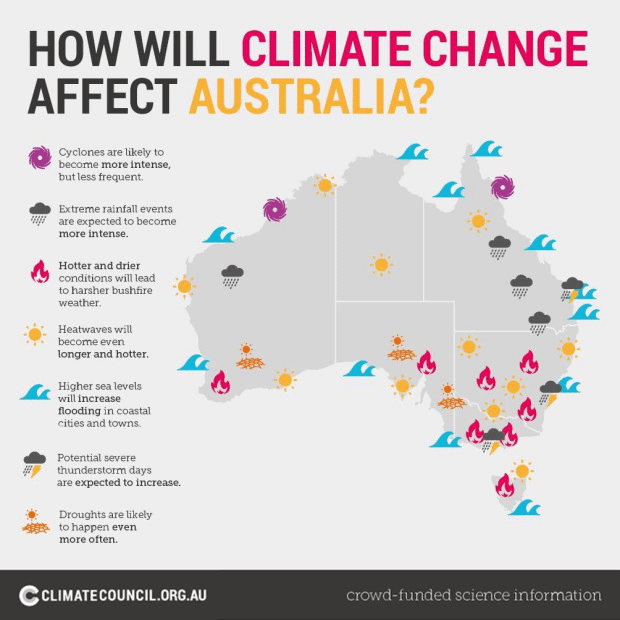
Australia among global ‘hot spots’ as droughts worsen in warming world, The Age, By Peter Hannam, June 1, 2020 The world’s major food baskets will experience more extreme droughts than previously forecast as greenhouse gases rise, with southern Australia among the worst-hit, climate projections show.
Scientists at the Australian National University and the University of NSW made the findings after running the latest generation of climate models used by the Intergovernmental Panel on Climate Change (IPCC). Future drought changes were larger and more consistent, the researchers found.
“Australia is one of the hot spots along with the Amazon and the Mediterranean, especially,” said Anna Ukkola, a research fellow at the ARC Centre of Excellence for Climate Extremes and lead author of the paper published in Geophysical Research Letters.
For southern Australia, the shift to longer, more frequent and more intense droughts up to 2100 will be due to greater variability in rainfall rather than a reduction in average rainfall. For the Amazon, both mean rain and variability changes…….
One reason for the prediction of worse droughts is that the latest models assume the climate will respond more than previously understood to increased atmospheric levels of carbon dioxide and other greenhouse gases.
Australia’s vulnerability to big shifts in annual rainfall already challenge the country’s farming sector, while also leaving much of the country’s south more at risk of bad bushfire seasons – such as last summer’s – as forests dry out.
The CSIRO has long forecast a large reduction in stream flows in the Murray-Darling Basin, for instance, as reduced cool-season rainfall combines with higher temperatures. Such a trend appears to have already begun.
While a more moderate emissions trajectory will still produce more intense, frequent and longer lasting droughts in most of the world’s mid-latitude regions than current conditions, the shift will be less than if carbon emissions remain near the top of forecasts. ……..https://www.theage.com.au/environment/climate-change/australia-among-global-hot-spots-as-droughts-worsen-in-warming-world-20200601-p54ydh.html
Australia, and the world, underestimate how many die due to global heating

|
Experts Warn Climate Change Is Already Killing Way More People Than We Record, Science Alert ,CARLY CASSELLA, 25 MAY 2020
People around the world are already dying from the climate crisis,and yet all too often, official death records do not reflect the impact of these large-scale environmental catastrophes. According to a team of Australian health experts, heat is the most dominant risk posed by climate change in the country. If the world’s emissions remain the same, by 2080 Australian cities could see at least four times the number of deaths from increasing temperatures alone. “Climate change is a killer, but we don’t acknowledge it on death certificates,” says physician Arnagretta Hunter from the Australian National University. That’s a potentially serious oversight. In a newly-published correspondence, Hunter and four other public health experts estimate Australia’s mortality records have substantially underreported heat-related deaths – at least 50-fold. While death certificates in Australia do actually have a section for pre-existing conditions and other factors, external climate conditions are rarely taken into account. Between 2006 and 2017, the analysis found less than 0.1 percent of 1.7 million deaths were attributed directly or indirectly to excessive natural heat. But this new analysis suggests the nation’s heat-related mortality is around 2 percent. “We know the summer bushfires were a consequence of extraordinary heat and drought and people who died during the bushfires were not just those fighting fires – many Australians had early deaths due to smoke exposure,” says Hunter……. “Death certification needs to be modernised, indirect causes should be reported, with all death certification prompting for external factors contributing to death, and these death data must be coupled with large-scale environmental datasets so that impact assessments can be done.” …… Such action, they say, is imperative. Not only for Australia but many other countries in the world. The United Kingdom has documented some problems with accurately filling out death certificates, and cities in several parts of the world are on track for similar heat-related mortality rates as Australia. But there are some places that will need to do more than just update their current system. In the tropics, there’s little valid mortality data on the more than 2 billion people who live in this heat-vulnerable region. And that makes predicting what will happen to these communities in the future much trickier. “Climate change is the single greatest health threat that we face globally even after we recover from coronavirus,” says Hunter. “We are successfully tracking deaths from coronavirus, but we also need healthcare workers and systems to acknowledge the relationship between our health and our environment.” In an unpredictable world, if we want to know where we’re going, we have to know where we’ve been. Figuring out how many of us have already died from climate change will be key to that process. We can’t ignore it any longer. The correspondence was published in The Lancet Planetary Health. https://www.sciencealert.com/official-death-records-are-terrible-at-showing-how-many-people-are-dying-from-the-climate-crisis |
|
|
Misleading and inaccurate information provided by Australia’s authorities on National Radioactive Waste Management
 Peter Remta – submission to Senate Committee on National Radioactive Waste Management Amendment (Site Specification, Community Fund and Other Measures) Bill 2020 [Provisions] Submission 65 more https://antinuclear.net/2020/05/23/peter-remta-misleading-and-inaccurate-information-provided-by-authorities-on-national-radioactive-waste-management/
“………. EXPLANATORY MEMORANDUM The explanatory memorandum accompanying the Bill simply repeats many of the inaccurate and misleading comments and information provided by the Department of Industry Innovation and Science and ANSTO to the communities of the initially accepted sites in South Australia since the beginning of the nomination process under the existing legislation.
………I must stress that the serious and unacceptable manner in which quite inaccurate information has been disseminated on behalf of the government on such an important issue both now and during the nomination and selection process has only caused more concern and community dissension and I suggest will lead to a greater general apprehension of starting a nuclear industry in Australia
Explanatory memorandum assertions :
1. While the concept of a single and purpose-built nuclear waste facility is a desired objective as outlined at the start of the explanatory memorandum it will be difficult to achieve as is now proposed.
To begin with it is wrong to say that this facility will support nuclear science and technology since it fails to meet the safety prescriptions for a facility of that nature.
It is also wrong to link the provision of nuclear medicine to the proposed storage and disposal of waste at the facility as the various entities generating waste from medical and research activities will continue relying on their own disposal methods and will not necessarily use a government run business for that purpose.
2. Most importantly it is a totally false and misleading proposition to suggest that the failure to establish the facility as proposed by the government will somehow lead to a reduction in nuclear medical services and treatment and the government should quickly correct that serious misconception since this has been a rather distressing concern for the community at Kimba and generally. It is therefore disingenuous to give that impression that this will be a central
facility for all nuclear waste in Australia.
3. While existing waste is held in numerous locations around the country there is no legal or other requirement that this waste would be disposed of at the facility and it is therefore disingenuous to give the impression that this will
be a central facility for all waste in Australia.
4. The reference to meeting with the international obligations under the Joint Convention4 ignores the safety code requirements promulgated some 12 years later under which it would be very difficult to establish the proposed
facility.
5. The suggestion of acquiring additional land for such things as all weather road access is only another example of the intrinsically unsuitable nature of the chosen site and the lack of planning and the necessary technical knowledge for construction of the facility.
6. The process of identifying a suitable location being a 40 year effort again shows the inability of the government or simply ignores that the current process in a proper manner only began after 2012 under the existing legislation.
7. To suggest proper and successful consultations with community members is a test of normal intelligence having regard to the strong and spirited opposition to the facility from the outset by the community generally and the fact that a concerned Aboriginal group has litigated its opposition to an appeal to the Federal Court5 and may now resort to a referral to the United Nations Human Rights Council.
8. The financial aspects of the government’s proposals lack frankness and justification when it has been claimed variously that the amount so far spent in selecting the site is $55 million or $85 million over the past five years but with a constant refusal to provide any details as to how that money has been spent or applied.
Surely there should be proper public disclosure of this quantum of expenditure when compared to the usual outcry where there is only a fraction of that amount involved if there is no reasonable explanation given. Moreover this should be gauged against the persistent refusal of the government to pay for an independent assessment and scrutiny of its
proposals by the members of the Kimba community who oppose the facility.
9. The statement as to compatibility with human rights is again with respect rather nonsensical when the government was incapable of holding a proper and valid ballot (albeit through the District Council of Kimba) which totally ignored the inclusion of an opposing argument contrary to the recognised and applicable principles of human rights. That ballot and the previous one as well as some claimed community surveys failed to meet the principles of informed consent which places a high standard of compliance on both the government and the District Council.
This becomes even worse by excluding the Aboriginal peoples from the ballotIf the government were genuine then it should hold another ballot with a more appropriate and wider base for voting and with the prior provision of all pertinent
information including the arguments or case against the facility. This goes back to providing a proper assessment and scrutiny of the government’s proposals by the opposing members of the Kimba community which has never been
the case.
Regrettably the compatibility statement is more prescriptive in its content instead of actually dealing with the facts of the situation and circumstances that occurred and which have been presented in the statement in a most favourable light for the government. when under the most basic of constitutional and democratic rights they
should have been included in that process…………
Sections on NAPANDEE FINANCIAL ASPECTS INFORMATION, BALLOTS, and INFORMED CONSENT LEGAL ACTIONS MANAGEMENT of FACILITY INTERNATIONAL OBLIGATIONS TECHNICAL ASSESSMENT [these will be published here separately, later]
…. CONCLUDING COMMENTS and RECOMMENDATIONS Continue reading
Australian politician John Barilaro gets it so wrong about small nuclear reactors
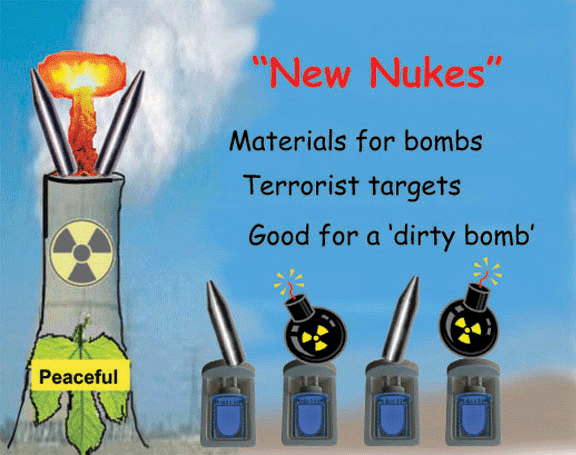
But there is as yet no sign of anything being oven-ready to come to the marketplace, let alone 15 up and running. But there remain some rather disturbing connections between small reactor projects and nuclear weapons proliferation. And Rolls-Royce does offer up one of the most glaring examples. Part of the company’s current sales pitch to the British government includes the argument that a civil small-reactor industry in the UK “would relieve the Ministry of Defence of the burden of developing and retaining skills and capability” for its weapons programme. It may be true. But it is not really Atoms for Peace, , is it?
https://electricalreview.co.uk/features-mm/13082-mystic-meg-from-down-under
Latest climate models suggest global heating could be worse than we thought
 Just how hot will it get this century? Latest climate models suggest it could be worse than we thought, The Conversation, May 18, 2020 , Michael Grose, Climate Projections Scientist, CSIRO, Julie Arblaster, Associate Professor, Monash University Climate scientists use mathematical models to project the Earth’s future under a warming world, but a group of the latest models have included unexpectedly high values for a measure called “climate sensitivity”.
Climate sensitivity refers to the relationship between changes in carbon dioxide in the atmosphere and warming.
The high values are an unwelcome surprise. If they’re right, it means a hotter future than previously expected – warming of up to 7℃ for Australia by 2100 if emissions continue to rise unabated.
1 This Month



26 September – International Day for the Total Elimination of Nuclear Weapons


PLEASE OPPOSE HR 8255 AND S.3639 – bills would accelerate satellite deployment, with no environmental review or safeguards – https://ncstd5li.quorum.us/campaign/169331/
To see nuclear-related stories in greater depth and intensity – go to https://nuclearinformation.wordpress.com
-
Archives
- September 2026 (233)
- August 2026 (330)
- July 2026 (355)
- June 2026 (287)
- May 2026 (306)
- April 2026 (356)
- March 2026 (251)
- February 2026 (267)
- January 2026 (308)
- December 2025 (358)
- November 2025 (359)
- October 2025 (375)
-
Categories
- 1
- 1 NUCLEAR ISSUES
- business and costs
- climate change
- culture and arts
- ENERGY
- environment
- health
- history
- indigenous issues
- Legal
- marketing of nuclear
- media
- opposition to nuclear
- PERSONAL STORIES
- politics
- politics international
- Religion and ethics
- safety
- secrets,lies and civil liberties
- spinbuster
- technology
- Uranium
- wastes
- weapons and war
- Women
- 2 WORLD
- ACTION
- AFRICA
- Atrocities
- AUSTRALIA
- Christina's notes
- Christina's themes
- culture and arts
- Events
- Fuk 2022
- Fuk 2023
- Fukushima 2017
- Fukushima 2018
- fukushima 2019
- Fukushima 2020
- Fukushima 2021
- general
- global warming
- Humour (God we need it)
- Nuclear
- RARE EARTHS
- Reference
- resources – print
- Resources -audiovicual
- Weekly Newsletter
- World
- World Nuclear
- YouTube
-
RSS
Entries RSS
Comments RSS
 nuclear-news