Terrifying nuclear bomb prediction as world tensions rise
As the prospect of nuclear war rises, experts have made a terrifying prediction about what this means for Australia.
news.com.au Jamie Seidel@JamieSeidel, August 16, 2022
It’s been 77 years since the destruction of Hiroshima and Nagasaki. It’s been 33 years since the Berlin Wall’s fall and the Cold War’s end.
But the bomb is back.
Russian President Vladimir Putin is making thinly veiled threats. China’s embarking on a massive nuclear weapon-building campaign. And the menace of atomic annihilation coming out of North Korea is so common as to become background noise.
Has the world forgotten how close these weapons can bring us to extinction?
A new study in the science journal Nature Foodhas built upon recent lessons from Australia’s and Canada’s catastrophic 2019-20 forest fires to anticipate the impact of nuclear detonation on global food production.
Estimates place the amount of smoke produced by the recent fires as up to 1 teragram (1 trillion grams). Heavier soot ejecta was up to 0.02Tg. Both quickly encompassed the globe – lingering in the sky for months afterwards.
This adds confidence to our simulations that predict the same process would occur after a nuclear war,” reads the research published today (Tuesday, August 16) in Nature Food, from lead author Lili Xia of Rutgers University, along with contributors including Dr Ryan Heneghan of the Queensland University of Technology.
The study’s not without immediate relevance.
The bomb is back……………..
UN Secretary-General Antonio Guterres warned that “humanity is just one misunderstanding, one miscalculation away from nuclear annihilation”. Ukraine. Asia. The Middle East. The Koreas. All are experiencing heightened levels of nuclear threats.
With 13,000 nuclear weapons sitting in stockpiles worldwide, the secretary-general warned delegates “the risks of proliferation are growing and guardrails to prevent escalation are weakening”.
“Future generations are counting on your commitment to step back from the abyss.
“This is our moment to meet this fundamental test and lift the cloud of nuclear annihilation once and for all.”
Such a war would reach far beyond the battlefield.
We’re seeing that right now.
The fighting between Russia and Ukraine has disrupted more than 20 per cent of global grain exports – threatening famine in Africa and the Middle East while causing prices to soar globally.
Even a “small” nuclear exchange between Pakistan and India would have catastrophic implications. The handful of weapons both nations possess would kill some 52 million people instantly. They would also eject more than 16 teragrams (16 trillion grams) of soot into the stratosphere.
National borders will not constrain this. Instead, the soot will quickly be picked up by high-altitude jet streams and circle the world.
The result would be a global famine killing an additional 926,000,000 people within two years.
Australia, however, appears to get off relatively lightly. At least at first.
Food for thought
The study, Global food insecurity and famine from … nuclear war soot injection, examines the implications of wars scaling up from 100 warhead detonations through to 4400.
Only Australia and some other southern hemisphere nations would potentially avert starvation.
And that may include the worst-case “all-out exchange” scenario.
Some 360 million would die in the initial blasts. Two years later, an additional five billion would be dead of hunger…………………………… more https://www.news.com.au/technology/innovation/military/terrifying-nuclear-bomb-prediction-as-world-tensions-rise/news-story/938f4ed66c8f38b8b9cbbb2147500400
How even small nuclear war would kill billions in apocalyptic famine
https://www.9news.com.au/national/even-small-nuclear-war-would-kill-billions-from-famine/0aadd094-e5be-471f-8278-b8bf485f759a By Mark Saunokonoko • Senior Journalist Aug 16, 2022,
Australia may be the best place in the world to shelter if nuclear war broke out, a study has predicted, although an “influx of refugees” from Asia and other regions would likely rush the country to try and survive the atomic holocaust.
Various apocalypse scenarios showed even a small nuclear war would cause devastating climate chaos, plunging the world into mass famine and starving billions to death.
The study estimated more than 2 billion people would die from a contained nuclear war between India and Pakistan, while more than 5 billion around the world would perish inside two years if the US and Russia launched thousands of nukes at each other.
Nuclear strikes on major cities and industrial areas would unleash massive firestorms, the peer-reviewed study said, injecting soot into the atmosphere, blocking sunlight from reaching the Earth’s surface and severely limiting food production.
Such catastrophic “soot loadings” would cause at least 10-15 years of disruption to global climate, researchers said.
As land and ocean food production faltered, and in the face of worsening hunger, the study said food exporting countries such as Australia would hunker down and hoard supplies.
“Wherever there’s scarcity, you start to see more conflicts,” Dr Ryan Heneghan, a co-author of the study from Queensland University of Technology, told 9news.com.au.
“Whether that makes Australia a (post-nuclear war) target, I don’t know.”
Being a food exporter and its location in the southern hemisphere, away from likely conflict zones, were the key factors that meant Australia was able to weather a nuclear catastrophe better than most, Heneghan said, with New Zealand not far behind.
“Australia has some resilience if there were drops in food productivity because of changes in climate caused by a nuclear war,” he said.
“We already produce more than enough food for our population.”
But waves of migrants would inevitably put “pressures” on any Australian stockpiles.
One factor not included in the models, but which could seriously affect Australia’s ability to cope, was the country’s lack of domestic fuel supplies, Heneghan said.
“Australia isn’t energy independent.
“So we would probably have shortages of fuel.”
Australia, the planet’s sixth largest country after Russia, Canada, China, the US and Brazil, would face huge challenges trying to transport food from agricultural heartlands into big, densely populated urban centres, he said.
“Even though we might make enough food, we might not be able to move it to where it needs to go,” he said, calling that a “big caveat” to the study’s models.
Researchers modelled the impacts of six atmospheric soot-injection scenarios, based on one week of nuclear war, on crop and fish supplies and other livestock and food production.
Even if humans reduced food waste reduction and began to eat crops grown primarily as animal feed and biofuel, researchers predicted livestock and aquatic food production could not compensate for reduced crop output in most nations.
Any nuclear weapon detonation that produces more than 5 teragrams (5 trillion grams) of soot, such as 100 warheads fired between India and Pakistan, would likely cause mass food shortages in almost all countries, the study said.
A nuclear war between the US and Russia could send more than 150 teragrams of soot into the stratosphere.
The bushfires that swept across Australia in 2019-20 generated 0.3 – 1 teragrams of smoke, which swirled around the world and lingered for many months.
Elon Musk’s SpaceX now leaving junk in Australia’s backyard
Independent Australia, By Darren Crawford | 10 August 2022 After a SpaceX capsule crashed onto an Australian farm, we’re left wondering if Elon Musk will clean up his own mess, writes Darren Crawford.
ACCORDING TO the ABC, the Australian Space Agency (ASA) has confirmed that debris found in a sheep paddock in the Snowy Mountains region of New South Wales, Australia, belongs to Elon Musk’s SpaceX Dragon capsule, which was launched in November 2020.
Local authorities were alerted after nearby residents heard a loud bang earlier this year on 9 July. It is now thought the bang was the noise of the capsule re-entering the Earth’s atmosphere. New South Wales Police and the ASA visited one of the sites on Saturday 31 July and confirmed that two of the pieces are from a SpaceX mission.
According to the ABC, the ASA is continuing to engage with its counterparts in the U.S. as well as other parts of the Commonwealth and local authorities.
An ASA spokesperson said:
“The agency is operating under the Australian Government Space Re-entry Debris Plan which outlines roles and responsibilities for key Australian government agencies and committees in supporting the response to space re-entry debris.”
So who is responsible for the clean-up?
According to the ABC report, the space debris will remain in place for now. However, the pieces could eventually be returned to U.S. soil.
Australian National University’s Institute of Space deputy director Dr Cassandra Steer said there was an obligation under international space law to repatriate any debris to the country from where it originated.
Dr Steer went on to confirm that “Any space object, or part thereof, has to be repatriated” and should be sent back to the U.S. However, SpaceX has only confirmed that the debris is theirs and is yet to commit to the costs associated with returning it to the U.S.
Dr Steer added:
“We have clarity in terms of lines of responsibilities. The U.S. is liable for any damage that is caused by this space debris… and Australia could go to the U.S. and seek some form of compensation if there are any costs involved in cleaning it up.”
Elon Musk and SpaceX have a poor environmental record
As reported earlier this year, Elon Musk and fellow billionaires Richard Branson and Jeff Bezos are currently participating in a dick-swinging rocket contest to see who can get to Mars first. Suffering from massive rocket envy, these three men are speeding up the climate change process by increasing the amount of carbon dioxide and other gases in the Earth’s atmosphere with every launch.
The Guardian reports that one rocket launch alone can release up to 300 tons of carbon dioxide into the Earth’s upper atmosphere and it can stay there for years. This is in comparison to a standard long-haul flight which produces three tons of carbon dioxide per passenger/per flight, into the lower atmosphere.
These impacts do not include what happens on the ground during a launch, including the heat and noise pollution in the immediate area, or the impacts on local wildlife.
There appear to be few controls put in place to protect the planet and its inhabitants from falling space junk by Elon Musk and SpaceX. In March 2021, a SpaceX rocket blew up on launch and debris was scattered throughout the protected area. According to a local non-profit environmental group, it took three months to clean up the mess.
According to the report, launch site ditches on SpaceX land and public property in the U.S. have dumped runoff water directly into the tidal flats threatening local fish breeding grounds, and public beaches and roads have been closed for longer than the agreed times.
Finally, at an earlier launch in 2018, a jettisoned SpaceX booster rocket missed its target drone ship a few hundred kilometres out to sea and destroyed itself on impact slamming into the ocean at 500 km/hour.
So, will Elon Musk and SpaceX clean up their mess down under?
This is the great unknown, as Elon Musk’s environmental record in relation to his SpaceX program is extremely poor.
It is also clear, as can be seen by his recently abandoned Twitter purchase, that Elon Musk doesn’t care who he burns, or how hard he burns them, to get his own way.
It is apparent that Elon Musk sees the increasing amount of pollution produced by his SpaceX endeavours as little more than collateral damage and less of a threat to our civilisation. Similarly, he doesn’t care whose backyard he trashes (as long as it’s not his, obviously).
Instead of turning his immense intelligence (and wealth) to solving our current problems, Elon Musk (and his billionaire space mates) seek to exacerbate these problems by polluting the planet further.
It will be interesting to see whether he does the right thing by the Australian Government and its people and pays for the clean-up of his mess.
Update, 10 August 2022:
The ABC is reporting that SpaceX has confirmed that the space debris spread throughout an Australian sheep paddock is indeed remnants of their Dragon Capsule and is sending a team down under to investigate………………………….
What was not stated was whether any ASA or government agencies were aware of or engaged in any of SpaceX’s planning. Space Law Lecturer at UNSW Canberra, Duncan Blake, wondered if they had coordinated with Australian agencies prior to their risk assessment — “If they didn’t, then that seems somewhat arrogant to make a decision that affects Australia without consulting Australians,” he said.
There has been no mention of the cost of removal or the debris, or as to whether Elon Musk and SpaceX will be more honest and open in the future and advise all Australians about the potential damage falling SpaceX junk may cause in their country.
https://independentaustralia.net/environment/environment-display/elon-musks-spacex-now-leaving-junk-in-our-own-backyard,16650
Nuclear bomb tests at Maralinga triggered Hedley Marston to study fallout over Australia
ABC Radio Adelaide / By Daniel Keane 10 Aug 22,
Hedley Marston could be charming, genial and witty but he was not above fulmination, especially where fulminations of a different kind were concerned.
In the mid-1950s, the CSIRO biochemist emerged as arguably the most significant contemporary critic of Britain’s nuclear weapons testing program, which was launched on Australia’s Montebello Islands almost 70 years ago in October 1952.
Despite the imminent anniversary Marston remains an obscure figure, but his biographer Roger Cross believes that should change.
“He appears to be totally unknown to the Australian public and, of course, to South Australians — he was a South Australian after all,” Dr Cross said.
Marston’s reservations about the nuclear program were far from spontaneous; indeed, his strongest concerns weren’t voiced until several years after the first test, when he recorded a radioactive plume passing over Adelaide.
The source of that plume was Operation Buffalo, a series of four nuclear blasts in 1956, and Marston was especially outraged by the fact that the general population was not warned.
“Sooner or later the public will demand a commission of enquiry on the ‘fall out’ in Australia,” he wrote to nuclear physicist and weapons advocate Sir Mark Oliphant.
“When this happens some of the boys will qualify for the hangman’s noose.”
What made Marston’s fury difficult to dismiss, especially for those inclined to deride opposition to nuclear testing as the exclusive preserve of ‘commies’ and ‘conchies’, was the fact that he was no peacenik.
Detractors might have damned him as an arriviste, but never as an activist: his cordial relations with Oliphant and other scientific grandees demonstrate that Marston was, in many respects, an establishment man.
Dr Cross has described Marston’s elegant prose as “Churchillian”, and the adjective is apposite in other ways.
While the roguish Marston might not have gone as far as the British wartime leader’s assertion that, during conflict, truth is so precious “that she should always be attended by a bodyguard of lies”, he had, in a 1947 letter to the editor, publicly defended scientific secrecy:
Under present conditions of fear and mistrust among nations it is obvious that military technology must be kept secret; and to achieve this end it should be conducted in special military laboratories where strictest security measures may be observed.”
But by late 1956, Marston’s alarm at radioactive fallout across parts of Australia was such that he was privately demanding greater disclosures to the general public.
Much of his ire was aimed at the Atomic Weapons Tests Safety Committee — a body established before the Maralinga tests, but after blasts had already occurred at Emu Fields* and the Montebello Islands.
“He was the only senior Australian scientist to express concerns and, because of his character, the concerns that he expressed were very forthright,” said Dr Cross, whose biography of Marston, aptly entitled Fallout, inspired the documentary Silent Storm.
“When the safety committee after each explosion said there was absolutely no effect on Australians, he believed that they were lying.”
‘If the wind changes, we need to go’
The experiments that led Marston, whose reputation largely rested on his expertise in sheep nutrition, to reach this conclusion were two-fold.
In the more protracted one, he analysed the presence of radioactive iodine-131 — a common component of nuclear fallout — in the thyroids of sheep.
“One group he kept penned up under cover eating dried hay, which had been cut some time before. The other group, he put outside eating the grass,” Dr Cross said.
“He tested the thyroids in each group – the ones on the hay only had background amounts of iodine-131.
“But the ones in the fields had a tremendously high concentration of this radioactive isotope, both north and south of the city.”

A fallout map from the 1985 royal commission, which stated that while fallout at Maralinga Village from the October 11, 1956, test was “considered to be ‘negligible from a biological point of view’ it does suggest difficulties with the forecast prior to the test”.(Royal Commission into British Nuclear Tests in Australia)
For the other experiment, Marston conducted air monitoring in Adelaide.
He was especially alarmed by what he found for the period following the Maralinga test of October 11, 1956.
“There was a wind shear and at least part, maybe the major part, of that cloud, blew in a south-easterly direction and that took it towards Adelaide and the country towns in between,” Dr Cross said.
“The safety committee — who must have known of the wind shear — had done nothing about warning Adelaide people perhaps to stay indoors.”……………………………………………………
Despite Marston’s reservations, the nuclear program carried on regardless.
Less than a year after the Operation Buffalo tests, Maralinga was hosting Operation Antler.
In September 1957, newspapers around Australia reported on an upcoming “second test” that would, weather permitting, proceed as part of a “spring series”.
If it hadn’t been for the presence of the words “atomic” and “radioactive”, a reader might easily have inferred that what was being described was as commonplace as a game of cricket.
 |
Regional security threat haunts nuclear power debate in Australia
we cannot ignore when weighing up these arguments that recent events at Zaporizhzhia help bolster the case against nuclear power. We would not want any future nuclear facilities to become hostage to the vagaries of war.
https://www.theage.com.au/national/regional-security-threat-haunts-nuclear-power-debate-20220808-p5b82t.html Editorial, August 8, 2022, The alarm sounded by the head of the International Atomic Energy Agency (IAEA), Rafael Mariano Grossi, that fighting between Russian invaders and Ukrainian forces near the Zaporizhzhia nuclear power plant carried “the very real risk of a nuclear disaster” is one with relevance far beyond the war raging within Ukraine’s borders.
The conflict has already served as a grim warning for powers such as Germany and the United States of the costs of relying on fossil fuel-producing nations with despotic leaders for energy supply. But Russia’s seizures of Zaporizhzhia and the defunct power plant at Chernobyl in the early days of the war – though Chernobyl later returned to Ukrainian control – have highlighted that a decision to increase reliance on nuclear power would carry risks even beyond the familiar ones.
As Industry and Science Minister Ed Husic pointed out during Grossi’s recent visit to this country, Australia has an exemplary record on nuclear safety. But one of the most important reasons for this is that we have a ban on using nuclear fission for power generation and have committed not to develop a nuclear arsenal under the Non-Proliferation Treaty (NPT).
In recent times both these bans have returned to the spotlight, as the Coalition in opposition has raised the possibility of domestic nuclear power plants to address our energy needs. This followed the Morrison government’s signing of the AUKUS deal with London and Washington last year. The deal envisions Royal Australian Navy submarines being fuelled with weapons-grade uranium.
Peter Hartcher reported for The Agethat the first question US President Joe Biden raised when the AUKUS proposal was put to him was whether it breached non-proliferation commitments. The key to addressing this question has been paragraph 14 of the IAEA’s safeguards agreement with Australia, which creates a loophole allowing weapons-grade material to be used without the usual safeguards in “non-proscribed military activity”. Concerns were raised earlier this month, at the latest meeting to review the treaty, that regardless of Australia’s good intentions, this would set a precedent for further transfers of highly enriched nuclear material to other nations.
Grossi has pointed out that Iran, which first informed the IAEA of its interest in naval nuclear propulsion in 2018, cited the AUKUS deal to argue for its own plans at meetings in 2021.
Some argue that this is a form of proliferation, and even our allies and neighbours, from New Zealand to Indonesia, have expressed strong reservations about the AUKUS arrangement. Australia has said that the nuclear material in its submarines will be handled only by existing nuclear states. Nevertheless, the deal could lead to a perception that nuclear “haves” will simply ignore “have-nots”.
The case for nuclear power more broadly – replacing coal and gas with another non-renewable resource in uranium – faces its own hurdles, from the cost, to the emissions involved in mining and waste management to the question of where highly radioactive waste might be stored.
As The Age has pointed out, nuclear power generation globally is declining. One major reason is the expense. A recent CSIRO report underlines that renewables are far cheaper, even after transmission and storage are taken into account.
All sides of politics agree that Australia faces an increasingly complex and challenging security environment, from talk of Chinese bases in Cambodia and Solomon Islands to cyberattacks by rogue international actors targeting key infrastructure, while general-turned-Coalition senator Jim Molan has outlined an even more apocalyptic scenario, a “second Pearl Harbour” aimed at establishing Chinese supremacy in the western Pacific.
The Age has agreed in the past that Australia should be prepared to have another look at the arguments for nuclear power. That remains our position. But we cannot ignore when weighing up these arguments that recent events at Zaporizhzhia help bolster the case against it. We would not want any future nuclear facilities to become hostage to the vagaries of war.
Does Australia actually need nuclear submarines?

“It’s obvious the real policy is to subsidise the US Navy’s submarine budget. Some will be located in Australia, with Australian flags and personnel, but they’re essentially US boats operated in the US’s great power interests. We’re paying for them to set up part of their current and future fleet in Australia.”
fewer than two of Australia’s eight nuclear submarines would be operationally available, on average, each year. And the cost of the purchases is likely to be stunning, possibly as high as $171 billion……………….. No other country has bought this type.
“Australia could buy 20 high-quality, off-the-shelf, modern submarines for $30 billion.”
influential Australian intelligence and defence officials are ignoring the point that there is no need for Australian submarines to spend much time in China’s waters
Gilligan also warns that the shallow and warm waters around Australia’s north are unsuited to large nuclear submarines.
As experts question the diplomatic, strategic and economic rationale behind Australia’s purchase of nuclear-powered submarines, the gaps in the country’s defensive fleet could be filled by conventional subs. https://www.thesaturdaypaper.com.au/news/politics/2022/08/06/does-australia-actually-need-nuclear-submarines#mtr By Brian Toohey. 6 Aug 22,
In 1992, an Australian Oberon-class submarine entered the crowded waters of Shanghai’s port and became entangled in fishing nets. It had to surface for crew members to cut it free with axes. Chinese Navy sailors witnessed this, but nevertheless the submarine escaped. Had it not, the crew would’ve been imprisoned and Australia widely condemned and potentially convicted for an outrageous breach of international law.
Almost a decade earlier, the Australian Navy had seriously considered scrapping submarines, according to former senior Australian Defence official Mike Gilligan. A study in 1985 had concluded they offered “little marginal benefit to Australia’s defences yet inflict a large marginal cost”. The cost could’ve been much higher given the tremendous risks the government allowed the navy to take, snooping in Chinese and Russian waters on behalf of the Americans, who wouldn’t put their nuclear submarines in danger.
Australia now faces some tough and highly consequential decisions with respect to its fleet. Some experts in the defence field question not only the utility of nuclear-powered vessels but the diplomatic, strategic and economic commitment they entail.
In Washington last month, Defence Minister Richard Marles said Australia, the United States and Britain were moving from “interoperability to interchangeability in defence hardware”. This would effectively mean Australia could not buy high-quality defence equipment from other countries if there was a higher-cost American or British version available. Professor Clinton Fernandes at the UNSW Canberra campus says, “It’s obvious the real policy is to subsidise the US Navy’s submarine budget. Some will be located in Australia, with Australian flags and personnel, but they’re essentially US boats operated in the US’s great power interests. We’re paying for them to set up part of their current and future fleet in Australia.”
Australia has a short and patchy record on submarine purchases. The government acquired many major weapons during World War II. None were submarines. That capability had to wait until the first of a total of six Oberon-class submarines was commissioned in 1967 from a Scottish shipyard. They operated satisfactorily but weren’t considered the nation’s most important military assets.
After Kim Beazley became Defence minister in the Hawke government, he gambled on the value of submarines by ordering six large, battery-powered versions to be built in Adelaide. No other country has bought this type.
The first was commissioned in 1966 and the last in 2003. Called the Collins class, it was based on a good Swedish design. But Beazley greatly increased its size and complexity, partly by adding American equipment that proved completely useless. Maintenance problems drove annual sustainment costs to $670 million. Often only two or three were available at a time, although availability later improved. And none attended the 2010 Rim of the Pacific event – known as Rimpac, the world’s largest international maritime warfare exercise, held biennially near Hawaii.
Former prime minister Scott Morrison and his successor, Anthony Albanese, have taken a much bigger gamble than Beazley did, with their commitment to buy at least eight nuclear attack submarines – almost certainly the American Virginia class. One of the US’s most highly regarded defence analysts, Winslow Wheeler, recently pointed out the Virginia-class subs have been available only 15 times in 33 years for their six-monthly deployments. This suggests fewer than two of Australia’s eight nuclear submarines would be operationally available, on average, each year. And the cost of the purchases is likely to be stunning, possibly as high as $171 billion when accounting for inflation, according to the Australian Strategic Policy Institute, and more recent estimates are above $200 billion. The costliest previous military acquisition, for the Australian Air Force, is the inflation-adjusted $16.6 billion program cost for 72 F-35 fighter jets.
Former submariner, naval consultant and South Australian senator Rex Patrick says, “Australia could buy 20 high-quality, off-the-shelf, modern submarines for $30 billion.”
Patrick also makes the point that nuclear submarines are often “defeated” in exercises by ultra-quiet conventional submarines.
Major new developments are making conventional submarines even more formidable than the nuclear versions. More powerful sensors mean submarines can be detected by the noise they make and by their passage through the Earth’s magnetic field. In addition, nuclear submarines can be detected by the wake they leave at high speeds, as well as the hot water they release from cooling their nuclear reactors, operating loud steam engines and other equipment. In future, submarines may also be detected by blue-green lasers that make the ocean more transparent.
A prize-winning essay published in the US Naval Institute’s magazine Proceedings in June 2018 said the US Navy would do well to consider acquiring “some quiet, inexpensive and highly capable diesel-electric submarines”. Until recently, conventionally powered submarines frequently had to rise close the surface to expose a mast and snorkel to obtain fresh air for their diesel engines to recharge the batteries. This process can be detected by radar.
Most conventionally powered submarines – except Australia’s – use what is called air independent propulsion (AIP), which allows them to remain silent for four to six weeks before snorkelling. That often entails using a hydrogen fuel cell to propel the submarine, but it takes up significant space on the vessel.
In a major change, Japan’s new Taigei-class submarines don’t need AIP because they’re equipped with particularly efficient lithium-nickel-cobalt-aluminium oxide batteries, rather than the lead-acid batteries that the Australian Navy prefers, due in part to the risks of lithium-ion batteries catching fire. Other navies are increasingly confident the new types of battery will prove safe. Hans Ohff, a submarine specialist and visiting fellow at Adelaide University, told The Saturday Paper, “Generally speaking, lithium-ion batteries have a 1.5-times range advantage over lead-acid at lower speeds and an incredible four-times range advantage at high speeds.”
Since the Collins class is due to start retiring in 2026, a replacement is urgently required to help fill the gap until the first nuclear submarine might arrive, near 2045, and the last in 2065. Senator Patrick says the time it takes to do this can be reduced by choosing one of the three available “off-the-shelf” submarines: Japan’s Taigei, which has passed numerous tests demonstrating the safety of its new batteries; Singapore’s Type 218SG, made by Germany’s thyssenkrupp Marine Systems; and the Spanish S-81. The latter two still use conventional lead-acid batteries, but Ohff says a French and German joint venture is under way to develop their own lithium-ion batteries.
These options have advantages and drawbacks. The new Taigei class – of which Japan is acquiring 22 – requires a costly crew of 70 per vessel. The Type 218SG’s German manufacturer is the biggest submarine exporter in the world, with an enviable reputation for low maintenance costs across its range. Extensive automation means it needs only 28 crew members, and the vessel has a longer range than the Taigei’s 12,500 kilometres. Spain’s S-81 has a crew of 32 but a less experienced manufacturer.
With China being the principal concern of Australian diplomatic and defence policymakers, Ohff says the navy will never accept off-the-shelf submarines unless it can “Australianise” them – meaning they must have the range to operate for long periods, many thousands of kilometres away, probably in Chinese waters or nearby. Ohff says the navy’s preferences would take a minimum of 10 years to deliver the first boat and additional two-year intervals for the following boats. He says delivery of a Swedish “Son of Collins” could take nine years.
Patrick says influential Australian intelligence and defence officials are ignoring the point that there is no need for Australian submarines to spend much time in China’s waters: Japan, South Korea, Singapore and Vietnam have high-quality submarines closer to China. The main attraction of nuclear submarines for these officials is they could fire subsonic cruise missiles at land targets in China from more than 1000 kilometres off its coast. However, cruise missiles can be shot down by fighter planes overhead. Once a nuclear submarine fired its missiles, it would be detected and swiftly targeted. Even if it survived, reloading would require the help of a tender – a large depot ship that supplies and supports submarines – probably from the distant base at Fremantle, which recently hosted a reloading for a US nuclear submarine. In any event, an attack on Chinese territory could provoke a heavy counterattack on Australia’s forces or its mainland.
Gilligan says most of the capability offered by submarines is better provided by Australia’s maritime and land-based aircraft. He says submarines, including nuclear ones, are slow compared to aircraft. Technically, a plane could sink a ship off Australia’s west coast in the morning, refuel, then sink another off the east coast in the afternoon. Gilligan also warns that the shallow and warm waters around Australia’s north are unsuited to large nuclear submarines.
Deploying nuclear submarines far from Australia marks a return to the previously discredited doctrine of “forward defence” in South-East Asia that concentrated on a big British naval base in Singapore, which was swiftly overrun by the Japanese in 1942. When this doctrine failed during the Vietnam War, the Coalition government in the late 1960s adopted a “defence of Australia” doctrine, which survived until its recent abandonment. Patrick and other proponents of this latter doctrine expect a revised doctrine would put more emphasis on having medium-sized conventional submarines to help deny hostile forces access to the approaches to Australia, unless they could detect and destroy all the submarines, drones, planes and land-based missiles blocking their way.
Finally, from a defence perspective, much of the planning around nuclear submarines assumes – implausibly – that Chinese and US policies will proceed in a predictable way until past 2060. A purely geopolitical analysis, however, could easily underplay the disruptive role of climate change.
In purely geopolitical terms, the region may become more peaceful or more dangerous. The only urgency for Australia is to forget about nuclear submarines and get some conventionally powered submarines to enhance deterrence.
Documents show Australian Labor government supports Assange’s extradition to the US

as far as the Labor government is concerned, Assange’s extradition is a done deal.
the greatest mistake defenders of Assange could make would be to harbour illusions that Labor will act to free the WikiLeaks founder.
as far as the Labor government is concerned, Assange’s extradition is a done deal.
the greatest mistake defenders of Assange could make would be to harbour illusions that Labor will act to free the WikiLeaks founder.
https://www.wsws.org/en/articles/2022/07/18/rqbf-j18.html Oscar Grenfell @Oscar_Grenfell, 18 July 22,
Documents obtained by lawyer Kellie Tranter and published on the Declassified Australia website cast a damning light on the Australian Labor government’s role in facilitating the continued imprisonment of WikiLeaks publisher Julian Assange and his extradition to the US.
The material gives the lie to the claims of Labor supporters that the newly-elected government may be seeking to secure Assange’s freedom through backroom diplomacy, despite the refusal of Labor ministers to condemn the attempted US extradition and prosecution.
They show that Labor is willing to let Assange be sent to the US, despite doctors and his family warning that it would be a death sentence. A successful extradition would also set a sweeping precedent for attacks on journalists and political dissidents globally.
Assange faces 17 charges under the Espionage Act, and 175 years imprisonment, for publishing true information exposing massive US-led war crimes in Iraq and Afghanistan.
Tranter, a longstanding legal advisor to Assange, has for many years filed freedom of information requests aimed at acquiring official documents revealing the role of Australian governments in the persecution of Assange. Those released by Declassified Australia are the first she has published since the Labor government was installed after the May 21 federal election.
The two documents are redacted. What is present, however, gives a sufficient picture of Labor’s acquiescence to Assange’s extradition, and the cynical, duplicitous character of the ambiguous public statements its leading representatives have made.
The first are internal “talking points” prepared for Attorney-General Mark Dreyfus on June 2. It is entitled: “Julian Assange – International Transfer of Prisoners process – talking points and background.” Its heading indicates the central preoccupation of the document, which states:
“Prisoner transfers cannot be agreed between governments in advance of a person being a prisoner (after a criminal trial, conviction and sentencing) in a particular country, and require the consent of the prisoner;
“International prisoner transfers to Australia are initiated by an application from a prisoner after the prisoner has been convicted and sentenced;
“If surrendered, convicted and sentenced in the US, Assange could apply under the ITP scheme to serve his sentence in Australia;”
In other words, Assange is to be extradited to the US, where the former Trump administration and the CIA plotted to kidnap or assassinate him from London in 2017, before settling on a pseudo-legal criminal indictment. He would be hauled before a kangaroo court in the District of Virginia, with a jury stacked by the very same CIA officers and their relatives. The hearings would proceed in secret and Assange’s detention regime would be one of total isolation.
With this hanging over his head, the document suggests that perhaps Assange will feel compelled to plead guilty to the “crime” of journalism revealing the illegal killings of civilians, torture and other violations of international law.
Tranter notes that following a redacted section, the document continues: “However, the UK High Court’s judgment does note that the US has provided an assurance that they will consent to Mr Assange being transferred to Australia to serve any custodial sentence on him if he is convicted.”
The US “assurances” are not worth the paper they are written on. Their sole aim was to overcome an earlier British court ruling, which found that Assange’s extradition would be “oppressive” because of his deep on-going health issues and the horrific conditions in which he would be held in a US prison.
The assurances, accepted by a British High Court as bona fide last October, asserted that Assange’s conditions of detention would not be as bad as his lawyers claimed. But those very assurances made plain that the intelligence agencies, including the CIA, would have complete control over the circumstances of Assange’s imprisonment, which could be changed at any time.
The second, June 8 document, is a “ministerial submission,” entitled “Julian Assange – extradition request from the United States to the United Kingdom.” It recommends that Dreyfus “note” the situation confronting Assange, in the lead up to an announcement by British Home Secretary Priti Patel on whether she would approve extradition. Several weeks later, Patel gave her green light.
The submission to Dreyfus bluntly stated: “The UK Home Secretary is due to make a final decision on Mr Assange’s extradition to the US by 20 June. Mr Assange will have one final avenue of appeal with the leave of the High Court, otherwise he must be extradited within 28 days of the Secretary of State’s decision.”
And again: “If Mr Assange is extradited, convicted and sentenced in the US, he may apply for transfer to Australia under the International Transfer of Prisoner’s Scheme. This will require the consent of the US and Australian authorities.
“The UK High Court’s judgment notes that the US has provided an assurance that it will consent to Mr Assange being transferred to Australia to serve any custodial sentence imposed on him if he is convicted.”
Later on, the document stated: “‘If Mr Assange is convicted and sentenced to imprisonment in the US, it will be possible for him to apply under the ITP scheme to serve the remainder of his sentence in Australia. A transfer would also require the consent of the US, the Australian Government (through you as Attorney-General), and the relevant minister in the state into whose prison Mr Assange would be transferring.
“In making any such decision, the department would provide you with advice on factors such as the extent to which the transfer would assist the prisoner’s rehabilitation, sentence enforcement, community safety and any relevant humanitarian considerations, in addition to any conditions of transfer required by the US.’”
In other words, as far as the Labor government is concerned, Assange’s extradition is a done deal.
Also striking is the fact that the documents do not countenance the possibility that he would be found “not guilty” in a US court. The entire thrust of the two documents is that the extradition and successful prosecution have already been stitched up, in a conspiracy involving the British government, the UK courts, the American authorities and the Labor administration.
Once Assange were in the US, moreover, the documents acknowledge that any “prison transfer” would be dependent upon the acquiescence of the American government whose President, Joe Biden, has previously branded Assange as a “high-tech terrorist.” A prison transfer, even in the unlikely event that it occurred, would mean years more of Assange’s incarceration, in Britain, the US and then Australia.
The contempt of the government for Assange is summed up by the reference to “factors such as the extent to which the transfer would assist the prisoner’s rehabilitation.” Assange does not need to be rehabilitated. He is a heroic journalist who has done a major service to humanity. It is the war criminals he has exposed who need to be placed in an institution.
Obviously it is unknown what is contained in the redacted section. It may deal with the elephant in the room, which is excluded from the rest of the documents. Assange’s doctors, lawyers and family have all testified that the WikiLeaks founder would take his life if he were to be extradited to the US. That judgment was effectively upheld by the British District Court, before it was overturned on the basis of the bogus US assurances.
All of the talk about “prison transfers” and the like is therefore window dressing for what would amount to a death sentence.
The documents reveal the sinister character of statements by Labor leaders, including Prime Minister Anthony Albanese, Foreign Minister Penny Wong and Dreyfus, that the Assange case has ‘gone on for too long,” and “needs to be brought to a close.” When asked by journalists, each has refused to elaborate on what this precisely means.
One thing that is entirely absent from the documents is any suggestion that Labor has so much as suggested the US government drop the charges against Assange and end the extradition proceedings. The continuation of the judicial frame-up and victimisation is taken as given.
The documents vindicate the warnings of the Socialist Equality Party that the greatest mistake defenders of Assange could make would be to harbour illusions that Labor will act to free the WikiLeaks founder.
The 2010-2013 Gillard Labor government initiated Australia’s collaboration with the persecution of Assange. Gillard slandered Assange by falsely claiming that he had broken Australian laws. Assange publicly accused Gillard and other senior ministers of secretly collaborating with the American state against him and other Australian citizens associated with WikiLeaks.
Those actions were bound up with the Gillard government’s full-throated support for the “pivot to Asia,” a vast military build-up aimed at preparing for an aggressive US-led war against China.
A decade on and the military preparations are far advanced. The new Labor government is functioning as an attack dog of the Biden administration throughout the region. Last week, during a visit to Washington, Defence Minister Richard Marles hailed the US-Australia alliance as “unbreakable,” as he outlined a further massive military-build up.
The documents confirm that the fight for Assange’s freedom requires a political struggle by the working class, the social constituency for democratic rights, against the Labor government and all of its defenders. A Labor government will only intervene diplomatically and legally to free Assange, if it is forced to do so by a mass movement from below.
INSIDE THE AUSTRALIAN LABOR GOVERNMENT’S ASSANGE GAME PLAN
Is Australia urging the United States in non-negotiable terms to give priority to human rights and press freedom over any intelligence service-based vendetta or US domestic political considerations, and drop the case against Assange completely?
The imprecise language of the Labor government statements on using “quiet diplomacy” to “bring the matter to a close”, rather than clearly saying what they are seeking, may be giving false hope to the Australian public. Without putting forward its “quiet diplomacy” in non-negotiable terms to the US, it may be that the dropping of charges will not even be considered.
Attorney-General, Mark Dreyfus It is not open to the Australian Government to directly interfere with either the jailing of Mr Assange in the United Kingdom, or the extradition request that’s been made by the United States to the United Kingdom.
“The Assange case is unique. One of the ways in which that is the case is the attempted extraterritorial use of the US Espionage Act. The US is seeking to establish a precedent where it could seek to extradite any journalist anywhere in the world for disclosure of US information.
“If Australia were to sanction a ‘deal’ whereby Assange pleaded guilty to a charge in exchange for an Australian served sentence, it would be endorsing that approach.”
New revelations on the Labor Government’s secret planning to act on the Assange case without offending the Americans.
https://declassifiedaus.org/2022/07/16/exclusive-inside-labors-assange-game-plan/ by Kellie Tranter | Jul 16, 2022, Quiet diplomacy”, a “soft approach”, a “loud approach” and “avoiding megaphone diplomacy” have all been floated as strategies to “bring to an end” the case against WikiLeaks founder, Julian Assange. In situations like his, the best form of diplomacy is that which produces results most favourable to the citizen involved and at the same time keeps them safe and in good health.
But government documents obtained this week by Declassified Australia under the Freedom of Information (FOI) Act from the Attorney-General’s Department, indicate the new Labor Government does certainly not rule out the physical extradition of Assange from the United Kingdom to the United States, nor does it give any hint about how it might deal with possible fallout from that.
Continue readingAustralia ‘Punctures’ US-UK Nuclear Submarine Proposal Under AUKUS; Says Hi-Tech Arms Better Than Nuke Subs
Eurasia Times. By Parth Satam, July 11, 2022
Australia’s new Defense Minister Richard Marles’ recent comment about “hi-tech arms” being “more important” than “nuclear submarines” while being in the US to meet his counterpart, Secretary of Defense Llyod Austin, presents a grim future for the Australia-United Kingdom-United States (AUKUS) pact.
This comes amidst Prime Minister Anthony Albanese’s government’s outreach to China, deployment and technical shortcomings with the USS Virginia-class nuclear submarines, and; oversight of the International Atomic Energy (IAEA) regarding the use of nuclear propulsion material some of the dampeners staring at Canberra.
Sky News Australia reported that this was Marles’ first since assuming office, making the statement a significant signal.
The AUKUS deal was announced on September 15 last year under then Prime Minister Scott Morrison in a secret agreement with Washington and London that envisages Australia acquiring at least eight nuclear submarines.
………… the deal’s biggest drawback is the monetary, operational, and technical challenges more than the political repercussions.
Nuclear Submarines Overrated?
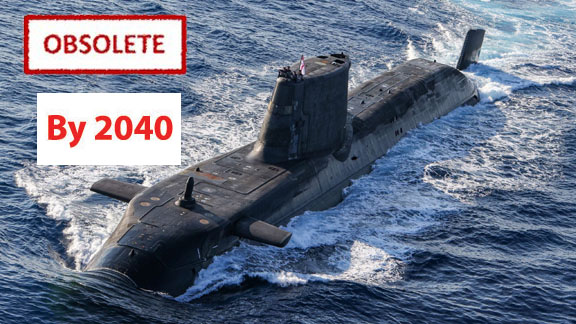
The first submarine, which is probably a version of the US Virginia class attack, will not be operationally available until the early 2040s and the last vessel by 2060.
The extended timeline that will leave the Royal Australian Navy without serious undersea capability calls for a stopgap interim arrangement. It could be an improved version of the Swedish-origin Collins-class ship to bridge the looming capability gap.
The Virginia class has been afflicted with maintenance problems and, over the last 33 years, has only performed 15 six-monthly deployments. Conventionally powered submarines are now commonly equipped with air-independent propulsion (AIP), which makes them quieter than nuclear submarines.
The latter must keep their reactor cooling pumps going and use noisy giant meshing gears between the steam turbines and propellers.
Nuclear submarines can also be detected by their constant release of hot water by leaving wakes on the surface when running at high speeds. A section of naval strategists within the US has been making a case for a return to diesel-electric or AIP-powered boats, given the technological improvements that have enhanced their speed, submerged endurance, and diving depths.
Diesel-electrics and AIP SSKs like the Swedish Gotland class or the Indian Navy’s Russian origin Kilo-class have also ‘sank’ US carriers often in exercises. Worse, the nuclear propulsion of the Virginia-class is not suitable in the littoral, shallow waters of the South and East China Seas…..
Naval bases in the first island chain around China like Guam, Subic Bay, Singapore, and Okinawa already provide proximity making attributes like range and endurance irrelevant, making conventional submarines more suited for the task.
The cost of the project also dwarfs Australia’s financial wherewithal. Australia’s defense budget this financial year stood at $48.6 billion.
But the upgraded USS Virginia-class boat that the AUKUS pact promises would be $3.5 billion per unit alone. This doesn’t include the highly sophisticated infrastructure required to maintain the fleet, which will entail additional expenses and having to rely on UK and US support until the facilities are functioning.
While former Australian Prime Minister Scott Morrison had announced that the submarines would be built within the country, the construction of advanced nuclear-powered submarines involves steep learning curves, experience, and transfer of technology costs.
Morrison had announced that the hulls would be fabricated in Australia and then sent to the US to install nuclear propulsion and other components. Only time will tell what will be the order book at overburdened US shipyards like the General Dynamics Electric Boat then.
Nuclear Proliferation Safeguards
Lastly, possible run-ins with the International Atomic Energy Agency (IAEA), the UN’s nuclear watchdog, will likely trigger different diplomatic hurdles. The IAEA prohibits the transfer of fissile material for nuclear purposes, preventing the use of nuclear fuel from Australia’s civil nuclear power plants from diverting it for the nuclear submarines.
Australia may be exempted under Paragraph 14 of the standard pact with the IAEA that allows the transfer of nuclear material for “non-prescribed military activity” like nuclear weapons or explosive nuclear material. But that raises a question of a different standard for Iran, whose IAEA-approved civil nuclear program is heavily monitored and safeguarded.
When the new Australian Foreign Minister Penny Wong has to assure IAEA chief Rafael Grossi about Canberra’s “total commitment” to nuclear non-proliferation, it portends tough nuclear diplomacy. Australia is a signatory of the Nuclear Non-Proliferation Treaty (NPT) and the South Pacific Nuclear Free Zone Treaty (SPNFZT) https://eurasiantimes.com/australia-punctures-us-uk-nuclear-submarine-proposal-under-aukus/
Why Australia’s Labor government refuses to defend Julian Assange

WSWS Oscar Grenfell@Oscar_Grenfell, 6 July 22, When the Labor Party scraped into office following the May 21 federal election, some supporters of Julian Assange voiced hopes that the new government would defend the WikiLeaks publisher because he is an Australian journalist and citizen undergoing persecution abroad.
The crudest and most thoughtless expression of these hopes came in the form of an update to a petition demanding that the Australian government act to free Assange. Over the course of almost three years, the petition has been signed by more than 730,000 people, and has served as an important focal point for the latent, mass support that exists for Assange.
But on July 4, the petition’s founder declared that it was no longer necessary to issue any demands on the Australian government. The sole evidence provided was that Labor Prime Minister Anthony Albanese had purportedly signed the petition, and that some members of the government have hinted that it may engage in “quiet diplomacy” on behalf of Assange. “Now that we confirm that the Prime Minister of Australia is one of us and together with all of our collective 731,000 Signatories to this petition we will together move forward with direct representations to the responsible Public Officers in both the USA and Britain,” the update declared.
It was necessary to “understand that the Australian Government does have a right to negotiate the matter of freedom of Julian Assange in the best way they see to secure his freedom… We do not intend to work against any action being taken in different ways by any individual Signatory”—i.e., Albanese.
“[W]e will move forward in a peaceful, harmonious and inclusive manner,” the update declared, that is with regards to the Labor government.
To be blunt, such statements are exercises in wilful delusion. Since forming government, Labor has not issued anything that even could be described as weasel-words in support of Assange. Its attitude towards the WikiLeaks publisher is barely concealed hostility.
The greatest mistake defenders of Assange could make would be to allow a right-wing pro-war Labor government to lead them around by the nose. Such a course would serve to demobilise the mass backing that Assange has among workers and young people, and create the political conditions required for Labor to bury his plight and ensure that extradition from Britain to the US proceeds without hindrance.
The petition update promoted the latest comments on Assange by a member of the government. In an Australian Broadcasting Corporation “Law Report” radio program on June 28, Labor’s Attorney-General Mark Dreyfus again stated that the Assange case had “gone on for too long.” It was this comment that was highlighted on the petition.
But what, of substance, did Dreyfus actually say?
Introducing the subject of Assange, midway through the interview, the host noted warnings that the attempted US prosecution of Assange would set a dangerous precedent of US law being imposed globally.
Assange, an Australian citizen, is facing prosecution in the US, for documents he published while in Europe, exposing American war crimes in Iraq and Afghanistan. Citing Assange legal advisor Greg Barns, the interviewer asked if Dreyfus was troubled by this attempt to extend the reach of American legislation to an Australian citizen with no legal connection to the US?
The attorney-general brushed the question aside. “The United States has long legislated in an extra-territorial way and I think that all other countries have understood that for a long time,” he said. In other words, the US government can do what it likes.
Dreyfus continued: “It is not open to the Australian government to directly interfere with either the jailing of Mr Assange in the United Kingdom or the extradition request that has been made by the United States.”
As with all other Labor ministers, Dreyfus presented Assange’s imprisonment and threatened extradition as a bona fide, lawful procedure. But Assange’s detention, in a maximum-security British prison, without conviction, has been denounced by outgoing United Nations Rapporteur Nils Melzer as state torture.
The US extradition effort is akin to a pseudo-legal lynching. Assange is to be imprisoned, for 175 years, under the draconian Espionage Act, for publishing true information revealing the illegal actions of the American government. Such an operation recalls dissidents being hurled into a dungeon cell, with the key thrown away, during medieval times.
Credible allegations are now on the public record, moreover, that the Trump administration and the CIA discussed kidnapping or assassinating Assange in 2017, before filing an indictment and an extradition request.
Dreyfus again made reference to the possibility of diplomatic representations on Assange’s behalf.
In a highly revealing exchange, the interviewer noted: “The government has said it would like to see this matter brought to an end, but hasn’t exactly said how it would prefer it to come to an end.” Would the government seek to have the charges against Assange dropped in the United States? she asked. “I am not going to canvas what will be the resolution of this case,” Dreyfus replied.
In other words, the attorney-general’s vague statements are worthless. Why would anyone believe that a government minister, who will not even state publicly that the charges against Assange should be dropped, would be fighting for his freedom behind closed doors?
Dreyfus’ vague references to “representations” are like a bone to a hungry dog, meant to placate Assange’s supporters, as is the cloak and dagger operation of Albanese possibly signing the petition.
The real position of Labor has been spelled out by two of its most prominent leaders, Foreign Minister Penny Wong and Defence Minister Richard Marles.
Marles stated last month: “This is a matter for the United Kingdom. Like any Australian citizen facing legal proceedings abroad, he will be provided consular assistance.”
The position is identical to that of the previous Liberal-National Coalition government. Consular support means monitoring the extradition case and the decline of Assange’s health. It is the antithesis of a diplomatic and political intervention to free Assange.
For his part, Albanese has sought to dodge the issue of Assange for the past six weeks. He refuses to mention the WikiLeaks founder’s name, even when directly questioned about the topic. The only passionate comments he has made on the case were in an angry denunciation of Twitter users calling on the Labor government to take action.
It is hardly a mystery why Labor refuses to defend Assange.
The primary focus of the new government has been a foreign policy blitz, orchestrated in the closest of collaboration with the Biden administration, which is seeking Assange’s extradition.
Wong and Albanese have been on one foreign visit after another, seeking to shore-up US dominance in the Indo-Pacific, and to further American imperialism’s confrontation with China, which threatens nuclear war.
The highpoint came last week, when Albanese attended the NATO summit in Madrid. There, he gave full support to a new NATO doctrine, which labels Russia and China as threats and calls on member states to prepare “for high-intensity, multi-domain warfighting against nuclear-armed peer-competitors.”
The persecution of Assange is retribution for his exposure of past war crimes. But it is also a preparation for new, and even greater crimes, associated with these US-led plans for what is nothing short of a global war. The aim is to intimidate the mass anti-war sentiment that exists among workers and young people, and to establish a precedent for further frame-ups and victimisations. The Labor government is fully committed to Washington’s war measures, so it is hostile to Assange. ………………………… https://www.wsws.org/en/articles/2022/07/07/isae-j07.html?fbclid=IwAR0KI1GXMtRjNi5gMnnDCcCiFsGuXMVqQKQcD1XNx2edJay1aEwTdLlSzmI
Mr Albanese goes to Madrid: Australia on the alliance path to Global Nato

Albanese’s trip to the leaders’ summit of a US-dominated alliance centred on the other side of the world will prepare the way for deeper Australian integration into a broadened Nato.
Above all, in one respect Mr Albanese’s rush to Madrid is not so different from his predecessor’s cajoling of Washington and London to help out a mate with the anachronistic PR nonsense of AUKUS and the gift horse of a ‘privileged’ offer to allow Australia to buy massively expensive American or conceivably British nuclear-powered submarines.

https://johnmenadue.com/mr-albanese-goes-to-madrid-australia-on-the-alliance-path-to-global-nato/ By Richard TanterJun 30, 2022, While most eyes rest on the remains of Scott Morrison’s failed attempt at a khaki election through last September’s announcement of a backward-looking AUKUS alliance, prime minister Anthony Albanese’s trip to Madrid for the North Atlantic Treaty Organisation summit points to a much more significant shift in Australia’s alliance with the United States – ‘a global alliance of democracies’, aka Global NATO.
Scott Morrison’s AUKUS centring on agreement with the US and UK to provide Australia with submarine nuclear propulsion evoked derision about its back to the 1950s strategic vision and despair about what promises to be the worst and most consequential of Australia’s numerous recent politically-driven defence procurement choices.
The submarines debacle apart, AUKUS for the most part remains a matter of two or three lines of unpromising promises in media releases, largely dealing with matters already the subject of bilateral agreements or dimly-seen possible futures like quantum computing for defence purposes.
The most recent, if somewhat limp, nudge to keep the Albanese government on the nuclear submarine track came at the National Press Club when the Lowy Institute’s Michael Fullilove mocked an informed questioner concerned about the deal’s implications for the tattered nuclear Non-Proliferation Treaty. This widely-held worry – if first Australia, then serious nuclear weapon-wannabes Brazil and South Korea – was in fact unimportant Fullilove replied, since experts such as former Foreign Minister Gareth Evans have assured us are under control.
At the same time the US has just added its confidence booster to this process with a bill before Congress for an Australia-U.S. Submarine Officer Pipeline Act that would allow two RAN submariners a year to attend a seven-week nuclear reactor training, take the US Navy’s Submarine Officer Basic Course, and then deploy aboard a US nuclear-powered submarine.
This only leaves the imponderables of deciding the strategic rationale of the mission to which the submarines are to be solution, the actual technical requirements that would be entailed by that mission, the design of the submarine, the choice of country and lead contractors for the build, the development of a full-scale naval nuclear-engineering safety and maintenance regime, and a brief discussion of the lifetime costs likely to be more than a couple of multiples of the $100 billion estimate for the French submarines.
What could possibly go wrong?
And that’s before any discussion of opportunity costs – even for alternative contenders for defence spending, let alone meeting non-military requirements for a secure Australia – of the lifetime costs of a commitment to nuclear submarines that are likely to move towards the half trillion dollar mark.
But Albanese’s trip to the leaders’ summit of a US-dominated alliance centred on the other side of the world will prepare the way for deeper Australian integration into a broadened Nato.
For over a decade US and Nato officials and Australian defence advisors have been calling for ‘a global alliance of democracies’. The Australian prime minister, together with the leaders of Nato’s other ‘Asia-Pacific partners’ from Japan, New Zealand and South Korea, will participate in the launch of the first formal iteration of Global Nato with Nato’s Strategic Concept 2022.
Two decades of high tempo deployment of Australian military under Nato auspices in the disastrous wars in Afghanistan and the Middle East have conditioned the Australian Defence Force to close operational coordination and interoperability with US-led Nato ground, air, and naval forces.
Defence planners have gradually integrated Nato into high-level Australian strategic planning, first as an ‘Asian partner’ Nato along with Japan, South Korea and New Zealand, and recently as an ‘Enhanced Strategic Partner’.
Nato’s centrality to the hyper-multinational International Security Assistance Force in Afghanistan provided the first and possibly most important Australian escalator into Nato.
While replete with consequences as lethal for the people of Afghanistan as they were dysfunctional for all of the alliance militaries involved, ISAF, together with the parallel US-orchestrated Combined Maritime Forces in the western Indian Ocean from 2002, provided deep operational experience and ‘learnings’ for a Nato-centred US-led coalition on a scale approaching a multilateral ‘global’ presence.
Nato’s Strategic Concept 2022 is to be formalised at the Madrid Summit, representing a maturation of US post-Cold War planning for a major step towards an integrated global defence alliance after seventy years of US-dominated Nato in Europe and the limitations of bilateral hub-and-spokes alliances in Asia.
Most importantly, apart from integrating its Asian partners more closely, the new Strategic Concept is to prepare Nato ‘against all threats, from all directions’.
Full membership of Nato for any of these Asian partners will be a long way off, not least because the governing institutions of a now 30 member country nuclear alliance will need adjustment, even assuming there is no uncomfortable internal opposition as Turkey has mounted against the admission of Sweden.
For the present, Australia, Japan and Korea – and possibly New Zealand – will be drawn into Nato’s seemingly endless rounds of political, diplomatic, military and civil society consultations (though the last is in practice a most attenuated and selective grouping of actual national and international civil society).
US-led military interoperability drives will be coupled with injunctions for closer political and strategic planning coordination between Canberra and Brussels (aka Washington).
But there can be little doubt of the ultimate goal for Washington in the construction of ‘an alliance of democracies’ with global reach.
The follies of AUKUS distract attention from the scale of the quiet achievement of the United States in rescuing Nato from post-Cold War obsolescence, latterly assisted greatly by the Russian war against Ukraine.
Drawing the line from Kyiv to Taipei, ‘we know’, the Prime Minister said, ‘that there is an alliance that has been reached as well between Russia and China. There are implications for our region, given the strategic competition that is in our region, which is why this Nato summit comes at such a critical time’.
As Mr Albanese rightly put it Russia’s ‘brutal invasion is against the rule of law’, and carries implications for ‘all of those who cherish democracy, who cherish the rule of law, and who cherish the rights of nations to be sovereign’.
Yet Australia needs to tread carefully.
The warm glow of rhetorical solidarity with Ukraine facing World War 2-scale Russian attack tends to veil the fact that multiple US-auspiced Nato interventions in the Middle East, North Africa and Afghanistan have led, via great destruction, to evident defeat or specious ‘mission accomplished’.
Moreover the list of Nato members and partners does not provide an unsullied list of countries honoured for their respect for democracy, rule of law, or sovereignty.
Mr Albanese might like to chat about the rule of law with Victor Orbán from Hungary or Recep Tayyip Erdoğan from Turkey, or indeed with Boris Johnson – or mull over the battered state of American democracy with Joe Biden.
Perhaps a stopover by his RAAF plane in Diego Garcia might prompt some thoughts about British respect for the rule of law – in certain respects, such as the forced dispossession of the indigenous Chagos Islanders to make way for a giant US military base often used by Australia, more egregious than China’s violations of international law somewhat further east.
Above all, in one respect Mr Albanese’s rush to Madrid is not so different from his predecessor’s cajoling of Washington and London to help out a mate with the anachronistic PR nonsense of AUKUS and the gift horse of a ‘privileged’ offer to allow Australia to buy massively expensive American or conceivably British nuclear-powered submarines.
By all means, let us make common cause with governments we find congenial – when our interests do in fact genuinely align. Defence coordination and cooperation with democratic states in our principal areas of strategic interest is a must for Australia. The problem is that Europe is not such an area, and neither was the Middle East, Afghanistan, nor Nato’s latest fronts in North Africa and the Sahel.
Thinking about an alliance of democracies is not inherently foolish. The problem comes when the form of periodic elections is confused with the substance of democracy. It may seem carping to point to the Orbans and Erdoğans of Nato, but with Marine Le Pen possibly just one more election away from the Elysée, the authoritarian threat in Europe is palpably real.
Remarking on a British prime minister’s announced willingness to trash international agreements for political gain at the risk of re-starting a war in Northern Ireland may seem unoriginal, it is scarcely beside the point with talk of new alliances built on rule of law.
Most seriously of all, we should be talking about the risk of a precipitous decline, or even collapse, of democracy in the United States extremely seriously. Appalling as it is, the Supreme Court decision abolishing US women’s rights to control their bodies is but the latest blow to the unexamined claim for the United States to still be called a global model of democracy.
The view in Canberra seems to be that the US alliance has survived the threat of Trump, so it’s back to business as usual, and onward to ever closer union – with the path leading now through Brussels. Yet the dangers to Australia from unconsidered reliance on a country with both systemic dysfunction and deep anti-democratic impulses at its heart should not be ignored.
The common element between the swooning Australian interest in Global Nato and the Morrison fiasco with AUKUS and the manifold problems of its submarine element is that in both cases a considered assessment of whether Australian national interests align with those of the United States – in this case in the guise of Nato – is absent.
The new Australian foreign minister has started a commendable reset of Australian regional relations in an effort to recover, at least as a start, from the wreckage of a decade of coalition policy.
In a series of important statements on foreign policy in recent years Penny Wong eloquently has made the case for understanding that a proper consideration of our national interest cannot be separated from the long and sometimes difficult process of working out who we are.
Interests very largely flow from identity, especially when it comes to reading a map of threats and opportunities. Why then would the first foreign policy ventures of a new prime minister be tied to an alliance with the other side of the world – for Australia, the old world?
Oh, for a Prime Minister honest about Australia’s security!

https://johnmenadue.com/oh-for-a-prime-minister-honest-about-australias-security/1 By Mike Gilligan, Jun 29, 2022,
How did it come to this? Australia’s defence policy has been baldly sacrificed to US interests via AUKUS with little public discourse.
Mostly, those that present as security experts have mumbled support as the US entangles Australia in its planning for war with China. Not a word from the serried rows of professors, publicly funded, who otherwise jostle for public exposure.
For five decades Australia’s security policy has centred on defending our territory independently. Self-reliance has been the prudent and rational posture for Australian governments with ANZUS deliberately avoiding a commitment to armed response by the US in the event of attack on Australia.
Implementing that strategy has been a big task – intellectually, financially and managerially, requiring all our defence spending to be directed to that objective. Whenever we have chosen to join the US in its global wars we did so with modest contributions drawn from forces created for our own priorities, measured to signal political support but not detract from our own objective. Now that policy has been abruptly buried with AUKUS requiring our taxes to heavily fund US strategic denial of China – building nuclear submarines of little value for our own needs to fit with US planning for military conflict with China.
How could Australia’s security policy move largely unremarked from an earnest and internationally respected self-defence policy to mounting aggressive deployments into China’s adjacent waters, at mind numbing cost? Former Prime Minister Paul Keating was an early and insightful critic of AUKUS. Just a few weeks after it was announced, Keating addressed the National Press Club, in November last year. He began by inferring that it was because mainstream media coverage of security is so weak in Australia he felt compelled to share his perspective. Keating’s reservation was reinforced by the level of questions from the floor at the end. Keating made the then striking claim that Australia was to build nuclear submarines specifically to attack China in its waters. He observed that this had been admitted effectively by Australia’s ambassador to Washington, Arthur Sinodinos. The submarines would be designed to attack China’s nuclear missile submarines which are China’s second-strike deterrent to US nuclear attack on China.
So, Australia is being set up as a key factor in the nuclear war equation of the US and China. Broadly, Keating argued that China deserves respect. It now has a bigger economy than the US by 25% and can be expected to expand that gap in coming decades. China has shown it wants to participate in global structures and be part of reform. China has a lot to offer and is not contriving to run the world. Its security concern is to push US sea and air military forces away from its borders, noting US and other forces (including Australian) exercise in the South China Sea. The more senior of the serried professors, Paul Dibb, quickly took up the pen disparagingly against Keating, observing that Keating “gave the strong impression of being a sleepwalker”. Dibb is thereby suggesting it has long been common knowledge that Australia is preparing for war against China. If so, that is news to most Australians, including those who have a more-than-cursory interest in our security affairs.
On Thursday last week, Dibb was delivered by ABC TV into the living rooms of Australians via the 7:30 Report, unannounced and without context, just prior to Leigh Sales’ interview with Prime Minister Albanese. His hectoring message was that Defence should have first priority from the Government, to ensure that it counters an “aggressive and expansionist” China. Urgency was implied as China could exploit a “window of opportunity” with the US distracted by the Ukraine. I suspect most viewers thought that this was just more of the banality we enjoy on Thursday nights from Sammy J. But it was shabby, ABC.
Dibb’s professional pedigree lies in Cold War intelligence. It has been claimed that he enjoyed unusual access to sensitive classified material for years. In this regard Dibb should now be obsolete. These days he writes for an online ASPI platform where his paragraphs settle comfortably alongside trademarks of weapons systems purveyors. The tone is invariably unsettling and receptive to greater defence spending. Yet big media conduits such as the Press Club and ABC television, which provide him a national platform at prime time, offer no declaration of interests.
Another professor, Rory Medcalf, head of the “National Security College “ at the ANU with staff of about sixty, writes and comments regularly. His recent book “Contest for the Indo-Pacific” is engaging but the substance is a worry. In discussing Australia, Medcalf shows poor comprehension of the realities of Australia’s defence policy post ANZUS: “ Australia relies acutely on … in the ultimate crisis, the expectation under the ANZUS Treaty that overwhelming (US) force would come to its aid “. In fact Australia’s policy has been quite the reverse – to have no such expectation of US force intervening on our behalf under ANZUS . Even security hobbyists know Medcalf Is at odds with decades of Australian defence policy centred on self-reliance, deriving from the ANZUS negotiation by Spender, its ratification by Congress and subsequent affirmations. This failure is not of some slippery nuance. Ignorance of a key risk factor in our security is more than disappointing at his level. Only by getting ANZUS right can we address our security risk.
In public commentary Medcalf seems as anchored ideologically as the daily media, lining up with China as a threat to be constrained. How can Australians understand security without credible public thought leaders? Recognising the deficiency is a start. Balanced analytical commentary should aim for Australians to be confident that their governments comprehend and are dealing with the risks in ANZUS. At present few realise that any Australian government joining with the US in applying military force against China on the assumption that the US will be with us “all the way”, is foolhardy.
What an achievement it would be for a serving prime minister to inform Australians honestly of our ultimate security risk under ANZUS. Prime Minister Albanese might ponder that as he sits amongst NATO leaders in Madrid, none of whom carry similar risk to him because they share a real security treaty with the US. And perhaps the Prime Minister might realise that Australia, in being treated differently, can learn from Ukraine’s experience as a qualified friend of the US.
Dr Mike Gilligan worked for 20 years in defence policy and evaluating military proposals for development, including time in the Pentagon on military balances in Asia.
Harsher anti-protest laws targeting environmentalists are putting greed before green

Guardian, Bob Brown 27 June 22,
Penalties for peaceful action are now the same as for aggravated assault.
Last Friday dozens of armed New South Wales police officers raided a camp near Sydney and arrested two environmentalists. One was Aunty Caroline Kirk, an Aboriginal elder. She was charged with “wilfully obstructing and intimidating police”.
“I can’t run, I can’t climb,” she said. “All I can do … is teach my culture. Why are they doing this?”
The answer lies in the showdown of our age between greed and green.
At the heart of this is greenophobia, the fear of things green, including environmentalists. It involves the blighted idea that people should be stopped from taking action to defend the environment, especially if it gets in the way of making money.

It has infected the world of natural resource extractors and they have found the established political parties around the world extra helpful. So, in this year’s Queen’s speech, Boris Johnson announced a bill to jail peaceful UK protesters for up to 10 years. The proposal of those measures was one of the triggers that brought 400 alarmed scientists out to support environmental activists last year.
Brazil’s president, Jair Bolsonaro, is a greenophobe who is letting the Amazon rainforest and its Indigenous cultures be destroyed. His nation has descended into environmental lawlessness in which two rainforest defenders, British journalist Dom Phillips and Brazilian Indigenous advocate Bruno Pereira, were murdered this month. Globally, 220 environmentalists were murdered last year and thousands more were injured, terrorised or imprisoned. Most of the perpetrators have not been arrested or charged.
MMG’s lobbying helped influence the Tasmanian parliament to vote last week for harsher penalties for the defenders of the Tarkine and its giant masked owls. A clear majority of Tasmanian MPs want MMG to get its toxic waste dump in the Tarkine and Tasmania’s defenders of nature to get a cell in Risdon prison.
Tasmania’s laws match those of NSW, with penalties of up to $11,000 for peaceful environmental protest and double that, or two and a half years in jail, for a second offence. Had these laws been in place in other jurisdictions at other times, the Franklin River would be dammed, the Daintree rainforest razed and much of Kakadu national park mined.
Victoria has also introduced legislation, one aim of which is to deter scientists who have previously gone into the highlands and found forests with protected species – such as the greater glider and the state’s critically endangered faunal emblem, the Leadbeater’s possum – being logged. That’s illegal. While the loggers faced no charges, the intention of the new laws is to stop or arrest those scientists next time.
In Newcastle last year a young man was sentenced to a year in jail for delaying a coal train. The court did not hear the assessment of the former chief scientist at Nasa who told the US Congress that, in this world of dangerous global heating, transporting coal is a criminal activity.
Greenophobia is percolating down. On the Monday before Aunty Caroline’s arrest, 100 or so officers raided Blockade Australia’s camp for peaceful protest at Colo near Sydney after four undercover officers who failed to identify themselves “feared for their lives” – though the police had the guns and the people in the camp, including the children, had none……………………………..
Corporate PR machines, with the rightwing media ready to go, are developing greenophobia to divert attention to their business wellbeing and away from the graver threat of the collapse of Earth’s biosphere, including through global heating and species extinctions. As the NSW attorney general, Mark Speakman, put it: “What we are stopping, or criminalising even further, are protests that shut down major economic activity.” It’s money before the planet.22
The new federal environment minister, Tanya Plibersek, is now Australia’s most powerful environmentalist. She will decide if MMG should treat its toxic wastes inside or outside the Tarkine rainforest. In doing so she will also decide if Tasmania’s environmentalists will face the new draconian sentences there. Those penalties, for peaceful environmental action, are now the same as for aggravated assault or for threatening neighbours with a shotgun.
Such laws may be tested in the high court as earlier laws were, after I was among those arrested in Tasmania’s Lapoinya rainforest in 2017. The court found those laws unconstitutional because they took away the right to peaceful protest. Meanwhile the Lapoinya forest was flattened and burnt, along with its rare wildlife. No one was arrested for that… The court found those laws unconstitutional because they took away the right to peaceful protest. Meanwhile the Lapoinya forest was flattened and burnt, along with its rare wildlife. No one was arrested for that.
If MMG’s needless waste dump is given the go-ahead I, for one, will help defend that vital forest, its owls, kingfishers and Tasmanian devils. They can take us out of nature but they can’t take nature out of us.
As for the “terrifying” Aunty Caroline, I would like to meet her and thank her. She may not be able to run or climb but she is an inspiration. https://www.theguardian.com/commentisfree/2022/jun/27/harsher-anti-protest-laws-targeting-environmentalists-are-putting-greed-before-green-bob-brown
- Bob Brown is a former senator and leader of the Australian Greens and is patron of the Bob Brown Foundation……
A new era as Australia joins historic UN nuclear ban meeting
.
https://johnmenadue.com/australia-joins-historic-un-nuclear-ban-meeting/ By Tilman RuffJun 27, 2022,
This week in Vienna, Australia joined a landmark gathering of eighty-three governments to further implement and develop the treaty banning nuclear weapons.
In a stunning demonstration of resolve, goodwill and cooperation, with no shred or adversarial politics, the meeting adopted a realistic action plan that breaks new ground. It maps out collaborative programs of work led by different states in key areas of treaty obligations: promoting treaty membership and norms, complementarity with other nuclear treaties, disarmament processes including verification, and assisting victims and remediating (where possible) environments harmed by nuclear weapons use and testing. States also made a political declaration that is arguably the strongest and clearest rejection of nuclear weapons ever made by a multilateral gathering.
Five years ago, by a vote of 122 to 1 in the United Nations in New York, the first treaty to ban the worst weapons of mass destruction was born: the Treaty on the Prohibition of Nuclear Weapons (TPNW). For its role in bringing about the treaty, the Melbourne-born International Campaign to Abolish Nuclear Weapons (ICAN) became the first Australian-born entity to be awarded the Nobel Peace Prize. The treaty entered into legal force last year, and this week for the first time, governments gathered to discuss and decide how to promote and implement the treaty.
The Australian delegation to Vienna was led by NSW Labor MP Susan Templeman, federal member for Macquarie, who last year said Australia “can and should lead international efforts to rid the world of nuclear weapons”. She told the Blue Mountains Gazette this week: “It was great to be in Austria to observe the first Meeting of States Parties to the Treaty on the Prohibition of Nuclear Weapons (TPNW) on behalf of Australia. … Australia shares the ambition of TPNW states parties of a world free of nuclear weapons.”
The Vienna meeting from 21-23 June was the first intergovernmental gathering focused on addressing the threat of nuclear weapons since Russia’s invasion of Ukraine and multiple threats by President Vladimir Putin to use nuclear weapons. Other “nuclear-endorsing” states attending the meeting as observers included NATO members Germany, the Netherlands, Norway and Belgium. Sweden, Finland and Switzerland also joined.
Shamefully, the previous Australian government boycotted the negotiation of and opposed the TPNW, the first time Australia has ever boycotted multilateral disarmament negotiations. This stands in stark contrast to Australia under governments both Labor and Coalition having joined the treaties that ban biological and chemical weapons, landmines and cluster munitions.
In 2018, the ALP adopted unanimously a national policy platform commitment to sign and ratify the TPNW. It reaffirmed that policy at its national conference in 2021. Prime Minister Anthony Albanese is a long-term champion of nuclear disarmament and non-proliferation and moved the new policy in 2018. Over three-quarters of all members of the new government have personally backed the treaty. In this they have strong public support – opinion polls over recent years have consistently shown 70-80% of the public want Australia to join the TPNW – in the most recent poll 76% of those asked want Australia to join the nuclear weapon ban, with only 6% opposed (Ipsos, March 2022).
Fifty-five Australian former ambassadors and high commissioners this week released an open letter to PM Albanese urging him to sign and ratify the TPNW without delay.
The meeting in Vienna and a new more constructive era in Australia’s approach to nuclear disarmament and non-proliferation could not come at a more critical time. With Russia’s invasion of Ukraine accompanied by repeated threats to use nuclear weapons, the world faces the greatest evident danger of nuclear war since the Cuban missile crisis of 1962. Russia’s threats should shatter any misplaced sense of complacency or denial that somehow the risk of nuclear war is a faded relic of the past that no longer demands our urgent attention.
Russia’s threats have upended decades-old assumptions about security and deterrence, with Russia using nuclear weapons not to deter but to coerce and intimidate, and provide a cover for war crimes and gross violations of international law and human rights.
But as former UN secretary-general Ban Ki-moon said, “There are no right hands for the wrong weapons.” Every day that thousands of nuclear weapons remain launch-ready, two thousand of them ready to be launched within minutes, they remain the most acute existential threat to humanity and our planet. The leading scientists behind the Doomsday Clock have set it at 100 seconds to midnight, further forward than ever before. None of the nine states wielding nuclear weapons are disarming or negotiating for disarmament as they are obligated to do. To the contrary, all are engaged in upgrading and modernising their arsenals with new, more accurate, flexible and ‘usable’ weapons. Kinds of nuclear weapons the world has never seen before are being developed and deployed, including hypersonic missiles, nuclear-armed cruise missiles powered by nuclear reactors, and nuclear torpedos. And the number of usable weapons in military stockpiles is again increasing.
The International Campaign to Abolish Nuclear Weapons (ICAN) in a report released last week documented that last year the nine nuclear-armed countries spent US$82.4 billion (A$116 billion) on nuclear weapons – A$220,000 per minute – an inflation-adjusted increase of A$9.2 billion from 2020.
The day before the treaty meeting, the Australian delegation also joined a Conference on the Humanitarian Impacts of Nuclear Weapons hosted by Austria, which provided compelling updated evidence from scientists, emergency responders and other experts on the catastrophic consequences and growing risks of use of nuclear weapons.
The TPNW provides our best hope to control our worst weapons, and is currently the only bright light in an otherwise bleak and darkening nuclear landscape. Hopefully this early positive step will be promptly followed by the new government signing and working towards Australia ratifying the treaty, in line with its pre-election commitments.
TILMAN RUFF
Tilman Ruff AO is Co-President of International Physicians for the Prevention of Nuclear War (Nobel Peace Prize 1985); and co-founder and founding international and Australian Chair of the International Campaign to Abolish Nuclear Weapons (ICAN), awarded the 2017 Nobel Peace Prize, the first to an entity born in Australia.
1 This Month


10 March A LIVE WEBINAR THE REAL EFFECTS OF NUCLEAR POWER
What the Industry Isn’t Telling Us
1:00 PM Mountain, 2 pm Central, 3 pm Eastern. Live on the Keepers of the Water Facebook page

18 March Webinar @ 1 PM EST: An Assessment of SMR Projects: The Case of Canada
register for the zoom:
https://us02web.zoom.us/webinar/register/WN_o8BIIOUvQ2ONJR1nta65DQ#/registration


of the week – STOP SMALL MODULAR REACTORS IN CANADA
To see nuclear-related stories in greater depth and intensity – go to https://nuclearinformation.wordpress.com
-
Archives
- March 2026 (62)
- February 2026 (268)
- January 2026 (308)
- December 2025 (358)
- November 2025 (359)
- October 2025 (376)
- September 2025 (258)
- August 2025 (319)
- July 2025 (230)
- June 2025 (348)
- May 2025 (261)
- April 2025 (305)
-
Categories
- 1
- 1 NUCLEAR ISSUES
- business and costs
- climate change
- culture and arts
- ENERGY
- environment
- health
- history
- indigenous issues
- Legal
- marketing of nuclear
- media
- opposition to nuclear
- PERSONAL STORIES
- politics
- politics international
- Religion and ethics
- safety
- secrets,lies and civil liberties
- spinbuster
- technology
- Uranium
- wastes
- weapons and war
- Women
- 2 WORLD
- ACTION
- AFRICA
- Atrocities
- AUSTRALIA
- Christina's notes
- Christina's themes
- culture and arts
- Events
- Fuk 2022
- Fuk 2023
- Fukushima 2017
- Fukushima 2018
- fukushima 2019
- Fukushima 2020
- Fukushima 2021
- general
- global warming
- Humour (God we need it)
- Nuclear
- RARE EARTHS
- Reference
- resources – print
- Resources -audiovicual
- Weekly Newsletter
- World
- World Nuclear
- YouTube
-
RSS
Entries RSS
Comments RSS
 nuclear-news