The Australian Opposition Party says its nuclear plants will run for 100 years. What does the international experience tell us?

The average age of an active nuclear reactor worldwide is about 32 years – and a live plant reaching even 60 has ‘never happened’, an expert says
Peter Hannam, Mon 24 Jun 2024 https://www.theguardian.com/australia-news/article/2024/jun/24/coalition-nuclear-policy-peter-dutton-power-plants-100-years-run-time
The federal Coalition’s pledge to build nuclear reactors on seven sites in five states if elected has continued to raise questions this week.
Ted O’Brien, the shadow energy minister, says the plants can operate for between 80 and 100 years, providing “cheaper, cleaner and consistent 24/7 electricity” compared with renewables.
That claim comes despite the CSIRO’s Gencost report estimating each 1-gigawatt nuclear plant could take 15-20 years to build and cost $8.4bn. The first may be double that given the high start-up costs.
But what does the state of the nuclear energy internationally tell us about the Coalition’s proposal?
What is the state of the global nuclear industry?
The world opened five nuclear reactors last year and shut the same number, trimming 1GW of capacity in the process, says Mycle Schneider, an independent analyst who coordinates the annual world nuclear industry status report.
During the past two decades, it’s a similar story of 102 reactors opened and 104 shutting. As with most energy sources, China has been the biggest mover, adding 49 during that time and closing none. Despite that burst, nuclear provides only about 5% of China’s electricity.
Last year, China added 1GW of nuclear energy but more than 200GW of solar alone. Solar passed nuclear for total power production in 2022 while wind overtook it a decade ago.
“In industrial terms, nuclear power is irrelevant in the overall global market for electricity generating technology,” he says.
As for small modular reactors, or SMRs,nobody has built one commercially. Not even billionaire Bill Gates, whose company has been trying for 18 years.
The CSIRO report examined the “contentious issue” of SMRs, and noted that one of the main US projects, Utah Associated Municipal Power Systems, was cancelled last November. Even then, its estimated costs in 2o2o of $18,200/kiloWatt, or more than double that of large-scale plants at $8,655/kW (in 2023 dollars).
“In late 2022 UAMPS updated their capital cost to $28,580/kW citing the global inflationary pressures that have increased the cost of all electricity generation technologies,” CSIRO said. “The UAMPS estimate implies nuclear SMR has been hit by a 57% cost increase which is much larger than the average 20% observed in other technologies.”
So at least some nations are still building large reactors?
Of the 35 construction starts since 2019, 22 were in China and the rest were Russian-built in various nations. Russia sweetens its deals by agreeing to handle the waste from the plants it builds.
“The US has blacklisted CGN and CNNC, which are the two major [Chinese] state-owned nuclear companies [in China] that could respond to an international call for tender,” Schneider says. “So could you imagine that Australia would hire a Chinese company under those conditions to build nuclear reactors?”
Aren’t allies like France an option?
France’s EDF was a poster child for the industry, not least because nuclear provides almost two-thirds of the country’s electricity. However, the firm has €54.5bn ($88bn) debt and hasn’t finished a plant since 2007.
Construction of its Hinkley Point C plant in the UK – two giant, 1.63GW units – began in 2018, aiming for first power from 2025. Rounds of delays now mean it might not fire up until 2031 and the costs may approach $90bn when it is complete.
South Korea’s Kepco has been active too, building the 5.6GW Barakah plant in the United Arab Emirates. As Schneider’s report notes, the UAE “did not agree” to the disclosure of cost, delays or impairment losses.
That Kepco debt totals an astonishing $US154bn ($231bn) is perhaps “a slight indication that they cannot have made tonnes of money in the UAE”, Schneider says.
The 4.5GW Vogtle plant reached full capacity in April, making it the US’s largest nuclear power station. Its first two units exceeded $US35bn, with the state of Georgia’s Public Service Commission saying cost increases and delays have “completely eliminated any benefit on a lifecycle costs basis”.
Can these plants really run 80-100 years?
Of the active 416 nuclear reactors, the mean age is about 32 years. Among the 29 reactors that have shut over the past five years, the average age was less than 43 years, Schneider says.
There are 16 reactors that have been operating for 51 years or more. “There is zero experience of a 60-year-old operating reactor, zero. It never happened. Leave alone 80 years or beyond,” he says. (The world’s oldest, Switzerland’s Beznau, has clocked up 55 years with periods of outages.)
CSIRO’s report looked at a 30- or 40-year life for a large nuclear plant as there was “little evidence presented that private financing would be comfortable” with risk for any longer.
As plants age, maintenance costs should increase, as they have in France. That’s not the case in the US, though, with declining investment in the past decade even as the average reactor age has jumped from 32 to 42 years.
“You have two options as to the outcome: either you hit an investment wall, so you have to have massive investments all over the place at the same time, or you get a very serious safety or security problem somewhere,” Schneider says.
US plants have been running an “incredible” 90% of the time over the past decade. Compare that with France’s load factor in 2022 of just 52%, he says.
“The best offshore wind farms in Scotland have a five-year average load factor of 54%.”
The insane amount it could cost to turn Australia nuclear – as new detail in Peter Dutton’s bold plan is revealed
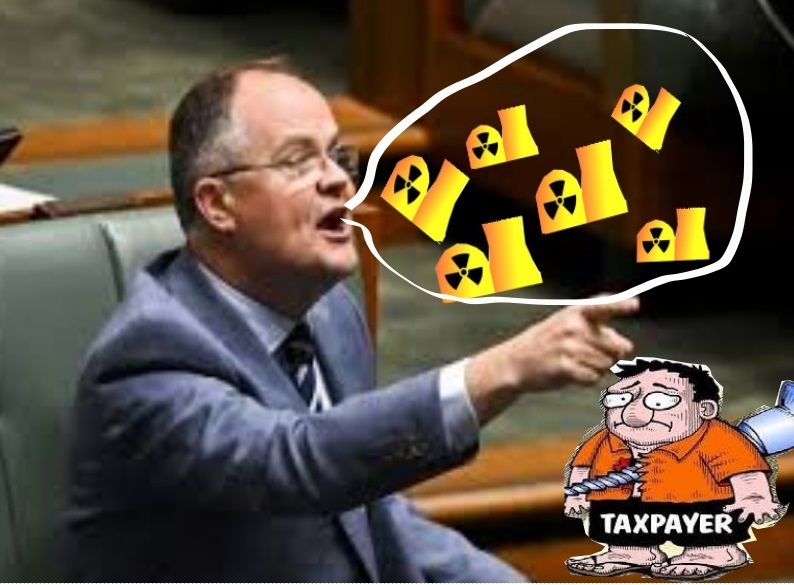
The large-scale and small modular generators would be Commonwealth-owned, similar to arrangements governing the Snowy Hydro 2.0 scheme, requiring a multibillion-dollar funding commitment from taxpayers.
- Peter Dutton nuclear plan slammed
- Proposal could cost $600billion
By JACK QUAIL FOR NCA NEWSWIRE and AUSTRALIAN ASSOCIATED PRESS 23 June 2024, more https://www.dailymail.co.uk/news/article-13559019/The-insane-cost-turn-Australia-nuclear-Peter-Dutton-slammed-completely-irrational-plan.html
Labor frontbencher Tanya Plibersek has added her voice to the tirade of criticism against the Opposition’s nuclear energy push, labelling the proposal as ‘completely irrational’ and ‘designed to be a distraction’.
Speaking on Sunday, the environment and water minister criticised the Coalition for its refusal to detail the estimated cost to add nuclear generation to the national electricity market in the biggest overhaul of energy policy in decades.
‘He’s saying to Australians: ‘I don’t trust you. I don’t trust you with the costing we’ve done,’ if he’s got costings,’ Ms Plibersek told Sky News.
According to analysis released by the Smart Energy Council using data from the latest GenCost report, Labor’s non-nuclear energy plan is estimated to cost $117bn through to 2050, while the Coalition’s pledge would cost upwards of $600bn.
Opposition energy spokesman Ted O’Brien has flagged an evolution in the Coalition’s nuclear power policy, revealing that each of the seven sites could host multiple reactors.
But in a major concession, Mr O’Brien said on Sunday the Coalition would not go to the election announcing the estimated generation capacity of its nuclear power plan, leaving this decision to an independent body until after the election.
‘One of the lessons we learned from overseas, in order to get prices down, you need multi-unit sites,’ Mr O’Brien told the ABC’s Insiders program.
‘Let’s say the small modular reactors … When you talk about a nuclear plant, these are modularised compartments. You can add another 300, add another 300.
‘You’re talking about multi-unit plants.’
An independent nuclear energy coordinating authority would make recommendations on the number and type of reactors per site, Mr O’Brien said, which would then determine the final generation capacity.
‘The independent body would look at each plant, and come up with a recommendation as to what sort of technology should be used,’ he said.
‘From there, it would be exactly what capacity based on that technology.
‘Only from there can you come down to a specific number of gigawatts’.
Last week Coalition unveiled plans to build seven nuclear power plants by 2050 with the first reactor slated to be operational in just over a decade in a move designed to deliver cheaper, zero-emissions and reliable power supply.
The large-scale and small modular generators would be Commonwealth-owned, similar to arrangements governing the Snowy Hydro 2.0 scheme, requiring a multibillion-dollar funding commitment from taxpayers.
The Coalition has proposed to locate the reactors in Queensland, NSW, Victoria, South Australia and Western Australia on the sites of former coal fired power stations, adding no more than 10GW to the power grid, meaning renewables will remain the vast majority of the energy mix.
Smart Energy Council chief executive John Grimes said Mr Dutton’s nuclear proposal would deliver ‘at best’ 3.7 per cent of the energy required at the same cost as the government’s current strategy.
‘In reality, current cost overruns happening right now in the UK could mean a $600 billion bill to Australian taxpayers, whilst delivering a small proportion of the energy that is actually required,’ he said.
Nuclear had no place in a country with cheap, reliable energy powered by the sun and wind and backed up by renewable energy storage, Mr Grimes said.
‘The most optimistic assessment of Peter Dutton’s nuclear proposal indicates it is a pale shadow of the reliable renewables plan outlined and costed by the Australian Energy Market Operator,’ he said.
The council has called on the opposition to release its analysis of the costings and generation capacity from the seven proposed nuclear reactor sites.
‘They need to explain how their forecasts contradict the experts at the CSIRO and AEMO,’ Mr Grimes said.
‘It is extraordinary that the details are being hidden from the Australian public.’
Separate analysis released by CSIRO put the cost of building a large-scale nuclear reactor at $8.6bn, bringing the total cost to approximately $60bn, however nuclear projects are often subject to hefty delays and soaring cost overruns.
Asked why Australia had eschewed nuclear power when many other advanced economies had adopted the technology, Ms Plibersek pointed to Australia’s comparative advantage in renewable power generation.
‘We’ve got the room, we’ve got the resources, we’ve got the critical minerals we need, battery manufacturing, we’re investing in green hydrogen,’ Ms Plibersek said.
‘We can be a renewable energy superpower and instead Peter Dutton wants to slam the brakes on, instead of leading the world with renewable energy investment.
‘He wants to fast track nuclear, and put us on the slow lane when it comes to renewables. It’s just mad.’
Australian Opposition Leader Peter Dutton’s nuclear plan could cost as much as $600bn and supply just 3.7% of Australia’s energy by 2050, experts say

Coalition proposal would cost a minimum of $116bn – the same as Labor’s plan for almost 100% renewables by 2050, the Smart Energy Council says
Jordyn Beazley, Sun 23 Jun 2024 https://www.theguardian.com/australia-news/article/2024/jun/23/peter-duttons-nuclear-plan-could-cost-as-much-as-600bn-and-supply-just-37-of-australias-energy-by-2050-experts-say
The Coalition’s pledge to build seven nuclear reactors as part of its controversial energy plan could cost taxpayers as much as $600bn while supplying just 3.7% of Australia’s energy mix by 2050, according to the Smart Energy Council.
The analysis found the plan would cost a minimum of $116bn – the same cost as delivering the Albanese government’s plan for 82% renewables by 2030, and an almost 100% renewable energy mix by 2050.
The Coalition has drawn widespread criticism for not releasing the costings of the nuclear power proposal it unveiled on Wednesday as part of its plan for Australia’s energy future if elected. On Friday, the opposition leader, Peter Dutton, said the costings would come “very soon”, but did not confirm whether it would be days, weeks or months.
The Smart Energy Council came to the $116bn figure using data from the CSIRO and the Australian Energy Market Operator’s latest GenCost report. It factored in the Coalition’s proposed timeframe and the capital costs of replacing the 11 gigawatts of coal capacity produced on the seven sites with nuclear reactors.
But factoring in the experience of cost and timeframe blowouts in the UK, the refurbishment of coal-fired power stations, and Dutton’s plan to compensate the states, the Smart Energy Council found the cost could reach as much as $600bn.
The council found the large nuclear reactors – of which there will be five alongside two smaller reactors – would probably cost $60bn each and were unlikely to be built by 2040. Dutton has said that they plan for the reactors to be built and operational by the second half of the 2030s.
“At best, Peter Dutton’s nuclear proposal would deliver 3.7% of the energy required at the same cost as the government’s comprehensive strategy,” John Grimes, the chief executive of the Smart Energy Council, said.
“In reality, current cost overruns happening right now in the UK could mean a $600bn bill to Australian taxpayers, whilst delivering a small proportion of the energy that is actually required.
“The most optimistic assessment of Peter Dutton’s nuclear proposal indicates it is a pale shadow of the reliable renewables plan outlined and costed by the Australian Energy Market Operator (Aemo).”
The Smart Energy Council called on the opposition to immediately release its costings and the generation capacity of the proposed seven nuclear reactors.
“They need to explain how their forecasts contradict the experts at the CSIRO and Aemo. It is extraordinary that the details are being hidden from the Australian public,” said Grimes.
The CSIRO and Aemo have assessed the cost of different electricity sources and found nuclear generation would be the most expensive technology available for consumers.
It found that solar and wind backed by storage energy, new transmission lines and other “firming” – in other words, what the country is building now – were the cheapest option.
The Coalition’s promise has met widespread scepticism from Australia’s energy sector and industry groups, which have warned about the risks of cost blowouts and destroying private sector investment.
During an address to party officials in Sydney on Saturday, Dutton said his nuclear energy plan would cost a fraction of Labor’s renewable energy rollout, and would assist in achieving the party’s goal for “cheaper, cleaner and consistent power.
Australia’s Nuclear debate is getting heated, but whose energy plan stacks up?

by Mike Foley, June 24, 2024, https://www.smh.com.au/politics/federal/nuclear-debate-is-getting-heated-but-whose-energy-plan-stacks-up-20240624-p5jo45.html
The Coalition’s nuclear power policy is less than a week old, but the political debate about Australia’s energy future has been raging since. The opposition’s claims about both its policy and the renewables-focused government plan have prompted plenty of questions about their veracity.
We take a look through the biggest of those talking points to see whether they stack up.
*** Labor’s ‘renewables-only’ plan will cost more than $1 trillion: False
The opposition says it will cost more than $1 trillion for the Albanese government to reach its target of boosting renewables to 82 per cent of the electricity grid by 2030. Currently, about 40 per cent of the grid is renewable electricity.
Nationals Leader David Littleproud on Sunday attributed the numbers to Net Zero Australia: a think tank of academics from University of Melbourne, University of Queensland and Princeton University.
The think tank calculated the estimated cost of reaching net zero across the entire economy, not just the electricity grid.
They found that it would cost more than $1 trillion by 2030 and up to $9 trillion by 2050, largely driven by private investment. The figure includes a range of actions, from integrating electric vehicles into the transport fleet to heavy industry, such as smelting switching from gas to electric power.
The Australian Energy Market Operator (AEMO) forecasts that the cost of reaching 82 per cent renewables, again largely driven by private investment in wind and solar farms and transmission lines, will cost $121 billion in today’s money.
The Albanese government has also committed $20 billion to underwrite transmission-line construction and has set up a fund called the Capacity Investment Scheme, estimated to be worth tens of billions of dollars. It will underwrite new renewable projects, and if private investors fail to achieve forecast returns, taxpayers could be on the hook to subsidise operations but will get a cut of the profits when they exceed a set threshold.
*** Nuclear energy will deliver cheaper power bills: False
Dutton said on Wednesday last week his plan would “see Australia achieve our three goals of cheaper, cleaner and consistent power”.
The opposition has committed to release the costings of their plan before the next election.
Many experts disagree, arguing nuclear power delivers the most expensive form of electricity.
The same report cited by the opposition for a $1 trillion cost of the renewables rollout said there is “no role” for nuclear power in Australia’s energy mix.
“We only see a potential role for nuclear electricity generation if its cost falls sharply and the growth of renewables is constrained,” Net Zero Australia’s report in July last year said.
Internationally recognised financial services firm Lazard also found renewable energy sources continued to be much cheaper than nuclear. It said onshore wind was the cheapest, with a cost between $US25 and $US73 per megawatt hour. The second cheapest was large-scale solar at between $US29 and $US92. Nuclear was the most expensive, at between $US145 and $US222.
The CSIRO found the cheapest electricity would come from a grid that draws 90 per cent of its power from renewables, which would supply electricity for a cost of between $89 and $128 per megawatt hour by 2030 – factoring in $40 billion in transmission lines and batteries to back up renewables.
CSIRO calculated that a large-scale nuclear reactor would supply power for $136 to $226 per megawatt hour by 2040.
** The renewables rollout needs 28,000 kilometres of transmission lines: False
“Labor has promised 28,000 kilometres of new poles and wires, there’s no transparency on where that will go, and we’ve been very clear about the fact that we don’t believe in that model,” Opposition Leader Peter Dutton said last week.
The AEMO releases a document each year called the Integrated System Plan, after consulting private industry, that details a road map of what the most efficient energy system will look like in coming years, including new infrastructure, up to 2050.
The Integrated System Plan includes directives set by policymakers, like the Albanese government’s commitment to reach 82 per cent of energy generation coming from renewables by 2030, and to hit net zero emissions by 2030.
The most recent plan, from January, says around 5000 kilometres of transmission lines are needed in the next 10 years to deliver the Albanese government’s goals, including 4000 kilometres of new lines and upgrading 1000 kilometres of existing lines. AEMO said 10,000 kilometres of transmission lines will be needed for Australia to reach net zero by 2050.
The 28,000-kilometre figure cited by the opposition resembles the 26,000 kilometres of transmission AEMO said would be needed by 2050 if Australia was to transform its economy to a clean energy export powerhouse, including large-scale production of green hydrogen and decarbonisation of other industrial processes.
*** The first reactor would be built before 2037: Questionable
The opposition says if elected, they would build a nuclear reactor and have it hooked up to the grid within 12 years of forming a government.
Its nuclear energy policy document, released last week, states that depending on what technology it chooses to prioritise, a large-scale reactor would start generating electricity by 2037 and a small modular reactor (SMR) by 2035. SMRs are a developing design not yet in commercial production.
This rollout would be as quick as anywhere in the world. The United Arab Emirates has set the global pace. It announced in 2008 that it would build four reactors under contract from Korean company KEPCO. Construction began in 2012, and the first reactor connected to the grid in 2020.
There are significant differences between the UAE and Australia. The former is a dictatorship without comparable labour laws or planning regulations that relies on cheap imported labour, whereas the latter has rigorous workforce protections, environmental laws and planning processes.
Opposition energy spokesman Ted O’Brien said a Coalition government would establish a Nuclear Energy Coordinating Authority that would assess each of the seven nuclear sites it has identified and determine what specific type of reactor would be built where, while also committing to two and half years of community consultation. A new safety and management regime would need to be developed, and parliament would have to repeal the current federal ban on nuclear energy within this timeframe.
If the Coalition forms government in May next year, following the consultation phase, it assumes construction could begin in late 2027 and would take 10 years for a large-scale reactor. That is far quicker than other Western nations have achieved recently.
The UK’s Hinkley Point nuclear plant began construction in 2018 and is not expected to be completed until at least 2030. The only reactor now under construction in France is the Flamanville EPR. Construction began in 2007 and is currently incomplete. A reactor at Olkiluoto Island, Finland, began in 2005 and was completed in 2022.
*** The annual waste from a reactor fits into a Coke can: False
Opposition Leader Peter Dutton’s claim that the annual waste generated by an SMR amounts to the size of a Coke can is incorrect, experts say, with such facilities likely to generate multiple tonnes of high-level radioactive waste each year.
“If you look at a 450-megawatt reactor, it produces waste equivalent to the size of a can of Coke each year,” Dutton said on Tuesday.
Multiple experts told this masthead a 450-megawatt reactor referenced by Dutton would generate many tonnes of waste a year.
Large-scale reactors, which have been deployed in 32 countries around the world, have a typical capacity of 1000 megawatts and generate about 30 tonnes of used fuel a year. This includes high-level radioactive waste toxic to humans for tens of thousands of years and weapons-grade plutonium.
SMRs are still under commercial development, and expert opinion is divided over whether they would produce more or less waste per unit of energy compared to a large reactor.
Emeritus Professor Ian Lowe of Griffith University’s School of Environment and Science said it was safe to assume an SMR would generate many tonnes of waste per year, and it was likely that waste would be more radioactive than the waste from a large-scale reactor.
“For a 400-megawatt SMR, you’d expect that to produce about six tonnes of waste a year. It could be more or less, depending on the actual technology, but certainly multiple tonnes a year,” he said.
Mike Foley is the climate and energy correspondent for The Age and The Sydney Morning Herald. Connect via email.
Australia’s Opposition leader Dutton’s plan to nuke Australia’s renewable energy transition explained in full
Giles Parkinson, Jun 21, 2024, https://reneweconomy.com.au/duttons-plan-to-nuke-australias-renewable-energy-transition-explained-in-full/
Opposition leader Peter Dutton has outlined his plan to bring the renewable energy transition in Australia to a halt, keep coal fired power stations open, build more gas and use taxpayer funds to build nuclear power plants in the 2030s and 2040s – if the Coalition wins the next election.
Here is an explanation of the plan as far as we know it.
What are the details?
There are not many, because the nuclear “policy” has been released in a one page press release. The Coalition says it wants to build seven nuclear power plants – all at the site of current or former coal fired power stations – in five states. It favours a mix of small modular reactors and large-scale nuclear. It wants the first reactor built by 2035.
Where exactly will they be built?
Two sites in NSW (Liddell in the Hunter and Mt Piper near Lithgow), two in Queensland (at the Tarong and Callide power plants), one in Victoria (Loy Yang in the Latrobe Valley), one in South Australia (Port Augusta), and one in Western Australia (Collie).
Are the site owners OK with that?
No, they say they haven’t been consulted and they say they have their own multi-billion dollar plans to build clean energy and industrial hubs. AGL CEO Damien Nicks says: “There is no viable schedule for the regulation or development of nuclear energy in Australia, and the cost, build time and public opinion are all prohibitive. ” However, the Coalition says if the site owners do not co-operate they will compulsory acquire the land needed.
Which technology will the Coalition use?
It’s not clear. Dutton wants to build small nuclear reactors at two sites, in South Australia and W.A. But SMRs do not exist yet, none have planning approval, and none even have licences to be built anywhere in the western world. Of the two large scale nuclear technologies cited, one (APR1400) has not been ordered anywhere in the world outside South Korea for 15 years. The other, the AP1000, sent its maker Westinghouse bankrupt in 2017 and was the technology used in the Vogtle reactor in the US whose massive delays and cost overruns might make it the last ever built in that country.
When is the timeline for the Coalition nuclear build?
The Coalition wants the first SMR up and running by 2035, and the first large-scale nuclear plant by 2037, with the rest in the 2040s.
Is that realistic?
No. SMRs – for all intents and purposes – haven’t been invented yet. There is no design in any western country that has even been licensed, let alone been given approvals or started construction. Globally, the industry is hopeful of getting the first up by the end of the decade. Even Canada, with a well established nuclear industry and an available site, says it is unlikely to have the second SMR up and running by 2035.
The timelines for large-scale nuclear are even longer. All four projects built or under construction in the last three decades in the US, France, Finland and the UK have suffered massive delays and cost over-runs. Australia has no regulatory platform, and no existing industry, apart from the small reactor at Lucas Heights in Sydney. Even pro-nuclear advocates like former chief scientist Alan Finkel say nuclear cannot realistically be delivered in Australia until the 2040s.
What are the costs?
The Coalition hasn’t said anything about costs, which is not surprising. SMRs have not been built and the only one that got close was cancelled by its would-be customers because it would have been hideously expensive. The Coalition’s timeline of 2035 means it wants to be an early adopter. The CSIRO puts the costs at more than $600/MWh, which might be palatable for a technology used only rarely for evening peaks, but such a price for “always on” power would be insane.
Would it lead to lower bills?
All Australian and international studies show that the Coalition’s choice of technologies – nuclear, gas and carbon capture – are by far the most expensive. See CSIRO, AEMO, Lazard, and BloombergNEF. Energy analysts say the growing reliance on gas power while renewables are stopped and coal kept on line would lead to soaring prices and an extra $1,000 on annual bills for the average household. The nuclear rollout will be entirely funded and subsidised by the taxpayer, which means that – as in France, Ontario and elsewhere – the costs of nuclear would be borne by the government and hidden from consumer bills.
What would happen to emissions?
Emissions will rise significantly if the Coalition puts its plan into action. One study suggests it would result in some 2.3 billion tonnes of additional carbon emissions over the Australian Energy Market Operator’s step change scenario.
What about Australia’s obligations to the Paris climate treaty?
The Coalition has made clear it will not seek to meet the current interim target of a 43 per cent cut in emissions. That means it is effectively ignoring the climate treaty, which requires no back-tracking on committed targets.
What about the net zero by 2050 target?
The Coalition says it still intends to meet that – but, by stopping wind and solar and building more gas, that target looks impossible under their plan.
The Coalition says the sites were chosen because they will not need new transmission. Is that true?
No. The site owners have their own plans. In Port Augusta, for instance, the grid capacity has already been mostly taken up by new wind, solar and batteries. “The myth that a nuclear reactor could just plug into the old Pt Augusta coal power station transmission lines is not true,” says South Australia energy minister Tom Koutsanstonis. “The transmission lines are already nearly full from new renewables. In truth, a nuclear reactor at Pt Augusta would need new transmission lines, the exact thing the LNP are complaining about.” And the large-scale nuclear reactors cited by Dutton will be twice the size of any existing unit in Australia, so it will need more grid infrastructure, and also more “back-up” in case those units fail.
The Coalition says the market operator has warned that the reliance on wind and solar will mean the lights will go out. Is that true?
No. The Australian Energy Market Operator says the biggest threat to energy reliability and security is the failure of ageing and increasingly unreliable coal fired generators.
The Coalition says wind and solar cannot power modern economies and businesses. Is that true?
No. The owners of Australia’s biggest smelters and refineries, including Rio Tinto and Ark Energy, are contracting multiple gigawatts of wind and solar to power their assets. South Australia says it has been flooded with inquiries from business with more than 2 GW of energy demand seeking to move to the state to access cheap wind and solar.
The Coalition says wind and solar cannot provide more than 10 per cent of the energy mix without causing problems. Is that true?
No. South Australia already enjoys a 75 per cent share of wind and solar, and the isolated W.A. grid has had 36 per cent wind and solar over the past year. The market operator says instantaneous levels of 100 per cent should be achieved in coming years.
The Coalition says the Labor government wants to build 28,000 km of new transmission lines by 2030. Is that true?
No. The market operator’s system plan envisages just over 5,000 km by 2030, one third of which have already been built, and some of the rest needed by growth in population and industry. The 28,000 km number comes from the “green export superpower” scenario and is for 2050. That assumes a switch from fossil fuel exports to green industries (steel, power, ammonia), and would likely be required whatever the technology.
Isn’t nuclear banned in Australia?
Yes, at federal and state levels. If the Coalition wants to repeal the laws it will need to get it through both houses of parliament, and who knows where the numbers will be after the next election, with the two-party preferred polls even stevens and any number of independents and minor parties also likely to emerge.
Do the states want nuclear?
No. The Labor governments in Queensland, NSW and Victoria have state laws against nuclear and intend to keep them. LNP Opposition leader David Crusafulli, favoured to take power in Queensland’s election in October, is also against nuclear. State governments in Western Australia, South Australia and even the Liberals in Tasmania are also opposed to nuclear, but legal experts say if the Commonwealth pulls rank, it is heading for the courts.
What if local communities object?
Nationals leader David Littleproud has spent the last few years defending the right of communities to oppose wind, solar, battery and transmission projects, and has demanded a pause and a “re-set.” But he says the Coalition will brook no opposition to its nuclear plans. If local communities don’t like it, tough luck. “We need strong leadership in this country, to have the courage of its convictions, to follow through and to make the tough calls in the national interest,” he told the ABC.
What will be the future of large-scale renewables under a Coalition government?
If the Coalition wins power, it won’t be good. Littleproud wants them stopped, and has vowed to rip up contracts written by the Commonwealth under the Capacity Investment Scheme, which could have 12 GW of capacity lined up over the next 12 months. States may plough on, but will face roadblocks and vetoes on projects. Investors say they need certainty.
So what is the real strategy here?
It’s pretty clear that the strategy is less about building nuclear and more about stopping renewables and protecting the fossil fuel industry, something that the Coalition has not been shy about for the last two decades. It will lead to higher costs, more emissions, squandered industry opportunities, and make the grid less reliable.
Will the strategy work?
Quite possibly. To people in the industry, pushing nuclear and walking away from Australia’s low cost wind and solar resources is nuts – from an engineering, economic and environmental point of view. But 95 per cent of people do not know, and are not interested in, the fine details of the complex energy system. They just want cheap power and the lights to stay on.
And to many of them the Coalition’s fear mongering may sound entirely plausible, particularly when the obvious misinformation is not contradicted by mainstream media – with a few notable exceptions such as The Guardian. See Trump, see Aboriginal voice referendum.
The fossil fuel industry is funding a massive campaign on social media to share simple and effective stories that make nuclear sound sensible and wind and solar as madness. They didn’t just think of this yesterday. If the renewable energy industry and Labor are not careful, they will lose this battle for hearts and minds.
Wow, that was exhausting. Do you need a lie down?
Yes.
Australia’s Opposition leader Peter Dutton launches highly personal attack on Prime Minister Albanese, calling him ‘a child in a man’s body’ while spruiking his new nuclear direction.

- Peter Dutton addressed party faithful in Sydney
- Painted PM Albanese as weak leader
By MICHAEL PICKERING FOR DAILY MAIL AUSTRALIA and WILLIAM TON and ANDREW BROWN FOR AUSTRALIAN ASSOCIATED PRESS, 22 June 2024
Opposition Leader Peter Dutton told Liberal Party faithful Prime Minister Anthony Albanese was ‘a child in a man’s body’ in a highly personal attack on Saturday.
Mr Dutton spoke to a federal council meeting of Liberal Party politicians, administrators and members in Sydney in which he painted Mr Albanese as ‘weak’ and a leader who told people ‘what they want to hear, not what needs to be said’.
‘He’s a man with a mind still captured in his university years; he’s a child in a man’s body,’ Mr Dutton said………. The opposition leader has cast the next federal election as defining Australia’s ‘future and fate’ with voters to decide the nation’s path forward on energy.
Australians will decide their energy future at the next election, says the opposition leader while slamming the government’s ‘reckless’ renewables policy and spruiking his nuclear pledge.
‘The next election will not only define the next political term, it will define the future and fate of this nation,’ he said.
Voters will have to choose the path they want to take including the nation’s energy future amid soaring power costs, Mr Dutton said.
‘A choice between Labor’s reckless renewables-only policy that will see the energy bills of Australians soar even more,’ he said.
‘Or the coalition’s plan for cheaper, cleaner and consistent energy, which includes our visionary plan to become a nuclear-powered nation and to do the right thing by the environment.’
It follows the coalition on Wednesday unveiling plans for seven nuclear reactors across five states on the sites of coal-fired power stations, should it win government.
The plan prompted safety concerns in regional areas where the reactors are due to be built, as well as criticism over the coalition not releasing any costings.
Prime Minister Anthony Albanese was panned for adhering to ‘unachievable’ renewable emissions targets, which the opposition said are blowing the budgets of Australians.
‘He’s more interested in appeasing the international climate lobby than sticking up for the interests of everyday Australians,’ Mr Dutton said.
‘I will be someone who doesn’t shirk the hard and necessary decisions which must be made in our national interest in these tough and precarious times.’
Opposition frontbencher Paul Fletcher dismissed fears the nuclear policy could make metropolitan electorates harder to win at the next election, saying it demonstrated the party’s commitment to achieving net zero by 2050.
The coalition faced significant challenges at the 2022 federal election in blue-ribbon, inner-city seats from teal independents, who pledged greater action on climate change.
While the reactors would be built in regional locations, Mr Fletcher said those in inner city areas would also embrace the idea of nuclear.
Under the plan, it would take until 2035 to 2037 at the earliest for the first facility to be built.
Assistant Climate Change and Energy Minister Jenny McAllister hit out at the nuclear policy which she said was expensive and risky.
‘Today Peter Dutton could’ve answered the many questions Australians have about his risky nuclear plan but all they got was more of the same nasty negativity and politics,’ she said.
‘Peter Dutton demands a mature debate but instead launches personal attacks. Peter Dutton demands lower power prices but opposes energy price relief and is unable or unwilling to say how much his nuclear plans will cost Australian taxpayers.
‘Australians deserve better.’
Australia’s Opposition leader Peter Dutton refuses to answer key questions about his nuclear power plan
Key question Peter Dutton refuses to answer about his nuclear power plan

- Peter Dutton refused to answer question
- He was probed about nuclear power policy
By NCA NEWSWIRE and ELEANOR CAMPBELL FOR NCA NEWSWIRE, 16 June 2024 https://www.dailymail.co.uk/news/article-13534571/Key-question-Peter-Dutton-refuses-answer-nuclear-power-plan.html
Peter Dutton has again refused to reveal key details on the Coalition’s nuclear power policy, declaring he would consider announcing his alternative 2035 emissions reduction goal if the government released modelling on interim climate targets.
In a fiery interview on Sunday with Sky’s Sunday Agenda host Andrew Clennell, the federal Opposition Leader became defensive after being pressed to reveal the locations and costings of his six proposed nuclear power plants.
Mr Dutton said he would reveal the opposition’s energy plan within ‘weeks’ in March but again declined to spell out the full details of his vision for Australia’s energy transition.
‘What we’ve said, the sites that we’re looking at are only those sites where there’s an end-of-life coal-fired power stations,’ he told Sky on Sunday.
‘One of the main reasons is that people in those communities know that they’re going when coal goes and we have the ability to sustain heavy industry, we have the ability to keep the lights on.’
A recent report from peak scientific body CSIRO suggested that building a large-scale nuclear power plant in Australia would cost at least $8.5bn and take at least 15 years to deliver.
The Coalition has refused to confirm reports of the locations of up to seven proposed power sites, which according to speculation, include sites in two Liberal-held seats and four or five Nationals-held seats.
Potential sites include the Latrobe Valley and Anglesea in Victoria, the Hunter Valley in NSW, Collie in WA, Port Augusta in South Australia, and potentially a plant in the southwest Queensland electorate of Maranoa, held by Nationals leader David Littleproud.
When pressed on the locations of the sites, Mr Dutton responded: ‘We’ve said that we’re looking at between six and seven sites, and we’ll make an announcement at the time of our choosing, not of Labor’s choosing.’
When asked if a power plant would be placed on each of the unspecified sites, Mr Dutton did not answer directly, saying only that he would consider output and environmental impact.
The Opposition Leader was then asked if the plants would be government subsidised, and responded by saying all power sources, other than coal, receives funding.
‘We’ll make an announcement in due course, but I just make the point that wind and solar don’t work without government subsidy,’ he said.
Mr Dutton also came under scrutiny this week after revealing he would oppose a legislated 2030 carbon emissions target at the next election.
Asked directly if he would consider a 2035 interim reduction target, which would be legally required under the 2015 Paris agreement, the Liberal leader said he would ‘take advice’ from the treasury before changing climate legislation, citing concerns about the nation’s economic situation
‘I think we have a look at all of that information and if there were settings we need to change … it doesn’t mean exiting Paris or walking away from our clear commitment to be net zero by 2050,’ he said.
Mr Dutton was asked for a second time if he would set a 2035 target, but again spoke at length about cost of living pressures facing the country.
Trade Minister Don Farrell said Mr Dutton’s comments were ‘outrageous’ and argued watered down climate commitments would damage Australia’s standing with its international allies.
‘It’s beyond the pale to be perfectly honest,’ Mr Farrell said on Sunday.
‘We went to the last election committing to a 2030 target and despite what Mr Dutton might say, we’re on track to meet that target.’
Why bet on a loser? Australia’s dangerous gamble on the USA

June 15, 2024, by: The AIM Network, By Michael Williss, https://theaimn.com/why-bet-on-a-loser-australias-dangerous-gamble-on-the-us/
A fresh warning that the US will lose a war with China has just been made by a US data analytics and military software company with US Department of Defense contracts.
It seems no-one is prepared to back the US to win a war with China, so why is Australia going all-out to align itself with provocative moves and hostility from the US directed at China?
Govini released its latest study of US capacity to fight China in June. Its annual reports measure the performance of the US federal government, looking at 12 top critical national security technologies through the lens of acquisition, procurement, supply chain, foreign influence and adversarial capital and science and technology.
It concluded that it is nearly impossible for the US to win a war against the PLA if a conflict were to break out between the two global superpowers.
The report also found that China has more patents than the US in 13 of 15 critical technology areas, further demonstrating how the US is falling behind in AI development.
“This year’s report also highlighted another reason a US conflict with China could be unwinnable: the very real possibility of parts scarcity.”
It identified serious risks within seven major DoD programs, including the cornerstone of AUKUS, namely the Virginia-class submarines. Not that this will worry the cargo-culters in Canberra who keep throwing billions at the fraught arrangement.
Another factor was China’s lead in the global supply chains.
-ADVERTISEMENT-
Govini CEO Tara Murphy Dougherty said:
”China still has a dangerously high presence in US government supply chains. The Departments of the Navy and Army showed a decreasing reliance on Chinese suppliers over the past year, however, the Department of the Air Force showed a 68.8 percent increase in the usage of Chinese suppliers.”
Govini’s report adds to a number of similar scenarios in recent years, starting with the headlined warning by The Times on May 16, 2020 “US ‘would lose any war’ fought in the Pacific with China.”
In the New Atlanticist, Lieutenant Colonel Brian Kerg, an active-duty US Marine Corps operational planner, critiqued biases in modern US war games, in which military planners command opposing armed forces in simulated warfare. He writes that instead of a short, sharp war over Taiwan with a win for the US, as predicted by war games, the greater likelihood is one of a years-long war with China with uncertain outcomes. One of those, too terrible to contemplate, must be the likelihood of Chinese retaliation against Australia for joining the US, for being fully interoperable with its military, and the consequent rubbleisation of Australian cities and attacks on US military bases here.
Retired US Army Colonel Dr John Mauk agrees that any conflict over Taiwan will almost certainly be a prolonged war, and he says that it would be one that favours China. He writes:
“U.S. military forces are too small, their supply lines are too vulnerable, and America’s defense industrial capacity is far too eroded to keep up with the materiel demands of a high-intensity conflict. Another critical factor undermining U.S. capacity to sustain a war is that Americans lack the resilience to fight a sustained, brutal conflict.”
By contrast, China is well-postured to sustain a protracted high intensity war of attrition.
He says that the current political divide in the US impedes its ability to respond to national security crises, and that:
“Americans in general are unprepared for, unwilling, or incapable to perform military service. Short of reinstituting a draft, U.S. military services cannot attract or retain enough manpower quickly enough to sustain a fight with China.”
Former US assistant secretary of state for Europe and Eurasia, A. Wess Mitchell, believes that “United States is a heartbeat away from a world war that it could lose.” He writes that:
“… today’s U.S. military is not designed to fight wars against two major rivals simultaneously. In the event of a Chinese attack on Taiwan, the United States would be hard-pressed to rebuff the attack while keeping up the flow of support to Ukraine and Israel.”
Comparing US and Chinese naval growths, Mitchell says that the US is no longer able to “outproduce its opponents”. With US debt already in excess of 100% of GDP, he says that the debt loads incurred through war with China would risk catastrophic consequences for the U.S. economy and financial system.
He raises the possibility of a Chinese fire-sale of US debt:
“China is a major holder of U.S. debt, and a sustained sell-off by Beijing could drive up yields in U.S. bonds and place further strains on the economy.”
Hillary Clinton raised this quandary facing the US with then PM Kevin Rudd in 2010 when she asked him “How do you deal toughly with your banker?” It is a question that the US has yet to find an answer to.
And questions there are. Harlan Ullman, a senior adviser at the Atlantic Council, opens a January 2024 article with the observation that:
“Since World War II ended, America has lost every war it started. Yes, America has lost every war it started – Vietnam, Afghanistan and the second Iraq War.”
He sounds a warning:
Farmers who graze sheep under solar panels say it improves productivity. So why don’t we do it more?
Guardian, by Aston Brown, 14 June 24
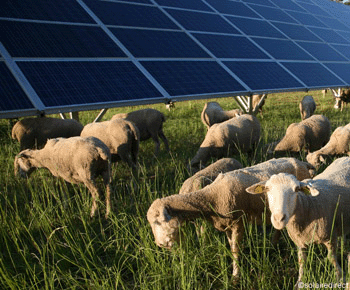
Allowing livestock to graze under renewable developments gives farmers a separate income stream, but solar developers have been slow to catch on.As a flock of about 2,000 sheep graze between rows of solar panels, grazier Tony Inder wonders what all the fuss is about. “I’m not going to suggest it’s everyone’s cup of tea,” he says. “But as far as sheep grazing goes, solar is really good.”
Inder is talking about concerns over the encroachment of prime agricultural land by ever-expanding solar and windfarms, a well-trodden talking point for the loudest opponents to Australia’s energy transition.
But on Inder’s New South Wales property, a solar farm has increased wool production. It is a symbiotic relationship that the director of the National Renewables in Agriculture Conference, Karin Stark, wants to see replicated across as many solar farms as possible as Australia’s energy grid transitions away from fossil fuels.
“It’s all about farm diversification,” Stark says. “At the moment a lot of us farmers are reliant on when it’s going to rain, having solar and wind provides this secondary income.”
In exchange, the panels provide shelter for the sheep, encourage healthier pasture growth under the shade of the panels and create “drip lines” from condensation rolling off the face of the panels.
“We had strips of green grass right through the drought,” Dubbo sheep grazier Tom Warren says. Warren has seen a 15% rise in wool production due to a solar farm installed on his property more than seven years ago.
Despite these success stories, a 2023 Agrivoltaic Resource Centre report authored by Stark found that solar grazing is under utilised in Australia because developers, despite saying they intend to host livestock, make few planning adjustments to ensure that happens……………………………………………………………………………….
According to an analysis by the Clean Energy Council, less than 0.027% of land used for agriculture production would be needed to power the east coast states with solar projects – far less than the one-third of all prime agricultural land that the rightwing thinktank the Institute of Public Affairs has claimed will be “taken over” by renewables. That argument, which has been heavily refuted by experts, has been taken up by the National party, whose leader, David Littleproud, said regional Australia had reached saturation point with renewable energy developments.
Queensland grazier and the chair of the Future Farmers Network, Caitlin McConnel, has sold electricity to the grid from a dozen custom-built solar arrays on her farm’s cattle pastures for more than a decade.
“Trial and error” and years of modifications have made them structurally sound around cattle and financially viable in the long-term, she says.
“As far as I know, we are the only farm to do solar with cattle,” McConnel says. “It’s good land, so why would we just lock it up just for solar panels?” https://www.theguardian.com/australia-news/article/2024/jun/13/farmers-who-graze-sheep-under-solar-panels-say-it-improves-productivity-so-why-dont-we-do-it-more
Will Port Adelaide, Fremantle or Port Kembla be the Australian Chernobyl?
By Douglas McCartyJul 21, 2023 https://johnmenadue.com/aukus-will-adelaide-fremantle-or-port-kembla-be-the-australian-chernobyl/
While most discussion of the AUKUS Agreement has focussed on the geopolitical implications for Australia’s standing in the world, the escalation of the risk of war and the crippling cost of the nuclear submarine purchases when less expensive and more sensible non-nuclear options are available, little has been said of the risk to the civilian population posed by these nuclear-powered submarines (or other nuclear-powered naval vessels) in Australia’s home ports.
Perhaps we citizens only enter the calculations as ‘collateral damage’. Any such necessarily technical discussion is hampered by military secrecy. Some information has been released officially, but most is from generalised inference, or conjecture, and so subject to uncertainty. However, in this important matter, it is worth attempting to join the dots….
News from the war in Ukraine includes, almost every other night, a report on the situation around the Zaporizhzhia Nuclear Power Plant, the largest in Europe. Though no longer continuing to generate power for Ukraine, it is always at risk of being shelled or bombed by one side or the other, and regularly just avoiding reactor cooling water pump failure from damaged power transmission lines or lack of diesel fuel for their backup generators for the pumps. How long this situation will continue remains to be seen. And now, after the breaching of the Kakhovka Dam, it is estimated just three months of water for cooling remains.
The consequences of the catastrophic failure of a nuclear reactor are well known to both the Ukrainians and the Russians. To the Northwest of Zaporizhzhia, and just 100 kilometres North of Kyiv, lies the Chernobyl Reactor No. 4, which, on 26 April 1986, underwent meltdown after a coolant and moderator failure, exploded, and caught fire. Radioactive material and fission products were ejected into the air, spreading across the immediate countryside and into Northern Europe. Radioactive rain was reported on the mountains of Wales and Scotland, in the Alps, and contamination in reindeer herds in Northern Sweden. The principal radiological contaminant of concern across this vast area was Caesium-137, one of many fission products and representing some 6% of fission reactor spent fuel. Just 27 kg of Caesium-137, it is calculated, caused this contamination. Some 150,000 square kilometres of Ukraine, Belarus and Russia were initially contaminated. Of course, at the time of the accident, all this was part of the Soviet Union. To this day, 2600 square kilometres around the plant are considered unsafe for human habitation, or agriculture, and will remain so for between 300 and 3000 years! The Reactor used 2% enriched Uranium fuel.
Although the loss of life at Chernobyl was a small fraction of the 100,000 deaths from one of the only two uses of nuclear weapons in war, on Hiroshima in 1945, Chernobyl created 400 times more radioactive pollution. The Hiroshima bomb, “Little Boy”, contained 64 kg of enriched Uranium, though less than 2% actually underwent nuclear fission. The bomb was detonated 500 metres above ground (‘airburst’), and the fatalities were the result of blast, heat, and irradiation, in a city centre. Chernobyl occurred at ground level and so ejected debris upwards initially, followed by smoke columns from subsequent fires. . The 31 deaths at Chernobyl were plant operators and, of course, firemen. The G7, the AUKUS Partners and the Quad just met at ‘ground zero’ in a rebuilt Hiroshima City, 78 years after the bombing.
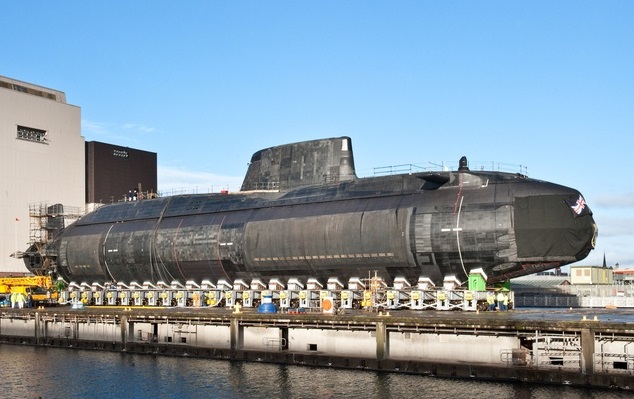
The US Navy nuclear powered warships, including the ‘Virginia’ Class submarines that Australia would buy under the AUKUS Agreement, principally use Highly Enriched Uranium (HEU) reactors. The Uranium is enriched to above 93% fissionable Uranium-235. It is weapons grade material and has in part been sourced from decommissioned nuclear weapons. The submarine reactors are intended to last for the ‘Life of Ship’ (LOS), up to 33 years, without needing refuelling. Low Enriched Uranium reactors need fuel replacement every 5 to 10 years, when, importantly, the containment pressure vessel around the reactor is physically inspected for flaws and deterioration. This is not done for the HEU, LOS reactors.
The US Navy nuclear powered warships, including the ‘Virginia’ Class submarines that Australia would buy under the AUKUS Agreement, principally use Highly Enriched Uranium (HEU) reactors. The Uranium is enriched to above 93% fissionable Uranium-235. It is weapons grade material and has in part been sourced from decommissioned nuclear weapons. The submarine reactors are intended to last for the ‘Life of Ship’ (LOS), up to 33 years, without needing refuelling. Low Enriched Uranium reactors need fuel replacement every 5 to 10 years, when, importantly, the containment pressure vessel around the reactor is physically inspected for flaws and deterioration. This is not done for the HEU, LOS reactors. In one year, at full power, (210 x 365 ÷ 940 =) 81.5 kg of U-235 would be required. Along with other decay products from the U-235 (Strontium-90, Iodine-131, Xenon-133 etc.), as noted earlier some 6% (or 4.9 kg) would be Caesium-137. The ‘neutron poisons’ also created are balanced out by ‘burnable’ neutron poisons incorporated into the core when new, to maintain reactor function over the years. So far, simple nuclear physics and thermodynamics.
Operationally, one surmises, the submarine reactor will infrequently run at full power. Actual annual production of Caesium-137 may lie between, say, 0.8 kg for 1/6th capacity operation on average for the whole year, and 2.45 kg at half capacity for the year. As the reactor is designed to not need refuelling for the ‘Life of the Ship’, the Cs-137 would continuously accumulate inside the reactor fuel elements. At the lower bound of 1/6th operation, there would be approaching 27 kg of Cs-137 in the core after 33 years, allowing for the decay of some of the Caesiun-137, given its half-life of 30.05 years. At the upper bound, it would take about 13 years for 27 kg of Caesium-137 to accumulate.
Visiting nuclear-powered submarines, from the US or UK, would be similar. Visiting US nuclear-powered aircraft carriers, each with two A1B reactors each of 700MWt, may have 27 kg of Cs-137 in their reactor cores after just two years of operation.
Visiting ships may stay in Australian ports for days or even weeks. Australian submarines will be in port not only between deployments, but also for maintenance, for months and years. The US Navy appears to have about 40 Virginia Class Subs, with some 18 undergoing long-stay maintenance, or about half. We might expect the same. So, at any one time, the AUKUS plan would see naval nuclear reactors, US, or UK, or Australian, or all, in Adelaide, and/or Fremantle, and/or Port Kembla. While peacetime only presents the risk of a nuclear accident, wartime would see these important military assets easily detectable – and targetable – while in port. In the event of a nuclear war, this may be just one of our worries.
In a conventional, non-nuclear conflict, the story may be very different. The situation of the Zaporizhzhia civilian reactors in Ukraine is most instructive. However, as legitimate military targets, would such restraint be shown towards the reactors in the submarines? What would be the impact of a conventional cruise or hypersonic or ballistic missile warhead on the pressure hull and reactor containment vessel (and plumbing) of a nuclear-powered submarine?
Should just 27 kg of the Caesium-137 in the naval reactor cores be released into the air through an explosion (as at Chernobyl) in an accident or deliberate attack, what would be the outcome? In Fremantle, especially if the ‘Fremantle Doctor’ was blowing, would sections of Fremantle and Perth become unsafe for human habitation? In Port Kembla, especially if a ‘Southery Buster’ came through, the Illawarra and, depending on the particular weather conditions, would parts of the South of Sydney become unsuitable for human habitation? For Port Adelaide, especially if a NW change came through, would the Adelaide coastal strip from Gawler to Aldinga become unsuitable for human habitation?
Imagine the number of “single mums doing it tough” who would have to be relocated to emergency accommodation – somewhere! Imagine all that social housing rendered uninhabitable! Even if we ‘won’ the war.
This is a real possibility if we have nuclear reactors in surface ships or submarines in our ports, or in our ship building and maintenance facilities.
A Detectable Subservience – Australia’s ill-fated nuclear submarine deal?

All of this leaves one wondering about just what due diligence was done before Morrison, and the 24-hour copycat decision-maker Albanese, committed us to the folly of paying $A368 billion to purchase a subservient position embedded within the US war machine by means of a soon-to-be fully detectable and therefore likely to be destroyed fleet of nuclear-powered submarines.
June 6, 2024 by: The AIM Network, By Michael Willis, https://theaimn.com/a-detectable-subservience/
The first operational outcome of the Pillar 2 AUKUS arrangement between the US, UK and Australia has just been announced.
The three countries will share data from their submarine-hunting PA-8 Poseidon aircraft, manufactured by the troubled Boeing Corporation.
This was announced on May 29 in an “exclusive interview” given to US online website Breaking Defense by Michael Horowitz, whose office serves as the Pentagon’s day-to-day lead on AUKUS issues.
(In a deliciously ironic slip, the website referred to the United Kingdom as the “Untied Kingdom”, true of the political cohesion of both the UK and the US at this time.)
All three AUKUS nations:
“… operate the Boeing-made maritime surveillance aircraft; the US operates 120, Australia 12, and the United Kingdom nine. A key part of the P-8 is its collection of sonobuoys, which are dropped into the water to hunt down submarines. (“Sonobuoys” is the preferred US-spelling of the English language “sonar buoys”.)
According to Horowitz, the Pentagon’s Deputy Assistant Secretary of Defense for Force Development and Emerging Capabilities, a new “trilateral algorithm” will allow them to share information from P-8 sonar buoys between each other.
According to Breaking Defense, the trilateral algorithm requires a high level of trust between the three countries.
“Even among Five Eyes partners,” it says, “sonobuoy information is highly sensitive, as sharing that data not only makes clear what each country has the ability to gather and where those buoys are deployed, but because it clearly reveals what and where each country is tracking.”
Pillar 2 arrangements build on those of Pillar 1 which are solely concerned with Australia’s acquisition of the hugely expensive nuclear-powered submarines.
At a cost averaged out at $A33 million a day over 35 years, we are promised a fleet of 8 submarines with the apparent advantages of extended range and endurance, higher speed, increased payload capacity, and reduced refuelling needs.
But given our own use of sonar buoys and knowing that our own all-but-at-war with “enemy”, China, has the same or superior detection technologies, it is the claim that SSNs (nuclear-powered submarines) have greater stealth and reduced detectability that is the major sales pitch justifying our $368 billion spend.
SSNs are claimed to have reduced noise and to be able to operate at greater depths, thus making them harder to detect.
Reduced noise will affect passive sonar buoys which listen for sounds generated by submarines. These sounds can include engine noise, propeller cavitation, or other mechanical noises.
Greater depth will affect active sonar buoys, those that send out a sound wave which then bounces off the submarine, allowing the buoy to detect the “ping” that travels back to the buoy. That ping is weaker the greater distance it has to travel.
Former Senator and submariner Rex Patrick was critical of the AUKUS decision for Australia to begin its SSN acquisition with the purchase of three second-hand Virginia Class SSNs from the US.
“The first highly noticeable issue with the Virginia class is a problem that has surfaced with the submarine’s acoustic coating that’s designed to reduce the ‘target strength’ of the submarine (how much sound energy from an enemy active sonar bounces off the submarine, back to the enemy),” he said.
“The coating is prone to peeling off at high-speed leaving loose cladding that slaps against the hull, making dangerous noise, and causes turbulent water flow, which also causes dangerous hull resonance (where the hull sings at its resonant frequency, like a tuning fork) and extra propulsion noise. I know a bit about this as a former underwater acoustics specialist.”
Magnetic Anomaly Detection (MAD) is another method of detection. MAD detects disturbances in the Earth’s magnetic field caused by the metal hull of a submarine. MAD sensors are typically deployed on aircraft and can detect submarines at relatively close ranges. The signals weaken with distance.
However, the Chinese are developing the ability to detect extremely low frequency (ELF) electromagnetic signal produced by speeding subs.
Researchers from the Chinese Academy of Sciences’ Fujian Institute of Research on the Structure of Matter found an ultra-sensitive magnetic detector could pick up traces of the most advanced submarine from long distances away.
The researchers calculated that the extremely low frequency (ELF) signal produced by a submarine’s bubbles could be stronger than the sensitivities of advanced magnetic anomaly detectors by three to six orders of magnitude.
The bubbles are an inevitable consequence of the submarine’s cruising speed, which causes the water flowing around the hull to move faster as its kinetic energy increases and its potential energy – expressed as pressure – decreases. When the pressure decreases sufficiently, small bubbles form on the surface of the hull as some of the water vaporises. This process causes turbulence and can produce an electromagnetic signature, in a phenomenon known as the magnetohydrodynamic (MHD) effect.
Though faint, ELF signals can travel great distances, thanks to their ability to penetrate the water and reach the ionosphere, where they are reflected back to the Earth’s surface.
Detection by ELF turns the advantage of an SSNs higher speed into its opposite, namely the disadvantage of higher detectability.
This ability of science to increase the detection of SSNs led even the pro-US Australian Strategic Policy Institute (ASPI) to publish a warning that “the oceans of tomorrow may become ‘transparent’. The submarine era could follow the battleship era and fade into history.”
It titled its article on a study of submarine detection by Australian scientists and academics “Advances in detection technology could render AUKUS submarines useless by 2050.”
According to the authors:
“The results should ring alarm bells for the AUKUS program to equip Australia with nuclear-powered submarines. Our assessment suggests that there will only be a brief window of time between the deployment of the first SSN AUKUS boats and the onset of transparent oceans.”
However, it is the expanding frontier of quantum computing that may be the ultimate nail in the AUKUS submarines coffin.
Quantum computing is the sexy new kid on the block – witness the Australian government’s investment of almost a billion dollars in a bid to build the world’s first commercially useful quantum computer in Brisbane. It’s bound to make the shareholders of US company PsiQuantum very happy, including notorious corporate investors such as Black Rock.
In July 2016, the Australia government awarded a contract to local company Q-CTRL to develop a quantum navigation system can use the motions of a single atom to precisely determine the course and position of a submarine and maintain accuracy to a remarkable degree. This overcomes two disadvantages of navigation by GPS: GPS is vulnerable to jamming by an adversary, and its signals cannot penetrate sea water to any appreciable depth.
That’s the good news story.
The bad news is that China has already funded its multi-billion-dollar National Quantum Laboratories to develop quantum-based technology applications for “immediate use to the Chinese armed forces”, possibly including targeting stealthy submarines.
According to Zhu Jin in The Conversation:
“New quantum sensing systems offer more sensitive detection and measurement of the physical environment. Existing stealth systems, including the latest generation of warplanes and ultra-quiet nuclear submarines, may no longer be so hard to spot.”
Using devices that measure and analyse the gravitational pull exercised by the mass of a submarine on the movement of sub-atomic particles in a sensor would overcome the disadvantages of sonar buoys and magnetometers, rendering any otherwise undetectable object with mass detectable.
The other area in which China is more advanced than its competitors is the use of quantum computing for encryption and decryption of communications.
In a 2022 paper on Quantum Computing and Cryptography, the authors that:
“China has set the pace for creating secure quantum communications that cannot be intercepted or manipulated. Further advances in Chinese quantum communication networks, especially networks designed for military use, will put the Navy at increased risk when deployed to the Indo-Pacific. If Chinese communications are virtually unbreakable and U.S. Navy communications can be exploited by Chinese quantum code-breaking technology, it will quickly lose its ability to safely operate among PLAN forces.”
All of this leaves one wondering about just what due diligence was done before Morrison, and the 24-hour copycat decision-maker Albanese, committed us to the folly of paying $A368 billion to purchase a subservient position embedded within the US war machine by means of a soon-to-be fully detectable and therefore likely to be destroyed fleet of nuclear-powered submarines.
Michael Williss is a member of the Australian Anti-AUKUS Coalition (AAAC) and the Independent and Peaceful Australia Network (IPAN).
Summary of Australian federal and state/territory nuclear/uranium laws and prohibitions

Current prohibitions on nuclear activities in Australia: a quick guide
From Jim Green, 30 May 2024
https://www.aph.gov.au/About_Parliament/Parliamentary_departments/Parliamentary_Library/pubs/rp/rp2324/Quick_Guides/NuclearActivitiesProhibitions
PDF Version [564KB]
Dr Emily Gibson
Science, Technology, Environment and Resources; Law and Bills Digest Sections
This quick guide provides an overview of current prohibitions on nuclear activities under Commonwealth, state and territory laws. It considers the primary legislation most relevant to current policy debates about domestic nuclear energy only and consequently does not consider recent changes to Commonwealth law to facilitate Australia’s acquisition of conventionally-armed, nuclear-powered submarines under the AUKUS partnership.[1] It also does not include consideration of Australia’s international obligations in respect of nuclear activities, including the safeguarding of nuclear materials and the non-proliferation of nuclear weapons.
If a domestic nuclear energy industry were to progress, it is expected that a comprehensive framework for the safety, security and safeguarding of the related nuclear material would need to be legislated to accommodate such an industry.[2] Consideration of these issues is beyond the scope of this paper.
What are nuclear activities?
A nuclear activity is any process or step in the utilisation of material capable of undergoing nuclear fission; that is, any activities in the nuclear fuel cycle.[3] Nuclear activities therefore include:
- mining of nuclear or radioactive materials such as uranium and thorium milling, refining, treatment, processing, reprocessing, fabrication or enrichment of nuclear material
- the production of nuclear energy
- the construction, operation or decommissioning of a mine, plant, facility, structure, apparatus or equipment used in the above activities
- the use, storage, handling, transportation, possession, acquisition, abandonment or disposal of nuclear materials, apparatus or equipment.
Prohibitions on nuclear activities
Commonwealth
Nuclear activities are regulated under the Australian Radiation Protection and Nuclear Safety Act 1998 (ARPANS Act) and the Environment Protection and Biodiversity Conservation Act 1999 (EPBC Act).
Australian Radiation Protection and Nuclear Safety Act 1998
The ARPANS Act establishes a licensing framework for controlled persons (including a Commonwealth entity or a Commonwealth contractor) in relation to controlled facilities (a nuclear installation, a prescribed radiation facility, or a prescribed legacy site).[4] A nuclear installation includes a nuclear reactor for research or the production of radioactive materials for industrial or medical use, and a radioactive waste storage or disposal facility with an activity that is greater than the activity level prescribed by the Australian Radiation Protection and Nuclear Safety Regulations 2018.[5]
The ARPANS Act allows the CEO of the Australian Radiation Protection and Nuclear Safety Agency (ARPANSA) to issue licences for controlled facilities.[6] In issuing a facility licence, the CEO ‘must take into account the matters (if any) specified in the regulations, and must also take into account international best practice in relation to radiation protection and nuclear safety’.[7]
However, subsection 10(2) of the Act expressly prohibits the CEO from granting a licence for the construction or operation of any of the following nuclear installations: a nuclear fuel fabrication plant; a nuclear power plant; an enrichment plant; or a reprocessing facility.[8] This prohibition does not appear to apply to a radioactive waste storage or disposal facility.
Environment Protection and Biodiversity Conservation Act 1999
The EPBC Act establishes 9 matters of national environmental significance (MNES) and provides for the assessment and approval of these actions if the action has, will have, or is likely to have a significant impact on the MNES.[9] ‘Nuclear actions’ are one of the MNES.[10] Where a nuclear action is determined to be a controlled action (that is, one likely to have a significant impact and requiring assessment and approval under the Act), the assessment considers the impact of a nuclear action on the environment generally (including people and communities).[11]
The Act establishes offences for the taking of nuclear actions in those circumstances.[14]
Similarly, the Act provides that a relevant entity (as set out below) must not take an action (including a nuclear action) unless a requisite approval has been obtained under Part 9 of the Act or a relevant exception applies:
- a person must not take a relevant action on Commonwealth land that has, will have or is likely to have a significant impact on the environment[15]
- a person must not take a relevant action outside Commonwealth land if the action has, will have or is likely to have a significant impact on the environment on Commonwealth land[16]
- the Commonwealth or a Commonwealth agency must not take inside or outside the Australian jurisdiction an action that has, will have or is likely to have a significant impact on the environment inside or outside the Australian jurisdiction.[17]
The Act establishes offences and civil penalty provisions for the taking of an action in those circumstances.[18]
Subsection 140A(1) prohibits the Minister for the Environment from granting an approval for a nuclear action relating to specified nuclear installations. These installations are a nuclear fuel fabrication plant, a nuclear power plant, an enrichment plant, and a reprocessing facility.
Potential reform of the nuclear action trigger
The second independent review of the EPBC Act, completed in October 2020 by Professor Graeme Samuel (Samuel Review), recommended that the nuclear actions MNES be retained.[19] The review recommended that ‘the EPBC Act and the regulatory arrangements of [ARPANSA] should be aligned, to support the implementation of best-practice international approaches based on risk of harm to the environment, including the community’.[20]
In 2022, the Government’s Nature Positive Plan adopted this approach and stated, ‘[a] uniform national approach to regulation of radiation will be delivered through the new National Environmental Standards’.
In February 2024, a policy draft of the National Environmental Standard for Matters of National Environmental Significance indicates that ‘nuclear actions’ will be renamed ‘radiological exposure actions’ and states:
Relevant decisions must:
Not be inconsistent with the ARPANSA national codesfor protection from radiological exposure actions including in relation to:
- human health and environmental risks and outcomes; and. radiological impacts on biological diversity,
- the conservation of species and the natural health of ecosystems.[22]
States and territories
States and territories generally regulate nuclear and radiation activities through either the health or the environmental protection portfolios. The relevant legislation provides for the protection of health and safety of people, and the protection of property and the environment, from the harmful effects of radiation by establishing licensing regimes to regulate the possession, use, and transportation of radiation sources and substances.[23] Mining of radioactive materials is regulated through the resources portfolio.
In addition, as outlined below, the states and territories have legislation prohibiting certain nuclear activities or the construction and operation of certain nuclear facilities. Importantly, where permitted, nuclear activities (including mining) would also be subject to assessment and approvals under a range of other legislation, including planning and environmental impact assessment, native title and cultural heritage, and radiation licensing laws at the state or territory and Commonwealth level.
New South Wales
Exploration for uranium has been permitted under the Mining Act 1992 since 2012.[24] However, the mining of uranium is prohibited by the Uranium Mining and Nuclear Facilities (Prohibitions) Act 1986 (NSW Prohibitions Act).[25]
The NSW Prohibitions Act also prohibits the construction and operation of certain nuclear facilities, including uranium enrichment facilities, fabrication and reprocessing plants, nuclear power plants, and storage and waste disposal facilities (other than for the storage and disposal of waste from research or medical purposes, or the relevant radiological licensing Act).[26]
Northern Territory
The Atomic Energy Act 1953 (Cth) provides that the Commonwealth owns all uranium found in the territories.[27] Uranium exploration and mining in the Northern Territory (NT) is regulated under both NT mining laws (the Mineral Titles Act 2010 and the Mining Management Act 2001) and the Atomic Energy Act.[28] The Ranger Uranium Mine operated until 2021 and is now undergoing rehabilitation.[29]
The Nuclear Waste Transport, Storage and Disposal (Prohibition) Act 2004 (NT) prohibits the construction and operation of nuclear waste storage facilities, as well as the transportation of nuclear waste for storage at a nuclear waste storage facility in the NT.[30] Nuclear waste is defined as including waste material from nuclear plants or the conditioning or reprocessing of spent nuclear fuel.[31]
This Act also:
- prohibits public funds from being expended, granted or advanced to any person for, or for encouraging or financing any activity associated with the development, construction or operation of a nuclear waste storage facility
- would require the NT Parliament to hold an inquiry into the likely impact of a nuclear waste storage facility proposed by the Commonwealth on the cultural, environmental and socio‑economic wellbeing of the territory.[32]
Queensland
Exploration for and mining of uranium are permitted under the Mineral Resources Act 1989. However, it has been government policy to not grant mining leases for uranium since 2015.[33] The government policy ban extends to the treatment or processing of uranium within the state.[34]
The Nuclear Facilities Prohibition Act 2007, in similar terms to the NSW Prohibitions Act, prohibits the construction and operation of nuclear reactors and other nuclear facilities in the nuclear fuel cycle.[35]
Unlike other state and territory prohibition legislation, the Nuclear Facilities Prohibition Act would require the responsible Queensland Minister to hold a plebiscite to gain the views of the Queensland population if the Minister was satisfied that the Commonwealth Government has taken, or is likely to take, steps to amend a Commonwealth law or exercise a power under a Commonwealth law to facilitate the construction of a prohibited nuclear facility, or if the Commonwealth Government adopts a policy position of supporting or allowing the construction of a prohibited nuclear facility in Queensland.[36]
South Australia
The exploration and mining of radioactive material (including uranium) is permitted in South Australia (SA), subject to approvals under the Mining Act 1971 and the Radiation Protection and Control Act 2021 (RP&C Act).[37] For example, uranium is mined at Olympic Dam, Four Mile and Honeymoon. However, conversion and enrichment activities are prohibited by the RP&C Act.[38]
The Nuclear Waste Storage Facility (Prohibition) Act 2000 prohibits the construction or operation of a nuclear waste storage facility, and the import to SA or transport within SA of nuclear waste for delivery to a nuclear waste storage facility.[39]
The Nuclear Waste Storage Facility (Prohibition) Act prohibits the SA Government from expending public funds to encourage or finance the construction or operation of nuclear waste storage facilities.[40] The Act would also require the SA Parliament to hold an inquiry into the proposed construction or operation of a nuclear waste storage facility in SA authorised under a Commonwealth law.[41]
Tasmania
The exploration and mining of atomic substances (which includes uranium and thorium) is permitted under the Mineral Resources Development Act 1995 (Tas), subject to approval.
Victoria
The Nuclear Activities (Prohibitions) Act 1983 prohibits a range of activities associated with the nuclear fuel cycle, including the exploration and mining of uranium and thorium, and the construction or operation of facilities for the conversion or enrichment of any nuclear material, nuclear reactors and facilities for the storage and disposal of nuclear waste from those prohibited activities.[42]
Western Australia
Exploration for and mining of uranium is permitted under the Mining Act 1978. A state policy ban on mining approvals was overturned in November 2008;[43] however, this was reinstated in June 2017, with a ‘no uranium’ condition on future mining leases.[44] The ban does not apply to 4 projects that had already been approved by the previous government.
The Nuclear Activities Regulation Act 1978 aims to protect the health and safety of people and the environment from possible harmful effects of nuclear activities, including by regulating the mining and processing of uranium and the equipment used in those processes. The Nuclear Waste Storage and Transportation (Prohibition) Act 1999 also prohibits the storage, disposal or transportation in Western Australia of certain nuclear waste (including waste from a nuclear plant or nuclear weapons).[45]
Can the Commonwealth override a state ban on nuclear activities?
The Commonwealth Parliament only has the power to make laws in relation to matters specified in the Constitution of Australia, including in sections 51, 52 and 122. Assuming the Commonwealth has a sufficient head of power to legislate, section 109 of the Constitution specifically provides for circumstances in which there might be an inconsistency between Commonwealth and state laws:
When a law of a State is inconsistent with a law of the Commonwealth, the latter shall prevail, and the former shall, to the extent of the inconsistency, be invalid.
Therefore, even though some states have enacted prohibitions on certain nuclear activities within their jurisdictions, the Commonwealth Parliament could enact specific legislation in relation to nuclear activities so that such activities can take place within those jurisdictions. One such example is the National Radioactive Waste Management Act 2012 (Cth), which provides for the establishment of a national radioactive waste management facility at a site to be declared by the responsible Commonwealth Minister. Section 12 of that Act provides that state and territory laws have no effect in regulating, hindering, or preventing such a facility
Further information
- ‘Who we regulate’, ARPANSA
- ‘State & territory regulators’, ARPANSA
- ‘Uranium and thorium’, in Geoscience Australia, Australia’s Energy Commodity Resources, 2023 Edition, (Canberra: Geoscience Australia, 2023).
Damning scientific report condemns the Australian Opposition’s push for nuclear power
Coalition’s brave nuke world a much harder sell after new CSIRO report
Graham Readfearn, https://www.theguardian.com/australia-news/article/2024/may/26/coalitions-brave-nuke-world-a-much-harder-sell-after-new-csiro-report?CMP=soc_568
The agency’s GenCost analysis says a first nuclear plant for Australia would deliver power ‘no sooner than 2040’ and could cost more than $17bn
The Coalition’s pitch on nuclear energy for Australia has had two recurring themes: the electricity will be cheap and it could be deployed within a decade.
CSIRO’s latest GenCost report – a document that analyses the costs of a range of electricity generation technologies – contradicts both of these points. It makes the Coalition’s job of selling nuclear power plants to Australians ever more challenging.
For the first time, the national science agency has calculated the potential costs of large-scale nuclear electricity in a country that banned the generation technology more than a quarter of a century ago.
Even using a set of generous assumptions, the CSIRO says a first nuclear plant would deliver power “no sooner than 2040” and could cost more than $17bn.
It is likely to spark an attack on the credibility of the report from nuclear advocates and those opposed to the rollout of renewable energy. Opposition leader, Peter Dutton, has already attacked the report.
In the meantime, Australia waits for the Coalition to say what kind of reactors it would deploy, where it would put them and how much it thinks they would cost.
Now that CSIRO has released its report, here’s what we know about the viability of a nuclear industry in Australia.
What’s new on nuclear costs?
CSIRO’s GenCost report says a 1,000 megawatt nuclear plant would cost about $8.6bn to build, but that comes with some large caveats. The main one is that this was the theoretical cost of a reactor in an Australia that already had an established and continuous program of building reactors.
The $8.6bn is based on costs in South Korea, which does have a continuous reactor building program and is one country the least beset by cost blowouts.
To make the cost more relevant, CSIRO compared the Australian and South Korean costs of building modern coal plants. Costs were more than double in Australia.
But CSIRO warns the first nuclear plants in Australia would be subject to a “first of a kind” premium that could easily double the $8.6bn build cost.
In the UK, a country that has been building reactors intermittently, costs for its under-construction Hinkley C reactor (more than three times the size of a theoretical 1,000MW reactor in Australia) started at $34bn and could now be as high as $89bn.
In the United States, the country’s largest nuclear plant has just turned on its final unit seven years behind schedule and at double the initial cost. There are no more nuclear plants under construction in the country.
What about the cost of the electricity?
CSIRO also offers cost estimates for the electricity produced by large-scale reactors, but those too assume a continuous nuclear building program in Australia.
Electricity from large-scale reactors would cost between $141 per megawatt hour and $233/MWh if they were running in 2030, according to GenCost.
Combining solar and wind would provide power at between $73 and $128/MWh – figures that include the costs of integrating renewables, such as building transmission lines and energy storage.
What about those small modular reactors?
The Coalition has also advocated for so-called “small modular reactors” which are not commercially available and, CSIRO says, are unlikely to be available to build in Australia until 2040.
One United States SMR project lauded by the Coalition collapsed in late 2023 because the cost of the power was too high.
That project, CSIRO says, was significant because its design had nuclear commission approval and was “the only recent estimate from a real project that was preparing to raise finance for the construction stage. As such, its costs are considered more reliable than theoretical projects.”
GenCost reports that power from a theoretical SMR in 2030 would cost between $230 and $382/MWh – much higher than solar and wind or large-scale nuclear.
How quickly could Australia build a nuclear plant?
Nuclear advocates tend to point to low nuclear power costs in countries that have long-established nuclear industries.
Australia has no expertise in building nuclear power, no infrastructure, no regulatory agency, no nuclear workforce and a public that is yet to have a serious proposition put in front of it.
Australia’s electricity grid is fast evolving from one dominated by large coal-fired power plants to one engineered for and dominated by solar, wind, batteries and pumped hydro with gas-fired power working as a rarely used backup.
This creates a major problem for the Coalition, because CSIRO estimates “if a decision to pursue nuclear in Australia were made in 2025, with political support for the required legislative changes, then the first full operation would be no sooner than 2040.”
Tony Wood, head of the Grattan Institute’s energy program, says: “By 2040, the coal-fired power stations will be in their graves. What do you do in the meantime?”
“You could keep the coal running, but that would become very expensive,” he says, pointing to the ageing coal fleet that is increasingly beset by outages.
Wood says the GenCost report is only a part of the story when it comes to understanding nuclear.
The Coalition, he says, would need to explain how much it would cost to build an electricity system to accommodate nuclear.
Could you just drop nuclear into the grid?
The biggest piece of generation kit on Australia’s electricity grid is a single 750 megawatt coal-fired unit at Kogan Creek in Queensland. Other power stations are larger but they are made up of a series of smaller units.
But the smallest of the “large-scale” nuclear reactors are about 1,000MW and most are 1,400MW.
Electricity system engineers have to build-in contingency plans if large units either trip or have to be pulled offline for maintenance. That contingency costs money.
In Australia’s current electricity system, the GenCost report says larger nuclear plants would probably “require the deployment of more generation units in reserve than the existing system consisting of units of 750MW or less.”
But by the time a theoretical nuclear plant could be deployed, most if not all the larger coal-fired units will be gone.
Who might build Australian nukes?
Some energy experts have questioned whether any company would be willing to take up a contract to build a reactor in Australia when there are existing nuclear nations looking to expand their fleets.
Right now, nuclear reactors are banned federally and in several states.
The GenCost report also points to another potential cost-raiser for nuclear – a lack of political bipartisanship.
The report says: “Without bipartisan support, given the historical context of nuclear power in Australia, investors may have to consider the risk that development expenses become stranded by future governments.”
Australian opposition leader Dutton’s devoid-of-details nuclear plan an atomic failure
By Belinda Jones | 25 May 2024 https://independentaustralia.net/politics/politics-display/duttons-devoid-of-details-nuclear-plan-an-atomic-failure,18632
Given the absence of substance in Peter Dutton’s nuclear policy so far, his ‘lack-of-details’ cry over The Voice must surely come back to haunt him, writes Belinda Jones.
TWO YEARS AGO, Nationals Leader David Littleproud called for a national discussion on nuclear energy.
Said Littleproud:
‘Peak business groups and unions are calling for the moratorium on nuclear power to be lifted, amid a push to ensure Australia is “technology agnostic” during its transition to cut emissions. It’s time to have the discussion.’
Almost two years later, neither Littleproud nor Dutton has yet produced anything of substance on the issue for the Australian public to consider — just broken promises and delays over when details on the Coalition’s nuclear energy policy will be delivered.
Prime Minister Anthony Albanese has called on the Coalition to release details on its nuclear energy policy.
Dutton’s level of preparedness for a discussion on nuclear energy appears only to have extended to a tweet at this stage.
Since taking over the nuclear conversation, Dutton has incurred the ire of the Commonwealth Scientific and Industrial Research Organisation (CSIRO), which was forced to defend its reporting in a “rare intervention”
In March 2024, Dutton made incorrect claims about Australia’s national science agency’s costings and slammed its GenCost 2023/24 report, prompting a warning from CSIRO chief executive Douglas Hilton that public trust requires our political leaders refrain from disparaging science.
In a telling statement this week, Member for Wannon Dan Tehan pledged his support for the Coalition’s nuclear energy policy — just not in his electorate. This may be the reason for Dutton’s delay in releasing the policy details: a divided party room.
To be fair, mainstream media has attempted to elicit answers from Dutton for months now, to no avail. The public’s desire for detail on the Coalition’s nuclear policy is becoming more pressing as both the 2024 Queensland State and 2025 Federal Elections loom.
IA contacted Peter Dutton to try to get some direct answers for our readers, asking the following questions:
In terms of transmission of nuclear energy, what changes to existing power grids and transmission systems will have to be made to accommodate nuclear reactors or SMRs? What will be the cost and timeframe of those changes?
How many nuclear reactors or small nuclear reactors (SMRs) does the Liberal/National Coalition want to build?
What will be the average cost per nuclear reactor and SMR?
What is the estimated date of nuclear reactors or SMRs being operational?
Where will the proposed nuclear reactors or SMRs be located?
In proposed nuclear reactor or SMR locations, what steps has the Coalition taken to consult with the local community, environmental agencies and other levels of government about the impacts of the proposed nuclear reactor or SMR, and are any details of those consultations available to the public?
Does the Coalition plan for nuclear include significant taxpayer investment? If so, how much?
What budget measures will have to be taken to free up funding for nuclear reactors or SMRs, that is, what cuts in other areas of the budget will have to be made?
How many short-term jobs will be created during the construction phase of each proposed nuclear reactor or SMR? Will those jobs be mainly local jobs or FIFO?
Traditionally, government support of a new enterprise/industry is conditional on the creation of secure, new, ongoing jobs. Given the fact nuclear reactors and SMRs will likely be fully automated requiring very few jobs when operational, what is the quid pro quo for government funding? Will taxpayer funding secure an equity stake in nuclear businesses in return for government support in lieu of a significant number of jobs?
How will the nuclear reactors or SMRs be cooled? Do the proposed locations have enough water to support a nuclear reactor or SMR, especially during drought? Please provide evidence to support your answer.
Will the Coalition’s proposed nuclear reactors or SMRs draw water from the Great Artesian Basin at any time? If so, how much and what will be the impact?
What is the Coalition’s plan for the nuclear waste generated by nuclear reactors and SMRs and the long-term site repatriation costs and timeframe of any proposed nuclear reactor or SMR site?
What business groups, individual persons or businesses, or private investors have expressed interest to the Coalition in building nuclear reactors or SMRs? And what is the current estimate in dollar terms of that interest?
Are any of those business groups, individual persons or businesses, or private investors already invested in other industries associated with nuclear energy, such as mining and resources?
Two hours later we received a curt reply stating, ‘… we will announce further detail regarding our energy policy in due course’.
The email also suggested IA “continues its own research”.
This reply from Dutton’s office is wholly unsatisfactory, so IA will continue seeking answers from the Coalition to these important questions — answers that our readers have a right to know – until we get a more informative response. After all, it was the Coalition that called for a conversation on nuclear energy in the first place and its “plan” is to implement a nuclear policy if it wins office in less than 12 months.
Time is running out for Dutton to present his nuclear energy policy — important electoral dates approach.
But, clearly, the Coalition’s behaviour around the much-awaited policy details indicates how totally unprepared it is to hold government. It wants to lead the conversation and the country, yet it hasn’t put in the work. After almost two years of “discussion”, the Opposition still comes to the table empty-handed — no information, no plan, just a series of thought bubbles and meaningless L-NP talking points.
Dutton’s words –“When you deliberately keep the detail back, people become suspicious” – will no doubt come back to haunt him. Because when it comes to the Coalition’s nuclear energy policy — if Australians don’t know, they’ll vote no.
Australia can learn from the American experience with nuclear power

Amory B Lovins, May 21, 2024, https://reneweconomy.com.au/australia-can-learn-from-the-american-experience-with-nuclear-power/#google_vignette
During my current visit to Australia I’ve been surprised to see nuclear power promoted by the federal Coalition and by certain media.
Rather than fact-check the questionable claims of nuclear proponents, let me here outline the recent experience with nuclear power in my home country, the United States, and then discuss how that experience could inform the energy debate in Australia.
Nuclear power in the US is in decline. A dozen reactors have been shut down over the past decade — 41 in all. The decline will continue because US reactors average 42 years old, beyond their original design life. Of 259 US power reactors ordered since 1955, 94 are still in service; by 2017, only 28 remained competitive and hadn’t suffered at least one outage of at least a year. That’s an 11 percent success rate.
Only two nuclear power construction projects have commenced this century, and Australians should take careful note of those projects’ failure despite massive government support.

The V.C. Summer project in South Carolina, comprising two Westinghouse AP1000 reactors, began construction for an estimated US$11.5bn total in 2013. It was abandoned in 2017 after costs rose to US$25bn, wasting US$9bn. Westinghouse soon filed for bankruptcy protection.
In addition to a $US9 billion hole in the ground, the V.C. Summer fiasco gave rise to the ‘nukegate’ scandal, a web of corruption that has already seen some culprits jailed with others likely to follow.
The other US reactor construction project was the Vogtle project in Georgia, also comprising two AP1000 reactors. It was recently completed but many years behind schedule and at extravagant cost, echoing similar experience in Finland, France, and the UK.

Westinghouse said in 2006 that it could build an AP1000 reactor for as little as US$1.4 billion. The Vogtle project’s final cost was over 10 times greater at US$17.5 billion per reactor. That money that would have been far better spent on renewables and energy efficiency programs. Buying nuclear power instead displaced less fossil fuel per year and per dollar, worsening climate change.
Small modular reactors
The failure of large reactor construction projects has led the industry to pivot to so-called small modular reactors (SMRs). But SMRs don’t exist, unless you count two demonstration plants in Russia and China. SMRs are unlikely to improve the safety, security or waste problems of large reactors, and SMRs’ economics are even more unattractive than large reactors’.

NuScale Power, leading America’s most advanced SMR project, recently abandoned its flagship project in Idaho due to soaring costs despite about US$4bn in US government subsidies. With no other credible customers, the firm seems more likely to go bankrupt than to build any SMRs.
NuScale’s most recent cost estimate was an astronomical US$9.3 billion for a 462 megawatt (MW) plant with six 77-MW reactors. That’s US$20,100 per kilowatt (kW). Compare the actual 2023 market prices per kW found by leading US investment firm Lazard: US$700-1400 for utility scale solar PV and US$1025-1700 for onshore wind.
Nuclear’s higher capital cost per kW far outweighs its greater output per kW, leaving it several-fold out of the money before counting its substantial operating costs. And including grid integration costs would actually widen nuclear’s disadvantage because its outages tend to be bigger, longer, sharper, and less predictable than solar and wind power’s variations, requiring more and costlier backup.
Other companies hoping to develop SMRs or so-called ‘advanced’ reactors are faring no better. Indeed a pro-nuclear lobby group noted late last year that efforts to commercialize a new generation of ‘advanced’ nuclear reactors “are simply not on track” and it warned nuclear enthusiasts not to “whistle past this graveyard”.
Coal-to-nuclear
The Coalition’s energy spokesperson Ted O’Brien claims that “evidence keeps mounting that a coal-to-nuclear strategy is good for host communities, and especially workers as zero-emissions nuclear plants offer more jobs and higher paying ones.”

Mr. O’Brien has promoted Terrapower’s plan to replace coal with nuclear in Wyoming but the company is at the early stages of a licensing process and it is unclear whether finance can be secured or whether the adventurous new technology can ever get built and compete on the grid despite about US$2bn of government subsidy.
In 2009, applications for 31 new reactors were pending in the US. Nothing eventuated other than the abandoned South Carolina project and the recently completed Georgia project. No reactors — large or small — are currently under construction in the US. For the time being at least, we’re being spared the economic and climate costs of further disastrous nuclear projects.
Lessons for Australia
What lessons can Australia learn from the US experience?
Industry claims should be treated with skepticism. Early cost estimates for the Vogtle project were out by a factor of 10. Westinghouse’s claim that it could build an AP1000 reactor in “approximately 36 months” also proved to be wildly inaccurate: the Vogtle reactors took 10 and 11 years to build; closer to 20 years if you include the planning and licensing process.
Proponents claiming that Australia could have reactors operating by the mid-2030s are sadly mistaken. Most or all of Australia’s remaining coal power plants will have closed long before nuclear reactors could take their place in the energy market.
It’s vital that Australians consider the fact that you would be starting a nuclear power industry with none of the United States’ 70-plus years’ experience – despite which 42 reactor projects were abandoned, 41 built but closed, and scores now operate only thanks to government rescues. It would be folly to imagine that Australia can do better.
The point was made sharply by NSW Chief Scientist Hugh Durrant-Whyte in a 2020 report prepared for the NSW Cabinet. A former Chief Scientific Adviser at the UK Ministry of Defence, Dr Durrant-Whyte said: “The hard reality is Australia has no skills or experience in nuclear power plant building, operation or maintenance – let alone in managing the fuel cycle. Realistically, Australia will be starting from scratch in developing skills in the whole nuclear power supply chain.”
Likewise, former Australian Chief Scientist Dr Alan Finkel states: “Any call to go directly from coal to nuclear is effectively a call to delay decarbonisation of our electricity system by 20 years.”
I’m pleased to learn that the Australian government aims to double renewable supply to the National Energy Market to reach 82 percent by 2030. It’s especially impressive to witness the world-class renewable energy revolution in South Australia, where renewables provide 74 percent of electricity on average and the state government aims to reach 100 percent net renewables as soon as 2027.
Nuclear power is a minor distraction, adding each year at best only as much electricity supply as renewables add every few days. It has no business case or operational need anywhere. Especially it has no place in Australia’s energy future. No one who understands energy markets would claim otherwise.
Amory Lovins has been an energy advisor to major firms and governments in 70+ countries for 50+ years; has authored 31 books and about 900 papers; is an integrative designer of superefficient buildings, factories, and vehicles; and has won many of the world’s top energy and environmental awards. He is Adjunct Professor of Civil and Environmental Engineering at Stanford University.
1 This Month

To see nuclear-related stories in greater depth and intensity – go to https://nuclearinformation.wordpress.com
-
Archives
- September 2026 (194)
- August 2026 (330)
- July 2026 (355)
- June 2026 (287)
- May 2026 (306)
- April 2026 (356)
- March 2026 (251)
- February 2026 (267)
- January 2026 (308)
- December 2025 (358)
- November 2025 (359)
- October 2025 (375)
-
Categories
- 1
- 1 NUCLEAR ISSUES
- business and costs
- climate change
- culture and arts
- ENERGY
- environment
- health
- history
- indigenous issues
- Legal
- marketing of nuclear
- media
- opposition to nuclear
- PERSONAL STORIES
- politics
- politics international
- Religion and ethics
- safety
- secrets,lies and civil liberties
- spinbuster
- technology
- Uranium
- wastes
- weapons and war
- Women
- 2 WORLD
- ACTION
- AFRICA
- Atrocities
- AUSTRALIA
- Christina's notes
- Christina's themes
- culture and arts
- Events
- Fuk 2022
- Fuk 2023
- Fukushima 2017
- Fukushima 2018
- fukushima 2019
- Fukushima 2020
- Fukushima 2021
- general
- global warming
- Humour (God we need it)
- Nuclear
- RARE EARTHS
- Reference
- resources – print
- Resources -audiovicual
- Weekly Newsletter
- World
- World Nuclear
- YouTube
-
RSS
Entries RSS
Comments RSS
 nuclear-news