That time when Canada cancelled its nuclear submarine order
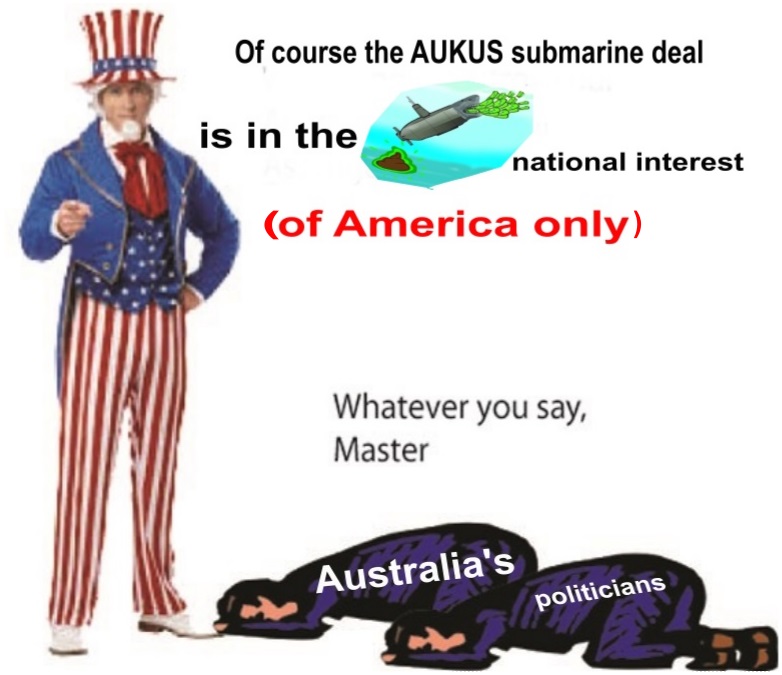
The decision to cut the Australian community out altogether — except where we will be called upon to service the US military as it builds its base in WA — puts us in the relationship of a vassal state, existing only to do the bidding of our powerful friend.
By Julie Macken and Michael Walker, Aug 30, 2024, https://johnmenadue.com/that-time-when-canada-cancelled-its-nuclear-submarine-order/
Back in 1987, when no one knew that the Cold War was just about to end, the Canadian Government signed up to build 10 nuclear-powered submarines. That submarine program lasted for all of two years before being cancelled in 1989. No nuclear Canadian sub ever even began construction, let alone getting put in the water.
There is a very real sense of déjà vu when we look at the Canadian experience and the current Australian experience of AUKUS. The good news is that it is not too late to learn the lessons the Canadians learnt for us.
One of the reasons for the Canadian cancellation was the $8 billion price tag, or about $19 billion in today’s money. Two billion dollars per submarine now sounds like a bargain compared to the astronomical $45 billion per submarine under AUKUS. Canada decided it had other priorities where that money could be put to better use.
But before the contract was cancelled in Canada, the ministries involved in its construction became embroiled in conflict, the Government itself was in a cost-of-living-crisis with immediate, real-world needs pressing and the hasty and secretive choice of vessel design came under withering criticism from the Treasury department for poor procurement with the cost expected to blow out to $30 billion ($70 billion today). And finally, media support eroded, with 71% of the population opposed to the project.
Déjà vu much?
On 12 June, the US Congressional Research Document service produced a research and advice document called the Navy Virginia-Class Submarine Program and AUKUS Submarine (Pillar 1) Project: Background and Issues for Congress.
The document points out the AUKUS deal was a three-step process. The first was to establish a US-UK rotational submarine force in Western Australia. The second was that the US would sell us three or five Virginia nuclear powered submarines and the third would be that the UK assists us in building our own AUKUS class nuclear submarines.
But the Congressional report outlines when comparing the “potential benefits, costs, and risks” of the three stage plan, it might just be better for the US to operate more of its own boats out of WA. That is, “procuring up to eight additional Virginia-class SSNs that would be retained in US Navy service and operated out of Australia along with the US and UK SSNs”.
That’s right, why bother with the whole step two and three when the US is best served by simply operating its nuclear-powered attack submarines out of WA?
This is an extraordinary development and one that demands more attention than has been given previously because a number of issues flow from this kind of thinking.
First, this potentially frees up $400 billion that could be put to far better use on a national housing construction program or high-speed rail network running the entire east coast of Australia or other large and much-needed nation-building projects. But not so fast.
The US Congressional Research Document suggests that “those funds (the $400 billion) could be invested in other military capabilities”, such as long-range missiles and bombers, “so as to create an Australian capacity for performing non-SSN military missions for both Australia and the United States”.
The decision to cut the Australian community out altogether — except where we will be called upon to service the US military as it builds its base in WA — puts us in the relationship of a vassal state, existing only to do the bidding of our powerful friend.
The fact that the document only referenced the “potential benefits, costs, and risks” from the US perspective, without any attempt to imagine how Australia may view becoming a life support for a US submarine base, makes the nature of our relationship pretty clear.
Australia’s Government may not consider it necessary to have done its due diligence on AUKUS but the Americans are happy to do that for us and, you guessed it, even though they quietly have doubts about the SSN project, they’ve already thought of plenty of other ways to spend our money on their own defence objectives. Spending it on the well-being and prosperity of our own people didn’t even rate a mention.
Opposing a USA-led international nuclear agreement that is bizarrely unfair to Australia
Australians can object to the agreement, by putting in a submission to a Parliamentary Joint Standing Committee.
Submissions are due by September 1st. So far, only 2 submissions have been published. They’re sort of “zipped” – so I can’t read them. You can bet your boots they are from the nuclear lobby
I’s a bit of an IT hurdle to actually get your submission in. That’s after you’ve even written it. Which is tough, too, as the general public in Australia knows nothing about it.
But anyway, here’s one little effort
TITLE: Submission to the Joint Standing Committee on Treaties concerning the:
Agreement among the Government of Australia, the Government of the
United Kingdom of Great Britain and Northern Ireland, and the Government
of the United States of America for Cooperation Related to Naval Nuclear Propulsion.
This submission urges that the Joint Standing Committee on Treaties recommends against
the Australian Government signing this Agreement as I believe that it is not in the best interests of the Australian people on a number of grounds, as outlined in this submission
Australia would be landed with high level nuclear waste – This Agreement
requires Australia to “be responsible for the management, disposition, storage, and
disposal of any spent nuclear fuel and radioactive waste resulting from the
operation of Naval Nuclear Propulsion Plants transferred pursuant to this Article,
including radioactive waste generated through submarine operations, maintenance,
decommissioning, and disposal.” (ARTICLE IV Naval Nuclear Propulsion Plants,
Related Equipment and Material, Section D).
The health risk to Australians brought in by the construction of nuclear facilities
and the management and storage of radioactive wastes. Buying second-hand
nuclear submarines make this waste danger another hazard, as we’d be buying
already existing toxic wastes.
Under this agreement it is possible for a nuclear weapon to be present on
Australian shores– this would it would be a clear breach of the highest order of the
Treaty on the Non-Proliferation of Nuclear Weapons (NPT) because as a signatory to
NPT Australia is not allowed to manufacture or otherwise acquire nuclear weapons.
The agreement does not guarantee that the USA will continue with the nuclear
submarine arrangements, but still ensures that Australia will cop the costs. This is
blatantly unfair.
It is extraordinarily unfair and bizarre that under Article IV E. “Australia shall
indemnify, the United States and the United Kingdom against any liability, loss,
costs, damage or injury (including third-party claims) arising out of, related to, or
resulting from Nuclear Risks connected with the design, manufacture, assembly,
transfer, or utilization of any Material or Equipment, including Naval Nuclear
Propulsion Plants and component parts and spare parts thereof transferred or to be
transferred pursuant to this Article.”
The ‘National Interest Analysis [2024] ATNIA 14 with attachment on consultation’,
acknowledges that “There has been no public consultation”, with paragraph 55
stating that “No public consultation has been undertaken, given the classified scope of consultations between the Parties on the Agreement, including matters relating to
national security and operational capability.”
The Treaty clearly outlines that Special Nuclear Material to be transferred under the
agreement, “shall contain highly enriched uranium and, only with respect to
irradiated fuel, may contain plutonium”, (ARTICLE VI Conditions and Guarantees,
SECTION I –SPECIAL NUCLEAR MATERIAL)
In conclusion – the whole agreement is unfair, poorly organised, and should not be
accepted by Australia, particularly in this situation where there has been no public
consultation – set up completely in the dark as far as the Australian people are
concerned.
Noel Wauchope
Australia offers U.S. a vast new military launchpad in China conflict

Australia is expanding its northern military bases, with U.S. support, to counter China’s growing threat. Critics quip it’s become the “51st state.”
Washington Post, By Michael E. Miller, August 24, 2024
ROYAL AUSTRALIAN AIR FORCE BASE TINDAL, Australia — Deep in the outback, a flurry of construction by Australia and the United States is transforming this once quiet military installation into a potential launchpad in case of conflict with China.
Runways are being expanded and strengthened to accommodate the allies’ biggest airplanes, including American B-52 bombers. A pair of massive fuel depots is rising side by side to supply U.S. and Australian fighter jets. And two earth-covered bunkers have been built for U.S. munitions.
But the activity at RAAF Tindal, less than 2,000 miles from the emerging flash points of the South China Sea,isn’t unique. Across Australia, decades-old facilities — many built by the United States during World War II — are now being dusted off or upgraded amid growing fears of another global conflict.
“This isabout deterrence,” Australia’s defense minister, Richard Marles, said in an interview. “We’re working together to deter future conflict and to provide for the collective security of the region in which we live.”
The United States has ramped up defense ties with allies across the region, including with the Philippines and Japan, as it tries to fend off an increasingly assertive and aggressive China. Australia offers the United States a stable and friendly government, a small but capable military, and a vast expanse from which to stage or resupply military efforts.
U.S. Secretary of Defense Lloyd Austin, hailing the “the extraordinary strength of our unbreakable alliance with Australia,” said after a meeting with Marles earlier this month that deepercooperation — including base upgrades and more frequent rotational bomber deployments — would help build “greater peace, stability, and deterrence across the region.”
Australia has also joined the AUKUS agreement, under which the United States and Britain will provide it with nuclear-propelled submarines, some of the world’s most closely guarded technology.
These moves underscore a bigger shift, as Canberra has grown increasingly tight with Washington as they both grow wary of Beijing. Military cooperation has become so extensive that critics quip Australia is becoming the United States’ “51st state.”
Mihai Sora, a former Australian diplomat who is an analyst at the Lowy Institute, a Sydney think tank, has a different metaphor. Australia is “an unsinkable aircraft carrier right at the bottom of the critical maritime sea lanes.”
“As the stakes increase in the South China Sea, as the risk over conflict in Taiwan increases, northern Australia in particular becomes of increasing strategic value for the United States,” Sora said.
American representatives ona recent congressional delegation to Darwin,onAustralia’s northern coast, agreed.
“This provides a central base of operations from which to project power,” Rep. Michael McCaul (R-Tex.), chairman of the House Foreign Affairs Committee, said during the trip.
Some Australian experts, however, argue that the growing U.S. military footprint doesn’t deter conflict with China so much as ensure Australia will be involved.
“I have deep misgivings about the whole enterprise” of increased U.S. military activity in Australia, said Sam Roggeveen, a former Australian intelligence analyst who is also at the Lowy Institute. “It conflates America’s strategic objectives in Asia with ours, and it makes those bases a target.”
……………………………………….Australia has spent roughly $1 billion on upgrading the Tindal air force base. Built by U.S. Army engineers in 1942 to stage bombing raids on Japanese targets in Papua New Guinea and Indonesia, Tindal is now the site of dozens of construction projects. A key one is the new parking apron capable of accommodating four of Australia’s biggest planes: KC-30 tankers that can refuel fighter jets and allow for far more distant attacks.
But there are also plans for the United States to build its own parking apron here, big enough for six B-52 bombers capable of reaching mainland China.
“That is absolutely something China would pay attention to,” Roggeveen said.
Marles declined to comment on the increasing rotations mentioned by Austin but said the trajectory is “an increasing American force posture in Australia.” We see that as very much in Australia’s national interest,” he said. “People understand that we are living through challenging times, when the global rules-based order is under pressure.”………………………………………………………………..
Australia is also surveying three “bare bases” — skeleton facilities in remote parts of western Australia and Queensland — with an eye to upgrading them so heavier Australian and American airplanes can use them, said Brigadier Michael Say, who leads Australia’s Force Posture Initiative. He said it’s still being determined whether the United States will pay for some of the improvements. [WHAA-A-AT!]
In the Cocos Islands, tiny coral atolls in the Indian Ocean northwest of the Australian continent and just south of Indonesia, Canberra will soon begin upgrading the airstrip to accommodate heavier military aircraft, including the P-8A Poseidon, a “submarine hunter” that could monitor increased Chinese naval activity in the area. A U.S. Navy construction contract published in June listed the Cocos as a possible project location, but Say said it hasn’t yet been decided whether the United States will contribute.
Diversifying — or redistributing?
These “bare bases,” which stretch for 3,000 miles from east to west, fit a new U.S. strategy of dispersing forces to prevent China from delivering a knockout blow.
“If one location gets taken out, the U.S. can still project force, it can still replenish and resupply and reinforce its troops,” Sora said. “Australia is fundamental to that but is just one plank in America’s regional force posture.”
Roggeveen questioned, however, whether the United States is actually increasing its capabilities in the region or merely moving assets out of places like Guam that are more immediately threatened by China’s improving missile capability. Under AUKUS, the United States will begin rotating up to four nuclear-powered submarines through western Australia in 2027………………………………………
Some concerns linger in Washington over Australia’s commitment, however. During the visit to Darwin, McCaul and other representatives asked about the 99-year lease a Chinese company holds over the port surrounding the Australian naval base. Australian officials said two reviews had found there wasn’t a security concern, and that in the case of a conflict, the port could be nationalized.
“Australia relies on China for prosperity and on America for security,” Rep. Jimmy Panetta (D-Calif.) told The Post. “That’s the balance they are playing.” https://www.washingtonpost.com/world/2024/08/24/us-military-base-australia-china/—
—
Too big to fail? Who cares if there’s no accountability – the Nuclear Lie

How is it that political parties can get away promising huge projects that won’t eventuate for 10 to 20 years; that’s four to eight election cycles in the future.
Even if the current opposition leader, Peter Dutton, manages to sell the nuclear dream at the next election, he won’t be around to see his promises are kept. He simply isn’t accountable for the claims he’s making today.
by David Salt | Aug 21, 2024 https://sustainabilitybites.com/too-big-to-fail-who-cares-if-theres-no-accountability/
Building big on big promises of endless clean energy ignores the limits of our institutions. It’s something rarely considered in the febrile, volatile environment of contemporary politics. We pull our leaders up on the smallest of inconsistencies but let them get away with the biggest of lies. When you next cast your vote, keep in mind that extraordinary promises require extraordinary accountability.
The nuclear lie
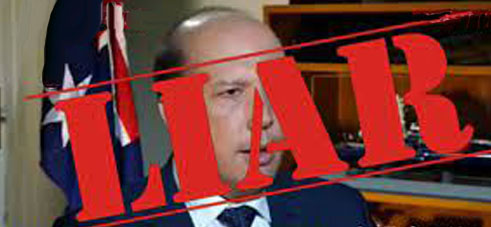
Australia is currently contesting a future based on nuclear energy vs renewables.
The conservative opposition Coalition has put forward a ‘plan’ to build seven government-owned nuclear plants across Australia that will come online around 2035. The promise is that these plants will provide cheap, reliable carbon free electricity and help our nation achieve ‘net zero’ by 2050. It’s a strange policy requiring massive government investment and control from a party the stands for smaller government. But that’s just the beginning of strangeness around this thinking.
To call it a ‘plan’ is drawing a long bow because the proposal comes with no costings or modelling attached; existing legislation prevents the construction of nuclear power plants; and Australia currently lacks the necessary capacity to develop a nuclear power network (something the nuclear loving coalition did nothing about while in government for most of the last decade). Experts from across Australia don’t believe it would be possible to build the plants by 2035, or that they can produce electricity at anything close to what can be produced by renewables.
However, if the electorate was to buy the proposal and vote in the conservatives, it would result in the extension of coal power (to fill the gap till nuclear comes online), the expansion of gas energy and a redirection of investment away from renewables, which don’t really complement nuclear anyway.
While questions are being asked about all of these uncertainties, I think a more fundamental issue relates to governance and scales of time.
How is it that political parties can get away promising huge projects that won’t eventuate for 10 to 20 years; that’s four to eight election cycles in the future. Even if the current opposition leader, Peter Dutton, manages to sell the nuclear dream at the next election, he won’t be around to see his promises are kept. He simply isn’t accountable for the claims he’s making today.
Flawed accountability
Clearly this is a weakness of our democratic system of governance. We vote someone in to represent us for a number of years, three to six years in most electorates around the world, and we hold these representatives to account for the how they perform in delivering what they promised at election time. This tends to have voters actively reflecting on day-to-day business (taxes, health care delivery, education etc), while simply ignoring the hundreds of billions of dollars of commitments made for promises that sit well over the electoral horizon (promises like nuclear submarine fleets and nuclear power plants).
This weakness in accountability appears to be increasingly exploited by all sides of politics. Voters are collapsing under the ‘cost of living’, holding their breaths with every quarterly inflation announcement, and quick to pull down any politician who seems insensitive to the needs of ‘working families’.
Yet, at the same time, voters seem oblivious to the consequences of political leaders making a $100 billion dollar pledge to be delivered in 3-4 election’s time (though I note critics say this plan could easily end up costing as much as $600 billion). Consequently, we’re seeing more of these big announcements because the pollies know the electorate is not going to hold them to account. They simply don’t have the capacity to take it in, they are too absorbed by the day-to-day stuff.
Extraordinary accountability
The late, great astronomer Carl Sagan once said that “extraordinary claims require extraordinary evidence”. He was referring to the possibility of UFOs and extra-terrestrial life, but the same principle should apply to extraordinary political promises. If a political leader makes an extraordinary promise that can’t be delivered in one to two electoral cycles and commits vast quantities of (scarce) resources, then they need to put up a corresponding level of ‘extraordinary accountability’ before their case should be considered seriously by the broader electorate.
It’s not just the money involved and skills needed, it’s also how such a goal might be met over several electoral cycles. Bipartisan support, you would think, would have to be a basic first step.
A couple of decades ago Prime Minister John Howard passed the Charter of Budget Honesty Act in an effort to make political parties more accountable for the spending they promised. Many claim it has achieved little however, at the very least, it was an effort to show the electorate that politicians were aware that they needed to demonstrate greater accountability for the promises they make.
In the case of Dutton’s nuclear plan, this accountability is completely missing. However, rather than acknowledging this and attempting to build a stronger case, the Coalition has instead been attacking the institutions that have been examining the proposal (like CSIRO and the Australian Academy of Technological Sciences and Engineering). The conservatives have simply written them off when they question the validity of the proposal. (“I’m not interested in the fanatics,” says Dutton.) This doubling down is doubly dumb because it involves both extraordinary promises with no proof and the politicisation of independent experts.
Beyond nuclear
But this tendency to aim extraordinarily big without extraordinary accountability goes way beyond Australia’s future nuclear energy ambitions. Consider the quest for fusion energy.
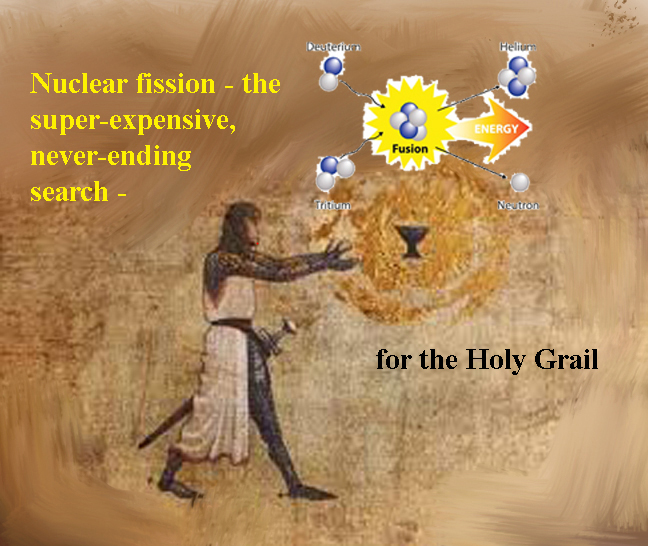
Europe is chasing the holy grail of clean energy by investing in fusion power. The multi-country International Thermonuclear Experimental Reactor (ITER) project was dreamt up in the 1980s and took over 25 years to come together as a formal collaboration between China, the European Union, India, Japan, South Korea, Russia, and the United States. Construction began in 2010 with operations expected to start about a decade later. But manufacturing faults, the COVID-19 pandemic, and the complexity of a first-of-a-kind machine (one of the most complex machines in the world) have all slowed progress and now ITER will not turn on until 2034, 9 years later than currently scheduled. Energy producing fusion reactions—the goal of the project—won’t come online until 2039!
ITER is a doughnut-shaped reactor, called a tokamak, in which magnetic fields contain a plasma of hydrogen nuclei hot enough to fuse and release energy. The technocrats running the project will gleefully explain that particle beams and microwaves heat the plasma to 150 million degrees Celsius—10 times the temperature of the Sun’s core—while a few meters away the superconducting magnets must be cooled to minus 269°C, a few degrees above absolute zero. Amazing as that sounds, it’s possibly less challenging than coordinating the actions and investment choices of the world’s superpowers decades into the future; Russia, China and the US are not exactly buddies at the moment. How strong do the ‘particle beams’ have to be to hold this agreement together for 20-30 years.
And even if ITER never eventuates, the possibility of ‘unlimited, clean energy’ over the horizon impacts investment decisions today. We’re seeing this even with the nuclear fission debate today in Australia as investors become wary of putting their money into renewables with the opposition promising nuclear powerplants just down the road.
And then there’s growing talk about implementing geoengineering solutions to fix humanity’s existential overheating problem (‘global boiling’). We’re talking pumping sulphates into the stratosphere, giant mirrors in space and fertilising the ocean to draw down carbon in the atmosphere. Playing God by ‘controlling’ the Earth system is going to be as big a governance issue as it is a technical challenge. And, given we’re doing so poorly on energy solutions using technology that’s relatively well understood, we’d be wise to demand extraordinary accountability before swallowing any promises in this domain.
Going thermonuclear
Which is not to say that ‘thermonuclear’ is not potentially a big part of a possible energy solution, just not the man-made kind. That big ball of energy in the sky called the Sun is driven by thermonuclear fusion, and this energy is there for the harvesting via photovoltaic cells (and indirectly by wind turbines).
And the accountability on these renewable sources of power doesn’t need the same level of extraordinary accountability that nuclear and thermonuclear demands because it can be delivered now, in the same electoral cycle as the promise to deliver it.
Renewables are not without their own set of issues but in terms of cost, feasibility AND accountability, it’s a solution that Australia (and the world) should be implementing now. Renewables are not ‘too big to fail’ but waiting twenty years before switching to them is simply too little too late.
AUKUS revamped: Australia to indemnify US and UK against ‘any liability’ from nuclear risks

Documents tabled in parliament on Monday have also revealed the United States or United Kingdom could walk away from the AUKUS deal with Australia with a year’s notice.
SBS News, 12 August 2024
Key Points
- The US, UK and Australia signed a new AUKUS agreement in Washington last week.
- Documents tabled in parliament on Monday revealed several key elements of the revamped agreement.
- Australia will indemnify the US and UK from any ‘liability’ arising from nuclear risks related to the program.
The United States or the United Kingdom could exit the AUKUS agreement to provide nuclear-powered submarines with Australia with a year’s notice under a new arrangement.
The revamped agreement also requires Australia to legally protect both allies against costs or injuries arising from nuclear risks.
The arrangement was signed by all three partner countries in Washington in the US last week.
Advertisement
Documents tabled in parliament on Monday set out the agreed legal framework for transferring nuclear materials and equipment to Australia for the $368 billion acquisition of atomic-powered submarines announced in 2021.
The plan will bring eight nuclear-powered subs into service by the 2050s.
US and UK could walk away with a year’s notice
The agreement, which “shall remain in force until 31 December 2075”, says the AUKUS deal shouldn’t adversely affect the ability of the US and UK to “meet their respective military requirements and to not degrade their respective naval nuclear propulsion programs”.
“Any party may terminate the agreement … by giving at least one year’s written notice to the other parties,” it reads.
Australia responsible for storage and disposal of waste
Nuclear material for the future submarines’ propulsion would be transferred from the US or UK in “complete, welded power units”, the agreement says.
But Australia would be responsible for the storage and disposal of spent nuclear fuel and radioactive waste from the nuclear power units that are transferred under the deal.
Australia to cover other members for nuclear risks
The updated agreement also means Australia will indemnify the US and UK from any “liability, loss, costs, damage, or injury (including third party claims)” arising from nuclear risks related to the program.
But the legal protection won’t apply in relation to a conventionally armed, nuclear-powered submarine that has been in service with the US Navy “until such time as it is transferred to Australia”…………………..
Greens attack revamped agreement
Greens defence spokesman David Shoebridge criticised the new agreement for its “multiple escape hatches” which risked Australia being left high and dry.
“This is a $368 billion gamble with taxpayers’ money from the Albanese government,” he said…………………..more https://www.sbs.com.au/news/article/aukus-revamped-australia-to-indemnify-us-and-uk-against-any-liability-from-nuclear-risks/rudp9zf10
While Cumbrian MPs Blindly Agitate for More Uranium Mining to Feed More Nuclear New Build, Indigenous Australians are celebrating Halt to Poisoning of their Lands

On By mariannewildart, https://mariannewildart.wordpress.com/2024/08/07/while-cumbrian-mps-blindly-agitate-for-more-uranium-mining-to-feed-more-nuclear-new-build-indigenous-australians-are-celebrating-halt-to-poisoning-of-their-lands/
Here in Cumbria MPs, most especially the new MP for Sellafield (apologies, MP for Whitehaven and Workington, Josh MacAlister) are agitating for new nuclear build on the floodplain of the River Ehen next to the bursting at the seams Sellafield nuclear waste site. New nuclear, even the so called “Small Modular Reactors” (actually near the size of the original Calder Hall reactors) would require new uranium – this is not a “home grown” or “clean” industry as its cheerleaders claim, the profligate amounts of uranium, high tensile steel, copper and a whole smorgasbord of toxic chemicals are shipped in and they outstrip any other industry in quantities and toxicity.
The start of the toxic uranium fuel cycle begins on the lands of indigenous peoples worldwide. In Australia a battle has been raging to stop ever more uranium mining, this time at Jabiluka. Now that battle has been won but the MP for Whitehaven and Workington wants indigenous peoples worldwide to carry on paying the price of polluted waters, poisoned lands and damaged health in order to continue with nuclear business as usual despite the fact that nuclear power’s most long lasting legacy is not “free electricity” far from it, energy bills will go up because successive governments’ have had an obsession with funding the nuclear industry at any price even asking consumers now to pay the price before they recieve any electricity and for generations after to try and ‘keep the wastes safe’.
“The announcement has been made that the mining lease will not be extended and the process to get Jabiluka into world heritage and Kakadu National Park can begin. A big shout out to the Traditional Owners, the @Mirarr for standing strong for this for generations, and thousands of people around the country standing with them.”
Meanwhile here in Cumbria this is what the local press fizzingly tell us “Cumbrian leaders put pressure on NDA over land at Moorside for SMRs. A letter signed by more than 100 political, business and union leaders is calling for urgent action to resolve land issues at Moorside so that new nuclear power stations can be built. Whitehaven and Workington MP Josh MacAlister wrote the letter, which has been signed by fellow Cumbrian MPs Julie Minns and Markus Campbell-Savours, local members of the House of Lords, Cumberland Council leader Mark Fryer, trade union leaders in the nuclear industry and dozens of local business leaders. Mr MacAlister says that unless urgent action is taken to resolve issues about land use at Moorside, west Cumbria will lose out in a competitive process that is now underway. Mr MacAlister says GBN will only select sites that have enough land available and the NDA (who own Sellafield) want to use much of the Moorside site for other decommissioning purposes. This has resulted in an impasse that, if left unresolved, will leave Cumbria behind in the race for new nuclear. The NDA says it is working with the government to consider how the land at Moorside may be used to enable new nuclear energy facilities, while taking into account how it might need to utilise the land in order to successfully deliver its mission. Mr MacAlister said: “In my first few weeks as an MP I’ve met with ministers, the NDA, GBN and leading industry figures. It’s become clear that there’s been a conspiracy of silence for years over plans for new nuclear in our area.In Cumbria 7th Aug 2024 https://www.in-cumbria.com/news/24501223.cumbrian-leaders-put-pressure-nda-land-moorside-smrs/“
No doubt Josh MacAlister MP for Whitehaven and Workington will be absolutely delighted to hear that as is the way of all ruthless corporations, yesterday “Mining company Energy Resources Australia (ERA) has launched legal action against the Commonwealth and Northern Territory governments over a decision not to renew its lease over the Jabiluka uranium mine. Surrounded by Kakadu National Park, the site at Jabiluka is one of the world’s largest and richest uranium deposits.”
Josh Macalister MP is the smiling assassin agitating to rip uranium out of the earth to fuel new nuclear on land next to Sellafield (on the flood plain of the river Ehen). Nice!
Australia makes undisclosed ‘political commitments’ in new AUKUS deal on transfer of naval nuclear technology

ABC News, By defence correspondent Andrew Greene, 8 Aug 2024
In short:
AUKUS partners have struck a revamped agreement to allow the transfer of US and UK naval nuclear material to Australia.
Critics of the trilateral submarine project warn the new document could eventually see high-level radioactive waste stored locally.
What’s next?
The agreement between the US, UK and Australia will need to be ratified by each AUKUS partner before coming into effect.
Undisclosed “political commitments” have been made between the Albanese government and its AUKUS partners in a new agreement for the transfer of naval nuclear technology to Australia, which critics warn is likely to also allow radioactive waste to be dumped here.
The White House confirmed Australia, the United Kingdom and the United States had reached another significant “AUKUS milestone” that set up further trilateral cooperation that would be essential for this country to build, operate and maintain nuclear-powered submarines.
Under the AUKUS “optimal pathway” unveiled in San Diego last year, Australia will spend up to $368 billion over the next three decades to first purchase second-hand Virginia-class submarines and then develop a new SSN-AUKUS fleet using British technology.
In a letter to speaker the US House of Representatives speaker and the US Senate president, President Joe Biden urged Congress to give the revamped AUKUS agreement “favourable consideration”
Mr Biden’s letter explains that the new agreement would permit the continued communication and exchange of Naval Nuclear Propulsion Information (NNPI), including certain Restricted Data (RD), only previously shared between the US and UK…………………………………………………………………..
Concerns over radioactive waste ‘loophole’
AUKUS critics, including the Greens party, warn that the new agreement is likely to eventually allow high-level radioactive waste to be stored in Australia and for uranium enrichment to be undertaken locally, but the government insists that is not the case.
“A political assurance is there — a legal assurance, a legislative assurance, an institutional assurance is not. That gate needs to be closed, that loophole needs to be closed,” warns Dave Sweeney, a nuclear free campaigner from the Australian Conservation Foundation.
“And that’s one of many concerns and many options for interpretation of how AUKUS is operationalised that can add greater pressure, nuclear threat in our ports, in our harbours and waters and on land around the management of radioactive waste.” https://www.abc.net.au/news/2024-08-08/australia-makes-political-commitments-in-new-aukus-deal/104200814
Israel lobby ramps up scare campaigns in fear of truth
By Bilal Cleland | 1 August 2024, https://independentaustralia.net/politics/politics-display/israel-lobby-ramps-up-scare-campaigns-in-fear-of-truth,18826
srael lobby groups have increased efforts to silence those accusing the nation of genocide in Gaza, writes Bilal Cleland.
SHAIMA FARWANEH, 16, in the coastal displacement camp in al-Mawasi, west of Khan Younis, was preparing to make breakfast for her family on 13 July when the Israeli bombs fell.
Ninety people, mainly women and children, were killed and over 300 injured.
Shaima told Mondoweiss:
There is no country in all the world that does this to children, women, and civilians. This isn’t how wars are.
A leg hit me and I saw dismembered bodies a few metres away. I saw a young child screaming. He lost his lower limbs and was crawling on his hands and screaming. The bombs didn’t stop and suddenly the boy disappeared. I saw how he vanished before me while we ran and lowered our eyes to the ground, unable to do anything but run.
Israel in trouble
Following 7 October, by the end of 2023, from over 4,000 immigrants a month only about 1,000 a month were arriving in Israel. A 70 per cent decline.
In that same couple of months, about 470,000 Israelis fled.
As reported in Anadolu Ajansi:
‘Therefore, there is a negative migration of about half a million people, and this does not include thousands of foreign workers, refugees and diplomats who left the country.’
Despite the support given to Israeli Prime Minister Benjamin Netanyahu by the ruling parties across North America, much of Europe and Australia, one in four Israeli Jews and four in ten Arab Israelis would like to leave Israel according to a new survey. This reflects ‘a steady distrust with Israel’s political and military leadership’.
International institutions closing in
Haaretz published the stunning International Court of Justice (ICJ) findings on the Israeli occupation of Palestinian territory:
- Israel must end its presence in the occupied territories as soon as possible.
- Israel should immediately cease settlement expansion and evacuate all settlers from the occupied areas.
- Israel is required to make reparations for the damage caused to the local and lawful population in the Palestinian territories.
- The international community and organisations have a duty not to recognise the Israeli presence in the territories as legal and to avoid supporting its maintenance.
- The UN should consider what actions are necessary to end the Israeli presence in the territories as soon as possible.
The International Criminal Court (ICC) in The Hague is expected to issue arrest warrants for Netanyahu and Defence Minister Yoav Gallant within a fortnight.
Conflating opposition to genocide with anti-Semitism
The United States makes much of the role of the Iranian Council of Guardians selecting acceptable candidates for political office but ignores the role of its own Council of Guardians, AIPAC, which decides on suitable candidates for office.
U.S. Congressman Jamaal Bowman, once a recipient of lobby largesse, after seeing reality in Palestine on a J Street-funded excursion, called Gaza a genocide and said boycotts were legitimate.
Israeli lobby groups spent $9.9 million in a Democrat primary to get rid of him in favour of a supporter of Israel.
The scare campaign around rising anti-Semitism, which conflates criticism of Israel’s mass atrocities with prejudice against Jews, is a feature of most of the old colonial countries.
Mary Kostakidis, one of Australia’s most respected journalists, who speaks truth to power, has written regarding the Israeli genocide in Gaza:
‘In an effort to silence me, the Zionist Federation have filed a complaint with the [Australian Human Rights Commission] for racial vilification, aided by a reporter who can’t do his own research.’
The lobby levelled another case of harassment and suspicious accusations against a Palestinian Australian engaged in anti-genocide activity.
Hash Tayeh, who had to present himself to the police over alleged anti-Semitic comments, was not charged and his matter has been referred to the Office of Public Prosecutions.
His Caulfield Burgertory outlet was set on fire, allegedly by two men, on 10 November, an attack he claimed was linked to his involvement in a pro-Palestine rally and thus a hate crime.
Then we witnessed the arrest of a Palestinian activist in the Prime Minister’s electoral office.
Sarah Shaweesh, who was asking about the delay in visas for her family in Gaza, was arrested.
The office refused to help her.
She is a key organiser of the 24/7 Gaza sit-in protest in front of the PM’s office.
Complicity in genocide
In early March, Sydney law firm Birchgrove Legal lodged a communiqué to the ICC prosecutor claiming that the Australian PM and a number of other high-level local politicians are complicit in the Gaza genocide.
On Tuesday this week, it announced that the Office of the Prosecutor of the ICC had added the document:
‘“…to the evidence gathered as part of the ICC’s investigation into the Situation in the State of Palestine,” as well as having been transmitted “to relevant staff members for further review”.’
Meanwhile, Muslim Votes Matter is mobilising the anti-genocide vote in preparation for the next federal electio
AUKUS Australian servility to USA – just one facet of poor governance
By Paul KeatingJul 31, 2024, https://johnmenadue.com/aukus-servility-just-one-facet-of-poor-governance/
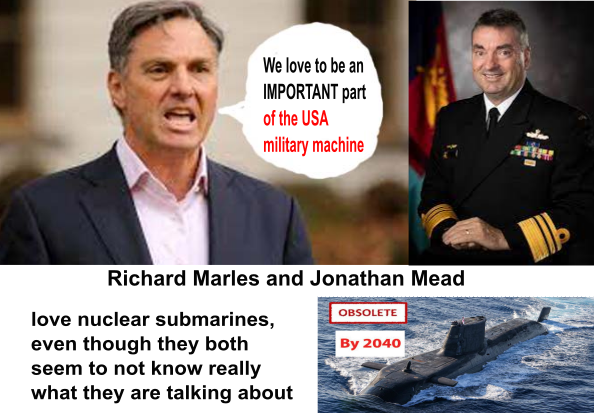
Richard Marles has the Navy out in force firing torpedoes at AUKUS critics.
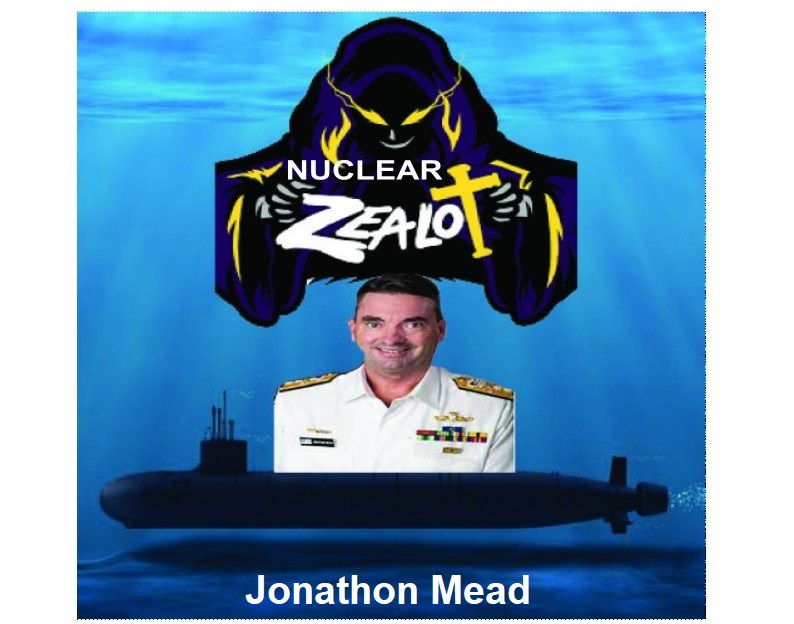
On Friday last, Vice Admiral Jonathan Mead claimed the critics need to produce evidence of any challenges to AUKUS being realised, then on Saturday, Vice Admiral Hammond, Chief of Navy, raised his periscope claiming the AUKUS debate was being ‘hijacked’ by people with ‘specific agendas’ without indicating what these agendas might be or who was likely making them.
The fact is, what clearly is being ‘hijacked’ is national accountability – accountability for the most wayward strategic and financial decision any government has taken since Federation.
Despite AUKUS’s half trillion of budgetary cost and its dangerous strategic implications there has not been one Ministerial Statement explaining its rationale, its strategic policy objective or defending its hugely distorting impact on government expenditures.
Not a coherent or persuasive word has come from the Minister for Defence or for that matter, the Prime Minister, let alone from a parliamentary debate on what is significantly a seminal turn in the country’s strategic and defence policy settings.
Vice Admiral Hammond, ignoring Australia’s geography – its residence among populous and prosperous Asian states, fell back on the old Anglo glee-club adage ‘three developed nations who have over 100 years of shared history, heritage, values and sense of purpose.’

The likelihood is that Australia will not come into possession of nuclear submarines of its own making, but what it will certainly become is landlord and host to American nuclear submarines as the United States appropriates Australian real estate in its attempts, against all odds, to maintain strategic primacy in Asia. Odds that carry the likelihood of Australia being dragged into military skirmishes with China, or indeed, worse.
So irresponsible, secretive and smug has the government been in making its decision, that no amount of ‘hijacking’ by anyone else is likely to disrupt Australia from its current path of effectively falling into American hands, or at least, being abjectly at America’s beck and call.
Republished from Australian Financial Review, July 30, 2024
“Nuked” on Aukus ‘fiasco’ says decision to embrace pact will ‘haunt’ Australia’sLabor for years

“undermines any argument that the new submarines – whether nuclear or not – would be used primarily to defend Australia or to protect the nation’s shipping lanes”.
“at least one new cabinet minister wondered if it was possible to stop Aukus, but the suggestion went no further”.
Fowler said he did not believe there had been adequate public debate in Australia about the merits of Aukus,
Andrew Fowler’s book reveals one of Australia’s most important requirements for its submarines was the ability to work alongside the US in South China Sea
Daniel Hurst , 7 July 24, https://www.theguardian.com/world/article/2024/jul/07/book-on-aukus-fiasco-says-decision-to-embrace-pact-will-haunt-labor-for-years
One of Australia’s most important requirements for its new submarines is the ability to work alongside the United States in the South China Sea, a new book discloses.
The book by Andrew Fowler, a former investigative journalist for the ABC’s Four Corners and Foreign Correspondent programs, also predicts that Labor’s rush to embrace the Aukus pact “will haunt them for years to come”.
Fowler examines the Morrison government’s cancellation of the French submarine contract and its pursuit of a nuclear-powered alternative in the book Nuked: The Submarine Fiasco that Sank Australia’s Sovereignty.
The book makes the case that Aukus is a “deeply flawed” scheme that, when combined with a parallel effort to deepen military integration with the US, effectively ties Australia’s future “to whoever is in the White House”.
It includes an interview with David Gould, a former UK undersecretary for defence, who was headhunted by the then Gillard Labor government in 2012 as a consultant on a replacement for Australia’s ageing Collins-class submarines.
“As we sat talking, Gould revealed for the first time what has long been suspected: one of the submarine’s most important requirements would be to work with the Americans in the South China Sea,” Fowler writes.
“He explained that the submarine would need ‘to get through the archipelago to the north of Australia and into the South China Sea and operate in the South China Sea for a reasonable period of time and then come back again, without docking, or refuelling or anything. That’s what it needs to do.’”
The book quotes Gould as saying that the submarine would work alongside the US and Japan in an “integrated system”, which had become “even more pertinent with China”.
Fowler writes that the statement “undermines any argument that the new submarines – whether nuclear or not – would be used primarily to defend Australia or to protect the nation’s shipping lanes”.
Fowler contends that the focus is “to contain China and threaten its trade routes and food and energy supplies in a crisis”.
The Australian government has repeatedly said that its strategic motivation for acquiring nuclear-powered submarines is to “contribute to the collective security of our region” and maintain the global rules-based order.
The Labor defence minister, Richard Marles, has argued that the defence of Australia “doesn’t mean that much unless we have the collective security of our region” and that the nuclear-powered submarines would put a “question mark in any adversary’s mind”.
Fowler contends that the focus is “to contain China and threaten its trade routes and food and energy supplies in a crisis”.
The Australian government has repeatedly said that its strategic motivation for acquiring nuclear-powered submarines is to “contribute to the collective security of our region” and maintain the global rules-based order.
The Labor defence minister, Richard Marles, has argued that the defence of Australia “doesn’t mean that much unless we have the collective security of our region” and that the nuclear-powered submarines would put a “question mark in any adversary’s mind”.
The book reveals that after Labor won the 2022 election, “at least one new cabinet minister wondered if it was possible to stop Aukus, but the suggestion went no further”.
In an interview with Guardian Australia, Fowler said he began researching the book after becoming fascinated with “the overuse of executive power of government in the Morrison government, particularly the exposure of his five secret ministries”.
“I thought that the arrival of a $368bn secret deal that was done and then sprung on the public and the opposition party at the last moment would require an investigation,” he said.
Fowler said he did not believe there had been adequate public debate in Australia about the merits of Aukus, the security partnership with the US and the UK that involves the nuclear-powered submarine project but also collaboration on other advanced defence technologies.
“I think we debate the dollar-and-dime arguments, as the Americans might say, but we don’t debate the really big issues,” Fowler said.
“I don’t give advice to government but I think the Australian people have a right to know what the submarines are being bought for. They’re being bought to run with the Americans and Japan to contain the rise of China.”
Fowler said the then Labor opposition was put “in a diabolical position” when forced by Scott Morrison to make a quick decision on whether to support Aukus in 2021.
“This was a calculated attempt to wedge Labor on this issue and Labor only had 24 hours to make a decision,” he said. “It was obscene and absurd, and yet they made the decision fearing that if they opposed it they would be accused of being anti-American and weak on national security.
“I do understand why they went with it, but I think they also had some time to do some backtracking.”
Fowler called for an inquiry focused on “a failure of due process” in the cancellation of the French contract and the decision to pursue the Aukus arrangement, which officials admitted during Senate estimates hearings had not gone through the normal two-gate process for defence acquisitions.
Instead, the Morrison government announced Australia, the US and the UK would carry out an 18-month joint study to work out how to deliver the project. That led to the Albanese government’s March 2023 announcement of more detailed plans.
The book argues the French submarines would have given Australia “greater independence”, noting the president, Emmanuel Macron, had described Australia, India and France as being at the heart of a “new Indo-Pacific alliance and axis”.
The book says this “more independent thinking” caused “consternation in Washington”.
Australian Opposition leader Dutton’s claim about G20 nuclear energy use doesn’t add up
William Summers , July 5, 2024, https://www.aap.com.au/factcheck/duttons-claim-about-g20-nuclear-energy-use-doesnt-add-up/
WHAT WAS CLAIMED
Australia is the only G20 nation that doesn’t use nuclear power.
OUR VERDICT
Misleading. Five other G20 nations don’t generate nuclear power, and two of those don’t use it.
AAP FACTCHECK – Federal Opposition Leader Peter Dutton claims Australia is the only country not to use nuclear energy out of the world’s 20 largest economies.
This is misleading. Five other nations in the top 20 – Germany, Italy, Turkiye, Saudi Arabia and Indonesia – do not generate nuclear energy.
Germany, Italy and Turkiye import very small amounts of electricity generated from nuclear sources, but Indonesia and Saudi Arabia don’t consume any nuclear power.
Australia is the only top 20 economy that doesn’t generate, import or have a plan to do so.
Mr Dutton has made the claim at least four times in interviews about the coalition’s plan to build seven nuclear power stations in Australia without clarifying that he’s counting countries planning to use nuclear power among those that are actually using it.
Mr Dutton said nuclear power was “used by 19 of the 20 biggest economies in the world” at a June 18 press conference in NSW.
He again claimed that of the top 20 economies in the world, “Australia is the only one that doesn’t have nuclear” in a June 20 interview on Sky News.
That same day, the opposition leader spoke out about how Australia could benefit from nuclear power “as 19 of the world’s top 20 economies have done” in an ABC News Breakfast interview.
Mr Dutton again said Australia was the only one of the 20 biggest economies that “doesn’t operate” nuclear at a press conference on July 5.
When asked to clarify his claims, the opposition leader’s spokeswoman told AAP FactCheck that he’s counting countries that have nuclear power and those “taking steps towards embracing nuclear”.
Mr Dutton accurately stated 19 of the world’s 20 biggest economies used nuclear power or “have signed up to it” in another press conference on June 19, and a Today Show interview on June 21.
He also said Australia was the only G20 member that didn’t use or plan to use nuclear power in an ABC TV interview on April 21.
The G20 is a global forum for countries with large economies. Despite its name, the G20 includes only 19 nations, plus the African Union and the European Union. Spain is invited to the G20 as a permanent guest.
It’s unclear if Mr Dutton is referring to the G20 countries plus Spain, or the 20 largest nations by gross domestic product, as he’s used both interchangeably.
However, AAP FactCheck has analysed the former because the nations that don’t generate nuclear power and the nations that only import small amounts of it are exactly the same for both groupings, as per World Bank 2023 GDP data.
Fourteen G20 countries operate nuclear power plants: Argentina, Brazil, Canada, China, France, India, Japan, Mexico, Russia, South Africa, South Korea, Spain, the UK and the US.
Three G20 nations that don’t generate nuclear power but import small amounts are Germany, Italy and Turkiye.
Germany shut down its final three reactors in April 2023. That year, about 0.5 per cent of the electricity consumed there was imported from France, which generates about two-thirds of its electricity from nuclear sources.
Italy closed its last reactors in 1990. About six per cent of its electricity consumption is imported nuclear power.
The country effectively banned nuclear power in 2011, but the current government wants to restart it.
Turkiye is building a plant that could start generating electricity from 2025. The country is also planning to build two other nuclear plants.
In 2022, the country imported a tiny amount of the electricity it consumed, including 0.8 per cent from Bulgaria, which generates about 35 per cent of its electricity from nuclear sources.
Therefore, a fraction of Turkiye’s electricity consumption could be produced from nuclear – likely less than half a per cent.
Saudi Arabia doesn’t use any nuclear energy either but it’s taking steps towards doing so in future.
Indonesia doesn’t have any nuclear reactors but has tentative plans to build some in the coming decades.
Dr Yogi Sugiawan, a policy analyst at the Indonesian government agency responsible for developing nuclear energy policies and plans, told AAP FactCheck that his country doesn’t generate or import nuclear energy.
However, Dr Sugiawan says Indonesia’s government is considering nuclear power, with an initial plant “expected to be commissioned before 2040”.
THE VERDICT
The claim that Australia is the only G20 nation that doesn’t use nuclear power is misleading.
Evidence and experts say six G20 countries do not generate any nuclear energy, and three of those don’t consume it either.
Misleading – The claim is accurate in parts but information has also been presented incorrectly, out of context or omitted.
AAP FactCheck is an accredited member of the International Fact-Checking Network. To keep up with our latest fact checks, follow us on Facebook, Twitter and Instagram.
Australia further in the grip of the USA, with the Amazon data spy hub – paid for by Aussie tax-payers!
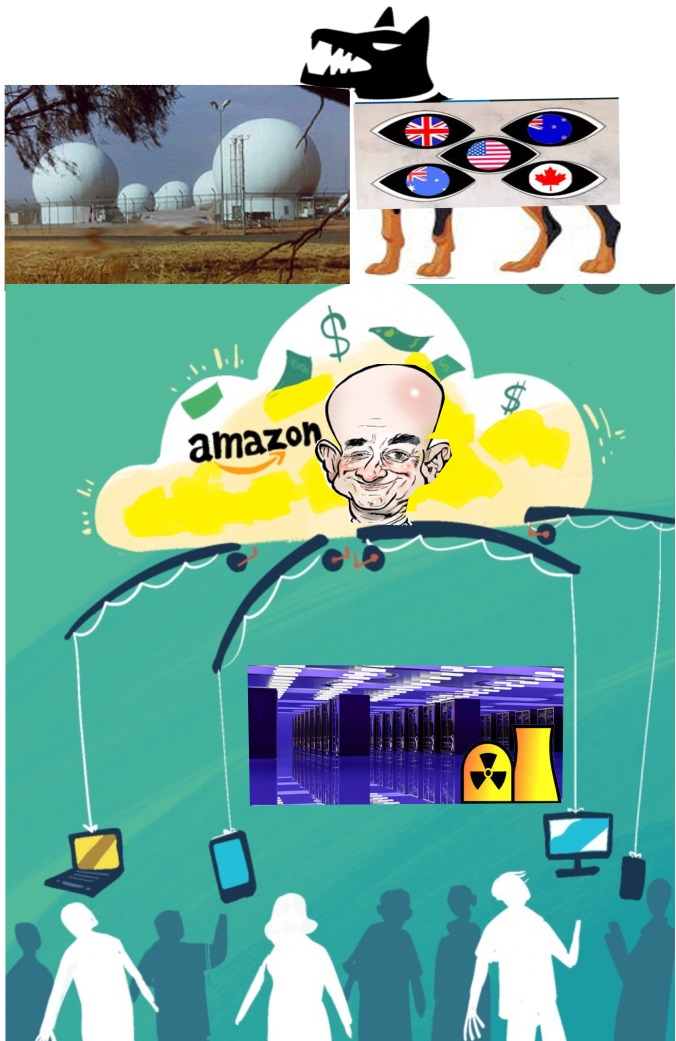
Australia’s Defence Minister Richard Marles was ecstatic as he announced the secret deal now organised for Australia to pay for Amazon to set up secret spy databanks, just as he was ecstatic about the government’s AUKUS deal for buying nuclear submarines from USA and UK.
It’s not as if the public knew about either of these decisions beforehand, (the AUKUS one being largely arranged with scandal-ridden consultancy PWC). It’s not as if these matters were discussed in Parliament. On both occasions, the government just did it.
Points that haven’t been addressed:
Australian taxpayers again foot the bill to an America private company
Amazon private staff will be running the operation – with access to the data?
The whole thing perpetrates the lie about the data being “in the cloud” – but there is no “cloud”. The data will be in gigantic steel containers, set out on a large area.
The data containers will require massive amounts of electricity. ? supplied by nuclear power
The data containers will require massive amounts of cooling water, in this dry, water-short country..
The whole set up, just like the now-being expanded Pine Gap. will form a dangerous target for terrorists, or for enemies of the USA.
Like Pine Gap, it is probable that Australian authorities will have limited access to the information. And as artificial intelligence is involved – who IS goig to be in control?
The whole set-up will be the servant of the Five Eyes, secret intelligence of five English-speaking countries, ( no trust in Europe, or any non-anglophone nation) but controlled by the USA.
The vast amount of tax-payer money going to all this means the money is not going to Australians’ health, welfare, education, environment, climate action – in other words to the common good.
As the USA Supreme Court has just made the U.S. president effectively above the law – this secret deal with Amazon and the USA puts Australia more firmly in the grip of the USA – (and God help us if Trump wins)
When it comes to power, solar is about to leave nuclear and everything else in the shade
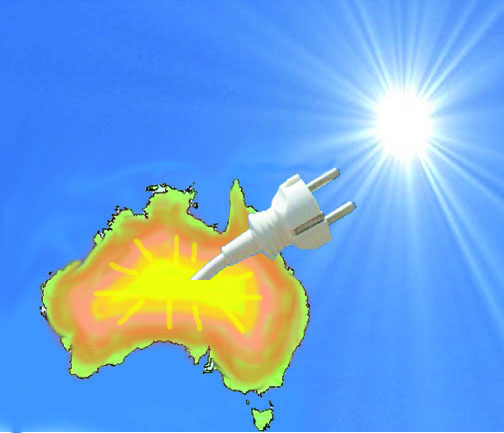
In Australia, solar is pushing down prices
Australia’s energy market operator says record generation from grid-scale renewables and rooftop solar is pushing down wholesale electricity prices.
Peter Martin, Visiting Fellow, Crawford School of Public Policy, Australian National University July 2, 2024 https://theconversation.com/when-it-comes-to-power-solar-is-about-to-leave-nuclear-and-everything-else-in-the-shade-233644
Opposition leader Peter Dutton might have been hoping for an endorsement from economists for his plan to take Australian nuclear.
He shouldn’t expect one from The Economist.
The Economist is a British weekly news magazine that has reported on economic thinking and served as a place for economists to exchange views since 1843.
By chance, just three days after Dutton announced plans for seven nuclear reactors he said would usher in a new era of economic prosperity for Australia, The Economist produced a special issue, titled Dawn of the Solar Age.
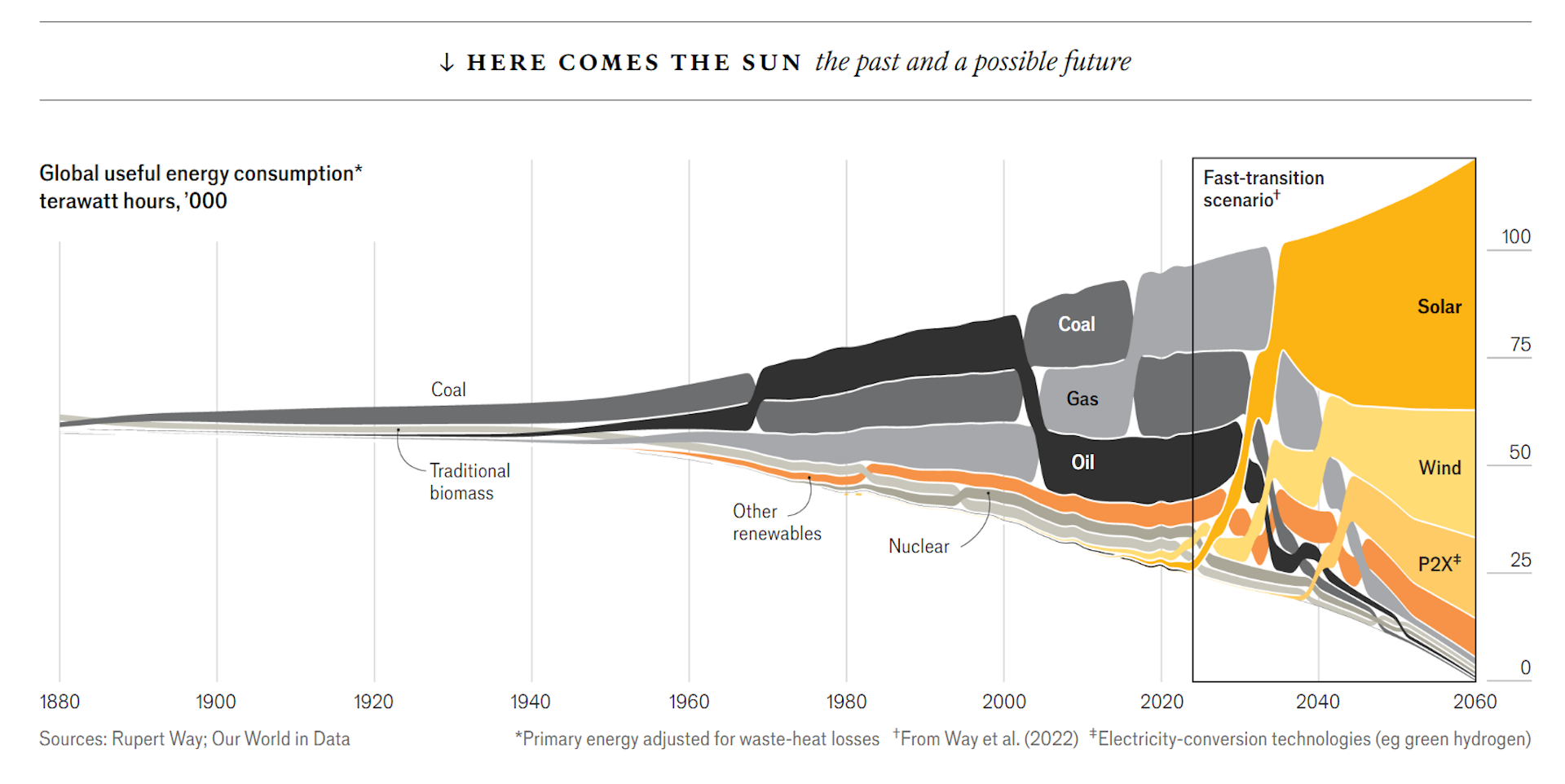
Whereas nuclear power is barely growing, and is shrinking as a proportion of global power output, The Economist reported solar power is growing so quickly it is set to become the biggest source of electricity on the planet by the mid-2030s.
By the 2040s – within this next generation – it could be the world’s largest source of energy of any kind, overtaking fossil fuels like coal and oil.
Solar’s off-the-charts global growth
Installed solar capacity is doubling every three years, meaning it has grown tenfold in the past ten years. The Economist says the next tenfold increase will be the equivalent of multiplying the world’s entire fleet of nuclear reactors by eight, in less time than it usually takes to build one of them.
To give an idea of the standing start the industry has grown from, The Economist reports that in 2004 it took the world an entire year to install one gigawatt of solar capacity (about enough to power a small city). This year, that’s expected to happen every day.
Energy experts didn’t see it coming. The Economist includes a chart showing that every single forecast the International Energy Agency has made for the growth of the growth of solar since 2009 has been wrong. What the agency said would take 20 years happened in only six.
The forecasts closest to the mark were made by Greenpeace – “environmentalists poo-pooed for zealotry and economic illiteracy” – but even those forecasts turned out to be woefully short of what actually happened.
And the cost of solar cells has been plunging in the way that costs usually do when emerging technologies become mainstream.
The Economist describes the process this way:
As the cumulative production of a manufactured good increases, costs go down. As costs go down, demand goes up. As demand goes up, production increases – and costs go down further.
Normally, this can’t continue. In earlier energy transitions – from wood to coal, coal to oil, and oil to gas – it became increasingly expensive to find fuel.
But the main ingredient in solar cells (apart from energy) is sand, for the silicon and the glass. This is not only the case in China, which makes the bulk of the world’s solar cells, but also in India, which is short of power, blessed by sun and sand, and which is manufacturing and installing solar cells at a prodigious rate.
Solar easy, batteries more difficult
Batteries are more difficult. They are needed to make solar useful after dark and they require so-called critical minerals such as lithium, nickel and cobalt (which Australia has in abundance).
But the efficiency of batteries is soaring and the price is plummeting, meaning that on one estimate the cost of a kilowatt-hour of battery storage has fallen by 99% over the past 30 years.
In the United States, plans are being drawn up to use batteries to transport solar energy as well as store it. Why build high-voltage transmission cables when you can use train carriages full of batteries to move power from the remote sunny places that collect it to the cities that need it?
Solar’s step change
The International Energy Agency is suddenly optimistic. Its latest assessment released in January says last year saw a “step change” in renewable power, driven by China’s adoption of solar. In 2023, China installed as much solar capacity as the entire world did in 2022.
The world is on track to install more renewable capacity over the next five years than has ever been installed over the past 100 years, something the agency says still won’t be enough to get to net-zero emissions by 2050.
That would need renewables capacity to triple over the next five years, instead of more than doubling.
Oxford University energy specialist Rupert Way has modelled a “fast transition” scenario, in which the costs of solar and other new technologies keep falling as they have been rather than as the International Energy Agency expects.
He finds that by 2060, solar will be by far the world’s biggest source of energy, exceeding wind and green hydrogen and leaving nuclear with an infinitesimally tiny role.
In Australia, solar is pushing down prices
Australia’s energy market operator says record generation from grid-scale renewables and rooftop solar is pushing down wholesale electricity prices.
South Australia and Tasmania are the states that rely on renewables the most. They are the two states with the lowest wholesale electricity prices outside Victoria, whose prices are very low because of its reliance on brown coal.
It is price – rather than the environment – that most interests The Economist. It says when the price of something gets low people use much, much more of it.
As energy gets really copious and all but free, it will be used for things we can’t even imagine today. The Economist said to bet against that is to bet against capitalism.
Why the Australian Opposition Party is not genuinely interested in nuclear power, (just in prolonging fossil fuels)
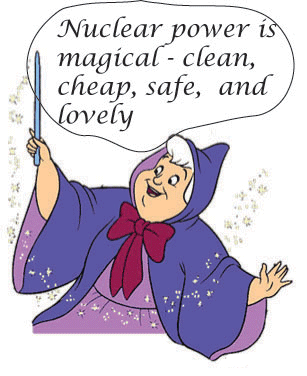
This is the truth at the heart of the Coalition’s latest climate fantasy: it gives people concerned about the speed and impact of the energy transition an alternative reality where this change doesn’t have to happen.
The Coalition’s nuclear fantasy serves short-term political objectives – and its fossil fuel backers
This is the truth at the heart of the Coalition’s latest climate fantasy: it gives people concerned about the speed and impact of the energy transition an alternative reality where this change doesn’t have to happen.
Dutton’s policy latches on to genuine concerns about power prices and disruption evident in the latest Guardian Essential report, but what are its real motivations?
Peter Lewis, 2 July 24 https://www.theguardian.com/australia-news/commentisfree/article/2024/jul/02/coalition-nuclear-policy-peter-dutton-power-plants
In 1959 the US government hatched a covert scheme to replace every single bird with a replicant surveillance drone to spy on its own citizens. This is only the second silliest theory flying around the internet right now.
Peter Dutton’s make-believe nuclear plan bears some of the hallmarks of Peter McIndoe’s actual piss-take, “Birds Aren’t Real”, which became so real he wound up doing interviews with Fox News and running large-scale community rallies where only some of the participants were chanting his nonsense slogan ironically.
There’s not too great a distance from ‘bird truthers’ to the Coalition’s latest permutation of fossil-fuelled climate skepticism.
In a world where information is driven by platform algorithms designed to maximise attention and reinforce existing prejudices, any theory can find a home; the crazier and louder the claims, the more likely they are to take off.
This is the truth at the heart of the Coalition’s latest climate fantasy: it gives people concerned about the speed and impact of the energy transition an alternative reality where this change doesn’t have to happen.
As this week’s Guardian Essential Report shows, support for renewable energy is contested. Lining up renewables, nuclear and fossil fuels, we found a lack of consensus on price, environmental impact and economic consequence.
While renewables are seen as the best energy source for the environment and most desirable overall, fossil fuels are seen as cheaper and better for jobs. It is here that the Coalition’s nuclear fantasy plays a critical bridging role.
The rollout of the renewable energy grid is a genuinely disruptive development; coal communities genuinely fear for their long-term economic future; consumers genuinely feel power prices rising as the rollout of renewables gathers momentum.
Coalition energy spokesperson Ted O’Brien is tasked with convincing those who have genuine concerns that if they just embrace nuclear, they can stop all these things they don’t like and still hit net zero by 2050.
Just like the bird conspiracy, this nuclear policy isn’t real: it has no scope, no production estimate, no costings, no timeline. But it’s a device that serves a flock of short-term political objectives.
It creates a reason to delay decommissioning coal and gas because, like magic, nuclear will provide a short cut. That’s good for the LNP’s fossil fuel backers and communities that rely on the production of these energy sources.
It offers hope to coal communities that they can become home to a new heavy industry. While critics of nuclear can make fun of the three-headed fish near the Springfield, the truth is Homer Simpson enjoyed the sort of secure job these communities fear will soon disappear.
And it sends a message to every regional community that they might not need to host the new renewable energy grid that is being rolled out. Because if you have a choice between looking out across a valley or looking out across power lines, who wouldn’t take the valley?
The problem for the Albanese government is that while each of these justifications is patently false, attacking them head-on risks a rerun of the voice referendum dynamic where “two sides” reporting creates a false equivalence that ends up defining the contest as a coin toss.
Exacerbating this challenge is the fact that fewer people trust the main proponents of the energy transition – the government and energy companies. Instead, trust is anchored at the level of the local.
The only people we really trust are those who we know personally – our friends and family and members of our community. Which raises the question, who do the people we trust get their information from? Perversely, the answer can only be “us”.
As McIndoe riffs in a hilarious piece of performance media: “Just because it’s a theory doesn’t mean its fake. It’s on the media, you can find it … Truth is subjective … There’s different proof out there for different things and if you do your research, you just might find it.”
Given this environment, the choice for Labor is whether to get dragged into a nuclear showdown where alternate facts will be wished into existence or simply dismiss the whole charade as the piece of political theatre it is.
A final question in this week’s report suggests the more effective way of confronting the nuclear “debate” is what disinformation experts call “pre-bunking” by calling out the opposition’s real motivations.
These findings show that half the electorate – and nearly two-thirds of young people – will reject the idea that this is a legitimate debate at all. Taking these people out of the equation before embarking on any merit analysis drastically reduces the number of votes in play.
Rather than trading economic models or platforming nuclear safety fears, the best approach might actually be the most honest one: to drag nuclear back into the political swamp from which it has risen.
First, expose the interests that will benefit from Dutton’s nuclear fantasy. Put the spotlight on the fossil fuel and nuclear players, who runs them, where they converge, who they pay to keep their dream alive and how much they stand to make by delaying the energy transition for a couple more decades.
Second, take away the oxygen for nuclear by doing the hard work required to build social licence for renewables, responding to legitimate concerns by giving communities a greater say in the way development occurs and how both costs and benefits are distributed.
Finally, turn the opposition to renewables back on to the LNP. While the political opportunism of the Dutton nuclear play is obvious, there are also risks that this decision comes to define not just him as a leader, but his entire political apparatus.
In a world where younger generations just want to get on with the job of addressing climate change, a major political party is walking away from this challenge in the interests of its corporate masters.
That’s the real conspiracy. And it’s not just a theory.
- Peter Lewis is the executive director of Essential and host of Per Capita’s Burning Platforms podcast
“They just fit in with what we do:” Australian farmers reap rewards as they play host to wind and solar
ReNewEconomy Liv Casben, Jun 29, 2024
Renewables in agriculture are gaining momentum across the nation as Australia pushes to reach its net-zero emissions target by 2050.
Australia’s energy market operator has declared renewables as the most cost-effective way of reaching net-zero targets in the grid, but just how much of the load will be carried by the farming sector remains unclear.
Across pockets of the nation, farmers are already doing their bit to reduce their carbon footprint.
“Anecdotally, we have seen a huge increase in farmers seeking renewables projects as farmers seek to increase the productivity of their farms,” Farmers for Climate Action’s Natalie Collard told AAP.
“Renewables offer drought-proof income, and drought-proof income keeps farms going through the toughest of times.”
The Lee family has farmed at Glenrowan West for 150 years, but for the past three years they’ve also added solar to the mix.
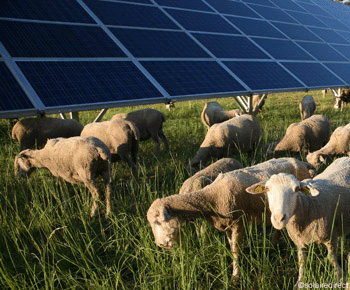
A German-based company leases the land from the Lees and maintains the solar panels, which run alongside the sheep farming operation.
“The lessee basically runs it just as another paddock, the sheep go in just as they would under any other farming operation,” Gayle Lee said. “We haven’t found there to be any noticeable loss of production.”
……………………………………………………. Karin Stark, who will host the annual Renewables in Agriculture conference in Toowoomba next week, says consultation is key to farmers playing a “critical role” in the renewables transition and keeping everyone happy…………… more https://reneweconomy.com.au/they-just-fit-in-with-what-we-do-farmers-reap-rewards-as-they-play-host-to-wind-and-solar/?fbclid=IwZXh0bgNhZW0CMTEAAR0qML5s3XgsQ3EZd5pJl15CdGXQ60-BC3TLkIVpcaWkgLsBSarHkHoPUYI_aem_OC5kzgz0cTiwWtnLVva56A
1 This Month

To see nuclear-related stories in greater depth and intensity – go to https://nuclearinformation.wordpress.com
-
Archives
- September 2026 (194)
- August 2026 (330)
- July 2026 (355)
- June 2026 (287)
- May 2026 (306)
- April 2026 (356)
- March 2026 (251)
- February 2026 (267)
- January 2026 (308)
- December 2025 (358)
- November 2025 (359)
- October 2025 (375)
-
Categories
- 1
- 1 NUCLEAR ISSUES
- business and costs
- climate change
- culture and arts
- ENERGY
- environment
- health
- history
- indigenous issues
- Legal
- marketing of nuclear
- media
- opposition to nuclear
- PERSONAL STORIES
- politics
- politics international
- Religion and ethics
- safety
- secrets,lies and civil liberties
- spinbuster
- technology
- Uranium
- wastes
- weapons and war
- Women
- 2 WORLD
- ACTION
- AFRICA
- Atrocities
- AUSTRALIA
- Christina's notes
- Christina's themes
- culture and arts
- Events
- Fuk 2022
- Fuk 2023
- Fukushima 2017
- Fukushima 2018
- fukushima 2019
- Fukushima 2020
- Fukushima 2021
- general
- global warming
- Humour (God we need it)
- Nuclear
- RARE EARTHS
- Reference
- resources – print
- Resources -audiovicual
- Weekly Newsletter
- World
- World Nuclear
- YouTube
-
RSS
Entries RSS
Comments RSS
 nuclear-news