‘Not everyone knows acronyms’: Australian politicians shrug off Trump blunder on AUKUS

By Richard Wood • Senior Journalist Feb 28, 2025, https://www.9news.com.au/world/donald-trump-stumbles-when-asked-about-aukus-defence-deal/6a602864-b990-4d37-95a4-530e31bd96e8
Politicians from both sides in Australia have weighed in today on US President Donald Trump’s apparent stumble when he said he did not know what AUKUS was.
Trump was hosting visiting British Prime Minister Keir Starmer at the White House when the pair were asked by a reporter whether they’d be discussing AUKUS, under which Australia will acquire nuclear-powered submarines.
“What does that mean?” Trump replied.
If China can’t scale nuclear, Australia’s got Buckley’s

Dutton’s proposal has seven nuclear power plants, including five large-scale reactors and two SMRs. This isn’t critical mass for a nuclear program. As of February 2025, the United States operates 94 nuclear reactors, France has 57, and South Korea maintains 26 reactors. Those are sufficient numbers of GW-scale reactors to achieve program economies of scale. Australia’s peak electricity demand of 38.6 GW isn’t sufficient to provide an opportunity for sufficient numbers of reactors of a single design to be built.
Michael Barnard, Feb 25, 2025, https://reneweconomy.com.au/if-china-cant-scale-nuclear-australias-got-buckleys/
The platypus of energy in Australia has reared its duckbill and stamped its webbed feet again in recent years.
A fractious group of bedfellows is advocating for nuclear generation, primarily driven by the Liberal-National Coalition under Peter Dutton, who has proposed repurposing decommissioned coal-fired stations for nuclear power, with the remarkable claim that reactors could be operational between 2035 and 2037.
Other political supporters include the Libertarian Party and One Nation. Unsurprising advocacy organisations such as the Australian Nuclear Association, Nuclear for Australia, the Minerals Council of Australia, and the South Australian Chamber of Mines and Energy are calling for legislative changes to allow nuclear development, citing its reliability and low emissions.
Notable figures like opposition energy spokesperson Ted O’Brien, who has chaired parliamentary inquiries into nuclear energy, and Indigenous leader Warren Mundine, who sees nuclear as an economic and climate solution, have also voiced strong support.
But nuclear energy, like the platypus, is an oddly shaped beast, and needs a very specific hole to fit into the energy jigsaw puzzle.
Successful nuclear programs share several key conditions, drawn from historical examples in the United States, France, South Korea, and the UK. These countries achieved large-scale nuclear deployment first by making it a top-priority national goal, tied to military strategy or energy security.
Bipartisan support ensured long-term stability, while military involvement helped enforce cost discipline and continuity over decades. Australia clearly doesn’t have bipartisan support for nuclear energy.
Previous countries found political consensus in the face of serious geopolitical threats from nuclear armed enemies such as the Soviet Union and North Korea. Australia isn’t threatened by invasion or nuclear war by any country, and the major political parties are clearly on opposite sides of the fence on the subject.
Teal MPs, supported by Climate 200 and a major new force, are in general not supportive of nuclear energy either.
Australia’s federal laws prohibit nuclear power development through the Environmental Protection and Biodiversity Conservation Act 1999 (EPBC Act), which explicitly bans the approval of nuclear power plants.
The Australian Radiation Protection and Nuclear Safety Act 1998 (ARPANS Act) restricts certain nuclear activities, reinforcing the ban. Both laws would have to be repealed or substantially altered, requiring draft legislation to start with. No draft legislation has been in evidence from the Liberal-National Coalition, which appears par for the course for a campaign plank which is very light on details.
If the Liberal-National Coalition were to regain power, they would first have to draft a bill, and then shepherd it through the extensive legislative process, something that with contentious bills can take up to two years. That’s just the beginning.
Australia’s status as a signatory to international nuclear non-proliferation treaties adds a layer of complexity to any move toward nuclear power. Compliance with agreements such as the Treaty on the Non-Proliferation of Nuclear Weapons (NPT) and safeguards enforced by the International Atomic Energy Agency (IAEA) would require strict oversight of uranium handling, enrichment, and waste disposal.
Any shift to nuclear energy could trigger lengthy negotiations with global regulatory bodies to ensure Australia remains within its non-proliferation commitments, delaying and complicating the development of a civilian nuclear program.
The duration for individual countries to negotiate and implement these protocols has ranged from a few months to several years, influenced by national legislative processes and political considerations.
Strong central control is another common factor in successful nuclear programs. National governments directly managed nuclear projects, maintaining tight oversight of construction schedules and decision-making. This approach prevented fragmentation and ensured that experienced leadership remained in place throughout the deployment.
In Australia, power systems are largely under state control, meaning any attempt to build nuclear power plants would require approval from individual state governments. While the federal government sets national energy policies and regulates nuclear safety, states have the authority over planning and construction approvals.
Several states, including Victoria, New South Wales, Queensland, and South Australia, have explicit bans on nuclear power, adding another layer of legislative hurdles. Even if the federal ban were lifted, nuclear development would still depend on state cooperation, making a nationwide rollout politically and legally complex.
Building a skilled workforce was essential to scaling nuclear generation. Successful programs invested in national education and certification systems, training engineers, construction workers, and technicians specifically for nuclear projects. Strict security measures were also necessary to vet personnel and prevent risks.
That’s challenging for Australia. The Australian National Training Authority (ANTA) was abolished on July 1, 2005, with all its functions transferred to the Department of Education, Science and Training. This move aimed to centralize vocational education and training (VET) oversight at the federal level, streamlining operations and reducing administrative complexities associated with the previous federal-state arrangements.
Despite this degree of centralisation, the administration and delivery of VET programs remain primarily under state and territory control, with public technical and further education institutes and private providers delivering courses under regional oversight.
While the coordination and policy aspects of ANTA’s functions persist at the national level, the execution and management of training programs continue to be managed by individual states and territories.
That’s not a good basis for a nationally run and managed nuclear workforce education, certification and security clearance program that would need to persist for thirty to forty years. A nuclear ANTA would have to be established, taking time in and of itself, and then it would take time to attract and create a critical mass of skilled nuclear engineering, construction, operation and security human resources.
Speaking of security, Australia’s nuclear ambitions come with an often overlooked cost: an immense, multilayered security burden that taxpayers will likely shoulder.
In the US, nuclear power requires an extensive web of international, national, state, and local security measures, yet much of this expense is not covered by reactor operators.
The US government funds $1.1 billion annually in international nuclear security, including protecting supply chains and waste management through agencies like the IAEA, the Department of Defense, and the CIA. These costs translate to $8 million per reactor per year, with a full lifecycle cost of $1.2 billion per reactor—expenses that remain largely hidden from public scrutiny.
Domestically, the security footprint is even larger. The U.S. Nuclear Regulatory Commission, the Department of Energy, Homeland Security, and law enforcement agencies provide a $26 million per reactor per year security umbrella, ensuring compliance, protecting fuel transport, and defending against threats.
On-site security measures – including armed patrols, cyber protection, and emergency response teams – add another $18 million annually per reactor. In total, US taxpayers effectively subsidise $34 million per reactor per year, or $4 billion over a nuclear site’s lifespan, a cost that is rarely included in nuclear energy debates.
For Australia, these figures should serve as a stark warning. If nuclear reactors are built, the country will need to establish entirely new layers of security infrastructure, from federal oversight and emergency response teams to military-style site defenses.
The financial burden won’t fall on private operators alone – it will land squarely on the Australian taxpayer. As policymakers debate nuclear’s role in the country’s energy future, they must ask: are Australians ready to take on a security commitment of this scale?
A single, GW-scale, standardised reactor design was crucial to keeping costs under control. Countries that succeeded in nuclear deployment avoided excessive customization and focused on repeating a proven design, allowing for efficiency gains and predictable outcomes.
At present, there are various proposed reactor designs under consideration. Dutton’s proposal includes evaluating various reactor technologies, with a focus on South Korea’s APR1000 and APR1400 pressurized water reactors.
O’Brien has led a delegation to South Korea to study its nuclear power industry and assess the suitability of these reactor models for Australia.
It’s worth noting that while South Korea was successful in scaling nuclear generation, it did so with corruption that included substandard parts in reactors that led to a political scandal that resulted in the jailing of politicians and energy company executives.
Small modular nuclear reactors (SMR) have been proposed as part of the mix. They aren’t GW-scale and they don’t actually exist. As the Australian Academy of Technological Sciences and Engineering (ATSE) accurately pointed out in mid-2024, SMR technology remains in developmental stages globally, with no operational units in OECD countries.
The ATSE suggests that a mature market for SMRs may not emerge until the late 2040s, while I think it’s unlikely to emerge at all. Small reactors were tried in the 1960s and 1970s and were too expensive, leading to reactors being scaled up to around the GW scale in successful programs. There is nothing to indicate that anything has changed since then that will make SMRs successful and inexpensive the second time around.
Scale and speed mattered. Effective programs built between 24 and 100 reactors of very similar designs within a 20-to-40-year timeframe, ensuring that expertise remained within the workforce. Spreading projects over longer periods led to skill erosion and inefficiencies.
Dutton’s proposal has seven nuclear power plants, including five large-scale reactors and two SMRs. This isn’t critical mass for a nuclear program. As of February 2025, the United States operates 94 nuclear reactors, France has 57, and South Korea maintains 26 reactors. Those are sufficient numbers of GW-scale reactors to achieve program economies of scale. Australia’s peak electricity demand of 38.6 GW isn’t sufficient to provide an opportunity for sufficient numbers of reactors of a single design to be built.
Finally, strict adherence to design was non-negotiable. Countries that allowed constant innovation or design changes saw costs balloon and timelines slip. The lesson from history is clear: nuclear success depends on disciplined execution, a committed national strategy, and a workforce dedicated to repeating a single proven approach.
Australia’s strong engineering culture, known for innovation and adaptation, could pose challenges to a strictly controlled nuclear deployment program. Unlike industries where iterative improvements drive progress, nuclear power requires rigid standardization to control costs, ensure safety, and meet regulatory demands.
Australia’s history of engineering-led modifications – seen in mining, renewables, and infrastructure – could lead to pressures for design changes mid-project, a factor that has contributed to cost overruns and delays in nuclear projects overseas.
While flexibility has been a strength in other sectors, in nuclear energy, deviation from a single, proven reactor design undermines efficiency and drives up costs, making strict oversight and discipline crucial to success.
Why are young people like this 18-year-old fronting the pro-nuclear push in Australia?

SBS News, 13 February 2025
The regional sessions were not publicised beforehand on Nuclear for Australia’s social media accounts or the tour page on its website — you could only register for tickets if you knew the URL for the event’s webpage.
Campaigns director for the Conservation Council of Western Australia, Mia Pepper, said when she tried to get tickets for the Perth event online, she was denied. She said a colleague also failed to get tickets using their real name, but able to get in using an alias.
Shackel said Nuclear for Australia Googles people’s names beforehand to determine whether they are “likely going to cause a disruption or a threat”
Some polling suggests older Australians are more supportive of nuclear power than their younger counterparts. So why are young people fronting a pro-nuclear push?
SBS News, By Jennifer Luu, 13 February 2025
In a function room at Brisbane’s The Gabba sports ground, around 600 people have gathered to hear Miss America 2023 try to convince Australians nuclear power is a good idea.
Sporting a blue cocktail dress, blonde hair and a wide smile, 22-year-old Grace Stanke looks the part of a beauty pageant contestant.
She’s also a nuclear engineer touring the country with Nuclear for Australia: a pro-nuclear lobby group founded by teenager Will Shackel and funded by donors that include entrepreneur Dick Smith.
The event — billed as an information evening featuring a panel of experts — is off to a rocky start. A protester steps in front of the audience and speaks into a microphone.
“All of the organisers, presenters and sponsorship of this event tonight has a very deep vested interest — ” he says, before he’s drowned out in a chorus of boos and the mic is seized from his hand.
Audience members continue to disrupt last month’s event, raising their voices and speaking to the crowd before being herded out by security.
Among them is Di Tucker, a retired psychologist concerned about climate change. She said she became upset after submitting half a dozen questions online to be answered by the panel — and felt like they were being deliberately ignored.
“I felt so frustrated by the lack of factual information in that so-called information session forum on the safety, the timescale and the reality of nuclear energy,” Tucker told The Feed.
“I did stand up and I addressed the crowd, and I said something like: ‘You people need to go away and do your own research … it’s glossing over facts’.”
Nuclear for Australia founder Will Shackel, who was emceeing, estimated there were 20 to 30 protesters heckling the room.
He labelled their behaviour “simply unacceptable and … not in the interest of a fair discussion”.
“They were yelling abuse at us on stage. We had people come up to Grace at the end, call her a clown,” he claimed.
Shackel told The Feed: “We had people [who] had to be physically dragged out because they were resisting security … it was pretty ugly and pretty disturbing.”
Tucker disputes this: “Nobody I saw leave the room was hostile or aggressive, physically aggressive towards the security guards.”
“In fact, it was the opposite. The security guards were shoving the people outside.”
Outside, a separate group of protesters wields banners warning against the dangers of radioactive waste.
The words “Nuclear energy distracts from the climate emergency” are projected onto The Gabba over the image of a red herring.
The teen and the beauty queen
Tucker said the audience was mostly male and over 60. So why are two young people fronting the pro-nuclear movement in Australia?………………………….
As well as launching Nuclear for Australia — which describes itself as “the largest nuclear advocacy organisation in Australia” with over 80,000 supporters — he’s addressed a Senate committee and interviewed French President Emmanuel Macron for his organisation’s social media at the COP28 climate conference in Dubai in 2023.
Shackel first became fascinated with the nuclear debate while in high school in Brisbane.
“I’d just done a school assignment on nuclear energy when I realised it was banned. And that, as a 16-year-old kid, was pretty shocking to me,” he said.
Australia is one of the few countries where using nuclear energy to produce electricity is illegal. The ban was introduced in 1998, when the Howard government made a deal with the Greens in order to build a nuclear reactor in Sydney for research purposes.
At 16, Shackel launched a petition calling on Australia to lift its nuclear energy ban, garnering a flurry of media attention……….
As well as launching Nuclear for Australia — which describes itself as “the largest nuclear advocacy organisation in Australia” with over 80,000 supporters — he’s addressed a Senate committee and interviewed French President Emmanuel Macron for his organisation’s social media at the COP28 climate conference in Dubai in 2023……………………………
Nuclear power is still a contentious topic, but more Australians have become supportive of the idea over time.
A 2024 Lowy Institute poll of 2,028 Australians
indicates 61 per cent support Australia using nuclear power to generate electricity, while 37 per cent were opposed.
Among the 18- to 29-year-olds surveyed, 66 per cent supported nuclear power while 33 per cent were opposed.
In contrast,
a December 2024 poll of 6,709 people conducted for the Australian Conservation Foundation suggests young people were less likely to agree that nuclear is good for Australia, compared to older respondents. For example, 42 per cent of males aged 18-24 agreed, while 56 per cent of males over 54 agreed.
There’s also a gender gap — in the same poll, just over a quarter of women thought nuclear would be good for Australia, compared to half of men.
Nuclear for Australia hopes Grace Stanke can convince the sceptics. Dubbed “the real-life Barbenheimer”, she works for the operator of the largest fleet of nuclear power plants in the US, Constellation. (The company operates 21 of the US’s 94 nuclear reactors).
Now 18, Shackel suggests young Australians are more open-minded towards nuclear power than older generations and are more likely to support parties that are concerned about climate change……..
Physicist Ken Baldwin speculates the rise in support for nuclear power is due to shifting demographics.
He said older generations are more likely to have historical hangups around the dangers of nuclear power, having lived through the British and French weapons tests in the Pacific and nuclear catastrophes like the 1986 accident in Chernobyl and the 2011 accident in Fukushima. ……
“The younger generation … doesn’t have that particular historical baggage, and perhaps they’re more attuned to thinking about the need to do something about climate change,” he said.
Nuclear for Australia hopes Grace Stanke can convince the sceptics. Dubbed “the real-life Barbenheimer”, she works for the operator of the largest fleet of nuclear power plants in the US, Constellation. (The company operates 21 of the US’s 94 nuclear reactors)…………….
Nuclear for Australia has been drumming up public support for nuclear power over the past fortnight, touring every capital city (except Darwin) and holding a parliamentary briefing in Canberra.
It also targeted regional areas near the Coalition’s proposed sites for future nuclear power stations — including Morwell in Victoria, Collie WA, Port Augusta SA, Callide and Tarong in Queensland and Lithgow in NSW. The Coalition says its taxpayer-funded plan is for five large and two smaller reactors, with the smaller ones to come online in 2035 and the rest by 2037.
Nuclear for Australia was slow to reveal all the names for a total number of regional locations for the tour. During the first week of the tour, Nuclear for Australia told The Feed there would only be two regional stops.
The regional sessions were not publicised beforehand on Nuclear for Australia’s social media accounts or the tour page on its website — you could only register for tickets if you knew the URL for the event’s webpage.
Campaigns director for the Conservation Council of Western Australia, Mia Pepper, said when she tried to get tickets for the Perth event online, she was denied. She said a colleague also failed to get tickets using their real name, but able to get in using an alias.
She accused Nuclear for Australia of blacklisting known anti-nuclear activists and trying to avoid criticism by attempting to “creep around the country”.
“If they were really genuine about having a mature debate, they would do their best to invite some people like myself that have engaged really respectfully in the debate over many years to answer the tough questions,” she said.
Shackel said Nuclear for Australia Googles people’s names beforehand to determine whether they are “likely going to cause a disruption or a threat”, and that regional events aren’t publicised on social media because they are not relevant to city-based audiences.
“We care about the safety of our attendees, we care about the safety of our experts,” Shackel said.
“If we believe that someone is a known protester … someone who could cause a physical threat to people in there, we will not allow them in.”
Pepper said: “I have never been physically aggressive to anybody in my entire life.”
“The idea that because you are opposed to nuclear power, you somehow would be aggressive or violent is absolutely outrageous.”
Locals left with more questions than answers
South of Perth, around 100 of the 9,000 residents of the tiny coal mining town of Collie showed up to the Nuclear for Australia event, hoping to learn more about how living next to a nuclear reactor could affect them.
The Coalition has proposed converting Collie’s coal-powered station into a nuclear power plant. But the state government is vowing to phase out coal by 2030 and there’s little chance nuclear power could come online by then, leaving coal workers in limbo.
Resident Jayla Anne Parkin said the information session was “an utter waste of time”, and she came away with more questions than answers. “Their whole speech was very generic. They were probably using the same speech for every single area,” she said.
Parkin asked one of the experts where the water for a nuclear power plant would come from — with large amounts needed to cool the radioactive core.
“He gave a long-winded speech about how we can take any body of water, whether it be the ocean, the river, pool, sewage, and treat it and turn it into the water. But at the end of him answering it, he still didn’t tell me what source of water in Collie they were going to use,” she said.
“We’re very limited with water here as it is.”……………………………………………
there have been reports about Shackel’s alleged political ties.
A 2024 research report from progressive activist group GetUp on nuclear disinformation in Australia
analysed Shackel’s LinkedIn connections and reported that their political party affiliation leant heavily towards Liberal Party MPs, Senators and advisors.
GetUp reported at least 36 of Shackel’s connections, including 11 current or former politicians, were directly linked to the Liberal Party — with the party having the highest concentration of current employees from a single organisation in his network…………………………………..
Lobby groups are allowed to have political party affiliations. While registered charities can participate in campaigning and advocacy, they “cannot have a purpose of promoting or opposing a particular political party or candidate”, according to the Australian Charities and Not-for-profits Commission.
……………………………………………………… Professor Ken Baldwin said nuclear is “not really viable” as an option for decarbonising Australia by 2050, as it would take 15 years at the very minimum to develop the necessary regulations and build a nuclear power station.
“We will have, according to the current plans, converted our current energy system to almost an entirely renewable energy system by that time,” Baldwin said.
“Australia is at the leading edge of the renewable energy transition. We’re installing solar and wind at one of the fastest rates per capita of any country in the world.”…………… https://www.sbs.com.au/news/the-feed/article/will-shackel-australia-pro-nuclear-movement-young-people/gucu0iefz
Doctors fear health fallout from nuclear energy plans

Canberra Times, By Marion Rae, February 12 2025
Doctors have warned of no “safe” level of radiation from a proposed network of nuclear reactors as battlelines are drawn for the federal election.
Similar to other nuclear-powered nations, Australians living within a certain radius of a reactor would need to be issued potassium iodide tablets for use in a radiation emergency, a nuclear briefing has learned.
“The only reason that everyone in that radius is given that is because they might need it,” Assistant Minister for Climate Change and Energy Josh Wilson told a nuclear briefing on Tuesday.
If anyone comes to buy your house, the proximity of a reactor will be noted on the land titles register, and insurers will not cover nuclear accidents, he said.
The warning came as doctors fronted parliament to warn of long-term health risks for workers and surrounding communities, particularly children.
Evidence included a meta-data analysis of occupational and environmental exposure that accumulated data on more than seven million people.
It found living within 30km of a reactor increased overall cancer risk by five per cent, with thyroid cancer increasing by 14 per cent and leukaemia by nine per cent.
A separate study of workers in the nuclear industry in France, the United Kingdom and the United States analysed results from more than 300,000 people who were monitored for over 30 years.
Finding not only increased cancer rates but surprisingly increased rates of heart attacks and strokes, it found impacts at low doses were larger than previously thought.
“There is no ‘safe’ lower dose of radiation. The science is clear. All exposure adds to long-term health risks,” vice-president of the Medical Association for Prevention of War Dr Margaret Beavis said……………………………
Under the coalition’s nuclear energy blueprint, seven reactors would be built across five states to replace ageing coal-fired power plants with more gas-fired plants to provide baseload power in the interim.
“Zero-emissions nuclear plants” are a key part of the Nationals’ election pitch to regions where coal plants are already closing, while Labor is pressing ahead with the transition to renewable energy backed up by big batteries.
Public Health Association of Australia spokesman Dr Peter Tait said the idea that the nuclear industry was free of greenhouse gas emissions was a “furphy”, given the construction and uranium supply chain involved.
Emissions would rise threefold under the nuclear plan due to increased coal and gas use, he warned, with the first plant not due to come online until the late 2030s.
From a public health perspective, Australians can’t afford that delay, Dr Tait said.
Executive director of Doctors for the Environment Dr Kate Wylie said prolonging the dependency on fossil fuels would mean more Australians would be affected by their known health risks, including increased rates of asthma.
Nuclear energy would also put communities at risk during the next drought, when reactors would be first in line for scarce water, Dr Wylie said.
“The ethical thing to do is to choose the least water-intensive energy sources, which are wind and solar,” she said. https://www.canberratimes.com.au/story/8890265/doctors-fear-health-fallout-from-nuclear-energy-plans/?fbclid=IwY2xjawIan3hleHRuA2FlbQIxMQABHaAJ7wF9BUi9CgA1_tQDXS5gC2WCrX8HSFZUrOQPGgXABnNkhEvlgHKolQ_aem_OShH2FPpE3tO3RIv_gAgBg
A former Miss America takes her nuclear sales pitch to audiences in Australia

By Hilary Whiteman, CNN, February 6, 2025, Brisbane, Australia,
Nuclear engineer and former Miss America Grace Stanke has entered the fierce debate in Australia over its future energy policy with a 10-day national tour extolling the benefits of nuclear power in a country where it’s been banned for almost 30 years.
The speaking tour is familiar territory for the 22-year-old former beauty queen, who said she studied nuclear engineering as a “flex,” but now works for US energy giant Constellation as a spokesperson and as an engineer on its nuclear team.
Her recent arrival comes at a delicate time in Australia, months before a national election that could put the opposition Liberal Party in power, along with its promises to build seven nuclear power stations – upending the current Labor government’s plan to rely on renewable energy and gas.
For several days, Stanke has been speaking to hundreds of Australians, in events organized by Nuclear for Australia (NFA), a charity founded by 18-year-old Will Shackel, who has received backing from a wealthy Australian pro-nuclear entrepreneur.
Most talks were well-attended by attentive crowds, but not all audience members were impressed by Stanke’s message.
As she started to speak in Brisbane last Friday, a woman in the audience began shouting, becoming the first of several people to be ejected from the room as other attendees booed and jeered. One woman who was physically pushed from the premises by a security guard has since filed a formal complaint.
……………Those against nuclear power say it’s too expensive, too unsafe and too slow to replace Australia’s coal-fired power stations that would need to keep burning for several more years until nuclear plants came online.
………………….A numbers game
Australia banned nuclear energy in 1998 as part of a political deal to win approval for the country’s first and only nuclear research facility that’s still operating in southern Sydney.
A change in government in an election, to be held before mid-May, would see seven nuclear reactors built in five states to provide power alongside renewable energy – a bold shift in direction that would not only require changes to federal law, but amendments to laws in states where premiers oppose nuclear power.
According to the plan proposed by Liberal Party leader Peter Dutton, the nuclear reactors would be funded by 331 billion Australian dollars ($206 billion) in public money and the first could be working by 2035.
Both forecasts are disputed as underestimates by the government acting on the advice of the country’s independent science agency – the Commonwealth Scientific and Industrial Research Organisation (CSIRO) – which says renewables are still the cheapest and the most efficient way for Australia to reach net zero by 2050.
…………………..“I do believe that a strong grid requires both renewables and nuclear energy combined,” Ms Stanke said, referring to the argument for a “baseload” energy source that doesn’t rely on unpredictable weather.
That argument is challenged by experts worldwide, who say the need for “baseload” energy is an outdated concept, and that stability can be achieved by other means, including batteries.
……………………………………………..Advance, a conservative campaign group that says it works to counter “woke politicians and elitist activist groups” is promoting a 48-minute documentary it claims tells the “untold stories” of farmers whose “lives have been upended by the rapid rollout of wind and solar projects.”
………………………………….Rural areas where opposition is building to renewable projects are fertile ground for Shackel and his nuclear campaign. He’s already visited some areas earmarked for power stations under the Liberal proposal. And while he says NFA isn’t politically aligned with either of the major parties, he accepts he’s doing some of the groundwork to bring the community on side………………………….
Nuclear ‘foolishness’
Bringing a former Miss America to Australia was part of a plan to raise support for nuclear power among Australian women, who according to one survey are far less enthusiastic than men about the proposal.
According to several people who attended sessions in various states, the audience was dominated by older men, many of whom didn’t seem to need convincing.
Jane McNicol, the first protester escorted from the room in Brisbane, told CNN she’s been an anti-nuclear campaigner since the 1980s. She said she stood up to “ensure that this foolishness does not take off.”
“It’s just a way of spinning the fossil fuel industry out for a bit longer, and we cannot afford to do that,” she said. “You can see how the climate is collapsing around us. Look at Los Angeles. Those poor people over there lost everything.”
Others said the panel – which included local nuclear experts – made generalizations and didn’t get to the nub of issues specific to their area, like the potential strain they say a nuclear power station could have on resources in Victoria’s Latrobe Valley.
“There is literally no water for a nuclear power station. The existing allocation is already committed to mine repair,” said Adrian Cosgriff, a member of community advocacy group Voices of the Valley, who attended the Melbourne talk.
“Australians know nuclear power exists. That’s fine. It’s just not suitable for here. That’s kind of the argument,” he said.
David Hood, a civil and environmental engineer who attended the Brisbane talk, said: “Renewables are working right now. We can’t wait 10 to 20 years for higher cost and risky nuclear energy.”
Stanke and Shackel delivered a parliamentary briefing in Parliament House, Canberra on Wednesday, to politicians and aides across the political spectrum.
Prime Minister Anthony Albanese was unsurprisingly not in attendance, having already labelled his political rival’s nuclear proposal as “madness” and a “fantasy, dreamed-up to delay real action on climate change.”……………. https://edition.cnn.com/2025/02/06/australia/australia-nuclear-debate-grace-stanke-intl-hnk-dst/index.html
How Australia’s CANDU Conservatives Fell in Love with Canadian Nuclear

This time around, with the current push to embrace nuclear energy, the federal Australian Coalition’s ideas appear to be shaped by the internet, where a pro-nuclear media ecosystem of influencers and podcasters has flourished just as nuclear has become attractive to conservative parties worldwide.
Ontario, Canada is the only place in the world to tear out wind turbines and embrace nuclear power. Australia’s conservatives have been taking notes.
DRILLED, Royce Kurmelovs 5 Feb 25
If there is a Holy Land for nuclear energy, Australian Shadow Climate Change and Energy Minister, Ted O’Brien, seems to think it’s Ontario, Canada.
Other countries have well-established nuclear power industries, of course. There’s the United Kingdom where the Hinkley Point C nuclear reactor – dubbed “the world’s most expensive power plant” – where work began in 2007 with an expected start date of 2027 but is now at least ten years behind schedule and billions over budget. Meanwhile, it’s sister project, Sizewell C, is estimated to cost the equivalent of AUD $80bn (GBP £40bn, USD $49bn). There’s France where, in mid-August 2022, half the country’s nuclear reactors were forced offline, many as a direct result of climate impacts such as heat and drought.
Over in the United States, storied home of the Manhattan Project, where newly minted energy secretary (and fracking CEO) Chris Wright has announced a commitment to “unleash” commercial nuclear energy, one of the last two new nuclear power builds attempted this century forced Westinghouse into bankruptcy protection, and a separate effort by NuScale to build a cutting edge small modular reactor (SMR) was cancelled in November 2023 due to rising costs. There’s also Finland, a country of 5.6 million people, that finally turned on Europe’s newest nuclear reactor 18 years after construction began, finishing up with a price tag three times its budget. Though it had a noticeably positive effect on prices after start up, the cost of building Olkiluoto-3 was so high, its developer had to be bailed out by the French government. Since then, technical faults continue to send the reactor temporarily offline – a remarkably common occurrence among nuclear reactors.
Ontario, however, is so far the only place in the world that has ripped out wind turbines and built reactors – though the AfD in Germany has pledged to do the same if elected, and US President Donald Trump has already moved to stop new windfarm construction. Thanks to much self-promotion by pro-nuclear activists and Canada’s resources sector, that move caught the imagination of O’Brien and Australia’s conservative party. Now, as Australians head to polls in 2025, the country’s conservatives are looking to claw back government from the incumbent Labor Party with a pro-nuclear power play that critics charge is nothing more than a climate-delay tactic meant to protect the status quo and keep fossil fuels burning. “This is your diversion tactic,” says Dave Sweeney, anti-nuclear campaigner with the Australian Conservation Foundation. “There’s a small group that have long held an ambition for an atomic Australia, from first shovel to last waste barrel to nuclear missile. Some of the people who support this are true believers, for others it’s just the perfect smoke screen for the continuation of coal and embedding gas as a future energy strategy.”
Apples and Maple Syrup
On the face of it, Ontario is an odd part of the world on which to model Australia’s energy future. Privatization in both places has evolved messy, complicated energy grids, but that’s about all they have in common. One is a province on the sprawling North American landmass, and the other is a nation that spans a continent. Ontario has half the population of Australia and spends five months a year under ice. Its energy system has traditionally relied on hydro power and nuclear, where Australia is famously the driest inhabited continent on the planet that used to depend on coal but now boasts nearly 40% renewable electricity as of 2024.
One Australian state, South Australia, already draws more than 70% of its power from renewables and frequently records weeks where all its electricity needs are met with solar and wind. Unlike Ontario, and the rest of Canada, Australia has no nuclear industry aside from a single research reactor in the Sydney suburbs. The cost of transmitting power over vast distances in Australia makes up approximately two-fifths of retail power prices. Electricity prices in Ontario, meanwhile, have been artificially lowered by an $7.3bn a year bundle of subsidies for households and businesses. Comparing the two jurisdictions is stranger than comparing apples and oranges; it’s more like comparing apples and maple syrup.
None of this has stopped the province from becoming O’Brien’s touchstone for the marvels of nuclear energy, and “Ontario” from becoming his one-word reply to critics who question the wisdom of creating a new nuclear industry from scratch in Australia. If the country wanted to transition away from coal, the Coalition’s suggestion was it should be embracing nuclear energy — not more renewables — just look at Ontario. “We have to keep learning the lessons from overseas,” O’Brien told Sky News in August 2024. “There’s a reason why countries like Canada, in particular the province of Ontario, has such cheap electricity. They’ve done this many years ago. They were very coal-reliant and eventually, as they retired those plants, they went into nuclear.”
Weirder still, O’Brien is not the only Australian political leader to be chugging the maple syrup. Ever since the conservative Liberal-National Coalition began to float the idea of an atomic Australia as part of their 2025 election pitch, its leader, Peter Dutton, has similarly pointed to the Canadian province as an example for Australia to follow. In interview after interview, Dutton referred to Ontario’s power prices to suggest that nuclear is the future for Australia – raising the question: how did Ontario capture the hearts and minds of Australia’s conservatives?
Atomic Australia
The idea of an atomic Australia has long lived in the heart of Australian conservatism. Former conservative Prime Minister Robert Menzies once begged the United Kingdom to supply Australia with nuclear weapons after World War II, going so far as to allow the British to nuke the desert and the local Indigenous people at a site known as Maralinga. The first suggestion for a civilian nuclear power industry evolved out of this defense program and has never been forgotten. Iron ore magnate Lang Hancock and his daughter, Gina Rinehart, today Australia’s richest woman, both remained fascinated by nuclear energy. In 1977, Hancock, a passionate supporter of conservative and libertarian causes, brought nuclear physicist Edward Teller to Australia on a speaking tour to promote nuclear power, including an address to the National Press Club where he promised thorium reactors would change the world.
Though Australian plans to build a domestic nuclear industry have failed due to eye-watering costs and public concerns about safety, the country today is the fourth largest exporter of uranium according to the World Nuclear Association, sending 4820 tonnes offshore in 2022 and providing 8% of the world’s supply. The country is also planning to acquire a nuclear-powered submarine fleet through AUKUS, an alliance with the US and UK. This increasingly tenuous defense deal is thought unlikely to happen thanks to issues with US and UK shipyards, but the existence of the program has been used to justify the creation of a civilian nuclear power sector. There have been at least eight inquiries or investigations into the viability of a nuclear industry in Australia since 2005, and five proposals to build government-owned nuclear waste dumps since 1990. Each inquiry has concluded that nuclear power would largely be a waste of time and money and, with the exception of two facilities in Western Australia that store low-level radioactive waste, efforts to build additional dumps capable of storing higher grades of waste have mostly foundered for lack of community support. This time around, with the current push to embrace nuclear energy, the federal Australian Coalition’s ideas appear to be shaped by the internet, where a pro-nuclear media ecosystem of influencers and podcasters has flourished just as nuclear has become attractive to conservative parties worldwide.
When Australia LNP opposition leader Peter Dutton formally unveiled the gist of his “coal-to-nuclear” transition plan in June 2024, for example, he was asked what the plan would be to handle the waste and responded with a curious sleight of hand: “If you look at a 470MW [nuclear] reactor, it produces waste equivalent to the size of a can of Coke each year.” A fact check published in the Nine papers pointed out that nuclear reactors typically operate on much larger scales than 470 megawatts. Citing World Nuclear Association figures, it found a typical large-scale nuclear reactor with 1-gigawatt capacity will generate 30 tonnes of spent fuel each year – roughly 10 cubic metres, or 10,000 litres a year. It is unclear where Dutton or his speechwriters stumbled onto this talking point, but it appeared to be a corruption of the idea that one person’s lifetime waste from nuclear energy could fit inside a soda can – a common Facebook meme promoted by the Canadian Nuclear Association. A similar claim was repeated last year in a social media video by Brazilian model and Instagram influencer Isabelle Boemeke.
Boemeke, who goes by the online persona Isodope and claims to be the “world’s first nuclear energy influencer,” begins her video by outlining her daily diet, starting with black coffee and ending with a post-gym snack of energy-dense gummy bears. In a dramatic transition, she then compares the size of a gummy bear to the size of a uranium pellet, before launching into a didactic explanation of the role these pellets play in generating nuclear power.

“It also means the waste it creates is tiny. If I were to get all of my life’s energy from nuclear, my waste would fit inside of a soda can,” she says, before ending by advising her viewers not to drink soda because “it’s bad for you.”
Neither the Canadian Nuclear Association nor Boemeke elaborated on how the world might dispose of the cumulative waste if a significant proportion of the Earth’s population drew their energy from nuclear power – but then that is not the point.
Boemeke is hardly alone. Online there is a small but determined band of highly networked, pro-nuclear advocates, podcasters and social media influencers working to present an alternate vision for an atomic world. Many of those involved in this information ecosystem are motivated by genuine belief or concern over environmental issues, even if their activities often align with right-wing causes and ideas. Nuclear is often positioned as an essential climate solution, as well, although it’s typically a cynical promise: nuclear reactors take decades and billions of dollars to build, buying fossil power more time. In the U.S. especially, pro-fossil conservative politicians often use nuclear as a rhetorical wedge: they will ask any expert or advocate in favor of climate policy whether they support nuclear and imply that if they don’t, they must not be serious about actually addressing the climate crisis by any means necessary.
One of those helping export the strategy from North America to Australia is Canadian pro-nuclear advocate, Chris Keefer, host of the Decouple podcast and the founder of Canadians for Nuclear Energy. A self-described “climate hawk”, Keefer is a practicing emergency physician in Toronto who built an online presence as an advocate for keeping existing nuclear power plants open. Through his public advocacy, he has been instrumental in cultivating the image of Canadian – and particularly Ontarian – nuclear excellence, a legend he has recently promoted in Australia through a series of meetings, speeches and his podcast.
Nuclear on Tour
…………………………………………………………………in September 2023, when Keefer traveled to Australia to give a keynote address at Minerals Week, hosted by the Minerals Council of Australia (MCA) at Parliament House in Canberra. Ahead of his visit, a write up published in the The Australian Financial Review framed Keefer as a “leftie” and “long time campaigner on human rights and reversing climate change” who had previously “unthinkingly accepted long-standing left-wing arguments against nuclear” but had embraced nuclear due to his unionism. During his time in Australia, Keefer says he met with federal Opposition leader Peter Dutton to discuss “Ontario’s coal phaseout and just transition for coal workers”,………………………………………..
As political folklore this was a tale that would have appealed deeply to Keefer’s audience, whose constituencies were threatened by renewable energy projects. The MCA itself has historically been hostile to Indigenous land rights and campaigned heavily to stop or delay any government response to climate change during the 90s, largely in defence of coal producers…………………………………………. The promise of an Ontario-style “blue-blue alliance” – a political alignment between certain blue-collar unions and conservatives – would be alluring, especially given how well a pro-nuclear campaign paired with anti-wind scaremongering. Even a nuclear-curious Labor member may have spotted a way to stem the flow of votes to Greens.
Changing Winds
What Keefer presented to the Australian resources sector as a glorious triumph, Don Ross, 70, recalls as a difficult time in his small community that became a flashpoint in a fight over Ontario’s future. ……………………………………………
As a longtime member of the County Sustainability Group, Ross says an awareness that the climate is changing pushed him and others to fight for the White Pines Wind development back in 2018. In his telling, the community had the best wind resource in the area and had been pitched as a site for development since the year 2000. There were six or seven serious efforts over the years, all small projects in the range of 20 megawatts that would have allowed the community to be largely self-reliant in terms of power. Only White Pines came closest to completion. It was a ten year development process that Ross says was fought at every step by an anti-wind campaign, with some of the campaigners active since 2001.
“They just took all the information from Australia or America or around the world to fight the same fight – they used the same information, same tactics, played on the same fears and uncertainties,” Ross says. “They were very effective. They had the media backing them, and the conservatives saw an opportunity to drive a wedge.”……………………………………………………………………………………………..
By election day, four of the nine towers at the White Pines windfarm development were already built, the cranes were on site, and the other towers were laying in position ready to go. The development was just four weeks from completion when the election was called for Ford.
On his first day in office, Ford cancelled 758 renewable energy contracts. ……………………………… Ontario’s future Energy Minister, Todd Smith – a former radio presenter who has since left politics and now serves as Vice President of Marketing and Business Development at the Canadian nuclear technology firm, Candu Energy, a subsidiary of AtkinsRealis – had opposed White Pines from its inception. ………………………………………………………………….
Next the Ford government slammed the brakes on renewables investment. It shredded a cap-and-trade program that was driving investment in the province, a successful energy efficiency strategy that was working to reduce demand and a deal to buy low-cost hydropower from neighbouring Quebec. During the campaign, Ford promised Ontario’s voters that taxpayers wouldn’t be on the hook for the cost of literally ripping the turbines out of the ground and ending the other 750 or so projects. He had pledged that doing so would actually save CAD $790 million. When the final tally came in, that decision alone ended up costing taxpayers at least CAD $231 million to compensate those who had contracts with the province. The amount finally paid to the German-company behind the White Pines development is unknown. The former developers remain bound by a non-disclosure clause.
Canada’s Nuclear Heartland
…………………………………..Under Ford, Ontario – and later, Canada itself – fell into a nuclear embrace. Much of this, Professor Winfield says, played on a historical amnesia and nostalgia for what was considered a hero industry that traced its origins to the dawn of the atomic era. The province supplied the refined uranium used in the Manhattan Project and its civilian nuclear industry grew out of the wartime program. At first, the long-term strategy was to use domestic nuclear power as a base for a new export industry, selling reactor technology and technical expertise to the world. Development on a Canadian-designed and built reactor, the heavy-water CANDU – short for “Canadian Deuterium Uranium” – began in 1954. Two sites, Pickering and, later, Darlington were set aside for the construction of nuclear plants. The first commercial CANDU reactor would start up at Pickering in 1971 but the hope of a nuclear-export industry died on the back of questions about risk, waste, cost and scandals involving Atomic Energy of Canada that included attempts to sell CANDU reactors to Nicholai Ceausescu’s Romania.
………………………………………………“So Ontario went from an electricity system that was basically almost 100% hydroelectric to a system that was about 60% nuclear by the early 90s. By 1997, eight of the original 20 reactors in Ontario were out of service.”
……………………………………….Until 2018, the idea of a nuclear revival in Ontario seemed a fantasy. Then Doug Ford began ripping out wind turbines and blocking the province from considering renewables as part of its energy mix. It was an act designed to play to his base, especially the workforce within the nuclear industry………………… Whatever the precise figure is today, the weight of numbers from those directly involved, or further out in the supply chain, offered a constituency that could be appealed to. It also helped that Ford’s government was able to run its energy systems largely by executive fiat. …………………….
More of the Same
So far, Ford’s government – re-elected in 2022 – has taken advantage of this opaque arrangement to pursue its plan to refurbish 10 existing nuclear reactors, build four new 1200 megawatt units at the Bruce Nuclear Facility, and four new small-modular reactors (SMR) at Darlington – the centerpiece of Ontario’s promised nuclear revival. ………………………….
…………………….Each [smr] unit is built to be smaller, more standardized, with fewer components or systems. On paper, this is supposed to make it possible to manufacture the units in large batches, bringing down costs, which are historically the barrier to a broader embrace of nuclear power. As the Globe and Mail reported in early December 2024, Christer Dahlgren, a GE-Hitachi executive, acknowledged as much during a talk in Helsinki in March 2019. The company, which is responsible for designing the BWRX-300 reactors – an acronym for “Boiling Water Reactor 10th generation” – to be installed at Darlington, needed to line up governments to ensure a customer base. Keeping the total capital cost for one plant under $1 billion was necessary, he said, “in order for our customer base to go up”.
The initial price for Ontario’s new reactors, however, was offered before the design had been finished. As the cost is not fixed, any change to the design at any part of the process will up the cost as the plans are reworked. ………………………….the publicly-owned utility companies most likely to invest in nuclear power take on considerable financial risk with any given project – a risk that only goes up as the price tag climbs through the billions………..
………………..So far Ontario is the only jurisdiction to fully commit to a new SMR build. In January 2023, Ontario Power Generation, the successor entity to Ontario Hydro, signed the contract to deploy a BWRX-300, and preliminary site preparation at Darlington is currently underway. As Darlington was already an approved site for nuclear operations, the regulatory process is expected to be shorter, meaning the project will move towards construction much more quickly than others might – such as any new greenfield development in Australia. If everything goes to plan – a questionable assumption given the project will bind Ontario and Canada to United States at a time when US President Donald Trump is threatening to impose tariffs – the first reactor is expected to come online by 2028, with additional reactors to follow by 2034 and 2036.
………………….. Some estimates, such as Professor Winfields’, put the total cost of the Ford government’s nuclear refurbishment and SMR build plan in the range of $100bn, but firm numbers on the expected cost of the SMR build and the refurbishment of existing reactors have remained elusive. Industry insiders expect the numbers to be released by the end of 2025 potentially after an early provincial election.
……………….“The idea that anybody would be looking at us as a model in terms of how to approach energy and electricity and climate planning is just bizarre,” says Professor Mark Winfield from York University,. “You can’t make this stuff up. We’re a mess.”
……………………………………………………………..Ontario’s Soft Power
Winfield’s is a very different read of the landscape than the one presented by Chris Keefer, who rejects these criticisms, saying claims about overblown costs and delays are themselves overblown – a deflection that has been repeated by Australian political figures.
……………………………………………………….Nuclear, in Keefer’s view, remains not just a climate solution, but the climate solution. A self-described “climate realist”, he has developed this theme across more than 300 episodes of his podcast, Decouple – much of this output devoted to specifically promoting the Canadian nuclear industry and the CANDU reactor. It is a story told again and again, whether in conversation with figures like climate contrarian and long-time nuclear advocate Michael Shellenberger……………………….
Keefer knows his reach. He says he has given no formal advice to the Australian federal Coalition on nuclear but adds that his podcast “is listened to by policy makers throughout the anglosphere,” meaning that “it is possible that the thinking of Australian policy makers has been influenced by this content.” Among his lesser-known guests have been a small contingent of Australian pro-nuclear activists such as Aidan Morrison and former advisor to Ted O’Brien, James Fleay, both of whom have been publicly involved in making the case for an atomic Australia.
As far as pro-nuclear advocates go, Morrison has self-styled himself the “bad boy of the energy debate”. A physicist who abandoned his PhD with the University of Melbourne, he worked briefly as data scientist with large banks and founded a Hunter S. Thompson-themed bar “Bat Country”. His first foray into public life and nuclear discourse was as a YouTuber, where he used the platform to attack the Australian Energy Market Operator (AEMO) and its Integrated System Plan (ISP), a document produced from a larger, iterative and ongoing planning process that guides the direction of the National Electricity Market. ………In December 2023, Morrison was hired into the Centre for Independent Studies (CIS), another free market think tank and Atlas Network partner, as head of research on energy systems.
………………………………..As Keefer hosted Morrison on his podcast, Morrison returned the favor in October 2024 when he brought Keefer back to Australia for a CIS event titled “Canada’s Nuclear Progress: Why Australia Should Pay Attention.” Leading up to the event, they toured the Loy Yang coal-fired power plant together, and visited farmers in St Arnaud, Victoria who have been campaigning against the construction of new transmission lines. Where Keefer previously presented himself as a lefty with a hard realist take on climate change, his address to the free market think tank took a different tack.
Over the course of the presentation, Keefer once more retold the story of the pivotal 2018 provincial election in Ontario, but this time elaborated on how an alliance between popular conservative movements and blue-collar unions mobilised against what he called a “devastating” renewables build out. Because “it was astonishingly difficult to convert environmentalists into being pro-nuclear”, Keefer explained how he had sought to exploit a vacuum around class politics by targeting workers unions and those employed in the industry by playing to an underlying anxiety…………………………..
In the mix were union groups such as the Laborers International Union of North America (LiUNA), the Society of United Professionals, the boilermakers union and, critically, the Power Workers’ Union. These were all unions whose membership depended on big infrastructure builds, but it was helpful that Keefer’s advocacy aligned with the interests of capital and government.
Twenty thousand signatures on a petition wasn’t enough to save the White Pines wind farm from demolition in 2018, but according to Keefer, 5874 names on an online petition to the House of Commons he organized as part of a campaign to save the Pickering nuclear plant in 2020 was enough to earn him access.
“That really opened the doors in Ottawa politically for me,” he said of the petition to save Pickering. His go-to tactic to achieve this influence, he said, was the “wedging tool” to pull left and centrist parties “kicking and screaming at least away from anti-nuclearism.”
………………………………………………………………………. “So the environmental NGOs were very, very powerful. We needed to form a countervailing force within civil society, and so with that intent I co-founded Canadians For Nuclear Energy in 2020 very quickly, to have some kind of influence.”…………………………………………………………………………………………………………
A Confluence of Energies
Within this convergence of pro-nuclear activism, internationalist conservative political ambition and new media ecosystems, companies within Canada’s nuclear industry have also been positioning themselves to take advantage should the prevailing wind change in Australia. In October 2024, Quebecois engineering services and nuclear company, AtkinsRéalis – the parent company of Candu Energy that now employs Ontario’s former energy minister, Todd Smith – announced it was opening a new Sydney office to “deliver critical infrastructure for Australians”.
Though little known in Australia, the company has a storied history in Canada. Formerly known as SNC-Lavalin, the Quebecois company changed name in 2023 in the long wake of a lingering corruption scandal involving allegations of political interference by Canadian Prime Minister Justin Trudeau in the justice system. Today the company holds an exclusive license to commercialize CANDU reactor technology through Candu Energy and in 2023 signed an agreement with Ontario Power Generation to help develop Canada’s first SMR reactor. A year later, the company signed a memorandum of understanding with GE Hitachi Nuclear Energy to support the deployment of its BWRX-300 reactors in the UK.
………………………………………………Under a future Coalition government, AtkinsRealis’s work with traditional reactors and SMRs would make it one among a field of contenders for lucrative contracts to design, build and operate any nuclear facility……………………………………………………………………………….
Just getting started, however, would require lifting a ban on nuclear power introduced in 1998 by former conservative prime minister John Howard, and any state-level equivalent. Communities, many of which are already concerned about unanswered questions such as how material will be transported and stored, or how much water will be required in the driest inhabited continent, would need to be consulted. …………………………………..
If all goes according to plan – a heroic “if” – the earliest any nuclear generator would come online in Australia is 2037 – or 2035 if the country embraces SMR technology – with the rest to follow after 2040. In the short-to-medium term, the Coalition leader Peter Dutton has freely admitted his government would continue with more of the same in a manner reminiscent of Ontario: propping up Australia’s aging fleet of coal-fired power plants, and burning more gas as a “stopgap” solution in the interim.
………………………………“This is not going to deliver anything in the times that are relevant to what the Australian system needs, or certainly what the climate needs. It’s not a serious policy or proposal.” – Dylan McConnell, an energy systems expert with University of New South Wales
……………… …………………………..To sell this vision to the Australian public, the Coalition released a set of cost estimates in late December 2024, claiming its plan would be (AUD) $263bn cheaper than a renewables-only approach. These figures, however, were declared dead on arrival. Not only did the modelling underpinning them assume a smaller economy, with a vastly lower take up in electric vehicles over time, but it excluded the entire state of Western Australia – a state twice as big as Ontario and nearly four times as big as Texas with a tenth of the population – and did not consider ancillary costs such as water, transport and waste management. Even more nuanced reviews, published weeks later, found the assumptions underpinning the model outlined a program of work that would choke off renewables and backslide on Australia’s commitments under the Paris Agreement………………………………………………………………………………………………………………………
Power Politics
The lack of detail and apparent effort to crib from Ontario’s conservatives on strategy underscores how the politics of nuclear power is what made it attractive to the federal Coalition, a party that continues to fiercely protect the interests of oil, gas and coal producers. As the reality of climate change increasingly compels action, the party has been facing a challenge from independent, climate-conscious candidates known collectively as the “Teals”, running in seats previously thought safe. Nuclear power offers the perception that the party is taking climate change seriously even as it still serves its traditional constituency ………………………………………………… https://drilled.media/news/aus-nuclear
Former Miss America’s Australian nuclear tour clouded by Chinese AI blow to her employer

Royce Kurmelovs, Jan 30, 2025, https://reneweconomy.com.au/former-miss-americas-australian-nuclear-tour-clouded-by-chinese-ai-blow-to-her-employer/
Miss America 2023 winner Grace Stanke has begun her Australian tour to promote nuclear power, just as the US energy giant that employs her has taken a big market hit after Chinese company DeepSeek claimed to have found a cheaper way to make AI.
Stanke, who flew into Perth on Wednesday, is a nuclear engineer who works in public relations for Constellation to promote nuclear technology, and has been brought out for an Australian tour by campaign group Nuclear For Australia in an attempt to drum up local support for the technology.
Nuclear For Australia is nominally headed by 18-year-old Will Shackel. But Stanke’s tour has reportedly been bankrolled by Australian businessman Dick Smith, who also provided the funding to establish the group.
The tour comes amid an aggressive expansion drive by Constellation, which holds a suite of nuclear and fossil fuel assets. According to the company’s 2024 Sustainability Report, nuclear makes up 67% of its generation capacity, with natural gas and oil making up 25% and renewables and storage accounting for 8%.
Constellation has increasingly been looking to capitalise on the development of AI as a driver in future electricity demand that it hopes to meet with nuclear power.
In September last year the company announced it would buy the Three Mile End nuclear facility under a deal to supply Microsoft with power to run its AI data centres.
Earlier in January, Constellation bought out rival Calvine for $US 27 billion, a move that meant it acquired the company’s gas-plants.
As gas-peaking plants currently help smooth out spikes in the wholesale electricity market by turning on during periods of high demand — at the expense of nuclear generators — the acquisition potentially gives Constellation greater influence over wholesale prices.
Late last week, President Donald Trump announced the US would pour $US 500 billion into AI development in what has been described as an “arms race” with China, a decision welcomed by Constellation CEO Joe Dominguez.
“President Trump is right that sustaining and enhancing America’s global AI dominance goes hand in hand with reliable, abundant American electricity,” he said. “Data center developers, generators, utilities, and other stakeholders should continue to work together to accomplish the President’s goals on behalf of the American people.”
On Tuesday, however, the assumption that power-hungry chipsets needed to train and run AI data centres would continue to drive demand for “clean” nuclear power ran into a wall.
Chinese firm DeepSeek announced it developed an open large-language model (LLM) that provides roughly the same service as ChatGPT with a smaller team and a fraction of the hardware as their US counterparts.
With the Chinese market subject to sanctions that limit access to the full-power graphics processing units (GPUs) needed to build their own models, the company was forced to find a workaround to do more with less.
These GPUs perform the calculations needed to drive LLMs and are manufactured by chipmaker Nvidia that was, until Wednesday, considered the world’s most valuable publicly-traded company with a market cap of $3.45 trillion. That changed with the latest news from DeepSeek.
In December, DeepSeek claimed it cost (USD) $5.6m and two months to develop its V3 model – a portion of what it cost to create ChatGPT. The accuracy of this figure, however, is questionable as the price of electricity is unknown.
Last week the company released the full version of its R1 model that it said is 30-times cheaper to run than equivalent models produced by US competitors such as OpenAI. The company has not released the training data, but has published papers outlining its methods, effectively allowing anyone to take DeepSeek work and expand upon it for free.
The announcement of a cheaper, less-demanding model triggered a massive 17% drop in Nvidia shares — wiping off $USD593bn, and knocked 20 per cent off the price of Constellation shares. By Thursday Constellation’s performance had partially recovered but not nearly enough to make up for Tuesday’s losses.
These events coincide with the arrival of 22-year-old Stanke, now a pro-nuclear influencer, in Australia to help local campaigns sell the technology to the Australian public.
Her tour includes appearances in Perth, Brisbane, Melbourne, Adelaide and Sydney, a parliamentary briefing and appearances at private events, including a community meeting in Lithgow, New South Wales.
The town selection is interesting as it has been a flashpoint for an anti-wind and anti-renewables campaign and has traditionally been a strong Nationals stronghold.
Lithgow falls within the federal seat of Calare which is currently held by federal independent Andrew Gee, who resigned from the National Party in 2022 over its opposition to the Indigenous Voice to Parliament.
‘I was exposed to evil in British nuclear tests’

Kirsteen O’Sullivan & Marcus White, 15 Jan 25, https://www.bbc.com/news/articles/cvgpp5ze28ro?fbclid=IwY2xjawH5E-JleHRuA2FlbQIxMQABHegxfVRLO66gQNKipt3Y5f9BWzRPbu0h6QWkys9CWH2yBTjZhE1YRCwhmA_aem_E7q8FCNDKoWD6DMMToVaoQ
A nuclear test veteran who witnessed the detonation of several British atomic bombs in the 1950s has said he was “exposed to evil”.
Robert James, 87, was an RAF firefighter stationed in Maralinga in Australia, where seven major UK tests took place.
Mr James, from Fordingbridge, Hampshire, said many service personnel had suffered fatal illnesses as a result and he was angry that the UK government had still not offered compensation.
The Ministry of Defence (MoD) said ministers were continuing to discuss issues with families.
Veterans’ campaign groups have said British service personnel were lined up and deliberately exposed to bomb tests to see what effect they would have.
Mr James said many of his comrades had died as a result of cancers and diseases associated with radiation exposure.
He said: “A lot of the guys suffered a lot. There’s lads dying every day… and after having long illness.
“We were exposed to evil, we were exposed to radiation. That’s pretty serious and I think that warrants compensation.
“Not only for people that are surviving like myself but the families that have suffered where their husbands or fathers died.”
In 2019, the Labour Party, then led by Jeremy Corbyn, pledged £50,000 for each surviving British nuclear test veteran.
Sir Keir Starmer met veterans in 2021, before becoming Prime Minister, but made no promises – and the 2019 offer was not in the 2024 manifesto.
However, the current Defence Secretary John Healey posted on his website in 2021: “UK remains the only nuclear power that refuses them recognition or compensation, unlike the US, France, Canada and Australia.”
Mr James said: “Don’t go back on your word, Mr Starmer… You promised us full compensation and recognition. Keep to your word.”
Virginia, we have a problem

14 Jan 2025, |Peter Briggs, https://www.aspistrategist.org.au/virginia-we-have-a-problem/
Australia’s plan to acquire Virginia-class submarines from the United State is looking increasingly improbable. The US building program is slipping too badly.
This heightens the need for Australia to begin looking at other options, including acquiring Suffren-class nuclear attack submarines (SSNs) from France.
The Covid-19 pandemic dramatically disrupted work at the two shipyards that build Virginias, General Dynamics Electric Boat at Groton, Connecticut, and Huntington Ingalls Industries’ yard at Newport News, Virginia. It badly hindered output at many companies in the supply chain, too. With too few workers, the industry has built up a backlog, and yards are filling with incomplete submarines.
Within six years, the US must decide whether to proceed with sale of the first of at least three and possibly five Virginias to Australia, a boat that will be transferred from the US Navy’s fleet.
Nine months before the transfer goes ahead, the president of the day must certify that it will not diminish USN undersea capability. This certification is unlikely if the industry has not by then cleared its backlog and achieved a production rate of 2.3 a year—the long-term building rate of two a year for the USN plus about one every three years to cover Australia’s requirement.
The chance of meeting that condition is vanishingly small.
The situation in the shipyards is stark. The industry laid down only one SSN in 2021. It delivered none from April 2020 to May 2022. The USN has requested funding for only one Virginia in fiscal year 2025, breaking the two-a-year drumbeat, ‘due to limits on Navy’s budget topline and the growing Virginia class production backlog’.
As of January 2025, five of 10 Block IV Virginias ordered are in the yards, as are five of 12 Block Vs for which acquisition has been announced. (Work has not begun on the other seven Block Vs.)
The building time from laying down until delivery has increased from between 3 and 3.5 years before the pandemic to more than 5 years. The tempo is still slowing: the next Virginia, USS Iowa, is due to be delivered on 5 April 2025, 5.8 years after it was laid down.
On the original, pre-pandemic schedule, all the Block IVs could probably have been delivered to the USN by now. This is a gap that cannot be recovered in a few years, despite all the expensive manpower training and retention programs in hand.
Exacerbating the problem for the yards, the Block V submarines are 30 percent larger, and more complex to build, making a return to shorter build times unlikely. Speaking to their shareholders in October, the chief executives of Huntington Ingalls and General Dynamics blamed their slowing delivery tempo on supply chain and workforce issues. HII says it is renegotiating contracts for 17 Block IV and Block V Virginias.
Furthermore, Electric Boat has diverted its most experienced workers to avoid further slippage in building the first two ballistic missile submarines of the Columbia class, the USN’s highest priority shipbuilding program, in which the Newport News yard also participates.
It gets worse. Many USN SSNs that have joined the US fleet over the past few decades are unavailable for service, awaiting maintenance. The pandemic similarly disrupted shipyards that maintain the SSNs of the Los Angeles and Virginia classes. In September 2022, 18 of the 50 SSNs in commission were awaiting maintenance. The Congressional Budget Office reports lack of spending on spare parts is also forcing cannibalisation and impacting the availability of Virginia class SSNs.
Australia’s SSN plan must worsen the US’s challenge in recovering from this situation, adding to the congestion in shipyards and further over loading supply chains already struggling to deliver SSNs to the USN.
A US decision not to sell SSNs to Australia is inevitable, and on current planning we will have no stopgap to cover withdrawal of our six diesel submarines of the Collins class, the oldest of which has already served for 28 years.
In the end, Australia’s unwise reliance on the US will have weakened the combined capability of the alliance. And Australia’s independent capacity for deterrence will be weakened, too.
As I wrote in December, it is time to look for another solution. One is ordering SSNs of the French Suffren class. The design is in production, with three of six planned boats delivered. It is optimised for anti-submarine warfare, with good anti-surface, land-strike, special-forces and mining capability. It is a smaller design, less capable than the Virginia, but should be cheaper and is a better fit for Australia’s requirements.
Importantly, it requires only half the crew of a Virginia, and we should be able to afford and crew the minimum viable force of 12 SSNs.
Let’s build on the good progress in training, industry and facility preparations for supporting US and British SSNs in Australia, all of which should continue, and find a way to add to the alliance’s overall submarine capability, not reduce it.
The Australian election as a game of cricket: cost of living is the issue, but does Nature bat last?

December 26, 2024 , By Noel Wauchope, https://theaimn.net/the-australian-election-as-a-game-of-cricket-cost-of-living-is-the-issue-but-does-nature-bat-last/
It is not nice to talk about politics at this happy festive time. But you can talk about cricket. Indeed, in Melbourne, it is your patriotic duty. So, I will – sort of.
A prestigious political analyst, Paul Bongiorno, writes in The Saturday Paper about the focus of campaigning for the 2025 Australian federal election. He sees both political parties emphasising the economy, and the “cost of living”. But Bongiorno warns that climate change could suddenly become once more the big factor in the political game, if summer does bring bushfires and floods.
Bongiorno argues that Dutton and the Liberal Coalition are out to stop renewable energy development:
“If the Dutton-led Coalition manages to take the treasury benches, the brakes will be dramatically applied to climate action. The energy transition would be stalled and billions of dollars of new-energy investment put in jeopardy.A key Labor strategist says… it would take only another summer of catastrophic bushfires or floods to significantly jolt public opinion.”
Bongiorno goes on to argue that “The portents here are not favourable for Dutton.” And he cites powerful arguments about “deep flaws” in Dutton’s energy plan’s economic modelling. Bongiorno draws the conclusion that if climate change extremes hit Australia, voters will recognise the value of renewable energy, and vote for the present Labor government’s policies on climate action.
If only that would be the effect of weather disasters – Australian voters embracing action on climate change – the development of renewable energy and energy conservation!
Paul Bongiorno is a much-admired and well-informed analyst. And I am presumptuous to doubt his opinion. But I do doubt it. Look what happened in 2023, with the Australian public first supporting the concept of an Aboriginal Voice to Parliament, but finally voting a resounding “No” to that plan.
How did it happen?
We are in a different era of media and opinion. We are in extraordinary times. When it comes to national elections, people still do vote according to what they see as “their best interest”. It’s just that now, due largely to the power and influence of “social” media, information about “one’s best interest” has become very confusing.
We thought that the Internet would give everyone a voice. And it did. But very soon the new information platforms found money and power could be bought by corporate interests, and indeed, that they themselves could become ultra-lucrative corporations. The media has become a smorgasbord of conflicting information, with so much of it not fact- checked. The “old” media still checks its facts (though I’m not sure about Sky News), but the old media has always been beholden to corporate influence. Even the ABC is circumspect in what it covers, and what it omits – and still makes sure to provide “balance”, even when one side is plainly unreasonable.
Anyway, for the old media to compete – the news has to be preferably exciting, dramatic, even violent. Except for sport and feel-good stuff.
In the new zeitgeist of 24 hour information barrage from so many different outlets, political news can be, and indeed is, swamped by cleverly designed brief messages, from forces like the Atlas Network, from the dominant global fossil fuel corporations. That swamping propelled many Australians to vote against the Aboriginal Voice.
In political news, media emphasis has shifted dramatically away from facts to personalities. In the USA, Donald Trump was seen as a strong, confident, interesting man, as against weak, indecisive, (and female) Kamala Harris. In Australia, there’s an obvious contrast between careful, measured, Anthony Albanese, and strong, outspoken Peter Dutton. In the USA, it didn’t matter that Trump offered few positive policies, so in Australia, the Liberal Coalition does the same.
In the USA, with a population of 334.9 million, approximately 161.42 million people were registered to vote. But only about 64% of these actually did vote in the 2024 general election. in the 2024 general election. So, the majority of Americans don’t vote anyway. Trump was elected by a minority. The rest either didn’t care, or weren’t able to vote.
The Australian election system is so different. With compulsory voting, preferential voting, and the nationwide and highly reliable Australian Electoral Commission (AEC), most Australians do vote. You’d think that with factual news being provided by mainstream media, climate change information would become so important to voters, in the event of summer weather disasters. Paul Bongiorno thinks so.
I think so, too, But the advantage for Peter Dutton in the current national mood might be twofold.
First, Dutton is still that “tough, decisive person” with a tough plan, too – nuclear power instead of renewables. Secondly, the Dutton plan can so easily be marketed as the only real solution to global heating – nuclear power portrayed as “emissions free”, and “cheaper” than solar and wind power.
Never mind that there are substantial greenhouse gas emissions from the total nuclear fuel cycle. Never mind the astronomic cost. Never mind problems of radioactive wastes, safety, and weapons proliferation. The very telling point is that nuclear reactors cannot be up and running in time to have the needed effect on cutting greenhouse emissions. The time for effective action is now, not decades later.
Action on climate change is critical for Australia – and now!
But for the global nuclear lobby, getting Australia as the new poster boy for nuclear power – is critical – now!
Nuclear power should be a dying industry. There is ample evidence of this: reactors shutting down much faster than new ones are built, and of the mind-boggling cost of decommissioning and waste disposal. However, “peaceful” nuclear power is essential to the nuclear weapons industry – with the arms industry burgeoning in tandem with the increasing risk of nuclear war. It seems that the world cannot afford to weaken this war economy.
And the cost and trouble of shutting down the nuclear industry with its tentacles in so many inter-connected industries, and in the media, and in politics, is unimaginable.
The old poster boy, France, has blotted its nuclear copybook recently with its state energy company EDF deep in debt, and things rather crook with its latest nuclear station. But hey! What about Australia, a whole continent, with a national government perhaps ready to institute nuclear power as its prime energy source, and all funded by the tax-payer!
The long-promised nuclear renaissance might really come about – led by Australia, the energetic new nation, with its AUKUS nuclear submarines, with brand-new nuclear waste facilities, and kicking off this exciting new enterprise – nuclear power. This is the opportunity for a global nuclear spin machine to gear up for an onslaught on Australia. They really need the Liberal-National Coalition to win this election.
Dutton will be fed with the right phrases to regurgitate. It’ll be all about a “balanced” economy – nuclear in partnership with renewables and so on, if people have any worries about that. All the same, there are those problems of pesky independent politicians like Monique Ryan and David Pocock, and there’s still the ABC, Channel 9 TV and its print publications.
First, I’m hoping that Australia does avoid bushfires and floods this summer. And second, I’m hoping that in the event of climate disasters, Australians will choose the Labor Party with its real plan for action against climate change, and reject the Coalition with its nuclear power dream. There is a good chance of this result.
I’m hoping that Paul Bongiorno is right, if climate change does bat last in the election game, and that I am wrong about the power of personality politics + slick lies.
The Australian Libera/National Coalition is playing voters for mugs once again with its nuclear costings
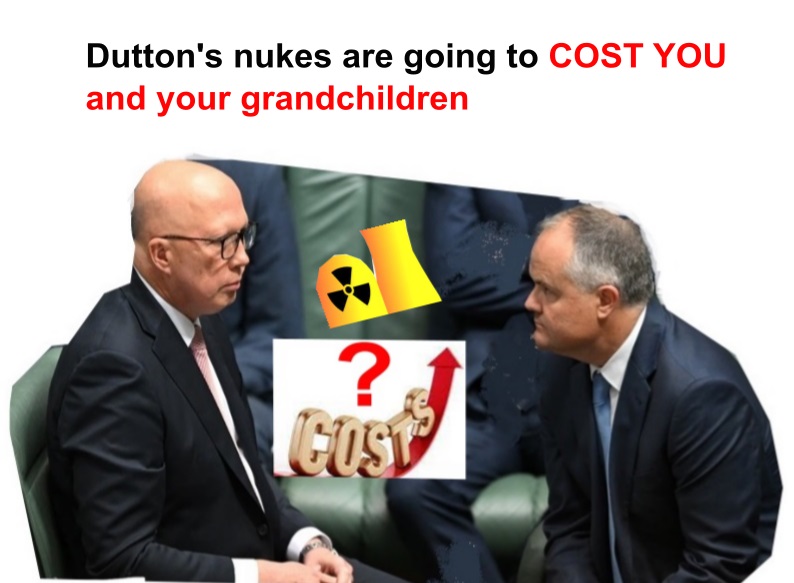
the Coalition documents released on Friday don’t seem to get around to mentioning is that its proposal for nuclear power involves taxpayers taking on all the massive financial risks (apart from the other sorts) and costs.
By Laura Tingle, 7.30 ABC 17 Dec 24
The August 2010 federal election campaign was conducted amid continuing shock waves from the Julia Gillard coup against Kevin Rudd a little less than two months earlier.
So, you may be forgiven for forgetting much that happened in the actual campaign, and specifically, how the federal Coalition didn’t bother releasing the costings of its election promises until just 48 hours before voters went to the polls.
It had already refused to submit the policy promises for independent analysis — which in those days was done by Treasury and the Department of Finance rather than the Parliamentary Budget Office.
That refusal might not have mattered too much to the broad sweep of history if the election result had been different. But a knife-edge result left three crossbench House of Representatives MPs to make the call on which side of politics would get their support and, therefore, be able to form government.
In making their decision the “Three Amigos” — Tony Windsor, Bob Katter and the subsequently infamously loquacious Rob Oakeshott — relied heavily on a Treasury and Finance analysis requested by them post-election.
Its findings? That the Coalition’s claimed budget savings were out by almost $11 billion. In the current age of announcements measured in the hundreds of billions of dollars, that might not sound like a lot.
But given that the claimed cost of Coalition policies was originally only $31.5 billion, that’s a rather spectacular …. miscalculation.
It felt for all the world like the work of an ill-prepared, lazy opposition that thought it could coast to office amid the chaos of a dysfunctional government. And it almost did.
A perfectly timed announcement
There’s something spookily familiar about the circumstances now, as the opposition finally unveiled its much-promised nuclear energy costings on a Friday one week before the country closes down entirely for Christmas.
There may be a lot more detailed modelling in the document prepared by Frontier Economics for the Coalition than there was in 2010.
But the modelling, and more importantly the Coalition’s political message wrapped around it, doesn’t answer the myriad of questions raised by the idea of nuclear energy. And this belated release of what we are led to believe is a signature policy for the election comes as the Coalition still hasn’t released details of most of its other key policies — from tax to immigration.
The decision to release the costing on December 13 feels like the Coalition is once again playing voters for mugs at a time when it is up against a federal government that has spent the year apparently determined to prove it is not very good at politics, or persuading voters that it knows what it is doing.
The Frontier modelling does implicitly raise important questions about the government’s own energy plans: just how much coal-fired power will the system need as we move towards a system that is dominated by renewables, and for how long?; how much gas will be needed (and is it in the right place) to be used to “firm” or underwrite the system?; how much can we really rely on battery technology that is still evolving to store renewables? and just how much transmission infrastructure do we need (and where) for a mostly renewables future?
The government has “sort of” answered these questions. Most analysts will tell you that it is almost impossible to answer them precisely because the wheel is still in spin. Prices and technologies are changing.
But, up against an opposition leader who is better at cut-through messages, it will need to do a lot better than that.
Crucial to the political debate is the fact that much of the uncertainty around these decisions arises because they are being made by individual investors who are taking on all the risks in building new energy capacity.
And this must surely be the threshold point of difference with what the federal Coalition is proposing.
For the one thing that the Coalition documents released on Friday don’t seem to get around to mentioning is that its proposal for nuclear power involves taxpayers taking on all the massive financial risks (apart from the other sorts) and costs.
The Coalition wants this big shift to be overseen by a public sector which it usually loves to point out is notoriously bad at running big projects, either directly or via massive subsidies.
The nuclear divide
The electorate is a lot more disengaged than it was in 2010, but the politically dangerous part of the nuclear policy from the government’s perspective is how it plays to regional Australia and, a bit like Brexit, likely divides the country into two very different blocks of voters.
Many regional voters, most pollsters will tell you, are worried about job losses as coal mining disappears, are unconvinced renewables offer job replacements, and are very exercised about the proliferation of wind and solar farms, and by the transmission lines to link them to the grid.
Earlier talk of small nuclear reactors has disappeared from the model set out using the Frontier modelling, and that modelling doesn’t seem to make provision for the fact that there are usually high costs for a first build, or that most expert opinion says it will take until at least 2040 to have the regulatory system and build in place for a first nuclear reactor to be functional, not 2036………………………………………………………………..
The Coalition has been pledging all year that its plans would lead to lower energy prices for stressed households.
But Peter Dutton had to sidestep on that issue on Friday because there is no clear mechanism for his plans to bring down those costs any time soon.
All the energy experts will be poring over the details for days. One could say they would be poring over them for weeks but (almost as if it was planned that way) the media coverage and the debate seem likely to come to a screeching stop in a week’s time as everything shuts down for Christmas.
Like the 2010 election costings, not many voters may remember the details of any analysis.
But the Coalition will have to be hoping there is no political equivalent of the Three Amigos to answer to this side of the 2025 election.
Laura Tingle is 7.30’s chief political correspondent. https://www.abc.net.au/news/2024-12-14/politics-dutton-release-nuclear-costings/104723416
Australia’s Nuclear Neverland politics: The Lost Boys of Costings | The West Report
It’s hard to take the Coalition’s nuclear energy policy seriously, so we didn’t. And frankly, why would they put taxpayers on the hook for the biggest public funded project in history when renewables are crowding private investment en masse? https://www.youtube.com/watch?v=fSeaybp9oAA
Rupert Murdoch loses his legal battle, leaving future of media empire in the balance

The Conversation, Matthew Ricketson and Andrew Dodd, December 10, 2024
In the seemingly never-ending psychodrama surrounding Rupert Murdoch and his family, life has imitated art. Again.
A report on December 9 in The New York Times revealed details of the recent secret hearing in a Nevada probate court that was literally prompted by the epic HBO drama Succession…………………………..
The probate commissioner in Nevada who heard Rupert Murdoch’s application, Edmund Gorman “resoundingly” ruled against his attempt to change his family trust in a way that would have secured Lachlan’s position atop the global media empire.
Gorman was scathing in his ruling, saying father and son had acted in “bad faith” in their bid to change an “irrevocable” family trust that divides control of Fox News and News Corporation equally among Murdoch’s four eldest children from his first and second marriages: Prudence, Elisabeth, Lachlan and James.
In the 96-page ruling, Gorman described the plan to change the trust as a “carefully crafted charade” to permanently consolidate Lachlan’s executive roles inside News, “regardless of the impacts such control would have over the companies or the beneficiaries” of the family trust……………………………………….
Gorman’s ruling is not the end of the matter, however. It’s technically a recommendation to the Probate Court, which a district judge will ratify or reject.
Whatever the judge decides is open to appeal, which a lawyer for Rupert and Lachlan has already said they plan to do. Meanwhile, the other three siblings have released a statement welcoming the decision and expressing hope that “we can move beyond this litigation to focus on strengthening and rebuilding relationships among all family members”.
Good luck with that. The strongly worded ruling seems likely only to drive the parties further apart………………………………………………………………………………….
Lachlan’s description of James as the trust’s “troublesome beneficiary”.
By “troublesome” the plan was obliquely referring to the split in the family between Lachlan and Rupert – who are wedded to a media empire that is both right-wing and profitable – and James, who severed all ties with the company over its denialist coverage of climate change and its credulous reporting of baseless conspiracy theories about the result of the 2020 US presidential election………………………………………………………………………………….
If Prudence, Elisabeth and James can assert control, sideline Lachlan, and settle on a unified path forward, they can potentially reshape the company and redefine its journalism.
If they have already war-gamed it, and surely by now they have, the three siblings would know their greatest risk is alienating their current audiences, subscribers and advertisers.
In Australia, News operates in a virtual monopoly, so it can shapeshift with fewer consequences. But the US market is awash with emerging right-wing alternatives, each of which is eager to steal a share of the Fox audience. These viewers are the people who make Fox such a valuable commodity, and they’re the reason why it’s been so hard to stand up to Trump and his anti-democratic tactics, even on the odd occasions when Rupert and Lachlan wanted to.
The challenge is to somehow bring those audiences along for whatever transition the siblings envisage for the company. Can it be done, and if so, how?
The company’s own history suggests editorial change can happen quickly and audiences do tend to retain some loyalty. Murdoch’s takeover of The New York Post in the 1970s shows it is possible to radically change a masthead’s editorial position while expanding its audience, in that case from a mostly Democrat-leaning readership to a larger and more conservative one. But that was a moribund newspaper due for a radical makeover. There’s no guarantee it would work in reverse.
Fox News is arguably at the peak of its powers. The incentive to impose change has everything to do with journalistic standards and nothing to do with finances. In 2023–24 the Fox Corporation’s net income was US$1.5 billion (A$2.35 billion).
Even so, it must be possible to introduce incremental changes that reacquaint Fox viewers with more considered and ethical journalism without scaring them off. This wouldn’t work universally. Some of the demagogues who couldn’t cope would have to go – Sean Hannity springs to mind, as does former Fox firebrand Tucker Carlson.
Under new management, News could reintroduce some of the elements lost to Talk-TV in the mid-1980s, when the US scrapped the fairness doctrine that guaranteed balance and greater civility on the airwaves. It could ensure programs canvas different views, ask devil’s-advocate questions, and investigate issues without fear or favour.
Change of this nature wouldn’t be easy. News Corp has an echelon of editors across its global mastheads, most of whom are culture warriors and battle-hardened loyalists. They can and probably would work together to undermine progressive change.
During his tenure as the Australian head of News Corp, well before he became chair of the ABC, Kim Williams saw how the editors sneeringly white-anted his efforts to introduce reform. Even Lachlan Murdoch discovered that senior staff could undercut him. Paddy Manning recounts in his 2022 biography of Lachlan Murdoch, The Successor, that the infamous Roger Ailes did just this as Lachlan was learning the ropes at Fox in the early 2000s.
The three siblings will need resolve to dispense with those who get in their way, and they’ll need to introduce firm but gradual changes that don’t unduly scare their audiences or the market. But if Prudence, James and Elizabeth do share such a vision and are up for a fight, the world could soon be in for a fascinating media transition. more https://theconversation.com/rupert-murdoch-loses-his-legal-battle-leaving-future-of-media-empire-in-the-balance-245665?utm_medium=email&utm_campaign=Latest%20from%20The%20Conversation%20for%20December%2011%202024%20-%203195432592&utm_content=Latest%20from%20The%20Conversation%20for%20December%2011%202024%20-%203195432592+CID_9d007a3b0e7578f878c65cbd5b463722&utm_source=campaign_monitor&utm_term=Rupert%20Murdoch%20loses%20his%20legal%20battle%20leaving%20future%20of%20media%20empire%20in%20the%20balance
Will Donald Trump kill US-UK-Aussie sub defense deal?

The landmark defense agreement between the U.S, U.K. and Australia could be in jeopardy with the maverick Republican back in the White House.
Politico, December 9, 2024, By Stefan Boscia and Caroline Hug
LONDON — There are few issues on which we do not know Donald Trump’s opinion.
After thousands of hours of interviews and speeches over the past eight years, the president-elect has enlightened us on what he thinks on almost any topic which enters his brain at any given moment.
But in the key area of defense, there are some gaps — and that’s leading global military chiefs to pore over the statements of the president’s allies and appointees to attempt to glean some clues, specifically over the $369 billion trilateral submarine program known as AUKUS he will inherit from Joe Biden.
Trump does not appear to have publicly commented on the AUKUS pact — named for its contingent parts Australia, the United Kingdom and the United States — which would see the U.S. share technology with its partners to allow both countries to build state-of-the-art nuclear submarines by the 2040s.
This uncertainty has left ministers and government officials in London and Canberra scrambling to discover how the Republican is likely to view the Biden-era deal when he returns to the White House in January.
Two defense industry figures told POLITICO there were serious concerns in the British government that Trump might seek to renegotiate the deal or alter the timelines.
This is because the pact likely requires the U.S. to temporarily downsize its own naval fleet as a part of the agreement — something Trump may interpret as an affront to his “America First” ideology.
Looking east
There is hope in Westminster that Trump would be in favor of a military project which is an obvious, if unspoken, challenge to China.
The deal would see American-designed nuclear submarines right on China’s doorstep and would form a part of Australia’s attempts to bolster its military might in the Indo-Pacific.
When former U.K. Prime Minister Boris Johnson said in September 2021 that the deal was not “intended to be adversarial toward China,” President Xi Jinping simply did not believe him.
The Chinese leader said AUKUS would “undermine peace” and accused the Western nations of stoking a Cold War mentality.
Mary Kissel, a former senior adviser to Trump’s ex-Secretary of State Mike Pompeo, said “you can assume Trump two will look a lot like Trump one” when it comes to building alliances with other Western countries against China.
“We revivified the Quad [Australia, India, Japan and the U.S.], got our allies to bolster NATO funding and worked to prevent China from dominating international institutions,” she said.
However, the deal also forces the U.S. government to sell Australia three to five active Virginia attack submarines, the best in the U.S. Navy’s fleet, by the early 2030s as a stopgap until the new AUKUS subs are built.
Is America first?
This coincides with a time where there is a widely recognized crunch on America’s industrial defense capacity.
In layman’s terms, the U.S. is currently struggling to build enough submarines or military equipment for its own needs.
One U.K. defense industry figure, granted anonymity to speak freely, said there was “a lot of queasiness” in the U.K. government and a “huge amount of queasiness in Australia” about whether Trump would allow this to happen.
“There is a world in which the Americans can’t scale up their domestic submarine capacity for their own needs and don’t have spare to meet Australia’s needs,” they said.
“If you started pulling on one thread of the deal, then the rest could easily fall away.”
One U.K. government official played down how much London and Canberra are worried about the future of the deal, however.
They said the U.K. government was confident Trump is positive about the deal and that the U.S. was “well equipped with the number of submarines for their fleet.”………………………………………………………………………………………………………………………………..
‘Everyone’s a winner
This attempted U.K.-China reset will likely be high on the list of talking points when Healey meets with his Australian counterpart Richard Marles next month in London for an “AUKMIN” summit.
The Australian Labor government, after all, has conducted a similar reset with the Chinese government since coming to power in 2022 after relations hit a nadir during COVID.
Also at the top of the agenda will be how to sell the incoming president on the AUKUS deal in a positive way.
A second defense industry insider said the British and Australian governments should try to badge the deal in terms that make it look like Trump has personally won from the deal.
“Everybody is worried about America’s lack of industrial capacity and how it affects AUKUS,” they said.
“He is also instinctively against the idea of America being the world’s police and so he may not see the value in AUKUS at all, but they need to let him own it and make him think he’s won by doing it.”………………………………………………………………………..
Pillar II
While the core nuclear submarine deal will get most of the headlines in the coming months, progress on the lesser-known Pillar II of AUKUS also remains somewhat elusive.
Launched alongside the submarine pact, Pillar II was designed to codevelop a range of military technologies, such as quantum-enabled navigation, artificial intelligence-enhanced artillery, and electronic warfare capabilities.
One Pillar II technology-sharing deal was struck on hypersonic missiles just last month, but expected progress on a range of other areas has not transpired.
Ambitions to admit Japan to the Pillar II partnership this year have also gone unfulfilled……………………………………………………………
https://www.politico.eu/article/donald-trump-aukus-kill-us-uk-aussie-sub-defense-deal/
Nuclear energy debate draws stark gender split in Australia ahead of next year’s election.
Lisa Cox, 5 Dec 24, https://www.theguardian.com/environment/2024/dec/04/nuclear-energy-debate-draws-stark-gender-split-in-australia-ahead-of-next-years-election
Survey finds 25 percentage point gender gap across all age brackets on whether nuclear power would be positive for the country, with majority of men saying it would.
New data points to a stark gender split in attitudes towards nuclear energy, with women much more likely to say they don’t support it or think the risks are too great.
Research company DemosAu surveyed 6,000 people on behalf of the Australian Conservation Foundation and found 26% of women thought nuclear energy would be good for Australia, compared with 51% of men.
DemosAu head of research, George Hasanakos, said the 25 percentage point gender gap was “the sharpest divide in attitudes between men and women” that the research firm had seen on any issue.
The polling found the split was pronounced regardless of the age of the people surveyed, with young men and women just as divided as those from older generations.
While 51% of men agreed nuclear energy would be good for Australia, that support dropped when asked if they would be happy to live near a nuclear plant.
A reported 38% of men agreed they would support a nuclear plant being located close to their city, with 44% disagreeing and 18% neutral. Among women, just 18% agreed they would be happy to have a nuclear plant near their city, with 63% disagreeing and 19% neutral.
“Men support nuclear much more than women,” the ACF chief executive, Kelly O’Shanassy, said.
“But as soon as you ask men more details such as ‘Would you be happy to live next door to a plant?’ or ‘Do you think one will be built within the next decade?’ – that level of support really comes down.”
The report found female respondents were more likely to answer “neutral” compared with male respondents. It identified this as both “a risk and opportunity for campaigners on both sides of the issue” as Australia approaches a federal election but said pro-nuclear campaigners would have to contend with widely held safety concerns about nuclear among women.
On the subject of transporting nuclear waste, the poll found 57% of women and 43% of men said it wasn’t worth the risk.
The prime minister, Anthony Albanese, has said the next election will be a referendum on nuclear power.
The Coalition has proposed seven sites where it says it would eventually replace coal-fired power plants with nuclear plants but not how much this would cost. The government has rejected the idea and the federal House of Representatives is conducting an inquiry into the consideration of nuclear power in Australia.
Multiple energy analysts have argued nuclear energy would be more expensive than other options and a nuclear industry would not be possible in Australia until after 2040.
O’Shanassy said among the report’s more interesting findings was that despite the gender gap on many aspects of nuclear, men and women were aligned in the view that renewables were cheaper.
A reported 47% of men agreed renewables would deliver cheaper energy, compared with 31% who disagreed (with 22% neutral).
While 47% of women also agreed renewables would deliver cheaper energy, 20% disagreed and 33% were neutral.
In separate data, the climate advocacy organisation 1 Million Women surveyed an additional 3,351 women among its own supporters and found 93% were concerned about nuclear.
“Nuclear energy is a distraction to meaningful climate solutions and women don’t have the time or patience to entertain the Coalition’s proposal,” its founder, Natalie Isaacs, said.
1 This Month



Shut down the radiation-damaged Heysham nuclear reactors now
To see nuclear-related stories in greater depth and intensity – go to https://nuclearinformation.wordpress.com

Say No to NASA’s Reckless Nuclear Reactor on the Moon
Say No to NASA’s Reckless Nuclear Reactor on the Moon
-
Archives
- October 2026 (256)
- September 2026 (339)
- August 2026 (330)
- July 2026 (355)
- June 2026 (287)
- May 2026 (306)
- April 2026 (356)
- March 2026 (251)
- February 2026 (267)
- January 2026 (308)
- December 2025 (358)
- November 2025 (359)
-
Categories
- 1
- 1 NUCLEAR ISSUES
- business and costs
- climate change
- culture and arts
- ENERGY
- environment
- health
- history
- indigenous issues
- Legal
- marketing of nuclear
- media
- opposition to nuclear
- PERSONAL STORIES
- politics
- politics international
- Religion and ethics
- safety
- secrets,lies and civil liberties
- spinbuster
- technology
- Uranium
- wastes
- weapons and war
- Women
- 2 WORLD
- ACTION
- AFRICA
- Atrocities
- AUSTRALIA
- Christina's notes
- Christina's themes
- culture and arts
- Events
- Fuk 2022
- Fuk 2023
- Fukushima 2017
- Fukushima 2018
- fukushima 2019
- Fukushima 2020
- Fukushima 2021
- general
- global warming
- Humour (God we need it)
- Nuclear
- RARE EARTHS
- Reference
- resources – print
- Resources -audiovicual
- Weekly Newsletter
- World
- World Nuclear
- YouTube
-
RSS
Entries RSS
Comments RSS

