South African govt’s aim for nuclear power is looking unconvincing
 The government’s pretence that there is a bidding war between nuclear power providers is also unconvincing. Companies from the US, South Korea and Russia have given up and a joint French-Chinese bid is the only game in town.
 Nuclear drive more about foreign policy than energy, ANTHONY BUTLER: http://www.businessday.co.za/articles/Content.aspx?id=171008 State’s campaign to win public support for proposed nuclear power programme hampered by logic and chronology 2012/05/04 THE government’s belated campaign to win public support for its proposed nuclear power programme has been hampered by logic and chronology. Continue reading
Nuclear power will make South African society even more unequal
The only conclusion is that there is an immense amount of money in the nuclear industry for those involved and in power. They will reap the financial benefits, not the majority of South Africans. This will exacerbate the poverty-wealth gap.
 Nuclear power will worsen the wealth gap Bishop Geoff Davies:Mail & Guardian, Apr 20 2012 “…..In the Southern African Faith Communities’ Environment Institute, we believe we have to apply moral principles of justice and equity when making energy choices. We made this call at the COP17 climate talks in Durban in our Act Now for Climate Justice campaign — that is, justice for people and planet. ….
We are deeply concerned about the government’s nuclear plans because it is the wrong direction to take. Nuclear energy requires a centralised grid system and is extremely costly. Taking into account the mining of uranium, its transport and the construction of power plants, nuclear energy is certainly neither carbon-neutral nor “clean”. Continue reading
Japan’s taxpayers up for $6 billion costs from nuclear disaster – it could happen to South Africans
the Japanese taxpayer is liable for losses caused by the nuclear meltdown. The fall out in Japan has cost an estimated 500 to 600 billion dollars according to Greenpeace.
Adam says clauses in South African law limit the liability nuclear power plants pay if a disaster occurs. If a disaster happens in South Africa “the ordinary citizen will be paying for a clean-up,” says Adam.
Greenpeace launches anti-nuclear energy campaign, Times Live, Pearl Boshomane and Katharine Child | 28 February, 2012 Environmental activist organisation Greenpeace has launched a campaign urging the government to abandon the move towards using nuclear energy in South Africa. This comes on the heels of an announcement by Energy minister Dipuo Peters on Tuesday that the government will allocate more funds — R300 billion– towards nuclear power plant construction
Also on Tuesday, Greenpeace released the ‘Lessons from Fukushima’ report, which states that the Japanese nuclear disaster of last year was a result of governmental and nuclear industry failures as opposed to a natural disaster. Continue reading
South Africa’s government silence as it gives R300bn to nuclear industry
 “Strangely, neither President [Jacob Zuma] nor the minister of finance saw fit to mention the largest-ever procurement in South African history in the state-of-the-nation address or the Budget speech.
Greyling said there had also been no opportunity for the public to scrutinise a nuclear programme.
R300bn for nuclear plants not ‘end amount’ News 24, 2012-02-28 Cape Town – The R300bn allocated in the Budget for building new nuclear power plants is not the final amount for the project, Energy Minister Dipuo Peters said on Tuesday. Continue reading
Hasty and secretive nuclear power move in South Africa
 R300bn nuclear tender shouldn’t be sneaked through – DA, Politics web, 26 February 2012 Lance Greyling says nuclear build programme must be properly scrutinised in parliament Nuclear Build Programme must be debated in Parliament In the budget review for 2012, a price tag of R300 billion appears for Eskom’s nuclear fleet build programme. The programme is designed to deliver 9,600MW of nuclear capacity by 2029 and is described as being in the “final stages of consideration before financial proposals can be determined”
This is all rather curious.
The President did not mention the R300 billion nuclear build programme in his State of the Nation Address. The Minister of Finance did not mention it explicitly in his Budget Speech. Now, apparently, it is in its “final stages”.
There has been no debate in Parliament and no opportunity for the public to scrutinise a nuclear programme that could have a very real impact on all of our lives. Not only will it cost nearly a third of our annual budget, but there are serious safety and environmental concerns to consider.
Given that the shadow of Arms Deal corruption continues to darken our democracy, government should be extra careful about the nuclear build programme. It must err on the side of more transparency, not less. For this reason, the DA will table a motion to debate the nuclear build programme in Parliament at the first opportunity.
From a technical point of view, an Environmental Impact Assessment (EIA) and Feasibility study for the programme should be in the public domain before any project of this magnitude is seriously considered. If a specific amount has already been allocated in the budget, the public has a right to see the evidence on which the budgetary allocation was decided…. http://www.politicsweb.co.za/politicsweb/view/politicsweb/en/page71654?oid=282389&sn=Detail&pid=71616
First Uranium company teeters on the brink of collapse
 What will happen to First Uranium? First Uranium is looking at a distress sale of assets to settle upcoming debts, a move that would have a number of implications for shareholders Christy Filen , 22 Feb 2012 JOHANNESBURG (MINEWEB) –
It is no secret that First Uranium is in a pickle. Releasing a forecast that shows its cash will run out by the end of March will be cold comfort to shareholders and creditors alike…. First Uranium has turned to what is conceivably its only option and that is a distress sale of its assets in an effort to settle upcoming debts….. As if this wasn’t enough First Uranium’s Ezulwini operation is not making the gradeand its Mine Waste Solutions (MWS) is fighting licensing issues with environmentalists and the Department of Mineral Resources. In terms of the results of an impairment exercise of the Ezulwini Mine’s assets, an impairment adjustment of $180m was recognised in the company’s financial statements…. “The Company’s ability to continue as a going concern is dependent upon its ability to bring these proposed transactions to fruition” said First Uranium….. http://www.mineweb.com/mineweb/view/mineweb/en/page34?oid=145826&sn=Detail&pid=102055
Social ownership of South Africa’s renewable energy sector
Renewable energy plans can create 50,000 jobs (With Video), Business Live 7 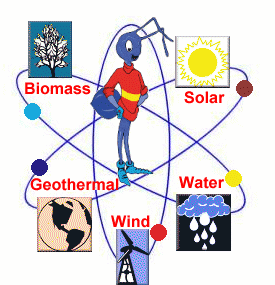 Feb 12 The Department of Energy will seek to ensure that government commits R22 billion over the next five years to green projects and aims to create 50,000 jobs in the renewable energy sector. This was revealed by Energy Minister Dipuo Peters who was speaking at a National Union of Metalworkers of South Africa (Numsa) conference on Monday, which was looking at social ownership of SA’s renewable energy sector.
“We want to ensure that the state, through its entities, invests R22 billion in green projects with a commitment of R3 billion towards local manufacturing in the next five years, and at the same time create 50,000 jobs in the renewable energy sector,” Peters said.
She also emphasised that foreign companies can invest in SA’s energy sector, but they must bring with them their technology so that local companies can adopt it.
“The renewable energy drive in China could succeed because companies relocated; based in China, where intimately they perfected the technology and now they’re exporting the technology to SA. So we are also saying as part of our requirement for localisation, let us insist
that these companies that want to invest here, they must bring this
technology to SA.” … http://www.businesslive.co.za/southafrica/sa_markets/2012/02/07/renewable-energy-plans-can-create-50000-jobs-with-video
Lingering health issues from old uranium mines in South Africa
A compromising health issue Times Live, SIPHO MASONDO | 05 February, Lecturers at a Johannesburg college that is surrounded by three abandoned mine dumps claim that they are getting sick from exposure to uranium. Continue reading
Uranium mining in Africa on a downward spiral
The signals of a troubled uranium sector are manifest. On Tuesday Areva wrote down the performance of its African mines, including Trekkopje and suspended further development.
 Fukushima still haunts uranium producers, The Southern Times, South Africa, 30 Dec 11 International prices of uranium, the major feedstock in nuclear reactors, have remained flat; averaging US$53 per pound as the market struggles to shrug off the effects of Japan’s nuclear crisis earlier this year.
Market analysts are warning that shrinking order books, a flat spot price and production cutbacks – largely attributable to the Fukushima disaster – will haunt uranium producers well into 2012.
A sluggish US economy and sovereign debt problems in advanced economies will continue to severely impact the uranium spot price. Global uranium stocks have significantly underperformed during 2011 and analysts attribute this to the diminishing appetite for nuclear energy after the horror of Fukushima. Continue reading
Durban: thousands of protesters demand action on climate change
 Thousands march in Durban for climate justice, ABC News 4 Dec 11 thousands of people have marched through the streets of Durban calling for “climate justice”. Their appeal was aimed at diplomats locked in negotiations under the 194-nation UN Framework Convention for Climate Change (UNFCCC), which is tasked with beating back the ever-mounting threat of global warming.
The crowd of around 6,500 snaked through the coastal city’s downtown area shouting and singing against a backdrop of drums and vuvuzelas, the high-decibel plastic trumpets that gained worldwide notoriety when South Africa hosted the football World Cup.
Many in the crowd lashed out at the UN talks, which end next Friday, saying that they were moving too slowly in the face of potentially catastrophic impacts of climate change, and that many of the solutions proposed lean too heavily on the market…. Continue reading
South African government owes people an explanation for its decision on dirty, costly, nuclear energy
“The government owes its citizens an answer as to why it is choosing a dangerous and expensive solution, when it has an abundance of renewable energy sources such as solar,” says Ferrial Adam, Greenpeace Africa climate and energy campaigner.
“Nuclear energy is a dangerous distraction from the clean energy development needed to prevent catastrophic climate change. Nuclear power simply delivers too little, too late, and at too high a price for people and the environment.”
Nuclear: Part of the solution – or the problem?, FT, By Siseko Njobeni, 1 Dec 11 “.. Under the plan, about 9,600MW new nuclear capacity should be commissioned up to that period. This has set in motion the jockeying for what will certainly be one of the biggest capital projects in South Africa. The planned nuclear programme could be worth R400bn, according to Nelisiwe Magubane, director-general at the department of energy. Continue reading
Renewable energy investment in South Africa
South Africa Becoming a Renewable Energy Hub Afribiz, Dec 1 South Africa is fast becoming a preferred renewable energy investment destination for both private and public sector investors – good news for the country’s growing electricity demands, emerging clean energy sector and the economy.
The World Bank recently approved a $250-million (R1.5- billion) loan to South African power utility Eskom to develop a wind and solar plant, which will help the country reduce its reliance on coal-based power generation.
The World Bank, which granted the funding through its Clean Technology Fund, will finance a 100-megawatt solar power plant in Upington in the Northern Cape province and a 100-megawatt wind power project north of Cape Town in the Western Cape…. http://www.afribiz.info/content/south-africa-becoming-a-renewable-energy-hub
South Africa’s huge nuclear power tender, but will there be graft?
 R1tn nuclear tender raises graft fears, Times Live South
 Africa, ANNA MAJAVU | 24 November, 2011 Concern is mounting about the government’s planned R1-trillion nuclear power station tender, with opposition parties demanding reassurances from Deputy President Kgalema Motlanthe that the tender will not be “mired in corruption” like the R70-billion arms deal.
It will be the biggest tender ever issued in South Africa . “The multibillion-rand arms deal, which was just a fraction of this cost, was mired in corruption,” said DA parliamentary leader Lindiwe Mazibuko. “There are reports that the government is being strongly lobbied about this tender by companies such as Areva and Westinghouse who are desperate to get in on the action.”….
African Christian Democratic Party MP Cheryllyn Dudley asked if the government had budgeted money for handling nuclear waste, which remains hazardous for more than 200000 years…. The cabinet approved a 20-year energy plan for South Africa in March. It stipulates that 23% of the energy supply be derived from nuclear power.
Parliament’s portfolio committee on energy visited France last year and met representatives of nuclear energy corporation Areva. They told the MPs that their company was ready to build six nuclear power plants in South Africa. http://www.timeslive.co.za/politics/2011/11/24/r1tn-nuclear-tender-raises-graft-fears
Parliamentarians taking up the cause of South Africa’s sick former nuclear workers
Political allies for past and present nuclear workers Workers at Necsa are not alone. Support for their plight is at hand. The New Age Mel Frykberg, 10 Nov 11 Former nuclear workers who have died or are suffering ill health, allegedly from working at the Nuclear Energy Corporation of South Africa’s (Necsa) nuclear complex, have found an ally in the DA’s new chief whip.
Wattie Watson, who was sworn in yesterday, has pledged to speed up answers to Parliamentary questions, including those affecting the nuclear workers. “I support the establishment of an independent enquiry into the former nuclear workers’ case,” Gareth Morgan, the DA shadow minister of water and environmental affairs told The New Age. “These workers haven’t received a fair hearing and we want to know how the government is going to respond,” said Morgan.
Watson said at the top of his priority list would be a request to Deputy President Kgalema Motlanthe to pressure government ministers to respond to unanswered questions raised in Parliament. Labour Minister Nelisiwe Mildred Oliphant was asked on July 1 how many workers at Necsa’s Pelindaba, Koeberg and Ithuba laboratories had applied for occupational health compensation since inception and how many had applied annually.
The minister was further asked about the number of successful applications, the number who had received compensation, the amount compensated and the names of the recipients. To date, the DA has still not received a response despite the Parliamentary custom of responding in writing within 10 days.
The Habitat Council, the Pelindaba Working Group (PWG), comprising antinuclear activists and former workers, Earthlife Africa and former Atteridgeville workers, have also called for an independent enquiry, particularly into “Necsa’s suspect rebuttal of workers’ sicknesses”.
The public protector is investigating the case but told The New Age that more medical files were needed to support the compensation claims. However, Judith Taylor, Earthlife Africa Johannesburg’s coordinator, said that the National Nuclear Regulator (NNR), the nuclear watchdog, was largely to blame for the stalemate.
Mariette Liefferlink, a NNR board member, who expressed concern in her capacity as an activist and the CEO of the Federation for a Sustainable Environment, is deeply concerned by the plight of former nuclear workers. http://thenewage.co.za/34642-1007-53-Political_allies_for_past_and_present_nuclear_workers
South Africa’s shame of radiation caused illness in uranium workers
Nuclear illness scourge, The new Age, Mel Frykberg, 20 Oct 11, Exposure to uranium at South African nuclear facilities over the years has left dozens of people dead and hundreds of others terminally ill, an investigation by The New Age has revealed. “These nuclear workers have been used and abused like cannon fodder and then abandoned without any care or compensation when they were no longer of any use to the nuclear industry,” said Mashile Phalane, the former coordinator of Earthlife Africa (ELA).
ELA and the Pelindaba Working Group – comprising ex-employees and antinuclear activists – are leading the battle to get compensation for victims. Former nuclear workers claim that they were not provided with protective clothing nor given the necessary medical attention when they were exposed to radiation.
Most claim they were given little or, in many cases, no financial compensation and in many cases were summarily dismissed once their symptoms became known. The country’s nuclear watchdog, the Nuclear Energy Corporation of South Africa (Necsa), stands accused by activists involved in the long-running campaign to ensure justice for victims and their families, of destroying the lives of hundreds of ex-employees.
1 This Month
Chernobyl: The Lost Tapes – A good documentary on Chernobyl on SBS available On Demand for the next 3 weeks– https://www.sbs.com.au/ondemand/tv-program/chernobyl-the-lost-tapes/2352741955560

of the week–London Campaign for Nuclear Disarmament

Tell the Ukrainian Government to Drop Prosecution of Peace Activist Yurii Sheliazhenko
To see nuclear-related stories in greater depth and intensity – go to https://nuclearinformation.wordpress.com
-
Archives
- April 2026 (126)
- March 2026 (251)
- February 2026 (268)
- January 2026 (308)
- December 2025 (358)
- November 2025 (359)
- October 2025 (376)
- September 2025 (257)
- August 2025 (319)
- July 2025 (230)
- June 2025 (348)
- May 2025 (261)
-
Categories
- 1
- 1 NUCLEAR ISSUES
- business and costs
- climate change
- culture and arts
- ENERGY
- environment
- health
- history
- indigenous issues
- Legal
- marketing of nuclear
- media
- opposition to nuclear
- PERSONAL STORIES
- politics
- politics international
- Religion and ethics
- safety
- secrets,lies and civil liberties
- spinbuster
- technology
- Uranium
- wastes
- weapons and war
- Women
- 2 WORLD
- ACTION
- AFRICA
- Atrocities
- AUSTRALIA
- Christina's notes
- Christina's themes
- culture and arts
- Events
- Fuk 2022
- Fuk 2023
- Fukushima 2017
- Fukushima 2018
- fukushima 2019
- Fukushima 2020
- Fukushima 2021
- general
- global warming
- Humour (God we need it)
- Nuclear
- RARE EARTHS
- Reference
- resources – print
- Resources -audiovicual
- Weekly Newsletter
- World
- World Nuclear
- YouTube
-
RSS
Entries RSS
Comments RSS
 nuclear-news