Extreme weather events – Senegal and Nigeria
Senegal suburbs remain under water days after ‘exceptional rainfall’
Suburbs outside Dakar remained under water, three days after ‘exceptional rainfall’. In Keur Massar, a town just east of Dakar, cars were partly submerged while residents were seen walking knee deep in stagnant flood waters.
Farmland submerged as severe floods hit Nigeria
Farmlands were severely affected and thousands were displaced as severe rainfall caused flooding in Nigeria. An eyewitness captured a completely flooded rice farmland in Kebbi State where over 500,000 hectares were affected, according to local news reports. Kebbi is the country’s main rice-growing state, according to the Rice Farmers Association of Nigeria.
Big oil looks to solve its problems by flooding Africa and Asia with plastic
Big Oil Is in Trouble. Its Plan: Flood Africa With Plastic. https://www.nytimes.com/2020/08/30/climate/oil-kenya-africa-plastics-trade.html
Faced with plunging profits and a climate crisis that threatens fossil fuels, the industry is demanding a trade deal that weakens Kenya’s rules on plastics and on imports of American trash. NYT, By Hiroko Tabuchi, Michael Corkery and Carlos Mureithi, Aug. 30, 2020
Confronting a climate crisis that threatens the fossil fuel industry, oil companies are racing to make more plastic. But they face two problems: Many markets are already awash with plastic, and few countries are willing to be dumping grounds for the world’s plastic waste……..
Last year, Kenya was one of many countries around the world that signed on to a global agreement to stop importing plastic waste — a pact strongly opposed by the chemical industry. Emails reviewed by The Times showed industry representatives, many of them former trade officials, working with U.S. negotiators last year to try to stall those rules.
The industry thinks it has found a solution to both problems in Africa.
According to documents reviewed by The New York Times, an industry group representing the world’s largest chemical makers and fossil fuel companies is lobbying to influence United States trade negotiations with Kenya, one of Africa’s biggest economies, to reverse its strict limits on plastics — including a tough plastic-bag ban. It is also pressing for Kenya to continue importing foreign plastic garbage, a practice it has pledged to limit.
Plastics makers are looking well beyond Kenya’s borders. “We anticipate that Kenya could serve in the future as a hub for supplying U.S.-made chemicals and plastics to other markets in Africa through this trade agreement,” Ed Brzytwa, the director of international trade for the American Chemistry Council, wrote in an April 28 letter to the Office of the United States Trade Representative.
The United States and Kenya are in the midst of trade negotiations and the Kenyan president, Uhuru Kenyatta, has made clear he is eager to strike a deal. But the behind-the-scenes lobbying by the petroleum companies has spread concern among environmental groups in Kenya and beyond that have been working to reduce both plastic use and waste.
Kenya, like many countries, has wrestled with the proliferation of plastic. It passed a stringent law against plastic bags in 2017, and last year was one of many nations around the world that signed on to a global agreement to stop importing plastic waste — a pact strongly opposed by the chemical industry.
The chemistry council’s plastics proposals would “inevitably mean more plastic and chemicals in the environment,” said Griffins Ochieng, executive director for the Centre for Environmental Justice and Development, a nonprofit group based in Nairobi that works on the problem of plastic waste in Kenya. “It’s shocking.”
The plastics proposal reflects an oil industry contemplating its inevitable decline as the world fights climate change. Profits are plunging amid the coronavirus pandemic, and the industry is fearful that climate change will force the world to retreat from burning fossil fuels. Producers are scrambling to find new uses for
an oversupply of oil and gas. Wind and solar power are becoming increasingly affordable, and governments are weighing new policies to fight climate change by reducing the burning of fossil fuels.
Pivoting to plastics, the industry has spent more than $200 billion on chemical and manufacturing plants in the United States over the past decade. But the United States already consumes as much as 16 times more plastic than many poor nations, and a backlash against single-use plastics has made it tougher to sell more at home……….
The Kenya proposal “really sets off alarm bells,” said Sharon Treat, a senior lawyer at the nonpartisan Institute for Agriculture and Trade Policy who has worked for more than a decade advising trade talks in both the Trump and Obama administrations. Corporate lobbyists “frequently offer up very specific proposals, which the government then takes up,” she said. ………..
The plastics industry’s proposals could also make it tougher for to regulate plastics in the United States, since a trade deal would apply to both sides.
The records, obtained through Freedom of Information Act requests by Unearthed, a London-based affiliate of the environmental group Greenpeace, paint a picture of close ties between the trade representatives, administration officials and industry representatives. …………..
Kenya isn’t the only country taking measures to curb plastics. A recent report by the United Nations counted 127 countries with policies on the books to regulate or limit use.
In response, the industry has tried to address the plastics issue. The Alliance to End Plastic Waste — formed by oil giants like Exxon Mobil and Chevron, as well as chemical companies like Dow — last year pledged $1.5 billion to fight plastic pollution. That figure, critics point out, is a small fraction of what the industry has invested in plastic infrastructure.
Manufacturers “say they will address plastic waste, but we say plastic itself is the problem,” Mr. Ochieng said. “An exponential growth in plastics production is just not something we can handle.”………….
Despite the industry opposition, last year more than 180 countries agreed to the restrictions. Starting next year, the new rules are expected to greatly reduce the ability of rich nations to send unwanted trash to poorer countries. The United States, which has not yet ratified the Basel Convention, won’t be able send waste to Basel member nations at all……
That setback has re-energized industry to seek deals with individual countries to boost the market for plastics, and find new destinations for plastic waste, analysts say.
In Nairobi, local groups are worried. “My concern is that Kenya will become a dumping ground for plastics,” said Dorothy Otieno of the Centre for Environmental Justice and Development. “And not just for Kenya, but all of Africa.” https://www.nytimes.com/2020/08/30/climate/oil-kenya-africa-plastics-trade.html
Minigrids – the clean energy revolution across Africa and Asia
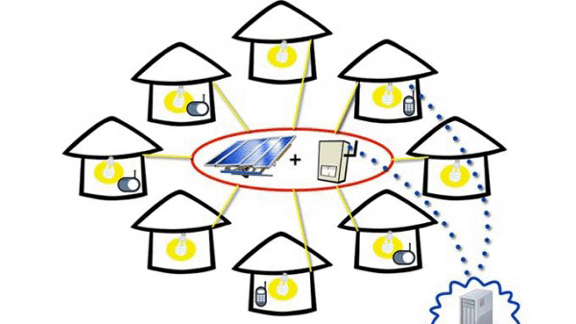
The little-known clean energy revolution https://energy.economictimes.indiatimes.com/news/renewable/the-little-known-clean-energy-revolution/77742430
There are about 5,500 mini-grids in operation across 12 countries in Africa and Asia, according to The State of the Global Mini-grids Market Report 2020 published by the international non-governmental organization Sustainable Energy for All and BloombergNEF, Bloomberg, August 26, 2020,
Over the last decade, the number of people in the world without access to electricity has fallen drastically — from 1.4 billion in 2010 to about 900 million in 2018, according to the United Nations. And yet, if current trends persist, the world won’t be able to meet the UN’s sustainable development goal of universal access to electricity by 2030, with as many as 600 million still lacking basic 21st century services.
It doesn’t have to be so. A new technology has matured and become affordable that could help achieve the laudable goal, and it’s called mini-grids.
As the name suggests, mini-grids are small, isolated versions of larger power grids. They increasingly use solar power as an energy source, with support from batteries or diesel generators. Because the cost of solar power has fallen drastically , mini-grids have become much cheaper than installing long-distance transmission lines from a central electricity grid.
There are about 5,500 mini-grids in operation across 12 countries in Africa and Asia, according to The State of the Global Mini-grids Market Report 2020, published by the international non-governmental organization Sustainable Energy for All and BloombergNEF earlier this year. The report’s authors found that mini-grids could meet the needs of half the people who still need access to electricity in those regions.
As the name suggests, mini-grids are small, isolated versions of larger power grids. They increasingly use solar power as an energy source, with support from batteries or diesel generators. Because the cost of solar power has fallen drastically , mini-grids have become much cheaper than installing long-distance transmission lines from a central electricity grid.
Universal power access will require $128 billion of spending, the report found, but the world is on track to spend only about $63 billion on mini-grids over the next decade. Plugging the gap would cost less than $600 per target household reached.
The need goes beyond money. “Today the mini-grid market is nascent, despite being the least-cost option for electricity access in many areas,” the report concludes. The international Mini-Grids Partnership, which includes the World Bank and other development agencies from rich countries, has approved $2 billion in awards since 2012 but only disbursed 13% of the money, with many projects stuck because of policy uncertainties.
Africa’s most populous country struggles to provide electricity to its 200 million people. Only 55% of the country has access to electricity, and even there, people suffer from power cuts lasting between four and 15 hours every day. As a result, the country spends more than $16 billion annually to power diesel generators.
In 2017, the country passed a law to help mini-grid development, which streamlines the online application process, offers $350 in government subsidies per user once grids with more than 30 users are up and running, and provides for compensation if the main power grid eventually arrives in an area served by a mini-grid. Developers in Nigeria now have simpler processes and clearer guidelines to follow.
The upshot is that mini-grids have become a much more attractive investment. “Now you see a lot of companies flocking to Nigeria,” says Ruchi Soni, program manager at Sustainable Energy for All. “We hear from partners that they would like to replicate Nigeria’s success in their country.”
This offshoot of the clean energy revolution has three benefits: mini-grids can help provide access to electricity to those who lack it and do so in a cleaner and cheaper way. Few things in life are win-win-win.
Nuclear colonialism. ICAN says that France must clean up its nucleat test wastelands in Algeria

France must clean up Algerian nuclear test sites: group, https://www.france24.com/en/20200826-france-must- clean-up-algerian-nuclear-test-sites-group 28 Aug 20, France must clean up nuclear test sites in Algeria where radioactive waste remains from testing in the former colony during the 1960s, a Nobel Peace Prize-winning group said Wednesday.
France carried out 17 nuclear explosions in the Algerian part of the Sahara Desert between 1960 and 1966.
Eleven of the tests came after the 1962 Evian Accords ended the six-year war of independence and 132 years of colonial rule.
“France must give the Algerian authorities the full list of where the contaminated toxic waste was buried,” the International Campaign to Abolish Nuclear Weapons (ICAN) said in a new 60-page report.
“The ‘nuclear past’ must no longer remain deeply buried under the sand,” ICAN said, citing the concerned areas as the western Reggane region and a zone close to the In Ekker village.
The campaign group identified contaminated, radioactive elements that have either been buried, or are easily accessible.
“The majority of the waste is in the open air, without any security, and accessible by the population, creating a high level of sanitary and environmental insecurity,” ICAN said.The 2017 Nobel Peace Prize laureate group added that almost nothing has been done to clean the sites, inform the populations and evaluate the risks.
Exposure to radioactive material can cause cancer.
“This case study shows once more an asymmetry of power and an injustice that we find all through nuclear history,” Giorgio Franceschini, director of the Heinrich Boll Foundation which published the report, said in his forward.
“It is not a coincidence that France tested its first nuclear weapon in Algeria, that was still a French colony in 1960,” he added.
France refused to sign up the UN’s 2017 Treaty on the Prohibition of Nuclear Weapons, whereas Algeria signed and is in the process of ratifying the legally binding agreement.
Since Algeria’s independence, Franco-Algerian relations have been tumultuous.
Algerian President Abdelmadjid Tebboune in July called on France to fully apologise for its colonial past.
An apology could “make it possible to cool tensions and create a calmer atmosphere for economic and cultural relations”, especially for the more than six million Algerians who live in France, he said.
Kenya cannot afford the costs of nuclear electricity, and the attendant human cost
The building of the nuclear electric power plant appears to be driven by factors other than the national interest. A cursory examination of economic, environmental and safety issues militates against the nuclear electricity option.
Kenya plans to build a 1,000 MWe nuclear power plant at a cost of US$5 billion. The National Environment Management Authority has requested for comments on a Strategic Environmental and Social Assessment Report for the Nuclear Power Programme for Kenya.
Operational costs for solar plants will be cheaper in terms of fuel, personnel and plant maintenance costs.
The amount of money spent so far in budgetary allocations to the Kenya Nuclear Electricity Board, and its successor, the Nuclear Power Energy Agency for salaries, training, and operations, is money that could have been used to build solar or wind energy plants in Kenya, or to further develop the abundant geothermal resources in the country.
Aside from economic arguments, there are numerous environmental and safety concerns. Radioactive waste that is generated at a nuclear power plant will be around for more than 300,000 years, and some of the radionuclides will be around for millions of years. The problem of radioactive waste disposal has not been conclusively resolved anywhere in the world. …….
Many countries around the world are shutting down their nuclear power plants. It is not inconceivable that Kenya will be sold second hand components of the power plants being dismantled around the world.
Southern African Faith Communities oppose extending the life of Koeberg nuclear power plant
 SA faith leaders against extending the life of Koeberg nuclear power plant https://www.iol.co.za/capeargus/news/sa-faith-leaders-against-extending-the-life-of-koeberg-nuclear-power-plant-e02fb49d-8b22-413b-95ef-165d7f31a5e4By Mwangi Githathu , 12 Aug, 20, Cape Town – Campaigners are urging a rethink on extending the life of the Western Cape’s Koeberg nuclear power plant, while the period for public comment on the draft regulations on the long-term operation of nuclear installations closes next Tuesday. SA faith leaders against extending the life of Koeberg nuclear power plant https://www.iol.co.za/capeargus/news/sa-faith-leaders-against-extending-the-life-of-koeberg-nuclear-power-plant-e02fb49d-8b22-413b-95ef-165d7f31a5e4By Mwangi Githathu , 12 Aug, 20, Cape Town – Campaigners are urging a rethink on extending the life of the Western Cape’s Koeberg nuclear power plant, while the period for public comment on the draft regulations on the long-term operation of nuclear installations closes next Tuesday.
Department of Mineral Resources and Energy Minister Gwede Mantashe published the request which is intended to lead to a nuclear programme delivering new installed capacity of 2.5 gigwatts in June. Mantashe said: “The plan also provides for the extension of the life of Koeberg, which is due to be decommissioned in 2024 after 40 years in operation.” Leading the charge against the extension of the plant’s life span is the Southern African Faith Communities’ Environment Institute, Safcei. In a statement, Safcei said: “As South Africa faces another push for nuclear energy when the country is in crisis from the Covid-19 pandemic, faith communities call for no more nuclear energy. “Nuclear power is not climate resilient, cheap, competitive, quick to build and deliver, safe or able to solve our immediate energy needs.” Safcei said lessons need to be learnt from the country’s past experience with nuclear energy, including what it claims were 14 years of research and billions of rands “wasted on small nuclear energy systems known as the Pebble Bed Modular Reactor (PBMR).” “The level of trust in Eskom is at an all-time low. South Africans are tired of load-shedding and annoyed that tax revenue continues to be diverted from essential services to bailout dysfunctional state owned enterprises. What reassurance do we have that a new state-owned nuclear project will be any different?” asked Safcei. Last year Eskom’s attempt to see whether there was a market and potential for the previously abandoned Pebble Bed Modular Reactor (PBMR) PBMR project was dismissed as “unrealistic” by the South African Independent Power Producers’ Association (SAIPPA). SAIPPA general secretary Dave Long said: “I can’t believe it has any real chance to succeed now. It has been overtaken by technology and nobody is that interested in nuclear any more.” |
|
Ways to get rid of nuclear weapons – ideas from Africa

Lessons from two pan-African giants on how to achieve genuine nuclear disarmament, The Conversation August 6, 2020 Joelien Pretorius, Associate Professor in Political Studies, University of the Western Cape “…………There are at least two traditions of African thought on nuclear weapons, traceable to their most vocal exponents: Kwame Nkrumah, the scholarly first president of independent Ghana, and Ali Mazrui, the renowned Kenyan scholar.
Both Nkrumah and Mazrui associated nuclear weapons with imperialism and racism, but proposed different approaches to address the problem they present. Nkrumah’s was an abolitionist non-violent approach. He argued for nuclear non-proliferation and disarmament and saw nuclear imperialism as the exploitation of smaller states and indigenous people and territory for nuclear tests and uranium mining.
Mazrui, on the other hand, argued for nuclear proliferation before nuclear disarmament could take place. His view was that the dominant policy towards nuclear weapons afforded some states the political privilege of having them, while denying this right to others. What he called nuclear imperialism.
Nkrumah’s approach arguably became the African approach to nuclear weapons. As a leading member of the Non Aligned Movement, Africa’s participation in the global nuclear order was directed through the organisation in the pursuit of nuclear disarmament. Closer to home, the achievement of an Africa Nuclear Free Zone treaty in 2009 was a direct outflow of Nkrumah’s approach.
Mazrui’s approach never had much official traction.
I argue that to end nuclear imperialism, African states have to reconcile Nkrumah’s and Mazrui’s approaches to nuclear weapons.
Reconciling the two approaches
Tackling nuclear imperialism would require African countries to sign up to the Treaty on the Prohibition of Nuclear Weapons, or the Ban Treaty, of 2017. This treaty is a first step toward eliminating the weapons themselves and the systems of control and exploitation they make possible. African states participated in the treaty process. More than 20 have signed the treaty and five have so far ratified it.
It would also require African states to withdraw from the Nuclear Non Proliferation Treaty. All African states are currently members of this treaty. But, after 50 years in existence, there is little hope that it will deliver genuine nuclear disarmament.
Reconciling Nkrumah’s idealism and Mazrui’s realism helps us see these treaties for what they are: the Ban Treaty is based on humanitarian concerns and the equality of states; the Non Proliferation Treaty legalises a few states’ nuclear hegemony indefinitely.
It is time for African states to lead in creating a new non-nuclear order.
Where both of them stood
An internationalist and pan-Africanist, Nkrumah saw abolition as the answer to nuclear weapons. He saw them as the “sword of Damocles” hanging over humanity. Embedded in the global peace movement of the time, he advocated for “positive action” – an outflow of Gandhiist non-violence. He attended and hosted several conferences with an anti-nuclear agenda, including an assembly in 1962 on the theme “A world without the bomb”.
Although many Africans lost faith in the value of non-violence and preferred a military solution to imperialism, Nkrumah’s approach to nuclear weapons did not fade. It was enmeshed with the position espoused by the Non Aligned Movement, and was the position adopted by the African National Congress in South Africa in 1994.
For his part, Mazrui believed African states should not pursue a nuclear weapon free zone and should leave the 1970 Nuclear Non Proliferation Treaty……
Mazrui saw the Non Proliferation Treaty as a trap that smacked of racism, where major powers got to say “such and such a weapon is not for Africans and children under 16”.
Mazrui was thus “advocating nuclear proliferation as the only realistic path to nuclear disarmament. This was a total inversion of the Western consensus.”
Wasted opportunities
The five nuclear powers have wasted many opportunities to negotiate the nuclear disarmament that the 50-year-old Non Proliferation Treaty binds them to. Instead, key nuclear arms control treaties have been discarded and all the nuclear weapon states are modernising their arsenals.
The treaty has also not stopped proliferation: four other states have since acquired nuclear weapons – Israel, India, Pakistan and North Korea.
Mazrui was right. In practice, the treaty is at most a status quo treaty that has come to legalise a small club being able to wield nuclear weapons – what India calls nuclear apartheid.
The treaty is not just about separating states into haves and have nots; it is also a stick to beat the have nots into submission.
In the Iraq War of 2003 the US used stopping nuclear proliferation as a false premise to justify making war on that country and is today doing the same to sanction Iran. States without nuclear weapons accepted the Non Proliferation Treaty in the hope that it would deliver a world without nuclear weapons, but that hasn’t happened and their patience is running out.
The efforts of the majority of states that went outside the Non Proliferation Treaty forum to negotiate the Treaty on the Prohibition of Nuclear Weapons three years ago, to make nuclear weapons illegal for all, without exception, need to succeed. The Ban Treaty will enter into force when 50 states have ratified it. The number currently stands at 40.
The Ban Treaty was only possible because of a broad international coalition emphasising the unacceptable humanitarian consequences of nuclear weapons.
To end nuclear imperialism, African states have to reconcile Nkrumah and Mazrui’s approaches by not only joining the Ban Treaty, but also withdrawing from the Non Proliferation Treaty. This will signal that African states will only take part as equals in global nuclear governance where these weapons are illegal for all. https://theconversation.com/lessons-from-two-pan-african-giants-on-how-to-achieve-genuine-nuclear-disarmament-144009
HEAT – Climate science must stop ignoring Southern Africa

Climate Science Has a Blind Spot When it Comes to Heat Waves in Southern Africa
The lack of detailed information on extreme heat impacts hinders disaster response and preparedness.
BY BOB BERWYN, INSIDECLIMATE NEWS 13 July 20
Centered in the equatorial tropics, Africa is the world’s hottest continent, and millions of people there are facing a growing threat from deadly heat waves. But no one knows how many people have died or been seriously affected in other ways by extreme heat because the impacts have been poorly tracked.
Coordinated reporting is lacking and, at the global level, research and tracking of the impacts of climate change are biased toward developed countries, scientists concluded in a new study published Monday in the journal Nature Climate Change.
Africa is warming faster than the global average, and the lack of data is a roadblock to effective disaster preparation, assessment of vulnerability and planning for climate resilience, said co-author Friederike Otto, acting director of the University of Oxford Environmental Change Institute. She said she noticed the information gap when she reviewed the international disasters database (EM-DAT), for another recent study on extreme weather events in lower income countries. ………
Temperatures in southern Africa, with a population of 1.1 billion, have increased steadily over the last 70 years. Since 1990, the continent’s average temperature has increased at a rate of 0.65 degrees Fahrenheit per decade.
Because the region is so warm already, it doesn’t take much for temperatures to reach life-threatening levels. Research shows that heat waves have been increasing since at least 2000. The study shows obstacles faced by the least developed countries in Sub-Saharan Africa as they try to detect heat waves and their impacts, said Izidine Pinto, a climate researcher at the University of Cape Town who was not involved in the study. …..
Climate Justice
“Heat waves are one of the most deadly impacts of human-caused global warming in terms of lives,” Otto said. “It would be really important to highlight that in Africa.”
She said the issue falls squarely into the realm of climate justice. One of the key obstacles to compiling useful heat wave data in southern Africa is weak governance in some countries, which can be traced back to a colonial legacy that destroyed and disempowered local cultures.
Developing countries in southern Africa contribute very little to human-caused warming in terms of emissions compared to the wealthy nations of North America, Europe and Asia, but they are among the hardest hit by its impacts. Per capita annual emissions in Sub-Saharan Africa are about 0.849 tons per person, according to the World Bank, compared to nine tons in Germany and 16 tons per capita annually in the United States………..
Finding Solutions
Otto said that researchers need to change the way climate science is done and who is doing it……….
Successful pilot projects are under way in Ghana and Gambia, where collaborations between local researchers, hospitals and epidemiologists are helping identify the direct health impacts of extreme heat, she said. That information can be combined with data on heat-related power outages and transport disruptions to further improve heatwave identification in sub-Saharan Africa.
In addition, more analysis of historical climate data from extreme heat periods is also needed, Otto wrote in a blog post for Carbon Brief accompanying the release of her new paper. That information combined with other data would help build effective early warning systems to save lives, Otto said.
“There is early warning on droughts, and other kinds of extremes, and they have improved a lot, but not really on heat wave warnings,” she added.
People in Africa are certainly aware of the growing number of heatwaves on the continent, said Mohamed Adow, Director of Power Shift Africa, a Nairobi-based climate and energy think tank. “But if they are not being recorded by scientists it will be much harder for African voices to be heard in the climate debate.” https://insideclimatenews.org/news/13072020/africa-heat-waves-climate-science
Russia’s nuclear imperialism in Africa
Russia’s nuclear play for power in Africa, DW 2 July 20,
Russia is pushing nuclear technology to African nations to both turn a profit and expand its political might on the continent. Rwanda’s parliament has just approved a plan for Russia’s state-owned Rosatom nuclear conglomerate to build it a nuclear research center and reactor in the capital, Kigali.
The Center of Nuclear Science and Technologies, planned for completion by 2024, will include nuclear research labs as well as a small research reactor with up to 10 MW capacity.
Ethiopia, Nigeria and Zambia have signed similar deals with Rosatom, while countries such as Ghana, Uganda, Sudan and DRC have less expansive cooperation agreements.
Rosatom has been aggressively wooing African nations since the mid-2000s and the nuclear deals are seen as part of Russia’s push turn a profit and also gain influence in Africa.
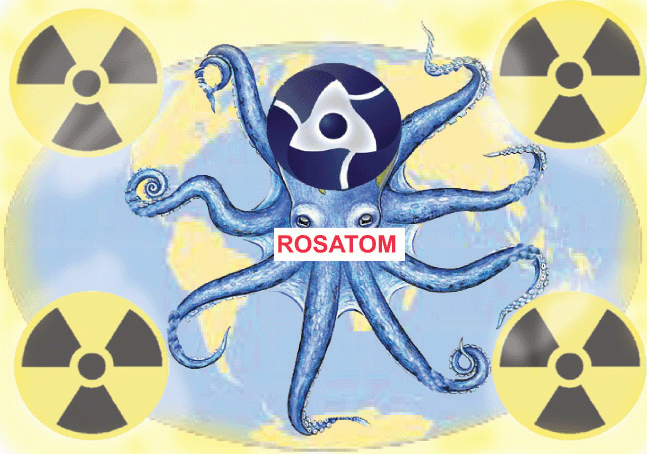
Western sanctions first imposed on Russia in 2014 over its annexation of the Crimea in the Ukraine have forced Russia to seek alternative sources of incomes and also new friends.
Nuclear technology instead of trade
“For Putin to remain relevant in Russia, he really has to ensure that Russia has a big influence,” said Ovigwe Eguegu, a geopolitics analyst with the international affairs platform, Afripolitika. “That’s why he is looking at African markets so he has more parties to partner with when it comes to international issues.”
African nations constitute the largest voting bloc in the United Nations.
While the Soviet Union had a close relationship to various African states during the Cold War, Russia’s trade balance with Africa is one tenth of that of China, meaning it needs to look for other means to get a foothold on the continent.
“Russia is using the tools that they have to expand their influence and right now, Russia has lots of experience in the nuclear energy area,” Eguegu said in a phone interview from Abuja.
Rosatom nuclear leader
Rosatom is the world’s biggest nuclear company by foreign orders. While it has projects in developed countries such as Finland and Hungary, it’s mainly involved in developing regions.
The Rosatom packages are popular because the corporation’s sheer size means it can offer all-in-one deals, from training local workers to developing nuclear science curricula, supplying uranium for the plant’s life time and dealing with nuclear waste — with the added plus of Russian state loans for the projects.
The cost and financing of Rwanda’s nuclear research center is still undisclosed. But Russia is extending a $25 billion (€22.23 billion) loan to Egypt to cover 85% of the cost of the El Dabaa nuclear power plant, which Rosatom is constructing.
Rosatom has come to dominate nuclear exports to developing countries because of their generous financing and worker training,” according to the 2018 Center for Global Development policy paper, Atoms for Africa.
Additionally, Russia is itself a major player in the nuclear market, responsible for some 8% of uranium production worldwide as well as 20% of uranium conversion and 43% of uranium enrichment (conversion and enrichment are stages of processing uranium so it can be used by commercial nuclear power reactors)………….
many experts, including Gatari, believe that nuclear technology doesn’t yet make sense for African countries. They lack the highly skilled local workforce required to run the technological intricacies of such reactors. Plus, nuclear facilities are vastly expensive and take years to build.
Gatari warns of countries becoming locked into costly projects that end up being “white elephants”.
“Such a project can only be driven by strong and educated local human resources,” the nuclear researcher said. “That knowledge isn’t possible by rushing young students through training for a short time.
And the cost of maintaining that kind of installation can cripple the budget of a country for a long, long time.”
Doing the smooth sell
Currently, South Africa is the only country in sub-Saharan Africa with a functioning nuclear power plant, while Nigeria and Ghana have research reactors, which are primarily used for studying and training and to test materials, such as minerals.
In Europe, safety concerns around nuclear technologies have already caused countries such as Germany, Italy, Spain and Switzerland to vote to phase out nuclear power.
These concerns are compounded in Africa, given the the political instability of certain regions and the threat of sabotage or terrorist attacks. This hasn’t stopped Rosatom, and Russia, from doing a soft sell of nuclear technologies on the continent.
Rosatom funds scholarships for students from sub-Saharan Africa to study nuclear sciences and engineering in Russia. As of January 2020, around 300 students from more than 15 African countries were studying nuclear specialties there.
It runs an online video competition, Atoms for Africa, where participants stand a chance to win an all expenses paid trip to Russia for a video dedicated to innovative nuclear technologies.
In 2019, it even held an international fishing competition near the Leningrad nuclear power station, Russia’s largest, to demonstrate the safety of nuclear power for water bodies. (The competition was won by an Egypt team).
“There is good money if you can sell a research reactor,” said nuclear scientist Gatari. “Unfortunately, the convincing capacity of [Rosatom’s] marketing is very high, and the understanding of those who are buying is low.” https://www.dw.com/en/russias-nuclear-play-for-power-in-africa/a-54004039
South Africa- financially ruinous coal and nuclear power proposals – will muck up post-Covid-19 recovery
 New coal and nuclear power proposals undermine prospects of a post-Covid-19 economic recovery, Daily Maverick, By Anton Eberhard• 17 June 2020
The Department of Mineral Resources and Energy’s attachment to ‘clean coal’ and new nuclear as immediate options for a post-Covid-19 economic recovery would be comical if they were not financially ruinous. Their fixation on these non-competitive, non-commercial technologies is now wasting scarce public resources.
South Africa is beginning to see the consequences of an energy ministry trapped in the past, beholden to interest groups and oblivious to global innovations in energy technologies and markets. Submissions by the minister and his energy department to Parliament in the past month reveal an economically disastrous commitment to policy, procurement and investment options that have no hope of contributing to our post-Covid-19 economic recovery.
The Department of Mineral Resources and Energy (DMRE) in its strategic and economic plans is promoting the role of nuclear energy (mainly small modular reactors) and clean coal (with carbon capture and storage), but these technologies are neither price competitive nor, in the case of small nuclear, are they currently commercially available.
In a presentation to Parliament on 26 May 2020, Minister Gwede Mantashe proposed several medium-term (6-12 month) interventions in response to the economic impacts of the Covid-19 pandemic. …….
In the same presentation, the minister proposed a number of interventions (also 6-12 months) to enhance electricity supply security, including acceleration of a nuclear build programme, conversion of Eskom’s diesel-fired turbines to gas and the building of a new oil refinery. None of these, of course, can be accomplished within a year and it’s highly unlikely that even contracts for these projects will be placed any time soon, if ever. Implementation of South Africa’s IRP electricity plan, which identifies wind, solar and storage as the next least-cost options to ensure electricity supply security, was evidently not regarded as a priority although – almost as an afterthought – it was offered as a long-term option.
Over the past weekend, DMRE launched a Request for Information (RFI) to commence preparations for a nuclear build programme. Of course, an RFI is non-binding (unlike a Request for Proposals, RFP, in a competitive tender or auction) and participants are perversely incentivised to put forward unrealistically attractive offers and prices which they’ll probably seek to alter when contracts are negotiated. In short, an RFI is not particularly helpful unless you don’t know what you’re doing and want technology and service providers to shape your procurement.
The minister has now appointed a new board chairperson, the retired nuclear chief officer of Eskom, an ex-British navy nuclear submariner, someone who continues, on social media, to rubbish renewable energy alternatives.
The minister has also entertained plans for expanded investment at the Nuclear Energy Corporation of South Africa (NECSA), despite the institution recording unprecedented financial losses. ……..
It’s time for a reality check. No country or private company currently offers commercially proven exports of land-based, small modular nuclear reactors. South Africa tried to develop one – the pebble bed modular reactor (PBMR) – but after spending more than R20-billion (in today’s money), the programme was closed after a decade without even a pilot demonstration plant being built. …….. Clean coal is also a mirage. …….. https://www.dailymaverick.co.za/article/2020-06-17-new-coal-and-nuclear-power-proposals-undermine-prospects-of-a-post-covid-19-economic-recovery/#gsc.tab=0
Renewable energy for South Africa – cost-efficient and quick – forget coal and nuclear
 Global advances in renewable energy sector should halt SA’s rush to nuclear, Let’s avoid any major financial and technological disasters such as Medupi and Kusile happening again Business Live 17 JUNE 2020 , SA is once again on the cusp of another major electricity production decision. We had better get this one right. Mineral resources & energy minister Gwede Mantashe recently announced that the government is pressing ahead with a nuclear build programme for SA as early as 2024. This despite ample reported evidence that renewables, particularly solar, can be built both rapidly and cost effectively in incremental amounts up to the scale envisaged (2,500MW) to closely match any supply/demand curve.
It is therefore of some concern that those major companies in SA that have been interfacing with the renewables fraternity for their internal electricity production will respond to the one month deadline to raise reservations in a responsible manner with sound factual numbers. We certainly need to avoid any major financial and technological disasters such as Medupi and Kusile happening again.
The coming decade looks set to become a golden one for renewables globally and could well cement their position irreversibly as the way forward for a threefold purpose: global electricity needs, containing the global temperature rise, and avoiding the drastic climate change…….
The good news is that the driver for electricity production through renewables is no longer climate change but economics. A recent announcement of the lowest competitive tariff globally for a large-scale solar PV (photovoltaic) project in Abu Dhabi certainly illustrates this. It particularly signals the resetting of economies after the Covid-19 lockdown, especially in terms of any incremental increase in the supply/demand curve going forward.
Most significantly, the rapid construction capability of small- to large-scale renewable technologies avoids the long lead times of the large-scale fossil fuel and nuclear projects, with their difficult financial funding constraints. In addition, it shows that matching the supply/demand curve is relatively straightforward.
With favourable economics as the driver, this raises the issue of stranded assets. Increased reporting on the abandonment of coal plants has become relevant. The stranded asset value of fossil fuel electricity production, explained in a recent Cambridge Econometrics paper in Nature Climate Change, is said to be in the range $1-trillion to $4-trillion. Big numbers. …….
For SA, renewables would surely help overcome load-shedding and the planned closure of our ageing coal fleet. However, the political opposition to significant introduction of renewables capacity (by trade unions) could well be a limitation for this route………. https://www.businesslive.co.za/bd/opinion/2020-06-17-global-advances-in-renewable-energy-sector-should-halt-sas-rush-to-nuclear/
South Africa’s environmental watchdogs warn government against new nuclear power
Environmental watchdogs are warning Energy Minister Gwede Mantashe against a new nuclear power programme. Mantashe’s department has indicated that it will be going ahead with the procurement process for a two thousand 500 megawatt programme. The Southern African Faith Communities’ Environment Institute says going forward with the plan would be unlawful. The institute’s Francesca de Gasparis joins us from Cape Town to discuss. Courtesy #DStv403
South African activists threaten to sue over nuclear plan
 South African activists threaten to sue over nuclear plan JOHANNESBURG, June 11 (Reuters) – South African activists have written to the energy minister threatening to take legal action if he moves to build new nuclear power plants without proper consultation.The letter to Gwede Mantashe from Earthlife Africa Johannesburg and the Southern African Faith Communities’ Environment Institute (SAFCEI) comes after energy officials said last month they planned to procure 2,500 megawatts (MW) of new nuclear capacity by 2024. South African activists threaten to sue over nuclear plan JOHANNESBURG, June 11 (Reuters) – South African activists have written to the energy minister threatening to take legal action if he moves to build new nuclear power plants without proper consultation.The letter to Gwede Mantashe from Earthlife Africa Johannesburg and the Southern African Faith Communities’ Environment Institute (SAFCEI) comes after energy officials said last month they planned to procure 2,500 megawatts (MW) of new nuclear capacity by 2024.
The activists said they would go to court if Mantashe tried to procure nuclear power, or seek information about it from vendors, without following proper regulatory processes and seeking public input. Three years ago, the same groups succeeded in persuading a court to block a nuclear power agreement with Russia, signed under then-president Jacob Zuma……. https://www.reuters.com/article/safrica-nuclear/update-1-south-african-activists-threaten-to-sue-over-nuclear-plan-idUSL8N2DO5SN |
|
South Africa’s nuclear waste problem- why plan to increase it?
 The nuclear option https://www.businesslive.co.za/bd/opinion/letters/2020-05-17-letter-the-nuclear-option/ 17 MAY 2020, Keith Gottschalk, It is bizarre that a government department is advocating the building of more nuclear power stations with the slogan “a no-regret option”! (“ANC government is determined to pursue nuclear at any cost”, May 12).
Try selling that slogan to the people of Fukushima and Chernobyl.
Murky links between the nuclear and coal lobbies in South Africa
 Anatomy of a lobby: How, and why, coal and nuclear interests are converging https://www.news24.com/SouthAfrica/News/anatomy-of-a-lobby-how-and-why-coal-and-nuclear-interests-are-converging-20200315, Sarah Evans
While in South Africa, there is little proof of such an organised, funded campaign being conducted by the coal industry itself, a motley crew of intersecting interests has coalesced around common policy goals: Attempting to stop government’s policy of introducing renewable energy onto the national grid by purchasing power from Independent Power Producers (IPPs), and pushing a narrative that says that Eskom needs to keep buying coal, and that the life of its ageing power stations needs to be extended.
The narrative is also centred around the idea that government must once again pursue a large nuclear building programme, once favoured by former president Jacob Zuma, but since shelved by the Cyril Ramaphosa administration.
Many of the anti-IPP lobbyists are strongly sympathetic to the former president.
The is despite the release of the Integrated Resource Plan last year – the country’s energy roadmap – which seeks to phase out coal, gradually, over the coming decades, increase the use of renewable energy onto the grid, with a reduced role for nuclear energy.
Lobbying efforts by the industry itself have cropped up all over the world as governments are pressured to radically reduce their reliance on burning fossil fuels.
The Guardian reported last year that such a campaign had been launched on a global scale by mining giant Glencore.
But in South Africa, the campaign has taken on the face of a coalition of forces, more than an organised and well-funded propaganda effort, as far as we know.
To the one side of the anti-IPP coalition are some unions, some obscure pro-Zuma lobby groups, coal truckers and disgruntled individuals such as former acting Eskom CEO Matshela Koko.
This campaign has played out in the mainstream media, but seems to have the most traction on social media.
The campaign reached Eskom’s physical doors last week when the EFF entered the fray on the side of the lobbyists. The party took its message to the power utility in the form of a protest, flanked by nuclear energy industry lobbyists like Adil Nchabaleng of pro-Zuma lobby group Transform RSA.
On the other side of the campaign is the coal industry itself, which appears to be in the initial stages of an advocacy campaign.
Transform RSA teamed up with Numsa and the Coal Truckers Association in 2018 in a failed court bid to stop the signing of IPP agreements – a case that Nchabaleng tried to link to a break-in at his home where his housekeeper was tied up and held at gunpoint.
He is also a Member of Parliament, representing the African People’s Convention.
Transform RSA’s politics were made clear when, also in early 2018, it threatened to take legal action against the ANC’s leadership if they moved against former president Jacob Zuma by discussing his recall at a meeting.
On the social media front, the South African Energy Forum (SAEF_ZA) has been actively opposing IPPs, and has advocated for more nuclear energy in South Africa’s energy mix in a “People’s IRP” released on behalf of itself and sister organisations last year.
Another vocal advocate of nuclear energy, and of abandoning the IPP project, is Khandani Msibi, who heads up Numsa’s investment arm.
The SAEF’s members are all APC party members, with the exception of one Ronald Mumyai. His social media accounts show that he is a former EFF member, supporter of Zuma, and homophobe, although the homophobic tweet in question has since been deleted.
Another obscure entity that appears only to exist online is the Anti-Poverty Forum, which, when it is not laying complaints with the Public Protector over IPPs, spends its days campaigning against Zuma’s nemesis, Public Enterprises Minister Pravin Gordhan.
The forum is fronted by ANC Brian Bunting branch member Phapano Phasha, also formerly associated with the Gupta’s failed television station ANN7, who laid a complaint against Public Enterprises Minister Pravin Gordhan with the ANC’s integrity commission last year.
Coal industry advocacy
As for the industry itself, it seems clear that many players feel coal is unfairly under attack, in the face of overwhelming scientific evidence of its contribution to climate change.
At a gathering of coal industry leaders in Cape Town in February, Minerals Council South Africa (MCSA) senior economist Bongani Motsa said there was a need for a “strong coal advocacy group” to lobby for the industry, against what it views as an onslaught from the “renewables lobby”.
Motsa likened the Integrated Resource Plan (IRP) to an abusive spouse that was unkind to the industry, in spite of its willingness to invest in “clean coal” technologies.
Motsa did not provide any details as to what this would look like.
In February 2018, when heated talks over the IRP were ongoing behind closed doors at Nedlac, the MSCA released a document titled “Coal Strategy 2018” in which it outlined plans to counter the narrative around coal.
The plan’s executive summary states: “The Chamber of Mines Coal Leadership Forum, consisting of coal executives, commissioned a report to determine what needs to be done to increase the profile of the coal mining industry in the face of seemingly ineluctable negative public opinion around the use of coal in industrial processes. Negative views on coal and its impact on the environment have resulted in a precipitous decline in the use of coal by the major economies of the world…”
The plan decried the introduction of strict laws to protect the environment that would stifle the coal industry, and implied that the industry’s contribution to the economy and jobs needed to be punted in public.
For now, the links between the pro-coal, anti-IPP actors are murky. But what is clear is that their interests align around policy and political goals, and it remains to be seen whether they carry enough weight to have real impact on either front.
1 This Month

of the week – Shut Down Drone Warfare!


Tell the Ukrainian Government to Drop Prosecution of Peace Activist Yurii Sheliazhenko

Petition to revoke the licensing of the Near Surface Nuclear Disposal Facility (NSDF) at Chalk River. https://www.ourcommons.ca/petitions/en/Petition/Details?Petition=e-7247
To see nuclear-related stories in greater depth and intensity – go to https://nuclearinformation.wordpress.com
-
Archives
- April 2026 (7)
- March 2026 (251)
- February 2026 (268)
- January 2026 (308)
- December 2025 (358)
- November 2025 (359)
- October 2025 (376)
- September 2025 (257)
- August 2025 (319)
- July 2025 (230)
- June 2025 (348)
- May 2025 (261)
-
Categories
- 1
- 1 NUCLEAR ISSUES
- business and costs
- climate change
- culture and arts
- ENERGY
- environment
- health
- history
- indigenous issues
- Legal
- marketing of nuclear
- media
- opposition to nuclear
- PERSONAL STORIES
- politics
- politics international
- Religion and ethics
- safety
- secrets,lies and civil liberties
- spinbuster
- technology
- Uranium
- wastes
- weapons and war
- Women
- 2 WORLD
- ACTION
- AFRICA
- Atrocities
- AUSTRALIA
- Christina's notes
- Christina's themes
- culture and arts
- Events
- Fuk 2022
- Fuk 2023
- Fukushima 2017
- Fukushima 2018
- fukushima 2019
- Fukushima 2020
- Fukushima 2021
- general
- global warming
- Humour (God we need it)
- Nuclear
- RARE EARTHS
- Reference
- resources – print
- Resources -audiovicual
- Weekly Newsletter
- World
- World Nuclear
- YouTube
-
RSS
Entries RSS
Comments RSS
 nuclear-news