South Africa’s Koeberg Nuclear Power Station has suffered severe corrosion
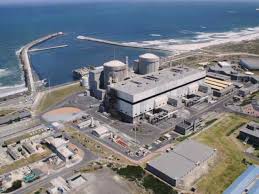
Koeberg has suffered substantial damage, according to Koeberg Alert Alliance. (with audio) https://www.capetalk.co.za/articles/408514/koeberg-nuclear-power-station-radioactivity-containment-building-is-severely-damaged?fbclid=IwAR1HSyt2Tw6lrsbwJxlEQW5m4i4YT18_Hl0MgVzEQV0f24h31btTVN150g4 Eskom says the containment building is ‘leak-tight’.
RELATED: We’ll extend Koeberg lifespan from 40 to 60 years. It’ll be safe – Eskom
Koeberg Nuclear Power Station has suffered substantial damage to its containment building, according to Koeberg Alert Alliance (KAA).
The containment building is designed to contain the escape of radioactive steam or gas in an emergency.
A nuclear accident at Koeberg will have devastating consequences for hundreds of thousands of people who live close nearby.
Eskom says it is aware of “deterioration” and that it is managing the issue by implementing a modification.
Like all other nuclear power plants around the world, we do get deterioration… We’re managing this issue… Recent tests show… It’s leak-tight. The building works…
Riedewaan Bakardien, Chief Nuclear Officer – Eskom
Sea air has severely damaged the concrete structure, highlighting the significant risk the facility poses to nearby residents, according to KAA.
A concerned insider at Koeberg brought the alarming structural problems to the attention of KAA.
The insider informed KAA of a crack so large it goes right around the entire 110-metre circumference of the containment dome.
The community group says it is struggling to access information from Eskom about the damaged containment dome.
KAA claims that a 31-page Eskom report (about the damage), has eleven pages entirely blacked out while various other sections, photos and tables were censored because, claims Eskom, it contained “sensitive technical information”.
Lester Kiewit interviewed Peter Becker, a spokesperson for KAA.
The salt in the sea air… has caused accelerated rust in the rebar in the concrete of the containment structures… which caused cracking… About 10% of the surface of the containment building has delaminated [split into layers] …
Peter Becker, spokesperson – Koeberg Alert Alliance
Eskom blacked out about half of the report before releasing it to us…
Peter Becker, spokesperson – Koeberg Alert Alliance
Eskom is surprised by the speed at which it’s deteriorating… Koeberg was not well constructed, and the effect of sea-air was not well understood.
Peter Becker, spokesperson – Koeberg Alert Alliance
Koeberg is far too close to densely populated areas. If they tried to get approval to build it in that location today, it would be refused…
Peter Becker, spokesperson – Koeberg Alert Alliance
Koeberg was designed to last for 40 years… We get to that in 2024… but Eskom wants to keep it going. It’s a really bad idea…
Peter Becker, spokesperson – Koeberg Alert AllianceThis problem will remain. We’re implementing a modification… which will retard the deterioration.
Riedewaan Bakardien, Chief Nuclear Officer – Eskom
It’s the building around the reactor. Yes, there is corrosion… We’re well aware of it…
Riedewaan Bakardien, Chief Nuclear Officer – Eskom
No apologies from France, over nuclear bomb tests’ pollution in Algeria
The New Arab 12th Feb 2021, President Emmanuel Macron’s recent statement that a “memories and truth” commission will be established to look into the history of the French colonisation of Algeria, has led to much public discussion over this bloody legacy.
And in this context, the absence of apologies or offers of reparations by the French state has not gone unnoticed. One area of particular contention in this process is the ongoing and detrimental effects of France’s nuclear testing in Algeria, conducted throughout the
1960s. France conducted its first nuclear test known as the “Gerboise Bleue” in February 1960 in the Sahara Desert – an atomic bomb that was four times the strength of Hiroshima. A total of 17 tests were carried out, four of them atmospheric detonations, and 13 underground.
https://english.alaraby.co.uk/english/comment/2021/2/12/frances-nuclear-colonial-legacy-in-algeria
Koeberg Nuclear Power Station containment buildings damaged by prolonged exposure to sea air
 Koeberg Nuclear Power Station containment buildings suffer damage, ESI Africa, Feb 12, 2021 A recently released Eskom document has revealed that 40 years of exposure to sea air at Koeberg Nuclear Power Station has damaged the concrete of the containment buildings, according to Koeberg Alert Alliance.
At one stage the concrete containment dome was found to have cracked around the entire 110-meter circumference, states the Koeberg Alert Alliance.
“The containment buildings are the outer shells of the reactor buildings, built as pressure vessels to withstand the pressure if the reactors inside them ever malfunction and therefore prevent harmful radiation being leaked into the environment,” says DR, a member of Koeberg Alert Alliance and a retired analytical chemist.
“Where the chloride salts have entered, they have caused corrosion of the reinforcing steel bars, resulting in spalling and delamination of the concrete – it is even more alarming than I thought,” he says. Spalling results from water entering concrete which forces the surface to peel, pop out, or flake off. ……..
According to the Koeberg Alert Alliance, the provided 31-page report which refers to repairs done up until 2018, has eleven pages entirely blacked out and various other sections, photos and tables redacted with the reason given as “sensitive technical information”.
“The interesting parts are clearly those that have been redacted,” says University of Johannesburg Physics Professor, Hartmut Winkler. “The first big redact is titled History/Background and presumably describes past failures and recent damage that Koeberg Alert Alliance’s PAIA was interrogating. Why should the ‘History’ be sensitive due to technical information when the less redacted sections are full of technical details.
“The most puzzling redact to me are the references which are supposed to be publicly available documents, so why are they all being hidden? Do they expose some entities that Eskom does not want anyone to know have been involved with Koeberg and why? I would also query why the financial information would be redacted. Surely the public has a right to know how much money certain components cost, and what Eskom paid for them?” says Winkler.
This is a developing story, ESI Africa will do a follow up to give Eskom an opportunity to respond to the claims. https://www.esi-africa.com/industry-sectors/generation/koeberg-nuclear-power-station-containment-buildings-suffer-damage/
South Africa’s new nuclear power plan would be a costly mistake
|
The National Energy Regulator of South Africa (Nersa), has issued a consultation paper and called for public input, comment and response to a determination by the Minister of Mineral Resources and Energy, in terms of Section 34(1) of the Electricity Regulation Act, 2006, to procure 2,500 MW of new nuclear power in South Africa. The ministerial determination was sent to Nersa for its consideration and concurrence, which is a necessary step before the Department of Mineral Resources and Energy (DMRE) can issue a request for proposals to nuclear vendors following an open, transparent and competitive procurement process. I am opposed to new nuclear power in South Africa, and this is definitely not because I am ideologically against nuclear energy or nuclear technology per se, but for sound, pragmatic reasons and the absence of a valid business case, including, amongst other factors:
This ministerial determination comes at a time when the world of energy and electricity is undergoing rapid change when the prices of renewable and flexible generation technologies are plummeting when new energy storage technologies are emerging, when the future of large-scale, centralised generation is changing and when the demand for electricity over long-distance transmission grids is decidedly uncertain and declining. The Integrated Resource Plan (IRP) 2019 indicates that a nuclear build programme “is a no-regret option in the long term”. I disagree and consider that a nuclear new-build programme is exactly the opposite – very high risk and high-regret option indeed. This is not the time to be making extremely expensive 100-year commitments. So, I urge thinking people to oppose new nuclear power in South Africa – because this is clearly not a national priority, and a new nuclear procurement cannot prevent the current electricity crisis from becoming a catastrophe in the course of the next decade. DM Written comments on the ministerial determination for 2,500 MW of new nuclear power in South Africa should be sent by email to Nersa at irp-procurement.newcap@nersa.org.za. The closing date is for written comments is Friday – 5 February 2021, but generally, Nersa does accept written comments after the closing date too. The dates for public hearings on the ministerial determination will be announced by Nersa shortly. Chris Yelland, energy advisor to OUTA, and managing director at EE Business Intelligence. |
|

All-Africa Conference of Churches welcomes Nuclear Weapons Prohibition Treaty
 All-Africa Conference of Churches welcomes Nuclear
  Prohibition Treaty https://www.vaticannews.va/en/church/news/2021-01/aacc-treaty-nuclear-weapon-proliferation-africa-church.htmlThe All-Africa Conference of Churches salutes the recent coming into force of the Treaty on Prohibition of Nuclear Weapons (TPNW), hailing it as further inspiration to work for a nuclear-weapons-free world.
Hailing this recent development, the All-Africa Conference of Churches (AACC), in a statement on Tuesday, expressed its support, together with the rest of the ecumenical community, for the Treaty which now becomes international law.
The ecumenical body said that the Treaty “ushers in the possibilities of heralding a new world free of the threats and tensions that have been characterized by the battle to develop and hold nuclear weapons.”
No safe hands for nuclear weapons
In the Tuesday statement, AACC stated its belief “that the very holding and potential threat of use of nuclear weapons is immoral,” adding that it looks forward to the day “when the world will be freed of these weapons permanently.”
“There are no safe hands for these weapons,” added AACC. “The accidental or deliberate detonation of a nuclear weapon would cause severe, long-lasting and far-reaching harm on all aspects of our lives and our environment throughout the world.”
At the same time, these technologies are “part of structures and systems that bring about great suffering and destruction” and have been the cause of “major tensions and threats of widespread devastation.”
TPNW: inspiration for a nuclear-weapon-free world
In the wake of the entry into force of the Treaty, AACC said that at a time when the world desperately needs fresh hope, the TPNW inspires us to work towards fully eliminating “the threat of nuclear weapons, and to create conditions for peace, justice and well-being.”
AACC also pointed out that the treaty addresses the disproportionate impact of nuclear weapons on women and indigenous peoples, as well as the “importance of victim assistance and healing environmental harms in a groundbreaking way.”
Citing the example of the hibakusha – survivors of the two nuclear attacks launched at Hiroshima and Nagasaki at the end of World War II – AACC noted that their courage and perseverance serve as “the inspiration, guidance and moral foundation” in the quest for a world without nuclear weapons.
Appeal to States
Highlighting that none of the nine nuclear global powers, and many countries with defense pacts with them have signed or ratified the Treaty, AACC pointed out that a lot of work still remains to be done. As at its entry into force, the TPNW was signed by 86 countries and ratified by 51.
n this regard, AACC appealed to the ecumenical global community to make its contribution, in whichever way possible, to participate in the global work for peace, justice and respect for life.
Concretely, the ecumenical body is urging all States to sign and ratify the TPNW, as well as join the first meeting of the State parties scheduled for next year. AACC further calls for decisive action “to strengthen the power of the TPNW upon its entry into force, and to work for peace, cooperation and common security.”
“We must not be discouraged at the slow pace, but become even more determined to push for a better world,” AACC said. “This is part of our mission and we know God is on our side.”
AACC
Founded in Kampala, Uganda, in 1963, the AAAC is an ecumenical association that today has 173 member churches present in 40 African countries, representing over 120 million Christians on the continent. Its headquarters is in Nairobi, Kenya.
Investigation of Algerians affected by France’s nuclear bomb tests
Le Monde 20th Jan 2021, At the heart of Franco-Algerian memory: the fight against those irradiated from the Sahara. This January 20, historian Benjamin Stora submits to the
President of the Republic, Emmanuel Macron, his report on Franco-Algerian memory. The nuclear tests carried out until 1966 in the Sahara are one of the disputes between the two countries. Investigation.
South Africa the only country to have nuclear weapons, then abandon them
|
The Story Of The Jet That Would Have Delivered South Africa’s Nuclear Bomb, The British-made Buccaneer strike aircraft was adapted to carry apartheid-era South Africa’s guided nuclear bomb. The War Zone, BY THOMAS NEWDICK JANUARY 18, 2021
“………South Africa, an international pariah for much of the Cold War due to its apartheid policy, remains the only country to have developed nuclear weapons and then voluntarily given them up. Before it did so, the main focus of these developments was an air-launched weapon that was intended to be delivered by a Hawker Siddeley Buccaneer strike aircraft. This combination could potentially have struck targets in other countries in sub-Saharan Africa, as partof South Africa’s long-running campaign against regional rebel groups, or even hostile revolutionary governments.
……..The final death knell for South Africa’s nuclear weapons program was the presidency of F. W. de Klerk, who came to power in 1989, deciding to do away with it. There was apparently no significant opposition from the military, whose experience in years cross-border campaigns had not revealed any requirement for a weapon of this type. Ultimately, the actual utility of a nuclear weapon in the conflict in Angola was always negligible, and its use would represent an unprecedented escalation while further ostracizing the South African regime. Moreover, the end of apartheid now seemed to be in sight, and possession of weapons of mass destruction would do nothing to enhance South Africa’s international position then, or in the future. While a veil of secrecy remained over the program, de Klerk oversaw the removal of enriched uranium from the weapons that had been completed. In 1991, South Africa finally signed the 1968 Non-Proliferation Treaty and, two years later, de Klerk acknowledged the existence of the nuclear weapons program. Survivors of the SAAF Buccaneer fleet were withdrawn in the same year, by which time only five examples were reportedly still airworthy. …
|
|
|
Another bit of boring nuclear propaganda – from Morocco this time
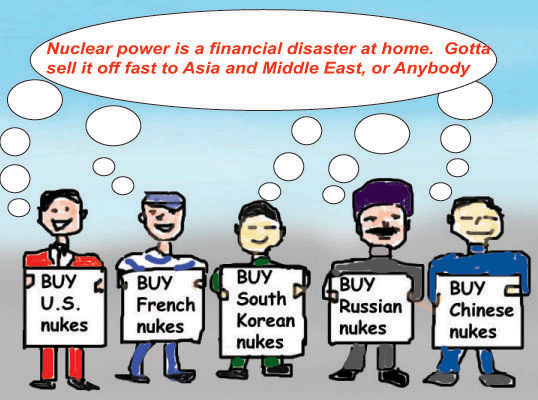
A straight handout from the nuclear lobby? Of course! Not a word about the costs. Not a word

Christina Macpherson’s websites & blogs
about safety, environmental issues. Not a word about the problem of radioactive trash produced. And, of course – no mention that medical radioisotopes can now be made safely and efficiently in non nuclear cyclotrons
Morocco, Hungary Sign Agreement On Nuclear Energy Cooperation. The agreement boosts bilateral cooperation in scientific and academic research. By Sanae Alouazen, Jan 20, 2021 Rabat- Morocco’s National Center for Nuclear Energy, Science and Technology (CNESTEN) and the Hungarian Center for Energy Research signed a cooperation agreement on Tuesday. The agreement aims to strengthen cooperation between the two research centers in the field of nuclear energy……. https://www.moroccoworldnews.com/2021/01/332545/morocco-hungary-sign-agreement-on-nuclear-energy-cooperation/
Ten compelling reasons to stay away from nuclear power
|
Ten compelling reasons to stay away from nuclear power Proponents of nuclear power argue that it is safe, clean, infinite and the way of the future. They are wrong. Here are ten good reasons. https://www.dailymaverick.co.za/opinionista/2021-01-07-ten-compelling-reasons-to-stay-away-from-nuclear-power/
The South African government recently released an invitation for comments on its proposal to instal 2.5 gigawatts of new nuclear power. There are at least 10 compelling reasons not to – a few of which you may not have thought of before. Described briefly below, they are arranged in what I consider to be a rough order of importance.
If a nuclear power station – such as Koeberg – blows up, we might have to abandon the City of Cape Town for 200 years. Nuclear plants can’t be too far from urban centres due to the high cost of transmitting power over long distances. So, even if better sited, there is low risk, maybe, but unimaginable consequences, as well as long-term and, in the case of radiation, invisible ones.
At least equally important, however, is the risk of mismanagement and corruption. Nuclear is simply out of the question as a safe option in a state characterised by any degree of dodgy tendering and procurement, corrupt construction, or incompetent leadership and operation. We have seen enough issues within Eskom to say that this is a major and real concern — incompetent design checks, cheating on materials, and so on. Even just faulty welding in constructing a coal-fired power station – which we have heard about recently – is simply not an option in the case of a nuclear reactor. Cost is basic common sense, but the current South African governance context is perhaps the strongest single argument against the nuclear option.
Constructing a nuclear power station creates a lot of jobs, but only for a few years. It has long been established that renewables, as well as energy efficiency measures, create far more jobs on a long-term or permanent basis. They also create jobs which are spread out regionally, as opposed to a huge project at just one location. One example: making homes and buildings more energy efficient requires thousands of jobs, spread all over the country and, in addition, these are conventional jobs for building trades, including for unskilled and semi-skilled workers.
Nuclear energy results in hundreds of tons of incredibly hazardous waste, which our descendants will have to police for thousands of years after our time. This is simply irresponsible to the human race (and to the environment). After more than 50 years, almost no “permanent” safe storage facilities for nuclear waste have ever been created. We don’t need to talk about “nuclear fear”; it’s just a disgusting thing to leave to our children.
The risk of nuclear material getting into the hands of violent states or terror organisations is considerable. We have already seen dissidents being poisoned with polonium, probably with the backing of the Russian state. And North Korea making noises about nuclear bombs? How great is this threat? Even in light of strict international controls, this is still a powerful threat.
Hence, it would take decades — time we don’t have — for nuclear to become the major world energy source. Even longer in the poor countries, which are in most need. And that delay will also enable the “dirty energy” guys, the oil, coal and gas multinationals, to carry on wrecking the planet and making billions for a few more decades.
Nuclear energy is based on uranium. But uranium, like coal, gas and oil, is a limited resource; there’s only enough for a few decades, perhaps for 100 years. So why not go straight to the renewables, which are here forever?
Let us add that various newer forms of biomass energy can also become a major source of energy. There is a huge emerging industry of plant-based materials, including bioplastics, already used for many motor vehicle parts, textiles and consumer goods; as well as for renewable bioenergy. In many countries, very productive plants can be grown as “energy crops” — without competing with agriculture, as the US ethanol industry unfortunately did. One might also recall that South African John Fry was a world pioneer of biogas in the 1950s. Much of Brazil’s “petrol” is produced from waste from the sugar plantations. Bioenergy is thus also a new potential source of income for farmers and rural areas.
This is a common false argument in favour of nuclear power. For sure, the sun doesn’t always shine and the wind doesn’t always blow. But that has long been recognised as a minor problem. If the energy system as a whole contains both wind, solar, hydropower, biomass and some other option such as gas (or even, for some more years, a little coal) – then the energy system as a whole is diverse and robust all year round. We might remember that the wind blows mainly in winter, when we need the power most, and that we enjoy far more sunshine hours than many other countries that are “going solar”. The key point is that any energy system needs a certain amount of “base-load” power for times when there is neither wind nor sun, and if the dams are nearly empty too. This is where fossil fuels like coal, gas and oil are so useful because we can burn them when needed to produce power. And quickly, if there is a sudden surge in demand. But nuclear, on the other hand, is not very flexible; it takes 10 to 14 days to close down a nuclear reactor or fire it up to maximum output.
Other arguments against renewables Even after all these years, the nuclear lobby continues to spread fake arguments. For example:
As for “clean fossil fuels”, it’s fiction: coal is never clean, carbon capture and storage, as well as oil sands and fracking, are very expensive and environmentally damaging.
The low climate emissions from nuclear power are often cited as a reason in its favour. Yes, the emissions of climate gases such as carbon dioxide are low. But so are those of the renewables. Even cleaner are energy-efficiency measures. So why make a nuclear pact with the devil in order to reduce the carbon emissions? Reducing consumption A final point that must be made, is that the way out of the energy crisis is not, and can never be, endless continued growth in energy supply, or in resource use generally. All state-of-the-art research and policies are now turning towards the challenge of reducing our consumption; of meat, petrol, electrical gadgets, air miles and consumer goods. We know that with today’s solutions we can have exactly the same standard of living, the same life quality, with just a quarter of the energy. That means no need for more power stations — and certainly not nuclear. Hence, energy authorities are starting to turn their focus far more towards ways of reducing our consumption of energy. And this path, by the way, is in many cases free. |
|


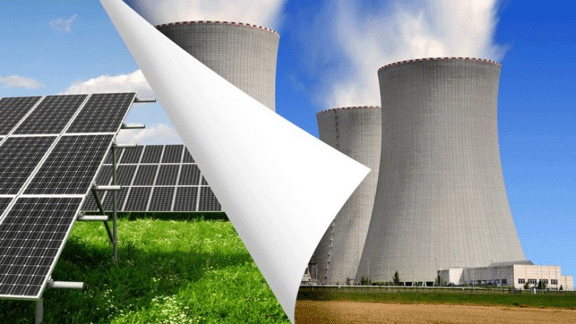
Growing opposition to nuclear power in Rwanda
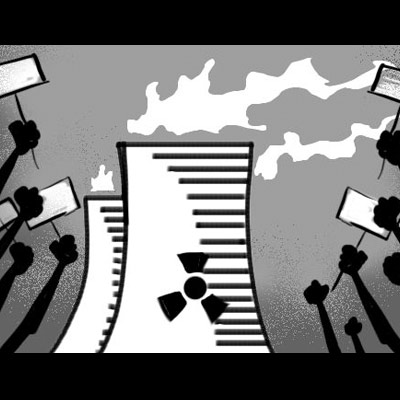 Rwanda: Opposition grows to Russian-backed nuclear plants Rwanda: Opposition grows to Russian-backed nuclear plantsLawmaker voices fears about safety of nuclear plants in densely populated Rwanda, but top official says nuclear is inevitable. KIGALI, Rwanda, 29 Nov 20, Plans by the tiny landlocked African country of Rwanda to build nuclear reactors with Russian help are facing stiff opposition in the country. Frank Habineza, a lawmaker and member of the Democratic Green Party, has warned that nuclear energy could do the country more harm than good. “Living near a nuclear energy plant is like living near a nuclear bomb which can explode and cause destruction of life and property to the nation and its neighboring countries,” he said. He said in light of Rwanda’s high population density, there is no place to set up the plant without compromising the safety of Rwandans and their neighbors. After Russian state-owned nuclear company Rosatom Global reached an agreement last year to set up the plant by 2024, the Rwandan cabinet approved establishment of the Rwanda Atomic Energy Board – an institution to coordinate nuclear science and technology activities in the country. In December 2018, Rwanda and Russia agreed on a roadmap for an inter-governmental agreement on the use of nuclear energy…… After Russian state-owned nuclear company Rosatom Global reached an agreement last year to set up the plant by 2024, the Rwandan cabinet approved establishment of the Rwanda Atomic Energy Board – an institution to coordinate nuclear science and technology activities in the country. In December 2018, Rwanda and Russia agreed on a roadmap for an inter-governmental agreement on the use of nuclear energy. …………. Experts say, however, it takes 10 years and billions of dollars to commission a nuclear power station. They argue that off-grid renewable projects are safer than nuclear energy, as they do not involve environmentally hazardous radioactive waste, and no huge financial costs are incurred in connection to the national grid. Experts raise concerns Lawmaker Habineza said nuclear energy is an old technology with proven risks to the environment. He said many developed nations such as Germany and Sweden are de-nuclearizing due to the dangers involved. “Nuclear waste and water pollution from a nuclear plant would cause serious environmental challenge to the country, its neighbors, and the world at large,” he argued. “More than that, raw materials needed to operate the nuclear center, such as uranium, emit harmful levels of radiation, which pose a great risk to the population and the environment.”….. https://www.aa.com.tr/en/africa/rwanda-opposition-grows-to-russian-backed-nuclear-plants/2059467 |
|
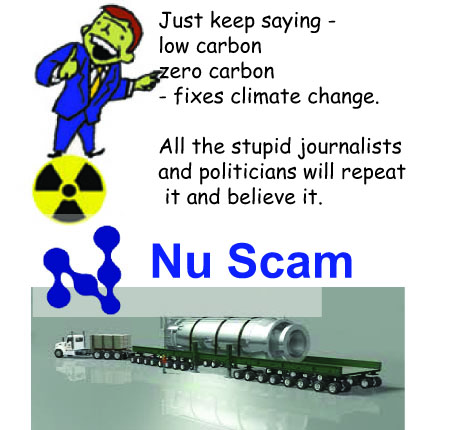
NuScam pushing to sell its ”small” nuclear reactors to South Africa
 S. Africa Regulator to Consider Approving Nuclear Power Plan, Bloomberg, By Antony Sguazzin,10 November 2020,
-
- Program envisages addition of 2,500 megawatts of atomic power
- Country’s renewable-energy lobby opposes expansion of industry
The National Energy Regulator of South Africa will on Nov. 11 consider approving the procurement of 2,500 megawatts of nuclear power, marking another step toward the expansion of the industry.
The regulator will consider approving a so-called section 34 determination for the program, which enables the Department of Mineral Resources and Energy to undertake a bidding process for private producers to build nuclear-power facilities, it said in a Twitter posting outlining the agenda for the meeting.
South Africa, which destroyed its atomic weapons prior to the end of apartheid, already operates Africa’s only nuclear-power plant, the 1,800 megawatt Koeberg facility in Cape Town, as well as the Pelindaba research facility north of Johannesburg.
While the expansion of nuclear power has the support of the ministry and labor unions, it’s opposed by environmentalists and backers of the country’s expanding renewable-energy program.
NuScale Power LLC, a U.S. nuclear-energy firm, has said it will propose small, modular reactors for installation in South Africa. The U.S. International Development Finance Corp. has announced that it will support a bid by NuScale, approving the procurement of 2,500 megawatts of nuclear power, marking another step toward the expansion of the industry.
The regulator will consider approving a so-called section 34 determination for the program, which enables the Department of Mineral Resources and Energy to undertake a bidding process for private producers to build nuclear-power facilities, it said in a Twitter posting outlining the agenda for the meeting.
South Africa, which destroyed its atomic weapons prior to the end of apartheid, already operates Africa’s only nuclear-power plant, the 1,800 megawatt Koeberg facility in Cape Town, as well as the Pelindaba research facility north of Johannesburg.
While the expansion of nuclear power has the support of the ministry and labor unions, it’s opposed by environmentalists and backers of the country’s expanding renewable-energy program. https://www.bloomberg.com/news/articles/2020-11-09/south-african-regulator-to-consider-approving-nuclear-power-plan
The tragic nuclear history of the Democratic Republic of the Congo
Six Million dead, The Congo Holocaust has its origins in minerals plunder and colonialism https://wordpress.com/read/feeds/72759838/posts/3011373848, By Linda Pentz Gunter, 8 Nov 20,
When you’ve lost family members to the Nazi death camps, it’s a pain that never goes away. Six of my relatives were killed there, four more shot in Polish ghettos and at Forlì. They died long before I was born and were people I never knew. But we have their photographs. Their pain stares out from those images, a perpetual ache.
But what use is endless mourning if no lessons are learned? The most important one surely is that no such Holocaust must ever be allowed to happen again? And yet it has. To almost universal silence. No one speaks of today’s six million dead. They lie beneath the mineral-rich soil of the Democratic Republic of Congo (DRC), invisible and unmourned by the world beyond their country’s borders.
“The Holocaust continues in DRC with the complicity of the international community,” Rodrigue Muganwa Lubulu wrote to me in an email exchange. “Women and girls are raped every day and the dead are counted by tens each day.” He is the program director for CRISPAL Afrique and gave a zoom talk recently hosted by ICAN Germany.
The tragedy of the DRC, the second largest country in Africa, began with the discovery in 1915 of the Shinkolobwe uranium deposit, the richest ever discovered at the time. Its plunder, from 1921 until its closure in 2004, “has been a curse for the powerless community” around the mine, said Lubulu, “because not only have they been forced to abandon their lands, houses and fields in favor of uranium mining, but also all the men were forced to dig out those extremely radioactive materials without protective equipment.”
The cancers and other illnesses that killed those uranium workers are still harming the community today, Lubulu says, even though the mine is now shut down.
The DRC was first colonized by Belgium in 1908 and known as the Belgian Congo until it gained independence in 1960. (It was known as Zaire between 1971 and 1997.) It rapidly became a country of great interest, especially to the United State and the then Soviet Union, engaged in a growing Cold War arms race. Then, as now, the country promised riches to its White pillagers. In the Eastern part of the country, wrote Armin Rosen, in a June 26, 2013 article in The Atlantic, “just feet beneath the surface of the earth are enough minerals to keep the global technology and defense industries humming.”
But during World War II, the uranium mined from Shinkolobwe went to the American Manhattan Project. “More than 70 percent of the uranium in the Hiroshima bomb came from Shinkolobwe,” says Lubulu, whose organization is holding workshops and other events in an effort to persuade the government of the DNC to ratify the Treaty on the Prohibition of Nuclear Weapons (TPNW).
He is haunted by what might have been if the “ore of death” as he calls uranium, had instead been left where it belongs; in the ground. “Without the uranium of Shinkolobwe, the 5th of August 1945 would have been a perfect and productive day in Hiroshima,” he said during his ICAN presentation.
This is supported by a recollection from the Manhattan Project’s Colonel Ken Nichols, who wrote: “Without Sengier’s foresight in stockpiling ore in the United States and aboveground in Africa, we simply would not have had the amounts of uranium needed to justify building the large separation plants and the plutonium reactors.” Edgar Sengier was the then director of Union Minière du Haut Katanga, and had stockpiled 1,200 tonnes of uranium ore in a warehouse in New York. This ore and an additional 3,000 tonnes of ore stored above-ground at the mine was purchased by Nichols for use in the Manhattan Project.
That connection between his homeland and Hiroshima, and the haunting reminders of its outcome so movingly expressed by Japan’s Hibakusha, as the atomic bomb survivors are known, is what spurs Lubulu and CRISPAL to urge on the ratification and implementation of the TPNW.
“You cannot separate nuclear weapons from uranium,” Lubulu said. “Once you have one, you get the other. Once you dig it out, it becomes a monster and you can’t control it anymore.”
Tragically, that monster could be unleashed again at Shinkolobwe. Both France and China are interested in mineral rights there. CRISPAL needs to move fast to educate people about these renewed dangers. But they face dangers of their own in doing so.
Since 1997, when internal and cross-border strife took hold in the DRC, at least six million people have died. Trying to leaflet or hold meetings in such communities, especially if it is in opposition to uranium mining, is fraught with danger. No one involved has forgotten the brutal treatment of Congolese anti-uranium mining activist, Golden Misabiko, who was arrested, imprisoned twice, poisoned by his own government in an apparent, and mercifully unsuccessful, assassination attempt, separated from his family and forced into exile.
Despite this, Lubulu believes that, above all, love will find a way. “There is no door that enough love cannot open,” he said in concluding his presentation. Hopefully, the rest of the world will start sending some love in Congo’s direction.
Covid-19 divides and weakens the nuclear sector in South Africa
 Covid-19 divides and weakens the nuclear sector in South Africa, Daily Maverick, By Chris Yelland• 5 November 2020 Covid-19 divides and weakens the nuclear sector in South Africa, Daily Maverick, By Chris Yelland• 5 November 2020
The coronavirus crisis is undermining the business plan and turnaround strategy at the Nuclear Energy Corporation of South Africa. The resulting losses are creating debilitating divisions between labour, middle and senior management, executives and boards of Necsa and its subsidiaries – as well as wage increases Following a tumultuous operational and management period for several years, with massive financial losses, new Nuclear Energy Corporation of South Africa (Necsa) chairperson David Nicholls and acting CEO Ayanda Myoli presented a restructuring and turnaround plan to Parliament on 20 May 2020……… While many considered the turnaround plan to be hopelessly optimistic even before the Covid-19 crisis in South Africa from March 2020, the impact of the national and international lockdowns are estimated to have resulted in the Necsa group taking a massive hit, which would increase the expected loss for 2020/21 to more than R300-million. …… While many considered the turnaround plan to be hopelessly optimistic even before the Covid-19 crisis in South Africa from March 2020, the impact of the national and international lockdowns are estimated to have resulted in the Necsa group taking a massive hit, which would increase the expected loss for 2020/21 to more than R300-million. https://www.dailymaverick.co.za/article/2020-11-05-covid-19-divides-and-weakens-the-nuclear-sector-in-south-africa/ |
|
Trump’s USA is pushing NuScale’s small nuclear reactors for South Africa.

The US nuclear company with an eye on South Africa just got a R23 billion boost, courtesy of Donald Trump, https://www.businessinsider.co.za/nuscale-nuclear-which-has-plans-for-sa-gets-a-big-us-subsidy-to-test-its-design-2020-10 Phillip de Wet , Business Insider SA Oct 22, 2020,
- American nuclear energy company NuScale has been citing Cape Town as an example of an ideal customer for its still-theoretical generators.
- It has now received in-principle financial support from the American government to build a nuclear power station in South Africa.
 NuScale’s pathfinder project for its new technology, in Idaho, just got a promise of an infusion of US government cash worth some R23 billion.
- While South Africa abandoned plans to create next-generation PBMR systems, the administration of Donald Trump has pushed small-scale nuclear development.
NuScale, a company with roots in US-funded research, this week received assurances that the American government will provide up to $1.4 billion (around R23 billion) in subsidies for a 12-module reactor it hopes to start building in Idaho by 2025.
The project is a commercial one, with municipal buyers lined up for the electricity, but the cash from the US department of energy is intended to bring the cost of that electricity down to $55 per MWh on a levelised cost of energy (LCOE) basis, making the project at least vaguely competitive with other forms of power generation.
Without the subsidies, the supposedly once-off cost of building a first-of-its kind power station would make the NuScale project commercially unviable, its planned customers say.
Just how once-off such costs are, and how much money the US government ends up actually spending on the project, will be closely watched in South Africa
Last week the US International Development Finance Corporation (DFC) announced it had signed a letter of intent to support NuScale “to develop 2,500 MW of nuclear energy in South Africa”.
NuScale has cited Cape Town as a purely theoretical customer for a 12-module version of its nuclear energy system, saying that such an installation could desalinate enough water to keep the entire city going.
But the 2,500MW number cited by the DFC suggests its South African ambitions are substantial. That is the full generating capability the South African government now envisages adding to the national grid from nuclear stations – but the government plan calls for a mixture of the conventional pressurised water reactors (PWRs) such as Russia’s Rosatom sells, and the type of small modular reactors (SMRs) NuScale is developing.
By seeking development finance for the full 2,500MW, NuScale appears to be signalling a plan to bid for the whole thing, rather than seeking to build only part of a new set of nuclear generators in SA alongside companies from China or elsewhere.
That matches the aggressive posture of the US government under the administration of Donald Trump. The DFC letter of intent is the first time the organisation has supported any nuclear project; a ban on its involvement in nuclear energy was lifted on the recommendation of a working group formed by the White House.
The state funding for the NuScale project in the US, meanwhile, comes after consistent and determined efforts under Trump’s presidency to “revitalise” nuclear energy in America, both in production and through research and development on next-generation systems.
South Africa, though determined to buy new nuclear power stations, has not had a similar political appetite to invest in research. In 2010 it mothballed work on the pebble bed modular reactor, a project launched in the late 1990s to create a safe, small, modular reactor system for both domestic use and sale abroad.
Russia once thought it had a done deal to build new nuclear reactors in South Africa. Half a decade later, thanks to its sheer political weight, China seems to be a serious contender for the job. Both France and South Korea have, at various points, been in the running too.
But as of this week, an American company with no track record of actually building commerical nuclear reactors yet is lining up the kind of money from the US government that could make its plans for South Africa viable – replacing a dream of home-grown next-generation nuclear with an imported version.
As of this year there are still vague plans to revive the project, in one form or another, but even if those were to succeed, the pace of development would have to be improbably fast for it to have any place in South Africa’s current round of explorations.
Hypocrisy prize to U.S. International Development Finance Corporation (DFC), for pretending that NuScam’s Small Nuclear Reactors are ”foreign aid”

|
DFC Convenes U.S., African Leaders for Investment Conference, U.S. International Development Finance Corporation (DFC), October 16, 2020 Announces new efforts aimed at bolstering agency’s reach across continent. WASHINGTON – Today, U.S. International Development Finance Corporation (DFC) and the Atlantic Council hosted the virtual Investing in Africa’s Future conference to bring together African heads of state, senior U.S. government officials, African development finance institutions and others to announce new efforts to promote and strengthen U.S. trade and investment in Africa, in support of the Administration’s Prosper Africa Initiative…….. DFC made the following announcements during the summit: …………
LOI for Nuclear in South Africa: In July 2020, DFC updated and modernized its nuclear energy policy—ending its prohibition on supporting nuclear power in order to help meet the energy needs in the developing world. DFC signed a Letter of Intent to support NuScale, a U.S. nuclear energy technology firm, to develop 2,500 MW of nuclear energy in South Africa. If successful, NuScale would be the first U.S. nuclear energy IPP on the continent and would help support energy resilience and security in one of Africa’s leading economies and a key partner on the continent for the United States Government……….. https://www.dfc.gov/media/press-releases/dfc-convenes-us-african-leaders-investment-conference
|
|
1 This Month
23-25 October – on Zoom – World BEYOND War’s annual global conferenc


Shut down the radiation-damaged Heysham nuclear reactors now
To see nuclear-related stories in greater depth and intensity – go to https://nuclearinformation.wordpress.com

Say No to NASA’s Reckless Nuclear Reactor on the Moon
Say No to NASA’s Reckless Nuclear Reactor on the Moon

-
Archives
- October 2026 (247)
- September 2026 (339)
- August 2026 (330)
- July 2026 (355)
- June 2026 (287)
- May 2026 (306)
- April 2026 (356)
- March 2026 (251)
- February 2026 (267)
- January 2026 (308)
- December 2025 (358)
- November 2025 (359)
-
Categories
- 1
- 1 NUCLEAR ISSUES
- business and costs
- climate change
- culture and arts
- ENERGY
- environment
- health
- history
- indigenous issues
- Legal
- marketing of nuclear
- media
- opposition to nuclear
- PERSONAL STORIES
- politics
- politics international
- Religion and ethics
- safety
- secrets,lies and civil liberties
- spinbuster
- technology
- Uranium
- wastes
- weapons and war
- Women
- 2 WORLD
- ACTION
- AFRICA
- Atrocities
- AUSTRALIA
- Christina's notes
- Christina's themes
- culture and arts
- Events
- Fuk 2022
- Fuk 2023
- Fukushima 2017
- Fukushima 2018
- fukushima 2019
- Fukushima 2020
- Fukushima 2021
- general
- global warming
- Humour (God we need it)
- Nuclear
- RARE EARTHS
- Reference
- resources – print
- Resources -audiovicual
- Weekly Newsletter
- World
- World Nuclear
- YouTube
-
RSS
Entries RSS
Comments RSS

