South Africa moves radioactive wastes to Northern Cape
Low-level nuclear waste moved to Northern Cape, Mail & Guardian JOHANNESBURG, SOUTH AFRICA – Jun 15 2011 Low-level radioactive waste packages accumulated from the 1960s at the Nuclear Energy Corporation South Africa (Necsa) in the North West have been removed to a waste disposal site, the corporation said on Wednesday. ….The trip to Vaalputs took two days over about 1 200km…..http://mg.co.za/article/2011-06-15-lowlevel-nuclear-waste-moved-to-northern-cape/
A legal win for Namibia’s groundwater against uranium mining

 issue is the question of who has the legal standing to go to court to ask for protection for the environment, which is unable to speak for itself…plan to extract large quantities of water from an underground water source in such a dry, environmentally sensitive and hitherto unspoilt area.
Uranium company loses desert water plan appeal, the Namibian, 20 May 11, By: WERNER MENGES A LEGAL challenge to a Canadian-owned mining company’s plan to use underground water to set up a uranium mine in the Namib Desert south-west of Usakos is heading back to the High Court after an appeal judgement that was given in the Supreme Court yesterday.
An issue that has never before had to be decided by a Namibian court is expected to be at the core Continue reading
Namibia: government and unions waking up to exploitation by foreign miners
“A lot of mining companies are at it to exploit people together with the minerals. They either employ people on fixed term contracts or outsource certain functions of their business simply to reduce labour costs,” he said.
“This practice results in poverty jobs where employees of these contractors sometimes earn as little as 20% of the basic salary offered by the Eastern Platinum (EPL) holder for the same job.
| Second mining expo to be held amid fears of ‘nationalisation’ |  |
 |
 |
| Namibia Economist, by Nyasha Francis Nyaungwa | ||||||
| 13 MAY 2011 | ||||||
| The 2011 Mining Expo which kicks off next week in the capital is being held at a time when the mining sector faces uncertainty after government recently declared uranium, copper, coal, diamonds and rare earth metals as strategic minerals. Last month, government through cabinet endorsed a decision that the right to own licenses for strategic minerals will only be issued to a state company. The dramatic shift in policy has caught many investors and would-be investors unaware …..“….the mining sector’s contribution to government revenue is not commensurate with its share to the gross domestic product. Such contribution is mainly through royalties levied on the market value of the minerals. This means that Namibia benefits from its natural endowment mainly through rent-seeking. This situation is untenable” the minister said……http://www.economist.com.na/index.php?option=com_content&view=article&id=23739:second-mining-expo-to-be-held-amid-fears-of-nationalisation&catid=588:special-focus&Itemid=70
President of the Mineworkers Union of Namibia (MUN), John Ndeutepo, says that in order to create a conducive labour environment for workers in the mining sector, there is a need for a paradigm shift…. companies try by all means to prevent its employees from being organised. Some even deny them their rights to freedom of association. It is a proven fact that one cannot make people work any longer; you will need to motivate workers in order for them to perform,” Ndeutepo added. He said that the mining labour sector is faced with great challenges that calls for urgent change. One such challenge is the ability of unions to address labour issues involving contract and agency labour cases. |
Some multi national companies do not even bother to monitor adherence especially when it comes to contractors and they even end up corrupting compliance officials,” he said.
Ndeutepo also called for the recognition of unions in the sector. He said that a lot of companies cannot yet get any returns from this relationship as they view the union as an enemy.—http://www.economist.com.na/index.php?option=com_content&view=article&id=23738%3Aunion-calls-for-a-paradigm-shift-within-the-mining-industry&catid=588%3Aspecial-focus&Itemid=70
South African government irresponsibly promoting nuclear energy
Greenpeace Africa, who accuses the government of being irresponsible in approving plans for nuclear expansion. ….South Africa is ill-equipped to handle nuclear power generation. “We have a very weak nuclear regulator, little nuclear expertise in the country and a dependency on foreign nuclear expertise and technology,”
Cold and desolate in the dead zone, Mail & Guardian, ILHAM RAWOOT – Apr 29 2011, “……….In the wake of the disaster South Africa’s Cabinet approved the Integrated Resources Plan, or IRP2010, which aims to expand nuclear power capacity Continue reading
Renewable energy feed in tariffs for Botswana
Botswana sees renewable feed-in tariffs for 2012 Mar 30, 2011 JOHANNESBURG (Reuters) – Botswana will introduce renewable energy feed-in tariffs for electricity generation by March next year, a senior government official said on Wednesday.
Under such a scheme, renewable energy suppliers are paid for generating electricity to the country’s national grid….Botswana sees renewable feed-in tariffs for 2012 | Reuters
France keen to sell nuclear reactors to South Africa
French companies Areva and EDF presented bids for the supply of highly specialised third-generation reactors,…..the president had not held separate talks with Areva and EDF but had attended a dinner at which all French companies with a stake in South Africa were represented.
SA unveils plans for a nuclear future French interested in supplying technology, Times LIVE, Mar 17, 2011 By CAIPHUS KGOSANAThe cabinet has approved a power generation master plan that calls for nuclear technology to become the single biggest new generator of electricity……. Continue reading
France vying with South Korea, to market nuclear power to South Africa
France has emerged as one of several countries, including South Korea, whose companies have been courting South Africa as it shops for multi-billion dollar nuclear power plants….In 2007 Areva submitted a proposal to power utility Eskom to build several nuclear plants in a tender process which was later scrapped due to its steep cost.
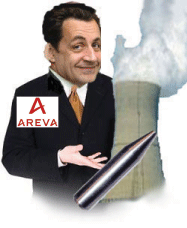
Nuclear projects on the agenda for Zuma’s French visit Cape Town, South Africa –— ESI-AFRICA.COM — 18 February 2011 – President Jacob Zuma of South Africa is to sign a €1billion agreement with the French Development Agency during a state visit to France next month, and it is understood that the deal could also touch on a pricey nuclear project. Continue reading

Delay for AREVA’s uranium mine in Namibia
Areva uranium mine in Namibia delayed, Bloomberg, Feb 17, 2011 By The Associated Press WINDHOEK, Namibia — French nuclear giant Areva says the opening of its $1 billion uranium mine in Namibia has been delayed again because the project is so complex.The company recently announced that commercial production, which was initially planned to start last year and then pushed to 2012, is now expected to start in 2013…….Areva uranium mine in Namibia delayed – Bloomberg

Paladin uranium company troubled by disruptions in Malawi
Paladin cuts uranium production forecast at Kayelekera The Australian, Ross Kelly Dow Jones Newswires * January 21, 2011 URANIUM miner Paladin Energy today downgraded its annual production guidance after disruptions at its Kayelekera mine in Malawi……Paladin cuts uranium production forecast at Kayelekera | The Australian
History of Congo’s atrocities tied to USA and atomic bombs
the US acquired a strategic stake in the enormous natural wealth of the Congo, following its use of the uranium from Congolese mines to manufacture the first atomic weapons, the Hiroshima and Nagasaki bombs..
Patrice Lumumba: the most important assassination of the 20th century, Georges Nzongola-Ntalaja |guardian.co.uk, 18 Jan 2011, The US-sponsored plot to kill Patrice Lumumba, the hero of Congolese independence, took place 50 years ago today. Continue reading
Assassination of Patrice Lumumba – the role of uranium
Congo’s production of weapons-grade uranium vastly raised the stakes for the United States, which had used Congolese uranium to build the two atomic bombs dropped on Japan in 1945…….
War-crimes charges to be filed 50 years after Lumumba’s assassinationm Google hostede news, The Canadian Press:, By Slobodan Lekic (CP) – 18 Jan 2011, BRUSSELS — Activists plan to file a civil suit alleging war crimes by a dozen former Belgian officials they say participated in the assassination of Congolese prime minister Patrice Lumumba 50 years ago, Continue reading
Nuclear energy a bad idea for Kenya
“The government can explore alternative sources of energy but the last place we want to go as Kenyans is towards nuclear energy,”


Kenya not ready for nuclear energy project: lobby, Daily Nation, 29 Dec 10, An environmental lobby has faulted the quest for nuclear energy. We do not have the capacity to secure nuclear energy plants… Our country does not even have the capacity to secure its borders leave alone engaging in such a toxic and a lethal enterprise,” said Prof Karanja Njoroge, the executive director of the Green Belt Movement.
The group was founded by the 2004 Nobel Peace laureate. Prof Wangari Maathai. Continue reading
Off-grid small scale solar energy in huts in Africa
There is no reliable data on the spread of off-grid renewable energy on a small scale, in part because the projects are often installed by individuals or tiny nongovernmental organizations…Part of the problem is that the new systems buck the traditional mold, in which power is generated by a very small number of huge government-owned companies that gradually extend the grid into rural areas. Investors are reluctant to pour money into products that serve a dispersed market of poor rural consumers
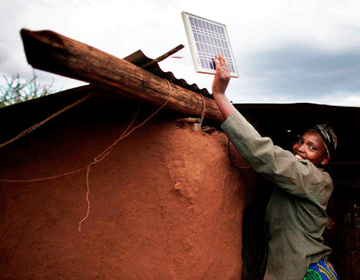
 Beyond Fossil Fuels African Huts Far From the Grid Glow With Renewable Power – NYTimes.com, by Elisabeth Rosenthal 27 Dec 10, “………As small-scale renewable energy becomes cheaper, more reliable and more efficient, it is providing the first drops of modern power to people who live far from slow-growing electricity grids and fuel pipelines in developing countries. Although dwarfed by the big renewable energy projects that many industrialized countries are embracing to rein in greenhouse gas emissions, these tiny systems are playing an epic, transformative role. Continue reading
Uranium industry in Africa fraught with corruption and poor safety
Wikileaks: Africa Offers Easy Uranium Global Issues by Julio Godoy (paris) December 25, 2010 Wikileaks cables have revealed a disturbing development in the African uranium mining industry: abysmal safety and security standards in the mines, nuclear research centres, and border customs are enabling international companies to exploit the mines and smuggle dangerous radioactive material across continents. Continue reading
Kenya’s people to get greeenwash, (?brainwash) on nuclear power
the commission to carry out a national campaign to educate Kenyans on nuclear energy……“We want to educate Kenyans what nuclear power is all about and remove those psychological negativities in minds of Kenyans,”…..The use of nuclear energy….. faces negative public perception largely due to safety and security issues……
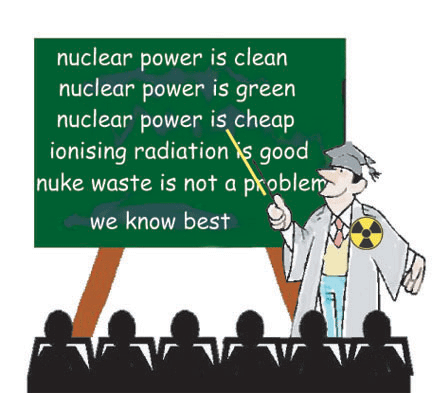
Ministry gives team Sh300m to lead push for nuclear energy. Daily Nation: By KABURU MUGAMBI , December 20 2010 The government has given the newly appointed Nuclear Electricity Project Committee Sh300 million to start work. Continue reading
1 This Month
10 March A LIVE WEBINAR THE REAL EFFECTS OF NUCLEAR POWER
What the Industry Isn’t Telling Us
1:00 PM Mountain, 2 pm Central, 3 pm Eastern. Live on the Keepers of the Water Facebook page



18 March Webinar @ 1 PM EST: An Assessment of SMR Projects: The Case of Canada
register for the zoom:
https://us02web.zoom.us/webinar/register/WN_o8BIIOUvQ2ONJR1nta65DQ#/registration


of the week – STOP SMALL MODULAR REACTORS IN CANADA
To see nuclear-related stories in greater depth and intensity – go to https://nuclearinformation.wordpress.com
-
Archives
- March 2026 (99)
- February 2026 (268)
- January 2026 (308)
- December 2025 (358)
- November 2025 (359)
- October 2025 (376)
- September 2025 (258)
- August 2025 (319)
- July 2025 (230)
- June 2025 (348)
- May 2025 (261)
- April 2025 (305)
-
Categories
- 1
- 1 NUCLEAR ISSUES
- business and costs
- climate change
- culture and arts
- ENERGY
- environment
- health
- history
- indigenous issues
- Legal
- marketing of nuclear
- media
- opposition to nuclear
- PERSONAL STORIES
- politics
- politics international
- Religion and ethics
- safety
- secrets,lies and civil liberties
- spinbuster
- technology
- Uranium
- wastes
- weapons and war
- Women
- 2 WORLD
- ACTION
- AFRICA
- Atrocities
- AUSTRALIA
- Christina's notes
- Christina's themes
- culture and arts
- Events
- Fuk 2022
- Fuk 2023
- Fukushima 2017
- Fukushima 2018
- fukushima 2019
- Fukushima 2020
- Fukushima 2021
- general
- global warming
- Humour (God we need it)
- Nuclear
- RARE EARTHS
- Reference
- resources – print
- Resources -audiovicual
- Weekly Newsletter
- World
- World Nuclear
- YouTube
-
RSS
Entries RSS
Comments RSS
 nuclear-news