Serious obstacles to South Africa’s nuclear power plans
South Africa’s new nuclear challenges, Mail and Guardian Africa 15 FEB 2013 LYNLEY DONNELLY South African authorities will have to address two critical issues as the country faces signing for its new nuclear procurement megaplan. Funding and human resources capacity are two of the biggest challenges confronting any country embarking on a nuclear energy programme, according to Yukiya Amano, director general of the International Atomic Energy Agency.
These are two critical issues that South African authorities will have to address as the country faces signing on the dotted line for its new nuclear procurement megaplan for six nuclear power stations by 2030. Funding was a “difficult issue” for the nuclear industry everywhere, said Amano, who was on a brief tour of South Africa last week…… Continue reading
Uranium mining companies might not be able to rip off African countries any more
it’s not acceptable” that Niger’s most
valuable export only contributes about 5 percent to the nation’s
annual budget.
Increased revenue for Niger may come in the form of more mining
taxes, royalties or even a stake in AREVA; any of those options would
lower returns for investors and discourage future investment
Investment analysts are advising those with resource investments in
Mali to get out while they can
 Mali, Niger Unrest Highlights Need for Uranium Asset Diversification
February 14, 2013, By Melissa Pistilli Uranium Investing News
France’s military intervention in Mali, its former West African
colony, highlights industrialized nations’ supreme need to secure
access to economically strategic assets — in France’s case, uranium.
That theme will increasingly be seen playing out on the world stage
over the coming years. Continue reading
See this: low cost boadband Internet – solar powered – for rural Africa
 Video: Microsoft Providing Low-Cost, Solar-Powered Broadband Access In Africa http://www.energymatters.com.au/index.php?main_page=news_article&article_id=3595 15 Feb 13, Early this month, Microsoft Corp announced the launch of a pilot project delivering low-cost wireless broadband access in parts of Kenya via solar-powered base stations.
A project carried out in collaboration with the government of Kenya’s Ministry of Information and Communications and Indigo Telecom Ltd., the network utilizes TV white spaces to carry broadband signals to previously unserved locations near Nanyuki and Kalema. The project is the first deployment of TV white space technology in Africa.
TV white spaces are well-suited for delivering low-cost broadband access as radio signals in the TV bands can be transmitted over longer distances and penetrate more obstacles than other types of radio signals. As a result, fewer base stations are required.
Microsoft says that as television has begun to switch from analog to digital around the world, even more of this spectrum can be used to relay broadband.
More than 6,000 people will benefit from the project; which is part of theMicrosoft 4Afrika Initiative. In addition, solar power systems with deep cycle battery energy storage will be installed at local schools to supply electricity to their Information & Communication Technology (ICT) labs. Each system will generate 4.5 kilowatt hours (kWh) of energy per day, which should provide a small surplus of power above what is required for each lab.
While 4.5 kilowatt hours doesn’t sound like a great deal, it will be sufficient for students to use tablets and eReaders in the labs.
“Solar power addresses the issue of reliability in developing economies and carries low operating costs since panels last a long time and batteries can function for up to three years,” says a statement from Microsoft.
“That makes solar an increasingly affordable way to deliver power, especially in areas that lack infrastructure for both electricity transmission and broadband access.”
Small scale solar energy will revolutionise Ghana’s rural communities
Solar energy to power rural electricity launched, Ghana Business News, February 10, 2013 A new life changing solar energy system aimed at augmenting rural electricity power generation using the sun’s direct energy has been launched in Accra.
Dubbed Solar2Africa400, the system consists of a portable folding solar panel, a cable, a connector and a 400-watt power inverter.
It is aimed at responding to the growing demand for off-grid electrification solutions and support government’s efforts at cutting down the cost of extending the national grid to island and lakeside communities.
The innovation was born out of collaboration between Power for Africa, a United Kingdom based company, which designed the system for developing countries such as Ghana and Gem Technologies, a Ghanaian company. Continue reading
Niger gets a poor deal from AREVA’s uranium mining
 In Niger, New Disputes Over French Uranium Extraction International Business Times, 6 Feb 13, “....no wonder Paris sent its own special security forces to Niger this week to protect a French-operated uranium mine there.
But mineral resources have long been a touchy subject in Niger, and the extra security has generated some controversy as to whether foreign investors have dealt a fair hand to the country’s 16 million people.
“Uranium is really a crucial point of contention,” said Leonardo A. Villalón, an associate professor at the University of Florida and expert on the Sahel, the band of semi-arid land just south of the Sahara Desert. “The notion of exactly who benefits from the resource is the central question of political economy in Niger.”….. President Mahamadou Issoufou suggested on Sunday that Nigeriens are getting the short end of the stick…..
The exact details regarding Areva’s current dealings with Niger are murky. …. Areva did not respond to requests for comment regarding its current agreement with the Nigerien administration….. http://www.ibtimes.com/niger-new-disputes-over-french-uranium-extraction-1064546
Yes, France is fighting in Mali on behalf of AREVA’s uranium mines
France protects Niger uranium mine BBC News, 4 Feb 13, Niger has confirmed that French special forces are protecting one of the country’s biggest uranium mines. President Mahamadou Issoufou told French media that security was being tightened at the Arlit mine after the recent hostage crisis in Algeria. French company Areva plays a major part in mining in Niger – the world’s fifth-largest producer of uranium.
Islamist militants kidnapped five French workers from the mine in Arlit three years ago. Four of them are still being held – along with three other French hostages – and it is believed they could be in the north of Mali close to where French troops are battling al-Qaeda-linked militants.
Asked if he could confirm that French special forces were guarding the uranium mine, President Issoufou told channel TV5: “Absolutely I can confirm. ”We decided, especially in light of what happened in Algeria… not to take risks and strengthen the protection of mining sites,” he added.
France’s Agence France-Presse news agency said a dozen French special forces reservists were strengthening security at the site.Areva gets much of its uranium from the two mines it operates in the country, at Arlit and Imouraren… http://www.bbc.co.uk/news/world-africa-21318043
France wants to hang on to control of uranium resources in Mali
beneath
the deserts in Northern Mali and Eastern Niger, territory now
exclusively claimed by the nomadic Tuareg tribes, exists the world’s
third largest uranium reserves as well as substantial oil reserves.
“Paris has cultivated the dependency
of their former colonies by hand-picking weak regimes that gave them
access to resources,”
Is the French Invasion of Mali tied to a Colonial War for Uranium? By
Saeed Shabazz Global Research, January 30, 2013 There is still
confusion in UN corridors concerning France’s military intervention in
Northern Mali, which began on Jan. 11 with air strikes against the
so-called Islamist camps moving closer to the capital city of Bamako. Continue reading
Australian uranium companies use taxpayer funds to set up overseas aid, and look good
Paladin, which has been the subject of some controversy in Malawi over job cuts, was last year linked to a funding application through its employees’ charity – Friends and Employees of Paladin for African Children.
Paladin’s (African) Ltd general manager, international affairs, Greg Walker, who was invited late last year to be Australia’s honorary consul to Malawi, was involved in the process, according to 2012 correspondence from Australia’s ambassador to Zimbabwe, Matthew Neuhaus, to Mr Walker. The letter obtained under freedom of information confirmed Mr Walker’s successful application for the employees’ charity funding proposal.
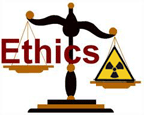 The Aidwatch director Thulsi Narayanasamy said it was not the place of the Australian aid program to fund the corporate social responsibility programs of wealthy mining companies.
Firms use tax money for aid projects : http://www.smh.com.au/money/tax/firms-use-tax-money-for-aid-projects-20130129-2ditd.html#ixzz2Jbp0RzOT January 30, 2013 Rory Callinan
WEALTHY resource companies operating overseas are tapping into Australian taxpayer funds to set up aid projects potentially benefiting their corporate social responsibility credentials.
Aid and mining watchdogs have expressed concerns about the practice, arguing the corporations are wealthy enough to bankroll their own aid and that linking donations to controversial mine operations is a conflict of interest.
Nine mining companies all operating in Africa have been linked to the successful applications via the Foreign Affairs Department’s Direct Aid Program – a scheme that allows heads of missions to give up to $30,000 to local causes.
About $215,000 of taxpayers’ money went to the mining company-conceived projects last financial year, including a school for the deaf, providing trade skill training to local workers, establishing women’s groups and digging wells. Two applications involved uranium mining companies, Paladin Energy in Malawi and Bannerman Resources in Namibia. Continue reading
France’s military in Niger to protect AREVA’s uranium mines
 France orders special forces to protect Niger uranium: source PARIS Jan 24, 2013 (Reuters)– France has ordered special forces to protect uranium sites run by state-owned Areva in Niger as the threat of attacks on its interests rises after its intervention against rebels in Mali, a military source said on Thursday Reporting by John Irish, Geert de Clercq, Muriel Boselli, Michel Rose in Paris and Abdoulaye Massalatchi in Niamey; …….
The military source confirmed a report in weekly magazine Le Point that special forces and equipment would be sent to Areva’s uranium production sites in Imouraren and Arlit very quickly, but declined to go into further details.
Defense ministry officials declined to comment on the report and Areva said it did not talk about security issues….
Areva, Niger’s biggest single investor, has about 2,700 workers in Niger and is planning to start up a third mine in Imouraren.
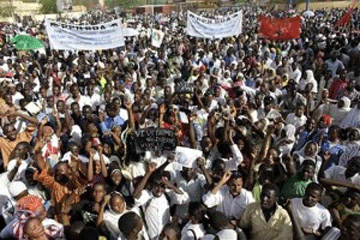 The planned startup of production in Imouraren was delayed to 2013 or 2014 from 2012, following the kidnappings and a labor dispute.
A Niger army officer said that there were already security arrangements agreed with France since 2011 after the kidnappings in Arlit and they had been reinforced over time.
“We also have our counter-terrorism units in the Agadez region,” he said. “For now, I don’t know of a decision by the Nigerien government to allow French special forces to base themselves in the north.”
An Areva spokeswoman said this month the French government had not asked the company to reduce staffing in Niger. She added Areva has an extensive security plan for its employees and that the plan has been reviewed by the French authorities.
Areva has been mining uranium in Niger for more than five decades and the country provides one third of the group’s uranium supplies.
According to a parliamentary committee enquiring into France’s supplies of uranium, about 18 percent of the raw material used to power France’s 58 nuclear reactors came from Niger in 2008…. http://www.reuters.com/article/2013/01/24/us-mali-rebels-niger-areva-idUSBRE90N0OD20130124
Re-colonisation of Africa in grab for uranium and other resources
it’s a uranium issue and how France needs uranium there. And Mali is a big producer of uranium. There are resources there. So, I think France – this is very clear – has economic reasons.
‘Al-Qaeda threat used by NATO as smoke screen for re-colonization of Northern Africa’, RT 21 Jan 13, The UK is providing logistical air assistance, while the United States is providing surveillance and other intelligence help.
Washington also announced it will supply transport planes for French forces and consider sending refueling tankers for French warplanes.
Canada has joined with the allies to support the on-going military intervention by dispatching a heavy-lift military transport. The country is also making an indirect contribution by training counter-terrorism operatives in neighboring Niger.
Italy is ready to offer logistical support for air operations, but it will not be joining French troops on the ground. The country’s defense Minister Giampaolo Di Paola told the Senate on Wednesday that Italy’s offer was confined to air operations only.
Journalist Neil Clark told RT he believed economic reasons were behind every single western military adventure of the last 30 years – and Mali was no different. Continue reading
In the West’s grab for resources, it’s convenient to blame Al Qaeda
RT: Africa has plenty of untapped natural resources. Which countries appear most interested in securing and possibly expanding their interests there? And how could those interests clash?
NC: Very possibly, because I think obviously France from Mr. Hollande’s point of view – their economy is in a very bad state in France – and I think that he is hoping that a successful intervention in Mali would boost his popularity ratings back home. So, it’s a uranium issue and how France needs uranium there. And Mali is a big producer of uranium.
the west wants resources, the west wants to get control of resources in this region
‘Al-Qaeda threat used by NATO as smoke screen for re-colonization of Northern Africa’, RT 21 Jan 13,
The UK is providing logistical air assistance, while the United States is providing surveillance and other intelligence help. Continue reading
In Mali – a war for grabbing resources – especially uranium
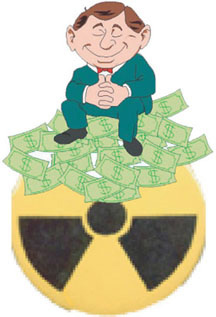 Uranium: encouraging signs and exploration in full swing. Exploration is currently being carried out by several companies with clear indications of deposits of uranium in Mali. Uranium potential is located in the Falea area which covers 150 km² of the Falea- North Guinea basin, a Neoproterozoic sedimentary basin marked by significant radiometric anomalies. Uranium potential in Falea is thought to be 5000 tonnes. The Kidal Project, in the north eastern part of Mali, with an area of 19,930 km2, the project covers a large crystalline geological province known as L’Adrar Des Iforas. Uranium potential in the Samit deposit, Gao region alone is thought to be 200 tonnes.
The War on Mali What You Should Know: An Eldorado of Uranium, Gold, Petroleum, Strategic Minerals SPY GhanaBy 4thmedia.org R. Teichman, News Beacon Ireland, 17 Jan 13
The French government has stated that: …… We have one goal. To ensure that when we leave, when we end our intervention, Mali is safe, has legitimate authorities, an electoral process and there are no more terrorists threatening its territory.” [1]
So this is the official narrative of France and those who support it. And of course this is what is widely reported by the mainstrem media.
France is supported by other NATO members. US Defense Secretary Leon Panetta confirmed that the US was providing intelligence to French forces in Mali. [2] Canada, Belgium, Denmark and Germany have also publicly backed the French incursion, pledging logistical support in the crackdown on the rebels. [3]
If we are to believe this narrative we are misled again about the real reasons. A look at Mali’s natural resources reveals what this is really about. Continue reading
It’s the uranium, stupid! France’s war in Mali
Although Niger has been France’s primary uranium trading partner in the region, investors are currently estimating 5,200 tonnes of untapped uranium sources in Mali, making the requirements of a favourable government and a suppressed civil society all the more urgent.
The curbs on civil liberties in the West which the so-called War on Terror forces upon citizens is part of the same struggle that activists in West Africa are fighting against uranium mining corporations
Blood for Uranium: France’s Mali intervention has little to do with terrorism http://ceasefiremagazine.co.uk/blood-uranium-frances-mali-intervention-terrorism/ Adam Elliott-Cooper looks at the geo-strategic and economic interests shaping the current French intervention in Mali. 17 Jan 13, France opened 2013 with a series of airstrikes on Northern Mali to prevent “the establishment of a terrorist state”. At the time of writing, 11 civilians (including two children) have been killed, and according to the UN, an estimated 30,000 have been displaced. The morbid irony of the France’s leaders bombing people in order to prevent a “terrorist state” appears to be lost on them, but this may be due to their eyes being on something far more important – Mali’s economy. (Picture: Activists in Niger protesting uranium mining company AREVA) Continue reading
War in Mali – to preserve France’s control of uranium resources?
 French mining company Areva, had lost its almost complete exclusive right to Niger’s uranium. This could easily explain why France could not afford to lose Mali as well.
On Monday, French foreign minister Laurent Fabius said… Key interests were at stake for us, for Africa, for Europe, so we had to act quickly,” said Fabius. Could one of the key interests mentioned by Mr. Fabius be uranium?
Uranium is indeed France’s key energy resource… , the country is heavily dependent on uranium..
Mali: France’s Neo-Colonial War for Uranium? News Junke Post, By Gilbert Mercier 15 Jan 13 In late December 2012, the United Nations Security Council approved the dispatch of an “African-led intervention force” to Mali’s to help the army reconquer the north of the country from Tuareg separatists and their allied Islamist militants. But in recent days, it is not the African-led troops who have been operating in Mali. Instead, troops from former colonial power France have been unilaterally deployed to fight the rebellion in the north….
Recipe for a failed state Continue reading
South Africa – a voice for nuclear weapons sanity
 Exiting the nuclear club
http://amanpour.blogs.cnn.com/2013/01/09/exiting-the-nuclear-club/ The
world believes that Iran, despite its denials, is trying to join the
handful of nations around the world that possess nuclear weapons.
 Over the past two decades, that list of countries has been growing,
with nations like Pakistan and India publicly acknowledging their
nuclear weapons.
There has been just one exception.
Just as Nelson Mandela was emerging from prison over 20 years ago to
lead South Africa out of the wilderness of racial hatred, his country
was in the midst of another change that could be a model for the rest
of the world.
By 1991, the Rainbow Nation had become the only country to dismantle
and destroy its own nuclear arsenal. That decision, along with the end
of apartheid, helped restore South Africa’s international legitimacy.
It also made the country a leading voice for nuclear sanity.
Today, South Africa’s weapons-grade uranium left over from the
apartheid era is being turned into medical isotopes that can detect
cancer and other diseases.
Swords into plowshares.
1 This Month

26 September – International Day for the Total Elimination of Nuclear Weapons


PLEASE OPPOSE HR 8255 AND S.3639 – bills would accelerate satellite deployment, with no environmental review or safeguards – https://ncstd5li.quorum.us/campaign/169331/
To see nuclear-related stories in greater depth and intensity – go to https://nuclearinformation.wordpress.com
-
Archives
- September 2026 (206)
- August 2026 (330)
- July 2026 (355)
- June 2026 (287)
- May 2026 (306)
- April 2026 (356)
- March 2026 (251)
- February 2026 (267)
- January 2026 (308)
- December 2025 (358)
- November 2025 (359)
- October 2025 (375)
-
Categories
- 1
- 1 NUCLEAR ISSUES
- business and costs
- climate change
- culture and arts
- ENERGY
- environment
- health
- history
- indigenous issues
- Legal
- marketing of nuclear
- media
- opposition to nuclear
- PERSONAL STORIES
- politics
- politics international
- Religion and ethics
- safety
- secrets,lies and civil liberties
- spinbuster
- technology
- Uranium
- wastes
- weapons and war
- Women
- 2 WORLD
- ACTION
- AFRICA
- Atrocities
- AUSTRALIA
- Christina's notes
- Christina's themes
- culture and arts
- Events
- Fuk 2022
- Fuk 2023
- Fukushima 2017
- Fukushima 2018
- fukushima 2019
- Fukushima 2020
- Fukushima 2021
- general
- global warming
- Humour (God we need it)
- Nuclear
- RARE EARTHS
- Reference
- resources – print
- Resources -audiovicual
- Weekly Newsletter
- World
- World Nuclear
- YouTube
-
RSS
Entries RSS
Comments RSS
 nuclear-news