France’s Orano loses operating licence at major uranium mine in Niger.
Niger has removed the mining permit of French nuclear fuel producer Orano
at one of the world’s biggest uranium mines, the company said Thursday,
highlighting tensions between France and the African country’s ruling
junta.
RFI 21st June 2024
Kenya’s first nuclear plant: why plans face fierce opposition in country’s coastal paradise

Unease and anger are rising over proposals to build country’s first facility on Kilifi coast, home to white sand beaches, coral reefs and mangrove swamps
Guardian, By Caroline Kimeu in Kilifi, 17 June 24
Kilifi County’s white sandy beaches have made it one of Kenya’s most popular tourist destinations. Hotels and beach bars line the 165 mile-long (265km) coast; fishers supply the district’s restaurants with fresh seafood; and visitors spend their days boating, snorkelling around coral reefs or bird watching in dense mangrove forests.
Soon, this idyllic coastline will host Kenya’s first nuclear plant, as the country, like its east African neighbour Uganda, pushes forward with atomic energy plans.
The proposals have sparked fierce opposition in Kilifi. In a building by Mida Creek, a swampy bayou known for its birdlife and mangrove forests, more than a dozen conservation and rights groups meet regularly to discuss the proposed plant.
“Kana nuclear!” Phyllis Omido, an award-winning environmentalist who is leading the protests, tells one such meeting. The Swahili slogan means “reject nuclear”, and encompasses the acronym for the Kenya Anti-Nuclear Alliance who say the plant will deepen Kenya’s debt and are calling for broader public awareness of the cost. Construction on the power station is expected to start in 2027, with it due to be operational in 2034.
“It is the worst economic decision we could make for our country,” says Omido, who began her campaign last year.
A lawsuit filed in the environmental court by lawyers Collins Sang and Cecilia Ndeti in July 2023 on behalf of Kilifi residents, seeks to stop the plant, arguing that the process has been “rushed” and was “illegal”, and that public participation meetings were “clandestine”. They argue the Nuclear Power and Energy Agency (Nupea) should not proceed with fixing any site for the plant before laws and adequate safeguards are in place. Nupea said construction would not begin for years, that laws were under discussion and that adequate public participation was being carried out. Hearings are continuing to take place.
In November, people in Kilifi filed a petition with parliament calling for an inquiry. The petition, sponsored by the Centre for Justice Governance and Environmental Action (CJGEA), a non-profit founded by Omido in 2009, also claimed that locals had limited information on the proposed plant and the criteria for selecting preferred sites. It raised concerns over the risks to health, the environment and tourism in the event of a nuclear spill, saying the country was undertaking a “high-risk venture” without proper legal and disaster response measures in place. The petition also flagged concerns over security and the handling of radioactive waste in a nation prone to floods and drought. The senate suspended the inquiry until the lawsuit was heard.
………………..Peter Musila, a marine scientist who monitors the impacts of global heating on coral reefs, fears that a nuclear power station will threaten aquatic life. The coral cover in Watamu marine national reserve, a protected area near Kilifi’s coast, has improved over the last decade and Musila fears progress could be reversed by thermal pollution from the plant, whose cooling system would suck large amounts of water from the ocean and return it a few degrees warmer, potentially killing fish and the micro-organisms such as plankton, which are essential for a thriving aquatic ecosystem
It’s terrifying,” says Musila, who works with the conservation organisation A Rocha Kenya. “It could wreak havoc.”
At Mida, those making a living from the land and sea, including workers in tourism, fishers and several dozen beekeeping groups and butterfly farmers around Arabuko-Sokoke Forest, have concerns about their futures. The forest is a Unesco biosphere reserve.
Justin Kenga, 51, a tour operator from the town of Watamu, who has worked in the industry for decades, says: “In tourism, we depend on the biodiversity around us – our tourists are very conscious about the environment – so anything that can alter or destruct our environment, it will destroy our livelihoods.”…………………………………………………………………………………………………………………
……..tensions between anti-nuclear activists and the government are growing. The UN special rapporteur on human rights defenders, Mary Lawlor, expressed concern over police violence against people in Uyombo, a potential plant site, during a protest in April. Activists said their peaceful protest was met with excessive violence, beatings, arrests and intimidation………………………………………. https://www.theguardian.com/global-development/article/2024/jun/17/kenya-plans-first-nuclear-power-plant-kilifi-opposition-activists
From the Hiroshima bomb to Israel’s nuclear weapons, the path leads back to Congo’s uranium
Conspiracies in the Congo Linda Pentz Gunter 16 June 24 https://beyondnuclearinternational.org/2024/06/16/conspiracies-in-the-congo/
It involved the Democratic Republic of Congo (DRC); a Belgian mining company; a fictitious Liberian trading company; a German-named ship — the Scheersberg A; a Spanish crew; a German petrochemical official; an Italian paint company; an Israeli freighter; the Greek island of Crete; a Turkish port; and a confession made in Norway.
If this sounds like the plot for an elaborate work of fiction, it was — it formed the basis of Ken Follett’s 1979 thriller, Triple. But it was also all true. The clandestine operation, which took place in November 1968, smuggled an estimated 200 tonnes of uranium yellowcake out of the DRC, transporting it to Israel. It was orchestrated by Mossad, the Israeli secret intelligence service and came to be known as Operation Plumbat, since the illicit cargo was marked as lead.
The scheme was set in motion when, after the 1967 Arab-Israeli War, France curtailed its weapons supplies to Israel and likely the uranium fuel as well needed for Israel’s Dimona reactor, believed then and still to be at the heart of the country’s nuclear weapons program. The operation concluded with an exchange of ships and cargos on the high seas, the Scheersberg A eventually docking empty in Turkey while the uranium, now aboard an Israeli freighter, made its way to Haifa and eventually to Dimona.
The Plumbat operation was first exposed in April 1977 at a non-proliferation conference in Salzburg, Austria by Paul Leventhal, who went on to found the Nuclear Control Institute in 1981.
Israel officially denies that any of this took place, despite ample documentation and the later confession of one of its Mossad officers after his arrest in Norway. This was yet another bizarre twist in the tale when a Mossad operation in Lillehammer to assassinate one of the 1973 Munich Olympic attackers instead mistakenly took out an innocent Moroccan waiter on his way home from work. One of the agents, in order to prove to Norwegian authorities that he was indeed with Mossad, related the story of Operation Plumbat.
Of course, Israel also officially denies the existence of its nuclear weapons arsenal.
The uranium bound for Israel came from the Shinkolobwe mine in DRC’s Katanga province. The veins of uranium that run through Shinkolobwe bleed everywhere. And so do its victims.
The DRC is the site of the present day genocide that no one talks about. As many as six million people have now died in the ongoing fighting there, mostly over mineral rights. That long and bloody history began in the 1880s when the despotic Belgian king, Leopold II, enslaved and brutalized the country’s population, violence that continued under the subsequent Belgian government that took control in 1908.
The Belgians first began mining uranium at Shinkolobwe in 1921. In 1939, Albert Einstein, by then aware that a nuclear bomb could potentially be built and that Nazi Germany might be pursuing one, alerted President Roosevelt to the need for access to a rich uranium supply. The best such, Einstein said, could be found in what was then known as the Belgian Congo.
Once Nazi Germany had occupied Belgium in 1940, concerns grew that the uranium stockpiled at Shinkolobwe could fall into Hitler’s hands. A plan was quickly developed to ship 1,200 tons of uranium ore to the US where it was first stored on Staten Island and eventually transported to the Manhattan Project’s nuclear bomb factory at Los Alamos in New Mexico.
As recounted in Susan Williams’s non-fiction book, Spies in the Congo, US agents in various guises slipped in and out of the Congo, secretly shepherding the uranium back to the Manhattan Project. A second shipment of 1,000 tons of stockpiled ore soon followed. Wrote Williams, citing Gabrielle Hecht’s book, Being Nuclear, Africans and the Global Uranium Trade: “The miners sorted and packed up the uranium ore by hand and, according to estimates, they could have been exposed to a year’s worth of radiation in about two weeks.”
Seventy percent of the uranium in the Hiroshima atomic bomb came from Shinkolobwe and another ten percent was used in the plutonium bomb dropped on Nagasaki.
However, the colonialist skulduggery didn’t end there. When the DRC gained its independence in June 1960 and Patrice Lumumba became the country’s first democratically elected prime minister, Katanga province abruptly seceded from the country. In an effort to quell the rebellion, Lumumba appealed to the United Nations but was rebuffed. He then turned to the Soviet Union for help, sealing his fate.
The assassination of Lumumba on January 17, 1961 after barely six months in office, appears to have come on direct orders from President Eisenhower, officially out of concerns that Lumumba’s association with the Soviets would create a communist stronghold in the region.
But uranium was also at the heart of the plot and the US may not have acted alone. UK Labour Party peer, David Lea, reported in 2013 that a former MI6 operative, Daphne Park, told him she and MI6 orchestrated the assassination to protect the uranium supply. “Lumumba would have handed over the whole lot to the Russians,” said Park according to Lea.
All of these schemes and intrigues have come about at the price of peace and stability for the Congolese people. Contamination from the radioactive and heavy metals left behind at the mine site continues to poison people and the environment. Other minerals, especially cobalt and copper, have invited further plunder and conflict.
And there could soon be renewed interest in Shinkolobwe’s uranium. “At a time when many nations are engaged in an arms race, stockpiling weapons of mass destruction to prove their ‘strength’, Shinkolobwe mine still risks being seen as an attractive prospect,” wrote young Congolese climate activist, Remy Zahiga in a paper for the Heinrich Böll Stiftung.
Renewed interest may be coming from countries such as France (which inked a deal, thus far unexploited, in 2008) and China, eager to continue and expand their nuclear power programs under the false premise of climate mitigation. China already owns other mines in the DRC. “The existence of hidden entrances and ownership of all surrounding infrastructure would make the Shinkolobwe mine an attractive location should China decide to supplement its current uranium imports,” writes Daniel Allen in his 2024 paper, Uranium Security in the DRC.
And yet, the world looks away.
During an online event hosted by the Peace & Justice Project, an initiative of former UK Labour Party leader, Jeremy Corbyn, and his wife Laura Alvarez, Congo-born London councillor, Michelline Safi-Ngongo, asked with rightful indignation and somewhat rhetorically why the media never talked about the on-going genocide in her country?
The answer was sadly all too obvious, including to her. Black faces. Far away places. Africa, where these things “happen all the time”. Worthy of a shrug, then forgotten. When the West needs uranium or cobalt or copper, workers in the Congo and their families become suddenly expendable.
Linda Pentz Gunter is the international specialist at Beyond Nuclear and writes for and edits Beyond Nuclear International. You can learn more about the Congo’s uranium history in her forthcoming book, Hot Stories. Reflections from a Radioactive World, will be published in autumn 2024. https://beyondnuclearinternational.org/2024/06/16/conspiracies-in-the-congo/
Russia’s state-owned energy company Rosatom is drumming up new nuclear business in Africa
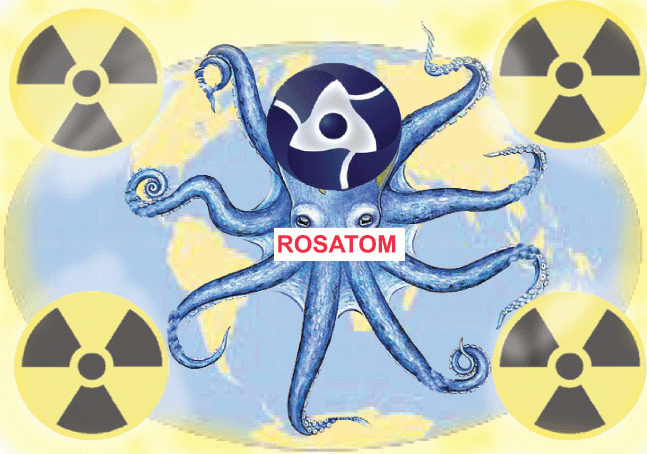
As the sabre-rattling over possible sanctions against Russia’s nuclear
industry intensifies, the country’s state-owned energy company Rosatom is
busily drumming up new business in Africa.
Last month, speaking at the
African Energy Indaba in Cape Town, Rosatom’s chief executive for central
and southern Africa, Ryan Collyer, urged the continent’s most
industrialised country, South Africa, to press go on its nuclear programme
to ensure “stable, affordable and environmentally friendly” power. It
was a message that resonated with South Africa’s energy minister Gwede
Mantashe, who said the country, which has been battling electricity
blackouts for the past 16 years, expects nuclear energy to be part of the
fix.
“The proposal to develop 2,500MW of nuclear power is not a dream —
there’s already an agreement, and the procurement capacity is being
worked on. We’re going to be investing in that capacity,” he told the
conference. While nuclear power provides about 10 per cent of electricity
generated globally, according to the Paris-based International Energy
Agency, the Koeberg plant in Cape Town is the only nuclear power station on
the African continent. Yet a number of African countries have announced
plans to build nuclear power plants in the past year — including Uganda,
Rwanda and Kenya.
FT 2nd April 2024
https://www.ft.com/content/4f1d0d1d-3a98-4b03-8771-54d88ed0a023
South Africa lodges Urgent Complaint with Int’l Court of Justice over Israel’s Plan to Assault Rafah
JUAN COLE, 02/14/2024
Ann Arbor (Informed Comment) – The South African government lodged an urgent complaint on Monday at the International Court of Justice against the plan announced by Israeli Prime Minister Binyamin Netanyahu to attack Rafah in southern Gaza, where 1.4 million people, most of them refugees from elsewhere, have been pushed by the Israeli military. So reports Siyabonga Mkhwanazi at Pretoria’s Independent On Line (IOL) (a consortium of South Africa newspapers).
The IOL says that President Cyril Ramaphosa confirmed Tuesday that South Africa has inquired with the ICJ whether it needs to issue another preliminary judgment to stop Israel’s planned offensive against Rafah. The Court is permitted to issue provisional orders at any time without having to convene to decide the case finally.
Lizeka Tandwa at the Mail & Guardian reports that the further submission to the court pointed out that “Rafah is the last refuge for the surviving people in Gaza.”
Vincent Magwenya, the spokesman for South African’s president, posted this statement to the presidency web site:
………………………………………………………………………https://www.juancole.com/2024/02/complaint-justice-israels.html
Do the Right Thing: Put the South African Government’s Nuclear Plans to a Popular Referendum
BY GERARD BOYCE, COUNTER PUNCH 5 Feb 24
Ever since South African Energy Minister Dr Kgosientsho Ramokgopa announced that Cabinet had approved the updated Integrated Resource Plan last December, local media has been awash with articles by nuclear supporters and sundry lobbyists exhorting politicians and government to ‘show true leadership’ and ‘do the right thing’ when it comes to nuclear power.
Invariably, doing so means showing unwavering support for the government’s plans to expand nuclear energy generation capacity by choosing the particular nuclear technology or reactor design favored by the author of the article being read or following the guidelines they helpfully drew up to assist policymakers by advising how they ought to proceed going about doing so, even if this means going against the recommendations of the presidentially-appointed panel of experts who sit on the Presidential Climate Commission or failing to address the numerous criticisms that have been leveled against government’s nuclear plans, prominent South African nuclear scientists among them. Presumably, depending on the responses these articles elicit, individual politicians would then be lauded for the leadership and courage they have shown or berated for their lack thereof.
It is curious, not to mention ironic, to hear such sentiments expressed by pro-nuclear supporters, especially those who have long attempted to portray the decision to ‘go nuclear’ as a self-evident outcome of a purely technical decision-making process that is obviously best left to ‘the experts’ i.e. appointed and unelected technocrats who are supposedly immune to political interference.
It is also somewhat misleading of them to characterize the decision to support the expansion of nuclear power capacity as one requiring ‘courage’ as such given the scant detail government has provided on its nuclear plans, the few general nuclear education and public awareness campaigns on nuclear power it has run within and outside of the communities in which it is proposed that reactors be located in future and the critical information related to its past nuclear dealings and the planned Koeberg life expansion project amongst others it has allegedly deliberately withheld from the public.
All of these combined result in persistent and extremely low public levels of knowledge of nuclear power and related issues, so much so that the general public appears ambivalent about the issue of nuclear power. This assessment seems to be supported by the persistently low turnout that is observed at the perfunctory public hearings which the government seemingly hosts to satisfy administrative requirements surrounding public participation in order to mitigate any potential for conflict to arise in the future rather than to genuinely engage the public’s views on nuclear power.
Subsequently, the organized anti-nuclear political movement nationally is under-resourced and the level of grassroots public support it enjoys is uncertain. Considering the limited organized opposition thereto and the general public’s nuclear indifference, none but the most biased observer would be reluctant to concede that the decision to champion nuclear power is unlikely to demand much by way of boldness or courage from the individual politician. More so since nuclear power, by its nature, accords so conveniently with the motivations of the average individual politician to amass more power and influence for themselves and members of their class and has the power to undermine the public oversight mechanisms and regulatory frameworks set up to monitor them. Yet perhaps the biggest reason why nuclear power is likely to appeal to representatives of SA’s major political parties especially is because it could enable their parties to navigate the political forces that assail them…………………………………………………………………………………………………………………………….
It is apparent from the scenarios described above that political imperatives dictate the adoption of a pro-nuclear position by politicians from all the major political parties in SA irrespective of the political ideologies they espouse or the content or merits of the specific nuclear plan under review. Under these circumstances, exhorting politicians to support nuclear power is akin to urging them to act to protect their party’s narrow political interests. One submits to the reader that this does not seem to be particularly brave or courageous.
In contrast, it would require a tremendous amount of courage for a politician to acknowledge and act on the insight that the distortions introduced by prevailing political considerations render it impossible for them to hold robust internal political debates on the issue of nuclear power, more so considering the increased frequency with which ostensible party comrades have resorted to using deadly methods to eliminate potential rivals. It is, therefore, naïve to rely on the party political system to formulate positions on nuclear power that are truly in the nation’s best interest.
……………………………………………… they could opt to support the right of every citizen to act with the courage and integrity nuclear supporters claim they want politicians to by calling upon the government to submit its nuclear plans to a popular referendum. In a country where citizens have become fed up by years of maladministration and corruption and large sections of the electorate are beginning to lose faith in the democratic system itself, this display of political courage would serve as definitive proof of the leadership credentials of the politician who wanted to ‘do the right thing’ by their compatriots.
Dr Gerard Boyce is an Economist and Senior Lecturer in the School of Built Environment and Development Studies at the University of KwaZulu-Natal (Howard College) in Durban, South Africa. He writes in his personal capacity. m https://www.counterpunch.org/2024/02/05/do-the-right-thing-put-the-south-african-governments-nuclear-plans-to-a-popular-referendum/
An international law expert explains why South Africa’s case at the ICJ is so important

A ruling by the International Court of Justice in favor of South Africa, which has accused Israel of genocide, could mean saving thousands of lives in Gaza. The alternative, however, could be devastating and further embolden Israeli violence.
BY YUMNA PATEL https://mondoweiss.net/2024/01/an-international-law-expert-explains-why-south-africas-case-at-the-icj-is-so-important/?fbclid=IwAR0_La2MT5GTGkKo2X56cAEa15B-SPBIOwKnMKznqzCczU0XVSIz_BlNrBE
South Africa and Israel will be appearing before the International Court of Justice, on Thursday, January 11, where the court will begin hearing arguments on whether Israel is committing the crime of Genocide.
The highly anticipated public hearings, which will last for two days, are based on an 84-page appeal submitted by South Africa in December to the ICJ, the top judicial body of the United Nations. In the appeal, South Africa argues that Israel’s military campaign in Gaza is “genocidal in character” and that through both action and intent to commit genocide, Israel has violated the 1948 Genocide Convention.
Both Israel and South Africa are parties to the convention, which came into being on the heels of World War II and the Holocaust. All signatories of the treaty are obligated not to commit genocide, to ensure that it is prevented, and to seek that the crime be prosecuted.
South Africa’s appeal to the ICJ, however, is not just about charging Israel with the crime of genocide – a lengthy process that could take the court months or years. It’s also seeking a more immediate solution by requesting the court institute provisional measures to immediately halt Israel’s military campaign in Gaza.
Essentially, South Africa wants two things: to stop the mass killing of Palestinians in Gaza now and for Israel to be charged with the crime of genocide in the long term. A condensed breakdown and explanation of the 84-page brief can be found here.
Expectedly, Israel has outright denied any accusations of genocide, lambasting the South African appeal as antisemtic “blood libel”. The U.S. has also rebuked South Africa’s appeal, called it “meritless” and “completely without any basis in fact.”
Nevertheless, Israel is pressing forward, sending a carefully crafted legal team to The Hague in the Netherlands to defend Israel’s position that it is not committing genocide in Gaza.
The much-talked about public proceedings, which will take place over the course of two days on Thursday and Friday, January 11th and 12th, are being welcomed by both Palestinians, as well as a number of countries around the world, who have thus far failed to bring about a ceasefire, primarily due to the U.S. veto of UN resolutions calling for a halt to the violence.
Despite the international buzz and anticipation, many in Palestine and around the world remain skeptical as to how much weight an ICJ ruling against Israel could hold due to a long history of Israeli impunity on the global stage and Israel’s well-documented disregard for international law and human rights norms.
Still, many Palestinian international law experts and human rights groups say the ICJ proceedings are significant and could hold serious consequences not only for Israel and Palestine but for the world.
Among them is Dr. Munir Nuseibah, a Palestinian professor of International law at Al-Quds University and the Director of the Al-Quds Human Rights Clinic. Mondoweiss spoke to Dr. Nuseibah about the significance of this case, why people should pay attention to it, and what implications it holds.
Why does this case matter?
The case filed by South Africa is important for a number of reasons. First, Dr. Nuseibah notes, the fact that it was filed at the ICJ in and of itself is significant, being that the court is the highest judicial body that settles disputes between states.
“This is quite significant because it’s… based on an agreement, or treaty that is binding to both South Africa and Israel,” he said, referring to the 1948 Genocide Convention.
“This is important in the history of the Palestinian cause, since we haven’t had an opportunity to get a binding international decision on any of the important questions that we have been dealing with, including for example, the issue of the Palestinian refugees, the [Israeli] occupation, etc,” Dr. Nuseibah continued.
The last time the ICJ made a decision in relation to Palestine was a 2004 advisory opinion that found Israel’s separation wall, which at that stage was still early on in its construction, violated international law and should be torn down.
However, because that decision was a non-binding advisory opinion, Israel was not obligated to stop construction or take down the wall. Instead, Israel continued constructing the wall, which today spans across hundreds of kilometers, cutting off Palestinians from their land and swallowing up swaths of Palestinian territory.
This case, Dr. Nuseibah says, would be different, as the resulting decision from this week’s proceedings would be binding, and if the court rules in favor of South Africa, it would mean that under international law, Israel would be obligated to end its military campaign in Gaza in the short term, and in the long term, potentially provide material reparations to the victims of its genocide.
The case is also significant as a symbolic measure as well. That, in the face of an ongoing genocide, which has been well documented by Palestinians and international human rights organizations alike, the world must intervene to stop it.
“If there is no serious intervention, and if the United Nations, the world, and what we call the international community is going to continue to be silenced and made inactive, and in a certain way deactivated and demobilized, this horror will continue,” Dr. Nusaibah said, not just in Palestine but around the world.
“To not only be accused of genocide, but to be charged by the court, and to be seen as a country guilty of genocide is very important,” he said. “In my opinion, everything that happens in the International Court of Justice now, is likely to influence thousands of lives in the future.
So whatever these judges will decide will actually be a question of life and death for many, many Palestinians.”
What will South Africa be arguing on Thursday?
The crux of South Africa’s argument is that Israel is committing genocide in Gaza and that it is violating its obligations under the 1948 Convention on the Prevention and Punishment of Genocide, which defines the crime as “acts intended to bring about the destruction of a substantial part of the Palestinian national, racial and ethnic group.”
South Africa’s argument hinges on proving that Israel is not only committing acts of genocide in Gaza but that there is a clear intent on Israel’s part to commit genocide – the latter being a significant focus of the 84-page brief, which listed off an array of quotes from Israeli politicians, officials, and public figures using genocidal language when speaking about Israel’s campaign in Gaza.
“[South Africa’s] first argument will involve the speeches and quotes basically from Israeli officials who have been using genocidal language from the very first day actually, from October 7th,” Dr. Nuseibah said.
“In criminal law it’s not enough to do something, but you have to intend to do something. And one of the signs of intent, are the things you say. So these quotes from Israeli officials will be used to show that Israel has been calling for genocide,” he continued.
And, of course, South Africa will be providing evidence of what it says are clear genocidal acts carried out by Israel in Gaza, such as “bombing civilians, heavily targeting homes, targeting hospitals, targeting cultural centers, targeting universities, schools, etc,” Dr. Nuseibah detailed.
“So all of these targets that the Israeli army has destroyed over the past months, and of course the civilian casualties, the human beings who have been murdered or injured or made disabled, [Israel] using hunger as a weapon, etc. – all of that will be a very important part of the facts South Africa will present,” he said, adding that the denial of fuel and electricity, the siege on 2 million civilians, and the forcible displacement of Palestinians in Gaza is also “an important element of genocide and especially in this case.”
What will Israel’s legal defense look like?
While there are 84 pages to give us an insight into South Africa’s case, it’s not as apparent what exactly Israel’s defense will consist of.
If the past few months have been any indication, however, during which Israel has denied any wrongdoing in Gaza, justified it as self-defense, and has actually accused Hamas of genocide for its October 7th attack – some assumptions can be made as to how Israel will approach it’s defense.
First, Israel’s primary strategy, Dr. Nuseibah says, will be to “deny, deny, deny.”
“Israel will deny everything that South Africa claims,” Dr. Nuseibah said. “It will deny that it has starved people, or that it is trying to starve people. It will deny that it is not allowing humanitarian aid into Gaza, by showing examples where it actually did allow some trucks to enter,” he continued, noting that what little humanitarian aid has been allowed into Gaza has been critically insufficient to address the needs of the more than 2 million people trapped in the strip.
“It [Israel] will talk about any attempts they made in any of their operations to ‘reduce civilian casualties’, whether by warning civilians in certain places,” Dr. Nuseibah said, referring to Israel’s practice of dropping leaflets to notify civilians that their area is going to be attacked, or by providing QR codes and maps of “safe zones” and “combat zones” in Gaza – all practices that have been widely criticized both as insufficient to save civilian lives, and as a PR move by Israel to save face in front of the international community.
At the time of publication, 96 days after Israel began its bombardment on Gaza, more than 23,000 Palestinians have been killed, the vast majority of them civilians.
“So, Israel’s strategy will be to deny everything, because there is nothing else they can do or say,” Dr. Nuseibah said. “It is a longtime strategy and practice of Israel that we are used to. Israel always denies its crimes. Even until today, Israel denies the Nakba, that is the official position of Israel, to deny it.”
While Israel has focused much of its propaganda campaign on accusing Hamas, and supporters of the Palestinian cause in general, of carrying out or advocating for the genocide of Israelis and Jewish people, Dr. Nuseibah said he doubts that will be a feature of Israel’s arguments at the ICJ.
“I doubt that they will do this or bring this up, because if they do, then they would have to present evidence. They would have to allow an open investigation into what happened on October 7th,” Dr. Nuseibah said, noting that Israel has historically prevented access to independent investigators seeking to probe potential crimes committed in the occupied Palestinian territory.
How will this impact Palestinian lives right now?
While the deliberations on whether Israel is guilty of genocide in Gaza or not could take years, South Africa’s case is expected to yield a much more immediate and time-sensitive result.
As part of its appeal to the court, South Africa is seeking an emergency interim decision by the court, or “provisional measures,” to order the Israeli military to cease its campaign in Gaza immediately, stop the displacement of Palestinians, and allow for the entry of adequate humanitarian aid into Gaza. The court could make that decision in as little as a few days or weeks.
These provisional measures, Dr. Nuseibah says, are some of the most critical elements to the case and have the biggest potential to change the course of the unfolding genocide in Gaza.
“This is very time sensitive. Every day that we lose, we are losing more lives. We are losing more casualties. There are more homes that are demolished. There are more days that children are not going to school,” he continued.”There is a lot of loss every single day of civilian life, and there is no human being in Gaza who is not heavily influenced by what is happening.”
“All of the provisional requests that South Africa has made are there to save lives immediately. And I do expect that the court will take these measures. History has shown that the ICJ has given these provisional measures in similar situations, even with less casualties and less risk,” Dr. Nuseibah said.
“So I do expect that the court will decide provisional measures, which would mean a ceasefire, which is the most important thing right now, as well as stopping the displacement, allowing for the entry of aid, and stopping the continuous demolition of Gaza.”
Israel has ignored international law before, what will be different this time?
Continue reading800+ Global Groups Back South Africa’s Genocide Case as ICJ Prepares for Hearing
byEDITORJanuary 9, 2024
“The very least states can do is to submit Declarations of Intervention as a small part of fulfilling their obligations under Article 1 of the Genocide Convention,” said a peace coalition.
SCHEERPOST, By Julia Conley / Common Dreams January 9, 2024
An international peace coalition announced Monday that more than 800 civil society organizations from across the globe have endorsed its sign-on letter distributed to world governments, urging leaders to join South Africa in formally accusing Israel of genocidal violence at the United Nations’ highest judicial body.
When Common Dreams first reported on the sign-on letter last Wednesday, just over 100 groups had joined the call.
The surge of support comes as the International Court of Justice (ICJ), also known as the World Court, is scheduled to hold a hearing on South Africa’s case on Thursday and Friday.
The International Coalition to Stop Genocide in Palestine (ICSGP)—which includes the National Lawyers Guild, the Black Alliance for Peace, World Beyond War, and Progressive International, among other groups—is calling on governments to “reinforce [South Africa’s] strongly worded and well-argued complaint by immediately filing a Declaration of Intervention” at the court.
The declarations could increase the likelihood that the ICJ sides with South Africa in the case, says the coalition.
In recent days, Turkey, Malaysia, and the Organization of Islamic Cooperation, which represents 57 member-states, have all endorsed South Africa’s 84-page claim, which details genocidal rhetoric in public statements made by high-level Israeli officials as well as the Israeli military’s actions in Gaza.
“The South African filing before the ICJ marks a critical juncture which tests the global will to salvage the laws and systems which were designed to safeguard not merely human rights, but to preserve humanity itself.”……………………………………………………………………………………………… more https://scheerpost.com/2024/01/09/800-global-groups-back-south-africas-genocide-case-as-icj-prepares-for-hearing/
Israel Is Terrified the World Court Will Decide It’s Committing Genocide
Public hearings on South Africa’s request for provisional measures will take place on January 11 and 12 at the ICJ which is located in the Peace Palace in The Hague, Netherlands. The hearings will be livestreamed from 4:00-6:00 a.m. Eastern/1:00-3:00 a.m. Pacific on the Court’s website and on UN Web TV. The court could order provisional measures within a week after the hearings.
Other States Parties to the Genocide Convention Can Join South Africa’s Case
South Africa, a party to the Genocide Convention, charged Israel with genocide in the International Court of Justice.
By Marjorie Cohn / Truthout, January 8, 2024, https://scheerpost.com/2024/01/08/israel-is-terrified-the-world-court-will-decide-its-committing-genocide/
For nearly three months, Israel has enjoyed virtual impunity for its atrocious crimes against the Palestinian people. That changed on December 29 when South Africa, a state party to the Genocide Convention, filed an 84-page application in the International Court of Justice (ICJ, or World Court) alleging that Israel is committing genocide in Gaza.
South Africa’s well-documented application alleges that “acts and omissions by Israel … are genocidal in character, as they are committed with the requisite specific intent … to destroy Palestinians in Gaza as a part of the broader Palestinian national, racial and ethnical group” and that “the conduct of Israel — through its State organs, State agents, and other persons and entities acting on its instructions or under its direction, control or influence — in relation to Palestinians in Gaza, is in violation of its obligations under the Genocide Convention.”
Israel is mounting a full-court press to prevent an ICJ finding that it’s committing genocide in Gaza. On January 4, the Israeli Foreign Ministry instructed its embassies to pressure politicians and diplomats in their host countries to make statements opposing South Africa’s case at the ICJ.
In its application, South Africa cited eight allegations to support its contention that Israel is perpetrating genocide in Gaza. They include:
(1) Killing Palestinians in Gaza, including a large proportion of women and children (approximately 70 percent) of the more than 21,110 fatalities and some appear to have been subjected to summary execution;
(2) Causing serious mental and bodily harm to Palestinians in Gaza, including maiming, psychological trauma, and inhuman and degrading treatment;
(3) Causing the forced evacuation and displacement of about 85 percent of Palestinians in Gaza — including children, the elderly and infirm, and the sick and wounded. Israel is also causing the massive destruction of Palestinian homes, villages, towns, refugee camps and entire areas, which precludes the return of a significant proportion of the Palestinian people to their homes;
(4) Causing widespread hunger, starvation and dehydration to the besieged Palestinians in Gaza by impeding sufficient humanitarian assistance, cutting off sufficient food, water, fuel and electricity, and destroying bakeries, mills, agricultural lands and other means of production and sustenance;
(5) Failing to provide and restricting the provision of adequate clothing, shelter, hygiene and sanitation to Palestinians in Gaza, including 1.9 million internally displaced persons. This has compelled them to live in dangerous situations of squalor, in conjunction with routine targeting and destruction of places of shelter and killing and wounding of persons who are sheltering, including women, children, the elderly and the disabled;
(6) Failing to provide for or ensure the provision of medical care to Palestinians in Gaza, including those medical needs created by other genocidal acts that are causing serious bodily harm. This is occurring by direct attacks on Palestinian hospitals, ambulances and other healthcare facilities, the killing of Palestinian doctors, medics and nurses (including the most qualified medics in Gaza) and the destruction and disabling of Gaza’s medical system;
(7) Destroying Palestinian life in Gaza, by destroying its infrastructure, schools, universities, courts, public buildings, public records, libraries, stores, churches, mosques, roads, utilities and other facilities necessary to sustain the lives of Palestinians as a group. Israel is killing whole families, erasing entire oral histories and killing prominent and distinguished members of society;
(8) Imposing measures intended to prevent Palestinian births in Gaza, including through reproductive violence inflicted on Palestinian women, newborns, infants and children.
South Africa cited myriad statements by Israeli officials that constitute direct evidence of an intent to commit genocide:
“Gaza won’t return to what it was before. We will eliminate everything,” Israel’s Defense Minister Yoav Gallant said. “If it doesn’t take one day, it will take a week. It will take weeks or even months, we will reach all places.”
Avi Dichter, Israel’s Minister of Agriculture, declared, “We are now actually rolling out the Gaza Nakba,” a reference to the 1948 ethnic cleansing of Palestinians to create the state of Israel.
“Now we all have one common goal — erasing the Gaza Strip from the face of the earth,” Nissim Vaturi, the Deputy Speaker of the Knesset and Member of the Foreign Affairs and Security Committee proclaimed.
Israel’s Strategy to Defeat South Africa’s Case at the ICJ
Continue reading4 east African countries are going for nuclear power – why this is a bad idea
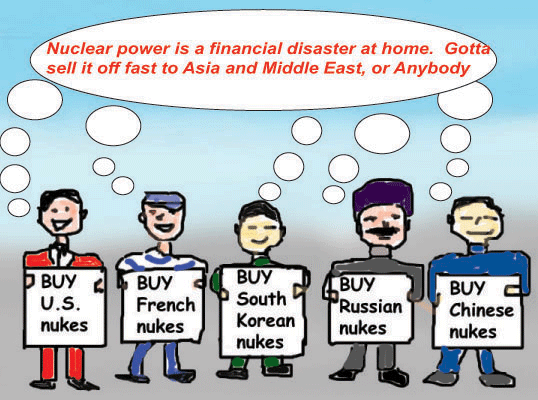
The Conversation, Hartmut Winkler, Professor of Physics, University of Johannesburg, 8 Dec 23
The east Africa region has the fastest growing population in Africa. Between 2013 and 2017, its growth rate was twice the African average. The region is also experiencing strong economic growth. It’s sub-Saharan share of GDP has risen from 14% in 2000 to 21% in 2022.
Such growth translates to higher electricity demand. Among a variety of new energy proposals is building nuclear power plants. Earlier this year, Uganda announced plans to construct a 2,000MW nuclear plant 150km north of Kampala, with the first 1,000MW operational by 2031. Rwanda also recently signed up to a deal to build a nuclear reactor, while Kenya and Tanzania have made more or less similar announcements.
It is in many ways tempting for these countries to pursue a nuclear power plant build. Even a single large-scale nuclear reactor would typically double national electricity generation capacity. In addition, it is technology that is – in theory at least – able to provide a constant electricity output independent of weather, season or time of day.
Another factor that motivates many potential entrants to nuclear power is that it has historically been perceived in many quarters as confirmation of high technological status and proof of national respectability. This is despite many of the world’s technologically and economically strongest nations now having shut down their nuclear plants. Germany and Italy are examples.
But there are several risks of choosing the nuclear path. The biggest in my view is financial. The costs of constructing, maintaining and later decommissioning a nuclear plant make this one of the most expensive forms of electricity generation. The actual cost is invariably a lot higher than originally announced.
Along with that, the construction period is usually many years longer than declared at the start.
In addition, safety issues can never be discounted when dealing with nuclear energy, as the 2011 Fukushima disaster in Japan amply illustrated………………………………………………………………………………..
East Africa’s likely future energy mix
In view of the financial risk and high cost, and as global experience has shown that it typically requires ten or more years to set up a new nuclear plant from project approval to electricity production, east African countries should pursue alternatives for electricity production.
New medium-scale solar, wind and geothermal power-generating facilities would likely dominate the expansion of east African electricity generation capacity in the coming decade as they are cheap in comparison. Typical construction timescales are also much lower than nuclear or hydro megaprojects.
………………………………………………………………… Given all these factors, investing in a large and expensive nuclear build with uncertain completion timeframes that may end up being way more expensive than projected is ultimately simply not worth it.
https://theconversation.com/4-east-african-countries-are-going-for-nuclear-power-why-this-is-a-bad-idea-218046
Risk of total shutdown of Eskom’s Koeberg nuclear power station continues to increase
The risk of both nuclear reactors at Eskom’s Koeberg nuclear power station in Cape Town being shut down simultaneously for life extension continues to increase…………………………………… (Subscribers only) https://www.dailymaverick.co.za/article/2023-10-20-koeberg-nuclear-power-station-rising-risk-of-total-shutdown/ #nuclear #antinuclear #nuclearfree #NoNukes
Film examines France’s nuclear history in Algeria
Documentary gives voice to villagers who lived through explosions and still suffer from deadly effects
Melissa Gronlund, Sep 29, 2023 https://www.thenationalnews.com/arts-culture/2023/09/29/france-algeria-atom-bomb/
etween 1960 and 1966, the French government detonated 13 atom bombs in the Algerian Sahara. The tests signalled France’s accession to the nuclear club and were hailed in Paris as a victory.
“Hoorah for France,” wrote President Charles de Gaulle the morning after the first blast, in a message to his army minister.
Little is known about the bomb’s effect in Algeria itself. According to a witness, 60 people died in 1962 after an explosion went wrong.
Inhabitants of the nearby village of Mertoutek say they were evacuated for 24hours and then told it was safe to return. More than 60 years later, they still say the land and water beneath it is contaminated. When they perform ablutions before prayers, for example, the water hurts their skin.
The international incident, which has been gaining exposure over the past few years, is the subject of a new short film And still, it remains by British filmmakers Arwa Aburawa and Turab Shah.
The husband and wife team had been thinking about how to represent the end of the world and the nuclear tests presented them with the example of a community who had – when they heard the detonations – believed the world was ending.
But when they began investigating the event, they realised there was only documentation of the French side of the story.
“[There was] nothing about the villagers themselves and absolutely nothing in terms of what happened next,” says Aburawa, who grew up in Manchester, UK, in a Palestinian family. “We were interested in the lack of perspective of people on the ground. How did they experience this moment, and then how did they experience life after that?”
Commissioned by the Liverpool Arab Arts Festival to look into how the climate crisis is affecting the Arab world, Aburawa and Shah spent two years researching the tests. In 2022, they travelled to the small village of Mertoutek.
Located in the foothills of the Hoggar Mountains, Mertoutek is profoundly isolated. Most of the villagers have never been to the nearest town, which is four hours away – itself a two-hour plane ride from Algiers. Most trace their ancestry to tribes from Mali and Niger who migrated to the village 400 years ago.
Aburawa and Shah were prepared to be ignored, but they were instead immediately welcomed. The villagers were keen to tell their side of history, the pair say, and were as interested in Aburawa and Shah as the filmmakers were in them and their stories.
Aburawa, who could communicate in Arabic with some of the elders of the village, was invited into gatherings with the women, who wanted to know how she celebrated her traditions as a Palestinian. Every morning, the young girls of the village would come by their house to see if she wanted to come herd the goats, she says, or to teach her their games.
The villagers ended up changing the shape of the film. Aburawa and Shah had initially been taken by the very poetic metaphor that followed the detonations – that the dust cloud of radioactive material travelled along the northern winds towards France, in effect returning to pollute the country that had perpetrated the tests.
“But when we visited Mertoutek, we learnt they have a long, long history. They told us how their families had been in the village for hundreds of years, and people before that for thousands of years,” says Aburawa.
“Suddenly, our concept of time and how to place a community’s experience in the moment massively shifted. We wanted to acknowledge that people have long histories and the land has an even longer history.”
And still, it remains treats the landscape as a main character. The pair filmed with a wide anamorphic lens in order to bring in more of the surroundings, and they pay attention to the sensory feel of life outdoors – fingers dig holes in the soft sand to create a board game; the wind whips painfully through spindly leaves.
Longer sequences give the sense of the world turning. In one stunning scene, the sky turns from bright, almost lurid orange to a faded pink, as the sun rises and the craggy mountains transform from outlines to legible sandstone edifices.
“What’s happening right now in the climate crisis and what happened in colonialism are so deeply connected,” says Aburawa. “They are both colonial mindsets of extraction and toxifying without thinking of the consequences.
“The situation in Algeria is saying, ‘You can’t escape these things. They don’t just disappear. A bomb exploded in the 60s, but it hasn’t gone away. It still remains with us.’ And that’s what inspired the title of the film.”
Today, the townspeople of Mertoutek still live in danger. At one point, one of the villagers recounts in the film that her father and some other men from the village went to the test site to take scrap metal to use for their gardens. The men all got sick. The recounter’s father got brain cancer and died.
“We asked them, did you ever think of leaving?” says Shah. “And they said, ‘But where would we go?’ There wasn’t anywhere for them to leave to. It was never an option.”
And still, it remains is showing at Lux in Waterlow Park, London, until October 14. More information is available at lux.org.uk
In Kenya, police break up an environmental meeting that was explaining nuclear hazards
by BRIAN OTIENO Correspondent, Coast Region 24 September 23 https://www.the-star.co.ke/counties/coast/2023-09-24-police-break-up-environmental-training-on-nuclear-reactor/
Police break up environmental training on nuclear reactor
The training was to enlighten the residents on the effects of a nuclear reactor.
In Summary
- Uyombo is a village next to the beach in Matsangoni, Kilifi county and has been earmarked to host Kenya’s first nuclear reactor.
- The residents and environmental activists however remain unconvinced and still maintain there is greater risk to their health than the benefits they will get from the reactor.
Environmental activists in Kilifi county have accused the government of trying to force a dangerous project on Uyombo residents.
Uyombo is a village next to the beach in Matsangoni, Kilifi county and has been earmarked to host Kenya’s first nuclear reactor.
On Thursday, the Centre for Justice, Governance and Environment Action organized the training to enlighten the residents on the effects of a nuclear reactor on the environment and how to best protect themselves from possible harm.
However, police disrupted the training before it even started and dispersed the residents who had gathered there.
They said the meeting was illegal.
On Sunday, CJGEA executive director Phyllis Omido termed the police action “extrajudicial, punitive and abuse of power by the state officers”.
“We tried to reason with them but they refused. They kept whisking our chairs away and were determined to prevent the meeting from happening,” Omido told the Star.
She said the security and administrative agencies have been holding meetings over the same and she has been attending them.
“Why is it that when we call the meeting, it suddenly becomes illegal and suddenly there are security risks?” she posed on the phone Sunday.
However, Matsangoni police boss Kenneth Maina told the Star the activists were inciting the locals against the project.
“You know the other day we had a meeting with the PS there and it was successful. Nobody is denied the right of picketing, demonstrating and the like but these people did not get a permit or notify the police,” Maina told the Star on the phone.
He said police never deny anyone any right to do anything, but procedures must be followed.
“There was no confrontation. When the OCS arrived at the scene and asked them to disperse, they did,” Maina said.
CJGEA, Ujamaa Centre, Muslims for Human Rights and Turtle Watch are among the environmental and human rights groups opposed to the setting up of the nuclear reactor there.
There have been several meetings between Nuclear Power and Energy Agency (Nupea) officials, the residents and the local administration as part of discussions over the intended establishment of the plant.
The plant is set to be established in 2034 if all goes to plan which includes putting in place all the safety measures, according to Nupea.
The residents and environmental activists however remain unconvinced and still maintain there is greater risk to their health than the benefits they will get from the reactor.
Omido said they were shocked to learn that the area administration had quickly planned another baraza on the same day as their training and asked all residents to attend.
USA can’t get investors for Small Nuclear Reactors: no problem – flog them off to Ghana!
U.S. Announces New Support for Ghana’s Civil Nuclear Energy Program under the FIRST Capacity Building Program
US Embassy in Ghana 16 Sept 23

Accra, Ghana – U.S. Principal Deputy Assistant Secretary of State for International Security and Nonproliferation Ann Ganzer joined Ghanaian counterparts today to announce further U.S. support for establishing Ghana as a Small Modular Nuclear Reactor (SMR) Regional Training Hub and center of excellence for the sub-Saharan African region……………………………………………………………………………………….
Germany advises against nuclear power in Uganda
The Independent September 13, 2023
Kampala, Uganda | THE INDEPENDENT | The Ambassador of the Federal Republic of Germany, Matthias Schauer, has advised against plans by Uganda to invest in nuclear power plants.
Ambassador Schauer joins a number of local and international experts who have advised Uganda against plans to put up 2000-megawatt nuclear.
Schauer, whose country continues to support Uganda’s clean energy projects and policies said nuclear power generation is not only costly but environmentally sensitive.
He was speaking at the launch of the Energy Policy for Uganda 2023 at the Sheraton Hotel in Kampala.
He said the plans to put nuclear power plants seem not to fit in the goals of the new policy.
According to the ambassador, Uganda is envied by industrial nations including Germany for its abundant hydropower and huge potential for solar power.
Germany stopped producing any electricity from its nuclear power plant in April this year.
He said Germany shut down its nuclear power plants for fear of disasters like the Chornobyl disaster in 1986 and the 2011 Fukushima Daiichi nuclear power plant disaster.
The Energy Ministry Permanent Secretary Irene Bateebe last year indicated that Uganda needs nine billion dollars to put up a nuclear power plant.
But the Ambassador says putting up a nuclear power plant costs between $15-20 billion.
The new policy which is replacing the one developed in 2002 identifies the development of nuclear as part of the plans for Uganda’s energy mix.
The policy among other strategies suggests Public-private partnership investments, including decommissioning, spent fuel, and radioactive waste management, in nuclear power development.
The government has in the past suggested a phased approach towards putting up the first reactors for the 2000-megawatt nuclear power plant by the end of 2031……………………………….
https://www.independent.co.ug/germany-advises-against-nuclear-power-in-uganda/
—
1 This Month





PLEASE OPPOSE HR 8255 AND S.3639 – bills would accelerate satellite deployment, with no environmental review or safeguards – https://ncstd5li.quorum.us/campaign/169331/
To see nuclear-related stories in greater depth and intensity – go to https://nuclearinformation.wordpress.com
-
Archives
- October 2026 (81)
- September 2026 (339)
- August 2026 (330)
- July 2026 (355)
- June 2026 (287)
- May 2026 (306)
- April 2026 (356)
- March 2026 (251)
- February 2026 (267)
- January 2026 (308)
- December 2025 (358)
- November 2025 (359)
-
Categories
- 1
- 1 NUCLEAR ISSUES
- business and costs
- climate change
- culture and arts
- ENERGY
- environment
- health
- history
- indigenous issues
- Legal
- marketing of nuclear
- media
- opposition to nuclear
- PERSONAL STORIES
- politics
- politics international
- Religion and ethics
- safety
- secrets,lies and civil liberties
- spinbuster
- technology
- Uranium
- wastes
- weapons and war
- Women
- 2 WORLD
- ACTION
- AFRICA
- Atrocities
- AUSTRALIA
- Christina's notes
- Christina's themes
- culture and arts
- Events
- Fuk 2022
- Fuk 2023
- Fukushima 2017
- Fukushima 2018
- fukushima 2019
- Fukushima 2020
- Fukushima 2021
- general
- global warming
- Humour (God we need it)
- Nuclear
- RARE EARTHS
- Reference
- resources – print
- Resources -audiovicual
- Weekly Newsletter
- World
- World Nuclear
- YouTube
-
RSS
Entries RSS
Comments RSS

