Niger to nationalise uranium project co-owned with France’s Orano
Niger has said it will nationalise a large uranium project it jointly owns
with French nuclear fuel producer Orano, in a significant escalation of the
tensions between the west African country’s military government and the
state-owned company. The plan was announced on the state broadcaster late
on Thursday, after ministers adopted a draft resolution transferring
complete ownership of the Somair project to the government in Niamey. Orano
owns just over 63 per cent of Somair and Niger’s state-run Sopamin holds
the rest.
FT 20th June 2025,
https://www.ft.com/content/a0f40288-f932-409a-bc98-eb8e05b43086
French nuclear company Orano explores sale of Niger uranium assets
French state-owned nuclear fuel company Orano is exploring the sale of its
uranium assets in Niger after the breakdown of its relationship with the
west African country’s military rulers. Orano operates three mines in
Niger in a joint venture with the Russian-backed government that seized
power in a coup two years ago, but was stripped of its rights over one
project in June and forced to stop work at another soon after because of
financial pressures. It said at the time that Niger had blocked uranium
exports and halted payments of its obligations as joint venture partners
since the 2023 coup that toppled the country’s pro-western government.
This has forced Orano to look at a possible sale of its Niger assets,
according to multiple people familiar with the matter.
FT 18th May 2025
https://www.ft.com/content/e0d5c62f-3794-4148-95e2-31deecbc7717
Nuclear war threat: why Africa’s pushing for a complete ban
Olamide Samuel, Track II Diplomat and Expert in Nuclear Politics, University of Leicester, April 1, 2025 , https://theconversation.com/nuclear-war-threat-why-africas-pushing-for-a-complete-ban-253171
At a time of heightened geopolitical tensions between Russia and Ukraine, intensified by strategic dynamics involving the US, Nato and Russia over Europe’s security, nuclear weapons are back on the agenda.
In recent times, Russia has openly threatened to use nuclear weapons. The UK and France are considering ways to rapidly increase their nuclear weapons stockpiles.
Germany, Poland, Sweden, Finland, South Korea and Japan are now seeking nuclear weapons capabilities.
Even a limited nuclear war in Europe would lead to catastrophic global climatic effects. Huge amounts of debris thrown high into the atmosphere would block sunlight, causing global temperatures to drop sharply. It would be much harder to grow food around the world.
This would severely threaten Africa’s food security, exacerbating mass migration, disrupting supply chains and potentially collapsing public order systems.
How should African countries respond to this growing threat?
Based on my experience in nuclear non-proliferation and politics, I argue that African leaders need to proactively confront the risks, while there is still time.
All African states, except for South Sudan, abide by the Nuclear Non-Proliferation Treaty. This is an international agreement which limits the spread of nuclear weapons. And 43 African states have gone further to join the African Nuclear Weapons Free Zone Treaty (Treaty of Pelindaba). This was negotiated in the belief that it would “protect African states against possible nuclear attacks on their territories”.
As conflict and uncertainty pushes many western leaders to support the madness of nuclear weapons proliferation, African leaders are in a unique position to push back against this.
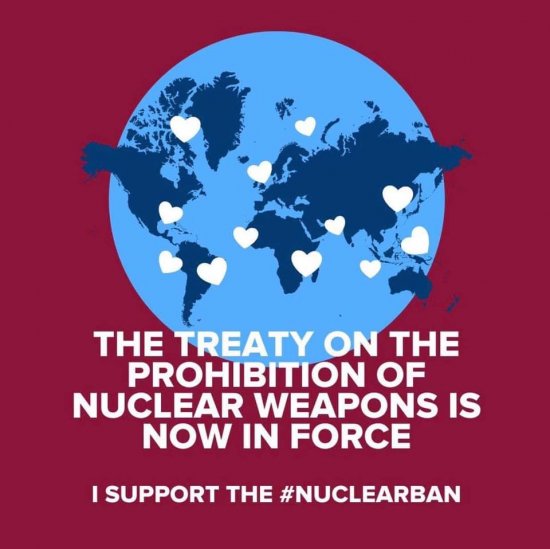
Africa’s strength in numbers in the Treaty on the Prohibition of Nuclear Weapons, also known as the Nuclear Ban Treaty, is a vehicle the continent can use to address nuclear weapons risks, head-on.
Global divide
On one side, nuclear-armed states cling to deterrence for their national security. They insist that possessing nuclear arsenals keeps them safe.
At present, there are nine nuclear-armed states: the US, Russia, the UK, China, France, India, Pakistan, Israel and North Korea. These countries possess around 12,331 nuclear warheads (as of 2025).
The use of only 10% of these weapons could disrupt the global climate and threaten the lives of up to 2 billion people.
On the other side, African countries and other non-nuclear-weapon states such as Ireland, Austria, New Zealand and Mexico highlight how deterrence creates unacceptable risks for the entire international community.
This global majority – the 93 countries that have signed the Nuclear Ban Treaty and 73 that are party to it – argue that real safety comes from eliminating nuclear threats.
The Nuclear Ban Treaty became international law on 22 January 2021. It is the first instance of international law challenging the legality and morality of nuclear deterrence.
Since 2022, states parties to the Nuclear Ban Treaty have held formal meetings to address current nuclear risks. In March 2025, at their third meeting, 17 African states officially recognised nuclear deterrence as a critical security concern. They called on nuclear armed states to end deterrence.
The deterioration of the international security environment is so palpable that there has been a noticeable shift in nuclear ban states’ perception of nuclear threats. Nuclear disarmament is no longer just a humanitarian or moral concern to these states, it is now a national security concern.
South Africa warned that
any use of nuclear weapons would result in catastrophic humanitarian consequences that would have a global impact.
Ghana likewise stressed that Africa is not immune to nuclear war’s fallout:
Africa, despite its geographic distance from the immediate hotspots of nuclear conflict, is not immune to the repercussions of nuclear weapons.
Africa bears a unique historical connection to nuclear issues. Nuclear testing in the Sahara Desert in the 1960s, when France detonated nuclear bombs in Algeria, had devastating consequences. Widespread radioactive contamination harmed local communities, caused long-lasting health problems, displaced populations, and left large areas environmentally damaged and unsafe for generations.
For its part, Nigeria recalled that Africa had “long acknowledged the existential threat nuclear weapons posed to human existence.”
The meeting determined that it is unacceptable that states parties are exposed to nuclear risks, “created without their control and without accountability”. It stressed that eliminating nuclear risks “is a prime and legitimate concern and national responsibility” of states.
Next steps
Delegates effectively asked whether their own national security concerns had less value than those of nuclear-armed states. I think this is a valid question.
Africa’s leaders and their allies in the Nuclear Ban Treaty are reframing what “national security” means in the nuclear age.
Rather than accepting a world perpetually held hostage by the madness of nuclear deterrence, they are asserting that the security of nations – and of peoples – is best served by dismantling this threat to humanity.
They are prioritising human life, development and international law over the threat of overwhelming force.
The outcome of this contest will have profound implications, not just for Africa but for the entire globe.
Radioactive Roulette: Uranium Mining Threatens Vital Southern African Aquifer
Andrew Maramwidze , 16 Jan 25, https://namibianminingnews.com/radioactive-roulette-uranium-mining-threatens-vital-southern-african-aquifer/?fbclid=IwY2xjawIeBAdleHRuA2FlbQIxMQABHSb3NRHlM9u5GURoopgphOqCBJptJNaq2Brc8FAAJr2DXIXC9rPY_nk-uA_aem_TR9RB_c4htmreaRa1XUdXA
The idyllic image of the Stampriet Transboundary Aquifer System, a vast freshwater reserve stretching across Namibia, South Africa, and Botswana, is under threat. The Namibian government has issued a flurry of uranium exploration permits, igniting fears that this precious resource could be irrevocably contaminated by the very industry it is meant to sustain.
This aquifer, roughly the size of Austria, provides a lifeline for over 50,000 people across the region. However, the allure of uranium, a key component in nuclear power generation, has enticed mining companies to stake their claims. While the Namibian government insists on safeguarding the aquifer, the potential for contamination looms large.
Uranium mining, by its very nature, carries significant environmental risks. The process often involves injecting sulfuric acid into the ground to dissolve uranium-rich rock, a method that can leach radioactive fluids into the surrounding environment. The long-term consequences of such contamination are dire, potentially leading to severe health issues for local populations, including cancer, kidney damage, and respiratory problems.
The experience of other mining regions, such as the boreal zone in Canada, provides a sobering cautionary tale. Acid mine drainage and mine effluents have contaminated numerous water sources, highlighting the difficulty of mitigating the environmental impact of large-scale mining operations. Furthermore, the long-term rehabilitation of mine sites often proves challenging, with determining individual mine’s responsibility for environmental damage proving to be a complex and protracted process.
The Namibian government, while acknowledging the potential risks, has awarded 35 uranium exploration permits, covering a vast expanse of territory. This raises serious concerns about the adequacy of environmental impact assessments and the long-term sustainability of the aquifer.
The potential impact on the aquifer extends beyond Namibia’s borders. The Stampriet Transboundary Aquifer System is a shared resource, and its contamination would have far-reaching consequences for South Africa and Botswana.
The need for cooperation between the three nations is paramount. A comprehensive, independent scientific assessment of the potential risks is crucial, along with the development of robust environmental safeguards and a clear plan for long-term monitoring and mitigation.
While the allure of mineral wealth is undeniable, it is imperative to prioritize the long-term health and well-being of the people who depend on this vital water source. The potential consequences of uranium mining in this sensitive region are simply too grave to ignore.
The question remains: Is the short-term economic gain worth the long-term environmental and human cost? The answer, for the sake of future generations, must be a resounding no.
Radioactive Plutonium In Sahara Dust Came From An Unexpected Source
The nuclear tests of the Cold War continue to haunt the world.
Tom Hale, IFL Science 1 Feb 25
Every now and again, the Sahara Desert in North Africa will kick up a storm and spread dust clouds across Europe and other parts of the world. Remarkably, the sand still carries traces of radioactive isotopes from the atomic bomb tests of the Cold War.
In a new study, scientists have investigated whether substantial amounts of radioactive isotopes generated by these tests were transported to Western Europe amid a powerful Saharan dust event in March 2022. They discovered that radiation still lingers in the dust that reached Europe – but not from the source they expected.
Between 1960 and 1966, France detonated 17 bombs in the Algerian Sahara, which was under their colonial control until they gained independence in 1962. With its vast, sparsely populated landscape, it was considered an ideal location for nuclear weapons testing.
Despite claims the bombs would be dropped in an unpopulated region, thousands of locals and French soldiers were exposed to radiation. The most severe estimates suggest that up to 60,000 Algerians were impacted by the blasts, while the French Ministry of Defense argues it’s closer to 27,000 people.
Oddly, though, the new study found that the radioactive isotopes present in the Sahara dust that reached Europe in March 2022 originated from nuclear tests conducted by the USA and the USSR, not France.
Although the USA and USSR did not conduct tests in the Sahara, the prolific nature of their nuclear tests during the Cold War left a widespread radioactive imprint detectable even in Saharan dust.
“This is because the power of detonation of French tests is only 0.02 percent of the total power of detonation of USSR and USA between 1950 to 1970. Much of the USSR and USA nuclear weapon tests were realized at the same latitude of South Algeria, and the debris of these tests can reach 8,000 meters [26,000 feet] high and be dispersed by wind very quickly at a global level,” Yangjunjie Xu-Yang, lead study author from the Climate and Environment Sciences Laboratory in France, told IFLScience
The team reached these conclusions by studying 53 samples from the March 2022 Saharan dust event and looking for the presence of specific radioactive isotopes.
The results suggest that the radioactive dust originated in Algeria’s Reggane region, but its plutonium levels didn’t match the low isotopic ratios (below 0.07) from France’s nuclear tests. Instead, with a median ratio of 0.187, the samples aligned with US and Soviet test signatures – a conclusion further supported by cesium isotopic analysis……………………………………………………………………………………………………… The new study is published in the journal Science Advances. https://www.iflscience.com/radioactive-plutonium-in-sahara-dust-came-from-an-unexpected-source-77866
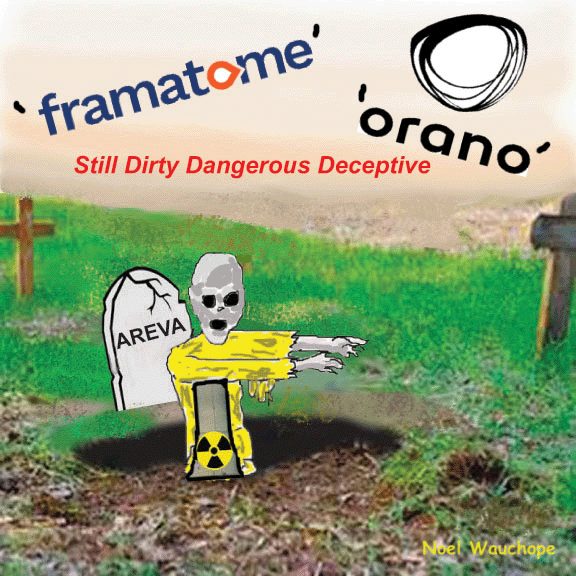
Nuclear company Orano seeks arbitration over Niger mining licence
World Nuclear News 20th Dec 2024, https://www.world-nuclear-news.org/articles/orano-seeks-arbitration-over-niger-mining-licence
The French company has opened international arbitration proceedings against the State of Niger following the withdrawal of its mining licence for the Imouraren project in June.
“This move comes after several months of unsuccessful attempts at mediation and conciliation,” the company said.
The Imouraren project is about 80km south of Arlit and about 160km north of Agadez and, with mineral reserves of over 200,000 tU, is one of the largest known uranium reserves in the world. Operating company Imouraren SA – owned 66.65% by Orano Expansion and 33.35% by Niger state interests – was awarded an operating permit to mine the deposit in 2009, but development work was suspended in 2015 due to market conditions at the time.
Earlier this year, the company announced it had restarted preparatory work for the project, but within days the Nigerien authorities withdrew the Orano subsidiary’s operating permit.
“The announcement of the withdrawal of the licence took place when Orano presented the State of Niger with a concrete, technical proposal, which would have allowed the IMOURAREN deposit to be exploited as quickly as possible, and after works had resumed since June 2024,” Orano said today. It has engaged law firm Clay Arbitration as its representative.
In July, the Nigerien authorities also withdrew Canadian company GoviEx Uranium’s mining rights for the Madouela uranium project. Earlier this month, the company and its fully owned subsidiary GoviEx Niger Holdings Ltd started proceedings against Niger under the Convention on the Settlement of Investment Disputes Between States and Nationals of Other States, on the basis the state had breached its legal obligations in withdrawing the permit.
How a uranium mine became a pawn in the row between Niger and France

Paul Melly, BBC 8th Dec 2024
In the latest sign of a dramatic deterioration in relations, Niger’s military rulers appear increasingly determined to drive France out of any significant sector in their economy – and particularly uranium mining.
This week the French state nuclear company Orano announced that the junta – which deposed France’s ally, President Mohamed Bazoum, in a coup in July 2023 – had taken operational control of its local mining firm, Somaïr.
The company’s efforts to resume exports have for months been blocked by the regime and it is being pushed into financial crisis.
And the impact could be felt more widely – although Niger accounts for less than 5% of the uranium produced globally, in 2022 it accounted for a quarter of the supply to nuclear power plants across Europe.
So the timing could hardly be more awkward, as Western countries struggle to meet the challenge of climate change and cut their carbon emissions from electricity generation.
For French President Emmanuel Macron, already wrestling with political crisis at home, the potential departure of Orano from Niger is certainly awkward in image terms…………………………………………………………………………………………………………
In this poisonous atmosphere of hostility and mistrust, Orano was an obvious and convenient target for junta retaliation.
The French company’s predominant role in the uranium sector had for years fuelled resentment among many Nigériens, amidst claims that the French company was buying their uranium on the cheap, despite periodic renegotiations of the export deal. Although the mining operations only started years after independence, they were seen as emblematic of France’s ongoing post-colonial influence.
……………….Niger’s junta feels no need to make concessions to Orano because it is now buoyed by a sharp rise in oil exports, thanks to a new Chinese-built pipeline.
With that financial cushion, the regime appears prepared to bear the cost of paralysing and probably dismantling the traditional uranium partnership with France – now its main international opponent.
https://www.bbc.co.uk/news/articles/czjd70mzge2o
Niger takes control of French nuclear firm’s uranium mining operations
Morning Star 5th Dec 2024, https://morningstaronline.co.uk/article/niger-takes-control-french-nuclear-firms-uranium-mining-operations
AUTHORITIES in Niger have taken control of the uranium mining operations of a French nuclear firm, it was reported on Wednesday.
After coming to power in July last year, Niger’s military leaders said they intended to seize back the natural resources of the west African country for the benefit of the people rather than Western interests.
The government said they would revamp rules regulating the mining of raw materials by foreign countries and earlier this year withdrew the permit for French nuclear company Oreno to mine one of the world’s largest uranium deposits.
Orano responded by suspending production of uranium in Niger.
Niger accounts for about 5 per cent of global uranium output, making it one of the world’s top 10 producers of uranium vital for the generation of nuclear weapons and the generation of nuclear power.
Last month, Niger’s Minister of Mines, Colonel Abarchi Ousmane said: “The French state, through its head of state, has declared that it does not recognise the current authorities in Niger. Does it seem possible to you that we, the state of Niger, would allow French companies to continue extracting our natural resources?”
Orano said that it intended “to defend its rights,” but also wanted to work with “stakeholders to re-establish a stable and sustainable mode of operation.”
South Africa Files 750 Pages of ‘Overwhelming’ Evidence in ICJ Genocide Case Against Israel

“The glaring genocide in Gaza is there for all who are not blinded by prejudice to see.”
By Brett Wilkins / Common Dreams, 30 Oct 24
South Africa filed 750 pages of “overwhelming” proof that Israel is committing genocide in Gaza to the International Court of Justice in The Hague, Netherlands on Monday, the deadline for submitting final evidence in the ongoing trial.
South African Ambassador to the Netherlands Vusi Madonsela delivered the legal document—known as a memorial—to the ICJ headquarters in the Dutch city. Under the court’s rules, the contents of the memorial cannot be made public at this time.
According to a statement from the office of South African President Cyril Ramaphosa, the memorial is a “comprehensive presentation of the overwhelming evidence of genocide in Gaza.”
The office said the document “contains evidence which shows how the government of Israel has violated the Genocide Convention by promoting the destruction of Palestinians living in Gaza, physically killing them with an assortment of destructive weapons, depriving them access to humanitarian assistance, causing conditions of life which are aimed at their physical destruction, and ignoring and defying several provisional measures of the International Court of Justice, and using starvation as a weapon of war and to further Israel’s aims to depopulate Gaza through mass death and forced displacement of Palestinians.”
South Africa filed 750 pages of “overwhelming” proof that Israel is committing genocide in Gaza to the International Court of Justice in The Hague, Netherlands on Monday, the deadline for submitting final evidence in the ongoing trial.
South African Ambassador to the Netherlands Vusi Madonsela delivered the legal document—known as a memorial—to the ICJ headquarters in the Dutch city. Under the court’s rules, the contents of the memorial cannot be made public at this time.
According to a statement from the office of South African President Cyril Ramaphosa, the memorial is a “comprehensive presentation of the overwhelming evidence of genocide in Gaza.”
The office said the document “contains evidence which shows how the government of Israel has violated the Genocide Convention by promoting the destruction of Palestinians living in Gaza, physically killing them with an assortment of destructive weapons, depriving them access to humanitarian assistance, causing conditions of life which are aimed at their physical destruction, and ignoring and defying several provisional measures of the International Court of Justice, and using starvation as a weapon of war and to further Israel’s aims to depopulate Gaza through mass death and forced displacement of Palestinians.”
“The evidence will show that undergirding Israel’s genocidal acts is the special intent to commit genocide, a failure by Israel to prevent incitement to genocide, to prevent genocide itself, and its failure to punish those inciting and committing acts of genocide,” Ramaphosa’s office added.
South Africa’s filing comes amid Israel’s ongoing 387-day assault on Gaza, which according to Palestinian and international agencies has killed at least 43,020 people—most of them women and children. At least 101,110 others have been wounded and over 10,000 Gazans are missing and believed dead and buried beneath the rubble of hundreds of thousands of bombed homes and other structures. Millions more Palestinians have been forcibly displaced, starved, or sickened by Israel’s invasion and “complete siege” of Gaza.
The filing also comes one week after senior members of Israeli Prime Minister Benjamin Netanyahu’s far-right Cabinet and national lawmakers spoke at a conference advocating the ethnic cleansing and recolonization of Gaza.
Ramaphosa’s office lamented that “Israel has been granted unprecedented impunity to breach international law and norms for as long as the United Nations Charter has been in existence.”………………………………………………………………https://www.commondreams.org/news/south-africa-icj-genocide-israel
Nuclear Energy Firm Orano Halts Niger Uranium Production
By Boureima HAMA avec Nathalie ALONSO à Paris, October 24, 2024, https://www.barrons.com/news/nuclear-energy-firm-orano-halts-niger-uranium-production-ed2fd6b6
French nuclear fuel firm Orano said on Wednesday it was halting its uranium production in junta-ruled Niger from October 31, citing a “highly deteriorated” situation and its inability to operate.
The Nigerien government, whose leader Abdourahamane Tiani seized power in a July 2023 coup, has previously made clear it would overhaul rules regulating the mining of raw materials by foreign companies.
Orano-owned mining subsidiary “Somair’s worsening financial difficulties have compelled the company to suspend its operations,” in the Artlit region of north Niger where Orano has operated since 1971, the French group’s Paris spokeswoman told AFP on Wednesday.
The Sahel nation’s military rulers have turned their backs on Paris, ordering French troops deployed there to leave and instead forging ties with fellow juntas in Burkina Faso and Mali — as well as Iran and Russia.
Niger’s position as the world’s seventh-largest uranium producer plays an important role in the shifting relations.
Iran has significantly increased its stock of enriched uranium in recent months, while strengthening ties with Niger, according to the International Atomic Energy Agency.
The production of uranium concentrate will cease from October 31 as Orano was unable to export the commodity, in part due to landlocked Niger’s closed border with coastal Benin, the firm said.
“Despite all the efforts deployed” with the military regime “to try and resolve the situation” and obtain export licenses, “all of our proposals were left unanswered”, said the spokeswoman of the group, which specialises in nuclear fuel.
Nigerien authorities did not follow up on an Orano proposal to export uranium by air via Namibia.
“Maintenance will continue but there will be no more production,” she added.
Nigerien authorities did not comment on the matter.
Niamey in June rescinded Orano’s licence to operate in one of the largest deposits in the world, Imouraren, with estimated reserves of 200,000 metric tonnes (220,000 US tons).
Niger’s Council of Ministers on September 19 passed a draft decree proposing to create a state company named “Timersoi National Uranium Company”, without detailing the move.
Planned nuclear plant in a Kenyan top tourist hub and home to endangered species sparks protest
Daily Mail. By Associated Press, 12 October 2024
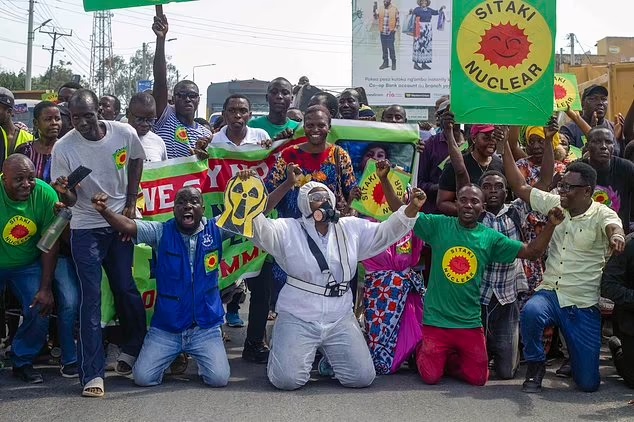
KILIFI, Kenya (AP) – Dozens rallied against a proposal to build Kenya’s first nuclear power plant in one of the country’s top coastal tourist hubs which also houses a forest on the tentative list of the UNESCO World Heritage site.
Kilifi County is renowned for its pristine sandy beaches where hotels and beach bars line the 165-mile-long coast and visitors boat and snorkel around coral reefs or bird watch in Arabuko Sokoke forest, a significant natural habitat for the conservation of rare and endangered species, according to the U.N. organization.
The project, proposed last year, is set to be built in the town of Kilifi – about 522 kilometers (324 miles) southeast of the capital, Nairobi. Many residents have openly opposed the proposal, worried about what they say are the negative effects of the project on people and the environment, leading to a string of protesters which at times turned violent.
Muslim for Human Rights (MUHURI) led the march Friday in Kilifi to the county governor´s office where they handed him a petition opposing the construction of the plant.
Some chanted anti-nuclear slogans while others carried placards with “Sitaki nuclear”, Swahili for “I don´t want nuclear.”
The construction of the 1,000MW nuclear plant is set to begin in 2027 and be operational by 2034, with a cost of 500 billion Kenyan shillings ($3.8 billion).
Francis Auma, a MUHURI activist, told the Associated Press that the negative effects of the nuclear plant outweigh its benefits.
“We say that this project has a lot of negative effects; there will be malformed children born out of this place, fish will die, and our forest Arabuko Sokoke, known to harbor the birds from abroad, will be lost,” Auma said during Friday´s protests.
Juma Sulubu, a resident who was beaten by the police during a previous demonstration, attended Friday’s march and said: “Even if you kill us, just kill us, but we do not want a nuclear power plant in our Uyombo community.”
Timothy Nyawa, a fisherman, participated in the rally out of fear that a nuclear power plant would kill fish and in turn his source of income. “If they set up a nuclear plant here, the fish breeding sites will all be destroyed.”
Phyllis Omido, the executive director at the Centre for Justice Governance and Environmental Action, who also attended the march, said Kenya´s eastern coastal towns depended on eco-tourism as the main source of income and a nuclear plant would threaten their livelihoods.
“We host the only East African coastal forest, we host the Watamu marine park, we host the largest mangrove plantation in Kenya. We do not want nuclear (energy) to mess up our ecosystem,” she said.
Her center filed a petition in Nov. 2023 in parliament calling for an inquiry and claiming that locals had limited information on the proposed plant and the criteria for selecting preferred sites. It also raised concerns over the risks to health, the environment and tourism in the event of a nuclear spill, saying the country was undertaking a “high-risk venture” without proper legal and disaster response measures in place. The petition also expressed unease over security and the handling of radioactive waste in a country prone to floods and drought.
The Senate suspended the inquiry until a lawsuit two layers filed in July seeking to stop the plant´s construction, claiming public participation meetings were rushed and urging the Nuclear Power and Energy Agency (Nupea) not to start the project, was heard………………………. https://www.dailymail.co.uk/wires/ap/article-13952403/Planned-nuclear-plant-Kenyan-tourist-hub-home-endangered-species-sparks-protest.html
African nations are losing up to 5% of their GDP per year with climate change, a new report says

By MONIKA PRONCZUK, September 3, 2024, https://apnews.com/article/africa-climate-change-flooding-droughts-af5beebf70f414098ad2a4a73a19b76c
DAKAR, Senegal (AP) — African nations are losing up to 5% of their GDP every year as they bear a heavier burden than the rest of the world from climate change, a new report said Monday after one of the continent’s hottest years on record.
The World Meteorological Organization said many African nations are spending up to 9% of their budgets for climate adaptation policies.
“Over the past 60 years, Africa has observed a warming trend that has become more rapid than the global average,” said WMO Secretary-General Celeste Saulo, warning that it is affecting everything from food security to public health to peace.
Africa is responsible for less than 10% of global greenhouse gas emissions. But it is the most vulnerable region to extreme weather events including droughts, floods and heatwaves, the WMO said.
The new report focuses on 2023, one of Africa’s three hottest years on record. It urged African governments to invest in early warning systems as well as meteorological services. If adequate measures are not put in place, up to 118 million Africans will be exposed to droughts, floods and extreme heat by 2030, the report warned.
In sub-Saharan Africa, the costs of adapting to extreme weather could be $30-50 billion per year over the next decade, the report estimated.
The effects of climate change have been harrowing. Between September and October 2023, approximately 300,000 people across West Africa were affected by floods, the report said. Zambia experienced the worst drought in 40 years, affecting nearly 6 million people.
The pattern of extreme weather events in Africa continues in 2024, experts said.
In the Sahel region south of the Sahara, flooding has affected over 716,000 people this year, according to the United Nations. In Mali, authorities last week declared a national disaster over floods which have affected 47,000 people since the beginning of the rainy season.
West Africa experienced an unprecedented heat wave earlier this year that led to a surge in deaths.
South Africa halts artillery shells to Poland over fears they will be used against Russia
South Africa has suspended a major arms deal with Poland, leading to Poland canceling the contract
Grzegorz Adamczyk. ReMix, 28 Aug 24
South Africa has withheld the delivery of 155mm artillery shells to Poland, citing concerns that the munitions could be sent to Ukraine, according to Ezra Jele, head of the secretariat of the South African government body overseeing arms contracts. After two years of uncertainty, Poland has canceled the contract.
In early 2022, following Russia’s invasion of Ukraine, Poland, along with several non-NATO countries, placed an order for 55,000 Assegai artillery shells from Denel Munition, a South African company and subsidiary of German arms manufacturer Rheinmetall. At the time, Jan-Patrick Helmsen, managing director of Denel Munition, expressed pride in the deal, noting NATO’s continued trust in their globally recognized technology.
However, later that year, South Africa’s National Conventional Arms Control Committee (NCACC) halted the contract’s fulfillment. While export permits to Poland and other countries were not canceled, they were indefinitely suspended, with no clear timeline for resolution, according to Jele………………………………………………… more https://www.sott.net/article/494487-South-Africa-halts-artillery-shells-to-Poland-over-fears-they-will-be-used-against-Russia
South Africa halts plans for nuclear power.
Minister of Energy and Electricity, Dr Kgosientsho Ramokgopa, has announced
that the Ministerial Determination for the procurement of 2 500MW of
nuclear energy, has been withdrawn. The Minister was speaking during a
media briefing held on Friday in Pretoria. The determination, and the
National Energy Regulator of South Africa’s (Nersa) concurrence of the
process, had come under legal pressure with groups contending that, amongst
others, public comments had not been sought and the procedure had not been
fair.
Business Tech 16th Aug 2024
https://businesstech.co.za/news/energy/787277/south-africa-halts-nuclear-plans-for-now/
French nuclear giant ORANO slips into the red following Niger-French breakup
French nuclear giant Orano ended the first half of the year with a loss of €133 million, weighed down by difficulties in its mining activities in Niger due to a “highly degraded” political context since a military regime came to power a year ago.
Radio Free Europe: 29/07/2024 –
At the end of June 2024, the group noted “the deteriorated situation affecting mining operations in Niger,” Orano’s chief financial officer, David Claverie, said in a statement.
The coup d’état in Niger on 26 July last year led to a halt in imports of critical materials necessary for uranium exploitation in Orano’s Somaïr mine, such as soda ash, carbonate, nitrates and sulphur.
And although uranium extraction continued in the first quarter of 2024 “after several months of early maintenance,” Somaïr’s sales were unable to resume “due to a lack of logistics solutions approved by the Niger authorities”.
The blockage led the mine into “financial difficulty … weighing on its ability to continue its operations”, the statement read.
In late June, Niger decided to withdraw the licence of Imouraren SA, a company jointly operated by Orano, Niger Mining and Korea Electric Power, and which ran the Somaïr mine.
The situation could eventually lead to “insolvency in the short to medium term, in the coming months”, Claverie said……………………………… https://www.rfi.fr/en/international/20240729-french-nuclear-giant-slips-into-the-red-following-niger-french-breakup
1 This Month
23-25 October – on Zoom – World BEYOND War’s annual global conferenc


Shut down the radiation-damaged Heysham nuclear reactors now
To see nuclear-related stories in greater depth and intensity – go to https://nuclearinformation.wordpress.com

Say No to NASA’s Reckless Nuclear Reactor on the Moon
Say No to NASA’s Reckless Nuclear Reactor on the Moon

-
Archives
- October 2026 (247)
- September 2026 (339)
- August 2026 (330)
- July 2026 (355)
- June 2026 (287)
- May 2026 (306)
- April 2026 (356)
- March 2026 (251)
- February 2026 (267)
- January 2026 (308)
- December 2025 (358)
- November 2025 (359)
-
Categories
- 1
- 1 NUCLEAR ISSUES
- business and costs
- climate change
- culture and arts
- ENERGY
- environment
- health
- history
- indigenous issues
- Legal
- marketing of nuclear
- media
- opposition to nuclear
- PERSONAL STORIES
- politics
- politics international
- Religion and ethics
- safety
- secrets,lies and civil liberties
- spinbuster
- technology
- Uranium
- wastes
- weapons and war
- Women
- 2 WORLD
- ACTION
- AFRICA
- Atrocities
- AUSTRALIA
- Christina's notes
- Christina's themes
- culture and arts
- Events
- Fuk 2022
- Fuk 2023
- Fukushima 2017
- Fukushima 2018
- fukushima 2019
- Fukushima 2020
- Fukushima 2021
- general
- global warming
- Humour (God we need it)
- Nuclear
- RARE EARTHS
- Reference
- resources – print
- Resources -audiovicual
- Weekly Newsletter
- World
- World Nuclear
- YouTube
-
RSS
Entries RSS
Comments RSS

