
 South Africa’s Proposed Nuclear Power Plant Unsafe: Study VOA News, 25 Nov 16 JOHANNESBURG —
South African power provider Eskom has proposed building a nuclear power station on a site that may be at risk of surge storms and tsunamis, a geological report suggests, but the state-owned utility disputes the findings.
South Africa has the continent’s only nuclear power station and plans to expand nuclear power generation to meet growing electricity demand in Africa’s most industrialized country.
The report by Maarten de Wit, a professor at the Nelson Mandela Metropolitan University and director of the Africa Earth Observatory Network, a research institute, says canyons in the bedrock would need to be secured.
“If you are going to build anything on that, it’s pretty prone to storms, sea level rises and tsunamis,” De Wit told Reuters on Friday.
The site at Thyspunt, near Port Elizabeth in the Nelson Mandela Bay municipality, is on the Indian Ocean coastline.
The report also showed seismic activity along dormant fault lines near the site that could trigger submarine landslides. Any such activity “is likely to generate a large submarine slump, and a possible significant local tsunami that would affect the coastal region, including Thyspunt,” the report said, warning that a plant at Thyspunt could be at risk of devastation similar that in Fukushima in Japan in 2011……. http://www.voanews.com/a/south-afdrica-s-proposed-nuclear-power-plant-unsafe-report-says/3611738.html
November 26, 2016
Posted by Christina Macpherson |
safety, South Africa |
Leave a comment
Busa warns Eskom on nuclear plans IOL, 25 November 2016, Siseko Njobeni Johannesburg – Business Unity South Africa (Busa) yesterday warned power utility Eskom not to proceed with preparations to procure nuclear while consultations on the draft integrated resource plan (IRP) had not been completed.
Busa said it was concerned that the difficulties that renewable projects faced in gaining access to the grid appeared to be used as an artificial constraint on renewable energy sources.
“Furthermore, Busa is concerned that Eskom and the government do not seem to be aligned on the question of the nuclear element of the IRP,” the business group said.
“Busa believes that the role of Eskom, particularly in respect of its position as the sole purchaser of electricity, needs to be clearly defined.”
“Additionally, Eskom’s role as the developer of new generation capacity should not proceed independently of the IRP which is only expected to be finalised in the third quarter of next year,” Busa said.
Procurement
The business body said any procurement of large-scale generation should commence only after finalisation of the IRP as the national plan.
The warning comes after the Department of Energy published the draft integrated energy plan and the draft IRP for the country on Tuesday. The documents are out for public comment.
The assumptions and scenarios in the IRP will be the subject of public consultation at Nedlac – the government, labour and business negotiating chamber – and provincial road shows in February next year…….
Meanwhile, the Nuclear Industry Association of South Africa said yesterday that it was alarmed at the prospect of a delay of the nuclear programme to 2037. http://www.iol.co.za/business/companies/busa-warns-eskom-on-nuclear-plans-2093258
November 26, 2016
Posted by Christina Macpherson |
business and costs, South Africa |
Leave a comment
Zuma’s waning power exposed by stalled nuclear plan. Mail and Guardian 24 Nov 2016 Mike Cohen, Paul Vecchiatto Government’s decision to stall plans championed by President Jacob Zuma to build nuclear plants has exposed his waning authority.
News of the delay came on Tuesday when the department of energy said additional atomic power won’t come on stream until 2037 under its “base case” scenario, 14 years later than previously projected. Although Zuma says reactors are key to addressing power constraints in Africa’s most industrialised economy, Finance Minister Pravin Gordhan, economists and ratings agencies warn that South Africa can’t afford them now.
“Essentially the project has been indefinitely postponed and the final decision on nuclear power will only be taken by Zuma’s successor,” said Robert Schrire, a politics professor at the University of Cape Town. “This is a great victory for economic rationality and political expediency and reflects the new political balance of a weakened Zuma administration.”…….
Gordhan’s victory
Gordhan won a victory this month after prosecutors withdrew fraud charges against him for allegedly approving a pension payment to a tax service official, two days before he was due to appear in court. The Democratic Alliance, the main opposition party, alleged that Zuma intended to use the court case as a pretext for firing Gordhan and in the process remove the biggest obstacle to his nuclear ambitions.
The party also says that Zuma may already have signed a secret nuclear power supply deal with Russia and that the programme would be used to benefit his own financial interests and those of his allies. The president and the government deny the allegation……
Energy Minister Tina Joemat-Pettersson told reporters the power blueprint was updated to reflect developments in the energy industry, including changes in technology costs and lower-than-anticipated demand. The draft plan will be finalised next year.
Eskom, which supplies about 90% of the nation’s power, isn’t shelving its nuclear plans yet. The state utility will continue to seek requests for proposals to build new reactors pending the completion of the energy plan…..
The dynamics of power in South Africa are shifting, according to Keith Gottschalk, a political scientist from the University of the Western Cape in Cape Town.
Zuma is “still able to outvote and outmanoeuvre his opponents in the ANC, but the mounting pressure has meant he has not been able to always get his own way all the time,” he said. “He is on the way down like a slow-leaking puncture.” – Bloomberg http://mg.co.za/article/2016-11-24-news-analysis-zumas-waning-power-exposed-by-stalled-nuclear-plan
November 24, 2016
Posted by Christina Macpherson |
politics, South Africa |
Leave a comment
 Government delays nuclear plant plans as economy stagnates, Mail and Guardian, 22 Nov 2016 Mike Cohen, Paul Vecchiatto South Africa delayed plans to build new nuclear power plants over concern about their cost and the waning demand for additional electricity as economic growth stalls.
Under a new timeline, the first nuclear power is expected to come on stream in 2037, with a total 20 385 megawatts of nuclear energy added to the national grid by 2050, according to the “base case” scenario outlined in a presentation about the department of energy’s updated Integrated Resources Plan. The proposal, released in Cape Town on Tuesday, also estimates as additional 37 400 MW of power from wind, 17 600 MW from solar plants, 35 292 MW from gas and 15 000 MW from coal by 2050.
The government previously said it wanted to generate 9 600 MW of energy from as many as eight reactors that should begin operating from 2023 and be completed by 2029. Price estimates had ranged from $37-billion to $100-billion. Although President Jacob Zuma has championed the nuclear programme, the treasury has cautioned that the country may be unable to afford new reactors at a time when the economy is barely growing and the budget deficit needs to be curbed to fend off a junk credit rating.
“Gas and renewables [will] form the biggest chunk of installed capacity by 2050,” the department of energy said in the presentation. “There is significant reduction in installed capacity from coal……..
Power cuts
The energy plan will be refined in March next year and then submitted to Cabinet for final sign-off.
Eskom, the state-owned utility, has said it could use the more than R150-billion it will accumulate in reserves within 10 years to build new reactors. The utility operates Africa’s only nuclear power plant — the 1 800 MW Koeberg facility near Cape Town, which began operating in 1984.
Rosatom, Areva SA, EDF SA, Toshiba’s Westinghouse Electric unit, China Guangdong Nuclear Power Holding Corp and Korea Electric Power Corp previously expressed interest in building new reactors in South Africa…..http://mg.co.za/article/2016-11-22-sa-delays-nuclear-plant-plan-as-economy-stagnates
November 23, 2016
Posted by Christina Macpherson |
politics, South Africa |
Leave a comment
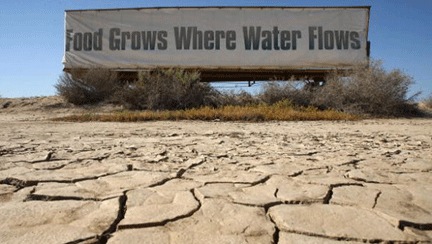
 Battle of the Desert (I): To Fight or to Flee? http://www.ipsnews.net/2016/11/battle-of-the-desert-i-to-fight-or-to-flee/ By Baher Kamal ROME, Nov 18 2016 (IPS) – To fight or to flee? These are the stark choices Maria, a single mother from the Bangalala midlands of Tanzania, faces repeatedly.
“After the rains failed for a few years, some neighbours claimed our trees were drawing too much water from the ground. We cut them down. Our harvests fell. My mother closed her stall at the local market. That is when my father and I moved from the midlands to the Ruvu Mferejini river valley.”
Maria, whose dramatic story has been told by the United Nations organization leading in combating desertification, goes on to say: “My brother quit school to help the family. He went to find work but he does not earn enough. My mother stayed in Bangalala so that my daughter could go to school because there are no schools in the valley.”
“But where we moved to, my crop also failed last year. That is why early this year I moved yet again, but I left my father behind. I hope to farm here much longer, as I am sure the people I left behind with my father will have to move too. But when will this moving end? I cannot afford it anymore.”
This is not an isolated case–Maria is in the same situation that women in Darfur, Mali, Chad or Afghanistan were in before local conflicts over water or land turned into civil wars, sexual violence or genocide, reports the United Nations Convention to Combat Desertification (UNCCD).
“Nor is this situation unique to sub-Saharan Africa where half a billion inhabitants are rural, a majority lives off the land and desertification is a constant threat to their livelihoods,” it alerts in its report Desertification, the Invisible Frontline.
“As the effects of climate change undermine livelihoods, inter-ethnic clashes are breaking out within and across states and fragile states are turning to militarisation to control the situation.” UNCCD
According to the Bonn-based UNCCD, more than 1.5 billion people in the world depend on degrading land, and 74 per cent of them, like Maria, are poor.
Desertification is a silent, invisible crisis that is destabilising communities on a global scale, says this international legal framework for tackling desertification, land degradation and drought, 169 of its 194 Parties have declared they are affected by desertification.
The consequences are dire. “As the effects of climate change undermine livelihoods, inter-ethnic clashes are breaking out within and across states and fragile states are turning to militarisation to control the situation.”
The effects of desertification are increasingly felt globally as victims turn into refugees, internally displaced people and forced migrants or they turn to radicalisation, extremism or resource-driven wars for survival, UNCCD continues.
“If we are to restore peace, security and international stability in a context where changing weather events are threatening the livelihoods of more and more people, survival options are declining and state capacities are overburdened, then more should be done to combat desertification, reverse land degradation and mitigate the effects of drought.’
Otherwise, many small-scale farmers and poor, land-dependent communities face two choices: fight or flight.
UP to 30% of World’s Land Affected by Desertification
For its part, the United Nations Environment Programme (UNEP) estimates that desertification currently affects approximately twenty-five to thirty per cent of the world’s land surface area. About 1,2 billion people in at least 100 states are at risk.
Over 42 billion dollars in lost productivity or human support occurs each year on account of it. According to UNEP, the global rate of desertification is increasing, although the local rates vary by region.
“Africa, with around sixty-six per cent of its land either desert or drylands, is particularly affected by desertification. Already, a number of large-scale famines have occurred in the Sahelian region, resulting in migration of people towards more hospitable lands.”
Desertification occurs mainly through over-cropping, over-grazing, improper irrigation practices, and deforestation. These activities arise from poor land management, which, in turn, stems from the socio-economic conditions in which the farmers live.
Monique Barbut, UNCCD Executive Secretary, gives specific figures.
“Globally, only 7.8 billion hectares of land are suitable for food production. About 2 billion hectares are already degraded, and of these 500 million hectares have been totally abandoned. These lands could be restored to fertility for future use.”
With 99.7 per cent of our food calories coming from the land –Barbut underlines– land degradation is a threat to our food security. But its effects are especially harsh for the poorest people who rely directly on the land for survival – food, employment and water. When their lands cannot produce any more, they have little choice but to migrate or fight over what little is left.
“Unless we change our approach, when drought comes and the rains fail, the future of the 400 million African farmers who rely on rain fed subsistence agriculture, for example, is put in jeopardy,” Barbut wroteon IPS.
Rain-fed agriculture accounts for more than 95 per cent of farmed land in sub-Saharan Africa. And water scarcity alone could cost some regions 6 per cent of their Gross Domestic Product, she added.
“Unless we change our approach, people are going to be increasingly forced to decide whether to ride out a drought disaster and then rebuild. Or simply leave.”
According to Barbut, “It is a form of madness that we force our people to make these difficult choices.”
Food Insecurity Triggering Riots
In 2008, food insecurity triggered riots in over 30 countries, ccording to the UNCCD. But it is rural communities like those of Bangalala, who depend on rainfed agriculture that contribute to global food security.
The livelihoods of over 2 billion people worldwide depend on 500 million small-scale farmers. Drylands, which make up nearly 34 per cent of the land mass and are a major source of food security especially for the poor, are being degraded day-by-day, it adds.
“Desertification does not always lead to conflict. But it is an amplifier of displacement, forced migration, radicalisation, extremism and violence.”
The US National Security Strategy refers to climate change as a key global challenge that will lead to conflicts over refugees and resources, suffering from drought and famine, catastrophic natural disasters, and the degradation of land across the globe, it reminds.
Therefore, “investing in practical solutions that transform lives and reduce the vulnerability of communities like Maria’s would be cheaper and work better than investing in walls, wars and relief.”
November 23, 2016
Posted by Christina Macpherson |
AFRICA, climate change |
Leave a comment
 Solar And Wind Versus Nuclear: Is Baseload Power Obsolete? Planet Save November 20th, 2016 by Stephen Hanley. The future of electrical energy is playing out in South Africa, where 80% of all electricity is generated by burning coal. The government is anxious to shutter all those coal fired plants but is caught in a crossfire between advocates for nuclear power and those who favor renewable solutions like solar and wind energy.
South Africa is the most advanced economy in sub-Saharan Africa. Until 2008, its electrical power came from coal fired generating stations and one nuclear power plant. Starting in 2008, the country ran short of electricity due to poor infrastructure planning, That’s when crippling rolling blackouts began. Desperate for more electrical capacity, the government started a campaign to lure investment in wind and solar power. By June of this year, 102 renewable energy projects worth $14.4 billion had been completed.
Renewable Strategy Successful
“The program has been very successful, clear of any corruption and very well run,” said Wikus van Niekerk, the director of the Center for Renewable and Sustainable Energy Studies at Stellenbosch University. “It’s been seen by many people in the rest of the world as one of the most successful procurement programs for renewable energy. It’s something that the South African government and public should be proud about.”
Several of those projects are concentrated solar facilities located near Upington in the central part of the country. That area has some of the most abundant daily sunshine of any place on earth. But those facilities use technology that is now almost obsolete. They use mirrors to concentrate sunlight to boil water to make steam.
After the sun goes down, they can continue to make electricity from the steam on hand for a few hours. After that, they have to wait for the sun to reappear the next day. Newer concentrated solar plants use the sun’s rays to heat molten salt, which can be kept in storage for up to 10 hours after the sun sets and used to keep the steam turbines spinning. Researchers in Spain say using molten silicon can store up to ten times as much energy as molten salt……….
Is Baseload Power An Outmoded Concept?
“The concept of baseload is actually an outdated concept,” said Harald Winkler, the director of the Energy Research Center at the University of Cape Town. “Eskom was built around big coal and to a lesser extent big nuclear — big chunks of base load power. It’s really myopic in terms of where the future of the grid is going to go. We’re going to see in South Africa and the rest of the world much more decentralized grids.”
Distributed Vs. Centralized Power
Ahhh, there is in a nutshell. The same fears that drive established utility companies in the United States. Europe, and Australia apply in South Africa. Utility companies think in terms of centralized grids. Renewables coupled with efficient, cost effective energy storage make grids virtually obsolete. Utility companies are petrified they may become irrelevant and the trillions of dollars invested in building grids throughout the world will stop producing income.
Businesses in South African cities are increasingly installing solar panels and going off the grid. Elsewhere in Africa, it is now common to see villagers connecting cellphones to single solar panels outside mud brick homes.
Opposition to South Africa’s nuclear plans is also coming from the government’s main research agency, the Council for Scientific and Industrial Research. It says an expansion of solar and wind energy, in addition to natural gas, could meet South Africa’s future energy needs for less money. “No new coal, no new nuclear,” said Tobias BischofNiemz, who leads the
council’s research on energy. “South Africa is in a very fortunate situation where we can decarbonize our energy system at negative cost.”……..
Nuclear power relies completely on a centralized grid. Building grid infrastructure — transmission lines and substations — costs as much or more as a building generating facilities themselves. That’s why localized renewable power provides the most amount of electricity per dollar invested. http://planetsave.com/2016/11/20/solar-wind-versus-nuclear-baseload-obsolete/
November 21, 2016
Posted by Christina Macpherson |
decentralised, South Africa |
Leave a comment
Windmills or Reactor Cores? Inside South Africa’s Energy Clash, NYT By NORIMITSU ONISHINOV. 13, 2016 UPINGTON, South Africa — In one of the most sun-drenched corners of the planet, a 670-foot tower rises above a desert dotted with 4,160 mirrors. Tracking the sun throughout the day, the mirrors, called heliostats, redirect the sun’s rays into the tower, where water is heated to generate steam — and electricity.
November 16, 2016
Posted by Christina Macpherson |
politics, South Africa |
Leave a comment
Media not welcome at nuclear energy briefing http://www.timeslive.co.za/politics/2016/11/15/Media-not-welcome-at-nuclear-energy-briefing Linda Ensor | 15 November, 2016 The Department of Energy’s briefing on the nuclear build programme to Parliament’s energy portfolio committee will be a closed meeting with no media or members of the public present‚ committee chairman Fikile Majola announced on Tuesday. The decision marks a step backwards in Majola’s otherwise forthright push for greater transparency from the department‚ which has been intent on withholding documents on the nuclear procurement programme.
The sitting was yet to be scheduled. Majola also said the meeting to discuss the forensic reports into the R14.5-billion impairment suffered by PetroSA on its investment in the Ikhwezi offshore drilling project was also to be closed.
This meeting was also scheduled for Tuesday‚ attracting a strong media presence. Journalists and other members of the public were required to leave the room. Majola said he had obtained the necessary authorisation from parliamentary authorities to close the meeting‚ which would be addressed by the PetroSA board.
At a previous sitting‚ Majola obtained copies of the forensic reports into the Ikhwezi project on the proviso that the committee decided in what manner it dealt with it‚ giving consideration to the need for confidentiality.
The Ikhwezi project was intended to bolster the supply of gas to PetroSA’s gas-to-fuel refinery at Mossel Bay but generated only about 10% of the envisaged volumes.
November 16, 2016
Posted by Christina Macpherson |
politics, South Africa |
Leave a comment
 HotSpots H2O: Africa’s Water Challenges http://www.circleofblue.org/2016/world/hotspots-h2o-africas-water-challenges/ Global HotSpots H2O, 13 Nov 16
From the Syrian conflict, to protests in Zimbabwe, Tunisia and India, to a deep drought destabilizing South Africa, water is playing a significant role in global civil unrest.
HotSpots H2O from Circle of Blue’s award-winning team of journalists examines regions, populations, and countries that are most at risk from water-related unrest and conflict. It reveals the challenges individuals confront — and the solutions they discover — as they strive to build resilient communities.
Africa’s Water Challenges The worst drought in 35 years continues to grip southern Africa, even as the El Nino season that caused it comes to an end. The drought, which began in 2015, has left 21.3 million people in need of food assistance,according the American aid agency USAID. Officials say the food crisis will continue to get worse.
“The crisis has yet to peak,” United Nation’s Special Envoy Macharia Kamau told journalists in Mozambique after a four day tour of that nation where he witnessed the desperation of the hungry. “For many children, women and the elderly, the next few months will be about looking at survival straight in the face,” he continued.
The fifteen-nation Southern African Development Community (SADC) has been scrabbling to find aid for the food crisis and has recently launched a call for $US 2.9 billion in food aid from the international community. The call for assistance comes as the wet season returns to southern Africa with the onset of La Nina.
Despite the upcoming rains, Lesotho, Madagascar, Malawi, Mozambique, Swaziland, and Zimbabwe have all declared a state of emergency, due to the upcoming “lean season.” From January to March famers will wait for their crops to grow before they can begin to harvest.
The severity of the effects of the drought in the region stem in part from the fragile nature of the water systems and the economic structures prevalent in the region, according to visiting Oxford Professor David Grey.
“Unsustainable livelihoods as a consequence of the hydrological complexity and variability are fairly widespread across the continent,” Grey told Circle of Blue. “And the consequences of this is that as populations grow, people find it harder and harder to feed themselves.”
Water Security: Freedom from Intolerable Water-Related Risks | PODCAST |
Large-scale drought in southern Africa. Floods in North Korea and Haiti. Rumblings of water-related conflicts in Pakistan and India. In Circle of Blue’s latest HotSpots H2O podcast, Dr. David Grey, a visiting professor of Water Policy from Oxford University, argues that water security is closely linked to migration, climate change risk, and economic development. In an interview with J. Carl Ganter, Circle of Blue’s director, Dr. Grey also offers solutions to alleviating the world’s water-related risks.
Dr. Grey also is a former member of the World Economic Forum Global Agenda Council on Water Security. J. Carl Ganter reports from Washington D.C. at the International Dialogue on the Global Commons.
Madagascar in Focus: Food Shortages Affects 1.4 Million People
Three years of extended drought in southern Madagascar have left
1.4 million people without food as a hunger crisis emerges in the southeast African island nation.
“These are people living on the very brink – many have nothing but wild fruits to eat,” United Nations World Food Programme (WFP) regional Director Chris Nikoi told reporters in late October.
The drought forced many subsistence farmers to begin eating their own seed stocks and selling their land to get by, meaning they will have nothing to plant and nowhere to plant it when the rain returns. Next year, according to the UN Food and Agriculture Organization, at least 840,000 people risk severe malnutrition, and nearly 1.4 million will be food insecure.
Children have been the hardest hit. According to UNICEF, some 10,500 kids have been treated for a hunger-related illness known as severe acute malnutrition or SAM since January of this year. Children suffering from SAM typically have a mortality rate of around 30 to 50 percent.
The return of La Nina this winter may bring some relief. But strong rain could cause flash flooding, washing away fragile topsoil and newly planted crops.
November 14, 2016
Posted by Christina Macpherson |
AFRICA, climate change |
Leave a comment
 Nuclear deals could be ‘captured’ http://www.timeslive.co.za/thetimes/2016/11/07/Nuclear-deals-could-be-captured JAN-JAN JOUBERT | 07 November, 2016
Environmentalists have warned that proposed nuclear building programmes could be “captured” if Eskom continues to be the procurement agency for the project, which is expected to cost more than R1-trillion. Environmental action group Greenpeace said former public protector Thuli Madonsela’s report on state capture released last week confirmed that vested interests and corruption in the energy sector were central to the energy choices made in South Africa.
“It is no coincidence that Brian Molefe is a key figure in the State of Capture report, and that he and the Eskom board have been running an anti-renewable energy campaign, focused instead on pushing for expensive and unnecessary nuclear energy,” said Greenpeace spokesman Helen Dena.
“This undermines the prioritisation of renewable energy, which would enhance South Africa’s energy future, strengthen the economy and deliver affordable, safe, clean electricity,” said Dena.
DA MP Gordon Mackay said: : “In light of the government’s own policy documents, preference for nuclear is irrational in law.”
November 6, 2016
Posted by Christina Macpherson |
secrets,lies and civil liberties, South Africa |
Leave a comment
South Africa’s power utility wants to finance nuclear. This is a bad idea. , enca, Seán Mfundza Muller, Senior Lecturer in Economics, University of Johannesburg Sunday 6 November 2016 JOHANNESBURG – South Africa’s cabinet is to consider a proposal that a mooted nuclear power deal for the country be financed through the state-owned power utility Eskom. This is the latest twist in South Africa’s controversial efforts to expand its nuclear power capability by commissioning up to 9.6GW of energy from six nuclear power stations. The decision has been mired in controversy and still hangs in the balance and the offer by Eskom to foot the bill raises more questions than it provides answers.
Recent claims by Eskom’s management fail to adequately address any of the fundamental criticisms of the proposed nuclear programme.
Statements that Eskom can “finance nuclear on its own”, or absorb the risks from an incorrect decision, don’t add up economically or financially, and are misleading.
Furthermore, changes in Eskom’s rationale for justifying nuclear procurement over the last two years call into question the merits and motives of these arguments. Its claims about financing also raise serious questions about the arguments it presented to Parliament last year to justify a R23 billion cash injection and writing off a R60 billion loan.
The right decision would be for cabinet to defer further consideration of the programme for at least two years. In addition Eskom should account to Parliament on discrepancies in its statements about its financial situation.
THE FUNDAMENTAL FLAWS IN THE CASE FOR NUCLEAR
The three main problems with the case for nuclear procurement are well-established.
The actual power probably will not be needed. Recent trends in economic growth and electricity demand are much lower than the original forecasts on which the supposed need for nuclear power were based.
The programme is also likely to be very costly although there are still no credible, government cost estimates in the public domain. Many energy experts have argued that even if additional capacity was needed, other energy sources may be cheaper or more appropriate.
Finally, the combination of insufficient demand and costly supply means that nuclear poses a serious threat to the future stability of the country’s public finances and economic growth.
November 6, 2016
Posted by Christina Macpherson |
business and costs, politics, South Africa |
Leave a comment
Can Eskom can be trusted with such a huge, risky and expensive exercise?
Between the Chains: Eskom just can’t do nuclear http://www.financialmail.co.za/opinion/Betweenthechains/2016/11/03/between-the-chains-eskom-just-can-t-do-nuclear
BY SIKONATHI MANTSHANTSHA, NOVEMBER 03 2016, By the time you read this, Statistics SA will have published yet another electricity production report that exposes the propaganda coming out of Eskom for the lie it really is. The last electricity production report, released in the first week in October, shows Eskom has been generating ever-shrinking amounts of power for the past decade. For the eight months to August, it produced a total 152,432 gigawatt hours (gWh) of electricity. For the whole of last year Eskom generated 230,122gWh of power, a far cry from the 241,170gWh it churned out in 2007, the year the screws really came off. The next-best generation performance came only in 2010, with 240,528gWh of electricity produced. It has been on a downward production spiral since then.
This year’s production figures also include the more than 2,000MW that is produced by private, renewable-power operators.
Yet for the past year the utility has been feeding the nation the lie that it has improved its generation performance, pointing at the absence of load shedding as proof. Only when confronted with the evidence do Eskom’s executives reluctantly admit that the much lower demand “has contributed” to the lack of load shedding.
Stats SA collects its information from the utility itself. So who is Eskom fooling with its public-relations spin?
Now that they have been repeating the “superb performance” narrative, Eskom’s managers are beginning to believe it and are becoming more ambitious and brazen. Generation chief Matshela Koko has been generating a storm of hot air about why Eskom must handle the procurement of the next fleet of nuclear power stations. And now that energy minister Tina Joemat-Pettersson has effectively handed the responsibility to Eskom, the utility says it will use its balance sheet to fund the nuclear power stations, which it would operate when the first one comes into operation by 2026……..
While I believe that SA does need to build more nuclear power stations in order to restore energy security, I do not think Eskom can be trusted with such a huge, risky and expensive exercise at this stage. And I believe we only need to build a maximum 3,000MW of new nuclear capacity during the next 20 years, not the 9,600MW government has been pushing for.
As a start, it is fanciful and misleading at best to say a nuclear power station can be commissioned by 2026. Certainly not by Eskom. The worst possibility is that Eskom executives are deliberately misleading SA into believing they can efficiently manage such a process.
Over budget and years late
Since August 2007, Eskom has been bumbling and unnecessarily costing SA billions trying to build the Medupi and Kusile power stations. Both are way over budget and at least five years late.
It is not only lack of skills causing these delays and cost overruns. Corruption inside Eskom and at government level has played the biggest role. And corruption has since got worse, not better.
The biggest lie in Eskom’s bid to control the nuclear procurement is that it has a balance sheet capable of handling such a commitment. Koko conveniently forgets that in 2009 Eskom abandoned its nuclear build programme, and handed the responsibility to government.
The reason was stated clearly: Eskom alone could not afford the commitment, said then chief generation officer Brian Dames in 2009. The utility has since leant on government for financial guarantees and bailouts to support its current capital investment programme. The taxpayer is exposed to more than R170bn in Eskom guarantees alone. Eskom did not have the money then. It does not have it now.
November 5, 2016
Posted by Christina Macpherson |
politics, secrets,lies and civil liberties, South Africa |
Leave a comment
Eskom’s nuclear energy offer doesn’t add up, Independent Online 3 November 2016, The power utility’s financial statements need scrutiny, writes Seán Mfundza Muller South Africa’s cabinet is to consider a proposal that a mooted nuclear power deal for the country be financed through the state-owned power utility Eskom. This is the latest twist in South Africa’s controversial efforts to expand its nuclear power capability by commissioning up to 9.6GW of energy from six nuclear power stations.
The decision has been mired in controversy and still hangs in the balance and the offer by Eskom to foot the bill raises more questions than it provides answers. Recent claims by Eskom’s management fail to adequately address any of the fundamental criticisms of the proposed nuclear programme. Statements that Eskom can “finance nuclear on its own” don’t add up and are misleading.
Changes in Eskom’s rationale for justifying nuclear procurement over the past two years call into question the merits of these arguments.
Its claims about financing also raise serious questions about the arguments it presented to Parliament last year to justify a R23 billion cash injection and write off a R60bn loan.
The right decision would be for the cabinet to defer further consideration of the programme for at least two years. In addition, Eskom should account to Parliament on discrepancies in its statements about its financial situation.
The three main problems with the case for nuclear procurement are well established.
The actual power probably will not be needed. Trends in economic growth and electricity demand are much lower than the original forecasts on which the supposed need for nuclear power were based.
The programme is also likely to be very costly although there are still no credible, government cost estimates in the public domain. Many energy experts have argued that even if additional capacity was needed, other energy sources may be cheaper or more appropriate.
Finally, the combination of insufficient demand and costly supply means that nuclear poses a serious threat to the future stability of the country’s public finances and economic growth.
An indicator of problematic motives is the way in which the arguments made for it keep shifting. Last year Eskom chief executive Brian Molefe told Parliament that procurement of nuclear was “urgent” and feasible. Molefe argued that nuclear costs were lower than critics implied and financing concerns reflected a “pedestrian” attitude.
Subsequent to this, Eskom decided on a new line of attack: trying to limit procurement of power from independent renewable energy producers………
It should therefore be clear that the case for proceeding with the procurement of nuclear power is fundamentally flawed. The rational and responsible decision by cabinet would be to halt it.
If economic growth and energy demand increases significantly over the next few years, the matter could be revisited based on an appropriately updated Integrated Resource Plan that uses credible forecasts of future energy needs. http://www.iol.co.za/dailynews/opinion/eskoms-nuclear-energy-offer-doesnt-add-up-2086209
November 4, 2016
Posted by Christina Macpherson |
business and costs, politics, South Africa |
Leave a comment
 Eskom boss Brian Molefe bursts into tears over #StateCaptureReport. Has he been hung out to dry? Biz News, 2 Nov 16 Eskom boss Brian Molefe is not coping well with the stream of allegations that point to his role as a central figure in the capture of state entities by the Gupta family. He broke down in tears at a conference on Eskom’s latest financial reports when talk turned to the #StateCaptureReport compiled by former Public Protector Thuli Madonsela, which was released to the public this week. Molefe has been referred to as a friend of the Gupta family and is a key link in allegations that Eskom may have fraudulently given money to a Gupta-linked company to enable it to buy a coal mine. Molefe has also vigorously promoted the benefits of a nuclear build programme, which many believe will bankrupt the country while its beneficiaries reap the benefits of tapping into state contracts. Molefe’s prominent appearance in the #StateCaptureReport has evidently caught him by surprise. With an illustrious career in powerful roles, including as chief executive officer of the state’s Public Investment Corporation, and influential friends, perhaps he thought he was beyond reach? At the very least, it seems that Molefe’s friends forgot to let him know that he featured in the document, while alerting others – including co-operative governance minister Des van Rooyen and mines’ minister Mosebenzi Zwane, who made noises about going to court to stop the release of the #StateCaptureReport. It’s starting to look a bit like a case of ‘every man for himself’ as the web of deceit around the Gupta and Zuma families unravels. – Jackie Cameron
November 4, 2016
Posted by Christina Macpherson |
secrets,lies and civil liberties, South Africa |
1 Comment
Eskom imperils our energy security – It is long past time to Liberate the Grid, Daily Maverick 27 OCT 2016 It is a paradox of sorts but Eskom’s increasingly hostile attitude towards the country’s once successful renewable energy programme (REIPPPP) and indeed, the government’s own energy policy, should be welcomed. By DIRK DE VOS.
Recently, we have seen Eskom’s current head generation, Matshela Koko, saying that National Treasury itself should pick up the liability created by existing renewable energy projects even though the costs of these are passed through via the regulated tariff mechanism (so no cost is borne by Eskom).
Eskom’s defiance of national policy and legislation by its refusal to connect additional renewable energy projects is now the subject of an official complaint by the Wind Energy Association (SAWEA). At the same time, Eskom wants to be at the centre of a future nuclear energy procurement programme despite the lack of an Integrated Resource Plan (IRP) to support any such thing.
This should not be seen as a bad thing. Why? In the Finance Minister’s Medium Term Budget Policy Statement, we see Treasury support REIPPPP and other energy initiatives but these are little more than encouraging words. It is Eskom that, perhaps inadvertently, is framing exactly the kind of debate that South Africa should have finalised more than 18 years ago. In 1998, Cabinet adopted the White Paper on Energy. It contemplated a substantial restructuring of our electricity sector separating generation, transmission and distribution, the extensive use of markets to regulate price, promoting energy efficiency and environmental sustainability.
Almost none of the policies was carried out. One initiative that did emerge was an Independent System and Market Operator (ISMO) Bill which would have made a modest start on separating the management of the grid from Eskom’s generation and distribution activities. It went nowhere.
In the interim, a revolution driven by increasingly cheap renewable energy has got under way. In 2014, more additions to global electricity generating capacity were accounted for by renewables than any other form of energy and growth of this sector is charging on requiring constant upward revisions to the future growth of renewables.
In South Africa however, despite claims to the contrary, the promising renewables programme is grinding to a halt. Eskom’s willingness to connect ever cheaper renewable projects has moved from what can be described as passive-aggressive to one of open defiance. Soon, investors in renewables will have to abandon the country and relocate their efforts to countries that are moving with the times.
We seem to be caught in endless debates about the merits of renewables. While Eskom, a publicly owned company, refuses to disclose information about the costs of its generation, new renewables are proving to be cheaper than any other source of electricity generation. Eskom, for its part, has sought to dismiss renewables with a series of misrepresentations about renewable energy and does so even in its own financial statements. Eskom’s false claims on renewable energy are then trafficked to the general public in such bad faith that there is little purpose in the tedious efforts to refute them.
Let’s get to the more useful debate then: Mr Koko is reported to have said that the financial strain caused by the REIPPPP (renewables) was indefensible. In doing so, he makes a telling point, “I am an executive of Eskom. I will not preside over Eskom sinking,” and to underline what he means, he goes on to say, “You cannot be a cardinal and not believe in the pope.” So, there it is. Eskom and its viability stands in the way of sensible electricity sector decisions.
One of the more recent changes to the electricity sector is that planning future generation is now not done by Eskom itself but through an independent IRP process. The IRP is now the means by which South Africa plans its future electricity path. The outcome of the IRP permits the Minister of Energy to make a determination in terms of the Electricity Regulation Act on what type of capacity is to be built, when and by whom. Previous such ministerial determinations have resulted in the REIPPPP, the coal IPP and the gas IPP.
The IRP processes are fairly rigorous but it looks at the South African electricity supply sector as a holistic system. That is essential for planning processes but it does not take into account that for all practical purposes system is Eskom and Eskom has its own plans for itself. If, theoretically, Eskom’s interests were the same as those of the rest of the country, that would not be much of a concern. But they are not and Mr Koko and his management now have made it quite clear whose interests are to be pursued. They are not our interests…….
Eskom’s extraordinary ability to dissipate large amounts of physical capital on a more or less continuous basis is matched only by its ability to maintain and preserve political capital. This is not a new problem. The current Eskom management simply follows an established tradition extending back to well before our democratic dispensation. As DrGrové Steyn, of Meridian Economics, writing about Eskom a decade ago, points out: “It should not escape the attention that technological paradigms, construction choices and (lack) of demand-side strategies serve the pecuniary and reputational interests of engineers, managers and politicians… Unfortunately, the interests of these groups are often not adequately aligned with the social interest”. None of this should be surprising – all government sanctioned monopolies do the same thing.
Seen in this way, Eskom’s enthusiastic support for the completely ludicrous nuclear programme makes perfect sense. Very few sensible independent observers think it can proceed and Eskom has no chance of financing or, as we have seen, successfully project managing any such programme. It is more than likely that most senior managers within Eskom know this too – as their own 2008 study showed. But there is a lot of political capital to be won by getting behind it. Again, dissipating physical capital and building political capital…….http://www.dailymaverick.co.za/article/2016-10-27-eskom-imperils-our-energy-security-it-is-long-past-time-to-liberate-the-grid/#.WBZ2hdJ95pg
October 31, 2016
Posted by Christina Macpherson |
ENERGY, South Africa |
Leave a comment









 nuclear-news