Why Gordhan’s silence on nuclear was golden’ The Minister effectively signaled that there is no need to react to exaggerated energy crisis talk coming from the pro-nuclear lobby’ Business Day, 24 FEBRUARY 2017 – 08:50 AM HARTMUT WINKLER South Africa’s Minister of Finance, Pravin Gordhan said very little about the energy sector in his recent budget speech. The word “energy” came up only once compared with 2016, when it was used five times. Even more notable is that he didn’t mention nuclear energy – a source of major contention – at all.
The explicit statements relating to energy were restricted to an increase in the fuel levy and affirmation that the independent power producer programme would continue with the development of further renewable and gas power generation.
This avoidance might at first glance seem odd given the heated controversies around power shortages as well as the government’s plans to invest in unaffordable nuclear power plants.
But there’s a great deal to take heart from. By downplaying the energy sector in his speech, the Minister effectively signaled that there is no need to react to exaggerated energy crisis talk coming from the pro-nuclear lobby. Instead, he is showing faith in the existing modest medium term energy budget, and an unwillingness to be diverted onto a reckless financial course…….
The significance of the Minister’s silence
Gordhan’s budget signalled that he is intent on standing firm against any political pressure by refusing to significantly deviate from the National Treasury’s long term expenditure plan.
Contrary to what his detractors would have hoped for, he did not make appreciably higher allocations to the nuclear sector. Instead he:
– Committed to the continuation of the independent power producer driven renewable energy programme. This has been opposed by the pro-nuclear Eskom;…….
Gordhan went on to say: “By acting now to stabilise debt … future generations will not pay … 20 or 30 years from now.”
This affirms the frequently stated view that the decision to embark on a massive nuclear build could only be financed through astronomical loans that will severely burden the nation for decades.
Gordhan has stood firm. But one question remains: will his stand lead to his dismissal and replacement with a stooge leading inevitably to a crash of the country’s currency, open warfare inside the ruling party and public protest? https://www.businesslive.co.za/rdm/politics/2017-02-24-why-gordhans-silence-on-nuclear-was-golden/
February 25, 2017
Posted by Christina Macpherson |
politics, South Africa |
Leave a comment
 Antinuclear lobby groups say government’s secrecy is embarrassing
Two groups are asking the high court to declare the alleged nuclear deal with Russia‚ signed by Energy Minister Tina Joemat-Pettersson‚ unlawful, Business Live 22 FEBRUARY 2017 PETRU SAAL The court battle between lobby groups and the government over the alleged R1-trillion proposed nuclear deal with Russia — ostensibly the biggest procurement by the government to date — resumed in Cape Town on Wednesday.
Earthlife Africa Johannesburg and the Southern African Faith Communities’ Environment Institute (Safcei) have taken the Department of Energy to court for procuring this arrangement under a veil of secrecy.
They have asked the court to declare the deal‚ signed by Energy Minister Tina Joemat-Pettersson‚ unlawful and unconstitutional.
Spokesperson for Earthlife Makoma Lekalakala said it was “embarrassing” that they had to turn to the courts because the government refused to divulge details of the deal, which was of great public interest.
“We wondered why the government wanted to build nuclear plants especially after what happened in Hiroshima. Nuclear is also very costly so this deal is on the brink of bankrupting the country‚” Lekalakala said…… Finance Minister Pravin Gordhan made no mention of the deal in his budget speech.https://www.businesslive.co.za/bd/national/2017-02-22-antinuclear-lobby-groups-say-governments-secrecy-is-embarrassing/
February 25, 2017
Posted by Christina Macpherson |
Legal, South Africa |
Leave a comment
 S. African bishop says government should scrap nuclear power; expand renewable energy sources, Ecumenical News, 23 Feb 17
 The
Anglican Archbishop of Cape Town, Thabo Makgoba, has appealed to the South African government to scrap plans for developing nuclear energy and instead spend the money on education, training and other development initiatives.
The archbishop said in a statement issued from the church’s Synod of Bishops Feb. 22 coming at a time that faith and environmental groups are issuing a court challenge to a secret nuclear deal the government has struck up with Russia.
“The Synod of Bishops has revisited the resolution adopted by the church’s Provincial Synod last September, in which the church expressed its opposition to the expansion of nuclear energy and urged the government to pursue the path of renewable energy initiatives……
“We are deeply concerned that an expanded nuclear energy program will become an albatross around the necks of our children. And we cannot leave to the generations to come the task of disposing of our nuclear waste.”
Makgoba said the bishops believe South Africa has the potential of becoming a renewable energy hub for Africa, with huge potential for investment in manufacturing and associated employment.
“We note that overseas investors are queuing up to invest in our renewable energy program and since the design of the program is such that they provide the finance, this does not burden our people.”
ENVIRONMENT JUSTICE GROUPS
Environmental justice groups have renewed a challenge to the government’s planned expansion of nuclear energy in a court hearing in currently Cape Town.
In November the Southern African Faith Communities’ Environment Institute said a closed meeting on a nuclear build plan reinforces the perception that government has something to hide……http://www.ecumenicalnews.com/article/s-african-archbishop-says-government-should-scrap-nuclear-power-expand-renewable-energy-sources/59172.htm
February 24, 2017
Posted by Christina Macpherson |
Religion and ethics, South Africa |
Leave a comment
Calls to scrap nuclear deal during #SONA2017, SONA / 9 February 2017, SAMKELO MTSHALI, Durban – Civil society organisations and other critics of government’s proposed multibillion-rand nuclear plan called on President Jacob Zuma to scrap it during his State of the Nation address tonight.
The South Durban Community Environmental Alliance (SDCEA) picketed outside City Hall on Wednesday and handed over a memorandum to the eThekwini Municipality, detailing their opposition to the nuclear plan.
Today in Cape Town the Right2Know Campaign is expected to add its voice to growing criticism of plans to build nuclear power stations in South Africa. Desmond D’Sa, SDCEA chairperson, said the deal had been shrouded in secrecy and accused the government of not consulting with communities.
“Ultimately it’s the poor and working class of this country who will have added pressure to pay for these nuclear power stations that cost so much money. “This money should instead be used for better access to healthcare facilities, education and other basic necessities,” D’Sa said.
He pointed out that a single nuclear powered plant would take close to a decade to build. With government planning on building six to eight, it would take about 30 to 40 years before all were completed. “If you take half the money of the nuclear deal, R500billion, and invest it in setting up companies in renewable energy projects , you could create over a million jobs ,” said D’Sa.
He said setting up these companies in townships such as uMlazi, KwaMashu, Soweto, Alexandra, Gugulethu and Langa would go a long way in addressing the high rate of unemployment, which stands at 26.6%.
He said this was the route countries like India, the US and China had followed.
“Nuclear energy is harmful……..
Carina Conradie, of the Right2Know Campaign, said they were concerned about the affordability of the nuclear deal because nuclear energy was one of the most expensive forms of energy. “Wind and solar energy are much better and cost-effective alternatives to nuclear energy,” she said.
Questioning the legitimacy of the deal, Conradie said: “There have been reports of secret deals with Russia and even the procurement process was not above board; it was shrouded in secrecy.”
She said they had strategically planned their demonstrations around Sona 2017 because it was important the issue remained at the forefront of the public’s thoughts and on the tip of their tongues.
This would ensure there was growing opposition to the deal by educating people on its perils…….http://www.iol.co.za/news/special-features/sona/calls-to-scrap-nuclear-deal-during-sona2017-7681658
February 10, 2017
Posted by Christina Macpherson |
opposition to nuclear, South Africa |
Leave a comment
 France joins suitors for Kenya’s nuclear plant venture, Business Daily Africa, NEVILLE OTUKI, notuki@ke.nationmedia.com February 7 2017 IN SUMMARY French Economy and Finance minister Michel Sapin said the nuclear-rich European country was looking to offer Kenya technical, engineering and financial support to develop reactors.
Kenya plans to start building its first nuclear plant from 2022 in a five-year period at a cost of about Sh500 billion
China, Russia, South Korea and Slovakia have since inked various pacts with Kenya in manpower development and skills exchange as they eye a possible deal.
France has joined the list of countries courting Kenya for a multi-billion-dollar deal to build East Africa’s first nuclear power plant.

French Economy and Finance minister Michel Sapin said the nuclear-rich European country was looking to offer Kenya technical, engineering and financial support to develop reactors.
Kenya plans to start building its first nuclear plant from 2022 in a five-year period at a cost of about Sh500 billion.
China, Russia, South Korea and Slovakia have since inked various pacts with Kenya in manpower development and skills exchange as they eye a possible deal.
“We have expressed our readiness to support the construction of the plants. Our support involves everything from expertise to funding,” Mr Sapin said on Sunday after concluding his two-day visit to Kenya during which he presided over the return of Peugeot assembly to Kenya…….
Mr Sapin said that France was seeking pacts with Nairobi like the ones it entered with South Africa on nuclear power development.
France has over the years signed several pacts with South Africa whose two power plants were built by French firm Areva.
South Africa plans to add more nuclear power plants.
Energy experts from Italy and Germany last October, however, advised Kenya to drop plans to build nuclear reactors and instead harness its vast renewable energy resources for power generation. The experts, attending a renewable energy conference in Nairobi, reckoned that Kenya is better off developing more geothermal wells, solar parks and wind farms.
They cited massive costs for a nuke plant, long construction periods of about 10 years and expensive decommissioning of plants at the end of their lifespan, especially disposing of hazardous radioactive waste.
February 8, 2017
Posted by Christina Macpherson |
France, Kenya, marketing |
Leave a comment
 Strong response on Nuclear – Eskom , AFRICAN NEWS AGENCY 1 February 2017 Johannesburg – Eskom said on Wednesday that it was receiving positive response from the market to the Request for Information (RFI) issued in relation to the proposed South African Nuclear New Build Programme.
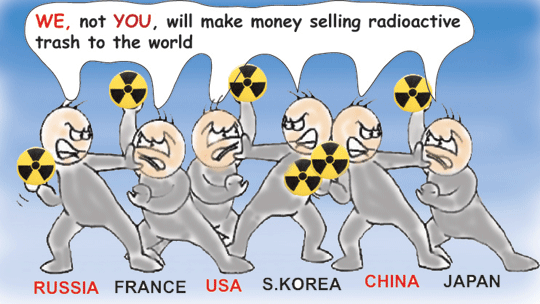
The power utility said some 27 companies had stated that they intended to provide a response to the RFI, including major nuclear vendors from China (SNPTC), France (EdF), Russia (Rosatom Overseas) and South Korea (KEPCO).
Eskom’s interim group chief executive Matshela Koko said: “Eskom is looking forward to the information supplied to confirm our understanding of the key issues that impact the timing and affordability of a nuclear programme.”……
Eskom issued the RFI on its website in December 2016 and asked companies that felt they could provide relevant information to confirm by January 31 that they would be submitting a response to it.
Cabinet in June designated Eskom as the procurer, owner and operator for the multi-million rand nuclear build programme to initially provide 9.6 gigawatts of nuclear energy at least by 2030.
But according to the base case scenario in the Integrated Resource Plan unveiled by Energy Minister Tina Joemat-Pettersson in November, only 1 359 megawatt of nuclear power would be added to the country’s energy mix by 2037 and the volume of renewable energy would rise significantly.
February 3, 2017
Posted by Christina Macpherson |
marketing, politics international, South Africa |
Leave a comment
 Russia’s Rosatom submits bid for South African nuclear project – TASS, Reuters Jan 24 Russian state nuclear agency Rosatom has submitted a bid for a nuclear power project in South Africa, TASS news agency cited the company’s General Director Alexei Likhachev as saying on Tuesday.
Rosatom had been considered the leading candidate for a tender to build 9.6 gigawatts of nuclear power capacity in South Africa by 2030, but South African nuclear state agency Necsa said last year it was no longer “the frontrunner”. (Reporting by Alexander Winning; Writing by Jack Stubbs) http://www.reuters.com/article/russia-safrica-nuclear-idUSR4N1F7023
January 25, 2017
Posted by Christina Macpherson |
marketing, Russia, South Africa |
Leave a comment
 South Africa: Court Orders Punitive Costs Against Minister in Nuclear Case http://allafrica.com/stories/201612150392.html By Ashleigh Furlong, 14 Dec 16 Minutes before hearing, ministry reveals new determination on nuclear energy
The Minister of Energy Tina Joemat-Pettersson has been ordered by the Western Cape High Court to pay punitive costs including the costs of four counsel for Earthlife Africa and the Southern African Faith Communities Environment Institute (SAFCEI) after the state brought forward new evidence minutes before the case was set to begin.
A court orders punitive costs usually when it is dissatisfied with the conduct of a litigant. This is rare and is considered a strong rebuke.
The respondents in the case are the Minister of Energy, the president, the National Energy Regulator of South Africa (NERSA) as well as two representatives from Parliament.
Yesterday, the case began with a postponement until February 2017, as it was revealed mere minutes before the hearing was to begin that the Minister had made a new nuclear energy determination – replacing a decision that was gazetted last December.
Part of the relief sought by Earthlife and SAFCEI was for the old decision to be declared invalid. They also want the court to declare invalid the agreement between South Africa and Russia, as well as the tabling in Parliament of the deals with the USA and Korea.
The new decision now states that Eskom, not the Department of Energy – as was the case in the old determination – will be the procurement agency for 9,600 megawatts of nuclear energy.
“Despite it being signed on 5 December 2016, the Court was not informed thereof and neither were the applicants – until literally minutes before the hearing was to begin. The Court stressed in its judgment that there was no evidence presented to the court explaining how this determination came about, when it was decided upon and the processes leading thereto, despite the Determination apparently having been made more than a week before the hearing,” says a statement issued by Earthlife and SAFCEI.
The South African Renewable Energy Council (SAREC) has also expressed concern over the new determination, saying that it was “seemingly rushed through” on the basis of “the very outdated Integrated Resource Plan published in 2010”.
“We are further disheartened by Eskom’s Acting CEO’s simultaneous announcement that the utility will release a nuclear Request for Proposals as soon as the determination is gazetted,” says Brenda Martin, Chair of SAREC in the statement.
“SAREC believes that this irrational behaviour fans the flames of suspicion as to the real motives behind the nuclear campaign. Facts, logic and basic financial prudence simply do not support this determination,” says the statement.
Earthlife and SAFCEI wanted the request for proposals to be halted until the court case was finalised. However, the court ruled that Eskom was allowed to go ahead with the process.
December 17, 2016
Posted by Christina Macpherson |
Legal, South Africa |
Leave a comment
Nuclear RFI delayed once again Release postponed ‘to brief minister’. Money Web , Antoinette Slabbert / 15 December 2016 Moneyweb has just learnt that Eskom will not release the highly-anticipated nuclear Request for Information (RFI) on Thursday, despite widely-published undertakings by its acting CEO Matshela Koko to that effect.
According to South African Nuclear Energy Corporation (Necsa) chair Dr Kelvin Kemm, the documents were signed off by him and Eskom chair Dr Ben Ngubane on Thursday morning and were ready for release. A further cooperation agreement between Eskom and Necsa was also signed.
Eskom and Necsa have been tasked by government to jointly manage the procurement of the country’s 9 600 MW new nuclear build programme.
Kemm said Eskom’s shareholder representative, public enterprise minister Lynne Brown, however requested a personal briefing on the matter, since she has not been closely involved in the nuclear procurement planning……http://www.moneyweb.co.za/news/industry/breaking-nuclear-rfi-delayed-once-again/
December 16, 2016
Posted by Christina Macpherson |
business and costs, South Africa |
Leave a comment
Earthlife Africa goes to court to halt SA’s bid for nuclear power http://www.heraldlive.co.za/news/2016/12/13/earthlife-africa-goes-court-halt-sas-bid-nuclear-power/
In a David versus Goliath battle which could determine the country’s energy future‚ an NGO will be in the Cape Town High Court on Tuesday to try halt government’s nuclear procurement deal.
In an affidavit submitted to the court‚ Earthlife Africa argues that government’s agreement with Russia to supply South Africa with multiple nuclear power plants is both unlawful and unconstitutional.
The procurement deal would be the largest in the country’s history at an estimated R1-trillion‚ and would see the building of a “nuclear fleet” that would generate nearly 10GW of power.
In September 2014‚ Energy Minister Tina Joemat-Pettersson signed an agreement with Russia on strategic partnership and cooperation in the fields of nuclear power and industry‚ which was then authorised by President Jacob Zuma.
The agreement was tabled before Parliament in June 2015.
In the affidavit‚ Earthlife branch coordinator Phillipine Lekalakala stated that the deal was unlawful‚ and should be reviewed and set aside. “The decision to proceed with procuring these nuclear power plants… has occurred without any of the necessary statutory and constitutional decisions having been lawfully taken‚” said Lekalakala.
“The minister and the National Energy Regulator of SA were obligated to have determined that new generation capacity is required and that the electricity must be generated from nuclear power in terms of the Energy Regulations Act (ERA).”
“No ERA requirement decision or ERA nuclear procurement system decision has been taken.”
The state opposed the application saying that the nuclear programme was a policy direction adopted by government to establish a self-sufficient nuclear industry for the industrialisation and development of the country.
The deputy director-general of the Department of Energy‚ Zizamele Mbambo‚ said that‚ as part of the nuclear programme‚ the energy and electricity needs of the country would be provided for.
“This policy direction allows the country to discharge its international obligation to reduce CO2 emissions from our historical fleet of coal-driven power stations‚” Mbambo said.
Earthlife and co-applicants in the matter‚ Southern African Faith Ministries’ Environment Institute‚ will be holding a demonstration outside the court on Tuesday. – TMG Digital/The Times
December 14, 2016
Posted by Christina Macpherson |
Legal, South Africa |
Leave a comment
In South Africa, Nuclear Energy Is Becoming A Dirty Word Forbes, Nishtha Chugh , 13 Dec 16
The nuclear reactors are still a plan on paper. But already the noxious debate over their future has made nuclear energy a dirty word in South Africa. To build or not to build – the stalemate over the proposed nuclear reactors to power the continent’s most advanced economy shows no sign of being resolved.
State power utility Eskom is dragging its feet on honoring government-brokered deals with private renewables companies. Its refusal to purchase 250 megawatts of power from wind and solar projects has left its Irish and Saudi Arabian suppliers fuming and in limbo. More than scuppering the deals, Eskom’s actions, critically, threaten to undermine the gains made by the country’s green energy program, which many have come to
hail as the shining beacon of a renewables-based future . On the Fieldstone Africa Renewable Index or FARI, South Africa’s ranking has plummeted off the charts entirely, prompting concerns amongst investors over green energy’s future in the country. Its decline is ironic given the rainbow nation had topped the continent-wide list just four months ago.
December 14, 2016
Posted by Christina Macpherson |
renewable, South Africa |
Leave a comment
Energy minister’s advisers reveal why nuclear should be dumped News 24, Dec 07 2016 14:53 Matthew le Cordeur Cape Town – A Ministerial Advisory Council on Energy (Mace) working group report on South Africa’s future energy plan explains that by removing policy adjustments and keeping the plan at a least cost level, the need for nuclear energy falls away.
The report was presented by Mace member Mike Levington on Wednesday, as part of the Department of Energy’s (DoE’s) public consultation workshop for the Integrated Resource Plan (IRP) and Integrated Energy Plan process……….
Energy Minister Tina Joemat-Pettersson and Public Enterprises Minister Lynne Brown have come out in support of nuclear energy as a big part of the eventual IRP, but critics have warned that nuclear energy’s inclusion will be a political decision and not based on scientific fact.
The Mace report recommended that the “annual new-build limits for solar PV and wind should be removed” from the base case assumptions, Levington revealed.
“This unconstrained scenario … re-run with correct solar PV and wind cost assumptions, should form the least-cost base case of IRP 2016,” it explained.
“Step by step constraints or policy adjustments scenarios (for example annual new-build limits for solar PV and wind) should also be financially modelled and the total cost per year of such constrained scenarios compared with the revised least-cost Base Case to assess the cost effectiveness of such interventions,” it said.
The Mace committee said nuclear energy is not a least-cost option in the current 2010 IRP.
“In IRP 2010, nuclear was not the least-cost option,” they said. “It was a policy decision to include nuclear in the plan to cater for uncertainties around the forecasted cost reduction of renewables, as at the time it was unclear whether they would materialise in the magnitude and as quickly as anticipated in the IRP 2010.
“These adjustments led to the model building nuclear under very specific constraints, where the amount of required CO2-neutral electricity could not be supplied entirely by renewables because of these annual new-build limits.”
Looking ahead, it said a “least cost IRP model, free of any artificial constraints and before any policy adjustments, does not include any new nuclear power generators”.
“The optimal least cost mix is one of solar PV, wind and flexible power generators (with relatively low utilisation).”…….. http://www.fin24.com/Economy/energy-ministers-advisers-reveal-why-nuclear-should-be-dumped-20161207
December 12, 2016
Posted by Christina Macpherson |
politics, South Africa |
Leave a comment
Plan to go to market for nuclear proposals not open for review http://www.iol.co.za/news/politics/plan-to-go-to-market-for-nuclear-proposals-not-open-for-review-7140535 9 December 2016, Emsie Ferreira Cabinet will not revisit its decision to endorse plans to proceed with a request for proposals to build new nuclear reactors, Presidency Minister Jeff Radebe said on Friday.
Reporting on the fortnightly Cabinet meeting, Radebe told reporters that the issue had not been discussed by Cabinet as it had been decided and ministers had approved the draft Infrastructure Resource Plan for publication.
“On nuclear options, we did not discuss those issues as there are Cabinet decisions on them which we gave on the ninth of December [2015], so there is nothing new on them except that in the last Cabinet we released for public discussion the Integrated Energy Plan, as well as the resource plan,” Radebe said.
He was referring to a decision taken a year ago to proceed to the market with a call for proposals to increase nuclear energy generation.
Initial public submissions on the IRP this week saw experts, including members of Energy Minister Tina Joemat-Pettersson advisory team, challenge the blueprint’s assumptions on the need for South Africa to procure more nuclear energy.
They told public hearings that should artificial constraints on increasing the amount of renewable energy in the power mix be removed, nuclear no longer made sense in a planning model.
The contested base case scenario in the IRP provides for a first new nuclear reactor coming on line in 2037, followed by more that would add a total of 20 gigawatt to the power grid by 2050.
Eskom, which Cabinet recently designated as implementing agency instead of the energy department, plans to proceed with a request for proposals this year still despite the longer timelines for nuclear commissioning introduced in the IR.Matshela Koko, Eskom’s new acting CEO, also said the country could need nuclear much earlier than the scenario set out in the document, putting him at odds with Joemat-Pettersson.
Pressed on this, Radebe said he did not expect Cabinet to discuss their divergence or any aspect of the nuclear drive before a final IRP is brought before it next year.
December 9, 2016
Posted by Christina Macpherson |
politics, South Africa |
Leave a comment
 Outa says there is no case for nuclear http://www.iol.co.za/business/news/outa-says-there-is-no-case-for-nuclear-7126828 BUSINESS NEWS / 8 December 2016, Emsie Ferreira Cape Town – Civic rights organisation Outa on Thursday said it believed the case for building new nuclear energy reactors had been dismantled after the energy minister’s advisors told public hearings there were cheaper viable options.
“Following input provided by numerous entities at Wednesday’s Integrated Energy and Resource Plan (IEP and IRP) draft documents, Outa believes the rationale for any plans to introduce nuclear energy into South Africa’s electricity grid has been removed,” Outa’s portfolio director Ted Blom said.
He said the first day of hearings on the draft resource and energy blueprints had shown that they contained serious flaws in their assumptions of the prices of different energy technologies and that there was a need to for the IRP base case scenario to use the cheapest options. The base case scenario advanced in the IRP provides for South Africa to add 20 gigawatt of new nuclear energy by 2050 and Eskom has said it would it go to the market with a request for proposals by the end of the year still.
A team of experts that advised Energy Minister Tina Joemat-Pettersson challenged this conclusion and said their input was ignored. Business Day reported that members of the panel of 40 experts told the hearings that the department’s decision to impose artificial constraints on how much renewable energy could be added to the grid, as well as outdated pricing had allowed nuclear into the model. Outa chairman Wayne Duvenhage said the hearings had already yielded valuable input for the final IRP and he did no see how it could support the government and Eskom’s plans for nuclear expansion.
“Personally, I cannot see how the final IRP-2016 document will be able to suggest the inclusion of even one kilowatt of energy being generated through nuclear. If nuclear energy is indeed forced into the system, the DOE’s credibility will come under serious scrutiny.” Outa has called on the department to allow more time for public submissions.
“We remain concerned that the DOE is trying to force the process to be complete by the end of March 2017, which we believe will not be sufficient time,” Blom said.
December 9, 2016
Posted by Christina Macpherson |
civil liberties, politics, South Africa |
Leave a comment
Nuclear Deal(s): What Zambia can learn from South Africa, Daily Maverick, 08 DEC 2016 Zambia has just signed four memoranda of understanding with Rosatom, Russia’s state-run nuclear agency, with a view to signing a nuclear deal worth $10-billion. While government has hailed the deal as a way to solve Zambia’s ongoing energy crisis, Zambians should be asking difficult questions – especially given Rosatom’s track record in South Africa. By SIMON ALLISON.
When Zambian President Edgar Lungu addressed Parliament in September, he announced a bold new energy strategy: Zambia is going nuclear…….
Three months later, we now have a better idea of what he was talking about. In a ceremony in Lusaka’s plush Pamodzi Hotel on Tuesday, Zambian government representatives signed a series of Memoranda of Understanding with Rosatom, the Russian state-owned nuclear agency.
The deal, which is not legally binding, sets out a 15-year nuclear co-operation plan, with the eventual goal of constructing a nuclear gigawatt nuclear power plant. In addition, Rosatom will help train Zambian nuclear engineers, develop a nuclear energy regulator, and spearhead nuclear research in the country. Local media estimate the total value of the deal to be $10-billion (that’s nearly half of Zambia’s GDP)……
There’s no doubt that Zambia needs an energy plan……..
But is nuclear really the solution? As Zambia prepares to go down the nuclear road, they could learn a few lessons from down south. Although South Africa has successfully operated a nuclear power station at Koeberg for several decades, a government initiative to build two new nuclear power stations has been mired in controversy, with Rosatom playing a central role in the drama. Based on the South African experience, here are three questions that Zambians should be asking.
1. Does Zambia need nuclear power? There’s no question that Zambia needs power…….. But nuclear power might not be the best solution. It’s not just the inherent dangers associated with nuclear power, although that is a factor; but also the nature of the energy generated. Nuclear power stations produce a steady “base line” supply of energy, which may not be appropriate for Zambia’s needs. Nuclear power can’t be turned on and off in response to supply and demand……
Critics of South Africa’s proposed nuclear deal have highlighted similar issues, as well as pointing out that South Africa – and, by extension, Zambia – might be better placed to take advantage of the decreasing cost of renewable energy.
“The promotion of nuclear energy at the expense of renewables bucks global trends. An industrial nation like Germany is phasing out nuclear power, and has a much higher renewable energy investment than sunny, windy South Africa. Chinese renewables expansion currently exceeds nuclear development by far,” said Hartmut Winkler, physics professor at the University of Johannesburg, writing in the Mail & Guardian.
 2. Can Zambia afford nuclear power?
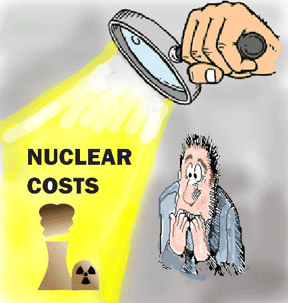
Nuclear power is expensive. Very expensive. It’s not just the cost of the construction of the nuclear plant itself, although those numbers are eye-watering (especially in an economy as small as Zambia’s, where GDP in 2015 was $21.2-billion). It is also the cost of financing that construction.
With most banks unwilling to take such a massive gamble, financing usually comes from the vendor itself. In South Africa’s case, Rosatom is supposed to fund the construction of the two new nuclear plants, and recoup its costs by selling the electricity generated at an artificially high price. According to the text of a secret agreement uncovered by investigative journalist Lionel Faull, Rosatom will be able to dictate that price at will – leaving South African energy users at the mercy of a foreign corporation.
 3. Will the nuclear deal be corrupt?
Suspicion of corruption immediately attaches itself to any massive infrastructure project, and with good reason – especially in the case of nuclear deals. South Africa appears to be a textbook example of how the massive sums of money at stake can lead both government and corporations astray.
For example, French nuclear company Areva was accused by Sherpa, an anti-corruption NGO, of attempting to bribe high-ranking South African officials by purchasing unprofitable uranium mining assets for an inflated sum, just months before the tender for the nuclear project was announced. Rosatom itself, meanwhile, has been linked with a suspicious lack of transparency, fuelling fears that not all is above board. As Professor Winkler wrote in a separate piece for The Conversation:
“The nuclear debate gained a political dimension when President Jacob Zuma and his Russian counterpart, Vladimir Putin, started to develop an unusually close relationship… The lack of transparency surrounding the process, coupled with a history of corruption in South African mega-projects like the arms deal, has made the whole scheme seem suspicious to the broader public,” he said……. https://www.dailymaverick.co.za/article/2016-12-08-nuclear-deals-what-zambia-can-learn-from-south-africa/#.WEoQptJ97Gg
December 9, 2016
Posted by Christina Macpherson |
AFRICA, politics |
Leave a comment