South Africa’s power utility wants to finance nuclear. This is a bad idea. , enca, Seán Mfundza Muller, Senior Lecturer in Economics, University of Johannesburg Sunday 6 November 2016 JOHANNESBURG – South Africa’s cabinet is to consider a proposal that a mooted nuclear power deal for the country be financed through the state-owned power utility Eskom. This is the latest twist in South Africa’s controversial efforts to expand its nuclear power capability by commissioning up to 9.6GW of energy from six nuclear power stations. The decision has been mired in controversy and still hangs in the balance and the offer by Eskom to foot the bill raises more questions than it provides answers.
Recent claims by Eskom’s management fail to adequately address any of the fundamental criticisms of the proposed nuclear programme.
Statements that Eskom can “finance nuclear on its own”, or absorb the risks from an incorrect decision, don’t add up economically or financially, and are misleading.
Furthermore, changes in Eskom’s rationale for justifying nuclear procurement over the last two years call into question the merits and motives of these arguments. Its claims about financing also raise serious questions about the arguments it presented to Parliament last year to justify a R23 billion cash injection and writing off a R60 billion loan.
The right decision would be for cabinet to defer further consideration of the programme for at least two years. In addition Eskom should account to Parliament on discrepancies in its statements about its financial situation.
THE FUNDAMENTAL FLAWS IN THE CASE FOR NUCLEAR
The three main problems with the case for nuclear procurement are well-established.
The actual power probably will not be needed. Recent trends in economic growth and electricity demand are much lower than the original forecasts on which the supposed need for nuclear power were based.
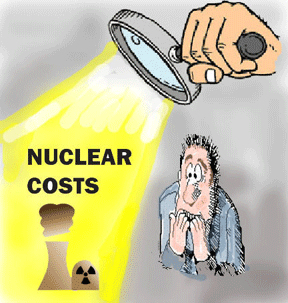
The programme is also likely to be very costly although there are still no credible, government cost estimates in the public domain. Many energy experts have argued that even if additional capacity was needed, other energy sources may be cheaper or more appropriate.
Finally, the combination of insufficient demand and costly supply means that nuclear poses a serious threat to the future stability of the country’s public finances and economic growth.
November 6, 2016
Posted by Christina Macpherson |
business and costs, politics, South Africa |
Leave a comment
 Can Eskom can be trusted with such a huge, risky and expensive exercise?
Between the Chains: Eskom just can’t do nuclear http://www.financialmail.co.za/opinion/Betweenthechains/2016/11/03/between-the-chains-eskom-just-can-t-do-nuclear
BY SIKONATHI MANTSHANTSHA, NOVEMBER 03 2016, By the time you read this, Statistics SA will have published yet another electricity production report that exposes the propaganda coming out of Eskom for the lie it really is. The last electricity production report, released in the first week in October, shows Eskom has been generating ever-shrinking amounts of power for the past decade. For the eight months to August, it produced a total 152,432 gigawatt hours (gWh) of electricity. For the whole of last year Eskom generated 230,122gWh of power, a far cry from the 241,170gWh it churned out in 2007, the year the screws really came off. The next-best generation performance came only in 2010, with 240,528gWh of electricity produced. It has been on a downward production spiral since then.
This year’s production figures also include the more than 2,000MW that is produced by private, renewable-power operators.
Yet for the past year the utility has been feeding the nation the lie that it has improved its generation performance, pointing at the absence of load shedding as proof. Only when confronted with the evidence do Eskom’s executives reluctantly admit that the much lower demand “has contributed” to the lack of load shedding.
Stats SA collects its information from the utility itself. So who is Eskom fooling with its public-relations spin?
Now that they have been repeating the “superb performance” narrative, Eskom’s managers are beginning to believe it and are becoming more ambitious and brazen. Generation chief Matshela Koko has been generating a storm of hot air about why Eskom must handle the procurement of the next fleet of nuclear power stations. And now that energy minister Tina Joemat-Pettersson has effectively handed the responsibility to Eskom, the utility says it will use its balance sheet to fund the nuclear power stations, which it would operate when the first one comes into operation by 2026……..
While I believe that SA does need to build more nuclear power stations in order to restore energy security, I do not think Eskom can be trusted with such a huge, risky and expensive exercise at this stage. And I believe we only need to build a maximum 3,000MW of new nuclear capacity during the next 20 years, not the 9,600MW government has been pushing for.
As a start, it is fanciful and misleading at best to say a nuclear power station can be commissioned by 2026. Certainly not by Eskom. The worst possibility is that Eskom executives are deliberately misleading SA into believing they can efficiently manage such a process.
Over budget and years late
Since August 2007, Eskom has been bumbling and unnecessarily costing SA billions trying to build the Medupi and Kusile power stations. Both are way over budget and at least five years late.
It is not only lack of skills causing these delays and cost overruns. Corruption inside Eskom and at government level has played the biggest role. And corruption has since got worse, not better.
The biggest lie in Eskom’s bid to control the nuclear procurement is that it has a balance sheet capable of handling such a commitment. Koko conveniently forgets that in 2009 Eskom abandoned its nuclear build programme, and handed the responsibility to government.
The reason was stated clearly: Eskom alone could not afford the commitment, said then chief generation officer Brian Dames in 2009. The utility has since leant on government for financial guarantees and bailouts to support its current capital investment programme. The taxpayer is exposed to more than R170bn in Eskom guarantees alone. Eskom did not have the money then. It does not have it now.
November 5, 2016
Posted by Christina Macpherson |
politics, secrets,lies and civil liberties, South Africa |
Leave a comment
 Eskom’s nuclear energy offer doesn’t add up, Independent Online 3 November 2016, The power utility’s financial statements need scrutiny, writes Seán Mfundza Muller South Africa’s cabinet is to consider a proposal that a mooted nuclear power deal for the country be financed through the state-owned power utility Eskom. This is the latest twist in South Africa’s controversial efforts to expand its nuclear power capability by commissioning up to 9.6GW of energy from six nuclear power stations.
The decision has been mired in controversy and still hangs in the balance and the offer by Eskom to foot the bill raises more questions than it provides answers. Recent claims by Eskom’s management fail to adequately address any of the fundamental criticisms of the proposed nuclear programme. Statements that Eskom can “finance nuclear on its own” don’t add up and are misleading.
Changes in Eskom’s rationale for justifying nuclear procurement over the past two years call into question the merits of these arguments.
Its claims about financing also raise serious questions about the arguments it presented to Parliament last year to justify a R23 billion cash injection and write off a R60bn loan.
The right decision would be for the cabinet to defer further consideration of the programme for at least two years. In addition, Eskom should account to Parliament on discrepancies in its statements about its financial situation.
The three main problems with the case for nuclear procurement are well established.
The actual power probably will not be needed. Trends in economic growth and electricity demand are much lower than the original forecasts on which the supposed need for nuclear power were based.
The programme is also likely to be very costly although there are still no credible, government cost estimates in the public domain. Many energy experts have argued that even if additional capacity was needed, other energy sources may be cheaper or more appropriate.
Finally, the combination of insufficient demand and costly supply means that nuclear poses a serious threat to the future stability of the country’s public finances and economic growth.
An indicator of problematic motives is the way in which the arguments made for it keep shifting. Last year Eskom chief executive Brian Molefe told Parliament that procurement of nuclear was “urgent” and feasible. Molefe argued that nuclear costs were lower than critics implied and financing concerns reflected a “pedestrian” attitude.
Subsequent to this, Eskom decided on a new line of attack: trying to limit procurement of power from independent renewable energy producers………
It should therefore be clear that the case for proceeding with the procurement of nuclear power is fundamentally flawed. The rational and responsible decision by cabinet would be to halt it.
If economic growth and energy demand increases significantly over the next few years, the matter could be revisited based on an appropriately updated Integrated Resource Plan that uses credible forecasts of future energy needs. http://www.iol.co.za/dailynews/opinion/eskoms-nuclear-energy-offer-doesnt-add-up-2086209
November 4, 2016
Posted by Christina Macpherson |
business and costs, politics, South Africa |
Leave a comment
 Eskom boss Brian Molefe bursts into tears over #StateCaptureReport. Has he been hung out to dry? Biz News, 2 Nov 16 Eskom boss Brian Molefe is not coping well with the stream of allegations that point to his role as a central figure in the capture of state entities by the Gupta family. He broke down in tears at a conference on Eskom’s latest financial reports when talk turned to the #StateCaptureReport compiled by former Public Protector Thuli Madonsela, which was released to the public this week. Molefe has been referred to as a friend of the Gupta family and is a key link in allegations that Eskom may have fraudulently given money to a Gupta-linked company to enable it to buy a coal mine. Molefe has also vigorously promoted the benefits of a nuclear build programme, which many believe will bankrupt the country while its beneficiaries reap the benefits of tapping into state contracts. Molefe’s prominent appearance in the #StateCaptureReport has evidently caught him by surprise. With an illustrious career in powerful roles, including as chief executive officer of the state’s Public Investment Corporation, and influential friends, perhaps he thought he was beyond reach? At the very least, it seems that Molefe’s friends forgot to let him know that he featured in the document, while alerting others – including co-operative governance minister Des van Rooyen and mines’ minister Mosebenzi Zwane, who made noises about going to court to stop the release of the #StateCaptureReport. It’s starting to look a bit like a case of ‘every man for himself’ as the web of deceit around the Gupta and Zuma families unravels. – Jackie Cameron
November 4, 2016
Posted by Christina Macpherson |
secrets,lies and civil liberties, South Africa |
1 Comment
Eskom imperils our energy security – It is long past time to Liberate the Grid, Daily Maverick 27 OCT 2016 It is a paradox of sorts but Eskom’s increasingly hostile attitude towards the country’s once successful renewable energy programme (REIPPPP) and indeed, the government’s own energy policy, should be welcomed. By DIRK DE VOS.
Recently, we have seen Eskom’s current head generation, Matshela Koko, saying that National Treasury itself should pick up the liability created by existing renewable energy projects even though the costs of these are passed through via the regulated tariff mechanism (so no cost is borne by Eskom).
Eskom’s defiance of national policy and legislation by its refusal to connect additional renewable energy projects is now the subject of an official complaint by the Wind Energy Association (SAWEA). At the same time, Eskom wants to be at the centre of a future nuclear energy procurement programme despite the lack of an Integrated Resource Plan (IRP) to support any such thing.
This should not be seen as a bad thing. Why? In the Finance Minister’s Medium Term Budget Policy Statement, we see Treasury support REIPPPP and other energy initiatives but these are little more than encouraging words. It is Eskom that, perhaps inadvertently, is framing exactly the kind of debate that South Africa should have finalised more than 18 years ago. In 1998, Cabinet adopted the White Paper on Energy. It contemplated a substantial restructuring of our electricity sector separating generation, transmission and distribution, the extensive use of markets to regulate price, promoting energy efficiency and environmental sustainability.
Almost none of the policies was carried out. One initiative that did emerge was an Independent System and Market Operator (ISMO) Bill which would have made a modest start on separating the management of the grid from Eskom’s generation and distribution activities. It went nowhere.
In the interim, a revolution driven by increasingly cheap renewable energy has got under way. In 2014, more additions to global electricity generating capacity were accounted for by renewables than any other form of energy and growth of this sector is charging on requiring constant upward revisions to the future growth of renewables.
In South Africa however, despite claims to the contrary, the promising renewables programme is grinding to a halt. Eskom’s willingness to connect ever cheaper renewable projects has moved from what can be described as passive-aggressive to one of open defiance. Soon, investors in renewables will have to abandon the country and relocate their efforts to countries that are moving with the times.
We seem to be caught in endless debates about the merits of renewables. While Eskom, a publicly owned company, refuses to disclose information about the costs of its generation, new renewables are proving to be cheaper than any other source of electricity generation. Eskom, for its part, has sought to dismiss renewables with a series of misrepresentations about renewable energy and does so even in its own financial statements. Eskom’s false claims on renewable energy are then trafficked to the general public in such bad faith that there is little purpose in the tedious efforts to refute them.
Let’s get to the more useful debate then: Mr Koko is reported to have said that the financial strain caused by the REIPPPP (renewables) was indefensible. In doing so, he makes a telling point, “I am an executive of Eskom. I will not preside over Eskom sinking,” and to underline what he means, he goes on to say, “You cannot be a cardinal and not believe in the pope.” So, there it is. Eskom and its viability stands in the way of sensible electricity sector decisions.
One of the more recent changes to the electricity sector is that planning future generation is now not done by Eskom itself but through an independent IRP process. The IRP is now the means by which South Africa plans its future electricity path. The outcome of the IRP permits the Minister of Energy to make a determination in terms of the Electricity Regulation Act on what type of capacity is to be built, when and by whom. Previous such ministerial determinations have resulted in the REIPPPP, the coal IPP and the gas IPP.
The IRP processes are fairly rigorous but it looks at the South African electricity supply sector as a holistic system. That is essential for planning processes but it does not take into account that for all practical purposes system is Eskom and Eskom has its own plans for itself. If, theoretically, Eskom’s interests were the same as those of the rest of the country, that would not be much of a concern. But they are not and Mr Koko and his management now have made it quite clear whose interests are to be pursued. They are not our interests…….
Eskom’s extraordinary ability to dissipate large amounts of physical capital on a more or less continuous basis is matched only by its ability to maintain and preserve political capital. This is not a new problem. The current Eskom management simply follows an established tradition extending back to well before our democratic dispensation. As DrGrové Steyn, of Meridian Economics, writing about Eskom a decade ago, points out: “It should not escape the attention that technological paradigms, construction choices and (lack) of demand-side strategies serve the pecuniary and reputational interests of engineers, managers and politicians… Unfortunately, the interests of these groups are often not adequately aligned with the social interest”. None of this should be surprising – all government sanctioned monopolies do the same thing.
Seen in this way, Eskom’s enthusiastic support for the completely ludicrous nuclear programme makes perfect sense. Very few sensible independent observers think it can proceed and Eskom has no chance of financing or, as we have seen, successfully project managing any such programme. It is more than likely that most senior managers within Eskom know this too – as their own 2008 study showed. But there is a lot of political capital to be won by getting behind it. Again, dissipating physical capital and building political capital…….http://www.dailymaverick.co.za/article/2016-10-27-eskom-imperils-our-energy-security-it-is-long-past-time-to-liberate-the-grid/#.WBZ2hdJ95pg
October 31, 2016
Posted by Christina Macpherson |
ENERGY, South Africa |
Leave a comment
 Daily Maverick AMABHUNGANE 20 OCT 2016
At a special late-night tender committee meeting, Eskom executives agreed to hand a Gupta company R587-million – money that was used, two days later, to help pay the R2.15-billion purchase price for Optimum Coal. By Susan Comrie for AMABHUNGANE.
Six hours after the banks refused to give the Guptas a R600-million loan for their controversial Optimum Coal deal, Eskom came to their rescue.
amaBhungane can reveal that at a special late-night tender committee meeting, Eskom executives agreed to hand a Gupta company R587-million – money that was then used, two days later, to help pay the R2.15-billion purchase price for Optimum Coal.
The deal, which documents show was clinched via a 21:00 teleconference call, involved extending Tegeta Exploration and Resources’ coal supply contract with Arnot power station by R587-million.
The fact that Eskom also agreed to pay the money up front reinforces the impression of preferential treatment.
Details of these hurried meetings – all held on April 11 this year – are contained in a report by the business rescue practitioners for Optimum Coal and in minutes of Eskom’s 21:00 meeting that were leaked to Carte Blanche in June.
The report by the business rescue practitioners, Piers Marsden and Peter van den Steen, was made to the Directorate of Priority Crime Investigation (Hawks) in terms of section 34 of the Prevention and Combating of Corrupt Activities Act.
amaBhungane understands that the section 34 report, submitted on July 1 this year, also forms part of former Public Protector Thuli Madonsela’s state capture report.
The business rescue practitioners refused to confirm or deny the existence of the report, but amaBhungane has seen a copy, which sets out in detail what happened on April 11:
- On that morning, Nazeem Howa, the chief executive of Gupta-owned Oakbay Investments, called the business rescue practitioners and asked for a meeting.
- At 10:00, Howa sat with the practitioners at Tegeta’s office in Sandton and delivered the bad news – Tegeta was R600-million short of the purchase price for Optimum Coal.
- At Howa’s request, the practitioners called an urgent meeting with Optimum’s three bank creditors – First Rand Bank, Investec and Nedbank – and a representative of Optimum’s then-owner, Glencore. At the meeting, held at about 13:30 at First Rand’s Sandton offices, the practitioners asked whether the consortium of banks would offer Tegeta a R600-million bridging loan.
- At 15:00, Marsden phoned Howa to tell him the banks had refused the request.
Leaked Eskom minutes, broadcast on Carte Blanche in June, show that about six hours after Howa was informed that the banks would not stump up the funding, Eskom held a “special tender committee meeting” where it decided to hand Tegeta a R587-million prepayment for coal.
Two days later, Tegeta delivered the full purchase price of R2.15-billion for Optimum Coal.
Tegeta’s purchase of Optimum from Glencore has been muddied by allegations of political interference and favouritism, particularly directed at mines minister Mosebenzi Zwane and Eskom.
Tegeta is partly owned by the Gupta family through Oakbay Investments, but smaller stakes are owned by President Jacob Zuma’s son Duduzane Zuma, Gupta-linked businessman Salim Essa and an opaque offshore company registered in the United Arab Emirates.
Eskom has repeatedly denied showing Tegeta favourable treatment.
Tegeta, through Oakbay Investments, declined to comment on this detailed timeline, saying it was “subject to an apparent ongoing investigation and the provisions of the Public Protector Act”.
Eskom and Oakbay deny that the approach for the R587-million prepayment was made after Tegeta failed to secure financing from the banks, saying that Eskom had been in discussions with Tegeta for some time.
“Following negotiations (of which we have proof and necessary documentation) we agreed that a prepayment be made against onerous provisions,” Oakbay said. “We cannot comment on how Eskom dealt with the transaction on their side save to mention that a formal agreement was reached, signed pursuant whereto an invoice was issued and paid.”……..
In written statements, Eskom and Oakbay Investments denied that the mine was entitled to receive any part of the prepayment.
Belatedly, Eskom is now seeking to characterise the prepayment as a loan, albeit one that would be repaid in coal at a very high price……….This story was produced by the amaBhungane Centre for Investigative Journalism http://www.dailymaverick.co.za/article/2016-10-20-amabhungane-r587m-in-six-hours-how-eskom-paid-for-gupta-mine/#.WAqNwOV97Gg
October 22, 2016
Posted by Christina Macpherson |
secrets,lies and civil liberties, South Africa |
Leave a comment
 CABINET TO DISCUSS ESKOM’S ROLE IN NUCLEAR DEAL AT NEXT MEETING http://ewn.co.za/2016/10/20/Cabinet-to-discuss-Eskoms-role-in-nuclear-deal-at-next-meeting
Minister Joematt-Pettersson said in October that Eskom was best-placed to drive the procurement process. Gaye Davis | 2 hours ago
CAPE TOWN – Minister in the Presidency Jeff Radebe says Cabinet will discuss a proposal that Eskom become the procurement agent for thecountry’s nuclear power programme at its next meeting.
Radebe was responding to questions after briefing on the outcomes of yesterday’s Cabinet meeting.
Energy Minister Tina Joematt-Pettersson said earlier this month Eskom was best-placed to drive the procurement process, while the Department of Energy would act as co-ordinator.
The plan to put Eskom in the nuclear driving seat is set to come before Cabinet in two weeks’ time.
Radebe says, “Eskom being the agency is going to be discussed in the next Cabinet (meeting).The minister of energy will be bringing forth those issues for finalisation by Cabinet.”
Joematt-Pettersson told Parliament’s energy committee earlier this month that Eskom will leverage its own balance sheet to raise the money needed.
Eskom says it wants the first of two nuclear reactors operational in 10 years’ time.
But a revised integrated resource plan, which tries to calculate the country’s long-term energy needs and ways of meeting them, has yet to be approved by Cabinet.
(Edited by Masechaba Sefularo)
October 22, 2016
Posted by Christina Macpherson |
politics, South Africa |
Leave a comment
 Climate change killing East Africa’s water resources, UN warns, Daily Nation OCTOBER 20 2016 BY KEVIN J. KELLEY
One of East Africa’s (EA) most important sources of water is drying up due to the impact of climate change on Mt Kilimanjaro, the United Nations Environment Programme (Unep) warned on Wednesday.
In Summary
- Populations and property near Mount Elgon on the Kenya-Uganda border are also being threatened by the impact of climate change, Unep said in a report on the status of mountain environments in East Africa.
- The Kenyan and Ugandan governments are further urged to “harmonise their environmental policies because, at the moment, they are scattered, disjointed and sometimes contradictory and are therefore failing to address climate change and mitigation issues, particularly in mountain areas.”
- Unep’s 97-page report explains that Kilimanjaro’s forests feed Tanzania’s Pangani River, and this vital resource for much of East Africa is threatened by an increasing number of wildfires on the mountain……..http://www.nation.co.ke/news/Climate-change-killing-water-resources/1056-3423570-uj0mob/
October 21, 2016
Posted by Christina Macpherson |
AFRICA, climate change |
Leave a comment
Why Google Cares about Wind Power in Africa Millions of people are coming online, and that requires (renewable) energy, Scientific American By Daniel Cusick, ClimateWire on October 12, 2016
Google Inc.’s investment in Kenya’s Lake Turkana Wind Power Project is its largest on the African continent to date, but it almost certainly won’t be the last.
The California internet giant has shown a growing interest in sub-Saharan Africa since it made its first cash outlay three years ago—a $12 million investment in the Jasper Solar Power Project in South Africa’s Northern Cape Province.
The 96-megawatt photovoltaic project, completed in 2014, was built by U.S.-based SolarReserve LLC and is capable of powering roughly 80,000 South African homes.
The Lake Turkana deal, whose financial terms were not disclosed, calls for Google to acquire 12.5 percent of the nearly $700 million project from Vestas Wind Systems A/S of Denmark after the wind farm is completed next year.
“We are investing in clean energy projects like Lake Turkana because they make business sense and can help accelerate the deployment of renewable energy,” a Google spokesperson said in an email to E&E News.
She added that the company sees “a large opportunity in fast-growing markets with rich renewable energy resources, where both the need and the potential are great.”
The ownership group includes lead developers Aldwych International Ltd. of Great Britain and KP&P Africa BV of the Netherlands, with additional financial support from international development funds in Norway, Finland and Denmark.
As with Jasper in South Africa, Google said its wind power investment “will help bring much needed capacity and stability to Kenya’s energy supply, reducing reliance on fossil fuels and emergency diesel generation while providing some of the most cost effective power in the country.”
In total, Google has committed more than $2.5 billion to 22 renewable energy projects around the world, mostly through power purchase agreements and direct ownership of wind and solar farms, officials said. Much of its purchased power goes to support massive Google data centers in the United States and Europe.
But the company sees a future in the developing world, where millions of new internet users are coming online annually……..https://www.scientificamerican.com/article/why-google-cares-about-wind-power-in-africa/
October 14, 2016
Posted by Christina Macpherson |
AFRICA, renewable |
Leave a comment
 Eskom will finance South Africa’s R1 trillion nuclear plans: minister, Business Tech By Staff Writer, October 11, 2016 Energy minister Tina Joemat-Pettersson has told Parliament that South Africa’s ambitious and controversial nuclear energy plans will be entirely funded by Eskom, with no money coming from National Treasury.
The minister was briefing Parliament’s energy oversight committee on Tuesday.
The process around South Africa’s nuclear plans, which will see 9,600MW of nuclear power added to the grid, has been a mysterious one, where the DoE has not revealed any of the details surrounding the project – including its cost.
Conservative estimates have put the build at R500 billion, while experts have noted – taking into consideration the country’s much-delayed Medupi and Kusile power station builds – that costs may balloon to well over R1 trillion.
 According to Joemat-Pettersson, Eskom will fund the entire build off its own balance sheet, and the funding process will be handled in the same way as the Medupi and Kusile projects.
No funds will come from Treasury or the fiscus, she said, with Eskom turning to global markets to raise money it needs.
Eskom’s handling of Medupi and Kusile have drawn much criticism as both projects have seen massive delays, labour issues and come in billions of rands over budget………
DA shadow minister of energy, Gordon Mackay, said that Pettersson’s announcement “is nothing short of an elaborate sleight of hand aimed at muddying the water and subverting effective parliamentary oversight over the R1 trillion nuclear deal”.
Mackay said that in designating Eskom as the procuring agent for the nuclear new build the following must be considered:
- The tender will be subject to Eskom’s board tender committee, the very same tender committee found to be corrupt by the Supreme Court of Appeal.
- The tender will be subject to internal Eskom processes, effectively shielding the nuclear deal from direct parliamentary oversight.
- A nuclear deal not directly subject to parliamentary oversight will cost more and be subject to greater levels of corruption, in the same way as Kusile and Medupi have been with regard to their association with Hitachi.
- While tax payers will not be directly liable for the build costs of the new build programme – like the costs of Kusile and Medupi – they will be passed onto consumers via higher electricity prices. Higher energy costs will kill economic growth and jobs.
“Far from providing much needed clarity and assurance, the Minister has created greater uncertainty and has all but ensured that Zuma and his cronies will enrich themselves at South Africa’s expense,” the DA’s energy lead said. http://businesstech.co.za/news/energy/139651/eskom-will-finance-south-africas-r1-trillion-nuclear-plans-minister/
October 12, 2016
Posted by Christina Macpherson |
business and costs, politics, secrets,lies and civil liberties, South Africa |
Leave a comment
 We who advocate renewable energy systems, and new technologies need to be aware of the dangers of the mining and processing of rare metals such as lithium. The history of this industry is scandalous. AFP: China pays price for world’s rare earths addiction. But today, the exploitation of lithium miners continues.
 THE COBALT PIPELINE Tracing the path from deadly hand-dug mines in Congo to consumers’ phones
  and laptops WP, by Todd C. Frankel Photos by Michael Robinson Chavez Video editing by Jorge Ribas September 30, 2016
The sun was rising over one of the richest mineral deposits on Earth, in one of the poorest countries, as Sidiki Mayamba got ready for work.
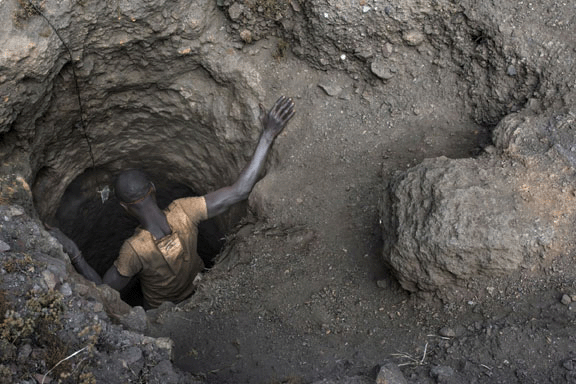
Mayamba is a cobalt miner. ….
This remote landscape in southern Africa lies at the heart of the world’s mad scramble for cheap cobalt, a mineral essential to the rechargeable lithium-ion batteries that power smartphones, laptops and electric vehicles made by companies such as Apple, Samsung and major automakers.
But Mayamba, 35, knew nothing about his role in this sprawling global supply chain. He grabbed his metal shovel and broken-headed hammer from a corner of the room he shares with his wife and child. He pulled on a dust-stained jacket. A proud man, he likes to wear a button-down shirt even to mine. And he planned to mine by hand all day and through the night. He would nap in the underground tunnels. No industrial tools. Not even a hard hat. The risk of a cave-in is constant……
The world’s soaring demand for cobalt is at times met by workers, including children, who labor in harsh and dangerous conditions. An estimated 100,000 cobalt miners in Congo use hand tools to dig hundreds of feet underground with little oversight and few safety measures, according to workers, government officials and evidence found by The Washington Post during visits to remote mines. Deaths and injuries are common. And the mining activity exposes local communities to levels of toxic metals that appear to be linked to ailments that include breathing problems and birth defects, health officials say.
The Post traced this cobalt pipeline and, for the first time, showed how cobalt mined in these harsh conditions ends up in popular consumer products. It moves from small-scale Congolese mines to a single Chinese company — Congo DongFang International Mining, part of one of the world’s biggest cobalt producers, Zhejiang Huayou Cobalt — that for years has supplied some of the world’s largest battery makers. They, in turn, have produced the batteries found inside products such as Apple’s iPhones — a finding that calls into question corporate assertions that they are capable of monitoring their supply chains for human rights abuses or child labor.
Apple, in response to questions from The Post, acknowledged that this cobalt has made its way into its batteries…….
Few companies regularly track where their cobalt comes from. Following the path from mine to finished product is difficult but possible, The Post discovered. Armed guards block access to many of Congo’s mines. The cobalt then passes through several companies and travels thousands of miles.
Yet 60 percent of the world’s cobalt originates in Congo — a chaotic country rife with corruption and a long history of foreign exploitation of its natural resources…..
In the past year, a Dutch advocacy group called the Center for Research on Multinational Corporations, known as SOMO, and Amnesty International have put out reports alleging improprieties including forced relocations of villages and water pollution. Amnesty’s report, which accused Congo DongFang of buying materials mined by children, prompted a fresh wave of companies to promise that their cobalt connections were being vetted.
But the problems remained starkly evident when Post journalists visited mining operations in Congo this summer. https://www.washingtonpost.com/graphics/business/batteries/congo-cobalt-mining-for-lithium-ion-battery/
October 3, 2016
Posted by Christina Macpherson |
AFRICA, health, PERSONAL STORIES |
1 Comment
Uranium Mining in Niger: Tuareg Activist Takes on French Nuclear Company,Spiegel.de By Cordula Meyer Translated from the German by Christopher Sultan, 2 Oct 16
Part 2: Life in the Vicinity of the Uranium Mines “……A massive hill, made up of 35 millions tons of waste material from the mine, is visible from the northwestern edge of Arlit. Although the uranium has already been extracted from the material, it retains 85 percent of its radiation, stemming from substances like radium and thorium, which have half-lives measured in thousands of years. The waste material lies there, uncovered, exposed to the desert winds. Residents grow tomatoes and lettuce between the waste dump and the city…….
Some 2,200 people work there. In the plant, workers break apart large pieces of rock, grind them into dust and then leach out the uranium using large amounts of water and acid. The end product is a yellow material known as yellowcake. The yellowcake is filled into barrels and then transported in convoys to Benin, 2,500 kilometers (1,560 miles) away. From there, the yellowcake is loaded onto ships bound for Marseilles.
Radioactive Dust Alhacen is a member of the Agir tribe in the Aïr Mountains. His father led camel caravans carrying salt and dates. Alhacen accompanied his father for the first time when he was 11. He began working in the mine about 10 years later, in 1978. His job was to repair the machines that crush the rock. Every evening, he would go home to his family and play with his children, still wearing his dusty work overalls. His wife washed his clothes, which were full of radioactive dust.
The first time Alhacen heard about radiation was in 1986, after the Chernobyl reactor accident. From then on, he was given a paper respiratory mask to wear. Eight years later, a lung ailment forced him to stop working. He was transferred to a new department that handled radiation protection. He is still officially employed there today, but the company has relieved him of his duties. “His suspensions were justified by his inappropriate conduct (unjustified absence etc…),” Areva told SPIEGEL in a statement. Alhacen is worried about his job, because he needs the income for his 13 children. But being furloughed also means that he has more time for his fight, and for the victims.
He now has time, for example, to visit the widow Fatima Taoka in her mud-walled house. Her husband Mamadou worked in the mine, where he drilled the rock into smaller pieces, until he fell ill. “He was always strong, but then he had nothing but pain and became as thin as a stick,” says Fatima. It was something in the lungs and kidneys, she says, but the people at the hospital did not tell her what exactly it was.
“It was because of the dust,” she says. “There was something evil in the dust.” Fatima doesn’t know what radioactivity is. Her husband died in 1999, the same year several of Alhacen’s coworkers died. Most of them had jobs that involved working around dust.
‘The Doctors Don’t Tell the Truth’
“They died of diseases that we didn’t understand,” says Alhacen. He says that when he asked hospital staff what had killed his coworkers, he didn’t receive an answer. Sometimes, he says, the doctors said it was AIDS, but this made Alhacen suspicious, because Niger had a low incidence of AIDS. The fact that the hospital belongs to Areva also made him suspicious. It was when Mamadou died that Alhacen decided to set up Aghirin Man.
That was 10 years ago. Since then, he has repeatedly heard accounts of ailments that resemble what happened to Mamadou. While making his rounds, he also visits Amalhe Algabit. The former assistant surveyor still has his I.D. card, coated in plastic, with the number 1328. His chest hurts, and he hides his emaciated body in a white robe and his collapsed face behind a pair of large sunglasses. He often feels as if he were suffocating. He doesn’t know why this is happening to him, but is afraid that he doesn’t have much time left. “I’m already so thin,” he says.
Rakia Agouma is a widow whose husband died on Sept. 23, 2009. For 31 years, he had driven trucks containing rocks in the mine. Three years before his death, he had severe pain in his chest and back, but tried to remain in good spirits. It was what Rakia had always liked about him. When he died at Areva’s hospital, she was apparently told it was malaria. “The doctors don’t tell the truth,” she says. “They’re liars.”
Areva says that everyone in Arlit and Akokan receives free medical treatment, even former workers. The company also claims that not a single worker has died of occupational cancer……….
Areva insists that it has satisfied the highest international standards for maximum radiation doses since 2002. Joseph Brehan, a Paris attorney, says: “The improvements aren’t that significant.” He recently traveled to Arlit to meet with his client, Almoustapha Alhacen. Last year, Areva signed an agreement that authorizes Sherpa to examine the working conditions in the mines. In return, Sherpa must coordinate its activities with Areva. Together they intend to introduce a comprehensive health monitoring system.
Physicist Bruno Chareyron and Alhacen believe that Sherpa has made a deal with the devil.
Depending on Areva
This is the problem with a powerful corporation. Criirad, Aghirin Man and Sherpa are small organizations that survive on donations. Even Alhacen is a critic that Areva can still tolerate, because he too has arguably made a deal with the devil. He still works for Areva. The company has furloughed him, but he still lives rent-free in a house owned by Areva and known as RA4, No. 6. The house has four rooms, and there are four goats in a shed in the inner courtyard. By Arlit standards, Alhacen is a prosperous man. “If I lose the job, I have to get out of the house — right away.”
There is no other place to work in Arlit than in the plant. Arlit is Areva. And even a critic like Alhacen depends on Areva……….http://www.spiegel.de/international/world/uranium-mining-in-niger-tuareg-activist-takes-on-french-nuclear-company-a-686774-2.html
October 3, 2016
Posted by Christina Macpherson |
AFRICA, health, opposition to nuclear, PERSONAL STORIES, Uranium |
Leave a comment
South Africa: Nuke RFP Delayed in Order to Give Eskom Greater Say and Avoid Parliamentary Scrutiny http://allafrica.com/stories/201609300697.html By Gordon Mackay, 30 Sep 16 At a cabinet briefing today, Minister in the Presidency, Jeff Radebe, confirmed that it was highly unlikely that the nuclear RFP would be issued tomorrow as announced by the Minister of Energy, Tina Joemat-Pettersson, three weeks ago in Parliament.
Minister Radebe also suggested that the delay in issuing the RFP is largely due to a decision by cabinet to strip the Department of Energy of its role as government’s designated procurement agent in favour of Eskom.
This must be seen for what it is – a blatant attempt by the Zuma administration to:
- side-line parliamentary oversight of the nuclear new build programme;
- block public debate on the need for additional nuclear capacity;
- create a veil of secrecy around the procurement process which would now be subject to internal Eskom processes and procedures;
- give President Jacob Zuma greater control of the nuclear procurement process.
Designating Eskom as the procuring agent of the state will fundamentally limit the role and capacity of Parliament to oversee the nuclear deal and, in doing so, increase the potential of corruption surrounding the trillion rand deal.
The DA rejects any attempt to designate Eskom, headed by CEO and Zupta buddy, Brian Molefe, as the procuring agent for nuclear. Eskom has proven with Medupi and Kusile that it is unfit to manage mega-projects. It has also proven that its governance procedures are lax and the Supreme Court of Appeal has found its Board Tender Committee to be corrupt.
The DA is further concerned that the nuclear new build programme will further be subject to undue influence by the President, who is the Chair of the SOE Co-ordinating Committee.
We will use every mechanism available to us to ensure that this deal – which we do not need and cannot afford – is not pushed through without proper parliamentary oversight and scrutiny.
October 1, 2016
Posted by Christina Macpherson |
politics, South Africa |
Leave a comment
Signs of a great rift over Zuma’s nuclear programme, Rand Daily Mail, RAY HARTLEY 30 SEPTEMBER 2016 In another indication of President Jacob Zuma’s dimishing influence, his headlong rush to build a ‘fleet’ of nuclear reactors has been halted. And there are signs that it is going to be cut down to size, if it goes ahead at all.
October 1, 2016
Posted by Christina Macpherson |
politics, South Africa |
Leave a comment
This has drawn attention to South Africa’s status as a global model for renewable energy, and raises new question about why the country is pursuing nuclear when renewables look so promising.
South Africa has the fastest growing green economy in the world, according to credit rating agency Moody’s.
“South Africa was the continent’s largest renewables market in 2015 in terms of asset finance for utility-scale projects and it saw the highest year-on-year growth globally,” said Christopher Bredholt, a Moody’s vice president, in a Sept. 16 report. Asset finance is usually used by businesses to lease equipment without having to buy it outright, according to Finance & Leasing Association.
South Africa had the highest growth globally for asset finance in 2015 at 300 percent, representing $4.5 billion, according to Moody’s.
Continue reading →
October 1, 2016
Posted by Christina Macpherson |
politics, renewable, South Africa |
Leave a comment