 Eskom: SA has not signed nuclear deal http://northglennews.co.za/106808/eskom-sa-not-signed-nuclear-deal/ The power utility has not received any formal proposals from potential supplier SOUTH Africa has not signed any nuclear deal, Eskom recently said. Responding to last week’s media reports alleging that a nuclear deal has been signed, Eskom reiterated the remarks made by National Treasury that no deal has been signed.
“Eskom expects to issue a full Request for Proposal (RFP) to the open market once the Request for Information (RFI) has been assessed and the relevant approvals have been obtained,” said Eskom Chief Nuclear Officer, Dave Nicholls.
Nicholls said the power utility has not received any formal proposals from potential suppliers and has not signed any power plant procurement agreements.
“Eskom has not undertaken any pre-qualification assessment to date related to the potential respondents to a potential RFP,” he said.
South Africa plans to introduce 9 600 megawatts of nuclear energy to the grid in the next decade.
“The funding model of the project will be determined by the response received from the markets once bidders have responded to the RFP. This will also be done at a pace and scale that government can afford,” said the department.
April 12, 2017
Posted by Christina Macpherson |
politics, South Africa |
Leave a comment
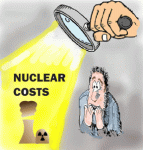 ‘R1 trillion nuclear deal will guarantee SA junk status’ http://www.iol.co.za/news/politics/r1-trillion-nuclear-deal-will-guarantee-sa-junk-status-8565844 9 April 2017 ANA Reporter Cape Town
 – It is an undeniable fact that South Africa cannot afford, and does not need, government’s planned nuclear energy deal, the Democratic Alliance said on Sunday.
Media reports on Sunday that the nuclear deal was going full-steam ahead were extremely concerning and would essentially guarantee that South Africa would be downgraded by more ratings agencies and make recovering from this status even more difficult, DA spokeswoman Natasha Mazzone said.
Fitch Ratings stated in no uncertain terms on Friday that a key driver behind the decision to downgrade SA’s long-term foreign currency debt and long-term local currency debt to “BB+”, or “junk status”, was that “Eskom has already issued a request for information for nuclear suppliers and is expected to issue a request for proposals for nuclear power stations later this year.
The Treasury under its previous leadership had said that Eskom could not absorb the nuclear programme with its current approved guarantees, so the Treasury will likely have to substantially increase guarantees to Eskom”.
Just days before, S&P Global also downgraded South Africa to sub-investment level – “junk status”. Mazzone said the DA would ask public enterprises portfolio committee chairwoman Dipuo Letsatsi-Dub for an urgent meeting of the committee to ensure that Parliament, as a key oversight body, would fully interrogate all aspects related to the nuclear deal.
“The undeniable fact is that South Africa cannot afford, and does not need, the nuclear deal. Indeed, international ratings agencies agree and this deal has been repeatedly cited as a cause for great concern and a key factor in downgrades not only for Eskom, but the country as a whole.
“These downgrades have already and will continue to have a devastating effect on our economy. Jobs will be lost and the cost of living will increase, which will hurt the poor,” Mazzone said.
Earlier on Sunday, City Press reported that a confidential document reveals that South Africa’s nuclear-build programme kicks off in earnest in June when Eskom issues a formal request for proposals from companies bidding for the estimated R1 trillion contract.
The nuclear deal – for which Russian company Rosatom was widely considered to be the front runner – was, according to senior National Treasury officials, “directly related” to President Jacob Zuma’s axing of finance minister Pravin Gordhan and his deputy Mcebisi Jonas, the newspaper reported.
“It is well known that Gordhan was against the project as he said the country couldn’t afford it.Eskom will be issuing a request for proposals in June and that really is the beginning of procurement. Gordhan had to go because he was going to block it again,” a senior official reportedly said.
The internal Eskom document dated three days before Gordhan and Jonas were axed revealed a tight timeline for the programme that would see four plants built to provide 9600 megawatts of electricity to the country.
After the request for proposals was issued in June, the deadline for bids was September, for evaluation in December. The winning bidder would be decided in March 2018 and the contract signed between December next year and March 2019, City Press reported.
The document also revealed that most of the major nuclear contracts would be implemented through “turnkey” procurement, which Treasury officials were concerned about.
“While Treasury allows for turnkey procurement, we know that it is often used to hide corruption. Companies that are asked to deliver turnkey projects are accountable to themselves. They appoint whoever they like, however they like,” a senior official reportedly said.
Turnkey projects were when a single company was appointed to manage and deliver an entire project. The management company became responsible for appointing all contractors and service providers. This was different from an open tender that was spread over a range of different contractors appointed by the state, City Press reported.
April 10, 2017
Posted by Christina Macpherson |
business and costs, politics, South Africa |
Leave a comment
 ZUMA’S CABINET RESHUFFLE OPENS DOOR FOR SA NUCLEAR DEAL, EyeWitness News, 1 April 17 Hartmut Winkler is professor of physics, University of Johannesburg.This article first appeared on The Conversation.
South Africa has just witnessed a game-changing Cabinet reshuffle with the firing of five ministers and several deputy ministers. This included the Finance Minister Pravin Gordhan and his second-in-charge Mcebisi Jonas.
The three ministries with the most critical impact on the energy sector have all been affected, significantly increasing the chances of the country opting for a highly controversial nuclear energy programme. Continue reading →
April 3, 2017
Posted by Christina Macpherson |
politics, South Africa |
Leave a comment
 ‘Gigaba has signed nuclear deal, we are Russia’s slaves’ http://citizen.co.za/news/news-
 national/1474986/gigaba-has-signed-nuclear-deal-we-are-russias-slaves/, Charles Cilliers , 1 Apr 17, Vytjie Mentor has thrown her weight behind an allegation that includes the ‘revelation’ that Zuma’s nephew is set to make billions.
A little-known ANC member and part-time lecturer at the University of KwaZulu-Natal put  Facebook users into a tailspin on Sunday evening when she took to the platform to declare that she had knowledge that the new finance minister, Malusi Gigaba, has already signed off on a new nuclear deal.
Sibusisiwe Mngadi, who lists as among her occupations being a part-time lecturer at the University of KwaZulu-Natal Pietermaritzburg and an area manager at the Msunduzi Municipality, wrote: “The Nuclear Deal deadline was last night. Guess whose signature is on the paper? The new Finance Minister Malusi Gigaba.” She alleges the deal will benefit President Jacob Zuma’s controversial nephew Khulubuse Zuma to the tune of R50 billion by his company being given the contract to build nuclear plants.
“Mission Nuclear done and dusted. Guess whose company is in charge of building the nuclear plants?
“Khulubuse Zuma is the SA holding company for the Nuclear plants. The next 20 yrs Khulubuse Zuma will be making more than 50billion. Congratulations, mission accomplished.”
She did not reveal what her source for this allegation was and many of her followers questioned whether she was properly informed or telling the truth.
Many pointed out that it was highly unlikely the new finance minister would have been able to sign off on such an important deal (the most expensive in South African history) after being in the job for just one day. Update: Treasury in an official statement later said that the new finance minister had signed no such documents and there were no documents ready to sign. Gigaba is yet to even occupy his office at Treasury.
Mngadi explained that she had not joined the struggle against apartheid and been jailed only for this to happen to her “beloved ANC”.
It is understood that President Jacob Zuma and the Gupta family have been pushing hard for government to sign off on a trillion-rand deal with Russia’s state-owned nuclear company Rosatom.
The former finance minister, Pravin Gordhan, and his predecessor, Nhlanhla Nene, were in no hurry to sign off on any nuclear agreements with Russia, or anyone else. Many analysts have concluded that both were axed due primarily to their opposition to any hasty conclusion of such a deal with Russia.
When Nene was axed in favour of Des van Rooyen in 2015, there were similar allegations that Van Rooyen had hurriedly signed off on the nuclear deal (he was in office for just four days), but these rumours turned out to be baseless.
Former ANC MP and party whistleblower Vytjie Mentor repeated the allegation about the deal being signed, though it’s not clear if she sourced her allegations from Mngadi or verified them independently.
She wrote: “Gigaba signed the nuclear deal last night. It will be R6 trillion with over-runs. All South Africans are now officially slaves of the Russians, and thus will be the case for the next 100 years.”
Mngadi’s post has already been shared nearly 700 times, with it also going viral on WhatsApp and Twitter.
Mentor has thrown her weight behind a group of South Africans calling for the observance of #BlackMonday by wearing black tomorrow in support of the call for Zuma to step down.
April 3, 2017
Posted by Christina Macpherson |
secrets,lies and civil liberties, South Africa |
Leave a comment
 Treasury shoots down nuclear deal allegations http://www.news24.com/SouthAfrica/News/treasury-shoots-down-nuclear-deal-allegations-20170402 Jenna Etheridge, News24 Cape Town – National Treasury on Sunday set the record straight on news that was circulating on social media of a nuclear deal allegedly signed by incoming Finance Minister Malusi Gigaba.
ANC member Sibusisiwe Mngadi had alleged on Facebook earlier on Sunday that “the nuclear deal deadline was last night” and that Gigaba had signed it.
She also alleged that President Jacob Zuma’s nephew Khulubuse Zuma would benefit from nuclear plants being built.
“Khulubuse Zuma is the SA holding company for the Nuclear plants. The next 20yrs Khulubuse Zuma will be making more than 50billion. Congratulations, mission accomplished,” she alleged on the post.
Mngadi listed her occupations as a researcher and part-time lecturer at University of KZN in Pietermaritzburg, and an area manager at Msunduzi Municipality.
Some of her followers asked her for proof to support her claims. She replied that people should do their own digging, alluding only to a “parliament document that was signed yesterday”.
Former ANC MP Vytjie Mentor also entered the fray on her personal Facebook profile page, seeming to support the allegations.
“Gigaba signed the Nuclear Deal Last night. It will be R6 trillion with over-runs. All South Africans are now Officially slaves of the Russians, and thus will be the case for the next 100 years,” Mentor alleged.
National Treasury issued a series of tweets on the matter on Sunday night. “The Minister arrived (on) Friday and has not yet gone beyond boardrooms where he met management and later had a telecon with rating agencies,” the treasury account stated.
“He is formally occupying his office tomorrow and will have a briefing meeting with the outgoing Minister Pravin Gordhan in the morning. There are no documents of deals ready for signature on nuclear. Therefore the reports are misleading and mischievous.”
Gigaba’s spokesperson Mayihlome Tshwete also took to Twitter to say he had signed “not a single thing”, not even to sign off for the printing of his business cards. He said Gigaba had not even received any documents from the Director-General.“Sadly, we must now release a statement to deny fake news, then the story will be about the denial,” he lamented.
In government’s updated Integrated Resource Plan (IRP) 2016, which is still under discussion, it intends to add 20 385MW units of nuclear power to the national grid, Fin24 reported.
This will make up approximately one-third of South Africa’s total generation mix.
On December 20, 2016, Eskom, which has taken over from the Department of Energy as owner and operator of the proposed nuclear build programme, issued a Request for Information (RFI) for the procurement of nuclear energy. Comment is currently open for the Request for Proposal (RFP) until April 28.
The RFP is expected to be issued to the market place by the middle of the year and in 2018 Eskom and the Nuclear Energy Corporation SA (Necsa) will choose their preferred bidders and negotiate and finalise contracts.
April 3, 2017
Posted by Christina Macpherson |
politics, politics international, South Africa |
Leave a comment
Gordhan said to have spooked Russian connection on nuclear deal http://www.iol.co.za/news/politics/gordhan-said-to-have-spooked-russian-connection-on-nuclear-deal-8459357
2 April 2017 Staff Reporter Johannesburg – Former finance minister Pravin Gordhan said the masses should be worried when top ANC officials admitted that they didn’t know where a decision was made.
Professor Njabulo Ndebele said the country was in a “deep political and moral crisis” characterised by power and greed.
Zuma’s spokesperson Dr Bongani Ngqulunga said the president was not involved “in the planning of the memorial service and in the cancellation thereof. Any impression created that the president cancelled or ordered the cancellation is erroneous and unfortunate.”
Meanwhile, while Gordhan was doing the presentations in London there was a gentleman called Chenkov who kept on asking many questions about South Africa. He wanted to know if the South African government was looking at developing nuclear energy. Gordhan quickly quashed the idea of nuclear and repeatedly confirmed that the South African government would never develop this energy.
Chenkov had no further questions. After the presentation Chenkov called someone and spoke in Russian but whoever he was speaking to was not impressed and angrily dropped the phone.
It is believed that this person immediately called President Jacob Zuma and threatened him that if he did not immediately trigger the process of changing the finance minister and sign the nuclear deal, as commission had already been paid, he would be taught a lesson.
A shaken Zuma immediately called the minister back home. “You obviously know what happened!”
April 3, 2017
Posted by Christina Macpherson |
politics, politics international, Russia, secrets,lies and civil liberties, South Africa |
Leave a comment
Eskom on nuclear charm offensive, IOL.co za.31 March 2017, Siseko Njobeni Johannesburg – Eskom, the designated procurer for South Africa’s new nuclear build programme, has gone on a charm offensive and recently commissioned a study that has shown the multibillion-rand benefits of its Koeberg nuclear power station.
Eskom yesterday released the results of a KPMG study that looked at Koeberg’s socio-economic impact in the Western Cape and South Africa in the period between 2012 and 2025.
Although Koeberg, which is Africa’s only nuclear plant, has been producing power into the national electricity grid since the mid-1980s, nuclear still battles with social acceptability in certain quarters in South Africa and internationally.
The government’s plans to go ahead with the nuclear build programme has consistently run into opposition on environmental and affordability grounds.
“Economic impact assessment of Koeberg does not provide answers to all the questions. But it adds context to the journey we are on and helps us to alter their philosophical views on nuclear power. It is meant to inform. For me what is important is not proving whether nuclear is preferable to coal or renewables to gas,” said Public Enterprises Minister Lynne Brown at the release of the report in Cape Town yesterday……..
Ironically, Eskom has recently been in the spotlight for its decision to decommission five of its power stations from 2020 because of, among others, lethargic economic growth and the addition of renewable energy from independent power producers (IPPs). http://www.iol.co.za/business-report/energy/eskom-on-nuclear-charm-offensive-8431033
April 1, 2017
Posted by Christina Macpherson |
South Africa, spinbuster |
Leave a comment
 In South Africa, as Australia’s top pro nuclear propagandist, Ben Heard, is busy glorifying nuclear power, the nuclear free movement there is mobilising
SDCEA mobilises anti-nuclear community unity with petition http://southlandssun.co.za/71218/sdcea-mobilises-anti-nuclear-community-unity-petition/ Local activists call for action. Erin Hanekom 22 Mar 17 COMMUNITY meetings have called for South Durbanites to take action against nuclear energy and for a referendum to decide the future of nuclear energy in the country.

The South Durban Community Environmental Alliance (SDCEA) hosted energy meetings at ML Sultan St Marys Primary School on 2 March and the Austerville community hall on 6 March to educate and mobilise community on the proposed nuclear energy build.
“Citizens need to understand they have the power to refuse or accept the nuclear energy fleet proposed to be built in South Africa. Sustainable energy should be the main focus in this country not unsustainable and dangerous energy,” said a statement from SDCEA.
Among SDCEA co-ordinator, Desmond D’Sa’s topics of discussion was the importance of community unity against what he termed as unsustainable developments.
“This community has a history of environmental activism that has previously brought successful results. The communities of South Durban need to unite against this nuclear build as the proposal is to develop a fleet of these facilities along the South African coastline which will pose an enormous danger to people and marine life,” said D’Sa.
Economist in development studies, Dr Gerard Boyce spoke about the financial and environmental aspects of the nuclear deal.
The use of a referendum was discussed, calling for government to set up a public vote on the matter, leaving the decision in the hands of the people.
“The referendum will benefit citizens by putting people back at the centre of politics, create greater openness and transparency in nuclear dealings. It will ensure increase current levels of public participation and foster a
culture of participatory democracy. To sum up, it will be a creation of an active and engaged citizenry,” said Dr Gerard Boyce.
SDCEA environmental project officer, Noluthando Mbeje galvanised people into being part of SDCEA’s nuclear energy campaign, which has been waged for years and has included protests, community meetings and discussions with experts in the field, including Russian environmentalist, Vladimir Slivyak.
Outcomes of the meeting include the decision to garner at least 15,000 signatures on an anti-nuclear petition; research to be conducted on cancer statistics in South Durban; getting the youth involved; renewable energy programmes;education and meetings with municipal and national officials.
Petitions can be collected at the SDCEA offices and on social media.
March 24, 2017
Posted by Christina Macpherson |
opposition to nuclear, South Africa |
Leave a comment
 Russia eyes deal to build Kenya’s sole nuclear plant, The Star, Kenya Mar. 14, 2017, By WEITERE MWITA @mwitamartin Russia has offered to design, finance and build Kenya’s proposed nuclear power plant.
A delegation from Russia will pitch tent in Nairobi for the regional nuclear energy conference which kicks off today.
Russia is seeking to strike a deal through its state-owned Rosatom State Atomic Energy Corporation. Kenya plans to set up four nuclear plants, with the first expected to be switched on in 2027.
On May 30, 2016, Rosatom signed a Memorandum of Understanding with Kenya to promote nuclear solutions, assist in training personnel, create public awareness, and design agriculture and medical solutions.
Rosatom regional vice president for Sub-Saharan Africa Viktor Polikarpov yesterday said the Moscow-based entity, through the government, is ready to support Kenya put up its plants on a Build–Operate–Transfer module or Private-Public-Partnership consortium.
Rosatom said it will borrow a loan through an intergovernmental agreement, with a repayment period of up to 25 years. The firm is the only reactor vendor in the world that can offer the nuclear industry’s entire range of products and services.
“We are currently providing the VVER-1200 (Water-Water Energetic Reactor) generation III reactor which is the safest in the world. We can offer the preferred solution to your government if given a chance,” Polikarpov told journalists…….
Kenya has also signed MoUs with China and South Korea but is yet to identify a developer for the project which could cost up to Sh2 trillion. The developer will be selected by the Kenya Nuclear Energy Board……http://www.the-star.co.ke/news/2017/03/14/russia-eyes-deal-to-build-kenyas-sole-nuclear-plant_c1523942
March 15, 2017
Posted by Christina Macpherson |
Kenya, marketing, Russia |
Leave a comment
Suitors line up to walk Kenya down controversial path to nuclear energy Standard media UK By Paul Wafula , March 7th 2017
Kenya is on a delicate journey that will see it switch on its first nuclear power plant by 2027. The country plans to put up four nuclear plants in the long term, each generating 1,000 megawatts (MW) of electricity. Initial estimates show it will cost between Sh400 billion and Sh500 billion to put up one nuclear reactor. This means one plant will cost slightly more than building the 609-kilometre Mombasa to Nairobi Standard Gauge Railway (SGR). By the time the plan is complete, the country will have spent about Sh2 trillion – just under the national Budget for a year – to reap the benefits of an additional 4,000MW of energy plugged into the national grid.
Besides the financing headache, the second test for the 10-year dream being championed by the Kenya Nuclear Energy Board (KNEB) is coming up with a location to for the reactors. The board estimates site selection will cost the country Sh1.5 billion in a three-year process. Though the potential sites have remained a closely guarded secret, the power plant will be built next to any of the four biggest water bodies in the country – that is, the Indian Ocean, Lake Victoria, River Tana and Lake Turkana.
…………..These plans have excited sellers of nuclear reactors who are now courting the country, with some dangling ‘free training’. The potential suppliers include South Korea, whose companies are constructing nuclear power plants in the United Arab Emirates. Kenya has also been window shopping in China, and with Rosatom in Russia and Westinghouse in the United States. The country’s plans appear modelled on the UAE’s, which awarded a South Korean consortium to build four plants at a cost of Sh2 trillion.
…………Kenya has already signed a memorandum of understanding with China, South Korea, Russia and Ghana. KNEB said the deal with China would help Kenya “obtain expertise through training and skills development, technical support in areas such as site selection for Kenya’s nuclear power plants, and feasibility studies”. China has been offering ‘free’ training and feasibility studies for big infrastructure projects in Africa as a strategy to get into the boardrooms where key decisions are made. This is the same approach it used to land the SGR deal.
………..The country has also signed nuclear power co-operation agreements with Slovakia and South Korea.
…………He added that the Sh500 billion cost per plant for UAE may be cheaper because South Koreans were trying to get into the market. France is also lining up for a piece of the action, with the country offering Kenya technical, engineering and financial support to develop reactors.
…………MAKING THE CASE Juma has defended the cost of the project on the grounds that in the long run, nuclear energy is a cheaper and more stable source of power, with sustainable base loads. The board is looking at having flexible financing options, including public-private partnership where a private developer will finance the plant, construct and operate it for some time to recoup investments and make a profit, before handing it over to the State.
……The agency is looking at plants that will have a lifespan of up to 80 years.
………….it will have a difficult task of convincing local communities that the country is ready to deal with the radiological effects of nuclear.
……The other headache that must be tackled is the development of national strategies for radioactive waste management, emergency preparedness and the nuclear fuel cycle.
……energy experts from Italy and Germany last year, advised Kenya to drop plans to build nuclear reactors and instead harness its vast renewable energy resources, including geothermal, solar and wind, for power generation. They cited massive costs for a nuclear plant, long construction periods of about 10 years and expensive decommissioning at the end of plants’ lifespan, especially disposing of hazardous radioactive waste.
March 8, 2017
Posted by Christina Macpherson |
Kenya, marketing |
Leave a comment
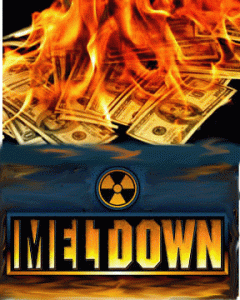 SA heads for financial armageddon, Fin 24 2017-02-26 06:02 – Justin Brown State finances face stormy times as the private sector braces itself for a possible switch in finance ministers amid spluttering tax collections, low growth, tax hikes and deep suspicion regarding the nuclear build.
Prince Mashele, a senior research fellow at the University of Pretoria, said at a PwC post-budget speech event on Friday – where Finance Minister Pravin Gordhan was conspicuously absent – that, depending on which ANC faction dominated, the next two to three weeks would be crucial in determining what would happen in the finance ministry.
Following the swift swearing-in of former Eskom CEO Brian Molefe as an ANC MP this week, Mashele pointed to the possibility of his becoming either finance minister or deputy finance minister…….
Mashele said that once Molefe was installed at Treasury, he was likely to sign off on a nuclear deal with Russia that would mean South Africa would never again enjoy the benefit of cheap power prices.
“Your grandchild and great-grandchild will pay through the nose [for the nuclear deal],” he added.
The plan by the Guptas, who are close allies of President Jacob Zuma, to install their preferred candidate as finance minister was put on hold – but not abandoned – when former finance minister Nhlanhla Nene was replaced by Des van Rooyen, whom the president reluctantly axed after pressure from the business sector, before Gordhan was placed in the position.
“They want Molefe to enter Treasury,” Mashele said, adding that Gordhan was “under siege” from Zuma and the Guptas, who were fighting court battles with him……. http://www.fin24.com/Budget/sa-heads-for-financial-armageddon-20170226-2
March 6, 2017
Posted by Christina Macpherson |
business and costs, politics, South Africa |
Leave a comment
LOOKING FOR MR. NUCLEAR, The amaBhungane Centre for Investigative Journalism , 28 Feb 17 Senti Thobejane, President Jacob Zuma’s former point man on South Africa’s proposed R1 trillion nuclear deal, appears to have gone to ground since his sudden departure as energy adviser in late 2015.
Back then he was riding high.
He was not only advisor to Minister of Energy Tina Joemat-Pettersson, but had outlasted her two predecessors, Dipuo Peters and Ben Martins, reportedly because of his status as Zuma’s personal go-to-guy on the nuclear project.
- Watch the video explainer here
One senior Department Of Energy (DoE) official told amaBhungane that he was known in the Department of Energy as “Mr Nuclear”.
Then, on September 15, 2015, Business Day reported that Thobejane had been fired. There was never any explanation or comment from Joemat-Pettersson or the DoE; he simply dropped out of sight.
Not long afterwards, amaBhungane received a tipoff from a highly placed source who had worked with Thobejane at the DoE.
According to the source, Thobejane had been fired after his behaviour in the murky discussions around a nuclear deal had riled senior officials, including the president.
The claim was potentially defamatory and based on insider gossip that was almost impossible to verify.
It went something like this:
Thobejane had travelled to Russia at the same time as Zuma’s mysterious “medical visit” in August 2014.
During that trip an understanding was reached with unidentified Russians which, claimed the source, included the payment of some kind of commission……….http://amabhungane.co.za/article/2017-02-22-exclusive-looking-for-mr-nuclear.
March 1, 2017
Posted by Christina Macpherson |
politics, South Africa |
Leave a comment
 FG’s guidance on licensing process for nuclear power plants set – D-G NNRA , Vanguard, FEBRUARY 28, 2017 Abuja – The Nigerian Nuclear Regulatory Authority (NNRA) said it was reviewing the Nuclear Safety, Security and Safeguards (NSSS) Bill regulations to accommodate the operation of Nuclear Power Programme (NPP) in the country. Prof. Lawrence Dim, the Director-General of the authority said this on Tuesday in an interview in Abuja.
Dim said that the NSSS Bill formed the basis for science and nuclear energy operations in the country and was undergoing a revision by relevant stakeholders to ensure that it was exclusive. “The Nuclear Safety, Security and Safeguards bill is the act that will guide the operation of nuclear science, technology, and nuclear energy practice in Nigeria. “It is very important that it is passed because it is the basis for any operation in Nigeria. If it is not passed, anything we are doing in that sector is null and void. “This bill has been with us from the last national assembly and it went through the lower house but could not get the concurrence of the upper house………
One of the most important provisions of the NSSS bill is that no person shall site, construct, commission, operate or decommission a nuclear installation without a license issued by the NNRA.
The bill also recommends that an operator shall be exclusively liable for injury to any person and property upon proof that the damage was caused by a nuclear or radiological incident.
March 1, 2017
Posted by Christina Macpherson |
Nigeria, politics |
Leave a comment
Indebtedness, a stumbling block to Nigeria’s nuclear sector progress- NNRA DG http://tribuneonlineng.com/indebtedness-stumbling-block-nigerias-nuclear-sector-progress-nnra-dg/ February 26, 2017 Ademola Adegbite – Abuja THE Nigerian Nuclear Regulatory Authority (NNRA) has appealed to the Federal Government to ensure the payment of its indebtedness to the International Atomic Energy Agency (IAEA), lamenting that the debt has been a stumbling block to the progress of nuclear sector in Nigeria.
The Director-General/Chief Executive Officer (DG/CEO) of the authority, Professor Lawrence Dim, who made this appeal in a signed statement made available to the Nigerian Tribune in Abuja, on Sunday, further urged the government to ensure that Nigeria paid up all her access contribution fees to the IAEA to enable the NNRA made meaningful contributions in the society.
He also implored the government to improve the funding of the NNRA, as nuclear power programme required long term commitment, pointing out that the authority has lived up to its mandate by continuously ensuring the protection of life, health, as well as property and the environment.
Professor Dim observed that there was the need for the institutionalisation of the Nuclear Safety Security and Safeguards Bill through an act of the National Assembly in order to domesticate the nation’s international obligations.
The DG, who admitted that there was inadequate information on the beneficial uses of ionizing radiation, said these were parts of recommendations after the 4th National Workshop organised by the NNRA in Abuja for Editors and Correspondents.
According to him, government at all levels should ensure that all facilities that ought to be under regulatory control of the NNRA are indeed regulated by the NNRA. Not all the facilities that should be under regulatory control of the NNRA are indeed regulated by the Authority.
“There is generally a low level of awareness with respect to the nuclear sector. The Nuclear Safety, Security and Safeguards Document (Bill) is yet to be passed into law by the National Assembly. There should be more information dissemination on the nuclear sector in order to enlighten the public.
“Government should embark on an intensive manpower development to achieve the critical mass of professionals for the development of the nuclear sector. The NNRA should collaborate with the relevant agencies on grassroots sensitization”, he added.
Other Management Staff present at the workshop included Director, Radiological Safety, Professor T. C. Akpa; Director, Authorization and Enforcement, Dr. Yau Idris; as well as Deputy Director, Nuclear Safety, Physical Security and Safeguards , Dr. Nasiru Bello and the Head of Information and Protocol Unit, Mrs. Ekaette Ebong Bassey.
February 27, 2017
Posted by Christina Macpherson |
Nigeria, politics |
Leave a comment
 Nuclear Deal: Case to stop SA from bankrupting itself begins https://www.dailymaverick.co.za/article/2017-02-22-nuclear-deal-case-to-stop-sa-from-bankrupting-itself-begins/#.WK9qo9KGPGg REBECCA DAVIS SOUTH AFRICA 22 FEB 2017
While Finance Minister Pravin Gordhan was throwing around some big figures in Parliament on Wednesday, an even bigger one was looming over the Western Cape High Court: R1-trillion, the estimated cost of South Africa’s nuclear deal with Russia. The legal challenge mounted by two environmental NGOs to the nuclear deal hit the court this week, with an accompanying bevy of protesters. It has been termed one of the most significant state capture court cases South Africa has yet seen. By REBECCA DAVIS.
“No nukes, no bankrupting SA, no enriching Zuma and Co,” read one sign. “Nuclear costs SA equivalent of 1.2-billion buses!” proclaimed another. On a day when South Africa’s economy was already in the spotlight, the small crowd assembled outside the Western Cape High Court had one particular aspect of its future in mind. “Phantsi secret nuclear deal phantsi!” the protesters chanted.
In the legal ring: two NGOs, Earthlife Africa and the Southern African Faith Communities’ Environment Institute (SAFCEI), squaring up against Energy Minister Tina Joemat-Pettersson’s pursuit of 9,600 megawatts of nuclear power. One media outlet referred to it as a “David vs Goliath battle”. That’s accurate in the sense that the two NGOs behind the legal battle are modestly resourced. But when David took on Goliath, he didn’t have one of the most lethal advocates in the country leading his legal team.
Acting for the NGOs is David Unterhalter, who has appeared in countless of South Africa’s most high-profile legal matters – including representing Deputy President Cyril Ramaphosa at the Marikana Commission. In this case, David is armed and dangerous.
The court challenge will not deal with the question of whether or not nuclear power is the right energy source to meet the country’s needs. Opening the arguments for the applicants on Wednesday, Unterhalter said that his team would show that the inter-governmental nuclear agreement with Russia “fails to comply with what is required constitutionally”.
While the government contends that this kind of international agreement is an instance of “executive action”, and thus beyond the purview of review, the applicants maintain that it is “a fairly straightforward case of administrative action” which should have gone before Parliament for resolution. While the Russian agreement was tabled in Parliament, it was not subject to a debate and a resolution of Parliament, despite the state law adviser’s counsel to Minister Joemat-Pettersson that this was required.
Lawyer Adrian Pole subsequently told journalists that they will also argue that the public should have been granted more of a voice in discussions about South Africa’s energy future.
This point was emphasised by the protesters outside court. Criticising the government for making use of “flawed” processes and failing to carry out public hearings, Earthlife Africa’s Makoma Lekalakala described the nuclear process as “shrouded in secrecy”.
Lekalakala said: “This case was filed in the public interest to hold those in government accountable and prevent secret deals leading to corruption.” She also hit out at the possible environmental damage of a large-scale nuclear programme. South Africa is currently dependent on a fossil fuel economy, Lekalakala said. “With nuclear it becomes much worse – it’s not just a question of pollution, but also of [how to dispose of nuclear] waste.”
South Korean activist Kim Yong-Bock was outside court on Wednesday in solidarity with South African protesters – and bearing an urgent message focusing on nuclear safety. Kim said that the local court case was similar to the ongoing debate in Japan about the constitutionality of nuclear plants.
“The security of life in your country is supposed to be protected by your Constitution,” Kim said, warning that after the 2011 Fukushima nuclear disaster in Japan, wrangling continues as to the liability of the Tokyo Electric Power Company. To the nuclear industry, Kim suggested, “it doesn’t really matter if you die or not”.
Looking around at the South Africans gathered outside the court, Kim said: “You are potential victims.”
The issue of the prohibitive cost of the nuclear build was also prominent among the protesters’ concerns. “There are many ways of providing the electricity we need now and in the future without spending R1-trillion or more,” SACSEI’s Ven Tsondru said. Both sun and wind, she suggested, could generate electricity quicker and cheaper than nuclear energy.
Tsondru explained that the court case’s major function was to force government to share both the reasoning behind, and financial details of, the nuclear deal.
The legal proceedings have already forced the government’s hand in revealing certain aspects of the previously secretive nuclear deal. The original court application was filed in October 2015. From papers revealed to the applicants in 2016, the NGOs said that it appeared that despite denials from the governments of both Russia and South Africa, a binding commitment to buy a fleet of nuclear reactors from Russia had already been signed.
On Wednesday morning, protesters were keeping one eye on Parliament, where Finance Minister Pravin Gordhan was due to deliver his Budget speech that afternoon. Ears would be pricked for reference to the nuclear deal, which President Jacob Zuma did not mention in his State of the Nation Address a fortnight ago.
Earthlife Africa’s Lekalakala told the small crowd outside the Western Cape High Court that they expected the Finance Minister to announce in the Budget that afternoon that “we cannot go ahead with nuclear now”. If he were to give endorsement to the nuclear deal, she said, he would be “undermining you and me”.
As it turned out, Minister Gordhan’s Budget did not mention the nuclear deal at all – unless you count a veiled reference to protecting future generations from today’s debt.
To SAFCEI’S Liz McDaid, this was a positive sign.
“We applaud the Minister of Finance for acting in the public interest and not wasting money on the nuclear deal,” McDaid told the Daily Maverick. “We will continue to monitor government with respect to the nuclear deal. If we are successful with our court case, the decision to procure nuclear will be overturned.”
February 25, 2017
Posted by Christina Macpherson |
Legal, South Africa |
Leave a comment

 ‘R1 trillion nuclear deal will guarantee SA junk status’ http://www.iol.co.za/news/politics/r1-trillion-nuclear-deal-will-guarantee-sa-junk-status-8565844 9 April 2017 ANA Reporter Cape Town – It is an undeniable fact that South Africa cannot afford, and does not need, government’s planned nuclear energy deal, the Democratic Alliance said on Sunday.