Australian-Chinese company Greenland Minerals to be thwarted in its bid for uranium and rare earth mining in Greenland.

Telegraph 17th April 2021, Overlooking the small fishing town of Narsaq, next to painted houses and slow-moving icebergs, lies one the last great untapped deposits of rare earth materials. About a quarter of the world’s rare earth minerals are thought to be found here, deep in the southern fjords of Greenland, providing key ingredients needed to build everything from wind turbines or electric vehicles. These deposits are crucial to Britain’s dream of developing the technologies required to become a green economy while reducing our rare-earth reliance on China.
But one man could be about to scupper the UK’s plans. Múte Bourup Egede, the 34-year-old leader of the Left-wing Inuit Ataqatigiit party, won a snap election in Greenland lastweek. At the heart of his election campaign was a pledge to halt the Kvanefjeld project by Greenland Minerals, an Australian company with Chinese ownership.
But for Greenlanders, strategic relevance was eclipsed by concerns surrounding the mine’s uranium contents. The territory’s anxieties around radioactive materials can be traced back to the 1968 Thule plane crash, when a US plane carrying nuclear bombs crashed into the sea ice in Greenland’s north. Even though the nuclear material did not
detonate, as part of clean up efforts the US Air Force collected 1.6m gallons of contaminated snow.
https://www.telegraph.co.uk/technology/2021/04/17/battle-rare-earth-minerals-turns-radioactive/
Iran has named a suspect for the recent attack on its nuclear facility.
Independent 17th April 2021, Iran has named a suspect it alleges is responsible for the attack on the
country’s nuclear facility in Natanz. The incident at the country’s
main uranium enrichment facility last week – which Tehran quickly blamed
on Israel – cast a shadow over vital ongoing talks in Vienna aimed at
salvaging the international deal intended to block Iran’s route to
creating a nuclear arsenal.
PNM Resources to replace its Palo Verde nuclear energy with 100% solar and battery
Sierra Club 16th April 2021, After announcing it would drop one of its leases in the Palo Verde Nuclear plant last year, this month PNM proposed replacing the energy with 100% solar and battery. In support of its proposal, PNM cited the Energy Transition Act’s requirements and the Public Regulation Commission’s decision last year to choose a 100% solar/storage proposalrather PNM’s favored gas-inclusive replacement scenario for San Juan Generating Station coal. The replacement proposal will need to be approved by the commission. In selecting carbon emission-free generation to replace Palo Verde, PNM states in testimony it has taken into consideration “the state’s energy transition policies and long-term mandate for a carbon emission-free generation portfolio.” While we have yet to delve into all of the details of PNM’s application, this is very encouraging and we look forward to supporting PNM’s request for prompt approval of replacement resources. https://www.krwg.org/post/pnm-cites-eta-proposing-100-solar-and-storage-replace-nuclear |
Puerile publicity tactics of pro nuclear publicist “Think Atom”
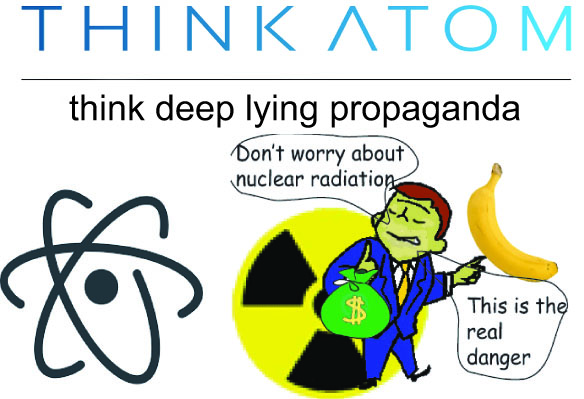
The keynote speexh at the World Nuclear Cycle Forum was so absurd as to be almost funny. It avoided consideration of nuclear power’s huge costs, safety problems, weapons connection, terrorism risk, – and above all, the fact that the nucleare fuel cycle is highly carbon-emitting. It also sidesteps the fact that nuclear power , even if it did combat climate change, could never be operating fast enough to be of any use anyway.
But that didn’t stop gee-whiz nuclear spinner ”Think Atom” from insulting our intelligence by recommending the most puerile publicity tactics to win over the hearts and minds of the general public.
********************************************************************
You need to put it in context: ‘The worst case scenario is a similar dose that you get from eating a bag of chips or a couple of bananas.’ And use emotion: ‘But that’s ridiculous! Yes, but it’s true!’ This context gives you an image of something. It’s easier [to convince people]/
Nuclear industry must change the way it communicates, says Think Atom, World Nuclear News, 15 April. 21, ”……….The fact that nuclear is clean [really?] energy is already “out there” and so the issue is not a lack of information, Rauli Partanen, the CEO of Think Atom, said, but rather of believing that information and then acting on those beliefs. For that to happen, data and reports proving the science are not enough. There also needs to be emotion and an alignment of values, he said, which will turn the information into something that has value.
“Why do people dislike nuclear? Forty years ago, the nuclear industry left the public discussion to those who opposed nuclear. These people, groups and organisations said that nuclear is dangerous and irresponsible, ……..
There has therefore been no progress in having a vision for the nuclear industry and instead it has focused on fighting against the premature closure of reactors or on decommissioning.
“That’s not very inspiring. How many young people are going to go into a field that’s focused on getting rid of itself? Not many……
The nuclear industry needs to start talking publicly about a “mission of expansion”, he said…… the nuclear industry should demand support from policymakers and legislators to create a fair market in clean [really?] energy, ……. enabling the nuclear industry to enjoy access to low-cost finance the way that other clean energy technologies already do.
The high rate of nuclear power plant construction seen in the 1970s and 1980s should be repeated over the next 40 years because “even when we get to net zero, we need to get into negative emissions, and that is not going to happen by itself, it will need a lot of energy”, he said.
“The key point is that, if the nuclear industry doesn’t have a big vision on its role, potential and importance in stopping climate change, how can it expect the rest of us to have that vision for them?”……
World Nuclear Association’s Harmony goal – the addition of 1000 GWe of new nuclear capacity and a 25% share in the global electricity mix, by 2050………. It needs to spread out from World Nuclear Association onto the slide presentations of utilities, with statements like; ‘We’re looking forward to doubling our fleet’.”…………
“He is certainly an influencer and thought leader in some circles, but we also need others – rock stars, famous politicians, climate scientists. The issue is you cannot have one single message for everyone. Know your audience.”
The message however needs to make clear that being ‘anti-nuclear’ effectively means being against a proven way to mitigate climate change……….
Asked how attitudes towards nuclear energy could be changed at the political level, he said this was difficult, but “when change starts it can happen pretty fast”……..”One of the catalysts for this has been advanced nuclear reactors and small modular reactors, which is a new way of thinking about nuclear. It can give people a second chance to rethink nuclear…”’
,,,,,, The anti-nuclear countries, like Austria, Germany and Luxembourg, are constantly joining up and bullying other nations
……….. The answers to those questions [about radioactive wastes] must be in a context the audience can understand, he said. For example, “the worst-case scenario” of radiation leaking from the Onkolo final repository would be a tiny number of millisieverts per year.
“Nobody will understand that. You need to put it in context: ‘The worst case scenario is a similar dose that you get from eating a bag of chips or a couple of bananas.’ And use emotion: ‘But that’s ridiculous! Yes, but it’s true!’ This context gives you an image of something. It’s easier than ‘many zeros of millisieverts’, which means nothing to the non-nuclear engineer.”
*Net Zero Without Nuclear**

Jonathon Porritt 15th April 2021, Jonathon Porritt: Even as the prospects for nuclear power continue to decline, the industry is spending more and more money seeking to persuade Governments, commentators and ‘gullible greenies’ that we’re going to need new nuclear power to get us to a Net Zero economy by 2050.
I’ve spent the last six months looking into this mismatch: declining prospects, escalating hype. All captured in my new Report, ‘Net Zero Without Nuclear’ – accessible here: Net Zero Without Nuclear 15.04.21 ‘Net Zero Without Nuclear’ has been generously endorsed by Greenpeace, Friends of the Earth, the Green Party, CND and a host of experts in this critical scientific and policy area.
http://www.jonathonporritt.com/net-zero-without-nuclear-the-case-against-nuclear-power/
French MPs urge Macron to provide data about nuclear waste buried in Algeria
French MPs urge Macron to provide data about nuclear waste buried in Algeria https://www.middleeastmonitor.com/20210415-french-mps-urge-macron-to-provide-data-about-nuclear-waste-buried-in-algeria/, April 15, 2021 Nine French MPs have called on President Emmanuel Macron to provide data and maps about nuclear waste sites in Algeria, agencies reported yesterday. The French conducted nuclear tests in the Algerian Sahara in the 1960s You now have the opportunity to take concrete action in favour of the civilians and the environment which continue to be affected by nuclear waste buried by France in the sands of the Algerian Sahara,” the MPs told Macron. “You must seize it.”They pointed out that the fifth session of the Algerian-French high level intergovernmental committee, which should have held on 11 April, has been postponed indefinitely. The committee works to resolve historical disputes between France and Algeria.
In February, the MPs said, the sky over a large part of France had an orange hue which was the result of sand carried by strong winds from Algeria. “This meteorological episode reminded us once again that France has left an indelible radioactive imprint in the heart of the Sahara… Seventeen nuclear explosions were carried out in [Algeria] between 1960 and 1966, both above ground and underground, to test the French atomic bomb.”Key information is still missing about the waste for the most part buried in the sand, added the MPs. “Providing the details requested,” they insisted, “will ensure the health and safety of the people living in the areas in question, protect future generations and take the necessary and appropriate measures for the restoration of the environment.”
China to Japan: If treated radioactive water from Fukushima is safe, ‘please drink it’
China to Japan: If treated radioactive water from Fukushima is safe, ‘please drink it’, WA Today, By Adam Taylor, April 15, 2021 —Washington: A spokesman for China’s Foreign Ministry challenged Japan’s deputy prime minister Wednesday to drink treated water, contaminated from contact with reactors, from the wrecked Fukushima nuclear power plant, after the Japanese official suggested the water released would be safe to drink.
Chinese Foreign Ministry spokesman Zhao Lijian, infamous for trolling Australia over the Afghanistan war crimes cases, said during a press briefing: “A Japanese official said, it’s okay if you drink this water. Then please drink it.”
The ocean is not Japan’s trash can,” Zhao also said.
The Chinese official also tweeted a similar message in English.
The Chinese Foreign Ministry’s remarks came after the Japanese government announced on Tuesday it had decided to release into the sea more than 1 million tons of water collected from Fukushima, which melted down during a 2011 nuclear disaster following a tsunami………….
China’s Zhao, known for his aggressive style of diplomacy, has responded at length to the issues surrounding Fukushima water this week, on Tuesday denying the suggestion that China had itself been in a comparable situation when it released treated radioactive water from power plants into the sea………..
Chinese records show that local power plants like Daya Bay in Shenzhen have also released large amounts of tritium into the sea. Zhao said that the water from the Fukushima was different from that released to the ocean by other nuclear plants.
“No comparison can be drawn between the two,” he said, without further explanation…..
While the United States has offered its support for Japan’s move on the Fukushima water, Zhao said on Wednesday that the Japanese side needed to reach an agreement with all stakeholder countries before it could proceed.
“China reserves the right to make further responses,” Zhao said.https://www.watoday.com.au/world/asia/china-to-japan-if-treated-radioactive-water-from-fukushima-is-safe-please-drink-it-20210415-p57jcj.html
Israel (itself having 80 nuclear weapons) will do ”whatever it takes” to stop Iran getting a nuclear weapon
Israel will do ‘whatever it takes’ to stop Iran on nuclear front -foreign minister https://www.reuters.com/world/middle-east/israel-will-do-whatever-it-takes-stop-iran-nuclear-front-foreign-minister-2021-04-16/Reuters, 17 Apr 21, Israel will do “whatever it takes” to ensure that Iran does not acquire nuclear weapons, Foreign Minister Gabi Ashkenazi said on Friday.
Speaking after a summit with his Greek and Cypriot counterparts and a senior representative from the UAE in Paphos, Cyprus, Ashkenazi said discussions centred around possibilities for building on prosperity and stability in the region.
“We also took time to discuss challenges that Iran and Hezbollah and other extremists pose to the stability of the Middle East and to the regional peace,” he said. “We will do whatever it takes to prevent this extremist … success and definitely, to prevent this regime from having nuclear weapons.”
American Physical Society – scientists discuss global threats -pandemics, cyberattacks, over-population, climate, nuclear annihilation…
Unconventional takes on pandemics and nuclear defense could protect humanity from catastrophic failure, https://www.sciencedaily.com/releases/2021/04/210416194919.htm April 16, 2021, Source: American Physical Society Summary: From engineered pandemics to city-toppling cyber attacks to nuclear annihilation, life on Earth could radically change, and soon.
From engineered pandemics to city-toppling cyber attacks to nuclear annihilation, life on Earth could radically change, and soon.
“Our Earth is 45 million centuries old. But this century is the first when one species — ours — can determine the biosphere’s fate,” said Martin Rees, the United Kingdom’s Astronomer Royal and a founder of the Centre for the Study of Existential Risks at Cambridge University.*
“Our globally-linked society is vulnerable to the unintended consequences of powerful new technologies — not only nuclear, but (even more) biotech, cyber, advanced AI, space technology,” he added.
Royal astronomer predicts the world in 2050 and beyond
Rees thinks biohackers pose a particularly underappreciated threat to humanity. In the near future, simple equipment will enable people to reengineer the human genome irrevocably or build a superspreading influenza. Like drug laws, regulations could never prevent all such actions — and in a world more interconnected than ever before, the consequences would spread globally.
He will discuss other dangers: population rise leading to plummeting biodiversity, disastrous climate change, uncontrollable cybercriminals, plans for artificial intelligence that erodes privacy, security, and freedom.
But Rees is an optimist. He will offer a path toward avoiding these risks and achieving a sustainable future better than the world we live in today.
“If all of us passengers on ‘spaceship Earth’ want to ensure that we leave it in better shape for future generations we need to promote wise deployment of new technologies, while minimizing the risk of pandemics, cyberthreats, and other global catastrophes,” he said.
Scaling back missile defense could prevent a nuclear attack
A single nuclear weapon could kill millions and destroy a city instantaneously. Hundreds of weapons could wipe out functioning society in a large nation. Even a limited nuclear war could cause a climate catastrophe, leading to the starvation of hundreds of millions of people.
Recently, Russia, China, and North Korea have deployed new types of nearly unstoppable missiles.
Missile defense is an idea that can sound appealing at first — doesn’t defense sound like the right thing to do?” said Frederick Lamb, astrophysicist at the University of Illinois at Urbana-Champaign, cochair of the 2003 APS Study of Boost-Phase Missile Defense, and chair of the current APS Panel on Public Affairs Study of Missile Defense and National Security.
“But when the technical challenges and arms race implications are considered, one can see that deploying a system that is intended to defend against intercontinental ballistic missiles is unlikely to improve the security of the United States,” he said.
Lamb points to the United Kingdom’s decision to increase its nuclear arsenal by 44%, possibly motivated by Russia’s new missile defense system around Moscow. He sees the move as yet another sign that existing limits on nuclear weapons are unraveling. Even missile defenses that would never work in practice can catalyze the development of new nuclear weapons and increase global risk.
Lamb will share what may happen if the United States ramps up new missile defense systems.
“What is done about nuclear weapons and missile defenses by the United States and other countries affects the safety and survival of every person on the planet,” he said.
*Scientists will forecast the fate of the planet at a press conference during the 2021 APS April Meeting.
A new plan for disposing of nuclear waste at USA’s Waste Isolation Pilot Plant
Carlsbad Current Argus 14th April 2021, A plan to build two new areas to dispose of nuclear waste began taking
shape at the Waste Isolation Pilot Plant after the U.S. Department of Energy published a report on the feasibility of adding an 11th and 12th waste panel to the underground nuclear waste repository.
At WIPP, low-level transuranic (TRU) waste made up of equipment and materials radiated during nuclear activities is permanently emplaced in an underground salt deposit more than 2,000 feet underground. In its original design, WIPP was planned to have eight panels for such disposal, but much of that space wasrestricted and abandoned following an accidental radiological release in2014 that contaminated parts of the underground and led to a three-year
pause of WIPP’s emplacement operations.
Nuclear power combined with nuclear weapons – confronts Britain with an intractable problem.
Electrical Review 14th April 2021, Nuclear waste has been an intractable problem ever since nuclear power was
developed over 60 years ago. It has become a very expensive and politically embarrassing issue all around the world.
Not that the Johnson Government would admit this. Many in it still argue that nuclear power is the answer
to climate change, conveniently forgetting that they are passing the waste buck onto future generations. To those in power, the solution to the waste problem is always just around the corner, to be resolved just beyond their term of office.
But the history of nuclear over the last six decades, across the globe, is of dozens of failed schemes. Currently the UK is
undertaking its sixth search in 42 years for a nuclear waste dump site. Yet again wrestling with the problem of years of public consultations, planning inquiries and geological investigations, only to be finally rejected, even as scientists warn that continued neglect of the issue is placing citizens in increasing danger.
The problem is that civil nuclear industries, especially when, as in Britain, they are combined with a weapons programme, produce plutonium and other by-products in spent fuel that take as long as 100,000 years to decay. International law requires the country that produced the waste to dispose of it within its own boundaries. Identifying
somewhere to put this waste, where they could be safe for that length of time, requires stable geological formations that are very hard to find anywhere.
Nuclear power’s waste problem complicates it as a green energy solution
Iran to enrich uranium to 60% after ‘wicked’ nuclear site attack,
Iran to enrich uranium to 60% after ‘wicked’ nuclear site attack, https://www.bbc.com/news/world-middle-east-56743560 14 Apr 21, Iran will produce 60%-enriched uranium in retaliation for a suspected Israeli attack on a nuclear site, President Hassan Rouhani says, bringing it closer to the purity required for a weapon.
A blast knocked out the power system at Natanz on Sunday, causing damage to thousands of uranium centrifuges.
Mr Rouhani warned the perpetrators that enrichment would now be ramped up as a response to “your wickedness”.
But he reiterated that Iran’s nuclear activities were “exclusively peaceful”.
France, Germany and the UK expressed “grave concern” at the move, saying Iran had “no credible civilian need for enrichment at this level”.
The three countries are parties to a 2015 nuclear deal with Iran, under which it is permitted to enrich uranium up to 3.67% purity to make reactor fuel. Weapons-grade uranium is 90%-enriched or more.
Iran began producing 20%-enriched uranium – a level that takes most of the overall effort required to get to weapons-grade – in January as part of its response to the US sanctions reinstated by former President Donald Trump when he abandoned the accord three years ago.
Israel, which sees Iran’s nuclear programme as a potential threat to its existence and is critical of Joe Biden’s efforts to revive the deal, has neither confirmed nor denied involvement in the Natanz incident. But public radio cited intelligence sources as saying it was a cyber operation by Mossad, Israel’s overseas intelligence agency.
US intelligence officials told the New York Times that a large explosion completely destroyed the power system that supplied an underground hall at Natanz where uranium hexafluoride gas was fed into centrifuges to separate out the most suitable isotope for nuclear fission, called U-235.
The head of the Iranian parliament’s research centre, Alireza Zakani, said on Tuesday that several thousand centrifuges were “damaged or destroyed in one instant” and that “the main part of our enrichment capacities” were eliminated.
On Tuesday night, Iran’s ambassador to the International Atomic Energy Agency (IAEA) announced it had just started enriching uranium up to 60% purity for the first time in response to the attack.
“We expect to accumulate the product next week,” Kazem Gharibabadi tweeted. “This will improve significantly both the quality and quantity of radiopharmaceutical products.”
Iran will also install 1,000 additional centrifuges at Natanz and replace damaged IR-1 centrifuges – the oldest and least efficient – with more advanced IR-6 models, significantly increasing its enrichment capacity.
President Rouhani told a cabinet meeting on Wednesday that, while Iranian security agencies had yet to provide their final reports on the attack, “apparently it is the crime of the Zionists”. Iran does not recognise Israel’s right to exist and often refers to it as the “Zionist state”.
“You cannot conspire against the Iranian nation and commit a crime in Natanz; we will cut off your arms when you commit a crime,” he said.
“What you did was nuclear terrorism; what we’ve done is legal,” he added.
Mr Rouhani said those responsible wanted to derail the indirect talks between US and Iranian officials in Vienna which are aimed at reviving the nuclear deal, formally known as the Joint Comprehensive Plan of Action (JCPOA).
“We know what you are trying to do; you want us to be empty-handed at the talks but we’re attending the negotiations with an even fuller hand.”
ran’s Supreme Leader, Ayatollah Ali Khamenei, later warned that US officials did not want to “accept the truth” and often made suggestions that were “not even worth looking at”.
“Sanctions must be removed first. Once we are certain that has been done, we will carry out our commitments,” he said.
The governments of France, Germany and the UK said enriching uranium up to 60% was “a serious development” since it constituted “an important step in the production of a nuclear weapon”.
“Iran’s announcements are particularly regrettable given they come at a time when all JCPOA participants and the United States have started substantive discussions, with the objective of finding a rapid diplomatic solution to revitalise and restore the JCPOA. Iran’s dangerous recent communication is contrary to the constructive spirit and good faith of these discussions.”
White House spokeswoman Jen Psaki said Iran’s decision was “provocative”.
In their annual threat assessment released on Tuesday, US intelligence agencies said they continued to “assess that Iran is not currently undertaking the key nuclear weapons-development activities that we judge would be necessary to produce a nuclear device”.
Electricity customers pay excessive costs for nuclear power – Egypt, Turkey, UK, France, Russia

Part two | Nuclear energy in Africa, The second in this three-part series looks at how power purchase agreements raise the cost of electricity for consumers and act as major sources of inflationary pressure in economies. New Frame, By: Neil Overy, 1 Dec 2020 Recent deals brokered between host nations and nuclear power companies show how consumers ultimately bear the cost of building nuclear power plants because of power purchase agreements, which favour the vendor and lower their financial risk but often lead to hugely inflated electricity costs for consumers.
No official details have yet been given to indicate what the price will be for electricity generated by the El Dabaa plant that Russia’s state-owned Rosatom is building in Egypt. But in 2016, one Egyptian energy expert predicted that prices per megawatt hour – how much it costs to produce one megawatt of energy for one hour – from El Dabaa would be at least four times more than from renewable power sources. Renewable energy prices have fallen significantly since 2016, while nuclear power has become more expensive.
British consumers will pay excessive amounts for electricity from the Hinkley Point C nuclear power station that EDF is building for decades after the plant is completed. While construction does not follow the Build-Own-Operate model, EDF negotiated a 35-year power purchase price linked to inflation with the British government in 2016 to extract as much profit as possible. The British government’s Public Accounts Committee conservatively estimated that this deal will cost consumers an additional $40 billion (about R615 billion) over the 35 years of the contract compared with alternative energy sources such as solar and wind.
A similar story is playing out in Turkey. Critics have pointed out that the price the government has agreed to pay Rosatom for electricity generated by the Akkuyu plant the Russian vendor is building will cost the country an additional $27 billion over the 15-year period of the power purchase agreement. This is because the price that has been agreed between Rosatom and the Turkish government is significantly above current electricity costs. A 2019 report by the Union of Chambers of Turkish Engineers and Architects notes that electricity purchased from the plant will be at least 275% more expensive than alternatives.
Financial trouble
Despite such deals being signed, the long-term financial viability of state-owned nuclear vendors is questionable. EDF received significant cash injections from the French government and secured favourable loans backed by the British Treasury for Hinkley Point C, but was still forced to sell a third of its stake in the project to the China General Nuclear Power Group in 2016 because it was running out of money.
And EDF remains in serious financial trouble. It is about $52 billion in debt and two major agencies have given it a negative credit rating. The French energy company’s problems stem from delays in the construction of Hinkley Point C, which is said to have cost it at least another $4 billion so far, and at other nuclear power stations it is building. The Flamanville 3 project in France is now four times over budget and 10 years late. In Finland, the Olkiluoto 3 project is also four times over budget and is now only expected to be running in 2022, 13 years after its original start-up date. Further delays at Hinkley Point C and Flamanville 3 are strongly anticipated, which will plunge EDF further into the mire, meaning that more bailouts from the French government are likely.
Rosatom has experienced serious problems financing the Akkuyu nuclear power station. In 2016, it tried to sell a 49% share in the project because it could not raise the necessary capital to complete the plant. After failing to find any buyers, Rosatom was saved, at least in the short term, late last year by a $400 million loan from another Russian state-owned enterprise, Sberbank. Unsurprisingly, the completion of this plant is also delayed. Originally scheduled to be operational by 2019, its completion has already been pushed back twice and it is now predicted to be partially operational by 2023.
That companies like EDF and Rosatom are reliant on the willingness of their respective governments to fund their survival is troubling. The economic consequences of the Covid-19 pandemic perfectly illustrate how susceptible both the global economy and individual economies are to unexpected shocks. Falling electricity sales in France owing to Covid-19 are resulting in intense speculation that EDF will need a significant emergency bailout from the French government sometime in early 2021 or face financial ruin. It is not clear what would happen to the plants it is currently building if EDF were to collapse. They could be abandoned, or taxpayers in host countries could be forced to pay even more for their completion.
These financial difficulties are often the result of problems that emerge during the construction phase of nuclear power stations, which lead to delays. A study completed in 2014 revealed the extent of this problem, saying only 3% of nuclear power stations have been built on schedule. In 2018, researchers from the Centre for Environmental Policy at Imperial College London found that between 1955 and 2016, construction delays increased the cost of nuclear power plants by 18% on average over their original budgets.
Consumers as cash cows
In effect, the public pays twice for these delays. In vendor countries such as France and Russia, taxpayers contribute to the bailouts of state-owned companies like EDF and Rosatom. In recipient countries, such as the United Kingdom, Egypt and Turkey, the public pays through artificially inflated electricity bills.
Rather than reflecting on this double burden, vendors and compliant governments are inventing new ways to squeeze yet more money out of the public. To fund additional nuclear power plants in Britain, the government is now considering a new funding model called Regulatory Asset Base (RAB).
The RAB model basically gives a blank cheque to vendors, allowing them to start charging customers for electricity during the construction phase of a power plant, before the station even produces electricity. In addition, it covers vendors for construction cost overruns of up to 30%, all of which would be paid for by consumers. It is proposed that the British government would cover any construction cost overruns of more than 30%. In effect, this funding model transfers almost all financial risk from investors to consumers, through hugely inflated electricity bills or tax transfers to vendors, or both.
In September, EDF appeared to indicate that it would only bid for the contract to build the proposed $25 billion Sizewell C nuclear plant in Britain if the British government adopted the RAB funding model…………………https://www.newframe.com/part-two-nuclear-energy-in-africa/
A shadow war between Israel and Iran hangs ominously over nuclear talks in Vienna
A shadow war between Israel and Iran hangs ominously over the resumption of
critical talks in Vienna on Wednesday, aimed at returning Iran and the US
to the 2015 nuclear agreement. The talks come just three days after a
sabotage attack at a key Iranian nuclear plant near Natanz, where an
explosion cut off electricity to the whole site. The attacked damaged an
unknown number of centrifuges – sophisticated machines that make uranium
usable for nuclear purposes – and has stopped work at the facility for now.
BBC 14th April 2021
https://www.bbc.co.uk/news/world-middle-east-56716472
thousands of machines used to refine nuclear material were destroyed or
damaged in an attack at a key site on Sunday, an Iranian official has said.
Alireza Zakani, head of the Iranian parliament’s Research Centre, said the
incident had “eliminated” Iran’s ability to carry out the process. The
attack took place in a facility up to 50m (165ft) underground, another
official said. Iran has blamed Israel for what it called an act of “nuclear
terrorism”.
BBC 13th April 2021
https://www.bbc.co.uk/news/world-middle-east-56734657
Iran gave notice yesterday that it will begin enriching uranium closer to
weapons-grade purity, two days after an explosion at its most important
nuclear facility for which it blamed Israel.
TTimes 14th April 2021
https://www.thetimes.co.uk/article/iran-takes-its-biggest-step-to-building-atomic-bomb-rtt587wxf
The fiasco of nuclear preprocessing: UK, Japan, USA.

Part one | The slow violence of SA’s nuclear waste,
Part one of this four-part story considers the imminent danger involved in storing used radioactive materials, a dilemma growing at a rate of more than 32 tonnes a year. New Frame , By: Neil Overy, 8 Mar 21
”……………..This is a process by which fission products are chemically separated out of used fuel rods to extract any unused uranium. This alleged solution to the problem of high-level waste has been one of the illusionary solutions Eskom has regularly mooted and just as regularly abandoned because of the colossal costs and serious dangers involved in reprocessing.
In the United Kingdom, the Thermal Oxide Reprocessing Plant, opened at huge cost in 1994, closed in 2018 having reached none of its intended reprocessing targets. Its decommissioning is now set to cost taxpayers at least $5.5 billion and take up to 100 years to complete. In Japan, construction of the Rokkasho Reprocessing Plant began in 1993 and was supposed to be completed by 1997. Incredibly, the plant is still not complete – its completion date has been postponed 25 times – and it is now expected to be operational in 2023, 26 years late and tens of billions of dollars over budget.
Even when operational, large quantities of dangerously radioactive waste, which needs to be stored for thousands of years, remains. Some of this waste is separated plutonium, a fissile material used in nuclear bombs, which presents a very serious security risk. This is precisely why reprocessing has never been authorised in the United States. As the Union of Concerned Scientists conclude, reprocessing is “dangerous, dirty and expensive”. Quite clearly, reprocessing is not an option South Africa should consider. …… , https://www.newframe.com/part-1-the-slow-violence-of-sas-nuclear-waste/?fbclid=IwAR0TEdv3xITKJISxqQs_UwdO9JB4m5LkPABzUl9b6R_nYVZKdL2S2ikp-MA
1 This Month

Read the Public Inquiry Report, the Commissioners’ report, Surrendering Australia: The AUKUS Deception is available to download for free at aukuspublicinquiry.com. Or just watch the replay of the National Press Club Luncheon.


19 November – Webinar – The Reality of Reprocessing
Time: 11:00 AM Pacific Time (US & Canada) / 2:00 PM Eastern / 7:00 PM UK / 8:00 PM CET
Register for the Zoom Event Here



Shut down the radiation-damaged Heysham nuclear reactors now
To see nuclear-related stories in greater depth and intensity – go to https://nuclearinformation.wordpress.com

Say No to NASA’s Reckless Nuclear Reactor on the Moon
Say No to NASA’s Reckless Nuclear Reactor on the Moon
-
Archives
- November 2026 (103)
- October 2026 (302)
- September 2026 (339)
- August 2026 (330)
- July 2026 (355)
- June 2026 (287)
- May 2026 (306)
- April 2026 (356)
- March 2026 (251)
- February 2026 (267)
- January 2026 (308)
- December 2025 (358)
-
Categories
- 1
- 1 NUCLEAR ISSUES
- business and costs
- climate change
- culture and arts
- ENERGY
- environment
- health
- history
- indigenous issues
- Legal
- marketing of nuclear
- media
- opposition to nuclear
- PERSONAL STORIES
- politics
- politics international
- Religion and ethics
- safety
- secrets,lies and civil liberties
- spinbuster
- technology
- Uranium
- wastes
- weapons and war
- Women
- 2 WORLD
- ACTION
- AFRICA
- Atrocities
- AUSTRALIA
- Christina's notes
- Christina's themes
- culture and arts
- Events
- Fuk 2022
- Fuk 2023
- Fukushima 2017
- Fukushima 2018
- fukushima 2019
- Fukushima 2020
- Fukushima 2021
- general
- global warming
- Humour (God we need it)
- Nuclear
- RARE EARTHS
- Reference
- resources – print
- Resources -audiovicual
- Weekly Newsletter
- World
- World Nuclear
- YouTube
-
RSS
Entries RSS
Comments RSS

