Further developments for space warfare planning
Space Force’s new delta organizations will help the service keep up with growing launch cadence C4ISRNET, By Nathan Strout 30 June 21
CAPE CANAVERAL SPACE FORCE STATION, Fla. — The U.S. Space Force is reorganizing its launch organizations, and while the change may not have immediate impacts, operators believe the new structure prepares the service for the coming moment when it is launching satellites daily.In April, the Space Force announced it would start a new field command called Space Systems Command to replace the main space acquisitions organization it took over from the U.S. Air Force: the Space and Missile Systems Center. As part of that restructuring, it’s unifying its entire launch enterprise — launch operations, range operations and acquisitions — and putting that under the SSC deputy commander, who will be known as the Assured Access to Space leader within the force………
All of those changes are expected to take place this summer, after Congress approves a general to lead the new field command………….
While those changes may not have a large impact on launch operations today, said Eno, they will become increasingly important as the Space Force increases the number of launches it conducts. Cape Canaveral expects more than 50 launches this year, driven largely by commercial launches — SpaceX’s Starlink launches in particular — and that number is set to continue growing……….https://www.c4isrnet.com/battlefield-tech/space/2021/06/16/space-forces-new-delta-organizations-will-help-the-service-keep-up-with-growing-launch-cadence/
Bradwell anti-nuclear campaigners may face fight against nuclear fusion plan
CAMPAIGNERS battling proposals for a new nuclear power station at Bradwell
could have to fight on a second front. The UK Atomic Energy Authority has
put Bradwell on a ‘long-list’ of 15 possible sites for the UK’s prototype
fusion energy plant – STEP. Others include Sellafield, north Wales and
Dounreay, together with other nuclear and former coal-fired power station
sites. The UKAEA says the successful site will become a “global hub” for
fusion energy and associated, industries and create thousands of highly
skilled jobs during the construction and operation of the plant, while
attracting investment that will enable the development of a new UK science
and technology centre of excellence”.
Essex Gazette 28th June 2021
https://www.gazette-news.co.uk/news/19399659.bradwell-earmarked-fusion-power-plant/
China’s handling of Taishan nuclear plant leak shows need for transparency
China’s handling of nuclear plant leak shows need for transparency. For
the Chinese Communist Party, opacity is a virtue and transparency is a
virtue. This approach to governance worked well for the party. 100th
anniversary Established on Thursday.
Unfortunately, it doesn’t work very
well if you run a nuclear power plant in China, especially if you are
partnering with a foreign investor who cannot easily accept the principles
of political parties.
Framatome, a division of China General Nuclear Power
Group and France’s EDF, provided an example of this textbook two weeks
ago when CNN reported that President Joe Biden’s administration was
“evaluating.” [a] Leak was reported At a nuclear facility in China.
“Framatome’s memo to the US Department of Energy dated June 8, and
CNN’s report was released on Monday morning, June 14, China time.
Taishan
Nuclear Power Station seems to have tried to anticipate the report by
issuing a statement on its website on Sunday night, June 13. In a CNN
report. CGN and Taiyama’s approach to the “neither apologize nor
explain” type of situation shook people. A local government official in
Jiangmen, which controls the Taishan plant, told the Financial Times that
the locals were completely in the dark. “The factory says everything is
going well,” officials said. “What can we do without proper explanation
of CNN’s report?”
FT 29th June 2021
https://www.ft.com/content/1c47d829-34a2-4efd-8c43-f9cdd95b6994
Nuclear Reactor Security Risk: Middle East and Gulf Region
Nuclear Reactor Security Risk: Middle East and Gulf Region
By Dr. Paul Dorfman, Honorary Senior Research Associate at the UCL Energy Institute, University College London NCT Magazine 30 June 21, The Middle East and Gulf region faces unique challenges and perceived opportunities when it comes to nuclear power. The tense geopolitical environment makes nuclear power an even more controversial issue here than elsewhere as competing states share the unease that neighbors may use civilian nuclear programs for military ends. It is not that nuclear military interests are sole drivers of support for civil nuclear power, but the fact is dual-use technology comprises a significant complementary factor.
This dynamic plays out via a range of safety and security concerns. Unless enrichment of uranium and reprocessing technologies are effectively regulated against diversion of civil materials for military purposes, the reality is that new nuclear power plants can and will provide the cover to develop and make nuclear weapons. Whether that capability is turned into actual weapons largely depends on political inclination. For example, in response to developments in Iran, Saudi Arabia has made it clear on more than one occasion that there is another reason for their interest in nuclear energy – the relationship between civil and nuclear weapon programs.
Trans-Boundary Consequences
In order to function at any level, nuclear power needs stability and cooperation between neighboring states. However, as recent military strikes infer, the region is one of the world’s most volatile. Nuclear safety revolves around the broader issue of security, especially since some armed groups may view state-sponsored military operations as a reason to target nuclear installations or intercept enriched uranium fuel or waste transfers……………
Such a backdraft from foreign policy, and politics more generally, will increasingly dovetail with regional nuclear safety considerations. This is important because, given the associated high human activity-related hazards, there are broader concerns – since a major nuclear accident or incident would have significant transboundary consequences.
Attack Risk
An attack on a nuclear installation may be one of several types. There are two main targets in a nuclear power plant: the reactor itself and the ponds storing the highly radioactive spent fuel removed from the reactor. An attack on the reactor could cause the core to go critical or result in a loss of the coolant that removes heat from it. And the protection of nuclear plants with fighter aircraft or surface-to-air missiles is not an easy task, with time available to scramble fighter aircraft or fire surface-to-air missiles proving limited. So, there are now heightened concerns about the need to try to secure high-risk radioactive material from concerted attack, sabotage, or hijack to a transporter of nuclear material……..
Radiological Hazard
There are a number of distinct radiological hazards at a nuclear power station, including fission products and the activated inventory of the reactor fuel and core, the irradiated fuel store, and radioactive wastes. Operational hazards also include irradiated spent fuel transportation and new fuel delivery. ……………..
Risk Cycles
Shifting power relations, regional and international rivalries have led to instability, security threats, and patterns of violence in the Middle East and Gulf region. Interactions between soft and military power have played a crucial role in shaping political and security landscapes……….
Another Pathway
But another pathway is both feasible and possible. Given the entropic risks involved, why commit to further nuclear expansion in a region so often impaired by overt or covert conflict? The case for civil nuclear power in the region has never been strong, and because their state electricity systems are relatively small, significant nuclear electricity grid input risks overload anyway.
Worldwide and in the Middle East and Gulf region, the fate of new nuclear is inextricably linked to, and determined by, renewable energy technology roll-out. Currently, global market trends for new nuclear are declining. Whilst ramping improvement in renewable technology is one explanation for this dynamic, the main driver seems to be the plummeting costs of renewable energy and the ramping costs of new nuclear construction.
Accidents Happen ……….. . Whatever one’s view of the risks and benefits of nuclear energy in the Middle East and Gulf region and further afield, it seems clear that the possibility of military attack and catastrophic accident must be factored in – and all that implies for complex defense and energy policy decisions.
The hybrid boars of Fukushima
“Once people were gone, the boar took over,” explains Donovan Anderson, a
researcher at Fukushima University in Japan. His genetic study of the wild
boar that roam in an area largely abandoned after Japan’s 2011 nuclear
disaster – has revealed how the animals have thrived. Using DNA samples, he
also discovered that boar have bred with domestic pigs that escaped from
farms. This has created wild pig-boar hybrids that now inhabit the zone.
“While the radiation hasn’t caused a genetic effect, the invasive domestic
pig species has,” Mr Anderson explained.
BBC 30th June 2021
Serious questions about government funding Bill Gates’new confidence-trick, the NATRIUM nuclear reactor

Can we be sure that we will not end up with plutonium-fueled reactors coupled with reprocessing?
Dangerous Decisions about Advanced Nuclear Reactors Could Lead to New Threats https://portside.org/2021-06-27/dangerous-decisions-about-advanced-nuclear-reactors-could-lead-new-threats
Congress should have answers to tough questions before giving the Energy Department’s Advanced Reactor Development Program additional funding. June 27, 2021 Victor Gilinsky, Henry Sokolski
The Department of Energy’s recently launched Advanced Reactor Demonstration Program (ARDP) is slipping by without any close Congressional oversight, which is unfortunate as there are some serious questions that should be answered, including ones related to national security. The program was launched with an award of $160 million to TerraPower for its Natrium design and X-energy for its Xe-100. Each is to build a full-scale nuclear reactor within the next seven years, one that could be duplicated and sold commercially. While not a huge sum, it is intended to be the down payment on over $3 billion, a sum that is supposed to be cost-shared by the companies, with more for other projects.
At a March 25 Senate Energy Committee hearing on “advanced” reactors, executives of the two companies described a future with almost unlimited opportunities worldwide for their reactors, hundreds, maybe thousands. They got an enthusiastic reception from both sides of the aisle, summed up by Chairman Joe Manchin’s (D-WV) final observation that while wind and solar power were OK, “nuclear really does the job.” No one asked how the reactors will be fueled. Will they be fueled with nearly highly enriched uranium, or with plutonium? And what will be the security consequences of selling and encouraging reactors fueled with such fuels around the world?
Despite the enthusiasm for new technology, the “advanced” label is misplaced. These are re-engineered versions of old designs, some over fifty years old. “Advanced small modular reactors” trips off the tongues of people who think they are talking about the nuclear future, whereas in fact, they are talking about reviving the past.
“Small” is also an inaccurate label. Yes, there are lots of projects for small reactors, but they are a sideshow, for niche applications. The real action, the main ring, concerns larger units. TerraPower’s CEO, Chris Levesque, told the senators at the March 25 hearing that the company was pursuing a 300-megawatt (electric) unit because that was what today’s market would accept. But as it gained experience, TerraPower anticipated “growing Natrium output back up to gigawatt scale,” the size of current large light water reactors. The obvious conclusion is that TerraPower doesn’t think the smaller units would be economic, despite the current ballyhoo about the economic advantages of such units. Levesque thought there was a market for hundreds of the large units domestically and more abroad. As much of the talk was on competing with Russia and China, it is clear that the nuclear industry business plan centers on exporting the technology around the world.

Above – a different model – NuScale, but see the person indicated – this ”small” reactor is not small

The Natrium reactor TerraPower has promised to build with DOE funds is not, as many people think, the highly advertised “traveling wave” reactor design that TerraPower pursued when started by Bill Gates. That idea involved the active (fissioning) reactor region slowly “traveling” from the center of the reactor core over the life of the reactor, “breeding” plutonium from uranium and fissioning it in place, therefore with no need for reprocessing. That Bill Gates was assumed to be a shrewd investor boosted the company’s credibility. The traveling wave idea didn’t work, but TerraPower retained the label for a different design, apparently because it aids marketing.
The Natrium reactor is a scaled-up version of a General Electric design for a small sodium-cooled, plutonium-fueled fast breeder reactor (natrium is German for sodium, and “fast” means it relies on energetic neutrons). This is the reactor the nuclear enthusiasts have wanted to build since Congress canceled the Clinch River Fast Breeder Reactor in 1983. The Atomic Energy Commission, the DOE’s predecessor agency, pushed the liquid metal fast breeder (LMFBR) reactors in the 1970s as the energy solution in what was thought to be a uranium-poor world. But it turned out we live in a uranium-rich world so the expensive LMFBR made no economic sense.
It also made no sense to flood the world with untold tons of plutonium when a few kilograms is enough for a bomb. That’s why Presidents Gerald Ford and Jimmy Carter made it U.S. policy to discourage commercializing of plutonium-fueled reactors. Enthusiasts tried but failed to revive fast reactors as part of the second Bush administration’s Global Nuclear Energy Partnership program. It appears they are trying again.

TerraPower’s CEO told the senate hearing that the Natrium reactor would be fueled with uranium enriched to just short of 20 percent U-235 (a level that America is trying to prevent Iran from enriching to). It’s the borderline between low and highly enriched uranium. That choice seems to be related to DOE’s interest in developing a large enrichment market for the DOE-created Centrus Corporation, which is a story in itself.

Widespread use of reactors in this mode would dramatically increase demand for enriched uranium. Will 20 percent enriched uranium remain the preferred fuel for Natrium, or will it revert to plutonium with reprocessing to meet foreign customer interest? (The original GE design included an onsite reprocessing plant.) So configured, the reactor would make and reuse massive quantities of material that could be used to create a bomb. Recently, the Senate armed Services Committee raised this worry with regard to China’s fast reactor program. Congress should nail down the answer to this key question with regard to DoE’s programs.
There is a natural tendency to loosen the financial reins on projects that fall into the research and development category. But the two ARDP projects are prototypes for the commercial market. Congress should have answers to tough questions before giving the Energy Department’s ARDP additional funding. A good start would be to ask: Can we be sure that we will not end up with plutonium-fueled reactors coupled with reprocessing?
Old cracked infrastructure – the Florida building collapse – a warning for old cracked nuclear reactors.

embrittlement, pipe cracking, component degradation, technical obsolescence, an aging workforce, rampant incompetence, and worse define the reality of virtually every operating atomic reactor, here and around the planet.
Collapsed Florida Condo Sends a Giant Nuke Warning https://readersupportednews.org/opinion2/277-75/70146-rsn-collapsed-florida-condo-sends-a-giant-nuke-warning, By Harvey Wasserman, Reader Supported News, 28 June 21 he horrifying collapse of a south Florida condo should alarm us all about the next reactor catastrophe.
The owners of that 13-story condo were warned years ago that it could implode. They were apparently getting ready for repairs, but in the interim did nothing.
The owners of America’s 93 licensed reactors have been warned for decades that they could both implode and explode. They have also done nothing.
More than 150 people may have died in this avoidable Florida disaster. The death toll from the next avoidable reactor disaster could stretch into the millions, with property damage in the trillions, a blow from which our economy and ecosystems might never recover.
South Florida authorities have now ordered inspections of large buildings over forty years old. Nearly all US reactors – including four on the ocean in South Florida – are also now around forty years old.
They all must be immediately shut for rigorous inspection. To wait is to invite a radioactive version of what just happened to that condo.
The argument is not about nuclear power. It’s about basic sanity.
The industry is currently pushing “new” designs based on fusion, thorium, breeder technologies, molten salt, small modular, and more. None have been proven safe or effective in fighting climate chaos. Nor can they compete with renewables. None have a reasonable prospect of coming online before being completely left in the radioactive dust by accelerating advances in wind, solar, batteries, and LED efficiency.
All are certain to consume huge quantities of public money, pouring into private pockets (like those of Bill Gates) before failing utterly.
But they pale in importance alongside the 93 US reactors (there are some 430 worldwide) now plummeting toward certain catastrophe.
None of these reactors can get private liability insurance against an apocalyptic disaster. Most were designed in the pre-digital 1950s and ‘60s. Many were built with inferior materials and understanding.
Critical welds at California’s Diablo Canyon, for example, contain metal components long since banned. But Unit One continues to operate.
Critical concrete at New Hampshire’s Seabrook and Ohio’s Davis-Besse is crumbling. Fort Calhoun in Nebraska was flooded. Intake pipes at South Texas froze. Reactors in Ohio and Virginia have been damaged by earthquakes. Diablo is surrounded by earthquake faults set to deliver seismic shocks which a Nuclear Regulatory Commission resident inspector has said it can’t withstand. The owners of San Onofre want to bury their high-level wastes ONE HUNDRED FEET from the tide line. Meaningful evacuation planning is nonexistent at sites where nearby population centers have exploded since the original siting approval.
All these old reactors contribute to climate chaos with emissions of heat, radiation, and carbon. They suck up billions of gallons of precious water, then dump it or evaporate it with chemical, radioactive, and thermal pollution. In every case, our planet would benefit from their shutdown.
Virtually all US reactors are almost certainly embrittled, meaning emergency cooling water poured into the core to quell a meltdown would shatter critical components, resulting in apocalyptic hydrogen and possibly fission explosions, as at Chernobyl and Fukushima.
To put it most simply: no embrittled reactor has a workable set of brakes. Yet states like California, and the NRC itself, refuse to conduct relatively cheap and simple open inspections.
Thus embrittlement, pipe cracking, component degradation, technical obsolescence, an aging workforce, rampant incompetence, and worse define the reality of virtually every operating atomic reactor, here and around the planet.
So when we look in horror at that collapsed south Florida condo, with all those innocent souls buried in the rubble, we must remember that later today, parallel pictures could show a mega-hot runaway reactor spewing Chernobyl/Fukushima levels of radiation throughout the ecosphere.
Thankfully, the Solartopian realities of fast-accelerating wind, solar, battery, and efficiency technologies give us the leeway to shut them all NOW.
Let’s do it before it’s too late!!
Harvey Wasserman co-convenes the weekly Election Protection 2024 ZOOM. His People’s Spiral of US History is at www.solartopia.org.
Protests against France’s Tricastin nuclear station, Greenpeace activists face gaol.
Despite the lawsuits, we, Greenpeace, will continue to warn of nuclear
danger. Thirty-four Greenpeace activists will appear on June 29 in court in
Valencia. They had entered the Tricastin nuclear site to denounce the
danger. Greenpeace reaffirms in this forum its commitment and calls for the
dismantling of the plant.
Reporterre 26th June 2021
“40 years is enough”: 300 people gathered in Montélimar to demand the
shutdown of the Tricastin power plant.
France Bleu 26th June 2021
EDF will try to minimise the radiological leak at the Taishan nuclear plant – but the damage is done.
A minor operating incident of a Chinese reactor at the French-designed Taishan NPP, pinned down by CNN. The small world of nuclear power has still not returned from the tortuous journey of this information. Monday, June 14, the American channel released a world scoop by reporting that the French group Framatome warned the American authorities of an “imminent radiological threat” to the Taishan power plant. In the hours that follow,
EDF, a 30% shareholder in the Taishan EPR plant, will specify that this is only a fuel rod leak (supplied by Framatome), confined in the very secure circuit. primary of a reactor. An operating incident under control, a priori without consequences. But the damage is done.
Le Figaro 24th June 2021
https://www.lefigaro.fr/international/nucleaire-chinois-la-bevue-incroyable-de-framatome-20210624
 | ReplyForward |
Magnox Silo Liquor “Crack Under Control.” note: it isn’t.
How does the Nuclear Industry get away with wanting to produce ever more and ever hotter nuclear wastes when they cannot contain the existing wastes. The Magnox Swarf silo is leaking – from an unknown point – part
of the silo is below ground. United Utilities are abstracting drinking water for West Cumbria from boreholes at South Egremont a short distance away.
This is just one of the tenders Sellafield has put out for help with “seepage.” Sellafield are asking contractors to help: The Key Questionis “Can We Stop This Leak Which Is In The Building” “Can We Identify The Location”.
Radiation Free Lakeland 25th June 2021
Magnox Silo Liquor “Crack Under Control.” note: it isn’t
Russia unveils largest nuclear submarine built in 30 years
Russia unveils largest nuclear submarine built in 30 years https://www.tvnz.co.nz/one-news/world/russia-unveils-largest-nuclear-submarine-built-in-30-years Russia has unveiled what’s believed to be its largest submarine built in 30 years amid a tense standoff with Britain in the Black Sea. The Belgorod sailed for the first time today, just days after the Russian military assets fired warning shots at a British Royal Navy destroyer after it came too close to what Moscow has claimed is its territorial waters near Crimea last week. Bombs were also dropped by jets near the vessel.
While the nuclear submarine’s specifications have not been revealed, the Belgorod will be able to launch nuclear strikes, according to the Daily Telegraph.
It will also act as a mothership for smaller submarines.
Iraq’s stability depends on Iran and the US re-entering the nuclear deal
Iraq’s stability depends on Iran and the US re-entering the nuclear deal https://www.trtworld.com/opinion/iraq-s-stability-depends-on-iran-and-the-us-re-entering-the-nuclear-deal-47901
Reviving the nuclear deal would give Iran less of an incentive to target US positions in Iraq and support Baghdad’s sovereignty.
Iran’s Chief Justice Ebrahim Raisi has emerged as president after an election with one of the lowest turnouts in the Islamic Republic’s history.
This outcome favours Ayatollah Ali Khamenei, Iran’s Supreme Leader, as it consolidates power in the hands of the so-called “hardliners” in a triumvirate with the presidency and the Revolutionary Guard.
The last time such an alignment occurred was during the Bush administration and the election of Mahmoud Ahmadinejad in 2005. Both alignments also corresponded with more antagonistic American foreign policies.
By withdrawing from the nuclear deal and undermining Rouhani’s foreign policy, Trump confirmed the hardliner mantra that the US is fickle and cannot be trusted to honour any agreement. He also contributed to Raisi’s election, as well as what is set to be a more assertive Iranian foreign policy towards Iraq.
But this wasn’t the case before. Former president Hassan Rouhani’s foreign policy sought to respect Iraq’s sovereignty, which was at odds with the hardliners who wanted to use Iraq as a means of challenging the US during the more bellicose Trump administration.
The consolidation of hardliners in Tehran’s leadership today means that its internal foreign policy conflict no longer exists.
Iraq’s future is now tied to Iran and the US finding an agreement to re-enter the Iran nuclear deal.
After the September 11 attacks, Iran and the US shared enmity towards the Taliban in Afghanistan. The George W Bush administration missed a window to forge relations with what was then a conciliatory Iranian president Mohammed Khatami. Like Rouhani, Khatami sought to engage with the US.
However, the Bush administration declared that the Islamic Republic of Iran formed part of an “axis of evil,” which included Iraq and North Korea. In March 2003, American forces were on Iran’s border, having just successfully invaded Iraq, a member of the “Axis.”
It was then that Iran offered the US a comprehensive negotiation proposal, where the Islamic Republic was willing to open its nuclear program for inspections, work to stabilise Iraq and cooperate against Al Qaeda, offering Washington what Trump later asked of Iran during his administration.
The significance of this offer was not that it occurred during the presidency of a moderate, Khatami, but that it had the blessing of Khamenei, the key decision maker in Iran.
Yet former Vice President Dick Cheney responded, “We don’t talk to evil,” and the Bush administration never engaged with the Iranian offer.
The Axis of Evil speech led to the victory of Iranian hardliners in the nation’s parliament and after the Iraq War, hardline president Mahmoud Ahmadinejad won the presidency in 2005, an outcome that Khamenei would have favoured then in response to American belligerency.
When Washington refused Iran’s overture, the Islamic Republic then was in a position to undermine US presence in Iraq after 2005. One tool at Iran’s disposal was its support of a variety of Iraqi insurgents to target American forces.
Jump to 2021, and Iran is in a much better position to project its influence in Iraq due to its sprawling network of allied militias. This is a message that the Biden administration has surely received.
Ultimately Iran, with its new constellation of power in Tehran, has found a way to shore up its position at home and in the region ahead of any potential renegotiations of the nuclear deal.
The future of US-Iran relations
Negotiations over re-entering the Iran deal continue in Vienna. Had these negotiations succeeded under Rouhani’s administration, it would have given the moderate faction in Iran a victory prior to the elections.
While a hardliner consolidation of power would not bode well for Iraq’s sovereignty, a resumption of the Iran nuclear deal would. It gives Iran less of an incentive to foment rocket strikes at US targets in Iraq, which only intensified in the aftermath of Trump’s withdrawal from this agreement.
Ironically, with a hardliner ascendancy today, a new deal is more likely, as there is one Iranian faction at the negotiating table rather than competing ones. This ultimately means Baghdad’s future domestic security is contingent on events in far-off Vienna and the nuclear negotiation.
Notwithstanding the hardliners in power, their legitimacy still rests on getting the Trump-era sanctions rescinded. Meanwhile, the Biden administration most likely wants to settle this issue in the Middle East to focus its efforts on China.
As Ali Vaez and Dina Esfandiary write in the New York Times, “The alternative to negotiations — an exponentially growing Iranian nuclear program — threatens to set the United States and the Islamic Republic on a collision course where there will be no winners.”
In this case there will also be another loser, Iraq, caught again between the two adversaries’ conflict.
Russia, China Pledge to Not Use Nuclear Weapons First, Avoid Firing Missiles at Each Other
Russia, China Pledge to Not Use Nuclear Weapons First, Avoid Firing Missiles at Each Other , NewsWeek, BY JENNI FINK ON 6/28/21 Russia and China reaffirmed their friendship treaty amid increasing concerns about their growing relationship and the two countries continued a vow not to fire strategic missiles at each other.
Russia President Vladimir Putin and Chinese President Xi Jinping extended the 20-year Treaty of Good-Neighborliness and Friendly Cooperation, a document Putin credited with taking their relationship to “unprecedented height.” An extension that’s set to last for five years, it outlines that both countries will support each others’ right to defend their “national unity” and territories.
Article 2 has both countries promising to using “peaceful means” to resolve their differences, not the use of force, threat of force or economic pressures.
The contracting parties reaffirm their commitment that they will not be the first to use nuclear weapons against each other nor target strategic nuclear missiles against each other,” the treaty states.
Russia and China have grown closer as their relationships with the United States has deteriorated. Although Putin’s summit with President Joe Biden was seen as a positive step, America and Russia failed to see eye-to-eye on a number of topics, but they agreed to work together on the issue of nuclear weapons.
In a joint statement, the two countries agreed to “embark” on dialogue that would “lay the groundwork” for future arms control and risk reduction measures, acknowledging that “nuclear war cannot be won and must never be fought.”
One of two biggest nuclear powers, Putin’s endorsement of Russia’s nuclear deterrent policy raised concerns. The policy allows him to use nuclear weapons in response to a strike with conventional weapons, or if Russia gets “reliable information” about the launch of an attack against its territory or allies.
The strategy is “purely defensive,” according to General of the Army Valery Gerasimov, chief of the General Staff of the Armed Forces, but he defended Russia’s ability to use nuclear weapons at the Moscow International Security Conference last week……. https://www.newsweek.com/russia-china-pledge-not-use-nuclear-weapons-first-avoid-firing-missiles-each-other-1604865
The Pentagon drums up its full-spectrum dominance with the story of the ”China threat”
Countering the “China Threat”–At What Price? The Pentagon is upgrading its full-spectrum dominance, with China as the primary target. Organising Notes, the Global Network Against Weapons & Nuclear Power in Space.By Koohan Paik-Mander 27 June 21

In early June 2021, in a classified directive to Pentagon officials, U.S. Secretary of Defense Lloyd Austin slammed the former Trump administration for talking big but never taking action to counter “the China threat.”
Austin made it clear that things would be different under President Biden. His “tough guy” rhetoric strikes just the right tone for a massive, costly, military-infrastructure overhaul that would render the conventional warfare of the twentieth century unrecognizable: more nukes, fewer troops, and an omnipotent 5G network.
The goal of this overhaul is to give the United States and its allies the ability to summon, at once, unmanned military forces to rain terror down on any spot in the world—a swarm of drones, hypersonic missiles, submarine torpedoes, and bombers—all with the ease of calling an Uber.
This game-changing metamorphosis of how wars are fought is already underway. It’s called the JADC2 (Joint All-Domain Command & Control), a globally networked, cloud-based command center, overseen by the recently anointed U.S. Space Force.
It was for this that the Space Force was created—not as a jokey Trump trifle.
However, targeting China with this new paradigm for mass destruction will not bring about global security. Even if it were to somehow not culminate in a nuclear conflict, the ecological and climate costs of commanding war from outer space would be devastating. And yet, ever-more-mammoth military preparations are being staged in ever-more-numerous locations on Earth.
President Biden is in lockstep with Austin’s anti-China mission. Much of Biden’s $715 billion Pentagon budget request for 2022 is for investment in hypersonic weapons, artificial intelligence, micro-electronics, 5G technology, space-based systems, shipbuilding and nuclear “modernization” (read: expansion). The request seeks $28 billion to “modernize” the nuclear triad (the ability to launch nukes from land, sea, and air). The budget also includes the largest research-and-development request—$112 billion—in the history of the Pentagon.
Imagine that kind of support for healthcare.
Each line item is a deadly weapon, which, discretely, already carries terrifying implications. But, taken together, as part of the JADC2—an integrated, multi-dimensional system with machines responsible for pulling the trigger—the whole is far more chilling than the sum of the parts.
Among the types of missiles on Biden’s wish-list are some whose range exceeds the limits in the Intermediate-Range Nuclear Forces (INF) Treaty of 1987. But the INF Treaty is no longer in effect, after President Trump withdrew the United States from the agreement in August 2019, just four months before the creation of the Space Force. That means that Biden and Austin are now free to spend taxpayer money on these perilous weapons
Policy analyst Michael Klare has observed that this year’s budget subordinates all perceived threats to a single bogeyman-du-jour: China. War with China, specifically, means more nukes, long-range missiles, and unmanned weapons. These weapons are not just to be used by the United States, but are also for export to allies as well—much to the financial gain of weapons industrialists like Lockheed Martin and Raytheon.
For example, a declassified U.S. Department of Defense report from 2018 provides a directive to sell more arms to India, to “enhance India’s status as a Major Defense Partner,” and to “support India’s membership in the Nuclear Supplier’s Group.” The essence of the Pentagon’s massive global vision is to construct, from the ground up, a hard and soft infrastructure upon which the newly created Space Force can operate.
Just as the continent-spanning interstate highway system was laid during the 1950s to ensure a profitable future for the automobile industry, this new infrastructure—comprised of 5G, artificial intelligence, rocket launchpads, missile tracking stations, satellites, nukes, and internet-connected fleets of unmanned ships, jets, subs, hypersonic, and other craft—will ensure a reliably profitable assembly-line output of arms for the weapons industry.
In tandem with the military infrastructure will come a continued expansion of associated security infrastructure, such as increased surveillance and data collection of every individual on the planet. As a former board member at Raytheon, Lloyd Austin is perfectly positioned to pull this off. In fact, during his first three months as defense secretary, he awarded over $2.36 billion in contracts to the missile manufacturer he once faithfully served………..
China Threat = Yellow Peril
The Pentagon has a billion dollars a year to spend on public relations, and vilifying China has become Lloyd Austin’s top priority. He paints a picture of urgency so dire that it seems the only way to meet the challenge is to fund his comprehensive Weapons New Deal.
Once the new military infrastructure is fully in place, the Space Force will be equipped to dominate the planet. Until now, the INF Treaty’s cap on missile range prevented the implementation of this vision, given the hemispheric distance between China and the United States. Now that the treaty is no longer in effect, however, the Indo-Pacific theater is the ideal geography to debut this new way of warfare that relies on satellites to deliver strikes clear to the opposite side of the planet.
Thousands of satellites are already in place; thousands more will follow, thanks to private efforts by the likes of Elon Musk and Jeff Bezos. The United States is currently working through the UN to standardize 5G internationally. Algorithms are now being written to remove human decision-making from warfare. Pacific reefs have already been dredged, forests razed, and protestors arrested on islands encircling China to make way for destroyer berths and rocket launchpads—nodes of the global war infrastructure.,,,,,,,,,,,,,,,,,,
peace activist Sung-Hee Choi. [ in South Korea] points out that the THAAD system is made by Lockheed Martin and the associated radar is manufactured by Raytheon, where Austin previously served on the board. Choi adds that she is nervous about the intensifying military tension in her country and in northeast Asia: “I think recent anti-Asian hate is like a preparation for war against North Korea and China, just like when the Bush administration exploited anti-Muslim sentiments just before the invasions of Afghanistan and Iraq.”…….
Pacific Pivot and the First Island Chain
Military planners have been nurturing this Rubicon moment with China for at least a decade, beginning when Obama announced his “Pacific Pivot” toward Asia. Since then, communities in the Asia-Pacific region have been confronted with elaborate, ecocidal preparations for full-scale war with China. Natural resources have been destroyed to construct a globe-sweeping, networked infrastructure of missile deployment and satellite tracking.
That was the first phase of laying the groundwork for 21st century warfare. Biden’s current request for funding will expand this strategic rebalance of military forces into its second phase……………………http://space4peace.blogspot.com/2021/06/countering-china-threatat-what-price.html
Rising sea levels might mean the end for many nuclear power stations.
Perspective: Will Rising Seas Be Nuclear’s Achilles’ Heel? https://www.energyintel.com/pages/eig_article.aspx?DocId=1109371&NLID=104 27 June21,
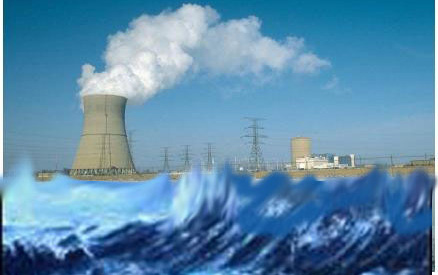
Nuclear energy’s unique selling proposition (USP) of lower-carbon electricity production sits in the context of a much larger picture — that coastal nuclear will be one of the first, and most significant, casualties to ramping climate impact, argues Paul Dorfman, of the UCL Energy Institute, University College London. Because of this, Dorfman, who authored a report on the issue released this week, posits that nuclear, far from helping with our shared climate problem, may well add to it.
As the world heats, sea levels are rising at an accelerated rate — now estimated at 3 to 4 millimeters a year — as ice stored at the poles and in glaciers melts. A recent NASA study based on 25 years of satellite data found that the Arctic is melting so rapidly that it’s now 20% thinner than a decade ago, weakening a major source of the planet’s cooling.
The polar ice caps are melting six times faster than they were in the 1990s, with the high melt rate corresponding to the worst-case scenario for global heating set out by the Intergovernmental Panel on Climate Change. This means that the planet will see a very significant rise in sea level, resulting in ramping annual coastal and inland flooding.
The melting Arctic ice cap is currently the biggest single contributor to sea-level rise, and already imperils coasts and coastal populations. In other words, a significant part of the Greenland Ice Sheet — which lost a record amount of ice in 2019 — is on the brink of a tipping point, after which accelerated melting would become inevitable.
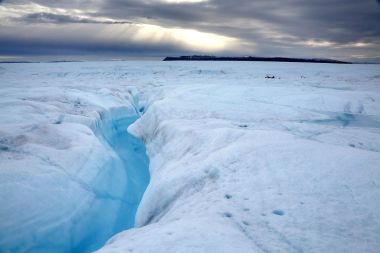
And the Antarctic (where more than half of Earth’s freshwater resources are held, representing by far the largest potential source for global sea-level rise under future warming conditions) is also threatened — with the likelihood that its long-term sea-level contribution will dramatically exceed that of other sources. Put simply, current fundamental scientific knowledge of climate sensitivity and polar ice melt concludes that sea-level rise is significantly faster than previously believed and likely to exceed up to 2.5 meters well within the 21st century.
And the Antarctic (where more than half of Earth’s freshwater resources are held, representing by far the largest potential source for global sea-level rise under future warming conditions) is also threatened — with the likelihood that its long-term sea-level contribution will dramatically exceed that of other sources. Put simply, current fundamental scientific knowledge of climate sensitivity and polar ice melt concludes that sea-level rise is significantly faster than previously believed and likely to exceed up to 2.5 meters well within the 21st century.
Unfortunately for coastal infrastructure, the effect of rising mean sea levels will be felt most profoundly during extreme storm conditions as strong winds and low atmospheric pressure bring about a temporary and localized increase in sea level known as a “storm surge.”
Recent published peer-reviewed scientific data point to much quicker and greater sea-level rise, faster, harder, more destructive storms, storm surges, and inland flooding. Yet the overwhelming majority of installed nuclear capacity began operation well before global heating was considered in design or construction.
Given ramping predictions for sea-level rise and climatic disturbance, nuclear will prove an important risk. This is because 41% of all nuclear power plants worldwide operate on the sea coast, making them vulnerable to increasing sea-level rise, storm intensity and storm surge-induced flooding. Inland nuclear installations may fare no better, as they face increasingly severe wildfire, with episodic flooding alternating with low river flow and raised water temperatures — the latter significantly impacting reactor cooling capacity and, hence, viability.
Since climate change will impact nuclear plant earlier and harder than industry, government or regulatory bodies may expect, necessary mitigation efforts imply significantly increased expense for nuclear construction, operation and decommissioning. Spent fuel management facilities will also be increasingly vulnerable to unanticipated climate-driven environmental events, involving significant risk to onsite high-, medium- and low-level nuclear waste stockpiles.

A key associated problem is that 516 million people worldwide live within a 50 mile (80 kilometer) radius of at least one operating nuclear power plant, and 20 million live within a 10 mile (16 km) radius — and so face health and safety risks from climate change-induced radiation contamination release events. Since at least 100 nuclear power stations are just a few meters above sea level and will be increasingly threatened by serious flooding caused by accelerating sea-level rise and more frequent storm surge, there’s no question that nuclear stations are, quite literally, on the front line of climate change risk — and not in a good way.
A key associated problem is that 516 million people worldwide live within a 50 mile (80 kilometer) radius of at least one operating nuclear power plant, and 20 million live within a 10 mile (16 km) radius — and so face health and safety risks from climate change-induced radiation contamination release events. Since at least 100 nuclear power stations are just a few meters above sea level and will be increasingly threatened by serious flooding caused by accelerating sea-level rise and more frequent storm surge, there’s no question that nuclear stations are, quite literally, on the front line of climate change risk — and not in a good way.
For example, the US Nuclear Regulatory Commission concludes that the vast majority of US nuclear sites have already experienced flooding hazard beyond their design basis, and a recent US Army War College report states that nuclear power facilities are at “high risk” of temporary or permanent closure due to climate threats — with 60% of US nuclear capacity vulnerable to major risks including sea-level rise, severe storms, and cooling water shortages.
Recent climate impact data suggests the need for a substantive reassessment of nuclear’s role in net zero. In other words, nuclear’s lower-carbon electricity USP sits alongside the probability that coastal nuclear plants will be one of the first, and most significant, casualties of rising seas; with inland nuclear plants increasingly subject to intermittent flooding, loss of reactor cooling, and wildfire risk.
This unfortunate reality means that evolutionary modeled predictions of climate change impact on nuclear infrastructure must be accounted for, including the potential for rapidly changing extreme events, abrupt interactions and problematic feedbacks. Further comprehensive nuclear industry and regulatory risk assessments based on “all case” scenarios must be published and regularly updated as fundamental scientific climate impact evidence evolves. Such an approach must include costings for any necessary mitigation measures and a range of contingency plans for the swift onset of climate-driven severe weather.
1 This Month

Read the Public Inquiry Report, the Commissioners’ report, Surrendering Australia: The AUKUS Deception is available to download for free at aukuspublicinquiry.com. Or just watch the replay of the National Press Club Luncheon.


19 November – Webinar – The Reality of Reprocessing
Time: 11:00 AM Pacific Time (US & Canada) / 2:00 PM Eastern / 7:00 PM UK / 8:00 PM CET
Register for the Zoom Event Here



Shut down the radiation-damaged Heysham nuclear reactors now
To see nuclear-related stories in greater depth and intensity – go to https://nuclearinformation.wordpress.com

Say No to NASA’s Reckless Nuclear Reactor on the Moon
Say No to NASA’s Reckless Nuclear Reactor on the Moon
-
Archives
- November 2026 (103)
- October 2026 (302)
- September 2026 (339)
- August 2026 (330)
- July 2026 (355)
- June 2026 (287)
- May 2026 (306)
- April 2026 (356)
- March 2026 (251)
- February 2026 (267)
- January 2026 (308)
- December 2025 (358)
-
Categories
- 1
- 1 NUCLEAR ISSUES
- business and costs
- climate change
- culture and arts
- ENERGY
- environment
- health
- history
- indigenous issues
- Legal
- marketing of nuclear
- media
- opposition to nuclear
- PERSONAL STORIES
- politics
- politics international
- Religion and ethics
- safety
- secrets,lies and civil liberties
- spinbuster
- technology
- Uranium
- wastes
- weapons and war
- Women
- 2 WORLD
- ACTION
- AFRICA
- Atrocities
- AUSTRALIA
- Christina's notes
- Christina's themes
- culture and arts
- Events
- Fuk 2022
- Fuk 2023
- Fukushima 2017
- Fukushima 2018
- fukushima 2019
- Fukushima 2020
- Fukushima 2021
- general
- global warming
- Humour (God we need it)
- Nuclear
- RARE EARTHS
- Reference
- resources – print
- Resources -audiovicual
- Weekly Newsletter
- World
- World Nuclear
- YouTube
-
RSS
Entries RSS
Comments RSS

