Nuclear power “just doesn’t make sense” for Ireland, a leading energy expert says.
Why nuclear power ”just doesn’t make sense” for Ireland, news talk, Stephen McNeice, 26 AUG 2021
Nuclear power “just doesn’t make sense” for Ireland, a leading energy expert says.
John Fitzgerald was speaking following recent fears that Ireland could face potential blackouts this winter.
Those concerns have eased now that two power generators are due to come back online in October and November, ahead of the high-demand winter season.
However, the situation has raised concerns about how the system will cope during periods when renewable sources such as wind turbines are unable to produce much power.
Those concerns have increased as more and more data centres are announced for Ireland – all of which require substantial and consistent supplies of electricity.
That has led to some questions about whether nuclear power – which, outside of safety concerns, is seen as a reliable source of energy by many countries – should be considered for Ireland.
Professor Fitzgerald – Research Affiliate at the ESRI and an Honorary Fellow of Trinity College Dublin – told The Pat Kenny Show it wouldn’t work for Ireland.
“Our generators come in what are called 400 megawatt lumps – nuclear comes in 1200 megawatt lumps.
“If you have a bloody massive nuclear generator in Ireland, you’ve got to have three gas stations puttering away and ready to go in case anything goes wrong. It just doesn’t make sense.”
rading electricity……
he suggested the current make-up of Ireland’s electricity grid does make sense.
He said: “The thing about nuclear is it’s always on, whereas with wind it’s intermittent.
“When you have a load of wind on the system, having a load of nuclear doesn’t fit – it makes more sense to put in more wires to France and Britain and trade the electricity.
For now, he said the concerns with wind energy are about what happens in periods – usually in January – when you have several weeks with low or no wind.
He explained: “You have to have alternatives so the lights don’t go off when the wind doesn’t blow.
“What the concerns were – although there are less now than they would have been two weeks ago – is there are two big gas generators which are broken.
“They’re an important part of the system, and if they didn’t come back on… then when the wind didn’t blow we’d be short of generation.”
However, he said EirGrid and its predecessors have ensured Ireland’s electricity supply has been one of the most reliable in the world.
He added: “We just need to keep them at it.” https://www.newstalk.com/news/why-nuclear-power-just-doesnt-make-sense-for-ireland-1243726
Swedish government decides to increase interim storage capacity for nuclear waste
The Government has decided to allow a capacity increase of the interim
storage facility for spent nuclear fuel, pending a repository for final
disposal being constructed and put into operation. An intermediate decision
on interim storage is necessary to safeguard the energy supply in the
coming years.
The Government is prioritising and working as swiftly as
possible to prepare the decision on the repository. In the Government’s
assessment, it will be a matter of months before such a decision can be
made. However, the permit process following a government decision will take
additional time.
Without a valid permit for increased interim storage in
place before the end of 2023, Sweden’s electricity generation could be
adversely affected. This is why an intermediate decision on interim storage
is necessary.
The Government is examining how spent nuclear fuel and other
nuclear waste will be disposed of. In the next step, the Government will
refer the evaluation of new research on the protective capability of the
copper canister in relation to both copper corrosion and the planned cast
iron insert to the Swedish Radiation Safety Authority and the Swedish
National Council for Nuclear Waste.
In the consultation process, the
Government wants these authorities to determine whether the article on
copper corrosion and the research to which the article refers provide new
information that may be of significance to the Government’s decision on
the case.
Swedish Government 27th Aug 2021
Rocket launches may be damaging the ozone layer
Rocket launches could be affecting our ozone layer, say experts.
Industry experts are calling for more research into how launches affect our atmosphere, Nicole Mortillaro · CBC News · Apr 23, 2021
Industry experts are calling for more research into how launches affect our atmosphere Rocket launches are a breathtaking culmination of human ingenuity as they propel us into the future, but there is a growing concern that not enough research has been done on their effect on the environment.
While some may be worried about potential greenhouse gas emissions that’s not the main issue. Instead, it’s ozone depletion and the potential effects in our upper atmosphere, specifically the stratosphere, along with concerns about toxic fuels.
The problem has flown under the radar, according to Martin Ross, an atmospheric scientist at The Aerospace Corporation, because people still think of rocket launches as rare.
But it’s time to face the fact that we may be entering a boom era, he said.
“One of the arguments that people have used in the past was to say that we don’t really need to pay attention to rockets or to the space industry, or the space industry is small, and it’s always going to be small,” Ross said.
“But I think the developments that we’re seeing the past few years show that … space is entering this very rapid growth phase like aviation saw in the ’20s and ’30s.”
Black soot in the atmosphere
The stratosphere is an important weather driver for Earth’s systems, and that’s where some particles from rocket launches are ending up.
The ozone layer, which helps protect us from the sun’s harmful ultraviolet rays, is also located in the stratosphere. In 1990, the Montreal Protocol was signed into law, banning harmful ozone-depleting substances, such as chlorofluorocarbons (CFCs), used in things like refrigerators and air conditioners, after it was revealed that the ozone layer was being stripped away by these chemicals. While the protocol touched on airlines, there was no mention of the aerospace industry.
But now some industry experts are concerned that with no oversight, we could be in for a problem.
There are different types of rocket propellants. Some, like liquid oxygen and liquid hydrogen, produce mainly water vapour and have little environmental impact. These were used in past shuttle launches and even in the Apollo-era Saturn V vehicles.
Then there are those that produce alumina particles in the stratosphere, such as those in solid rocket boosters, which were also used in past shuttle launches, and are still being used today by some launch companies.
Finally, there are those that deposit black soot in the stratosphere, such as kerosene used in SpaceX’s Falcon 9 and Russia’s Soyuz rockets.
It’s the alumina and black soot that is most concerning to experts.
“The atmosphere is complex,” said Jessica Dallas, a PhD candidate at the Australian Centre for Space Engineering Research, in New South Wales. “We don’t have a complete understanding of atmospheric circulation and how all of the mechanisms in the atmosphere actually work. And so that means that we also don’t have a good idea of what happens when we’re injecting these particles into the stratosphere.”
Dallas, who wrote a comprehensive analysis of research on rocket propellants, said that she’s concerned that there haven’t been studies on how these particles interact in our atmosphere………………………. https://www.cbc.ca/news/science/rocket-launches-environment-1.5995252
U.S. Strategic Command general tries to stir up trouble about nuclear arsenals
US Strategic Command general aspires to muddy the water of nuclear arsenals, By Hu XijinGlobal Times, Aug 29, 2021 US Air Force Lieutenant General Thomas Bussiere, who is deputy commander of the US Strategic Command which oversees the nuclear arsenal, said on Friday that China will soon surpass Russia as the top nuclear threat of the US, a Reuter report said………..
I think Bussiere’s remarks had two malicious goals. First, he wants to sow discord between Russia and China, instigating a sense of crisis in Russia that China’s nuclear capabilities are to surpass Russia.
His reasoning is problematic. The number of nuclear warheads in China and Russia is not in the same order of magnitude. It is known that Russia owns more nuclear warheads than the US. It’s incredible that China’s nuclear capability could surpass that of Russia in the foreseeable future.
Bussiere said his judgment is not based solely on the number of China’s stockpiled nuclear warheads, but he didn’t give any other parameters. Instead, he just vaguely said that it also depends on how they are “operationally fielded.” What he wants to achieve is to confuse and mislead the public.
It’s well-known that China is the sole nuclear power that has declared a policy of “no-first-use” of nuclear weapons at any time, and, under any circumstances. China has far fewer nuclear warheads than Russia or the US, and has made the aforementioned self-restrained commitment. How can China’s nuclear deterrent surpass that of Russia?
Bussiere’s second purpose is sinister, too. ……..
He wanted to prevent China from increasing nuclear deterrent, and, to sustain the huge disparity of nuclear weapons between China and the US………… https://www.globaltimes.cn/page/202108/1232705.shtml
Engie nuclear subsidiary Endel in bad shape about to be sold
Nuclear: Engie about to sell its Endel subsidiary to the Altrad group. The
energy company’s industrial and nuclear maintenance subsidiary is in bad
shape. The state has given the green light for the operation.
Le Figaro 26th Aug 2021
Even the right-wing Competitive Enterprise Institute doubts the wisdom of bailing out struggling nuclear power stations

The dubious Senate proposal to bail out nuclear powerplants, https://thehill.com/opinion/energy-environment/569831-the-dubious-senate-proposal-to-bail-out-nuclear-powerplants BY BENJAMIN ZYCHER, — 08/28/21 Costly economic distortions are an inexorable result of government bailouts for specific industries, the justifications for which are almost always deeply dubious.
Consider section 3203 of the proposed Senate Energy Infrastructure Act. It would establish a $6 billion credit program over four years starting in fiscal year 2022 for nuclear electricity plants “projected to cease operations due to economic factors.” The credits, disbursement of which would cease after 2031, would be defined as a certain dollar amount per megawatt-hour (mWh) of generation. And just as the production tax credit for wind electricity has been extended 13 times, it is difficult to believe that once implemented a similar subvention for nuclear power will fail to prove semi-permanent.
And sure enough: The draft legislation directs the comptroller general to submit by Jan. 1, 2024 “any recommendations to renew or expand the credits.”
The bill makes it clear that the ostensible rationale for the credits is “the potential incremental air pollutants that would result if the [given] nuclear reactor were to cease operations. …and be replaced with other types of power generation.”
But the draft legislation asks no one to investigate or even to speculate about whether the hypothetical increase in air pollutants resulting from a shutdown of a nuclear generating plant would yield a violation of the National Ambient Air Quality Standards (NAAQS) in the relevant geographic region for any of the (criteria) pollutants covered by the Clean Air Act.
Because the Clean Air Act requires that the respective NAAQS “protect the public health” with “an adequate margin of safety,” it is difficult to believe that a shutdown of a limited number of reactors and replacement with, say, combined-cycle gas generation, would result in ambient air quality in excess of a given NAAQS. The “public health” would continue to be protected.
Forget air pollution. This proposed subsidy is a bailout — that is, a sizable economic distortion to be added to all of the other distortions inflicted by various policies upon electricity markets. Would it not be better to reduce that aggregate of economic losses rather than to add to them? The actual unpublicized justifications for this proposal are exceedingly weak.
Competitive price pressures from generation fueled with inexpensive natural gas. Competition is the very basis of a market economy, and a failure to foresee the sharp decline in natural gas prices when nuclear investments were made does not justify a federal bailout. Investors and managements contemplating large investments know that there are important risks, both known and unknown, and make their decisions accordingly. The proposed subsidy would shift those risks onto the taxpayers writ large, and there is no reason to believe that such a shift is efficient.
Single-unit vs multi-unit nuclear operating costs. Two of the nuclear generating stations desperate for operating subsidies (Davis Besse and Perry, both in Ohio) are single-unit facilities, which have operating costs per mWh higher than those for multi-unit stations, because their fixed overhead costs are spread over less generation, and because they cannot achieve scale economies similar to those of multi-unit plants when negotiating service and fuel contracts. There is no reason that taxpayers should bear the attendant economic burdens.
Potential mismanagement. It is no secret that business management, like all human endeavors, varies in terms of the efficiency of the decisions made and the conduct of operations. Not only does the proposed legislation not consider the cost effects of possible mismanagement, it also reduces the economic penalty for such inefficiency.
Costly state regulation and the effects of “renewable portfolio” or “clean energy” standards. Regulation at the state level, imposed by legislatures, public utility commissions and other official bureaus, obviously creates costs and distortions, often sizable. Moreover, about 30 states require that some proportion of the electricity produced or consumed in the state be generated by certain technologies (e.g., wind and solar power), and those requirements often exclude nuclear electricity.
Is there a reason that federal taxpayers should be forced to bear the consequences of state laws and regulations? Reforms of state policies yielding adverse outcomes must be implemented at the state level; a federal bailout reduces the incentives for such reforms. The owners of nuclear powerplants should make their case to the state legislatures.
The distortions created by the federal wind production tax credit. The one argument in support of the proposed nuclear subsidy that is not wholly spurious is the effect of the wind production tax credit (PTC), now between $15 and $25 per mWh. The PTC thus allows the wind producers to reduce the prices that they bid for sales into bulk power markets – sometimes to negative levels – while still “earning” positive net prices.
This obviously is unfair competition: The operators of nuclear plants receive no such subventions, and for technical engineering reasons, it is difficult or impossible for nuclear plants to ramp generation up and down in response to short-term price fluctuations.
So, one could argue that the proposed nuclear subsidy corrects the competitive problem created by the PTC, but that is a non sequitur. If the distortions created by given policies are to be addressed by incorporating new distortions, over time the entire economy in effect will become centrally planned, as one set of distortions after another is adopted to deal with the problems created by earlier ones. The proper course is to end the wind PTC and not to bail out nuclear plants with another subsidy program.
Note also that the prospective “profitability” of a given nuclear plant hinges on assumptions about prices, operations costs and other parameters that are subject to important uncertainties. One study by the former chief economist of the PJM Regional Transmission Organization projects net operating profits for 2021 of $30.4 million and $47.5 million for the two plants in Ohio referenced above, respectively. Another study from the PJM itself projects 2021 operating losses for those units of $28.8 million and $33.2 million, respectively.
In short, such calculations are far from straightforward, and no one will be surprised when those applying for the new nuclear credits find ways to increase the magnitude of the operating losses they will claim.
The arguments in favor of this proposed subsidy are exceedingly weak, and the central principle weighing against it is powerful: Let us reduce rather than increase the distortions created by government economic policies. A failure to keep that principle in mind will yield ongoing economic losses for all of us.
Benjamin Zycher is a senior fellow at the American Enterprise Institute.
UN urges Japan to investigate damaged Fukushima nuclear reactors for clean-up
UN urges Japan to investigate damaged Fukushima nuclear reactors for clean-up, New York Post,
By Isabel Vincent 28 Aug 21. A team of United Nations experts is urging Japan to investigate nuclear reactors damaged a decade ago by a massive earthquake and tsunami.
Scientists working for the International Atomic Energy Agency reviewing the progress of the Fukushima plant’s clean-up say that Japan has been slow to examine the melted fuel inside the reactors.
And they’re worried that the country will be unable to meet a 2051 target to clean up the mess, according to a report.
“We need to gather more information on the fuel debris and more experience on the retrieval of the fuel debris to know if the plan can be completed as expected in the next 30 years,” said Christophe Xerri, head of IAEA, at a press conference after he and a colleague submitted a report on their recent findings to the Japanese government Friday……….https://nypost.com/2021/08/28/un-urges-japan-to-investigate-damaged-fukushima-nuclear-reactors/
Nuclear Regulatory Commission finds cable issues in special inspection of Vogtle Unit 3
Nuclear Regulatory Commission finds cable issues in special inspection of Vogtle Unit 3, Augusta Chronicle Abraham Kenmore, 27 Aug 21, The federal Nuclear Regulatory Commission has finished its special inspection of the Plant Vogtle Unit 3 expansion. The report found several preliminary issues with how cables had been installed during the construction of the new nuclear power facility.
“The NRC inspectors found that Southern Nuclear did not adequately separate safety and non-safety-related cables for reactor coolant pumps and equipment designed to safely shut down the reactor,” according to a press release sent with the report. “They also found instances where the company did not identify and report construction quality issues related to the safety-related electrical raceway system and enter them into its corrective action program.”
Southern Nuclear, the company in charge of construction, can choose to accept the results of the inspection or provide additional information before a final determination is reached. Unit 3 currently has no fuel loaded into the reactor and the press release makes it clear there is no increased risk to the public from the safety issues. Southern Company will not be allowed to operate the reactor until construction is finished to standards……… www.augustachronicle.com/story/news/2021/08/27/plant-vogtle-unit-3-nrc-inspection-shows-cable-problems/5603644001/?fbclid=IwAR2O-5h1IDZhDUu4H5sVJ9tPRoQXDYv58lFDQK0LkyjBE_qekMjnpKo7Q34
‘Critical issues’ with Sizewell C plans to be discussed at public hearings
‘Critical issues’ with Sizewell C plans to be discussed at public hearings https://www.eadt.co.uk/news/sizewell-c-september-2021-hearings-8274260Andrew Papworth0 August 26, 2021 “Critical issues” with plans for a new nuclear power station on the Suffolk coast – including the impact building work would have on residents – are to be discussed at public hearings.
The Planning Inspectorate is holding a series of Issue Specific Hearings on EDF Energy’s bid to build Sizewell C as part of its formal examination of proposals for a new twin-reactor.
Hearings have been taking place this week, with another four days of hearings scheduled to take place at Snape Maltings in mid-September.
The first day on Tuesday, September 14 will look at flood risk and water supply issues, while the following day will examine the “potential adverse effects on human health and living conditions of local residents during construction”.
The hearings on Thursday, September 16 will look at landscape and heritage issues, including “potential adverse effects on heritage assets forming part of the Heveningham Hall estate and National Trust Coastguard Cottages”.
The code of practice for the construction of the site will be assessed on Friday, September 17.
A spokesman for EDF Energy said: “We are pleased the hearings are going ahead, as they will allow the examining authority to continue to explore all our proposals and enable all interested parties to participate.”
But Paul Collins, chairman of the Stop Sizewell C campaign group, said: “We are well over two-thirds of the way through the Sizewell C examination, which has exposed many serious failings in EDF’s application.
“There are still a number of critical issues to be heard.
“Whether or not the Planning Inspectorate will agree with our MP’s recommendation that the examination is extended remains to be seen, although we note EDF’s latest financial report is now hinting that a secretary of state decision is due ‘mid-2022’ as opposed to April 2022, which suggests that they at least are expecting this.”
Once the examination process is concluded, an inspector will make a recommendation to government as to whether the nuclear plant should go ahead or not.
Sizewell C had delayed the original submission of the planning application by two months and extended the period of public registration due to the coronavirus pandemic.
This had followed eight years of public consultation to form the proposals for the new power station.
The meetings will be live-streamed and also available to watch afterwards.
Anti-nuclear campaigners slam plans to install new nuclear reactors in Wales
Anti-nuclear campaigners slam plans to install new nuclear reactors in Wales, NATION CYMRU, 27 Aug 2021 Anti-nuclear campaigners in Wales have criticised the Welsh Government for supporting “flawed and outdated” technology amid plans to install new reactors in Wales.
It was revealed on Wednesday that Mike Tynan, former head of UK operations at US nuclear engineering group Westinghouse, has been recruited by the Welsh Government to head up their nuclear company Cwmni Egino with the aim of resurrecting the Trawsfynydd site.
Both Trawsfynydd and the Wylfa site on Anglesey are being discussed as possible locations for small modular reactors at existing nuclear sites.
But anti-nuclear campaign groups PAWB and CADNO said that the nuclear power station at Trawsfynydd should be a focus for the development of renewable and sustainable technologies.
Trawsnfynydd is already the site of the decommissioned Magnox nuclear power station that ran between 1965 and 1991.
PAWB and CADNO said that once again hopes for work for local people will be raised, with few substantive promises.
“There is not enough proof that the technology will have been developed enough to make a difference in the critical fight against climate change in time,” they said.
“In addition, limited public resources that support nuclear mean that those resources are not available to truly green and sustainable technologies.
Climate change, homelessness, poverty, inequality – these are the complex problems of our time. The nuclear obsession does nothing to solve these problems; it adds to them. ”……………….. https://nation.cymru/news/anti-nuclear-campaigners-slam-plans-to-install-new-nuclear-reactors-in-wales/
Reaffirm commitment to ban nuclear tests, UN chief says in message for International Day,
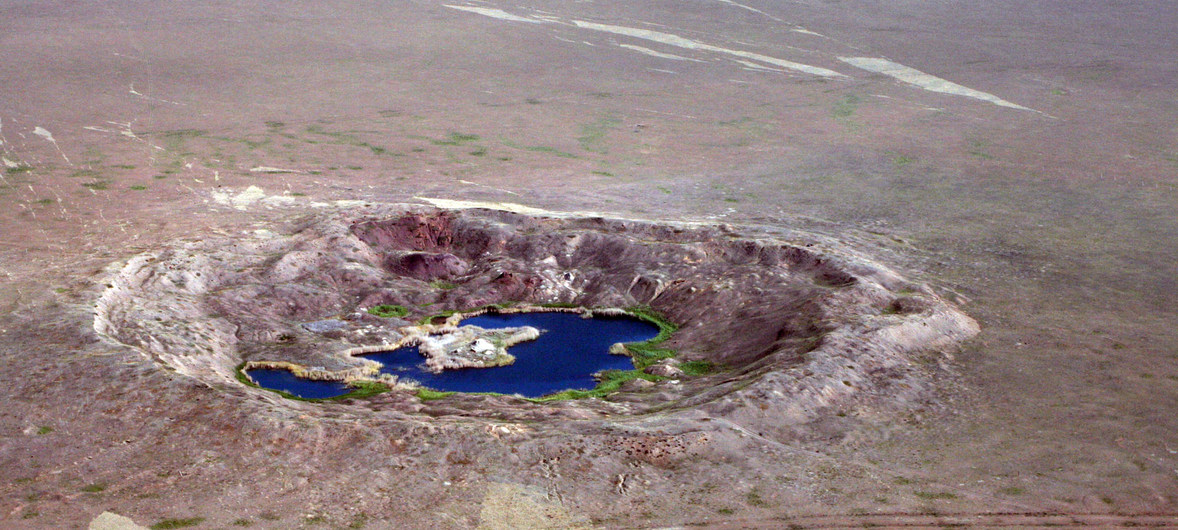
Reaffirm commitment to ban nuclear tests, UN chief says in message for International Day, UN News 29 Aug 21 Countries which have not yet ratified the Comprehensive Nuclear-Test-Ban Treaty (CTBT) are urged by UN Secretary-General António Guterres to do so without delay.
The UN chief made the appeal in his message for the International Day Against Nuclear Tests, observed on Sunday, 29 AugustThe UN chief made the appeal in his message for the International Day Against Nuclear Tests, observed on Sunday, 29 August
The date marks the 30th anniversary of the closure of the Semipalatinsk nuclear test site in Kazakhstan, the largest of its kind in the former Soviet Union, where more than 450 nuclear devices were exploded over four decades.
Terrible consequences
Mr. Guterres said nuclear tests caused enormous human suffering and environmental damage.
They had terrible consequences on the health of people living in affected areas. Many were relocated from their ancestral lands, disrupting their lives and livelihoods. Pristine environments and ecosystems were destroyed, which will take decades, if not centuries, to heal.”
The closure of the Semipalatinsk test site signaled the end of the era of unrestrained nuclear testing, said Mr. Guterres. Soon afterwards, countries began negotiating the CTBT.
The treaty bans all explosive nuclear weapons tests anywhere, by any country, he added, effectively “putting a brake on the nuclear arms race and providing a powerful barrier to the development of new nuclear weapons.”
No excuse
The CTBT was adopted in 1996 and has been signed by 185 countries, and ratified by 170, including three nuclear weapon States. However, it must be signed and ratified by 44 specific nuclear technology holder countries before it can enter into force……………….
Threat still real: Kazakhstan Ambassador
The threat that nuclear weapons pose to the world remains “as realistic as ever”, said Kazakhstan’s Ambassador to the UN, Magzhan Ilyassov, speaking to UN News ahead of the International Day (interview here and at right).
“For us, the 29th of August is not a day in the calendar. It is a reminder about how traumatic nuclear tests can be for humankind because in Kazakhstan alone, 1.5 million people still suffer, and will unfortunately suffer for future generations, from genetic diseases, cancer, leukaemia, which were caused by exposure to nuclear tests.”
Mr. Ilyassov said the total impact of the nuclear explosions carried out at the Semipalatinsk site was “1,200 times more” than the atomic bomb dropped on Hiroshima, Japan, during the Second World War.
“The test site itself is of the size of Israel, so it’s a big chunk of the territory of Kazakhstan and that cannot be used for any other purpose like agriculture for many, many decades now,” he said, adding “so with that, we can also project what was the damage caused by other nuclear test sites around the world which were eventually closed.” https://news.un.org/en/story/2021/08/1098682
Vulnerability of Louisiana’s Waterford 3 nuclear plant to storm surge
Intensifying Hurricane Ida a significant threat to key infrastructure. Ida is forecast to hit the industrial corridor between Baton Rouge and New Orleans, site of three key ports, petrochemical sites, and a nuclear power plant. Yale Climate Connections, by JEFF MASTERS and BOB HENSON, AUGUST 29, 2021
Vulnerability of Waterford 3 nuclear plant to storm surge. Although it lies 65 miles inland from the south coast of Louisiana, the Waterford 3 nuclear generating station, located at an elevation of 10-15 feet on the south shore of the Mississippi River, is vulnerable to storm surge from a major hurricane. Hurricane Betsy, a category 4 storm that hit Louisiana in 1965, brought a storm surge to the edge of the plant’s location (Figure 3 on original).
According to a 2019 analysis by Bloomberg, the Waterford 3 plant is designed to withstand a maximum storm surge of 23.7 feet above sea level, or about 10 feet higher than the plant’s elevation. According to NOAA’s National Storm Surge Hazard database, a worst-case category 3 hurricane could flood the plant to a depth of 3’, while a worst-case category 4 hurricane could flood the plant to a depth of more than 9’ – near its design limit. Fortunately, storm surge modeling by Louisiana State University using the 11 a.m. EDT Saturday NHC forecast showed Ida’s storm surge stopping just short of the plant (Figure 4 on original)
After the 2011 disaster at Japan’s Fukushima nuclear power plant, the Waterford 3 plant moved to store all of its emergency generators, pumps, and other essential safety equipment in a 30-foot flood-proof concrete bunker – a system called Flex, for Flexible Mitigation Capability. The bunker has manually operated and powered sump pumps to remove water in the event of a flood.
After the 2011 disaster at Japan’s Fukushima nuclear power plant, the Waterford 3 plant moved to store all of its emergency generators, pumps, and other essential safety equipment in a 30-foot flood-proof concrete bunker – a system called Flex, for Flexible Mitigation Capability. The bunker has manually operated and powered sump pumps to remove water in the event of a flood…………………….. https://yaleclimateconnections.org/2021/08/intensifying-hurricane-ida-a-significant-threat-to-key-infrastructure/
Hurricane Ida threatens 2 nuclear power stations in Louisiana
Two Nuclear Plants In Ida’s Path As Storm Expected At Cat 4, Simply Info, [excellent pictures and maps]
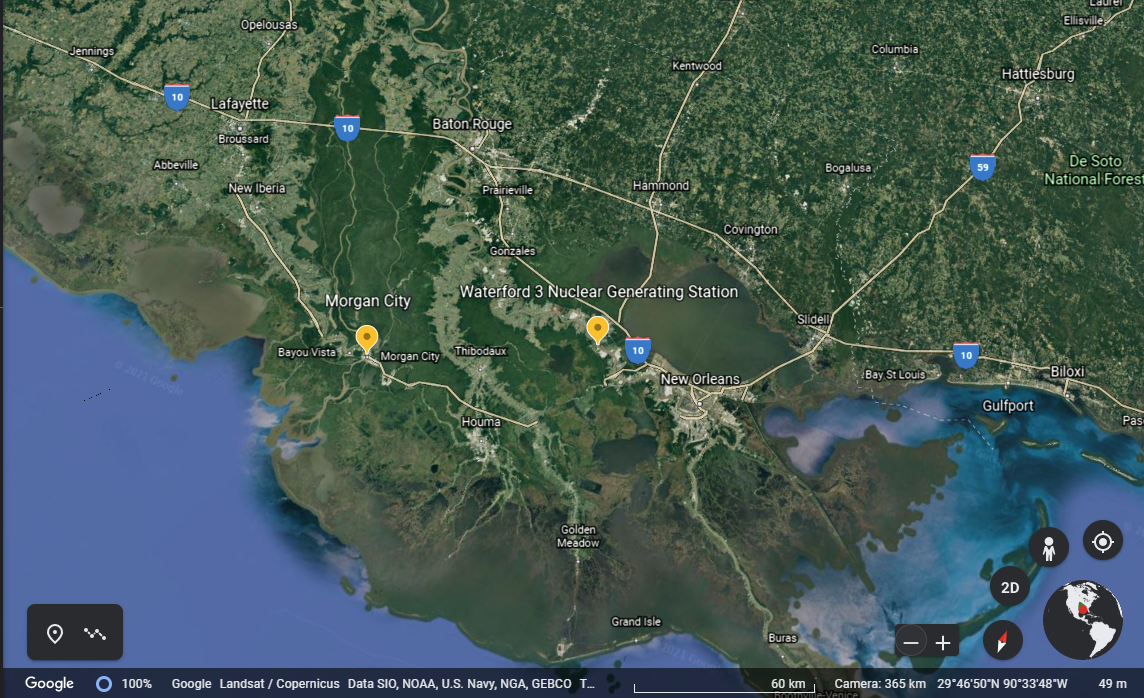
Hurricane Ida is expected to hit the US as a category 4 storm. The Weather Channel projects Sunday night landfall and a direct hit on Louisiana. Storm surges in the area range from the Texas border to Mobile Alabama.
Two nuclear power plants are in the direct storm path. River Bend and Waterford. Waterford sits near the mouth of the Mississippi and in the zone of the highest expected storm surge. Current estimates have a 10-15 foot surge expected for that area. This could be potentially more severe as the storm pushes water up the Mississippi River. Waterford sits about 24 miles from the mouth of the river and is next to Lake Pontchartrain……………..more http://www.simplyinfo.org/?p=19660
International Atomic Energy Agency doubts the ability of Japan to clean up Fukushima nuclear wreck by intended date 2051

UN team: Unclear if Fukushima cleanup can finish by 2051, MARI YAMAGUCHI, THE PRESS DEMOCRAT, ASSOCIATED PRESS, August 27, 2021,
TOKYO — Too little is known about melted fuel inside damaged reactors at the wrecked Fukushima nuclear power plant, even a decade after the disaster, to be able to tell if its decommissioning can be finished by 2051 as planned, a U.N. nuclear agency official said Friday.
“Honestly speaking, I don’t know, and I don’t know if anybody knows,” said Christophe Xerri, head of an International Atomic Energy Agency team reviewing progress in the plant’s cleanup.
“We need to gather more information on the fuel debris and more experience on the retrieval of the fuel debris to know if the plan can be completed as expected in the next 30 years,” he told reporters.
The cleanup plan depends on how the melted fuel needs to be handled for long-term storage and management, he said.
The IAEA team’s review, the fifth since the disaster, was mostly conducted online due to the coronavirus pandemic. Only Xerri and another team member visited the plant this week before compiling and submitting a report to Japan’s government on Friday.
In the report, the team noted progress in a number of areas since its last review in 2018, including the removal of spent fuel from a storage pool at one of the damaged reactors, as well as a decision to start discharging massive amounts of treated but still radioactive water stored at the plant into the ocean in 2023………. https://www.pressdemocrat.com/article/news/un-team-unclear-if-fukushima-cleanup-can-finish-by-2051/?ref=recent
Weaponising space -the high road to World War 3, but profitable for weapon and space companies

Insane U.S. Plan to Spend Billions on Weaponizing Space Makes Defense Contractors Jump for Joy—But Rest of World Cowers in Horror at Prospect of New Arms Race Leading to World War IIICovertAction Magazine By Karl Grossman – August 25, 2021 Imagine this scenario from the year 2045: The U.S. and China, after years of belligerence, go to war over control of the Taiwan straits; most of the battles are fought through cyber-attacks and space-based weapons systems that had been perfected over the previous decades.
In a desperate maneuver, the U.S. activates its “rods from God”—a scheme developed in Project Thor involving telephone-pole-sized tungsten rods being dropped from orbit reaching a speed ten times the speed of sound [7,500 miles per hour] hitting with the force of nuclear weapons—and Beijing’s military command centers and other significant targets are destroyed.
The above scenario looks increasingly plausible given a) the growing prospect of war between the U.S. and China; and b) the growing militarization of space by the U.S.—in violation of the landmark Outer Space Treaty of 1967 that sets aside space “for peaceful purposes.”
U.S. Space Force and the Evisceration of the 1967 Outer Space Treaty
Donald Trump declared at a meeting of the National Space Council of the U.S. in 2018 that “it is not enough to merely have an American presence in space, we must have American dominance in space…. I’m hereby directing the Department of Defense and Pentagon to immediately begin the process necessary to establish a Space Force as the sixth branch of the armed forces … It is going to be something.”

Indeed, the U.S. Space Force, established in December 2019, is something—and can, if not will, destroy the visionary Outer Space Treaty of keeping space for peace.
The Outer Space Treaty of 1967 was put together by the U.S., Great Britain and the former Soviet Union and has wide support from nations around the world. 111 countries are parties to the treaty, while another 23 have signed the treaty but have not completed ratification.
As Craig Eisendrath, who as a young U.S. State Department officer was involved in the treaty’s creation, told me—and I quote him in my book Weapons in Space—“we sought to de-weaponize space before it got weaponized … to keep war out of space.”
“This foundational treaty has allowed for half a century of ever expanding peaceful activity in space, free from man-made threats,” writes Paul Meyer, in his chapter “Arms Control in Outer Space: A Diplomatic Alternative to Star Wars” in the book Security in the Global Commons and Beyond.[1]
The Outer Space Treaty bars placement “in orbit around the Earth any objects carrying nuclear weapons or any other kinds of weapons of mass destruction or from installing such weapons on celestial bodies.”
Biden Signs Off on Space Force
Republican Trump’s successor as U.S. president, Democrat Joe Biden, has not pulled back on the U.S. Space Force. As Defense News headlined in 2021: “With Biden’s ‘full support,’ the Space Force is officially here to stay.”
Its article opened: “U.S. President Joe Biden will not seek to eliminate the Space Force and roll military space functions back into the Air Force, the White House confirmed.” It continued: “White House spokeswoman Jen Psaki told reporters during a Feb. 3 briefing that the new service has the ‘full support’ of the Biden administration.” And it went on: “‘We’re not revisiting the decision,’ she said.”
Most Democrats in the U.S. Congress voted for the legislation providing for formation of the U.S. Space Force as pushed by Trump. All Republicans in the U.S. Congress voted for it.
False Pretext
For decades there has been an effort to extend the Outer Space Treaty and enact the Prevention of an Arms Race, the PAROS treaty, which would bar any weapons in space.
China, Russia (and U.S. neighbor Canada) have been leaders in seeking passage of the PAROS treaty. But the U.S.—through administration after administration, Republican and Democrat—has opposed the PAROS treaty and effectively vetoed it at the United Nations.
Although the PAROS treaty has broad backing from nations around the world, it must move through the UN’s Conference on Disarmament which functions on a consensual basis.
A rationale for the U.S. Space Force now being claimed is that it is necessary to counter moves by China and Russia in space, particularly development of anti-satellite weapons.
That is what a CNN report in August 2021, titled “An Exclusive Look into How Space Force Is Defending America,” centrally asserted. There was no mention in the six-minute-plus CNN piece of how China and Russia (and Canada) have led for decades in the push for PAROS, and how China and Russia in recent times have reiterated their calls for space to be weapons-free.
“We are calling on the international community to start negotiations and reach agreement on arms control in order to ensure space safety as soon as possible,” said the Chinese Foreign Ministry spokesperson, Zhao Lijian, in April 2021. “China has always been in favor of preventing an arms race in space; it has been actively promoting negotiations on a legally binding agreement on space arms control jointly with Russia.”
A day earlier, Russian Foreign Minister Sergey Lavrov called for talks to create an “international legally binding instrument” to ban the deployment of “any types of weapons” in space. Lavrov said: “We consistently believe that only a guaranteed prevention of an arms race in space will make it possible to use it for creative purposes, for the benefit of the entire mankind. We call for negotiations on the development of an international legally binding instrument that would prohibit the deployment of any types of weapons there, as well as the use of force or the threat of force.”
Onward and Upward!

Meanwhile, the U.S. Space Force drives ahead.
It has requested a budget of $17.4 billion for 2020 to “grow the service,” reports Air Force Magazine. “Space Force 2022 Budget Adds Satellites, Warfighting Center, More Guardians,” was the headline of its article. And in the first paragraph, it adds “and fund more than $800 million in new classified programs.” (“Guardians” is the name adopted by the U.S. Space Force in 2021 for its members.)
A recruitment drive is under way.
The U.S. Space Force “received its first offensive weapon … satellite jammers,” reported American Military News in 2020. “The weapon does not destroy enemy satellites, but can be used to interrupt enemy satellite communications and hinder enemy early warning systems meant to detect a U.S. attack,” it stated…………
“US Space Command—dominating the space dimension of military operations to protect US interests and investment. Integrating Space Forces into war-fighting capabilities across the full spectrum of conflict,” trumpeted Vision for 2020……….
I displayed the comments of U.S. Space Command Commander-in-Chief Joseph W. Ashy in Aviation Week and Space Technology in 1996: “It’s politically sensitive, but it’s going to happen,” said the general.

Some people don’t want to hear this … but—absolutely—we’re going to fight in space. We’re going to fight from space and we’re going to fight into space…. We will engage terrestrial targets someday—ships, airplanes, land targets—from space.” U.S. Space Command Commander-in-Chief General Joseph W. Ashy……………
1 This Month

Read the Public Inquiry Report, the Commissioners’ report, Surrendering Australia: The AUKUS Deception is available to download for free at aukuspublicinquiry.com. Or just watch the replay of the National Press Club Luncheon.


19 November – Webinar – The Reality of Reprocessing
Time: 11:00 AM Pacific Time (US & Canada) / 2:00 PM Eastern / 7:00 PM UK / 8:00 PM CET
Register for the Zoom Event Here



Shut down the radiation-damaged Heysham nuclear reactors now
To see nuclear-related stories in greater depth and intensity – go to https://nuclearinformation.wordpress.com

Say No to NASA’s Reckless Nuclear Reactor on the Moon
Say No to NASA’s Reckless Nuclear Reactor on the Moon
-
Archives
- November 2026 (94)
- October 2026 (302)
- September 2026 (339)
- August 2026 (330)
- July 2026 (355)
- June 2026 (287)
- May 2026 (306)
- April 2026 (356)
- March 2026 (251)
- February 2026 (267)
- January 2026 (308)
- December 2025 (358)
-
Categories
- 1
- 1 NUCLEAR ISSUES
- business and costs
- climate change
- culture and arts
- ENERGY
- environment
- health
- history
- indigenous issues
- Legal
- marketing of nuclear
- media
- opposition to nuclear
- PERSONAL STORIES
- politics
- politics international
- Religion and ethics
- safety
- secrets,lies and civil liberties
- spinbuster
- technology
- Uranium
- wastes
- weapons and war
- Women
- 2 WORLD
- ACTION
- AFRICA
- Atrocities
- AUSTRALIA
- Christina's notes
- Christina's themes
- culture and arts
- Events
- Fuk 2022
- Fuk 2023
- Fukushima 2017
- Fukushima 2018
- fukushima 2019
- Fukushima 2020
- Fukushima 2021
- general
- global warming
- Humour (God we need it)
- Nuclear
- RARE EARTHS
- Reference
- resources – print
- Resources -audiovicual
- Weekly Newsletter
- World
- World Nuclear
- YouTube
-
RSS
Entries RSS
Comments RSS

