Georgia Power customers to pay up even more for Vogtle nuclear project
$224M Georgia Power Rate Hike Likely for Nuclear Plant
Georgia Power Co. customers will likely pay another $224 million a year for the first of two nuclear reactors near Augusta.U.S. Oct. 14, 2021, By JEFF AMY, Associated Press
ATLANTA (AP) — Georgia Power Co. customers are likely to pay another $224 million a year for the first of two nuclear reactors near Augusta.
…… The rate increase would start after Unit 3 at Plant Vogtle begins generating electricity. The reactor is now supposed to go into service in June. Customers could be asked to pay substantially more once the fourth reactor begins generating power, now scheduled for sometime in 2023.
A $157 million rate hike, costing a typical residential customer $2.87 a month, is also set to begin on Jan. 1. That’s part of a three-year $1.77 billion plan approved by commissioners in 2019. Customers also are likely to see a third separate rate hike, to allow Georgia Power to cover higher fuel costs.
……….. Georgia Power owns 46% of the two new reactors at Plant Vogtle. The unit of Atlanta-based Southern Co. currently projects it will spend $9.2 billion, with another $3.2 billion in financing costs. Those numbers could rise as construction delays continue to mount.
The Vogtle reactors are currently projected to cost more than $27.8 billion overall, not counting the $3.68 billion that original contractor Westinghouse paid back to the owners after going bankrupt. When approved in 2012, the estimated cost was $14 billion, with the first electricity being generated in 2016.
Other owners include most Georgia electric cooperatives and municipal utilities. Florida’s Jacksonville Electric Authority and some other municipal utilities and cooperatives in Florida and Alabama are also obligated to buy the nuclear power. The Georgia Public Service Commission controls rates only for Georgia Power.
In a Thursday hearing, several witnesses called for delaying or reducing the proposed rate increase.
“Rate increases are never welcome, but the timing of Vogtle 3 could not be worse,” said Jeffry Pollock, a rate consultant who testified on behalf of the Georgia Association of Manufacturers. He proposed delaying part of the increase until the beginning of 2023.
Georgia Power’s 2.6 million customers have already paid more than $3.5 billion toward the cost of Vogtle units 3 and 4 under an arrangement that’s supposed to hold down borrowing costs. But rates are still projected to rise more as the nuclear reactors are completed. Public Service Commission staff members earlier estimated that the typical customer will have paid $854 in financing costs alone by the time the Vogtle reactors are finished…………………. https://www.usnews.com/news/politics/articles/2021-10-14/224m-georgia-power-rate-hike-likely-for-nuclear-plant
Rebranded – ROLLS-ROYCE SMR , a new conglomerate of 9 groups (to spread the risks of uneconomic small nuclear reactors?)
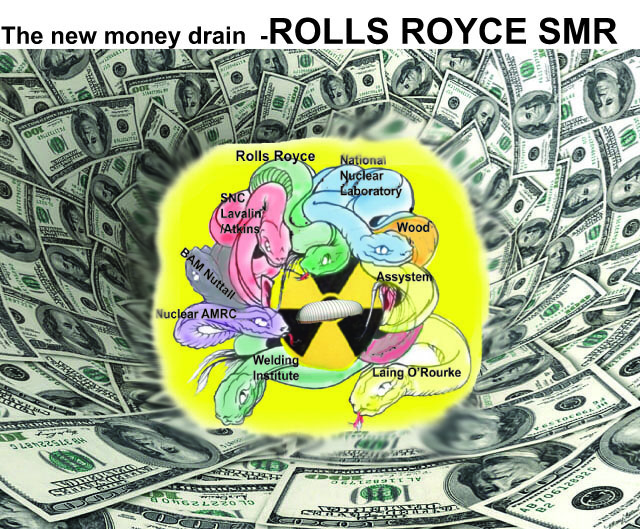
The nine-strong consortium also includes the National Nuclear Laboratory and Laing O’Rourke, the construction firm, alongside Assystem, SNC Lavalin/Atkins, Wood, BAM Nuttall, the Welding Institute and Nuclear AMRC.
UK poised to confirm funding for mini nuclear reactors for carbon-free energy Guardian,
Rolls-Royce-led consortium already has £210m in private backing for plans to build 16 reactors across the country, The government is poised to approve funding for a fleet of Rolls-Royce mini nuclear reactors that the prime minister hopes will help the UK reach his target of zero-carbon electricity by 2035.
A consortium led by the British engineering firm had already secured £210m in backing from private investors for the small modular reactor (SMR) project, a sum that the government is expected to match or better. Confirmation is expected before the spending review on 27 October, according to well-placed sources.
The consortium, known as UK SMR, will rebrand as Rolls-Royce SMR to coincide with Westminster’s blessing.
Tom Greatrex, the chief executive of the Nuclear Industry Association (NIA), said: “Match-funding for Rolls-Royce would be a huge signal to private investors that the government wants SMRs alongside new large-scale stations to hit net zero. It would also show investors that the government believes in nuclear as a green technology.”
Backing from the government will pave the way for the consortium’s multibillion-pound plan to build 16 SMRs around the country, the first of which could be plugged into the grid by 2031…………..
Confirmed support for SMRs could signal a concerted effort within government to reverse the scheduled decline in the UK’s nuclear power capacity. About 20% of the nation’s electricity comes from 13 nuclear reactors capable of producing 7.8GW of power. But more than half of that capacity comes from reactors due to retire by 2025, and plans to replace them have stalled.
Toshiba pulled out of a plant at Moorside in Cumbria in 2020, and Hitachi withdrew planning consent for a project at Wylfa Newydd, on Anglesey, this year. While Hinkley Point C is due to start generating electricity from 2026, only one new project, Sizewell C, is now in the works, with no final investment decision yet made.
Britain’s ability to build new nuclear reactors has been further complicated by the government’s unwillingness to allow any further involvement from the state-backed China General Nuclear. CGN has a 20% stake in Sizewell C but ministers have been looking into ways to remove it from the project before it moves to the construction phase. The Chinese company was due to take a lead role in the Bradwell reactor in Suffolk, which is now highly unlikely to go ahead.
Industry players are keen to see the government legislate to approve the regulated asset base (RAB) model, which allows private investors a more reliable stream of revenues from nuclear power plants – which typically require tens of billions of pounds to build – by piling costs on to household energy bills……..
The nine-strong consortium also includes the National Nuclear Laboratory and Laing O’Rourke, the construction firm, alongside Assystem, SNC Lavalin/Atkins, Wood, BAM Nuttall, the Welding Institute and Nuclear AMRC. https://www.theguardian.com/business/2021/oct/15/uk-poised-to-confirm-funding-for-mini-nuclear-reactors-for-green-energy
Orano building 5km wall around its La Hague nuclear reprocessing station

Orano has started construction of a 5 km wall around its nuclear waste
reprocessing plant in La Hague (Manche), a site with the most radioactive
material in Europe, we learned Thursday from the business.
“Orano la Hague has initiated the construction of a new internal fence at the establishment
over nearly 5 km long which will encompass all the nuclear buildings,” the
site management told AFP. “The building will be masonry in the lower part
and fenced in the upper part”, specifies the company.
Le Figaro 14th Oct 2021
Corrosion problems cause shutdown of Orano’s nuclear reprocessing station in La Hague
Orano had to shut down one of its two nuclear waste reprocessing plants,
located in La Hague (Channel), for at least two months, following in
particular a corrosion problem, we learned Friday from the site.
“The UP3 plant was shut down at the end of September and we hope to restart at the
beginning of December,” said the management of the site, confirming
information from the daily La Manche Press. This shutdown is linked in
particular to a problem with evaporators, highly irradiating tanks, under
close surveillance since 2016 due to faster corrosion than expected.
The Times Hub 9th Oct 2021
Vale Sister Megan Rice – an anti-nuclear hero

Catholic sister who spent 2 years in prison for nuclear weapons protest dies at 91, Catholic News Service 13 Oct 21,
ROSEMONT, Pa. (CNS) — Sister Megan Rice, whose yearslong crusade against nuclear weapons included serving two years behind bars for a felony, died Oct. 10 at the Rosemont residence of her religious order, the Society of the Holy Child Jesus. She was 91.
Colleen Carroll, director of communications for the order, said the cause of death was congestive heart failure.
“It is incredible to consider how the bravery of this small, smiling, unassuming woman in standing up to the entirety of the U.S. military-industrial complex could bring so much awareness to the devastation our nation’s idolatry of nuclear weapons inflicts on people here in the U.S. and around the world,” Johnny Zokovitch, executive director of Pax Christi USA, said in a statement.
“All of Pax Christi USA grieves at her passing, but we give thanks for her witness, for her life and for the challenge that she issued by standing up nonviolently for a better world for all of us,” he said.
Sister Rice’s bold campaign against nuclear weapons launched her into the spotlight and caused her to become the issue’s ad hoc spokeswoman.
In July 2012, at age 82, she and two other members of Transform Now Plowshares breached security to stage a protest at the self-styled “Fort Knox of uranium,” the Y-12 National Security Complex in Oak Ridge, Tennessee. The facility creates and houses materials for making nuclear weapons.
The three activists cut through fences and reached the warehouse that stores bomb-making uranium. There, they splashed blood on the wall, hung banners and spray-painted messages condemning nuclear weapons.
The action sparked national shock and outrage, led to a congressional investigation of the security at Y-12 and sent Sister Rice and her companions, Michael Walli, then 63, and Greg Boertje-Obed, then 57, to prison.
On Feb. 18, 2014, in U.S. District Court, Sister Rice, of Washington, was sentenced to 35 months in prison on each of two counts — one count of depredation of property and one count of sabotage.
Sister Rice toured the country to protest the United States’ nuclear arsenal as the star of the film. She also spoke to a congressional hearing and at the United Nations in New York City on the issue of nuclear disarmament.
And she continued her activism through vigils, marches, prayers and visits to classrooms.
“It’s illegal to deal in weapons of mass destruction — immoral and illegal,” Sister Rice declared during an April 8, 2018, event at the DeBartolo Performing Arts Center at the University of Notre Dame in South Bend, Indiana, where the documentary was being screened.
“We’re not being taken to the international court of justice and indicted the way Iran or some other place would,” she said.
……….In the 1980s, Sister Rice got involved in the anti-war movement, participating in protests against a variety of American military actions, military sites and nuclear weapons installations.
She was arrested more than three dozen times in acts of civil disobedience, including her anti-nuclear weapons activism. https://www.americamagazine.org/faith/2021/10/13/sister-megan-rice-obituary-241640
Patients lack knowledge on radiation in medical imaging

Patients lack knowledge on radiation in medical imaging, https://www.auntminnie.com/index.aspx?sec=ser&sub=def&pag=dis&ItemID=133758. By Amerigo Allegretto, AuntMinnie.com staff writer, October 13, 2021 –– More than half of patients did not know that chest CT delivers more radiation compared with chest radiography, one of several findings in a survey of nearly 2,900 patients published October 13 in JAMA Network Open.
An Italian research team led by Luca Bastiani, PhD, from the Italian National Research Council in Pisa found that overall, patients have a “substantial lack” of knowledge about medical radiation. This includes such topics as the relationship between radiation and age, natural sources of ionizing radiation, and dosage of different imaging methods among others.
“Intervention to achieve better patient awareness of radiation risks related to medical exposures may be beneficial,” Bastiani and colleagues wrote.
Radiation exposure due to medical imaging has been a point of concern over the years as the use of such imaging has increased to screen and diagnose diseases such as cancer.
While ultrasound and MRI do not give off radiation, they are not the standards of care in some cases. For example, mammography is the standard imaging method used for breast cancer screening. The researchers also said multidetector CT alone makes up about 50% of the total radiation burden for medical purposes, even though it accounts for only 17% of all medical examinations.
Bastiani et al wanted to develop and validate a questionnaire assessing patient knowledge of radiation from medical imaging, as well as to identify differences related to patient sex, age, educational level, information received, and radiological procedures performed.
Data was gathered from multiple Italian medical centers for 2,866 patients, 1,531 of whom were women (53.4%) and 1,335 of whom were men (46.6%). The average age of patients was 44.9 years. Most of the survey respondents (98.5%) said they had undergone imaging before.
Of the total, 1,529 (53.3%) were aware of the existence of natural sources of ionizing radiation.
MRI was mistakenly categorized as a radiation-based imaging method by 1,231 (43%) of patients, while mammography was categorized as such by 1,101 (38.4%) patients.
t 55.1%, more than half of patients did not know that chest CT delivers a larger dose of radiation than chest radiography (p = 0.03), and 1,499 (52.3%) knew that radiation can be emitted after nuclear medicine examinations (p = 0.004).
A total of 667 patients (23.3%) believed that radiation risks were unrelated to age; 1,273 (44.4%) deemed their knowledge about radiation risks inadequate, and 2,305 (80.4%) preferred to be informed about radiation risks by medical staff.
Having a higher education level and receiving information from healthcare professionals were linked to better knowledge of radiation issues.
However, the individuals who were surveyed want more information about radiation. Most patients (68.6%) would like to be informed by a radiologist, followed by their general practitioner (56.3%), a radiographer (52.5%), and a medical physicist (12.6%). A total of 2,525 (88.1%) patients, meanwhile, wanted to be informed about the amount of radiation received after examination.
However, only 1,224 respondents (42.7%) had been informed about radiation risks during imaging.
The researchers said this study, along with previous literature, reveals an unmet need for awareness campaigns about medical radiation addressed to the general population. They also suggested improving communication between medical staff and patients.
In an invited commentary piece, Dr. Rebecca Smith-Bindman and Carly Stewart from the University of California called for a “systemic and seismic shift” in educating physicians and patients in having candid conversations with patients on benefits and tradeoffs of using medical radiation.
“In doing so, we improve the safety of medical imaging while reducing the physical, social, and economic toll of overuse and disease,” they wrote.
Crypto currency and nuclear power – a worrying partnership

Why Crypto Mining Needs Nuclear Power, Yahoo Finance Florent Heidet, Milos Atz (both writers employed at USA’s Dept of Enegy Argonne National Laboratory) Thu, October 14, 2021
”………Cryptocurrencies are digital currencies secured by cryptography. Unlike physical money, like dollars, cryptocurrencies are not minted by national institutions. Instead, they are created through complex algorithms that take place over computer networks. While not all crypto currencies have a specific function, the most valuable ones, such as BTC and ETH, exist primarily to carry financial transactions embedded in the blockchain – the cryptographic transaction record.
……….. The incredible rise in cryptocurrency value, associated with the ease to contribute to the cryptocurrency mining process with common computer hardware, has resulted in an ever-larger number of miners joining cryptocurrency networks. Increasing the number of miners benefits the system by further decentralizing, and therefore securing, the cryptocurrency.
……… Total power consumption used by mining across the major cryptocurrencies is tens of gigawatts electrical, or GWe, based on current network size and average mining equipment power. That is about the same as the power demand of Sweden or Montana. New generations of computing hardware are more efficient and progressively reduce power consumption per hashrate, but the high profitability of mining attracts more participants, yielding a net increase of the overall power used by the network. In fact, as long as the combined costs of electricity and hardware remain lower than the value of the generated cryptocurrency, the networks and their power consumption will continue growing and will soon surpass that of most countries.
Although cryptocurrency mining requires huge amounts of energy, the process itself is not directly polluting. The natural resource requirement is limited to what is needed to manufacture computer hardware and to generate electricity for the mining operations. Cryptocurrency mining is a 24/7 process using constant power with minimal downtime. Additionally, larger mining operations can require in excess of 100 megawatts of power for facilities with the footprint of a medium-size factory. Mining operations need a highly reliable and dense power supply.
………. To guarantee a share of carbon-free electricity, cryptocurrency mining operations may seek agreements with local grid operators or electricity generators. Some larger cryptocurrency mining operations may choose to own and operate their own electricity generation facilities.
………….The power demands of the cryptocurrency mining industry create a unique opportunity for synergizing with nuclear power. Nuclear reactors harness energy from fissioning elements such as uranium
………… Engaging with the burgeoning cryptocurrency industry is advantageous for the nuclear industry,…….. the cryptocurrency industry specifically demands the unique benefits of nuclear power, making partnerships an ideal opportunity…….. Cryptocurrency network growth will only further propel energy cost increases.
…………. Partnerships between the crypto-mining and the nuclear industries have already started to blossom. Recent reporting has showcased agreements forged between cryptocurrency mining operations and both nuclear utilities and nuclear reactor vendors. Given the synergies between cryptocurrency energy demands and nuclear power, we hope that these industries continue to engage with each other to explore mutually beneficial opportunities for growth and collaboration.
Greenpeace France denounces shipments of uranium from Orano to Russia

Greenpeace denounces shipments of uranium from Orano to Russia. An Orano spokesperson confirms that the group signed a contract with Rosatom at the end of 2020 for the sale of just over 1,000 tonnes of reprocessed uranium for the manufacture of “nuclear fuel for Russian power plants.
Ouest France 12th Oct 2021
At each stage of its production, nuclear electricity generates tons of waste and material that is difficult to reuse and as a result accumulates throughout France. These ever-increasing quantities of useless radioactive substances are a problem for the French nuclear industry and tarnish its message regarding the alleged environmental virtues of nuclear power.
To rid themselves of some of this cumbersome waste, French companies EDF and Orano have chosen to resume the sale of spent uranium to Russia – a business interrupted over 10 years ago. While nvestigating in the port of Le Havre, Greenpeace France discovered that several dozen tons of uranium
obtained by reprocessing spent fuel were loaded on board the ship Kapitan Lomonosov bound for St. Petersburg on 20 January and 12 February 2021.
Greenpeace France 13th Oct 2021
France building a pro-nuclear European alliance in lead-up to Cop26

France is building a pro-nuclear European alliance to overcome German resistance to new rules that would open the way for more [so-called] carbon-free atomic power. Nine other European countries have signed up to a nuclear power initiative at a time of spiralling energy prices, partly caused by EU
climate change policies that increase the cost of electricity generation using fossil fuels.
The countries are pushing for nuclear power, which produces no carbon emissions [if you just don’t count the full nuclear fuel chain] , and they want it to be classified as a greentechnology in EU industrial “taxonomy” ratings, which would clearprivate investment in atomic power to be linked to climate policy
subsidies.
Times 12th Oct 2021
President Macron backs nuclear energy, but France’s Greens want speedier end to nuclear power
The president 9 Macron) used the speech to state his support for nuclear energy, which accounts for about 70% of French electricity and has become a point of fierce debate in the run-up to next year’s election.
Green politicians want France to move fast to end its dependence on nuclear, highlighting the large amounts of radioactive waste it produces as well as safety issues.
Politicians on the right and far-right want more reactors. Macron said France would invest €1bn by 2030 in “disruptive innovation” to produce atomic power, which he said would focus on designing small nuclear reactors with improved waste management. He added that France should be able to produce 2m electric and hybrid cars by 2030 and build a low-CO2 aeroplane during the same timeframe.
Guardian 12th Oct 2021
https://www.theguardian.com/world/2021/oct/12/macron-30bn-plan-to-reindustrialise-france
France is betting on small nuclear reactors, but obstacles remain.
| Nuclear, France still believes in it. Analysis The executive will encourage the creation of small reactors. The decision to launch the construction of 6 EPRs could come more quickly than expected, but the obstacles still remain numerous. La Criox 12th Oct 2021 https://www.la-croix.com/Economie/Nucleaire-France-croit-encore-2021-10-12-1201180081 *France – SMRs &EPRs** Nuclear: France is betting on SMR mini-reactors. As part of the France 2030 plan, the President of the Republic should announce this Tuesday a new envelope for the development of Small modular reactors (SMR). Mini-reactors with a power of 170 MW, ten times less than a conventional reactor. Les Echos 12th Oct 2021 https://www.lesechos.fr/industrie-services/energie-environnement/nucleaire-la-france-parie-sur-les-mini-reacteurs-1354051 |
Pentagon Denies Chinese Accusation of Cover-Up in Nuclear Attack Submarine Crash
Pentagon Denies Chinese Accusation of Cover-Up in Nuclear Attack Submarine Crash USNI News, By: Heather Mongilio, October 12, 2021, Pentagon spokesman John Kirby on Tuesday denied a Chinese accusation that the U.S. is seeking to cover up a submarine collision in the South China Sea…..
Seawolf-class nuclear attack submarine USS Connecticut (SSN-22) hit an unknown object while underwater on Oct. 2, injuring 11 sailors, USNI News previously reported.
The Navy has not yet said what Connecticut struck, and Kirby referred reporters to the Navy when asked. USNI News previously reported that it was not another vessel.
It took the Navy five days to release information on the crash, which prompted Chinese Foreign Ministry spokesman Zhao Lijian to question the details about the collision, according to a transcript of the foreign ministry’s Monday press conference.
“Such irresponsible attitude and stonewalling and cover-up practice only make the international community more suspicious of the US intention and details of the accident,” Zhao said, according to the transcript.
Zhao called on the United States to clarify the location of the accident, if there was any nuclear leakage and if the crash will affect fishery, according to the statement.
“The US side should take a responsible attitude, give a detailed account of what happened as soon as possible and make a satisfactory explanation to the international community and regional countries,” he said.
…… The submarine arrived at Naval Base Guam on Friday and is undergoing an assessment and preliminary repairs while the Navy investigates the crash, USNI News reported this week.
U.S. 7th Fleet is leading a command investigation into the crash, while Submarine Force, U.S. Pacific Fleet heads up a safety investigation, COMSUBPAC spokeswoman Cmdr. Cindy Fields previously told USNI News…. https://news.usni.org/2021/10/12/pentagon-denies-chinese-accusation-of-cover-up-in-nuclear-attack-submarine-crash
Smoke from nuclear war would devastate ozone layer, alter climate

SMOKE FROM NUCLEAR WAR WOULD DEVASTATE OZONE LAYER, ALTER CLIMATE Atmospheric impacts of global nuclear war would be more severe than previously thought https://news.ucar.edu/132813/smoke-nuclear-war-would-devastate-ozone-layer-alter-climate
OCT 13, 2021 – BY DAVID HOSANSKY The massive columns of smoke generated by a nuclear war would alter the world’s climate for years and devastate the ozone layer, endangering both human health and food supplies, new research shows.
The international study paints an even grimmer picture of a global nuclear war’s aftermath than previous analyses. The research team used newly developed computer climate modeling techniques to learn more about the effects of a hypothetical nuclear exchange, including complex chemistry interactions in the stratosphere that influence the amounts of ultraviolet (UV) radiation that reach the planet’s surface.
Since the ozone layer protects Earth’s surface from harmful UV radiation, such impacts would be devastating to humans and the environment. High levels of UV radiation have been linked to certain types of skin cancer, cataracts, and immunological disorders. The ozone layer also protects terrestrial and aquatic ecosystems, as well as agriculture.
“Although we suspected that ozone would be destroyed after nuclear war and that would result in enhanced ultraviolet light at the Earth’s surface, if there was too much smoke, it would block out the ultraviolet light,” said study co-author Alan Robock, a professor of climate science at Rutgers University. “Now, for the first time, we have calculated how this would work and quantified how it would depend on the amount of smoke.”
Continue readingWaste Isolation Pilot Plant adds space for nuclear waste disposal near Carlsbad
Waste Isolation Pilot Plant adds space for nuclear waste disposal near Carlsbad Adrian Hedden, Carlsbad Current-Argus, 12 Oct 21, An eighth panel to store nuclear waste at the Waste Isolation Pilot Plant’s underground repository near Carlsbad was completed with waste expected to go in next year . At WIPP, low-level transuranic (TRU) nuclear waste made up of clothing materials and equipment irradiated during nuclear activities, is stored in an underground salt deposit about 2,000 feet underground.The facility stores the waste in panels, with each panel containing seven rooms where workers emplace drums of it and allow the salt to gradually collapse in for permanent disposal.WIPP has emplaced waste in seven panels so far but lost some capacity due to contamination from an accidental radiological release in 2014 that also disrupted mining and emplacement activities during a three-year shutdown of the WIPP’s core operations. But seven years since mining Panel 8 began, WIPP officials reported the work was complete in Tuesday announcement.Panel 7 was expected to be full by April 2022, per the announcement, and Panel 8 will be ready to accept waste immediately……………… The utility shaft project was paused last year when the New Mexico Environment Department denied extending a temporary authorization for construction ahead of a modification to WIPP’s permit to allow its use, citing concerns with COVID-19 infections at the site.The permit modification is under review by NMED.Also under review by NMED was a proposal by WIPP to construct two additional panels needed to restore the facility’s capacity from losses associated with the 2014 incident………. https://www.currentargus.com/story/news/local/2021/10/13/wipp-adds-space-nuclear-waste-disposal-near-carlsbad/6092842001/ |
Lincolnshire nuclear waste burial can go ahead only if the local community suports it
Plans to dispose of nuclear waste from across the UK in Lincolnshire can
only go ahead with the support of a “willing community”, officials have
said. Radioactive Waste Management (RWM), a government agency, has
identified a potential site at a former gas terminal in Theddlethorpe, near
Mablethorpe. However, opponents said the move would impact tourism and
lower house prices in the area. A working group has now been formed to
examine the proposals.
BBC 12th Oct 2021
1 This Month

Read the Public Inquiry Report, the Commissioners’ report, Surrendering Australia: The AUKUS Deception is available to download for free at aukuspublicinquiry.com. Or just watch the replay of the National Press Club Luncheon.


19 November – Webinar – The Reality of Reprocessing
Time: 11:00 AM Pacific Time (US & Canada) / 2:00 PM Eastern / 7:00 PM UK / 8:00 PM CET
Register for the Zoom Event Here



Shut down the radiation-damaged Heysham nuclear reactors now
To see nuclear-related stories in greater depth and intensity – go to https://nuclearinformation.wordpress.com

Say No to NASA’s Reckless Nuclear Reactor on the Moon
Say No to NASA’s Reckless Nuclear Reactor on the Moon
-
Archives
- November 2026 (94)
- October 2026 (302)
- September 2026 (339)
- August 2026 (330)
- July 2026 (355)
- June 2026 (287)
- May 2026 (306)
- April 2026 (356)
- March 2026 (251)
- February 2026 (267)
- January 2026 (308)
- December 2025 (358)
-
Categories
- 1
- 1 NUCLEAR ISSUES
- business and costs
- climate change
- culture and arts
- ENERGY
- environment
- health
- history
- indigenous issues
- Legal
- marketing of nuclear
- media
- opposition to nuclear
- PERSONAL STORIES
- politics
- politics international
- Religion and ethics
- safety
- secrets,lies and civil liberties
- spinbuster
- technology
- Uranium
- wastes
- weapons and war
- Women
- 2 WORLD
- ACTION
- AFRICA
- Atrocities
- AUSTRALIA
- Christina's notes
- Christina's themes
- culture and arts
- Events
- Fuk 2022
- Fuk 2023
- Fukushima 2017
- Fukushima 2018
- fukushima 2019
- Fukushima 2020
- Fukushima 2021
- general
- global warming
- Humour (God we need it)
- Nuclear
- RARE EARTHS
- Reference
- resources – print
- Resources -audiovicual
- Weekly Newsletter
- World
- World Nuclear
- YouTube
-
RSS
Entries RSS
Comments RSS

