NATO chief advises UK to deal with climate change threat to its Trident nuclear weapons at Faslane

COP26: NATO chief says it is up to UK to address Trident climate change flooding threat. NATO’s secretary general has stressed that it is up to individual nation members of the alliance to take action to protect military resources from the impacts of climate change, amid warnings that Faslane, the home of the UK’s Trident nuclear deterrent, could be
impacted by flooding due to rising sea levels.
Scotsman 3rd Nov 2021
”Cocooning” Hanford nuclear reactors conveniently leaves the $600 billion clean-up to future generations
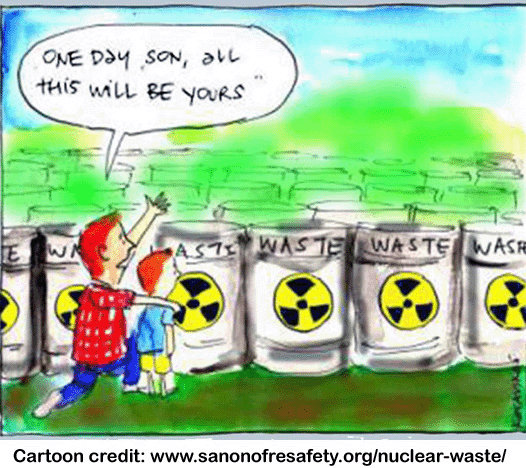
Future generations will decide the final disposition of the eight Hanford reactors.
The bigger question is whether future generations will be willing to pay the massive costs of Hanford cleanup, he said.
Carpenter said the estimated cost to completely clean up just the tank wastes at the Hanford site is around $660 billion.
“It’s rather grim. It’s multigenerational,” he said.
“This will cost more than anyone thought possible,” Carpenter said of the tank wastes and other wastes that were dumped into the ground at Hanford. “It’s a hidden cost of the (nuclear) buildup.
US government works to ‘cocoon’ old nuclear reactors https://abcnews.go.com/Technology/wireStory/us-government-works-cocoon-nuclear-reactors-80964651
Costs to clean up a massive nuclear weapons complex in Washington state are usually expressed in the hundreds of billions of dollars and involve decades of work, By NICHOLAS K. GERANIOS Associated Press5 November 2021 SPOKANE, Wash. — Costs to clean up a massive nuclear weapons complex in Washington state are usually expressed in the hundreds of billions of dollars and involve decades of work.
usually expressed in the hundreds of billions of dollars and involve decades of work.
But one project on the Hanford Nuclear Reservation is progressing at a much lower price.
The federal government is moving forward with the “cocooning” of eight plutonium production reactors at Hanford that will place them in a state of long-term storage to allow radiation inside to dissipate over a period of decades, until they can be dismantled and buried.
“It’s relatively non-expensive,” Mark French, a manager for the U.S. Department of Energy, said of cocooning. “The cost of trying to dismantle the reactor and demolish the reactor core would be extremely expensive and put workers at risk.”
The federal government built nine nuclear reactors at Hanford to make plutonium for atomic bombs during World War II and the Cold War. The site along the Columbia River contains America’s largest quantity of radioactive waste.
The reactors are now shut down and sit like cement fortresses near the southeastern Washington city of Richland. Six have already been cocooned for long-term storage, and two more are headed in that direction. The ninth reactor was turned into a museum as part of the Manhattan Project National Historical Park.
While World War II ended in 1945 and the Cold War ended in 1989, the United States is still paying billions of dollars per year for the disposal of the nuclear waste produced by the atomic weapons that played a big role in ending those conflicts. The biggest expense is dealing with a massive volume of liquid wastes left over from the production of plutonium, a key ingredient in nuclear weapons.
While the liquid wastes stored in 177 underground tanks will take decades of work and hundreds of billions of dollars to clean, efforts to secure the nine plutonium reactors are much closer to completion.
The last two reactors, shut down in 1970 and 1971, are about to enter the cocooning stage, when they are covered with steel and cement to prevent radioactivity from escaping into the environment, French said.
The cocoons are expected to last about 75 years, by which time the radioactivity inside will have dramatically decreased and there presumably will be a plan for final disposition of the remaining parts, French said.
Every five years, workers enter the reactor building to make sure there are no leaks or rodent or bird infestations, he said.
Cleanup of Hanford, which has about 11,000 employees and is half the size of Rhode Island, started in the late 1980s, and now costs about $2.5 billion per year. The work has been slowed by technical issues, lack of funding, lawsuits from state regulators, worker exposure to radiation and turnover of contractors on the complex job.
But the handling of the old reactors is a bright spot.
The nine reactors — called B Reactor, C Reactor, D Reactor, DR Reactor, F Reactor, H Reactor, K-East Reactor, K-West Reactor, and N Reactor — were built from 1943 through 1965.
They were constructed next to the Columbia River because of the abundance of hydropower and cooling water needed by the reactors during operation.
All have been cocooned except K-East and K-West. Work on cocooning the K-East reactor has already started and should be finished by 2023, French said. Work on the K-West reactor is scheduled for completion in 2026.
The cocoon plan for K-East and K-West is to basically construct steel buildings around them. Each building is 158 feet (48.2 meters) long, 151 feet (46 meters) wide and 123 feet (37.5 meters) tall, French said. The two steel buildings will cost less than $10 million each.
The government also operated five plutonium production reactors at the Savannah River Site in South Carolina during the Cold War. All of those are also shut down, although three of the reactor buildings are being used to store radioactive materials Two of the reactors at Savannah River are closed but under a different procedure than the Hanford reactors, said Amy Boyette, a spokeswoman for Savannah River.
Future generations will decide the final disposition of the eight Hanford reactors, French said. They will likely be dismantled and buried in the central area of the Hanford site, away from the river.
Robots may be deployed in the future” for that work, French said.
Hanford watchdogs generally agree with this process, said Tom Carpenter, director of the Seattle-based watchdog group Hanford Challenge.
“Nobody is raising any concerns about cocooning,” Carpenter
said. “We’re all worried about the tank waste that needs immediate and urgent attention.”
The bigger question is whether future generations will be willing to pay the massive costs of Hanford cleanup, he said.
Carpenter said the estimated cost to completely clean up just the tank wastes at the Hanford site is around $660 billion.
“It’s rather grim. It’s multigenerational,” he said.
“This will cost more than anyone thought possible,” Carpenter said of the tank wastes and other wastes that were dumped into the ground at Hanford. “It’s a hidden cost of the (nuclear) buildup.
By then, there might be bigger budget concerns such as dealing with the effects of climate change, Carpenter said.
The most intriguing of the old reactors is the B Reactor, the first one built during World War II. It will not be cocooned, and can be visited by tourists at the national historical park. B Reactor, which shut down in 1968, was cleaned up enough to allow some 10,000 tourists to visit each year and learn the history of Hanford. It has been designated a National Historic Landmark.
Plutonium from Hanford’s B Reactor was used in the testing of the world’s first atomic bomb in July 1945. Called the Trinity Test, the bomb was blown up in the New Mexico desert. Hanford plutonium was also used for the bomb that was dropped over Nagasaki, Japan, on Aug. 9, 1945.
Is it green, or forever toxic? France’s radioactive waste crisis. Nuclear rift at climate talks
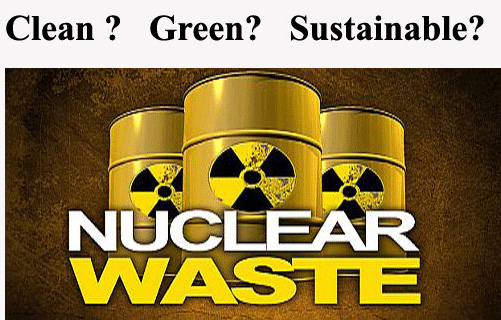
Is it green, or forever toxic? Nuclear rift at climate talks
By ANGELA CHARLTON, 4 Nov 21, SOULAINES-DHUYS, France (AP) — Deep in a French forest of oaks, birches and pines, a steady stream of trucks carries a silent reminder of nuclear energy’s often invisible cost: canisters of radioactive waste, heading into storage for the next 300 years.
As negotiators plot out how to fuel the world while also reducing carbon emissions at climate talks in Scotland, nuclear power is a central sticking point. Critics decry its mammoth price tag, the disproportionate damage caused by nuclear accidents, and radioactive leftovers that remain deadly for thousands of years.
……… Many governments are pushing to enshrine nuclear energy in climate plans being hashed out at the conference in Glasgow, known as COP26. The European Union, meanwhile, is debating whether to label nuclear energy as officially “green” — a decision that will steer billions of euros of investment for years to come. That has implications worldwide, as the EU policy could set a standard that other economies follow.
But what about all that waste? Reactors worldwide produce thousands of tons of highly radioactive detritus per year, on top of what has already been left by decades of harnessing the atom to electrify homes and factories around the world.
Germany is leading the pack of countries, mainly within the EU, standing firmly against labeling nuclear as “green.” …..
nowhere in the world is as reliant on nuclear reactors as France, which is at the forefront of the pro-nuclear push at the European and global level. And it’s among leading players in the nuclear waste industry, recycling or reprocessing material from around the world.
South of the World War I battlefields of Verdun, trucks bearing radioactivity warning stickers pull into a waste storage site near the village of Soulaines-Dhuys. They’re repeatedly checked, wiped and scanned for leaks. Their cargo — compacted waste stuffed into concrete or steel cylinders — is stacked by robotic cranes in warehouses that are then filled with gravel and sealed with more concrete.
……….. The storage units hold 90% of France’s low- to medium-activity radioactive waste, including tools, clothing and other material linked to reactor operation and maintenance. The site is designed to last at least 300 years after the last shipment arrives, when the radioactivity of its contents is forecast to be no higher than levels found in nature.
For longer-life waste — mainly used nuclear fuel, which remains potentially deadly for tens of thousands of years — France is laying the groundwork for a permanent, deep-earth repository beneath corn and wheat fields outside the nearby stone-house hamlet of Bure.
Some 500 meters (yards) below the surface, workers carry out tests on the clay and granite, carve tunnels and seek to prove that the long-term storage plan is the safest solution for future generations. Similar sites are under development or study in other countries, too.
If the repository wins French regulatory approval, it would hold some 85,000 metric tons (94,000 tons) of the most radioactive waste produced “from the beginning of the nuclear era until the end of existing nuclear facilities,” said Audrey Guillemenet, geologist and spokesperson for the underground lab.
“We can’t leave this waste in storage sites on the surface,” where it is now, she said. “That is secure, but not sustainable.”
The 25 billion euro ($29 billion) cost of the proposed repository is already built into budgeting by French utilities, Guillemenet said. But that’s just one piece of the staggering cost of building and operating nuclear plants, and one of the reasons that opposition abounds.
All around Bure, street signs are replaced with graffiti reading “Nuclear is Over,” and activists camp out at the town’s main intersection.
Greenpeace accuses the French nuclear industry of fobbing off waste on other countries and covering up problems at nuclear facilities, which industry officials deny. Activists staged a protest last week in the port of Dunkirk, as reprocessed uranium was being loaded onto a ship for St. Petersburg, demanding an end to nuclear energy and more research into solutions for existing waste.
…….. The current energy crunch is giving nuclear advocates another argument. With oil and gas costs driving an energy price crisis across Europe and beyond, French President Emmanuel Macron has trumpeted “European renewables and, of course, European nuclear.”
The waste, meanwhile, isn’t going away.
To make radioactive garbage dumps less worrying to local residents, Andra organizes school visits; one site even hosts an escape game. Waste storage researchers are readying for all kinds of potential future threats — revolution, extreme weather, even the next Ice Age, Guillemenet said.
Whatever happens in Glasgow, “whether we decide to go on with the nuclear energy or not,” she said, “we will need to find a solution for the management of that nuclear waste” that humankind has already produced. https://apnews.com/article/climate-science-business-environment-accidents-b334c5cddc50c620d53674a5b32518dd
A ”scientific disgrace” – a leaked document pushing nuclear and gas as sustainable will damage the EU’s credibilify on green finance.
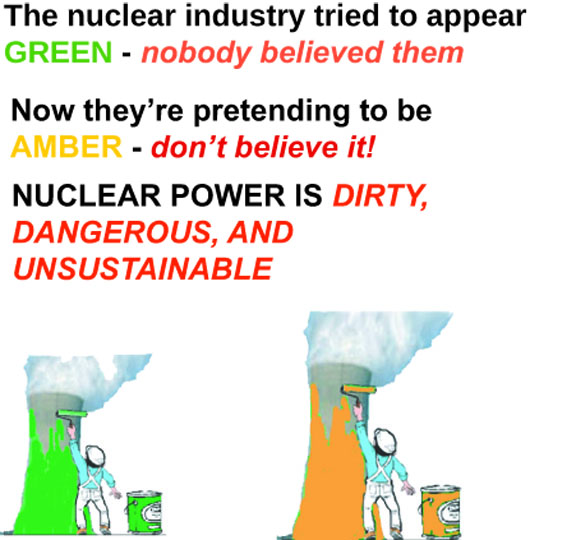
”the EU Sustainable Taxonomy’s design is aimed at defining which economic activities are green – not which economic sectors are needed for the transition to a net-zero by 2050 economy.”
LEAKED: Paper on gas and nuclear’s inclusion in EU green finance rules https://www.euractiv.com/section/energy-environment/news/leaked-paper-on-gas-and-nuclears-inclusion-in-eu-green-finance-rules/
By Frédéric Simon | EURACTIV.com A proposal to bring both nuclear power and natural gas into the bloc’s green finance taxonomy is circulating in Brussels. The paper has been branded as a “scientific disgrace” by campaigners who warned it would damage the EU’s credibility on green finance.
The so-called “non-paper”, obtained by EURACTIV, lays out detailed technical criteria for gas to qualify as a transitional activity under the EU’s sustainable finance rules.
To qualify as a “sustainable” investment, gas power plants or cogeneration facilities must not emit more than 100 grams of CO2 equivalent per kilowatt-hour, according to the draft paper.
It comes in the wake of declarations by European Commission President Ursula von der Leyen, who said the EU executive would soon table proposals on gas and nuclear as part of the bloc’s green finance rulebook.
“We need more renewables. They are cheaper, carbon-free and homegrown,” von der Leyen wrote on Twitter after an EU summit meeting two weeks ago where leaders debated the bloc’s response to rising energy prices.
“We also need a stable source, nuclear, and during the transition, gas. This is why we will come forward with our taxonomy proposal,” she added.
Gas as a ‘transitional activity’
The 100gCO2 emissions criteria is the same as earlier proposals circulated last year, which were rejected as too stringent by a group of 10 pro-gas EU countries who threatened to veto the proposal.
To assuage critics concerns, the paper lays out additional criteria for gas plants to qualify as a “transitional activity”, accompanied by a sunset clause (until 31 December 2030) for the commissioning of new plants…………
Campaigners denounced those criteria as “radically weaker” than previous plans drafted by the European Commission.
“This proposal is a scientific disgrace that would deal a fatal blow to the taxonomy,” said Henry Eviston, spokesman on sustainable finance at WWF European Policy Office.
“It would severely damage the EU’s sustainable finance agenda and the EU Green Deal. It must be firmly rejected by the Commission and opposed by all member states,” he added in a statement.
Campaigners were unsure about the origin of the non-paper. But diplomats who spoke to EURACTIV at an EU summit two weeks ago said France has been working behind the scenes to forge a compromise on the taxonomy that would satisfy supporters of gas and nuclear power.
At the initiative of Paris, representatives from like-minded EU countries held a meeting on 18 October to debate nuclear and natural gas in the context of the taxonomy, the EU diplomat said. The meeting was attended by Bulgaria, Cyprus, Czechia, Finland, France, Greece, Hungary, Malta, Poland, Romania, Slovakia, and Slovenia.
According to the same diplomatic source, participants discussed compromise proposals for technical criteria to assess the sustainability of gas and nuclear power plants.
Nuclear
On nuclear, the “non-paper” builds on the EU’s Joint Research Centre (JRC) recommendations, which concluded in a July report that nuclear power was safe and therefore eligible for a green label under the taxonomy.
The paper does not propose detailed sustainability criteria at this stage and merely divides nuclear power production activities into four categories:
- Nuclear plant operation: Production of electricity, including the construction, commissioning, operation and decommissioning of nuclear power plants.
- Storage or disposal of radioactive waste or spent nuclear fuel (enabling activity).
- Mining and processing of uranium (enabling activity).
- Reprocessing of spent nuclear fuel (enabling activity).
The “non-paper” comes in the wake of a meeting of EU energy ministers last week where twelve EU countries spoke in favour of nuclear’s inclusion in the taxonomy.
Prominent critics of gas and nuclear’s inclusion in the taxonomy include Elise Attal is Head of EU Policy at the Principles for Responsible Investment (PRI), a United Nations-supported international network of investors.
“Proponents of the inclusion of gas-fired electricity and nuclear energy in the EU Sustainable Taxonomy will argue that these economic activities have a role to play in the energy transition,” she wrote in a recent op-ed published on EURACTIV.
“This argument is beside the point: the EU Sustainable Taxonomy’s design is aimed at defining which economic activities are green – not which economic sectors are needed for the transition to a net-zero by 2050 economy.”
Read the full paper below or download here:
High time to rid Wales of plans for costly, risky Small Modular Nuclear Reactors
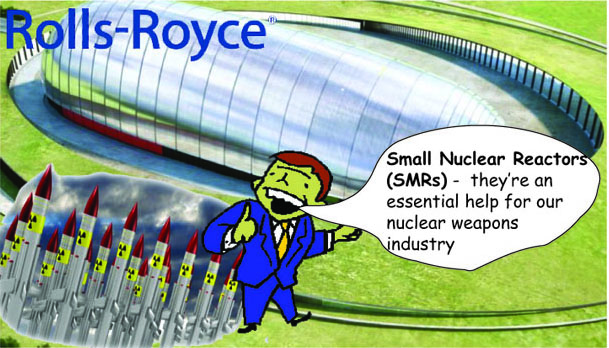
Leanne Wood: My column in The National two weeks ago argued for a transition away from manufacturing weapons of war to firing up our greeneconomy. Isn’t it also high time we rid Wales of the scourge of nuclear
power and redirect resources into clean, renewable energy? We have that opportunity now. Wales is a nuclear-free zone but for how much longer?
Plans to resurrect Wylfa B are effectively dead, even though some politicians continue to tout the idea. Attention has turned, instead, to the Trawsfynydd site where Rolls Royce is proposing a Small Modular Nuclear Reactor (SMNR), the latest experiment in nuclear fission technology. Except the old problems of safety and cost of storage and waste disposal haven’t gone away.
The first SMNR to be approved last year in the US was met by fierce criticism from notable scientists, including Professor MV Ramana of the University of Columbia who described the project as “risky and expensive”. Edwin Lyman, director of nuclear power safety at the Union of Concerned Scientists, highlighted ‘safety gaps’ in the design. Still
the Welsh Government, with the backing of Westminster, continues with costly feasibility studies.
The National (Wales) 10th Oct 2021
https://www.thenational.wales/news/19637359.wales-needs-forget-nuclear-power-forever/
UK govt would do better to spend consumers’ money on making homes sustainable, and supporting smart grids, rather than on a nuclear tax
NFLA comments on Plans to Impose a Nuclear Tax on Consumers’ Bills. The
Minister justifies this on the basis that consumers will save more than
£30 billion compared with the system used to pay for Hinkley Point C.
NFLA UK & Ireland Steering Committee Chair Councillor David Blackburn said:
“The Minister is comparing one expensive environmentally unsustainable
project with another expensive environmentally unsustainable project.
If he really wanted to save consumers’ money he would introduce a National
Homes Retrofit Scheme as quickly as possible having learned the lessons
from its failed Green Homes Scheme, and introduce a scheme to support
flexibility, demand management and smart grids so that we can use more of
our cheap, sustainable renewable electricity.”
The Minister went on to argue that despite the fact that the Scottish Government has a different
position with regard to new nuclear projects, Scottish Consumers should
also pay his “nuclear tax” because they “will benefit from a cheaper,
more resilient and lower-carbon electricity system.”
Scottish NFLA Chair, Cllr. Feargal Dalton said: “Renewables met 97% of Scotland’s
electricity demand in 2020. The Scottish electorate has consistently voted
for Governments opposed to building new nuclear power stations. With wind
and solar now the cheapest forms of electricity Scottish consumers
shouldn’t have to pay for the Tories’ failed energy policies.”
NFLA 4th Nov 2021
Fukushima farmers fear nuclear-tainted water’s impact on business
A decade on, Fukushima farmers fear nuclear-tainted water’s impact on business, Channel Newa Asia, 5 Nov 21, WAKI, Japan: Fukushima farmers fear the Japanese government’s planned release of water from the crippled power plant could revive concerns about contamination and again hit the price of their produce, undoing a decade of slow recovery from nuclear disaster.
Japan plans to release more than one million tonnes of contaminated water from the plant in the country’s northeast into the sea after treating it, as the site reaches storage limits for the water. Although international authorities support the plan, it has sparked concern from neighbours China and South Korea and worried local fisherman and farmers.
“We’re just about seeing our prices go back to normal after a big drop following the disaster, but now we will have to deal with the potential reputational damage all over again because of the release of the water,” said Hiroaki Kusano, a pear farmer and vice-leader of the local agricultural co-operative.
The water is to be processed to remove radioactive contamination other than from tritium, which cannot be removed. Water with the radioactive isotope diluted to one-seventh of the World Health Organization’s guidelines for drinking water will be released into the Pacific a kilometre out from the plant around spring 2023, under a government plan.
Nuclear plants worldwide routinely release water containing tritium, considered the least-toxic byproduct of atomic power…………….
DECOMMISSIONING
The Daiichi plant is being decomissioned as part of a clean-up by operator Tokyo Electric Power Company Holdings (Tepco) expected to take decades,
Some 1,000 tanks, each 12m tall, crowd the site and hold enough radioactive water to fill around 500 Olympic-sized swimming polls. The release of water that once passed through contaminated areas of the plant marks a milestone in decommissioning and will free up space for the clean-up.
……………… Tepco will compensate for damages related to the water release, said Junichi Matsumoto, a company official overseeing decommissioning work. Tepco says it has so far paid out some ¥10.1 trillion (US$89 billion) in damages from the crisis…
There are additional concerns because the Fukushima water has been sitting around for years, said Toru Watanabe, a radioactivity researcher at the Fukushima Fisheries and Marine Science Research Center.
“The water has been in those tanks for a long time. The quality of that water needs to be thoroughly understood before it’s released,” he said.
Farmers say there is not much they can do once the water is released. They worry about their tough customers – Japanese shoppers are famously picky about produce and pay close attention to freshness and place of origin… https://www.channelnewsasia.com/asia/decade-fukushima-farmers-fear-nuclear-tainted-waters-impact-business-2293361
Nuclear workers’ unions want nuclear energy included as clean and sustsainable
—European unions press leaders to include nuclear in clean energy mix, Ft.com Jim Pickard in Glasgow, 5 Nov 21, A dozen union chiefs from across Europe have pressed world leaders to factor in nuclear power as they discuss how to accelerate the path to net zero emissions at the global climate summit in Glasgow……….. ….. The use of nuclear to tackle climate change is fiercely contested, with some countries such as Belgium phasing out their existing power stations. Countries such as Germany, Austria and Luxembourg have opposed a Finnish proposal for the EU “taxonomy” to include nuclear in its definition of sustainable activity…….. Today’s letter was signed by figures including Gary Smith, general secretary of Britain’s GMB union, Helene Lopez, secretary-general of CFE-CGC Energies in France, and Bob Walker, national director of the Canadian Nuclear Workers’ Council – as well as counterparts in Belgium, Czech Republic, Hungary, Slovakia and Romania………. https://www.ft.com/content/f01342c5-d1af-4c36-8362-582b48767a05 |
Canada’s Environment Minister refuses to declare his support for nuclear energy
Guilbeault refuses to declare his support of nuclear energy iPolitics, By Aidan Chamandy. Nov 5, 2021 Environment Minister Steven Guilbeault says “it’s not up to the government to decide” which sources of energy will reduce the country’s greenhouse-gas emissions to net zero by 2050.
Nor would he say explicitly whether he supports nuclear energy, which he’d opposed in his work before entering politics in 2019……
Before running for the Liberals in 2019, Guilbeault worked for decades as an environmental activist for Greenpeace and Équiterre.
In 2018, he said the Pickering nuclear plant in Ontario should be shut down and replaced with other forms of renewable energy. https://ipolitics.ca/2021/11/05/guilbeault-refuses-to-declare-his-support-of-nuclear-energy/
China’s strategy in its nuclear weapons buildup
China’s Nuclear Gambit
Don’t be distracted by the aerial incursions and naval build-ups – the real action is China’s nuclear build-up, in the hopes of deterring any U.S. intervention in a regional conflict. The Diplomat, By Valerie Niquet, November 06, 2021
”……………………………….. Anxious not to suffer the fate of the Soviet Union, China has always refused to be dragged into an unwinnable arms race with the United States. A guaranteed second-strike nuclear capability is enough to achieve China’s objectives. But that objective is threatened by U.S. conventional precision strike capabilities, superiority in next-generation ISR, and ballistic missile defense developments at the regional level. This last aspect threatens the deterrent effect of China’s nuclear-capable middle-range ballistic missiles, which can target U.S. bases in Asia as well as the United States’ closest allies in the region.
China’s nuclear doctrine and objectives have not changed fundamentally. Credible nuclear capabilities have always been part of China’s strategy of deterrence and anti-access/area denial (A2/AD) against the United States. By reinforcing the credibility and certainty of its second-strike capability, China expects to deter the United States from intervening in a regional conflict, for example, Taiwan’s “reunification” by force or grey zone tactics. China wants to assert its capacity in order to make use of a set of pressure tactics, using public opinion in the United States as well as among U.S. allies such as Japan. In the event of a conflict in the Taiwan Strait, Japan would be very nearly on the frontline. However, Japan is also extremely risk-averse and vulnerable to threats of missile strikes from China.
To win in a regional conflict, China must maintain pressure to dissuade the United States from intervention by using the threat of escalation, to make the idea of intervention impossible to fathom. China is playing on reticence among the U.S. public to engage in asymmetric wars, where one side projects a high level of will when the other seems to be less involved. China is betting on a “Munich moment,” relying on its nuclear capabilities to keep any future conflict local or even under the threshold of war, thereby winning without fighting.
The acceleration of silo construction and the testing of new “game-changing” arms are all part of a nuclear signaling game in times of peace that serve to demonstrate China’s determination and impress the adversary. By increasing these capacities, China is testing the sole guarantor of strategic stability in Asia, the United States, and the will of the U.S. to intervene….. https://thediplomat.com/2021/11/chinas-nuclear-gambit/
Why the Pentagon Is Equipping the F-35 With a Thermonuclear Bomb
Why the Pentagon Is Equipping the F-35 With a Thermonuclear Bomb, Popular Mechanics, A man with a bomb can do things a missile with a bomb can’t. BY KYLE MIZOKAMINOV 5, 2021
- The F-35 Joint Strike Fighter is nearly certified to carry a new thermonuclear weapon, the B61-12.
- Although the U.S. military has a variety of ways to deliver nuclear weapons, there are only a handful of ways to use them on the battlefield.
- Using a crewed delivery system ensures there is a person in the loop for the entire flight who can execute last minute instructions……………. https://www.popularmechanics.com/military/weapons/a38093134/pentagon-equipping-f-35-thermonuclear-bomb/
Terra Praxis – another pro nuclear front group pushing for the mythical small nuclear reactors.
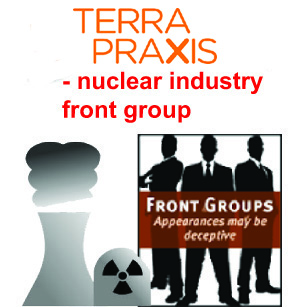
AJ100 practice Bryden Wood has revealed plans to repurpose the world’s
coal-fired power stations to house modular nuclear reactors as part of a
‘major initiative’ to decarbonise the energy sector. The practice’s
Repurposing Coal proposal has been drawn up with Terra Praxis, a non-profit
organisation focused on action for climate and energy.
Unveiled at COP26 this week, the strategy sets out how coal-fired boilers at existing power
plants could be replaced with Advanced Heat Sources (Generation IV Advanced
Modular Reactors) .
Architects Journal 5th Nov 2021
Moving to peace and security – by ratifying the Comprehensive Nuclear Test Ban Treaty
Ratifying the Comprehensive Nuclear-Test-Ban Treaty is the way to ensure peace The Hill BY IVANA NIKOLIĆ HUGHES AND HART RAPAPORT, — 11/04/21 The Comprehensive Nuclear-Test-Ban Treaty (CTBT) — the international agreement governing use of nuclear weapons — turned 25 in September. The anniversary, ordinarily a time to celebrate the careful diplomacy that led to such an achievement, was tempered by the continued refusal of the U.S. government to accede to a document that it negotiated. The resulting void created by this lack of leadership threatens to overturn a decades-long period of relative nuclear peace. There is only one option to hem in the dangerous proliferation of nuclear weapons that has led nations such as Iran and North Korea to the precipice of nuclear power: Ratify the CTBT and ensure it enters into force……………
ratification would allow the newly-empowered CTBT and its accompanying oversight organization to benefit from the consent of the world’s most powerful government in creating an international norm against nuclear testing. Currently, nations such as Russia — which is party to the CTBT — face little substantial backlash for their detonations. After all, they can easily point to the United States’s refusal to accede to the treaty as proof of the validity of their own actions. These excuses would lose their power after ratification, with future actions against those nations’ international commitments subject to pushback through the full power of the nearly 200 CTBT signatories marshaled by the United States.
To fully enter force, the CTBT also must be signed by seven nations — China, Egypt, India, Iran, Israel, North Korea and Pakistan — aside from the United States. Achieving this would be a difficult diplomatic effort, but it is possible. These nations’ refusals to sign are largely based on a geopolitical rival’s — India with Pakistan, and vice versa, for example — failure to sign and ratify the document. This presents an opportunity for American foreign policy to work at its best by bringing these pairs of nations to the bargaining table concurrently to hash out any testing-related difficulties. It may be unreasonable to assume that all of the states are willing to do so, but the reduction in geopolitical tensions and chance of nuclear mishaps from even a single additional state pledging not to test nuclear weapons would be substantial. Of course, this can only happen after the United States ratifies the document and commits to support its tenets in the international arena.
During a time of increased partisan polarization in Congress, a domestic and international priority such as the CTBT provides a gateway for politicians from both parties to focus on what matters to the American people: ensuring that nuclear threats do not dominate the 21st century like they did in the latter half of the 20th century. It would send a strong signal to the rest of the world that our political elite can still collaborate to ensure that America remains a defining member of the international community after years of disengagement. If nothing else, it would ensure that time and money can be spent on today’s true priorities — among them, cybersecurity, climate change and infrastructure development — rather than those of the past.
Ivana Nikolić Hughes is a senior lecturer in chemistry at Columbia University and the director of Columbia’s Center for Nuclear Studies.
Hart Rapaport is a research assistant at Columbia’s Center for Nuclear Studies. https://thehill.com/opinion/national-security/579506-ratifying-the-comprehensive-nuclear-test-ban-treaty-is-the-way-to
Bradwell is not suitable for nuclear fusion, not suitable for nuclear fission either.
Bradwell has been dropped from the list of 15 sites for fusion. Andy
Blowers said Bradwell was always unlikely to be a non-starter for the
nuclear fantasy project. Voracious cooling water demands will damage the
vulnerable ecology of the Blackwater estuary. If Bradwell is not suitable
for fusion it is not suitable for Bradwell B. Maylands Mayl – November 5th Nov 2021
Only Britain has the dubious plan to get to net zero by relying on multiple nuclear reactors

Even without our plentiful opportunities to exploit wind, solar, wave and tidal power many countries feel they do not need nuclear power to reach their goals.
Questions remain over the UK’s nuclear power plans https://www.theguardian.com/news/2021/nov/02/questions-remain-over-the-uks-nuclear-power-plans?fbclid=IwAR3TQj7xYv3jEY824jm9tVFuNln6CgT7xqS3
No other country taking part in Cop26 is relying on multiple new reactors to get to net zero by 2050 Paul Brown, Tue 2 Nov 2021 In 2007, Vincent de Rivaz, the then EDF chief executive, said Britain would be “cooking our Christmas turkeys” with electricity from Hinkley Point C nuclear station by 2017. Instead the first concrete was poured that year and the turkey is now scheduled for late 2026.
In the race against time to avert dangerous global heating, the UK government has decided to back an untried reactor from Rolls Royce. The first of these could be “plugged into the grid by 2031”, according to Nuclear Industry Association.
Internationally average planning time for reactor proposals is 10 years, plus another decade for building, and that is for already proven designs. The 16 planned Rolls Royce reactors are still on the drawing board. The arguments about where they could be sited are beginning. Apart from other possible objections the favoured UK coastal locations are vulnerable to sea level rise, erosion and storms.
Faced with the well-documented delays and drawbacks to nuclear programmes it is perhaps not surprising that there is no other country taking part in the Cop26 process in Glasgow relying on multiple new nuclear reactors to get to net zero carbon targets by 2050. Even without our plentiful opportunities to exploit wind, solar, wave and tidal power many countries feel they do not need nuclear power to reach their goals.
1 This Month



19 November – Webinar – The Reality of Reprocessing
Time: 11:00 AM Pacific Time (US & Canada) / 2:00 PM Eastern / 7:00 PM UK / 8:00 PM CET
Register for the Zoom Event Here



Shut down the radiation-damaged Heysham nuclear reactors now
To see nuclear-related stories in greater depth and intensity – go to https://nuclearinformation.wordpress.com

Say No to NASA’s Reckless Nuclear Reactor on the Moon
Say No to NASA’s Reckless Nuclear Reactor on the Moon
-
Archives
- November 2026 (84)
- October 2026 (302)
- September 2026 (339)
- August 2026 (330)
- July 2026 (355)
- June 2026 (287)
- May 2026 (306)
- April 2026 (356)
- March 2026 (251)
- February 2026 (267)
- January 2026 (308)
- December 2025 (358)
-
Categories
- 1
- 1 NUCLEAR ISSUES
- business and costs
- climate change
- culture and arts
- ENERGY
- environment
- health
- history
- indigenous issues
- Legal
- marketing of nuclear
- media
- opposition to nuclear
- PERSONAL STORIES
- politics
- politics international
- Religion and ethics
- safety
- secrets,lies and civil liberties
- spinbuster
- technology
- Uranium
- wastes
- weapons and war
- Women
- 2 WORLD
- ACTION
- AFRICA
- Atrocities
- AUSTRALIA
- Christina's notes
- Christina's themes
- culture and arts
- Events
- Fuk 2022
- Fuk 2023
- Fukushima 2017
- Fukushima 2018
- fukushima 2019
- Fukushima 2020
- Fukushima 2021
- general
- global warming
- Humour (God we need it)
- Nuclear
- RARE EARTHS
- Reference
- resources – print
- Resources -audiovicual
- Weekly Newsletter
- World
- World Nuclear
- YouTube
-
RSS
Entries RSS
Comments RSS

