Scottish MP seeks commitment from UK govt to protect Beaufot’s Dyke from nuclear waste dumping
| MSP concerned about potential for dumping in Beaufort’s Dyke. South Scotland list MSP Emma Harper (SNP) is seeking a commitment from the UK Government that Beaufort’s Dyke will not be used as a dumpsite for nuclear and radioactive waste. Ms Harper has written to the Secretary of State for Scotland and the Defence Secretary following speculation that through committing to upgrading the A75 and building a new nuclear power station, that the Government will once again use Beaufort’s Dyke as dumping site. Previously Ms Harper has also raised concerns over the noted increase in the amount of unexploded ordnance which has washed up on beaches across south west Scotland over recent years. Beaufort’s Dyke became the United Kingdom’s largest offshore dumpsite for surplus conventional and chemical munitions after the Second World War. Galloway Gazette 12th Nov 2021 https://www.gallowaygazette.co.uk/news/environment/msp-concerned-about-potential-for-dumping-in-beauforts-dyke-3456195 |
EX manager sues EDF over safety concerns
A former manager at EDF’s Tricastin nuclear plant in southern France has
filed a complaint in a Paris court alleging the state-owned utility failed
to report or minimised safety concerns at the plant, Le Monde newspaper
reported on Friday.
The newspaper said the plaintiff, whom it did not name,
filed the lawsuit in early October at the Paris judicial court. It said the
plaintiff was also suing EDF for harassment, without detailing those
allegations. EDF declined to comment on the allegations, but said safety at
its nuclear sites was its priority. “Transparency and compliance with
regulations are strictly applied and respected at all sites”, it said.
Yahoo 12th Nov 2021
https://uk.finance.yahoo.com/news/ex-manager-sues-edf-over-123859453.html
France: public inquiry for the authorization to reprocess new fuels
**France – Reprocessing**
A public inquiry for the authorization to reprocess new fuels, particularly from foreign heavy water or MOX reactors, is open until
November 17, 2021. It is closely following another survey for the densification of the C D E swimming pools at La Hague in order to increase spent fuel storage capacity by 30%. Based on files with blackened lines, it only confirmed decisions already taken.
Crilan 12th Nov 2021
http://crilan.fr/densification-des-piscines-de-la-hague-mayak-en-cotentin-non-merci/
Flooding and nuclear wastes eat away at a tribe’s ancestral home
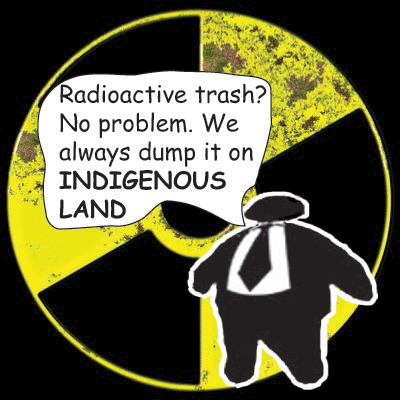
For decades, chronic flooding and nuclear waste have encroached on the
ancestral lands in southeastern Minnesota that the Prairie Island Indian
Community calls home, whittling them to about a third of their original
size.
Two years after the tribe received federal recognition in 1936, the
Army Corps of Engineers installed a lock-and-dam system just to the south
along the Mississippi River. It repeatedly flooded the tribe’s land,
including burial mounds, leaving members with only 300 livable acres.
Decades later, a stockpile of nuclear waste from a power plant next to the
reservation, which the federal government reneged on a promise to remove in
the 1990s, has tripled in size. It comes within 600 yards of some
residents’ homes. With no room to develop more housing on the
reservation, more than 150 tribal members who are eager to live in their
ancestral home are on a waiting list.
New York Times 13th Nov 2021
President Biden is marginalised by the Pentagon
The nuclear bureaucracy is adamant about not upsetting the programs and
polices forged during the Cold War. “There’s no points of debate” in
the internal discussions, a former Pentagon official said recently. Rather
than working to implement President Joe Biden’s long-held views on
restraining the massive destructive power of the nuclear arsenal, the
Pentagon has rigged the system to marginalize the president.
Responsible Statecraft 9th Nov 2021
Nuclear power is the 3rd highest carbon emitter after coal-fired and natural gas.

Richard, 13 Nov Nuclear is not green. It’s the 3rd highest carbon emitter after coal-fired and natural gas electricity generators. Life cycle emissions 66 grams of carbon dioxide for every kilowatt-hour compared with 9 grams per kilowatt-hour for wind and 32 grams per kilowatt-hour for solar.
[“Valuing the greenhouse gas emissions from nuclear power”: A critical survey
Benjamin K. Sovacool Energy Policy 36 (2008) 2940– 2953]
COP26 – while some progress has been made, a current policy world of 2.6C or 2.7C warming is still one with potentially catastrophic impacts on human and natural systems.
Business Green 11th Nov 2021, Depending on whom you ask, the COP26 climate summit may seem like the best of times or the worst of times. On the one hand, reports proclaim boldly that limiting global warming to below 2C might finally be in reach. On theother, critics complain that modest improvements on country commitments amount to little more than “blah blah blah”. The reality is more nuanced. There has been progress made in flattening the curve of future emissions through both climate policies and falling clean energy costs.
At the same time, the world is still far from on track to meet Paris Agreement goals of limiting warming to 1.5C or “well below” 2C.
COP26 negotiations have seen a flurry of new reports on what existing and new promises and pledges mean for the climate.
Here, Carbon Brief breaks down these numbers, looking at what they refer to, where different groups agree and disagree on likely outcomes, and the potential impact of new long-term net-zero promises.
The analysis reveals widespread agreement between four different groups assessing the climate outcomes of COP26. They suggest that current policies will lead to a best-estimate of around 2.6C to 2.7C warming by 2100 (with an uncertainty range of 2C to 3.6C).
Finally, if countries meet their long-term net-zero promises, global warming would be reduced to around 1.8C (1.4C to 2.6C) by 2100, though temperatures would likely peak around 1.9C in the middle of the century before declining.
In addition to the revised NDCs, there have been a series of announcements at COP26 – including the Global Methane Pledge and an accelerated coal phaseout, as well as business pledges as part of the Race to Zero campaign. Carbon Brief’s analysis finds that these new announcements – combined with recent updates to NDCs – have likely shaved an additional 0.1C warming off what was implied under commitments out to 2030.
Similarly, India’s new net-zero pledge has reduced projected global temperature rise by around 0.2C – if all countries meet their long-term net-zero promises.
The extent to which the many new and revised targets will be met will depend on whether they are translated into meaningful near-term commitments. So far the lack of stronger commitments for emissions cuts by 2030 creates a “very big credibility gap” for net-zero promises, according to the Climate Action Tracker………………..
while some progress has been made, a current policy world of 2.6C or 2.7C warming is still one with potentially catastrophic impacts on human and natural systems. Much more needs to be done to further reduce emissions to meet Paris Agreement goals of limiting warming to “well below” 2C by 2100.
Business Green 11th Nov 2021
EU states split on classifying nuclear energy as ‘green’
EU states split on classifying nuclear energy as ‘green’ DW 12 Nov 21,
“It’s too risky, too slow and too expensive,” Germany says — while other EU members have pushed for the bloc to classify nuclear power as eco-friendly for investors.
Germany, Luxembourg, Portugal, Denmark and Austria spoke out on Thursday against the classification of nuclear energy as a climate-friendly source of power.
The five countries issued a statement on the sidelines of the UN climate summit in Glasgow, COP26. It comes as the European Commission is working on a so-called EU taxonomy, in which it lists what the bloc considers as “environmentally sustainable economic activities.”
Some other EU countries, led by France, are seeking to add modern forms of nuclear energy to that list……
“The current decade will be crucial for our common path toward climate neutrality and an economic system that respects the limits of our planet,” Germany, Luxembourg, Portugal, Denmark and Austria said in a statement.
Therefore, it is crucial to have an EU taxonomy that considers the sustainability of a form of energy “throughout its life cycle,” the signatories added, referring to the radioactive waste generated by nuclear power use.
They also warned that the classification could risk diverting EU funds from renewable energies such as wind and solar power.
“Nuclear power cannot be a solution in the climate crisis,” said German Environment Minister Svenja Schulze.
“It is too risky, too slow and too expensive for the crucial decade in the fight against climate change,” she added.
Austria’s environment minister, Leonore Gewessler, also backed Germany’s stance, saying, “Just because something is not quite so bad doesn’t mean it’s good.”
What about the countries supporting nuclear energy?
France, Poland, Hungary and the Czech Republic have called on the European Commission to classify nuclear power plants and nuclear waste storage facilities as “green.”
They also want the taxonomy to include natural gas-fired power plants.
What is the EU taxonomy?
Compiled by the European Commission, the highly anticipated classification system is a list of “environmentally sustainable economic activities.”
The Commission has said the list should “create security for investors, protect private investors from greenwashing, help companies to become more climate-friendly, mitigate market fragmentation and help shift investments where they are most needed.”
If Brussels classifies nuclear power as “sustainable” in the legal text, it will count as a direct recommendation to financial markets to invest in nuclear plants…..
many environmentalists oppose nuclear power, citing the risk of nuclear meltdowns and the difficulty of properly disposing of nuclear waste.
“Perilous Profiteering: The companies building nuclear arsenals and their financial backers”

Table on original lists the top 10 investors in nuclear weapons –Vanguard, State street, Capital Group, Blaxk Rock, Bank of America, Citigroup, J P Morgan Chase, Wells Fargo, Morgan Stanley
$63 billion drop in investments: New report shows impact of nuclear weapons ban treaty on nuclear weapons business, ICAN,
Anew report released by ICAN and PAX today, has found that the number of banks, pension funds, asset managers and insurance companies investing in the production of nuclear weapons has gone down in 2021, and shows significant drops in the shareholder values of investments in the 25 companies involved in nuclear weapon production around the world. There is also an early but visible impact of the entry into force of the UN Treaty on the Prohibition of Nuclear Weapons (TPNW), with many institutions citing the treaty’s entry into force and the risk of a negative public perception as reasons for the change in their investment policies.
The 2021 report “Perilous Profiteering: The companies building nuclear arsenals and their financial backers” exposes the banks, pension funds, asset managers and insurance companies investing in the production of nuclear weapons and examines the companies involved in producing, manufacturing, or developing nuclear weapons for six of the nine nuclear armed countries for which data was available between January 2019 and July 2021.
Download the Executive Summary
Key findings from the report:
- While $685,184 million was made available to the 25 nuclear weapons producing companies during this period, this actually marks a $63 billion drop from the 2019 “Shorting our security”report, a trend that is affecting the producing companies’ stock holdings. There is also a marked shift in how the nuclear industry is raising funds to off-set debt, from significant loans to issuances, and underwriting of bond issuances rose by $80 billion.
- Northrop Grumman is the biggest nuclear weapons profiteer, with at least $24 billion in outstanding contracts, not including the consortium and joint venture revenues. Raytheon Technologies and Lockheed Martin also hold multi-billion-dollar contracts to produce new nuclear weapon systems.
Table on original lists the top 10 investors in nuclear weapons –Vanguard, State street, Capital Group, Blaxk Rock, Bank of America, Citigroup, J P Morgan Chase, Wells Fargo, Morgan Stanley
The Good news:
- In 2021,127 financial institutions stopped investing in companies producing nuclear weapons, valued at $31 billion. .
- Several of these institutions are from states that joined the TPNW, including the Bank of Ireland and AIB (Ireland), and Investec (South Africa), but they are not the only ones. Exclusions by financial institutions based in nuclear-armed states or allied countries are worth billions, such as Longview Asset Management (U.S.) which divested $5.7 billion from General Dynamics or Nomura (Japan) which divested $273 million from Larsen & Toubro.
- The nuclear weapons industry itself is getting smaller, with companies acquiring or merging together, which in turn makes it easier for financial institutions and other investors to exclude them from investments. Instead of tracking down hundreds, or even thousands of contributors to catastrophic threats, it’s simply a matter of exiting a few relationships
ICAN and PAX show how despite $billions still going to nuclear weapons, – $63 billion has moved away from this funding

Perilous Profiteering: The companies building nuclear arsenals and their financial backers
The 2021 report “Perilous Profiteering: The companies building nuclear arsenals and their financial backers” is a joint publication of ICAN and it’s partner PAX. The report details how 338 financial institutions made $685 billion available to 25 nuclear weapon producing companies from China, France, India, the Russian Federation, the United Kingdom and the United States.
This report looks at those with vested interests to keep a nuclear arms race going. The companies that want to get contracts to build weapons of mass destruction, and the private sector financiers and investors that want to generate a profit without apparent concern for the devastating potential consequences of any use of the products they support. It is only by knowing those who seek to maintain the status quo that we can engage and shift their behaviour……….https://www.icanw.org/perilous_profiteering_companies_building_nuclear_weapons_and_financial_backers?utm_campaign=perilous_profiteers_launch&utm_medium=email&utm_source=ican
ICAN – If you only take one thing away from this, it is that we moved $63 billion in funds away from the companies producing nuclear weapons in the last 2 years.
Today, PAX and ICAN are releasing the latest Don’t Bank on the Bomb report “Perilous Profiteering: The companies building nuclear arsenals and their financial backers”, which names the 338 investors backing 25 nuclear weapon producing companies and the size of their investments. This report is also the first time we were able to find information on Russian and Chinese investments.
But that’s not the most interesting part. The report also found three clear signs that financial institutions are starting to see nuclear weapons as risky business, and are leaving them behind:
• From 2019 to 2021, the total amount made available for nuclear weapons producing companies dropped by an impressive $63 billion, and the total number of financial institutions willing to invest in nuclear weapons producing companies went down too.
• Nuclear weapons producing companies, despite billion dollar contracts, have debt. But investors are moving away. So instead, they’re borrowing from wherever they can to raise cash. In other words: producing weapons of mass destruction has become extremely unattractive.
• 127 financial institutions stopped investing in companies producing nuclear weapons this year!
Of course, we still have a lot of work to do to hold these profiteers accountable. Banks, insurers, asset managers and pension funds still made $685 billion available for the companies producing nuclear weapons (like Northrop Grumman, which has $24 billion in outstanding contracts).
Our banks, insurers, and pension funds have no business investing in companies that choose to be involved in illegal weapons of mass destruction, and we need to tell them. Can you start today by reading and sharing the key findings of the report?
Germany, Denmark, Luxembourg, Austria and Portugal warn against including nuclear in the proposed EU taxonomy
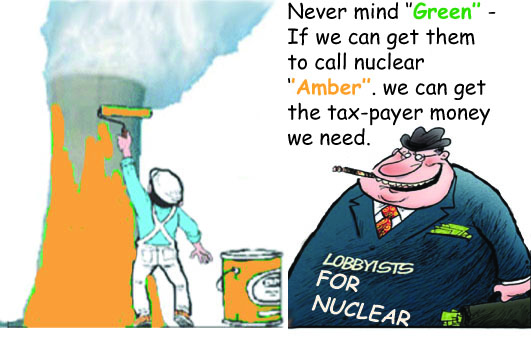
The environment ministers of five EU member states including Germany warned against including nuclear power in the proposed EU taxonomy at the sidelines of the UN Cop 26 climate conference in Glasgow today. In a jointstatement issued by the environment ministers of Germany, Denmark, Luxembourg, Austria and Portugal, the signatories warn that including nuclear in the taxonomy would permanently damage the latter’s “integrity, credibility and therefore its usefulness”. The EU taxonomy is to establish criteria for environmentally sustainable economic practices, steering funding towards these activities. German caretaker environment minister Svenja Schulze said that “nuclear power is too risky, too expensive”, and in any case would come too late to make a notable contribution to mitigating climate warming. Argus Media 11th Nov 2021 https://www.argusmedia.com/en/news/2272872-ministries-reject-nuclear-inclusion-in-eu-taxonomy |
Nuclear War and Climate Change: The Urgency for Action — The Center for Climate & Security

Christine Parthemore speaks on nuclear war and climate change at a COP26 side event hosted by the International Forum for Understanding, Nov 1, 2021. Source: International Forum for Understanding By Christine Parthemore I had the honor of delivering a keynote speech at a COP26 side event hosted by the International Forum for Understanding on November…
Nuclear War and Climate Change: The Urgency for Action — The Center for Climate & Security
EXPLORING THE SECURITY RISKS OF CLIMATE CHANGE Nuclear War and Climate Change: The Urgency for Action By Christine Parthemore
–There is urgency in this Conference’s proceedings. The urgency is greater because the world’s leaders, to date, have not yet taken the climate crisis seriously enough. Not even close. Yet this echoes a shared challenge: across the most catastrophic risks facing humanity, whether climate change, biological risks, or the risk of nuclear war, we have historically underestimated these threats.
Nuclear weapons – shared history of underestimating effects
What happens when our policies and plans do not fully account for the damage they may cause to the world?
Just as we are witnessing the answers to this question unfolding regarding the climate crisis, there is a similar and in many ways shared history of underestimatingthe catastrophic effects that could come from nuclear weapons.
During World War II, in the surge by the United States to ready nuclear weapons for potential use in the war, most estimates of damage focused on immediate blast effects of the use of these weapons — not secondary or enduring damage that may come after. And our knowledge of those effects was not robust.
Those who created nuclear weapons largely seemed to believe that everyone within the area hit by these weapons would die from the nuclear blast itself — that everything would be obliterated quickly. That, it would be learned, was not necessarily the case.
The first evidence came from the U.S. atomic bombings of Hiroshima and Nagasaki. The full human toll will never truly be known — estimates are between 110,000 and 210,000 people killed.
Yet those who lost their lives directly from the attacks were just one aspect. The degree to which the use of atomic bombs in conflict caused serious, lasting, devastating injuries was underestimated. For those who were not immediately lost, thousands suffered ghastly burns, loss of skin, and shrapnel embedded in their bodies that caused excruciating pain for as long as they lived. This is in addition to extreme suffering beyond injuries and sickness, in years and in some cases lifetimes of economic hardship, social stigma, and psychological damage.
Under-estimating the damage of nuclear weapons contributed to the United States and Soviet Union producing astronomical numbers of them — tens of thousands — in part driven by the belief that they needed tens of thousands of nuclear warheads in order to effectively deter one another from war—or to effectively wipe out the other nation.
Along with these growing nuclear arsenals came increasing nuclear tests. Soviet and U.S. citizens – and those of other nations – were subject to radiation effects from the detonation sites.
Some of the early U.S. nuclear tests were carried out in the Marshall Islands. Others, in the desert of the U.S. southwest.
Almost one quarter of all nuclear tests in history were conducted at one test site in what is now Kazakhstan from 1949 to 1989. The citizens of nearby villages that were exposed now tell the story of the radiation damage caused, including significant genetic effects that crossed generations.
On these terrible legacies of nuclear weapons tests was built significant knowledge of their effects. Before the international community united to ban them, mostly ending the practice, this included more than 2,000 nuclear tests.
Though results were classified in their earliest decades, extensive data from these tests revealed that the use of nuclear weapons could cause major disruptions to temperature patterns, sunlight, and precipitation. Into the 1970s and 80s, it became clearer that such nuclear weapons effects could cause more geographically dispersed and longer-enduring harm than previously realized.
With such data, the world was able to create mathematical and computer models of ever-increasing sophistication.
mportantly, the results of modeling potential effects of nuclear war started becoming public in the last decades of the 20th Century. Citizens of the world began to learn more about how the use of nuclear weapons could cause dramatic changes in weather patterns, and how this could drive severe changes in the availability of food and water, and how it would affect peoples’ health and their ability to care for their families. One such initiative labeled the potential damages of nuclear war as a “nuclear winter” that would befall the planet in some scenarios. ………..
Arms race today / Inflection Point
Unfortunately, this momentum has not been sustained. In the earliest decades of this Century, we have begun moving back in the wrong direction.
During this time, the risk of nuclear war has begun rising again. Most nuclear-armed nations are trying to expand the types of nuclear capabilities they possess, adding even more scenarios for how these weapons might be used in conflict.
Unfortunately, several nations — including my own — are reigniting interest in types of nuclear weapons that are envisioned to be more usable in conflict. These include increasing focus on the horrifically mis-labeled, so-called low-yield nuclear weapon options.
Even more dangerous than the mere presence of such weapons is the mindset that, in the heat of a conflict, it may be feasible to use one nuclear weapon without it being reciprocated. This is a fallacy, and we should not accept it as an assumption steering policy.
While this wasn’t the case early in the Cold War, this time, under-estimating the effects of using such nuclear weapons is not an excuse. We have to assume that the use of even one nuclear weapon would be followed by another, and potentially lead to a broader nuclear exchange and the catastrophic damage that would follow. Today, we know in great detail what that could look like…………..
Convergence
If the intersection of nuclear weapons use and climate change is rooted in work to understand how our atmosphere and our world may be altered by both, today we have an even more daunting task. We have to consider how these threats may actually manifest together.
Some effects of climate change are reigniting attention to past nuclear weapons damages. The Marshall Islands are a central case: at one atoll where the United States conducted nuclear weapon tests, a concrete dome that was designed to encase debris contaminated by these tests is now being inundated by rising seas. We don’t have to model this damage — it has been measured, and we have drone footage recording this occurring………………..
We know that in addition to the immediate death and destruction, such a nuclear conflict also risks significant damage to agricultural production through contamination or disruptions in weather patterns. Now combine this with a scenario in which such conflict occurs when extreme weather exacerbated by climate change has already spent years devastating the world’s food supplies.
How many more millions of people could starve? How many millions of people will try to move in order to save themselves and their families, and how many communities could descend into instability or internal conflict if pressure is not relieved any other way?
This is the reality of the world that we live in today — in which several catastrophic risks to humanity are occurring simultaneously, and they are not isolated from one another in time or space. ………….
I urge the leaders of our nations to commit to serious progress in addressing the climate crisis in the days ahead. We must then also act with urgency, expanding those efforts to rally similar momentum to reduce the risks of nuclear war as well. https://climateandsecurity.org/2021/11/nuclear-war-and-climate-change-the-urgency-for-action/#more-29718
Speaker of UK Parliament refuses debate on motions against Nuclear Energy (Financing) Bill.

Of course, consumers who have signed up to buy 100% renewable electricity could quite rightly feel aggrieved at having to pay the “nuclear tax” as well.
nuClear News, November. 21. Nuclear Energy Finance Bill On Wednesday 3rd November, MPs debated the second reading of the Nuclear Energy (Financing) Bill. The Liberal Democrats and the SNP, bot put forward an amendment, but neither was accepted for debate by the Speaker.
LibDem Motion: That this House declines to give a Second Reading to the Nuclear Energy (Financing) Bill because there is no economic or environmental case for the construction of any further nuclear stations in the UK; because the Bill does nothing to address concerns about costs around nuclear waste disposal and decommissioning; because the Bill fails to bring forward meaningful reforms to accelerate the deployment of renewable power or the removal of restrictions on solar, wind and the building of more interconnectors to guarantee security of supply; and because it fails to remove barriers to investment in renewables or to support investment and innovation in cutting-edge energy technologies, including tidal and wave power, energy storage, demand response, smart grids and hydrogen.
SNP Motion: This House declines to give a Second Reading to the Nuclear Energy (Financing) Bill because it believes there is no longer a justification for a large nuclear power station to provide base load energy, because large scale nuclear is not compatible as a counter to the intermittency of renewable wind as nuclear stations are too inflexible, because pumped storage hydro should be utilised to provide renewable energy that can be dispatched when required and pumped storage hydro should be supported with a minimum electricity price providing better value to bill payers than funding new nuclear, because wave and tidal technologies should be utilised to provide stable and predictable electricity generation and these technologies should be supported to scale up via the provision of a ring fenced pot of funding within the forthcoming contracts for difference auction, because the net zero pathway will be better advanced by supporting the Scottish Cluster as a fast track Carbon Capture, Utilisation and Storage project given that it includes hydrogen production, direct air capture and carbon storage facilities that will serve the wider UK, and because greater support and investment should be directed towards green hydrogen production and emerging storage technologies; and, as the cost of energy increases, this House calls on the Government to spend more money on energy efficiency measures and targeted support for those who suffer from or are at risk of fuel povertyac1
Continue readingExperts alarmed at the weakening of climate targets at COP26

World leaders will have to return to the negotiating table next year with
improved plans to cut greenhouse gases because the proposed targets agreed
at the Cop26 summit are too weak to prevent disastrous levels of global
heating, the three architects of the Paris agreement have warned.
Christiana Figueres, the former UN climate chief who oversaw the 2015 Paris
summit, and Laurence Tubiana, the French diplomat who crafted the
agreement, have told the Guardian the deadline is essential if the world is
to avoid exceeding its 1.5C temperature limit.
Laurent Fabius, the former French foreign minister who also oversaw Paris, added: “In the present
circumstances [targets] must be enhanced next year.” The last-ditch
intervention by such senior figures, with the Glasgow talks reaching their
final hours, reveals the heightened alarm among many experts over the chasm
between carbon targets and the deep cuts necessary to limit temperature
rises to 1.5C above pre-industrial levels. Current national plans – known
as nationally determined contributions (NDCs) – would lead to 2.4C of
heating, according to an influential analysis this week by Climate Action
Tracker.
Guardian 11th Nov 2021
New draft of climate deal of COP26 weakens plans to get rid of fossil fuels
A NEW draft of the deal that could be agreed at the Glasgow COP26 climate
talks appears to have watered down its push to curb fossil fuels. The first
draft of the “cover decision” for the overarching agreement at the
summit called for countries “to accelerate the phasing-out of coal and
subsidies for fossil fuels”.
The National 12th Nov 2021
1 This Month



19 November – Webinar – The Reality of Reprocessing
Time: 11:00 AM Pacific Time (US & Canada) / 2:00 PM Eastern / 7:00 PM UK / 8:00 PM CET
Register for the Zoom Event Here



Shut down the radiation-damaged Heysham nuclear reactors now
To see nuclear-related stories in greater depth and intensity – go to https://nuclearinformation.wordpress.com

Say No to NASA’s Reckless Nuclear Reactor on the Moon
Say No to NASA’s Reckless Nuclear Reactor on the Moon
-
Archives
- November 2026 (84)
- October 2026 (302)
- September 2026 (339)
- August 2026 (330)
- July 2026 (355)
- June 2026 (287)
- May 2026 (306)
- April 2026 (356)
- March 2026 (251)
- February 2026 (267)
- January 2026 (308)
- December 2025 (358)
-
Categories
- 1
- 1 NUCLEAR ISSUES
- business and costs
- climate change
- culture and arts
- ENERGY
- environment
- health
- history
- indigenous issues
- Legal
- marketing of nuclear
- media
- opposition to nuclear
- PERSONAL STORIES
- politics
- politics international
- Religion and ethics
- safety
- secrets,lies and civil liberties
- spinbuster
- technology
- Uranium
- wastes
- weapons and war
- Women
- 2 WORLD
- ACTION
- AFRICA
- Atrocities
- AUSTRALIA
- Christina's notes
- Christina's themes
- culture and arts
- Events
- Fuk 2022
- Fuk 2023
- Fukushima 2017
- Fukushima 2018
- fukushima 2019
- Fukushima 2020
- Fukushima 2021
- general
- global warming
- Humour (God we need it)
- Nuclear
- RARE EARTHS
- Reference
- resources – print
- Resources -audiovicual
- Weekly Newsletter
- World
- World Nuclear
- YouTube
-
RSS
Entries RSS
Comments RSS

