Germany’s Brokdorf nuclear station closes, so activists end their 35 year vigil against it.
Germany’s long anti-nuclear protest ends, DW, 29 Dec 21,
Activists have been protesting in front of the nuclear power plant in Brokdorf, northern Germany for 35 years. But now that the plant is set to be removed from the grid, their vigil is finally over………
Singing peace songs and chatting while standing in a circle, the groups appear well-adjusted to the freezing cold, having met at the power plant’s gate on the sixth day of each month for the last 35 years.
Today, the activists are once again holding a vigil to commemorate the victims of nuclear catastrophes while also demanding the shutdown of the nuclear reactor in their neighborhood.
Today is different, however. This 425th vigil will be the last. Later this month, the Brokdorf nuclear power plant will be shut down as part of Germany’s 2022 nuclear phaseout.
First nuclear reactor after Chernobyl
Amid the growing anti-nuclear movement in the 1980s, hundreds of thousands protested against the construction of the nuclear plant in Brokdorf.
Time and again, the protesters clashed with the police — especially after the nuclear accident in Chernobyl in 1986 saw increased radiation levels in soil and foods across Germany…..
Opening in late 1986, Brokdorf was the first nuclear reactor in the world to go into operation after the Chernobyl disaster.
At that time, Werner and a few allies protested peacefully and decided to continue their protests in the future. They vowed to meet once a month until Brokdorf was shut down…….
Increased cancer risk, and an ice rink
His fears weren’t unjustified. In 2008, a study found that children growing up in close proximity to a German nuclear power plant face a higher risk of developing leukemia.
Yet plants stayed open amid such health threats. One reason might be the decades of high revenues earned by the Brokdorf municipality through a commercial tax on the plant. Local politicians were loath to give up this income…….
Meanwhile, the nuclear power lobby is promoting nuclear energy as an allegedly clean and, most importantly, climate-friendly alternative……….. compared to power from wind and solar energy, the technology costs are much higher, and the construction of nuclear plants takes significantly longer.
Military motives
The fact that states still stick with nuclear power clearly also has another reason, said Andrew Stirling, professor of science and technology policy at the University of Sussex.
“Globally speaking, those countries that are the most truly dedicated to a civil use of nuclear energy either also have nuclear weapons or they are very keen on getting them,” he said.
According to Stirling, the civil use of nuclear energy is often needed for the realization of nuclear weapons programs, a point admitted by nuclear armed France and the US.
Without the engineers and specialists working in the commercial nuclear power sector, it would be impossible to build nuclear-powered submarines, for example, Stirling explained.
“The reports from the USA are absolutely clear. Even if the costs of nuclear energy were twice as high, it would still make sense for them to build reactors because this allows them to keep up their military activities,” he said……….
although Brokdorf will be removed from the grid on December 31, the plant will continue to serve as a temporary storage facility for nuclear waste for decades. There is still no final repository for radioactive waste.
“Therefore, our commitment is not yet over,” said one of the activists. https://www.dw.com/en/germanys-long-anti-nuclear-protest-ends/a-60278006
Radioactive radiation could damage biological tissue also via a previously unnoticed mechanism

Radioactive radiation could damage biological tissue also via a previously unnoticed mechanism, Science Daily
Date:December 27, 2021Source:Max-Planck-Gesellschaft
Summary:When cells are exposed to ionizing radiation, more destructive chain reactions may occur than previously thought. An international team led by researchers has now observed intermolecular Coulombic decay in organic molecules. This is triggered by ionizing radiation such as from radioactivity or from space. The effect damages two neighboring molecules and ultimately leads to the breaking of bonds – like the ones in DNA and proteins. The finding not only improves the understanding of radiation damage but could also help in the search for more effective substances to support radiation therapy……….. https://www.sciencedaily.com/releases/2021/12/211227154333.htm3
Secretive transports returning nuclear waste from UK to Australia

Nuclear waste from Britain heading to Lucas Heights, THE AUSTRALIAN, JACQUELIN MAGNAY 30 DECEMBER 21, LONDON@jacquelinmagnay,
Australia is to receive a two-tonne shipment of nuclear waste from Britain that will arrive under tight security and amid high secrecy in the coming months.
The shipment of intermediate-level nuclear waste has been prepared for delivery to the Australian Nuclear Science and Technology Organisation facilities at Lucas Heights, in Sydney’s south.
It will be just the second tranche of intermediate-level nuclear waste returned to the country, and its arrival shines a spotlight on Australia’s lack of a long-term storage plan for nuclear waste classified above low-level material.
The radioactive uranium and plutonium waste has been vitrified in four glass containers and then encased in an outer container made of specialised steel, known as a TN81 cask.
ANSTO says its previous experience in receiving intermediate-level nuclear waste – which occurred in 2015 when a larger shipment was returned from France – will mitigate any risks.

In that shipment, all local roads along the route were shut for more than five hours, and the operation involved the NSW Riot Squad and other police units to contain antinuclear protesters.
In the coming weeks, the nuclear waste will be moved by rail from the decommissioned nuclear plant at Sellafield in Cumbria to the British coast before being loaded onto a ship operated by Nuclear Transport Solutions.
It is expected to travel through Australian waters, including some maritime parks, before berthing.
The cargo is likely to be unloaded at Port Kembla in Wollongong under heavy guard, arriving sometime before the middle of next year.
Wherever the ship berths, the container will be loaded onto a truck for transport through residential and industrial areas, as well as along the Princes Highway through the Royal National Park south of Sydney and on to the Lucas Heights facility.
ANSTO says the final route will be a closely guarded secret and will be decided in consultation with NSW authorities.
NTS confirmed that the return of the intermediate-level waste in the form of vitrified residue to Australia had first been expected to take place last year.
Preparations for the shipment have been carried out since 2014……..
The Australian Radiation Protection and Nuclear Safety Agency has recently certified “the transport package”, and it will allow ANSTO to “temporarily” store the nuclear waste in the Interim Waste Store at Lucas Heights before another temporary storage facility for intermediate waste – currently being considered for Napandee, near the town of Kimba in South Australia – is ready to receive it.
This planned alternative storage solution, which is known as the National Radioactive Waste Management Facility, would bring together all the low-level radioactive waste from 100 different sites around the country and allow temporary storage of intermediate-level waste.
However, the proposed site in Kimba is being contested, with a judicial review requested earlier this month by traditional landowners the Barngarla Determination Aboriginal Corporation.
Longer-term storage plans for the intermediate waste are yet to be considered.
Despite this uncertainty, Australia is committed to receiving the waste after 114 ANSTO spent fuel rods were sent to Dounreay, Scotland, to be reprocessed of plutonium and uranium in 1996.
The processed waste being returned is of an equivalent radioactive level, but in a more condensed form than was originally exported to Scotland, and it has now been transported to the old Sellafield power station.
This means that instead of 52 500-litre drums of cemented waste, the British shipment will comprise four canisters of glass waste of an equivalent level.
It is classified by British authorities as having radioactivity levels greater than four GBq/tonne for alpha emitters and Beta/gamma emitters greater than 12 GBq/tonne – which puts it in the intermediate category.
ANSTO says it has experience in handling and storing such waste, citing the 2015 arrival of 25 tonnes of similar-level nuclear waste from France.
The new shipment will be stored next to that waste……………..
It is unclear if local councils positioned along the expected transport route will be notified when the shipment lands.
Previously, some export transportation of spent nuclear fuel rods from ANSTO to France for reprocessing has been carried out in the middle of the night with tight secrecy and no prior notice. Several councils, including Wollongong through which the nuclear waste will be carried, have called for Australia to sign and ratify the Treaty on the Prohibition of Nuclear Weapons.
Australia can expect to have to receive further shipments of returned waste every six or seven years, including spent fuel elements from the Opal reactor sent to La Hague in France for reprocessing before being returned. https://www.theaustralian.com.au/world/nuclear-waste-from-britain-heading-to-lucas-heights/news-story/e5e8511403cd24de66c79be3d1d96fe6
Massive leak of tritium at France’s Tricastin nuclear power plant.

A massive leak of tritium, a radioactive isotope of hydrogen, occurred earlier this month at the Tricastin nuclear power plant, one of the oldest in France, when subsequent radiation levels recorded in groundwater below it reached 28,900 becquerels per litre.
Both the plant’s operator, EDF, and the French nuclear safety watchdog, the ASN, insist that the spill has
been contained. But, as Jade Lindgaard reports, despite that claim it appears inevitable that that the radioactive effluent will pollute the local environment.
Mediapart 28th Dec 2021
France’s oldest nuclear power plant, shut in 1985, still highly radioactive

“You can’t see radioactivity, you can’t feel it, so people don’t care”: in Brennilis, nuclear power is no longer operating. Shutdown in 1985, the monts d’Arrée power plant was the first in France to begin dismantling.
The reactor block of the Finistère nuclear power plant in Brennilis remains one of the last vestiges of the gigantic installation, in operation from 1967 to 1985. Despite the decades, its dismantling has not yet been completed. It is in this building, however, that the most radioactive elements of the infrastructure are stored, a prototype of a heavy water reactor cooled with carbon dioxide, never reproduced in France afterwards.
Le Monde 28th Dec 2021
Japan’s plan for dumping nuclear waste-water into the sea
Japan’s government on Tuesday mapped out a plan for releasing contaminated
water from the crippled Fukushima nuclear plant into the sea, including
compensation standards for local industry and the compilation of a safety
assessment report. Japan said in April it would discharge more than 1
million tonnes of contaminated water in stages after treatment and
dilution, starting around spring 2023. The announcement provoked concerns
from local fishermen and objections from neighbouring China and South
Korea.
Reuters 28th Dec 2021
France to lead the European Council – a worrying situation as Macron cosies up to polluting corporations, especially nuclear.

In January, France will take on the rotating Presidency of the Council of
the EU for six months. This Presidency will have a particular resonance
both in France itself, coinciding as it does with Emmanuel Macron’s
re-election campaign, and at the European level, with many critical pieces
of legislation and policy on the line.
It is therefore worrying that this
Presidency has been prepared in close collaboration with the French
corporate sector, and is setting a policy agenda that strongly reflects
business demands.
In the name of climate action, the French Government is
pushing for more public support and funding for controversial industries,
including a renewed push for the nuclear sector. For the sake of nuclear
energy, the French Government appears willing to undermine the integrity of
the European Green Deal and other EU policies on the climate crisis, for
instance with the demand that gas is seen as ‘green’ in the Green
Taxonomy which will direct financial flows accordingly, and generally
through the prioritisation of industry-pushed ‘techno-fixes’ instead of
structural changes to make our lives more sustainable.
Corporate Europe 20th Dec 2021
https://corporateeurope.org/en/under-influence-distorted-priorities
Consider the potential risks of having nuclear submarines on Devonport Dockyard
After news broke this year that Devonport Dockyard is getting a £1billion
rebuild to meet the requirements of the Navy’s futuristic
Dreadnought-class ballistic missile subs, you might be left thinking about
the potential risks of an increased nuclear presence in the west of
Plymouth. Although the subs won’t enter service until the 2030s, it’s
better to be safe than sorry. Or maybe you’ve considered the potential risk
associated with the 12 submarines which still have their nuclear cargo
intact on the dock.
Plymouth Live 29th Dec 2021
https://www.plymouthherald.co.uk/news/plymouth-news/what-nuclear-disaster-declared-plymouth-6238969
Plutonium found on a beach near Sellafield
While in Cumbria on a visit hosted by Radiation Free Lakeland in 2015,
former United States Nuclear Industry Regulator Arnie Gundersen now nuclear
educator with Fairewinds took samples from the beaches. These samples were
tested back in the US. One of the samples unintentionally collected was
found in Arnie’s coat pocket. It turned out to be plutonium. “Arnie’s
time sampling near Sellafield is part of our worldwide campaign to protect
families and communities from the devasting and lasting impact of radiation
exposure. Currently, we have begun the process of researching and
documenting our Irish Sea data for another peer-reviewed journal
article.”
Radiation Free Lakeland 27th Dec 2021
Ukraine aims to produce enough uranium for nuclear energy needs
Ukraine aims to produce enough uranium for nuclear energy needs
Reuters KYIV, 29 Dec 21, – Ukraine, facing a lack of fuel for thermal power plants and surging gas prices, aims to increase its uranium production to cover fully the needs of its nuclear power units after 2026, the government said on Wednesday.
Under a national programme the government adopted on Wednesday, Ukraine will invest 9.1 billion hryvnia ($335 million) over the next five years to increase uranium mining and processing facilities in the centre of the country.
It said the production at four Ukrainian uranium deposits would total 995 tonnes in 2022 and should rise to 1,265 tonnes in 2026.
It gave no uranium output figure for 2021 but said current production meets around 40% of Ukraine’s needs for nuclear fuel.The rest comes from imports from Russia and the United State…….. https://www.reuters.com/markets/commodities/ukraine-aims-produce-enough-uranium-nuclear-energy-needs-2021-12-29/
China hits back at ‘double standards’ amid US tech war, Washington’s nuclear weapon concerns
Beijing issued its first white paper on export controls on Wednesday, a month after 12 more Chinese companies were placed on the United States’ export blacklist
The ‘China’s Export Controls’ white paper argues that no country or region should ‘gratuitously impose discriminatory restrictions or apply ‘double standards’…….. https://www.scmp.com/economy/china-economy/article/3161447/china-hits-back-double-standards-amid-us-tech-war-washingtons
Nuclear Twilight – the ”limited” nuclear war
‘Nuclear twilight’: Something else to worry about, Stuff Gwynne Dyer05:00, Dec 30 2021 ”………………… A different team of researchers discovered nuclear winter almost 40 years ago, and it helped to convince the great powers they must never fight a nuclear war.
The reason we don’t worry much about nuclear winter now is that we think they have finally learned that lesson.
True, there are now other countries with nuclear weapons that don’t seem immune to outbreaks of major war, like India and Pakistan. However, everybody assumed the damage would be confined to their own region.
If we don’t let it escalate into a superpower clash, the rest of the world should be all right.
Wrong.
The Indian and Pakistani nuclear arsenals each amount to about 150 warheads now. That’s a modest number compared to the thousands held by the superpowers, but it turns out to be quite enough to cause…let’s call it a nuclear twilight.
What makes this so worrisome is that India and Pakistan have already fought three full-scale wars and half a dozen major skirmishes since they got their independence.
Another is entirely possible, and the risk of escalation to nuclear weapons would be very high, for two reasons.
First, most of their nuclear-capable aircraft and missiles are vulnerable to being destroyed on the ground in a surprise attack.
Secondly, the two countries are so close together that only a very brief warning time is available. In these circumstances, a policy of ‘launch on warning’, with all the risk of mistakes that entails, is the only rational option for both sides
The first victims of such a war would be Pakistani and Indian civilians, because cities will be on the target lists: that’s where the major ports, airfields and critical infrastructure are.
Robock’s team calculated that those burning cities would loft enough ‘black carbon’ into the stratosphere to create a shroud of soot over the whole world within a few weeks.
t wouldn’t be the full-dress nuclear winter of superpower war, with ‘darkness at noon’. However, 300 nuclear explosions in the Indian subcontinent, most of them airbursts over cities, would dim the sun enough to drop temperatures and severely damage crop yields in the main food-producing regions of the planet.
The main effects would be a severe drop in the average global temperature and a comparable decline in global food production – with the worst-hit areas being in the Northern Hemisphere, north of latitude 30°N. (Almost all of India and Pakistan are south of that.)
It’s counter-intuitive, but that’s the way the climate system works.
The most important ‘breadbaskets’ of the planet – grain-growing areas that produce a big crop surplus for export – are the United States, Canada and Europe (including European Russia) – and they are all just north of 30.
The dimming effects of an Indo-Pak nuclear war in 2025, say, would drop the average global temperature by 5 °C over all the continents, but in the key regions of North America and Europe it could reach 10 °C colder.
That maximum cooling would be reached in the fourth year after the war, and would gradually return to ‘normal’ by around year 15.
Australia, Brazil and Argentina, the Southern Hemisphere’s bread-baskets, might still be able to export some grain, but they would not be remotely capable of compensating for the huge shortfalls of food in the Northern Hemisphere.
Tens, maybe hundreds of millions would starve in the poorer parts of the north, and scrabbling for food in the cold and the dark would certainly take our minds off our longer-term problem: global heating.
But when the effects of the local nuclear war in the Indian subcontinent finally faded, it would be right back to that bigger climate crisis.
And it would be bigger, for carbon dioxide would not have stopped accumulating during the hungry years. Indeed, the world might find that it was returning not to the average global temperature of +1.3 °C that prevailed when the Indo-Pak war started, but to a climate that was now hovering on the brink of +2.0 °C. https://www.stuff.co.nz/manawatu-standard/opinion/300487679/nuclear-twilight-something-else-to-worry-about
A Ukrainian invasion could go nuclear: 15 reactors would be in a war zone
 | |||
|
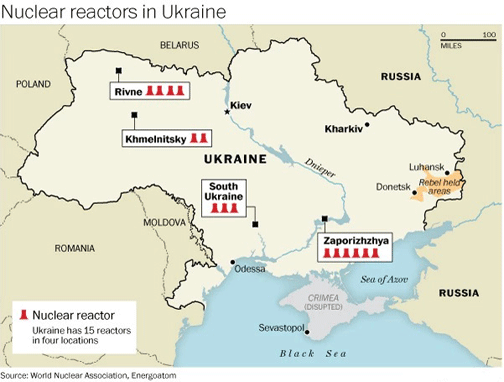
A Ukraine Invasion Could Go Nuclear: 15 Reactors Would Be In War Zone https://www.forbes.com/sites/craighooper/2021/12/28/a-ukraine-invasion-will-go-nuclear-15-reactors-are-in-the-war-zone/?sh=1c9a8a0a27aa&fbclid=IwAR1k5sz1_5PLOb7Lg6qMjULu_lj0nqF-6SXx7NifPxr6uakDliSUlgyHFqI Craig HooperSenior Contributor
As Russia’s buildup on the Ukrainian border continues, few observers note that an invasion of Ukraine could put nuclear reactors on the front line of military conflict. The world is underestimating the risk that full-scale, no-holds-barred conventional warfare could spark a catastrophic reactor failure, causing an unprecedented regional nuclear emergency.
The threat is real. Ukraine is heavily dependent upon nuclear power, maintaining four nuclear power plants and stewardship of the shattered nuclear site at Chernobyl. In a major war, all 15 reactors at Ukraine’s nuclear power facilities would be at risk, but even a desultory Russian incursion into eastern Ukraine is likely to expose at least six active reactors to the uncertainty of a ground combat environment.
The world has little experience with reactors in a war zone. Since humanity first harnessed the atom, the world has only experienced two “major” accidents—Chernobyl and Japan’s Fukushima disaster. A Russian invasion, coupled with an extended conventional war throughout Ukraine, could generate multiple International Atomic Energy Agency “Level 7” accidents in a matter of days. Such a contingency would induce a massive refugee exodus and could render much of Ukraine uninhabitable for decades.
Turning the Ukraine into a dystopian landscape, pockmarked by radioactive exclusion zones, would be an extreme method to obtain the defensive zone Russian President Vladimir Putin seems to want. Managing a massive Western-focused migratory crisis and environmental cleanup would absorb Europe for years. The work would distract European leaders and empower nativist governments that tend to be aligned with Russia’s baser interests, giving an overextended Russia breathing room as the country teeters on the brink of technological, demographic, and financial exhaustion.
Put bluntly, the integrity of Ukrainian nuclear reactors is a strategic matter, critical for both NATO and non-NATO countries alike. Causing a severe radiological accident for strategic purposes is unacceptable. A deliberate aggravation of an emerging nuclear catastrophe—preventing mitigation measures or allowing reactors to deliberately melt down and potentially contaminate wide portions of Europe—would simply be nuclear warfare without bombs.
Such a scenario can’t be ruled out. Russia has repeatedly used Ukraine to test out concepts for “Gray Zone” warfare, where an attacker dances just beyond the threshold of open conflict. Given Russia’s apparent interest in radiation-spewing nuclear-powered cruise missiles, robotic undersea bombs with a radiological fallout-oriented payload, destructive anti-satellite tests and other nihilistic, world-harming weapons, Russia’s ongoing dalliance with “Gray Zone” warfare in Ukraine may, for the rest of Europe, become a real matter of estimating radiological “grays,” or, in other words, estimating the amount of ionizing radiation absorbed by humans.
When War Comes To Zaporizhzhia
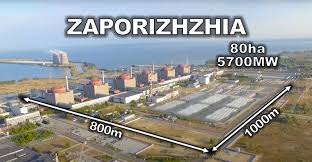
Ukraine’s Zaporizhzhia nuclear power plant is a particular risk. It is the second-largest nuclear power plant in Europe (essentially tied with a French reactor complex near Calais), and one of the 10 largest nuclear power plants in the world. The site has little protection, and the six VVER-1000 pressurized water reactors could easily be embroiled in any Russian invasion.
If war comes, the fight will be close by. The Zaporizhzhia nuclear power plant is located only 120 miles from the current “front line” in the Donbass region and is on the hard-to-defend east bank of the Dnieper River. Aside from the geographical hazards, the power plant provides about a quarter of Ukraine’s total electrical power. Given the importance of the electricity, plant managers will be reluctant to shut it down, securing the reactors only at the very last possible second. Ukraine’s desperate need for energy only compounds the opportunities for an accident.
Outside of direct battle damage, cyber and other Russian-sourced “grey zone” mischief could make the plant unmanageable even before the battle arrives at the reactor gates.
Though unlikely, direct bombardment could cause serious damage to reactor containment structures. While the reactor structures themselves are strong, warfare at the plant could kill key personnel and destroy command-and-control structures, monitoring sensors or critical reactor-cooling infrastructure. And, as an operating power plant, the reactors are not the only threat. Dangerous spent fuel rods are sitting in vulnerable cooling ponds, while older fuel sits in the site’s 167 dry spent fuel assemblies.
If the reactors suffer any operational anomalies, crisis management is not going to happen. Support infrastructure needed for safe reactor management will collapse during conflict. Plant security forces will disappear, operators will flee, and, if an accident occurs, mitigating measures will be impossible.
It seems unlikely that Russia has mobilized trained reactor operators and prepared reactor crisis-management teams to take over any “liberated” power plants. The heroic measures that kept the Chernobyl nuclear accident and Japan’s Fukushima nuclear disaster from becoming far more damaging events just will not happen in a war zone.
Again, the risks are very high. The world has never dealt with an unmanaged meltdown at a large nuclear power plant. The very real prospect of an extended and unmitigated incident at a six-reactor powerplant in a war zone is worth urgent and immediate consultations throughout Europe and NATO.
Gray Zone Nuclear Conflict Can Happen
The world has never experienced war that threatens active nuclear power infrastructure, and world leaders may be underestimating the peril conventional warfare presents to these powerful and perilous assets.
On the other hand, heedless purveyors of “gray zone” warfare may be underestimating the risk themselves, all too eager to determine just how degraded nuclear infrastructure might serve as a “less risky” surrogate for nuclear conflict.
To them, it’s not nuclear war, but just a series of unfortunate nuclear accidents.
The science-based case for excluding Nuclear Fission Technologies from the EU Taxonomy

The question whether nuclear fission energy complies with the ‘do no significant harm’ (DNSH) criteria of the EU Taxonomy was the focus of the Technical Expert Group (TEG) DNSH assessment on nuclear fission technologies which recommended to the Commission that nuclear should not be included in the EU Taxonomy of environmentally sustainable activities.
The independent scientific evidence which the TEG presented to the European Commission, shows evidence of adverse impacts to the natural environment arising from the many processes involved in the nuclear power lifecycle (from uranium mining to waste disposal) that are operational today.
The Argument against Nuclear Power as Sustainable for FinancePetitions.net, 26 Dec 21, Europe’s ‘science-based’ Sustainable Finance Taxonomy is politicised to include nuclear power.
The Science-based case for excluding Nuclear Fission Technologies from the EU Taxonomy One of the most influential policy initiatives of the European Commission in the past years has been the “EU Taxonomy”, essentially a shopping list of investments that may be considered environmentally sustainable across six environmental objectives.
To be deemed EU Taxonomy aligned, the activity must demonstrate a substantial contribution to one environmental objective, such as climate change mitigation, whilst causing no significant harm to the remaining five environmental objectives (climate change adaptation, sustainable use and protection of water and marine resources, transition to a circular economy, pollution prevention and control, and protection and restoration of biodiversity and ecosystems).
All eligible activities are required to comply with technical screening criteria (TSC) for ‘substantial contribution’ and ‘do no significant harm’ and to demonstrate that social safeguards are in place.
The EU Taxonomy provides a common language for sustainability reporting, a foundation for green bond reporting and much more. It is intended to be used by international financial markets participants whose products are sold within the EU in order to evaluate the sustainability of their underlying investments. The use of the EU Taxonomy is furthermore compulsory for the EU and member states when introducing requirements and standards regarding environmental sustainability of financial products, such as an EU ecolabel for investment products or an EU Green Bond Standard.
It will also apply to 37% of activities earmarked as ‘climate-friendly’ financed by the EU COVID-19 recovery funding. Its science-based approach is designed to give confidence to a wide range of international stakeholders that environmental claims are not greenwashing.
The question whether nuclear fission energy complies with the ‘do no significant harm’ (DNSH) criteria of the EU Taxonomy was the focus of the Technical Expert Group (TEG) DNSH assessment on nuclear fission technologies which recommended to the Commission that nuclear should not be included in the EU Taxonomy of environmentally sustainable activities.
Taking into account the significant financial implications of adopting the TEG recommendations, it became the starting point of intense behind-door lobbying. France led a coalition of 10 EU Member States arguing that nuclear fission as well as gas-fired power plants should be included in the Taxonomy. Together with Finland (Olkiluoto-3), France is at present the only EU country constructing a new nuclear power plant (Flamanville-3). The Finnish and French construction sites were meant to be the industrial demonstration of an evolutionary nuclear technology (the “European Pressurised water Reactor” or EPR). Olkiluoto-3 was meant to start generating power in 2009, followed by Flamanville-3 in 2012. Instead, the projects turned out to have multiple engineering difficulties and financial constraints that resulted in significant delays culminating in missed deadlines for various production start dates and tripling unit cost……………………. the independent scientific evidence which the TEG presented to the European Commission, shows evidence of adverse impacts to the natural environment arising from the many processes involved in the nuclear power lifecycle (from uranium mining to waste disposal) that are operational today. …………
Does the present generation of nuclear fission power plants ‘do no significant harm’? To answer this question, two specific issues for nuclear power stand out: the risk of a catastrophic accident and the management of high-level nuclear waste (HLW)………………………………
Especially relevant for nuclear fission power is the fact that the liability of the operator in the case of a severe accident is limited and the remaining costs are (largely) taken on by the state (privatization of profits, socialization of risks).
The Taxonomy architecture is not designed to cater for such risks that carry an intergenerational impact lasting for thousands of years, making it an unsuitable instrument to decide on the sustainable nature of nuclear power. The characteristics and nature of HLW generated by the nuclear fission process presents long-term intergenerational risks and thereby challenge the principle of ‘do no significant harm’ to the extent that nuclear fission energy may not be considered eligible for the EU Taxonomy.
This was made abundantly clear to the Commission in the TEG’s recommendations, which were not published in their entirety. Independent, scientific, peer-reviewed evidence compiled by TEG provided confirmation of the risk of significant harm arising from nuclear waste. The back end of the fuel cycle is currently dominated by the containment of spent fuel rods and waste from nuclear power facilities. Safe and secure long-term storage of nuclear waste remains unresolved and has to be demonstrated in its operational complexity. ……….
The fact that a ‘solution’ has to be found for the existing quantities of waste (as well spent fuel as conditioned high level waste forms), and that geological disposal is the least bad solution for this, does not imply that nuclear power can suddenly be classified as a ‘green’ energy source.
Other concerns with regard to DNSH criteria Nuclear fission power plants require about three cubic metres of cooling water per megawatt hour (MWh) produced. A nuclear plants’ cooling water consumption is higher than that of fossil-fuel plants. Throughout the world, new nuclear plants and existing plants increasingly face cooling water scarcity induced by heat waves, a situation that is likely to be aggravated by climate change…..
For reasons of having access to enough cooling water, nuclear plants are mostly sited in coastal or estuarine locations, but this makes them vulnerable to flooding and extreme events that climate change may occasion. The siting of nuclear power plants along coastal zones presents adaptation risks associated with sea-level rise, water temperature rise, coastal erosion as well as natural catastrophes such as the Fukushima disaster demonstrates. ………………..
when major nuclear plant accidents occur significant land areas become unsuitable for human habitation (e.g. Chernobyl, Fukushima). …….
Surface or underground mining and the processing of uranium ore can substantially damage surrounding ecosystems and waterways. The huge volumes of associated mining waste in developing countries are normally not considered in life cycle waste inventories of nuclear energy producing countries. More critically, the adverse effects on local environmental conditions of routine discharging of nuclear isotopes to the air and water at reprocessing plants have not been considered thoroughly enough. A number of adverse impacts (of radiation) on soil/sediment, benthic flora and fauna and marine mammals has been demonstrated.
Should nuclear fission power be included in the taxonomy as a transition activity? According to Article 10 (2) of the Taxonomy Regulation, which is the law underpinning the EU Taxonomy, activities that are incompatible with climate neutrality but considered necessary in the transition to a climate-neutral economy can be labelled and supported as ‘transition activities’…………
A key principle of the EU Taxonomy is to avoid environmentally harmful ‘lock-in’ effects of activities. Lock-in describes the phenomenon whereby it is difficult to set a technical and political system on a new path once it has developed a momentum of its own and once it is ‘locked-in’ on a certain path. ……
Nuclear fission plants require at least 10 years to be built (with recent experience even pointing in the direction of 20 years for the EPR), while they have to remain operational for 50-60 years. Decommissioning will then take another 20-50 years. This means that a decision to build new nuclear power plants will lock in societies for some 80-130 years, not counting the years needed to store spent fuel or dispose of high-level waste. …
A decision to include nuclear fission into the energy mix of the EU Taxonomy sustainable activities will during this period therefore channel much needed capital away from renewable energy technologies, which do not present long-term and catastrophic risks to humans and the environment as nuclear fission does. ……………………………………..
Signed by EU Taxonomy subgroup DNSH TEG members and expert supporters:
Dawn Slevin, Dr. Erik Laes, Paolo Masoni, Jochen Krimphoff, Fabrizio Varriale, Andrea Di Turi, Dr. Ulrich Ofterdinger, Dr. Dolores Byrne, Dr. Petra Kuenkel, Ursula Hartenberger, Kosha Joubert
Link to PDF Version of the Statement of Concern sent to the Commission on 21 Dec 21:
https://www.petitions.net/the_argument_against_nuclear_power_as_sustainable_for_finance .petitions.net/the_argument_against_nuclear_power_as_sustainable_for_finance
Julian Assange’s lawyers start process for UK Supreme Court appeal against his extradition to America

Julian Assange’s lawyers start process for Supreme Court appeal to stop WikiLeaks founder being extradited to US and tried on espionage charges
- Fiancee Stella Moris said application to bring appeal filed after 11am Thursday
- Judges must now decide whether to hear the case before any appeal takes place
- He is wanted in the US over alleged conspiracy to disclose national defence information
Daily Mail. By TOM PYMAN FOR MAILONLINE, 24 December. Julian Assange‘s lawyers have started the process for a Supreme Court appeal to stop the WikiLeaks founder being extradited to the US and tried on espionage charges, his fiancee has said.
Stella Moris said Assange filed an application to bring an appeal shortly after 11am on Thursday.
As his lawyers have applied to take his case to the Supreme Court, the UK’s highest court, judges must now decide whether to hear the case before any appeal takes place. Ms Moris, a lawyer and the mother of his two children, said in a statement on Thursday the High Court must first ‘certify that at least one of the Supreme Court appeal grounds is a point of law of general public
importance’ before the application has a chance to be considered by the Supreme Court.
A decision is not expected before the third week of January, Ms Moris added.
Birnberg Peirce Solicitors, who are representing Assange, said in a statement: ‘We believe serious and important issues of law of wider public importance are being raised in this application.
They arise from the Court’s judgment and its receipt and reliance on US assurances regarding the prison regimes and treatment Mr Assange is likely to face if extradited.
‘Because this application is now the subject of judicial consideration, his lawyers do not propose to comment further at the moment.
‘We hope and trust the High Court will grant a certificate on the questions raised as well as giving permission to appeal in order that they can thereafter be fully argued before the Supreme Court.’……………….. https://www.dailymail.co.uk/news/article-10341045/Julian-Assanges-lawyers-start-process-Supreme-Court-appeal.html?ito=social-twitter_dailymailUK
1 This Month



19 November – Webinar – The Reality of Reprocessing
Time: 11:00 AM Pacific Time (US & Canada) / 2:00 PM Eastern / 7:00 PM UK / 8:00 PM CET
Register for the Zoom Event Here



Shut down the radiation-damaged Heysham nuclear reactors now
To see nuclear-related stories in greater depth and intensity – go to https://nuclearinformation.wordpress.com

Say No to NASA’s Reckless Nuclear Reactor on the Moon
Say No to NASA’s Reckless Nuclear Reactor on the Moon
-
Archives
- November 2026 (74)
- October 2026 (302)
- September 2026 (339)
- August 2026 (330)
- July 2026 (355)
- June 2026 (287)
- May 2026 (306)
- April 2026 (356)
- March 2026 (251)
- February 2026 (267)
- January 2026 (308)
- December 2025 (358)
-
Categories
- 1
- 1 NUCLEAR ISSUES
- business and costs
- climate change
- culture and arts
- ENERGY
- environment
- health
- history
- indigenous issues
- Legal
- marketing of nuclear
- media
- opposition to nuclear
- PERSONAL STORIES
- politics
- politics international
- Religion and ethics
- safety
- secrets,lies and civil liberties
- spinbuster
- technology
- Uranium
- wastes
- weapons and war
- Women
- 2 WORLD
- ACTION
- AFRICA
- Atrocities
- AUSTRALIA
- Christina's notes
- Christina's themes
- culture and arts
- Events
- Fuk 2022
- Fuk 2023
- Fukushima 2017
- Fukushima 2018
- fukushima 2019
- Fukushima 2020
- Fukushima 2021
- general
- global warming
- Humour (God we need it)
- Nuclear
- RARE EARTHS
- Reference
- resources – print
- Resources -audiovicual
- Weekly Newsletter
- World
- World Nuclear
- YouTube
-
RSS
Entries RSS
Comments RSS

