Largest increase in the UK nuclear liability regime for 50 years
Largest increase in the UK nuclear liability regime for 50 years take, https://www.jdsupra.com/legalnews/largest-increase-in-the-uk-nuclear-6038616/, 21 Jan 22, As we flagged last year in this note, the 2004 Protocols updating the Paris Convention and Brussels Convention have finally been ratified. This is likely the biggest increase in the international nuclear liability regime for decades, and has global impact.
In the UK this means that the Nuclear Installations (Liability for Damage) Order 2016 came into effect on 1 January 2022. This immediately increases the liability cap of nuclear operators in the UK from £140m to €700m (approx. £585m), with those caps increasing annually over the next five years to €1.2bn (approx. £1bn). The UK also now has a new operator duty of care not to cause significant impairment to the environment, new categories of compensation for which an operator will be liable (including loss of profit in some instances), and material extensions to the geographical scope covered by the regime (e.g. now including the Republic of Ireland).
The extension of the limitation period for personal injury to 30 years from the date of the incident is likely the one with the largest impact after it became clear last year that insurance would not be available to cover the full period, at least for the time being. The UK Government instead stepping in and indemnifying operators to cover the insurance gap using the powers granted to the Secretary of State under the amended Nuclear Installations Act 1965.
Similar changes to the liability regime in certain other European and Scandinavian signatory countries should also have taken effect.
Please see our detailed note on the topic here for further information.
[View source.]
Scientists trace the path of radioactive cesium in the ecosystem of Fukushima

Scientists trace the path of radioactive cesium in the ecosystem of Fukushima https://phys.org/news/2022-01-scientists-path-radioactive-cesium-ecosystem.html
by National Institute for Environmental Studies In 2011, the nuclear accident at Fukushima, Japan, resulted in the deposit of radioactive cesium (radiocesium) into habitats in the vicinity. A decade after the accident, researchers from the National Institute of Environmental Studies, Japan, have collated the complicated dynamics of radiocesium within forest-stream ecosystems. Understanding radiocesium flow in the environment could help mitigate contamination and inform future containment strategies.
In the aftermath of the Fukushima nuclear accident, the Japanese government performed intensive decontamination in the human-occupied parts of the affected area by removing soil surface layers. But a major affected region consists of dense, uninhabited forests, where such decontamination strategies are not feasible. So, finding ways to avoid the spread of radioactive contaminants like radiocesium to areas of human activity that lie downstream to these contaminated forests is crucial.
The first step to this is to understand the dynamics of radiocesium flow through forest-stream ecosystems. In the decade since the accident, a vast body of research has been dedicated to doing just that. Scientists from the National Institute of Environmental Studies, Japan, sifted through the data and detangled the threads of individual radiocesium transport processes in forest-stream ecosystems. “We identified that radiocesium accumulates primarily in the organic soil layer in forests and in stagnant water in streams, thereby making them potent sources for contaminating organisms. Contamination management in these habitats is crucial to provisioning services in forest-stream ecosystems,” says Dr. Masaru Sakai, who led the study. The findings of this study was made available online on 6 July 2021 and published in volume 288 of the journal Environmental Pollution on 1st November 2021.
The research team reviewed a broad range of scientific research on radiocesium in forests and streams to identify regions of radiocesium accumulation and storage. After the accident, radiocesium was primarily deposited onto the forest canopy and forest floor. This radiocesium reaches the earth eventually—through rainfall and falling leaves—where it builds up in the upper layers of the soil. Biological activities, such as those of detritivores (insects and fungi that live off leaf debris etc.) ensure that radiocesium is circulated through the upper layers of the soil and subsequently incorporated into plants and fungi. This allows radiocesium to enter the food web, eventually making its way into higher organisms. Radiocesium is chemically similar to potassium, an essential mineral in living organisms, contributing to its uptake in plants and animals. “Fertilizing” contaminated areas with an excess of potassium provides an effective strategy to suppress the biological absorption of radiocesium.
Streams and water bodies in the surrounding area get their share of radiocesium from runoff and fallen leaves. Most radiocesium in streams is likely to be captured by the clay minerals on stream beds, but a small part dissolves in the water. Unfortunately, there is little information on the relationship between dissolved radiocesium and aquatic organisms, like fish, which could be important to the formulation of contamination management strategies. Radiocesium in streams also accumulates in headwater valleys,pools, and other areas of stagnant water. Constructions such as reservoir dams provide a way to effectively trap radiocesium but steady leaching from the reservoir sediments causes re-contamination downstream.
This complicated web of radiocesium transport is hard to trace, making the development of a one-stop solution to radiocesium contamination impossible. Dr. Sakai and team recommend interdisciplinary studies to accelerate a full understanding of radiocesium pathways in forest-stream ecosystems so that measures can be developed to reduce future contamination. “This review can serve as basal knowledge for exploring future contamination management strategies. The tangled radiocesium pathways documented here may also imply the difficulties of creating successful radiation contamination management strategies after unwished-for nuclear accidents,” explains Dr. Sakai.
Nuclear power is often touted as a solution to the energy crisis, but it is important to plan response measures to unpredictable contamination events. To address the essential need for clean energy in view of the climate crisis, contamination management in societies depending on nuclear power is integral. Fully understanding the behavior of radiocesium in ecosystems can not only lead to the successful management of existing contamination but can also ensure the swift containment of potential future accidents.
France’s nuclear company EDF accused of cover-ups over ‘serious and unexpected’ corrosion on Tricastin and other reactors.
“Hugo”, nuclear whistleblower: “I accuse EDF of cover-ups”. “With this
type of attitude, our power plants are not safe”: the shocking testimony of
a member of the management of the Tricastin nuclear power plant, worried
that the culture of nuclear safety is taking a back seat to financial
imperatives within the EDF group.
Mediapart 19th Jan 2022
Nuclear reactors shut down due to ‘serious and unexpected’ corrosion
problem. EDF, which operates the French power plants, should say by the end
of January whether other facilities in the fleet could be affected by this
as yet unexplained anomaly.
Le Monde 19th Jan 2022
Hinkley Point mud dredging and dumping plan faces a legal challenge
Hinkley Point dredging plan for Portishead faces legal challenge. Plans to
dump hundreds of thousands of tonnes of sediment from Hinkley Point into
the Bristol Channel at Portishead face a legal challenge.
Environmental groups represented by Tarian Hafren say the Marine Management Organisation
unlawfully varied EDF Energy’s licence to deposit dredged material at the
Severn Estuary Marine Protection Area. The disposal site is close to
Portbury Wharf Salt Marsh, a Site of Special Scientific Interest and part
of the Severn Estuary Special Protection Area. Tarian Hafren argues that
the MMO did not have the statutory power to change the licence for dredging
to include dumping, did not give adequate reasons for doing so, failed to
examine the potential impact of the dredging on marine life, and ignored a
less harmful method of waste disposal.
High Court judge Beverley Lang ruled
that the grounds for a judicial review are arguable and the claim will be
heard this spring. Cian Ciaran for Tarian Hafren said: “The Welsh
National Marine Plan accepts no dumping in the Welsh half of the estuary,
but the Welsh authorities failed to press MMO to comply on the English
side. “As Geiger Bay, we established at court in 2018 that the Welsh
authorities were wrong to license dumping near Cardiff. Let’s now compel
the MMO to respect the protected status that’s needed for both fish
stocks and wildlife.”
Somerset Live 20th Jan 2022
https://www.somersetlive.co.uk/news/hinkley-point-dredging-plan-portishead-6514361
France’s nuclear regulator warns on the ”security fragility” of both the reactors, and the reprocessing system
“The continued operation of EDF’s nuclear reactors should not be the
adjustment variable for French energy policy”. In an interview with “Le
Monde”, Bernard Doroszczuk, the president of the Nuclear Safety Authority,
warns about the lack of margins in terms of security of electricity supply.
First, the president of the Nuclear Safety Authority (ASN), Bernard
Doroszczuk, wishes to underline a reassuring point. Despite the
complications due to the health crisis, “the level of nuclear safety and
radiation protection was completely satisfactory in 2021, he says in the
preamble to his interview with Le Monde. In particular the conduct of the
fourth ten-yearly inspections of the oldest reactors”.
The French nuclear “policeman” however warns against “an unprecedented double
fragility”: both for the reactors, but also for the installations which
manufacture, reprocess or recover the fuel.
Le Monde 19th Jan 2022
China hits back at US, Japan over nuclear transparency call
China hits back at US, Japan over nuclear transparency call, Catherine Wong SCMP, 21 Jan 22,
Beijing says Washington is the biggest threat to global stability and should make the first move by reducing its stockpile. Tokyo should also adopt a more responsible approach on nuclear policy, foreign ministry says.
China hit out at the United States and Japan on Friday after the two nations sounded alarm over China’s growing nuclear capabilities.
In a statement on the Treaty on the Non-Proliferation of Nuclear Weapons on Thursday, the two countries called on China to increase transparency and reduce nuclear risks.
“Noting the People’s Republic of China’s ongoing increase in its nuclear capabilities, Japan and the United States request [China] to contribute to arrangements that reduce nuclear risks, increase transparency, and advance nuclear disarmament,” the US and Japan said.
Chinese foreign ministry spokesman Zhao Lijian said the US was the bigger threat.
“As we all know, it is the US that is the biggest threat to global stability with the world’s biggest and most advanced nuclear stockpile,” Zhao said, adding that the US had deployed missile defence systems around the world.
“Despite possessing the world’s largest and most advanced nuclear arsenal, the US is still investing trillions of dollars to upgrade its ‘nuclear triad’, developing low-yield nuclear weapons and lowering the threshold for using nuclear weapons.”
He said the US should “mind its own business” before criticising China and cut its nuclear stockpile to set an example for other countries.
He added that China remained firmly committed to a self-defensive nuclear strategy and no-first-use policy on nuclear weapons.
Zhao also criticised Japan for storing large quantities of weapons-grade plutonium and “desperately trying to prevent the US from adopting the no-first-use policy”…….. https://www.scmp.com/news/china/diplomacy/article/3164302/china-hits-back-us-japan-over-nuclear-transparency-call
Difficulties at Orano nuclear elements site adds to France’s nuclear woes.
France’s nuclear sector, which lately came under additional pressure due
to newly discovered corrosion problems at some EDF (EDF.PA) sites, may need
a “Marshall plan” to survive, said the head of France’s ASN nuclear
watchdog. Difficulties also increased at Orano’s Melox site which produces
nuclear elements for plants, adding to EDF’s problems, ASN President
Bernard Doroszczuk told reporters.
Reuters 19th Jan 2022
Transistion to genuinely clean energy has succeeded in many cases, including economically

Michael Grubb: Limiting climate change will require an unprecedented
global movement to make low-carbon technologies the norm. COP26 – the UN
climate conference held last November in Glasgow – showed that
unfortunately, the world is far from ready for such a movement.
Many leaders still assume that reducing emissions and growing their countries’
economies aren’t compatible goals. Yet in many places, transitions to
clean energy technologies have succeeded far beyond expectations.
Since 2010, wind power has grown from providing under 1% to providing 10% of
electricity in Brazil, and provided 15% of the EU’s electricity demand in
2019. Solar power – described as “the most expensive way to reduce
carbon emissions” as recently as 2014 – now costs 85% less than it did
a decade ago, increasingly making it the cheapest electricity in history.
And in India, affordable energy access programmes drove sales of
high-efficiency LED bulbs from just 3 million in 2012 to 670 million in
2018, with prices also falling by 85%.
These three technologies now offer
some of the cheapest ways to produce electricity or light across much of
the world. What’s crucial is that these transitions all involved
significant government action. Plus, most went ahead despite the fact that
in many cases, early economic calculations suggested that developing
renewables would be an especially expensive way to cut emissions.
Rather than relying on research and development to bring down costs through coming
up with new inventions – or leaving the market to do so on its own
through competition – governments used subsidies and public procurement
programmes (government commitments to buy a certain volume of a new
product) to keep costs down and boost uptake.
Historically, it’s been widely assumed that reducing emissions would mean damaging countries’
economies. And low-carbon transitions do, of course, involve social and
economic challenges. But well-designed policies – such as those used to
drive the revolutions in wind, solar and LEDs – have the potential to
create huge benefits for participating countries, not just for our climate.
If we want to solve climate change, we first need to transform our economic
thinking.
Renew Economy 20th Jan 2022
Mayors for Peace UK / Ireland Chapter and NFLA celebrates first nuclear weapons ‘banniversary’.
Richard Outram, UK / Ireland Mayors for Peace / NFLA Secretary, Richard.outram@manchester.gov.uk / 21 Jan 22,
Local authorities working for peace in the UK and Ireland will be celebrating the first ‘banniversary’ of the UN treaty making nuclear weapons illegal (22January).
The United Nations Treaty on the Prohibition of Nuclear Weapons (the Treaty) entered into force on the 22 January 2021, 90 days after the fiftieth nation ratified acceptance of it.
The Treaty requires signatory states to undertake not to develop, test, produce, acquire, possess, stockpile, deploy, use, or threaten to use nuclear weapons or permit or support other states to do so. The Treaty also requires any state which is a party to the treaty to provide assistance to persons and communities affected by the use or testing of nuclear weapons and to work to clear up land contaminated by such activities which lies under its jurisdiction or control[i].
Across the world, campaigners will be celebrating the first so-called ‘banniversary’, and the huge progress that has been made in the cause of advancing nuclear disarmament over the last year, in advance of a much-anticipated First Meeting of the States Parties currently scheduled to be hosted by Vienna, Austria between 22-24 March 2022.
59 UN member states have now ratified their acceptance of the Treaty and a further 27 have signed and are currently in the process of doing so. 101 financial institutions across the world representing almost $4 trillion have also announced they will shun further investment in nuclear weapons because of the Treaty.[ii]
The UK / Ireland Chapter of the international Mayors for Peace movement and the UK / Ireland Nuclear Free Local Authorities will be amongst the many organisations celebrating the date. Both are partner organisations of ICAN (the International Campaign to Abolish Nuclear Weapons).
Born out of the frustration that the UN Non-Proliferation Treaty had failed to deliver nuclear disarmament after almost half-a-century, ICAN, a global coalition of civil society, faith and peace organisations, atomic bomb and test survivors, scientists, doctors, academics and concerned world citizens, began to work for a treaty ban.[iii] Their work led to the Treaty being adopted by 122 of the world’s states at the United Nations on 7 July 2017 and later that year, ICAN and its partners were awarded the Nobel Peace Prize.
Subsequently ICAN worked with these states to bring the Treaty into law.
Commenting, Manchester City Councillor Eddy Newman, speaking on behalf of the UK / Ireland Chapter of Mayors for Peace, said:
“In the past, similar treaties have banned germ and chemical weapons, landmines, and cluster bombs and in the last year we have already achieved so much as a world community in moving forward a nuclear weapons ban. However there remain many challenges. Yesterday (20 January), the Bulletin of Atomic Scientists announced that the Doomsday Clock remains at 100 seconds to midnight in recognition that our world faces many grave threats. One, which is existential, is the ever-present threat of nuclear annihilation. Despite world opinion favouring nuclear disarmament, the nuclear weapon armed states, amongst them the United Kingdom, continue to refuse to engage with this Treaty and continue to renege upon their solemn promise made over 50 years ago as signatories to the Non-Proliferation Treaty to do so.”
The Chair of the Nuclear Free Local Authorities Steering Committee, Leeds City Councillor David Blackburn, added:
“Although the Republic of Ireland has creditably signed the Treaty, one of our priorities as Mayors for Peace Councils and Nuclear Free Local Authorities in the UK must be to continue to put pressure on the UK Government to engage with the treaty. One way to do this is to ask our member Councils to pass resolutions calling on the government to do so. This will be a priority for both of our organisations over the coming year. Leeds and Manchester are both amongst the UK Councils which have already passed such resolutions, and we hope many more will do so in 2022.[iv]”
Doomsday Clock continues to hover dangerously
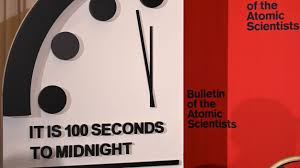
Doomsday Clock unchanged: scientists, https://www.canberratimes.com.au/story/7589207/doomsday-clock-unchanged-scientists/?cs=14232 The Doomsday Clock has remained at 100 seconds to midnight for a third year in a row as scientists said the world is “no safer” than it was this time last year.
Maintaining last year’s setting means the clock’s keepers believe the threat of global apocalypse has not cooled off in the past 12 months.
Rachel Bronson, president and chief executive of the Bulletin of the Atomic Scientists, said: “This year, in our statement, the science and security board highlights several bright spots and many disturbing trends.
The board describes a mixed-threat environment, one with positive developments counteracted by accelerating negative ones.
“Today, the members of the science and security board deem the world to be no safer than it was last year at this time, and therefore have decided to set the Doomsday Clock at 100 seconds to midnight.
“The Doomsday Clock continues to hover dangerously, reminding us how much work is needed to ensure a safer and healthier planet. We must continue to push the hands of the clock away from midnight.”
Small nuclear reactors for Scotland? Expensive, unpopular, and not even small
Nuclear power in Scotland: ‘Small modular reactors’ are expensive, will be
unpopular and they’re not even small – Dr Richard Dixon. The final
shutdown of reactor number four at Hunterston and the announcement the two
reactors at Torness will cease operating in 2028 have led nuclear
enthusiasts to talk even more about small modular reactors. Even if you
were not worried about creating yet more radioactive waste for which we
have no long-term storage solution and the £132bn public-money bill for
decommissioning and you were not worried about terrorists blowing up
reactors or just the likely delays and cost over-runs, these small(ish)
reactors still aren’t likely to become a reality.
Scotsman 20th Jan 2022
Nuclear Safety Authority (ASN) warns France on problems, costs, safety in nuclear projects
The French nuclear industry will need a “Marshall plan” to carry out new
projects, warned Wednesday the Nuclear Safety Authority (ASN), which also
calls on France to re-examine the scheduled closure of 12 reactors and
alert on increasingly fragile management of spent fuel from the EDF fleet.
Les Echos 19th Jan 2022
Doomsday clock stays at 100 seconds to midnight.

What the Doomsday Clock is really counting down to, The number of human-made existential risks has ballooned, but the most pressing one is the original: nuclear war. Vox, By Bryan Walsh @bryanrwalsh Jan 21, 2022 One hundred seconds to midnight. That’s the latest setting of the Doomsday Clock, unveiled yesterday morning by the Science and Security Board of the Bulletin of the Atomic Scientists.
That matches the setting in 2020 and 2021, making all three years the closest the Clock has been to midnight in its 75-year history. “The world is no safer than it was last year at this time,” said Rachel Bronson, the president and CEO of the Bulletin of the Atomic Scientists. “The Doomsday Clock continues to hover dangerously, reminding us how much work is needed to ensure a safer and healthier planet.”
As for why the world is supposedly lingering on the edge of Armageddon, take your pick. Covid-19 has amply demonstrated just how unprepared the world was to handle a major new infectious virus, and both increasing global interconnectedness and the spread of new biological engineering tools mean that the threat from both natural and human-made pathogens will only grow. Even with increasing efforts to reduce carbon emissions, climate change is worsening year after year. New technologies like artificial intelligence, autonomous weapons, even advanced cyberhacking present harder-to-gauge but still very real dangers.
The sheer number of factors that now go into Bulletin’s annual decision can obscure the bracing clarity that the Doomsday Clock was meant to evoke. But the Clock still works for the biggest existential threat facing the world right now, the one that the Doomsday Clock was invented to illustrate 75 years ago. It’s one that has been with us for so long that it has receded into the background of our nightmares: nuclear war — and the threat is arguably greater at this moment than it has been since the end of the Cold War.
The Doomsday Clock, explained
The Clock was originally the work of Martyl Langsdorf, an abstract landscape artist whose husband Alexander had been a physicist with the Manhattan Project. He was also a founder of the Bulletin, which began as a magazine put out by scientists worried about the dangers of the nuclear age and is now a nonprofit media organization that focuses on existential risks to humanity……………………. https://www.vox.com/22893594/doomsday-clock-nuclear-war-climate-change-risk
European States opposing inclusion of nuclear in ‘green’ taxonomy warn on diverting investement from genuinely clean technologies.
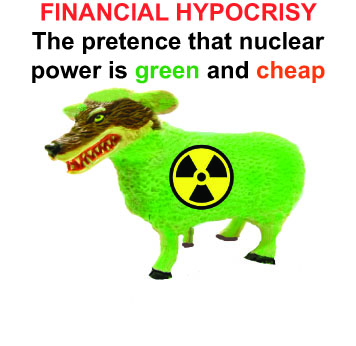
Austria, Denmark, Luxembourg and Spain continue to reject natural gas and
nuclear in the EU’s sustainable finance taxonomy, their energy and
climate ministers have said in response to a recent draft proposal.
The European Commission’s proposed conditions under which investments in
natural gas-fired and nuclear power plants would be deemed “green” in a
draft updated taxonomy sent “the wrong signals to financial markets and
seriously risks being rejected by investors,” the ministers said late on
Thursday.
The taxonomy aims to help investors identify suitable projects
that support the EU’s climate goals. It does not require investments in
projects that meet the criteria nor prohibit investments in projects that
do not. The ministers argued, however, that the long lifetimes of natural
gas and nuclear plants meant that including them in the taxonomy could lock
in their use for many decades and divert investments away from renewables.
Montel 21st Jan 2022
https://www.montelnews.com/news/1294402/four-eu-nations-reject-gas-nuclear-in-green-taxonomy
Does the Flamanville EPR nuclear reactor have a design fault?

Nuclear: is the Flamanville EPR vessel poorly designed? In its edition of
Wednesday January 19, 2022, Le Canard Enchaîné details the problem on the
Taishan EPR and links it to the Cotentin site. “EDF is struggling to sleep
off its nuclear”. This is the title at the top of page 3 of the Chained
Duck of this Wednesday, January 19, 2022.
Is this a new article following the announcement, a week ago, of a delay and an additional cost of 300
million euros for the construction of the future Flamanville EPR reactor?
No, there is no question of re-welding operations taking longer than
expected.
“The energy company must face a formidable puzzle encountered on
the reactor vessel, where nuclear fission takes place”, immediately
announces the journalist Hervé Liffran. The concern was flushed out
following an incident on the other side of the world, in China. The Taishan
nuclear power plant, with the world’s first operating EPR reactor, was shut
down on July 30, 2021, after damaged fuel rods caused a buildup of
radioactive noble gases in the reactor’s primary circuit .
La Presse de la Manche 20th Jan 2022
1 This Month



19 November – Webinar – The Reality of Reprocessing
Time: 11:00 AM Pacific Time (US & Canada) / 2:00 PM Eastern / 7:00 PM UK / 8:00 PM CET
Register for the Zoom Event Here



Shut down the radiation-damaged Heysham nuclear reactors now
To see nuclear-related stories in greater depth and intensity – go to https://nuclearinformation.wordpress.com

Say No to NASA’s Reckless Nuclear Reactor on the Moon
Say No to NASA’s Reckless Nuclear Reactor on the Moon
-
Archives
- November 2026 (74)
- October 2026 (302)
- September 2026 (339)
- August 2026 (330)
- July 2026 (355)
- June 2026 (287)
- May 2026 (306)
- April 2026 (356)
- March 2026 (251)
- February 2026 (267)
- January 2026 (308)
- December 2025 (358)
-
Categories
- 1
- 1 NUCLEAR ISSUES
- business and costs
- climate change
- culture and arts
- ENERGY
- environment
- health
- history
- indigenous issues
- Legal
- marketing of nuclear
- media
- opposition to nuclear
- PERSONAL STORIES
- politics
- politics international
- Religion and ethics
- safety
- secrets,lies and civil liberties
- spinbuster
- technology
- Uranium
- wastes
- weapons and war
- Women
- 2 WORLD
- ACTION
- AFRICA
- Atrocities
- AUSTRALIA
- Christina's notes
- Christina's themes
- culture and arts
- Events
- Fuk 2022
- Fuk 2023
- Fukushima 2017
- Fukushima 2018
- fukushima 2019
- Fukushima 2020
- Fukushima 2021
- general
- global warming
- Humour (God we need it)
- Nuclear
- RARE EARTHS
- Reference
- resources – print
- Resources -audiovicual
- Weekly Newsletter
- World
- World Nuclear
- YouTube
-
RSS
Entries RSS
Comments RSS

