Report that Chinese drones are spying on UK nuclear sites, including submarines
Chinese agents are using drones to spy on our nuclear bases, defence
chiefs warn. They believe Beijing spooks are behind 18 drone sightings
above military sites and power stations in just two years. The disclosure
follows warnings by intelligence chiefs that China is intent on stealing
our most sensitive secrets. The Sunday People uncovered details of the
drone activity under Freedom of Information laws. And Lieutenant Colonel
Philip Ingram, a former intelligence officer, told us: “The Chinese have
a very mature and sophisticated espionage programme running throughout the
UK.
Mirror 23rd April 2022
https://www.mirror.co.uk/news/uk-news/chinese-spies-use-drones-spy-26781649
Portsmouth News 24th April 2022
Over a third of the world’s uranium is supplied by Russian-owned sources
| The European nuclear power sector is highly dependent on imports of Russian uranium, according to a report by NGOs Friends of the Earth Germany (BUND), the Nuclear Free Future Foundation, the Rosa Luxemburg Foundation, Greenpeace and Ausgestrahlt. In 2020, EU countries received 20.2 percent of their uranium needs from Russia and another 19.1 percent came from Russian ally Kazakhstan, according to the report. The dependency on Russian uranium is highest in Eastern Europe, where 18 nuclear power plants are calibrated to use the hexagonal fuel elements provided by Rosatom. This Russian statecorporation also has shares in uranium mines in Canada, the USA and above all Kazakhstan, making it the second largest uranium producer in the world, the report states. More than a third of the global demand for enriched uranium, which is needed for the operation of nuclear power plants, comes from the Russian company. According to German nuclear power plant operator PreussenElektra, Germany’s three remaining reactors are also mainly running on Russian and Kazakh uranium. Clean Energy Wire 22nd April 2022 https://www.cleanenergywire.org/news/europe-highly-dependent-russian-uranium-nuclear-power-plants-report |
Take uranium contamination off our land, Navajos urge federal nuclear officials
By Marjorie Childress, New Mexico In Depth | April 23, 202
The gale-force winds that swept across New Mexico on Friday, driving fires and evacuations, gave Diné residents in a small western New Mexico community an opportunity to demonstrate first hand the danger they live with every day.
Nuclear Regulatory Commission (NRC) members were in the Red Water Pond Road community, about 20 minutes northeast of Gallup, to hear local input on a controversial plan to clean up a nearby abandoned uranium mine. It was the first visit anyone could recall by NRC commissioners to the Navajo Nation, where the agency regulates four uranium mills. Chairman Christopher Hanson called the visit historic, and the significance was visible with Navajo Nation President Jonathan Nez and other Navajo officials in attendance.
As commissioners listened to 20 or so people give testimony over several hours Friday afternoon, high winds battered the plastic sheeting hung on the sides of the Cha’a’oh, or shade house, making it hard for some in the audience of many dozens to hear all that was said. “This is like this everyday,” community member Annie Benally told commissioners, mentioning the dust being whipped around outside by the wind. “They say it’s clean, it’s ok. But we have more piles back there and you see it blowing this way.”
Benally was referring to piles of contaminated radioactive soil and debris at two adjacent abandoned uranium mines. One mine is near enough to the shade house that its gate is visible. The U.S. Environmental Protection Agency wants to move some of that waste to a mill site regulated by the NRC, where contaminated groundwater is still being cleaned up. To drive north of Church Rock to the Red Water Pond Road community is to appreciate how close that mill site is to the surrounding community. It sits one mile south of the shade house, on private land but right next to a highway driven every day by local residents.
After Friday afternoon’s listening session, the federal commissioners conducted a public meeting in Gallup in the evening where they heard from EPA officials. The NRC is expected to decide in June whether or not to permit the EPA to move the mine debris to the mill.
The swirling dust outside was a consistent theme during the Friday afternoon session as residents described a generational struggle with significant health risks from uranium contamination.
…………………………….. The multiple hours of testimony concluded with remarks by Nez, who put a point on the message residents were sending: the mining waste should be moved completely outside of their community.
“This is what the Navajo people live with, just imagine 500 open uranium mines on a windy day,” Nez said. “…the Navajo people in this area have lived with this for a very long time, so we plead with you, I plead with you, let’s get this waste, and get it way far away from the Navajo Nation.”
The EPA cleanup plan wouldn’t move the contamination far, though, just to the nearby mill site. At the public meeting Friday evening, NRC commissioner Jeff Baran asked San Francisco-based EPA Region 9 Superfund and Emergency Management Director Michael Montgomery whether there are other disposal locations outside Indian country but still reasonably close.
Montgomery said current law only allows the EPA to go so far. It can’t site or create facilities for disposal, or ask a private party to do it either, he said. The agency is working to identify locations on federal land for other mine cleanups, Montgomery said, but for the Church Rock area there are no easy solutions for taking the waste out of Indian country. Should the NRC not approve the current plan, the agency would be at an “impasse” that would take years to move beyond, he said.
Montgomery suggested that Navajo aspirations to remove all uranium mine waste from their land would be difficult to achieve by the EPA alone. “If the solution for all the mines is to take all the waste off of tribal land, it’s going to require a dialogue that’s possibly outside our authority,” he said.
Montgomery’s answers seemed to confound Baran. “Would EPA proceed with the mill site option if the community it is meant to benefit opposes it?” he asked.
“There are a lot of perspectives within the community,” Montgomery said. “You can’t always get everyone to agree.”
Nez challenged those remarks later in the meeting after Baran asked him if he wanted to respond to any of Montgomery’s comments.
“I’ve heard a hundred percent of my Navajo relatives there say they didn’t want the waste. So I’m just wondering who are these individuals who can’t agree?” he asked.https://nmpoliticalreport.com/2022/04/25/take-uranium-contamination-off-our-land-navajos-urge-federal-nuclear-officials/
Olaf Scholz cites risk of nuclear war in refusal to send tanks to Ukraine
Politico, BY LAURENZ GEHRKE.April 22, 2022
Chancellor pushes back against demands from Kyiv and coalition partners. Asked what made him sure that sending German tanks to Ukraine would trigger a catastrophic reaction from Russian President Vladimir Putin, Scholz argued that “there is no textbook for this situation where you can read at what point we are perceived as a belligerent.”
“That’s why I’m not squinting at poll numbers or letting myself be irritated by shrill calls,” the chancellor added in an obvious reference to the growing criticism of his stance at home and abroad. “The consequences of a mistake would be dramatic,” he said.
The Ukrainian government has called on Western allies to urgently send large amounts of heavy weaponry to help in the fight against Russia’s invasion, which has now entered a new phase focused on the east of the country…………
Echoing remarks by Defense Minister Christine Lambrecht, Scholz said that instead of Berlin directly supplying heavy weaponry, several Eastern European NATO partners would deliver weapons from Soviet-designed stocks that “can be deployed without lengthy training, without further logistics, and without soldiers from our countries.”
Germany would then “gradually fill the gaps created by these deliveries … as just discussed in the case of Slovenia,” he said. https://www.politico.eu/article/germany-chancellor-olaf-scholz-nuclear-war-tanks-heavy-weapons-ukraine-russia-invasion/
French election: Macron and Le Pen’s nuclear plans torn apart: ‘Waste of time AND money’
FRENCH presidential hopefuls Emmanuel Macron and Marine Le Pen have unveiled ambitious plans to boost France’s nuclear power capacity – already at 70 percent of its domestic electricity generation – but experts have questioned the feasibility.
By IAN RANDALL, , Apr 24, 2022
The recent emphasis on large-scale nuclear reactors is, at least superficially, seemingly at odds with President Macron’s announcement late last year that France would be investing in so-called small modular reactor designs as part of his “France 2020” roadmap.
……………… Of the strategy’s allocated €30billion (£25.2billion) budget, €8billion (£6.7 billion) is to be apportioned towards the development of hydrogen power, compared with just €1billion (£0.8billion) towards small-scale reactor concepts.
Despite this funding disparity, however, Mr Macron asserted that the realisation of the small modular reactors was in fact “goal number one”……………………………. https://www.express.co.uk/news/science/1600032/french-election-energy-macron-le-pen-grand-nuclear-plans
Hibakusha renews call for nuclear abolition
Hibakusha renews call for nuclear abolition, https://www3.nhk.or.jp/nhkworld/en/news/20220425_01/
Concerns about the possibility of nuclear warfare are growing as Russia’s invasion of Ukraine drags on.
A Japanese hibakusha, an atomic bomb survivor, shared her experiences in a virtual event organized by a group of university students in Tokyo on Sunday.
Wada Masako was one year old when an atomic bomb was detonated by the US Army over Nagasaki in 1945.
She was too young to remember that day, but her mother often told her what it was like to walk through the city in the bombing’s aftermath.
Wada said, “my mother told me people were stumbling around, their hair caked with blood. She said their clothes were in tatters, and one couldn’t tell whether they were men or women.”
She has been involved in the nuclear abolition movement for much of her life. She participated in rallies in New York City to support the adoption of the UN nuclear ban treaty.
Wada says she was shocked by Russia’s invasion of Ukraine, and President Vladimir Putin’s recent threats to use nuclear weapons.
She said, “I’m worried there may soon be new hibakusha. I want everyone to know that what we have right now is a crisis. I want to tell them what happens when nuclear weapons are used.”
Wada said she hopes for real progress toward abolition at the first meeting of the parties to the nuclear ban treaty this June. She believes the advocacy of young people from Japan and around the world will only strengthen the movement.
She also urged the Japanese government to participate in the conference, and take an active role in the abolition movement. Japan has refused to join the ban treaty as it is under the US nuclear umbrella.
No more nuclear power plants, no more war! 〜4.16 “Sayonara Nuke Plant Metropolitan Area Rally” was held.

On April 16, at 1:30 p.m., a “Sayonara Nuclear Power Plant Metropolitan Area Rally” was held at Kameido Chuo Park in Tokyo. Eleven years have passed since the Fukushima nuclear power plant accident, and the decommissioning of the plant, a gigantic accident unparalleled in the world, is still not in sight. The government and TEPCO are forcing the release of ALPUS contaminated water into the ocean. They are trying to pollute the sea of Fukushima again. Without taking into account the lessons learned from the accident, the government has formulated a new basic energy plan that calls for nuclear power plants to account for 20 to 22% of the nation’s power supply by 2030. This is based on the premise that 30 nuclear reactors will be restarted. Furthermore, the government is aggressively trying to extend the life of the broken nuclear fuel cycle. The Fukushima nuclear accident has ushered in an era of nuclear decommissioning, and public opinion strongly demands it. Now is the time to raise the voice of “good-bye nuclear power plant” and create a swell for nuclear power plant phase-out! (Report by Toshikazu Miyagawa)

Organized by Citizens’ Circle for 10 Million Signatures for “Sayonara Nuclear Power Plant
Music】13:00 Nisshikawa meets Folk
Opening】13:30
Organizer’s Greeting: Toshi Kamada (Reportage writer)
The current situation is that Russia’s invasion of Ukraine is openly taking place, but cannot be stopped. Biden calls it a holocaust, but speaking of holocaust, we have experienced enormous damage from air raids and the dropping of nuclear power plants. With the invasion of Ukraine, the conservative Liberal Democrats, like fish out of water, talk about possessing nuclear weapons and attacking enemy bases. The Russians are digging trenches and exposing themselves to massive radiation in an attempt to overrun the Chernobyl nuclear power plant. Nuclear power plants are playing the same role as nuclear bombs; a ceasefire and an end to the war must be put in place as soon as possible. This is the first gathering in a long time to spread the peace movement. Let’s work hard until there are no more nuclear power plants, until there are no more wars!
Solidarity speech】】 ◆ “From Fukushima
◆”About the Fukushima Nuclear Power Plant Criminal Complaint Trial” by Ms. Akiko Uno from Fukushima
I am happy to be able to speak in front of so many of you. Those who were evicted and evacuated due to the nuclear accident left everything behind. Some of them lost their lives. There are still more than 60,000 people in Fukushima. There are 293 children with thyroid cancer in Fukushima alone, more than one in 10,000. We must stop the discharge of contaminated water into the sea. The government has abandoned what it learned from the nuclear accident. We will seek a fair trial and work hard until the end.
◆”Japan Power Supply obstructs the postponement of the judgment on Rokkasho Reprocessing Plant” by Mr. Kiyohiko Yamada
I will run for Rokkasho village mayor on June 12. I have been vocal about the seriousness of the nuclear fuel cycle. I will do my best with the pledge “because I am afraid.
◆”About the Tokai No.2 Nuclear Power Plant Operation Injunction Trial” by Mr. Mitsunobu Oishi
The fight has moved to the Tokyo High Court. Last year, Mito District Court ruled that Tokai No.2 Nuclear Power Plant should not be operated. I believe this is in response to the Fukushima No.1 nuclear power plant accident. 1 year has passed and it has not started. Evacuation must be effective. The Tokyo High Court tries to overturn this. Eleven years of struggle since the nuclear accident has revealed the truth. It was the trial that revealed the truth over the past decade. We will do our best until the Supreme Court in a struggle that is etched in history.

◆Hideyuki Bamba on Russian invasion and occupation of nuclear power plants
The unexpected Russian invasion of Ukraine, from the control of the Chernobyl nuclear power plant to the exposure of Russian soldiers to radiation at nuclear facilities. The Zaporozhye nuclear power plant, the best in Europe, was also temporarily overrun. Nuclear power plants are always in danger of being targeted. In Japan, an attack on a nuclear power plant would be a disaster. We must accept the danger and work hard to end nuclear power generation in Japan.
◆Assistance to Ukraine Mr. Tsutomu Taguchi (YMCA)
The YMCA in Russia and Ukraine has been promoting friendship activities from the standpoint of citizens. Individual income in Ukraine is 1/5 of that in Japan, and it is not possible for individuals to travel to Ukraine for evacuation. Individuals cannot evacuate to Japan due to difficulties with administrative procedures. The main evacuees to Japan are women. In Ukraine, 90% of women go to university, work after marriage, and have no sense of being housewives; everyone has a desire to work. In Japan, securing a place to work is also an issue.
Closing remarks】 【Closing remarks
◆Mr. Keiko Ochiai
I saw the trees and thought again that spring has come to a country with nuclear power plants, although it is natural. What kind of words will be used to describe Putin’s invasion of Ukraine? The fact that people are living in a country with nuclear power plants. We must not cease. There are 15 nuclear reactors in Ukraine. Japan is the same. How much suffering did we suffer 11 years ago in the spring? We have not been able to reduce even one of those sufferings. We should not endure it. Our only pride is that we have fought. We can fight against power, it is our treasure. We do not want to be victims. We do not want to look back on the sorrow of Fukushima. We do not want to be perpetrators against anyone. That is our pride. The environment may not change in the future. But, since it won’t change, it is not cowardly not to do it. Let’s do our best to make peace properly.
March】14:45
■Venue→Kinshicho Station area
http://www.labornetjp.org/news/2022/0416hokoku?fbclid=IwAR1F6zxaj7UIxTNik40gJrSloPwbR7_jUV7VrEIDwcxUc-lIh2Enbvpbj6A
Is a long, bloody war between Russia and Ukraine really in our national interest?

https://www.thenation.com/article/world/ukraine-us-nuclear-war/ By David Bromwich, 22 Apr 22
Russia invaded Ukraine in violation of international law, and now we stand on a precipice. Advocates of war are saying that World War III has already begun, and the United States should therefore plunge in. How can they say that? People may finally hurl themselves into an abyss from the sheer terror of falling.
I learned something about this mood from a retired Foreign Service veteran. On October 27, 1962, he was sitting in the next room, listening on an intercom with second-echelon State Department officials while President Kennedy and his advisers discussed the appropriate response to Russian missiles in Cuba. As we now know, Kennedy barely held off an almost unanimous recommendation to bomb. What my informant vividly recalled was the mood of decision. They all recognized that a nuclear war would be a catastrophe of unimaginable dimensions; but at a certain point, the momentum seemed irresistible. “I thought to myself,” he said, “OK, let’s just do this.”
That state of mind—of blank acceptance (because they had already come so far)—“lasted,” he continued, “for about 20 minutes. Then, somehow, I came to my senses. But I’ve thought of that moment ever since. I was willing to ‘live with’ the end of the world. It showed me what we are capable of—what I was capable of.”
Joe Biden has long been a man given to sentimental avowals and reckless denunciations. He was indulged for half a century; the slips were easily exposed and of no large consequence. His rhetorical effervescence took on a graver aspect in mid and late March, when he called Vladimir Putin a war criminal, broke with the US renunciation of chemical weapons by saying we would use them in retaliation if Russia used them, told members of the 82nd Airborne Division that they would soon be deployed in Ukraine, and signaled a wartime goal of regime change in Russia: “For God’s sake, this man cannot remain in power.”
When a leader speaks of an international rival with unbounded contempt, it renders negotiation impossible. Yet the president’s advisers, Secretary of State Antony Blinken and national security adviser Jake Sullivan, have done little to blunt his message. Congress, too, is full of members who yesterday could not have found Ukraine on a map but today want US missiles to shoot down Russian planes. The US/NATO plan looks forward to a long and bloody war, hundreds of thousands of Ukrainians and Russians killed, Ukraine vindicated and the Russian economy destroyed.
Is this a probable result? Is it desirable?
There is a broader allegorical battle in which many Americans now imagine us playing a part. We—along with our surrogate, Ukraine—stand for democracy, civilization, and enlightenment. Russia is tyranny, barbarism, darkness and dirt and gas.
The push for a bigger war draws enormous strength from the weapons lobby, of course, but another influence is the daily inundation of headlines. Consider The New York Times, April 10: “Russia Resets Military Command as Western Arms Pour In.” April 15: “Russian Flagship Sinks in Black Sea; E.U. Could Ban Oil” It has been permanent Ukraine, all day and every day, with a drumbeat that exceeds any comparable string of headlines during Afghanistan and Iraq. This is a foreign war that the Times and The Washington Post, CNN, NPR, and all the old networks cover as if it were being fought on American soil.
The columnists have followed close behind. On April 13, the Times’ Bret Stephens asked: “What Do We Do if Putin Uses Chemical Weapons?” His answers, fluent and brash, led off with approval of cyberwarfare against Russian pipelines, and proceeded to a series of excited subheads: “Tear apart Russia’s supply chains,” “Arm Ukraine with offensive weapons,” “Plan for a long war.” Writers of humbler strategic ambitions have written accusingly of American faintheartedness. A recent George Packer column in The Atlantic was listed in the magazine’s online “ideas archive” as “Can We Be Worthy of Ukraine?” while the article itself was titled “I Worry We’ll Soon Forget About Ukraine.”
This posture of sorrow and humility, the prayer We are not worthy in homage to people living a higher moral reality, owes much to an undeserved nostalgia for the Cold War. More insistently, our opinion-masters look to the example of World War II. The zealots want another good war like that one; and Volodymyr Zelensky has breathed new life into their yearning. He is courageous, and his appeals are convincing; but
the truth is that Zelensky is a target from more than one direction: the Russian Army facing him and, at his back, the Azov Battalion and the neofascist militias, who fear him as little as they love the Russians, and whose actions many months ago nullified his election promise to negotiate peace in the Donbas. Even now, Zelensky could save most of his country and many lives if the United States strongly backed negotiations; but our leaders and munitions-makers agree that Ukraine must go on fighting.
What still seems barely possible, at press time, is a solution that Zelensky has come halfway to suggesting, with no encouragement from the US or its European dependents: namely, a neutral Ukraine, part of the Western European community in most respects but not a member of NATO; autonomous status for the Donbas, the details to be decided perhaps by referendum; and Russian troops withdrawn, never to return. Admittedly, this would disappoint believers in a worldwide struggle-to-the-death from which either tyranny or democracy must emerge the final victor.
Words are going to matter more than usual in the next few weeks. The let’s just do this mood is as deranged now as it was in 1962. Trap the invader in a tight enough corner, choke off all the exits, make him feel he has nothing to lose, and he will drive the world off a cliff as surely as our generals and think-tank adepts, our senators and columnists. “I am,” says Macbeth, “in blood / Stepped in so far that, should I wade no more, / Returning were as tedious as go o’er.” We had better step back before we step any further. AT TOP https://www.thenation.com/article/world/ukraine-us-nuclear-war/
Mariupol – city under siege – the OTHER SIDE OF THIS STORY
Sonja van den Ende, an independent journalists, traveling with the Russian military into the liberated areas of The Donbass. She has been into the liberated cities, towns and villages and met with many of those who have survived. She saw Russian humanitarian aide trucks delivering food, water and other essentials, as well as many buses and ambulances to evacuate the people and the injured. She reports that many had been shot in the legs by Ukrainian Nationalist troops or Azov brigades. sonjavandenende@gmail.com
Ukraine: The End Game – A Proxy War and Armageddon – Who are the Flag Waivers supporting?
Bruce Gagnon in a wide-ranging discussion on the false flag in Bucha, Americans waiving Ukrainian flags, Elinsky a hero in the USA, tens of thousands of mercenaries fighting in Ukraine, armed, trained, and directed by the USA. One of the most important articles about the history and current events in Ukraine: https://www.thepostil.com/author/jacq..
Ukraine threatens ‘terrorist’ attack on Crimean Bridge – the longest bridge in Europe
 |
https://www.sott.net/article/467022-Ukraine-threatens-terrorist-attack-on-Crimean-Bridge
RT, Thu, 21 Apr 2022 ,
Ukrainian official said if Kiev had the chance, it would have struck the Crimean Bridge long ago and would still do so, if the possibility arises
Russia has responded to recent threats by Ukraine’s armed forces about a potential strike on the Crimean Bridge, which connects the peninsula to the rest of the country. Kremlin spokesperson Dmitry Peskov said on Thursday:
“Such statements are nothing less than the announcement of a possible terrorist act. This is unacceptable. There are many signs here of deeds that are subject to legal verification and subsequent punishment.”
It comes comes after Alexey Danilov, the secretary of the National Security and Defense Council of Ukraine, stated on Wednesday that if Kiev had the chance, it would have struck the Crimean Bridge long ago, and that its armed forces would do it now if possible.
Danilov, in an interview with Radio NV, when asked if Ukraine could strike the Crimean Bridge, since it is being used to send reinforcements, said:
“If we had the opportunity to do this, we would have done it already. If there is an opportunity to do this, we will definitely do it.”
Former Russian president and current head of the National Security Council Dmitriy Medvedev also replied to the threat by writing in his Telegram channel that
“One of the hard-nosed Ukrainian chiefs spoke of the need to strike at the Crimean Bridge. I hope he understands what will be the retaliatory target.”
Construction of the Crimean Bridge, also known as the Kerch Strait Bridge began in 2016 and was completed two years later. The multibillion-dollar infrastructure project connects the Crimean peninsula with Krasnodar Krai in Russia’s southwest. At 19km, it is the longest bridge in Europe and allows the passage of cars and trains, and has been used by Russia to transport armored vehicles into the southern regions of Ukraine amid the ongoing military conflict between Moscow and Kiev.
Russia attacked the neighboring state in late February, following Ukraine’s failure to implement the terms of the Minsk agreements, first signed in 2014, and Moscow’s eventual recognition of the Donbass republics of Donetsk and Lugansk. The German and French brokered protocols were designed to give the breakaway regions special status within the Ukrainian state.
The Kremlin has since demanded that Ukraine officially declare itself a neutral country that will never join the US-led NATO military bloc. Kiev insists the Russian offensive was completely unprovoked and has denied claims it was planning to retake the two republics by force.
The big mistake of sudden renewed optimism about nuclear power

The global scramble for fuel after Russia’s invasion of Ukraine has decidedly ended any debate over whether nuclear energy should be part of the world’s new renewable era. Governments in Europe, Asia and the US have all recently overridden environmental concerns about radioactive waste and nuclear accidents to recommit to nuclear power plants as a part of any transition away from oil and gas.
As the world celebrates Earth Day this weekend, the return of nuclear energy harks back to the 1970s, before the accidents at Three Mile Island and Chernobyl scarred its reputation as a safe and cheap alternative to oil and gas.
But the sudden spurt of nuclear optimism from Washington to London is little more than a political feint.
By the time most proposed nuclear projects are paid for and developed, in a decade or more, we will be either well into a new chapter of solar and wind energy dependence or dashed against the globally-warmed rocks of fossil fuel hubris.
Next week, the Biden administration will commit up to $6bn of its infrastructure bill to preserving almost 100 ailing nuclear power plants for future use. Plans to transform closing coal plants – and their
workers – into nuclear facilities, are taking shape. Nuclear power currently makes up about 20 per cent of US energy usage, compared to wind (9 per cent) and solar (3 per cent), according to the US Energy Information Administration.
In Europe, harsh condemnation of nuclear power in places such as Germany, the UK and Brussels has given way this spring to the political expediency of siding with countries such as France, which have
long supported nuclear power. Belgium, for example, has changed its mind and recommitted to building new power plants. Poland plans to build new ones. France has doubled down and even the UK’s Boris Johnson has placed new nuclear facilities squarely within his government’s new energy strategy, even at the expense of onshore wind farms. He wants to move Britain’s nuclear mix to 25 per cent by 2030 from 16 per cent.
The energy crunch caused by Ukraine is an immediate crisis, not one that can be fixed with long-term, expensive solutions. While Europe – and the rest of the world – must think long term to mitigate global heating and stop burning fossil fuels, the decreasing costs of other renewable energies such as wind, solar, and tidal will eventually catch up with expensive alternative plans. Likely faster than we all think, given the reduction in their costs over the past 10 years.
Independent 21st April 2022
https://www.independent.co.uk/voices/earth-day-nuclear-energy-fuel-energy-b2062615.html
Overwhelming majority of Members of European Parliament oppose inclusion of nuclear power in Europe’s taxonomy as ”green”

MEPs set to block plan deeming nuclear and gas energy ‘green’
McGuinness seeks to use EU taxonomy of environmentally sustainable activities
Irish Times, Naomi O’Leary, 22 Apr 22, Europe Correspondent A plan by Ireland’s European Commissioner Mairead McGuinness to classify nuclear and gas energy as “green” is facing major opposition in the European Parliament, with MEPs preparing to block the move.
The so-called EU taxonomy was intended as a classification system to label economic activities that are environmentally sustainable in an attempt to direct private investment to industries that help the green transition.
But an attempt by the commission, fronted by Ms McGuinness, to add gas and nuclear to this list is facing a kill vote in the parliament, backed by MEPs from her own centre-right political group, according to the results of an internal consultation seen by The Irish Times.
MEPs from the European People’s Party, of which Fine Gael is a member, have joined with those from the centre-left Socialists and Democrats; Renew, of which Fianna Fáil is a member; the Greens; and the Independents’ Left group, to which Sinn Féin is affiliated, to back an objection that could block the change from coming into force.
At the parliament’s environment and economy committees, an overwhelming majority of 115 MEPs chose to object to the commission’s move, with just 23 from the hard-right Identity and Democracy and ECR groups opting to acquiesce to the addition of nuclear and gas to the taxonomy, the results show.
The MEPs now have weeks to approve a joint objection text in committees. It would then go to a full vote in the European Parliament in its July session, where a majority of at least 353 MEPs would be sufficient to stop gas and nuclear being added to the taxonomy.
Russia’s invasion
The majority is easily achievable if the same political groups back the objection as they have in the committee stage. Observers believe that if the commission’s move is blocked in July, there would be little political will to make another attempt given the difficulties that have dogged the file and the additional controversy that now surrounds gas since Russia’s invasion of Ukraine……………………………………………
The move to add green and nuclear to this list is being done as a so-called “delegated act” – something which updates existing EU legislation rather than creating new law, and does not need the usual vote of approval by the European Parliament to come into force. It can, however, be blocked by an objection procedure backed by a majority of MEPs.
The opposition of MEPs to adding gas and nuclear to the taxonomy is grounded in doubts about the inherent merits of the move, but also in opposition to the commission’s method in using a delegated act to do it………………………….. https://www.irishtimes.com/news/politics/meps-set-to-block-plan-deeming-nuclear-and-gas-energy-green-1.485
Russia makes another offer to besieged Ukrainian forces

https://www.sott.net/article/467013-Russia-makes-another-offer-to-besieged-Ukrainian-forces RT, Fri, 22 Apr 2022,
Ukrainian troops and members of the Neo-Nazi Azov battalion, who remain at the surrounded Azovstal steel plant in Mariupol, can still surrender to the Russian military, the Defense Ministry explained on Friday.
A day earlier, Moscow announced the capture of Mariupol, with President Vladimir Putin calling off the assault on Azovstal, which remains the last holdout of the Ukrainian forces in the strategic port city. Russian troops should “seal the area so that a fly cannot get through,” he instead ordered.
In its fresh statement, the Defense Ministry pointed out that the offer to surrender for those inside the facility remained in place. “At any given moment, Russia is ready to introduce a ceasefire and announce a humanitarian pause in order to stage the evacuation of civilians (if they’re really in the underground structures of the steel plant) and troops of the Ukrainian armed forces and nationalist battalions.”
The commander of the Ukrainian marines, holed up at the plant, had earlier claimed that “hundreds” of civilians were trapped at the premises. He didn’t explain why the people would voluntarily decide to hide out together with Ukrainian troops, who are under attack by Russian forces.
The Ukrainian fighters and foreign mercenaries only need to raise white flags along the perimeter of Azovstal to be able to surrender. “This humanitarian offer by Russia remains in force 24/7,” according to the statement.
Their lives are guaranteed to be spared, and they will also be provided with medical assistance – just like other combatants, who chose to stop resisting earlier, the Russian side insisted.
According to the ministry, the humanitarian corridors, organized by the Russian forces in Mariupol, have allowed the evacuation of 143,631 Ukrainian civilians, 341 foreign citizens as well as 1,844 Ukrainian servicemen.
Those figures are more proof that claims by Ukraine and the West that Russia is hampering civilian evacuation, or is reluctant to provide necessary conditions for combatants to surrender, are absolutely groundless, it added.
The 2,000 fighters, according to Russia’s estimates, that are holed up at the Azovstal steelworks have been given several opportunities to lay down their arms in recent days, but they have refrained from availing of them.
Intercepted communications from the steel plant suggest that the Ukrainian troops and nationalist battalion fighters are short on food and water and are eager to surrender, but can’t do so without an order from Kiev over fears of being court-martialed.
However, Ukrainian authorities have so far been reluctant to give such a command. On Thursday, President Volodymyr Zelensky claimed that there was still “a military way” to recover Mariupol, but added that it would require the “help of our partners,” apparently referring to Kiev’s backers in the West.
Russia attacked the neighboring state in late February, following Ukraine’s failure to implement the terms of the Minsk agreements, first signed in 2014, and Moscow’s eventual recognition of the Donbass republics of Donetsk and Lugansk. The German and French brokered protocols were designed to give the breakaway regions special status within the Ukrainian state.
The Kremlin has since demanded that Ukraine officially declare itself a neutral country that will never join the US-led NATO military bloc. Kiev insists the Russian offensive was completely unprovoked and has denied claims it was planning to retake the two republics by force.
”Decommissioming” of UK’s dead nuclear reactors is likely to cost the tax-payer much more than planned for.
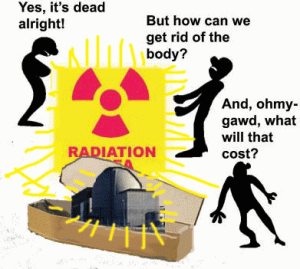
significant additional taxpayer support has been required, and more is likely to be necessary.
there is a risk that the taxpayer will have to make further
contributions.
A report from the UK’s National Audit Office examines whether the
government’s arrangements for decommissioning Britain’s fleet of
advanced-gas-cooled reactors offers value for money.
The UK has eight second generation nuclear power stations accounting for around 16% of total
UK electricity generation in 2020. Seven of the eight stations are Advanced
Gas-cooled Reactors (AGRs), the design of which built on that of the first
generation of now closed Magnox reactors.
Under current plans, all the AGR
stations will have stopped generating electricity by 2028. Decommissioning
is envisaged to take just over 100 years under current plans. The Nuclear
Liabilities Fund (the Fund) was established to meet the costs of
decommissioning all seven AGRs plus a pressurised water reactor at Sizewell
B, but significant additional taxpayer support has been required, and more
is likely to be necessary.
The UK government has provided a guarantee to
underwrite the Fund if its assets are insufficient to meet the total costs
of decommissioning. In 2020, government contributed £5.1 billion ($6.8bn)
to strengthen the Fund’s position and the Fund has recently requested a
further £5.6 billion. The Fund’s assets were valued at £14.8 billion at
the end of March 2021. The aim is that growth in the Fund’s investments
will be sufficient to meet the long-term costs of decommissioning
(currently £23.5 billion).
However, cost estimates have doubled in real
terms since 2004/5. If this trend is maintained and investment growth is
not sufficient, there is a risk that the taxpayer will have to make further
contributions. Last year, the government entered into new arrangements to
decommission the seven AGR nuclear power plants, making EDF Energy
responsible for defueling. The decommissioning of the AGR nuclear power
stations, a 66-page report published by the National Audit Office (NAO)
examines whether these arrangements will lead to better value for money.
The NAO scrutinises public spending to help Parliament hold government to
account and improve public services. It says that while the arrangements
could deliver savings, their success will ultimately depend on the relevant
parties working collaboratively to overcome risks.
Nuclear Engineering International 20th April 2022
https://www.neimagazine.com/features/featurearrangements-for-decommissioning-the-agrs-9640510/
1 This Month



19 November – Webinar – The Reality of Reprocessing
Time: 11:00 AM Pacific Time (US & Canada) / 2:00 PM Eastern / 7:00 PM UK / 8:00 PM CET
Register for the Zoom Event Here



Shut down the radiation-damaged Heysham nuclear reactors now
To see nuclear-related stories in greater depth and intensity – go to https://nuclearinformation.wordpress.com

Say No to NASA’s Reckless Nuclear Reactor on the Moon
Say No to NASA’s Reckless Nuclear Reactor on the Moon
-
Archives
- November 2026 (74)
- October 2026 (302)
- September 2026 (339)
- August 2026 (330)
- July 2026 (355)
- June 2026 (287)
- May 2026 (306)
- April 2026 (356)
- March 2026 (251)
- February 2026 (267)
- January 2026 (308)
- December 2025 (358)
-
Categories
- 1
- 1 NUCLEAR ISSUES
- business and costs
- climate change
- culture and arts
- ENERGY
- environment
- health
- history
- indigenous issues
- Legal
- marketing of nuclear
- media
- opposition to nuclear
- PERSONAL STORIES
- politics
- politics international
- Religion and ethics
- safety
- secrets,lies and civil liberties
- spinbuster
- technology
- Uranium
- wastes
- weapons and war
- Women
- 2 WORLD
- ACTION
- AFRICA
- Atrocities
- AUSTRALIA
- Christina's notes
- Christina's themes
- culture and arts
- Events
- Fuk 2022
- Fuk 2023
- Fukushima 2017
- Fukushima 2018
- fukushima 2019
- Fukushima 2020
- Fukushima 2021
- general
- global warming
- Humour (God we need it)
- Nuclear
- RARE EARTHS
- Reference
- resources – print
- Resources -audiovicual
- Weekly Newsletter
- World
- World Nuclear
- YouTube
-
RSS
Entries RSS
Comments RSS

