Americans Divided on Nuclear Energy
News Gallup poll. BY LYDIA SAAD, 20 May 22
STORY HIGHLIGHTS
- 51% of Americans favor, 47% oppose nuclear energy, similar to 2019
- Recent views contrast with 2004 to 2015, when majorities backed it
- Republicans and independents in favor, but not Democrats
WASHINGTON, D.C. — Americans are evenly split on whether nuclear energy should be a source of electricity in the U.S., with 51% in favor and 47% opposed. Three years ago, the two camps were tied at 49%, while in 2016, the majority (54%) opposed nuclear power.
Americans’ relatively limited support for nuclear energy in recent years contrasts with more solid backing from 2004 to 2015, when majorities of between 53% and 62% favored it.
……………………….. As Gallup has found previously, support for nuclear energy also differs sharply by gender, while it varies modestly by education. Older adults are slightly more positive than those younger than 55, but differences by age have been less consistent over time.
- Sixty-three percent of men versus 39% of women are in favor of using nuclear energy for electricity.
- Support by education ranges from 57% of college graduates to 50% of those with some college experience and 45% of those with no college.
- A 57% majority of adults 55 and older favor nuclear energy, compared with half of 18- to 34-year-olds and 45% of those aged 35 to 54.
………………………………. https://news.gallup.com/poll/392831/americans-divided-nuclear-energy.aspx
France’s woes with nuclear power plants means more energy uncertainty for Europe
The utility cut its forecast as it realised that “stress corrosion” issues affecting some of its reactors will require more checks and repairs. Irish Examiner, THU, 19 MAY, 2022. LARS PAULSSON, JESPER STARN AND FRANCOIS DE BEAUPUY
The woes facing the nuclear power stations at France’s EDF — Europe’s largest electricity producer — will increase the pressure on war-hit European energy markets after the summer.
EDF, which is the backbone of Europe’s integrated power system, cut its nuclear output target for a third time this year, the latest sign that Europe’s power crisis is worsening.
Western Europe has for decades relied on exports of power from EDF’s nuclear stations. The cuts are another blow to European energy security just as the region is weaning itself off Russian supplies of everything from natural gas to coal and oil because of the war in Ukraine.
Less output from EDF is sending prices higher just as soaring inflation is pushing up costs for everything from petrol to food. It could get even worse in winter as France, traditionally an exporter of electricity, may be forced to import more from its neighbours.
French prices are the most expensive in Europe, with contracts for the period almost double levels in Germany. The utility cut its forecast as it realised that “stress corrosion” issues affecting some of its reactors will require more checks and repairs. The outlook for the following year remains unchanged for now, the firm said.
| “We fine-tuned the repairs to be made,” Regis Clement, deputy head of the company’s nuclear division, said during a media conference. “We’ve got to cut more pipes” to carry out further checks “and more repairs to handle”, he said.The big test will come when temperatures start to fall toward the end of the year. It won’t take many days of cold weather to jeopardise French power supplies, according to Emeric de Vigan, chief executive officer at French energy analysis firm Cor-e.“With such poor nuclear availability, if we reach 2 degrees Celsius below normal in the winter for a few days we could be in trouble, it would be really tight,” Mr de Vigan said. Paying customers and factories to lower consumption are steps that likely will need to be taken, he said. ………………. https://www.irishexaminer.com/business/economy/arid-40876541.html |
Five new plutonium buildings for Los Alamos National Laboratory, with the costly funding details rather obscure
Nuclear agency plans five new plutonium buildings at Los Alamos lab, Santa Fe New Mexican , By Scott Wyland swyland@sfnewmexican.com, May 18, 2022
As a further sign Los Alamos National Laboratory is inching toward its 2026 target for making 30 warhead triggers a year, nuclear security managers plan to construct five buildings in the lab’s plutonium complex over the next five years, in part to support that effort.
A new building would be funded annually, beginning in fiscal year 2023, with the aim of supporting production of the bomb cores, known as pits, and other plutonium operations, according to the National Nuclear Security Administration’s budget request for the coming year.
The total cost of the five buildings will be more than $240 million………………….
One critic of the lab’s pit production plans said each of the buildings was priced just under the $50 million threshold that would trigger a more rigorous congressional review.
That might allow the lab to change the office buildings into something else later for a different purpose, such as producing more pits, said Greg Mello, executive director of the Los Alamos Study Group.
“No one ever talked about these costs before,” Mello said. “We don’t think this is the end of the surprises. There are more surprises to come.”
The federal budget for plutonium operations has climbed steeply in recent years, both at the lab and at Savannah River Site in South Carolina, where officials hope to make an additional 50 pits yearly by the mid-2030s.
Under the U.S. Department of Energy’s draft budget, the lab’s plutonium modernization funding would climb to $1.56 billion in 2023 from the current year’s $1 billion, more than a 50 percent increase.
At the same time, the nuclear security agency, an Energy Department branch, has proposed funneling $700 million this coming year toward converting Savannah River Site into a pit factory. That’s a sizable jump from the $475 million spent for that purpose in the last budget cycle………………….
Jay Coghlan, executive director of Nuclear Watch New Mexico, said federal officials want the lab’s pit plant to be able to produce up to 80 pits for short periods.
He contends the lab is likely to use this “surge capacity” given the longer time it will take for Savannah River to begin production…………….. https://www.santafenewmexican.com/news/local_news/nuclear-agency-plans-five-new-plutonium-buildings-at-los-alamos-lab/article_48acffdc-d5fb-11ec-985e-5b26a02df8f5.html
Russia’s grip on Europe’s nuclear power industry – this is being ignored
Europe needs a plan in place for cutting ties with Russia’s nuclear
giant Rosatom, says 2021 Right Livelihood Award winner and co-chairman of
Ecodefense Vladimir Slivyak. With the European Union tightening its
sanctions against Russia, banning Russian imports of oil, gas, and coal has
emerged as one powerful tool to starve the Kremlin’s war machine of
funding it needs to continue its brutal aggression in Ukraine.
But one other major source of Russia’s revenue in Europe has largely remained
unnoticed: Russia’s supplies of nuclear fuel and services to European
nuclear power plants.
Seeking to close this gap in Europe’s concerted
action against the war in Ukraine and to provide a comprehensive picture of
the union’s reliance on Russian nuclear technology, environmentalists
Patricia Lorenz, of Friends of the Earth Europe, and Vladimir Slivyak, a
2021 Right Livelihood Award laureate and co-chairman of the Russian
environmental group Ecodefense, on Wednesday jointly presented Russian Grip
on EU Nuclear Power – an overview of Russia’s businesses and supply
chains serving the European nuclear market.
Eco Defense 19th May 2022
Opposition mounts against 25-year licence extension request from New Brunswick nuclear plant with no long-term waste disposal plan
By Cloe Logan National Observer May 20th 2022 Sitting on the Bay of Fundy, one of the seven wonders of North America, is the Point Lepreau Nuclear Generating Station. New Brunswick Power hopes it will remain there a good long time: the company has asked for an unprecedented 25-year licence extension, prompting pushback during a recent round of public hearings.
Coming into operation in the 1980s, the station is one of four in Canada and the only nuclear power station outside of Ontario. Consisting of a singular CANDU reactor, a heavy-water reactor that generates power, Point Lepreau’s current licence renewal is reaching a close, so the Canadian Nuclear Safety Commission (CNSC) is required to grant a new one. The current term is five years, as was the one before that.
The request to operate until 2047 has raised concerns from numerous people, who say a shorter licence should be granted instead, and during that time, NB Power should focus on a decommissioning plan. So far, the CNSC has suggested a 20-year extension but will release its final decision before June 30, when the current licence expires. If the commission deems more information is needed, it could grant a short extension while deliberating, a spokesperson told Canada’s National Observer.
Many environmentalists oppose nuclear plants of any sort, insisting they stand in the way of cleaner and more sustainable renewable energy, such as wind. Although the CANDU reactor doesn’t directly produce carbon dioxide like oil or gas, the process produces harmful nuclear waste, and opponents say the cost and risk make it a poor solution to the climate crisis.
The concern around waste is top of mind for one Indigenous community — the Passamaquoddy, whose traditional territory includes Point Lepreau where the nuclear reactor is sited. Chief Hugh Akagi said at a public hearing in Saint John last week that a three-year extension would be more reasonable. As an intervenor through the Passamaquoddy Recognition Group (PRG), Akagi is deeply concerned about the nuclear waste resulting from the reactors. Nuclear waste is currently stored at Point Lepreau but will need to be moved elsewhere in the future. He notes there is no plan for long-term storage; the Nuclear Waste Management Organization is currently responsible for finding somewhere to bury the spent fuel but needs to convince a community to take on the responsibility.
| The Passamaquoddy Tribe spans across New Brunswick and Maine’s borders and are a federally recognized group in the States but not in Canada. Although they don’t have First Nations status, the Passamoquoddy in New Brunswick have a government and have been seeking recognition for decades.The nation wasn’t consulted about storing nuclear waste on its land, which goes against the United Nations Declaration on the Rights of Indigenous Peoples Act (UNDRIP), the PRG stated. It pointed to Article 29.2, which says: “States shall take effective measures to ensure that no storage or disposal of hazardous materials shall take place in the lands or territories of Indigenous peoples without their free, prior and informed consent.”………………………… https://www.nationalobserver.com/2022/05/20/news/opposition-against-25-year-licence-extension-request-nb-nuclear-plant |
Cost of shutting down UK’s old nuclear reactors is doubling and then some
The cost of decommissioning the UK’s seven ageing nuclear power stations
has nearly doubled to £23.5bn and is likely to rise further, the public
accounts committee has said. The soaring costs of safely decommissioning
the advanced gas-cooled reactors (AGRs), including Dungeness B, Hunsterston
B and Hinkley B, are being loaded on to the taxpayer, their report said.
Failures in the government’s investment strategy for the fund, which was
set up to pay for the decommissioning, have led to the taxpayer topping it
up by an additional £10.7bn in just two years. The nuclear power stations
are owned by EDF Energy and provide much of the UK’s nuclear
power-generated electricity, which makes up 16% of the energy mix. But the
stations are nearing the end of their lives and are scheduled to stop
generating electricity during this decade. The government has recently
agreed that once the stations have been defuelled by EDF, which involves
the removal of all the spent fuel from the reactor core and cooling ponds,
ownership of the stations will be transferred to the government’s Nuclear
Decommissioning Authority (NDA) to complete decommissioning.
Guardian 20th May 2022
https://www.theguardian.com/environment/2022/may/20/uk-nuclear-power-stations-decommissioning-cost
EDF shares fall after new profit warning due to nuclear outages
Shares in EDF fell 1.8% on Thursday after the French utility warned
outages at its nuclear power plants would result in a steeper-than-expected
cut in power output and thus have a greater than previously estimated
impact on 2022 core earnings. EDF said the impact of the outages largely
related to a program of inspections and repairs the company is carrying out
on some of its reactors would have a negative impact of around 18.5 billion
euros on the group’s core earnings this year instead of the 14 billion
euros previously forecast.
Financial Post 19th May 2022
The U.S. energy secretary says it is critical to find a solution for storing the nation’s spent nuclear fuel.
Energy Secretary: We Must Find a Solution for Nuclear Waste The U.S. energy secretary says it is critical to find a solution for storing the nation’s spent nuclear fuel. By Associated Press, May 20, 2022, JENNIFER McDERMOTT, Associated Press
WATERFORD, Conn. (AP) — It is critical to find a solution for storing the nation’s spent nuclear fuel, U.S. Energy Secretary Jennifer Granholm said Friday during a visit to a nuclear power plant in Connecticut……………………
There’s renewed momentum to figure out a storage site, or sites, to free up the land where the waste is currently being stored and move it away from population centers, fault lines and flood plains………….
There is roughly 89,000 metric tons of used commercial fuel at nearly 80 sites in 35 U.S. states, according to the Nuclear Energy Institute, the industry’s trade association. At 20 of the sites, there’s no longer an operating reactor, the institute said………………..
Democratic U.S. Rep. Joe Courtney is part of a bipartisan congressional caucus working to change how spent nuclear fuel is stored. Its members believe the current system is not sustainable, particularly for sites that could be redeveloped. Many are along the coastline, in flood plains — the worst geology for spent fuel to be stranded, Courtney said.
Congress has provided about $40 million to fund the consent-based siting process that would be used to identify sites to store the nation’s spent nuclear fuel, and the administration asked for $53 million more for fiscal 2023, Courtney said.
Edwin Lyman, director of nuclear power safety at the Union of Concerned Scientists, said his main concern is that planning for consolidated interim storage could undermine efforts to figure out a permanent storage repository underground.
If there’s a place to ship fuel, there won’t be the political momentum to site an underground repository, which is the only plausible, safe, long-term solution for this waste, he said Friday…………… https://www.usnews.com/news/business/articles/2022-05-20/energy-secretary-to-visit-nuclear-plant-discuss-waste-issue
Chernobyl nuclear fears as forest near Exclusion Zone in FLAMES – emergency triggered

CHERNOBYL nuclear fears have surged after a forest near the Exclusion Zone erupted in flames as emergency services battled to extinguish the huge blaze.
By PAUL WITHERS, May 18, 2022 The State Emergency Service of Ukraine reported that litter in the forest near the Chernobyl Exclusion Zone had caught fire. More than a dozen firefighters and four units of equipment were involved in battling to put out the massive fire. At 2.10am local time, the fire had been localised to an area of 45 hectares.
Video footage shared on Twitter shows the forest next to the Exclusion Zone engulfed in flames that are several metres high.
Rescue workers wearing protective face masks are also seen leading a local resident to safety.
The State Emergency Service of Ukraine shared footage of the fire on its Telegram channel.
The service also wrote alongside this: “May 17 near the village. “In the forest of Vyshhorod district, forest litter caught fire.
“During the fire, our firefighters rescued a local resident.
“At 02:10 on May 18, the fire was localized on an area of 45 hectares.
“As of 09:00 there is decay of dry grass and stumps.
“Sixteen rescuers and four units were involved in the firefighting techniques.
The Chernobyl Exclusion Zone is an officially designated 1,000 square mile area in Ukraine around the site of the Chernobyl nuclear reactor disaster.
It covers an area where radioactive contamination is highest and public access and habitation are restricted.
The Exclusion Zone aims to restrict access to hazardous areas, reduce the spread of radiological contamination, and conduct radiological and ecological monitoring activities.
It remains one of the most radioactively contaminated areas in the world, attracting widespread interest over the high levels of radiation exposure in the environment.
The Exclusion Zone had been established by the Soviet Armed Forces soon after the nuclear power plant disaster in 1986. This initially existed as an area with a radius of 30 miles from the structure, designated for evacuation and placed under military control.
Over the years, its borders have been widened to cover a much larger area of Ukraine.
Up to 100 U.S. nuclear weapons surround Russia’s border
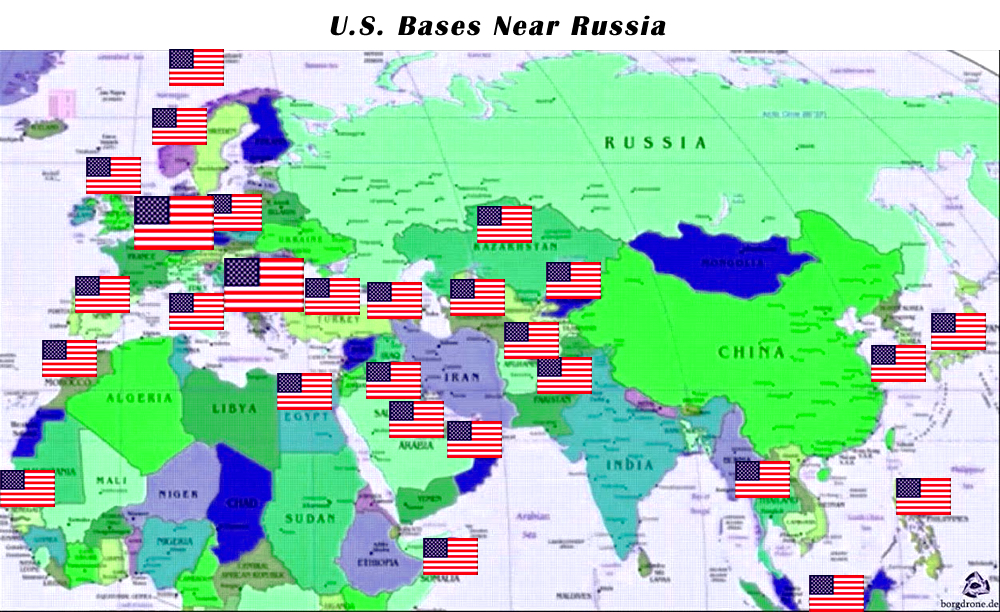
Putin’s worst nightmare MAPPED as ‘up to 100’ US nuclear weapons surround Russia’s border https://www.express.co.uk/news/science/1611678/putin-nuclear-weapons-nato-europe-russia-us
AS MANY as 100 of the US’s nuclear weapons are reportedly stationed surrounding Russia in European NATO territories in a nightmare situation for Vladimir Putin.
By JACOB PAUL, May 17, 2022 While Russia has the largest arsenal of nuclear weapons, at nearly 6,000, none of these are anywhere near the US. But the US reportedly keeps many of its nuclear weapons at sites in Europe. The estimate comes from experts Miles A. Pomper and Vasilii Tuganov, both from the James Martin Center for Nonproliferation Studies. They wrote in a piece for The Conversation: “About half of the roughly 200 US shorter-range weapons are believed to be deployed in five NATO countries in Europe.”
It is thought that the Volkel Airbase in the Netherlands, Kleine Brogel Air Base, in Belgium and Buchel Air base in Germany house the US’s B61-3 and -4 gravity bombs.
The same goes for Ghendi and Aviano bases, both in Italy, and the Incirlik Air Base in Turkey.
Several NATO countries do have their own arsenals too, but this refers specifically to US weapons. The B61 nuclear bomb is the US’ main type of thermonuclear gravity bomb, meaning it is even more destructive than the first-generation atomic bombs. The weapon has been operational with the US military since 1968.
The weapons can be dropped by dual aircraft, which is likely why they are kept at air bases.
And these bombs might not only stay limited to continental Europe.
According to US government budget documents, RAF Lakenheath in Suffolk is set to be upgraded – and some believe that will hand it the ability to store B61-12 nuclear bombs.
But the Ministry of Defence has so-far refused to clarify whether US nuclear weapons would be returning to the UK.
Back in the 1990s, RAF Lakenheath had 33 underground storage vaults, where 110 B61 bombs were stored, according to the Federation of American Scientists (FAS).
The American weapons on NATO territories are thought to be kept in underground vaults of the airbases, with a Permissive Action Link (PAL) code restricting their use to the US.
While there are thought to be 100 US nuclear bombs in NATO territory today, back at the peak of Cold War tensions there were thought to be a staggering 7,300 or so.
But the US does not have a shortage of bases on its own territory, where thousands of weapons are kept.
US strategic bombers are kept at the Minot Air Force base in North Dakota and the Whiteman Air Force base in Missouri .
The US also has ICBM silo fields in its Frances E. Warren Air Force base in Wyoming and its Malmstrom Air Force Base in Montana. There are submarine bases in Kings Bay in Georgia and Kitsap in Washington.
While Russia does possess more weapons than the US in total, the 2011 New Strategic Arms Reduction Treaty limits both sides to 1,600 weapons on standby each.
These weapons include intercontinental ballistic missiles (ICMBs), and submarine-launched ballistic missiles, missiles launched from specialized aircraft.
Many of these have nuclear warheads attached.
Despite being surrounded by US weapons, Russian nuclear warheads can travel at alarming speeds to strike targets large distances away. This includes the recently unveiled Sarmat 2, dubbed Satan 2 by the West.
The ICBM is capable of carrying 10 or more nuclear warheads and can even hit targets in the US and Europe.
Prof Andrew Futter, a nuclear weapons expert from the University of Leicester, warned that if Putin did launch an attack on London, it would have around 15 minutes to prepare.
He told MyLondon: “It wouldn’t give us time to do anything. Government officials might be OK, there is a bunker under Whitehall and some places VIPs can hide.”
Ukraine controlled by US and UK – Russia
Rt.com 17 May 22, The stalling of the peace talks is a result of the wish of London and Washington to drag out the Ukraine conflict, Lavrov claimed. London and Washington have been exercising their control over the Ukrainian negotiators with the aim of dragging out the conflict, and this policy has led to the suspension of peace talks between Moscow and Kiev, Russian Foreign Minister Sergey Lavrov claimed on Tuesday.
Speaking at the New Horizons educational marathon, Lavrov said that Ukraine may have made its own decision in Istanbul, when it came up with some “acceptable principles for reaching agreements” during negotiations with Russia. However, according to the minister, these ideas were apparently not supported by the West.
“We have information coming through various channels that Washington and especially London ‘lead’ the Ukrainian negotiators and control their freedom of maneuver. They want to drag out the conflict, and it seems to them that the longer it will last, the more damage they will inflict on Russian servicemen,” Lavrov said.
The foreign minister doubts, however, that “transferring the conversation to the level of Washington or London” would be able to change anything in terms of the progress.
“Anyway, neither London, nor Washington, nor the West as a whole has put forward any proposals,” Lavrov said.
The West actually acknowledged that Ukraine is “expendable in a hybrid total war against the Russian Federation,” Lavrov claimed, citing remarks by the EU, UK and US officials who have said on multiple occasions that Russia should not be allowed to win in the Ukrainian conflict.
“The war was declared by them. And not at all between Ukraine and Russia, but between the West and Russia,” Lavrov said.
Earlier on Tuesday, Deputy Foreign Minister Andrey Rudenko said that diplomatic dialogue between Moscow and Kiev had been completely suspended after Kiev withdrew from negotiations without providing any response to the latest Russian proposals.
A Ukrainian presidential adviser, Mikhail Podolyak, later confirmed that “after the Istanbul communiqué [in March], there have been no changes, no progress.”……. https://www.rt.com/russia/555640-russia-lavrov-west-ukraine/
Greens oppose Nato membership for Scotland and ‘evil’ nuclear weapons
The National By Angus Cochrane@_Anguscchrn, Multimedia Journalist 18 May 22, NUCLEAR weapons are “simply evil”, the Scottish Greens have said as they detailed their reasons for opposing Nato membership for an independent Scotland.
West Scotland MSP Ross Greer said it would be “morally wrong” for Scotland to join Nato if it were to become independent. It comes after Nicola Sturgeon reaffirmed her party’s support for joining the military alliance in the event of a Yes vote.
Greer explained both parties, who signed a historic co-operation deal in Holyrood last year, “agreed to disagree” on Nato. The MSP told BBC Scotland’s The Nine: “It’s no surprise to anyone that the Scottish Greens and the SNP have different positions on Nato.
“For the Scottish Greens, we enthusiastically believe in co-operation, especially in areas like security and defence.
“Patrick Harvie lists one of them and that is Nato’s first strike nuclear policy. Nato reserves the right to launch the first strike in a nuclear war.
“That would be world ending and we believe that is simply evil. No-one has the right to do that and we believe it would be morally wrong for Scotland to join such an alliance.”
BBC Scotland put it to Greer that nuclear weapons were a deterrent.
Greer added: “But it is a Nato policy. First strike is not about responding to an attack, first strike is about the right to launch, to actually start that war, to start the last world war, because it would be the war that ended the world as we know it.
| “That’s the nature of nuclear weapons.“The very existence of nuclear weapons risks the chance of nuclear war.“If we want to persuade rogue and hostile states to reduce their nuclear stockpiles, asking them to do it, demanding that they do it unilaterally, has no chance of success.”“This is a fundamental moral question. I don’t want the last thing that my country potentially does in its existence is to wipe another country off the map. Nuclear weapons are simply evil.”…………………….. The intervention comes after Nicola Sturgeon said the Russian invasion of Ukraine has strengthened the case for joining Nato…………………………… https://www.thenational.scot/news/20147291.greens-oppose-nato-membership-scotland-evil-nuclear-weapons/ |
“We agree with the First Minister that Scotland has a really positive role to play in Europe’s collective security arrangements. But we disagree on membership of Nato for two reasons.
Say No to Nuclear Power.

Our energy future should consist of modern solar, wind, battery and LED/efficiency technologies, not nuclear reactors. https://progressive.org/op-eds/say-no-to-nuclear-power-wasserman-220518/ BY HARVEY WASSERMAN , MAY 18, 2022

Desperate atomic cultists including Bill Gates are now touting small modular reactors. But they’re unproven, can’t deploy for years to come, can’t be guarded against terrorists and can’t beat renewables in safety, speed to build, climate impacts, price or job creation.
The nuclear power industry has been pushing the fantasy of yet another “renaissance” of nuclear power, based on the absurd idea that atomic reactors — which operate at 571 degrees Fahrenheit, resulting in substantial greenhouse gas emissions and, periodically, explosions — can somehow cool the planet.
But the fact is that no more big, old-style light water reactors are likely to be built in the United States. And the current 93 licensed reactors in this country (there are 400-plus worldwide) grow increasingly dangerous every day.
As a green power advocate since 1973, I’ve visited dozens of reactor sites throughout the U.S. and Japan. The industry’s backers portray them as high-tech black boxes that are uniformly safe, efficient and reliable, ready to hum for decades without melt-downs, blow-ups or the constant emissions of heat, radiation, chemical pollution and eco-devastation that plague us all.
In reality, the global reactor fleet is riddled with widely varied and increasingly dangerous defects. These range from inherent design flaws to original construction errors, faulty components, fake replacement parts, stress-damaged (“embrittled”) pressure vessels, cracked piping, inoperable safety systems, crumbling concrete, lethal vulnerabilities to floods, storms and earthquakes, corporate greed and unmanageable radioactive emissions and wastes — to name a few.

Heat, radiation and steam have pounded every reactor’s internal components. They are cracked, warped, morphed and transmuted into rickety fossils virtually certain to shatter in the next meltdown.

Twice-bankrupt Pacific Gas & Electric of California has been found guilty in the 2010 burning deaths of eight San Bruno residents caused by under-maintained gas pipes. The company was also convicted in the deaths of more than eighty people when its faulty wires ignited whole northern California forests and towns in a series of fires.

In 2003, the Perry and Davis-Besse power plants’ operators blacked out 50 million homes in southern Canada and the northeastern United States. The FBI has linked them to a $61-million-bribe handed to the majority leader of the Ohio House of Representatives, and possibly tens of thousands more to the former chair of the state Public Utilities Commission.
The industry’s “regulators” have turned blind eyes to crumbling concrete at the Seabrook and Davis-Besse facilities, whose “hole-in-the-head” defects almost brought Chernobyl to the shores of Lake Erie. When Diablo Canyon’s resident site inspector warned the plant could not withstand a likely seismic shock, the Nuclear Regulatory Commission shut him up and moved him out.
The industry’s four most recent reactor construction projects include two at South Carolina’s Virgil C. Summer Nuclear Generating Station— totally abandoned after over $10 billion was spent — and two at Georgia’s Alvin W. Vogtle Electric Generating Plant, years late and costing more than $30 billion. Plagued by corruption and incompetence, design flaws and labor problems, Plant Vogtle might never open, especially in light of the astonishing advances in renewable and efficiency technologies, which have completely buried any economic or ecological justification for atomic power, new or old.
Desperate atomic cultists including Bill Gates are now touting small modular reactors. But they’re unproven, can’t deploy for years to come, can’t be guarded against terrorists and can’t beat renewables in safety, speed to build, climate impacts, price or job creation.
Our energy future should consist of modern solar, wind, battery and LED/efficiency technologies, not nuclear reactors. Let’s work to guarantee that none of them explode before we get there.
Disinformation’ Label Serves to Marginalize Crucial Ukraine Facts
To ignore the fact that prolonged military aid could reshape Ukraine’s politics in favor of neo-Nazi groups prevents an understanding of the threats posed to Ukrainian democracy and civil society.
These “disinformation” claims also ignore the more contemporary evidence that Western officials have an explicit agenda of weakening Russia and even ending the Putin regime. According to Ukrainska Pravda (5/5/22; Intercept, 5/10/22), in his recent trip to Kyiv, UK prime minister Boris Johnson told Volodymyr Zelensky that regardless of a peace agreement being reached between Ukraine and Russia, the United States would remain intent on confronting Russia.
https://fair.org/home/disinformation-label-serves-to-marginalize-crucial-ukraine-facts/– 18 May 22,
Disinformation has become a central tool in the United States and Russia’s expanding information war. US officials have openly admitted to “using information as a weapon even when the confidence and accuracy of the information wasn’t high,” with corporate media eager to assist Washington in its strategy to “pre-empt and disrupt the Kremlin’s tactics, complicate its military campaign” (NBC, 4/6/22).
In defense of the US narrative, corporate media have increasingly taken to branding realities inconvenient to US information goals as “disinformation” spread by Russia or its proxies.
The New York Times (1/25/22) reported that Russian disinformation doesn’t only take the form of patently false assertions, but also those which are “true but tangential to current events”—a convenient definition, in that it allows accurate facts to be dismissed as “disinformation.” But who determines what is “tangential” and what is relevant, and what are the guiding principles to make such a determination? In this assessment, Western audiences are too fickle to be trusted with making up their own mind.
There’s no denying that Russia’s disinformation campaign is key to justifying its war on Ukraine. But instead of uncritically outsourcing these decisions to Western intelligence officials and weapons manufacturers, and as a result erasing realities key to a political settlement, the media’s ultimate guiding principle for what information is “tangential” should be whether it is relevant to preventing the further suffering of Ukrainian civilians—and reducing tensions between the world’s two largest nuclear powers.
For Western audiences, and US citizens in particular, labeling or otherwise marginalizing inconvenient realities as “disinformation” prevents a clear understanding of how their government helped escalate tensions in the region, continues to obstruct the possibility of peace talks, and is prepared to, as retired senior US diplomat Chas Freeman describes it, “fight to the last Ukrainian” in a bid to weaken Russia.
Coup ‘conspiracy theory’
For example, the New York Times (4/11/22) claimed that US support for the 2014 “Maidan Revolution” that ousted Ukraine’s democratically elected President Viktor Yanukovych was a “conspiracy theory” being peddled by the Chinese government in support of Russia. The article featured an image with a red line crossing out the face of journalist Benjamin Norton, who was appearing on a Chinese news channel to discuss how the US helped orchestrate the coup. (Norton wrote for FAIR.org frequently from 2015–18.) The evidence he presented—a leaked call initially reported by the BBC in which then–State Department official Victoria Nuland appears to select opposition leader Arseniy Yatsenyuk to be Ukraine’s new prime minister—is something, he noted, that the Times itself has reported on multiple times (2/6/14, 2/7/14).
Not having been asked for comment by the Times, Norton responded in a piece of his own (Multipolarista, 4/14/22), claiming that the newspaper was “acting as a tool of US government information warfare.”
Beyond Nuland’s apparent coup-plotting, the US campaign to destabilize Ukraine stretched back over a decade. Seeking to isolate Russia and open up Ukraine to Western capital, the US had long been “fueling anti-government sentiment through mechanisms like USAID and National Endowment for Democracy (NED)” (FAIR.org, 1/28/22). High-profile US officials like Sen. John McCain even went so far as to rally protesters in the midst of the Maidan uprising.
In the wake of the far right–led and constitutionally dubious overthrow, Russia illegally annexed the Crimean Peninsula and supported a secession movement in the eastern Donbass region, prompting a repressive response from Ukraine’s new US-backed government. Eight years later, the civil war has killed more than 14,000. Of those deaths, 3,400 were civilian casualties, which were disproportionately in separatist-controlled territories, UN data shows. Opinions on remaining in Ukraine vary within the Donbass.
When the Times covered the Russian annexation of Crimea, it acknowledged that the predominantly ethnic Russian population there viewed “the Ukrainian government installed after the ouster last weekend of Mr. Yanukovych as the illegitimate result of a fascist coup.” But now the newspaper of record is using allegations of disinformation to change the record.
To discredit evidence of US involvement in Ukraine’s 2014 regime change hides crucial facts that could potentially support a political solution to this crisis. When the crisis is reduced merely to the context of Russian aggression, a peace deal that includes, for example, a referendum on increased autonomy for the Donbass seems like an outrageous thing for Ukraine to have to agree to. But in the context of a civil war brought on by a US-backed coup—a context the Times is eager to erase—it may appear a more palatable solution.
More broadly, Western audiences that are aware of their own government’s role in sparking tensions may have more skepticism of Washington’s aims and an increased appetite for peace negotiations.
Normalizing neo-Nazis
The outsized influence of neo-Nazi groups in Ukrainian society (Human Rights Watch, 6/14/18)—including the the Azov Regiment, the explicitly neo-Nazi branch of Ukraine’s National Guard—is another fact that has been dismissed as disinformation.
Western outlets once understood far-right extremism as a festering issue (Haaretz, 12/27/18) that Ukraine’s government “underplayed” (BBC, 12/13/14). In a piece called “Ukraine’s Got a Real Problem with Far-Right Violence (and No, RT Didn’t Write This Headline),” the Atlantic Council (UkraineAlert, 6/20/18) wrote:
Amnesty International, Human Rights Watch, Freedom House and Front Line Defenders warned in a letter that radical groups acting under “a veneer of patriotism” and “traditional values” were allowed to operate under an “atmosphere of near total impunity that cannot but embolden these groups to commit more attacks.”
To be clear, far-right parties like Svoboda perform poorly in Ukraine’s polls and elections, and Ukrainians evince no desire to be ruled by them. But this argument is a bit of “red herring.” It’s not extremists’ electoral prospects that should concern Ukraine’s friends, but rather the state’s unwillingness or inability to confront violent groups and end their impunity.
But now Western media attempt to diminish those groups’ significance, arguing that singling out a vocal but insignificant far right only benefits Russia’s disinformation campaign (New Statesman, 4/12/22). Almost exactly three years after warning about Ukraine’s “real problem” with the far right, the Atlantic Council (UkraineAlert, 6/19/21) ran a piece entitled “The Dangers of Echoing Russian Disinformation on Ukraine,” in which it seemingly forgot that arguments about the electoral marginalization of Ukraine’s right wing are a “red herring”
In reality, Ukraine’s nationalist parties enjoy less support than similar political parties in a host of EU member states. Notably, in the two Ukrainian parliamentary elections held since the outbreak of hostilities with Russia in 2014, nationalist parties have failed miserably and fallen short of the 5% threshold to enter Ukrainian parliament
‘Lead[ing] the white races’
Russian propaganda does overstate the power of Nazi elements in Ukraine’s government—which it refers to as “fascist”—to justify its illegal aggression, but seizing on this propaganda to in turn downplay the influence and radicalism of these elements (e.g., USA Today, 3/30/22; Welt, 4/22/22) only prevents an important debate on how prolonged US and NATO military aid may empower these groups.
The Financial Times (3/29/22) and London Times (3/30/22) attempted to rehabilitate the Azov regiment’s reputation, using the disinformation label to downplay the influence of extremism in the national guard unit. Quoting Azov’s founder Andriy Biletsky as well as an unnamed Azov commander, the Financial Times cast Azov’s members as “patriots” who “shrug off the neo-Nazi label as ‘Russian propaganda.’” Alex Kovzhun, a “consultant” who helped draft the political program of the National Corps, Azov’s political wing, added a lighthearted human interest perspective, saying Azov was “made up of historians, football hooligans and men with military experience.”
That the Financial Times would take Biletsky at his word on the issue of Azov’s Nazi-free character, a man who once declared that the National Corps would “lead the white races of the world in a final crusade…against Semite-led Untermenschen [subhumans]” (Guardian, 3/13/18), is a prime example of how Western media have engaged in information war at the expense of their most basic journalistic duties and ethics.
Azov has opened its ranks to a flood of volunteers, the Financial Times continued, diluting its connection to Ukraine’s far-right movement, a movement that has “never proved popular at the ballot box” anyways. BBC (3/26/22) also cited electoral marginalization in its dismissal of claims about Ukraine’s far right as “a mix of falsehoods and distortions.” Putin’s distortions require debunking, but neither outlet acknowledged that these groups’ outsized influence comes more from their capacity for political violence than from their electoral participation (Hromadske, 10/13/16; Responsible Statecraft, 3/25/22).
In the London Times piece, Azov commander Yevgenii Vradnik dismissed the neo-Nazi characterization as Russian disinformation: “Perhaps [Putin] really believes it,” as he “lives in a strange, warped world. We are patriots but we are not Nazis.” Sure, the article reports, “Azov has its fair share of football hooligans and ultranationalists,” but it also includes “scholars like Zaikovsky, who worked as a translator and book editor.”
To support such “patriots,” the West should fulfill their “urgent plea” for more weapons. “To retake our regions, we need vehicle-mounted anti-aircraft weapons from NATO,” Vradnik said. Thus Western media use the “Russian disinformation” label to not only downplay the threat of Ukraine’s far right, but even to encourage the West to arm them.
Responsible Statecraft (3/25/22) pushed back on the media’s dismissiveness, warning that “Russian propaganda has colossally exaggerated the contemporary strength of Ukrainian extreme nationalist groups,” but
because these groups have been integrated into the Ukrainian National Guard yet retain their autonomous identities and command structures, over the course of an extended war they could amass a formidable fifth column that would radicalize Ukraine’s postwar political dynamic.
To ignore the fact that prolonged military aid could reshape Ukraine’s politics in favor of neo-Nazi groups prevents an understanding of the threats posed to Ukrainian democracy and civil society.
Shielding NATO from blame
Much like with the Maidan coup, the corporate media’s insistence on viewing Russian aggression as unconnected to US imperial expansion has led it to cast any blame placed on NATO policy as Russian disinformation.
In “The Five Conspiracy Theories That Putin Has Weaponized,” New York Times (4/25/22), historian and author Ilya Yaboklov listed the Kremlin’s most prominent “disinformation” narratives. High on his list was the idea that “NATO has turned Ukraine into a military camp.”
Without mentioning that NATO, a remnant of the Cold War, is explicitly hostile to Russia, the Times piece portrayed Putin’s disdain for NATO as a paranoia that is convenient for Russian propaganda:
”NATO is Mr. Putin’s worst nightmare: Its military operations in Serbia, Iraq and Libya have planted the fear that Russia will be the military alliance’s next target. It’s also a convenient boogeyman that animates the anti-Western element of Mr. Putin’s electorate. In his rhetoric, NATO is synonymous with the United States, the military hand of “the collective West” that will suffocate Russia whenever it becomes weak.”
The New York Times is not the only outlet to dismiss claims that NATO’s militarization of Ukraine has contributed to regional tensions. Jessica Brandt of the Brookings Institute claimed on CNN Newsroom (4/8/22): “There’s two places where I have seen China carry Russia’s water. The first is, starting long before the invasion, casting blame at the foot of the United States and NATO.” The Washington Post editorial board (4/11/22) argued much to the same effect that Chinese “disinformation” included arguing “NATO is to blame for the fighting.” Newsweek (4/13/22) stated that Chinese disinformation “blames the US military/industrial complex for the chaos in Ukraine and other parts of the world,” and falsely claims that “Washington ‘squeezed Russia’s security space.’”
Characterizing claims that NATO’s militarization of Russia’s neighbors was a hostile act as “paranoia” or “disinformation” ignores the decades of warnings from top US diplomats and anti-war dissidents alike that NATO expansionism into former Warsaw Pact countries would lead to conflict with Russia.
Jack F. Matlock Jr, the former ambassador to the USSR warned the US Senate as early as 1997 that NATO expansion would threaten a renewal of Cold War hostilities (Responsible Statecraft, 2/15/22):
I consider the administration’s recommendation to take new members into NATO at this time misguided. If it should be approved by the United States Senate, it may well go down in history as the most profound strategic blunder made since the end of the Cold War. Far from improving the security of the United States, its Allies, and the nations that wish to enter the Alliance, it could well encourage a chain of events that could produce the most serious security threat to this nation since the Soviet Union collapsed.
Weakening Russia
These “disinformation” claims also ignore the more contemporary evidence that Western officials have an explicit agenda of weakening Russia and even ending the Putin regime. According to Ukrainska Pravda (5/5/22; Intercept, 5/10/22), in his recent trip to Kyiv, UK prime minister Boris Johnson told Volodymyr Zelensky that regardless of a peace agreement being reached between Ukraine and Russia, the United States would remain intent on confronting Russia.
The evidence doesn’t stop there. In the past months, Joe Biden let slip his desire that Putin “cannot remain in power,” and US officials’ have become more open about their objectives to weaken Russia (Democracy Now!, 5/9/22; Wall Street Journal, 4/25/22). Corporate media have cheered on these developments, running op-eds in support of policies that go beyond a defense of Ukraine to an attack on Russia (Foreign Policy, 5/4/22; Washington Post, 4/28/22), even expressing hope for a “palace coup” there (The Lead, 4/19/22; CNN Newsroom, 3/4/22).
As famed dissident Noam Chomsky said in a discussion with the Intercept’s Jeremy Scahill (4/14/22):
We can see that our explicit policy—explicit—is rejection of any form of negotiations. The explicit policy goes way back, but it was given a definitive form in September 2021 in the September 1 joint policy statement that was then reiterated and expanded in the November 10 charter of agreement….
What it says is it calls for Ukraine to move towards what they called an enhanced program for entering NATO, which kills negotiations.
When the media denies NATO’s culpability in stoking the flames of war in Ukraine, Americans are left unaware of their most effective tool in preventing further catastrophe: pressuring their own government to stop undermining negotiations and to join the negotiating table. Dismissing these realities threatens to prolong the war in Ukraine indefinitely.
Squelching dissent
As the Biden administration launches a new Disinformation Governance Board aimed at policing online discourse, it is clear that the trend of silencing those who speak out against official US narratives is going to get worse.
Outlets like Russia Today, MintPress News and Consortium News have been banned or demonetized by platforms like Google and its subsidiary YouTube, or services like PayPal. MintPress News (4/25/22) reported YouTube had “permanently banned more than a thousand channels and 15,000 videos,” on the grounds that they were “denying, minimizing or trivializing well-documented violent events.” At the same time, platforms are loosening the restrictions on praising Ukraine’s far right or calling for the death of Russians (Reuters, 3/11/22). These policies of asymmetric censorship aid US propaganda and squelch dissent.
After receiving a barrage of complaints from the outlet’s supporters, PayPal seemingly reversed its ban of Consortium News’ account, only to state later on that this reversal was “mistaken,” and that Consortium was in fact permanently banned. The outlet’s editor-in-chief Joe Lauria (5/4/22) responded to PayPal’s ban:
Given the political climate it is reasonable to conclude that PayPal was reacting to Consortium News’ coverage of the war in Ukraine, which is not in line with the dominant narrative that is being increasingly enforced.
As Western outlets embrace the framing of a new Cold War, so too have they embraced the Cold War’s McCarthyite tactics that rooted out dissent in the United States. With great-power conflict on the rise, it is all the more important that US audiences understand the media’s increasing repression of debate in defense of the “dominant narrative.” In the words of Chomsky:
There’s a long record in the United States of censorship, not official censorship, just devices, to make sure that, what intellectuals call the “bewildered herd,” the “rabble,” the population, don’t get misled. You have to control them. And that’s happening right now.
Sellafield Update 2022
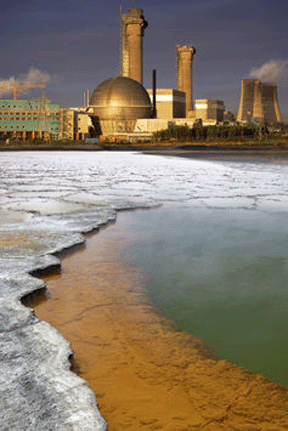
nuClear News, May 2922, Executive Summary
Reprocessing
Spent fuel from the UK’s first-generation Magnox reactors is still being reprocessed. It was
scheduled to end in 2012 to help the UK meet its international obligations to end the radioactive
pollution of the north-east Atlantic. It’s now scheduled to end later this year.
Storage
At the end of 2021, the First Generation Magnox Storage Pond (FGMSP), one of Sellafield’s most
hazardous facilities, and the Pile Fuel Storage Pond (PFSP) still contained 75% of the legacy
spent fuel which has to be removed and placed in interim storage. This degraded fuel won’t be
in interim storage until 2025. It will then have to be conditioned, and eventually transferred to
the proposed Geological Disposal Facility by 2125.
Spent fuel
The Thermal Oxide Reprocessing Plant (THORP) has closed, and almost 5,000 tonnes of unreprocessed spent fuel from the UK’s second-generation Advanced Gas-cooled Reactors (AGRs)
will be stored in ponds at Sellafield until at least 2075. In addition, an estimated 141 tonnes of
exotic fuel will remain in storage once the Magnox reprocessing plant closes, and isn’t expected
to be in a modern interim storage facility until 2028. Sellafield is also contracted to receive and
store spent submarine fuel from the MoD.
Plutonium
The government has yet to decide about possible re-use or disposal of the 140 tonnes of
plutonium stored at Sellafield. Its preferred option is to re-use it in Mixed Oxide Fuel (MOX) for
nuclear reactors, but some plutonium will be unsuitable for this and will need to be immobilised
and treated as a waste for disposal. Some of the older plutonium packages and facilities are
amongst the highest hazards on the Sellafield site. All plutonium needs to be gradually transferred to a new store, and two more stores are likely to be required – one is expected to be
ready in 2033 and the second in 2040.
High Level Waste
High Level Waste (HLW) Liquors, left over after reprocessing, need to be constantly cooled
otherwise they would start to boil causing radioactivity to escape and contaminate the
surrounding environment. Conversion of these liquors into a solid form and emplacement in
storage is not expected to be complete until 2030. The solid waste will remain in storage until
‘disposal’ by 2104. All HLW belonging to overseas customers should be returned by 2025.
Levels of risk
In 2013 Sellafield was described as posing an “intolerable risk”. Then in 2018 it was reported
that “work to reduce risk and high hazard at Sellafield has taken an encouraging turn for the
better”. Since then, the site has not been much in the news, but there is still a lot of work to do,
as many of the risks remain. And the timescales for carrying out this work are simply
staggering. According to the UK Radioactive Waste Inventory decommissioning won’t be
complete until around 2090 and then all buildings won’t be demolished until 2120 – almost a
century from now. (1)
1 This Month



19 November – Webinar – The Reality of Reprocessing
Time: 11:00 AM Pacific Time (US & Canada) / 2:00 PM Eastern / 7:00 PM UK / 8:00 PM CET
Register for the Zoom Event Here



Shut down the radiation-damaged Heysham nuclear reactors now
To see nuclear-related stories in greater depth and intensity – go to https://nuclearinformation.wordpress.com

Say No to NASA’s Reckless Nuclear Reactor on the Moon
Say No to NASA’s Reckless Nuclear Reactor on the Moon
-
Archives
- November 2026 (74)
- October 2026 (302)
- September 2026 (339)
- August 2026 (330)
- July 2026 (355)
- June 2026 (287)
- May 2026 (306)
- April 2026 (356)
- March 2026 (251)
- February 2026 (267)
- January 2026 (308)
- December 2025 (358)
-
Categories
- 1
- 1 NUCLEAR ISSUES
- business and costs
- climate change
- culture and arts
- ENERGY
- environment
- health
- history
- indigenous issues
- Legal
- marketing of nuclear
- media
- opposition to nuclear
- PERSONAL STORIES
- politics
- politics international
- Religion and ethics
- safety
- secrets,lies and civil liberties
- spinbuster
- technology
- Uranium
- wastes
- weapons and war
- Women
- 2 WORLD
- ACTION
- AFRICA
- Atrocities
- AUSTRALIA
- Christina's notes
- Christina's themes
- culture and arts
- Events
- Fuk 2022
- Fuk 2023
- Fukushima 2017
- Fukushima 2018
- fukushima 2019
- Fukushima 2020
- Fukushima 2021
- general
- global warming
- Humour (God we need it)
- Nuclear
- RARE EARTHS
- Reference
- resources – print
- Resources -audiovicual
- Weekly Newsletter
- World
- World Nuclear
- YouTube
-
RSS
Entries RSS
Comments RSS

