Rare Pediatric Cancers Persist 63 Years After Nuclear Accident

Melissa Bumstead is one of those residents. She and her family live 3.7 miles from the Santa Susana site. When her toddler Grace was diagnosed with a rare form of leukemia in 2014, doctors told Bumstead there were no known links between her daughter’s cancer and environmental contamination.
But during Grace’s treatment at Children’s Hospital Los Angeles, her mother began meeting other parents who lived near her and had children facing equally rare cancers.
They plotted their homes on Google Maps and found that they all lived within roughly 10 miles of one another. It would take another year for them to realize that the SSFL site was at the center of the circle.
WebMD Cancer news, By Neil Osterweil, March 11, 2022 –– Chernobyl. Fukushima. Three Mile Island.
The world knows these names all too well because of accidents there: complete or partial meltdowns of nuclear reactors that released massive amounts of cancer-causing radiation into the air, soil, and water.
The Santa Susana Field Lab (SSFL) is far less well-known, but no less infamous for what took place at this former rocket engine and nuclear energy test site just 28 miles northwest of downtown Los Angeles.
In July 1959, an accident involving one of 10 experimental nuclear reactors at the SSFL sitereleased a cloud of harmful radiation and toxic chemicals over the surrounding area, including Simi Valley, San Gabriel Valley, Chatsworth, and Canoga Park. The small reactor had no containment vessel.
This accident resulted in a release of radioactive iodine estimated to be as much as 250 times that of the partial meltdown that would occur 2 decades later at Three Mile Island, a much larger commercial reactor that had a containment vessel.
Six decades later, hundreds of potentially carcinogenic chemicals remain in the surrounding environment. And local children are being diagnosed with rare cancers at a rate that far outpaces what experts would predict.
Decades-Long Cover-Up
In 1959, the public knew nothing about what had happened at the site.
According to John Pace, then an employee at SSFL, the accident was covered up. Pace recounted the cover-up in the documentary In the Dark of the Valley, which first aired in November 2021 on MSNBC.
In fact, the accident at SSFL remained under wraps for 2 decades, according to Daniel Hirsch, former director of the Program on Environmental and Nuclear Policy at the University of California, Santa Cruz, and now president of Committee to Bridge the Gap, a nuclear policy nongovernmental organization.
“Students working with me while I was teaching at UCLA in 1979 uncovered these Atomic Energy Commission reports from Atomics International,” he said in an interview. “We had to order the documents from the annex to the UCLA Engineering Library. They were stored offsite, and it took a few days, and when we got them, we opened them up, and there were these fold-out photographs of the fuel [rods]. As we folded out the photographs further, we saw one photo with an arrow labeled ‘longitudinal cracks,’ and then other arrows showing other kinds of cracks, and then another arrow labeled ‘melted blob.’”
Hirsch and his students found that other accidents had occurred at SSFL, including a fuel fabrication system that leached plutonium, fires in a “hot” lab where irradiated nuclear fuel from around the United States was handled, and open-air burn pits where radioactive and toxic chemical wastes were illegally torched.
According to the Committee to Bridge the Gap, when the 2,800-acre SSFL site was being developed under the name Rocketdyne by aircraft maker North American Aviation, the area was sparsely populated, with nearly as many grazing animals as people in its hills and valleys.
North American Aviation later became part of Rockwell International, which in turn sold its aerospace and defense business units to the Boeing Company in 1996. Boeing, now in charge of the site and the cleanup efforts, is doing everything in its power to shirk or diminish its responsibility, Hirsch and other critics say.
Parents Against SSFL
Today, more than 150,000 people live within 5 miles of SSFL, and more than half a million live within 10 miles.
Continue readingArms sent to Ukraine will end up in criminal hands, says Interpol chief
Jürgen Stock urges members to cooperate on arms tracing as weapons will flood hidden economy when war ends,
Guardian, Kim Willsher, Thu 2 Jun 2022
Weapons sent to Ukraine after Russia’s invasion in February will end up in the global hidden economy and in the hands of criminals, the head of Interpol has said.
Jürgen Stock says once the conflict ends, a wave of guns and heavy arms will flood the international market and he urged Interpol’s member states, especially those supplying weapons, to cooperate on arms tracing.
“Once the guns fall silent [in Ukraine], the illegal weapons will come. We know this from many other theatres of conflict. The criminals are even now, as we speak, focusing on them,” Stock said.
“Criminal groups try to exploit these chaotic situations and the availability of weapons, even those used by the military and including heavy weapons. These will be available on the criminal market and will create a challenge. No country or region can deal with it in isolation because these groups operate at a global level.”
He added: “We can expect an influx of weapons in Europe and beyond. We should be alarmed and we have to expect these weapons to be trafficked not only to neighbouring countries but to other continents.”
He said Interpol urged members to use its database to help “track and trace” the weapons. “We are in contact with member countries to encourage them to use these tools. Criminals are interested in all kinds of weapons … basically any weapons that can be carried might be used for criminal purposes.”
Ukraine’s western allies have sent shipments of high-end military weapons to Ukraine since the Russian invasion more than three months ago. On Tuesday, the American president, Joe Biden, announced the US would supply Kyiv with advanced missile systems and munitions. After the US pulled out of Afghanistan in 2021, following 20 years of war, huge amounts of often highly sophisticated military equipment was left behind and fell into the hands of the Taliban.
Stock, the secretary general of the international policing organisation who was speaking to the Anglo-American Press Association in Paris, said the conflict in Ukraine had also led to a rise in large-scale fertiliser theft and an increase in counterfeit agrochemicals. There was also a huge rise in fuel theft. “These products have become more valuable,” he said……………………………………. https://www.theguardian.com/world/2022/jun/02/ukraine-weapons-end-up-criminal-hands-says-interpol-chief-jurgen-stock
Much hyping for France’s NUWARD small modular reactor (SMR) design: construction to start in 2030 (but will it be a lemon?)

France’s NUWARD SMR Will Be Test Case for European Early Joint Nuclear Regulatory Review, Power, 5 June 22. The French Nuclear Safety Authority (ASN), the Czech State Office for Nuclear Safety (SUJB), and Finland’s Radiation and Nuclear Safety Authority (STUK) have picked France’s NUWARD small modular reactor (SMR) design as a test case for an early joint regulatory review for SMRs. The development marks a notable step by European regulators to align practices in a bid to harmonize licensing and regulation for SMRs in the region.
EDF, an entity that is majority held by the French government, on June 2 announced the reactor design will be the subject of the review, which “will be based on the current set of national regulations from each country, the highest international safety objectives and reference levels, and up-to-date knowledge and relevant good practice.”
The technical discussions and collaborative efforts associated with the review will both help ASN, STUK, and SUJB “increase their respective knowledge of each other’s regulatory practices at the European level,” as well as “improve NUWARD’s ability to anticipate the challenges of international licensing and meet future market needs,” it said.
A European Frontrunner
NUWARD, which is still currently in the conceptual design phase, may be a frontrunner in the deployment of SMRs in Europe. It was unveiled in 2019 by EDF, France’s Alternative Energies and Atomic Energy Commission (CEA), French defense contractor Naval Group, and TechnicAtome, a designer of naval propulsion nuclear reactors and an operator of nuclear defense facilities. The consortium in May tasked Belgian engineering firm Tractabel with completing—by October 2022—conceptual design studies for parts of the conventional island (turbine hall), the balance of plant (water intake and servicing system), and the 3D modeling of the buildings that will house those systems.
Launched as a design that derives from the “best-in-class French technologies” and “more than 50 years of experience in pressurized water reactor (PWR) design, development, construction, and operation,” the design proposes a 340-MWe power plant configured with twin 170-MWe modules. NUWARD is based on an integrated PWR design with full integration of the main components within the reactor pressure vessel, including the control rod drive mechanisms, compact steam generators, and pressurizer, CEA says.
As “the most compact reactor in the world,” the design is well-suited for power generation, including replacing coal and gas-fired generation, as well as for electrification of medium-sized cities and isolated industrial sites, CEA says. According to Tractabel, the next phase of the NUWARD project—the basic design completion—is slated to begin in 2023. Construction of a reference plant is expected to start in 2030.
Crucial to SMR Deployment: Harmonization of Regulations
On Thursday, EDF noted that while SMR technology innovation is important, deployment of SMRs, which will be integral to the energy transition toward carbon neutrality, will require “a serial production process and a clear regulatory framework.” Harmonization of regulations and requirements in Europe and elsewhere will be “an essential element to support aspirations of standardization of design, in-factory series production and limited design adaptations to country-specific requirements,” it said.
Several efforts to encourage collaboration on SMR licensing and regulatory alignment are already underway in Europe. These include the European SMR Partnership led by FORATOM, the Brussels-based trade association for the nuclear energy industry in Europe, and the Sustainable Nuclear Energy Technology Platform (SNETP), as well as the Nuclear Harmonisation and Standardisation Initiative (NHSI), which the International Atomic Energy Agency launched in March.
The European Union is separately spearheading the ELSMOR project, which aims to enhance the European capability to assess and develop the innovative light water reactor (LWR) SMR concepts and their safety features, as well as sharing that information with policymakers and regulators.
SMRs Part of Future Plans for France, Czech Republic, Finland
Participation of the three countries—France, the Czech Republic, and Finland—is noteworthy for their near-term plans to expand generation portfolios with new nuclear. French President Emmanuel Macron on Feb. 10 said France will build six new nuclear reactors and will consider building eight more. Macron also notably said $1.1 billion would be made available through the France 2030 re-industrialization plan for the NUWARD SMR project.
In the Czech Republic, which has six existing nuclear reactors that generate about a third of its power, energy giant ČEZ has designated a site at the Temelín Nuclear Power Plant as a potential site for an SMR. ČEZ has signed a memorandum of understanding on SMRs with NuScale, and it also has cooperation agreements with GE Hitachi, Rolls-Royce, EDF, Korea Hydro and Nuclear Power, and Holtec.
Finland has five operating reactors, and it is in the process of starting up Olkiluoto 3, a 1.6-GW EPR (EDF’s next-generation nuclear reactor), whose construction began in 2005. Two others were planned: Olkiluoto 4 and Hanhikivi 1. Early in May, however, Finnish-led consortium Fennovoima said it had scrapped an engineering, procurement, and construction contract for Russia’s state-owned Rosatom to build the 1.2-GW Hanhikivi 1, citing delays and increased risks due to the war in Ukraine. On May 24, Fennovoima withdrew the Hanhikivi 1 nuclear power plant construction license application.
The VTT Technical Research Centre of Finland is actively developing an SMR intended for district heating. While Finland now mostly relies on coal for district heat, it has pledged to phase out coal by 2029. VTT, notably, coordinates with the ELSMOR project for European SMR licensing practices. In addition, VTT says it is leading a work package related to the new McSAFER project, which is developing next-generation calculation tools for the modeling of SMR physics.
—Sonal Patel is a POWER senior associate editor (@sonalcpatel, @POWERmagazine).
Thin-walled nuclear waste containers – not really very secure

Greg Phillips, Nuclear Fuel Cycle Watch 4 June The biggest piece of BS that jumped out at me [in this pro nuclear article] is the bolded section:
“…Nuclear waste containers have been tested over the last 40 years by running them into concrete bunkers at 80 mph, being dropped onto huge steel spikes, burned in jet fuel fires at thousands of degrees, and sunk deep in water for weeks. These things are as strong as humans can make them.”
ONLY TRANSPORT CONTAINERS HAVE BEEN SUBJECTED TO THE ABOVE TESTS. THE THIN WELDED CONTAINERS PLACED INTO A PROTECTIVE OUTER SHELL OF CONCRETE. THE PRESSURISED THIN INNER CONTAINERS ARE VENTED TO OPEN AIR TO LET HEAT ESCAPE. ANY LEAK FROM A FAILED WELD WILL ESCAPE TO THE ENVIRONMENT.
Excuse the caps, but too many people have been fooled by such pro-nuclear propaganda. Pictured at top is a thin welded canister – a fully laden canister would not survive a drop of a few metres.
Those nuclear waste containers pictured above are like hermit crabs, a hard exterior shell with vulnerable internals. The thin welded canister is placed into the concrete outer shell, which has vents to keep the canister cool. So any weld failure, crack can lead to radioactive contamination into the atmosphere. If the vents of the outer shell get blocked, the temperature of the fuel will rise to 400C+. If the pressurised Helium leaks out the temperature will rise. https://www.facebook.com/groups/1021186047913052
Spain and Portugal stand out from the European Union, in slashing energy bills because of their high renewable energy use
Spain and Portugal have broken ranks with the EU to allow themselves the
space to slash their energy bills by 40 per cent. The move is being allowed
because both southern European countries have a large amount of renewable
energy and aren’t as reliant on fossil fuels as the rest of the Continent.
MSM 31st May 2022
South Korean government to massively fund developing small nuclear reactors, partnering with USA companies NuScam and Terra Power.
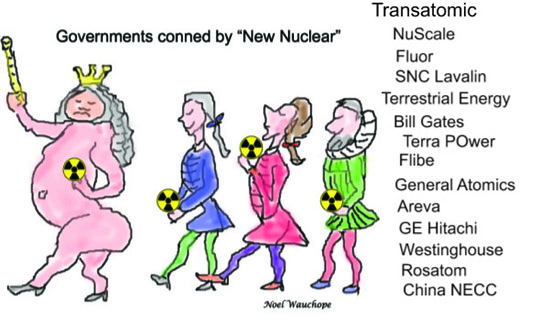
Policymakers endorse massive injection of state money for SMR development
Lim Chang-won Reporter(cwlim34@ajunews.com) | Lim Chang-won Reporter, email : cwlim34@ajunews.com© Aju Business Daily & www.ajunews.com
June 2, 2022, SEOUL — With the blessing of President Yoon Suk-yeol, South Korea’s nuclear power industry grabbed a new opportunity to rebound after policymakers endorsed a massive injection of state money for the development of a relatively safe small modular reactor called “i-SMR” that can be operated in an underground water tank and cooled naturally in case of emergency.
Yoon, who took office in early May, dumped his predecessor’s “nuclear-exit” policy of phasing out nuclear power plants and vowed to actively revitalize South Korea’s struggling nuclear power industry and develop next-generation reactors, insisting that nuclear power plants are an essential factor in restoring industrial competitiveness.
Up to Yoon’s expectations, the proposed development of i-SMRs has passed a preliminary feasibility study, according to the Ministry of Science and ICT. Some 399.2 billion won ($319.9 million) will be spent from 2023 to 2028 for the i-SMR project aimed at developing a reactor with a power generation capacity of less than 300 megawatts. ……..
Mainly through partnerships with American companies, South Korean companies have jumped into the SMR market, such as Hyundai E&C and Doosan Enerbility, a key player in South Korea’s nuclear industry that tied up with NuScale Power, an SMR company in the United States.
In May 2022, Samsung C&T strengthened its partnership with NuScale Power to cooperate in SMR projects in Romania and other East European countries. SK Group tied up with TerraPower for cooperation in the development and commercialization of SMR technology.
Separately, the government approved the proposed spending of 348.2 billion won from 2023 to 2030 to develop technologies for the dismantling of defunct reactors………
Hyundai E&C has tied up with its American partner, Holtec International, for the decommissioning of defunct nuclear power plants, starting with the Indian Point Energy Center in Buchanan in Westchester County. https://www.ajudaily.com/view/20220602110820983
New documentary shows Soviet disinformation over the true horror of the Chernobyl nuclear meltdown
On April 26, 1986, the core of the No. 4 reactor in the Chernobyl Nuclear
Power Plant near Pripyat melted down, causing a nuclear accident that
released airborne radioactive contamination for about nine days in what is
still classified as the worst nuclear disaster in history, both in cost and
casualties.
Stories around the Chernobyl disaster have been told time and
time again, most notably in the critically-acclaimed HBO limited series
“Chernobyl.”
Now, HBO is returning with yet another Chernobyl project, but
this time without the dramatization. As part of HBO Documentary films,
Emmy-winning filmmaker James Jones (“Mosul”) is debuting his film
“Chernobyl: The Lost Tapes.” Thirty-six years after the initial disaster,
“Chernobyl: The Lost Tapes” presents recently uncovered archival footage
and recorded interviews with those who were present during the disaster and
subsequent fall out, as a means to show the reality of just how horrific
the Chernobyl disaster actually was, and the deplorable lengths the Soviet
government went in an attempt to cover up what really happened.
It’s estimated that over 200,000 people died as a result of the Chernobyl
disaster, but the official Soviet count lists it only as 31. The Soviet’s
mishandling of the crisis utilized misinformation and distortion tactics
still used today, led citizens to greatly distrust authorities, and
contributed to the end of the Soviet Union. According to the official press
release, “Chernobyl: The Lost Tapes” is the “full, unvarnished true story
of what happened in one of the least understood tragedies of the twentieth
century.”
Slash Film 3rd June 2022
Joe Biden’s huge move against Russia: ‘This is how nuclear war begins’

Yahoo News Australia and agencies, Thu, 2 June 2022
The US overnight has unveiled a new US$700 million package ($975 million) of sophisticated weapons for Ukraine in an urgent effort to prevent Russia from seizing the final swaths of land in the Donbas region.
But the most advanced rocket systems will take at least three weeks to reach the battlefront, raising questions of whether they will arrive in time to stop Russia’s slow but steady gains as the war inches closer to global catastrophe.
The Biden administration’s decision to send four medium-range rocket systems came after weeks of debate over whether the precision-guided weapons would provoke a strong military reaction from Russian President Vladimir Putin. It suggests the US believes it has zeroed in on what weapons deliveries are worth the risk…….
“The Ukrainians have given us assurances that they will not use these systems against targets on Russian territory,” Secretary of State Antony Blinken said Wednesday (local time).
“There is a strong trust bond between Ukraine and the United States.”
Nuclear war beings ‘one step at a time’
But not everyone has such faith in the latest decision by the US.
“The Ukrainians have given us assurances that they will not use these systems against targets on Russian territory,” Secretary of State Antony Blinken said Wednesday (local time).
“There is a strong trust bond between Ukraine and the United States.”
“This is a textbook example of how a nuclear war begins. One step at a time,” tweeted popular author Jim Rickards on Wednesday.
The Kremlin is also making threatening noises about the move. Kremlin spokesman Dmitry Peskov told reporters Wednesday the US is “deliberately and diligently pouring fuel on the fire.” He added that Russia doesn’t trust
Kyiv’s assurances that the multiple rocket launch systems supplied by the US will not be used to attack.
“In order to trust (someone), you need to have experience with situations when such promises were kept. Regretfully, there is no such experience whatsoever,” Peskov said.,……………….
The Pentagon would not say how many rockets it will provide to Ukraine, only that it is sending four of the truck-mounted HIMARS systems. The trucks each carry a container with six precision-guided rockets, which can travel about 70 kilometres……………… https://au.news.yahoo.com/joe-bidens-huge-move-against-russia-nuclear-war-223931012.html
Co-Founder of Green and Blacks Calls Out Small Modular Reactors: They Would Produce 30 Times As Much Nuclear Waste
While Nuclear Luvvies and Lords in Cumbria Big Up Small Modular Reactors being touted by Rolls Royce, science is stacked against them. IF science is genuinely allied to ethics and a living planet then Small Modular Reactors (or any nuclear fuelled plan ) should not even be on the table.
Co-Founder of Green and Blacks Calls Out Small Modular Reactors: They Would Produce 30 Times As Much Nuclear Waste — RADIATION FREE LAKELAND
ular Reactors
(or any nuclear fuelled plan) should not even be on the table. Craig Sams
the co-founder of Green and Blacks has written on social media: “This was
what I wrote 12 years ago. The New Scientist now reports that SMRs (Small
Modular Reactors) produce 30 times as much nuclear waste for the amount of
electricity produced and its more complex. I realise Boris upset everyone
by boozing when he should’ve been following his own rules, but condemning
future generations to even worse nuclear waste problems than we already
have is the real crime against humanity. No more nuclear. The French
nuclear power stations are corroding badly and nobody’s sure what to do.
The Irish Sea is still contaminating fish. We had to stop serving laver
bread in our restaurant Seed back in 1970 because of radioactive waste
contamination and things have only got worse since then. Wind, solar,
geothermal, oil,gas, anything but nuclear”
Radiation Free Lakeland 2nd June 2022
Russia is winning the economic war – and Putin is no closer to withdrawing troops
Putin has rightly been condemned for “weaponising” food, but his willingness to do so should come as no surprise. From the start, the Russian president has been playing a long game, waiting for the international coalition against him to fragment. The Kremlin thinks Russia’s threshold for economic pain is higher than the west’s, and it is probably right about that
Guardian, Larry Elliott, 3 June 22,
The perverse effects of sanctions means rising fuel and food costs for the rest of the world – and fears are growing of a humanitarian catastrophe. Sooner or later, a deal must be made.
It is now three months since the west launched its economic war against Russia, and it is not going according to plan. On the contrary, things are going very badly indeed.
Sanctions were imposed on Vladimir Putin not because they were considered the best option, but because they were better than the other two available courses of action: doing nothing or getting involved militarily.
The first set of economic measures were introduced immediately after the invasion, when it was assumed Ukraine would capitulate within days. That didn’t happen, with the result that sanctions – while still incomplete – have gradually been intensified.
There is, though, no immediate sign of Russia pulling out of Ukraine and that’s hardly surprising, because the sanctions have had the perverse effect of driving up the cost of Russia’s oil and gas exports, massively boosting its trade balance and financing its war effort. In the first four months of 2022, Putin could boast a current account surplus of $96bn (£76bn) – more than treble the figure for the same period of 2021.
When the EU announced its partial ban on Russian oil exports earlier this week, the cost of crude oil on the global markets rose, providing the Kremlin with another financial windfall. Russia is finding no difficulty finding alternative markets for its energy, with exports of oil and gas to China in April up more than 50% year on year.
That’s not to say the sanctions are pain-free for Russia. The International Monetary Fund estimates the economy will shrink by 8.5% this year as imports from the west collapse. Russia has stockpiles of goods essential to keep its economy going, but over time they will be used up.
But Europe is only gradually weaning itself off its dependency on Russian energy, and so an immediate financial crisis for Putin has been averted. The rouble – courtesy of capital controls and a healthy trade surplus – is strong. The Kremlin has time to find alternative sources of spare parts and components from countries willing to circumvent western sanctions…………………
As a result of the war, western economies face a period of slow or negative growth and rising inflation – a return to the stagflation of the 1970s. Central banks – including the Bank of England – feel they have to respond to near double-digit inflation by raising interest rates. Unemployment is set to rise. Other European countries face the same problems, if not more so, since most of them are more dependent on Russian gas than is the UK.
The problems facing the world’s poorer countries are of a different order of magnitude. For some of them the issue is not stagflation, but starvation, as a result of wheat supplies from Ukraine’s Black Sea ports being blocked.
As David Beasley, the executive director of the World Food Programme put it: “Right now, Ukraine’s grain silos are full. At the same time, 44 million people around the world are marching towards starvation.”
………………….. Putin has rightly been condemned for “weaponising” food, but his willingness to do so should come as no surprise. From the start, the Russian president has been playing a long game, waiting for the international coalition against him to fragment. The Kremlin thinks Russia’s threshold for economic pain is higher than the west’s, and it is probably right about that……
The atrocities committed by Russian troops mean compromising with the Kremlin is currently hard to swallow, but economic reality suggests only one thing: sooner or later a deal will be struck.
- Larry Elliott is the Guardian’s economics editor https://www.theguardian.com/commentisfree/2022/jun/02/russia-economic-war-ukraine-food-fuel-price-vladimir-putin
Russia Withdraws From Nuclear Arctic Safety Program with Norway, Amid Safety Concerns
Russia has announced its withdrawal from a nuclear safety program in the
Arctic region, furthering concerns experts have raised about a new period
of heightened nuclear risks. On Tuesday, representatives of Russian state
nuclear agency Rosatom said Norway would no longer be welcome to
participate in radiation safety projects the Nordic country had helped
fund.
The move closes nearly three decades of a bilateral partnership to
deal with nuclear safety in the aftermath of the Cold War. The announcement
has been seen as Moscow’s direct response to Norway’s recent decision to
freeze funding to the high-level joint commission after the invasion of
Ukraine. Norway has provided Russia with more than 2 billion euros to help
secure radioactive dumpsites and improve safety at power plants.
Newsweek 2nd June 2022
Russian-held nuclear plant faces critical shortage of spare parts, says Kyiv

Russian-held nuclear plant faces critical shortage of spare parts, says Kyiv https://www.reuters.com/business/energy/russian-held-nuclear-plant-faces-critical-shortage-spare-parts-says-kyiv-2022-06-03/
KYIV, June 3 (Reuters) – Europe’s largest nuclear power plant that lies in Russian-occupied Ukraine faces a critical shortage of spare parts, threatening the safety of its operations, Ukraine’s military intelligence agency said on Friday.
The plant in the southeastern region of Zaporizhzhia was occupied by Russian troops shortly after its Feb. 24 invasion, but the facility is still operated by Ukrainian technicians.
“A critical situation has developed at the … plant in terms of ensuring stable and safe operations. There are practically no spare parts and expendable materials left,” the Defence Intelligence of the Ministry of Defence said.
The facility is being operated by week-long rotations of staff who have all of their personal belongings and phones taken from them when they begin, it said in a statement.
Then-Soviet Ukraine was the site of the world’s worst nuclear accident at its now-defunct Chornobyl atomic power station north of Kyiv in 1986.
The International Atomic Energy Agency (IAEA) completed a three-day trip to the Chornobyl plant on Friday to ensure safety at the site during the war in Ukraine and said that it also wanted to visit the Zaporizhzhia plant. Reporting by Natalia Zinets in Kyiv and Francois Murphy in Vienna; writing by Tom Balmforth; Editing by Hugh Lawson
U.S. government must increase the cleanup of Hanford’s very toxic nuclear wastes

In a worst case scenario, cleanup of Hanford might not be completed for another 150 years, or possibly never, Inslee wrote. He pointed out that Hanford’s older single-walled storage tanks are between 58 and 78 years old, which exceeds their designed lifespan of 20 to 30 years. At least two of those tanks are known to be leaking radioactive and other hazardous waste into the ground.
Inslee: Feds need to increase nuclear waste cleanup funds. https://www.bellinghamherald.com/news/business/national-business/article262083272.html By NICHOLAS K. GERANIOS and TED WARREN Associated Press June 03, 2022 Washington Gov. Jay Inslee, who has recently criticized the slow pace of cleaning up the Hanford Nuclear Reservation, toured the former nuclear weapons production site on Thursday and said more federal money is needed to finish the job. Hanford created more than two-thirds of the nation’s plutonium for nuclear weapons, including the atomic bomb dropped on Nagasaki, Japan, at the end of World War II. Left behind was the most contaminated nuclear site in the nation. Inslee wants the Biden administration to request $3.76 billion for Hanford cleanup in fiscal 2024, up from its current request of $2.52 billion for fiscal 2023. The $3.76 billion would help meet legal obligations, including court-ordered cleanup deadlines.
“We need the federal government to step up to the plate and do it’s job,” Inslee said Thursday. “This is an environmental justice issue.” Much of the waste is stored in 177 aging underground tanks, some of which are leaking.
The 580-square mile (1,500 square kilometer) Hanford site is located near Richland in southcentral Washington state. In a May letter to the director of the Office of Management and Budget at the Biden White House, Inslee wrote that Hanford budgets need to be far higher to avoid disaster, meet legal obligations and prevent the cleanup from continuing until as late as 2178, if not longer. “As the earliest possible date for cleanup continues to extend farther into the future, the harms to the surrounding communities and the danger of catastrophic impacts to the Pacific Northwest are occurring right now,” Inslee, a Democrat, said in the May 23 letter to OMB Director Shalanda Young.
In a worst case scenario, cleanup of Hanford might not be completed for another 150 years, or possibly never, Inslee wrote. He pointed out that Hanford’s older single-walled storage tanks are between 58 and 78 years old, which exceeds their designed lifespan of 20 to 30 years. At least two of those tanks are known to be leaking radioactive and other hazardous waste into the ground.
In addition. a tunnel storing highly contaminated equipment partially collapsed five years ago, and the collapse of a second waste storage tunnel was averted at great expense two years later, he wrote. “If the idea of investing in the cleanup today is unpalatable, consider this — whether calamity comes in the form of a release of radiation, groundwater contamination reaching the Columbia River, harmful exposures to workers at the site, or something else, the bill will eventually come due,” Inslee wrote. Relying on DOE data, Inslee said that even if cleanup is sufficiently funded every year, the earliest cleanup would be completed is 2064, but it could stretch to 2178 or later, if it ever is completed.
Each year that Hanford is underfunded adds 18 months to three years to the cleanup timeline as taxpayer dollars end up being spent on maintaining aging facilities and responding to emergency infrastructure failures, he said. “The slower this pace goes, the more it’s going to cost the American taxpayers,” Inslee said Thursday.
In a Senate subcommittee hearing in May, Energy Secretary Jennifer Granholm defended the administration’s latest budget request for Hanford, telling Washington’s Democratic Sen. Patty Murray it had to balance cleanup needs at all DOE sites. About a third of the nation’s defense-related environmental cleanup money goes to Hanford. ___ Geranios reported from Spokane, Washington.
Israel warns it could act against Iranian nuclear programme
Prime minister tells atomic energy agency chief that Tehran misleading world with ‘false information’
Irish Times, By Mark WeissFri Jun 3 202
Israel has warned that it reserves the right to act to prevent Iran obtaining a nuclear bomb if the international community fails to do so. …………
The talks took place ahead of Monday’s scheduled IAEA board of governors’ meeting, at which the US and the E3 — Britain, France and Germany — plan to push for the nuclear watchdog to rebuke Iran following a report by Mr Grossi that Iran has enough enriched uranium for a nuclear weapon and has not provided credible explanations for the IAEA’s findings of violations.
Iran has always insisted that its nuclear programme is peaceful and condemned the UN watchdog’s report as “not fair and balanced”, saying it “does not reflect the reality of the negotiations between Iran and the IAEA”.
“We will respond firmly and appropriately to any unconstructive action at the board of governors,” Iranian foreign ministry spokesman Saeed Khatibzadeh warned in a statement.

Iranian foreign minister Hossein Amirabdollahian said the IAEA head’s visit to Israel was in conflict with the agency’s impartiality, Iranian media reported.,,………
talks to revive the Joint Comprehensive Plan of Action were derailed after Russia invaded Ukraine and the decision by US president Joe Biden not to remove the Islamic Revolutionary Guard Corps from the state department’s list of foreign terrorist organisations.
Amid the ongoing uncertainty of reviving the Iran nuclear deal, Israel’s military has stepped up preparations to strike against Tehran’s nuclear facilities and on Friday concluded a wide-scale exercise, dubbed Chariots of Fire, simulating attacks against underground nuclear facilities and reacting to expected retaliation from Tehran and Iranian proxies in the region. https://www.irishtimes.com/world/middle-east/2022/06/03/israel-warns-it-could-act-against-iranian-nuclear-programme/
If we bury today the repulsive nuclear wastes, why do we pass it on to others to deal with?
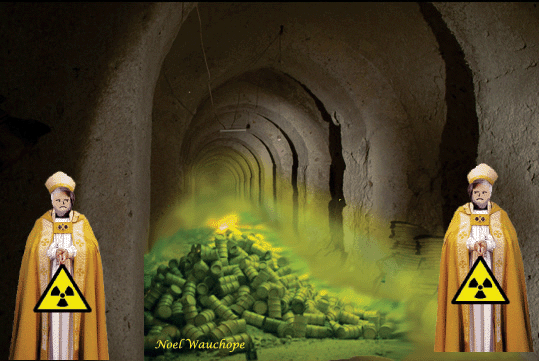
At the recent local elections three of the five candidates for the West
Caithness ward listed on their leaflets building more nuclear reactors at
Dounreay alongside complaints about potholes in the roads as their
priorities. They all got in. None of them took up my suggestion that they
could fill all the potholes in Caithness with nuclear waste.
I suspect none of them had given much thought to nuclear waste at all, which is something
they had in common with the United Kingdom Atomic Energy Authority when
they built Dounreay in the 1950’s.
Unfortunately the waste problem is now
critical, in more ways than one. The Dounreay dome, the reactor protective
casing structure, also known as the sphere and the golf ball, has been a
feature of the north Caithness coast for almost 60 years. The Nuclear
Decommissioning Authority (NDA) has recommended that the DFR be
decontaminated by 2022 (the schedule has slipped) so it can then be
demolished.
In 2007, Dounreay Site Restoration Limited (DSRL), the company
that manages the site, released the results of public consultation on
future uses for the dome. Suggestions included turning it into a hotel,
museum and even a nightclub.
However, because the structure is contaminated
with worrying levels of radioactivity and due to high maintenance costs, it
was decided to demolish it. So, sadly, no glowing raves or very long
radioactive sleeps or trips back into a memory that begins in 1955 and will
never end as the nuclear waste, dome and all, will be buried at a nuclear
dump site at nearby Buldoo.
What language, I wonder, will they put on the
steel door of this addition to the ancient burial mound culture of
Caithness? At an underground facility, a bit like Buldoo, assuringly called
“The Waste Isolation Plant”, the US government buries all kinds of
nasty waste from its nuclear weapons production 600 metres below the rocks
of New Mexico. In 20 years time, when the dump has been stuffed to the
gunnels with nuclear crap, the US government will have to seal the steel
and concrete entrances and place signs saying “Danger Zone!” all around
them.
The problem, as Serhii Plokhy, the author of “Atoms and Ashes: From
Bikini Atoll to Fukushima”, has pointed out, is that the underground
store will still be contaminated in 300,000 years, and no one can predict
what language our descendants will read or speak at that time, or what
messages might convince them not to dig into the New Mexico rocks. In the
1990s nuclear security experts proposed symbols, earthworks and mounds of
rubble designed to convey an appropriate sense of menace to anyone
stumbling on the area.
The intended message the US government wanted to
broadcast was: “This place is not a place of honour. No highly esteemed
deed is commemorated here. Nothing valued is here. What is here was
dangerous and repulsive to us. This message is a warning about danger.”
The hard question Serhii Plokhy, who is also a professor of Ukrainian
history at Harvard University where he also serves as the director of the
Harvard Ukrainian Research Institute, asks is, “If what we bury today in
the New Mexico desert – the waste created by our nuclear ambitions – is
so repulsive to us, why do we pass it on to others to deal with?”
Bella Caledonia 2nd June 2022
1 This Month



19 November – Webinar – The Reality of Reprocessing
Time: 11:00 AM Pacific Time (US & Canada) / 2:00 PM Eastern / 7:00 PM UK / 8:00 PM CET
Register for the Zoom Event Here



Shut down the radiation-damaged Heysham nuclear reactors now
To see nuclear-related stories in greater depth and intensity – go to https://nuclearinformation.wordpress.com

Say No to NASA’s Reckless Nuclear Reactor on the Moon
Say No to NASA’s Reckless Nuclear Reactor on the Moon
-
Archives
- November 2026 (74)
- October 2026 (302)
- September 2026 (339)
- August 2026 (330)
- July 2026 (355)
- June 2026 (287)
- May 2026 (306)
- April 2026 (356)
- March 2026 (251)
- February 2026 (267)
- January 2026 (308)
- December 2025 (358)
-
Categories
- 1
- 1 NUCLEAR ISSUES
- business and costs
- climate change
- culture and arts
- ENERGY
- environment
- health
- history
- indigenous issues
- Legal
- marketing of nuclear
- media
- opposition to nuclear
- PERSONAL STORIES
- politics
- politics international
- Religion and ethics
- safety
- secrets,lies and civil liberties
- spinbuster
- technology
- Uranium
- wastes
- weapons and war
- Women
- 2 WORLD
- ACTION
- AFRICA
- Atrocities
- AUSTRALIA
- Christina's notes
- Christina's themes
- culture and arts
- Events
- Fuk 2022
- Fuk 2023
- Fukushima 2017
- Fukushima 2018
- fukushima 2019
- Fukushima 2020
- Fukushima 2021
- general
- global warming
- Humour (God we need it)
- Nuclear
- RARE EARTHS
- Reference
- resources – print
- Resources -audiovicual
- Weekly Newsletter
- World
- World Nuclear
- YouTube
-
RSS
Entries RSS
Comments RSS

