UK overtakes Russia as Labour hike nuclear weapon spend by 17 per cent

the private sector earned at least $38bn from nuclear weapons contracts in 2025.
“This money is being wasted given the nuclear-armed states agree a nuclear war can never be won and should never be fought. It is also diverting resources from acute human needs.“
By Xander Elliards, https://www.thenational.scot/news/26176024.uk-overtakes-russia-labour-hike-nuclear-weapon-spend-17-per-cent/
THE UK Government increased its spending on nuclear weaponry by 17 per cent in the first full year of Labour in power, according to new statistics.
The data, published by the International Campaign to Abolish Nuclear Weapons (ICAN), shows that spending on nuclear weapons rose globally in 2025 by 19% to reach its highest levels ever.
In total, eight countries other than the UK have nuclear weapons: France, the US, Russia, India, China, Pakistan, Israel, and North Korea.
The ICAN report said that in total the nine nations had spent $118.8 billion in 2025, up 19% on 2025. The US spent $69.2bn, an increase of 22%, while Pakistan spent £1.5bn, an increase of 18%.
The UK spent a total of $12.6bn on nuclear weaponry in 2025, up 17% on 2024.
The UK was also third in terms of absolute spend, behind China in second place on $13.5bn, an increase of 7% on 2024.
Russia, who had been third in 2024, dropped to fourth, upping spending by 6% to $9.5bn.
Elsewhere, the report from ICAN, which produces the most authoritative figures on annual nuclear weapons expenditure, found that the private sector earned at least $38bn from nuclear weapons contracts in 2025.
ICAN said: “This money is being wasted given the nuclear-armed states agree a nuclear war can never be won and should never be fought. It is also diverting resources from acute human needs.
“A minute of nuclear weapons spending could provide access to clean water and sanitation for 3478 people. A day of this spending could save two million people from food insecurity. A week could protect more than 12 billion people from measles, mumps and rubella. A year’s spending could provide more than six million homes with solar power.”
ICAN also noted that the increase in spending on nuclear weaponry is happening alongside cuts to the humanitarian and development sector.
In the UK, the Government had pledged the UN target of 0.7% of Gross National Income (GNI) to the international aid budget each year. However, the Tories cut this to 0.5% in 2021, and Labour will cut it again to 0.3% from 2027.
The UK spent more than triple the UN’s entire annual budget for 2025 ($3.72bn) on nuclear weaponry. The US spent more than 19 times the UN budget.
Susi Snyder, ICAN’s director of programmes and co-author of the report, said: “At a time when the cost of living is skyrocketing and food and fuel are unaffordable for so many, it is unthinkable that these nine countries are spending billions on a false promise of security.
“Nuclear weapons cannot be used without causing catastrophe, and the false logic of nuclear deterrence requires us to trust our enemies with our very survival.”
Alicia Sanders-Zakre, a second co-author of the report and ICAN’s head of policy, added: “Our research is annual, but nuclear weapons spending is not.
“The nine nuclear-armed states are planning to maintain and modernise their nuclear forces for decades to come, diverting untold billions of dollars away from real human security needs.”
IAEA warning after drone hits used fuel facility near Chernobyl
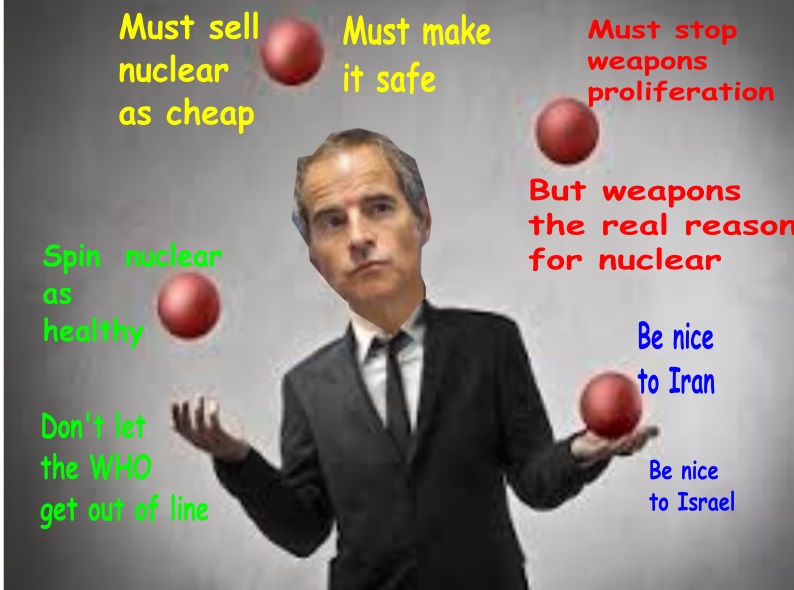
WNN, 8 June 2026
Significant structural damage was caused to a building at the new central used fuel storage facility in the Chernobyl exclusion zone, International Atomic Energy Agency Director General Rafael Mariano Grossi has said.
In a briefing to the IAEA’s Board of Governors, and in a subsequent press conference, Grossi said that in a separate incident on Friday a drone had injured Russian military personnel undertaking de-mining activities as part of an IAEA-mediated ceasefire to allow the main 750 kV Dniprovska external power line to Zaporizhzhia Nuclear Power Plant to be fixed.
He said that over the weekend there had been further negotiations with both sides before it was agreed that the IAEA would send observers to monitor the mine-clearing work, which is necessary before the repair work can take place on the external power supply lines on pylons on either side of the military front line.
“Without the Dniprovska line, Zaporizhzhia Nuclear Power Plant’s off-site power situation is very fragile. Over the past days, the plant suffered its 18th offsite power outage since the war began. With a duration of 15-hours, it was also one of its longest, necessitating the use of emergency diesel generators to cool the six shut down reactors until offsite power was restored on Saturday morning,” he said.
The incident with a drone striking the three-year-old Central Spent Nuclear Fuel Storage Facility in the Chernobyl exclusion zone took place on Sunday, with Grossi reporting it caused “significant structural damage to part of the fuel reception building, including the IAEA safeguards office. Spent fuel was stored in casks just a few hundred metres from the damaged building. Thankfully, radiation levels at the facility remained normal, indicating the incident did not cause radioactive contamination. It remains unclear when the facility will be able to start receiving spent fuel from Ukraine’s operating nuclear power plants again”.
He added: “Attacking a facility with large amounts of nuclear material is extremely dangerous. It must not happen.”
The Centralised Spent Nuclear Fuel Storage Facility is a dry storage site for used nuclear fuel assemblies from the country’s VVER-1000 and VVER-440 reactors. It is designed to have a total storage capacity of 16,530 used fuel assemblies, including 12,010 VVER-1000 assemblies and 4,520 VVER-440 assemblies. Contracts were signed for its construction with USA-based Holtec International in 2005, although construction only began in 2017.
It started receiving used nuclear fuel from the country’s nuclear power plants at the end of 2023 and it has been operating under a commissioning licence. It was issued with its operating licence last month after an inspection carried out from 20 April to 1 May.
Operator Energoatom said the fire caused by the drone strike covered an area of 40 square metres and “was quickly localised and completely eliminated”. It said there were no injuries among the personnel and the radiation situation remained within normal limits.
During his speech to the board of governors and during his media briefing, Grossi maintained the IAEA’s stance of not attributing blame to either side for incidents during the war…………………….. https://www.world-nuclear-news.org/articles/iaea-warning-after-drone-hits-used-fuel-facility-near-chernobyl
The US Starts Wars On The Other Side Of The Planet And Then Claims “Self-Defense”
Caitlin Johnstone, Jun 10, 2026, https://www.caitlinjohnst.one/p/the-us-starts-wars-on-the-other-side?utm_source=post-email-title&publication_id=82124&post_id=201394626&utm_campaign=email-post-title&isFreemail=true&r=1ise1&triedRedirect=true&utm_medium=email
The US is bombing Iran again after an American attack helicopter was downed over the Strait of Hormuz amid renewed escalations in the conflict.
CENTCOM said the following in a statement on the airstrikes:
“U.S. Central Command (CENTCOM) forces began launching self-defense strikes against Iran at 5 p.m. ET today at the Commander in Chief’s direction, in response to yesterday’s downing of a U.S. Army Apache helicopter. The mission is a proportional response to unjustified Iranian aggression.”
It always amazes me how the US can start an unprovoked war of aggression on the other side of the planet and then claim it is “launching self-defense strikes” there.
These military forces are nowhere near the United States. It’s absurd to claim “self-defense” against a country that has been defending itself in a war you started. There’s some debate about whether the helicopter was intentionally targeted by Iran and whether or not it was over international waters at the time it was struck, but honestly, who cares? It shouldn’t have been there in the first place.
These freaks really do operate from the premise that the entire planet is their property, and that any failure to respect their property rights shall therefore be viewed as an act of aggression.
I mean, just look at who’s making this statement. US “Central Command” is the unified combatant command responsible for military operations in the middle east. The US military has separate unified combatant commands for every part of the globe:
• Central Command (CENTCOM) for the middle east.
• Africa Command (AFRICOM) for Africa.
• Indo-Pacific Command (INDOPACOM) for Asia, the Pacific islands, Australia and Antarctica.
• European Command (EUCOM) for Europe.
• Southern Command (SOUTHCOM) for South America.
• Northern Command (NORTHCOM) for North America.
No other country on earth does this. No other military power is segmented into areas of responsibility spanning every continent on earth. This is because normal military forces are used to defend the actual, official country they belong to, whereas the US military is used to dominate the entire planet.
And in that sense it’s actually entirely reasonable that the US “Department of Defense” changed its name to the Department of War. The US military is never used to defend the actual, official country of the United States of America; it is only ever used to prop up the globe-spanning imperial power structure it commands.
This is not normal. It is a freakish aberration without historical precedent. The world cannot know peace until the US empire is dismantled.
Sizewell C: the Unanswered Questions

Alison Downes, https://stopsizewellc.org/sizewell-c-the-unanswered-questions/
8 June 2026: On the day the Public Accounts Committee begins scrutiny of Sizewell C, [1] and almost a year to the day that the government’s announcement of its £14.2bn investment paved the way for a Final Investment Decision, Stop Sizewell C is publishing a report “Sizewell C – The Unanswered Questions”. This highlights what is known, what it is impossible to know, and what the government continues to keep secret about Sizewell C. It is a story of secrecy, obfuscation and deception and contains a number of recommendations. [2]
Read here: Sizewell C, the Unanswered Questions, 8 June 2026
Stop Sizewell C said: “Over the last decade, efforts to uncover Sizewell C’s expected cost and schedule have been met by obfuscation, secrecy and outright deception. [3] While the National Audit Office published some details that the government wanted to keep secret, [4] we now demand much greater transparency; the Sizewell C Full Business Case and Strategy and Delivery Plan must be published – unredacted – immediately.
“With households on the hook for Sizewell C, we need assurances that the government has a prepared exit strategy for when the project – which according to the NAO is already based on “big assumptions” and “significant uncertainty” [5] – goes wrong. The government’s inability to back out of HS2 shows where this project might be heading, but with Sizewell C’s “novel” financing, it would be immoral to force households to continue paying for something that might never work properly, while investors laugh all the way to the bank.
“In the cost of living crisis, consumers must be protected now and into the future from the risks of building nuclear projects. As well as assurances of increased scrutiny and Ministerial accountability for Sizewell C, we call for a commitment that RAB will never be used again for future nuclear projects. Unless investors suddenly rediscover an appetite for risk – unlikely given the free ride provided by Sizewell C’s RAB – abandoning nuclear or switching to full state funding would seem to be the only alternatives.
“We look forward to the outcomes of the Public Accounts Committee’s enquiry into Sizewell C and hope the Committee calls out the government for failing to come clean about this deeply flawed project.”
Notes
1. The Public Accounts Committee is taking oral evidence on Sizewell C at 1pm today, 8 June with senior officials and Nigel Cann https://committees.parliament.uk/work/9713/sizewell-c/
2. See Appendix below. Some of our recommendations echo those by the National Audit Office in its report on Sizewell C.
3. Our report includes examples such as:
The government claimed not to “recognise” a cost of Sizewell C put at “close to £40bn” by the Financial Times in January 2025, when in July the project “baseline” was given as £38bn and HMG’s “central cost estimate” as £40.5bn.- Ministers are keeping the target completion date secret, saying only “mid to late 2030s”, but the NAO revealed the project baseline date as July 2039.
- Sizewell C revised its May 2020 cost estimate of £20bn a few months later, including removing allowances for in risk contingencies, but told the Planning Inspectorate in January 2021 the estimated cost “remains the same”.
- Officials gaslit Stop Sizewell C in a conversation about the project costing over £30bn.
4. Stop Sizewell C has repeatedly called for publication of the Sizewell C Full Business Case (FBC) but the government decided to only publish a summary. The NAO had sight of the FBC in preparing its report, but the FBC itself is still unpublished.
5. NAO’s press statement says: “This novel approach [RAB financing] has costs and relies on big assumptions” and “DESNZ’s modelling of [Sizewell C’s] benefits shows they will not outweigh the costs to consumers until after 2060. They are also subject to significant uncertainty.”
Appendix: Our recommendations.
I. GREATER TRANSPARENCY
- We call for the immediate unredacted publication of Sizewell C’s Strategy and Delivery Plan that contains clear and accessible information about cost, schedule and project milestones to enable the public to understand project progress. Annual updates to Parliament should spell out the following:
- Average and total costs for domestic and business users to date.
- Total capital accessed by the project to date.
- Updated construction cost compared to project baseline, LRT and HRT.
- Transparency about the whole life cost of the project from inception, through construction, operation and decommissioning. The cost of risk shouldered by HMG should also be included.
- If the Strategy and Delivery Plan cannot be published at this time the government should make a statement explaining why and commit to a publishing date.
- We call for the immediate – unredacted – publication of Sizewell C’s Full Business Case, as accessed by the National Audit Office.
- Terms agreed with EDF for use of its technology should be placed in the public domain.
II. EVIDENCE OF AN EXIT STRATEGY
While Stop Sizewell C is already convinced that Sizewell C cannot provide value for money or energy security, we believe the case for Sizewell C will weaken further over time as project milestones are missed, technological challenges emerge, and other sources of energy generation become cheaper. Given the financial burden on consumers, we seek assurances that the government would pursue an exit strategy rather than commit further funds to an expensive, unreliable energy source that would add to the UK’s stockpile of nuclear waste. The lack of an exit strategy must surely be a fundamental learning from HS2 – and Hinkley Point C.
- DESNZ should publish a process and timetable for regular reviews of the FBC, including ongoing assessments of internal or external developments on the economic viability of the project. These updates should be made public.
- These updates should transparently communicate the cost of continuing Sizewell C compared to the cost of abandoning the project, and what and when a government exit strategy would be pursued, to save consumer money being wasted.
III. PROVIDE CONSUMERS WITH ASSURANCES OF SCRUTINY AND PROTECTION
- We echo the NAO’s call for close, ongoing scrutiny by Ministers and independent watchdogs of consumer risk. The government must provide clarity on how this scrutiny will be undertaken, and demonstrate that DESNZ is resourced with the right skills and expertise to ensure full oversight. The government should undertake an early review of Sizewell C’s governance and assign specific Ministerial accountability for the project.
- The government should make a commitment not to use RAB for future nuclear power developments, especially GW nuclear projects. Full state funding would seem inevitable.
- The policy decision to “recycle” the government’s profit from Sizewell C’s RAB during construction (and operation, assuming the government kept its share) to help reduce consumer contributions towards Sizewell C should be legislated, to reduce the likelihood that future governments would rescind this arrangement and force consumers to pay even more for Sizewell C. (See point 3.)
- DESNZ should provide more detailed information to show how private sector expertise will be garnered from investors, and the basis of their belief that this will deliver savings for the benefit of consumers and that would justify use of the RAB.
- With investor returns during construction considered “high” by the NAO, we call on Ofgem to use all its powers to limit the profits investors would receive during operation, and not be swayed by investor claims that returns should reflect their “higher risk” * – when in fact consumers are bearing significant risk.
*Comments made by Centrica in a video presentation, https://www.centrica.com/investors/centrica-as-an-investment/investing-for-value-at-sizewell-c/
Department for Energy Security and Net Zero (DESNZ) defends Sizewell C funding which puts risk on taxpayer.
Representatives of the Department for Energy Security and Net Zero (DESNZ)
have defended the government’s funding model for Sizewell C, which places
risk on taxpayers rather than private investors.
Under the agreed final
investment decision (FID), private investors won’t have to pump more
equity into the nuclear project even if construction costs spiral.
At an oral evidence session of the Public Accounts Committee (PAC) on Monday (8
June), DESNZ civil servants were grilled about the findings of a recently
published report by the National Audit Office (NAO) into the delivery of
the 3.2GW nuclear plant, which concluded that private investors are reaping
“high” rewards from the project.
Utility Week 8th June 2026,
https://utilityweek.co.uk/desnz-defends-sizewell-c-funding-which-puts-risk-on-taxpayer/
Lawrence Wilkerson: Israel Bet Everything on War With Iran-and Lost
Speaking with political analyst Glenn Diesen, Wilkerson contends that despite years of military escalation, sanctions, and regional conflict, Israel has failed to achieve its central objective: weakening Iran’s influence across the Middle East. Instead, he argues, the war has strengthened regional opposition, intensified global criticism of Israel’s actions in Gaza, and exposed growing cracks in America’s support for endless military intervention.
At the center of Wilkerson’s analysis is a point often ignored in Western discussions: the conflict ultimately revolves around Palestine.
“The Palestinians are still dying every day,” Wilkerson noted, arguing that military campaigns against Iran, Lebanon, and Gaza have failed to address the root political crisis driving instability throughout the region.
Highlights
• “All Iran has to do is not lose.” Wilkerson argues that Israel and the United States require a decisive victory while Iran simply needs to survive and endure.
• Palestine remains the core issue. According to Wilkerson, efforts to shift attention toward Iran, Hezbollah, or other regional actors obscure the unresolved question of Palestinian statehood.
• Growing public opposition. Wilkerson points to rising global criticism of Israel’s actions and increasing skepticism among Americans about continued military involvement abroad.
• A deeper U.S.-Israel integration. He warns that proposed legislation would further embed Israel within the U.S. military and defense establishment while reducing public oversight and accountability.
• A changing world order. Wilkerson argues that conflicts in the Middle East and Ukraine are unfolding alongside a broader shift in global power away from Western dominance and toward emerging Eurasian economic and political networks.
For Wilkerson, the danger is not simply another regional war. It is the possibility that Washington continues doubling down on military solutions while ignoring the political realities that have fueled conflict for generations. The result, he warns, could leave both Israel and the United States increasingly isolated in a rapidly changing world.
Spiralling costs, fish discos and vast radioactive waste. Is nuclear really the solution to Britain’s energy problem?

an “unsolved environmental problem for future generations… a heavy burden to lay on our children and their children’s, children.” Porritt is aghast: “This is a truly extraordinary development – confirming that the UK still has NO idea what to do about its legacy nuclear waste.” And there is, of course, a huge cost involved, firstly with decommissioning a nuclear reactor and then storing the waste.
an “unsolved environmental problem for future generations… a heavy burden to lay on our children and their children’s, children.” Porritt is aghast: “This is a truly extraordinary development – confirming that the UK still has NO idea what to do about its legacy n
In an increasingly energy-hungry Britain, is nuclear the best way to meet soaring demand without burning fossil fuels? Fergus Collins investigates the benefits and risks
Fergus Collins, BBC CountryFile, June 8, 2026
“…………………………………….. The UK currently has nine operational nuclear reactors at five plants, with four more due to come online in the 2030s – two at Hinkley Point C in Somerset and two planned at Sizewell C in Suffolk – demonstrating Government commitment to this energy source (devolved Scotland has no nuclear plans).
“Nuclear will play a central role in meeting the UK’s future energy needs as we deliver our net zero target,” says the current minister for nuclear Lord Patrick Vallance. “As set out in our clean power mission, while our future electricity system will be dominated by renewables, we still need firm, low-carbon power to ensure the system is stable, secure and affordable. Nuclear provides that essential backbone – delivering clean power for millions of homes while underpinning a safe, resilient and cheaper system for the decades ahead.”
Not everyone is convinced, especially those concerned about safety issues; the shadows of the Chernobyl and Fukushima nuclear disasters, in 1986 and 2011 respectively, still dog the industry. Nuclear power creates vast amounts of potentially lethal radioactive waste, which must be contained and stored securely for thousands of years. Then there are questions of cost. Nuclear reactors are massive infrastructure projects and hugely expensive, not least because of the requirements of mitigating safety risks. Is it worth the investment – or could we power the UK through other means?
………………………………………………………………..The two new nuclear power stations at Hinkley Point and Sizewell are being built by EDF, France’s state-owned energy company. EDF manages eight nuclear sites in the UK – seven Advanced Gas-cooled Reactor (AGR) sites and one Pressurised Water Reactor (PWR). It says it’s driving the transition towards “an Electric Britain
………………………………….Who opposes nuclear power?
Some of the strongest voices against nuclear power in the UK come from groups protesting against the new reactors at Hinkley and Sizewell. Former science teacher Allan Jeffrey has been voicing concerns for over 40 years as part of campaign group Stop Hinkley, which works closely with TASC (Together Against Sizewell C). He doesn’t mince words: “Nuclear power stations are toxic radioactive waste factories” and argues that nuclear is “neither clean nor green” saying “large amounts of greenhouse gasses are produced in the nuclear fuel cycle from uranium mining and fuel processing to the building of power stations and waste storage sites and decommissioning old reactors.”
Jeffrey dismisses the idea that nuclear is more ethical than the gas or coal supplies the UK buys from unstable or openly hostile foreign states. “Uranium is not a renewable fuel,” he says, “and is mined in countries such as Australia, Canada, Niger and Kazakhstan. The miners frequently get lung cancer from the Radon gas, and much environmental pollution is left locally by the mining tailings and river water pollution.”
Jeffrey also points at the cost of nuclear: “Nuclear reactors take too long to build and pay back their greenhouse gas emissions.” He has a point with Hinkley Point C, which has been a building site since being approved by the Conservative Government in 2016.
Stop Hinkley and TASC are supported by statistics from CND (Campaign for Nuclear Disarmament) and many prominent anti-nuclear voices, including the environmentalist and friend of King Charles, Jonathan Porritt. In a recent blog post he claimed: “The Treasury’s financial modelling for the new power station at Sizewell C (seen by the Financial Times) gives a range of roughly £80 billion to £100 billion, far higher than the official estimate of £47 billion from the DESNZ – which in itself was already nearly double the original cost of £20 billion!”
DESNZ argues that there will be a big saving with Sizewell C because it is a replica of Hinkley and will be “built at a cost of £38bn in 2024 real terms. This would represent around 20% saving on the capital cost of the project compared with Hinkley C”.
What are the wildlife costs of nuclear power?
One very public reason for rising costs – and one the press have leapt on – is mitigation measures to prevent deaths of wildlife, especially fish. Nuclear power stations are located on the coast so they can draw seawater to cool the reactors. But they also suck in large numbers of fish; the Environment Agency has estimated 4.6 million per year at Hinkley, a figure EDF strongly contests.
EDF says it has spent £700 million in mitigation measures, including sonic fish deterrents developed with Swansea University. These use ultrasound to drive fish from the water intakes and have been dubbed ‘fish discos’ in the press.
That said, the Government’s own review, led by Sir John Fingleton, found that Britain was the most expensive place in the world to build nuclear facilities due largely to a “fragmented” regulatory system that had led to “conservative and costly decisions not proportionate to the actual risk being managed”.
However, Matt Browne, head of public affairs at The Wildlife Trusts, disputes EDF’s claims. “The developers of Hinkley C continue to misrepresent the impact that the nuclear plant will have on nature… This is highly misleading and allows EDF to pretend that £700 million is being spent to protect nature, when the real figure is closer to £50 million. It also misrepresents the number of fish affected by the proposed plant.”
Browne goes on to say: “On the basis of these false claims, the Government is now considering progressing recommendations which will lead to nature protections being severely compromised.”……………………………….
What happens to nuclear waste?
One area where there is a gap in the Government and EDF’s positive messaging – and one that tallies with Stop Hinkley and Porritt’s deeper fears – is just how and where to store nuclear waste.
Even after it’s no longer useful for generating heat, it continues to emit radiation, which breaks molecular bonds and causes severe damage to cell tissues in all organisms, leading to cancers and other severe health issues. And, as it breaks down very slowly, the waste emits this harmful radiation for tens of thousands of years.
The ONR says “Nuclear waste is primarily transferred to specialised, secure and regulated facilities for storage pending long-term disposal. Current Government policy is that UK higher activity radioactive waste will be managed in the long-term through geological disposal facilities (GDF)”.
GDF means burying the waste in deep subterranean vaults and leaving it alone till its radiation cools.
For Allan Jeffrey, this is simply an “unsolved environmental problem for future generations… a heavy burden to lay on our children and their children’s, children.” Porritt is aghast: “This is a truly extraordinary development – confirming that the UK still has NO idea what to do about its legacy nuclear waste.” And there is, of course, a huge cost involved, firstly with decommissioning a nuclear reactor and then storing the waste.
Currently, most high-level nuclear waste is being stored at Sellafield. Once at the forefront of the UK’s nuclear programme, Sellafield stopped generating electricity in 2003 and is now in the process of being decommissioned. As well as dealing with Sellafield’s own waste – spent fuel rods and other debris stored in silos and artificial ponds – it holds waste from other plants.
High level waste usually occurs in liquid form, a byproduct of processing spent fuel. This is mixed with crushed glass in a furnace and the molten product is poured into steel cannisters where it cools and solidifies, making it stable and safe for storage. But it is temporary storage only and Sellafield is almost full. Communities in Cumbria and Lincolnshire have been identified as potential nuclear waste sites.
…………The decommissioning of Sellafield is a massive project that may take over 100 years, with spiralling costs – but that’s a blink of an eye in terms of nuclear radiation.
………………………..Such gigantic periods of time, when all current decision makers and hundreds of generations of their descendants will be long dead, are hard to comprehend. Opponents of nuclear, such as Stop Hinkley and TASC, urge policymakers not to take the risk and to invest instead in renewables such as wind, solar and hydro power. In 2025, wind provided approximately 30% of the UK’s electricity needs compared to just 11–17% provided by nuclear. The UN’s International Energy Agency predicts renewables will generate 90% of all new power in the coming years. And yet you’ll find protest groups opposing almost every new wind or solar farm with the same vigour as those who are anti-nuclear……………..https://www.countryfile.com/environment/spiralling-costs-fish-discos-and-vast-radioactive-waste-is-nuclear-really-the-solution-to-britain-s-energy-problem
Visual data reveals extent of systematic Israeli white phosphorus attacks on south Lebanon: Report
These shells are designed to release 116 burning felt wedges that can be detonated high in the air and drift over a radius of up to 250 meters, causing widespread fires on the ground.
Lebanon’s Ministry of Environment has formally accused the Israeli military of committing ‘an act of ecocide,’ resulting in an estimated $25 billion in damages
The humanitarian risks of these munitions are devastating because white phosphorus causes horrific, deep-tissue burns that can reach the bone and may reignite if exposed to oxygen after treatment.
News Desk, JUN 7, 2026, https://thecradle.co/articles/visual-data-reveals-extent-of-systematic-israeli-white-phosphorus-attacks-on-south-lebanon-report
A report by The New York Times (NYT) published on 6 June gathers thorough documentation that the Israeli military has repeatedly deployed white phosphorus over populated areas in southern Lebanon during its ongoing war and invasion of the country.
Visual evidence collected by NYT, including verified social media footage and news coverage, shows distinctive smoke trails and airbursts over cities like Nabatieh and Tyre, as well as smaller towns like Qlayaa, Khiam, and Yohmor, with incidents documented as recently as May 2026.
While the Israeli military maintains that its use of these munitions is intended for smoke screens and complies with international law, human rights experts assert that deploying such an indiscriminate incendiary substance in civilian-heavy areas violates the laws of war.
The body of evidence gathered by numerous international observers and human rights groups is extensive and corroborates these findings.
Amnesty International’s Crisis Evidence Lab and Human Rights Watch (HRW) have verified dozens of videos and photos showing the airbursting of US-made M825A1 artillery shells.
These shells are designed to release 116 burning felt wedges that can be detonated high in the air and drift over a radius of up to 250 meters, causing widespread fires on the ground.
In Yohmor, HRW geolocated eight images from March 2026 showing these munitions exploding over residential neighborhoods, directly resulting in fires in homes and vehicles.
Similar evidence from Dhayra in October 2023 includes testimony from residents and doctors who treated nine civilians for suffocation and respiratory damage caused by the “garlic-like” smoke.
Independent researchers have now documented over 200 uses of the substance in Lebanon since October 2023, which the Lebanese government reports have caused more than 600 fires.
This pattern of use extends far beyond recent events in Lebanon; Israel has a long history of deploying white phosphorus in the region, including during the 1982 and 2006 wars in Lebanon, extensively in Gaza in 2009, and throughout its ongoing genocidal campaign since 2023.
Amnesty International documented the use of white phosphorus artillery shells in densely populated civilian areas in Gaza shortly after the launch of the war on 7 October, 2023; this deployment directly violated a 2013 pledge by the Israeli military to phase out the use of the incendiary substance in populated areas.
The humanitarian risks of these munitions are devastating because white phosphorus causes horrific, deep-tissue burns that can reach the bone and may reignite if exposed to oxygen after treatment.
Beyond the immediate physical trauma, the substance poses long-term environmental hazards by contaminating soil and water, necessitating specialized cleanup operations before farmers can safely return to their land.
Due to the indiscriminate nature of these illegal weapons, rights groups continue to call for an immediate halt to their use in residential areas.
Lebanon’s Ministry of Environment formally accused the Israeli military of committing “an act of ecocide,” back in April 2026, citing a National Council for Scientific Research report that details $25 billion in damages, including the destruction of thousands of hectares of forest and orchards alongside extreme phosphorus soil contamination in strikes conducted between 2023 and 2024.
𝐍𝐄𝐓𝐀𝐍𝐘𝐀𝐇𝐔’𝐒 𝐆𝐀𝐌𝐁𝐋𝐄 𝐖𝐈𝐓𝐇 𝐀𝐌𝐄𝐑𝐈𝐂𝐀𝐍 𝐈𝐍𝐓𝐄𝐑𝐄𝐒𝐓𝐒 𝐀𝐍𝐃 𝐒𝐎𝐋𝐃𝐈𝐄𝐑𝐒 𝐈𝐍 𝐓𝐇𝐄 𝐌𝐈𝐃𝐃𝐋𝐄 𝐄𝐀𝐒𝐓
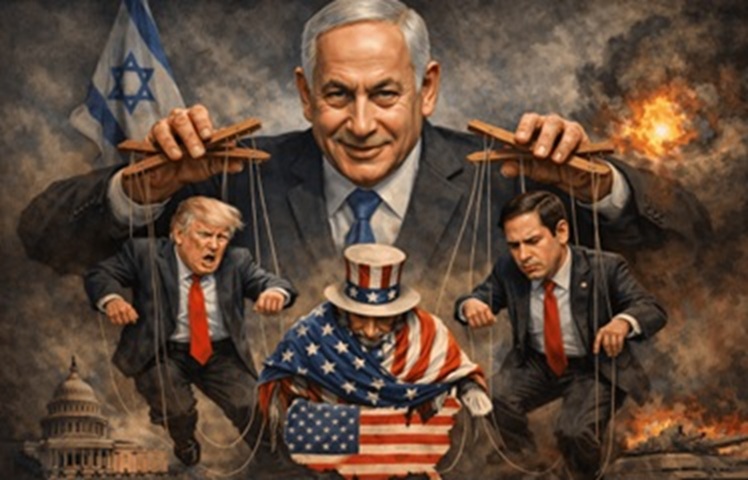
DD Geopolitics Protagonist HQ and Ibrahim Majed, Jun 09, 2026
The fragile calm that had prevailed across much of the Middle East since April, excluding the ongoing Israeli war on Lebanon, unraveled within hours, exposing a strategic reality Washington has long sought to avoid.
What began as a localized escalation rapidly evolved into a broader geo-economic crisis with consequences extending far beyond the battlefield.
At the center of the crisis lies a structural imbalance within the U.S.-Israeli relationship.
While Washington remains Israel’s principal military, diplomatic, and economic backer, recent events have highlighted the extent to which regional escalations can impose costs on the United States regardless of American preferences.
The result is a dynamic in which decisions made in Tel Aviv increasingly shape the strategic environment that Washington must manage.
𝐓𝐡𝐞 𝐄𝐬𝐜𝐚𝐥𝐚𝐭𝐢𝐨𝐧 𝐓𝐫𝐢𝐠𝐠𝐞𝐫
he latest escalation stemmed from Israel’s continued military operations in Lebanon, including renewed strikes on the southern suburbs of Beirut, despite mounting regional warnings and Iran’s explicit signaling that further escalation in Lebanese territory would cross a red line.
These actions effectively collapsed the fragile de-escalation framework that had begun to take shape in recent months.
Yet the strategic significance of the crisis did not stem solely from direct military exchanges.
The conflict quickly expanded through an asymmetric front.
Yemen’s Ansarallah movement announced a comprehensive blockade targeting Israeli-linked maritime traffic through the Bab al-Mandab Strait, transforming what might have remained a localized confrontation into a wider geo-economic challenge.
The implications were immediate.
One of the world’s most critical maritime chokepoints suddenly became a theater of strategic pressure.
Energy markets reacted rapidly, with oil prices surging as traders assessed the risks posed to global shipping routes and regional stability.
What began as a military confrontation was now exerting pressure on the economic infrastructure that underpins global commerce.
𝐓𝐡𝐞 𝐂𝐥𝐚𝐬𝐡 𝐨𝐟 𝐏𝐨𝐥𝐢𝐭𝐢𝐜𝐚𝐥 𝐓𝐢𝐦𝐞𝐥𝐢𝐧𝐞𝐬
The military escalation unfolded against the backdrop of a growing political divergence between U.S. President Donald Trump and Israeli Prime Minister Benjamin Netanyahu.
Hours before the strikes, Trump projected confidence that Washington remained firmly in control of events.
According to reports surrounding a high-level phone conversation, the American president conveyed the impression that he retained decisive influence over Israeli decision-making and could prevent a broader confrontation.
The subsequent Israeli strikes conveyed a different message.
Regardless of Washington’s preferences, events on the ground proceeded according to Israeli calculations.
The operation demonstrated the limits of American influence at a moment when the White House was attempting to contain regional tensions and preserve diplomatic channels.
More importantly, it reinforced a perception increasingly shared across the region: while the United States remains the dominant external power, its ability to dictate the behavior of key allies is not unlimited.
𝐓𝐫𝐮𝐦𝐩’𝐬 𝐄𝐥𝐞𝐜𝐭𝐨𝐫𝐚𝐥 𝐍𝐢𝐠𝐡𝐭𝐦𝐚𝐫𝐞
For the White House, the timing could hardly be worse.
The administration entered 2026 seeking to reduce regional tensions, stabilize energy markets, and avoid another Middle Eastern crisis capable of dominating domestic political discourse ahead of the Midterm Elections.
Escalation threatens all three objectives simultaneously…………………………………………………………………….
𝐍𝐞𝐭𝐚𝐧𝐲𝐚𝐡𝐮’𝐬 𝐒𝐮𝐫𝐯𝐢𝐯𝐚𝐥 𝐓𝐢𝐦𝐞𝐥𝐢𝐧𝐞
Netanyahu, however, is operating according to a very different political timetable.
His government faces mounting domestic pressures, including declining public support, growing political fragmentation, large-scale protests, and unresolved disputes surrounding the conscription of the Ultra-Orthodox community.
Current political trends suggest that a return to normal political conditions could expose the governing coalition to severe electoral risks…………………………………………..
𝐓𝐡𝐞 𝐒𝐭𝐫𝐮𝐜𝐭𝐮𝐫𝐚𝐥 𝐓𝐫𝐚𝐩
The deeper problem for Washington is that its options remain constrained.
Despite occasional public disagreements, successive American administrations have found it politically difficult to impose meaningful costs on Israel during periods of confrontation.
Congressional support, entrenched institutional relationships, domestic political considerations, and long-standing strategic commitments collectively limit the range of coercive tools available to the White House.
As a result, American policymakers frequently find themselves attempting to contain the consequences of decisions they neither initiated nor fully control.
This dynamic creates a strategic trap.
The United States absorbs the diplomatic costs of regional instability, bears responsibility for protecting maritime trade routes, manages the economic consequences of energy market disruptions, and remains expected to provide security guarantees throughout the region.
Yet its ability to shape the behavior that generates those costs remains constrained by political realities at home.
𝐓𝐡𝐞 𝐒𝐭𝐫𝐚𝐭𝐞𝐠𝐢𝐜 𝐂𝐨𝐬𝐭
The deeper danger for Washington extends far beyond the immediate crisis.
What has emerged is a growing divergence between Israeli domestic political imperatives and broader American strategic objectives………………………………………………………….
Ultimately, the central question is no longer whether the United States can continue supporting Israel.
Rather, it is whether American policymakers can reconcile unconditional strategic commitments with a regional reality in which their own interests are increasingly exposed to decisions made by an ally pursuing a very different political agenda.
If the current trajectory continues, the greatest challenge to Washington’s Middle East strategy may not emerge from its adversaries, but from the widening gap between American interests and the actions of the partner it remains committed to defending. https://ddgeopolitics.substack.com/p/75a?utm_source=post-email-title&publication_id=1769298&post_id=201184525&utm_campaign=email-post-title&isFreemail=true&r=1ise1&triedRedirect=true&utm_medium=email
‘The Humiliation Just Compounds’: Trump Tells Netanyahu Not to Bomb Iran, Then Israel Strikes Anyway

US President Donald Trump “appears unwilling to spend the political capital necessary to rein in Netanyahu—beyond angry phone calls and tough public statements,” said one analyst.
Jake Johnson, Jun 08, 2026, https://www.commondreams.org/news/trump-netanyahu-iran-2677009860
The Israeli military bombed Iran on Monday shortly after US President Donald Trump urged Israeli Prime Minister Benjamin Netanyahu not to respond to an Iranian missile barrage, which came in retaliation for Israel’s earlier bombing of Beirut.
“I am going to call Bibi right now and tell him not to retaliate,” Trump told Axios on Sunday, noting that the Iranian strikes did not appear to cause any injuries. “Each of them had their fun. Israel had its strike, and Iran had its strike. We don’t need another one.”
Iran’s missile attack on Israel was the first since a tenuous ceasefire agreement took effect in early April, and the exchange intensified concerns of a return to full-blown regional war. Iran’s Foreign Ministry said the Sunday strikes were a defensive response to the Israeli military’s bombing of southern Beirut as well as “Israel’s persistent breaches of the April ceasefire, including its collaboration with the US military in attacks on Iranian ships and targets in southern Iran over the past two weeks.”
The Israel Defense Forces vowed to “continue to operate all across Lebanon” and said it would not “allow fire toward Israel.”
Esmail Baghaei, a spokesperson for Iran’s Foreign Ministry, said during a press conference on Monday that despite Trump’s public comments, “no one in the region believes” that Israel attacked Lebanon or Iran “without prior coordination and cooperation with the United States.”
“The United States bears responsibility as a party to the April 8 ceasefire understanding,” said Baghaei. “Whatever happens in the region, whether the US itself violates the ceasefire by attacking Iranian commercial ships or targeting southern parts of the country, or whether violations are carried out through the Zionist regime in Lebanon with US complicity, the direct responsibility of the United States is clear, and the consequences of any escalation will also fall on Washington.”
Trump told the Financial Times following Iran’s missile attack on Israel that he did not believe it would undercut the prospects of a diplomatic agreement. The US president also said Netanyahu would have no choice but to accept any agreement the Trump administration reaches with Iran, declaring: “I call the shots. I call all the shots. [Netanyahu] doesn’t call the shots.”
But critics of Trump’s illegal and costly war of choice in Iran, which he launched in coordination with Israel in late February, said Netanyahu’s swift defiance of the president’s call for restraint underscored how disastrous the conflict has been for the US.
“This war has been humiliating for Trump and American power generally,” US Sen. Chris Murphy (D-Conn.) wrote on social media. “And when Trump announces he is going to call Netanyahu and tell him not to retaliate, and within hours Netanyahu retaliates, the humiliation just compounds.”
Trita Parsi, executive vice president of the Quincy Institute for Responsible Statecraft, wrote in a blog post following the Israeli attack on Iran that Trump “appears unwilling to spend the political capital necessary to rein in Netanyahu—beyond angry phone calls and tough public statements—unless he knows that he has a deal with Iran.”
“From Trump’s perspective, it is only worth doing if an agreement with Iran is already secured. In short, Trump is willing to restrain Israel to preserve a deal, but not to obtain one. Iran, however, wants evidence that Trump can restrain Israel before agreeing to a deal,” Parsi wrote. “As a result, the most likely scenario is another round of Iranian and Israeli strikes, with Trump declining to meaningfully constrain Israel.”
The National Iranian American Council noted that Iran’s leadership “has already threatened a broader and more destructive campaign” in response to Israel’s strikes.
“The coming 24 to 72 hours will likely determine whether this becomes a contained crisis or the beginning of a new phase in the regional conflict,” the group added.
UK Navy nuclear submarine fleet stuck in dock while awaiting maintenance
The UK’s Navy’s entire available fleet of nuclear attack submarines is stuck in
port, leaving Britain vulnerable to Vladimir Putin’s underwater fleet. All
five of the UK’s Astute-class hunter-killer boats are awaiting maintenance
and repairs. A sixth, which was commissioned into the fleet, is not yet
ready to deploy. Naval commanders have said the situation makes the UK look
“toothless” in the eyes of Russia, which has ramped up naval activity
around British waters by a third in the past year. Cdr Ryan Ramsey, a
former nuclear submarine captain, said the lack of available attack boats
was a “serious wake-up call” for Britain.
Telegraph 7th June 2026, https://www.telegraph.co.uk/news/2026/06/07/navy-fleet-out-of-service-maintenance-russia-lord-west/
FIFA, Eurovision expelled Russia but Israel has Impunity
June 8, 2026 Mohammed Samaana Informed Comment, https://scheerpost.com/2026/06/08/fifa-eurovision-expelled-russia-but-israel-has-impunity/
Hypocrisy and double standard are the words that come to mind in relation to how the west in general deals with the plight of the Palestinian people.
This is well manifested in culture and sports. Two major events this year have demonstrated just that. The first is the popular annual European singing contest Eurovision which was no different this year to any other year with Israel allowed to participate despite the ongoing genocide and ethnic cleansing against the Palestinian people in their own homeland.
Though five European countries – Spain, Ireland, Slovenia, Iceland and The Netherlands – took the higher moral ground and applied pressure by boycotting the contest in protest against Israel participation, this year’s edition of Eurovision went ahead without the participation of five European countries to ensure that Israel is present. To add insult to injury, the annual event took place at the usual time of every year when the Palestinian people mark the Nakba anniversary of their 1948 expulsion from their ancestral homeland by the Israelis. Because of its invasion and occupation of Ukraine, Russia hasn’t been allowed to participate in the Eurovision contest since 2022.
The second event is the World Cup. This year’s men football World Cup is another arena where the West is showing its hypocrisy. Russia was banned from all FIFA and UEFA soccer / football competitions in 2022 because of its illegal invasion of Ukraine and attempt to annex its territory, and the ban has become indefinite. All Russian national representative teams and club teams are prohibited from participation in global football events. Yet Israel’s deliberate assault on civilians and key infrastructure in Gaza and Lebanon is much worse than anything Russia has done, bad as it is.
We all also remember the calls to boycott the last World Cup in Qatar over allegations of human rights abuses, including LGBTQ and migrant workers rights and the environment. Given the current and previous US administration’s record on human rights home and abroad, it is only common sense to ask the logical question, where are those who called to boycott the last World Cup four years ago?
If they were concerned about human rights then why they are not concerned about Joe Biden and Donald Trump administrations’ support for the Israel genocide in Gaza where well over 72,000 Palestinians, the vast majority civilians, are confirmed dead so far as a direct result of Israeli fire without taking into consideration the missing and the ones who died indirectly as a result of the Israeli assault? This is besides Israel aggression towards other countries in the region including its destruction of Lebanon and the destitution of its civilian population after Israel grabbed land in the south of the country. This is besides Israel expansion into Syria and and its war on Iran which is more likely to have impacted every human on this planet at least financially.
Additionally, during Qatar World Cup in 2022, the German players famously took a photo covering their mouths in protest against the FIFA denying them freedom of expression. No sign of Germany’s team this year protesting against the American security oppressing protests against the genocide in Gaza on college campuses and elsewhere or for that matter their own German security forces brutality against similar protests in Germany or the German government support for the genocide.
Moreover, where is the concern about individual sexual rights in the light of the reports about sexual violence against Palestinian detainees and international peace activists who were at the Sumud (Steadfastness) flotilla after being kidnapped by Israeli soldiers at international waters. It is no wonder why the UN added Israel to the blacklist of states that uses sexual violence in conflict.
In terms of the environment, a study showed that the carbon footprint during the first 15 months of Israel ecocide war on Gaza mainly provided by the US is greater than the planet-warming emissions of a hundred countries.
Furthermore, how could any one be concerned about immigrants’ rights and overlook the brutality of the America Immigration and Customs Enforcement (ICE) officers? In 2025 alone 32 died in ICE custody. Not to forget the treatment of Palestinian human rights activist and green card holder Mahmoud Khalil and the ongoing effort to deport him
For the qualifying games to the World Cup, Israel has always played in the European groups with no concern over human rights violations whatsoever except for protests by solidarity groups and other peace activists. At club level, Israeli clubs take part in the European competitions. This applies to all sports and not only soccer / football.
It is important to point out that Israel is located in west Asia, not in Europe. This means that Europe is under no obligation to allow Israel to take part in any European sport or cultural events. But by allowing Israel participation especially when it is committing a genocide, Europe indicates it support for Israel and everything that it does which makes Europe complicit.
Any times these issues were raised, the world was told to keep politics out of sports. The same, however, didn’t apply when Russia was thrown out of every sport and cultural event over its invasion of Ukraine. Even if we were to accept their double standards by keeping politics out of sport when it comes to Israel, it is impossible to argue for keeping ethics or human rights out of sports. Those who insist on applying exceptionalism when it come to Israel know very well that they are enablers of its atrocities by allowing it to sportswash its reputation.
Mohammed Samaana , a freelance journalist published in the Belfast Telegraph, is originally from Palestine and lives in Belfast.
Media’s Ceasefire Fiction Masks Continuing War

SCHEERPOST, June 7, 2026, Joshua Scheer
One of the most revealing aspects of this war has not only been the violence itself, but the language used to explain, justify, or obscure it. As the death toll has climbed and entire communities have been erased, many journalists have struggled to confront a disturbing reality: narratives that would be unthinkable in other conflicts have become routine when discussing Gaza.
Veteran journalist Kathy Gannon reflects on how certain assumptions and talking points have seeped into media coverage, often shifting attention away from those carrying out the destruction and onto those enduring it. Her observation is less about a single comment than a broader pattern—one that raises uncomfortable questions about how suffering is framed, whose voices are amplified, and how language can become a tool for sanitizing mass violence.
“A media colleague described devastated Gazans as “under the boot of Hamas,” not under the horrific bombing of Israel, or the devastating attacks that have wiped out entire families, denied food and medical supplies, subjected to enforced starvation, all by Israel. I wondered at what it could mean. It was as if it was offered, as the reason or to somehow soften Israel’s killing of Gazans by the tens of thousands, 20,000 children killed, journalists targeted, hospitals destroyed, schools devastated. Of course there are still those in the media who say Israel isn’t targeting journalists, but rather it is just not paying enough attention, just not being careful enough. Really? Israel has killed more journalists than any other country, according to the Committee to Protect Journalists, nearly 300 have been killed, scores listed as targeted.”
Kathy Gannon Substack
What Kathy Gannon lays out is what far too many newsrooms still refuse to say plainly: there is no cease-fire when Israel continues killing civilians, journalists, and entire families in Gaza and Lebanon with total impunity. Calling this a “fragile cease-fire” is not reporting — it’s participating in a lie.
Since the so‑called Gaza cease-fire was announced, Israel has killed more than 1,000 Palestinians, many of them children. It has expanded the “yellow line”, shot civilians near it — including children — and continued bombing neighborhoods where displaced families were told to shelter. These are not “violations.” This is policy.
In Lebanon, Israel has bulldozed villages, bombed civilian areas, and assassinated three senior Lebanese military officers in a targeted strike. That alone shatters any pretense of a cease-fire. And yet Western media still repeats the script.
Meanwhile, the death toll of journalists is staggering: nearly 300 journalists killed, according to the Committee to Protect Journalists — the highest number ever recorded in a single conflict. Many were targeted, not caught in crossfire. To pretend otherwise is to launder the killing of the very people documenting the war.
Israel’s own officials flaunt this brutality. National Security Minister Itamar Ben‑Gvir — a man who has openly advocated genocide — posted video of himself abusing flotilla activists protesting the slaughter in Gaza. This is the level of impunity we’re dealing with.
International law is not ambiguous. The Fourth Geneva Convention prohibits transferring settlers into occupied territory. UN Security Council Resolution 2334 declares Israeli settlements a “flagrant violation.” Yet media outlets still describe illegal settlers as merely “seen by many as illegal,” as if the law were a matter of opinion.
Hospitals, schools, and refugee camps have been bombed in Gaza — and now in Lebanon. Israel claimed Gaza’s hospitals were targeted because of tunnels. What’s the excuse for the hospitals in Lebanon?
This is why Gannon’s warning matters: the more the world normalizes Israel’s actions, the more it signals to Palestinians and Lebanese that their lives do not matter. And the more Western governments expose their own hypocrisy — preaching human rights while enabling mass killing.
If journalism means anything, it must start with refusing to repeat government talking points. Stop calling this a cease-fire. Stop sanitizing the killing of children. Stop pretending journalists aren’t being targeted. Stop turning victims into perpetrators.
We have watched journalists be killed in staggering numbers, and the refusal of empire’s defenders to even acknowledge their deaths is not only unacceptable — it is the predictable rot of a country drifting toward tyranny, where legacy media long ago bartered away its soul.
This is not fragile. This is not complicated. This is not a cease-fire. It is a war on civilians — and the world is watching, even if CBS pretends not to.
Read more here about press freedom and Israel — though it omits the daily, mounting murders of women and children under the ongoing genocide……………………………………………………………….https://scheerpost.com/2026/06/07/medias-ceasefire-fiction-masks-continuing-war/
The Gazafication of Lebanon: How Israel Exports Destruction and Washington Protects It
7 June 2026 Dr Andrew Klein,, Australian Independent Media
Dedication: To the people of Lebanon – who have been told that their country is a “failed state” by those who worked ceaselessly to break it.
“The destruction will stop only when the silence is broken. Break it.”
On 1 March 2026, Israel launched a full-scale military offensive against Lebanon. The official rationale was self-defence: to push Hezbollah away from the border, to “demilitarize” Lebanon, and to secure the northern settlements. Within weeks, the death toll passed 3,500; 1.6 million people – roughly one‑fifth of Lebanon’s population – were displaced; hundreds of towns and villages were flattened.
The violence did not come from nowhere. It was the product of decades of Israeli military intervention, occupation, political interference, and a US‑backed policy that has systematically dismantled Lebanon’s sovereignty. The objective is not peace. It is the Gazafication of Lebanon: the imposition of a siege-and-destruction model that has already been perfected in Gaza, now exported to a second country.
This article is a comprehensive examination of the historical record, the current violence, and the geopolitical machinery that enables it. It is based on verifiable sources: official government statements, United Nations data, peer‑review
peer‑reviewed research, and on‑the‑ground reporting.
II. The Anatomy of the Current Assault
The offensive began on 2 March 2026, two days after a joint US‑Israeli attack on Iran. Hezbollah responded with rocket fire; Israel responded with a full‑scale ground and air campaign. By early June, the Lebanese health ministry had recorded more than 3,500 killed – including 711 women, children, and medical personnel – and over 10,000 wounded.
The disparity in casualties is stark:
- Israel: 24 soldiers and 4 civilians killed.
- Lebanon: Over 3,500 killed, plus 1.6 million displaced.
According to the UN, between 8 and 10 May 2026 alone, Israeli forces carried out 1,296 strikes in Lebanon, killing 87 people and wounding hundreds more – all during a supposed “ceasefire.” The United States‑brokered truce, ostensibly in place since April, has been violated by Israel on a near‑daily basis.
Evacuation orders have been issued for roughly 15% of Lebanese territory, including vast areas south of the Litani River. The military has drawn up maps for a permanent “buffer zone” that extends north of key cities such as Bint Jbeil, Aita al‑Shaab, and Khiam, reaching the Litani River and beyond.
The destruction is systematic. Human Rights Watch and the Lebanese government have documented “widespread demolitions” of entire villages, flattening of residential areas, and severe damage to schools, hospitals, mosques, and civilian infrastructure, including bridges and gas stations. One report described the operation as “the Gaza model” applied to Lebanon: mass displacement, wholesale destruction of housing stock, and the deliberate degradation of the country’s capacity to sustain life.
III. The Invention of Hezbollah: Israel’s Self‑Fulfilling Prophecy
The current violence is often presented as a war between Israel and an Iranian “proxy.” This framing ignores history. Hezbollah would not exist without Israel’s own actions.
On 6 June 1982, Israel invaded Lebanon, deploying up to 75,000 troops and advancing all the way to Beirut. The official objective was to remove the Palestine Liberation Organization (PLO), which had been launching cross‑border attacks. But the invasion quickly became an occupation, lasting 18 years in southern Lebanon.
The brutality of the invasion – the siege of Beirut, the massacres at Sabra and Shatila (carried out by Lebanese Christian militias but enabled by Israeli forces surrounding the camps), the widespread destruction – galvanised a resistance movement. In the aftermath of the invasion, Iran sent a contingent of Revolutionary Guards to the Bekaa Valley to help organise local Shi’ite militias. In 1985, these groups formally coalesced into Hezbollah – the “Party of God.”
Hezbollah was born to fight an Israeli occupation. It was not a “terrorist” group in any meaningful sense of the word; it was a national resistance movement recognised as such by a broad cross‑section of the Lebanese population. That Israel now cites Hezbollah’s existence as a justification for further violence is a grotesque circular argument: Israel invades, Hezbollah forms, Israel calls Hezbollah a “threat,” and invades again.
The pattern has repeated for over four decades. The 2006 war, which killed more than 1,100 Lebanese (mostly civilians) and devastated the country’s infrastructure, was the dress rehearsal. Today’s assault is the full performance.
IV. The “Greater Israel” Project – Not a Conspiracy, But a Policy
Statements by Israeli ministers make the objective abundantly clear: this is not about security; it is about expansion.
In March 2026, a map circulated by Israeli officials depicted a “Greater Israel” stretching from the Litani River in Lebanon to the Suez Canal in Egypt, swallowing the West Bank, Gaza, most of Lebanon, large parts of Syria, and all of Jordan.
Prime Minister Benjamin Netanyahu has repeatedly stated that the goal of the current operation is to “demilitarize Lebanon” and to establish Israeli security control over the Litani area – a demand that goes far beyond anything required for border security. In a CNBC interview on 3 June 2026, he declared: “If we want to save Lebanon, we have to disarm Hezbollah and demilitarize Lebanon.”…………………………………………………………………………………………
V. Lebanon: A State Crippled by Design
To understand why Lebanon is so vulnerable, it is necessary to understand how it was deliberately crippled.
The French Mandate (1920–1943)
Modern Lebanon was carved out of the former Ottoman Empire by the French. The French mandatory authorities institutionalised a confessional political system, distributing power among 18 officially recognised religious sects on the basis of a 1932 census that gave Christians a slight majority. This system was further codified in the unwritten National Pact of 1943, which reserved the presidency for a Maronite Christian, the prime ministership for a Sunni Muslim, and the speakership of parliament for a Shi’ite Muslim.
The confessional system was not designed to foster national unity; it was designed to make Lebanon governable by divide and rule. …………………………………………………………………………………………………………………………………………………….
VI. US Complicity – The Perpetual Enabler
Every major Israeli military operation – 1982, 2006, 2024, 2026 – has been carried out with direct US diplomatic, military, and financial backing………………………..
The current US‑brokered “ceasefire” is a farce. It has been violated by Israel almost daily. Rather than enforcing its terms, Washington has used it as a cover to continue arms shipments and diplomatic protection.
Hezbollah MP Hassan Hamade described the reality accurately: the conflict is part of a “Zionist‑US scheme” to redraw the map of the region and to incorporate Lebanon into a Greater Israel project.
VII. The Two Narratives – What They Say at Home vs. What They Tell the World
Israel consistently presents two incompatible narratives.
To its own public and to Western allies:
- The war is a defensive operation against a “terrorist” organisation (Hezbollah) that holds Lebanon hostage.
- The goal is to push Hezbollah north of the Litani River and to “demilitarize” Lebanon – a “peace” operation, not a conquest.
- The destruction of civilian infrastructure is regrettable but unavoidable, because Hezbollah “hides among civilians.
To the rest of the world (and through the actions of its ministers):
- The goal is territorial expansion, as made explicit by the “Greater Israel” maps and the statements of ministers like Ben‑Gvir and Strock.
- The objective is the permanent displacement of populations – both in Gaza and in Lebanon – to create “facts on the ground” that prevent any return.
………………………………………………………………… VIII. A Double Standard That Undermines International Law
No other state in 2026 would be permitted to behave as Israel does.
No other state’s ministers openly call for the establishment of settlements in a third country, to be populated by its own citizens.
No other state systematically occupies territory in defiance of decades of UN Security Council resolutions.
No other state issues mass evacuation orders covering a fifth of a neighbour’s population while claiming “self‑defence.”
No other state’s ministers openly call for the establishment of settlements in a third country, to be populated by its own citizens.
The international community’s response has been a masterclass in moral cowardice. The UN Security Council is paralysed by the US veto. The International Criminal Court’s investigation into Israeli officials – including Prime Minister Benjamin Netanyahu and former Defence Minister Yoav Gallant – proceeds at a glacial pace, while arrest warrants for Russian officials were issued within months………………………………………………………………………………………….
IX. The Gazafication of Lebanon – A Deliberate Export
The term “Gazafication” – the deliberate application of the Gaza model (siege, mass displacement, and wholesale infrastructure destruction) to another territory – is not hyperbole. It is an accurate description of current Israeli strategy……………………………………………………………………..
X. Conclusion: No Sovereign State Should Dictate Terms to Another
The official Israeli narrative – that this is a war against “terrorism” – collapses under the weight of the evidence.
- Israel invaded Lebanon in 1982; Hezbollah was formed to resist the occupation.
- Israel has occupied Lebanese territory for over 40 years (the Shebaa Farms, the Kfar Shuba hills).
- Israel has interfered in Lebanese politics, assassinated its leaders, and undermined its sovereignty.
- Israeli ministers openly call for the expansion of “Greater Israel” into Lebanese territory.
- The United States has protected every single Israeli violation of international law.
No sovereign state should be forced to accept that its northern river marks the boundary of a foreign power‘s “security zone.” No people should be told that their homes must be destroyed to satisfy the expansionist ambitions of a neighbour.
The “Greater Israel” project is not a fringe fantasy; it is official policy. The “buffer zone” maps have been published. The ministers have spoken. The bombs have fallen. The only question is whether the international community will continue to look away.
History will not forgive those who remained silent while a second country was systematically dismantled.
References…………………………………………. https://theaimn.net/the-gazafication-of-lebanon-how-israel-exports-destruction-and-washington-protects-it/
North Korea will never give up its nuclear weapons, says Kim Jong-un’s sister
The sister of Kim Jong-un has insisted that North Korea will never give up
its nuclear weapons, setting back hopes of progress towards
denuclearisation during Monday’s visit to Pyongyang by President Xi of
China. Kim Yo-jong, a senior figure in the leadership who sometimes serves
as spokeswoman for her brother, said North Korea’s “status as a nuclear
weapons state is the line of no retreat and it is a stark reality whether
anyone recognises it or not”.
Times 7th June 2026, https://www.thetimes.com/world/asia/article/kim-jong-un-sister-north-korea-nuclear-deal-president-xi-zs7qbkt5c
1 This Month




Shut down the radiation-damaged Heysham nuclear reactors now
To see nuclear-related stories in greater depth and intensity – go to https://nuclearinformation.wordpress.com

Say No to NASA’s Reckless Nuclear Reactor on the Moon
Say No to NASA’s Reckless Nuclear Reactor on the Moon
-
Archives
- October 2026 (302)
- September 2026 (339)
- August 2026 (330)
- July 2026 (355)
- June 2026 (287)
- May 2026 (306)
- April 2026 (356)
- March 2026 (251)
- February 2026 (267)
- January 2026 (308)
- December 2025 (358)
- November 2025 (359)
-
Categories
- 1
- 1 NUCLEAR ISSUES
- business and costs
- climate change
- culture and arts
- ENERGY
- environment
- health
- history
- indigenous issues
- Legal
- marketing of nuclear
- media
- opposition to nuclear
- PERSONAL STORIES
- politics
- politics international
- Religion and ethics
- safety
- secrets,lies and civil liberties
- spinbuster
- technology
- Uranium
- wastes
- weapons and war
- Women
- 2 WORLD
- ACTION
- AFRICA
- Atrocities
- AUSTRALIA
- Christina's notes
- Christina's themes
- culture and arts
- Events
- Fuk 2022
- Fuk 2023
- Fukushima 2017
- Fukushima 2018
- fukushima 2019
- Fukushima 2020
- Fukushima 2021
- general
- global warming
- Humour (God we need it)
- Nuclear
- RARE EARTHS
- Reference
- resources – print
- Resources -audiovicual
- Weekly Newsletter
- World
- World Nuclear
- YouTube
-
RSS
Entries RSS
Comments RSS

