UK government denies reports that the Sizewell C nuclear project is in doubt
The UK government has denied plans for Sizewell C are currently under
review, reiterating its commitment in supporting the acceleration of the
nuclear industry. This is contrary to reports that emerged from the BBC in
which it was stated a “government official had disclosed that every major
project was under review including Sizewell C”.
It was reported that the
primary reason behind this was to cut costs as the UK enters the bleak
winter period amid the energy crisis. Dispelling these reports, a
government spokesperson told Current± that its position on the Sizewell C
project “has not changed” and it will continue to support the
development of the nuclear industry as a means to reach net zero.
Current 4th Nov 2022
https://www.current-news.co.uk/news/uk-government-squashes-claims-sizewell-c-is-under-review
Azov Nazi speaks to school kids across America
http://space4peace.blogspot.com/2022/11/azov-nazi-speaks-to-school-kids-across.html Bruce Gagnon, 7 Nov 22, I know this is hard to imagine – to believe. An Azov death squad member – a Nazi being paraded across the US to speak to school students. As we like to say – this takes the cake!
And to top it off he gets interviewed on MSNBC TV. The so-called ‘liberal’ channel.
This is how the minds of American youth are being contaminated with trash – filth – pure evil.
This is how fascism is being introduced to young people across our land.
This is a total disgrace.
This is being supported/organized by the neo-con run Democratic Party that a high percentage of American ‘peaceniks’ will be voting for on November 8.
Can we say that most Americans are blind and confused? Yes for sure.
This makes me sick.
Remember WW II Italian leader Benito Mussolini’s definition of fascism – the ‘wedding of corporations and government’.
This is what we have in the USA today.
Radioactive Waste Flasks to Share Arnside Viaduct with Walkers and Cyclists ?
Movers and Shakers including green minded and not so green minded folk are
pushing ahead with the plan to open the Arnside Viaduct to walkers and
cyclists. Whats wrong with that? Nothing apart from the fact that
radioactive waste travels this route to Sellafield on a regular basis.
Several flasks are sometimes taken across the viaduct at a time with at
least two deisel engines required just in case one breaks down as the load
is so very dangerous to the public ..and a target for goodness knows what.
Along with Nuclear Free Local Authorities and Close Capenhurst, Radiation
Free Lakeland recently put a series of questions to Direct Rail Services
who operate the nuclear waste trains on behalf of UK Government. The
replies have so far been unsatisfactory to say the least given that UK
Government is putting public money into ever increasing nuclear waste
flasks journeying to Sellafield alongside public access for walkers and
cyclists sharing the same route over the Arnside Viaduct.
Radiation Free Lakeland 6th Nov 2022
NRA risks losing its reputation as neutral nuclear watchdog body

Members of the Nuclear Regulation Authority hold a meeting Nov. 2 in Tokyo’s Minato Ward.
November 5, 2022
The Nuclear Regulation Authority (NRA) has started working on legal revisions to effectively eliminate the limit on the operational life span of nuclear reactors.
The NRA appears to be responding to growing calls for the “revival” of nuclear power generation within the government and the business community. The NRA was set up as a highly independent nuclear safety watchdog in line with lessons gleaned from the 2011 Fukushima nuclear disaster. It should not forget its original mission.
The legal life span of a nuclear reactor is 40 years in principle but can be extended to 60 years at a maximum.
But the Ministry of Economy, Trade and Industry (METI), acting at Prime Minister Fumio Kishida’s behest, has proposed increasing the life span of reactors. Acting in tandem with the government’s move, the NRA instructed its Secretariat, a government agency, to review the current rules.
In a recent meeting on this issue, the NRA Secretariat presented a proposal which would require reactors that have been in service for 30 years to undergo inspections for signs of degradation at intervals of 10 years or less to win permission for continued operation. As long as they keep passing these periodical inspections, they can run beyond the 60-year limit.
The NRA is expected to work out, possibly by the end of the year, an outline of a draft revision of the Nuclear Reactor Regulation Law for the extended operations of nuclear plants.
The 40-year cap was a rule established under a bipartisan agreement reached through Diet debate that focused on the bitter lessons from the triple meltdown at the Fukushima No. 1 nuclear power plant in 2011. This rule, along with the suspension of new construction and expansion of nuclear power plants, played an important role in reducing the nation’s dependence on atomic energy, a policy goal adopted by the government. The rule must not be changed without national debate after only 10 years.
The NRA argues that whether to extend the legal life of reactors is a policy decision concerning the use of nuclear power that is outside its mandate. That means the NRA’s mandate is to ensure proper regulations of nuclear power generation according to the government’s policy.
At a glance, this position appears to be based on the principle of the separation of nuclear safety regulation from the government’s policy to promote nuclear power generation. But it is, in effect, regulation in line with promotion.
Nuclear power plants inevitably wear down over time. There are many plant parts that were not designed to be replaced. As the initial design philosophy for reactors has become outdated, the risk of unexpected problems and malfunctions increases. The 40-year rule was partly aimed at avoiding such unclear and unpredictable risks.
Extended life spans will inevitably increase the burden of inspections and raise the cost of electricity generated by aging reactors due to costs incurred by taking the necessary measures to pass inspections. This also raises questions about whether extended operations of reactors will make economic sense.
The NRA claims the regulations for reactors that have run for 30 years or longer would become “far more rigorous than now” under the proposed change. Some NRA experts have said the new system should make it harder for older reactors to pass inspections. Others have pointed out the importance of responding to the risks posed by natural disasters like earthquakes, tsunami and volcanic eruptions.
But the specifics of the new regulations and operational rules remain unclear. The ongoing policy debate on the issue, clearly driven by arguments for promoting nuclear power, raises doubts about whether the government could develop a new regulatory system that can win the support of the residents and administrations of host communities and the public as a whole.
To prevent another nuclear tragedy, it is vital for the NRA to remain solidly committed to maintaining its independence. Serious doubt about its independence would deliver a huge blow to its credibility with society.
If its independence is undermined, the NRA might be unable to resist future political pressure for relaxing the safety regulations or safety inspections of aged and risky reactors.
The NRA must realize that the situation poses a critical test of its commitment to its core mission as the nuclear safety watchdog.
Nuclear waste: from Bure in the Meuse, France to Japan, opponents of the burial unite
In Bure, in the Meuse, the Cigéo project for the burial of long-lived nuclear waste has been recognized as being of public utility. Opponents are calling on the Japanese to mobilize against a similar project on the island of Hokkaido.

Opponents of the Bure nuclear waste burial project have lent their support to the inhabitants of Suttsu, Japan, where a similar project is under study.
Ouest-France Alan LE BLOA. Published on 03/11/2022
On the borders of the Meuse and Haute-Marne regions, the Cigéo project for a nuclear waste burial center in Bure has been declared to be in the public interest. The decree, published on Friday, July 8, authorizes the National Agency for Radioactive Waste Management (Andra) to acquire the land needed for the surface installations, as well as the land located above the galleries. This means about 3,500 hectares, which can be expropriated if necessary.
85,000 m3 of radioactive waste
The aim of the project is to bury 85,000 cubic meters of long-lived high-level and intermediate-level radioactive waste from France’s nuclear power plants 500 meters underground by at least 2080. This decisive step, since the launch of research on site twenty years ago, has rekindled tensions. Some thirty associations and residents have filed an appeal with the Council of State to challenge the decision. A message relayed to Japan
On September 16, EELV and LFI parliamentarians gave their political support to the opponents’ action… which is becoming international. In a message relayed to Japan, they have, in fact, sent their support to the inhabitants of the village of Suttsu, opposed to the project of burying radioactive waste in the subsoil of the island of Hokkaido, in the north of the archipelago. The burial projects “are devastating for our territories and represent economic brakes for their future. No one wants to live next to a radioactive repository. The promises of development are lies intended to make the projects acceptable”, they write, condemning “the lack of transparency of the authorities”.
In the meantime, in Bure, an observatory for the health of local residents is being set up. Its objective? To monitor the physical and psychological health of residents within a 25 km (6,000 people in 180 municipalities) and 50 km (340,000 people in 679 municipalities) perimeter. Some 900 people, selected at random, are to be interviewed to assess their health.
Nuclear waste: in Japan, a sensitive project in an earthquake-prone region
On the island of Hokkaido, a contested project plans to bury 19,000 tons of radioactive waste 300 m underground. In a region subject to the risk of earthquakes.

Yugo Ono, geologist and professor emeritus at the University of Hokkaido, considers that it is risky to bury radioactive waste in an area subject to seismic movements.
Ouest-France Johann FLEURI. Published on 03/11/2022 at 06h30
On the island of Hokkaido, Numo is carrying out stage 1 of the investigation, which began in 2020. The radioactive waste management company is studying the location, soils, seismic history of the area and calculating budgets. Residents and the city council will be asked to vote on whether to proceed with the project and move to Phase 2. The vote, scheduled for November, has been postponed.
Stored for over a thousand years
The 19,000 tons of nuclear waste that could eventually be buried on site, between 300 m and 3 km below the surface of the ground, are extracts of liquid waste, which after several treatments, remain highly radioactive and must be stored for more than a thousand years, to no longer present a danger to humans. The burial project, the first of its kind in the archipelago, consists of placing them in stainless steel tubes, so that they can be stored as vitrified waste. Numo plans to store 40,000 of these containers underground.
Soil and water table
An underground project that seems risky in a country subject to earthquakes. At Numo, we believe that “the degree of danger is under control”. In the event of a major earthquake, “the containers will follow the movement of the earth”. But Yugo Ono, a geologist and professor emeritus at Hokkaido University, does not share this opinion. “Buried, the waste could pollute the soil and groundwater in the event of a strong earthquake,” he says.
Risks
“The geology of the region, composed of volcanic rocks, is unsuitable for such a project, says the scientist. The soil is very affected by seismic activity. In the case of a major earthquake in Suttsu, “the radioactivity will spread into the water table,” he says. The waste would be stored at a depth of 300 meters, while “seismic activity can be felt up to 10 kilometers down.” Under pressure, the expert is certain: “The tanks will break.”
Another method
Rather than burial, “the only method of storing radioactive waste for Japan today is in steel containers, covered with 2 meters of concrete, within the walls of nuclear power plants. According to Yugo Uno, “this is the safest method, which we master best and it is not so expensive”. But this system requires that the containers be changed every fifty years at the most because the steel will be attacked by radioactivity. “Every twenty years would be better for maximum safety.”
REPORT. In Suttsu, Japan, the inhabitants do not want nuclear waste
At a time when Japan is announcing the restart of seventeen nuclear reactors by 2023, the question of radioactive waste management arises. In Suttsu, a landfill project is under study, to the great despair of the inhabitants.

Miki Nobuka, 50 years old, says she learned that the project of nuclear waste burial was validated while she was buying her bread.
Ouest-France Johann FLEURI. Published on 03/11/2022
“We don’t want our village to become a garbage dump,” say Kazuyuki Tsuchiya and his wife Kyoko. This couple of septuagenarians runs an inn in Suttsu, located on the island of Hokkaido, in northern Japan. This village of 2,800 souls, 78% of which is made up of forests, is picturesque and is located between mountains and the sea.
It is here that a nuclear waste storage project has been taking shape since 2020. Suttsu and the neighboring village of Kamoenai (800 inhabitants) were the only ones to apply to the Radioactive Waste Management Corporation (Numo), created by the Ministry of Economy, Trade and Industry and the electricity companies, and were selected to receive, within 20 years, the 19,000 tons of radioactive waste piling up in the country’s power plants, particularly in Fukushima Dai-chi and Rokassho in Aomori, where storage capacity is saturated.
In Japan, between the villages of Suttsu and Kamoenai, which have applied for the radioactive waste burial project, is the Tomari nuclear power plant. In Japan, between the villages of Suttsu and Kamoenai, which have applied for the radioactive waste disposal project, is the Tomari nuclear power plant.
Although Suttsu officially submitted its application, the inhabitants feel that they were not consulted and accuse the municipal council of having made the decision alone. Miki Nobuka, 50 years old, says she learned that the project was approved while she was buying her bread. This mother has been campaigning ever since to “stop it for our children”.
More than 50% of the inhabitants against
According to Kazuyuki Tsuchiya’s calculations, “more than 50% of the inhabitants of Suttsu are against”. Not having had access to the details of the project, “the council makes heavy decisions in plenary sessions”. The residents feel betrayed and angry. “The mayor wants to take advantage of the subsidies to develop the city, but we don’t want it,” he says.
According to Kazuyuki Tsuchiya’s calculations, “more than 50 percent of the residents of Suttsu are against” the radioactive waste disposal project.
In the first phase of the project, which consists mainly of soil investigation, 15 million euros are paid to each of the two municipalities. Fifty-three million in the second phase, which is to be voted on by referendum. The city council can say stop at any time,” says a Numo spokesperson. A vote will validate the continuation of each phase.”
Lack of transparency
But “we want to have access to all the documents: it’s unacceptable,” says Kazuyuki Tsuchiya, who won his case in the Hakodate administrative court last March for lack of transparency on the part of local authorities. The court ruled that the city of Suttsu should publicly share all the minutes of the city council meeting during which the vote for the final storage project was held. The vote for the second phase, originally scheduled for November, has therefore been postponed to a later date.
When contacted, the mayor of Suttsu refused to answer our questions. The Kishida government has announced the restart of 17 of its reactors by 2023 and the probable construction of new ones in the future. The Prime Minister also declared that before each restart, the local population, who live near the said plants, would be consulted. A promise that makes the inhabitants of Suttsu smile bitterly.
Will Biden Gamble on a Ukraine Coalition?
First, what is the aim of the coalition? Is the aim to expel Russian forces from Ukrainian territory? Is the aim to reinforce Ukrainian defense lines and achieve a ceasefire for negotiations? Or is the coalition merely a device to drag the rest of the NATO alliance into a war with Russia that very few Europeans will support?
The Washington establishment is considering a risky and ill-defined intervention in Europe.
https://www.theamericanconservative.com/will-biden-gamble-on-a-ukraine-coalition/ Douglas Macgregor, Nov 3, 2022,
When Napoleon Bonaparte began his 1812 campaign to conquer Russia, he led the largest “coalition of the willing” in history. In addition to its French core, Bonaparte’s army of more than 400,000 consisted of Italian, Dutch, German, and Polish soldiers. They were at best unenthusiastic. Frankly, other than the French, only Napoleon’s Polish allies were truly eager to march on Moscow.
By the time Bonaparte’s multinational force reached Moscow, paralyzing cold, ruinous battles, exhaustion, disease, and poor logistical planning reduced the original invasion force to less than half of its original strength. It was not long before Prussia and its North German allies defected to the Russians while the remainder (minus the Poles) deserted or died on the march home.
Today, the Biden White House appears to be considering the use of a multinational force aimed at Russia. The NATO alliance is unable to reach a unanimous decision to intervene militarily in support of Ukraine in its war with Russia. But as signaled recently by David Petraeus, the president and his generals are evaluating their own “coalition of the willing.” The coalition would allegedly consist of primarily, but not exclusively, Polish and Romanian forces, with the U.S. Army at its core, for employment in Ukraine.
All military campaigns succeed or fail based on strategic assumptions that underpin operational planning and execution. Without knowing the details of the ongoing discussions, it is still possible to raise questions about the coalition’s proposed operational “purpose, method, and end state.”
First, what is the aim of the coalition? Is the aim to expel Russian forces from Ukrainian territory? Is the aim to reinforce Ukrainian defense lines and achieve a ceasefire for negotiations? Or is the coalition merely a device to drag the rest of the NATO alliance into a war with Russia that very few Europeans will support?
Second, what will U.S. air and ground forces do if they are decisively engaged from the moment they cross the Polish and Romanian Borders into western Ukraine? The Russian High Command will no doubt identify the U.S. military component as the coalition’s center of gravity. It follows that Russian military power will focus first and foremost on the destruction of the U.S. warfighting structure together with its space-based command, control, intelligence, surveillance, and reconnaissance capabilities.
Third, is Washington building a “coalition of the willing” for political reasons or because it anticipates a resource-intensive commitment and needs regional allies to share the burden? Since it is unlikely that conventional U.S. military power would defeat conventional Russian military power on its own, can the U.S.-led coalition assemble the diverse military capabilities required to dominate Russian forces with enough striking power to compel a change in Russian behavior? Equally important, can U.S. and allied forces protect Europe’s numerous transportation networks, as well as air and naval bases, from Russian air and missile attack?
Fourth, will the coalition’s conduct of operations be subject to limitations deemed essential to allied partners? Differences of opinion always exist on questions of how to fight the opponent, how far to move, and just how much to risk. Lack of clarity about specific objectives can have serious consequences. In other words, how much unity of command can U.S. military commanders really expect from their allies in war and will the demand for unity of command outweigh purely national interests? It is useful to remember that Moscow enjoys complete authority over all its forces including those of its partners and allies. Russian unity of command is absolute. Moscow is not compelled to cope with diverging preferences and opinions from coalition members.
Finally, Jens Stoltenberg, the Secretary General of NATO insists that Ukraine’s failure to prevail in its war with Russia would be interpreted as a defeat for NATO. Would heavy losses inflicted on U.S. ground forces in a confrontation with Russian military power not also signal Washington’s defeat? How rapidly could U.S. and allied forces replace their losses? Would severe U.S. losses raise the specter of a U.S. nuclear response? When does support for Ukraine put NATO’s security and survival at risk?
Washington’s recently announced reiteration of strategic ambiguity regarding the “first use of nuclear weapons” raises additional questions. Spokesmen for the Biden administration indicate that the president will not follow through on his 2020 pledge and declare that the sole purpose of nuclear weapons is to deter a nuclear attack against the United States or its allies.
Instead, President Biden approved a version of the policy from the Obama administration that permits the use of nuclear weapons not only in retaliation to a nuclear attack, but also to respond to non-nuclear threats. President Biden’s decision is at least as dangerous and destructive to American and Allied goals as was the Morgenthau Plan: a plan to deindustrialize Germany that, while rejected, probably lengthened the war against Nazi Germany by at least half a year. Does anyone in Washington, D.C., really believe that this new policy makes a nuclear war with Russia less likely?
Europe can’t cut economic ties with Russia unless it cuts nuclear power use as well

Uranium addiction . https://beyondnuclearinternational.org/2022/11/06/uranium-addiction/ By Hannes Czerulla, 6 Nov 22
The new edition of the Uranium Atlas makes it clear that Europe will not be able to detach itself economically from Russia as long as the states continue to use electricity from nuclear power. After all, both Germany and other European states obtain a large part of the uranium needed for this purpose from mines in Russia and Kazakhstan.
The recently updated version of the Uranium Atlas (in German), is published by the Bund für Umwelt und Naturschutz Deutschland (BUND) together with the Nuclear Free Future Foundation, the Rosa Luxemburg Foundation, Greenpeace and “.ausgestrahlt”. According to the report, around 40 per cent of European uranium imports come from Russia and Kazakhstan. Thus, in addition to fossil energy imports, European countries are significantly dependent on Russia.
If Europe really wants to become independent of Russia in the energy sector, “it must also stop its cooperation with Russia in the nuclear sector as soon as possible,” emphasised Uwe Witt, Senior Advisor for Climate Protection and Structural Change at the Rosa Luxemburg Foundation.
The Uranium Atlas highlights the regions of the world where uranium is mined, utilised or disposed of. The history of the uranium industry is mostly marked by exploitation and environmental destruction. In Africa, for example, foreign companies still control the mining of radioactive ore and leave behind contaminated land and a population with impaired health. In Canada and the USA, too, indigenous inhabitants are suffering from the uranium-related contamination of entire regions. Meanwhile, Central Europe is struggling with the legacy of uranium mining.
Nuclear power does not bring security of supplies
At the centre of the Russian uranium industry is the state-owned corporation Rosatom. Founded in 2007 by Russian President Vladimir Putin, it reports directly to the Kremlin and holds stakes in uranium mines mainly in Kazakhstan, but also in Canada and the USA. With an annual output of 7,122 tonnes of uranium, the company produces 15 percent of the global total and is the second-largest uranium producer in the world.
Angela Wolff, nuclear and energy policy officer at BUND, explains: “In the production of enriched uranium, which is needed for the operation of nuclear power plants, the dependency is even greater: more than a third of the global demand comes from the Russian state corporation.”
Eastern Europe in particular is also specifically dependent on Russian fuel elements because reactors in the Czech Republic, Hungary, Bulgaria, Slovakia – and Finland – can only be operated with these hexagonal fuel rods. In total, there are 18 reactors of this type in the EU.
Russia ignores environmental problems
Rosatom is silent about the details of uranium mining in Russia’s three remaining mines. The 225-page annual report contains only production and key figures on uranium mining. No details were mentioned and certainly no problems.
Uranium expert Paul Robinson reports in the Uranium Atlas: “In some houses in the vicinity of uranium mines in Krasnokamensk, radon concentrations of up to 28,000 becquerels per cubic metre have been measured; this value is 190 times above the limit at which, for example in the USA, emergency measures are prescribed by law.”
Closed mines need to be cleaned up in Russia. Environmental protection organisations that wanted to secure them are harassed by the state. The nuclear physicist Oleg Bodrov, for example, had to resign from the leadership of the organisation Green World in 2017 because he had campaigned for the decommissioning of all nuclear power plants in Russia and the cessation of uranium mining.
Import ban for Russia is not enough
While Rosatom is planning to build a total of 35 new nuclear power plants abroad – among others in Belarus, Bulgaria, China, Finland and Hungary – the EU Commission is being forced to act, explained Armin Simon of the anti-nuclear organisation .ausgestrahlt. The EU Commission has justified the inclusion of nuclear power and fossil gas in the EU taxonomy with supply security aspects, Simon said. “This justification has turned out to be false for all to see. Contrary to what is claimed, nuclear power does not contribute to security of supply.”
An import ban on nuclear fuel from Russia, as already demanded by the EU Parliament, falls short, he said. “The EU Commission must revise its position on this. Otherwise, the EU Parliament must pull the emergency brake,” Simon demanded.
BUND points out that despite the precarious situation, CDU/CSU politicians are calling for lifetime extensions for German nuclear power plants. For example, Bavaria’s Prime Minister “Markus Söder is conducting a grotesque sham debate,” said Olaf Bandt, Chairman of BUND. “His calls for nuclear power are a political and moral indictment in light of the nuclear threats from nuclear power plants in the war zone [in Ukraine] and Putin’s nuclear bomb threats.” (Editor’s note: Since this article was originally published, the German government did decide to extend the operating life of two of its remaining three reactors, but only until next April.)
Critics as enemies of the state
In the authors’ view, obtaining the uranium needed in Europe from states other than Russia is not an alternative. The conditions under which the fuel is mined are precarious everywhere. In China, anyone who criticises uranium mining is considered an enemy of the state.
The activist and Nuclear Free Future Award winner Sun Xiaodi is mentioned as an example. He had run a warehouse at one of China’s largest mines and raised questions about health hazards and radiation exposure from 1988 onwards. After giving an interview to a French journalist in 2005, he was placed under house arrest. In 2009, Sun Xiaodi was sentenced to two years in a penal camp for inciting public opinion, according to reports by the medical organisation IPPNW.
Africa does not benefit from mining
Read more: Europe can’t cut economic ties with Russia unless it cuts nuclear power use as wellNowadays, active mines in Africa are found in Niger, Namibia and South Africa. Although Niger is the world’s eighth-largest uranium producer in terms of total historical mining, the population has not benefited from the boom since the 1960s. Today, the country is one of the poorest in the world. At the same time, about 152,000 tonnes of uranium with a current market price of about 40 billion US dollars were exported.
What has been left behind – mainly by the French nuclear company Areva – is radiating waste. In the areas surrounding the mines, the radiation levels in the water are in some cases ten to a hundred times higher than recommended by the World Health Organisation (WHO). Roads have been built out of radiated rock debris. In the mining town of Arlit on the southern edge of the Sahara, 35 million tonnes of radioactive waste are lying around in the open. The background radiation there is 200 times higher. Nevertheless, three new mines are planned.
Under South Africa’s apartheid system, it was standard practice for decades that workers with suspicious symptoms of illness were given a last month’s pay and dismissed. There, uranium is only a by-product of gold mining. However, this was enough to make South Africa the most important uranium producer in Africa.
“Nuclear power contributes nothing to solving the climate crisis.”
The authors of the Uranium Atlas also warn against viewing nuclear power as a “climate saviour”, as is currently repeatedly suggested by interest groups and politicians. “Climate protection is currently the central argument for making nuclear power respectable again,” the Uranium Atlas states.
In its brochure “Nuclear Power and the Paris Agreement”, the International Atomic Energy Agency (IAEA) claims that nuclear power is also needed to achieve the goals of the Paris Climate Agreement. With this justification, the EU Commission also wants to classify nuclear energy as sustainable in the EU taxonomy (in German). (Editor’s note. Since the original publication of this article, this has now become a reality.)
From the authors’ point of view, however, these demands neglect the health and environmental dangers of uranium mining, the possibility of a catastrophe of unimaginable proportions and the still unresolved question of final storage. Horst Hamm, project manager of the Uranium Atlases, therefore declared: “Nuclear power contributes nothing to solving the climate crisis.” Moreover, the construction of new nuclear power plants is too expensive and too slow to make a difference to climate protection in the future, he said.
“Not even existing nuclear power plants are still able to compete with renewable energies, as the example of the USA in the Uranium Atlas shows,” Hamm added. Six US reactors are being shut down there ahead of schedule, and more are to follow. (Editor’s note: there are now moves afoot to subsidize and keep open reactors that planned to close and even to reopen at least one.) The nuclear industry had already been highly subsidised in the past decades and, from a purely economic point of view, was not viable.
New construction projects: Bottomless pit
Worldwide, one in eight new nuclear power plants was abandoned before it went into operation. The reason was often delays in completion and rising costs during construction. Examples include Chile, Indonesia, Jordan, Lithuania, South Africa, Thailand and Vietnam.
However, there are also reactors in Europe whose commissioning has been delayed by years and whose costs continue to rise: The construction of the first European pressurised water reactor (EPR) in Olkiluoto, Finland, started in 2005 and was supposed to be finished in 2009. Now, in the course of 2022, with a delay of 13 years, regular generation of electricity is to begin there. (Editor’s note: In October, cracks in all four feedwater pumps of Finland’s Olkiluoto 3 were found and startup is now delayed until at least late December 2022.)
The new reactor in Flamanville, France has been under construction since 2007 and should have been operational in 2012. Due to technical and industrial problems, it will now be commissioned in 2023 at the earliest. With projected costs of 19 billion Euros, the power plant is expected to be six times as expensive as planned. The costs of the Finnish EPR have risen from an estimated 3 billion Euros to almost 11 billion Euros.
Renewables cheaper than nuclear power
When calculating the costs of nuclear power, items such as the removal of damage from uranium mining as well as the dismantling and final storage of contaminated waste must also be priced in. The latter, however, are difficult to quantify. According to the Uranium Atlas, the nuclear industry has “neither determined the true price of its business nor adequately illuminated its economic situation”. Instead, state subsidies have been paid again and again due to the interconnections with the construction of nuclear bombs and the maintenance of nuclear-powered submarines and warships.
According to calculations made by the Fraunhofer Institute for Solar Energy Systems in 2021, generating electricity with the help of nuclear fission is more expensive than almost any other method. Only energy from gas and hard coal costs even more per kilowatt-hour. The researchers calculated a price of 13.5 Euro cents for a kilowatt-hour of nuclear electricity. A kilowatt-hour from hard coal costs 15.5 cents and from gas 20.2 cents.
In contrast, energy production from renewable resources is in part significantly cheaper. The price of a kilowatt-hour from offshore wind turbines is only 9.7 cents, onshore 6.1 cents, and photovoltaic plants on open land in southern Germany produce the kilowatt-hour for 3.6 cents. In sunnier countries like oil-rich Saudi Arabia, it is even cheaper. There, a 600-megawatt solar project has been connected to the grid that generates the kilowatt-hour for 1.04 US cents.
The authors see the future of sustainable energy generation not in nuclear power, but in renewables like wind and solar. “Renewable energies are now cheaper than coal, gas or nuclear power plants, even if you don’t count their follow-up costs,” said Heinz Smital, nuclear campaigner for Greenpeace. Even old and depreciated plants often cannot keep up.
Last April marked the 36th anniversary of the April 26, 1986 Chernobyl reactor disaster. Nevertheless, nuclear energy is once again being presented as the solution in Europe (in German) today. In light of this, BUND calls on the federal government to stand by its refusal to extend the operating lives of nuclear power plants and to complete the phase-out of nuclear power.
Poland picks nuclear power that the International Energy Agency says is “stagnating or in decline”
Poland won’t get energy security from three Westinghouse reactors. It probably won’t even get the reactors. What it will get, however, is junior membership in the Nuclear Club
The love of three lemons, https://beyondnuclearinternational.org/2022/11/06/the-love-of-three-lemons/ By Linda Pentz Gunter, 5 Nov 22,
Congratulations must go to Poland — and to US vice president, Kamala Harris, and US energy secretary, Jennifer Granholm for brokering the deal — for its commitment to purchase a triad of American nuclear lemons.
With breathtaking myopia, the Polish government has signed a deal to partner with the US company, Westinghouse, in the construction of three nuclear reactors in Poland.
Apparently, everyone concerned is happy to ignore the fact that Westinghouse was bankrupted by its disastrous nuclear projects in South Carolina and Georgia. The former was canceled mid-construction and the latter, at Plant Vogtle, is now years behind schedule and well beyond its originally predicted 2016 start-up date, with ever-ballooning cost over-runs that have now topped $30 billion.
Also overlooked was that former Westinghouse Electric Company Senior Vice President, Jeffrey A. Benjamin, was charged with 16 felony counts including conspiracy, wire fraud, securities fraud, and causing a publicly-traded company to keep a false record, over the company’s handling of its now canceled V.C. Summer 2-reactor project in South Carolina.
The official reason that long-shelved plans to build nuclear reactors were suddenly revived is that the war in Ukraine has caused energy shortages in heavily fossil fuel-dependent Poland. But, tellingly, another reason given was Poland’s “lack of immediate renewable substitutes”.
Like France with its nuclear power monopoly, Poland’s reliance on coal and gas stifled renewable energy development. Now there is nowhere else to turn. France is similarly stranded and is importing fossil fuel energy and even reopening closed coal plants.
The backward turn by France in climate mitigation was effectively caused by prioritizing nuclear power for so many decades. Added to that, its aging nuclear reactor fleet is now breaking down with remarkable alacrity — at various times recently more than half of all French reactors have been out of operation. It’s a perfect demonstration of why the nuclear choice is a rash and unreliable one, even without addressing all the inherent dangers and waste issues.
The Polish decision to partner with a bankrupt company that has a track record of failure to deliver on time or on budget, as well as criminal activity, certainly seems like a bizarre choice. So perhaps there is another agenda afoot here?
Poland’s unhappy history of invasion, occupation and shifting boundaries puts the country in a uniquely vulnerable position. Once behind the Iron Curtain and a member of the Warsaw Pact, Poland is now an enthusiastic member of NATO and outspokenly critical of Russia’s invasion of Ukraine. Its multiple shared borders include Ukraine as well as Russian ally, Belarus.
In announcing the Westinghouse contract with Poland, the U.S. State Department called it “a watershed moment in advancing European energy security”.
Polish government spokesman, Piotr Müller, echoed this when he said: “Nuclear energy will be an important element of Poland’s energy security”.
The International Energy Agency defines energy security as “the uninterrupted availability of energy sources at an affordable price”. But, more revealingly, it describes electricity security thus:
“Variable renewable generation has already surged over the past decade, driven by cost reductions and favorable policy environments, a trend that is set to continue and even accelerate in line with climate change objectives. Meanwhile, conventional power plants, notably those using coal, nuclear and hydro, are stagnating or in decline.” [emphasis added]
Poland won’t get energy security from three Westinghouse reactors. It probably won’t even get the reactors. What it will get, however, is junior membership in the Nuclear Club. In possession of nuclear materials, technology, personnel and know-how, it will join other aspirational nations developing nuclear power, not because they need it or can even afford it, but because it delivers some sort of absurd prestige. Not quite a member of the Big Nine — the actual nuclear weapon states — Poland will at least arrive on the doorstep.
In early October, President Andrzej Duda, even said that he had asked to have US nuclear weapons stationed on Polish territory, although the US government denied receiving any such request. None of this is coincidence or unconnected.
The UN Treaty on the Prohibition of Nuclear Weapons, now supported by a majority of the world’s countries, works hard to stigmatize nuclear weapons. We need to do the same for nuclear power. Otherwise it serves as the nuclear drawbridge that is never raised.
Linda Pentz Gunter is the international specialist at Beyond Nuclear and writes for and curates Beyond Nuclear International.
How Close are We to Nuclear War?
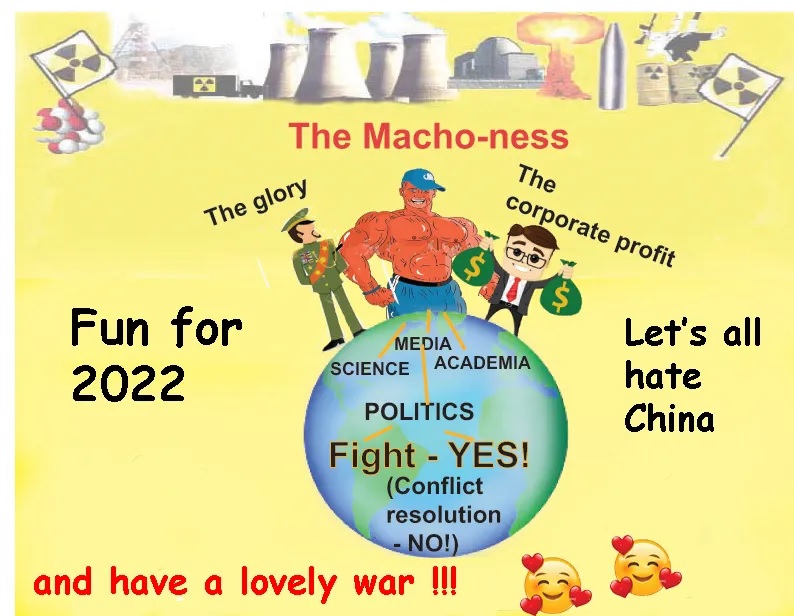
We should have no illusions that the leaders of the world will move to deep cuts in nuclear weapons and eventual abolition on their own. The military-industrial-congressional complex is going to perpetuate the current system as long as it can. It’s going to take intense public pressure and movement building
it is crackpot realism to believe that we can keep nuclear weapons without them eventually being used. The imperatives of use it or lose it and belief in the first strike advantage make that clear.
it is crackpot realism to believe that we can keep nuclear weapons without them eventually being used. The imperatives of use it or lose it and belief in the first strike advantage make that clear.
CounterPunch, BY PATRICK MAZZA 4 Nov 22. For the first time in many years, the threat of nuclear war has burst into public awareness. Many proclaim we are at a pinnacle of danger not seen since the 1962 Cuban Missile Crisis, when the U.S. and USSR faced off over Soviet nuclear missiles situated in Cuba.
………………………… there was another moment of peril in 1983 that is far less known. Daniel Ellsberg, who as a defense analyst advised the White House during the Cuban crisis, says it may have been even more dangerous. That was Able Archer 83, a NATO exercise that took place in the early days of November mimicking escalation to nuclear war in response to a Soviet invasion of Western Europe.
……………………. In this respect, it is remarkably similar to a NATO nuclear war exercise conducted over Europe from October 17-30, Steadfast Noon, in which dozens of planes from 14 nations conducted mock bombing runs. The U.S practiced sharing nuclear weapons with NATO partners using dummy bombs. At the same time, the U.S. announced speeded delivery of B61-12 bombs to Europe, an upgrade which increases accuracy.
This is the so-called adjustable nuclear weapon, supposedly usable in a limited nuclear war, offering a range of explosive potentials from 0.3 to 50 kilotons. By comparison, the Hiroshima bomb was 15 kilotons. Meanwhile, the Russians were conducting their own nuclear exercises, Thunder 2022, from October 26-28, with launch of nuclear-capable missiles from land, sea and air.
The obvious contrast between now and 1983 is that, though the U.S. was then conducting a proxy war against the Soviets in Afghanistan, it was on the fringes of the then USSR. The Ukraine War is in Europe close to the Russian heartland, with fighting at a far greater level of intensity.
Could we be at an even greater level of danger now? The key issue that joins the present moment with 1983 is how each side perceives the intentions of the other. The crucial lesson of Able Archer is that misperception and miscommunication can cause a fatal error leading to a full nuclear exchange, especially at a time of heated rhetoric. Let us first look at 1983, then contrast and compare it with the present.
Expecting a first strike
Fortunately, recent years have seen publication of several books that delve deeply into the crisis, what led up to it, and its aftermath: 1983: Reagan, Andropov, and a World on the Brink by Taylor Downing; The Brink: President Reagan and the Nuclear War Scare of 1983 by Mark Ambinder, and Able Archer 83: The Secret NATO Exercise That Almost Triggered Nuclear War by Nate Jones. The latter contains many formerly secret documents wrested from the archives. From these I wrote a three-part series that starts here. I will briefly summarize the key points
First, it is key to know that then Soviet leader Yuri Andropov genuinely believed the U.S. planned a nuclear first strike on the USSR. Ronald Reagan’s white hot rhetoric fueled that perception…………………………
The first strike advantage
Andropov’s anxieties were grounded in what the Soviets had learned during their own nuclear exercises. It is the most powerful argument for entirely ridding the world of nuclear weapons. In a nuclear war, the side that strikes first has overwhelming advantage. It can decapitate the enemy’s leadership and command and control systems, prospectively eliminating its ability to order a response, even as nuclear forces with which a counterstrike could be launched are destroyed.
Of course, a nuclear war of almost any scale would ignite fires sending a cloud of black soot into the stratosphere, shutting off sunlight and creating a nuclear winter that would crash agricultural production and kill billions. Any immediate advantage, if one were to be had, would turn into a pyrrhic victory, killing the “winners” as well as the losers. This fact known since 1983 unfortunately still has not entered the calculations of nuclear strategists.
Heightening the fears of Soviet leaders were plans to place cruise and Pershing II missiles in Europe, which the Soviets believed could reach Moscow in a few minutes and accomplish a decapitation strike. This has come back today with Russian leaders expressing concerns over NATO missiles placed in Ukraine even closer to the Russian capital.
Reagan’s announcement of the Star Wars missile defense program in March 1983 two weeks after he made the Evil Empire speech heightened Soviet worries. They believed this would make response to a first strike even more difficult.
Inducing Soviet paranoia
The U.S. was doing nothing to reduce Soviet fears, conducting exercises near the borders of the USSR. A later declassified National Security Administration history said, “these actions were calculated to induce paranoia, and they did.”…………………………
“These aggressions and vulnerabilities alarmed Soviet leadership to an extreme never seen during the Cold War,” writes Nate Jones. Andropov reacted by ordering Soviet aircraft to “shoot-to-kill” any plane that invaded national airspace.
When Korean Air Lines flight 007 inadvertently wandered over the Soviet far east Sept. 1, 1983, it was mistaken for a spy plane that had crossed its flight path earlier. Following Andropov’s order, a Soviet fighter plane sent KAL 007 plummeting into the ocean, killing all 229 on board. That plunged relations between the west and the Soviet Union to perhaps the lowest level of the Cold War.
As Able Archer came closer, two events were misconstrued by the Soviets as war preparations…………………….
The close brush with nuclear holocaust
The Soviets had an additional reason to worry. They conceived that if a surprise attack took place, it would happen on a national holiday when their guard was down. In this case, Able Archer took place during then celebration of the 1917 Bolshevik Revolution. So the Soviets took a range of steps to prepare………………………………………………………….
In another one of those situations similar to that of Vasily Arkhipov, when one man’s actions may have saved the world, Lieutenant General Leonard Perroots, who ran the U.S. Air Force intelligence operation in Europe, picked up on many of these signs. But Perroots, who could not believe the Soviets were contemplating a strike, decided on gut instinct not to respond. ………………
How close did we come? It took years to fully realize the danger. I tell the story of what some regard as the greatest intelligence failure in history in the third part of my series…………………………
Today’s war scare
This is what draws the contrast most sharply between Able Archer and the Cuban Crisis. In 1962, each side was aware they were in a crisis. In 1983, one side was preparing for war while the other side was oblivious. Today comes closer to Cuba in that each side is acutely tuned to the fact of crisis. But it has similarities to Able Archer in that each side is less than clear on the intentions of the other. …………………..
At the same time, first strike fears are being raised. ……………..
Each side may be raising the rhetorical heat for propaganda purposes, as the CIA believed the Russians were doing in 1983. But it is a mistake to dismiss the possibility that statements may reflect real fears that could become self-fulfilling prophecies. Particularly in a time when the Ukraine War seems to be in a pattern of tit-for-tat escalation.
False alarms
Consider what would happen if an early warning system gave a false reading that the other side had launched missiles. That occurred with the U.S. system on November 9, 1979, when a war game program mistakenly loaded into a NORAD computer indicated 1,400 missiles incoming, triggering a full nuclear alert, or on June 3, 1980, when a failed 46-cent computer chip set off another false alert. Those errors were fortunately caught in time.
We have to ask what would have happened if another of those Russians described as “the man who saved the world,” Stanislav Petrov, had not been in charge at the Soviet missile command center when on Sept. 27, 1983 a new satellite system indicated 5 U.S. missile launches. He had worked on the system, and thought it was probably a faulty reading, as it later proved to be. He also thought a first strike would be a larger volley. So Petrov decided not to report it to higher command. Who knows how a fearful Soviet leadership would have responded in the hair trigger environment in the wake of the KAL 007 shootdown, even as the NATO fall exercises leading to Able Archer were beginning to ramp up?
So to answer the question of how close we are to nuclear war, the most honest answer is, we don’t know. But the danger has clearly escalated. And the longer the war goes on, the greater the risk these scenarios may become reality. How do we stop this runaway train before it derails?
Putting nuclear on a separate track
It took months for U.S. and western leaders to realize the danger confronting the world in those early days of November, and years to fully analyze the intelligence failure………………………………………………
Reagan would subsequently begin to tone down his bellicose rhetoric, and on January 16 delivered a conciliatory speech on national television. By 1987, that would lead to the first nuclear arms control treaty, the Intermediate Nuclear Force (INF) Treaty negotiated with then Soviet leader Mikhail Gorbachev, and discussions to abolish all nuclear weapons which came heartbreakingly close. That treaty laid the groundwork for the START agreement signed in 1991 which limits each side’s deployed nuclear weapons to 1,550.
The INF Treaty was unfortunately cancelled by the Trump Administration in 2019. But START was re-upped in 2021 to run until 2026. . Reportedly there are backchannel discussions regarding START going on between the U.S. and Russia…………………………………….
Finding a way to resume START negotiations even as the Ukraine War continues is, I believe, the key. The issues surrounding the war seem, for the moment, intractable. It is crucial to place the transcendent issue of nuclear weapons on a separate track. How the Ukraine War is resolved has deep implications for global geopolitics. Whether we control nuclear weapons has implications for whether humanity survives at all. Having the two sides sit down in a forum where they can have open and frank discussions reduces uncertainty about intentions, and eliminates potential misunderstandings such as those that almost triggered war in 1983. Recent contacts between the defense leaders of Russia, the U.S. and the U.K. are a hopeful step in that direction.
Dramatic arms reductions leading to abolition
Those discussions must put deep cuts in nuclear arsenals on the table, with a clear pathway toward what the nuclear nations promised when they signed the Nuclear Non-Proliferation Treaty in 1968, the total abolition of nuclear weapons.
The immediate goal should be for each side to reduce its deployed weapons from the current 1,550 to somewhere in the 300-500 range. That would still provide a deterrent, but make a successful first strike less likely. Importantly, the ICBMs should go first. They are the most vulnerable to first strike, where use-it-or-lose it is most imperative. The bombers should go next, situating the remaining arsenal on submarines, the most difficult to detect. Coming to agreement on the distance submarines operate from the other side’s shores would also be valuable, since close-in operations also raise first strike fears.
And, unlike START, a new treaty should outright eliminate the reserve arsenal. The U.S. now has around 2,000 warheads in bunkers that could readily be refitted on submarines, ICBMs and bombers. If START is not re-negotiated, that could happen quickly after the 2026 expiration. A new treaty should also set up a process that moves the U.S., Russia and smaller nuclear powers to abolition.
The need for a people’s movement
We should have no illusions that the leaders of the world will move to deep cuts in nuclear weapons and eventual abolition on their own. The military-industrial-congressional complex is going to perpetuate the current system as long as it can. It’s going to take intense public pressure and movement building.
The 1980s nuclear freeze movement set the stage for the INF and START treaties, which most likely would have never happened if it had not been for millions in the streets. It is going to take something similar again to move to the sane course of dramatic nuclear reductions and abolition. We are nowhere near that now, and it is our role as people concerned about our future and that of our children to build that movement. In reality, I believe we need a broader global survival movement that addresses the existential crises facing us, from climate disruption and general ecological breakdown, to great power competition and the threat of nuclear war.
……… it is crackpot realism to believe that we can keep nuclear weapons without them eventually being used. The imperatives of use it or lose it and belief in the first strike advantage make that clear.
I recently interviewed a former U.S. Navy submarine captain, Tom Rogers, who handled nuclear weapons throughout his time on submarines, and now works for their abolition as part of the Ground Zero Center. Tom has been arrested blocking the gate at the Trident nuclear missile submarine base at Bangor, Washington at least 10 times. He told me, “It’s only a matter of time until by miscalculation or accident a nuclear weapon gets used. Because of the way the strategy is written, you don’t shoot just one nuclear weapon. You don’t see just three coming over the horizon. You see 3,000. The only way to prevent that carnage is to get rid of them.”
That should be our call to mobilize, to end nuclear weapons before they end us. As steep a climb as it is, we really have no other choice if we value human survival. https://www.counterpunch.org/2022/11/04/how-close-are-we-to-nuclear-war/
France, depending on nuclear power, now imports more electricity than it exports

Nuclear power provides 70pc of French electricity. The failure to replace
ageing infrastructure has left more than half of the 56 reactors out of
service as the worst winter in living memory approaches.
EDF, whichnoperates the plants, has been nationalised and, for the first time in
decades, France is importing more energy than it exports, only narrowly
avoiding blackouts so far. For the foreseeable future, the country has not
only been overtaken by Sweden as Europe’s leading electricity exporter,
but has lost its vaunted reputation for energy security.
Telegraph 6th Nov 2022
https://www.telegraph.co.uk/business/2022/11/06/how-france-became-trapped-spiral-chaos-decline/
Does the UK need new nuclear plants like Sizewell C to reach net zero?
Does the UK need new nuclear plants like Sizewell C to reach net zero?
With the cost of renewables and batteries plummeting, some academics argue
that the UK doesn’t need to build new nuclear power stations to achieve its
net zero goal.
Eight months ago, the UK government made a big bet on
nuclear, promising to treble the size of the country’s nuclear fleet
between now and 2050. Delivering on that promise would require huge
investment in both large-scale new nuclear plants and small-scale modular
reactors. This follows years of government delay and prevarication.
Ministers at the time told the public this push for nuclear was essential
to achieve the UK’s aim to have net-zero carbon emissions by 2050.
That nuclear-fuelled zero-carbon future could now be in doubt, according to news
reports. A government official told the BBC that plans for the nuclear
power plant Sizewell C, which would supply around 7 per cent of the UK’s
electricity, are “under review” as the government looks to cut
spending.
The prime minister’s spokesperson later denied that it was
under review, saying that negotiations with private firms over funding were
ongoing and the government “hoped to get a deal over the line as soon as
possible”.
However, some academics are questioning whether new nuclear is
even necessary. For years it has been energy orthodoxy to argue that
nuclear will be an essential component of the UK’s energy mix to meet its
net zero goal. Wind and solar would supply most of the country’s energy,
so the thinking went, but some back-up power would be needed for when the
wind doesn’t blow and the sky is cloudy. It is an argument broadly
accepted by the UK government, the Climate Change Committee that advises it
and, reluctantly, many environmental campaigners.
But that is now changing,
says James Price at University College London, author of a study published
in September that suggests the government’s backing for new nuclear is
“increasingly difficult to justify”
New Scientist 4th Nov 2022
Ukrainian First Lady Zelenska ordered The Grayzone’s Web Summit cancellation
The Grayzone, MAX BLUMENTHAL·NOVEMBER 3, 2022
Irish media and sources close to Web Summit’s CEO confirm The Grayzone was banned from the gathering as the result of a personal campaign waged by Olena Zelenska, the wife of Ukrainian President Volodymyr Zelensky.
The Grayzone was disinvited from Web Summit, a tech industry mega-event in Lisbon, Portugal this November, following a personal lobbying campaign spearheaded by Ukrainian First Lady Olena Zelenska. Zelenska was the surprise keynote speaker at Web Summit, addressing conference attendees on November 1.
This outlet learned of Zelenska’s role in our cancellation from several sources close to Web Summit CEO Paddy Cosgrave. Their accounts were confirmed in a November 3 report by the Irish Examiner, which noted that The Grayzone’s Max Blumenthal and Aaron Mate “had been cancelled from the event at the insistence of the first lady of Ukraine Olena Zelenska…”
According to a source privy to internal communications among Web Summit organizers, Zelenska “and the highest levels of the Ukrainian government” threatened to “apply significant influence on sponsors” if the summit did not cancel The Grayzone and academic Noam Chomsky, who had also been invited to speak.
She basically said she was gonna yank the whole tablecloth off of the table and break everything,” the source said.
The source explained that in order to prevent the possible sabotage of his event, Web Summit chief executive Paddy Cosgrave decided to “give up” Blumenthal and Mate in exchange for “keeping” Chomsky.
Additionally, The Grayzone’s Anya Parampil was unable to access her Web Summit ticket upon arriving in Lisbon despite having been granted a press credential for the event.
A second source close to Web Summit organizing discussions emphasized the Ukrainian First Lady’s influence over the event, explaining Zelenska “would have been able to get quite a number of people to pull out, big companies or whatever, I would say that was a strong possibility.”
“The bottom line is you were dropped because that’s what she [Zelenska] wanted,” the source stated.
Yet Zelenska demands did not end with her call to cancel The Grayzone.
Zelenska cancels nuclear button memes………..
The Ukrainian first lady is due to remain in Lisbon throughout the week to lobby government officials and tech bigwigs to support the Ukrainian war effort.
A Web Summit source said their colleagues were well aware that “a small group of Atlantic Council people and Bellingcat people” helped coordinate the social media campaign to disinvite The Grayzone.
The Atlantic Council and Bellingcat are NATO-related lobbying groups which rely on funding from the US and British governments, as well as assorted pro-NATO oligarchs. The former organization, a DC-based think tank which has hosted Bellingcat founder Elliot Higgins as a resident fellow, has also received funding from the corruption-stained Ukrainian gas company, Burisma.
The Ukrainian Ministry of Digital Transformation and Ukrainian embassy in Portugal also participated in the censorship blitzkreig, delivering a letter to Web Summit organizers which demanded The Grayzone’s staff be banished from the conference.
Since the US-backed Maidan coup in 2014, Kiev has maintained an iron grip on the flow of information. All opposition media has been effectively banned under the watch of Zelensky, and of the 400-some journalists listed on the Ukrainian government’s semi-official “hit list,” known as Myrotvorets, at least a dozen have been murdered. Now, Zelensky and his wife have brought their government’s war on the press and free exchange of ideas well into the heart of Western Europe.
The Grayzone attends private dinner with Web Summit organizers
On the evening of November 2, The Grayzone’s Max Blumenthal, Aaron Mate, and Anya Parampil attended a private dinner in Lisbon organized by Web Summit chief executive Paddy Cosgrave. There, they and other guests discussed the proxy war in Ukraine, the dangers of NATO expansion, and the upcoming US midterm elections.
The Grayzone’s presence at the private dinner generated headlines the following day in the Irish Examiner and the Business Post, the latter of which tasked two reporters with covering the story.
more https://thegrayzone.com/2022/11/03/ukrainian-zelenska-grayzones-web-summit/
Councillor wants to know why there has been an increase in radioactive particles found on Dounreay foreshore.
A Caithness councillor wants to know
why there has been an increase in the number of radioactive particles found
on the foreshore at Dounreay this year. Struan Mackie, a Thurso and
Northwest Caithness Highland councillor and chairman of the Dounreay
Stakeholder Group (DSG), made the call after 15 irradiated particles were
discovered on the foreshore area between February and March. It is
understood to be the highest number since 17 were found in 1996.
Mr Mackie
said: “We wish to ascertain why there has been an increase in particle
detections and whether this was preventable. “Regular public updates are
provided to the Dounreay Stakeholder Group through our Site Restoration
sub-group, and it is of the utmost importance that these matters are dealt
with in a robust but transparent manner.”
Dounreay confirmed there has been
an increase in the number of particles found on the foreshore. A
spokeswoman said: “We closely monitor the environment around the site and
have seen an increase in particles found on the Dounreay foreshore this
year. “The foreshore is not used by the general public. We are looking at
wind and wave data to see if we can pinpoint a trend, and will report our
findings when they are complete. Safety is our number one priority and we
continue to monitor the foreshore on a regular basis.
John O’Groat Journal 4th Nov 2022
1 This Month




Shut down the radiation-damaged Heysham nuclear reactors now
To see nuclear-related stories in greater depth and intensity – go to https://nuclearinformation.wordpress.com

Say No to NASA’s Reckless Nuclear Reactor on the Moon
Say No to NASA’s Reckless Nuclear Reactor on the Moon
-
Archives
- November 2026 (12)
- October 2026 (302)
- September 2026 (339)
- August 2026 (330)
- July 2026 (355)
- June 2026 (287)
- May 2026 (306)
- April 2026 (356)
- March 2026 (251)
- February 2026 (267)
- January 2026 (308)
- December 2025 (358)
-
Categories
- 1
- 1 NUCLEAR ISSUES
- business and costs
- climate change
- culture and arts
- ENERGY
- environment
- health
- history
- indigenous issues
- Legal
- marketing of nuclear
- media
- opposition to nuclear
- PERSONAL STORIES
- politics
- politics international
- Religion and ethics
- safety
- secrets,lies and civil liberties
- spinbuster
- technology
- Uranium
- wastes
- weapons and war
- Women
- 2 WORLD
- ACTION
- AFRICA
- Atrocities
- AUSTRALIA
- Christina's notes
- Christina's themes
- culture and arts
- Events
- Fuk 2022
- Fuk 2023
- Fukushima 2017
- Fukushima 2018
- fukushima 2019
- Fukushima 2020
- Fukushima 2021
- general
- global warming
- Humour (God we need it)
- Nuclear
- RARE EARTHS
- Reference
- resources – print
- Resources -audiovicual
- Weekly Newsletter
- World
- World Nuclear
- YouTube
-
RSS
Entries RSS
Comments RSS

