Nuclear Power Is Not the Answer

As world leaders convene at COP27 to discuss the global decarbonization agenda, they should focus on the technologies that can be deployed rapidly and universally to replace fossil fuels.
As consecutive editions of the WNISR have shown, nuclear power is too slow and too expensive to compete with energy-efficiency measures and renewable energy.
Project Syndicate, Nov 14, 2022 ANTONY FROGGATT
As world leaders convene at COP27 to discuss the global decarbonization agenda, they should focus on the technologies that can be deployed rapidly and universally. That means de-emphasizing nuclear power, which was no longer competitive with solar and wind even before this year’s geopolitical turmoil.
PARIS – Just as Russia’s invasion of Ukraine has highlighted Europe’s dangerous dependence on fossil fuels, increasingly frequent and intense climate-driven weather events are highlighting the death and destruction that fossil-fuel dependence has wrought. Understandably, political and public pressure to reduce greenhouse-gas emissions, move away from insecure primary energy supplies, and develop new, reliable, secure, and affordable energy sources is at an all-time high. But rather than rushing ahead, we need to consider carefully which options are most realistic, and how they will be deployed and operate in the real world.
Consider nuclear power. With many countries and companies now giving this option a second (or even a third) look, the 2022 World Nuclear Industry Status Report (WNISR) offers valuable insights into how the sector is faring.
While the last 12 months may be remembered as a turning point for the broader energy sector, it won’t be because of the nuclear industry. Nuclear energy’s share of global commercial gross electricity generation in 2021 dropped to 9.8%, which is its first dip below 10% in four decades, barely more than half its peak of 17.5% in 1996. Meanwhile, wind and solar surpassed nuclear for the first time in 2021, accounting for 10.2% of gross power generation.
These diverging trajectories can be seen clearly across every indicator of investment, deployment, and output. According to the International Atomic Energy Agency, operating reactors peaked in 2018, both in terms of their number (449) and total capacity (396.5 gigawatts). The IAEA reports that 437 reactors were “in operation” globally at the end of 2021, including 23 reactors that have not generated power for at least nine years, and which may never do so again.
In 2018, when installed nuclear power peaked below 400 GW, solar and wind capacity rose above 1,000 GW, on its way to reaching 1,660 GW by the end of 2021. In just three years, solar and wind added two-thirds more capacity than nuclear at its last peak. Even if nuclear plants usually generate more electricity per unit of installed capacity than wind and solar, the divergence in these numbers is staggering.
In 2021, total investments in non-hydro renewables hit a record $366 billion, adding an unprecedented 257 GW (on net) to electricity grids, whereas operating nuclear capacity decreased by 0.4 GW. Only six new reactors were connected to the grid that year, and half of these were in China. Then, in the first half of 2022, five new reactors went online, two of which were in China. But while China has the most reactors under construction (21, as of mid-2022), it is not building them abroad.
Until recently, that role was taken up by Russia, which is dominating the international market with 20 units under construction, including 17 in seven countries as of mid-2022. Sanctions and potential other geopolitical developments have cast doubt on many of these projects, with a Finnish consortium already canceling construction of a facility based on a Russian design.
Only 33 countries operate nuclear power plants today, and only three – Bangladesh, Egypt, and Turkey – are building reactors for the first time (all in partnership with the Russian nuclear industry). Twenty-six of the 53 construction projects around the world have suffered various delays, with at least 14 reporting increased delays, and two reporting new delays, just in the past year.
For the first time, the WNISR also assesses the risks of nuclear power and war. There has been significant international concern about Ukraine’s Zaporizhzhia nuclear power plant, which has been occupied by Russia forces since March 4, 2022. Owing to repeated shelling in and around the area, the plant has frequently lost external power, prompting warnings from the IAEA that the situation is “untenable.” Operating a nuclear facility requires motivated, rested, skilled staff; but Zaporizhzhia’s Ukrainian personnel are under severe stress.
The key challenge now is to maintain continuous cooling for the reactor core and the pool for spent fuel, even after the reactor is shut down. The failure to evacuate heat from residual decay would lead to a core meltdown within hours, or a spent-fuel fire within days or weeks, with potentially large releases of radioactivity.
As world leaders convene at COP27 to discuss the global decarbonization agenda, they should focus on the technologies that can be deployed rapidly and universally to replace fossil fuels. As consecutive editions of the WNISR have shown, nuclear power is too slow and too expensive to compete with energy-efficiency measures and renewable energy.
Urging peace with Russia, top US general challenges DC’s proxy war
A series of leaks, including a call for diplomacy from Gen. Mark Milley, show that some US officials are ready for a settlement in Ukraine.
Substack, Aaron Maté Nov 13,
When the Congressional Progressive Caucus was bullied into withdrawing a letter urging diplomacy with Russia to end the war in Ukraine, everyone from neoconservative pundits to Sen. Bernie Sanders came forward to scold them. But now the same call is coming from a source that cannot be so easily ignored, and intimidated.
“A disagreement has emerged at the highest levels of the United States government over whether to press Ukraine to seek a diplomatic end to its war with Russia,” the New York Times reports. Leading the call for talks with Moscow is Gen. Mark Milley, the chairman of the Joint Chiefs of Staff. According to US officials, Milley “has made the case in internal meetings that the Ukrainians have achieved about as much as they could reasonably expect on the battlefield before winter sets in and so they should try to cement their gains at the bargaining table.”
The top US general has made no secret of his stance. “When there’s an opportunity to negotiate, when peace can be achieved, seize it,” Milley declared in a public speech this week.
Milley’s view “is not shared” by President Biden or his National Security Adviser, Jake Sullivan, the Times claims. Nor by the top US diplomat, Secretary of State Antony Blinken. As one US official explained to CNN, “the State Department is on the opposite side of the pole,” leading to “a unique situation where military brass are more fervently pushing for diplomacy than US diplomats.”
While US “diplomats” oppose diplomacy, White House officials would not be disclosing that Milley, the nation’s highest military officer, is challenging their stance if he were alone. Indeed, the Milley revelation is only the latest in a series of leaks suggesting that, despite the uproar over the progressives’ pro-diplomacy letter, at least some close to the president agree with its message……… more https://mate.substack.com/p/urging-peace-with-russia-top-us-general?utm_source=post-email-title&publication_id=100118&post_id=84024812&isFreemail=true&utm_medium=email
Austria digs in anti-nuclear heels as neighbours build out
https://www.euractiv.com/section/energy/news/austria-to-continue-anti-nuclear-stance-against-its-neighbours/ Nikolaus J. Kurmayer | EURACTIV.de Nov 8, 2022
The government confirmed that it would uphold its long-held anti-nuclear stance against its neighbours following media reports that Czech plans to build new nuclear reactors near the Austrian border are further ahead than scheduled.
Austria is Europe’s most fervent anti-nuclear country, and its only nuclear power plant never entered operation due to heavy opposition. Vienna is now suing the European Commission for granting the “green” label to nuclear power through the EU sustainable finance taxonomy.
This anti-nuclear stance against neighbouring countries will continue to be developed, said Green Environment Minister Leonore Gewessler, according to Ö1.
Meanwhile, six nuclear reactors in neighbouring Czechia are currently operating and provide about 37% of the country’s electricity. The government plans to have nuclear provide half of the country’s electricity in nearly 20 years, despite a projected general increase in electricity demand.
To achieve this serious nuclear build-out, the Czech government is betting on miniature nuclear power plants, so-called small modular reactors (SMRs). SMRs are far from commercial reality, as none have been built so far.
But Czechia is also looking at two regular reactors in Temelin, which is some 100 kilometres away from Linz, Austria’s third-largest city.
“Temelin is only about 50 kilometres away from the centre of our village”, from which the reactors can be seen from certain rights, Anita Gstöttenmayr, the mayor of a village located at the border, has said. “Something is simply being considered or decided without us being informed,” she added.
Anti-nuclear Austrian towns are now threatening to take the matter to the streets via protests and street blockades.
“It sounds stupid, but we will have to take to the streets again to raise awareness and make a difference,” the mayor added.
Languages: Deutsch
Russia and US hold secret talks in Ankara – Kommersant
https://www.rt.com/russia/566501-russia-us-secret-talks/ 14 Nov 22, Moscow is reportedly represented by the country’s top spy at the negotiations.
A leading Moscow newspaper claimed, on Monday, that secret US-Russian talks are being hosted by Türkiye. Kommersant, a privately owned title which is known to have good sources in Moscow, reported, citing anonymous sources, that the un-announced meeting was taking place in Ankara.
The outlet alleged that Russia had sent Sergey Naryshkin, director of the Foreign Intelligence Service (SVR) to the talks.
Kremlin spokesperson Dmitry Peskov later confirmed to Russian media that bilateral talks had taken place in Ankara, adding that they were held at the initiative of the US.
CNN claimed that CIA Director Bill Burns had represented Washington at the gathering, citing a “National Security Council spokesperson.”
Earlier this month, Western media reported that top Russian and US officials were engaging in undeclared contacts. According to the Wall Street Journal, US national-security adviser Jake Sullivan has been engaged with Yury Ushakov, a senior foreign policy aide to President Vladimir Putin, and with Nikolay Patrushev, Sullivan’s counterpart in the Russian government.
The White House did not deny the talks, with spokesperson Karine Jean-Pierre telling journalists that the contacts focused on “risk reduction.” Meanwhile, Peskov told the WSJ at the time that the British and American press tended to print “hoaxes.”
Türkiye emerged as a principal mediator during the Ukraine crisis. In late March, it hosted Russia-Ukraine talks, during which the two parties made significant progress towards settling on a peace agreement.
The negotiations were reportedly torpedoed by the UK, when then-Prime Minister Boris Johnson traveled to Kiev in April. According to Ukrainian media, he told President Vladimir Zelensky that Western nations would not support the proposed security pact that was discussed with Russia.
Ankara also helped the UN to launch the Black Sea Initiative, an arrangement that allows Ukraine to export its grain via commercial ships. The agreement, which was signed in July, expires on Friday. Moscow has repeatedly stated that it may not agree to a renewal, unless the UN delivers on its promise to facilitate Moscow’s export of Russian grain and fertilizers, which was part of the deal.
NATO needs enemies to justify its existence – Russia

The bloc’s ongoing expansion is motivated by a desire to manufacture confrontation, a senior diplomat claims
Having an enemy to fight against is essential for NATO’s survival, Russian Deputy Foreign Minister Alexander Grushko has claimed.
The diplomat added that the bloc’s expansion is largely motivated by the need to antagonize nations so they can fit the role of an enemy.
“NATO is the kind of organization that cannot live without an enemy. If it had none, it would have died,” he was quoted as saying by RIA Novosti news agency on Monday.
“They have declared Asia a zone of the alliance’s interest, pushed the zone of their defense right to the border of China,” he noted.
Grushko said the conflict in Ukraine stems from NATO’s declared intention to eventually accept Kiev as a new member, while ignoring Russia’s national security concerns. The alliance is still trying to bring in Ukraine, he said, adding that he doesn’t believe the US and its allies are acting rationally on the issue.
The NATO leadership claims to have an open door policy, saying that every nation has a sovereign right to choose it as provider of security. Its charter, however, requires all members to approve any expansion, a fact that came to the forefront after Türkiye stalled the accession of Finland and Sweden over their alleged sheltering of terrorism suspects.
The US-led military alliance declared the inclusion of Ukraine as one of its objectives in 2008, dismissing Moscow’s warning that such a move would cross a red line. After the 2014 coup in Kiev, the new Ukrainian government dropped the nation’s neutrality policy and said that joining NATO was its primary goal.
When Russia sent its troops into Ukraine in February, it cited NATO’s clandestine expansion into Ukraine as one of the key reasons. Organization members were training and arming the Ukrainian army and establishing military infrastructure in the country without formally accepting Kiev’s membership bid, Moscow said.
Top Zelensky advisor threatens war with Iran
The GrayZone, ALEXANDER RUBINSTEIN·NOVEMBER 12, 2022,
Mykhailo Podolyak, an advisor to Ukrainian President Volodymyr Zelensky, has called for attacks inside Iran as the country’s drones cause setbacks for the Ukrainian military.
On November 5, Mykhailo Podolyak, an advisor to Ukrainian President Volodymyr Zelensky, has advocated for military strikes on drone production sites located in Iran. President Zelensky echoed Podolyak’s belligerent rhetoric the following day, demanding Iran be “punished” for allegedly supplying drones to Russia.
Kiev adopted its hostile posture towards Tehran after claiming Russia deployed Iranian-supplied drones to strike Ukrainian civilian infrastructure throughout much of October.
In an interview with a Ukrainian news outlet on November 5, Podolyak argued that the response to Iran supplying Russia with drones should not be limited to sanctions or even a total trade embargo: “It seems to me that it should not be sanctions or even an embargo, yes a total embargo. It seems to me that it would be possible to carry out specific strikes on the production of drones, ballistic missiles, and so on.”………………………….
Podolyak has been ranked the third most influential Ukrainian by the Kiev-based Focus Magazine.
………………………………………. Though there is no record of any Iranian missile being used in an attack on Ukrainian infrastructure thus far, Zelensky declared, “We are preparing to respond.”
Just as Iranian-made drones appear to have given Russian forces a major boost on the battlefield, the US HIMARS artillery system has enabled significant Ukrainian gains, including the recapture of Kherson. However, no high ranking officials in Russian president Vladimir Putin’s office have similarly threatened the United States, or any of the other 40 countries that provided Ukraine with critical military assistance. https://thegrayzone.com/2022/11/12/zelensky-threatens-war-iran/
Biden’s Nuclear Policy Fails the Ukraine Test
His administration’s Cold War-style thinking is missing a golden opportunity.
Defense One, BY TOM Z. COLLINA, POLICY DIRECTOR, PLOUGHSHARES FUND, NOVEMBER 14, 2022
Senior Russian military leaders reportedly recently discussed how they might use nuclear weapons in Ukraine, while other Russian officials were suggesting that Kyiv might detonate a “dirty bomb”—suggestions widely dismissed as a setup for a false-flag excuse to escalate the war. And even before all that, President Joe Biden reckoned that the world was closer to “Armageddon” than any time since the 1962 Cuban missile crisis…………………………………….
Cause for concern? You bet. But if you’re looking for new ideas to address Russian President Vladimir Putin’s attempts at nuclear blackmail in Ukraine, you won’t find them in the Biden administration’s new statement on nuclear policy. Known as the Nuclear Posture Review, or NPR, the report is a disappointing defense of the status quo. It breaks little new ground, and it fails to respond to the Ukraine moment. Reading it, you might almost forget that the world is facing the most serious nuclear threat in 60 years.
Lacking fresh thinking on the Ukraine crisis, the Biden team has fallen back on the old Cold War playbook: when in doubt, build more nuclear bombs. Biden lends his support to essentially all the new nuclear weapons proposed by his predecessor, including a new $260 billion intercontinental ballistic missile and new lower-yield warheads for missiles on Trident submarines. As a candidate, Biden said the Trump administration’s new Trident warheads were a “bad idea,” and that having them would make the U.S. “more inclined to use them.” Now that he’s president, Biden opposes just one Trump-proposed nuke—a new and unneeded sea-launched cruise missile—that will likely win support in Congress anyway due to the administration’s tepid effort to stop it.
Building new nukes we don’t need will not solve the Ukraine crisis, but it could get us into another expensive and dangerous arms race. One of the more troubling assertions in the NPR is that “By the 2030s the United States will, for the first time in its history, face two major nuclear powers as strategic competitors and potential adversaries.” This sets the stage for a future administration to argue, erroneously, that the Pentagon needs a larger nuclear arsenal—say, as big as Russia’s and China’s combined. This could lead to a new arms race with both Moscow and Beijing.
What should we do instead? In the short term, the Biden team needs to talk with Russia’s leaders, as it has started to do. These talks should not yet be about ending the war in Ukraine, but we need to set clear expectations with Russia about preventing the war from going nuclear or spreading beyond Ukraine’s borders. As Biden has rightly said, we must do all we can to prevent direct U.S. conflict with Russia, which would lead to World War III. Biden has so far successfully balanced support for Ukraine while withholding U.S. forces, a no-fly zone, and more sophisticated weapons.
…………………… One of the underappreciated lessons of the Ukraine crisis is that the West would be better off if nuclear weapons were not part of the conflict. Russia might have not invaded if it did not have nukes to hide behind, and the United States could play a bigger role in helping Ukraine if it did not have to worry about Russian nuclear escalation. As Putin is showing, the bomb is a weapon of the weak and only serves to neutralize the U.S. conventional military advantage.
The Biden NPR missed a golden opportunity to update our nuclear policies for a new era. We cannot meet the Ukraine moment with Cold War thinking. President Biden must, and can, do better. https://www.defenseone.com/ideas/2022/11/bidens-nuclear-policy-fails-ukraine-test/379717/
—
The USA’s “climate” envoy at COP27 John Kerry is just another nuclear shill

John Kerry, ostensibly the US Special Climate Envoy, but actually yet another nuclear industry shill, used the occasion of the COP first to hold a special press conference to trumpet a $3 billion US nuclear deal with Romania and then announced a small modular reactor partnership with, incredibly, Ukraine.
“We have a viable alternative in nuclear,” Kerry told reporters. Viable? This was duly lapped up by the press without challenge.
John Kerry uses last-chance climate summit to tout nuclear power, https://beyondnuclearinternational.org/2022/11/13/the-kerry-copout/
By Linda Pentz Gunter, 14 Nov 22
“Russia’s seizure earlier this year of Ukraine’s Zaporizhzhia nuclear energy facility is shining a new light on the safety and security risks of the atomic export policies of the United States and other technologically advanced countries,” began a promising November 8 article in Roll Call.
However, that light seems to have blinded those in power to any common sense.
What has the alarm over the vulnerabilities of Ukraine’s reactors caught in a war zone actually taught any of them? Let’s start with the International Atomic Energy Agency.
“The problem is not nuclear energy,” IAEA Director General Rafael Grossi told the BBC recently. Nuclear power, Grossi said,“can provide a safe, clean source of energy and this is why many countries in Africa and in other places are turning to nuclear.” It’s just war that’s the trouble, Grossi said.
That’s like the gun lobby claiming it’s bad guys, not guns, that do the killing. Sorry, but no. Bad guys without guns can’t shoot people. Broken solar panels and fallen wind turbines can’t release massive amounts of radioactivity. The problem here very definitely IS nuclear energy. Period.
The IAEA position isn’t disingenuous of course. It’s a necessity borne of the agency’s massive conflict of interest, bound, as it is, to further and expand the use of nuclear power across the world. And then enforce safety at plants that are inherently dangerous.
“You will see that nuclear energy has a really solid, very consistent safety record,” said Grossi as the COP27 climate summit got underway in Egypt.
Except of course when there is a war, a prolonged loss of power, a natural disaster, a major human error or a catastrophic technical failure. Then, all of a sudden, having nuclear power plants is, according to Grossi, “playing with fire.”
Will US elected (or appointed) officials take heed of the obvious obstacles presented by nuclear power plants to achieving lasting peace and safety? Of course not. As we wrote here last week, US vice president, Kamala Harris, crowed about selling three Westinghouse reactors to Poland, tweeting that “We can address the climate crisis, strengthen European energy security, and deepen the US-Poland strategic relationship.”
Only the third part is true and is, of course, the basis for the contract in the first place, given Poland’s shared Eastern borders with Russia, Lithuania, Belarus, and Ukraine.
John Kerry, ostensibly the US Special Climate Envoy, but actually yet another nuclear industry shill, used the occasion of the COP first to hold a special press conference to trumpet a $3 billion US nuclear deal with Romania and then announced a small modular reactor partnership with, incredibly, Ukraine.
“We have a viable alternative in nuclear,” Kerry told reporters. Viable? This was duly lapped up by the press without challenge.
The Romanian debacle-to-be will be funded by the US Export-Import Bank. The Ukraine announcement read:
“Special Presidential Envoy for Climate John Kerry and Ukraine Minister of Energy German Galushchenko announced a Ukraine Clean Fuels from SMRs Pilot project that will demonstrate production of clean hydrogen and ammonia using secure and safe small modular nuclear reactor (SMR) and cutting-edge electrolysis technologies in Ukraine.”
Then they used the word “clean” again four times in the next paragraph. Which speaks volumes and definitely falls into the “doth protest too much” category.
Meanwhile, some experts in the field are warning against exporting nuclear technology to countries that might become embroiled in a war. Surely that would rule out Ukraine? And most if not all of Grossi’s beloved Africa? And what about Poland and Romania? How can we ever be sure which countries might suddenly find themselves at war? Another world war in Europe seemed unthinkable until February 24, 2022.
“An air raid siren sounded for the first time this morning in the nuclear city of Sosnovy Bor on the southern coast of the Gulf of Finland in the Baltic,” wrote Russian activist, Oleg Bodrov, a member of the Public Council of the Southern Coast of the Gulf of Finland (PCSCGF) in a November 8 email.
“A similar siren would have been heard by 2 million residents of the Leningrad Region,” said Bodrov. “It was a drill in case of war, which was carried out by decision of the authorities of the region.”
The term “nuclear football” is traditionally applied to the black bags containing the “nuclear button” that accompany the US president and vice president at all times. (The third is kept at the White House.) But nuclear power plants are also now proverbial nuclear footballs, being used to deliver a false sense of security but actually putting the countries on whose soil they sit in far greater danger.
Selling US reactors to Eastern European countries clearly has nothing whatever to do with climate or energy needs. “We don’t get to net zero by 2050 without nuclear power in the mix,” Kerry said at his COP press conference. Actually, yes, doing without slow, expensive and dangerous nuclear power is essential if we have any chance whatsoever of achieving net zero (2050 is already too late).
It is ever more apparent that most of our “mediocre politicians,” as Bodrov rightly characterizes them, are not interested in net zero. They are interested in using nuclear power as a nuclear weapons surrogate; in bolstering alliances with Russia’s neighbors in a dangerous move to drive Russia into ever greater political isolation; in propping up failing nuclear corporations like Westinghouse; and in answering their nuclear paymasters in Washington by wasting time and our money on foolish new nuclear plants that are irrelevant to addressing the climate peril we are already in.
Linda Pentz Gunter is the international specialist at Beyond Nuclear and writes for and curates Beyond Nuclear International.
Corruption exposed: US meddled in Ecuador’s election, using Julian Assange as bargaining chip
A former minister of Ecuador testified that the US government conspired with a right-wing political party to run a disinformation campaign against the leftist Correísta movement, backing a millionaire banker for president in exchange for giving up journalist Julian Assange, who had asylum in the Ecuadorian embassy.
MP, Ben Norton, 13 Nov 22,
Ecuador’s former energy minister testified that the US government conspired with a right-wing political party to run a disinformation campaign against the leftist Correísta movement of ex President Rafael Correa.
He said that US “federal agents” pledged to help “influence” the 2017 presidential elections and support the candidacy of conservative millionaire banker Guillermo Lasso in exchange for the promise to turn over journalist Julian Assange, who had been given asylum by Correa and was stuck living for years in Ecuador’s embassy in London.
The former energy minister, Carlos Pareja Yannuzzelli, had fled a corruption investigation in Ecuador and was living as a fugitive from justice in the United States in late 2016 when he was offered large sums of money and US government protection in return for reading a carefully prepared “script” that made false accusations of corruption against Correa and his Vice President Jorge Glas, who was later imprisoned on highly dubious charges.
Pareja testified that the federal agents also coerced him into making false accusations against a US citizen, so they could justify their involvement in the Ecuadorian case. This led to the US citizen being arrested and imprisoned for three-and-a-half years.
Lasso ended up losing the 2017 election (before going on to win the 2021 election), but his victorious opponent, Lenín Moreno, later betrayed Assange anyway, letting British authorities raid the embassy, imprison the WikiLeaks journalist, and prepare to extradite him to the United States.
The revelation of this extraordinary example of Washington meddling in another country’s election came from one of the top officials in Ecuador’s oil industry……………………………………………………………
US intelligence-linked right-wing Ecuadorian politician uses corrupt US asset to accuse Correa of corruption……………………………………………..
Ecuador’s ex energy minister details US-backed campaign to help the right wing in the 2017 elections………………………………………………………..
it was widely assumed, even by Correa himself, that Correa’s former Vice President Lenín Moreno would continue his socialist political program.
Moreno did run on a left-wing presidential campaign, but after entering office, he did a political 180. Moreno turned hard to the right, repressing, imprisoning, and exiling Correísta politicians.
He also stabbed Julian Assange in the back, reversing Correa’s pledge to protect the WikiLeaks publisher and renouncing the Ecuadorian citizenship that had been given to the journalist. In order to arrest Assange, Moreno even let British authorities violate his own country’s sovereignty by storming the embassy, which constitutes Ecuadorian territory under the Vienna Convention in international law.
Correísta politicians have alleged that Moreno was bribed and/or blackmailed by the US government, as he obediently fulfilled all of Washington’s foreign-policy goals, collaborating closely with the Donald Trump administration, removing Ecuador from the Bolivarian Alliance (ALBA) and Union of South American Nations (UNASUR), and even recognizing US-appointed coup leader Juan Guaidó in Venezuela.
…………………………………………………………….. Corrupt Ecuadorian official conspired with Miami-based oligarchs who stole millions from their people……………………………………………. more https://multipolarista.com/2022/11/11/capaya-us-meddled-ecuador-election-assange/
Why is Bill Gates investing in nuclear power?

Such forms of corruption are also widespread in the nuclear industry, with groups like the Nuclear Energy Institute (NEI), devising marketing campaigns that benefit nuclear power plant owning companies, including influencing the appointment of officials to oversight bodies such as the Nuclear Regulatory Commission (NRC).
In this pursuit, the public also gets to foot the bill; in the case of TerraPower, taxpayers have put up tens of millions of dollars into this venture without ever being given an opportunity to provide or deny their informed consent for this technology.
Beyond Nuclear By M.V. Ramana and Cassandra Jeffery 14 Nov 22
………………………………………………………………………….Systemic Problems
Why is Bill Gates investing in nuclear power? This question comes up a lot, although frequently as a rhetorical excuse to wax eloquently about the virtues of nuclear technology. The answer is by no means straightforward.
Nuclear energy is only one lottery ticket among many for Bill Gates. He’s invested into dozens of companies, especially through Breakthrough Energy Ventures. Breakthrough’s investments range from companies that focus on energy storage — examples are Form Energy and Malta — to ones making new kinds of concrete, developing geothermal energy, and producing steel.
Gates has also secured a stake in the future of agriculture; in 2021, he was dubbed America’s largest private farmland owner.
Clearly, Gates’ strategy is to diversify his investments. If the Natrium reactor — TerraPower’s leading offering at this point — turns out to be a nuclear lemon, which is quite likely for the reasons discussed above, Gates will have a suite of investments to fall back on.
This tactic — diversifying assets and investments to increase the probability that at least one stake will pay off big time — is standard practice among venture capitalists. Other fellow billionaires investing in nuclear power have similarly diversified strategies.
Gates and fellow oligarchs have other strategies to maintain their wealth. They devote enormous financial resources and time to nurture their economic positions by political campaign financing and lobbying for favorable policies and regulations.
Such tactics are legal but amount to a form of corruption and facilitate the extraction of what economists call rents (for example, through the imposition of intellectual property protections), which are going to come in the way of climate mitigation as well.
Such forms of corruption are also widespread in the nuclear industry, with groups like the Nuclear Energy Institute (NEI), devising marketing campaigns that benefit nuclear power plant owning companies, including influencing the appointment of officials to oversight bodies such as the Nuclear Regulatory Commission (NRC).
Among the recent pieces of legislation that NEI lobbied for was the Nuclear Energy Innovation and Modernisation Act. Publicly endorsed by Gates, the law makes it easier for “next-generation advanced reactors,” the kind that TerraPower is developing, to be licensed for construction by the NRC.
Such behaviors, unfortunately, are standard for the large organizations that dominate today’s economy.
People like Bill Gates are billionaires because they hit the jackpot on a lottery ticket and then lobbied rule-makers to extract as much money as possible from that lottery ticket. These gains allow them to reinvest into a diversified portfolio to increase the odds of another windfall prize.
In this pursuit, the public also gets to foot the bill; in the case of TerraPower, taxpayers have put up tens of millions of dollars into this venture without ever being given an opportunity to provide or deny their informed consent for this technology.
The public — especially those who live near one of the sites targeted for new reactor deployment, the areas where uranium will be mined and processed, and wherever the long-lived nuclear waste will go — will be subject to environmental contamination, paying far more than just a financial cost.
Given the experimental technologies involved in these new nuclear reactor designs, the risks to such communities are considerable. Many of these risks will only become greater with climate change as extreme weather events become more frequent and challenge operations at nuclear plants.
The risks and wasted investments are mounting. Further, this obsession with nuclear power and other untested technologies diverts the public’s attention from the larger systemic drivers of the climate crisis: unabated capitalism and its need for never-ending economic growth.
Pushing the nuclear agenda furthers the falsehood that growth can continue indefinitely with no limits, and the pretense that climate change can be solved using one more technology from the same toolbox that caused the problem in the first place.
“Those most responsible for creating the problem [of climate change] will see to it that they profit from the solution that they propose,” observed Indian writer Arundhati Roy in 2019. People like Gates exemplify that observation. Not only do they create the conditions for accelerating global warming but they also see to it that they are amply rewarded when they claim to know how to solve climate change.
Bill Gates might well be interested in finding a solution to climate change but he seems far more devoted to maintaining the current system for as long as it is feasible. Protecting this system requires, among other things, selling people the idea that the system is capable of solving climate change. Selling nuclear power is part of that larger sales job.
M.V. Ramana is the Simons Chair in Disarmament, Global and Human Security and Professor at the School of Public Policy and Global Affairs, University of British Columbia, Vancouver, Canada, and the author of The Power Of Promise: Examining Nuclear Energy In India. Cassandra Jeffery holds a Master’s degree in Public Policy and Global Affairs from the University of British Columbia and is the recipient of a Simons Award in Nuclear Disarmament and Global Security for research into the political economy of nuclear energy. https://beyondnuclearinternational.org/2022/11/13/bill-gates-and-techno-fix-delusions/
Why molten salt nuclear reactors really can’t succeed
Beyond Nuclear By M.V. Ramana and Cassandra Jeffery 14 Nov 22

………………………………………………………….Technical Problems
Let us start with the problems with the molten chloride fast reactor. As its name suggests, the reactor uses nuclear materials dissolved in molten chemical salts.
Salt is corrosive — just ask anyone who lives on the coast. So the inside of the reactor will be a chemically corrosive and highly radioactive environment.
No material can perform satisfactorily in such an environment. After reviewing the available studies, all that the U.S. Idaho National Laboratory — a nuclear power booster — could recommend was that “a systematic development program be initiated.”
TerraPower has three different nuclear reactor designs on the books: the Natrium reactor; the molten chloride fast reactor; and the traveling wave reactor.
Given his emphasis on novelty and innovation, one would expect Gates to put his money on reactor designs that are new and likely to succeed. None of these designs have that merit. All of these reactors are based on two old reactor designs vexed with major problems.
Other leading research laboratories like France’s Institut de radioprotection et de sûreté nucléaire (IRSN) and the U.K.’s Nuclear Innovation and Research Office, have concluded that molten salt reactors are problematic. As IRSN put it, “numerous technological challenges remain to be overcome before the construction of an MSR can be considered.”
The historical experience with molten salt reactors has been pretty bleak, to put it mildly. The last one to be built was the Molten Salt Reactor Experiment in Oakridge, Tennessee. It operated intermittently from 1965 to 1969, and operations were interrupted 225 times in those four years; of these interruptions, only 58 were planned.
But it’s not just a matter of molten salt reactors being unreliable or technologically challenged. As Edwin Lyman from the Union of Concerned Scientists has documented at length, the “use of liquid fuel instead of a solid fuel” in molten salt reactors “has significant safety implications for both normal operation and accidents.”
Specifically, the molten nature of the fuel makes it easier for radioactive materials to escape into the atmosphere and be dispersed.
Terrapower’s other two reactor designs are not much better. Both the Travelling Wave Reactor and the Natrium use molten sodium. Another problematic material, molten sodium is used to transport the intense heat produced by the nuclear fission reactions. Again, such reactors have been constructed since the dawn of the nuclear age and with similarly dismal results.
To start with, such reactors have had numerous accidents. The record starts on November 29, 1955 when the Experimental Breeder Reactor (EBR-1) in Idaho had a partial core meltdown.
A decade later, in October 1966, the Fermi-1 demonstration fast reactor in Michigan suffered a partial core meltdown. The shock made its way into the cultural mainstream in the form of a book called We Almost Lost Detroit and a song with the same name by Gil Scott Heron.
In Japan, the Monju reactor suffered a series of accidents and produced almost no electricity, after an expenditure of at least $8.5 billion
The use of molten sodium makes such reactors susceptible to serious fires, because the material burns if exposed to air. Almost all sodium-cooled reactors constructed around the world have experienced sodium leaks, likely because of chemical interactions between sodium and the stainless steel used in various components of the reactor.
Finally, the use of sodium also makes it difficult to maintain and carry out repairs on fast reactors, which then become susceptible to long shutdowns. Having to deal with all these volatile properties and safety concerns naturally drives up the construction costs of fast reactors, rendering them substantially more expensive than common thermal reactors.
Sodium-cooled reactors are also unreliable, operating at dismally low rates compared to standard reactors. The load factor (the ratio of the amount of electrical energy a power plant has produced to the amount of energy it would have produced had it operated at full capacity) for the Prototype Fast Reactor in the United Kingdom was 27%; France’s Superphenix reactor managed a mere 7.9%.
The typical U.S. reactor operates with a load factor of more than 90%. Sodium- cooled reactors would have to sell their power at higher prices to compensate for the fewer units of electrical energy generated.
“Without innovation, we will not solve climate change,” chanted Gates. But no amount of innovation will change the laws of chemistry or physics. How sodium behaves when it interacts with air or water won’t be affected, even if the sodium is inside a nuclear reactor backed by one of America’s oligarchs.
Innovation will not change the fact that the radioactive wastes produced by the Natrium reactor will remain hazardous for tens of thousands of years……………………………………………….. more https://beyondnuclearinternational.org/2022/11/13/bill-gates-and-techno-fix-delusions/
Ukraine joins in USA’s false story, “clean” energy from the mythical small nuclear reactors

Ukraine, United States announce cooperation on Clean Fuels from SMR pilot project. https://www.ukrinform.net/rubric-economy/3613271-ukraine-united-states-announce-cooperation-on-clean-fuels-from-smr-pilot-project.html 13 Nov 22,
—
As part of the UN’s COP27 Climate Conference, U.S. Special Presidential Envoy for Climate John Kerry and Ukrainian Energy Minister German Galushchenko announced cooperation on a Ukraine Clean Fuels from Small Modular Reactors (SMR) pilot project.
The relevant statement was made by the U.S. Department of State, an Ukrinform correspondent reports.
“Special Presidential Envoy for Climate John Kerry and Ukraine Minister of Energy German Galushchenko announced a Ukraine Clean Fuels from SMRs Pilot project that will demonstrate production of clean hydrogen and ammonia using secure and safe small modular nuclear reactor (SMR) and cutting-edge electrolysis technologies in Ukraine,” the report states.
The project aims to carry out a first-of-a-kind pilot of commercial-scale production of clean fuels from SMRs using solid oxide electrolysis.
“Building on existing capacity-building cooperation launched under the U.S. Foundational Infrastructure for Responsible Use of SMR Technology (FIRST) program, the project seeks to support Ukraine’s energy security goals, enable decarbonization of hard-to-abate energy sectors through clean hydrogen generation, and improve long-term food security through clean ammonia-produced fertilizers. Further, it aims to demonstrate Ukraine’s innovative clean energy leadership through the use of advanced technologies,” the U.S. Department of State noted.
Additionally, Special Envoy Kerry launched a new initiative, Project Phoenix, to accelerate the transition in Europe of coal-fired plants to SMRs while retaining local jobs through workforce retraining.
Project Phoenix will provide direct U.S. support for coal-to-SMR feasibility studies and related activities in support of energy security goals for countries in Central and Eastern Europe.
Bill Gates and techno-fix delusions
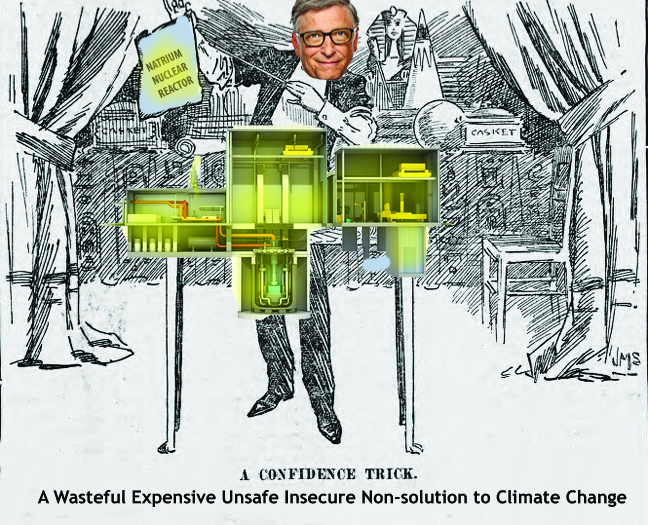
When elites try to change the world, it’s not usually for the better for the rest of us
Beyond Nuclear By M.V. Ramana and Cassandra Jeffery 14 Nov 22
Bill Gates, the businessman, made one of the world’s biggest fortunes by designing, selling and marketing computer technology. It shouldn’t come as a surprise that when it comes to climate change, he’s pushing more technology.
When wealthy people push something, the world pays attention. Practically all major media outlets covered his recent book, How to Avoid a Climate Disaster, and Gates has been interviewed dozens of times. All this pushing came with the pre-emptive caveat expressed in his book that the “world is not exactly lacking in rich men with big ideas about what other people should do, or who think technology can fix any problem.”
In his account of how elites try to “change the world,” journalist Anand Giridharadas explained: “All around us, the winners in our highly inequitable status quo declare themselves partisans of change. They know the problem, and they want to be part of the solution. Actually, they want to lead the search for solutions…the attempts naturally reflect their biases.
Gates is no exception to the rule; his bias favors maintaining the current economic and political system that has made him into one of the richest people in the world. The same bias also underpinned his stance on preserving intellectual property rights over Covid-19 vaccines, even at the cost of impeding access to these vaccines in much of the world.
Just as the pandemic was accentuated by insisting on the rights to continued profits for pharmaceutical companies, climate change is exacerbated by the current economic system that is predicated on unending growth.
A focus on technical solutions without fixing the underlying driver of climate change will not help. What is worse, some of the proposed technologies are positively dangerous.
Exhibit A: untested nuclear reactors like the ones that Gates is developing and endorsing.
Puzzling Choices
In an interview with CNBC following the publication of his book, Bill Gates announced: “There’s a new generation of nuclear power that solves the economics, which has been the big, big problem.”
To understand the economic problem, consider the only two nuclear reactors being built in the United States. These are in the state of Georgia, and the cost of constructing these has ballooned from an initial estimate of $14 billion to over $30 billion.
Even worse was the case of the V. C. Summer project in South Carolina, where over $9 billion was spent, only for the project to be abandoned because cost overruns led to Westinghouse, one of the leading nuclear reactor companies in the world, filing for bankruptcy protection.
These high construction costs naturally result in high electricity costs. In 2021, Lazard, the Wall Street firm, estimated the average cost of electricity from new nuclear plants to be between $131 and $204 per megawatt hour, whereas it estimated that newly constructed utility-scale solar and wind plants produce electricity at somewhere between $26 and $50 per megawatt-hour.
Likewise, in June 2022 NextEra, a large electricity utility, estimated that wind and solar energy, with four hours of electricity storage to allow for generation even when the sun is not shining or the wind is not blowing, ranged between $25 and $37 per megawatt-hour. Electricity from renewables is thus far cheaper than nuclear power, a difference only growing as solar and wind continue to become cheaper.
Many reactors have been shut down because they are unprofitable. In 2018, Bloomberg New Energy Finance concluded that more than a quarter of U.S. nuclear plants don’t make enough money to cover their operating costs.
That year, NextEra decided to shut down the Duane Arnold nuclear reactor in Iowa, because it was cheaper to take advantage of the lower costs of renewables, primarily wind power. The decision, NextEra estimated, will “save customers nearly $300 million in energy costs, on a net present value basis.”
It is this economic conundrum that Gates is claiming to address through new nuclear reactor designs. He is not alone. A number of other investors have backed “new” nuclear technology, and dozens of companies have received funding to design “advanced” or “small modular” reactors.
But these nuclear reactors of the future are no less problematic than traditional reactors. Besides unfavourable economics, there are at least three other well-known “unresolved problems” with nuclear power.
First, the acquisition of nuclear power technology increases the capacity of a country to make nuclear weapons, and thus increases the risk of nuclear weapons proliferation.
Second, despite assurances about safety, all nuclear reactors can undergo major accidents, albeit infrequently. Chernobyl and Fukushima are the best-known examples, but not the only ones.
Third, the multiple forms of radioactive waste produced during the nuclear energy generation process pose a seemingly intractable management problem. Exposure to these wastes will be harmful to people and other living organisms for hundreds of thousands of years.
Wastes must therefore be isolated for millennia from human contact. The storage and disposal of these wastes often take place in poor, disadvantaged communities, typically far away from the gated homes of people like Gates.
It is not possible to simultaneously address all of these four challenges — cost, safety, waste, and proliferation — facing nuclear power. To a greater or lesser extent, all these problems will afflict the reactors being developed by TerraPower, the nuclear power company backed by Gates………………………………………………………………………….more https://beyondnuclearinternational.org/2022/11/13/bill-gates-and-techno-fix-delusions/
USA, France, continue to buy nuclear supplies from Russia – no sanctions on that industry!
Stop funding Russia’s nuclear weapons, The Hill, BY HENRY SOKOLSKI, – 11/13/22
As Washington and the commentariat wring their hands about Russian President Vladimir Putin’s nuclear sword rattling, the United States and the European Union (EU) continue to shovel hundreds of millions of dollars to Rosatom — a Russian nuclear firm that maintains Moscow’s nuclear weapons complex and just filched a $60-billion Ukrainian nuclear plant.
Why would Washington and Brussels back such a nuclear villain? Do we really want to support Russian organizations that are critical to Putin building the nuclear bombs he is now threatening us with? No one will say yes, but the nuclear industry in Europe and the United States insist we can’t afford not to.
Besides being in charge of all of Russia’s nuclear weapons production and development, Rosatom supplies nuclear fuel to nuclear plants in the Czech Republic, Slovakia, Bulgaria and Hungary. Any European Union (EU) decision to cut off fuel to these plants would immediately harm these states economically. So, when Poland, Ireland, Estonia, Latvia, Lithuania and Germany recently recommended that the EU ban Russian nuclear imports to avoid funding Russia’s military efforts, the Hungarians and French howled and Brussels blinked.
What’s Paris’s brief? Russia buys two-thirds of France’s electrical steam generators. Also, French nuclear fuel fabricator Framatome just struck a major nuclear fuel development cooperation agreement with Rosatom……………………………
The EU, of course, must act by consensus. But what of the United States? There are no Russian-designed reactors in America. Nor is the United States without alternative uranium suppliers in Canada, Australia and Kazakhstan or practical, near-term uranium enrichment options. Yet, Washington pretty much followed the EU’s play book.
Russia provides roughly 15 percent of America’s raw uranium and 28 percent of its enriched uranium. Combined with Russian nuclear sales to the EU, these uranium imports from Russia fatten Rosatom’s coffers by as much as $1 billion a year — easily more than Rosatom spends to maintain Russia’s nuclear weapons complex.
You’d think that this last point would be politically fatal to further imports. Think again. Only days after Russia seized the Zaporizhzhia nuclear plant, the Nuclear Energy Institute and Duke power lobbied President Biden to keep Russian uranium imports coming. Failing to do so, they claimed, would risk increasing the cost of “zero-carbon” nuclear-supplied electricity. Worse, they insisted, it would jeopardize the future of advanced small modular reactors, most of which favor using special enriched uranium.
Soon after they made this plea, the White House concurred: Biden announced a U.S. embargo on all forms of Russian energy – oil, natural gas, and coal – but not on uranium……………………………. https://thehill.com/opinion/national-security/3732521-stop-funding-russias-nuclear-weapons/
How Bill Gates’ TerraPower rips off the American taxpayers
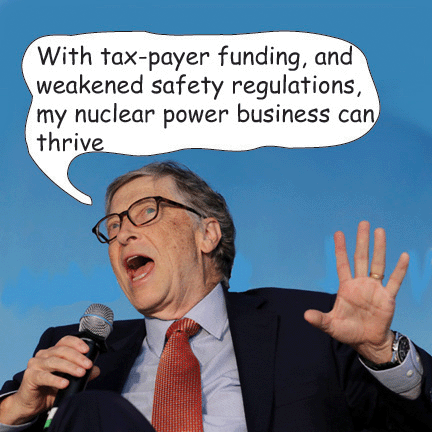
government support adds up to nearly as much as private investments and almost certainly more than Gates has personally invested. In other words, taxpayers have already paid tens of millions of dollars, and could pay far more in the future, for this technology
Beyond Nuclear By M.V. Ramana and Cassandra Jeffery 14 Nov 22…………………………………………………………………………. Bill Gates and TerraPower
TerraPower was founded in 2006 and Gates continues to serve as Chairman of the Board. The company has funded the development of three different nuclear reactor designs through a mix of venture capitalist investments from fellow billionaires, engineering and manufacturing corporations in the energy and defense sector, and government.
The company has research and development partnerships with several major institutions, including the Los Alamos National Laboratory and Y-12 National Security Complex, both of which design and test nuclear weapons.
TerraPower is well-funded. In 2010, the company received $35 million in seed money from venture capital firms to develop the first of its nuclear power plant designs, the “traveling wave” reactor. It has also received an undisclosed amount of funding from Breakthrough Energy Ventures, an investment firm co-founded and co-chaired by Gates.
According to a 2015 TerraPower promotional video, Gates pledged to invest $2 billion into emerging energy technologies, including nuclear technologies produced by TerraPower. And a few years back, Gates promised to invest $1 billion from his personal coffers and raise another $1 billion in private capital to fund TerraPower directly.
Despite these announcements, the exact financial figure Gates has personally invested into TerraPower is not known. In 2019, he declined interview requests by the Washington Post about his investment in the company. TerraPower’s financial records are not publicly available.
But investments by Gates and his friends are not the only source of funding for TerraPower. In 2016, TerraPower received a $40 million grant from the Department of Energy (DOE), followed by another $80 million in 2020, and $8.5 million in 2022.
In 2021, under the Bipartisan Infrastructure Act, the U.S. Department of Energy’s Office of Clean Energy Demonstrations has set aside $2.5 billion for nuclear projects and some of this funding will subsidize the TerraPower nuclear project slated for development in Wyoming.
As far as we can tell from publicly available data, government support adds up to nearly as much as private investments and almost certainly more than Gates has personally invested. In other words, taxpayers have already paid tens of millions of dollars, and could pay far more in the future, for this technology.

The U.S. taxpayer isn’t the only source of public funding that Bill Gates has tried to leverage. The 1.4 billion people of China came close to ponying up their tax dollars (or renminbis). After a series of visits by Gates to the Middle Kingdom, TerraPower reached an agreement with state-owned China National Nuclear Corporation in 2017 to build an experimental nuclear reactor south of Beijing.
That project would have likely gone forward but was stopped by America’s waning diplomatic and trade relationship with China…………………………….more https://beyondnuclearinternational.org/2022/11/13/bill-gates-and-techno-fix-delusions/
1 This Month




Shut down the radiation-damaged Heysham nuclear reactors now
To see nuclear-related stories in greater depth and intensity – go to https://nuclearinformation.wordpress.com

Say No to NASA’s Reckless Nuclear Reactor on the Moon
Say No to NASA’s Reckless Nuclear Reactor on the Moon
-
Archives
- November 2026 (12)
- October 2026 (302)
- September 2026 (339)
- August 2026 (330)
- July 2026 (355)
- June 2026 (287)
- May 2026 (306)
- April 2026 (356)
- March 2026 (251)
- February 2026 (267)
- January 2026 (308)
- December 2025 (358)
-
Categories
- 1
- 1 NUCLEAR ISSUES
- business and costs
- climate change
- culture and arts
- ENERGY
- environment
- health
- history
- indigenous issues
- Legal
- marketing of nuclear
- media
- opposition to nuclear
- PERSONAL STORIES
- politics
- politics international
- Religion and ethics
- safety
- secrets,lies and civil liberties
- spinbuster
- technology
- Uranium
- wastes
- weapons and war
- Women
- 2 WORLD
- ACTION
- AFRICA
- Atrocities
- AUSTRALIA
- Christina's notes
- Christina's themes
- culture and arts
- Events
- Fuk 2022
- Fuk 2023
- Fukushima 2017
- Fukushima 2018
- fukushima 2019
- Fukushima 2020
- Fukushima 2021
- general
- global warming
- Humour (God we need it)
- Nuclear
- RARE EARTHS
- Reference
- resources – print
- Resources -audiovicual
- Weekly Newsletter
- World
- World Nuclear
- YouTube
-
RSS
Entries RSS
Comments RSS

