Rising seas threaten ‘mass exodus on a biblical scale’, UN chief warns

An increase in the pace at which sea levels are rising threatens “a mass
exodus of entire populations on a biblical scale”, the UN secretary
general has warned. The climate crisis is causing sea levels to rise faster
than for 3,000 years, bringing a “torrent of trouble” to almost a
billion people, from London to Los Angeles and Bangkok to Buenos Aires,
António Guterres said on Tuesday.
Some nations could cease to exist,
drowned under the waves, he said. Significant sea level rise is already
inevitable with current levels of global heating, but the consequences of
failing to tackle the problem are “unthinkable”. Guterres said:
“Low-lying communities and entire countries could disappear for ever. We
would witness a mass exodus of entire populations on a biblical scale. And
we would see ever fiercer competition for fresh water, land and other
resources.
Guardian 14th Feb 2023
Why the US seeks War with China by 2025
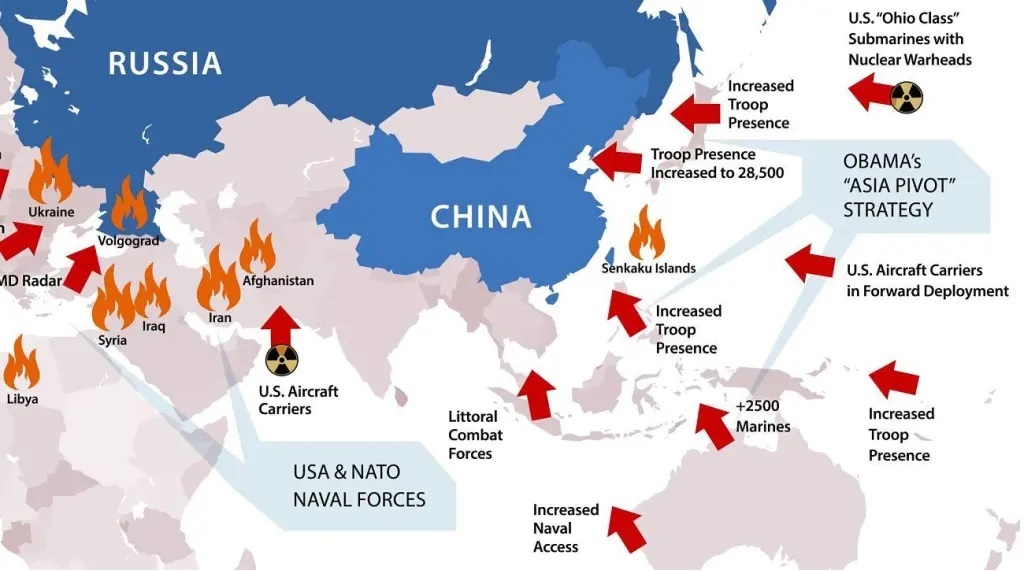
A clash between the United States and China over Taiwan would be the result of the United States willfully going to war with China over a matter the United States officially recognizes as China’s internal political affairs.
The current US State Department’s website regarding “U.S. Relations With Taiwan” admits that officially, “we do not support Taiwan independence.”

The US has also poured billions of dollars’ worth of weapons into Taiwan, just as the US did in Ukraine from 2014 onward. The weapons are clearly intended for a Ukraine-style proxy war with China
.
New Eastern Outlook, : Brian Berletic 8 Feb 23
In recent weeks there has been a build-up of talk regarding a US war with China. Not because of any actual provocation from Beijing, but instead because of a collective resignation to its supposed inevitability.
This is best illustrated by comments made by US Air Force General Michael Minihan. In TIME Magazine’s article, “U.S. General’s Prediction of War With China ‘in 2025’ Risks Turning Worst Fears Into Reality,” General Minihan is quoted as saying:
Worst of all is the small but growing presence of US military activity on Taiwan itself.
Even as the US State Department claims it does not support Taiwan independence, in 2021 Voice of America in its article, “US Nearly Doubled Military Personnel Stationed in Taiwan This Year,” admits that not only are there US troops on Taiwan, the number is increasing.
The article explains:……………………………
“My gut tells me we will fight in 2025.”
The article goes on to claim:
“I hope I am wrong,” Minihan, who heads the Air Force’s Air Mobility Command, wrote in an internal memo, which circulated on social media, to the leadership of its 110,000 members. Chinese President Xi Jinping, he explains, “secured his third term and set his war council in October 2022. Taiwan’s presidential elections are in 2024 and will offer Xi a reason. United States’ presidential elections are in 2024 and will offer Xi a distracted America. Xi’s team, reason, and opportunity are all aligned for 2025.”
Yet nothing General Minihan says explains why the United States itself would conceivably find itself at war with the United States. Instead, General Minihan is more or less admitting that the US will go to war with China over Chinese actions regarding Taiwan. In fact, the article goes on to admit:
Minihan’s comments are merely the most immediate of a worrying, emerging consensus that the U.S. and China are destined to clash over Taiwan, the self-ruling island of 23 million that Beijing claims as its sovereign territory.
A clash between the United States and China over Taiwan would be the result of the United States willfully going to war with China over a matter the United States officially recognizes as China’s internal political affairs.
The current US State Department’s website regarding “U.S. Relations With Taiwan” admits that officially, “we do not support Taiwan independence.”
If the US does not support Taiwan independence then by extension the US acknowledges Taiwan is not independent and therefore Washington, officially, recognizes Beijing’s sovereignty over Taiwan. This is what defines the “One China” policy Washington and virtually every other nation on Earth has agreed to in order to establish diplomatic relations with the People’s Republic of China in Beijing.
At a time when Washington regularly lectures Moscow about “violating sovereignty,” Washington’s stance toward Beijing and Taiwan should be a simple matter of respecting Chinese sovereignty. Yet it is not because of the double-game the United States plays both internationally and with China specifically.
Washington’s Deliberate Provocations
TIME Magazine and other Western media publications attempt to depict Beijing as the aggressor, omitting any discussion of either the “One China” policy or the US State Department’s own official declaration of supposedly upholding it.
Instead, Western audiences are led to believe that Taiwan somehow is independent and that Beijing is “bullying” it. The inevitable clash between the US and China is supposedly driven by America’s desire to “stand up” for Taiwan and its inferred sovereignty. In reality, a potential clash between the US and China would be the result of Washington once again violating the sovereignty of another nation thousands of miles from its own shores.
Washington’s double game of officially recognizing Chinese sovereignty over Taiwan while openly and deliberately trampling that sovereignty is best illustrated by former US Speaker of the House Nancy Pelosi’s visit to Taiwan utilizing an official US Air Force aircraft against the protests of Beijing. Pelosi’s trip to Taiwan is only one of many made by US representatives who openly use visits like this in an attempt to goad Beijing……….
Looking at any map of US military deployments in the “Indo-Pacific” region reveals China as virtually surrounded by the US military by way of South Korea, mainland Japan, Okinawa, and with new basing agreements in the works with Manila, potentially the Philippines as well.
This puts US troops, naval assets, and hundreds of warplanes within striking distance of China, including Taiwan from north, east, and potentially the south.
The US has also poured billions of dollars’ worth of weapons into Taiwan, just as the US did in Ukraine from 2014 onward. The weapons are clearly intended for a Ukraine-style proxy war with China.
Worst of all is the small but growing presence of US military activity on Taiwan itself.
Even as the US State Department claims it does not support Taiwan independence, in 2021 Voice of America in its article, “US Nearly Doubled Military Personnel Stationed in Taiwan This Year,” admits that not only are there US troops on Taiwan, the number is increasing.
The article explains:………………………………….
One could only imagine the reaction in Washington if Beijing and a government in, say San Juan, revealed the presence of Chinese forces in Puerto Rico. Yet as is the case in many instances regarding international relations, American “exceptionalism” not only absolves the US from any penalty for blatant violations of another nation’s sovereignty, it transfers the blame to the nation being targeted itself, in this case, China.
Why US War with China by 2025?
Despite serial provocations, Beijing has exercised exemplary patience and restraint. China has invested heavily in its military and is indeed preparing for conflict with the United States, not because it seeks to wage war with the United States but because the United States has placed its military on China’s doorstep, very clearly seeking war with China.
Taiwan’s full reintegration with the rest of China is inevitable. Already its economy is heavily dependent on access to markets across the rest of China. Harvard University’s Atlas of Economic Complexity reveals that nearly 50% of all exports from Taiwan go to the rest of China. The rest of China also accounts for the largest amount of imports to the island. Many of these imports are crucial inputs for Taiwan’s semiconductor and electronic component production which constitutes, by far, Taiwan’s largest industry.
Only through Washington’s persistent and extensive interference in Taiwan’s local political affairs has gradual reintegration been suspended. Before the US-backed Democratic Progressive Party (DPP) came to power in 2016, the incumbent Kuomintang (KMT) party was on track to sign a trade agreement with the mainland that would have increased already extensive economic integration even further.
Ironically, as the US captured Ukraine politically in 2014, it was also backing opposition protests in Taiwan dubbed the “Sunflower Movement,” paving the way for the DPP’s ascent into power 2 years later. Just like the US-installed client regime in Kiev, the DPP immediately set a course for self-destruction, irrationally rolling back ties with the mainland at the expense of the people living on Taiwan.
More recently, local elections in Taiwan saw the DPP fare poorly, serving as an unofficial referendum rejecting the DPP’s separatist platform, the damage it has consistently done to the local economy, and the instability it has created across the strait with the mainland. However, just as was the case in Ukraine where public sentiment sought peace, Washington and its client regime have every intention of overriding that sentiment in Taiwan, and pushing the island closer still to yet another US-engineered proxy war.
It is clear that it is not China rushing for war with the United States, but precisely the other way around. Time, economics, and proximity favor China. In 10 years, China will be economically and militarily stronger while the US will continue its slow decline. At that point the window of opportunity will have closed for the United States to wage any type of military conflict with China and obtain anything close to resembling “victory.”
Some could argue that the window has already closed.
The Center for Strategic and International Studies (CSIS) recently published the outcome of “wargames” regarding a theoretical Chinese “invasion” of Taiwan in a paper titled, “The First Battle of the Next War: Wargaming a Chinese Invasion of Taiwan.”The paper concludes:
In most scenarios, the United States/Taiwan/Japan defeated a conventional amphibious invasion by China and maintained an autonomous Taiwan. However, this defense came at high cost. The United States and its allies lost dozens of ships, hundreds of aircraft, and tens of thousands of servicemembers. Taiwan saw its economy devastated. Further, the high losses damaged the U.S. global position for many years.
Regarding China, it says:
China also lost heavily, and failure to occupy Taiwan might destabilize Chinese Communist Party rule. Victory is therefore not enough. The United States needs to strengthen deterrence immediately.
In essence, the US will suffer unprecedented military losses and Taiwan itself will be scoured clean of its industry and infrastructure. While CSIS claims that the Chinese amphibious landing was successfully foiled in its wargames thus preserving Taiwan’s political existence, the cost is Taiwan’s physical existence.
Both the CSIS paper together with public comments made by the Pentagon about their own classified wargames indicate disparity between the US and China militarily is narrowing quickly. If there is to be a conflict between the US and China, the sooner it takes place the better chance the US has of achieving a favorable outcome. It is therefore the US racing eagerly toward war, not China. China’s military posture reflects the close proximity of US forces to Chinese territory and their obvious intent to menace China in its own territory, not a China expanding its military capabilities to threaten the United States. In fact, the CSIS paper made a specific note about China’s ability to attack the US “homeland.”
The paper claims:
Because the United States will be striking the Chinese homeland, the base case assumes that the U.S. homeland is not a sanctuary. However, the ability of the Chinese to conduct strikes against the U.S. homeland and thereby affect operations in the Western Pacific is extremely limited. A few special forces might infiltrate and attack a small number of high-value targets but not enough to materially affect military operations in the Western Pacific.
Thus, even in a war between the US and China where the US is conducting strikes on Chinese territory, CSIS admits that China has very limited means to likewise strike at the US. This reveals that US policymakers are not concerned about any real threat China poses to the US, but instead to US “interests” thousands of miles from its own shores and, in fact, within the sovereign territory of China itself.
Potential war between the US and China, if it takes place, will merely be the most recent example of US military aggression in pursuit of global hegemony targeting and attempting to undermine another nation’s sovereignty in violation of international law, not as a means to uphold it. As the US often does, the lead up to this potential war sees the US projecting its own menace toward international law, peace and stability onto the very target of US military aggression, in this case China.
Brian Berletic is a Bangkok-based geopolitical researcher and writer, especially for the online magazine “New Eastern Outlook”.
“No regrets” as UK government portrays nuclear power as “clean” and “green”

Nuclear power to get ‘green’ status as Britain races EU to hit net
zero. Move is part of a bid to unlock billions of pounds of funding for
more power stations. Nuclear power projects such as Sizewell C in Suffolk
will be granted so-called “green” status under plans by Jeremy Hunt to
unlock billions of pounds in funding for the industry. The Chancellor is
expected to announce the change within weeks as part of a broader shake-up
of the UK’s financial rules on green energy.
It would see nuclear power
projects classed as “green” or “sustainable” investments, clearing
the way for more institutional investors and environment-focused funds to
back them. There are also hopes that the Treasury could fund new power
plants with money raised through the Government’s green gilts and green
savings bonds. Generating nuclear power does not produce carbon dioxide, [ if you ignore the total nuclear fuel chain] so the sector is seen as a key plank of Britain’s plans to reach net zero
emissions by 2050.
A recent review by former energy minister and Tory MP
Chris Skidmore said that supporting the construction of more nuclear
reactors was a “no regrets” option. However, the sector has faced
difficulties portraying itself as environmentally friendly in the past
because of concerns about nuclear waste, water usage, and the remote but
catastrophic risk of nuclear accidents. Top fund managers such as Legal &
General and Aviva have previously expressed caution about the green
credentials of nuclear, with Aviva chairman George Culmer last year saying
there was an “ongoing debate”.
Telegraph 14th Feb 2023
Some, but not all, First Nations support small nuclear reactors in New Brunswick

Moltex CEO says company has full support of all 15 First Nations in N.B. to develop SMRs
Jennifer Sweet · CBC News Feb 15, 2023
Companies trying to develop small modular nuclear reactors in New Brunswick are getting some support from an unlikely source.
An energy crisis is looming large, and SMRs have better potential than renewables in the short term, said Chief Terry Richardson of Pabineau First Nation, near Bathurst.
Richardson said he sees nuclear power as consistent with his cultural values.
“As First Nations, we are stewards of the land. Well, when we look at nuclear technology, it’s not a carbon emitter. So it’s not going to cause a problem. It’s going to actually solve the problem of carbon.
“If we don’t do something, we all know what’s happening with climate change.”
Pabineau has signed memoranda of understanding to work with two companies that have SMR projects under way at Point Lepreau — Moltex and ARC, said Richardson.
He describes the MOUs as “non-contractual, binding documents” that state a willingness to work together on development.
Details of exactly how his community and potentially other First Nations in the province may take part in SMR projects have yet to be negotiated, said Richardson.
“There’s going to be an opportunity to be involved on the equity side and that’s where we have to sit down and talk and discuss it and see where we’re going to go.”
After the initial development at Lepreau, ARC is talking about installing more SMRs in Belledune, Richardson noted, which could mean job opportunities in northern New Brunswick.
He also likes that Moltex is looking at reusing spent fuel rods, which it says would reduce the amount of toxic nuclear waste that already exists.
Study looks at SMR waste
A Canadian peer-reviewed study that came out last summer found the volume of waste from SMRs would be between double and 30 fold that from a typical reactor and that its chemical complexity would make it more difficult to manage.
Richardson said he is satisfied that plans are in place to deal with nuclear waste and added that maybe in the future there will be a way to recycle it…..
Moltex CEO Rory O’Sullivan told the legislative committee Wednesday that his company has the support of all 15 First Nations in the province to develop SMRs.
However, some other Indigenous leaders addressed the committee who have concerns about the SMR plans and the public investment in development.
Chief Hugh Akagi represents the Peskotomuhkati Nation at Skutik, which doesn’t have official recognition as a First Nation in Canada. https://www.cbc.ca/news/canada/new-brunswick/first-nations-small-modular-nuclear-reactors-1.6749808
Fukushima: Japan insists release of 1.3m tonnes of ‘treated’ water is safe
Neighbouring countries and local fishers express concern as 12th anniversary of nuclear disaster looms
Justin McCurry, Guardian 15 Feb 23,
“……………….. As the country prepares to mark the 11 March anniversary, one of the disaster’s most troubling legacies is about to come into full view with the release of more than 1m tonnes of “treated” water from the destroyed Fukushima Daiichi nuclear power plant.
The tsunami knocked out the plant’s backup electricity supply, leading to meltdowns in three of its reactors, in the world’s worst nuclear accident since Chornobyl 25 years earlier.
Much has changed since the Guardian’s first visit to the plant in 2012, when the cleanup had barely begun and visitors were required to wear protective clothing and full-face masks. Atmospheric radiation levels have dropped, damaged reactor buildings have been reinforced and robots have identified melted fuel in the basements.
But as the Guardian learned on a recent visit, progress on decommissioning – a process that could take four decades – is being held up by the accumulation of huge quantities of water that is used to cool the damaged reactor cores.
Now, 1.3m tonnes of water – enough to fill about 500 Olympic-sized swimming pools – is being stored in 1,000 tanks that cover huge swathes of the complex. And space is running out.
Two steel pillars protruding from the sea a kilometre from the shore mark the spot where, later this year, the plant’s operator, Tokyo Electric Power [Tepco], plans to begin releasing the water into the Pacific Ocean, in the most controversial step in the Fukushima Daiichi cleanup to date.
The decision comes more than two years after Japan’s government approved the release of the water, which is treated using on-site technology to remove most radioactive materials. But the water still contains tritium, a naturally occurring radioactive form of hydrogen that is technically difficult to separate from water.
The discharge, which is due to begin in the spring or summer, will take place in defiance of local fishing communities, who say it will destroy more than a decade of work to rebuild their industry. Neighbouring countries have also voiced opposition.
The government and Tepco claim the environmental and health impacts will be negligible because the treated water will be released gradually after it has been diluted by large amounts of seawater. The International Atomic Energy Agency says nuclear plants around the world use a similar process to dispose of wastewater containing low-level concentrations of tritium and other radionuclides.
Tepco and government officials who guided a small group of journalists around Fukushima Daiichi this month insisted the science supports their plans to pump the “treated” water – they object to media reports describing it as contaminated – into the ocean………………………………………….
Environmental groups have challenged the Japanese government’s claims that the water will not affect marine life or human health, while the US National Association of Marine Laboratories has pointed to a lack of adequate and accurate scientific data to support its reassurances on safety………………….. https://www.theguardian.com/environment/2023/feb/15/fukushima-japan-insists-release-of-treated-water-is-safe-nuclear-disaster
Scotland’s campaign groups call on government to reject plans for nuclear power at new Green Freeports.
NORTH campaigners have called on the Scottish Government to reject plans
to build nuclear plants at the country’s two new Green Freeports.
John O’Groat Journal 14th Feb 2023
THE convener of Scotland’s nuclear-free local authorities (NFLAs) has
written to Net Zero Minister Michael Matheson asking him to reject nuclear
power at Scotland’s two new green freeports.
The National 15th Feb 2023
Earth Changes Summary – January 2023: Extreme Weather, Planetary Upheaval, Meteor Fireballs.
Sott.net
2023-02-14
The start of 2023 has been marked by heavy snow, unseasonably cold temperatures, and wetter-than-expected weather for the season.
Extreme weather hit California pretty hard this month: A bomb cyclone, severe flooding, mudslides, power outages, walls of snow in Soda Spring, and a magnitude 4.2 earthquake with an epicenter in offshore Malibu……………………………….
Heavy snow also disrupted normal life in Italy, Austria, Slovenia, Croatia, and Mallorca. Mallorca was covered by its largest snowfall in more than five years.
China’s northernmost city, Mohe, was hit by an all-time record of -53°C, the lowest ever recorded. The local officials worked overtime to ensure heating and water services. This comes days after temperatures plunged to -50°C in Russia’s Yakutsk.
Central Asia also suffered a harsh January. In Kyrgyzstan, Tajikistan, Uzbekistan, and Turkmenistan recorded unusual levels of snow, that collapsed power poles and trees, blocked main roads, and burst water pipes. Thetemperatures in Kazakhstan reached a chilling -30°C.
The Middle East was also caught off guard by colder-than-usual temperatures and snow. Tens of thousands of Iranians were left without gas amid snow and freezing conditions, and Afghanistan temperatures plummeted as low as -33°C,combined with widespread snowfall, freezing gusts, and regular power outages. At least 166 people died due to the cold wave.
Ex-Tropical Cyclone Ellie continued to batter northern Australia this month. Heavy rain turned roads into rivers, thousands of cattle got lost or died, and boats were the only form of transportation in some counties. Western Australia was also hit hard by heavy rain and floods. 38 homes and 37 businesses were destroyed, with an additional 121 homes damaged. In some cases, the damage is so severe that will require long-term rebuilding efforts. The floods have also caused significant damage to infrastructure and transportation routes.
New Zealand’s largest city declared a state of emergency after torrential rains caused widespread flooding and evacuations. Heavy floods washed away houses, blocked roads, and knocked out power. The city received 75% of its usual summer rainfall in just 15 hours.
Latvia experienced its worst flooding since 1981, forcing residents of central areas to evacuate their homes. Meanwhile, large chunks of ice that drifted from Belkarus caused the water level to rise, while also putting pressure on a new dam.
Other noteworthy events this month:
- Sumatra, Indonesia: Heavy flooding leaves 3 dead and 15,000 homes damaged
- Johor and Pahang, Malaysia: More than 4,000 were displaced by flooding caused by 17 inches of rain in 24 hours
- North Sulawesi, Indonesia: Nearly 18 inches of rain in 48 hours left 3-meter floods in some areas.
- Zambia – Non-stop rains caused catastrophic flooding in southern and central provinces.
And things start to get rocky! A 5.9 Mag earthquake struck northwestern Iran, killing at least seven people and injuring 440.
All this and more in our SOTT Earth Changes Summary for January 2023:… https://www.sott.net/article/477313-SOTT-Earth-Changes-Summary-January-2023-Extreme-Weather-Planetary-Upheaval-Meteor-Fireballs
U.S. military’s newest weapon against China and Russia: Hot air balloon

The Pentagon is quietly transitioning high-altitude balloon projects to the military services.
By LEE HUDSON, 07/05/2022 https://www.politico.com/news/2022/07/05/u-s-militarys-newest-weapon-against-china-and-russia-hot-air-00043860
The Pentagon is working on a new plan to rise above competition from China and Russia: balloons.
The high-altitude inflatables, flying at between 60,000 and 90,000 feet, would be added to the Pentagon’s extensive surveillance network and could eventually be used to track hypersonic weapons.
The idea may sound like science fiction, but Pentagon budget documents signal the technology is moving from DoD’s scientific community to the military services.
“High or very high-altitude platforms have a lot of benefit for their endurance on station, maneuverability and also flexibility for multiple payloads,” said Tom Karako, senior fellow for the International Security Program and Missile Defense Project director at the Center for Strategic and International Studies.
The Pentagon continues to invest in these projects because the military could use the balloons for various missions.
Over the past two years, the Pentagon has spent about $3.8 million on balloon projects, and plans to spend $27.1 million in fiscal year 2023 to continue work on multiple efforts, according to budget documents.
Meanwhile, the Pentagon is working on its own hypersonic weapons program, despite Wednesday’s failure of the latest test.
A bright spot for the U.S. is the balloons may help track and deter hypersonic weapons being developed by China and Russia.
The half billion nuclear kitty litter incident
by Brian Nitz “…………………………. imagine being the person who caused a nuclear accident by ordering the wrong kitty litter?
It happened in February 2014 at a nuclear weapons waste processing facility for the Los Alamos National Laboratory in New Mexico. Anyone involved may be trying hard to forget that it ever happened. The confusion began with a typo in a request for “kitty litter/zeolite clay.” (Zeolites can also be used in energy storage as I wrote here).
At some point this was replaced with kitty litter (clay). This was further transformed into an order for organic cat litter, specifically the sWheat Scoop brand which the manufacturer claims is 100% wheat. Now while the word organic has a folk meaning to environmentalists and hipsters at your local cafe, to chemists it means something more specific……………………………
Don’t try this at home
Green Prophet recently covered the possibilities of using Zeolite for energy storage and this amazing mineral has many more tricks up its sleeve. But while it might seem obvious that anything capable of detoxifying cat pee would be equally effective for nuclear waste disposal, this isn’t necessarily true.
The problem with using 100% organic wheat-based organic kitty litter for your nuclear waste disposal instead of zeolite (non-clay) kitty litter has to do with its reactivity and flammability when confined in a barrel with plutonium, americium, uranium and nitrate-based processing chemicals when compared to zeolite. It doesn’t help that all of this takes place deep underground in an abandoned salt mine where there is much more salt and nuclear waste than there are people to watch it.
So the problem wasn’t discovered until barrel #68660 burst, releasing radiation into a ventilation system. It is believed that several hundred nuclear waste barrels were contaminated with the wrong kind of kitty litter. The cost of the cleanup is said to have been more than half a billion. https://www.greenprophet.com/2023/02/kitty-litter-nuclear/
NewsReal: Alien Balloon Malarkey! Setting The Stage For Proxy War Against China?
What in the name of God is going on in America?
Following last week’s comically bizarre ‘Chinese Spy Balloon Shoot-down’, this weekend the Pentagon declared that it shot down two MORE ‘Chinese balloons’ over Alaska and Canada, and that it scrambled fighter jets to investigate a ‘radar anomaly’ over Montana. (And, since airing, a FOURTH balloon has been downed by the US Air Force over Lake Huron.)
What’s different this week is that the Pentagon isn’t exactly confirming that these latest ‘objects’ are balloons, much less Chinese ‘spy’ ones. In fact, the media and govt spokespeople seem to be deliberately insinuating that these ‘unidentified objects’ are… extraterrestrial in origin!
South Korea’s Nuclear Flirtations Highlight the Growing Risks of Allied Proliferation
Carnegie Endowment, ERIC BREWER, TOBY DALTON, FEBRUARY 13, 2023
South Korean President Yoon Suk-yeol’s January comments about his country possibly acquiring nuclear weapons adds to the mounting nuclear dangers in Asia. Though he subsequently walked back his statement, the underlying motives and risks remain that South Korea could one day decide to go nuclear.
Yoon’s nuclear threat also fueled a debate among security experts in Washington about how to respond. Many nonproliferation analysts highlighted the rarity of national leaders making public allusions to acquiring nuclear weapons and argued that the United States needs to remind South Korea of its commitments not to do so. Others highlighted the dangers of a rising tide of “nuclear populism” that is driving South Korea’s nuclear discourse. Conversely, some analysts argued that there is little the United States can do to prevent an inevitable South Korean weapon and that it is better to reduce U.S. extended deterrence commitments in conflicts that exceed vital U.S. interests. A few go even further and suggest that Washington should welcome or even facilitate a nuclear-armed Seoul.
This debate indicates a very unsettled dynamic that American and other policymakers cannot wish away or ignore. Yoon’s comments may simply be the leading edge of a trend in nuclear flirtations by U.S. allies and partners.
Since the dawn of the nuclear age, the United States has sought to stem the spread of nuclear weapons to adversaries and allies alike. This policy aims partly to preserve the U.S. nuclear advantage and to reduce the potential that nuclear weapons are used, which many experts judge increases if more states acquire them. Over the past few decades, the major proliferation fear has been about rogue actors: North Korea, Iraq, Iran, Syria, or potentially terrorist groups. The United States and the international community developed a policy tool kit to address these threats, including sanctions, technology denial, and even cyber and military attacks on nuclear facilities. Today, however, an increasing proliferation risk comes from U.S. allies and partners worried about their security and the credibility of U.S. commitments to their defense…………………………………….more https://carnegieendowment.org/publications/89015?utm_source=rss&utm_medium=rss
Checking Back in on China’s Nuclear Icebreaker
Over four years after the project was announced, updates remain scarce on China’s first nuclear icebreaker.
The Diplomat, By Trym Eiterjord 13 Feb 23
In 2018, it became known that the state-owned China National Nuclear Corporation (CNNC) was embarking on a project to develop nuclear-powered icebreakers…………….
Over four years later, information about the project remains scarce, but a handful of patents recently filed by engineers at the CNNC Marine subsidiary would seem to indicate that development is moving forward. The content of these patents may give some insight into what is potentially China’s first nuclear-powered surface vessel.
The patents filed so far are concerned mainly with nuclear engineering. ……………………
Finally, the new subsidiary has filed a patent titled simply “A nuclear-powered icebreaker,”………………..
This is more or less the extent of new information to have come out since the project was first revealed in 2018……………………………….
The People’s Liberation Army Navy has also seemingly become interested in nuclear propulsion for polar-going icebreakers…………………….. more https://thediplomat.com/2023/02/checking-back-in-on-chinas-nuclear-icebreaker/
Ballooning paranoia: The China threat hits the skies
Thankfully, one or two sober notes of reflection have prevailed, even from within the military-intelligence fraternity. The Center for Strategic and International Studies has issued a few self-evident truths. ‘Balloons are not an ideal platform for spying,’ writes James Andrew Lewis, ‘they are big and hard to hide. They go where the winds take them’. Such instruments ‘would be a strange choice for a technologically advanced and sophisticated opponent’.
Independent Australia, By Binoy Kampmark | 13 February 2023
Hysteria over balloons is a strange thing, writes Dr Binoy Kampmark.
HOT AIR balloons first appeared during the Napoleonic era, where they served as delivery weapons for bombs and undertook surveillance tasks. High-altitude balloons were also used by, of all powers, the United States during the 1950s, for reasons of gathering intelligence, though these were shot down by the irritated Soviets.
On 28 January, a device reported to be a “high-altitude surveillance balloon” entered U.S. airspace in Alaska. It then had a brief spell in Canadian airspace before returning to the U.S. via Idaho on 31 January.
On 4 February, with the balloon moving off the coast of South Carolina, a decision was made by the U.S. military to shoot it down using an F-22 Raptor from the First Fighter Wing based at Langley Air Force Base. The Pentagon has revealed that the collection of debris is underway.
In response, the Chinese Foreign Ministry issued a stern note of disapproval, protesting:
‘The US attack on a civilian unmanned airship by force.’
This was ‘a clear overreaction and a serious violation of international practice’. Beijing also issued a note of apology, regretting ‘the unintended entry of the ship into U.S. airspace due to force majeure’.
A U.S. State Department official, while noting the statement of regret, felt compelled to designate:
‘The presence of this balloon in our airspace [as] a clear violation of our sovereignty as well as international law.’
Rumours of a second Chinese balloon flying across Latin America were also confirmed by a spokesperson of the Chinese Foreign Ministry on 6 February, who described it as being “of a civilian nature and is used for flight tests”.The instrument had been impaired by weather in its direction, having “limited self-control capabilities”.
The Pentagon’s press secretary, Brigadier General Pat Ryder, also confirmed the existence of the second balloon, reaching the predictably opposite conclusion to his Chinese counterparts:
“We are seeing reports of a balloon transiting Latin America. We now assess it is another Chinese surveillance balloon.”
This overegged saga has seen much airtime and column space dedicated to those in the pay of the military-defence complex. Little thought was given to the purpose of such a seemingly crude way of collecting military intelligence. Timothy Heath of the Rand Corporation went so far as to extol the merits of such cheeky devices. For one thing, they were hard to detect, making them somehow reliable.
General Glen VanHerck, commander of North American Aerospace Defense Command and U.S. Northern Command, made reference to a number of Chinese spy balloons that supposedly operated with impunity during the Trump Administration. “I will tell you that we did not detect those threats,” he said. This had resulted in a “domain awareness gap that we have to figure out”.
The begging bowl for even larger defence budgets is being pushed around the corridors of power.
Lawyers of international law have also had their say, reaching for their manuals, and shaking their heads gravely. Donald Rothwell of the Australian National University thought that:
‘The incursion of the Chinese balloon tested the boundaries of international law.’
Thankfully, one or two sober notes of reflection have prevailed, even from within the military-intelligence fraternity. The Center for Strategic and International Studies has issued a few self-evident truths. ‘Balloons are not an ideal platform for spying,’ writes James Andrew Lewis, ‘they are big and hard to hide. They go where the winds take them’. Such instruments ‘would be a strange choice for a technologically advanced and sophisticated opponent’.……………………………..
The Chinese explanation has been scoffed at and derisively dismissed. Yet balloons are an almost quotidian feature of scientific and meteorological work, whatever the official explanation offered by Beijing might be. NASA’s own Scientific Balloon Program, for instance, has been most engaged of late.
The organisation was keen to tout its fall 2022 campaign involving six scientific, engineering and student balloon flights in support of 17 missions.
The scale of any one mission be sizeable. ‘Our balloon platforms’, came the description from NASA’s Scientific Balloon chief Debbie Fairbrother, ‘can lift several thousand pounds to the edge of space, allowing for multiple, various scientific instruments, technologies, and education payloads to fly together in one balloon flight’.
The disproportionate nature of Washington’s reaction to Beijing over such balloons also looks rather odd in the face of the vast surveillance technologies it deploys against adversaries and friends.
But politics is not merely the art of the possible but an opportunity for the absurd to find form and voice. On this score, the mouse has clearly terrified the elephant. https://independentaustralia.net/politics/politics-display/ballooning-paranoia-the-china-threat-hits-the-skies,17230
Many people in the public opinion polls are opposed to the idea, and briefings are being held in various regions… but the Cabinet decides to promote nuclear power plants, ignoring the voices of “grave danger to future generations”
February 11, 2023
The government’s basic policy, which includes measures to promote nuclear power plants, such as rebuilding them and operating them for more than 60 years, received nearly 4,000 opinions (public comments), many of which were against nuclear power. However, the Cabinet decision was made on April 10 without changing the main outline of the policy. The major change in nuclear policy less than six months after Prime Minister Fumio Kishida’s order to study the issue has consistently failed to address the voices of the public. (The Cabinet decision was made on October 10, 2011, without any change in the major nuclear policy.)
◆Consideration of voices within the ruling party

The TEPCO’s Fukushima Daiichi nuclear power plant accident proves that humans have no control over nuclear power plants,” and “It invites grave danger to future generations.
The results of the public solicitation of opinions announced by the government after the cabinet decision were lined with requests for the government to reconsider its decision. A total of 3,966 opinions were received in the public solicitation, which was conducted for about a month from the end of December last year, after the basic policy was decided at the government meeting. The government has clarified the contents of 356 opinions and their responses by summarizing similar opinions.
The government’s response to the negative opinions on nuclear power emphasized that the stable supply of electricity is in crisis due to changes in the energy situation caused by the crisis in Ukraine. The government reiterated its explanation that it will utilize nuclear power along with renewable energy and other energy sources that have decarbonizing effects.
Since the end of the public comment period, there has been only one major revision to the basic policy, related to nuclear power. Regarding the reconstruction of nuclear power plants, which had not been envisioned by the government after the Fukushima accident, the target location was elaborated from “nuclear power plants that have been decided to be decommissioned” to “within the premises of nuclear power plants that have been decided to be decommissioned. This is a strong indication that the government took into consideration the opinions of the nuclear power prudent within the ruling party.
◆Not listening to the voice of the people, “They are making fun of the victims.
The basic policy was discussed by a number of METI experts. Although a number of committee members who are negative about nuclear power plants called for a national debate, the public’s voice was not heard before the policy was decided.
After deciding on the basic policy at the end of last year, METI began holding explanatory meetings in mid-January in 10 cities across Japan where METI and other bureaus are located. So far, they have been held in Nagoya, Saitama, Osaka, and Sendai, and will continue until early March.
Ruiko Muto, co-chairperson of the Liaison Association of Organizations Affected by the Nuclear Power Plant Accident in Miharu-machi, Fukushima Prefecture, commented at a press conference on March 10, “I don’t understand what the meetings are for. It is ridiculous that the meeting was not held in Fukushima Prefecture, a disaster-stricken area, and that they are making fun of the victims of the disaster.
◆It’s conclusory, forced, and unacceptable as a method of policy making.” It is unacceptable as a method of policy making.
Opposition to the policy is also smoldering among regulators. The basic policy stipulates that the Nuclear Regulation Authority (NRA) will conduct rigorous examinations and regulations as a precondition for utilizing nuclear power plants. At a regular meeting of the regulatory commission on August 8, Akira Ishiwatari, a member of the commission, opposed the transfer of the 40-year operating period, with a maximum of 60 years, stipulated in the Nuclear Reactor Regulation Law, to a law under METI jurisdiction, saying that it is not necessary. It became unclear whether a new regulatory system could be decided upon.
At a press conference following the cabinet decision, METI Minister Yasutoshi Nishimura explained, “The basic policy was put together from the perspective of nuclear energy utilization policy and does not include safety regulations, so there is no problem,” and expressed his intention to continue with procedures such as amending related laws. Hajime Matsukubo, executive director of the NPO Nuclear Information and Documentation Office, who also served as a member of METI’s expert panel, commented, “They are forcibly proceeding with the conclusion that they are promoting nuclear power without listening to opposing opinions. This is unacceptable as a method of policy making.

People opposing the Cabinet decision on the basic policy in front of the Prime Minister’s official residence in Nagatacho, Tokyo, on March 10.
◆Attack on the Prime Minister’s Office
On January 10, about 100 people protested in front of the Prime Minister’s official residence in Nagata-cho, Tokyo, after the cabinet approved a basic policy that includes measures to promote nuclear power plants. In the cold rain, they called for “No new nuclear power plants” and “Don’t forget Fukushima. (Nozomi Masui)
The event was organized by the Executive Committee for 10 Million People’s Action to Say Goodbye to Nuclear Power Plants, a citizens’ group. Members of six organizations, including environmental groups and labor unions, took the microphone.
Natsuka Mitsuda, 55, secretary general of FoE Japan, an international environmental NGO, said, “In order for the nuclear industry to survive, future generations will have to bear a heavy burden and risk of accidents. We are firmly opposed to the cabinet decision that ignores the will of the people. Taeko Fujimura, 68, vice chairperson of the National Trade Union Liaison Council, said, “We have learned nothing from the accident at the Fukushima Daiichi Nuclear Power Plant. The operation of aging nuclear power plants is absolutely unacceptable.
Cabinet adopts policy of using nuclear reactors beyond 60-year limit

The No. 3 reactor at Kansai Electric Power’s Mihama nuclear power plant in Mihama, Fukui Prefecture, the first nuclear reactor in Japan to operate beyond 40 years.
Feb 10, 2023
The Cabinet formally adopted a policy on Friday that will allow for the operation of nuclear reactors beyond their current 60-year limit alongside the building of new units to replace aging ones as part of efforts to cut carbon emissions while ensuring adequate national energy supply.
The government’s “green transformation” policy features extensive use of nuclear power along with renewable energy and marks a major policy shift for the country, which suffered a devastating nuclear disaster in 2011. The Cabinet decision follows a meeting in late December at which the policy was agreed upon.
The government also plans to raise about ¥20 trillion ($152 billion) through the issuance of green transformation bonds to boost investment in decarbonization projects, as it estimates public and private investment of over ¥150 trillion will be necessary over the next 10 years.
Bills necessary to implement the new policy were submitted to parliament Friday.
The new policy will effectively extend the amount of time reactors can remain operational beyond 60 years by excluding time spent on inspections and other periods they are offline from consideration when calculating their total service life.
The policy also calls for developing advanced reactors, regarded as safer than conventional ones, and only allowing them to be built within the premises of reactors destined for decommissioning. The government aims to begin operating next-generation reactors in the 2030s.
It also states the central government is responsible for the final disposal of high-level radioactive waste created through nuclear power generation. The issue has been a source of concern among the public and a challenge in advancing nuclear policy.
Economy, Trade and Industry Minister Yasutoshi Nishimura said at a news conference after the Cabinet meeting that the government hopes to expand the areas in which it will conduct first-stage surveys as part of the selection process for the final disposal site.
The new policy stipulates government support for local governments which accept the survey.
Public sentiment turned sour over the use of nuclear power as a national source of energy following the Fukushima No. 1 nuclear disaster in March 2011 that was triggered by a massive earthquake and tsunami. The government had repeatedly said it was not considering building new reactors or replacing existing ones.
But since Russia launched a major invasion of Ukraine in late February last year, a sharp rise in global energy prices has threatened the stable supply of energy for Japan, a resource-scarce country that heavily relies on fossil fuel imports, prompting officials to look into greater use of nuclear power.
Prime Minister Fumio Kishida instructed the government last summer to look into how the country can maximize the use of its nuclear energy facilities most effectively.
1 This Month
Tell Congress: Prevent Nuclear Catastrophe in Iran

Tell Congress: Prevent Nuclear Catastrophe in Iran

Read the Public Inquiry Report, the Commissioners’ report, Surrendering Australia: The AUKUS Deception is available to download for free at aukuspublicinquiry.com. Or just watch the replay of the National Press Club Luncheon.


Shut down the radiation-damaged Heysham nuclear reactors now
To see nuclear-related stories in greater depth and intensity – go to https://nuclearinformation.wordpress.com

Say No to NASA’s Reckless Nuclear Reactor on the Moon
Say No to NASA’s Reckless Nuclear Reactor on the Moon
-
Archives
- November 2026 (238)
- October 2026 (302)
- September 2026 (339)
- August 2026 (330)
- July 2026 (355)
- June 2026 (287)
- May 2026 (306)
- April 2026 (356)
- March 2026 (251)
- February 2026 (267)
- January 2026 (308)
- December 2025 (358)
-
Categories
- 1
- 1 NUCLEAR ISSUES
- business and costs
- climate change
- culture and arts
- ENERGY
- environment
- health
- history
- indigenous issues
- Legal
- marketing of nuclear
- media
- opposition to nuclear
- PERSONAL STORIES
- politics
- politics international
- Religion and ethics
- safety
- secrets,lies and civil liberties
- spinbuster
- technology
- Uranium
- wastes
- weapons and war
- Women
- 2 WORLD
- ACTION
- AFRICA
- Atrocities
- AUSTRALIA
- Christina's notes
- Christina's themes
- culture and arts
- Events
- Fuk 2022
- Fuk 2023
- Fukushima 2017
- Fukushima 2018
- fukushima 2019
- Fukushima 2020
- Fukushima 2021
- general
- global warming
- Humour (God we need it)
- Nuclear
- RARE EARTHS
- Reference
- resources – print
- Resources -audiovicual
- Weekly Newsletter
- World
- World Nuclear
- YouTube
-
RSS
Entries RSS
Comments RSS

