Steele-John, the Australian senator, called Richardson and other American consultants “inherently biased” and said they were primarily representing U.S., not Australian, interests
In its quest to build nuclear-powered submarines, the government of Australia recently hired a little-known, one-person consulting firm from Virginia: Briny Deep.
Briny Deep, based in Alexandria, Va., received a $210,000 part-time contract in late November to advise Australian defense officials during their negotiations to acquire top-secret nuclear submarine technology from the United States and Britain, according to Australian contracting documents. U.S. public records show the company is owned by John M. Richardson, a retired four-star U.S. admiral and career submariner who headed the U.S. Navy from 2015 to 2019.
Richardson, who declined to comment, is the latest former U.S. Navy leader to cash in on the nuclear talks by working as a high-dollar consultant for the Australian government, a pattern that was revealed in a Washington Post investigation last year. His case brings to a dozen the number of retired officers and former civilian leaders from the U.S. Navy whom Australia has employed as advisers since the nuclear talks began in September 2021, documents show.
The former U.S. Navy officials are profiting from a web of sources with sometimes divergent interests. One retired U.S. admiral charges $4,000 per day to consult for the Australian government while simultaneously advising other foreign defense clients and collecting his U.S. military pension, according to records obtained by The Post under the Freedom of Information Act (FOIA).
The overlapping arrangements cast doubt on whether the U.S. consultants can provide impartial advice and raise questions about whose interests they are representing, said Jordon Steele-John, a member of the Australian Senate whose Green Party opposes the nuclear talks and has been critical of the government’s dependence on American advisers. “If you’re on the payroll of a foreign government, your advice is by definition not independent,” he said.
Under federal law, retired U.S. military personnel must obtain approval from the Pentagon and the State Department before they can accept money or jobs from foreign powers that could compromise their sworn allegiance to the United States. The law applies to retirees — generally those who served at least 20 years in uniform — because they receive a U.S. pension and can be recalled to active duty……………………………………………………………..
Vice Adm. Jonathan Mead, (above) the chief of Australia’s nuclear-powered submarine task force, told an Australian parliamentary committee last month that Richardson had been hired to provide guidance “on stewardship — that is, how to safely and securely manage nuclear technology” and on the training of naval personnel. “When we have specific tasks, questions or complex problems which come our way that we don’t have the subject matter expertise for, we reach in for his assistance,” Mead said during a Feb. 15 hearing.
……………………………….. Since his retirement from active duty, Richardson also has served on the board of directors for major companies in the defense and nuclear sectors, including Boeing, Constellation Energy and BWX Technologies. In 2021, he received more than $900,000 in compensation for his services on corporate boards, records show, plus a six-figure U.S. military pension.
……… “We’ve been very careful to make sure his advice is very specific to the questions that remain within the guidelines,” Mead said.
Steele-John, the Australian senator, called Richardson and other American consultants “inherently biased” and said they were primarily representing U.S., not Australian, interests. “Our government has been paying them handsomely for their advice,” he said. But he added that the arrangement “calls into question” any collaboration between Australia and the United States on military matters.
……………………………. One of the most prominent former officers is retired Vice Adm. William Hilarides, a career submariner who commanded the U.S. Naval Sea Systems Command until 2016. Since then, he has received consulting contracts from the Australian government worth $1.3 million, according to Australian defense officials.
He charges $4,000 per day for his consulting services, according to documents that the U.S. Navy recently released in response to The Post’s FOIA lawsuits. He has also worked for Fincantieri Marine Group, a Wisconsin shipyard company that is majority owned by the government of Italy. He did not respond to an email seeking comment.
As for Julian Assange, the urgency behind bringing attention to the case is justified. According to Shenkman, “We tried to dig through the history to see if a publisher has ever been charged for anything like Julian Assange has been accused of. And the answer is no. This is the first case in U.S. history of its kind. And it would set a precedent that would open the floodgates for prosecuting the press.”
The use of the century old Espionage Act in the Julian Assange case continues to set the chilling precedent of a bleak future in American journalism, a precedent that endangers even those outside US borders.
arey Shenkman, attorney, author, and litigator specializing in civil and human rights, joins Robert Scheer for this week’s Scheer Intelligence, where Shenkman offers a sobering analysis on one of the most chilling attacks on press freedom exhibited in the Julian Assange case. Using his recently published book, A Century of Repression: The Espionage Act and Freedom of the Press, Shenkman details the history of the Espionage Act and how civil liberties have continued to be eroded as a result of the existence of this law and the lack of revision.
Shenkman talks about the bipartisan disdain towards the Espionage Act in legal circles yet its continued use by bipartisan presidents brings the conversation to its flaws and disreputability: “Over the decades, you have folks that are coming out with law review articles saying that it’s vague, verbose, that it makes no sense, and that ambiguity in the law is being exploited now to go after Julian Assange, to go after government whistleblowers. So there have actually been serious calls for its reform and repeal in recent years.” Assange faces 175 years in a U.S. maximum security prison after being indicted with 17 charges relating to the Espionage Act.
Going back to its inception during World War I, Shenkman explains what its true purpose was and how within the law, “you get a sense that this language of promoting disloyalty, of promoting opposition to the war, was actually used to go after conscientious objectors and folks that opposed entry into World War I.”
As for Julian Assange, the urgency behind bringing attention to the case is justified. According to Shenkman, “We tried to dig through the history to see if a publisher has ever been charged for anything like Julian Assange has been accused of. And the answer is no. This is the first case in U.S. history of its kind. And it would set a precedent that would open the floodgates for prosecuting the press.”
Shenkman says if Assange is extradited, it will make his case a law school case for all the wrong reasons. Despite all the concern surrounding the overreaching power of the United States, this case could also open the door to countries around the world to extradite citizens from foreign countries for exposing their wrongdoings. As Shenkman mentions, “Assange is not a U.S. government employee. He’s not even a U.S. citizen. And somehow the U.S. government says it has jurisdiction.”
The Israeli PM has challenged the UN watchdog’s statement that any attacks against nuclear plants are “outlawed”
Israeli Prime Minister Benjamin Netanyahu has insisted that the option of attacking an Iranian nuclear facility in “self-defense” must be left on the table, arguing that the chief of the UN’s International Atomic Energy Agency (IAEA) made an “unworthy” statement when he declared that any such strikes are banned.
“Are we forbidden to defend ourselves?” Netanyahu said on Sunday in a cabinet meeting. “Of course, we are allowed, and of course, we are doing this… Nothing will prevent us from protecting our country and preventing oppressors from destroying the Jewish state.”
Netanyahu’s remarks came a day after IAEA Director-General Rafael Mariano Grossi was asked by a reporter about US and Israeli threats to attack Iran if it doesn’t agree to curb its nuclear program.
“Any military attack on a nuclear facility is outlawed, is out of the normative structures that we all abide by,” Grossi said at a press briefing in Tehran after meeting with Iranian leaders. That principle applies to all nuclear facilities, including Europe’s biggest atomic facility in Zaporozhye.
Netanyahu said no such prohibition could apply to Israel. “Rafael Grossi is a worthy person who made an unworthy remark,” he said. “Outlawed by what law? Is Iran, which publicly calls for our extermination, allowed to protect its weapons of destruction that will slaughter us?”
Grossi’s trip to Tehran apparently paid dividends, as Iranian officials agreed to restore the UN watchdog’s access to some surveillance tools at the country’s nuclear facilities. The IAEA also was granted an increase in inspections at the Fordo nuclear site, as well as additional verification and monitoring activities.
“These are not words,” Grossi told reporters upon his return to Vienna on Saturday. “This is very concrete.”
Tehran has denied having any ambition to acquire nuclear weapons. Iran signed a deal with the US and other world powers in 2015, agreeing to impose restrictions on its nuclear industry, including uranium enrichment, to allay fears about its potential for warhead development. Washington reneged on the agreement in 2018, when then-US President Donald Trump said he would instead apply “maximum pressure” through sanctions on Iran to contain its nuclear program.
Koeberg Thin Walled Holtec Nuclear Waste Canister In S. Africa Leaked After 17 Years, More Holtec Canister Problems That Threaten Massive Radiological Releases, Explosion & Criticality Risks From Holtec Canisters, Potential Canister Problem At Diabalo Canyon After 2 Years.
List of other thin walled nuclear canisters vendors who threaten life on Earth listed at https://sanonofresafety.org in addition to Holtec. Where is the media? The vaunted “free press”?
The number of students on renewables-related courses in Scotland has soared by 70% in four years, figures reveal. Scottish Renewables found that 22,000 undergraduates were studying subjects which cover the sector, ranging from engineering to maths. The same survey in 2019 reported around 13,000 young people studying in similar areas. Scottish Renewables said it demonstrated the attractiveness of the industry.
It’s almost a year since Boris Johnson’s announcement that a new nuclear power station will be built at Wylfa, Ynys Môn. ‘Wylfa Newydd’ is part of the proposed new nuclear scheme, Great British Nuclear (GBN). But GBN, if it goes ahead, will be the third generation of nuclear reactors in the UK.
Let’s look back at the past two generations of nuclear power stations in the UK, and see how they’ve performed, and ask if Wylfa Newydd is really the boon for Cymru that the Tories claim it is.
As Johnson made his Wylfa announcement in April 2022, the Public Accounts Committee (PAC) was busy finalising a report on the economic performance of Britain’s previous, second generation of reactors. The PAC report, entitled ‘The Future of Advanced Gas-cooled Reactors [AGRs],’ was released just a month after Johnson’s announcement.
It revealed: hownthese retirement-age AGR reactors have been a poor investment, not serving Britain well economically; how the estimated cost of decommissioning them had nearly doubled since 2004, and would likely climb further; and how these astronomical, escalating costs of decommissioning the AGR sites (now at £23.5 billion) is being put onto UK tax-payers.
In his farewell address, Dwight D. Eisenhower warned of the “military-industrial-congressional complex” where one hand fed the other in a vicious cycle of self-aggrandizement at public expense. Of the expenses paid since 1960, none has been dearer than the habitable climate of Earth.
………………………………………………………………………. Direct Air Capture, Small Modular Reactors, and Fusion Energy — all are pwnings of solar by the National Laboratories, set in motion by Edward Teller.
National Labs make some sense if you are trying to solve some gargantuan problem that humanity faces — it would be good to have one for climate change, for instance — but today they mainly exist to keep engineers and physicists fully employed.
It is easy for the labs to lobby their funders, ultimately taxpayers, for ungodly sums for national security reasons, to prevent a brain drain, to advance basic science — even if the work being proposed is not only useless but mindlessly destructive, as long as it costs a lot and employs millions of little Edward Tellers. It will be good for the economy and will advance the cause of democracy, right?
History Rhymes
Edward Teller is commonly thought of as the “father of the hydrogen bomb” although he did not like the sobriquet. Born in Hungary in 1908, Teller came to the United States in the 1930s as one of the many so-called “Martians”, physicists being rescued from Europe to join what would become the Manhattan Project that developed the first atomic bomb. After the war, having successfully pwned his rival, Robert Oppenheimer, as a pinko, Teller co-founded the Lawrence Livermore National Laboratory, and was its director for many years. He was author of the Red Scare, the Cold War expansion of nuclear arsenals, the Reagan “Star Wars” Strategic Defense Initiative, posthumously the Trump Space Force, and some hare-brained plans that thankfully never came to fruition, such as nuclear-powered airplanes and a plan to excavate an artificial harbor in Alaska using H-bombs.
In a recent Pugwash podcast, Professor Frank von Hippel, Co-Director of the Science and Global Security program at Princeton, explained how Teller was so masterful at pwning presidents and secretaries of Energy and Defense. In the 1990’s, von Hippel was an advisor to President Clinton, and later Obama. In the ’80s, he advised Gorbachev on how to wind down the Soviet nuclear threat. He reveals that Reagan and Gorbachev had agreed, mano a mano at the Reykjavik summit, to eliminate nuclear weapons from the face of the Earth only to have Reagan backpedal when the weapons labs balked. Reagan was pwned. Von Hippel tells how it later went during the Clinton years:
… the emphasis has been on energy but the research really was done for nuclear weapons design purposes … and the issue was a Nuclear Weapons Test Ban and where the weapons lab directors were insisting that they needed to do 15 more tests… there were reasons of safety or reliability that required them.
And the labs presented the tests that they wanted to do in this meeting that was called by the Secretary of Energy [Hazel Henderson] and I was not convinced so I brought along a retired weapons designer who was also not convinced. And it turns out the Secretary of Energy wasn’t convinced either.
And one of them [the directors] said, well if you would give us as much money for not testing as you’ve been giving us for testing we might be able to see it your way. And so that was the beginning of the science-based stockpile stewardship program and it was basically the budgets — some billions of dollars a year — that were offered to the weapons labs basically to do what they wanted.
This month’s issue of Wired magazine gushes over one outcome:
In December 2022 — a solid century since physicists first identified fusion as the source of star power — American scientists at the National Ignition Facility in Livermore, California, where ignition is a way of life, had a breakthrough – [much touted laser fusion experiment]…………………………………
……………………………………. they’ve been trying to ignite these little pellets for decades now and they finally got to the point where [for 80 nanoseconds] they got as much energy out of of the pellet from fusion energy as they put into it from laser energy and that was a breakthrough.
To get to a power plant is an enormous, enormous extrapolation. You’d have to do this many times a second — hundreds of times a second. You’d have to have affordable lasers that would do this repeatedly many hundreds of times a second and in the end, whether that would compete with other sources of energy is a stretch. Even a very simple nuclear power plant can’t compete with solar and wind power anymore, so whether this extravagant contraption could is extremely unlikely.
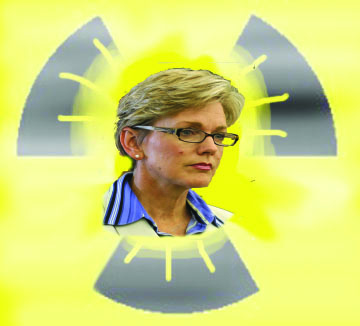
I watched the press conference where US Energy Secretary Jennifer Granholm [above] took to the stage and announced this world-changing breakthrough with visions of unlimited energy that would have no climate consequences. I could barely fathom how people could be so gullible as to believe it. Even when one of the lab directors got up and said that the breakthrough would really help their weapons research, apparently no-one saw through the ruse. Astonishing.
Wired’s head exploded in technocornucopian orgasm:
Fusion will, of course, rescue the environment and decarbonize planet Earth in a cool afternoon.………………………..
That 80-nanosecond burst was estimated to have cost $3.5 billion, which is likely an underestimate. It resulted in nuclear waste — principally tritium, which will linger for some 240 years as a lethal isotope. Gordon Edwards, President of Canadian Coalition for Nuclear Responsibility, replied to von Hippel that:
I think we have been we have been manipulated and a lot of people fell for it because you don’t think that the Secretary of Energy is going to go on public airwaves and simply give a false account of what actually happened. And that’s what we’re seeing. I think that the the scramble for money for fusion research, and even for fission research in terms of small modular reactors, is impelling people to misrepresent their product as a way of of getting governments to invest in it and the public to support it.
………………………………………………………. Rather than disguising a fundamentally military project like the Lawrence Lawrence Livermore Lab experiment as a peaceful energy thing when in fact it’s a military maintenance project, we have to restart the debate over nuclear weapons policy.
And thus we all drift, pwned like Granholm, stocked to the gills with horrific weaponry and new threats to unleash it out of MRGA (Make Russia Great Again) rage. Every new reactor built is both a bomb component factory and a wartime target. It makes plutonium. We gave up a critical 50 years chasing the peaceful atom myth — unlimited energy that’s safe, clean, too cheap to meter — when we could have had cheap, safe, clean renewable energy with no explosive potential and a tamer climate all that time. Maybe it is time we stop listening to Edward Teller’s ghost and listened to Justin Trudeau’s dad, Maybe it’s time we did something different for a change. https://medium.com/the-shadow/jennifer-granholm-was-pwned-301c2a3c657a
As small modular nuclear reactors come closer to reality in the U.S., managing and disposing of their highly radioactive waste should be a national priority. Forty years after the passage of the Nuclear Waste Policy Act, there is, “no clear path forward for the siting, licensing, and construction of a geologic repository” for nuclear waste, according to a recent U.S. National Academies of Science, Engineering and Medicine report.
The good news is that there is already a clear strategy for managing and disposing of this highly radioactive material. The bad news is that the U.S. government has yet to seriously follow that plan.
The National Academies report tells us that new or advanced reactor designs—the hoped-for saviors of the nuclear industry—will not save us from the need to build geologic repositories, deep-mined facilities for permanent nuclear waste disposal. In some cases, these new reactors may make it worse by creating more waste that’s more costly to manage, new kinds of complex waste, or just more waste, period. Before we face that onrush, we first need to deal with the large volume of waste we’ve already produced.
The U.S., which led the way on managing nuclear waste in the 1980s and 1990s, has now fallen to the back of the pack. About 88,000 metric tons of spent nuclear fuel from commercial reactors remain stranded at reactor sites, and this number is increasing by some 2,000 metric tons each year. These 77 sites are in 35 states and threaten to become de facto permanent disposal facilities. Without a geologic repository, there is no way forward for the final disposal of this highly radioactive material. Storing it in pools and dry casks at reactor sites is a temporary solution; it is safe for decades, but not the millennia needed to isolate this radioactive material from the environment. The present U.S. policy of indefinite storage at a centralized site is not a viable solution, as it shifts the cost and risk to future generations.
Beginning now, the nation needs to follow a pathway already set out for a national nuclear waste repository. Both a 2012 presidential Blue Ribbon Commission and an international expert panel organized by Stanford and George Washington Universities in 2018 recommended a new, independent, waste management and disposal organization with funding outside of the annual Congressional appropriations and restrictive budgetary rules. The Blue Ribbon Commission called for creation of a new federal corporation, like the Tennessee Valley Authority, for this organization, while the Stanford/GWU panel looked to replicate not-for-profit, utility-owned, but independent, organizations modeled on successful programs in other countries, such as Sweden and Finland.
Charges to nuclear-power-produced electricity fund these organizations, and they remain regulated by independent nuclear regulators. Both panels agreed on the need for an independent organization and finances………………………………………………………………
Assured finances are also key. In the U.S., Congress hasn’t appropriated funds for its Yucca Mountain nuclear waste program since 2010. In fact, Congress has so badly mangled the process of collecting and appropriating the ratepayers fund, now over $40 billion, that it has rendered these funds essentially inaccessible. Outrageously, this money, actually collected from electricity ratepayers, not taxpayers, is being used to offset the national debt.
Even if the U.S. starts today, it will take decades to site, design and build a facility for disposal of its nuclear waste stockpile. That process must accelerate now, before the reactors we need for their electricity run out of room for their growing inventories of highly radioactive waste. https://www.scientificamerican.com/article/nuclear-waste-is-piling-up-does-the-u-s-have-a-plan/
West created ‘Nazi paradise’ in Ukraine to fight Russians – Dugin
Kiev’s backers, however, ultimately don’t believe it will win, the political philosopher said.
The West has fostered the creeping “nazification” of Ukraine in order to make its people hostile to Russia, political philosopher and author Aleksandr Dugin has told RT. In an exclusive interview aired on Saturday, he said that Kiev’s backers have tried to hide from their own citizens the growing tolerance of nationalists and neo-Nazis in the country.
“The West thinks in such a manner: We could not create artificial nationalism in Ukraine and push Ukrainians to fight Russians [any other way],” Dugin said.
“For a traditional society, liberal values cannot be the goal to defend. So they need something [else]. The most radical [tool] to create and promote this artificial pseudo-consciousness is nationalism … or Ukrainian Russophobic fascism. And it is being used by the [globalist] liberals.”
Dugin said the West supported radicals in Kiev, despite cracking down on similar groups at home. “They destroy any kind of nationalism on their [own] territories. But in Ukraine, on the other hand, they make it flourish.” In the end, “a Nazi paradise” has been created in Ukraine, he claimed.
According to Dugin, such an approach will ultimately lead to the destruction of the Ukrainian state. “I don’t think they seriously believe in the possible victory of Ukraine,” he stated.
Ukraine’s Azov Battalion is among the units that welcomes fighters with openly nationalist and neo-Nazi views. Ukrainian soldiers have repeatedly been filmed and photographed bearing Nazi insignia and tattoos. Russian President Vladimir Putin listed “denazification” as one of the objectives of the military operation Moscow launched in the neighboring state a year ago.
Last year, Dugin’s daughter, journalist Darya Dugina, was killed by a bomb planted under the car she was driving. Moscow said Ukrainian agents were behind the assassination. Kiev denied its involvement. Nevertheless, the New York Times later reported that US intelligence officials believe that the Ukrainian authorities had authorized the attack.
ST. LOUIS, Mo. (KMOV) – Two Republican state representatives from Wentzville are seeking a full accounting of the contamination and potential caused by the nuclear weapons work that took place in the St. Louis region decades ago.
Additionally, they hope to get the state to press the federal government for compensation for people who developed rare cancers and diseases that were likely caused by radiation exposure.
Representative Tricia Byrnes filed House Concurrent Resolution number 21 last week, and Representative Richard West filed the companion House concurrent Resolution number 22. The legislation calls for a joint investigation by various departments of state government.
“We hope to get the state of Missouri and its agencies to stand up and ask the federal government to step in with some kind of legislative remedy,” said Byrnes.
“We’ve been fighting this as singular battles, St. Louis City, St. Louis County, St. Charles County. And I think if all the leaders come together, we approached the federal government and say, look, we want to be made whole,” said West.
Uranium was processed in the 1940′s and 1950′s at Mallinckrodt Chemical Works at a facility downtown for atomic bombs. Some of the waste was stored along Banshee Road near Lambert St. Louis International Airport and contributed to the contamination of nearby Coldwater Creek. Some of the waste was also stored in the 9200 block of Latty Avenue and eventually was illegally buried at West Lake Landfill.
Uranium was also processed at the Weldon Spring Chemical Plant along Highway 94 in St. Charles County from 1957-1966. After the plant closed and before it became a Superfund Cleanup site, children were known to play in the abandoned buildings. People also swam in a nearby quarry where radioactive waste and remnants of the downtown St. Louis site were dumped.
Both Byrnes and West have relatives who’ve been diagnosed with rare cancers and diseases that are associated with exposure to radiation.
“The victims of this are starting to become numerous,” said West.
In 2018 the Missouri Department of Health and Senior Services found elevated levels of cancer in the zip codes that Coldwater Creek runs through. And the CDC concluded that contamination in the creek was the likely cause.
The Energy Employees Occupational Illness Compensation Program Act (EEOICPA) was set up to compensate nuclear weapons workers who develop one of about two dozen types of cancer associated with radiation exposure. A similar program called the Radiation Exposure Compensation Act (RECA) was set up to compensate people who lived downwind from nuclear bomb tests and also developed one of the cancers on the government list.
West and Byrnes are seeking to get the State of Missouri to advocate, on behalf of residents of the region with radiation-related cancers and illnesses, to be compensated similarly.
Both pieces of legislation have been assigned to the General Laws committee, which will hold a hearing on the legislation Tuesday, March 7, at 4 p.m. Byrnes and West are requesting that anyone who was diagnosed with radiation-related cancer or illness which may have been caused by the local work on the nuclear weapons program, to attend the hearing and tell their story.
The decision still needs to go through some legislative hoops before it is finalised – but it signals a stronger-than-ever willingness by the government to revamp nuclear power across the country. The Senate voted in favour of getting rid of the limit altogether in January.
A 2015 law to promote green growth limited the proportion of energy France could get from nuclear to 50% of its energy mix by 2035. With 69% of the country’s energy coming from nuclear, according to official data, the measure was thought to encourage investment in renewables and paved the way at the time of the closing of France’s iconic and then oldest Fessenheim plant in June 2020.
Mar 3, 2023
Lawmakers voted in favour of doing away with the 50% legal limit on nuclear in the country’s total energy mix on Thursday as part of France’s larger efforts to build newer, more modern nuclear plants.
The vote took place in the Committee for Economic Affairs on Thursday as part of a broader legislative package that would see the building of six new nuclear European Pressurised Reactors 2 (EPR2). The first one of those, EPR2 is expected to be operational in 2035………………………
There are certain English villages, wrote Bill Bryson, “whose very names summon forth an image of lazy summer afternoons”. One example was Theddlethorpe All Saints. Lying on the quiet Lincolnshire coast north of Skegness, Theddlethorpe’s approximately 500 residents are served by a thatched pub and two handsome medieval churches, which stand out against huge skies.
Yet storm-clouds are building on the horizon; soon, this obscure corner of England could be the backdrop to a dystopian tale. Theddlethorpe has always had an industrious underbelly. Between 1972 and 2018, it was known for the Theddlethorpe Gas Terminal, where natural gas gathered from beneath the North Sea was collected, then fed into the National Grid. At its peak, Theddlethorpe handled around 5% of the UK’s gas supply, but with the shift away from fossil fuels, the plant became redundant.
In 2021, just as locals were feeling grateful for the site’s long-promised return to agricultural use, came news that the terminal might have an unwelcome afterlife — as the landward end of an undersea nuclear waste dump. It is one of four sites being considered by the government for a Geological Disposal Facility (GDF), the others all being on the far side of the country, near Sellafield, a huge nuclear site in Cumbria.
The idea s that vast storage caverns would be blasted into bedrock up to 1,000 metres under the sea, several miles offshore. “Higher activity” radioactive waste would then be transported to Theddlethorpe from 23 surface storage locations across the UK, and trundled out along a tunnel, to be walled up and forgotten. The immediate vicinity of Sellafield is already unfit for many other purposes; why contaminate hitherto unaffected areas?
Especially because it would clearly be much cheaper to store waste close to its sources. NWS admits: “The transport provisions to the Theddlethorpe GDF Search Area are currently limited” and “significant works” would be required. The Government proposal suggests these works would cost between £20 and £53 billion — although as the tale of HS2 shows, the cost of extending transport networks is liable to gross underestimation. This throws up a question considered taboo in the discourse around large infrastructure projects: would expansion of either railways or roads really “benefit” an area whose residents generally value its rural character?
After 15 years of stalled talks, more than 100 countries reached a historic agreement to protect the high seas on Saturday, a long-awaited step that environmental groups say will help reverse marine biodiversity losses from climate change and overfishing.
The legally binding UN treaty to conserve and ensure the sustainable use of ocean biodiversity was finally agreed on after five rounds of protracted UN-led negotiations that ended on Saturday, a day after the original deadline. “The ship has reached the shore,” said the UN conference’s president Rena Lee, after a marathon final stretch of talks hit 38 hours.
Le Regroupement des organismes environnementaux en énergie (ROEE) is a voluntary association of Quebec groups with a fine professional team:
ROEE is funded to intervene in hearings of the Régie de l’Énergie on matters related to energy and the environment and toeducate the public on such matters in a regular way. The ROEE was founded in 1997 following a public debate on energy policy in Quebec that led to the creation of the
Régie de l’Énergie on matters related to energy and the environment and to educate the public on such matters in a regular way.
The ROEE was founded in 1997 following a public debate on energy policy in Quebec that led to the creation of the Régie.
The Canadian Coalition for Nuclear Responsibility, known in Quebec as le Regroupement pour la surveillance du nucléaire, is one of the founding members of the ROEE.
The ROEE is a champion of “soft energy paths” based on energy efficiency and renewable energy sources, and has recently decided to adopt a policy on nuclear power although Quebec phased out of nuclear power in 2012 with the closure of the only operating nuclear power reactor in Quebec called “Gentilly-2”. (Gentilly-1 was retired many years beforehand).
Quebec also adopted a one-year moratorium on uranium mining in 2014, leading to a year-long series of hearing in Quebec conducted by the BAPE (Bueau des audiences publiques sur l’environnement), who recommended in 2015 that the moratorium on uranium exploration and mining be made permanent. So far this has not been done but uranium exploration has been terminated in the province of Quebec – hence we have an informal moratorium in effect.
Membres du ROEE (2023)
Association madelinienne pour la sécurité énergétique et environnementale Canot Kayak Québec Écohabitation Fondation Coule pas chez nous Fondation Rivières Nature Québec Draft Policy on nuclear power (English original and French translation are copied below).
ROEE does not support the expansion of nuclear power based on the fissioning of uranium or plutonium as an energy source. The unsolved problems associated with nuclear fission technology are far more significant than any benefits it is supposed to offer, and there are now more affordable alternatives such as energy efficiency and renewable energy sources that are easier and faster to deploy than nuclear.
Background
•Nuclear fission inevitably creates a long-lived legacy of human-made radioactive wastes that will continue to challenge the health and safety of humans and the environment for hundreds of thousands of years. By far the most intensely radioactive wastes are contained in the used nuclear fuel. These wastes cannot be eliminated or neutralized but only contained, and safe containment over such long time periods cannot be assured.
•Materials such as stainless steel and concrete in the core area of a nuclear reactor also become long-lived radioactive wastes and therefore cannot be recycled. This debris cannot be decontaminated, it must be kept out of the environment for many generations after dismantling the reactors, which is delayed for decades to protect workers from excessive exposure. Canada has no strategy for dealing with these wastes over the very long term.
The risk of catastrophic nuclear accidents cannot be eliminated. Even if the risk is small, the consequences can be unacceptable, leading to radioactive contamination of large land areas and large volumes of water, as well as the permanent evacuation of large populations.
• The risk of proliferation of nuclear weapons using plutonium created in nuclear reactors, as India did in 1974, is not negligible. Such proliferation remains a significant danger for thousands of years after the last reactor is shut down.
• The proliferation risk becomes more acute when “advanced” nuclear reactors require the extraction of plutonium from used nuclear fuel to create more nuclear fuel – an operation called “reprocessing”. Reprocessing is now being considered by the Canadian government in coinnection with new reactors proposed for New Brunswick.
• ROEE supports the movement to ban reprocesssing – plutonium extraction – in Canada. Non-proliferation experts are agreed that ready access to plutonium should not be encouraged. In 1977, US President Carter banned reprocessing in the USA because of the proliferation risk.
• ROEE opposes uranium mining as well. The only significant uses of uranium are as an explosive for nuclear weapons and as a fuel for nuclear reactors. ROEE is opposed to both.
• Uranium mining also leaves a long-lived radioactive waste legacy. Canada currently has over 120 million tonnes of radioactive waste left over from uranium mining. These wastes will rmain danberous for hundreds of thousands of years.
• Uranium wastes, called “tailings”, contain some of the deadliest naturally occurring toxic materials known to science, such as radium, polonium, and radon gas. Mining brings these materials to the surface and makes them much more accessible to the environment.
ROEE Positions
ROEE disagrees wth the promotion of a new generation of nuclear reactors to deal with the climate emergency. Compared with energy efficiency and renewables such as solar and wind, nuclear power is at least 4 to 7 times more costly and much too slow to reduce greenhouse gas emissions in a timely fashion. In contrast to the proven performance and declining price of alternatives, new nuclear reactors are uncertain in performance and sometimes are completely unusable, while experience has shown a pattern of major price escalations and construction delays for nuclear projects.
ROEE applauds the decision to close down the Gentilly-2 reactor at Bécancour in 2012, thereby phasing out nuclear power in Québec. ROEE urges government to make this phase-out permanent by banning the construction of any new nuclear power reactors in the province.
A severe nuclear accident in either Ontario or New Brunswick can have serious airborne and water-borne consequences in Quebec as well as in those provinces. ROEE urges the government to encourage the phaseout of nuclear power in neighbouring provinces for safety reasons, while continuing to offer them sales of excess hydroelectric power from Quebec.
ROEE welcomes the 2015 recommendation of the BAPE for the government to declare a permanent moratorium on uranium mining in Quebec. ROEE urges the government to accept this recommendation fully by passing a law that bans uranium exploration and mining in the province, similar to the law passed by Nova Scotia on the same matter.
ROEE supports Quebec’s determination not to accept the import of long-lived radioactive waste from other jurisdictions for permanent storage in Quebec.
In addition, ROEE opposes current federal plans to construct a permanent radioactive storage facility on the surface at Chalk River, just one kilomete from the Ottawa River, close to the Quebec border. This landfill operation is intended to house one million cubic metres of radioactive wastes and other toxic materials such as asbestos and lead, some of it imported from as far away as Manitoba. As of 2022, over 130 municipalities, including the members of the Montreal Agglomeration Council, have opposed the planned Chalk River dump. ROEE supports their efforts to prevent it also urges the government of Quebec to do likewise.
At the end of 2021, President Putin made very clear that the three red lines for Russia were: (1) NATO enlargement to Ukraine as unacceptable; (2) Russia would maintain control of Crimea; and (3) the war in the Donbass needed to be settled by implementation of Minsk-2. The Biden White House refused to negotiate on the issue of NATO enlargement.
We are not at the 1-year anniversary of the war, as the Western governments and media claim. This is the 9-year anniversary of the war. And that makes a big difference.
The war began with the violent overthrow of Ukraine President Viktor Yanukovych in February 2014, a coup that was overtly and covertly backed by the United States government (see also here). From 2008 onward, the United States pushed NATO enlargement to Ukraine and Georgia. The 2014 coup of Yanukovych was in the service of NATO expansion.
We must keep this relentless drive towards NATO expansion in context. The US and Germany explicitly and repeatedly promised Soviet President Mikhail Gorbachev that NATO would not enlarge “one inch eastward” after Gorbachev disbanded the Soviet military alliance known as the Warsaw Pact. The entire premise of NATO enlargement was a violation of agreements reached with Soviet Union, and therefore with the continuation state of Russia.
The neocons have pushed NATO enlargement because they seek to surround Russia in the Black Sea region, akin to the aims of Britain and France in the Crimean War (1853-56). US strategist Zbigniew Brzezinski described Ukraine as the “geographical pivot” of Eurasia. If the US could surround Russia in the Black Sea region, and incorporate Ukraine into the US military alliance, Russia’s ability to project power in the Eastern Mediterranean, the Middle East, and globally would disappear, or so goes the theory.
Of course, Russia saw this not only as a general threat, but as a specific threat of putting advanced armaments right up to Russia’s border. This was especially ominous after the US unilaterally abandoned the Anti-Ballistic Missile Treaty in 2002, which according to Russia posed a direct threat to Russian national security.
During his presidency (2010-2014), Yanukovych sought military neutrality, precisely to avoid a civil war or proxy war in Ukraine. This was a very wise and prudent choice for Ukraine, but it stood in the way of the U.S. neoconservative obsession with NATO enlargement.
When protests broke out against Yanukovych at the end of 2013 upon the delay of the signing of an accession roadmap with the EU, the United States took the opportunity to escalate the protests into a coup, which culminated in Yanukovych’s overthrow in February 2014.
The US meddled relentlessly and covertly in the protests, urging them onward even as right-wing Ukrainian nationalist paramilitaries entered the scene. US NGO spent vast sums to finance the protests and the eventual overthrow. This NGO financing has never come to light.
Three people intimately involved in the US effort to overthrow Yanukovych were Victoria Nuland, then the Assistant Secretary of State, now Under-Secretary of State;Nuland was famously caught on the phone with the US Ambassador to Ukraine, Geoffrey Pyatt, planning the next government in Ukraine, and without allowing any second thoughts by the Europeans (“F*ck the EU,” in Nuland’s crude phrase caught on tape).
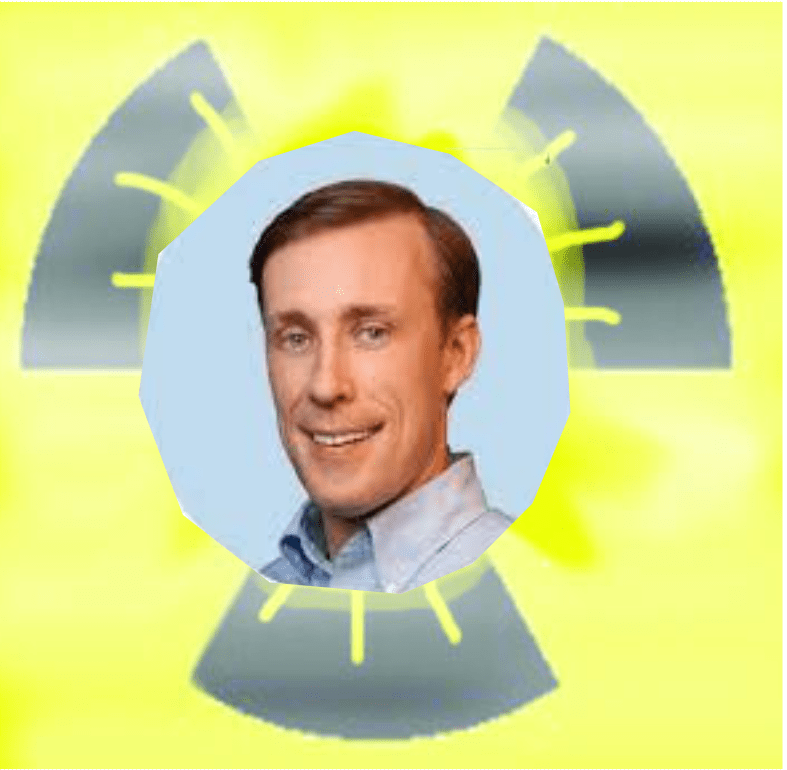
Jake Sullivan, then the security advisor to VP Joe Biden, and now the US National Security Advisor to President Biden;
and VP Biden, now President.
The intercepted conversation reveals the depth of the Biden-Nuland-Sullivan planning. Nuland says, “So on that piece Geoff, when I wrote the note Sullivan’s come back to me VFR [direct to me], saying you need Biden and I said probably tomorrow for an atta-boy and to get the deets [details] to stick. So, Biden’s willing.”
US Film director Oliver Stone helps us to understand the US involvement in the coup in his 2016 documentary movie, Ukraine on Fire. I urge all people to watch it, and to learn what a US-regime change operation looks like. I also urge all people to read the powerful academic studies by Prof. Ivan Katchanovski of the University of Ottawa (for example, here and here), who has laboriously reviewed all of the evidence of the Maidan and found that most of the violence and killing originated not from Yanukovych’s security detail, as alleged, but from the coup leaders themselves, who fired into the crowds, killing both policemen and demonstrators.
These truths remain obscured by US secrecy and European obsequiousness to US power. A US-orchestrated coup occurred in the heart of Europe, and no European leader dared to speak the truth. Brutal consequences have followed, but still no European leader honestly tells the facts.
The coup was the start of the war nine years ago. An extra-constitutional, right-wing, anti-Russian and ultra-nationalist government came to power in Kiev. After the coup, Russia quickly retook Crimea following a quick referendum, and war broke out in the Donbass as Russians in the Ukraine army switched sides to opposed the post-coup government in Kiev.
NATO almost immediately began to pour in billions of dollars of weaponry to Ukraine. And the war escalated. The Minsk-1 and Minsk-2 peace agreements, in which France and Germany were to be co-guarantors, did not function, first, because the nationalist Ukrainian government in Kiev refused to implement them, and second, because Germany and France did not press for their implementation, as recently admitted by former Chancellor Angela Merkel.
At the end of 2021, President Putin made very clear that the three red lines for Russia were: (1) NATO enlargement to Ukraine as unacceptable; (2) Russia would maintain control of Crimea; and (3) the war in the Donbass needed to be settled by implementation of Minsk-2. The Biden White House refused to negotiate on the issue of NATO enlargement.
The Russian invasion tragically and wrongly took place in February 2022, eight years after the Yanukovych coup. The United States has poured in tens of billions of dollars of armaments and budget support since then, doubling down on the US attempt to expand its military alliance into Ukraine and Georgia. The deaths and destruction in this escalating battlefield are horrific.
In March 2022, Ukraine said that it would negotiate on the basis of neutrality. The war indeed seemed close to an end. Positive statements were made by both Ukrainian and Russian officials, as well as the Turkish mediators. We now know from former Israeli Prime Minister Naftali Bennett that the United States blocked those negotiations, instead favouring an escalation of war to “weaken Russia.”
In September 2022, the Nord Stream pipelines were blown up. The overwhelming evidence at this date is that the United States led that destruction of the Nord Stream pipelines. Seymour Hersh’s account is highly credible and has not been refuted on a single major point (though it has been heatedly denied by the US Government). It points to the Biden-Nuland-Sullivan team as leading the Nord Stream destruction.
We are on a path of dire escalation and lies or silence in much of the mainstream US and European media. The entire narrative that this is the first anniversary of war is a falsehood that hides the reasons of this war and the way to end it. This is a war that began because of the reckless US neoconservative push for NATO enlargement, followed by the US neoconservative participation in the 2014 regime-change operation. Since then, there has been massive escalation of armaments, death, and destruction.
This is a war that needs to stop before it engulfs all of us in nuclear Armageddon. I praise the peace movement for its valiant efforts, especially in the face of brazen lies and propaganda by the US Government and craven silence by the European governments, which act as wholly subservient to the US neoconservatives.
We must speak truth. Both sides have lied and cheated and committed violence. Both sides need to back off. NATO must stop the attempt to enlarge to Ukraine and to Georgia. Russia must withdraw from Ukraine. We must listen to the red lines of both sides so that the world will survive.
Jeffrey D. Sachs, Professor of Sustainable Development and Professor of Health Policy and Management at Columbia University, is Director of Columbia’s Center for Sustainable Development and the UN Sustainable Development Solutions Network. He has served as Special Adviser to three UN Secretaries-General. His books include The End of Poverty, Common Wealth, The Age of Sustainable Development, Building the New American Economy, and most recently, A New Foreign Policy: Beyond American Exceptionalism.
Tell Congress: Prevent Nuclear Catastrophe in Iran
Read the Public Inquiry Report, the Commissioners’ report, Surrendering Australia: The AUKUS Deception is available to download for free at aukuspublicinquiry.com. Or just watch the replay of the National Press Club Luncheon.