DOE wanted to quadruple plutonium pit production. For now, activists have stopped them

https://beyondnuclearinternational.org/2023/03/05/new-nuclear-weapons-plan-faces-scrutiny/From SRS Watch, Tri-Valley CAREs, Nuclear Watch New Mexico and the Gullah/Geechee Sea Island Coalition 13 Mar 23,
In a win for public participation and environmental protection, the United States District Court of South Carolina denied the Department of Energy’s motion to dismiss a 2021 legal action filed by multiple citizen groups.
The suit was prompted by the agency’s failure to take the “hard look” required by the National Environmental Policy Act at its plans to more than quadruple the production of plutonium pits for new nuclear weapons and split their production between the Los Alamos National Laboratory and the Savannah River Site.
In her ruling, Judge Mary Geiger Lewis thoroughly rejected the defendants’ arguments that the plaintiffs lacked standing, saying it was “not a close call”.
“We were able to defeat yet another attempt to use standing as a weapon to keep members of the public out of the government’s decision-making process,” said Leslie Lenhardt, Senior Managing Attorney at the South Carolina Environmental Law Project (SCELP).
To date, the Department of Energy (DOE) has refused to fully examine the environmental and safety impacts of their cross-country plan, which would create massive quantities of dangerous radioactive materials, put hundreds of billions of taxpayer dollars on the line, risk a new nuclear arms race, and violate the nation’s foundational environmental law.
The Savannah River Site has never produced plutonium pits, the explosive cores of all U.S.nuclear weapons, and currently stores 11.5 metric tons of plutonium, which poses a daunting management and disposal challenge. Pit production will only increase its plutonium burden, along with more waste that needs to be treated, stored and disposed of.
“The ruling is a significant loss for the DOE in its efforts to dodge its legal obligations under NEPA,” said Tom Clements, Director of SRS Watch. “We will push forward in court to make sure that the DOE conducts the mandated environmental analysis of impacts of plutonium pit production at all involved DOE sites, including sites at which plutonium waste would be disposed.”
Despite outdated analyses failing to account for significant changes in circumstances, the U.S. government has ignored the repeated calls from the public, including the plaintiffs specifically, to conduct the legally required “hard look” at this major shift in policy that will only exacerbate the already documented waste of taxpayers’ money.
“It’s critical that the public understands that no future pit production is to maintain the safety and reliability of the existing nuclear weapons stockpile,” said Jay Coghlan, Executive Director of Nuclear Watch New Mexico. “Instead, it is for speculative new designs that can’t be tested because of the international testing moratorium. Or worse yet, it could prompt the U.S. to resume testing, which would have severe proliferation consequences. This is the kind of needed public discussion that the Department of Energy seeks to shut down while spending enormous sums of taxpayers’ money on expanding nuclear weapons production.”
SCELP filed the lawsuit on behalf of Savannah River Site Watch, Nuclear Watch New Mexico, Tri-Valley CAREs and the Gullah/Geechee Sea Island Coalition in June of 2021 after the DOE’s semi-autonomous National Nuclear Security Administration (NNSA) concluded it was unnecessary to conduct a broad, nationwide review of this two-site strategy. Instead, the agency is relying on a supplemental analysis of an outdated Programmatic Environmental Impact Statement (PEIS) completed more than a decade ago, along with a separate review done for SRS alone.
“We are thrilled that the Court ruled in our favor and that this landmark environmental case can now proceed toward a final decision,” said Marylia Kelley, Executive Director of the Livermore-based Tri-Valley CAREs. “What’s at stake in our litigation is nothing less than the question of whether the federal government will be allowed to run roughshod over affected communities like mine all across the country.
“We believe the Court will ultimately agree with Plaintiff groups that the National Nuclear Security Administration must produce a nationwide Programmatic Environmental Impact Statement and hold public hearings at all of the locations that will be actively involved in these dangerous plutonium bomb core activities, including Livermore, CA. The analysis of risks must precede implementation of the project in order to forestall serious environmental degradation and potential loss of life, “Kelley concluded.
US Department of Energy announces a $1.2 billion fund to save America’s aged nuclear power stations

Energy Department Announces Funds for Nuclear Power Plants
MARCH 12, 2023
Both existing operational and closed facilities are receiving assistance.
The Department of Energy has announced a $1.2 billion fund dedicated to extending the life of America’s aging nuclear power plants or potentially reopening plants that have closed, expanding the reactors eligible for aid.

Secretary Jennifer Granholm said, “Preserving the domestic fleet is critical to reaching America’s clean energy future.” She said that expanding the scope of funding “will allow even more nuclear facilities the opportunity to continue operating as economic drivers in local communities that benefit from cheap [??], clean[??] and reliable power.” …………………… https://www.presidentialprayerteam.org/2023/03/12/energy-department-announces-funds-for-nuclear-power-plants/—
China is competing in a great Asian arms race because it has no other choice
Timur Fomenko, more https://www.sott.net/article/478199-China-is-competing-in-a-great-Asian-arms-race-because-it-has-no-other-choice
Thu, 09 Mar 2023
Hechi City, Guangxi Province, China • Feb. 17, 2023Beijing’s continued militarization is a forced response to US pressure. But can it keep its cool?
During the two sessions of the National People’s Congress (NPC) over the weekend, China announced that its military budget would increase by 7.2% year on year. The news made headlines around the world.
The Chinese premier’s work report, submitted to the NPC, says the country’s military “should intensify military training and preparedness across the board,” and points to escalating “external attempts to suppress and contain China.” The country’s state media reacted conservatively, stressing that the defense spending increase is in keeping with the “single-digit” growth pattern of recent years (7.1% in 2022, 6.8% in 2021, 6.6% in 2020).
Western media took a much different angle, with many outlets making obligatory mention of warnings from analysts and officials that China’s real military spending could be much higher than the announced budget. For example the Guardian cited the US Department of Defense as claiming it could be up to two times higher. These outlets do mention that China’s defense budget is still dwarfed by that of the US ($224B versus $772B), before moving on to talk about the size of China’s navy and infantry, its “militarization” of the South China Sea and, of course, repeating the warnings emanating from Washington DC that “China may invade Taiwan” soon.
Such warnings from the US come coupled with a string of deliberate provocations such as official visits to Taiwan, flyovers, and ‘freedom of navigation’ operations. The US itself has made it a priority to militarize the region and to encircle China. None of these points can be found in Western media reports on Beijing’s defense spending – even though they are directly responsible for continued growth in China’s military budget.
Owing to the US attempt to contain China, the Asia-Pacific is now locked in a growing arms race and military competition, and Beijing has no choice but to participate. Washington has initiated a militarization of the region, under the label of its “Indo-Pacific” strategy, with the focus on suppressing the rise of China. To do this, the US has created minilateral blocs targeting China,one being the Quad (Australia, India, Japan, US) and the other being AUKUS with Britain. Additionally, the US has dramatically increased its deployment of military assets in the region, has pushed the Philippines to increase access to its bases, and has also deliberately pushed the Taiwan issue and walked back from its existing commitments to China in order to escalate regional tensions.
The US has actively encouraged and pushed for the arming of its regional allies too, the most notable example being Japan’s pledge to double its military spending and to buy hundreds of cruise missiles from the US. This militarization has been complementary to the parallel expansion of sanctions and embargoes aimed at crushing China’s rise in high-end technologies, which the US sees as directly contributing to its military capabilities. In this sense, the technological and military aspects of China-US competition are intrinsically linked, all in the name of American supremacy over the region.
So facing this growing military encirclement and competition, how does China respond? The answer is that it continues to develop and strengthen its military, with the optimism that it can keep up with the United States in the long term. The US military budget continues to be over three times the size of China’s, which is also sobering for those calling Beijing a “threat.” However, this does not mean that China is incapable, as its resources are concentrated in one region around itself, while the US is aiming for worldwide domination. When it comes to raw numbers, for example, China already has a larger navy than the United States and greater shipbuilding capacity.
2023 will be a year of significantly increased tensions. It hasn’t started well, with the US kicking up a storm over an alleged Chinese spy balloon, continuing provocations around Taiwan and reviving the Covid-19 lab leak theory. But will China bite? It seems unlikely.
One of the primary goals of this US-led effort is precisely to provoke Beijing so that Washington might be able to induce instability and therefore increase its geopolitical clout over other countries, breaking up positive regional integration. That is why China needs to be careful.
With Beijing recognizing it is facing US encirclement, it has to defend its critical national interests, but in conjunction, it also needs to play a diplomatic game to reassure other countries simultaneously. China does not want ties with India to deteriorate further, or to create anxiety for ASEAN claimants in the South China Sea, such as Vietnam, Malaysia, Indonesia or the Philippines.
It also wants to avoid Europe becoming more militarily involved against China, which would represent a great success for the US. China strives to be firm but also calm and cautious. There is a lot to lose in facing a hostile US, but sitting idly by is not an option. A military competition has begun, and it isn’t going away. Beijing must be strong but also avoid “rocking the boat” too much.
Why Russia has such a strong grip on Europe’s nuclear power
Why Russia Has Such a Strong Grip on Europe’s Nuclear Power. New energy
sources to replace oil and natural gas have been easier to find than
kicking the dependency on Rosatom, the state-owned nuclear superstore.
The pinched cylinders of Russian-built nuclear power plants that dot Europe’s
landscape are visible reminders of the crucial role that Russia still plays
in the continent’s energy supply.
Europe moved with startling speed to wean
itself off Russian oil and natural gas in the wake of war in Ukraine. But
breaking the longstanding dependency on Russia’s vast nuclear industry is a
much more complicated undertaking.
New York Times 10th March 2023
Some ‘sober thinking’ remains in Ukraine as portions of population are in favor of peace talks
RFri, 10 Mar 2023 https://www.sott.net/article/478187-Praise-be-Some-sober-thinking-remains-in-Ukraine-as-portions-of-population-are-in-favor-of-peace-talks
A senior Kiev official recently admitted that an increasing portion of the country’s population wants peace talks with Moscow
Some Ukrainians are realistic about future relations between Russia and Ukraine, which are bound to be restored in some capacity sooner or later, Kremlin Press Secretary Dmitry Peskov suggested on Friday.
Speaking to reporters, Peskov said that while it was premature to talk about a diplomatic settlement of the conflict, “there are still small streams of sober thinking” in Ukraine about ties between Moscow and Kiev, despite “the flood of propaganda filled with hatred of Russia” and “efforts to brainwash the Ukrainian population.”
Relations between the two countries are “inevitable, because we are neighbors, that’s obvious,” he added.
Peskov’s comments come after Aleksey Danilov, the head of Ukraine’s National Security and Defense Council, admitted on Thursday that an increasing number of Ukrainians would like to see diplomatic engagement with Moscow to end the conflict. According to Danilov, such thinking is a “very dangerous tendency” and one that is even shared by some people in western Ukraine, a region that for decades has traditionally been ill-disposed towards Russia.
Moscow has repeatedly said that it is open to talks with Kiev on condition that the latter recognizes the “reality on the ground,” referring to the new status of the Donetsk and Lugansk People’s Republics, as well as Kherson and Zaporozhye Regions, as part of Russia. The former Ukrainian regions overwhelmingly voted to join Russia in public referendums last autumn.
However, also last autumn, Ukrainian President Vladimir Zelensky signed a decree prohibiting talks with the current Russian leadership. Later, he floated a ten-point “peace formula” that would require Moscow to withdraw all of its troops from the territory Kiev claims as its own. Russia rejected the proposal, claiming that it shows Ukraine’s unwillingness to find a solution to the crisis.
In January, Russian Foreign Minister Sergey Lavrov also said that while Moscow is “ready to respond to all serious proposals” to resolve the conflict, it is “the West which decides for Ukraine,” and it does not give Kiev any chance to make decisions on its own.
Lessons from Chernobyl and Fukushima: Is Europe prepared for another nuclear disaster?
By Camille Bello • Updated: 11/03/2023 – 15:29
Exactly 12 years ago, a massive earthquake and tsunami caused the second-worst nuclear accident in history at the Fukushima Daiichi Nuclear Power Plant in Japan.
The anniversary of the catastrophic meltdown that displaced 160,000 people and cost the Japanese government over €176 billion should itself be enough of a reminder of the potential threat of a nuclear spill, but a number of recent events have also raised the alarm in Europe.
Russia’s invasion of Ukraine has repeatedly knocked out the country’s electricity grid, causing blackouts at the Zaporizhzhia nuclear plant, Europe’s largest, where power is needed to prevent the reactors from overheating like in the 1986 Chernobyl radiation disaster.
Meanwhile, Europe’s other nuclear reactors are ageing – they were built on average 36.6 years ago – and recent checkups in France have found cracks in several of them.
Some energy experts have warned that the extreme weather events brought on by climate change could pose a serious threat to the EU’s 103 nuclear reactors, which account for about one-quarter of the electricity generated in the bloc.
Jan Haverkamp, a senior nuclear energy and energy policy expert for Greenpeace, said the chances of Europe seeing a large accident like Fukushima were now “realistic” and “we should take them into consideration”.
“We are not properly prepared,” he told Euronews Next https://www.euronews.com/next/2023/03/11/chernobyl-fukushima-europe-prepared-nuclear-disaster-ukraine-earthquake-meltdown-radiation
Nuclear research center reiterates need for separate regulatory body

Business World, March 12, 2023,
THE creation of a new agency that will oversee nuclear power will assure objective regulation of the development of the industry, especially in the areas of safety and security, the head of a nuclear research institution said.
Responding to claims that a separate regulator is unnecessary, Carlo A. Arcilla, director of the Philippine Nuclear Research Institute (PNRI), told BusinessWorld by phone: “You don’t normally want to have a situation where a body will regulate itself.”
The PNRI is an arm of the Department of Science and Technology tasked with conducting research into the safe and peaceful use of nuclear energy in the Philippines. Mr. Arcilla said that transferring regulatory powers to a different agency would help avoid conflict of interest.
The House nuclear energy committee is currently discussing a bill proposing to create the Philippine Atomic Energy Regulatory Authority or PhilATOM, which will take on the regulatory functions that the PNRI currently holds.
A science advocacy organization has called the bill unnecessary, calling instead for the expansion of the PNRI’s powers……………….
The proposed agency will be headed by a director general and deputy director-general, who will be appointed by the President of the Philippines.
Advocates of Science and Technology for the People, the group that opposed the bill, also said that nuclear waste disposal could affect the safety of nearby communities. ……. https://www.bworldonline.com/economy/2023/03/12/510115/nuclear-research-center-reiterates-need-for-separate-regulatory-body/
Dr Ian Fairlie -Low-dose radiation a health in the nuclear industry , as well as in medicine

Dr Ian Fairlie , 12 Mar 23
This is an important new study in the BMJ …a meta analysis of 93 health studies. https://www.bmj.com/content/380/bmj-2022-072924
The authors conclude, inter alia, “Our findings suggest that radiation detriment might have been significantly underestimated, implying that radiation protection and optimisation at low doses should be rethought.” And also
“This finding has considerable implications for the system of radiological protection, assuming that the extrapolation is permissible, even, for example, over the restricted dose range 0-0.5 Gy. This added risk would nearly double the low dose detriment.”
These conclusions are supported in an accompanying BMJ editorial https://www.bmj.com/content/380/bmj-2022-074589
In initial thoughts: we should note that almost all of these studies concern medical exposures (ie for diagnostic or for cancer treatment purposes). Environmental exposures are hardly mentioned at all. However radiation exposures do occur to nuclear workers and to populations near nuclear facilities. Therefore we should be concerned about their cardiovascular health risks too.
For example, there exists a 2017 INWORKS study – strangely omitted in this BMJ meta analysis – of increased deaths to nuclear workers from cardiovascular diseases. see
[1][ Gillies M, Richardson DB, Cardis E, Daniels RD, O’Hagan JA, Haylock R, Laurier D, Leuraud K, Moissonnier M, Schubauer-Berigan MK, Thierry-Chef I, Kesminiene A, “Mortality from Circulatory Diseases and other Non-Cancer Outcomes among Nuclear Workers in France, the United Kingdom and the United States” (2017) 188:3 (INWORKS) Radiat Res at pp 276-290, online: https://meridian.allenpress.com/radiation-research/article/188/3/276/192902/Mortality-from-Circulatory-Diseases-and-other-Non.
It remains to be seen whether the nuclear establishment (ICRP, UNSCEAR, IAEA, WHO etc) will pay any attention to this study.
National remembrance day , and huge civil case penalty for Tepco executives, but memory of Fukushima now fading in Japan
Japanese offered tearful prayers Saturday on the anniversary of the deadly
tsunami that triggered the Fukushima disaster, but public support for
nuclear power is growing as memories of the 2011 meltdown fade. A minute’s
silence was observed nationwide at 2:46 pm (0546 GMT), the precise moment
when a 9.0-magnitude quake – the fourth strongest in Earth’s recorded
history – devastated northeastern Japan 12 years ago.
In January, Tokyo’s,High Court upheld the acquittal of three former TEPCO executives, again
clearing them of professional negligence over the disaster. But in a
separate civil verdict last year, the trio – plus one other ex-official –
were ordered to pay a whopping 13.3 trillion yen ($97 billion) for failing
to prevent the accident. The enormous compensation sum is believed to be
the largest ever for a Japanese civil case, although lawyers acknowledge it
is well beyond the defendants’ capacity to pay.
The government also plans
to start releasing more than a million tonnes of treated water from the
stricken Fukushima plant into the sea this year. A combination of
groundwater, rainwater that seeps into the area, and water used for
cooling, it has been filtered to remove various radionuclides and kept in
storage tanks on site, but space is running out. The water release plan has
been endorsed by the International Atomic Energy Agency but faces staunch
resistance from local fishing communities and neighbouring countries.
France24 11th March 2023
Nuclear crash exercise beset by blunders, says UK’s Ministry of Defence
Rob Edwards March 12, 2023
An exercise testing emergency responses to a nuclear bomb convoy crashing,
exploding and spreading a cloud of radioactive contamination was plagued
with “errors” and “confusion”, according to official assessments by
the Ministry of Defence (MoD).
There were shortages of vital medical
equipment, “poor” arrangements for casualties and multiple mistakes in
radiation monitoring. One set of radiation readings was wrong “by a
factor of 1,000 times”. At one point MoD firefighters ran out of water,
and at another an MoD commander refused help from the civil fire service.
There was no official assessment of whether or not the crash was caused by
a terrorist.
The Ferret 12th March 2023 https://theferret.scot/nuclear-crash-exercise-blunders/
Saudi Arabia seeks US security guarantees, nuclear assistance in return for Israel normalisation
Middle East Monitor March 12, 2023
Saudi Arabia is reportedly seeking a number of conditions to be met by the United States in return for its normalisation of relations with Israel, a report has claimed.
According to the New York Times, Saudi Arabia has said that it could potentially normalise ties with Israel if the US provides it security guarantees, assistance in its civilian nuclear program, and the lifting of restrictions on arms sales to the kingdom.
Those intentions and conditions were reportedly communicated to Washington by senior Saudi officials last year, when they talked to policy experts in the US such as members of the Washington Institute for Near East Policy – a pro-Israel think tank – who visited Riyadh in October………………………………………………………………. https://www.middleeastmonitor.com/20230312-saudi-arabia-seeks-us-security-guarantees-nuclear-assistance-in-return-for-israel-normalisation/
The Foreseeable End of Ukraine

The days of Ukraine as we know it are now numbered. Sooner rather than later, it will probably sink into insignificance as a greatly diminished rump state. Its tragedy is that it has allowed itself to be instrumentalised by the West, above all by Washington, in an almost suicidal manner for goals that are not its own. The phrase that the US administration is fighting ‘to the last Ukrainian’ has become a common expression
By Karl Richter, 6 March 2023, https://arktos.com/2023/03/06/the-foreseeable-end-of-ukraine/
Karl Richter asserts that Ukraine is facing an imminent end due to Russia’s dominance in the ongoing conflict, weak Western military and economic support, and Ukraine’s own nationalism, citing predictions by several Western military experts and predicting Western governments will soon have to justify the utter failure of their Ukraine policy.
The faces of Ukraine supporters are now visibly getting longer. In fact, things are getting interesting now. In the next few months, the central lie of Western politics will burst: Ukraine is coming to an end. No more billions of dollars sinking into the Kiev quagmire, and certainly no handful of Western battle tanks, should they ever come, will make much difference to events. Russia is in the driver’s seat and has all the means of escalation at its disposal, while the West is on its last legs economically, militarily and not least morally.
At least four Western military experts who know something of their trade have contradicted mainstream reporting in recent weeks and are now predicting the decisive weeks of Ukraine’s survival. Among them is Austrian Colonel Markus Reisner, a convinced Ukraine sympathiser. In one of his latest analyses, Reisner points to the considerable Russian resources and has to concede: ‘Ukraine could win several rounds, but there has been no knockout yet.’ The Russian side, he says, still has stocks of at least ten million artillery shells at its disposal, plus 3.4 million new shells produced each year. ‘So they are in a position to fight this war even longer’, while things are now getting tight for Kiev
Erich Vad, ex-brigadier general and former military policy advisor to German Chancellor Angela Merkel, is more explicit. He sees Russia ‘clearly on the advance’ and agrees with US Chief of Staff (!) Mark Milley ‘that a military victory for Ukraine is not to be expected’. He is surprised, however, at the extensive ‘synchronisation of the media, the likes of which I have never experienced in the Federal Republic of Germany. This is pure opinion mongering.’ One wonders, however, in which world the honourable ex-general has been living in the last decades.
The fourth member of the group is the former Pentagon adviser and former US colonel Douglas Macgregor. In several recent interviews (including those of the independent US portal Redacted), he not only addresses the immense losses of the Ukrainians – in some cases up to 70 per cent of the original battalion strength – but also the rampant repression of the Ukrainian domestic intelligence service SBU against its own population – a sure sign that the end is near. If the Kiev leadership does not agree to negotiations soon, there will be little more left of Ukraine than a rump state west of the Dnieper, says Macgregor. He does not want to rule out the possibility of a coup movement against the Kiev junta in view of the horrendous losses at the front – if not, Moscow itself would be forced to finish the ‘job’ and mop up the Selenskyj regime. A new Ukrainian government would probably be sensible enough to enter into peace negotiations. In the best case, Russia would thus also have achieved its wartime goal of ‘denazifying’ Ukraine.
Even a mainstream newspaper like the German daily Die Welt had to admit recently (31 January) that in the foreseeable future Russia will emerge from the conflict as the victor not only militarily but also politically: while Ukraine will not achieve any of its goals, certainly not the reconquest of Crimea, Russia will, in the course of an inevitable negotiated settlement, enforce that Ukraine’s NATO membership ‘will be excluded for the foreseeable future’ – nothing else was demanded by Moscow before the war began almost a year ago. And: ‘The result will be an amputated Ukraine.’
One can look forward to how the Western regimes will soon explain the complete failure of their Ukraine policy to their populations. Neither will Ukraine have won nor will Russia be ‘ruined’, which the German Foreign Minister Annalena Baerbock has erroneously claimed is the goal of German government policy. When it comes to the end of Ukraine, the Western regimes will not only have sunk gigantic sums of billions into Kiev, but will also have permanently poisoned relations with Russia, destroyed their own energy supply and successfully disarmed their own armed forces. This is truly an unprecedented achievement that can only be described as open treason. It will cost the Europeans dearly. In ‘normal’ times, those responsible would be held accountable. This bill remains open. The current leadership – not only in Germany – will have to be replaced without residue anyway if we want to get back into talks with Russia even halfway sensibly.
The days of Ukraine as we know it are now numbered. Sooner rather than later, it will probably sink into insignificance as a greatly diminished rump state. Its tragedy is that it has allowed itself to be instrumentalised by the West, above all by Washington, in an almost suicidal manner for goals that are not its own. The phrase that the US administration is fighting ‘to the last Ukrainian’ has become a common expression.
Last but not least, Ukraine has become a victim of its own nationalism. In Soviet times, this was only kept under the surface in a makeshift manner, only to be vigorously fanned by American foundations soon after 1991, with an anti-Russian bias from the start. Today, Ukraine is a pseudo-state consumed by national hatred, which is no longer viable in its current form. If one wants to apply historical perspective, similarities with Czechoslovakia and Poland before the Second World War come to mind. Both countries proved incapable of getting along with their ethnic minorities in a sensible way as a result of their nationalism and the Western powers’ agitation. Kiev is currently reaping the consequences of this policy, comparable to Czechoslovakia in 1938 and Poland in 1939.
As far as Poland is concerned, it would be a particularly bitter irony of history if Poland were to take back its former eastern territories in Galicia in the course of the settlement of Ukraine. The preparations for this have been in full swing for months – interestingly enough, in full agreement with the Kiev cokehead regime. One can research this without much effort. It cannot be ruled out that Moscow has long been on board behind the scenes. The Kremlin could be the one laughing, watching Polish and Ukrainian nationalists butting heads in the future. The Volhynia massacres of 1943/44, when the Ukrainians slaughtered up to 300,000 Polish peasants behind the German lines, have not been forgotten. In no time at all, the EU would have another trouble spot on its hands where it could sink its billions in the future. A mature achievement all around.
Another executive goes to prison for lying about doomed nuclear project

Is 15 months long enough?
By JEFFREY COLLINS, March 9, 2023, https://apnews.com/article/stephen-byrne-scana-power-plant-prison-c97cb1aaa33c991020551b2ae5c4dd85
COLUMBIA, S.C. (AP) — A former executive utility who gave rosy projections on the progress of two nuclear power plants in South Carolina while they were hopelessly behind will spend 15 months in prison for the doomed project that cost ratepayers billions of dollars.
Ex-SCANA Corp. Executive Vice President Stephen Byrne apologized in court Wednesday, saying he thinks about how he let down customers, shareholders, employees, taxpayers and his family almost every day.
The two nuclear plants, which never generated a watt of power despite $9 billion of investment, were supposed to be “the crowning achievement of my life,” Byrne said. “But I failed.”
Byrne is the second SCANA executive to head to prison for the nuclear debacle. Former CEO Kevin Marsh was sentenced to two years in prison in October 2021 and released earlier in March after serving about 17 months.
Two executives at Westinghouse, which was contracted to build the reactors, are also charged. Carl Churchman, who was the company’s top official at the Fairfield County construction site at V.C. Summer, pleaded guilty to perjury and is awaiting sentencing. Former Westinghouse senior vice president Jeff Benjamin faces 16 charges. His trial is scheduled for October.
In Taiwan, strong opposition to extending life of nuclear reactor
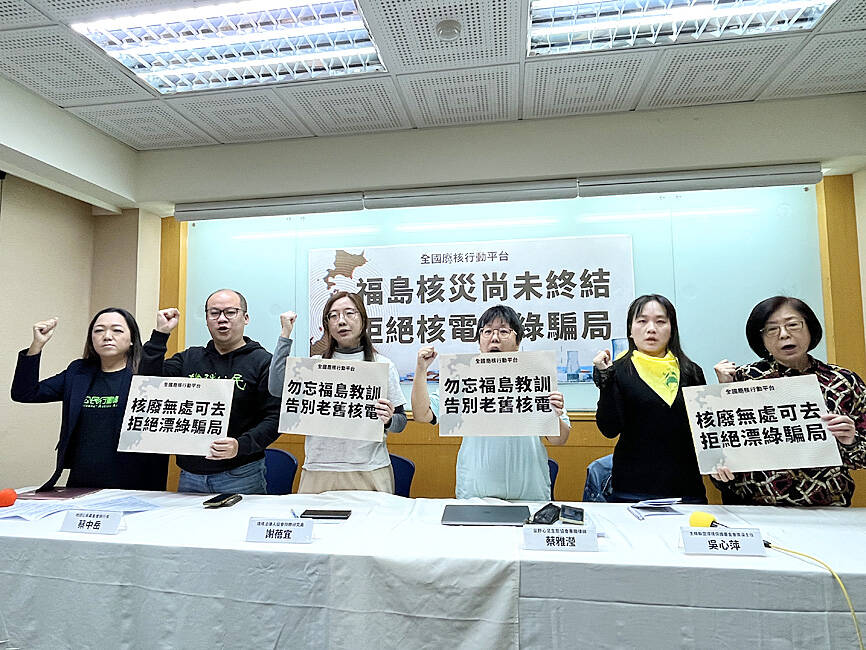
Proposed 20-year nuclear plant extension opposed
NO WASTE STORAGE: Renewable energy last year contributed more than the output of nuclear sources, but the nation risks moving backward, critics said
By Chen Chia-yi and Kayleigh Madjar / Staff reporter, with staff writer 10 Mar 23 https://www.taipeitimes.com/News/taiwan/archives/2023/03/10/2003795851
The National Nuclear Abolition Action Platform yesterday criticized calls by politicians to extend the service of the Guosheng Nuclear Power Plant’s No. 2 reactor, saying it disregards public sentiment and does not address problems with waste storage.
Some lawmakers have suggested a 20-year extension of the No. 2 reactor at the plant in New Taipei City’s Wanli District (萬里), which is set to reach the end of its lifespan on Tuesday, the groups told a news conference in Taipei.
More than 12 years after the Fukushima Dai-ichi nuclear power plant disaster in Japan, issues with contamination and wastewater have yet to be resolved, Green Citizens’ Action Alliance secretary-general Tsuei Su-hsin (崔愫欣) said.
The disaster occurred just as the plant turned 40 years old, said Tsai Ya-ying (蔡雅瀅), an attorney with the Wild at Heart Legal Defense Association.
Although the main cause was a tsunami triggered by an earthquake, an underlying weakness that exacerbated the disaster was the age of its facilities, Tsai said.
The second reactor at the Guosheng plant is about to turn 40 next week and should be decommissioned, she said.
Without locations identified to store nuclear waste, there is no basis for discussing continued use of the reactor, Environmental Jurists Association researcher Hsieh Pei-yi (謝蓓宜) said.
Politicians and corporate leaders — including Taipei City Councilor Wang Hung-wei (王鴻薇) and Broadcasting Corp of China chairman Jaw Shaw-kong (趙少康) — have been using “false, one-sided information” to call for its extension, Citizen of the Earth, Taiwan executive director Tsai Chung-yueh (蔡中岳) said.
They have not addressed the issue of waste storage sites at the plant being filled to capacity, he said, adding that they have evading the question whenever asked.
They are not only disregarding public concern about nuclear waste, but also ignoring legal provisions that require extension requests to be made at least five years before a nuclear plant’s decommission date, Tsai said.
Japan’s experience with restarting its nuclear plants was much different than perceived, the groups said.
In 2011, Japan had 54 nuclear generating units, 24 of which had been decommissioned, they said.
In the years since, seven have been restarted, and more planned restarts were canceled due to public opposition, the groups said.
Last year, renewables contributed close to that of nuclear in the nation’s power mix, at 8.3 percent, the groups said, adding that Taiwan should not to “move backward” on energy transition.
Renewable energy should be made a more viable long-term goal, Homemakers United Foundation director Wu Hsin-ping (吳心萍) said.
Solar and small-scale hydropower are being used in many communities, Wu said.
For example, one small 20-kilowatt solar installation in Taipei, despite frequent overcast weather in the capital, is able to produce a month of power in a year for about 70 households, she said.
Biden’s $1 trillion budget for world war
Patrick Martin, 10 Mar 23, WSWS<
The White House unveiled its budget request for the 2024 fiscal year Thursday, with the largest ever proposed spending on the military. It is a $1 trillion budget for world war. The Biden administration wants the resources to fight Russia in Ukraine, intensify its buildup towards war with China in the Far East and sustain US military aggression in the Middle East.
Besides $842 billion for the Pentagon, which will undoubtedly be pushed even higher in Congress, there is $24 billion for the Department of Energy, which maintains the US nuclear arsenal, and $20 billion for military-related programs in the State Department, CIA and other agencies, bringing the total official military spending to $886 billion.
To this must be added the real cost of the war in Ukraine, which is listed as only $6 billion for the 2024 fiscal year, which begins October 1. In the previous fiscal year, the Biden administration requested $6.9 billion but ended up spending $114 billion. Given that there is no sign of the war ending—on the contrary, it is escalating rapidly—the cost of US support for the otherwise bankrupt regime in Kiev is likely to surpass the current level. This would swell total military outlays well above the $1 trillion mark.
Since Biden took office, the budget for the Pentagon alone has jumped from $718 billion in fiscal 2022, the first full year of his administration, to $816 billion last year. The $842 billion requested for this year could rise past the $900 billion mark once Congress and lobbyists for the weapons manufacturers have their say. Congressional Republicans have already denounced the budget for providing too little funding for the military.
The name “Department of Defense” is itself a gross distortion since there is not an inch of American soil that needs to be defended against an external enemy. It is rather the world which is under threat from the Pentagon. The US government maintains a global military presence without precedent in history, with more than 700 US bases worldwide, while its main targets, Russia and China, have only one base each outside their own borders.
The department should be renamed the Department of Maintaining America’s Global Empire, or perhaps more simply, the Department of World Destruction. Some $38 billion of the Pentagon budget will go to nuclear weapons modernization, bringing the total spending this year on the US nuclear arsenal, to carry out the worldwide annihilation of civilization and perhaps all life on the planet, to more than $60 billion.
Much of the “non-military” budget also contributes to the US capacity to wage war around the world. ………………………………………………………..
The proxy war against Russia in Ukraine is only the antechamber to an even greater conflict with China, which now takes the form of a rapid military buildup towards what one top general suggested would be open warfare by 2025. The corporate media is doing its part to suppress popular opposition to these wars, seeking to shift public opinion with a propaganda blitz over Russia’s reactionary invasion of Ukraine, and whipping up hysteria over alleged Chinese “spy balloons” and the social media app TikTok, depicted as a nefarious scheme by Beijing to collect intelligence on ordinary Americans………………………………………… https://www.wsws.org/en/articles/2023/03/10/pers-m10.html
1 This Month




Shut down the radiation-damaged Heysham nuclear reactors now
To see nuclear-related stories in greater depth and intensity – go to https://nuclearinformation.wordpress.com

Say No to NASA’s Reckless Nuclear Reactor on the Moon
Say No to NASA’s Reckless Nuclear Reactor on the Moon
-
Archives
- October 2026 (268)
- September 2026 (339)
- August 2026 (330)
- July 2026 (355)
- June 2026 (287)
- May 2026 (306)
- April 2026 (356)
- March 2026 (251)
- February 2026 (267)
- January 2026 (308)
- December 2025 (358)
- November 2025 (359)
-
Categories
- 1
- 1 NUCLEAR ISSUES
- business and costs
- climate change
- culture and arts
- ENERGY
- environment
- health
- history
- indigenous issues
- Legal
- marketing of nuclear
- media
- opposition to nuclear
- PERSONAL STORIES
- politics
- politics international
- Religion and ethics
- safety
- secrets,lies and civil liberties
- spinbuster
- technology
- Uranium
- wastes
- weapons and war
- Women
- 2 WORLD
- ACTION
- AFRICA
- Atrocities
- AUSTRALIA
- Christina's notes
- Christina's themes
- culture and arts
- Events
- Fuk 2022
- Fuk 2023
- Fukushima 2017
- Fukushima 2018
- fukushima 2019
- Fukushima 2020
- Fukushima 2021
- general
- global warming
- Humour (God we need it)
- Nuclear
- RARE EARTHS
- Reference
- resources – print
- Resources -audiovicual
- Weekly Newsletter
- World
- World Nuclear
- YouTube
-
RSS
Entries RSS
Comments RSS

