France’s radioactive waste management agency Andra wants to increase storage capacity at Cires waste dump
French radioactive waste management agency Andra has applied to the
department of Aube in north-eastern France for environmental permission to
increase the current authorised storage capacity of Cires, the country’s
dedicated disposal facility for very-low-level radioactive waste (VLLW).
World Nuclear News 12th April 2023
https://www.world-nuclear-news.org/Articles/Application-to-raise-capacity-of-French-very-low-l
Jonathon Porritt: Germany’s nuclear nous vs UK nuclear nutters.

So that’s another dead duck in the case made for new nuclear. Which just leaves the final barrier: the continuing reality that our nuclear weapons capability still depends very heavily on maintaining a civil nuclear power programme – not just to guarantee a continuing supply of nuclear engineers and R&D funding, but to keep the public in the dark about the increasingly insupportable costs of renewing our notionally ‘independent’ nuclear deterrent.
I’m celebrating today – for the simple reason that Germany closed down its three remaining nuclear reactors on Saturday 15th April.
I’ve followed the nuclear debate in Germany ever since I first got involved in green politics back in the 1970s, and was hugely inspired by the campaigns of Die Grünen against both nuclear power and nuclear weapons – seeing the two as inextricably linked. Interestingly, it’s as controversial a debate now as it was then – with a majority of people in Germany (including some Die Grünen voters) still believing that nuclear power should be part of the electricity mix.
As I argued back in 2011, I did not agree with the decision of the Merkel Government (in coalition with Die Grünen) to close down all its remaining reactors in response to the Fukushima disaster – well before the end of their scheduled operational lifetime. Inevitably, this decision caused an (albeit temporary) increase in burning coal and gas.
That’s now water under the bridge – and Germany’s energy system will now be completely nuclear-free, even if it will be dealing with the legacy of its nuclear waste for many years to come. As the German Environment Minster, Steffi Lemke, said: ‘Three generations have benefitted from nuclear power in Germany, but about 30,000 generations will be affected by the ongoing presence of nuclear waste.’
But my celebration has been sadly attenuated by the current nuclear frenzy going on here in the UK. I’ve been through many periods of nuclear hype over the years, but nothing quite like this one – with all the mainstream political parties, the industry itself and all mainstream media (including some sorely deluded muppets in the BBC and the Guardian) ramping up their ‘nuclear renaissance’ rhetoric in increasingly dishonest and fact-free ways.
I suspect they see this as a ‘now or never’ moment before economic reality kills off nuclear power once and for all – when that combination of renewables-storage-efficiency is so massively outperforming nuclear as to starve all nuclear options of the capital they will still need. Government subsidy can only go so far.
In the meantime, however, we have a Government still strenuously seeking investors in its godforsaken plans for two more ludicrously expensive reactors at Sizewell C – an asset that already looks totally stranded even before a Final Investment Decision is taken.
Even that, however, is just a sideshow in comparison to the hype around prospects for Small Modular Reactors (SMRs) here in the UK. In March, the Chancellor announced a new competition to identify the best value SMR design for the UK, with a view to its eventually handing over a full £1bn in co-funding to get that design off the ground. Ludicrous. But full marks to the Tories for ‘recycling’ here: the announcement sounded almost identical to the earlier competition it announced back in March 2016. (And it was only the fifth time that the Chancellor reconfirmed plans for a new Great British Nuclear agency!)

Apart from the nuclear industry itself, and all its happy-clappy cheerleaders, the majority of independent commentators continue to point out that SMRs cannot possibly deliver what we now need: safe, affordable, ultra-low-carbon electricity that can actually make a practical difference in meeting our Net Zero target by 2035.
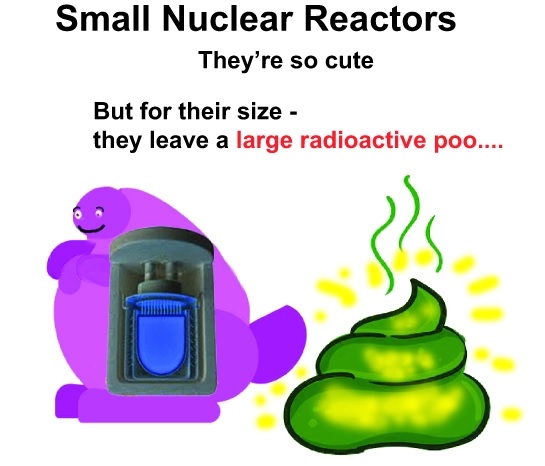
And that’s before one thinks about the nuclear waste nightmare: a new study published in Proceedings of the American National Academy of Sciences estimates that SMRs will create 30 times as much nuclear waste (per unit of electricity generated) as conventional reactors.
It’s all just a massive waste of time and public money – but with devastating consequences. If we could just free ourselves of our residual hankering after nuclear power, we could (finally!) double down on the infinitely more cost-effective renewables-storage-efficiency alternatives. With massive benefits in terms of decarbonisation, jobs, addressing fuel poverty and so on.
The case for this transition (away from fossil fuels and nuclear) is now incontrovertible but two remaining barriers stand in the way of us doing what Germany has managed to do.
The first is the endlessly repeated argument from nuclear industry spokespeople that nuclear power is the only way of providing the baseload generation our current electricity supply system depends on – once big thermal coal and gas plants are taken off the grid. There was indeed a time when grid stability depended on ‘always on’ big power stations. But that is now widely seen (outside the nuclear industry) to be a completely outmoded concept.
……………………… , the Government acknowledges that there is now no specific baseload expectations of nuclear or anything else. It is now all about ‘lowest cost’, rather than baseload,………..
So that’s another dead duck in the case made for new nuclear. Which just leaves the final barrier: the continuing reality that our nuclear weapons capability still depends very heavily on maintaining a civil nuclear power programme – not just to guarantee a continuing supply of nuclear engineers and R&D funding, but to keep the public in the dark about the increasingly insupportable costs of renewing our notionally ‘independent’ nuclear deterrent.

Which takes us right back to the origins of the German anti-nuclear movement in the 1970s. These ‘evil twins’, nuclear weapons and nuclear power, have forever been joined at the hip, and always will be until the world rids itself of the deadly incubus of nuclear weaponry.
Leaks Reveal Reality Behind U.S. Propaganda in Ukraine
The inability of either side to decisively defeat the other in the ruins of Bakhmut and other front-line towns in Donbas is why one of the most important documents predicted that the war was locked in a “grinding campaign of attrition” and was “likely heading toward a stalemate.”
What U.S. intelligence officials know, but the White House is doggedly ignoring, is that, as in Afghanistan and Iraq, top Ukrainian officials running this endemically corrupt country are making fortunes skimming money from the over $100 billion in aid and weapons that America has sent them.
By Medea Benjamin and Nicolas J. S. Davies, World BEYOND War, April 19, 2023
The U.S. corporate media’s first response to the leaking of secret documents about the war in Ukraine was to throw some mud in the water, declare “nothing to see here,” and cover it as a depoliticized crime story about a 21-year-old Air National Guardsman who published secret documents to impress his friends. President Biden dismissed the leaks as revealing nothing of “great consequence.”
What these documents reveal, however, is that the war is going worse for Ukraine than our political leaders have admitted to us, while going badly for Russia too, so that neither side is likely to break the stalemate this year, and this will lead to “a protracted war beyond 2023,” as one of the documents says.
The publication of these assessments should lead to renewed calls for our government to level with the public about what it realistically hopes to achieve by prolonging the bloodshed, and why it continues to reject the resumption of the promising peace negotiations it blocked in April 2022.
We believe that blocking those talks was a dreadful mistake, in which the Biden administration capitulated to the warmongering, since-disgraced U.K. Prime Minister Boris Johnson, and that current U.S. policy is compounding that mistake at the cost of tens of thousands more Ukrainian lives and the destruction of even more of their country.
In most wars, while the warring parties strenuously suppress the reporting of civilian casualties for which they are responsible, professional militaries generally treat accurate reporting of their own military casualties as a basic responsibility. But in the virulent propaganda surrounding the war in Ukraine, all sides have treated military casualty figures as fair game, systematically exaggerating enemy casualties and understating their own.
Publicly available U.S. estimates have supported the idea that many more Russians are being killed than Ukrainians, deliberately skewing public perceptions to support the notion that Ukraine can somehow win the war, as long as we just keep sending more weapons.
The leaked documents provide internal U.S. military intelligence assessments of casualties on both sides. But different documents, and different copies of the documents circulating online, show conflicting numbers, so the propaganda war rages on despite the leak.
The most detailed assessment of attrition rates of troops says explicitly that U.S. military intelligence has “low confidence” in the attrition rates it cites. It attributes that partly to “potential bias” in Ukraine’s information sharing, and notes that casualty assessments “fluctuate according to the source.”
So, despite denials by the Pentagon, a document that shows a higher death toll on the Ukrainian side may be correct, since it has been widely reported that Russia has been firing several times the number of artillery shells as Ukraine, in a bloody war of attrition in which artillery appears to be the main instrument of death. Altogether, some of the documents estimate a total death toll on both sides approaching 100,000 and total casualties, killed and wounded, of up to 350,000.
Another document reveals that, after using up the stocks sent by NATO countries, Ukraine is running out of missiles for the S-300 and BUK systems that make up 89% of its air defenses. By May or June, Ukraine will therefore be vulnerable, for the first time, to the full strength of the Russian air force, which has until now been limited mainly to long-range missile strikes and drone attacks.
Recent Western arms shipments have been justified to the public by predictions that Ukraine will soon be able to launch new counter-offensives to take back territory from Russia. Twelve brigades, or up to 60,000 troops, were assembled to train on newly delivered Western tanks for this “spring offensive,” with three brigades in Ukraine and nine more in Poland, Romania and Slovenia.
But a leaked document from the end of February reveals that the nine brigades being equipped and trained abroad had less than half their equipment and, on average, were only 15% trained. Meanwhile, Ukraine faced a stark choice to either send reinforcements to Bakhmut or withdraw from the town entirely, and it chose to sacrifice some of its “spring offensive” forces to prevent the imminent fall of Bakhmut…………………………………….
The inability of either side to decisively defeat the other in the ruins of Bakhmut and other front-line towns in Donbas is why one of the most important documents predicted that the war was locked in a “grinding campaign of attrition” and was “likely heading toward a stalemate.”
Adding to the concerns about where this conflict is headed is the revelation in the leaked documents about the presence of 97 special forces from NATO countries, including from the U.K. and the U.S. This is in addition to previous reports about the presence of CIA personnel, trainers and Pentagon contractors, and the unexplained deployment of 20,000 troops from the 82nd and 101st Airborne Brigades near the border between Poland and Ukraine.
Worried about the ever-increasing direct U.S. military involvement, Republican Congressman Matt Gaetz has introduced a Privileged Resolution of Inquiry to force President Biden to notify the House of the exact number of U.S. military personnel inside Ukraine and precise U.S. plans to assist Ukraine militarily.
We can’t help wondering what President Biden’s plan could be, or if he even has one. But it turns out that we’re not alone. In what amounts to a second leak that the corporate media have studiously ignored, U.S. intelligence sources have told veteran investigative reporter Seymour Hersh that they are asking the same questions, and they describe a “total breakdown” between the White House and the U.S. intelligence
community.

Hersh’s sources describe a pattern that echoes the use of fabricated and unvetted intelligence to justify U.S. aggression against Iraq in 2003, in which Secretary of State Antony Blinken and National Security Advisor Sullivan are by-passing regular intelligence analysis and procedures and running the Ukraine War as their own private fiefdom. They reportedly smear all criticism of President Zelenskyy as “pro-Putin,” and leave U.S. intelligence agencies out in the cold trying to understand a policy that makes no sense to them.
What U.S. intelligence officials know, but the White House is doggedly ignoring, is that, as in Afghanistan and Iraq, top Ukrainian officials running this endemically corrupt country are making fortunes skimming money from the over $100 billion in aid and weapons that America has sent them.
According to Hersh’s report, the CIA assesses that Ukrainian officials, including President Zelenskyy, have embezzled $400 million from money the United States sent Ukraine to buy diesel fuel for its war effort, in a scheme that involves buying cheap, discounted fuel from Russia. Meanwhile, Hersh says, Ukrainian government ministries literally compete with each other to sell weapons paid for by U.S. taxpayers to private arms dealers in Poland, the Czech Republic and around the world…………………….
First-hand reporting from inside Ukraine by New Cold War has described the same systematic pyramid of corruption as Hersh. A member of parliament, formerly in Zelenskyy’s party, told New Cold War that Zelenskyy and other officials skimmed 170 million euros from money that was supposed to pay for Bulgarian artillery shells.
The corruption reportedly extends to bribes to avoid conscription. The Open Ukraine Telegram channel was told by a military recruitment office that it could get the son of one of its writers released from the front line in Bakhmut and sent out of the country for $32,000.
As has happened in Vietnam, Iraq, Afghanistan and all the wars the United States has been involved in for many decades, the longer the war goes on, the more the web of corruption, lies and distortions unravels…………………………….
These leaks and investigative reports are not the first, nor will they be the last, to shine a light through the veil of propaganda that permits these wars to destroy young people’s lives in faraway places, so that oligarchs in Russia, Ukraine and the United States can amass wealth and power.
The only way this will stop is if more and more people get active in opposing those companies and individuals that profit from war–who Pope Francis calls the Merchants of Death–and boot out the politicians who do their bidding, before they make an even more fatal misstep and start a nuclear war.
Medea Benjamin and Nicolas J. S. Davies are the authors of War in Ukraine: Making Sense of a Senseless Conflict, published by OR Books in November 2022.
Medea Benjamin is the cofounder of CODEPINK for Peace, and the author of several books, including Inside Iran: The Real History and Politics of the Islamic Republic of Iran.
Nicolas J. S. Davies is an independent journalist, a researcher with CODEPINK and the author of Blood on Our Hands: The American Invasion and Destruction of Iraq. https://worldbeyondwar.org/leaks-reveal-reality-behind-u-s-propaganda-in-ukraine/
As Germany ends nuclear era, activist says there is still more to do
By Riham Alkousaa 13 Apr 23 https://www.reuters.com/world/europe/germany-ends-nuclear-era-activist-says-still-more-do-2023-04-15/?fbclid=IwAR2vNrwrRP0HzRERH0bM02b4-zC1-Zd9NAhDKtbpSleRXrTvHbRlOa0HRzs
- Germany is closing its last three reactors on Saturday
- Smital says protest against nuclear power is not over
- Cites fuel assembly, enrichment facilities still operating
- Anti-nuclear movement helped spawn Germany’s Greens
BERLIN, April 15 (Reuters) – Heinz Smital was a 24-year-old nuclear physics researcher when he first saw how far nuclear contamination could spread after the Chornobyl disaster in 1986.
A few days after it occurred he waved a damp cloth out of a window at the University of Vienna to sample the city’s air and was shocked by how many radionuclides could be seen under a microscope.
“Technetium, Cobalt, Cesium 134, Cesium 137 …Chornobyl was 1,000 kilometres away … That made an impression,” Smital, now 61, said as he told Reuters about his life-long activism against nuclear power in Germany.
On Saturday Germany will shut off its last three reactors, ending six decades of nuclear power which helped spawn one of Europe’s strongest protest movements and the political party that governs Berlin today, the Greens.
“I can look back on a great many successes where I saw injustice and many years later, there was a breakthrough,” Smital said, showing a photo of himself in 1990s in front of the Unterweser Nuclear Power Plant, which was closed in 2011 following the Fukushima disaster in Japan.
Former Chancellor Angela Merkel responded to Fukushima by doing what no other Western leader had done, passing a law to exit nuclear by 2022.
An estimated 50,000 protesters in Germany formed a 45-kilometre long (27-mile) human chain after the Fukushima disaster from Stuttgart to the Neckarwestheim Nuclear Power Plant. Merkel would announce Germany’s planned nuclear exit within weeks.
“We really stood hand in hand at a certain point in time. I was also in the chain … It was impressive how that formed,” Smital said.
“That was a great feeling of a movement and also of belonging …a very nice, communal, exciting feeling that also develops a power,” Smital said.
One of the long-running movement’s early successes came in the 1970s when it managed to get plans for a nuclear plant in Wyhl in western Germany overturned.
THE GREENS
In parallel, a divided Germany during the Cold War also saw a peace movement evolve amid concerns among Germans that their land could become a battlefield between the two camps.
“This produced a strong peace movement and the two movements reinforced each other,” said Nicolas Wendler, a spokesperson for Germany’s nuclear technology industry group KernD.
Moving from street protests to organised political work with the establishment of the Greens party in 1980 gave the movement more power.
It was a Greens-coalition government that introduced the country’s first nuclear phase-out law in 2002.
The nuclear phase-out is a Greens project … and all parties have practically adopted it,” said Rainer Klute, head of pro-nuclear non-profit association Nuklearia.
On Saturday, both Smital and Klute stood as protesters at Berlin’s Brandenburg Gate, one celebrating the end of nuclear power, the other lamenting its demise.
“We have no other choice but to accept the phase-out for the time being,” Klute said.
Yet for Smital, the reactor closures do not mean the end of his activism.
“We have a uranium fuel assemblies factory in Germany … we have uranium enrichment, so there is still a lot that needs to be discussed here and I will be on the street a lot …very gladly,” he said.
Reporting by Riham Alkousaa; editing by Jason Neely
Fukushima’s fishing industry survived a nuclear disaster. 12 years on, it fears Tokyo’s next move may finish it off.
By Emiko Jozuka, Krystina Shveda, Junko Ogura, Marc Stewart and Daniel Campisi, CNN, April 19, 2023
It is still morning when Kinzaburo Shiga, 77, returns to Onahama port after catching a trawler full of fish off Japan’s eastern coast.
But the third-generation fisherman won’t head straight to market. First, he’ll test his catch for radiation.
It’s a ritual he’s repeated for more than a decade since a devastating earthquake and tsunami triggered a nuclear meltdown at the Fukushima Daiichi power plant in 2011, spewing deadly radioactive particles into the surrounding area.
Radiation from the damaged nuclear plant leaked into the sea, prompting authorities to suspend fishing operations off the coast of three prefectures that had previously provided Japan with half of its catch.
That ban lasted over a year and even after it was lifted, Fukushima-based fishermen like Shiga were for years mostly limited to collecting samples for radioactivity tests on behalf of the state-owned electricity firm Tokyo Electric Power Company, or TEPCO, rather than taking their catches to market.
Ocean currents have since dispersed the contaminated water enough that radioactive Cesium is nearly undetectable in fish from Fukushima prefecture. Japan lifted its last remaining restrictions on fish from the area in 2021, and most countries have eased import restrictions.
Shiga and others in the industry thought they’d put the nightmare of the past years behind them.
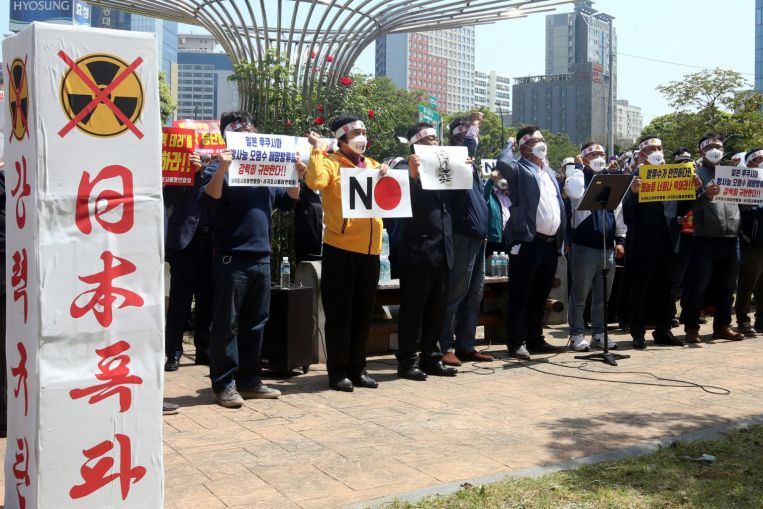
So when Japan followed through on plans to gradually release more than 1 million metric tons of filtered wastewater into the Pacific Ocean from the summer of 2023 – an action the government says is necessary to decommission the plant safely – the industry reeled.
The Japanese government and the International Atomic Energy Agency (IAEA), a United Nations body promoting the peaceful use of nuclear energy, say the controlled release, which is expected to take decades, will meet international safety regulations and not harm the environment, as the water will be treated to remove radioactive elements – with the exception of tritium – and diluted more than 100 times.
But with the deadline for the planned water release looming this summer, Fukushima’s fishermen fear that – whether the release is safe or not – the move will undermine consumer confidence in their catches and once again threaten the way of life they have fought so hard to recover…………………………………………………………………..
While radioactive wastewater contains dangerous elements including Cesium and Strontium, TEPCO says the majority of those particles can be separated from the water and removed. TEPCO claims its filtering system, called advanced liquid processing (ALPS), can bring down the amount of those elements far below regulatory standards.
But one hydrogen isotope cannot be taken away, as there is currently no technology available to do so. This isotope is radioactive tritium, and the scientific community is divided on the risk its dissemination carries………………………………………………………
“For decades, nuclear power plants worldwide – including in the United States, Canada, Britain, France, China and South Korea – have been releasing waste contaminated with tritium, each under its own national quota,” said Tim Mousseau, an environmental scientist at the University of South Carolina.
But Mousseau argues tritium is overlooked because many countries are invested in nuclear energy, and “there’s no way to produce it without also generating vast amounts of tritium.”
“If people started picking on TEPCO in Fukushima, then the practice of releasing tritium to the environment in all of these other nuclear power plants would need to be examined as well. So, it opens up a can of worms,” he said, adding the biological consequences of exposure to tritium have not been studied sufficiently.
In 2012, a French literature review study said tritium can be toxic to the DNA and reproductive processes of aquatic animals, particularly invertebrates, and the sensitivity of different species to various levels of tritium needs to be further investigated.
Currently, countries set different standards for the concentration of tritium allowed in drinking water. For example. Australia, which has no nuclear power plants, allows more than 76,000 becquerel per liter, a measure used to gauge radioactivity, while the WHO’s limit is 10,000. Meanwhile, the US and the European Union have much more conservative limits – 740 and 100 becquerel per liter respectively.
Ian Fairlie, an independent consultant on radioactivity in the environment, told CNN that “two wrongs don’t make a right” when it comes to Japan’s decision to release tritiated water. He argues TEPCO should build more storage tanks to allow for the decay of the radioactive tritium, which has a half-life of 12.3 years.
Lack of trust for the ‘nuclear village’
In Japan, the Fukushima wastewater issue has become highly contentious due to a lack of trust among influential advocates of nuclear energy, or what’s locally known as the “nuclear village.”
The informal group includes members of Japan’s ruling party (the Liberal Democratic Party), the Ministry of Economy Trade and Industry and the nuclear industry.
“(The nuclear village) used to tell us that nuclear energy is 100% safe – but it wasn’t, as the Fukushima Daiichi plant accident revealed,” said Koichi Nakano, a political scientist at Sophia University, in Tokyo.
A series of missteps after the disaster further eroded public trust, according to a 2016 report written by Kohta Juraku, a researcher at Tokyo Denki University.
For instance, in 2012, the government and TEPCO presented a proposed action plan to local fishing representatives that involved pumping up groundwater before it flooded into the nuclear reactor buildings and releasing it into the sea. Fishing bodies were on board but the plan was it postponed until 2014 after 300 tons of radioactive water leaked from the plant into the sea, infuriating fishers……………………………………… https://edition.cnn.com/2023/04/19/asia/japan-fukushima-disaster-wastewater-fishing-concerns-hnk-dst-dg-intl/index.html
Civil Society Wants Deeds, Not Words, on Nuclear Disarmament: The G7 Should Listen
The Civil 7 (C7) is a non-governmental organization that brings together thousands of highly-skilled individuals from around the world who work to improve government responses to global environmental, economic, and social problems. The C7 held its annual summit in Tokyo last week to discuss its current recommendations and to present them to emissaries of the Group of 7 (G7) nations—Canada, France, Germany, Italy, Japan, the United Kingdom, and the United States, which will be holding their annual summit in Hiroshima next month.
For the first time in the history of the C7, it also presented recommendations on nuclear disarmament. I participated in the newly formed C7 Nuclear Disarmament Working Group and spoke about the need for it at the summit in Tokyo. The G7 decision to meet in Hiroshima this year acknowledges growing international concern about the growing risk of nuclear war and the costs of the new nuclear arms race. When US President Barack Obama visited Hiroshima in 2016, he considered, but then decided against, announcing specific steps to reduce the risk of nuclear use. The G7 has given no indication it is willing to halt the arms race that’s developed in the wake of Obama’s failure to act.
Symbolism is important but it can be misleading. Japanese Prime Minister Fumio Kishida claims credit for getting the powerful group of seven wealthy nations to Hiroshima to make a public statement supporting the ultimate elimination of nuclear weapons. But his government encourages the United States to develop new tactical nuclear weapons and to deploy them in East Asia. President Biden supports expensive and unnecessary upgrades to the US nuclear arsenal. The United Kingdom plans to increase its nuclear stockpile by forty percent and France is building a new generation of nuclear-armed ballistic missile submarines. Germany and Italy recently received upgraded US tactical nuclear weapons and both support US and NATO threats to use them first.
The C7 recommended the G7 “unequivocally condemn any and all threats to use nuclear weapons and disavow all options to resort to nuclear weapons in conflict.” The G7 already agreed in its 2022 communique that “a nuclear war cannot be won and must never be fought.” Nevertheless, as noted in the 2023 C7 communique, the three nuclear armed members of the G7 are currently spending over $100,000 a minute preparing for such a war.
The C7 also recommended the G7 “begin urgent negotiations to achieve the complete elimination, of nuclear weapons before 2045,” the year of the 100th anniversary of the atomic bombings of Hiroshima and Nagasaki…………………………………… more https://blog.ucsusa.org/gregory-kulacki/civil-society-wants-deeds-not-words-on-nuclear-disarmament-the-g7-should-listen/
 |
EU faces legal action after including gas and nuclear in ‘green’ investments guide

European Commission accused of acting unlawfully in two separate cases bought by environment groups
Jennifer Rankin in BrusselsTue 18 Apr 2023 https://www.theguardian.com/environment/2023/apr/18/eu-faces-legal-action-gas-nuclear-green-investments-guide
The European Commission is being sued by environmental campaigners over a decision to include gas and nuclear in an EU guide to “green” investments.
Two separate legal challenges are being lodged on Tuesday at the European Union’s general court in Luxembourg – one by Greenpeace and another by a coalition including Client Earth and WWF – after the classification of fuels in the so-called taxonomy, a guide for investors intended to channel billions into green technologies.
The EU executive, argues Greenpeace, acted unlawfully when it designated gas and nuclear as bridge technologies in the taxonomy, which is intended to help meet the bloc’s goal of carbon neutrality by 2050. Client Earth, along with three other NGOs, is challenging the inclusion of gas, which it says breaks the EU climate law that sets a legally binding target of reaching net zero emissions by the middle of the century.
The cases are the latest legal action against the EU’s “taxonomy for environmentally sustainable economic activities”. Last year a lawsuit was launched by Austria and supported by Luxembourg.
Eight national and regional Greenpeace organisations including France, Germany and EU office in Brussels are asking the court to rule the inclusion of gas and nuclear invalid.
Nina Treu, the executive director of Greenpeace Germany, said: “The taxonomy was meant to be a tool to meet the 1.5C target [on global heating] and make the European Union climate neutral, fostering social and economic restructuring for the European economy by shifting funds. Instead of hindering greenwashing, it has become a tool for greenwashing.”
Gas and nuclear had been included because of “politically motivated lobbying”, Treu said. Greenpeace will tell the court that gas cannot be considered a “transition fuel” because any gas-powered plant that comes online today will still be running beyond 2050.
The environment group will also say the construction of new nuclear plants – which usually take one to two decades to build in Europe – will delay the move away from coal power, hinder development of renewables, risk accidents and create pollution. “Nuclear is dangerous, expensive, vulnerable to climate change and too slow to stop the climate breakdown,” Treu said.
Greenpeace has hired the lawyer Roda Verheyen, who acted for the group in a landmark case that resulted in Germany’s climate protection laws being ruled inadequate by the country’s constitutional court in 2021.
Verheyen said the inclusion of gas and nuclear was not in line with the EU’s original taxonomy law. “The European Commission has violated the very idea of the taxonomy regulation. This is especially obvious as including nuclear activities does pose significant harm to the environment, which is expressly prohibited by the regulation.”
The lawsuit was “essentially an enforcement claim”, she said. “Observe your own law. Actually carry through with the European green deal,” she said, referring to the EU’s flagship climate plan.
The EU taxonomy became law in July 2020, but legislators left important details to be resolved through so-called delegated acts – secondary legislation meant for technical issues that is not subject to the same degree of ministerial and parliamentary oversight.
The campaign groups are challenging one of the delegated acts.
The separate legal challenge by the coalition including Client Earth and WWF covers the inclusion of gas but not nuclear. Anaïs Berthier at Client Earth said the European Commission had violated a requirement to make science-based policy and broken the EU climate law that required policymakers to carry out checks to ensure all actions by the bloc were consistent with the goal of achieving net zero by 2050.
“Labelling fossil gas as ‘sustainable’ is as absurd as it is unlawful,” said the coalition, which also includes the NGOs Transport & Environment and Bund. “It goes against the EU’s own scientific advice and fundamentally undermines the credibility of the EU’s climate action. Fossil gas is not clean, not cheap and not a secure source of energy.”
A judgment is expected in 2025, although participants expressed the hope the court would act faster. “There is confusion in the market, because the current law infringes European law,” Verheyen said.
83 Hiroshimas — New nuclear bombs coming to Europe and UK

US ships powerful new nuke to Europe, heightening tensions
83 Hiroshimas — Beyond Nuclear International
American B61-12 nuclear bombs head to Europe
Since last December, the United States has begun to replace its nuclear weapons on European soil with more modern ones. It is replacing the B61-3, B61-4 and B61-7 thermonuclear bombs with the B61-12, which has become the main US and NATO air-launched nuclear weapon.
Boeing designed the bomb’s new guided-tailkit, giving it additional maneuverability and the appearance of more precision. But, it’s a nuclear weapon, and has different yields, from 0.3kt to 50kt. These bombs can detonate beneath the Earth’s surface, increasing their destructiveness against underground targets to the equivalent of a surface-burst weapon with a yield of 1,250 kilotons––the equivalent of 83 Hiroshima bombs.
These nuclear weapons are coming to Europe in a time of heightened nuclear tension on the continent, and even as the majority of people in European host countries want to remove nuclear weapons and join the Treaty on the Prohibition of Nuclear Weapons.
Combined with the lack of transparency around nuclear sharing, this moment raises questions about whether citizens in the host states would agree to be complicit if these weapons are ever used. Even if the bombs are American and the US retains launch authority, they would most likely be dropped by Europeans. If the US decides to use its nuclear weapons located in Germany, the warheads are loaded onto German planes and a German pilot drops them.
ICAN is a broad, inclusive campaign, focused on mobilizing civil society around the world to support the specific objective of prohibiting and eliminating nuclear weapons.
Share this video to spread the word about these new nuclear weapons and join the movement to eliminate them.
And from: Tica Font, member of Centre Delàs and WILPF Spain, published by Pressenza
It is a free-fall bomb equipped with state-of-the-art navigation systems and a versatile warhead that can be configured in four strengths, 0.3 kiloton (kt), 1.5 kt, 10 kt and 50 kt depending on the target, making it a low to medium-yield weapon. This type of weapon is referred to as a ‘first-strike’ weapon. Having a tactical nuclear weapon with higher precision and lower yield could make politicians less reluctant to use them in conventional operations and puts us on an increasingly dangerous front line of confrontation between NATO and Russia.
These new nuclear weapons will replace existing ones on the soil of Belgium, the Netherlands, Italy, Germany and Turkey. But Washington has announced that it will also deploy them on UK soil; this time it is not a replacement for more outdated ones, as it reported in 2008 that its nuclear weapons had been withdrawn from the RAF; now it appears that it wants to put new nuclear weapons in the empty bunkers at Lakenheath again.
All this deployment of nuclear weapons represents a violation of the Non-Proliferation Treaty (NPT). The NPT prohibits nuclear-weapon States Parties from transferring nuclear weapons to any other State and prohibits non-nuclear-weapon States Parties from receiving nuclear weapons or from manufacturing or acquiring them.
53 years after the entry into force of the NPT, we see that it has not served to achieve nuclear disarmament. Just two years ago, in January 2021, the Treaty on the Prohibition of Nuclear Weapons (TPNW) entered into force. The TPNW outlaws nuclear weapons and makes it illegal for states that sign the TPNW to possess, develop, deploy, test, use or threaten to use nuclear weapons.
However, for the Spanish government the NPT remains the “cornerstone of the international nuclear non-proliferation and disarmament regime”, considering that this treaty is an adequate and sufficient instrument for nuclear non-proliferation and disarmament. They therefore consider that the TPNW is not necessary, as the NPT already exists.
But the facts do not support the Spanish government’s position. In addition to the deployment of new weapons in Europe, the new NATO Strategic Concept 2022, approved in Madrid last summer, states that “NATO’s deterrence and defence posture is based on an appropriate mix of nuclear, conventional and missile defence assets (…) and that it will take all necessary steps to ensure the credibility, effectiveness, integrity and security of the nuclear deterrence mission”.
In short, it seems that the NPT is only defended when it comes to imposing nuclear weapons restrictions on countries outside the NATO orbit (the “others”), that compliance with the NPT is not applicable to either the US or NATO, while both re-emphasise deterrence and the nuclear threat. On the contrary, the safest position, the position that would best reflect citizens’ aspirations to completely destroy nuclear weapons, is for Spain to decide to join the TPNW, and for the Spanish government to attend meetings of TPNW states parties, to show genuine support for denuclearisation.
Tica Font is a member of Centre Delàs and WILPF Spain.
UK ignites new depleted uranium weapons debate — Beyond Nuclear International

Headline photo shows a painting by Mark Southerland, who served in the Marine Corps from 1988-1994, an unshakable image from ‘Desert Storm’, painted as therapy in recovery from PTSD. Wikimedia Commons.
Wars in Iraq/ Kuwait and the Balkans have left toxic legacy
UK ignites new depleted uranium weapons debate — Beyond Nuclear International
The situation in Ukraine creates a double jeopardy. First, the use of DU weapons by the Ukrainian military might provoke the Russians to use nuclear weapons. And second, simply transporting these weapons from Britain and using them on Ukrainian soil will constitute additional radioactive and heavy metal pollution with long-term effects on human health and the European environment.
Taking all of this into consideration, the known risks of DU weapons are already too great to justify their continued use.
UK will send DU weapons to Ukraine prompting “nuclear” rhetoric from Russia
By Linda Pentz Gunter and Maria Arvaniti Sotiropoulou
On March 21, 2023 Britain confirmed that it was sending depleted uranium (DU) weapons to Ukraine , prompting a response from Russian president, Vladimir Putin, that, “If all this happens, Russia will have to respond accordingly, given that the west collectively is already beginning to use weapons with a nuclear component.”
Russian defense minister, Sergei Shoigu, warned that such steps moved us closer to a “nuclear collision.”
Days later, Putin announced he had made an arrangement with neighboring Belarus to station tactical nuclear weapons there.
According to ICAN, Putin “will start training Belarusian personnel to use them” and that “up to 10 Belarusian aircraft are already prepared to use these weapons and Russia would complete the construction of a storage facility for nuclear warheads in Belarus by July.”
The Belarus nuclear weapons deal was more likely a response to the continued expansion of NATO — with Finland now the newest member — rather than retaliation for Britain arming Ukraine with depleted uranium weapons.
However, there are many wrongs in this situation to unpack.
Possessing or threatening the use of nuclear weapons is a violation of the human rights that are embedded in the Treaty on the Prohibition of Nuclear Weapons. The use of depleted uranium weapons is also abhorrent, with compelling, if still somewhat anecdotal, evidence from the wars in the Balkans and Iraq/Kuwait to suggest these toxic exposures cause serious long-term health effects.
Despite Putin’s thinly veiled threat mount a nuclear response to DU weapons, the International Campaign to Ban Uranium Weapons (ICBUW) points out that this would be disproportionate because “DU projectiles are not nuclear weapons at all, but conventional weapons of high chemical-radiological toxicity and harmfulness.”
Adds Dr. Frank Boulton of the British IPPNW affiliate, MEDACT: “Much if not most of the toxicity of DU is biological rather than radiological (DU is a heavy metal with biological effects similar to that of lead)”.
The US and NATO used around 980,000 rounds of uranium shells in Iraq and Kuwait, 10,800 in Bosnia, 31,000 in Kosovo , another 7,000 in S. Serbia and Montenegro, and an unknown number in Afghanistan, while Russia also used such weapons in Chechnya.
The ICBUW quickly spoke out against the export of DU weapons to Ukraine: “The use of DU munitions has been shown to cause widespread and lasting damage to the health of people living in the contaminated area,” the network said in a statement. “Military personnel and those involved in subsequent demining are also exposed to health hazards from DU (remnants). In addition, long-term environmental damage, including groundwater contamination, occurs as a result of DU use.”
Kate Hudson, General Secretary of the long-time British peace and disarmament group Campaign for Nuclear Disarmament, also condemned her country’s decision:
“CND has repeatedly called for the UK government to place an immediate moratorium on the use of depleted uranium weapons and to fund long-term studies into their health and environmental impacts,” she said. “Sending them into yet another war zone will not help the people of Ukraine.”
The UK may not be the first country to introduce DU weapons into the current Russia-Ukraine war. In a statement, the ICBUW said that, “According to media reports, Russian forces in Ukraine have also recently received the more modern 3BM60 ‘Svinets-2’ ammunition.” The Guardian reported that “Moscow also has its own Svinets-2 depleted uranium tank shells in its stockpile,” without saying whether or not they had been deployed in Ukraine.
International Humanitarian Law prohibits weapons that cause unnecessary suffering, have indiscriminate effects or cause long-term damage to the natural environment, factors that should apply to outlawing DU weapons.
Several resolutions have been passed in both the UN General Assembly and in the European Parliament calling for a moratorium on the use of DU weapons. The latest such UN resolution was adopted by the General Assembly in 2022. Yet, no treaty regulating — let alone banning — DU weapons exists.
DU is used in weaponry because, due to its high molecular weight, it easily penetrates the steel of armored tanks. Missile-like uranium weapons will pierce any target they hit at 3,600km/h.
Known as uranium-238, DU is a by-product of the uranium enrichment process needed to produce the fuel for nuclear reactors. It is called ‘depleted’ because it has a lower content of the fissile isotope, uranium-235, than natural uranium. Depleted uranium has a half-life of 4.5 billion years.
DU is highly toxic, especially when inhaled and can be present in the human body for many years as well as excreted in urine. According to the IPPNW pamphlet — Uranium Weapons. Radioactive Penetrators — “When uranium is inhaled or ingested with foods and beverages, its full pathogenic and lethal effects unfold. On entering the body it is taken up by the blood, which transports it to the organs. It can reach an unborn child via the placenta.”
Continue readingGermany’s last nukes shut down — Beyond Nuclear
As planned, Germany closed the last of its three operational reactors on April 15. These were kept running beyond their original December 2022 shutdown dates, largely as a political concession to conservative minority partners within the German government, as their electricity was not actually needed. The German winter energy crunch was related to a cutoff of gas imports from Russia, needed for heating. Since German heating is not electric, nuclear power had no role to play in easing that situation.
Amidst all the false propaganda in circulation that the German nuclear shutdown has caused a rise in coal use in Germany, it’s important to note an important historical fact that is the genesis for the German green energy revolution — known in Germany as the Energiewende.
Germany’s last nukes shut down — Beyond Nuclear
The Renewable Energy Act of 2000 stipulated as a pre-condition, that if nuclear power plants were to be shut down, these would be replaced by renewable energy and not by fossil fuels. And by creating a favorable and reliable investment environment for renewables, this is exactly what happened. Given its starting point in 2000, the growth of renewables has been stratospheric and Germany is well on target for its 2045 carbon-neutral goal. It also plans to phase out all coal use by 2038 at the latest and possibly by 2030. Moreover, while the nuclear share of Germany’s electricity market in 2000 was around 30%, today it is less than 6%.
Recent slight increases in brown coal (lignite) production in Germany were not for domestic consumption but market driven and, ironically, to meet winter electricity needs in nuclear France, which saw more than half of its not-so-reliable nuclear power fleet go down. More information about why Germany’s Energiewende is working, can be found in the 5th edition of our Talking Points. (Headline photo: Jakob Huber/Wikimedia Commons)
How Fukushima wastewater into Pacific will disrupt seafood trade
By Ming Wang, Dalian Maritime University, China
Public opinion will dictate how Japanese seafood is received after the wastewater is disposed of into the Pacific Ocean.
The global seafood market faces turmoil with the release of the Fukushima nuclear wastewater from Japan into the Pacific Ocean, computer modelling predicts.
Japan announced in 2021 it would release over 1.25 million tonnes of treated Fukushima radioactive wastewater into the sea as part of its plan to decommission the power station when its storage capacity reaches its limit this year.
Seafood is one of the most important food commodities in international trade, far exceeding meat and milk products. According to the United Nations Comtrade database, global seafood trade has grown from $US7.6 billion in 2009 to $US12.4 billion in 2019, an increase of 63 percent.
The Japanese nuclear wastewater discharge raises global worries about the safety of Japanese seafood as public opinion influences consumers’ preference for seafood.
In this empirical study involving American consumers, 30 percent of respondents said they reduced their seafood consumption following the Fukushima nuclear plant accident and more than half believe Asian seafood poses a risk to consumer health due to the disaster.
Most of Japan’s seafood trading partners, such as China, Russia, India and South Korea, imposed temporary bans on food from several districts around Fukushima in the wake of the accident in 2011.
This paper models the potential impact of the Fukushima nuclear wastewater disposal on the global seafood trade using the import and export data for 26 countries which make up more than 92 percent of the world’s trade in marine products………………..
China, South Korea and the US are expected to increase their seafood imports from Denmark, France, Norway and other community group two countries while reducing seafood exports to them. This is because these three countries have already reduced their seafood trade with Japan.
The increase in exports from community group three to community group two nations leads to a decrease in imports and exports between countries within community group two. For example, the study notes that Denmark, Norway and France are all experiencing a decrease in seafood exports and imports between each other……………………………………..
The model also divided the global seafood market into two segments – the first being the Japanese market and the second comprising 25 other countries. It calculated that Japan’s seafood exports fell by 19 percent in 2021, or $US259 million.
Public opinion after the Fukushima wastewater is discharged will have different impacts on the import and export trade of seafood for each country, especially for countries which trade with Japan.
What people think about the discharge is closely related to the amount of Japanese seafood imported by each country. The higher the amount of Japanese seafood imported by a particular country, the more negative public opinion is likely to be, according to computer modelling…………………………………………………………… more https://www.rnz.co.nz/international/pacific-news/487942/how-fukushima-wastewater-into-pacific-will-disrupt-seafood-trade
Lawsuit seeks to uphold closing California’s last nuke plant

By MICHAEL R. BLOOD, April 11, 2023
LOS ANGELES (AP) — An environmental group on Tuesday sued to block Pacific Gas & Electric from seeking to extend the federal operating licenses for California’s last nuclear power plant.
A complaint filed in San Francisco Superior Court by Friends of the Earth asks the court to prohibit the utility from sidestepping its 2016 agreement with environmentalists and plant workers to close the twin-domed Diablo Canyon Nuclear Power Plant by 2025.
The possibility of a longer operating run emerged last year after Democratic Gov. Gavin Newsom and the Legislature opened the way for PG&E to seek an extended lifespan for the twin reactors. The company intends to apply to the Nuclear Regulatory Commission by the end of the year to extend operations by as much as two decades.
The operating license for the Unit 1 reactor expires next year and the Unit 2 license expires in 2025.
Hallie Templeton, legal director for Friends of the Earth, said in a statement that “PG&E has been acting as if our contract has disappeared.”……………..
Newsom’s decision last year to support a longer operating run for Diablo Canyon shocked environmentalists and anti-nuclear advocates because he had once been a leading voice for closing the plant…………….
At issue in the lawsuit is how a complex 2016 agreement figures in the Legislature’s decision reverse itself and to try and keep the reactors running. At the time the agreement to wind down Diablo Canyon was made, California utility regulators, the Legislature and then-Democratic Gov. Jerry Brown agreed to the closure………..
“PG&E acts as if it has no remaining contractual obligations,” the complaint said, while asserting that the utility still has a responsibility to retire the nuclear power plant on schedule.
It’s not clear if the reactors will continue operating beyond the expiration of their 2024 and 2025 licenses — and if so, for how long — since many regulatory milestones and unanswered questions remain. Last year, PG&E CEO Patricia “Patti” Poppe warned that the “permitting and relicensing of the facility is complex and so there’s a lot of hurdles to be overcome.”……
Newsom’s decision last year to support a longer operating run for Diablo Canyon shocked environmentalists and anti-nuclear advocates because he had once been a leading voice for closing the plant…………..
At issue in the lawsuit is how a complex 2016 agreement figures in the Legislature’s decision reverse itself and to try and keep the reactors running. At the time the agreement to wind down Diablo Canyon was made, California utility regulators, the Legislature and then-Democratic Gov. Jerry Brown agreed to the closure.
The complaint describes the 2016 agreement as a “contract,” and asks the court to find it binding. It also asks for an order prohibiting PG&E from violating the contract.
“PG&E acts as if it has no remaining contractual obligations,” the complaint said, while asserting that the utility still has a responsibility to retire the nuclear power plant on schedule.
It’s not clear if the reactors will continue operating beyond the expiration of their 2024 and 2025 licenses — and if so, for how long — since many regulatory milestones and unanswered questions remain. Last year, PG&E CEO Patricia “Patti” Poppe warned that the “permitting and relicensing of the facility is complex and so there’s a lot of hurdles to be overcome.”
For example, it’s not yet publicly known what it will cost to update the plant for a longer run given that the company was preparing to close it for years. The state could consider backing out if capital costs climb over $1.4 billion and a string of state agencies also has to review extending the plant’s lifespan…………………
The lawsuit also named labor groups from the plant that were involved in the 2016 agreement as defendants, including the Coalition Of California Utility Employees. https://apnews.com/article/diablo-canyon-nuclear-extension-california-reactors-pge-cd398f8251311053b08aa8fbfcfa8ef4
SEN. MARKEY AND REP. LIEU ANNOUNCE LEGISLATION TO LIMIT U.S. PRESIDENT’S POWER TO UNILATERALLY START NUCLEAR WAR
17 Apr 23
Bill would prevent any American president from launching a nuclear first strike without Congressional approval
Washington (April 14, 2023) – Senator Edward J. Markey (D-Mass.), co-chair of the Nuclear Weapons and Arms Control Working Group, and Representative Ted Lieu (CA-33) today announced the reintroduction of the Restricting First Use of Nuclear Weapons Act to prohibit any United States President from launching a nuclear strike without prior authorization from Congress. The legislation would also institute safeguards to prevent the president from introducing nuclear weapons in a conflict and reaffirm Congress’ singular constitutional authority to declare war. The reintroduction of Restricting First Use of Nuclear Weapons Act comes after a year of reckless nuclear threats from Russian President Vladimir Putin in his war of aggression against Ukraine. Fifty-four years ago this week, on April 15, 1969, North Korea shot down a U.S. military plane. According to top aides present at the time, an intoxicated President Richard Nixon allegedly ordered a nuclear strike in response. Thankfully, that order was disregarded and never carried out – however, it exposed the dangerous possibility of a rogue U.S. president ordering a nuclear strike without Congressional authorization.
“No president has the right or the constitutional authority to unilaterally declare war, let alone launch a nuclear first strike,” said Senator Markey. “In the face of Vladimir Putin’s nuclear threats, Congress must pass the Restricting First Use of Nuclear Weapons Act to reaffirm its authority and make clear to world leaders that the United States will uphold its commitment to peace, stability, and democracy.”
“Our founders established a system of checks and balances for a reason—no one person should have the ability to launch a war that would end life as we know it,” said Representative Lieu. “Congress alone has the constitutional duty to declare war, and decide whether a nuclear launch is necessary. In the wake of Russia’s unprovoked and illegal invasion of Ukraine, and given the volatility of autocrats like war criminal Vladimir Putin, the threat presented by unpredictable use of nuclear weapons has never been clearer. I’m proud to join Senator Markey in reintroducing this important legislation, which will establish necessary guardrails to the President’s ability to launch nuclear weapons.”
A copy of the legislation can be found HERE.
The Restricting First Use of Nuclear Weapons Act is endorsed by Physicians for Social Responsibility, Council for a Livable World, Foreign Policy for America, Friends Committee on National Legislation, Global Zero, Win Without War, and Ploughshares Fund.
In 2022, Senators Markey and Jeff Merkley (D-Ore.) and Representatives John Garamendi (CA-03) and Don Beyer (VA-08) led 51 of their colleagues in a letter to President Joe Biden urging the U.S. to reduce its reliance on nuclear weapons. On the one-year anniversary of the start of Russia’s full-scale invasion of Ukraine, the lawmakers condemned President Putin’s nuclear threats and Russia’s violation of the New START Treaty.
US ready to lend Poland $4 billion for nuclear energy plan
A project to develop about 20 small nuclear power reactors in Poland is moving forward as Polish energy company Orlen and two U.S. government financial institutions signed an agreement
abc news, By MONIKA SCISLOWSKA Associated Press, April 17, 2023,
WARSAW, Poland — A project to develop small nuclear power reactors in Poland is moving forward, with Polish energy company Orlen and two U.S. government financial institutions signing an agreement Monday.
Poland is turning toward energy that is renewable [whaa a at – nuclear renewable?] or does not use climate-changing fossil fuels as it tries to break its reliance on coal. Moscow’s invasion of Ukraine also has accelerated Poland’s drive to cut its dependence on Russian oil and natural gas…………………
Alba MP Neale Hanvey calls for Ministry of Defence to tackle nuclear decontamination at Dalgety Bay
The National, By James Walker @James_L_Walker 19 Apr 23
More than 3,000 radioactive particles have been found at Dalgety Bay.
ALBA Party MP Neale Hanvey has called on the Ministry of Defence to clean-up radiation contamination on the Dalgety Bay shoreline.
In a statement, Hanvey added that “there can be no excuse for inaction”.
Leading a Westminster debate on the issue on Tuesday, the MP for Kirkcaldy and Cowdenbeath – the constituency which includes the West Fife town – listed and condemned what he described as a “historical backlog in remediation”.
Radioactive material was first detected at Dalgety Bay in 1990 and came from WW2 planes, which had aircraft dials coated in radium to help pilots see in the dark.
More than 3,000 radioactive particles, with a half-life of 1,600 years, have been found on the beach and next to Dalgety Bay Sailing Club.
Restrictions were put in place in 2011, with parts of the beach fenced off.
The MoD admitted responsibility for the radioactive pollution in 2014. But plans to tackle the issue have frequently been delayed.
Balfour Beatty took on a £10.5 million contract in 2020 but decontamination work didn’t get under way until May 2021 and hasn’t yet been completed.
Hanvey has repeatedly condemned the Ministry of Defense for continued silence and delays in tackling the issue.
At the debate, Hanvey asked the Minister for Defence Procurement, Alex Chalk, for further clarification as to when the work would be completed, the costs incurred and whether they will be fully covered by the MoD.
Chalk said the cost would be around £15 million. He said that the costs would be be met by the MoD, but added: “I stress that there was absolutely no legal requirement on the Ministry of Defence to do so. However, we decided to take that step.”
Chalk also stressed that many of the delays were unforeseen, including having to “search through many tonnes of sand and soil for minute radioactive particles”.
He added, however, that he was “delighted” to say that work will be completed by September 2023…………………. more https://www.thenational.scot/news/23464754.alba-mp-neale-hanvey-calls-mod-tackle-nuclear-decontamination/
1 This Month



Shut down the radiation-damaged Heysham nuclear reactors now
To see nuclear-related stories in greater depth and intensity – go to https://nuclearinformation.wordpress.com

Say No to NASA’s Reckless Nuclear Reactor on the Moon
Say No to NASA’s Reckless Nuclear Reactor on the Moon
-
Archives
- October 2026 (256)
- September 2026 (339)
- August 2026 (330)
- July 2026 (355)
- June 2026 (287)
- May 2026 (306)
- April 2026 (356)
- March 2026 (251)
- February 2026 (267)
- January 2026 (308)
- December 2025 (358)
- November 2025 (359)
-
Categories
- 1
- 1 NUCLEAR ISSUES
- business and costs
- climate change
- culture and arts
- ENERGY
- environment
- health
- history
- indigenous issues
- Legal
- marketing of nuclear
- media
- opposition to nuclear
- PERSONAL STORIES
- politics
- politics international
- Religion and ethics
- safety
- secrets,lies and civil liberties
- spinbuster
- technology
- Uranium
- wastes
- weapons and war
- Women
- 2 WORLD
- ACTION
- AFRICA
- Atrocities
- AUSTRALIA
- Christina's notes
- Christina's themes
- culture and arts
- Events
- Fuk 2022
- Fuk 2023
- Fukushima 2017
- Fukushima 2018
- fukushima 2019
- Fukushima 2020
- Fukushima 2021
- general
- global warming
- Humour (God we need it)
- Nuclear
- RARE EARTHS
- Reference
- resources – print
- Resources -audiovicual
- Weekly Newsletter
- World
- World Nuclear
- YouTube
-
RSS
Entries RSS
Comments RSS


