The Nuclear Lie at the Center of U.S. Foreign Policy
May 19, 2026, Joshua Scheer, https://scheerpost.com/2026/05/19/the-nuclear-lie-at-the-center-of-u-s-foreign-policy/
“One country is sanctioned, threatened, bombed, and demonized over the fear of nuclear weapons. The other already has them — and the world is expected to look away.”
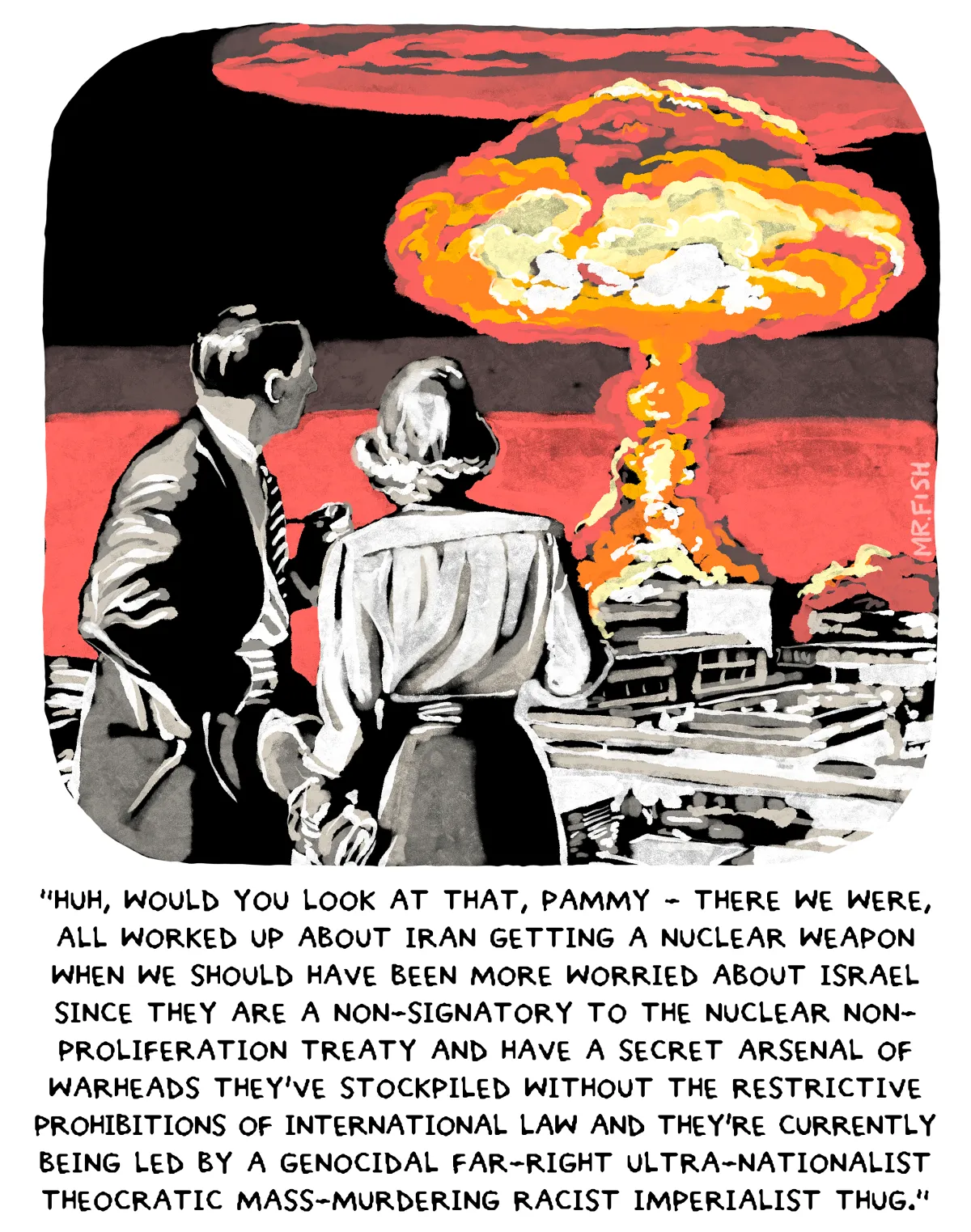
Mr. Fish’s cartoon stuck in my head because it cuts straight through the insanity of the entire conversation. One country already has nuclear weapons and the world is told not to talk about it, while another country that still doesn’t have them is treated like an immediate threat to civilization. The more I sat with the image, the more I started digging into the history underneath it — and the hypocrisy only got harder to ignore.
For decades we’ve been told to panic about the country that doesn’t have nuclear weapons while pretending not to notice the country that actually does. Iran gets sanctions, assassinations, bombings, and endless media hysteria over what it might someday build. Israel sits on an undeclared nuclear arsenal outside the Nuclear Non-Proliferation Treaty and the political/media class acts like everyone is supposed to politely shut the hell up about it.
Mr. Fish’s cartoon cuts through that theater with a sledgehammer.
Israel has never officially acknowledged its nuclear weapons program, yet experts and watchdog groups estimate it possesses roughly 90 nuclear warheads and maintains one of the most secretive nuclear infrastructures on Earth. Unlike Iran, Israel is not a signatory to the Nuclear Non-Proliferation Treaty, and international inspectors have never had full access to the Dimona facility believed to anchor its nuclear program.
The roots of Israel’s nuclear program stretch back decades. The Israel Atomic Energy Commission was established in 1952, and its first chairman, Ernst David Bergmann, openly argued that nuclear weapons would ensure “that we shall never again be led as lambs to the slaughter,” according to the Jewish Virtual Library. As with so much of Israel’s national security doctrine, the trauma and memory of the Holocaust were invoked as a central justification for building and maintaining the program.
Documents show that as far back as 1968, the CIA had already informed President Lyndon B. Johnson that Israel either possessed nuclear weapons or was on the verge of developing them. But instead of confronting the issue publicly, Washington chose silence. President Richard Nixon later struck a secret understanding with Israeli Prime Minister Golda Meir: Israel would neither officially acknowledge nor test its nuclear arsenal, and in return, the U.S. would back off demands for inspections and oversight. From that point on, one of the world’s worst-kept secrets became official policy — don’t ask, don’t tell.
They weren’t guessing. Even reporting from the 1970s pointed to what U.S. intelligence already knew. As The New York Times later revealed, the CIA disclosed in a 1974 assessment that Israel had already developed nuclear weapons — partly using uranium obtained “by clandestine means.”
Meanwhile, Iran — despite years of sanctions, assassinations, cyberwarfare, and bombing campaigns — remains under constant international scrutiny precisely because it is formally inside the nonproliferation framework. Even members of the U.S. Congress have begun openly questioning the contradiction, warning that America’s policy of “official ambiguity” around Israel’s arsenal makes any coherent nonproliferation policy nearly impossible.
That’s the uncomfortable truth sitting underneath the mushroom cloud in Mr. Fish’s illustration: the issue has never simply been nuclear weapons. It has always been about who is allowed to have power, who is allowed to threaten annihilation, and whose violence is treated as “security” instead of extremism.
The cartoon’s suburban couple staring calmly into apocalypse captures the moral numbness at the center of the debate. Entire populations have been conditioned to panic over hypothetical weapons programs while accepting real arsenals, real occupations, and real mass death as background noise. The danger isn’t only the bomb — it’s the normalization of permanent double standards enforced through military dominance and political silence.
The Council on Foreign Relations directly undercuts the claim that Iran is an imminent nuclear threat. CFR writes that “many foreign policy experts warn that a nuclear-armed Iran would destabilize the Middle East and nearby regions,” and argues that Israel viewed Iran’s potential possession of nuclear weapons as a “major, perhaps existential, threat” — a fear used to justify Israel’s June 2025 attacks on Iranian nuclear and military facilities, followed by the joint U.S.-Israeli strikes in February 2026.
But even CFR acknowledges a critical fact often buried beneath the war rhetoric: Iran does not currently possess a nuclear weapon. The organization notes that while Iran has the scientific knowledge and infrastructure to potentially build one fast, there is no confirmed evidence that its leadership has decided to do so.
Adding to that reality, the claim that Iran posed an imminent nuclear threat sharply conflicts with decades of U.S. intelligence assessments. The 2007 U.S. National Intelligence Estimate concluded that Iran halted its structured nuclear weapons program in 2003. Successive American intelligence officials — including former CIA Director William Burns — have repeatedly stated that Iran had not made the decision to build a nuclear bomb. International Atomic Energy Agency (IAEA) inspectors, including former chief Mohamed ElBaradei, likewise reported finding no evidence of an active Iranian nuclear weapons program.
Even Trump’s own Director of National Intelligence, Tulsi Gabbard, recently contradicted the administration’s escalation narrative. In Senate testimony, Gabbard stated that Iran had not rebuilt a nuclear weapons program after the 2025 strikes — directly undercutting claims used to justify continued confrontation and military escalation.
She months later changed of position came after Donald Trump publicly claimed she was “wrong” and insisted U.S. intelligence showed Iran had amassed a “tremendous amount of material” and could build a nuclear weapon “within months.” Of course what has been stated here over and over again Iran doesn’t have a nuclear weapon.
The lie, of course, is that Israel is not treated as a legitimate nuclear and existential threat while Iran — which still does not possess a nuclear weapon — is framed as the ultimate danger. This, of course, is the same logic that has fueled decades of endless war: the claim that Iran could build a weapon someday is treated as justification for permanent aggression today. Yet Iran still does not possess a nuclear weapon — and one reason may be obvious: countries like North Korea learned that once you do obtain one, you become untouchable, while nations without them remain at the mercy of the empire’s next target.
Within the last week, members of Congress have started asking the same question — because who can’t see what’s right in front of our faces anymore? As lawmakers pressed the State Department for transparency over Israel’s undeclared nuclear arsenal, the hypocrisy at the center of U.S. foreign policy became increasingly difficult to ignore.
In a letter sent to Secretary of State Marco Rubio, Democratic lawmakers pointed directly to the U.S.-Israel war on Iran as evidence that greater clarity is urgently needed.
“Congress has a constitutional responsibility to be fully informed about the nuclear balance in the Middle East, the risk of escalation by any party to this conflict, and the administration’s planning and contingencies for such scenarios,” the letter, signed by 30 members of Congress, stated. “We do not believe we have received that information.”
The lawmakers also warned that maintaining “official ambiguity” around one state’s nuclear capabilities while threatening war over another’s makes genuine nonproliferation impossible in the Middle East.
“A policy of official ambiguity about the nuclear capabilities of one party to this conflict makes coherent nonproliferation policy in the Middle East impossible,” the letter stated, “for Iran, for Saudi Arabia, and for every other state in the region making decisions based on their perceptions of the capabilities of their neighbours.”
“This initiative is taking place against the backdrop of the US-Israeli war of aggression against Iran,” said Josh Ruebner of the Institute for Middle East Understanding Policy Project. “One of Trump’s goals for ending this war involves negotiations to lift sanctions against Iran in exchange for an Iranian commitment not to develop nuclear weapons.”
“Members of Congress are right to question why Israel’s development of nuclear weapons gets a free pass while we’re trying to prevent Iran from acquiring them,” Ruebner added.
Of course, throughout the 1970s and ever since, Israeli officials have maintained the same carefully worded line: “Israel will not be the first country to introduce nuclear weapons to the Middle East.” It’s a statement built on ambiguity — one that allowed everyone to pretend not to see what was already obvious.
But now, as the world edges closer to what increasingly feels like a third world war and the Doomsday Clock sits nearer to midnight than ever before, the real question is no longer whether these weapons exist. The question is when — and under what leadership — they could be used.
That fear becomes even more dangerous under a U.S. president whose mental fitness has become a serious public concern, and who has repeatedly used apocalyptic rhetoric about “’blown off the face of the earth’” Because if Israel is treated as an undeclared nuclear power beyond accountability, the United States remains the ultimate nuclear superpower — the empire standing behind it with the largest arsenal on Earth.
Remember how all of this started — with an Mr. Fish cartoon forcing us to stare directly at the hypocrisy and madness surrounding nuclear weapons, war, and empire. Thanks for making people think. And here’s his work: The Independent Ink Archive
A national analysis of the impact of proximity to nuclear power plants on lung, breast and colon cancer mortalities in the U.S., 2000–2020
Significance
This national-scale analysis provides new evidence that proximity to nuclear power plants is associated with increased mortality from major cancers in the U.S. The magnitude and consistency of the findings highlight the importance of updated risk assessments, sustained surveillance, and strengthened public health planning for communities living near nuclear facilities.
- Yazan Alwadi,
- Joel Schwartz,
- David C. Christiani,
- Marco Kaltofen,
- Brent A. Coull,
- John S. Evans,
- Yaguang Wei &
- Petros Koutrakis
Journal of Exposure Science & Environmental Epidemiology (2026) 20 May 2026, https://www.nature.com/articles/s41370-026-00922-2
Abstract
Background
Nuclear power plants emit low levels of ionizing radiation, an established risk factor for breast, colon, and lung cancers, yet the long-term effects of chronic environmental exposure in U.S. populations remain unclear.
Objective
To evaluate sex- and age-specific associations between proximity to nuclear power plants and mortality from the three most common cancers in the U.S.: breast, colon, and lung cancer.
Methods
We quantified county-level proximity to nuclear power plants using the sum of inverse distances from each residence county’s population-weighted center to all plants within 200 km, updated annually from 2000 to 2020. Cancer-specific mortality data (breast, colon, and lung) from the CDC were analyzed by sex and five age groups (45–54, 55–64, 65–74, 75–84, 85 + ). Relative risks (RRs) were estimated using generalized estimating equations with a Poisson link. Models were adjusted for sociodemographic factors, urbanicity, region, and temporal trends.
Results
Proximity to nuclear power plants was associated with elevated mortality from breast, colon, and lung cancers. From 2000 to 2020, an estimated 39,767 female deaths (95% CI: 9312–69,381), representing 2.01% (95% CI: 0.47–3.50%), and 38,124 male deaths (95% CI: 16,106–59,600), representing 2.33% (95% CI: 0.98–3.64%), were attributable to this proximity. Lung cancer accounted for the largest burden in both sexes, followed by breast and colon cancer in females and colon cancer in males. Mortality risks declined with increasing distance, becoming negligible beyond 50 km.
Significance
This national-scale analysis provides new evidence that proximity to nuclear power plants is associated with increased mortality from major cancers in the U.S. The magnitude and consistency of the findings highlight the importance of updated risk assessments, sustained surveillance, and strengthened public health planning for communities living near nuclear facilities.
Impact
- This study provides the first national assessment of sex- and age-specific mortality from breast, colon, and lung cancers in relation to proximity to U.S. nuclear power plants, revealing consistent patterns not previously demonstrated. These findings fill a major gap in environmental epidemiology and underscore the need for cohort studies, refined exposure assessments, and pathway-specific analyses to strengthen causal interpretation. As nuclear power gains momentum in national energy planning, establishing clearer evidence on potential health impacts is increasingly essential for guiding research priorities and public health preparedness.
As support for Israel declines in the U.S., the ‘Special Relationship 2.0’ is starting to take shape.

This can be presented as an investment in American jobs in partnership with Israel rather than as taxpayer assistance to a foreign government.
Benjamin Netanyahu and his allies in Congress have begun calling for an end to U.S. aid to Israel, but this won’t end the “special relationship” between the two countries. In fact, recent signs suggest it may only deepen U.S. military ties to Israel.
By Mitchell Plitnick Mondoweiss, May 17, 2026
This month, Israel and the United States are expected to begin negotiations on a new memorandum of understanding (MOU) that would outline the United States’ plans to support Israel after the current MOU expires in 2028. Chances are this will look like a very different conversation than in the past.
In recent months, there’s been a lot of noise around the idea of ending U.S. military aid to Israel. It’s an idea that has long been pursued by Palestine solidarity activists and, in the past, has also been floated by the Israeli right and their fellow travelers, who thought the aid wasn’t worth restricting Israel’s “freedom to act.” But surprisingly, the current proposal to end the annual grant of Foreign Military Financing (FMF) to Israel—which makes up most, though not all, of the annual aid package—comes from none other than Israeli Prime Minister Benjamin Netanyahu and is championed in Washington by South Carolina Republican Senator Lindsey Graham, the biggest hawk in the Senate.
What explains this?
Back in January, the Institute for Middle East Understanding’s Policy Project published a timely and detailed backgrounder on what is actually going on here.
What emerges is a plan to continue aid to Israel in a different form. Instead of sending money to Israel, which they have to spend with American corporations, Congress would appropriate money for joint development and production projects instead. This can be presented as an investment in American jobs in partnership with Israel rather than as taxpayer assistance to a foreign government.
The time to make such a move is now. Israel’s popularity has plummeted, and the once-certain annual military aid package is now up for debate. While the current Congress is still inclined to fund an unimpeded tidal wave of weapons and money to Israel, growing opposition in both parties makes even the near future of such aid uncertain………………………………………………………………………………………………………………………………………………………………………………………………………………………………………………………….. https://mondoweiss.net/2026/05/as-support-for-israel-declines-in-the-u-s-the-special-relationship-2-0-is-starting-to-take-shape/
Golden Dome or Golden Scam?

19 May 2026 – A report by the International Physicians for the Prevention of Nuclear War,
Back from the Brink, and Physicians for Social Responsibility
On May 19, PSR along with International Physicians for the Prevention of Nuclear War and Back From The Brink, released a new report on the proposed Golden Dome defense system. Organizations hosted a press conference in DC with the Up In Arms campaign, Senator Ed Markey, and Congressman Jim McGovern.
The false promise of strategic missile defense…………………………………….
Will the Golden Dome Protect us?
This brief report looks at what the United States would get from a $3.6 trillion
system that falls short of 100 percent effectiveness. Specifically, it considers what
would happen in a war with Russia if the U.S. had an 80% effective missile
defense system in place. The technology required to shoot down an
intercontinental ballistic missile is much more complex than that used to take out
the relatively primitive short-range rockets used in the current wars in the Middle
East. [3] Given the track record of the last 40 years, an 80% success rate is almost
certainly an unrealistically optimistic goal. But examining this “best case
scenario” sheds important light on the real value, or lack of value, of the Golden
Dome.
If the U.S. were to build a missile defense system that could shoot down 80% of
the current Russian nuclear arsenal, Russia could simply build many more
warheads and decoys to overwhelm this system, or redeploy some of the nearly
three thousand warheads it has put into storage. But for the purposes of this
scenario, we use the more conservative assumption that Russia is financially
unable to do so and simply retargets all its currently deployed warheads at U.S.
cities to exact an unacceptable price in any war with the U.S.
The current Russian nuclear arsenal contains an estimated 1718 deployed
warheads: 430 warheads with the destructive power of 800 kilotons (Kt)—50
times the explosive yield of the Hiroshima bomb, 200 warheads with the power
of 250 kilotons (Kt) , and 1088 100 kiloton (Kt) warheads. [4] There are many
different targeting scenarios Russia could choose to maximize damage with
this arsenal despite the existence ………………………….of the Golden Dome.
Let’s consider one of them.
If the US had the ability to shoot down 80% of all incoming Russian warheads,
then, in order to achieve a 95% probability of hitting a given population center,
Russia would have to target that city with 13 warheads. [5]…………………………………………………………………..
CONCLUSION
The Golden Dome will not protect
the American people. Even if the
system achieved an extremely
optimistic 80% success rate, it
would leave the 132 largest
population centers open to attack
with 75 million Americans in the
zones of total destruction. Such an
attack would also cause global
climate disruption and lead to
famine that would kill 1.4 billion
people worldwide
What the Golden Dome will do is to
squander $3.6 trillion creating a
dangerous, false sense of security.
This is money that could be spent on
education, housing, health care, and
food security– social services that
are currently being cut because we
are told we can’t afford them.
Developing and deploying the
Golden Dome will also exacerbate
the danger of nuclear war by
blocking progress towards nuclear
disarmament and further fueling the
new and destabilizing arms race as
Russia and China build more
weapons to overcome any ability the
Golden Dome has to intercept some
of their current warheads. This is not
a hypothetical concern. U.S.
determination to pursue Star Wars
during the 1980’s derailed the
attempt by Presidents Reagan and
Gorbachev to reach an agreement to
eliminate all nuclear weapons at the
Reykjavik Summit in 1986. [9]
There is no technical fix to the threat
posed by nuclear weapons
We have survived this far into the nuclear era
because, according to former
Defense Secretary Robert
McNamara, “We lucked out….It
was luck that prevented nuclear
war.” The United States cannot rely
on our luck lasting forever, and it
cannot rely on a mythical Golden
Dome to protect us. The only way to
confront the growing danger of
nuclear war and to guarantee that
our world is not destroyed by these
weapons is to eliminate them
The United States should enter
negotiations now with the other 8
nuclear armed states for a
verifiable, enforceable agreement
to eliminate all of their nuclear
arsenals according to an agreed
upon timetable. We cannot know
in advance if this effort will
succeed, but we do know what
will happen if we don’t eliminate
these weapons. So there is every reason to try
…………………………………………………….. https://psr.org/wp-content/uploads/2026/05/golden-dome.pdf
The CIA’s Cuba Ultimatum: Regime Change With a Diplomatic Smile
create the crisis, punish the population, scare off investment, then demand political surrender from the government you have spent decades trying to brea. – — force Cuba to bend to Washington’s will.
SCHEERPOST, May 19, 2026.
The CIA did not sneak into Havana this time. It landed in broad daylight.
Peter Kornbluh reports in The Nation that CIA Director John Ratcliffe led a high-level U.S. delegation to Cuba on May 14, delivering what amounted to a blunt Trump administration ultimatum: Washington is willing to “engage” on economic and security issues, but only if Cuba makes “fundamental changes.”
The message is hard to miss. After decades of sabotage, sanctions, assassination plots, covert operations and economic strangulation, the U.S. is now packaging regime-change pressure as diplomacy. Cuba is facing severe fuel shortages, blackouts and growing hardship — conditions Washington’s policy has helped intensify — while Trump officials tighten sanctions, target foreign investors and float military threats.
This is not diplomacy. It is submission politics.
Kornbluh’s piece lays out the old imperial script in its newest form: create the crisis, punish the population, scare off investment, then demand political surrender from the government you have spent decades trying to break. The CIA’s public trip to Havana may look different from Bay of Pigs secrecy or Operation Mongoose sabotage, but the goal remains painfully familiar — force Cuba to bend to Washington’s will.
The danger now is that economic warfare is being paired with open military signaling. Reports of increased U.S. intelligence flights near Cuba, threats involving aircraft carriers, possible indictments of Cuban leaders and leaked claims about Cuban drones all point toward a familiar pretext-building machine.
Once again, the United States claims to be defending freedom while tightening the noose around an island it has never forgiven for refusing to obey.
The CIA has spent decades trying to overthrow the Cuban government through covert operations, assassination plots, sabotage, and economic warfare — from the Bay of Pigs to Operation Mongoose and countless regime-change schemes. But now Washington isn’t even pretending anymore. CIA Director John Ratcliffe’s very public trip to Havana marks a dangerous new phase in the long U.S. campaign to force Cuba into submission politically and economically.
According to reports, Ratcliffe delivered what was essentially a “do or die” ultimatum from the Trump administration: either Cuba accepts Washington’s demands for change, or the window for diplomacy closes. He reportedly pointed to what happened in Venezuela after Maduro refused to bend to Trump’s threats, making clear the White House is prepared to “enforce its red lines” if Cuba refuses to capitulate.
The timing says everything. Ratcliffe arrived just one day after Cuba publicly admitted the country has effectively run out of fuel. “We have absolutely no fuel oil, and absolutely no diesel,” Cuba’s energy minister said on state television. That crisis didn’t happen in a vacuum. Cutting off Cuba’s access to fuel, electricity, and basic economic survival has become central to Trump’s pressure campaign against the island.
As one analyst put it, previous administrations tried to lure Cuba with carrots. Trump’s strategy is to beat Cuba with a stick until it collapses. And with U.S. military activity escalating around the region, it’s becoming harder to ignore the possibility that Washington is preparing for something even more dangerous if Cuba refuses to surrender to its imperial demands.
Read The CIA Goes to Cuba from Peter Kornbluh at The Nation
Trump Sends CIA Chief — Not Diplomats — To Deliver Cuba Threat
……………………………………………………………………………………………………………… https://scheerpost.com/2026/05/19/the-cias-cuba-ultimatum-regime-change-with-a-diplomatic-smile/
From Asia to the Middle East, US Bombs Are a Failed Foreign Policy Choice
The only reliable products of US airpower are devastated civilian populations and suppression of internal movements.
By Christine Ahn , Truthout, May 19, 2026
The U.S.-Israeli war on Iran opened not with a declaration, not with diplomacy exhausted, but with airstrikes.
Among the first confirmed casualties were more than a hundred schoolchildren killed in a strike on their elementary school in southern Iran. Within a month, 850 U.S.-made Tomahawk missiles were used to strike Iran. President Donald Trump has delivered on his promise to bomb Iran “back to the Stone Ages,” with U.S. and Israeli missiles targeting bridges, pharmaceutical and steel plants, and civilian infrastructure like schools and hospitals. The bombing campaign has struck civilian oil infrastructure in Tehran, engulfing a city of 10 million people in toxic black rain. Thousands of Iranians and Lebanese have been killed, and hundreds of thousands of workers have lost their jobs as factories and basic infrastructure have been destroyed.
Washington calls this national security. The historical record calls it something else entirely.
For more than 75 years, the United States has reached for airpower as its preferred instrument of foreign policy — a tool that promises decisive results without the political costs of ground occupation; the illusion that enough bombs, dropped with enough precision, can produce the outcomes that diplomacy did not. Korea, Vietnam, Laos, Cambodia, Afghanistan, Iraq, and now Iran: the targets have changed, the doctrine has not.
The Failure of U.S. Doctrine
As a Korean American, Cathi Choi of Women Cross DMZ knows this history personally. From 1950 to 1953, during the Korean War, U.S. forces dropped 635,000 tons of bombs and 32,000 tons of napalm, burning 80 percent of North Korean cities to the ground. One year into the war, U.S. Maj. Gen. Emmett O’Donnell testified in the Senate, “There are no more targets in Korea.” More than 4 million people were killed, the overwhelming majority of them Korean civilians. Choi, whose grandfather fled the north during the war, is among millions of Koreans from separated families. The division of the peninsula left an estimated 10 million Koreans cut off from relatives on the other side, unable to exchange phone calls or letters or reunite, with the exception of a few state-sponsored family reunions during periods of détente. Seventy-three years later, the war has only ended in a ceasefire, not a treaty, and the peninsula has remained in a stalemate ever since.
“The Korean War didn’t just leave its mark on the peninsula,” Choi explained. “It left deep scars among divided families, inaugurated the U.S. military-industrial complex, quadrupled the Pentagon budget in three years, and set a course from which Washington has never turned back.” Today, the Trump administration is proposing a $1.5 trillion Pentagon budget while slashing investments in diplomacy, development, and domestic programs like Medicaid and food stamps. Meanwhile, 1.2 million land mines are still buried across the world’s most militarized border, keeping Korean families — like Choi’s — separated, and both sides heavily militarized while on the precipice of nuclear war.
Danae Hendrickson, chief of mission advancement and communications at the advocacy group Legacies of War, has spent years documenting what the United States left behind in Laos, Cambodia, and Vietnam — not as history, but as present danger. …………………………………………………………………………………………………………………………………………………………………………………………………………………………………. https://truthout.org/articles/from-southeast-asia-to-middle-east-us-bombs-are-a-failed-foreign-policy-choice/?utm_source=Truthout&utm_campaign=0f6b169c87-EMAIL_CAMPAIGN_2026_05_19_09_10&utm_medium=email&utm_term=0_bbb541a1db-0f6b169c87-650192793
The President of Peace Makes War on the Planet
SCHEERPOST Tom Engelhardt TomDispatch, May 19, 2026
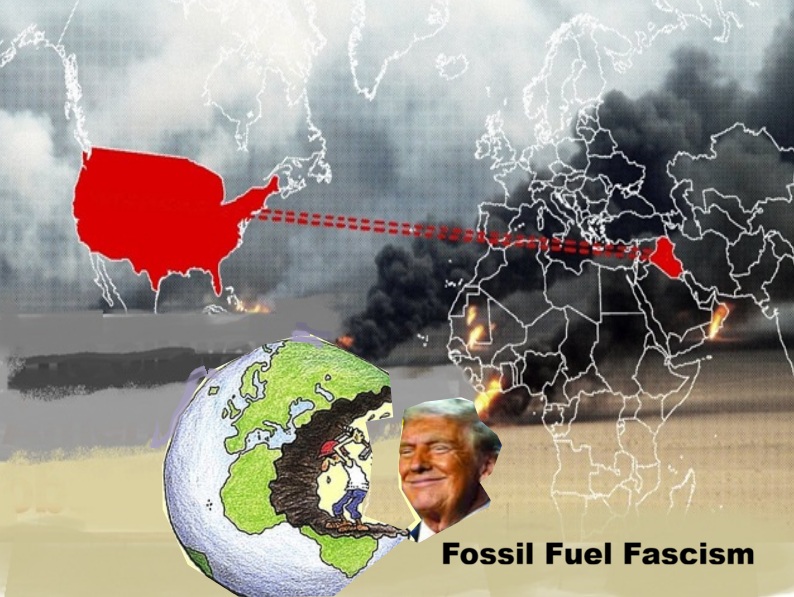
“………………………………………………………………………………………………………………………………………………………………………………………………………………………………………………………. I almost forgot to mention one more Trumpian set of acts of war, undoubtedly by far the most important and devastating of all: those he’s launched against planet Earth itself. I mean, we’re talking about the president who has done his — and this word couldn’t be more appropriate — damnedest to shut down wind farms of any sort, cut solar energy projects, and expand the burning of fossil fuels in just about every way imaginable, including by opening up 1.3 billion acres (no, that is not a misprint!) of U.S. coastal waters to further oil and natural gas drilling.
New York Times reporter Maxine Jocelow caught this Trumpian moment on Planet Earth perfectly in a recent piece on the “triumphant resurgence in Mr. Trump’s Washington” of climate-change denial. She summed up the Trumpian viewpoint this way: “Climate change is a hoax perpetrated by ‘leftist politicians.’ Fossil fuels are the greenest energy sources. More carbon dioxide in the atmosphere will be harmless.”……………………………………………
There really can’t be any question that this president is distinctly intent on nothing less than making war not just on specific nations like Iran, or on ships in the Caribbean Sea, or on anyone in or near the Strait of Hormuz, but on this very planet in every way imaginable……………………….
Defeat on Land, at Sea, and Anywhere Else Imaginable
Once upon a time, such wildly futuristic madness would have been left to the most dystopian of science-fiction novels — and undoubtedly not very popular ones at that, since such a plot and such a president would (once upon a time) have seemed far too unrealistic even for fiction. But now, thanks to President Donald J. Trump, the United States of America, in addition to all its other warring acts of recent months, is distinctly at war — and there’s no other adequate word for it — with Planet Earth (at least as a habitable place for future versions of us).
Someday, if anyone is still making TV series (since by then they’ll all undoubtedly be AI-created), I wonder if there will be one that young people, along with their parents, would be able to catch called not Defeat at Sea, but something far larger and more definitive like Defeat on Planet Earth. After all, we now have a president of the United States who seems ready not just to make war on Iran, but on more or less everything…………………………………
Trump and crew, while working as hard as they can to launch a thoroughly useless fleet of naval vessels, have also been doing their damnedest to heat this planet to the boiling point. He has literally decided to transform himself into a hell-on-earth president at a moment when renewable energy has beaten out coal as the primary source of energy globally for the first time ever.
…………………………………………………………………………………………………………………………………………………. Donald Trump, of course, is distinctly intent on making war on planet Earth (including, by recently making war on Iran, pouring yet more greenhouse gases into the atmosphere). War, after all, may be the world’s most efficient producer of such gases and the U.S. military, even in peacetime (which, unlike during his first term in office, is no longer Trump time), remains the largest institutional emitter of greenhouse gases on this planet. In the process, he’s doing his damnedest to take both his country and the planet down with him.
All too sadly, if he’s successful, American children of tomorrow, when they turn on their machines (whatever they may be), could witness not Victory, but Defeat at Sea, on Land, and Anywhere Else You Might Imagine. https://scheerpost.com/2026/05/19/the-president-of-peace-makes-war-on-the-planet/
Death will kill with its poisonous wings.
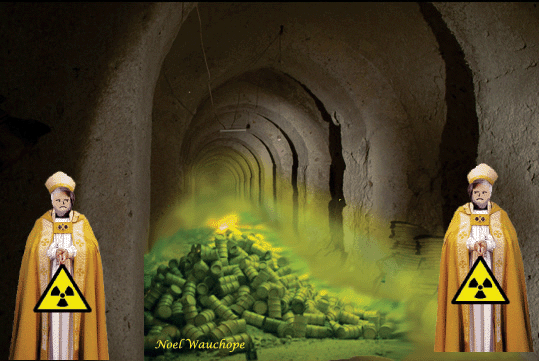
“This place is not a place of honor … no highly esteemed dead is commemorated here … nothing valued is here. What is here was dangerous and repulsive to us. This message is a warning about danger
by Martin McKenzie-Murray, https://www.themonthly.com.au/martin-mckenzie-murray/2026-05-08/death-will-kill-its-poisonous-wings
Very soon, likely within a few weeks, one of the world’s most interesting pieces of infrastructure will open after 22 years of construction and almost half a century of contemplation. Called Onkalo – Finnish for “cavity” – the site will be the world’s first permanent repository for nuclear waste.
By law, Finland obliges that nuclear waste produced domestically must be stored domestically. That will now occur on the island of Olkiluoto at a depth of more than 400 metres within bedrock that’s almost two billion years old. Currently, the repository area is about two square kilometres and comprised of 10 kilometres of tunnels – this number will likely quadruple before the site’s decommissioning in around 2100, when this cavern will be backfilled and sealed, creating a self-maintained nuclear sarcophagus for the approximately 100,000 years it will take for the waste’s radioactivity to have decayed to safe levels.
Perhaps by now you’re beginning to intuit a little about a) the complexity of its design, b) the richness of its semiotic implications, and c) the sobering absence of anything approaching a precedent for this. Consider: after its decommissioning, Onkalo must remain perfectly passive, requiring no active management or monitoring for 100,000 years. Second, its profound danger must be communicated so far into the future that current languages, customs – even genetic dispositions – can no longer be assumed to exist. It’s a strange and disquieting fact that the radioactivity of our nuclear waste might outlive our languages for communicating its danger. Third, no man-made structure has ever lasted anything close to the length of time that Onkalo is hoped to be preserved for.
Let’s start with the simpler facts of the site. Olkiluoto Island was chosen for its geological stability – the low-permeability of its bedrock and its low-risk of seismic tremors. In Michael Madsen’s fascinating 2010 documentary about the site’s design, Into Eternity, one project adviser explains how time down there goes slowly, while up here, on the surface, it passes very, very quickly.
In other words, the crystalline rock 450 metres below ground here looks much the same as it did 500,000 years ago. The surface of our planet, however, would look unrecognisable if we travelled back just 200 years. Our natural, political and material world changes often and quickly – the latter to the whims and passions of its human inhabitants, our creative and destructive ingenuities, and the gravity of civilisational entropy. The natural world, meanwhile, forever remains subject to the whims and passions of storms and droughts and a climate that’s being altered by us.
Currently, the world’s approximately half-a-million tonnes of nuclear waste is kept in temporary storage on the surface of our planet, and is thus subject to war, sabotage or natural calamity. Much safer to secure it deep down where time moves slowly.
There is something lusciously strange and dreamlike about the projections and assumptions Onkalo’s designers were asked to make. They did nothing less than imaginatively commune with a form of humanity far into the future.
The weirdness of this can be emphasised by offering some modest timescale. The birth of Jesus Christ was 2000 years ago. The pyramids of Giza were completed about 4500 years ago. The previous Ice Age ended almost 12,000 years ago and found the peak of its severity about 10,000 years before that. That is still nowhere near 100,000 years, the length of time into the future for which Onkalo must remain independently stable and for which the warnings we write today must travel and remain intelligible.
And so, the niche field of nuclear semiotics: how do we communicate today’s intentions to a civilisation so distant that we presume it to be almost alien and to not share our language? Preceding this question though, is another: should we even try? Can we assume that humanity will, in 80,000 years, say, possess the same curiosity we do today? That is, will they perform the same enthusiastic archaeological excavations as we do now? And, if so, will they treat the nuclear tomb as we might an Incan crypt?
Might it be that by signposting the danger, we simply encourage their curiosity? Would warnings, even if we could guarantee their future intelligibility, serve to appropriately quell curiosity or dangerously arouse it?
The questions only birth more questions. Given that Onkalo is so deeply buried, and its decommissioning would involve erasing all surface infrastructure, can it not be assumed that it would never be accidentally found? Or might some evidence of its existence survive? Physical evidence, or digital? Is it preposterous to think that any digital evidence of our civilisation today could survive so far into the future – when, between now and the safe decay of the waste, there is assumed to fall several new ice ages?
The designers answered at least one big question: they would, via ceramic tablets, leave warnings to our future selves about the site. Detailed warnings, in several languages unlikely to survive several epochs, have been suggested: “This place is not a place of honor … no highly esteemed dead is commemorated here … nothing valued is here. What is here was dangerous and repulsive to us. This message is a warning about danger.”
Also proposed are simple pictographs that are assumed to have a universally intelligible quality: a triangle that includes the radioactive symbol, a skull and crossbones, an arrow pointing away from the danger, and a human stick-figure running in the direction it suggests.
Given the spookiness of radioactivity – and the oddity of communicating its dangers across a chasm of time to unknowable descendants – the project invited some strange proposals. One was rendering the surface above the tomb conspicuously forbidding: lightning bolt sculptures amongst forests of barbed wire. (But optimistically assuming their material survival, how can we assume that their symbolic charge would survive, and not simply invite curiosity as cryptic anachronisms?) Another proposal was made for genetically engineering cats who change colour in the proximity of radiation – a kind of bizarre Geiger counter.
In 2020, the American electronic music producer (and roboticist) Skytree, aka Evan Snyder, released a track called “Atomic Priest” written with rapper Jackson Whalan. Its lyrics were about precisely the problem of communicating danger forward through “deep time”:
This is for the humans living ten thousand years from now
With radioactive capsules, thousands of feet underground
Grabbin’ the mic to warn you of these hazardous sites
For those who lack in the sight in the black of the night
The least good that we could do is form an Atomic Priesthood
To keep the future species from going where no one should
We’ve buried the mistakes of past nuclear waste
Hidden underground for future races to face
It’s our task to leave signs for civilization to trace
But who’s to say what language these generations will embrace?
The American-Hungarian linguist Thomas Sebeok minted the term “atomic priesthood” in the early 1980s. Sebeok thought that, given that radioactivity of our waste would outlive current languages (and God knows what else), the trick to communicating our warnings about it lay in folklore. Sebeok had been commissioned by the US Department of Energy to this end. In 1980, the department had established the “Human Interference Task Force”, which was asked to “investigate the problems connected with the post-closure, final marking of a filled nuclear waste repository. The task of the HITF is to devise a method of warning future generations not to mine or drill at that site unless they are aware of the consequences of their actions.”
In 1984, Sebeok submitted his report. It was called “Communication Measures to Bridge Ten Millenia”. Semiotics were everything here, Sebeok wrote, given its relevance to “the problems of human interference and message exchanges involving long periods of time, over which spoken and written languages are sure to decay to the point of incomprehensibility, making it necessary to utilize a perspective that goes well beyond linguistics”.
Here, then, is the luscious strangeness of nuclear semiotics – a field that overlaps with our formal considerations of communicating with extraterrestrial intelligence, but which seems even stranger to me given that the aliens in this case are our future selves.
Sebeok suggested that the best way to ensure the survival of our warnings deep into the future was through mythology – the enactment of annual rituals and the ratification of legends that were upheld by an “atomic priesthood”. The stories would alter over time, but perhaps the core desire of the transmission – to effectively warn off future excavators – would survive. It wouldn’t matter if the sense of hazard had degraded into superstition, long untethered to science or the danger at hand. Only that a sense of fear and repulsion was maintained.
“A ritual annually renewed can be foreseen, with the legend retold year-by-year (with, presumably, slight variations),” Sebeok wrote in his government report. “The actual ‘truth’ would be entrusted exclusively to what we might call for dramatic emphasis an ‘atomic priesthood’, that is, a commission of knowledgeable physicists, experts in radiation sickness, anthropologists, linguists, psychologists, semioticians, and whatever additional expertise may be called for now and in the future. Membership in this ‘priesthood’ would be self-selective over time.
“The best mechanism for embarking upon a novel tradition … is at present unclear. Folklore specialists consulted have advised that they know of no precedent, nor could they think of a parallel situation, except the well-known, but ineffectual, curses associated with the burial sites (viz., pyramids) of some Egyptian Pharaohs … which did not deter greedy grave-robbers from digging for ‘hidden treasure’.”
Here, then, is the weird world of considering future ones. In a few weeks, Onkalo will become operational, accepting the copper-encased tubes of nuclear waste into its deep tombs of crystalline rock, where things remain more stable than the conditions half a kilometre above.
Labour accused of making nuclear sector ‘more dangerous’ after capture by ‘vested interests’

by Tom Pashby, 14 May 2026, https://www.thecanary.co/uk/analysis/2026/05/14/nuclear-sector-more-dangerous/
The nuclear industry will become “more dangerous” and regulation of the sector has been captured by “vested interests,” campaigners and experts have told the Canary, after the Nuclear Regulation Bill was put forward in the 2026 King’s Speech.
The Labour Government had already said in March 2026 that it was committed to implementing the recommendations of the Nuclear Regulatory Review, which was led by John Fingleton – sometimes referred to as the Fingleton Review.
Announcing the findings of the review in March 2026, the government said:
overly complex regulation in the UK has contributed to the ‘relative decline’ in the UK’s global leadership position in nuclear.
It also set out 47 recommendations to:
to speed up building new nuclear projects.
King’s speech 2026
The King announced the Bill in his King’s Speech, saying:
My Ministers will also take forward recommendations of the Nuclear Regulatory Review and encourage a new era of British nuclear energy generation.
In briefing notes published by the government, which explain their plans in more detail, the government referenced the Fingleton Review, which it characterized as calling for “a radical refresh” of the nuclear regulatory regime.
It went on to say that the Nuclear Regulation Bill is:
modernising the way that new nuclear projects are regulated so we can deliver safe, secure and affordable nuclear power and infrastructure sooner, while maintaining strong environmental protections.
The briefing notes tried to placate fears that the recommendations in the Fingleton Review could erode environmental protections.
They added:
To speed up the delivery of new nuclear and reduce costs, the Government is overhauling planning and regulation in a boost to the UK’s energy sovereignty and the nuclear deterrent.
This Bill will support quicker delivery of nuclear projects in a way that produces a win-win for building critical infrastructure while protecting nature and the environment, and high standards of nuclear safety.
‘Industry falsehoods’ used to justify risk nuclear projects pose to nature – conservationist
The Wildlife Trusts‘ head of public affairs Matthew Browne told the Canary:
This Government was elected to govern on the basis of a manifesto that promised to restore the natural world. We are a long way from this promise being delivered. Today’s King’s Speech is silent on nature recovery, and includes measures that will actively harm wildlife.
Whilst early proposals for the ripping up of nature protections have thankfully been dropped, the Nuclear Regulation Bill is justified on the grounds of industry falsehoods which minimise the risk projects can pose to nature. The Regulating for Growth Bill gives environmental regulators an inappropriate focus on growth, bending their work away from vital nature recovery objectives.
With ongoing nature loss impacting our ability to grow food, to protect communities from flooding and our ability to stay healthy, this failure to respond to a growing national security crisis risks fundamental dereliction of duty. The Government needs to change course, and face up to environmental reality, before it comes an economic and social disaster.
Bill will make ‘inherently dangerous’ nuclear power ‘more dangerous’ – anti-nuclear campaigner
Campaign for Nuclear Disarmament (CND) general secretary Sophie Bolt told the Canary:
When you think of nuclear accidents like at Windscale in 1957, Chernobyl in 1986, or Fukushima in 2011, it’s easy to see that Britain’s current nuclear regulatory procedures and rules are in place for a simple reason – that nuclear power is inherently dangerous.
Rather than acknowledge these risks or legacy issues – like tackling the toxic waste generated by nuclear power – the government’s plan to cut regulations essentially means this industry will be more dangerous.
This is disturbingly similar to what Donald Trump did earlier this year when he gutted the US Nuclear Regulatory Commission and the US Environmental Protection Agency.
These proposed regulatory changes are also for the benefit of Britain’s deadly and costly nuclear weapons programme, which already accounts for almost a quarter of Britain’s military budget. Rather than strengthening our security, these proposals will instead weaken it and put us all at even greater risks from the nuclear industry.
Government should pursue renewables instead of nuclear – SNP
Scottish National Party (SNP) Alex Kerr MSP told the Canary:
Under Keir Starmer’s watch, energy bills have spiralled out of control, 1,000 jobs are being lost every month in the North Sea and Scotland’s only refinery at Grangemouth has closed – the Labour party has zero credibility when it comes to energy.
Now Labour is ripping up regulations to pursue its dangerous obsession with nuclear power.
Scotland has an abundance of clean energy sources – we don’t need new nuclear power stations, which are ludicrously expensive, take years to build, and leave us with dangerous waste.
Another energy superpower, Norway, has just ruled out using nuclear energy. With the fresh start of independence, Scotland can do the same and use our vast energy wealth to lower bills, enhance our energy security, and build a wealthier country.
Pursuit of nuclear instead of renewables unjustifiable – academic
University of Sussex emeritus professor Andy Stirling told the Canary that the evidence shows renewables should be pursued instead of nuclear, and the only reason that the government wants a civil nuclear sector is to enable the UK’s nuclear weapons programme.
He said:
Detailed plans for deregulating nuclear power set out in the King’s speech further underscore how deeply policy making in this field has been captured by vested interests.
Despite huge official noise around this issue, no UK Government document has systematically compared nuclear with alternative options to deliver affordable, safe, secure, domestic low carbon power. This situation in itself seriously undermines both sound policy making and wider democracy.
If any such analysis were to have been undertaken, the overwhelming independent evidence is, that it would have had to conclude that nuclear is verging on obsolescent as a means to deliver these objectives. Even existing mature forms of nuclear power costs many times more than comparable means to deliver firm-equivalent electricity and are far slower and problematic in other ways. So consumer bills are raised and climate action delayed.
That the Government does not even try to make arguments against this, shows the real reason for supporting high price, slow, troublesome nuclear power, is to underpin equally problematic and ineffective nuclear weapons ambitions.
Bill sets government on ‘collision course with communities’ – anti-Sizewell C campaigner
Stop Sizewell C executive director Alison Downes told the Canary:
The government is on a collision course with communities over its plans for a Nuclear Regulation Bill, for example in response to the Nuclear Regulatory Task Force it included the concerning promise to ‘go further’ in creating a new pathway to allow semi-urban nuclear power stations.
Ironically, rigorous public consultations are promised, but the Prime Minister’s inflammatory rhetoric directed at those who express concern about new nuclear plants in no way builds public confidence. We need assurances of strong, independent regulators and affected communities to be allowed to actively engage, not be insulted.
Declassified: UK Knew NATO Expansion ‘Would Provoke’ Russia War
Kit Klarenberg, Global Delinquents, May 18, 2026
On April 15th, Declassified UK published a bombshell investigation exposing how in the mid-1990s, senior British political and military officials were well-aware NATO expansion into Central and Eastern Europe “would provoke [the] Russians,” and likely trigger all-out war. Hitherto unreported Ministry of Defence files reveal London knew Moscow’s “sensitivities” over a “hostile military alliance” enlarging up to its borders were profound, and based on very “real” concerns. Yet, NATO’s dangerous crusade to absorb Central and Eastern Europe continued apace, ultimately producing the Ukraine proxy conflict.
Since the so-called Special Military Operation’s February 2022 eruption, British officials have relentlessly reiterated the mantra the proxy war was “unprovoked”. However, a declassified March 1995 Foreign Office memo noted “there was a widespread psychological and intellectual perception in Moscow that NATO was a real threat.” In May that year, then-Prime Minister John Major succinctly articulated Russian anxieties to his Irish counterpart John Bruton, as a “fundamental fear…of encirclement.” Concerns about EU membership were comparatively muted:
“For the Russians, NATO had a much more threatening symbolism and political resonance…The Baltics were particularly difficult, with extreme sensitivity for Russia. It would be very hard to have a NATO border directly against Russia.”
Still, in 1997 NATO invited Czechia, Hungary, and Poland to join, which they did two years later. In 2004, Estonia, Latvia and Lithuania simultaneously joined the military alliance. So too did ex-Warsaw Pact members Bulgaria, Romania, Slovakia, and former Yugoslav republic Slovenia. Declassified UK shows how back in August 1996, British Defence Intelligence prepared a NATO enlargement study specifically forecasting that these countries joining could trigger war, and an alliance military operation launched via Article 5 of the NATO treaty in response.
This refers to collective self-defence, under which NATO members are obligated to come to each other’s defence if attacked. In the scenario, Defence Intelligence assumed “Russia has vehemently opposed NATO membership for the Baltic states and has threatened retaliation to preserve her own security against a perceived hostile military alliance on her borders.” In the real world, Boris Yeltsin made at-times irate public statements about NATO enlargement into the Baltics at the time, while lobbying US President Bill Clinton on the issue behind closed doors.
NATO expansion continued regardless. In December 1996, Declassified UK reports then-Russian premier Viktor Chernomyrdin privately warned Major: “Russia could not stop NATO enlarging, but this would create a fragile situation which could explode.” Other declassified files from this time show senior apparatchiks in London were acutely aware of Moscow’s “concern,” “fears,” “hostility,” “negative attitudes,” and “resentment” over alliance enlargement. Both Major and his successor Tony Blair explicitly pledged in person to Kremlin officials that NATO wouldn’t “move up to Russia’s borders.”
However, a secret September 1996 policy paper made clear Britain was committed “to enlarge NATO to the East,” even if “Russian acquiescence is not possible.” In February 1997, Russia’s deputy foreign minister Nikolai Afanasievsky angrily branded public discussions in Western capitals of admitting former Soviet republics to the alliance a “blatant provocation” in a meeting with Jeremy Greenstock, Britain’s ambassador to Moscow. Greenstock reassured his Russian opposite number NATO had “no intention” of admitting former Soviet states “at this stage” – which, technically, was true.
‘Russian Problem’
A March 1997 Foreign Office memo forecast rapid NATO enlargement would “antagonise,” and ultimately “provoke,” Russia into a belligerent counter-response. Yeltsin’s “anxiety” about the “possible accession of Ukraine, the Baltic states and other states of the former Soviet Union” was considered the “most difficult issue” affecting Western relations with Moscow. A more staggered approach was thus required. That month, John Major met with NATO secretary general Javier Solana, who spoke of “Russians fears about NATO troops and equipment moving eastwards.”…………………………………………………………………………………………………………………………………………………………………………………………………………………………..https://www.kitklarenberg.com/p/declassified-uk-knew-nato-expansion
Danger at Europe’s largest nuclear plant ‘near point of no return’ after deadly attack
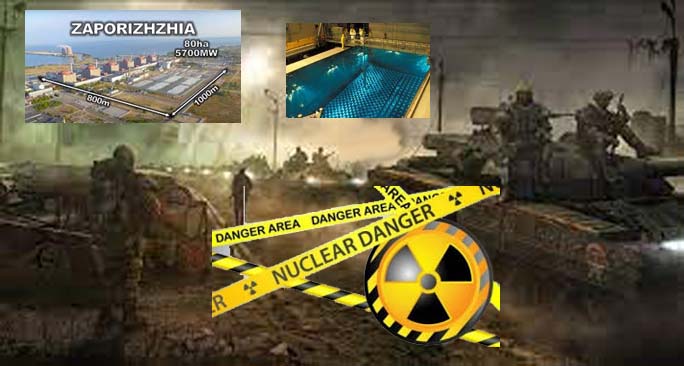
The Zaporizhzhia Nuclear Power Plant in Ukraine was targeted
again last week, with continual concern over its safety since the start of
the war with Russia in 2022. Safety at Europe’s biggest nuclear power plant
is “rapidly deteriorating”, Russia’s nuclear energy chief has warned.
Mirror 18th May 2026 https://www.mirror.co.uk/news/world-news/zaporizhzhia-nuclear-power-plant-ukraine-37171510
First attack on Arab nuclear site sends warning to Gulf, US
The first attack targeting an Arab nuclear site has sent a symbolic warning
to the United Arab Emirates and its allies, even as Iran and the US remain
in negotiations to end the Middle East war, analysts say. An unclaimed
drone struck an electrical generator on Sunday near the Arab world’s first
nuclear power plant in Barakah in the emirate of Abu Dhabi, triggering a
fire but causing no injuries nor radiation leak.
Daily Mail 18th May 2026 https://www.dailymail.com/wires/afp/article-15828501/First-attack-Arab-nuclear-site-sends-warning-Gulf-US.html
Scotland the Dump
A long-term project we have had here at Bella, that is charting the toxic
legacy of the British State. Our map, Scotland the Dump, produced by the
wonderful Magnificent Octopus Illustration is being prepared for shipping
right now. The map details the weapons ranges, munitions dumps, biological
and chemical weapons dumps and nuclear waste scattered around Scotland.
Bella Caledonia 18th May 2026 https://bellacaledonia.org.uk/2026/05/18/scotland-the-dump-4/
Mirrors of Greed: Elon Musk, OpenAI and the Tech Brat Battle

19 May 2026 Dr Binoy Kampmark , https://theaimn.net/mirrors-of-greed-elon-musk-openai-and-the-tech-brat-battle/
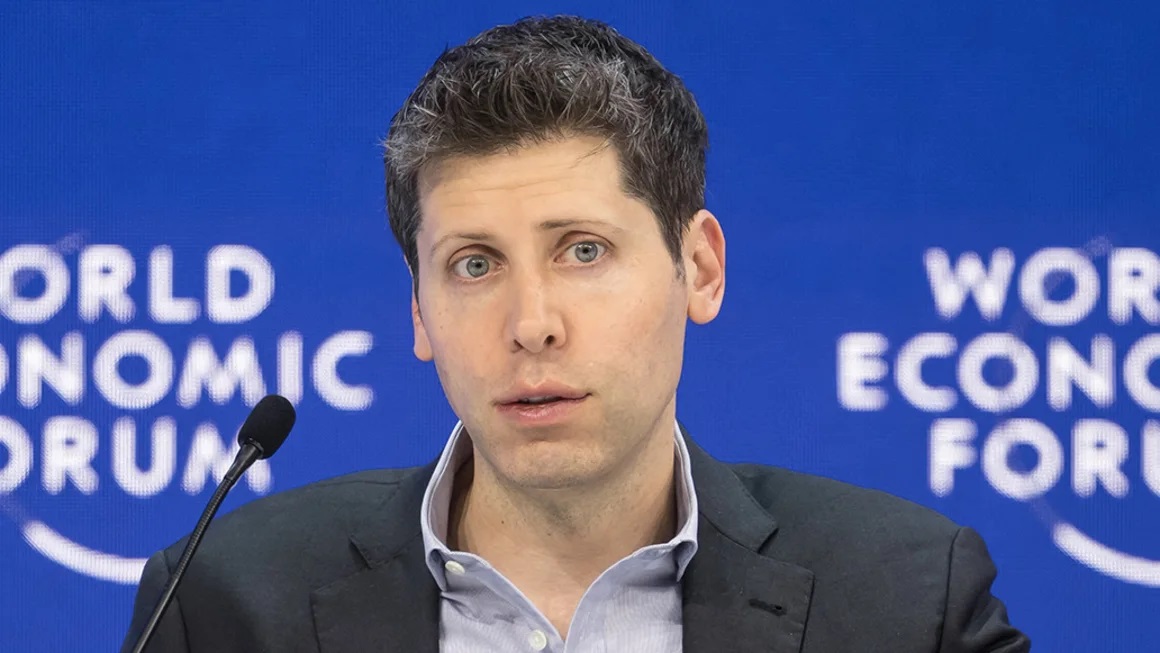
They are a disagreeable bunch, with disagreeable ideas to match. The querulous brats behind the drive for technological servility and plugged in stupidity were always going to scrap over which dystopian vision they most prefer. Elon Musk thought he was onto something hounding OpenAI and its current CEO Sam Altman for supposedly betraying one of those visions. In his $150 billion legal action, Musk alleged that Altman and OpenAI president Greg Brockman deceived him into investing in the company in its initial stages when salad green altruism was modish and humanity mattered. The litigation was a prong in a broader strategy to unseat Altman from OpenAI, sabotage the company’s $852 billion restructuring into a public benefit corporation and direct $134 billion to OpenAI’s non-profit foundation.
The deception centred on maintaining OpenAI as a non-profit entity and pursuing artificial intelligence (AI) ventures in ways beneficial to humanity. (When the tech brats have a stab at humour, they go in hard.) According to Musk, OpenAI had effectively stolen a charity. (Between 2015 and 2017, he had personally put $44 million into OpenAI, funds, he argues, that were essentially misappropriated when the company sloughed its non-profit skin.) In an introductory overview of the company from December 2015, the company badges itself a “non-profit artificial intelligence research company” with the object of advancing “digital intelligence in a way that is most likely to benefit humanity as a whole, unconstrained by a need to generate financial return. Since our research is free from financial obligations, we can better focus on a positive human impact.”
How things change. On May 18, a mere two hours was needed for a nine-jury member in Oakland, California to unanimously find against Musk, basing their decision on that most technical of grounds: the statute of limitations. This left two civil claims – breach of charitable trust and unjust enrichment – untested. Having left OpenAI’s board in 2018, Musk dithered till February 2024 to file suit. Musk claimed to have only discovered the company’s abandonment of its non-profit mission in 2022, when Microsoft showed its interest with an investment of $10 billion. OpenAI’s legal team argued that the pertinent events – the creation of a for-profit subsidiary in 2019 for instance and Microsoft’s initial injection of $1 billion that same year, were already matters of common knowledge. Time on the statute of limitations was running well before 2022. US District Judge Yvonne Gonzalez Rogers of the Northern District of California saw no reason to question the jury’s conclusion. “There’s substantial amount of evidence to support the jury’s finding, which is why I was prepared to dismiss on the spot.”
The trial was impressively ugly and amounted to an insult to the stout intelligence of the public whose welfare both parties claim to be protecting. The legal representatives from both sides jousted over respective views on AI and the credibility of the disputants. Musk’s lawyer, Steven Molo, pressed jurors to consider that several witnesses, including former OpenAI chief scientist Ilya Sutskever, doubted Altman’s candour, going so far as to find him mendacious. Altman had also conceded under cross-examination that he “told the occasional lie”. “Sam Altman’s credibility is directly at issue,” Molo crowed. “If you don’t believe him, they cannot win.”
OpenAI, Musk accusingly asserted, had wrongfully attempted to enrich investors and insiders at the expense of the non-profit. Along the way, it had failed to make AI safety a matter central to its operations. Microsoft, he further argued, had always known that OpenAI cared more about money than altruism. A personal journal entry penned by Brockman in November 2017 was also instructive, baldly revealing that OpenAI could not assert fidelity to its non-profit status if it intended becoming a benefit corporation months later. So it came to pass that Altman, Brockman and OpenAI were accused of the very same temptations, frailties and indifference to safety that could be found in Musk’s own conduct.
On the issue of safety and welfare, Musk’s own xAI, acquired by space and rocket company SpaceX, also part of the South African’s fiefdom of misrule, has drawn the attention of the European Commission and UK watchdog Ofcom over Grok, a product that has been used to create sexualised images. The combine arising from xAI and SpaceX could lead to an initial public offering that would surpass OpenAI in size, which sinks the scurrilous suggestion of altruism. Provided things go smoothly, the world’s first trillionaire might arise.
OpenAI was hardly going to leave Musk’s feeling of tech purity unchallenged. It was he, not OpenAI, who saw the shimmering dollar signs. Going back to 2017, he had floated the idea of a for-profit subsidiary with one caveat: he would have exclusive control. Failing this, he left the board in a huff. OpenAI’s attorney William Savitt suggested that Musk, having failed to “get his way at OpenAI,” filed his lawsuit only after establishing his own competing AI company in 2023. But most saliently, he waited too long to claim breaches of the founding agreement regarding the building of safe artificial intelligence for the benefit of humanity. “Mr Musk may have the Midas touch in some areas, but not in AI,” claimed Savitt.
OpenAI’s predatory reflexes will be boosted by the decision. The non-profit status in this field has been found wanting, and the scramble for profits given much encouragement in this most unprincipled of frontiers. “The decision is likely to reassure investors and the broader AI sector,” opines Sarah Kreps of the Tech Policy Institute at Cornell University, “because it avoids a potentially chaotic outcome that could have challenged OpenAI’s commercial structure, Microsoft partnership, and future fund-raising plans.”
This was by no means the first time Musk had taken to throwing a brief of anger against OpenAI. In March 2024, showing that intelligence can be authentically artificial, he filed a lawsuit citing a contract violation of a contract that did not exist. Using the misguided legal offices of Irell & Manella – the same firm that erroneously claimed on behalf of PETA that a monkey could hold copyright – Musk pursued what Techdirt’s Mike Masnick appropriately called a “vibes based” action. “Elon doesn’t have a contract with OpenAI which the company could have breached. And that’s kinda a problem in a breach of contract lawsuit.” This insuperable logic led Musk to abandon the lawsuit in June that year.
For Musk, the wells of indignation run deep. This is a man in the habit of losing or settling claims, be it with former Twitter executives and employees of the social platform now known as X, losing to investors in that same company for misleading public statements made during his untidy, often chaotic takeover, or having his lawsuit promptly dismissed against advertisers that exited that troubled platform. While such behaviour should draw scorn, those drawing benefit from his litigious pathologies – lawyers, in the main – can only be grateful. “In a lot of ways, he is just another businessperson asserting his rights,” says a credulous Shubha Ghosh, lawyer and law academic at Syracuse University. “I don’t think he’s abusing the legal system. Whether he uses it effectively, I’m not sure.” Wrong, certainly, on the first count.
1 This Month



26 September – International Day for the Total Elimination of Nuclear Weapons


PLEASE OPPOSE HR 8255 AND S.3639 – bills would accelerate satellite deployment, with no environmental review or safeguards – https://ncstd5li.quorum.us/campaign/169331/
To see nuclear-related stories in greater depth and intensity – go to https://nuclearinformation.wordpress.com
-
Archives
- September 2026 (219)
- August 2026 (330)
- July 2026 (355)
- June 2026 (287)
- May 2026 (306)
- April 2026 (356)
- March 2026 (251)
- February 2026 (267)
- January 2026 (308)
- December 2025 (358)
- November 2025 (359)
- October 2025 (375)
-
Categories
- 1
- 1 NUCLEAR ISSUES
- business and costs
- climate change
- culture and arts
- ENERGY
- environment
- health
- history
- indigenous issues
- Legal
- marketing of nuclear
- media
- opposition to nuclear
- PERSONAL STORIES
- politics
- politics international
- Religion and ethics
- safety
- secrets,lies and civil liberties
- spinbuster
- technology
- Uranium
- wastes
- weapons and war
- Women
- 2 WORLD
- ACTION
- AFRICA
- Atrocities
- AUSTRALIA
- Christina's notes
- Christina's themes
- culture and arts
- Events
- Fuk 2022
- Fuk 2023
- Fukushima 2017
- Fukushima 2018
- fukushima 2019
- Fukushima 2020
- Fukushima 2021
- general
- global warming
- Humour (God we need it)
- Nuclear
- RARE EARTHS
- Reference
- resources – print
- Resources -audiovicual
- Weekly Newsletter
- World
- World Nuclear
- YouTube
-
RSS
Entries RSS
Comments RSS
 nuclear-news