As UK’s Prime Minister fades away, will his beloved Small Nuclear Reactor dream fade too?
5 July 2026, https://theaimn.net/as-uks-prime-minister-fades-away-will-his-beloved-small-nuclear-reactor-dream-fade-too/
As soon as mid-July, Sir Keir Starmer is expected to finally quit his job as British Prime Minister. He’s not very popular, either within his own party, or with the general public. Labour’s previous popular leader, Jeremy Corbyn, opposed nuclear power. Soon after coming to power, Starmer called for tech companies to work alongside the government’s Great British Energy – Nuclear, to build SMRs to power energy-intensive AI data centres across Britain. Starmer might be hoping to be, later on, renowned for his legacy in revolutionising British energy systems, and producing a glorious renaissance for the global nuclear industry.
But possibly not.
“I say: build, baby, build,” – Starmer’s theme on Small Nuclear Reactors looks now, on the face of it, to be a resounding winner for Britain on the global nuclear scene. Why? Because… haven’t you heard? It is all over the British press that the UK is to get a fleet of SMRs with a multi-billion dollar “privately financed” scheme (helped just a bit by the government), to start generating in 2034.
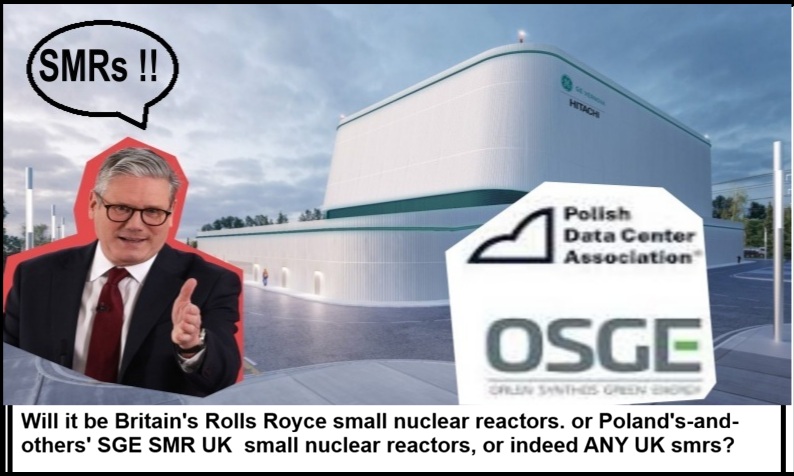
SGE is a European Small Modular Reactor (SMR) development and investment platform. Founded by Polish billionaire Michał Sołowow, SGE has plans for SMR developments across Europe. On July 1st SGE announced in glowing terms, its UK plans for “delivering efficient, safe, affordable, and clean nuclear energy power at fleet scale.” It has established a consortium, SGE SMR UK Limited, as its dedicated UK-based project vehicle.
SGE hopes to use the GE Vernova Hitachi BWRX-300 design, to build under the government’s advanced nuclear framework (which was initiated by Starmer in February after the government promised to rip up “archaic rules” and slash regulations to “get Britain building”). SGE boasts that this SMR design is a “proven technology,” but it’s really a smaller, and as yet untested, version of the large boiling water nuclear reactor.
Where’s the money coming from?
The plan is to put in £35bn of private capital to build 14 small modular nuclear reactors on three sites across the UK. The consortium SGE SMR UK consists of SGE (formerly Synthos Green Energy), GE Vernova, Hitachi Nuclear, Samsung C&T, Laing O’Rourke, Aecon Group, Google Cloud, Fermi Development, and Etara. The biggest investor presumably is the Polish company.
Under the National Wealth Fund, Great British Energy – Nuclear (GBE-N) set up its Small Modular Reactor (SMR) Technical Partner contract (TP Contract) as a way for the government to help fund SMR development. It initially forecast that it may need £20bn to cover the cost of the (TP) Contract. “GBE-N has ultimately decided to award only one TP Contract and the contract award notice value reflects this.”
SGE plans to deploy under a Contract for Difference framework with National Wealth Fund engagement. I know that the contract for difference scheme means a fixed price for electricity bills once the project begins generating electricity. If the market price is below the fixed price, the government tops up the payment to the company. I don’t know what the National Wealth Fund engagement means, and I suspect that I’m not the only one puzzled about this.
In May 2026 Great British Energy – Nuclear (GBE-N) announced that Rolls-Royce SMR has been awarded Stage 1 of its Small Modular Reactor (SMR) Technical Partner contract (TP Contract). Stage 1 has a “forecast” price of £359M. A furtherr £8.17bn is estimated for the second delivery phase. Rolls Royce expects the SMRs to start operating in the mid 2030s.
So how much of the tax-payers’ £20bn is Rolls Royce going to get? And is SGE SMR UK going to get some too, and if so, how much? Or is the Polish entrepreneur’s SGE SMR UK truly really going to go it alone – with private financing?
Mysterious unanswered questions
Through the Freedom of Information Act, The New Civil Engineer requested some detail on the breakdown of the TP Contract award ‘s available £20bn. Great British Energy – Nuclear ‘s reply was – “GBE-N does not hold the information you have requested.”
Given the nuclear industry’s notorious history of delays and cost overruns, it’s pretty important to know how much each of these competing SMR projects is likely to cost, how long each would really take to come into operation, and how much the tax-payer will have to cough up.
What a complicated mess!
In 2023 the UK joined enthusiastically with world leaders in The Declaration to Triple Nuclear Energy by 2050. The Starmer Labour government took this up with zeal, and the message has been reinforced by academia and the media. Several UK universities have jumped on the nuclear bandwagon. Just this week, the Manchester University announced:
The University of Manchester and United Kingdom National Nuclear Laboratory (UKNNL) have signed a Memorandum of Understanding (MoU) formalising a wide-ranging partnership to advance nuclear science, grow the UK’s nuclear workforce, and strengthen the country’s position as a global leader in nuclear technology.
The UK media, except for The Guardian and New Civil Engineer, is ecstatically regurgitating nuclear lobby handouts. On July 2nd we have excited and positive articles on the SGE SMR UK project – from The Times, Telegraph, PR Newswire, Energy Live, Business Green, as well as from leading international news media. This privately-funded SMR project is a global first.
The New Civil Engineer is peskily pursuing its search for information on the UK government’s planned funding of small nuclear reactors, while the rest of them continue applauding this small nuclear fantasy.
I’m not here to push the points that SMRs are not cheap, not proven, not safe, not clean, not environmentally beneficial, not free of toxic wastes, and not actually in existence. Plenty of economists and scientists have made those assessments. Is the SGE UK thing going to really happen? Or is the Rolls Royce SMR thing going to beat it? When and where are these reactors going to operate? I’m just wondering about – for how long the UK pro SMR charade is going to play. Now that the leading actor Keir Starmer is about to bow out, will the whole performance have a very short season indeed?
No comments yet.
1 This Month
15 October. Joint Appeal for Nuclear Abolition Day -presentation to the UN on October 15 will be live on UNWebTV
Endorse the Nuclear Abolition Day Appeal
23-25 October – on Zoom – World BEYOND War’s annual global conference

To see nuclear-related stories in greater depth and intensity – go to https://nuclearinformation.wordpress.com
-
Archives
- October 2026 (139)
- September 2026 (339)
- August 2026 (330)
- July 2026 (355)
- June 2026 (287)
- May 2026 (306)
- April 2026 (356)
- March 2026 (251)
- February 2026 (267)
- January 2026 (308)
- December 2025 (358)
- November 2025 (359)
-
Categories
- 1
- 1 NUCLEAR ISSUES
- business and costs
- climate change
- culture and arts
- ENERGY
- environment
- health
- history
- indigenous issues
- Legal
- marketing of nuclear
- media
- opposition to nuclear
- PERSONAL STORIES
- politics
- politics international
- Religion and ethics
- safety
- secrets,lies and civil liberties
- spinbuster
- technology
- Uranium
- wastes
- weapons and war
- Women
- 2 WORLD
- ACTION
- AFRICA
- Atrocities
- AUSTRALIA
- Christina's notes
- Christina's themes
- culture and arts
- Events
- Fuk 2022
- Fuk 2023
- Fukushima 2017
- Fukushima 2018
- fukushima 2019
- Fukushima 2020
- Fukushima 2021
- general
- global warming
- Humour (God we need it)
- Nuclear
- RARE EARTHS
- Reference
- resources – print
- Resources -audiovicual
- Weekly Newsletter
- World
- World Nuclear
- YouTube
-
RSS
Entries RSS
Comments RSS


Leave a Reply