Indonesia calls for destruction of the world’s nuclear arsenals.
THE ASAHI SHIMBUN, by Yoshiaki Kasuga, Naoko Handa and Tadao Onaga. Rizki Akbar Hasan contributed to this story. May 19, 2023
BOGOR, Indonesia–Indonesian President Joko Widodo will call on the nuclear powers at the Group of Seven summit being held in Japan to destroy their nuclear arsenals.
In an exclusive interview with The Asahi Shimbun at Bogor on May 18, Joko said: “The Indonesian position is clear and firm. Nuclear weapons must be destroyed because they are a threat in the world.”
Joko and leaders of seven other non-member nations were invited to the G-7 summit that began May 19 in Hiroshima.
“Hiroshima is the symbol of peace,” Joko said. “I’m very happy that the G-7 is held in Hiroshima. This is very important.”
Joko was due to arrive May 19 for his first visit to this western Japan city. He expressed an interest in visiting the Hiroshima Peace Memorial Museum….
Indonesia, along with the other ASEAN nations, has signed the Treaty on the Southeast Asia Nuclear Weapon-Free Zone……..
Indonesia’s foreign policy is non-alignment and neutrality, which the government describes as “free and active.” For example, Jakarta has refused to take sides in the war between Russia and Ukraine, and Joko himself has met with both Ukrainian President Volodymyr Zelenskyy and Russian President Vladimir Putin to promote dialogue between the two nations.
Joko became the first Asian leader to visit the two nations in June 2022.
Indonesia’s neutral stance means it has not gone along with economic sanctions against Russia pushed by the United States and adopted by Western allies.
“The war (has been in place) one year already and (sanctions have not proved) effective to stop the war,” Joko said. “Dialogue is very important, and it must continue to be maintained.”
He added that Indonesia was prepared to serve as a bridge between Russia and Ukraine.
“Indonesia stands ready to contribute to bridge the differences and the collective leadership required to end the war,” Joko said. “Peace must be reached as soon as possible because in the end, the people are the victims.”
Indonesia was invited to the G-7 summit because it is considered one of the leaders of the Global South, mainly developing nations located in the Southern Hemisphere……………..
Referring to growing confrontation between the United States and China in the Asia-Pacific region, Joko emphasized that Indonesia continues with its “non-bloc” stance.
“Many said that Indonesia is close with the United States,” the Indonesian president said. “Many also said that Indonesia is close with China. I want to say that both statements are correct. The United States and China are important partners of Indonesia, just like Japan.” ……………………… https://www.asahi.com/ajw/articles/14911780
Russian forces dig in at Ukrainian nuclear plant, witnesses say
Tom Balmforth and Sarah McFarlane, Fri, 19 May 2023,Yahoo! Lifestyle
LONDON (Reuters) -Russian military forces have been enhancing defensive positions in and around the Zaporizhzhia nuclear power plant in southern Ukraine in recent weeks, four witnesses said, ahead of an expected counteroffensive in the region.
New trenches have been dug around the city and more mines have been laid. Surveillance cameras at the plant are pointing north across a wide reservoir towards Ukrainian-controlled territory.
The Russians have had firing positions set up atop some of the plant’s buildings for several months. Nets have been erected in a possible deterrent to drones.
The measures described by two Ukrainians who work at the power plant and two other residents in the city of Enerhodar underline the risks the war poses to the security of the facility.
The sources spoke on condition of anonymity because of fears for their safety in a city under Russian occupation.
Russian state nuclear energy company Rosatom said any possible military action by Ukraine posed a threat to nuclear safety, and that the plant’s equipment was being maintained properly. The Ukrainian military intelligence agency and the Russian defence ministry did not respond to requests for comment.
Some nuclear industry experts said they were alarmed and warned that any damage to the plant could have dire consequences for people, the surrounding area, the war and the global nuclear industry.
………………………………… there is concern in the international community that the six-reactor nuclear plant, Europe’s largest, could be caught up in fighting, particularly as military analysts expect Ukraine to try to push Russian forces back in the Zaporizhzhia region.
The U.N. nuclear watchdog says that the military presence and activity is growing in the region, underlining the need for urgent action. It has warned for months of the danger of a major accident at the plant.
The agency plans to present a deal between Russia and Ukraine to the U.N. Security Council later this month to protect the facility, four diplomats told Reuters…………………………………………………………… https://au.lifestyle.yahoo.com/russian-forces-dig-ukrainian-nuclear-060319771.html
Robert F Kennedy’s Peace Platform – BRING IT HOME
In the long term, a nation’s strength does not come from its armies. America spends as much on weaponry as the next nine nations combined, yet the country has grown weaker, not stronger, over the last 30 years. Even as its military technology has reigned supreme, America has been hollowing out from the inside. We cannot be a strong or secure nation when our infrastructure, industry, society, and economy are infirm.
A high priority of a Kennedy administration will be to make America strong again. When a body is sick, it withdraws its energy from the extremities in order to nourish the vital organs. It is time to end the imperial project and attend to all that has been neglected: the crumbling cities, the antiquated railways, the failing water systems, the decaying infrastructure, the ailing economy. Annual defense-related spending is close to one trillion dollars. We maintain 800 military bases around the world. The peace dividend that was supposed to come after the Berlin Wall fell was never redeemed. Now we have another chance.
As President, Robert F. Kennedy, Jr. will start the process of unwinding empire. We will bring the troops home. We will stop racking up unpayable debt to fight one war after another. The military will return to its proper role of defending our country. We will end the proxy wars, bombing campaigns, covert operations, coups, paramilitaries, and everything else that has become so normal most people don’t know it’s happening. But it is happening, a constant drain on our strength. It’s time to come home and restore this country.
In Ukraine, the most important priority is to end the suffering of the Ukrainian people, victims of a brutal Russian invasion, and also victims of American geopolitical machinations going back at least to 2014. We must first get clear: Is our mission to help the brave Ukrainians defend their sovereignty? Or is it to use Ukraine as a pawn to weaken Russia? Robert F. Kennedy will choose the first. He will find a diplomatic solution that brings peace to Ukraine and brings our resources back where they belong. We will offer to withdraw our troops and nuclear-capable missiles from Russia’s borders. Russia will withdraw its troops from Ukraine and guarantee its freedom and independence. UN peacekeepers will guarantee peace to the Russian-speaking eastern regions. We will put an end to this war. We will put an end to the suffering of the Ukranian people. That will be the start of a broader program of demilitarization of all countries.
We have to stop seeing the world in terms of enemies and adversaries. As John Quincy Adams wrote, “Americans go not abroad in search of monsters to destroy.” Robert F. Kennedy will revive a lost thread of American foreign policy thinking, the one championed by his uncle, John F. Kennedy who, over his 1000 days in office, had become a firm anti-imperialist. He wanted to exit Vietnam. He defied the Joint Chiefs of Staff and refused to bomb Cuba, thus saving us from nuclear Armageddon. He wanted to reverse the imperialistic policies of Truman and Eisenhower, rein in the CIA, and support freedom movements around the world. He wanted to revive Roosevelt’s impulse to dissolve the British empire rather than take it over.
John F. Kennedy’s vision was tragically cut short by an assassin’s bullet. But now we have another chance. The country is ailing, yes, but underneath there is vitality still. America is a land rich in resources, creativity, and intelligence. We just need to get serious about healing our society, to become strong again from the inside.
America was once an inspiration to the world, a beacon of freedom and democracy. Our priority will be nothing less than to restore our moral leadership. We will lead by example. When a warlike imperial nation disarms of its own accord, it sets a template for peace everywhere. It is not too late for us to voluntarily let go of empire and serve peace instead, as a strong and healthy nation.
IAEA Warns of Tense Military Situation Near Ukraine Nuclear Plant
Mirage News 19 May 23
The International Atomic Energy Agency (IAEA) continues to warn of the potential nuclear threat in the Ukraine conflict amid rising tensions surrounding the Zaporizhzhya Nuclear Power Plant (ZNPP).
IAEA Director General Rafael Mariano Grossi said on Friday in a statement, that a location near the town of Enerhodar, home of most of the plant’s staff, reportedly came under artillery fire earlier in the day, “in the latest incident indicating an increasingly tense military situation in the area.”
Speculation of military activity
The ZNPP, Europe’s largest nuclear power plant, is located just a few kilometres from Enerhodar.
IAEA experts present at the plant reported that it had not been affected “but the proximity once again underlined persistent nuclear safety and security dangers at a time of heightened speculation of future military operations in the region,” said Mr. Grossi…………………………………………………………… more https://www.miragenews.com/iaea-warns-of-tense-military-situation-near-1010184/
Ukrainian diplomat fears ‘terrible summer’ ahead

 | |||
| |||
https://www.rt.com/russia/576550-terrible-price-ukraine-counteroffensive/
The country’s troops may have to pay a “terrible price” in a planned counteroffensive, envoy Vadim Pristaiko said
Ukraine could suffer heavy losses during its much-anticipated counteroffensive against Russia, Vadim Pristaiko, Kiev’s ambassador to the UK, warned on Thursday.
In an interview with British broadcaster ITV, the diplomat said: “I know that it can be a very terrible summer and the price is terrible.”
Pristaiko also said Kiev’s Western backers have piled “too much pressure” on Kiev and have built up “too much expectations” about the spring campaign.
When asked to comment on why Ukraine maintains its position on not revealing its losses in the conflict, Pristaiko replied: “internally, we understand how many of us are already killed and lost.”
“We understand that it will be extremely difficult to fight with a nation that is 16 times bigger than us,” the envoy said. “But we are determined to do it and we are not going to tell Russians how painful it is – they know it is painful and we know it is painful”.
The Ukrainian ambassador also acknowledged that while US President Joe Biden and his administration have emerged as one of Kiev’s most staunch supporters, his successor might prove to be less willing to help the country.
“One of the weaknesses of democracy is the cyclical nature, and we have the same… we have to take into account this cycle in politics,” he said.
“We understand that the time might come that we won’t enjoy such great support, that is why we have to put all the pressure right now”, Pristaiko said. “That is why we are asking our friends, can you bring everything to the table? Allow us to have a decisive push this time.”
For several months, Ukraine has been speaking about a counteroffensive against Russia to reclaim territories Kiev considers as its own, but some officials have complained about a lack of ammunition, weapons, and even adverse weather conditions.
Last week, Ukrainian President Vladimir Zelensky stated that his country is basically “ready” for its launch, but “still needs a bit more time” as it waits for more Western weapons.
Last month, The New York Times reported that there are no guarantees that the Ukrainian counteroffensive will succeed, adding that an underwhelming outcome would likely prompt Kiev’s backers to press it to negotiate for peace.
How a small activist sailing ship successfully challenged the nuclear arms race

The 1958 voyage of the Golden Rule offers important strategic lessons on how to confront an overwhelming evil and win.
Waging Peace , George Lakey May 19, 2023
In today’s polarized context, progressive movements need their best strategic thinking. One source for inspiration should be the Golden Rule, a historic sailing ship that’s currently visiting ports along the Eastern U.S.
Organized by Veterans for Peace, this national tour puts the 1958 Golden Rule voyage back in the news. Nearly 65 years ago, the Golden Rule defiantly sailed toward the Pacific Ocean site where U.S. nuclear weapons were being tested, sparking a movement that forced the U.S. government to sign the Partial Nuclear Test Ban Treaty………………………………………………………………………………………………………………………………
Putting the opponent in a dilemma
The strategy deployed by the voyage of the Golden Rule — and the civil rights movement before it and the Phoenix after it — builds the kind of power more activists could be using today. It comes from a tactic I call a “dilemma demonstration,” which basically puts the opponent in a lose-lose situation.
The Montgomery city government, for example, was in a dilemma. If it allowed Rosa Parks to continue to sit wherever she pleased, it would have lost its segregated transit policy. At the same time, however, it also lost by arresting her, because it stimulated a widespread resistance movement.
Similarly, if the U.S. government allowed the Golden Rule crew to reach the nuclear testing zone and the crew members developed cancer, the government would have lost. It would publicize the growing medical evidence that the U.S. government was actively spreading cancer among American babies.
In 1958, the U.S. chose the other horn of its dilemma: arresting the gallant crew of the Golden Rule, which of course also benefitted the nuclear test ban movement. The impetus helped the movement grow large and pressure the U.S. government into signing the 1963 treaty banning nuclear weapons tests in the atmosphere.
Dilemma demonstrations have shown their power in a wide range of situations……………………………………..
We’re lucky that Veterans for Peace rebuilt — and is sailing — the Golden Rule once again. It gives all of us activists inspiration and the opportunity to think more about how to use direct action for building our movements. https://wagingnonviolence.org/2023/05/how-the-1958-golden-rule-voyage-successfully-challenged-the-nuclear-weapons-arms-race/
G7 Hiroshima summit fails to deliver progress on nuclear disarmament

The G7 has just released its “G7 Leaders’ Hiroshima Vision on Nuclear Disarmament”, a joint statement which falls far short of providing any meaningful outcomes for nuclear disarmament. After months of preparation and amid high expectations, the leaders are missing the moment to make the world safer from nuclear weapons, instead of confronting nuclear threats with a concrete, credible plan for nuclear disarmament – like the Treaty on the Prohibition of Nuclear Weapons- they are barely even paying lip service to the horrors of Hiroshima, the first city attacked by nuclear weapons.
The statement recalls the unprecedented devastation and extreme and inhumane suffering experienced by the people of Hiroshima and Nagasaki, where the atomic bombs were dropped and reconfirms the G7 leaders’ determination to realise a “world without nuclear weapons.” Yet it fails to commit to concrete measures towards that goal and even emphasises the importance of reserving the right to use nuclear weapons. The G7 are trying to sell decades-old and insufficient initiatives as a new “vision”, when at the same time they themselves are complicit in the rising nuclear risks and promoting mass murder of civilians as a legitimate form of national security policy.
ICAN’s Executive Director Daniel Hogsta responded to the statement “This is more than a missed opportunity. With the world facing the acute risk that nuclear weapons could be used for the first time since Hiroshima and Nagasaki were bombed, this is a gross failure of global leadership. Simply pointing fingers at Russia and China is insufficient. We need the G7 countries, which all either possess, host or endorse the use of nuclear weapons, to step up and engage the other nuclear powers in disarmament talks if we are to reach their professed goal of a world without nuclear weapons”
In light of Russia’s unacceptable threats nuclear threats, the G7 leaders failed to offer a progressive and credible response, effectively walking back earlier language by the G20 that clearly condemned all nuclear threats, with equivocations meant to give the nuclear armed states in the group some cover: “ In this context, we reiterate our position that threats by Russia of nuclear weapon use, let alone any use of nuclear weapons by Russia, in the context of its aggression against Ukraine are inadmissible.” This is a step back from acknowledging that all nuclear threats are inadmissible, no matter who they come from.
The statement also refers to the importance of transparency. Again, this is something where some of the G7 states must look at the example they are setting- the UK, for example, decided in 2021 to be less transparent about their arsenal.
Failure to heed the survivors’ call
The statement fails to meaningfully acknowledge the humanitarian consequences of nuclear weapons, and above all, it fails to meet the hibakusha’s demands for real action to eliminate nuclear weapons. Instead of rising to meet the urgency and weight of this moment, the G7’s inaction is an insult to the hibakusha, and the memory of those who died in Hiroshima.
Earlier in the day, the G7 leaders reportedly spent less than 30 min inside the Peace Memorial Museum before placing a wreath at the cenotaph. They also met briefly with atomic bomb survivors, but this statement shows they did not actually listen to what the Hibakusha are asking for. They intend to ignore the risks and the humanitarian consequences of nuclear weapons and to continue to be complicit in the risks they pose.
Satoshi Tanaka, survivor of the atomic bombing and Secretary General of the Liaison Conference of Hiroshima Hibakusha Organisations said: “This is not the genuine nuclear disarmament that Hibakusha are calling for. This is an evasion of their responsibility. Prime Minister Kishida has said that the Treaty on the Prohibition of Nuclear Weapons is the final passage for a nuclear weapon-free world. No, it is not a final passage. It is the entry point. PM Kishida and other G7 leaders should accept the TPNW and start the real process of eliminating nuclear weapons.”
Nuclear weapons are illegal under international law.
The next opportunity for the G7 to show that they are serious about addressing the nuclear threat is to participate in the next meeting of states parties to the Treaty on the Prohibition of Nuclear Weapons. That’s where the responsible states meet to implement a plan for global disarmament.
$3 BILLION Pentagon ‘accounting error’ means more weapons for Ukraine
What’s a lazy couple of billion in U.S. taxpayer dollars when there’s a war in Eastern Europe to fight? That question was answered Thursday when the Defense Department revealed it can send more weapons to Ukraine without Congress spending approval after the Pentagon overestimated the value of the arms it has already sent Kyiv by some $3 billion.
AP reports the error was caused when officials wrongly used valuation for new equipment, rather than for used equipment drawn from U.S. stocks, to assess the cost of weapons already despatched to the war zone.
The poor accounting methodology has been exposed as the Pentagon faces increased pressure by Congress to show accountability for the billions of dollars it has sent in weapons, ammunition, equipment, and training to Ukraine and as some lawmakers question whether that level of support is sustainable.
In many of the military aid packages, the Pentagon has opted to drain stockpiles of older, existing gear because it can get those items to Ukraine faster. Pentagon spokeswoman Sabrina Singh addressed the financial mess by saying:
During our regular oversight process of presidential drawdown packages, the Department discovered inconsistencies in equipment valuation for Ukraine.
In some cases, ‘replacement cost’ rather than ‘net book value’ was used, therefore overestimating the value of the equipment drawn down from U.S. stocks.
She added the mistake hasn’t constrained U.S. support to Ukraine or hampered the ability to send aid to the battlefield.
According to the AP report, a defense official said the Pentagon is still trying to determine exactly how much the total surplus will be.
The official, who spoke on condition of anonymity to discuss internal deliberations, said the comptroller has asked the military services to review all previous Ukraine aid packages using the proper cost figures.
The result, said the official, will be that the department will have more available funding authority to use as the Ukraine offensive nears.
The aid surplus was first reported by the Wall Street Journal.
To date the U.S. has provided Ukraine nearly $37 billion in military aid since Russia invaded in February 2022.
The rush of U.S. weapons to Ukraine has already sparked a warning that domestic military stockpiles have been pushed to “dangerously low levels” not seen for decades. https://www.breitbart.com/politics/2023/05/19/oops-3-billion-pentagon-accounting-error-means-more-arms-for-ukraine/
Nuclear Free Local Authorities condemn UK Environment Agency’s failure to protect fish in Hinkley Point C’s nuclear project
NFLAs condemn ‘craven climbdown’ by Environment Agency over Acoustic
Fish Deterrent. In response to an ongoing consultation, the UK / Ireland
Nuclear Free Local Authorities has condemned the Environment Agency for
cravenly climbing down when faced with EDF Energy’s demand that it be
excused from providing an Acoustic Fish Deterrent at the new Hinkley Point
C nuclear power project, and has urged them not to waive this requirement.
The Environment Agency’s latest recommendation represents a complete
volte-face on its previous position on the permit requirements, which was
taken after an in-depth examination by an inspection team and by
verification by the Secretary of State. NFLA England Forum Chair,
Councillor David Blackburn said: “The consequences of the Environment
Agency granting this concession will be catastrophic for the local fish
population and marine environment.
NFLA 18th May 2023
Global heating is predicted to trigger more nuclear outages in France every year.

extreme heat and droughts amid
climate change could impact nuclear plants, which use water to cool down.
EDF expects to lose 1.5% of its nuclear output, or about 5 TWh, annually
by 2050 due to the impact of global warming based on an average production
of 400 TWh, an executive said on Tuesday.
This compares with a current
average loss of nuclear power output caused by global warming of 0.3%, or
1.2 TWh, Cecile Laugier, head of environment at EDF’s nuclear branch,
told reporters. This echoes a report released in March by France’s Court
of Auditors, which said global warming could trigger three to four times
more outages than today. Increased risk of extreme heat and droughts amid
climate change could impact nuclear plants, which use water to cool down.
Montel 16th May 2023
https://www.montelnews.com/news/1499729/heat-to-cause-15-yearly-nuclear-output-loss-by-2050–edf
Nuclear Fusion breakthrough hits hurdles as five experiments fail

Japan Times, BY DAVID R. BAKER, BLOOMBERG 17 May 23,
The U.S. government lab that made a long-awaited breakthrough in fusion energy late last year has run five similar experiments since then without being able to replicate the results.
The milestone came in December as the the Lawrence Livermore National Laboratory near San Francisco reported achieving the first fusion reaction that produced more energy than it took to create — a threshold known as ignition. The achievement opened the possibility of power plants one day running on nuclear fusion, the same energy source as the sun.
Since then, the lab has run five similar experiments, shooting the world’s most powerful laser at small diamond capsules filled with hydrogen, said Lawrence Livermore Director Kim Budil. But so far, ignition hasn’t been achieved again…………….
Speaking at an event at the lab Monday celebrating December’s breakthrough, U.S. Energy Secretary Jennifer Granholm said the federal government would spend $45 million over the next four years to create a series of research hubs pursuing the kind of fusion achieved at Lawrence Livermore, known as inertial confinement. https://www.japantimes.co.jp/news/2023/05/09/business/nuclear-fusion-experiments-fail/
Pentagon seeks authority to transfer nuclear submarines (and costs) to Australia
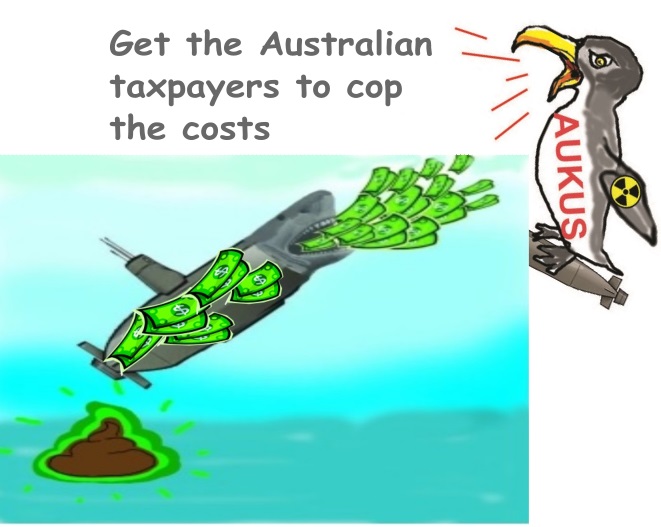
Finally, the Pentagon is also asking Congress for permission to accept Australian payments to bolster the U.S. submarine industrial base. Australia has offered to make an undisclosed sum of investments in the U.S. submarine industrial base as part of AUKUS.
Defense News, By Bryant Harris and Megan Eckstein 17 May 23
WASHINGTON — The U.S. Department of Defense asked Congress to authorize the transfer of nuclear-powered submarines to Australia as part of the trilateral AUKUS agreement with the U.K.
Three legislative proposals, submitted on May 2 and first posted online Tuesday, would greenlight the sale of two Virginia-class submarines to Australia, permit the training of Australian nationals for submarine work and allow Canberra to invest in the U.S. submarine industrial base………………
“Importantly, the proposals spell out a clear path forward to facilitate the transfer of Virginia-class submarines to Australia while ensuring we have the necessary authorities to accept the Australian Government’s investments to enhance our submarine industrial base capacity and provide training for Australian personnel.” – Rep. Joe Courtney of Connecticut, the top Democrat on the Armed Services Committee’s sea power panel
AUKUS stipulates that Australia will buy at least three and as many as five Virginia-class submarines in the 2030s as part of phase two of the agreement, giving Congress more than a decade to authorize the sale. This year’s proposal, which the Pentagon hopes will become part of the fiscal 2024 National Defense Authorization Act, asks that Congress approve just two of those submarines “without a deadline to consummate the transfers and without specifying the specific vessels to be transferred.”
The proposal argues that this “small amount of flexibility is necessary” since the transfers depend on Australian readiness to operate the submarines, which will involve developing Australia’s submarine industrial base through training and appropriate shipyard infrastructure.
To that end, a second legislative proposal would authorize U.S. defense service exports directly to Australia’s private sector in order to train its own submarine workers……..
Finally, the Pentagon is also asking Congress for permission to accept Australian payments to bolster the U.S. submarine industrial base. Australia has offered to make an undisclosed sum of investments in the U.S. submarine industrial base as part of AUKUS.
The Pentagon states in the legislative proposal that those funds would be used to “add a significant number of trade workers” that will help address “the significant overhaul backlog” for the Virginia-class submarine. Australian monies would also be used for “advance purchasing of components and materials that are known to be replacement items for submarine overhauls” and “outsourcing less complex sustainment work to local contractors.”
Congress is also making its own investments to expand the U.S. submarine industrial base as the Navy ultimately aims to build two Virginia-class and one Columbia-class submarines per year. Courtney helped secure $541 million in submarine supplier development and $207 million in workforce development initiatives as part of the FY 23 government funding bill.
Austal USA, the American subsidiary of Australia-based Austal, plans to open a new facility at its shipyard in Mobile, Alabama to begin construction on nuclear submarine modules for General Dynamics’ Electric Boat shipyard in Connecticut, which produces both Virginia and Columbia-class submarines. Austal expects it will need 1,000 new hires in Mobile to staff that facility.
At Electric Boat, the prime contractor for the Virginia- and Columbia-class submarine programs, the hiring need will be even greater. The company currently employs more than 19,000 people, after hiring 3,700 new workers in 2022, according to local newspaper The Day. But the company needs to hire 5,750 new workers this year, to manage attrition and to help grow the workforce to about 22,000 to handle the increased workload.
The legislative proposal notes that Australian funds “would be applied to recruitment, training, incentivizing, and retention of key skilled trades, engineering and planning personnel in both nuclear and non-nuclear disciplines that are required by the additional AUKUS workload.” https://www.defensenews.com/congress/2023/05/17/pentagon-seeks-authority-to-transfer-nuclear-submarines-to-australia/
At Hiroshima, Leaders Should Choose to End All Nuclear Threats

In January 2023, Biden and Kishida made a joint statement “We state unequivocally that any use of a nuclear weapon by Russia in Ukraine would be an act of hostility against humanity and unjustifiable in any way.”
The caveat that such a judgment applies only to Russia in Ukraine is stunning.
Facing Russia’s nuclear threats, the U.S. and its allies must not whitewash their own
Scientific American By Zia Mian, Daryl G. Kimball on May 17, 2023
At a meeting of the G7 nations this week in Hiroshima, the first city destroyed by the bomb, President Joe Biden and other leaders have a chance to begin addressing the long-standing problem of states threatening to use nuclear weapons. Russia’s nuclear threats of the past year in support of its invasion of Ukraine have flashed for all to see a core purpose of nuclear arsenals: coercion and intimidation. At this historic gathering, Biden and his counterparts need to act on Japanese Prime Minister Fumio Kishida’s proposal that the G7 “demonstrate a firm commitment to absolutely reject the threat or use of nuclear weapons.”
To do so, the U.S. and its allies must acknowledge that any and all threats to use nuclear weapons, not just Russia’s, are unacceptable.
It is well known Hiroshima was destroyed without warning on August 6, 1945 by the U.S. Less familiar is that this devastation was followed that day by the first threat to use nuclear weapons. President Harry Truman threatened Japan “If they do not now accept our terms they may expect a rain of ruin from the air, the likes of which has never been seen on this earth.” Another threat came on August 9 when a second atomic bomb had destroyed Nagasaki; Truman announced “We shall continue to use it until we completely destroy Japan’s power to make war. Only a Japanese surrender will stop us.”
All G7 states (Canada, France, Germany, Italy, Japan, the U.K. and the U.S.) have condemned President Putin’s February, April and September 2022 threats of Russian nuclear weapons use. But like Russia those states themselves have chosen military strategies that depend on threats of nuclear weapon use.
A statement from the G7 nuclear nonproliferation directors group, issued April 17, predictably asserts that, unlike Russia, their nations’ security policies “are based on the understanding that nuclear weapons, for as long as they exist, should serve defensive purposes, deter aggression, and prevent war and coercion.” Just as predictably, Russian officials claim Putin’s comments are simply a deterrent against direct U.S. or NATO military intervention in Ukraine.
Regardless of intent, the underlying nuclear logic is the same, however. It was described by defense intellectual Daniel Ellsberg in a famous 1959 lecture “The Theory and Practice of Blackmail.” Ellsberg observed:
“Nuclear weapons have one preeminent use in politics: to support threats. These threats recommend themselves, almost inescapably, as tools of policy not only to expansionist powers but to status quo nations.” He expounded: “Call it blackmail, call it deterrence, call both … coercion: the art of influencing the behavior of others by threats. The key here of course is that with nuclear weapons we are dealing with threats of force.”
…………………………………………….. In 2017, backed by NGOs, a group of 122 nations at the U.N. agreed to the Treaty on the Prohibition of Nuclear Weapons (TPNW). Among its binding obligations is “never under any circumstances to … use or threaten to use nuclear weapons or other nuclear explosive devices.” There are almost 100 signatories to the treaty so far. No nuclear-armed state has signed.
…………………….. In June 2022, at their first meeting, TPNW states declared that “any use or threat of use of nuclear weapons is a violation of international law, including the Charter of the United Nations,” and condemned “unequivocally any and all nuclear threats, whether they be explicit or implicit and irrespective of the circumstances.”
The scale of destruction implied by threats to use nuclear weapons is beyond any moral measure.
In January 2023, Biden and Kishida made a joint statement “We state unequivocally that any use of a nuclear weapon by Russia in Ukraine would be an act of hostility against humanity and unjustifiable in any way.”
The caveat that such a judgment applies only to Russia in Ukraine is stunning.
If we are to avert catastrophe, the nuclear use policies of the United States and the other nuclear-armed states need to acknowledge that any and all threats to use nuclear weapons need to be treated alike. G7 leaders should look to a statement organized by the Physicists Coalition for Nuclear Threat Reduction, endorsed by more than 1,000 scientists, which states that “any threat to use nuclear weapons, at any time and under any circumstances, is extremely dangerous and totally unacceptable.” It goes on to “call on all people and governments everywhere to clearly condemn all nuclear threats, explicit or implicit, and any use of such weapons.”
As a first step, President Biden, along with the other G7 leaders, all of whose countries either have nuclear weapons or rely on U.S. nuclear weapons being used on their behalf, should declare that the U.S. and its allies will act as they demand others do, and will accept being judged by the same standards they apply to others. They must accept, without any self-serving caveat, that any use of a nuclear weapon, by any state, under any circumstances, would be “an act of hostility against humanity and unjustifiable in any way.”
If G7 leaders choose, the Hiroshima summit can mark their turning away from seeking to justify their own nuclear threats as acceptable tools of policy. It is time for a human-centered standard for judging nuclear threats, one that holds regardless of those making the threats, their targets or the political goal. https://www.scientificamerican.com/article/at-hiroshima-leaders-should-choose-to-end-all-nuclear-threats/
France to speed up nuclear power deployment
By Davide Basso | EURACTIV.fr 17 May 23
A bill to speed up the construction of new nuclear reactors was approved by the French parliament on Tuesday (16 May), with the government hailing it as an environmental step forward.
Lawmakers on Tuesday validated the bill to accelerate the construction of new nuclear reactors. The compromise text struck between the National Assembly and the Senate was voted by 339 votes to 399.
MPs from the majority (Renaissance, Horizons, Modem), the independents (LIOT), the right (Les Républicains) and the extreme right (Rassemblement national) voted in favour of the text, in addition to a dozen communist MPs.
Among the opponents, the Greens, the radical left (La France insoumise) and a handful of Communists voted “against” while the Socialists abstained.
Once it comes into force, the new law will speed up the construction of new nuclear reactors by simplifying the required administrative procedures and planning documents. The Energy Transition Ministry expects future construction times to be reduced by at least two years.
In addition, a 50% cap on nuclear power’s share of France’s electricity mix was removed. The text also provides for tightening the penalties for those who illegally enter a nuclear power plant, now set at a maximum of two years imprisonment.
….. Environmental NGOs denounced “a law that is disconnected from ecological and climatic imperatives”. Greenpeace, in particular, questioned “the slowness of the construction of nuclear reactors”, as well as “the safety” and “the conflicts of water use” that are to be expected………………. https://www.euractiv.com/section/politics/news/france-to-speed-up-nuclear-power-deployment/
1 This Month



Shut down the radiation-damaged Heysham nuclear reactors now
To see nuclear-related stories in greater depth and intensity – go to https://nuclearinformation.wordpress.com

Say No to NASA’s Reckless Nuclear Reactor on the Moon
Say No to NASA’s Reckless Nuclear Reactor on the Moon
-
Archives
- October 2026 (256)
- September 2026 (339)
- August 2026 (330)
- July 2026 (355)
- June 2026 (287)
- May 2026 (306)
- April 2026 (356)
- March 2026 (251)
- February 2026 (267)
- January 2026 (308)
- December 2025 (358)
- November 2025 (359)
-
Categories
- 1
- 1 NUCLEAR ISSUES
- business and costs
- climate change
- culture and arts
- ENERGY
- environment
- health
- history
- indigenous issues
- Legal
- marketing of nuclear
- media
- opposition to nuclear
- PERSONAL STORIES
- politics
- politics international
- Religion and ethics
- safety
- secrets,lies and civil liberties
- spinbuster
- technology
- Uranium
- wastes
- weapons and war
- Women
- 2 WORLD
- ACTION
- AFRICA
- Atrocities
- AUSTRALIA
- Christina's notes
- Christina's themes
- culture and arts
- Events
- Fuk 2022
- Fuk 2023
- Fukushima 2017
- Fukushima 2018
- fukushima 2019
- Fukushima 2020
- Fukushima 2021
- general
- global warming
- Humour (God we need it)
- Nuclear
- RARE EARTHS
- Reference
- resources – print
- Resources -audiovicual
- Weekly Newsletter
- World
- World Nuclear
- YouTube
-
RSS
Entries RSS
Comments RSS

