Canada’s controversial nuclear waste disposal design for Chalk River

How safe is the Ottawa River from nuclear waste? Canada’s National Observer April 8th 2019 “……..Nuclear disposal site design
The proposed Near Surface Disposal Facility is not new technology, according to its proponents. The same technology set for Chalk River has also been adopted in the U.K. and Belgium, the company says.
The key component is an engineered containment mound. It is contained by a large cover system designed to keep out rain and other elements. Below the cover, a liner system is meant to collect contaminated water — and alert monitoring systems to leaks — and direct the effluent to treatment systems.
The timeline for the project is monumental. The mound will be filled with low-level nuclear waste that is currently held on site at Chalk River, as well as a small amount of waste that will be transported to the facility from other locations such as hospitals, universities and other nuclear facilities in Canada. Five per cent of the total waste will come from Whiteshell Laboratories in Manitoba, which is undergoing its own decommissioning process.

The waste in the mound would be split into cells according to contaminants or time for decay. A temporary cover would allow time to add radioactive waste for 50 years. When the site is full it would be permanently sealed.
The site would be monitored for 300 years after the permanent cover is installed at which point the radioactive material will have decayed. The facility is designed to last 550 years, the company says.
The radioactive waste inside the mound will break down. The half-life for tritium is around 12 years, and the half-life for strontium-90 is about 29 years. That means half of the tritium or strontium stored on the site decays during that period, with half of the remainder taking a further 12 or 29 years to decay. The process keeps repeating itself until ultimately all the material has broken down.
The engineered containment mound is CNL’s preferred nuclear waste storage option. In its draft environmental impact statement, CNL includes a discussion of the various other types of disposal options and techniques including deep-underground repositories, above-ground cement vaults and different on-and off-site locations.
In an opinion article in the Ottawa Citizen in April 2018, Eva Schacherl, a former executive director of the Canadian Environmental Network, argued the project was “the wrong plan at the wrong site,” and a vault buried hundreds of metres deep below the grounds should have been chosen.
In a draft environmental assessment, the lab did not conduct geological tests far below the surface. Although the deep-underground method provides additional protections against leakage, CNL says there is not enough evidence to outweigh the benefits of its chosen model.
A deep-underground vault would be much more expensive to monitor and maintain over its life cycle, according to CNL’s analysis. CNL has made several changes to the proposal since public consultations began in May 2016, in response to some of the hundreds of initial comments by the public during an ongoing environmental assessment.
Ottawa Riverkeeper advocates a type of facility that does not come into contact with water. “We want a solution that will safeguard all species from the radioactive waste that is currently onsite at Chalk River and Rolphton,” Riverkeeper said in a Nov. 1 update. “We would like to see Canada look to countries like Finland who have constructed siloed geological repositories to safeguard all levels of radioactive waste. We want a disposal facility where radioactive waste does not come into contact with water.”
CNL acknowledged during an interview for this story that it was not transparent enough during the environmental impact statement process in explaining why the particular location near the Ottawa River on the CRL site was the best choice.
Subsequent studies, analyses and updates to the document are part of the delay that will push the delivery of CNL’s final environmental impact statement to the CNSC for approval back to around spring 2020, according to the company. The delay was also caused by technical questions from provincial and government agencies that have required additional study, including a notable point where nuclear waste is discharged into Perch Lake.
The public comment process has led to other significant changes to the project design. The original project was meant to hold predominantly low-level intermediate waste, but also allowed for about one per cent intermediate-level waste or mixed wastes. The company has now decided to restrict the waste going into the storage facility to only the low-level category.
The change was purely driven by feedback from the community, the company representatives said. The site was never intended to hold high-level waste, such as spent nuclear fuel from a reactor.
“It’s in response to concerns from the public or interest groups,” said Meggan Vickerd, director of the nuclear waste facility project for CNL. “Intermediate-level waste was only a fraction of the inventory, plus it was not all of the intermediate-level waste, so we knew we still needed another facility.”
Controversy over near-surface disposal
The company says the project prompted hundreds of public comments during its opening consultation phase. Pat Quinn, CNL’s communications director, says the company is dedicated to transparency and open communication.
Activist organizations and Indigenous groups have raised a number of red flags about the suggested nuclear waste site and the overall security of decommissioning, including its construction about one kilometre away from the river.
Riverkeeper has also emphasized that despite the Canadian government’s rhetoric about the importance of a Nation to Nation relationship, “there has been no consultation with Indigenous Governments to develop a radioactive waste policy on terms that would be acceptable to Indigenous peoples.
“Likewise, there has been no consultation with the Algonquin Anishinaabe people about consolidating all federal radioactive wastes within their traditional, unsurrendered territory.”
Some local farmers have also expressed concern. One is Taylor Hanrath, an organic pork farmer and the owner of Butternutty Farm who lives downstream in Pembroke.
“If there’s a leak at all, in some way, shape, or form it would have the pretty big Ottawa River right beside it to transport it quickly and there’s always going to be the potential for human error, on top of a possible earthquake or tornado.” Hanrath said. “Even right now I don’t know what the plan would be for my farm if a leak were to happen at the current site.”
………The International Atomic Energy Agency indicates better ways to store nuclear waste are to bury it in “caverns, vaults, or silos, at least a few tens of metres below ground level, and up to a few hundred metres below ground level.” It does state, however, that a near-surface facility would be sufficient for low-level waste, such as decommissioned structures, old laboratory materials and soil.
Chalk River: Radioactive Wastes and the Honour of the Crown
Background: May 9, 2023
A consortium of multinational corporations, operating under the banner CNL (Canadian Nuclear Laboratories), is contracted to manage all of the federal government’s nuclear facilities. The contract obliges CNL to “reduce the liability” associated with the multibillion dollar legacy of radioactive wastes created in the name of the Crown by uranium processing (mainly at Port Hope, Ontario) and by nuclear fission (mainly at Chalk River). CNL has been given close to a billion dollars a year for the last five years from Canadian taxpayers.
The Port Hope and Chalk River nuclear facilities are outgrowths of the World War II Atomic Bomb project and the subsequent Cold War era. Canada sold uranium and plutonium almost exclusively for nuclear weapons use from 1941 to 1965. In a very real sense, the “legacy radioactive wastes” at these two sites are in large part leftovers of the American bomb program and the Cold War arms buildup.
How does CNL propose to deal with the radioactive legacy of the nuclear age? At Chalk River, CNL proposes to build a huge earthen mound of “low-level” radioactive and toxic chemical wastes within one kilometre of the Ottawa River. The low-level waste is a minute fraction of the total radio-toxic burden at Chalk River, which includes highly radioactive reactor cores, tanks of reprocessing liquid, plutonium handling facilities, and large quantities of high-level and intermediate-level radioactive wastes for which there is as yet no plan at all. The mound is a cheap and convenient way of dealign with the most voluminous material, clearing the decks for building new facilities that will produce even more challenging forms of nuclear wastes, while ignoring the bulk of the radioactivity that afflicts this “Nuclear Sacrifice Zone”.
The engineered mound – a glorified landfall 5 to 7 stories high – will hold a million cubic metres of toxic waste, on a site that drains into Perch Lake and then into the Ottawa River. Called a “Near Surface Disposal Facility” (NSDF), this megadump is planned to be built on lthe unsurrendered territory of several Algonquin communities that have inhabited the Ottawa Valley for thousands of years.
Canada’s nuclear regulator, the Canadian Nuclear Safety Commission (CNSC) conducted an environmental assessment of the NSDF and held a week of public hearings in February 2022. Since then, two Algonquin communities – the Keboawek First Nation (KFN) and the Kitigan Zibi Anishinabeg (KZA) community, have demonstrated their strong opposition to the proposed megadump, as have more than a hundred communities downstream from Chalk River, including the 18 municipalities comprising the Montreal City Agglomeration Council. KFN has done outstanding work in documenting several key species inhabiting the proposed site that have been totally ignored by the environmental assessment process.CNL is now asking CNSC to grant CNL a licence amendment to prepare the contested site for the NSDF.
Public hearings will be held remotely on June 27 with no opportunity for intervenors to appear in person before the Commission, despite strong requests from the Indigenous communities to allow face-to-face meetings.
All those who intervened in the February 2022 hearings are allowed no more than 5000 words to give their final input on this issue before CNSC renders its decision. Here is the final submission from the Canadian Coalition for Nuclear Responsibility.
Radioactive Wastes and the Honour of the Crown
Final report submitted to the Canadian Nuclear Safety Commission
by Gordon Edwards, president, Canadian Coalition for Nuclear Responsibility
www.ccnr.org/CCNR_CNSC_NSDF_final_2023.pdf
Contents –
1. The Honour of the Crown
2. Protecting the Environment & the Health and Safety of Persons
3. Communicating with Future Genera>ons
4. Safety Culture and the Justification Principle
5. A Tale of Two Dumps
6. List of radioactive poisons
Water levels at Zaporizhzhia nuclear plant ‘critical’ after dam collapsesin Ukraine.
Water levels at Zaporizhzhia nuclear plant ‘critical’ after dam collapses
in Ukraine. Water levels have fallen below a critical point for being able
to supply cooling water to the Zaporizhzhia nuclear power station, the
operator of the Kakhovka dam in Ukraine has said.
Mirror 8th June 2023
https://www.mirror.co.uk/news/world-news/breaking-water-levels-zaporizhzhia-nuclear-30109697
US presidential candidate Nikki Haley says that arming Ukraine is “preventing war”
US presidential candidate Nikki Haley insists on WW3 if Ukraine loses, 9 June 23, https://www.rt.com/news/577539-nikki-haley-ukraine-ww3-cheerleading/
The Republican presidential candidate explained that the only way to prevent war was to “send a message” by fighting one
Allowing Ukraine to lose to Russia on the battlefield will unleash world war, according to US Republican presidential candidate Nikki Haley. The former South Carolina governor told a town hall audience in Iowa on Sunday that arming Kiev was all about “preventing war” by “sending a message” to America’s rivals.
“When Ukraine wins, that sends a message to China with Taiwan, it sends a message to Iran that wants to build a bomb, it sends a message to North Korea testing ballistic missiles, it sends a message to Russia that it’s over.”
“It is in the best interests of America, it is in the best interests of our national security for Ukraine to win. We have to see this through, we have to finish it,” Haley declared.
Regarding how the war might finish, Haley was less forthcoming. “It would end in a day if Russia would pull out,” she suggested. “If Ukraine pulls out, then we’re all looking at world war.” To prevent that, she explained, Kiev needed weapons – lots of them.
“A win for Ukraine is a win for all of us, because tyrants tell us exactly what they’re gonna do,” Haley continued, claiming “Russia said Poland and the Baltics are next,” should Ukraine fall. “If that happens, we’re looking at a world war,” she repeated.
While much has been written about the possibility of a Russian invasion of Poland or the Baltic states, even most US experts admit these are unlikely. Invading any of those countries would trigger Article 5, NATO’s mutual-defense clause, turning a conflict many have described as a proxy war between Moscow and Brussels into a direct war between nuclear powers.
Haley has been quick to set herself apart on foreign policy matters from Republican frontrunner Donald Trump, who quipped earlier this year that it was the US, not Russia, that needed regime change, and from challenger Ron DeSantis, who downplayed the conflict in Ukraine as a “territorial dispute.”
During the town hall, she again scoffed at the notion of remaining neutral in the conflict, insisting “This is a war about freedom and it’s one we have to win.”
While Haley served as US ambassador to the United Nations under Trump, she made no secret of her interventionist leanings, even announcing an unexpected round of sanctions against Russia that the White House then had to retract. She has urged the Biden administration to give in to Ukrainian President Vladimir Zelensky’s demands for F-16 fighter jets for months and impose even more sanctions, insisting Washington is too soft on Moscow.
The Zaporizhzhia nuclear plant used water from the destroyed Nova Kakhovka dam. What happens now?
By Felicity Ripper with wires, ABC, 9 June 23
One of the world’s largest nuclear power plants relies on a water reservoir linked to the destroyed Nova Kakhovka dam.
So what does that mean for the Zaporizhzhia Nuclear Power Plant?
What is the relationship between Nova Kakhovka dam and the Zaporizhzhia plant?
The main line of water used at the plant is pumped out of the reservoir above the dam, and up to the site.
This reservoir is currently draining because the downstream dam has collapsed………………………
But isn’t the plant in shutdown?
Zaporizhzhia was placed in a cold shutdown in September 2022.
While it doesn’t need the large amounts of water it would while operating normally, it still needs some supplies for cooling.
Dwindling water supplies also complicate any future prospects of restarting the power plant.
Has the plant lost its water supply from the dam reservoir?
Not yet.
International Atomic Energy Agency (IAEA) chief Rafael Grossi said water could still be pumped out for a few days after the dam’s collapse.
“The rate may reduce as the water lowers,” he said.
Mr Grossi on Tuesday said that the water in the reservoir was sitting at 16.5m, and once it reached 2.7m it could no longer be pumped out.
He said while there was no reason for panic, the plant was facing a serious situation. ………………………….. https://www.abc.net.au/news/2023-06-09/explainer-zaporizhzhia-nuclear-nova-kakhovka/102454194
Are We Back to Nuclear Brinkmanship for Good?
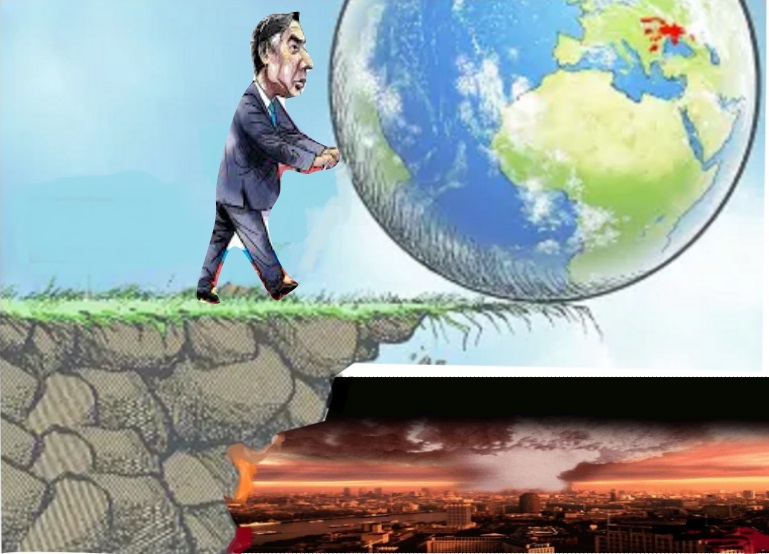
It’s not just Putin who has re-embraced nuclear threats. The U.S. and China are also cracking open the door.
By Michael Hirsh, a columnist for Foreign Policy. https://foreignpolicy.com/2023/06/09/nuclear-brinksmanship-arms-control-jake-sullivan-putin-china-russia/
Sixty years ago this week, U.S. President John F. Kennedy gave a speech at American University that transformed the nature of the Cold War, turning the insanity of nuclear brinkmanship into the relative safety of negotiation. Coming just eight months after the Cuban Missile Crisis brought the world harrowingly close to armageddon, Kennedy noted the “ironic but accurate fact that the two strongest powers [on earth] are the two in the most danger of devastation.”
That, he said, had to stop—not to achieve some “infinite concept of universal peace and goodwill” but rather to secure “a more practical, more attainable peace.”
In an act of political courage for the time, Kennedy then delivered a unilateral concession to Moscow, saying the United States “does not propose to conduct nuclear tests in the atmosphere so long as other states do not do so.”
Astonishingly, given the hostility between the United States and the Soviet Union, the Soviet government broadcast Kennedy’s June 10, 1963, address in its entirety, and it was published by the Soviet newspapers Izvestia and Pravda. On July 25, 1963, after only 12 days of negotiations, a nuclear test ban treaty was signed.
Where is the political courage of yesteryear?
In a speech at the Arms Control Association’s annual conference on June 2, U.S. National Security Advisor Jake Sullivan took a very different tack. Sullivan signaled—though he likely didn’t intend to—that there is little hope for restraining the threat of nuclear war in the foreseeable future. Sullivan conceded that there was no meaningful U.S. communication with either Russia or China, that Washington was engaging in tit-for-tat reprisals against Moscow by suspending day-to-day missile operations notification, and that the United States would continue to push for military dominance over both Russia and China for decades to come.
Sullivan, rightly blaming Russian President Vladimir Putin for bringing nuclear brinkmanship back into the conventional war equation, said “the cracks in our post-Cold War nuclear foundation are substantial and they are deep.” But in the end, Matthew Bunn, a nuclear expert at Harvard University, told Foreign Policy, Sullivan “offered nothing, no proposals.”
To be fair, the Biden administration is already being criticized by Republicans for proposing unconditional nuclear talks with both Russia and China. Indeed, U.S. President Joe Biden is clearly avoiding what may be his biggest foreign-policy fear leading up to the 2024 presidential election: the perception of being soft on China. That sort of political pressure at home, combined with Chinese President Xi Jinping’s apparent determination to rapidly build up his nuclear capability, suggests a long-term arms race.
Yet Sullivan did little to ameliorate those fears last week. On the contrary, he announced that the United States is pursuing an arms race in order to prevent an arms race. “Together with our NATO allies, we’ve been laser-focused on modernizing the alliance’s nuclear capabilities,” Sullivan said, including “certifying our F-35 aircraft to be able to deliver modern nuclear gravity bombs. … Together, these modernization efforts will ensure our deterrent capabilities remain secure and strong as we head into the 2030s—when the United States will need to deter two near-peer nuclear powers for the first time in its history.”
Sullivan denied that he was calling for a new arms race, contending the Biden administration was taking a “better” approach rather than a “more” one. “The United States does not need to increase our nuclear forces to outnumber the combined total of our competitors in order to successfully deter them,” he said. But Sullivan was basically telling the Chinese and Russians that Washington will continue to insist on precisely what both Beijing and Moscow have said they can no longer accept: U.S. hegemony in the global system.
As a result, Bunn said, “I’m fairly worried that we have a level of hostility that is the worst since the Cuban Missile Crisis.”
Patrick Lawrence: Neo-Nazis in Ukraine? No, Yes, No–Yes
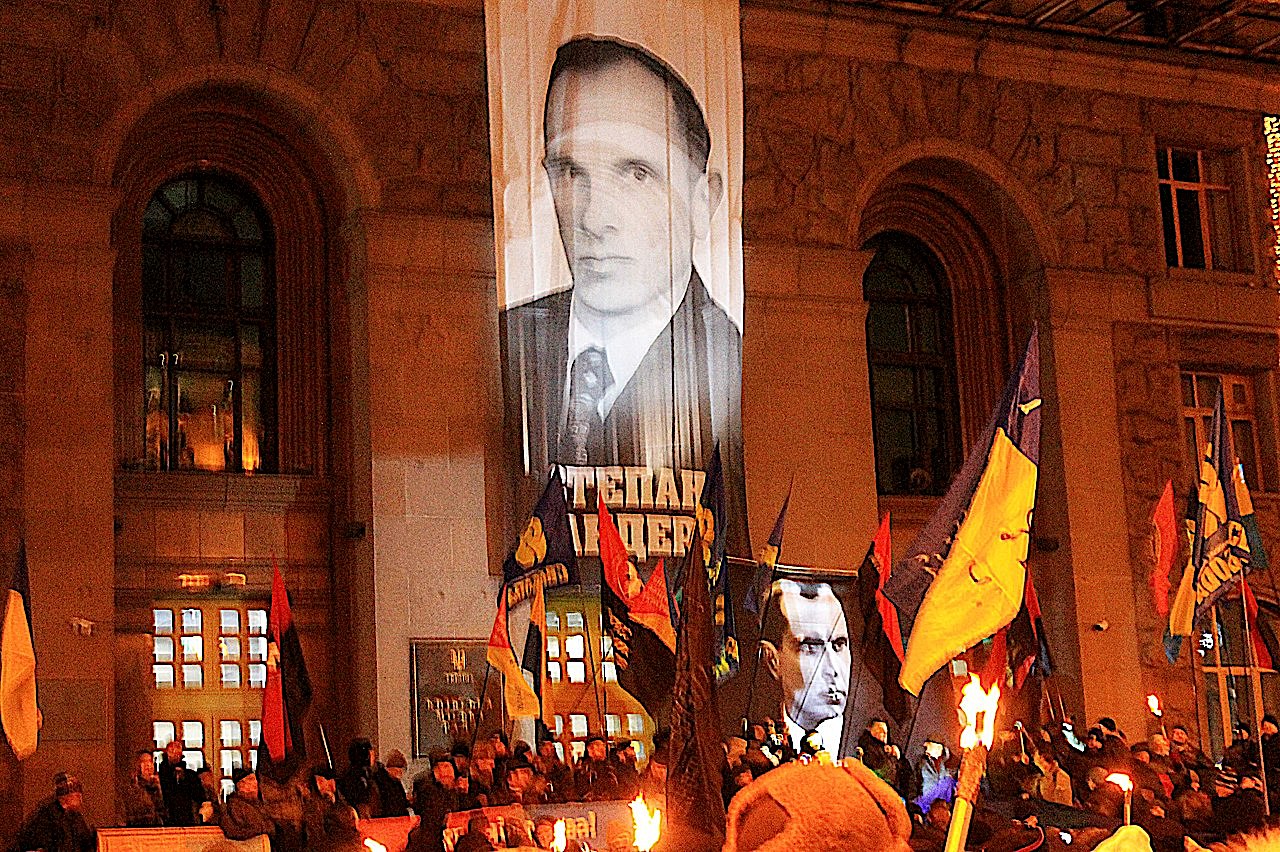
Stepan Bandera torchlight parade in Kiev, Jan. 1, 2020. (A1/Wikimedia Commons)
As is well-known and documented, the neo–Nazis who infest the Armed Forces of Ukraine, the AFU — among many other national institutions — have made idols of such figures as Stepan Bandera, the freakishly murderous nationalist who allied with the Nazi regime during the war.
A New York Times’ reporter’s job this week is to persuade us that all those Ukrainian soldiers wearing Nazi insignia and marching through Kiev in Klan-like torch parades are not what you think.
June 7, 2023, By Patrick Lawrence, Original to ScheerPost
I tell you, serving as a New York Times correspondent these days cannot be easy.
You have to convey utter nonsense to your readers while maintaining a straight face and a serious demeanor.
You have to suggest the Russians may have exploded a drone over the Kremlin, that they may have blown up their own gas pipeline, that their president is an out-of-touch psychotic, that their soldiers in Ukraine are drunkards using faulty equipment, that they attack with “human hordes” (Orientalism, anyone?) and on and on — all the while affecting the gravitas once associated with the traditional “Timesman.” You try it sometime.
………………….. now we have the case of Thomas Gibbons–Neff, a square-jawed former Marine covering the Ukraine war for the Times — strictly to the extent the Kyiv regime permits him to do so, as he explains with admirable honesty. This guy is serious times 10, he and his newspaper want us to know.
Tom’s job this week is to persuade us that all those Ukrainian soldiers wearing Nazi insignia, idolizing Jew-murdering, Russophobic collaborators with the Third Reich, gathering ritually in Nazi-inspired cabals, marching through Kyiv in Klan-like torch parades are not what you think.
Nah, our Tom tells us. They look like neo–Nazis, they act like neo–Nazis, they dress like neo–Nazis, they profess Fascist and neo–Nazi ideologies, they wage this war with the Wehrmacht’s visceral hatred of Russians — O.K., but whyever would you think they are neo–Nazis?
They are just regular guys. They wear the Wolfsangel, the Schwarze sonne, the black sun, the Totenkopf, or Death’s Head — all Nazi symbols — because they are proud of themselves, and these are the kinds of things proud people wear. I was just wearing mine the other day.
The slipping and sliding starts early in “Nazi Symbols on Ukraine’s Front Lines Highlight Thorny Issues of History,” the piece Gibbons–Neff published in Monday’s editions.
He begins with three photographs of neo–Nazi Ukrainian soldiers, SS insignia plainly visible, that the Kyiv regime has posted on social media, “then quietly deleted,” since the Russian intervention began last year.
“The photographs, and their deletions,” Gibbons–Neff writes, “highlight the Ukrainian military’s complicated relationship with Nazi imagery, a relationship forged under both Soviet and German occupation during World War II.”
Complicated relationship with Nazi imagery? Stop right there, Mr. Semper fi. Ukraine’s neo–Nazi problem is not about a few indiscreetly displayed images. Sorry. The Ukrainian army’s “complicated relationship” is with a century of ultra-right ideology drawn from Mussolini’s Fascism and then the German Reich.
As is well-known and documented, the neo–Nazis who infest the Armed Forces of Ukraine, the AFU — among many other national institutions — have made idols of such figures as Stepan Bandera, the freakishly murderous nationalist who allied with the Nazi regime during the war.
This history is a matter of record, as briefly outlined here, but Gibbons–Neff alludes to none of it. It’s merely a matter of poor image-making, you see. In support of this offensive whitewash, Gibbons–Neff has the nerve to quote a source from none other than Bellingcat, which was long, long back exposed as a C.I.A. and MI6 cutout and which is now supported by the Atlantic Council, the NATO–funded, spook-infested think tank based in Washington.
“What worries me, in the Ukrainian context, is that people in Ukraine who are in leadership positions, either they don’t or they’re not willing to acknowledge and understand how these symbols are viewed outside of Ukraine,” a Bellingcat “researcher” named Michael Colborne tells Gibbons–Neff. “I think Ukrainians need to increasingly realize that these images undermine support for the country.”
[Related: Ukraine Parliament Cheers Nazi Collaborator]
Think about that. The presence of Nazi elements in the AFU is not a worry. The worry is merely whether clear signs of Nazi sympathies might cause some members of the Western alliance to decide they no longer want to support Nazi elements in the AFU.
I am reminded of that Public Broadcasting news segment last year, wherein a provincial governor is featured with a portrait of Bandera behind him. PBS simply blurred the photograph and ran the interview with another of the courageous, admirable Ukrainians to which we are regularly treated.
I hardly need remind paying-attention readers that the neo–Nazis-who-are-not-neo–Nazis were for years well-reported as simply neo–Nazis in the years after the U.S.–cultivated coup in 2014.
[Related: Caitlin Johnstone: What MSM Can No Longer Say]
The Times, The Washington Post, PBS, CNN — the whole sorry lot — ran pieces on neo–Nazi elements in the AFU and elsewhere. In March 2018, Reuters published a commentary by Jeff Cohen under the headline “Ukraine’s Neo–Nazi Problem.”
Three months later The Atlantic Council, for heaven’s sake, published a paper, also written by Cohen, titled, “Ukraine’s Got a Real Problem with Far–Right Violence (And no, RT Didn’t Write This Headline).”
I recall, because it was so surprising coming from the council. The original head on that paper was “Ukraine’s Got a Neo–Nazi Problem,” but that version now seems lost to the blur of stealth editing.
Then came the Russian intervention, and Poof! There are no more neo–Nazis in Ukraine.
There are only these errant images that are of no special account.
And to assert there are neo–Nazis in Ukraine — to have some semblance of memory and a capacity to judge what is before one’s eyes — “plays into Russian propaganda,” Gibbons–Neff warns us.
It is to “give fuel to his”— Vladimir Putin’s — “false claims that Ukraine must be de–Nazified.” For good measure Gibbons–Neff gets out the old Volodymyr-Zelensky-is-Jewish chestnut, as if this is proof of… of something or other.
My mind goes to that lovely Donovan lyric from the Scottish singer’s Zen enlightenment phase. Remember “There Is a Mountain?” The famous lines went, “First there is a mountain/ Then there is no mountain/ Then there is.” There were neo–Nazis in Ukraine, then there were no neo–Nazis, and now there are neo–Nazis but they aren’t neo–Nazis after all.
………………………………….. Gibbons–Neff resolutely avoids dilating his lens such that the larger phenomenon comes into view. It all comes down to those three unfortunate insignia in those three deleted photographs.
The parades, the corridors of neo–Nazi flags, the ever-present swastikas, the reenactments of all-night SS rituals, the glorification of Nazis and Nazi collaborators, the Russophobic blood lust: Sure, it can all be explained, except that our Timesman does not go anywhere near any of this.
Gibbons–Neff resolutely avoids dilating his lens such that the larger phenomenon comes into view. It all comes down to those three unfortunate insignia in those three deleted photographs.
The parades, the corridors of neo–Nazi flags, the ever-present swastikas, the reenactments of all-night SS rituals, the glorification of Nazis and Nazi collaborators, the Russophobic blood lust: Sure, it can all be explained, except that our Timesman does not go anywhere near any of this.
“It is, of course, true that, for instance, the Azov Battalion was originally founded by neo–Nazi and far-right groups (as well as many soccer ultra-fans), which brought along with it the typical aesthetics — not only neo–Nazi insignia but also things like Pagan rituals or names like ‘The Black Corps,’ the official newspaper of Nazi Germany’s major paramilitary organization Schutzstaffel (SS).”
But worry not, readers. It is merely an aesthetic, part of a harmless, misunderstood “subculture”:
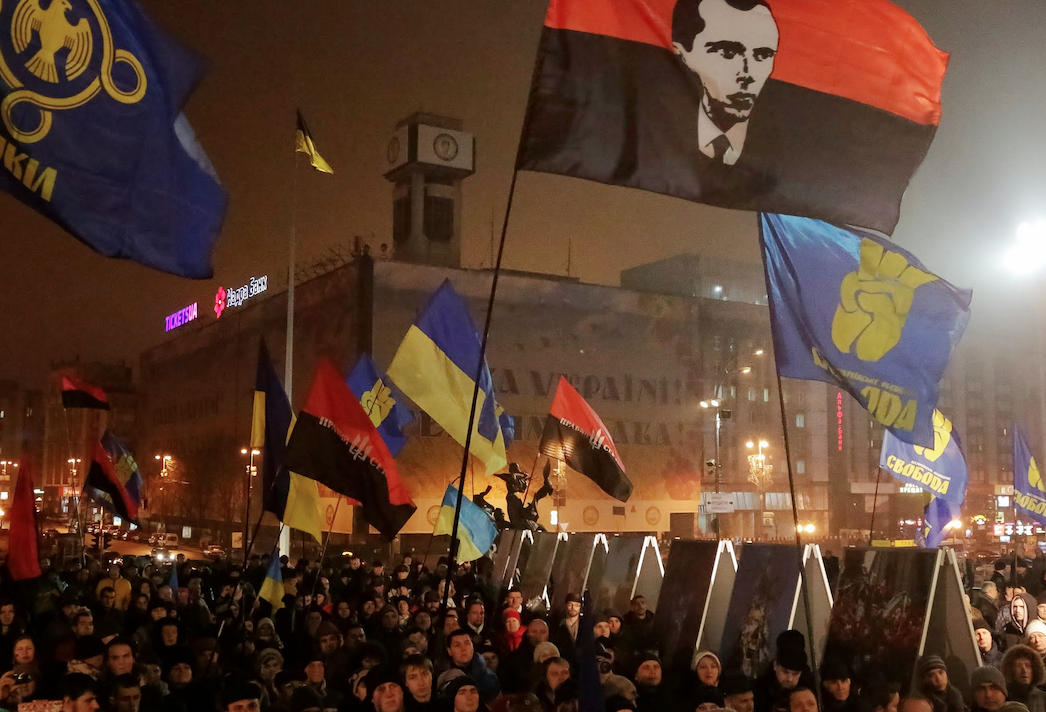
Torchlight procession in honor of the 106 anniversary of the birthday of Stepan Bandera, Kiev, Jan. 1, 2015. (All-Ukrainian Union CC BY 3.0, Wikimedia Commons)
…………………………………………….It is always interesting to ask why a piece such as this appears when it does. Dead silence for months on the neo–Nazi question, and then suddenly a long explainer that does its best to avoid explaining anything. Always interesting to ask, never easy to answer.
It could be that a lot of stuff on these awful people is sifting out from under the carpet. Or maybe something big is on the way and this piece is preemptive. Or maybe either Gibbons–Neff or his editors saw the Ponomarenko piece as an opportunity to dispose of one of the Kyiv regime’s most embarrassing features.
Or maybe the larger context counts here. As mentioned in this space last week, the Times’ Steve Erlanger recently suggested from Brussels that NATO might do a postwar Germany job with Ukraine: Welcome the West of the country to the alliance and let the eastern provinces go for an indefinite period, unification the long-term objective.
Late last week Foreign Affairs ran a fantastical piece by Andriy Zagorodnyuk, formerly a Ukrainian defense minister and now, yes indeedy, a distinguished fellow at the Atlantic Council. It appeared under the headline, “To Protect Europe, Let Ukraine Join NATO—Right Now.” ……………………………………….more https://consortiumnews.com/2023/06/07/patrick-lawrence-neo-nazis-in-ukraine-no-yes-no-yes/?fbclid=IwAR2qutGUc886hz22JN9TvBgmNTXCb-dJwB1TvxPfsnvxCTT6d9yuEoeJOH8
France fully nationalises debt-laden nuclear power group EDF, after its record loss last year
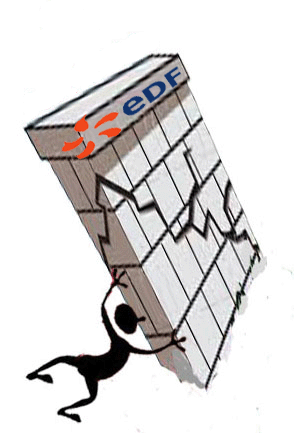
EDF quits Paris stock exchange after full nationalisation. French nuclear
power group EDF (EDF.PA) returns to full state ownership on Thursday with
its de-listing from the Paris stock exchange after it suffered a record
loss last year and saw nuclear output fall to a 34-year low.
The government launched a buyout for the 16% stake it did not already own in EDF in late
2022, stumping up around 10 billion euros ($10.9 billion) to take full
control of the debt-laden operator of Europe’s largest fleet of nuclear
power plants.
Reuters 8th June 2023
https://www.reuters.com/business/energy/french-utility-giant-edfs-history-2022-07-08
Problems ahead for the nuclear industry in the closing and disposal of dead nuclear reactors
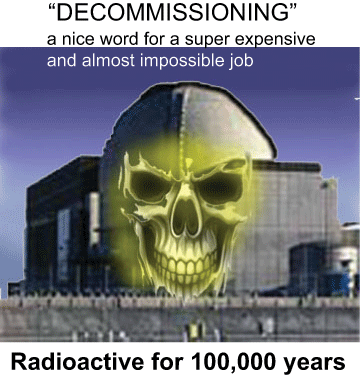
Regions like Europe are expected to face significant growing pains as the
expansion of nuclear generation picks up pace. This will include not only
the challenge of building new facilities, but also how to handle more
widespread decommissioning and maintenance work.
Many existing plants are
ageing, built as long ago as the 1970s with a typical lifespan of around 40
to 50 years. These assets will need to be replaced in the coming decades
for the continent to meet its energy transition goals. The growing need for
decommissioning and maintenance should be met most efficiently and –
above all – safely.
A major challenge that will be increasingly faced by
nuclear projects is the sheer variety of different facilities that were
built from the 1970s onwards. This means that there is no one methodology
that can be applied across all sites. This is not simply a case of
construction and layout, but also the data available – it is quite common
to have to work with a lack of detailed information on older plants built
some 50 years ago or more.
This means that more work is needed early in
each project to ensure the logistic methodologies will work within the
site. This early involvement also gives suppliers the best chance of
developing bespoke equipment within the project timeframe. Problems can
often be solved by addressing them laterally. It can be highly undesirable
or simply impossible to move modules through the plant itself. Instead,
alternative options should be considered such as cutting a hole in the roof
of the containment building, lifting the vessel out using a crane or
gantry, or creating a bespoke engineering solution that has not been used
before.
NS Energy 7th June 2023 https://www.nsenergybusiness.com/features/how-to-ensure-safe-and-effective-nuclear-decommissioning-and-maintenance/
German TV Shows Nazi Symbols on Helmets of Ukraine Soldiers

In a ZDF report on the fragile cease-fire in eastern Ukraine, images were shown of soldiers wearing combat helmets with SS insignia and swastikas.
Sept. 10, 2014, https://www.nbcnews.com/storyline/ukraine-crisis/german-tv-shows-nazi-symbols-helmets-ukraine-soldiers-n198961
Germans were confronted with images of their country’s dark past on Monday night, when German public broadcaster ZDF showed video of Ukrainian soldiers with Nazi symbols on their helmets in its evening newscast. In a report on the fragile cease-fire in eastern Ukraine, Moscow correspondent Bernhard Lichte used pictures of a soldier wearing a combat helmet with the “SS runes” of Hitler’s infamous black-uniformed elite corps. A second soldier was seen with a swastika on his gear. “Volunteer battalions from nearly every political spectrum are reinforcing the government side,” the ZDF correspondent said in his report.
The video was shot last week in Ukraine by a camera team from Norwegian broadcaster TV2. “We were filming a report about Ukraine’s AZOV battalion in the eastern city of Urzuf, when we came across these soldiers,” Oysten Bogen, a correspondent for the private television station, told NBC News. Minutes before the images were taped, Bogen said he had asked a spokesperson whether the battalion had fascist tendencies. “The reply was: absolutely not, we are just Ukrainian nationalists,” Bogen said.
Snowden Warns Today’s Surveillance Technology Makes 2013 Look Like ‘Child’s Play’

“We trusted the government not to screw us,” said Edward Snowden. “But they did. We trusted the tech companies not to take advantage of us. But they did. That is going to happen again, because that is the nature of power.”
by EDITOR, June 9, 2023 https://scheerpost.com/2023/06/09/snowden-warns-todays-surveillance-technology-makes-2013-look-like-childs-play/
By Julia Conley / Common Dreams
With this week marking 10 years since whistleblower Edward Snowden disclosed information to journalists about widespread government spying by United States and British agencies, the former National Security Agency contractor on Thursday joined other advocates in warning that the fight for privacy rights, while making several inroads in the past decade, has grown harder due to major changes in technology.
“If we think about what we saw in 2013 and the capabilities of governments today,” Snowden told The Guardian, “2013 seems like child’s play.”
Snowden said that the advent of commercially available surveillance products such as Ring cameras, Pegasus spyware, and facial recognition technology has posed new dangers.
As Common Dreams has reported, the home security company Ring has faced legal challenges due to security concerns and its products’ vulnerability to hacking, and has faced criticism from rights groups for partnering with more than 1,000 police departments—including some with histories of police violence—and leaving community members vulnerable to harassment or wrongful arrests.
Law enforcement agencies have also begun using facial recognition technology to identify crime suspects despite the fact that the softwareis known to frequently misidentify people of color—leading to the wrongful arrest and detention earlier this year of Randal Reid in Georgia, among other cases.
“Despite calls over the last few years for federal legislation to rein in Big Tech companies, we’ve seen nothing significant in limiting tech companies’ ability to collect data.”
Last month, journalists and civil society groups called for a global moratorium on the sale and transfer of spyware like Pegasus, which has been used to target dozens of journalists in at least 10 countries.
Protecting the public from surveillance “is an ongoing process,” Snowden told The Guardian on Thursday. “And we will have to be working at it for the rest of our lives and our children’s lives and beyond.”
In 2013, Snowden revealed that the U.S. government was broadly monitoring the communications of citizens, sparking a debate over surveillance as well as sustained privacy rights campaigns from groups like Electronic Frontier Foundation (EFF) and Fight for the Future.
“Technology has grown to be enormously influential,” Snowden told The Guardian on Thursday. “We trusted the government not to screw us. But they did. We trusted the tech companies not to take advantage of us. But they did. That is going to happen again, because that is the nature of power.”
Last month ahead of the anniversary of Snowden’s revelations, EFF notedthat some improvements to privacy rights have been made in the past decade, including:
- The sunsetting of Section 215 of the PATRIOT Act, which until 2020 allowed the U.S. government to conduct a dragnet surveillance program that collected billions of phone records;
- The emergence of end-to-end encryption of internet communications, which Snowden noted was “a pipe dream in 2013”;
- The end of the NSA’s bulk collection of internet metadata, including email addresses of senders and recipients; and
- Rulings in countries including South Africa and Germany against bulk data collection.
The group noted that privacy advocates are still pushing Congress to end Section 702 of the Foreign Intelligence Surveillance Act, which permits the warrantless surveillance of Americans’ communications, and “to take privacy seriously,” particularly as tech companies expand spying capabilities.
“Despite calls over the last few years for federal legislation to rein in Big Tech companies, we’ve seen nothing significant in limiting tech companies’ ability to collect data… or regulate biometric surveillance, or close the backdoor that allows the government to buy personal information rather than get a warrant, much less create a new Church Committee to investigate the intelligence community’s overreaches,” wrote EFF senior policy analyst Matthew Guariglia, executive director Cindy Cohn, and assistant director Andrew Crocker. “It’s why so many cities and states have had to take it upon themselves to ban face recognition or predictive policing, or pass laws to protect consumer privacy and stop biometric data collection without consent.”
“It’s been 10 years since the Snowden revelations,” they added, “and Congress needs to wake up and finally pass some legislation that actually protects our privacy, from companies as well as from the NSA directly.”
Timeline: The history of radioactive contamination in St. Louis County
The long history of radioactive contamination in St. Louis County began with the Manhattan Project during World War II.
5 on Your Side, Clarissa Cowley, June 8, 2023
FLORISSANT, Mo. — Jana Elementary School has been in the spotlight for months after conflicting reports regarding radioactive pollution at the school. At its root is nearby Coldwater Creek, which was contaminated for years by improperly stored nuclear waste.
In the months since an independent report showed high levels of radioactive lead at the school, parents and community members have called for action to clean up the pollution, and some families said they are even moving out of their homes and away from the Hazelwood School District.
Now the U.S. Army Corps of Engineers planned to hold a public meeting Thursday night at Jana Elementary School after it made public the final results of its testing, which conversely found no radiological concerns at the school.
5 On Your Side has created a timeline of the decades-long saga leading up to this point, citing public documents as well as our own records and reporting.
The details below include information about the atomic waste illegally dumped in the Bridgeton Landfill, which sits inside the West Lake Landfill site off St. Charles Rock Road. It was a dumpsite for radioactive material following World War II, and in 2010, a fire broke out underground not far from that dump site that is still burning. In addition, this timeline breaks down the history of chemical pollution alongside Coldwater Creek near Jana Elementary School.
Timeline:
1940
- The Manhattan Project, an American-led effort during World War II to develop a functional atomic weapon, is officially created. The Mallinckrodt Chemical Works plant in St. Louis begins processing uranium oxide used by the Manhattan Project.
- 1947
- Waste from the uranium oxide production is taken and stored at a site north of St. Louis Lambert International Airport from 1947 until the late 1960s.
- 957
- Mallinckrodt moves uranium processing to a Weldon Spring facility, where it would continue until 1966.
- 1960s
- The toxic waste is purchased and moved from the airport site to a site half a mile away on Latty Avenue. This site and the airport site were located near 19-mile-long Coldwater Creek. Radioactive waste would contaminate the creek, which would then carry the contamination into north St. Louis County.
- 1973
- Atomic waste is illegally dumped in the West Lake Landfill.
- A long-time employee of the Mallinckrodt plant, who took radioactive waste to Coldwater Creek in Styrofoam containers in an open-air truck, dies of brain cancer.
- The EPA takes over West Lake Landfill as a Superfund Site.
- 2004
- Mallinckrodt employees, who worked with uranium used in nuclear weapon manufacturing, become eligible for compensation in Weldon Spring and St. Louis. Workers had to prove how much exposure they had to radiation while working for the Mallinckrodt facility.
- 2010
- A smoldering underground fire is found at the Bridgeton Landfill, raising concerns it would threaten the nearby radioactive material.
- Families and workers around the Bridgeton Landfill are burdened by smelly fumes that were emitting from the fire still burning underground. The smoldering accelerated the decay of solid waste at the site, causing excessive gas release and powerful odors that many living nearby said made them sick.
- 2012
- The Centers for Disease Control and Prevention (CDC) said the United States Army Corps of Engineers (USACE) began a detailed investigation of Coldwater Creek and its floodplain areas in October 2012, working downstream from the historical source areas.
- 2013
- Three years after the underground smoldering started at the landfill, then-Attorney General Chris Koster files a lawsuit against Republic Services over ongoing concerns.
…………………………………………………….January 2022
- The Army Corps of Engineers notified the district that there was low-level radioactive pollution at Coldwater Creek, which is on the edge of Jana Elementary’s property boundary. The letter also said the contamination did not pose an immediate risk. The Corps had previously found low-level radioactive contamination on the banks of Coldwater Creek in its soil samples.
- March 2022
- The EPA’s plan for a $205 million clean-up project at Bridgeton’s West Lake landfill is delayed after finding more extensive radioactive waste.
…………………………August 2022: Several details regarding the levels of contamination begin to come to light. Parents are notified that soil sampling showed a presence of low-level radioactive contamination on the banks of Coldwater Creek. The amount of toxins found around Jana Elementary and the two landfills (Bridgeton and West Lake) had to reach a certain threshold, according to CDC guidelines. Based on these findings, parents became concerned about exposure and health risk.
…………………………………………………………………..June 8, 2023
- The Army Corps of Engineers planned to hold a public meeting to discuss the findings of all three reports with the community.
All Army Corps of Engineers reports can be found here.
World Ocean Day appeal to international bodies over Fukushima dump plan

Nuclear Free Local Authorities 8 June 23
Today (8 June) is celebrated the world over as UN World Ocean Day. The UK/Ireland Nuclear Free Local Authorities have chosen this day to make a final appeal to the International Maritime Organisation and the United Nations to intercede to stop the Japanese Government and nuclear industry from committing a criminal folly.
For the Japanese Government and executives at Tokyo Electric Power (TEPCO) which formerly operated the Fukushima nuclear power plant, plan imminently to dump well over one million tonnes of radioactive water into the Pacific Ocean. This water has been used to cool the reactors at the plant which were destroyed by an earthquake and tsunami in March 2011. The radioactive water has been stored on site in large drums; now there are plans to start to discharge the water out to sea through a pipeline especially built for this purpose.
Although the water has been ‘treated’ this cannot remove the radioactive tritium that is present that if inhaled or ingested can become fatal to marine life and ultimately to any humans who come into contact with it.
Councillor Lawrence O’Neill, Chair of the UK/Ireland Nuclear Free Local Authorities, said: “In looking to release the contaminated water, Japan will be transgressing the commitments it has made as a nation under the London Protocol and the UN Law of the Sea not to pollute our oceans and, more specifically, not to pollute them with radioactive materials.
“We are concerned that not only will marine life be jeopardised but human life too and that the discharge will destroy many livelihoods as this will have an adverse impact on the fishing and tourism industries. We stand with the people and nations of the Pacific in calling upon the Japanese Government and nuclear industry to step back and save our ocean from this blight. This water should be retained on land until it is truly safe.”…………….more https://www.nuclearpolicy.info/news/world-ocean-day-appeal-to-international-bodies-over-fukushima-dump-plan/
Washington banned Kiev from signing truce with Moscow – Russian security chief
Prolonging violence in Ukraine at any cost is in the interest of the US, Nikolay Patrushev has claimed.
https://www.rt.com/russia/577700-patrushev-us-truce-ukraine/ 8 June 23
Nikolay Patrushev, one of Russia’s senior security officials, has accused the US and the UK of standing in the way of peace. Unlike the peoples of Russia and Ukraine, the two English-speaking countries are interested in prolonging the violence and do not care about human suffering, he alleged.
“I can identify the nations that are most interested [in continued hostilities] – they are the US and England,” he said on Thursday during a press conference in Belarus. “And one should clearly realize that they do not care about people dying, because it’s not their people, they are not waging the war on their own soil.”
Patrushev, who serves as secretary of the Security Council, reminded journalists that Moscow and Kiev were on the verge of a truce in the first weeks of the conflict. But the Ukrainian government pulled out of peace talks under US pressure, he added.
The official was referring to negotiations in Istanbul, during which Ukraine proposed to pledge neutrality in exchange for security guarantees, to which Moscow provisionally agreed.
“Russia is not the ultimate target [for Western nations],” Patrushev assessed. “Their ultimate target is China. They [intend to] dominate the world, but that is unacceptable and won’t happen.”
Patrushev was visiting the Belarusian capital Minsk for a meeting of security chiefs from members of the Collective Security Treaty Organization (CSTO), a regional mutual defense bloc that also includes Armenia, Kazakhstan, Kyrgyzstan and Tajikistan.
Russian officials have described the hostilities in Ukraine as part of a larger proxy war waged by the US and its allies against Moscow, aimed at preserving Western powers’ hegemony.
Washington has declared the “strategic defeat” of Russia as its goal in Ukraine and pledged to provide military assistance to Kiev for as long as it takes to achieve that objective.
Amid Blinken visit, top Saudi diplomat says kingdom seeks U.S. nuclear aid

PBS. Jun 8, 2023
DUBAI, United Arab Emirates (AP) — Saudi Arabia’s foreign minister said after meeting with the visiting U.S. secretary of state on Thursday that while the kingdom would welcome U.S. aid in building its civilian nuclear program, “there are others that are bidding.”
Foreign Minister Prince Faisal bin Farhan was responding to a question about recent news reports that Saudi Arabia is asking for U.S. aid in building its own nuclear program in exchange for establishing diplomatic relations with Israel.
“It’s no secret that we are developing our domestic civilian nuclear program and we would very much prefer to be able to have the U.S. as one of the bidders,” he said. “Obviously we would like to build our program with the best technology in the world.”
Prince Faisal went on to say that normalization with Israel would have “limited benefits” without “finding a pathway to peace for the Palestinian people.” He did not say whether the nuclear issue is linked to normalization.
The exchange came at the end of a two-day visit to the kingdom in which U.S. Secretary of State Antony Blinken met with senior Saudi officials, including the country’s de facto leader, Crown Prince Mohammed bin Salman, and co-hosted a meeting of the global coalition fighting the Islamic State group………………………………………………………………………………………….
Critics say Saudi Arabia’s diplomatic efforts and its push into international sports are aimed at repairing the kingdom’s image after the 2018 killing and dismemberment of Jamal Khashoggi, a prominent Saudi dissident and Washington Post columnist. U.S. intelligence concluded that Prince Mohammed likely approved the operation carried out by Saudi agents — allegations he denies.
Critics also point to an unprecedented crackdown on dissent in recent years, with authorities jailing everyone from liberal women’s rights activists to ultra-conservative Islamists, and even targeting Saudis living in the United States.
Blinken said “human rights are always on the agenda” and that he had raised “specific cases,” but did not say whether any progress had been made on the release of detainees or the lifting of travel bans on prominent activists…… https://www.pbs.org/newshour/world/amid-blinken-visit-top-saudi-diplomat-says-kingdom-seeks-u-s-nuclear-aid
1 This Month
23-25 October – on Zoom – World BEYOND War’s annual global conferenc


Shut down the radiation-damaged Heysham nuclear reactors now
To see nuclear-related stories in greater depth and intensity – go to https://nuclearinformation.wordpress.com

Say No to NASA’s Reckless Nuclear Reactor on the Moon
Say No to NASA’s Reckless Nuclear Reactor on the Moon

-
Archives
- October 2026 (231)
- September 2026 (339)
- August 2026 (330)
- July 2026 (355)
- June 2026 (287)
- May 2026 (306)
- April 2026 (356)
- March 2026 (251)
- February 2026 (267)
- January 2026 (308)
- December 2025 (358)
- November 2025 (359)
-
Categories
- 1
- 1 NUCLEAR ISSUES
- business and costs
- climate change
- culture and arts
- ENERGY
- environment
- health
- history
- indigenous issues
- Legal
- marketing of nuclear
- media
- opposition to nuclear
- PERSONAL STORIES
- politics
- politics international
- Religion and ethics
- safety
- secrets,lies and civil liberties
- spinbuster
- technology
- Uranium
- wastes
- weapons and war
- Women
- 2 WORLD
- ACTION
- AFRICA
- Atrocities
- AUSTRALIA
- Christina's notes
- Christina's themes
- culture and arts
- Events
- Fuk 2022
- Fuk 2023
- Fukushima 2017
- Fukushima 2018
- fukushima 2019
- Fukushima 2020
- Fukushima 2021
- general
- global warming
- Humour (God we need it)
- Nuclear
- RARE EARTHS
- Reference
- resources – print
- Resources -audiovicual
- Weekly Newsletter
- World
- World Nuclear
- YouTube
-
RSS
Entries RSS
Comments RSS

