French nuclear watchdog ASN issues first lifespan extension to 40-year-old reactor

French nuclear watchdog ASN issued a decision allowing for the continued
operation of state-owned utility EDF’s Tricastin 1 nuclear reactor in
southern France, the first lifetime extension granted to a French reactor
after 40 years of operation.
In a decision published on Aug. 10 and seen by
Reuters on Tuesday, ASN granted the reactor an extension until its next
review, so for another ten years. Some 32 of France’s fleet of 56 reactors
are up for their fourth ten-yearly inspection this decade, leaving French
energy production reliant on securing a swathe of reactor extensions for
another ten years.
Reuters 22nd Aug 2023
Ukraine likely to fail in key counteroffensive aim, says US intelligence

Roland Oliphant, Telegraph, Fri, 18 Aug 2023, https://www.sott.net/article/483699-Ukraine-likely-to-fail-in-key-counteroffensive-aim-says-US-intelligence
Ukraine’s counter-offensive will likely fail in its key objective to cut Russia’s land bridge to Crimea this year, according to a US intelligence assessment briefed to members of Congress.
Instead, Ukraine’s attack is expected to stop some way short of the key city of Melitopol, the Washington Post reported, citing anonymous officials familiar with the assessment.
The reported assessment, which The Telegraph could not immediately verify, could foreshadow mutual recriminations between members of the pro-Ukraine alliance over the offensive’s slow progress.
Ukraine launched a long-planned counter-offensive in June. Its main objective was to reach the sea of Azov and sever Russia’s land bridge to the annexed Black Sea Crimean peninsula.
Ukraine and its allies hoped newly supplied Western equipment such as Leopard tanks and Bradley fighting vehicles would help achieve a breakthrough. But the assault immediately ran into stronger than anticipated Russian resistance and has struggled to make progress.
In an effort to reduce losses, analysts said Ukraine has now switched back to the strategy of smaller assaults and strikes on supply lines that eventually led to success in the southern Kherson region last year.
Melitopol, about 50 miles south of the current front line, is often called the “gateway” to Crimea and sits astride two roads and a railway controlling access to the peninsula. To reach it, the Ukrainians would have to puncture three layers of reinforced defensive lines and minefields, and bypass or capture several heavily fortified towns and villages en route.
Playing down tensions
In public, Ukrainian and Western officials generally seek to play down tensions over the slow progress of the fighting.
Dmytro Kuleba, the Ukrainian foreign minister, said on Thursday that Ukraine does not feel under pressure from Western allies to deliver quicker results.
But mutual recriminations have begun.
Volodymyr Zelensky, the president of Ukraine, said in July that the operation was originally planned for spring but delayed for months because of insufficient weapons systems and munitions. That delay in turn gave the Russians time to dig in and sow minefields, he said.
Other critics have accused Western governments of hypocrisy for expecting Ukraine to achieve a combined-arms-style breakthrough without air superiority or long-range precision missiles to hit supply lines, minimum requirements for any similar Nato operation.
No ‘panaceas’
US and other Western officials have denied decisions on arms supplies have hampered the offensive.
A senior official in Joe Biden’s administration told the Washington Post the main issue remains piercing the Russian defensive lines and that there was “no evidence” F-16 fighters or longer-range missile systems such as ATACMS would have been a “panacea” to that problem.
Late last month, a German military intelligence report blamed slow progress on Ukraine’s generals splitting Western-trained brigades into small units to assault objectives, which it said negated advantages in force and firepower.
It said an “operational doctrine” particularly entrenched in senior officers with combat experience meant Nato training was not being put into practice.
The Biden administration gave the green light to European countries to provide F16 fighters and associated training to Ukrainian pilots and crews in May, following months of Ukrainian lobbying.
The United States on Friday formally assured Denmark and the Netherlands that it would give permission for F-16s to be exported to Ukraine when training is complete, but that is not expected to be until early next year.
It has so far rebuffed Ukrainian requests for ATACMS precision missiles.
EDF Warns of French Nuclear Output Cuts in Weekend Heat Wave

Bloomberg, By Francois De Beaupuy, August 22, 2023
Electricite de France SA will probably have to reduce nuclear output over the coming weekend as a heat wave affecting a large part of the country warms rivers used for cooling some of its reactors.
Due to the high temperatures forecast on Rhone river, production restrictions are likely to affect production at its Tricastin power plant — where two of its four 900-megawatt reactors are already………….(Subscribers only) more https://www.bloomberg.com/news/articles/2023-08-21/edf-warns-of-french-nuclear-output-cuts-in-weekend-heat-wave#xj4y7vzkg
Japan’s nuclear wastewater – should we be worried?
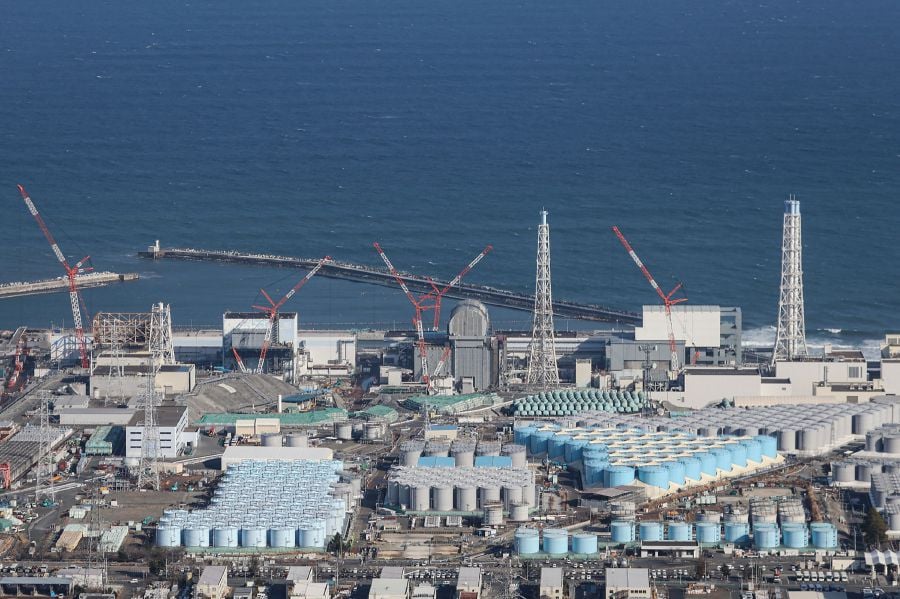
August 22, 2023 https://www.nst.com.my/opinion/leaders/2023/08/945792/nst-leader-japans-nuclear-wastewater
FUKUSHIMA is a dreaded word in the region because what happens there doesn’t stay there. There in Japan on March 11, 2011, an earthquake and tsunami, in that order, knocked out the Fukushima Daiichi nuclear-power plant, releasing untreated radioactive water into the sea.
Given the state of the nuclear plant technology then — or even now — there wasn’t the time for the radioactive elements to self-destruct. The human mind, including the Japanese ones, for some reason didn’t perceive that calamities can happen all at once.
The Fukushima disaster is such a tale of instantaneous conjunction of calamities. On a visit to the disaster zone on Sunday, Japanese Prime Minister Fumio Kishida was quoted by news agency AFP as saying that he was refraining from “commenting on a concrete timing of the release into the ocean at this point in time”, leaving ample room for a prime ministerial hint that it will be soon.
Some 500 Olympic-size swimming pools of wastewater, accumulated over 12 years after the disaster, are expected to be released into the Pacific Ocean. The fact that it would be a slow release over 10 years registered no effect in the region’s dread meter.
The region is on dread-watch, but much of it is coated with diplomatic niceties. China has been the most vociferous in opposing the release of the wastewater into the ocean. In China, dread comes mixed with geopolitical anger, given that Tokyo is a tango partner of Washington.
If a taste of Chinese animus is needed, here is one quote from a Beijing official, gleefully circulated by the Western media: Japan is treating the sea as its sewer. An interesting take, we must say, now that all nations without exception are treating the seas as their sewer.
How many marine lives were destroyed or how many people have ingested radioactive materials through seafood after the accident 12 years ago is hard to tell. Nuclear literature tells us if the water isn’t treated properly, dangerous isotopes can have devastating effects, including DNA-damaging ones. Should we fear? Yes and no. Start with yes.
The Tokyo Electric Power Company (Tepco), the operator of the crippled nuclear plant, and Japanese regulators stand accused of negligence, notwithstanding the earthquake and tsunami. Now that Tepco and the government are saying the 1.34 million tonnes of wastewater planned to be released into the Pacific Ocean is safe, many in Japan don’t believe them. Both are victims of trust deficit.
Kishida, though he wasn’t prime minister when disaster struck in 2011, is in need of reputation management advice. Not just to repair the trust deficit at home, but also abroad.
China has banned seafood from Fukushima and considering a wider ban. Others in the region are beginning to be infected by China’s isotope fear, not because of Beijing’s geopolitics, but because of the nightmarish outcome of radioactive contamination. If the dread grows, it will cripple more than Fukushima.
Now for the no, our second response to Japan’s release of the treated wastewater into the ocean. The world shouldn’t fear because the Japanese guarantee that the dangerous radioactive elements have been filtered out and comes stamped with the approval of the United Nations’ International Atomic Energy Agency
Unless, of course, if the world has reasons to believe that the IAEA, too, comes branded with a trust deficit.
Biden’s rival, Robert F. Kennedy Junior, labels F-16s for Ukraine ‘a disaster for humanity’

21vAug 23 , https://www.rt.com/news/581543-kennedy-ukraine-f16-delivery/1
Supplying US-made fighter jets to Kiev would only benefit the defense industry, RFK Jr. says
The looming delivery of US-made F-16 fighter jets to Ukraine will not prevent the “collapse” of the country’s military and will only benefit the military-industrial complex, Democrat presidential hopeful Robert F. Kennedy Junior has claimed.
The Ukrainian conflict should be resolved through negotiations, RFK Jr. argued in a thread on social media platform X (formerly Twitter), stating that supplying F-16s to Kiev was a “great decision for the defense industry, but a disaster for Ukraine and humanity.”
“F-16s won’t stop the collapse of the Ukrainian military (which some experts say is imminent). These planes require a lot of training and maintenance. This isn’t the movies,” Kennedy stressed.
The presidential hopeful has long-opposed the enduring Western aid to Ukraine, spearheaded by Washington, arguing that the US should admit its “failure” in the country and focus on domestic issues instead. Kennedy’s criticism of the fighter-jet delivery comes after Washington enabled its European allies to re-export older planes to Ukraine, and hours before the move was officially announced by Denmark and the Netherlands.
The upcoming delivery was heralded by Dutch PM Mark Rutte on Sunday as he hosted Ukrainian President Vladimir Zelensky at a military airbase in Eindhoven.
“Today we can announce that the Netherlands and Denmark commit to the transfer of F-16 aircraft to Ukraine and the Ukrainian Air Force, including cooperation with the United States and other partners once the conditions for such a transfer have been met,” Rutte said at a press conference.
Simultaneously, the Danish Ministry of Defence released a statement confirming its pledge to provide Kiev with F-16s from its inventory, once certain “conditions” are met. The conditions “include, but are not limited to, successfully selected, tested and trained Ukrainian F-16 personnel as well as necessary authorizations, infrastructure and logistics,” it said.
Kiev has long-demanded modern aircraft, as well as other, increasingly sophisticated weaponry, from its Western backers, arguing the planes would help it turn the tide of the conflict with Russia, which has been going on since February 2022. Moscow has repeatedly urged the collective West to stop the military deliveries, arguing they would only prolong the hostilities rather than change their ultimate outcome.
Japanese fishing industry leader is “greatly concerned” over the pending disharge of Fukushima radioactive water into the ocean.

The leader of a Japanese fisheries industry group told officials on Monday
he was “greatly concerned” about the discharge of treated radioactive water
set to be released into the sea from the wrecked Fukushima nuclear plant.
The government is expected to decide soon, perhaps within days, when to
start releasing the water, equivalent to the contents of 500 Olympic-size
swimming pools, despite objections at home and abroad to the plan.
Reuters 21st Aug 2023
Most ‘experts’ pushing for endless conflict in Ukraine share a common benefactor.

the top 50 think tanks received over a billion dollars from the US government and its defense contractors and manufacturers, including some of the biggest beneficiaries of weapons production today ‘for Ukraine’. The top recipients of this funding include the Atlantic Council, German Marshall Fund of the United States, Brookings Institution, Heritage Foundation, Center for Strategic and International Studies, New America Foundation, RAND Corporation, Center for a New American Security, Council on Foreign Relations, and the Stimson Center.
A whopping 85% of media quotes on US military involvement come from someone paid by the defense industry
rachelmarsden.com 20 Aug 23
Experts with important-sounding titles linked to academic-sounding entities have been shaping hearts and minds in the press, both at home and abroad, in favor of endless conflict in Ukraine. Guess what deep-pocketed benefactor lurks beneath the surface?
During the Iraq War, the Pentagon backed retired generals to make the rounds of TV and radio shows as ‘military analysts’ to promote the Bush administration’s agenda in the Persian Gulf. It was like inviting Ronald McDonald on a program to debate and discuss the merit of Big Macs. You could almost see the strings attached to the puppets, linked to the military-industrial complex that benefited from war without an off-ramp.
Fast forward 20 years, and the sales tactics have drastically changed. The generals have been replaced by various experts with academic credentials, typically linked to one or more ‘think tanks’. Far from the neutral academic centers of intellectual integrity that the names suggest, these entities are little more than laundromats for discreet special interests. I should know – I used to be a director of one.
Every Wednesday, some of the highest-ranking figures of the Bush administration would come to our Washington, DC office to deliver their main agenda points for the week, requesting assistance in placing and promoting them to both grassroots activists sympathetic to the cause and to the general public. The experts within the think tank were hired based on political litmus tests, no doubt to ensure that their views aligned with the organization’s. When they no longer do, you’re either fired or you leave.
The donors, many of whom were well-known millionaires and billionaires driven by a passion for certain issues, would come straight out and ask for bang for their buck in exchange for the opening of their wallets. In some cases, an entire project or department would be mounted at the think tank with the understanding that it would be fully funded by a single donor. These rich, influential folks typically had business or investment interests that benefited from shaping the establishment narrative in their favor, and they wanted to do so without leaving any footprints. What better way than to have it all fronted by a shiny veneer of expert credibility?
So while the generals of the Iraq War era had all the subtlety of a sledgehammer in representing the interests of the military-industrial complex, the new salesmen of endless armed conflict in Ukraine have overwhelmingly adopted the more subtle model. A study published in 2020 found that the top 50 think tanks received over a billion dollars from the US government and its defense contractors and manufacturers, including some of the biggest beneficiaries of weapons production today ‘for Ukraine’. The top recipients of this funding include the Atlantic Council, German Marshall Fund of the United States, Brookings Institution, Heritage Foundation, Center for Strategic and International Studies, New America Foundation, RAND Corporation, Center for a New American Security, Council on Foreign Relations, and the Stimson Center.
Some of these black boxes are more ideologically-driven than others. The Heritage Foundation, for example, leans overwhelmingly neoconservative and interventionist. Others, like the Atlantic Council and German Marshall Fund, are effectively force multipliers for NATO talking points. But the RAND Corporation also houses systems analysts and scientists specializing in space and computing. The fact that not all of these entities – or even the people who work within some of them – can be tossed into the same basket and labeled mere parrots for the special interests of their organization’s benefactors helps to muddy the waters.
In an analysis published in June of media coverage related to US military involvement in Ukraine, the Quincy Institute for Responsible Statecraft found that, when a think tank is cited regarding the issue, 85% of the time it’s a think tank with “financial backing from the defense industry.” Taken at face value, this risks being interpreted by the general public as expert ‘consensus’ on the need for US taxpayers to continue flooding Ukraine with weapons, unaware that it’s really just a bunch of Pentagon-backed actors agreeing with each other about the need to pursue the most profitable course of action on behalf of their War Inc. sugar daddies. Just like when climate scientists, who have parlayed climate change into endless funding and a perpetual justification for their existence, aren’t going to kill their cash cow by arguing that the climate can’t be controlled by man and that throwing cash at the issue – or at them – is futile.
Many of the Ukraine think tank experts are quick to attack analysis and information published on platforms they don’t like – such as RT – as ‘Russian-backed’. You’d have to be living under a rock these days to not know that RT is linked to Russia. No transparency issues there.
But there is far less transparency around their own organizations’ financing. Where is their insistence on being above board about the use of defense industry cash to influence not just the general public but the course of the conflict itself? Around a third of top foreign policy think tanks don’t disclose this Pentagon funding, according to the Quincy Institute. Nor is it unheard of for these experts to springboard from these establishment-friendly platforms and the public notoriety they provide, right into public office – where they can translate the same agenda that they promoted into actionable policy. Isn’t it important for voters to consider the powerful hidden hand who helped to get them there?
Threat from the skies: India steps up the fight against a major space danger.

By B R Srikanth, a veteran Bengaluru-based journalist reporting on space and defense, 21 Aug 23, https://www.rt.com/india/581397-india-space-debris-cleaning-mission/
New Delhi’s ambitious space plans include tackling the problem of floating debris, countless pieces of which orbit the Earth
A spectacular display of celestial fireworks? The momentous arrival of aliens? Or was it a work-in-progress sci-fi flick?
These questions weighed heavily on many minds as Melbourne’s night sky lit up for almost a minute on the night of August 7. The flame raced across the sky before breaking into blazing fragments. A sonic boom shook the ground for a couple of seconds, setting off a panic among residents. A day later, the Australian Space Agency confirmed it was space junk, likely “remnants” of a giant Russian rocket which had hoisted a new navigational satellite into orbit.
A few weeks earlier, a six-foot high cylindrical object, perhaps the fuel tank of an Indian rocket, had washed ashore at Green Head Beach, 250 km north of Perth, Australia. The artificial lighting, the loud explosion, and the large fuel tank found there reignited one question: How to vacuum-clean the graveyard in the deep, dark heavens to safeguard assets worth billions of dollars?
Such assets include satellites circling the Earth at 300 km to 36,000 km, in support of telecommunications, broadcasting, meteorology, civil aviation, telemedicine, distance education, and even espionage (by military satellites launched without fanfare).
Space junk
Outer space contains hundreds of dead satellites, millions of fragments of old satellites and rockets, and even paint flakes; each is hurtling through space at an incredible speed of 10 km a second, with a lethal punch of a 550-pound object. NASA estimates there are around 23,000 pieces of debris larger than a softball, half a million pieces the size of a marble or up to a centimeter, 100 million pieces one millimeter and larger.
Example of space junk include a glove lost by Edward Higgins White during America’s first spacewalk, Michael Collins’ camera lost near Gemini 10, a thermal blanket lost during STS-88, the first space shuttle mission, garbage bags jettisoned by cosmonauts during Mir’s 15-year life, a wrench, and a toothbrush.
Indian-American astronaut Sunita Williams lost her camera during her spacewalk from the space shuttle in 2007, and astronaut Heidemarie Stefanyshyn-Piper lost a briefcase-sized tool bag during her spacewalk the following year.
And if you think the Hollywood film ‘Gravity’, where a spacecraft is hit by a cloud of space debris (killing George Clooney’s character, and nearly marooning Sandra Bullock) was fiction, then consider that in 1996, a French satellite was hit and damaged by a French rocket that had exploded a decade earlier. Or that on February 10, 2009, a defunct Russian spacecraft collided with and destroyed a USA Iridium commercial spacecraft. The collision over northern Siberia added 2,300 pieces of large trackable debris and a bigger quantity of smaller trash to the existing space junk.
China did not help matters when in 2007 it used a missile to destroy an old weather satellite, creating 3,500 pieces of large debris. In 2016, a tiny piece of debris punched a hole in the solar panel of the European Space Agency (ESA) observation satellite, Copernicus Sentinel 1A. Even the Hubble Telescope’s solar array shows hundreds of tiny holes caused by dust-sized debris.
The risk of trash colliding with satellites could spiral higher in the future, K R Sridhara Murthy, Honorary Director and former vice president of Paris-based International Institute of Space Law (IISL), and a former senior scientist of the Indian Space Research Organisation (ISRO), told RT.
This is because a large number of private companies – SpaceX, OneWeb, Amazon Kuiper, Guo Wang (China), Samsung (Korea), and Astrome Tech (India) plan to add a whopping 75,000 satellites within a decade to provide global communication networks (superfast internet services), and Automatic Identification Systems (AIS) to track ships (including those of pirates) among other benefits.
Though smaller than conventional satellites, they will crowd the low earth orbit (LEO), about 400 km from the ground, and multiply the number already in this sphere. “More companies are joining the race to position their satellites in orbit because the economics of satellite launch are changing drastically owing to reduction in the cost of putting a satellite into orbit and the deployment of reusable rockets,” Murthy added.
Need for self-discipline
Nations have not been unmindful of the hazards of space junk. The USA and the former USSR tracked objects measuring four inches or more from the Cold War era using a string of radars. NASA and the US Defense Department’s Space Surveillance Network (SSN) have cataloged more than 27,000 pieces of debris, and track each piece’s trajectory.
Not surprisingly, nations with ambitions in space, including India, are setting up facilities to track the burgeoning amount of trash.
The importance of tracking can be gauged when even the voyage of a rocket into space is delayed by a couple of minutes to prevent debris from causing a disastrous impact on missions, Dr. Mylswami Annadurai, the “Moon man of India” and former director of ISRO’s Prof. U R Rao Satellite Centre in Bengaluru, told RT. He said that ISRO delayed the launch of its rockets three times to avoid a piece of space junk: a one-minute delay in the blast-offs in 2011 and 2016 and a three-minute hold in 2014
All space agencies realize the need for self-discipline in outer space and try not to disturb the operations of other satellites when decommissioning an old and defunct one. “For example, we (ISRO) brought down Megha-Tropiques (a satellite designed jointly and launched by ISRO and CNES of France in 2011 to study tropical atmosphere in the context of climate change) last year with the help of fuel available onboard without causing damage to any other satellite,” Rao said.
Last month, Indian space scientists reduced the altitude of the last stage of the Polar Satellite Launch Vehicle (PSLV) rocket as part of its initiative to avoid creating more space junk. “Left alone at a 536 km circular orbit, the PSLV4 stage would orbit the Earth for over 25 years. As the number of satellites in LEO (low earth orbit) is growing and the space around this orbit is of particular interest, the orbit of the spent PSLV4 was reduced to 300 km,” said the ISRO’s spokesperson.
“Everybody wants to clear outer Space of debris, but how to do it is a billion-dollar question,” K Sivan, former Chairman of ISRO, explained to RT. “We are part of the Inter-Agency Space Debris Coordination Committee (IADC). This international governmental forum coordinates global efforts to reduce debris by sharing research and identifying debris mitigation options.”
When Sivan was at the helm, ISRO established a radar at the Deep Space Network Station on the outskirts of Bengaluru as part of a project, called ‘Nethra’, to track junk in outer space and to share the data with other space agencies. Earlier, ISRO established the Multi-Object Tracking Radar at Satish Dhawan Space Centre, Sriharikota, the country’s spaceport just off the eastern coast in Odisha, to track the trajectory of 10 pieces of space junk and share the data with IADC.
According to Sivan’s predecessor, Gopalan Madhavan Nair, options include preventing new debris, designing satellites to withstand the impact of minor pieces, and improving procedures such as using orbits with less trash.
“Earlier, we used to allow the last stage of our PSLV rocket, along with some fuel, to drift away after launching the satellite, but now we make sure that the fuel (propellant) is exhausted to prevent an explosion of the last stage, or it is used to push the last stage closer to the Earth. Eventually, the last stage will drift further down and burn on re-entering the Earth’s atmosphere,” he said, alluding to the recent manoeuver.
Clearing efforts
In 2018, the United Nations Institute for Disarmament Research (UNDIR) proposed three A-SAT (anti-satellite) test guidelines for preventing junk in outer space. No consensus, however, has been reached among space-faring nations on the policies.
To mitigate the hazards of vast amounts of junk in outer space, the Japanese Space Agency, JAXA, has launched a project to develop a sprawling net akin to the one used by fishermen, to trap and drag down the trash. Many private companies are working on similar methods to cart away the garbage through operations that could fetch them millions of dollars.
ESA has teamed up with a consortium led by Swedish start-up, ClearSpace, to remove all ESA-owned, defunct satellites in the LEO. Their mission, ClearSpace1, will be launched in 2025 to capture a 100-kg upper-stage left orbit after the second flight of ESA’s Vega launcher in 2013. During follow-up missions, ESA will attempt multi-object captures.
Other space agencies and private enterprises could follow suit, each with unique techniques to reduce the trash in outer space by 2050. Space scientists, however, feel new satellite observation methods, too, ought to be developed to forecast the trajectory of orbiting satellites and debris to avoid collisions.
Georgia’s new nuclear reactors a cautionary tale

R Street, BY MARC HYDEN, AUG 21, 2023
Regulators and industry professionals have been gushing over the launch of Georgia’s newest nuclear reactor—Plant Vogtle’s Unit 3. It’s the first such reactor built in the United States in over three decades, and it is positioned to provide around 500,000 customers with clean energy for up to 80 years, which is something to celebrate.
Electric monopoly Georgia Power—who owns a nearly 50 percent stake in it—hailed the recent Vogtle construction as an “American energy success story.” While nuclear energy is impressive and there’s reason to be awestruck by Unit 3, the Vogtle project has been an absolute mess. It’s less of an American success story and more of a subsidized boondoggle that should serve as a cautionary tale for others.
In the early planning stages, a conglomerate of electric companies came together with plans to build two new nuclear reactors—units 3 and 4—and quickly obtained some attractive deals. The U.S. Department of Energy agreed to provide $12 billion in loan guarantees for the construction, the Georgia Public Service Commission greenlit the Vogtle plan, and in 2009, the state Legislature permitted Georgia Power to raise ratepayers’ bills to begin recouping the construction costs far in advance of the units’ completion.
Since Georgia has a monopoly system for electric companies, customers have little choice but to fork out the cash, and the utilities saw little risk and heralded the plan. The construction was intended as a clean energy investment in the future. Best of all, the units would supposedly be completed quickly and for a fair price. That’s where things began to fall apart.
Plant Vogtle’s construction could be best described by the Beach Boys’ lyric, “We’ll get there fast and then we’ll take it slow” because the only thing that happened relatively quickly were the sweetheart deals. Original estimates suggested that units 3 and 4 would be operational in 2016 and 2017, respectively, and the total project would cost around $14 billion. That’s a lot of money for captive ratepayers to bankroll, but that turned out to be more like a down payment. Cost overruns and persistent delays plagued Vogtle.
Construction began in 2009, but only by this summer did Unit 3 become operational for commercial use—7 years behind schedule. Meanwhile, Unit 4 isn’t expected to serve customers until later this year or next. Further, the running price tag for the project now exceeds $35 billion—more than double the original projection—but this was easily foreseeable.
Built in the late 1980s, Vogtle’s units 1 and 2 cost many billions more than estimated, and over 20 nuclear projects have been abandoned in the South since the 1970s for various reasons. Constructing massive nuclear reactors isn’t cheap, nor is it a simple task by any means, and just as anyone who watched the HBO series Chernobyl knows, you don’t want to rush through construction and cut corners……………………………………………………
If nuclear energy is in a resurgence, then Vogtle should serve as a cautionary tale for other states. Mega projects subsidized by the government and underwritten by electric monopolies’ captive ratepayers are fraught with problems. Rather than rushing to help finance massively wealthy energy companies’ nuclear ambitions, the government should reassess whether the actual—not estimated—costs and delays are worth it.
Governments love to act rashly, and asking them to proceed with caution might be futile in a changing world, which reminds me of another song lyric: “The more things change, the more they stay the same. https://www.rstreet.org/commentary/georgias-new-nuclear-reactors-a-cautionary-tale/
Israel will not agree to Saudi nuclear program: Netanyahu
Saudi Arabia has demanded US assistance for establishing a civilian nuclear program in exchange for normalization with Israel
The Cradle, News Desk AUG 20, 2023
The office of Israeli Prime Minister Benjamin Netanyahu clarified on 20 August that Israel would not agree to any of its neighbors having a nuclear program.
“That was and remains Israel’s policy,” Netanyahu stated during a cabinet meeting.
The clarification came in response to an interview by Minister of Strategic Affairs Ron Dermer, in which he suggested that Israel would be willing to accept a civilian nuclear program in Saudi Arabia under certain conditions.
Saudi Arabia has stated that it demands US assistance in developing a civilian nuclear program as one of its conditions for normalizing relations with Israel.
The Saudis are reportedly also asking for a defense pact with Washington and access to purchase more advanced US weapons.
The White House has prioritized reaching a deal between its two closest allies in West Asia before the next presidential election.
In an interview with the PBS TV network on 18 August, Dermer said that when it comes to a civil nuclear program in Saudi Arabia, “the devil is in the details.”
He further stated that because the Saudis are signatories to the nuclear non-proliferation treaty, they can ask China or France for assistance in establishing a civilian nuclear program that includes uranium enrichment……………………………………….. more https://new.thecradle.co/articles/israel-will-not-agree-to-saudi-nuclear-program-netanyahu
French cruise ship makes rendezvous with Russian nuclear icebreaker near North Pole
Barents Observer, By Atle Staalesen August 20, 2023
The meeting between the two vessels took place in remote Arctic waters not far from the North Pole.
Video made by passengers onboard the 50 Let Pobedy and shared on social media shows the two vessels trading greetings and sailing side by side through thick sea-ice.
The Russian nuclear-powered icebreaker is on the way to the North Pole as part of an expedition for students. Shortly after its meeting with the tourist ship, it encountered also two other ships currently sailing in the area. According to ship operator Rosatom, the 50 Let Pobedy met with Arctic research station Severny Polyus, as well as research ship Akademik Tryoshnikov.
The latter ship had sailed all the way from St.Petersburg with new crew and equipment for the drifting station that is on a two-year expedition across the ice.
The Le Commandant Charcot is the new vessel built for cruise ship operator Ponant. It is classified as icebreaker and can make independent voyages to the North Pole. In 2021, it was first hybrid-electric luxury cruise ship to make it to the North Pole.
The ship set out on a 16-days expedition from Reykjavik in early August. It sails to the geographic North Pole and ends up in Longyearbyen, Svalbard.
It is not a voyage for the regular man and woman. The starting price per person is €31,485…………………………………………… https://thebarentsobserver.com/en/arctic/2023/08/french-cruise-ship-makes-rendezvous-russian-nuclear-icebreaker-near-north-pole
France and Russia co-operate on developing a plant in Russia for processing depleted uranium
The installation of equipment has begun at TVEL’s JSC Electrochemical Plant
(ECP) in Zelenogorsk in Russia’s Krasnoyarsk Region for W2-ECP, the
country’s second plant for the processing of depleted uranium hexafluoride.
The plant is part of a long-term project to manage and make use of depleted
uranium stocks in Russia. The plant, with a processing capacity of 10,000
tonnes per year, is being supplied by Orano Projets – the engineering arm
of France’s nuclear fuel cycle specialist Orano – under a EUR40 million
(USD44 million) contract signed in December 2019.
Under the terms of the contract, Orano will supply the equipment for the construction of the
deconversion facility, as well as providing technical assistance in its
installation and commissioning. The first equipment for the plant arrived
at the construction site in eastern Siberia from France in December 2021.
The project was originally expected to be completed in 2022. The W2-ECP
plant will accept deliveries of depleted uranium hexafluoride gas (DUF6 –
sometimes called DUHF) and deconvert these to uranium tetrafluoride, with
anhydrous hydrofluoric acid being produced as a by-product. Deconversion
transforms the toxic and somewhat corrosive gaseous DUF6 enrichment
tailings into a stable powdered oxide form fit for long-term storage,
transport or final disposal.
World Nuclear News 16th Aug 2023
https://www.world-nuclear-news.org/Articles/Construction-of-second-Russian-deconversion-plant
UK ‘s Minister for Nuclear and Networks very upbeat about nuclear energy’s future

In February, Andrew Bowie
became the UK’s first-ever
Minister for Nuclear and Networks
2 Andrew Bowie
became the country’s first-ever U.K.,”
Minister for Nuclear and Networks nuclear minister in February,
TOKYO — The U.K. government is “absolutely committed” to boosting nuclear power as a key energy source, but national security is paramount as Chinese investment in new plants raises concerns, the minister in charge of the sector told Nikkei Asia.
Most of the U.K.’s existing nuclear plants are to be retired by the end of this decade, while a new generation of reactors is still under construction………
“The British government is absolutely committed to new nuclear, after about three decades of underinvestment. We are reinvesting and reinvigorating an industry which has not had the attention that it should in the U.K.,” Minister for Nuclear and Networks Andrew Bowie said in a recent interview. “On the whole, we are open to investors from overseas,” he added……………….
The UK government has announced plans to build as many as eight new reactors. However, major projects already underway are mired in controversy over funding from Chinese investors, given tense relations between London and Beijing……………
Now uncertainty looms for Hinkley Point C, which broke ground in 2016 under a joint investment by EDF and CGN as the first new nuclear power station built in the U.K. in nearly 30 years. The plant is home to the only two reactors now under construction, according to data from the International Atomic Energy Agency……….
“The pendulum has swung” on British nuclear policy, the minister said, but the pronuclear plans could fall victim to politics, with a general election due within 15 months………… https://asia.nikkei.com/Business/Energy/U.K.-committed-to-nuclear-power-despite-China-funding-concerns2
Big Brave Western Proxy Warriors Keep Whining That Ukrainian Troops Are Cowards

CAITLIN JOHNSTONE, AUG 19, 2023
Amid continuous news that the Ukrainian counteroffensive which began in June is not going as hoped, The New York Times has published an article titled “Troop Deaths and Injuries in Ukraine War Near 500,000, U.S. Officials Say.”
Reporting that Ukrainian efforts to retake Russia-occupied territory have been “bogged down in dense Russian minefields under constant fire from artillery and helicopter gunships,” The New York Times reports that Ukrainian forces have switched tactics to using “artillery and long-range missiles instead of plunging into minefields under fire.”
Then the article gets really freaky:
“American officials are worried that Ukraine’s adjustments will race through precious ammunition supplies, which could benefit President Vladimir V. Putin of Russia and disadvantage Ukraine in a war of attrition. But Ukrainian commanders decided the pivot reduced casualties and preserved their frontline fighting force.
“American officials say they fear that Ukraine has become casualty averse, one reason it has been cautious about pressing ahead with the counteroffensive. Almost any big push against dug-in Russian defenders protected by minefields would result in huge numbers of losses.”
I’m sorry, US officials “fear” that Ukraine is becoming “casualty averse”? Because safer battlefield tactics that burn through a lot of ammunition don’t chew through lives like charging through a minefield under heavy artillery fire?
What are the Ukrainians supposed to be? Casualty amenable? If Ukraine was more casualty amenable, would it be more willing to throw young bodies into the gears of this proxy war that the US empire actively provoked and killed peace deals to maintain?
Something tells me that the US officials speaking to The New York Times about their “fear” of Ukrainian casualty aversiveness do not know what real fear is. Something tells me that if you marched these US officials through Russian minefields under constant fire from artillery and helicopter gunships, then they would understand fear.
Western officials have been spending the last few weeks whining to the media that Ukraine’s inability to gain ground is due to an irrational aversion to being killed. They’ve been decrying Ukrainian cowardice to the press under cover of anonymity, from behind the safety of their office desks.
In an article published Thursday titled “U.S. intelligence says Ukraine will fail to meet offensive’s key goal,” The Washington Post cited anonymous “U.S. and Western officials” to report that the massive losses Ukraine has been suffering in this counteroffensive had been “anticipated” in war games ahead of time, but that they had “envisioned Kyiv accepting the casualties as the cost of piercing through Russia’s main defensive line.”
The same article quotes Ukrainian Foreign Minister Dmytro Kuleba telling critics of the counteroffensive to “go and join the foreign legion” if they don’t like the results so far, adding, “It’s easy to say that you want everything to be faster when you are not there.”
In an article published last month titled “U.S. Cluster Munitions Arrive in Ukraine, but Impact on Battlefield Remains Unclear,” The New York Times reported unnamed senior US officials had “privately expressed frustration” that Ukrainian commanders “fearing increased casualties among their ranks” were switching to artillery barrages, “rather than sticking with the Western tactics and pressing harder to breach the Russian defenses.”
“Why don’t they come and do it themselves?” a former Ukrainian defense minister told The New York Times in response to the American criticism.
In an article last month titled “Ukraine’s Lack of Weaponry and Training Risks Stalemate in Fight With Russia,” The Wall Street Journal reported that unnamed western military officials “knew Kyiv didn’t have all the training or weapons” needed to dislodge Russia, but that they had “hoped Ukrainian courage and resourcefulness would carry the day” anyway.
“It didn’t,” Wall Street Journal added.
In the same article, The Wall Street Journal cited a US Army War College professor named John Nagle admitting that the US itself would never attempt the kind of counteroffensive it’s been pushing Ukrainians into attempting.
“America would never attempt to defeat a prepared defense without air superiority, but they [Ukrainians] don’t have air superiority,” Nagl said, adding, “It’s impossible to overstate how important air superiority is for fighting a ground fight at a reasonable cost in casualties.”
And now we’re seeing reports in the mass media that US officials — still under cover of anonymity of course — are beginning to wonder if perhaps it might have been better to try to negotiate peace instead of launching this counteroffensive that they knew was doomed from the beginning.
In an article titled “Milley had a point,” Politico cites multiple anonymous US officials saying that as “the realities of the counteroffensive are sinking in around Washington,” empire managers are beginning to wonder if they should have heeded outgoing Joint Chiefs chair Mark Milley’s suggestion back in November that it was a good time to consider peace talks.
“We may have missed a window to push for earlier talks,” one anonymous official says, adding, “Milley had a point.”
Oops. Oops they made a little oopsie poopsie. Oh well, it’s only Ukrainian lives.
Imagine reading through all this as a Ukrainian, especially a Ukrainian who’s lost a home or a loved one to this war. I imagine white hot tears pouring down my face. I imagine rage, and I imagine overwhelming frustration.
This whole war could have been avoided with a little diplomacy and a few mild concessions to Moscow. It could have been stopped in the early weeks of the conflict back when a tentative peace agreement had been struck. It could have been stopped back in November before this catastrophic counteroffensive.
But it wasn’t. The US had an agenda to lock Moscow into a costly military quagmire with the goal of weakening Russia, and to this day US officials openly boast about all this war is doing to advance US interests. So they’ve kept it going, using Ukrainian bodies as a giant sponge to soak up as many expensive military explosives as possible to drain Russian coffers while advancing US energy interests in Europe and keeping Moscow preoccupied while the empire orchestrates its next move against China.
Last month The Washington Post’s David Ignatius wrote an article explaining why westerners shouldn’t “feel gloomy” about how things are going in Ukraine, writing the following about how much this war is doing to benefit US interests overseas:
“Meanwhile, for the United States and its NATO allies, these 18 months of war have been a strategic windfall, at relatively low cost (other than for the Ukrainians). The West’s most reckless antagonist has been rocked. NATO has grown much stronger with the additions of Sweden and Finland. Germany has weaned itself from dependence on Russian energy and, in many ways, rediscovered its sense of values. NATO squabbles make headlines, but overall, this has been a triumphal summer for the alliance.”
Other than for the Ukrainians” he says, as a parenthetical aside.
Everyone who supported this horrifying proxy war should have that paragraph tattooed on their fucking forehead.
New York governor blocks discharge of radioactive water into Hudson River from closed nuclear plant.

A measure to block discharges of radioactive
water into the Hudson River as part of the Indian Point nuclear plant’s
decommissioning was signed into law Friday by New York Gov. Kathy Hochul.
The bill was introduced to thwart the planned release of 1.3 million
gallons of water with traces of radioactive tritium from the retired
riverside plant 25 miles (40 kilometers) north of New York City.
The plan sparked a groundswell of opposition in the suburban communities along the
river. Many feared the discharges would depress real estate values and
drive away sailors, kayakers and swimmers after decades of progress in
cleaning up the Hudson River.
AP 18th Aug 2023
1 This Month
Tell Congress: Prevent Nuclear Catastrophe in Iran

Tell Congress: Prevent Nuclear Catastrophe in Iran

Read the Public Inquiry Report, the Commissioners’ report, Surrendering Australia: The AUKUS Deception is available to download for free at aukuspublicinquiry.com. Or just watch the replay of the National Press Club Luncheon.


Shut down the radiation-damaged Heysham nuclear reactors now
To see nuclear-related stories in greater depth and intensity – go to https://nuclearinformation.wordpress.com

Say No to NASA’s Reckless Nuclear Reactor on the Moon
Say No to NASA’s Reckless Nuclear Reactor on the Moon
-
Archives
- November 2026 (224)
- October 2026 (302)
- September 2026 (339)
- August 2026 (330)
- July 2026 (355)
- June 2026 (287)
- May 2026 (306)
- April 2026 (356)
- March 2026 (251)
- February 2026 (267)
- January 2026 (308)
- December 2025 (358)
-
Categories
- 1
- 1 NUCLEAR ISSUES
- business and costs
- climate change
- culture and arts
- ENERGY
- environment
- health
- history
- indigenous issues
- Legal
- marketing of nuclear
- media
- opposition to nuclear
- PERSONAL STORIES
- politics
- politics international
- Religion and ethics
- safety
- secrets,lies and civil liberties
- spinbuster
- technology
- Uranium
- wastes
- weapons and war
- Women
- 2 WORLD
- ACTION
- AFRICA
- Atrocities
- AUSTRALIA
- Christina's notes
- Christina's themes
- culture and arts
- Events
- Fuk 2022
- Fuk 2023
- Fukushima 2017
- Fukushima 2018
- fukushima 2019
- Fukushima 2020
- Fukushima 2021
- general
- global warming
- Humour (God we need it)
- Nuclear
- RARE EARTHS
- Reference
- resources – print
- Resources -audiovicual
- Weekly Newsletter
- World
- World Nuclear
- YouTube
-
RSS
Entries RSS
Comments RSS

