Cesium 180 times limit found in fish at Fukushima nuke plant 12 years after disaster.

July 19, 2023 (Mainichi Japan)
FUKUSHIMA — Radioactive cesium 180 times Japan’s legal maximum has been found in fish caught in the port at the crippled Fukushima Daiichi nuclear plant, revealing that the March 2011 triple meltdown there continues to impact the local ecosystem.
The cesium in the black rockfish caught in May measured 18,000 becquerels per kilogram. The legal limit under the Food Sanitation Act is 100 becquerels per kg. According to plant operator Tokyo Electric Power Company (TEPCO) Holdings Inc., the fish was captured inside the inner breakwater, close to the No. 1 to No. 4 reactors at the seaside plant, where decommissioning work continues.
When it rains, the rainwater streams into the “K drainage” — one of several drainpipes at the plant — after running through debris and over the ground, both contaminated with radioactive substances. It is then discharged into the station’s small port.
TEPCO claims that it has confirmed the cesium levels in the discharged rainwater are below the government criteria of 60 becquerels per liter for cesium-134 and 90 becquerels for cesium-137. But compared with other drainages at the plant, runoff with higher concentrations of radioactive materials has been discharged within the inner breakwater. The seabed sediment in the area was also found to contain cesium-137 up to 130,000 becquerels-plus per kilogram and cesium-134 up to 3,400 becquerels-plus as of the end of January this year………………………………………………………………..
……………………………………………………….”We urge that TEPCO take thorough measures to prevent radioactive materials from getting into the ocean, even within the port,” a fisheries federation official urged, refering to the black rockfish with more than 100 becquerels per kg caught in May at the nuclear complex’s port.
Toshihiro Wada, an associate professor of fish ecology at Fukushima University, said of the heavily contaminated fish, “It’s likely that cesium was concentrated within the fish from the food chain, confined as it is by the inner breakwater where radioactive substances have accumulated from the drainages flowing into the port.”
He continued, “Unless fundamental measures are taken to lower the concentrations of radioactive materials discharged from the ‘K drainage,’ fish surpassing the maximum will likely keep being found,” even as TEPCO has stepped up measures to prevent fish from getting away…………………………………
Radioactively contaminated water has been swelling daily at the plant as water injected to cool nuclear fuel debris that melted down in the 2011 disaster has been accumulating with groundwater and rainwater mixing into it. TEPCO processes the contaminated water using ALPS, or multi-nuclide removal equipment, and stores the treated water in tanks after reducing the radioactive levels apart from tritium, which is difficult to remove from water.
‘Set treated water aside’
The Japanese government plans to release treated water from the Fukushima plant into the ocean around the summer, after diluting it to get tritium concentrations below 1,500 becquerels per liter, or one-fortieth of the national standard. It plans to release the water about 1 kilometer offshore via an undersea tunnel.
“Unlike cesium, tritium does not concentrate in fish even if they ingest it, according to data,” associate professor Wada said. “Experimental results have shown that if treated water is put into regular seawater, the concentration (of tritium) is reduced. We need to consider (tritium) separately from cesium.”
(Japanese original by Riki Iwama, Fukushima Bureau, and Hideyuki Kakinuma, Iwaki Local Bureau) https://mainichi.jp/english/articles/20230718/p2a/00m/0na/019000c?fbclid=IwAR2R-0GtuaSlHvGQZ13yqRzQdZ1HUr3RNu4yHWzLBLytboJldZs2eMLHmxM
From body bags of ice to pavement burn: US grapples with new extreme heat reality

From body bags of ice to pavement burn: US grapples with new extreme heat
reality. As unrelenting, record-breaking temperatures continue across many
states, pressure is mounting on US healthcare systems due to an increasing
number of people in heat distress coming through their doors.
In the Southwest, doctors are relying on tried-and-tested measures such as body
bags packed with ice to quickly bring down dangerously high body
temperatures. Doctors at Memorial Hermann Medical Center in Houston, Texas,
told The Independent that there has been an increase in the number of
patients presenting with heat-related illnesses including heat stroke,
which can be potentially fatal if not treated rapidly.
Independent 22nd July 2023
https://www.independent.co.uk/climate-change/news/heatwave-arizona-texas-deaths-burns-b2378285.html
Science and Global Security Maps Radioactive Fallout from U.S. Nuclear Weapon Tests, Beginning with July 1945 Trinity Test
July 21, 2023
SGS has released research showing in unprecedented detail the spread of radioactive fallout from 94 continental U.S. atmospheric nuclear weapon tests, including the first nuclear weapon test – the 16 July 1945 Trinity explosion that was a key part of the Manhattan Project. This work has been reported in The New York Times.
The new model shows the nuclear explosions carried out in New Mexico and Nevada between 1945 and 1962 led to widespread radioactive contamination, with Trinity making a significant contribution to exposure in New Mexico, in neighboring states, and reaching 46 of the 48 contiguous United States as well as Canada and Mexico. The study also documents significant deposition in Nevada, Utah, Wyoming, Colorado, Arizona and Idaho, as well as dozens of federally recognized tribal lands.
The research provides estimates of the deposition of radioactivity over 10 days following the detonation of the Trinity nuclear explosion, and for five days subsequent to the atmospheric tests in Nevada. It highlights that significant radioactive deposition took place in locations in New Mexico and on federally recognized tribal lands not covered by the U.S. Radiation Exposure Compensation Act. It also reveals that plutonium carried by the wind from the Trinity test explosion reached Crawford Lake in Canada on July 20, 1945. The presence of plutonium in Crawford Lake sediments has been proposed as one maker for the beginning of the Anthropocene epoch……………………………………….. more https://sgs.princeton.edu/news-announcements/n
The True Symbol Of The United States Is The Pentagon

JUL 22, 2023
The real symbol of the United States is not the stars and stripes, nor the bald eagle, nor the Statue of Liberty, nor even the mighty McDonald’s logo. The real symbol of the United States is the Pentagon.
The Pentagon should feature centrally on the US flag. It should be on the coins and on all the bills, and it should appear next to the name of every American in the Olympics. When anyone sees a five-sided polygon, they should immediately think “United States of America”.
There is nothing more representative of the most significant things about the United States than the Pentagon. Sure the US has lovely national parks, an abundance of fast food chains and 500 million-dollar superhero movies, but nothing has anywhere near the effect on the world as the US government’s ability to project force around the planet with military violence and the threat thereof.
That is the main thing that makes the US unique among nations, after all. Americans are taught from childhood to take special pride in their nation’s “freedom” and “democracy” (of which they have neither), when what actually makes their country stand out against the crowd is its role as the hub of a globe-spanning empire that is held together by nonstop military aggression. The five-sided building which houses the US Department of Defense — formerly called the Department of War until someone noticed that was a bit too truthful — is the perfect symbol for that empire. It conveys what the United States is really putting out into the world more accurately than any other…………………………………….. more https://www.caitlinjohnst.one/p/the-true-symbol-of-the-united-states
Tory nuclear expansion programme

Renew Extra Weekly, 22 July 23
“…..a bit delayed, the secretary of state for energy security and net zero, Grant Shapps, has officially launched Great British Nuclear (GBN), the new ‘arm’s-length’ government agency that is meant drive the delivery of new nuclear energy projects- especially small modular reactors (SMRs). The press release was very up tempo…………………………………………
………talk of a ‘massive revival’ of UK nuclear may be a bit premature. In all about £233m has been allocated to new SMR work so far, plus £700m for the big Sizewell C., and it’s far from clear whether either of these options, big or small, will get the go ahead. Funding Sizewell C will not be easy, according to a review in Nuclear Engineering International, with few investors coming forward, and a review of SMR options concluded that ‘none of the tested concepts is able to compete economically with existing renewable technologies’.
Nevertheless, a tender for procurement contracts for SMRs has been launched which states that between one and four awards could be made for grant funding, and, ultimately, up to £20bn spent on developing designs and funding construction. However, that’s all a bit speculative. ……………………………the £20bn will mostly presumably involve GBN seeking partnerships with private sector companies and private finance. Shapps stressed that this was ‘not a spending commitment’ by government.
……… It will in any case take a while for GBN to get fully established, at present it hardly exists, and even longer for SMRs to exist- the Guardian noted that, in relation to the SMR competition, ‘a final decision on each project will not occur before 2029’.
……..the Rolls Royce isalso not exactly a small reactor. At 470MW, it is actually larger than unit 1 at Fukushima and most of the old UK Magnox reactors.
…………………………..chided by Labour, with Shadow energy minister Alan Whitehead saying ‘it’s shambolic that after 13 years of Tory government, not one of the 10 nuclear sites approved by the last Labour government have been built,’ the UK does now have an ambitious nuclear programme, at least on paper, with a commitment to build a massive 24GW of nuclear capacity, the equivalent of a quarter of total generating capacity, by 2050. But, as I have indicated, it is far from clear if it can be achieved, especially given the low cost of renewables.
……………………….Leaving aside the cost issue and the still unresolved issue of long term radioactive waste disposal, nuclear enthusiasts do sometimes claim that we will need nuclear to back up variable renewables. However, there are cheaper ways to do that, including advanced batteries,………………………….
Given options like these, the whole idea of needing ‘baseload plants’ has become redundant. Certainly building new large inflexible nuclear plants for backup would be very expensive and inefficient, and we have no idea if SMRs would be any better. ………………………………………………….. more https://renewextraweekly.blogspot.com/2023/07/tory-nuclear-expansion-programme.html
USA government – more money, $19 billion, grant for making deadly plutonium
Senate appropriators boost funding for plutonium, uranium production facilities, By Dan Parsons, 21 Jul 23
Nearly $19 billion is included in the Senate Appropriations Committee’s 2024 spending bill for National Nuclear Security Administration nuclear-weapon programs, with funding boosts for planned facilities that will process plutonium and uranium for refurbished…………… (Subscribers only) https://www.exchangemonitor.com/senate-appropriators-boost-funding-for-plutonium-uranium-production-facilities/
US Republicans threaten to block AUKUS deal

By Anthony Galloway, The Age, July 21, 2023
Australia’s AUKUS submarine deal with the United States has hit a hurdle with Senate Republicans threatening to block the sale unless President Joe Biden boosts funding for the domestic production line.
Republican members of the Senate Armed Services Committee on Friday moved to block legislation which would enable the sale of US Virginia-class submarines to Australia.
Under the AUKUS deal, Washington was set to sell Canberra between three and five of its own nuclear submarines in the 2030s before Australia begins building a new class of boat with Britain.
But the ranking Republican on the Senate Armed Services Committee, senator Roger Wicker, said Biden needed to commit more money to guarantee “we have enough submarines for our own security before we endorse that pillar of the agreement”.
Wicker said Australia’s commitment of US$3 billion ($4.4 billion) for the US production line would not be enough to meet the needs of both countries.
“The president needs to submit a supplemental request to give us an adequate number of submarines,” he told US news outlet Politico…………………………………………………….. https://www.theage.com.au/politics/federal/foolish-us-republicans-threaten-to-block-aukus-deal-20230721-p5dqc3.html
Europe’s black hole: How much of the more than $185 billion given by the West to Ukraine has been stolen?

Rt.com By George Trenin, 20 Jul 23
The fate of huge amounts of aid sent to the country is uncertain amid endemic corruption and a lack of accountability.
As a result of last week’s NATO summit in Vilnius, the US-led military bloc promised Ukraine fresh tranches of financial and military aid. This was despite the fact that by the beginning of the summer, Kiev had already received a total of €165 billion ($185.6 billion) from Western countries. Meanwhile, as the spending increases, the number of US and EU citizens who are willing to sacrifice their own comfort for the sake of Kiev appears to be steadily decreasing.
One of the reasons for this is corruption in Ukraine, which – despite some lofty promises – seems to be as bad now as it was before the Western-backed 2014 ‘Maidan’ coup. If not worse.
Moral compensation
The NATO summit, despite Ukraine’s hopes, did not bring it a long-awaited timeframe for membership. Instead, Western leaders announced new military aid packages for Kiev.
According to the French newspaper Le Monde, French President Emmanuel Macron promised to give Ukraine a “substantial number” of SCALP missiles that can hit targets at a distance of 250 kilometers. According to France24, each costs €850,000.
Berlin announced a package amounting to €700 million. Germany plans to supply Ukraine with launchers for the Patriot missile defense system, Marder-type infantry fighting vehicles, UAVs, Leopard 1 A5 tanks, and artillery shells. However, for Berlin, this is not even close to a record gift value. On May 21, the German Foreign Ministry announced the transfer of military aid to Ukraine worth €2.7 billion.
On July 7, US Under Secretary of Defense for Policy Colin Kahl spoke about a new package of aid from the US which includes cluster munitions – which are banned in 120 countries. The cost was $800 million.
This is the 42nd delivery of aid that Ukraine has received from the US in the past year and a half. Since the beginning of Russia’s offensive, the US Congress has approved military and economic assistance to Ukraine amounting to over $70 billion – and that’s only counting direct expenses.
According to July data from the Kiel Institute (which tracks the volume of aid allocated to Ukraine), total direct subvention provided by the US and its allies in the period from February 24, 2022 to May 31, 2023 topped €165 billion.
The rate at which new tranches are allocated increases every month. For example, at the end of April, the total amount of aid was €15 billion less than it is now – according to NATO Secretary General Jens Stoltenberg, it was then €150 billion. ……………………………………………………………………………..
the risk of corruption exists not only within state borders but that fraud can also occur when concluding contracts in the US. Furthermore, the theft of weapons or other aid may happen as it travels to the war zone through Europe.
Another official involved in criminal investigations at the Pentagon also told Defense One that his department is “concerned about the potential diversion or legal export, or theft for that matter, of the goods.”
Many American businesses do not trust the Ukrainian authorities either and believe that aid is being stolen. According to US Secretary of Commerce Gina Raimondo, private businesses doubt that the funds allocated to Ukraine for reconstruction will be safe from corruption.
nternal games
The corruption issue is acknowledged in Ukraine as well. This spring, the ex-adviser of the office of the president of Ukraine, Aleksey Arestovich, said on his YouTube channel that his old boss, Vladimir Zelensky, has not been able to deal with corruption in Ukraine.
“Ukraine needs only one thing… To have someone come to power who won’t steal. Someone who won’t do it himself and won’t allow others to do so. Unfortunately, so far we haven’t been lucky,” he said.
…………………………………………….. “The Ukrainian president and many in his entourage have been skimming untold millions from the American dollars earmarked for diesel fuel payments. One estimate by analysts from the Central Intelligence Agency put the embezzled funds at $400 million last year, at least,” – American investigative journalist Seymour Hersh stated that Ukrainian President Vladimir Zelensky and his entourage illegally appropriated at least $400 million from funds that were allocated to Kiev for the purchase of diesel fuel.
…………….. Moreover, Hersh says that CIA Director William Burns was displeased with Zelensky because of the possible theft of Western aid, since “he was taking a larger share of the skim money than was going to the generals.” ……………… more https://www.rt.com/russia/579897-europes-black-hole-ukraine/
Luck Is Not a Strategy for the Ukraine, The Germans Take the “Evidence-based” Path.
We Chat with Nuclear Expert Dr. Paul Dorfman
Hot Globe, STEVE CHAPPLE, JUL 20, 2023
“………………………………………………………………………………. HOT GLOBE: It’s always bothered me that Saudi Arabia because of the Trump administration has now got access to the beginnings of nuclear power, and to a future nuclear bomb. The idea of selling small nuclear reactors around the world raises a pretty problematic point.
DORFMAN: That’s absolutely true. Saudi has made no bones about its nuclear ambitions and I mean its military nuclear ambitions. Saudi diplomats have said quite clearly that they’re looking towards Iran and that they’re seriously thinking about both civil and military nuclear. So there’s a potential for an arms race, a military nuclear arms race in the Middle East region. It’s actually even more bad news for the Middle East because in a proxy war if say, for example, Russian and America wanted to have a bit of a go and they didn’t want to absolutely destroy each other’s country where would they be fighting their proxy nuclear war? The first region that comes to mind is the Middle East and Saudi and Iran.
The economies of small nuclear reactors depend absolutely on production to scale. It’s been proven time and time again that in order to make any money at all, to break even on small nuclear production, you need to sell them abroad. Now, selling them abroad to whom, for what reasons? You’d be selling them to developing nations who may or may not have the capacity to regulate, to protect, to defend in depth, and so therefore you would be significantly expanding the potential for military nuclear risk whether that means a dirty bomb or further nuclear development.
HOT GLOBE: A slightly different question here, but Germany had ongoing nuclear plants and even though they were still producing electricity, they’ve shut those down. That may be a little puzzling to some Americans. Can you explain that?
DORFMAN: First of all, what Germany does is evidence-based policy. Germany puts out its scientific, technological questions, its energy questions, to well-funded high level research units. They go away and do their research. They come back with their research. They give it to the government departments and then the government makes a decision. So it’s evidence-based policy making. Over the years Germany has said well, we want to get to net-zero and we’re kind of worried about nuclear. Now around 2011 when Fukushima happened–remember Chancellor Merkel is a PhD chemist. She realized like many of us that even in an advanced society things could go badly wrong since accidents are by definition accidental.
HOT GLOBE: Good line
DORFMAN: Yeah, who knew? [laughs] So when Fukushima happened, Merkel and many others in Germany said well, look, we can’t stand the pain of this. I was having supper with Naoto Kan, the premier of Japan at the time of Fukushima after we both spoke in Westminster. Even then I was shocked when he turned to me and said that if the wind had been in the wrong direction, they would have lost Tokyo. The majority of the pollution went out into the Pacific Ocean. Now to the point about Germany. It’s landlocked so the Germans looked at the possibility of an accident and they came up with the numbers. It would cost trillions and trillions and trillions of Euros if they had a nuclear accident and they said look, we really can’t be doing this. This is just crazy, basically, and so we’re going to do “the German energy transition.” We’re going to try to lead the world on this and we’re going to move stepwise into renewables-plus, that’s renewables solar wind energy storage, interconnection, demand site management, energy management, distributed grids and a significant centralized upgrade of grids, too.
Now clearly Germany has a core problem, a fossil fuel problem, but they didn’t want to go down the fissile fuel route so Germany has said well OK for the time being we’re going to rely on gas but then we’re going to move to a full renewable economy. Well, the war has speeded that up. Since the war Germany has burnt less coal and Germany has shuttered all its nuclear power plants. It’s done this because what Germany says it will do, it does, unlike many other states. It set upon a route to go renewables. Now there is no such thing as a free lunch. Everything costs and there’s no perfect solution to the energy crisis, but what Germany is trying to do is to lead the world in this so-called energy transition, and I won’t spout numbers but basically what has happened is you’ve just seen significant renewable deployment, significant storage and a water storage as it were deployment which is sort of integrated into the power system and also integrated into the democratic system whereby by local communities also own the local renewable aspects of the local renewable power generation. It’s basically saying well look yes we can do this rather like Americans, you know, we have a dream, we will try to do this, it will be difficult but we will do our best to get there since the costs and the risks of nuclear are far too great. Let’s find a realistic, sustainable, positive, constructive way through……..
more https://hotglobe.substack.com/p/nuclear-power-is-already-a-climate
Ontario – Ford government’s electricity plan takes wrong approach
Windsor Star, By Jack Gibbons 21 Jul 23
Having missed the boat on the global green energy boom by crushing the province’s early leadership on renewable energy, Premier Doug Ford is now trying to take another stab at building a future economy by investing in buggy whip manufacturing.
That’s what spending tens of billions of dollars on high-cost, high-risk nuclear power essentially represents — a bet on a technology that has been in decline for decades.
Instead of trying to catch up with a global marketplace that is decidedly all-in on renewable energy — with the International Energy Agency saying 90 per cent of new electricity capacity will come from renewables over the next five years — Ontario wants to go back to the 1960s and ‘70s and embark on another long shot effort to build nuclear power plants.
It’s important to remember the province’s past nuclear projects have been one fiasco after another. Our most recent nuclear new build project — the Darlington nuclear station — went massively over budget.
The huge cost overruns and poor performance of its nuclear reactors essentially bankrupted the old Ontario Hydro. Ontario power ratepayers and taxpayers were left paying off the utility’s massive $19.4-billion stranded nuclear debt.
That hasn’t stopped a government with a strong distaste for solar panels and wind turbines from warmly embracing a technology that has never lived up to its promise.
It is now planning to build a massive new nuclear plant right beside the Bruce nuclear station which is already the largest nuclear station in the world. It also wants to build mythical “modular” reactors along the waterfront at Darlington right next to Toronto.
That the reactors the government is touting for Darlington are, at this point, nothing more than PowerPoint slides in a nuclear PR presentation hasn’t stopped the government from making wild claims that these unproven (and, at this point, unlicensed and physically non-existent) reactors can be built at what it deems to be a reasonable cost.
In 2009, when the nuclear companies wanted to build two new nuclear reactors at Darlington, the Dalton McGuinty government required them to submit fixed-price bids.
Not surprisingly the most competitive bid was 3.7 times higher than the forecast price. As a result, the government suspended the procurement process and the reactors were never built.
But despite repeatedly slamming the “fiscal irresponsibility” of previous Liberal governments, it appears that Premier Doug Ford is only too happy to give the nuclear industry a blank cheque and allow inevitable cost overruns to be passed on to electricity consumers and taxpayers.
That the projected cost for the province’s new dream nuclear projects are more than three times higher than what we would pay today for power from competitively procured wind and solar also doesn’t seem to bother Energy Minister Todd Smith…………………………………………..
New nuclear reactors that will take at least 10 to 15 years to build can not provide the dramatic reductions in greenhouse gas pollution that we need now. To add insult to injury, Doug Ford’s solution to keeping the lights on in the interim is to ramp up use of climate-wrecking gas plants and, even more astoundingly, build new ones.
But what’s truly scandalous about the government’s Powering Ontario plan is prioritizing phantom nuclear technology over what the world wants: smart, integrated and highly efficient renewable power systems………… more https://windsorstar.com/opinion/letters/guest-column-ontario-governments-electricity-plan-taking-wrong-approach
Feds digging up nuclear waste in Los Alamos for disposal at Carlsbad-area repository
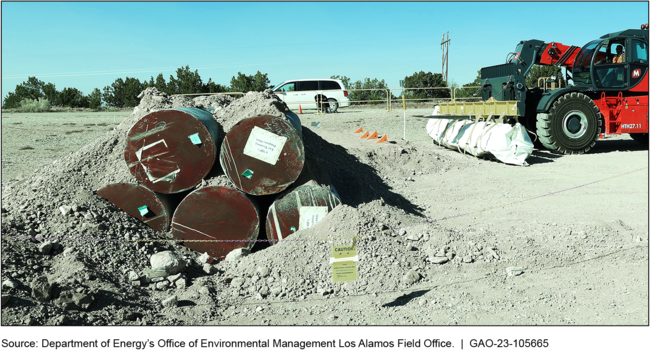
Adrian Hedden, Carlsbad Current-Argus, 21 Jul 23, https://www.currentargus.com/story/news/2023/07/21/feds-digging-up-nuclear-waste-in-los-alamos-for-disposal-at-carlsbad-area-repository/70426843007/
Workers at Los Alamos National Laboratory dug up buried nuclear waste they planned to dispose of at the federal repository near Carlsbad, amid pressure from State officials that the facility prioritize New Mexico waste.
The U.S. Department of Energy’s Los Alamos Field Office and the lab’s cleanup contractor Newport News Nuclear BWXT (N3B) Los Alamos announced Tuesday they began exhuming corrugated metal pipes containing transuranic (TRU) nuclear waste and preparing them for shipment.
At the Waste Isolation Pilot Plant near Carlsbad, TRU waste is disposed of via burial in a salt deposit about 2,000 feet underground, trucked into the site from DOE facilities throughout the country.
TRU waste is made up of irradiated clothing, equipment and other debris from nuclear research and development activities around the U.S.
Before it can be shipped to WIPP, the pipes must be cut using hydraulic sheers, allowing them to be loaded into waste boxes for shipment and disposal.
The pipes weight about 10,000 to 14,000 pounds, and measure about 20 feet long. They are cut into five pieces, with each piece loaded into a box.
It’s occurring at portion of the lab known as Dome 375, and the waste came from Los Alamos’ former radioactive liquid waste treatment facility operating during the Cold War at Technical Area 21 (TA-21).
There were 158 pipes in total transferred from TA-21, records show, containing cemented waste.
They were buried in 1986, where the waste sat until recently when worked began preparing it for final disposal.
The DOE hoped to finish digging up and preparing the pipes for disposal by spring 2024.
More: No progress to report on nuclear waste site aside from Carlsbad-area repository, feds say
The US should end its use of nuclear power plants – the intractible problem of dangerous spent fuel rods

Chicago Tribune, Jul 21, 2023 , Larry R. Eaton, Chicago
Fifty years ago, as chief of the Illinois attorney general’s Environmental Control Law Division, a relatively new field of law at that time, I had the occasion to tour an Illinois nuclear power plant. I was taken aback to see extensive pools of water containing bundles of spent nuclear fuel rods standing on end just beneath the surface of the water. I was advised that a pilot plant study had indicated that it would have an essentially closed-loop system that would not generate large amounts of spent fuel; however, once the full-scale plant became operational, the system failed to perform as anticipated. Plant workers were left with no good alternative but to store spent fuel rods in pools of water, at least temporarily, pending (hopefully) a better idea.
It appears that the nuclear power industry is still waiting for that better idea. A supporter of nuclear power production now maintains, in essence, that we have nothing to be concerned about regarding spent nuclear fuel because all we need to do is encase it in concrete and then open it up and repackage it in concrete every several decades. (In perpetuity, presumably; the radioactivity will remain unabated for a very long time indeed.) To understand how absurd this proposal is requires little more than to say it out loud.
Chernobyl and Three Mile Island were wake-up calls, but we do not appear to have fully awakened. It does not help that a nuclear power plant now sits near the front lines of a shooting war between Russia and Ukraine. Hopefully, we will somehow be lucky enough never to have a massive nuclear power plant disaster. But regardless of that, we will have radioactive spent fuel problems with us forever. We can no longer escape that fact. However, we can choose to stop making it worse.
Germany has decided to end its use of nuclear power. The U.S. should do the same. If there is anything worse than having an enormous carbon footprint, it has to be for that footprint to be radioactive too!
Corruption In Ukraine & The U.S. Mutually Rewarding
The Pentagon failed its 5th consecutive audit last year, appearing to lose track of 61% of its $3.5 trillion in assets.
Substack, LISA SAVAGE, JUL 20, 2023
“…………………………………………………………………………………………. Ukraine’s leaders are so over the top that it’s becoming impossible to ignore. Add in the fact that they have been enriched by U.S. taxpayers more or less directly despite crumbling infrastructure, catastrophic homelessness, apartheid healthcare, and a host of other problems that the U.S. could address with adequate funding.
From RT (whose editor-in-chief, Margarita Simonyan, just survived a second assassination attempt):
On July 7, US Under Secretary of Defense for Policy Colin Kahl spoke about a new package of aid from the US which includes cluster munitions – which are banned in 120 countries. The cost was $800 million.This is the 42nd delivery of aid that Ukraine has received from the US in the past year and a half.[emphasis mine] Since the beginning of Russia’s offensive, the US Congress has approved military and economic assistance to Ukraine amounting to over $70 billion – and that’s only counting direct expenses..
“Ukraine needs only one thing… To have someone come to power who won’t steal. Someone who won’t do it himself and won’t allow others to do so. Unfortunately, so far we haven’t been lucky,” [Aleksey Arestovich, former advisor to President Zelensky] said.
Ok, so Arestovich has a motive for trashing the government that used to include him. How about Pulitzer Prize-winning U.S. investigative journalist Seymour Hersh? Hersh does not approve of Russia’s entry into the war but he nonetheless published a piece on rampant corruption in Ukraine, “Trading with the Enemy,” back in April.
Zelensky has been buying fuel from Russia, the country with which it, and Washington, are at war, and the Ukrainian president and many in his entourage have been skimming untold millions from the American dollars earmarked for diesel fuel payments. One estimate by analysts from the Central Intelligence Agency put the embezzled funds at $400 million last year, at least; another expert compared the level of corruption in Kiev as approaching that of the Afghan war………………………………
Then there is President Zelensky, elected on pledges to end corruption and, incidentally, the war on the Donbas.
Pre-2022, i.e. when corporate media headlines about Ukraine did a 180, even The Guardian found he was part of the problem and not likely to be part of the solution.
Neither is the U.S. government likely to be part of the solution. The Pentagon failed its fifth consecutive audit last year, appearing to lose track of 61% of its $3.5 trillion in assets……………………….. more https://went2thebridge.substack.com/p/corruption-in-ukraine-and-the-us?utm_source=post-email-title&publication_id=1580975&post_id=135301485&isFreemail=true&utm_medium=email_medium=email
The Big Problem With Small Nuclear Reactors
The diminutive reactors are likely to be just as prone to delays and cost overruns as their behemoth predecessors.

I just read Pal Hockenos’ fine story about small nuclear reactors. But Hockenos is naive to think that Bill Gates and co. give a hoot about our future. What they do care about is their own increasing $squillions. And the coming source of new $squillions is in weaponry – that’s where all sorts of applications for SMRs lie. And Gates etc are well aware that the fixing-climate story is just a cover for the real practical purpose.
UNDARK BY PAUL HOCKENOS , 07.20.2023
IN RECENT YEARS, the nuclear power lobby and its advocates have begun to sing a new song. They have bailed on the monstrous reactors of the 20th century — not because of safety or toxic waste concerns, but because of the reactors’ exorbitant expense and ponderous rollout schedules. And they have switched their allegiance to a next generation nuclear fission technology: small modular reactors, which they claim will help rescue our warming planet, as well as the nuclear power industry— once they exist.
Respected thinkers such as former U.S. president Barack Obama, French president Emmanuel Macron, and Microsoft co-founder and philanthropist Bill Gates have toasted the idea of small modular reactors, or SMRs, as a potentially reliable, almost-emissions-free backup to intermittent renewable energy sources like wind and solar. Advocates claim that because SMRs will be smaller than the giants that currently dominate horizons, they will be safer, cheaper, and quicker to build. Although SMRs will have only a fraction of the power-generating capacity of traditional nuclear power reactors, proponents envision that they will, one day, be assembled in factories and transported as a unit to sites — like Sears’ mail-order Modern Homes of the early 1900s.
Currently, half of the states in the EU, both major political parties in the U.S, and the five BRICS nations — Brazil, Russia, India, China, and South Africa — have indicated that they want to split atoms for the purpose of generating energy. U.S. President Joe Biden included billions of dollars in tax credits for nuclear energy in the Inflation Reduction Act and the Infrastructure Investment and Jobs Act. Gates has gone so far as to invest a chunk of his fortune in a firm he founded, TerraPower, a leading nuclear innovation company. But despite the prodigious chatter, the endeavor to blanket the Earth with SMRs is a Hail Mary pass that’s very unlikely to succeed.
Granted, it is certainly a step in the right direction that most observers now see the postwar, giga-watt-scale water-cooled reactors as obsolete. When constructed new, these behemoths generate electricity at up to nine times the cost of large-scale solar and onshore wind facilities, and can take well over a decade to get up and running. Perhaps for this reason, there has been one, and only one, new nuclear power project initiated in the U.S. since construction began on the last one 50 years ago: a two-reactor expansion of the Vogtle Electric Generating Plant in Georgia. The first of the reactors came online this year — seven years behind schedule. The staggering $35 billion cost for the pair is more than twice the original projection.
But SMRs are just as likely to face similar delays and cost overruns. Currently, there are just two existing advanced SMR facilities in the world that could be reasonably described as SMRs: a pilot reactor in China and Russia’s diminutive Akademik Lomonosov. More small reactors are under construction in China, Russia, and Argentina, but all of them are proving even more expensive per kilowatt than traditional reactors.
It’s worth noting that in the U.S., and everywhere else in the world, nuclear policy relies heavily on subsidies to be economically competitive. Starting next year, utilities operating nuclear facilities in the U.S. can qualify for a tax credit of $15 per megawatt-hour — a break that could be worth up to $30 billion for the industry as a whole. However, even these giveaways won’t reduce the projected costs of SMR-generated electricity to anywhere near the going prices of wind and solar power.
In the U.S., the only SMR developer with a design approved by the Nuclear Regulatory Commission is NuScale, which plans to deploy six modules at one site in Idaho that will together generate less electricity than a smallish standard nuclear reactor. So far, however, NuScale has yet to lay a single brick. Its biggest win to date is securing $4 billion in federal tax subsidies. In January of this year, NuScale announced plans to sell electricity not at $58 per megawatt-hour, as originally pledged, but at $89 per megawatt-hour, citing higher than anticipated construction costs. The new projection is nearly twice the average global cost of utility-scale solar and onshore wind, according to calculations by BloombergNEF. And without the government subsidies, NuScale’s price tag would be that much higher.
In fact, there’s a fair chance that not a single NuScale SMR will ever be built: The company has said it will not begin construction until 80 percent of its expected generation capacity is subscribed, and currently buyers have signed up for less than a quarter of the plant’s capacity.
Gates’s TerraPower has an even longer way to go, although it too is cashing in on subsidies. The U.S. Department of Energy has pledged up to $2 billion in matching funds to construct a demonstration plant in Wyoming. Yet TerraPower recently announced it’s facing delays of at least two years because of difficulties securing uranium fuel from its lone supplier: Russia.
Even if the unlikely rollout of SMRs eventually happens, it will unfold too late to curb the climate crisis. And the reactors will face many of the same safety and radioactive waste concerns that plagued their larger counterparts, if only at smaller scales. Meanwhile, the siren song of nuclear energy is diverting critical resources from the urgent task of building out clean technologies. And the idea that nuclear reactors would serve as “backups” for wind and solar is misguided because the reactors can’t be ramped up and down quickly.
……………………………The technology of the future is already here. Clean wind and solar energy — coupled with updated smart grids, expanded storage capacity, hydrogen technology, virtual power plants, and demand response strategies — can work. Our energy systems of the future will look like a patchwork quilt, with diverse energy sources kicking in at different times during the day, and with the mix differing from one day to the next.
Bill Gates and like-minded innovators should put their minds and fortunes to work on this futuristic project of the present — and leave the 20th century relic that is nuclear power in the past, where it belongs
Is the UK Government unable to fund its promised nuclear renaissance?
- “Great British Nuclear has no legal basis – the Energy Bill has been delayed till the autumn, so it can’t do anything legally.
- “Great British Nuclear has no budget, so it can’t buy anything or commission anything.
- “Great British Nuclear has no premises.
- “Great British Nuclear has no paid staff.”
Great British Nuclear officially launched, sparks funding doubts.
Electrical Review 18th July 2023
“………………… So we’ve heard that Great British Nuclear has high hopes to kickstart a renaissance period for nuclear power in the UK, but how does it plan on achieving that? Well, thanks to the official launch, we now have more concrete information as to what the body plans to do.
The UK Government has officially launched Great British Nuclear, a new Government agency that is designed to support the growth of nuclear energy in the UK.
The official launch of Great British Nuclear was initially tipped for July 13, although the launch was pushed back due to “unforeseen circumstances.” Despite the delayed start, the Government has high hopes for the new department, with it hoping to create a renaissance for nuclear energy in the UK.
One of Great British Nuclear’s first acts will be to kickstart a competition for small modular reactor (SMR) technology, which it believes could help boost energy security, create cheaper power, and grow the economy through well-paid jobs.
Many in the industry have been calling for the UK Government to do more to encourage the construction of more nuclear power, including SMRs, as the UK transitions towards cleaner power generation. The UK Government has even gone so far as to claim that nuclear will be essential to our net zero future, noting that it will provide a ‘baseload’ to cover more intermittent renewable energy generation – something that our Gossage Gossip columnist recently described as a ‘load of cobblers’.
How will Great British Nuclear Help?
So we’ve heard that Great British Nuclear has high hopes to kickstart a renaissance period for nuclear power in the UK, but how does it plan on achieving that? Well, thanks to the official launch, we now have more concrete information as to what the body plans to do.
From today, companies can register their interest with Great British Nuclear to participate in a competition to secure funding support to develop their SMRs. Additionally, the Government body is eager to explore future sites for new large gigawatt-scale nuclear power plants, such as those at Hinkley Point C and Sizewell C.
That’s about as much as we know about Great British Nuclear’s initial plans – although the UK Government is throwing its weight behind the nuclear industry with a brand-new funding package totalling up to £157 million.
This includes:
Up to £77.1 million of funding for companies to accelerate advanced nuclear business development in the UK and support advanced nuclear designs to enter UK regulation, maximising the chance of small and advanced modular reactors being built during the next ParliamentUp to £58 million funding for the further development and design of a type of advanced modular reactor (AMR) and next generation fuel. AMRs operate at a higher temperature than SMRs and as a result they could provide high temperature heat for hydrogen and other industrial uses alongside nuclear power. This includes:
- Up to £22.5 million to Ultra Safe Nuclear Corporation UK in Warrington to further develop the design of a high temperature micro modular reactor, a type of AMR suited to UK industrial demands including hydrogen and sustainable aviation fuel production.
- Up to £15 million to the National Nuclear laboratory in Warrington to accelerate the design of a high temperature reactor, following its success in Japan.
- Up to £16 million to National Nuclear Laboratory in Preston to continue to develop sovereign coated particle fuel capability, a type of robust advanced fuel which is suitable for high temperature reactors.
A further £22.3 million from the Nuclear Fuel Fund will enable eight projects to develop new fuel production and manufacturing capabilities in the UK, driving up energy security and supporting the global move away from Russian fuel. This will include:
- Over £10.5 million to Westinghouse Springfields nuclear fuel plant in Preston to manufacture more innovative types of nuclear fuel for customers both in the UK and overseas, boosting jobs and skills in the North West.
- Over £9.5 million to Urenco UK in Capenhurst Chester, an international supplier of nuclear materials, to enrich uranium to higher levels, including LEU+ and high assay low enriched uranium (HALEU). LEU+ will allow for current reactors and SMRs to run for longer between refuelling outages, improving reactor efficiency and economics both in the UK and abroad. HALEU development will ensure that the UK remains at the forefront of fuel development for future advanced reactors.
- Over £1 million has also been awarded to Nuclear Transport Solutions, a subsidiary of the Nuclear Decommissioning Authority, to develop transport solutions to facilitate a supply chain for highly enriched uranium in the UK and internationally.
- Over £1.2 million to support MoltexFLEX, a UK molten salt reactor developer based in the North West, to build and operate rigs for the development of molten salt fuel. Molten Salt Reactors (MSRs) are an AMR type that use a molten salt as a coolant and fuel, leading to intrinsic safety compared with conventional fuels.
Is the UK Government unable to fund its promised nuclear renaissance?
Despite announcing £157 million in investment for the nuclear industry in the UK, many experts will argue that the UK Government’s funding plans are woefully inadequate to meaningfully move the needle.
Recent nuclear projects within the UK have been unable to get off the ground without significant Government intervention, including Hinkley Point C, which the Government has committed at least £679 million towards, despite the new reactor facing constant delays – with its opening date now set for September 2028.
Rolls-Royce, which is currently undergoing regulatory testing on its small modular reactor technology, has suggested that SMRs will be cheaper – although the company still believes each SMR will carry a price tag of at least £1.8 billion when they start rolling out of factories in 2030. That is expected to get you around 440 MW of generation – which for the same price, you could purchase 782 Enercon E82 onshore wind turbines, netting you up to 2346 MW of generation.
One industry insider suggested that the UK Government’s woeful funding figures was “the best example I have ever seen of what a Government on its last legs sounds like when it has nothing to say and no money to spend.” Adding that, “All this amount will buy you, literally, is a very large pile of paper and possibly a few more headlines.”
Given the Conservative Party’s performance in recent polls, it’s likely the UK Government is unwilling to commit large amounts to Great British Nuclear when it’s unlikely to be in Government for much longer. Unfortunately, large infrastructure projects of this nature require huge investment across multiple parliamentary terms – and the short-sighted nature of the country’s leaders got us into this situation in the first place. In fact, by the time Hinkley Point C comes online, it will be 20 years since the Government of the day supported a new reactor.
Will the launch of Great British Nuclear move the needle?
The UK Government is hopeful that Great British Nuclear will move the needle in the development of nuclear power technology in the UK. While it may not have the budget to invest in new nuclear reactors itself – it could potentially foster an environment that is ultimately friendly to nuclear power.
Unfortunately, as our industry insider notes:
- “Great British Nuclear has no legal basis – the Energy Bill has been delayed till the autumn, so it can’t do anything legally.
- “Great British Nuclear has no budget, so it can’t buy anything or commission anything.
- “Great British Nuclear has no premises.
- “Great British Nuclear has no paid staff.”
So, the chance of meaningfully moving the needle is essentially nil. But at least the current Government can capture headlines and act like it’s trying to help. https://electricalreview.co.uk/2023/07/18/great-british-nuclear-officially-launched-sparks-funding-doubts/
1 This Month
23-25 October – on Zoom – World BEYOND War’s annual global conferenc


Shut down the radiation-damaged Heysham nuclear reactors now
To see nuclear-related stories in greater depth and intensity – go to https://nuclearinformation.wordpress.com

Say No to NASA’s Reckless Nuclear Reactor on the Moon
Say No to NASA’s Reckless Nuclear Reactor on the Moon

-
Archives
- October 2026 (219)
- September 2026 (339)
- August 2026 (330)
- July 2026 (355)
- June 2026 (287)
- May 2026 (306)
- April 2026 (356)
- March 2026 (251)
- February 2026 (267)
- January 2026 (308)
- December 2025 (358)
- November 2025 (359)
-
Categories
- 1
- 1 NUCLEAR ISSUES
- business and costs
- climate change
- culture and arts
- ENERGY
- environment
- health
- history
- indigenous issues
- Legal
- marketing of nuclear
- media
- opposition to nuclear
- PERSONAL STORIES
- politics
- politics international
- Religion and ethics
- safety
- secrets,lies and civil liberties
- spinbuster
- technology
- Uranium
- wastes
- weapons and war
- Women
- 2 WORLD
- ACTION
- AFRICA
- Atrocities
- AUSTRALIA
- Christina's notes
- Christina's themes
- culture and arts
- Events
- Fuk 2022
- Fuk 2023
- Fukushima 2017
- Fukushima 2018
- fukushima 2019
- Fukushima 2020
- Fukushima 2021
- general
- global warming
- Humour (God we need it)
- Nuclear
- RARE EARTHS
- Reference
- resources – print
- Resources -audiovicual
- Weekly Newsletter
- World
- World Nuclear
- YouTube
-
RSS
Entries RSS
Comments RSS

