The U.S. ally getting nuclear submarines with no AUKUS deal
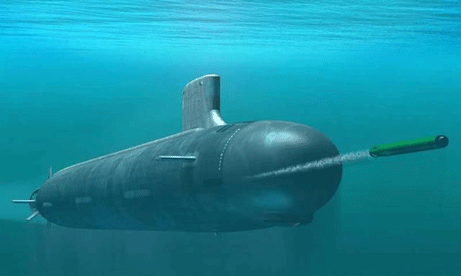
How South Korea’s plan for nuclear-powered submarines compares to AUKUS
ABC News, By Doug Dingwall, 6 June 26
The South Korean city of Gyeongju is famous for its uncanny, grass-covered burial mounds bearing the tombs of ancient kings.
It will also go down in history as the place where the United States finally agreed to South Korea’s long-held aspirations to acquire nuclear-powered submarines, ahead of the Asia-Pacific Economic Cooperation leaders’ meeting last year.
Months later, South Korea’s government has announced its plan to build the submarines by the mid-2030s, but it did not reveal how many, nor the expected cost.
As with the AUKUS agreement, the United States will help a close ally gain a fleet of nuclear-powered submarines.
But beyond that, South Korea and Australia are taking different paths to building their new vessels, and they’re acquiring them for different reasons.
So what is Seoul’s plan, and how does it compare to Australia’s AUKUS submarine endeavour?
Unknown unknowns
South Korea’s ambitions for nuclear-powered submarines go back 20 years, but it had been unable to secure approval from the US, which was concerned about nuclear proliferation.
However, US President Donald Trump broke with previous administrations and in October agreed to South Korea having nuclear-powered submarines, framing it as a win for American industry.
“South Korea will be building its Nuclear Powered Submarine in the Philadelphia Shipyards, right here in the good ol’ USA,” he posted on Truth Social.
Plans have changed since then, with South Korea’s Defence Minister Ahn Gyu-back announcing the submarines will be developed and built by his country.
The submarines would use low-enriched uranium fuel and the first would be launched in about a decade, he said.
Other than that, experts say the details are scant, maybe intentionally so.
“Most importantly, they haven’t put a dollar figure on it,” said Euan Graham, senior fellow at the Australian Strategic Policy Institute (ASPI).
In contrast, the AUKUS submarine program comes with a $368 billion price tag, one that Dr Graham expects won’t reflect the final cost.
“That ambiguity [in the South Korean plan] is, in a funny way, more honest because they don’t know what they don’t know,”
he said.
Observers agree the cost is one of the major risks in Seoul’s plan to build nuclear-powered submarines.
The vessels are expensive, not only to build, but also to operate, maintain and support over their entire life cycle, said Jihoon Yu, research fellow at the Korea Institute for Defense Analyses.
“South Korea will need to balance this program with other defence priorities, including air and missile defence, conventional submarines, unmanned systems, cyber capabilities, and space-based surveillance,” Dr Yu said.
Why nuclear-powered submarines?
Unlike AUKUS, South Korea’s plan is not about replacing a fleet of aging submarines.
Dr Yu said it was already modernising its diesel-electric submarines, including the KSS-II and KSS-III class, which were expected to remain operational for decades.
Instead, South Korea wants nuclear-powered submarines because it believes they are better suited for deterring the changing threat posed by North Korea.
That’s because nuclear-powered submarines can stay underwater longer, experts said.
“North Korea has invested heavily in submarine-launched ballistic missile capabilities, and tracking those platforms requires prolonged underwater endurance and sustained speed,” said Seong-Hyon Lee, associate in research at Harvard University’s Asia Center………………………..
Dr Yu said nuclear-powered submarines could also cover vast distances, and this would let South Korea contribute more to security beyond its immediate coastal waters.
“Nuclear-powered submarines could contribute to sea lane protection, regional maritime stability and broader allied deterrence missions,” he said.
That might appeal to the Trump administration, which wants US allies to take on more responsibility for their defence and security, including in the Asia-Pacific region.
Will South Korea’s plan rely less on the US?
Australia’s pathway to nuclear-powered submarines relies deeply on the US and the United Kingdom for technology and training.
“AUKUS is not just a submarine acquisition program; it is also a long-term strategic, industrial and technological integration project among three countries,” Dr Yu said.
“South Korea would likely seek a more domestically driven model, although it would still need close cooperation with the United States, especially on nuclear fuel,, safeguards, regulatory arrangements and political approval.”…………………………………………………………………….
know-how in building diesel-electric submarines, and in civilian nuclear technology, will only take South Korea so far.
It would have to solve questions such as reactor miniaturisation, acoustic quieting, shock resistance and integrating complex propulsion systems, Dr Lee said.
“These are highly demanding technical areas where even established naval powers have faced considerable hurdles.”
Mr Trump and South Korean President Lee Jae Myung agreed last year the US would work with Seoul on the project, including on “avenues to source fuel”.
“The most important unresolved issue concerns the nuclear-fuel framework under which any future submarine program would operate,” Dr Lee said.
South Korea has an agreement with the US that restricts its uranium enrichment.
“More broadly, the political, legal and technical details of any US-South Korea cooperation in this area have yet to be fully defined,” Dr Lee said.
Different plan, different problems
Experts say there’s a risk that South Korea’s nuclear-powered submarines program could be misunderstood in the region………………………………. https://www.abc.net.au/news/2026-06-06/how-south-korea-submarine-plan-compares-to-aukus/106764594
Repetitive Folly: Israel’s Futile War in Lebanon Deepens
4 June 2026 Dr Binoy Kampmark, https://theaimn.net/repetitive-folly-israels-futile-war-in-lebanon-deepens/
Call it a repeating script, a rusty template, or simply a creaky model to emulate time and again. The structural and homicidal destruction of Gaza undertaken by Israeli forces is now finding full expression in southern Lebanon, a cause of concern even for those in Washington. The war’s increasing savagery is a reminder of how hollow the exhortations by the Netanyahu government seem following the official cessation of hostilities against Hezbollah in November 2024.
Israel’s pre-emptive war on Iran, commencing on February 28 with the full and criminal connivance of the United States, took place alongside an incursion into southern Lebanon that has become a burgeoning invasion ostensibly to create a chunky buffer against Hezbollah’s attacks. Presumably, the wishful thinking here was to eliminate Iran as a threat, thereby removing Hezbollah’s most ardent patron and sponsor. At the time, coteries of commentators and Israeli leaders lavished praise on the country’s technical and military achievements, forgetting the central point that Hezbollah remains an idea as much as a physical movement, a deep well rather than defined, terminable cul-de-sac. Ideas, which can only really be battled by better ones, prove sleekly stubborn before tanks, missiles and jets.
From March, the southern part of Lebanon was subjected to infrastructural degradation, population displacement and the wholesale destruction of villages, all on the spurious premise that the security of Israeli settlements near the border will be somehow improved. In April, in the long cast shadow of the Iran War, another ceasefire was brokered between Israel and Lebanon, with another extension to the truce for another 45 days agreed to mid-May. This farcical theatre has taken place amidst ongoing IDF operations which have, as of June 1, displaced over a million Lebanese and seen more than 3,300 deaths. Israel has lost 24 soldiers and 4 civilians during that time.
With Iran resiliently stubborn in diplomacy, collaterally backed by its continued blocking of the Strait of Hormuz, and Hezbollah showing signs of renewed martial vigour, the two-pronged plan has been defanged. Hezbollah’s revivified hunger for battle has taken the form of lethal attacks on the IDF with drones resistant to electronic jamming. These explosive-laden fibre-optic First-Person View drones, connected to their operators with a bare yet lengthy optical wire, permit visibility and manoeuvrability for miles. Israeli soldiers, long seen as having immune breastplates against Hezbollah’s attacks, are now dying.
Former Israeli national security official Orna Mizrahi, who heads the Lebanon program at Tel Aviv’s Institute for National Studies, accepts that “the drones made for some confusion, because it was a surprise. The IDF didn’t think that it would be such a dangerous weapon.In Israel, they looked at it as a toy.” Remarks from the IDF reported in the Times of Israel show that the military has been disabused of this notion. The FPV drones posed “a dynamic and evolving threat, characterized by inexpensive, readily made tools with a high rate of variability.”
The BBC reports the troubled account of a council chief from the northern Israeli town of Shomera, Sami Zanetti: “The problem is you don’t feel them coming. You’re sitting there, and suddenly it arrives. And if you run away, it follows you.” Prime Minister Benjamin Netanyahu, acknowledging the dangers posed by these economical, effective packages of death, promises that a “special team” is labouring away to “solve this.”
Despite the increasingly attritive toll on its forces, the propaganda channels on Israeli triumphs continue to prove thick and hefty, attempting to justify a campaign described by Michael Koplow of the Israeli Policy Forum as “a political imperative in search of a strategy.” The May 31 seizure of the Beaufort Castle area and the Ali al-Taher Ridge was celebrated by the Israeli Alma Research and Education Center as one of “operational significance, as it constitutes a strategic zone in southern Lebanon and psychological significance for all parties involved in the conflict.” The “loss of control over the Beaufort area” was deemed “a direct operational setback for” Hezbollah.
These ground operations, false heralds of decisiveness, barely conceal the increasing desperation within the Netanyahu government, culminating in threats made on June 1 to attack the Lebanese capital. On June 2, the Israeli Minister of Defence, Israel Katz, told a gathering at the Defense Export Conference that the bombing of certain neighbourhoods of Beirut with alleged ties with Hezbollah was in the offing. “The proof of this policy in protecting the settlements [near the border] will be simple and will become clear in the coming days: if the shooting against the settlements ceases, or if it continues and we attack Dahiyé in Beirut, this equation will become a reality.”
Currently, another counterfeit, jejune ceasefire is in play, one that was only reached after a ranting call of colour and invective between US President Donald Trump and Netanyahu on June 1. (According to a US official quoted by Axios, Trump is said to have bellowed the following: “You’re fucking crazy. You’d be in prison if it weren’t for me. I’m saving your ass. Everybody hates you now. Everybody hates Israel because of this.”) While Trump finds himself held in an Iranian lock, tightened by Tehran’s insistence on tying a halt of Israeli hostilities in Lebanon with a broader cessation of conflict, Israel has been ensnared by its own too-clever-by-half logic in Lebanon. The un-snaring will be sanguinary and ugly.
15TH INTERNATIONAL URANIUM FILM FESTIVAL RIO DE JANEIRO AWARDS

Uranium Film Festival, Jun 03, 2026
Films from Canada, Spain, Germany, Brazil and the USA won the top awards at the 15th International Uranium Film Festival of Rio de Janeiro. The awards ceremony took place on Saturday, May 30, 2026, at the Cinematheque of the renowned Museum of Modern Art (MAM Rio). Bye, Bye Rio, hello Las Vegas. For those who could not make it to the Rio de Janeiro International Uranium Film Festival in time this year, you may join us in Las Vegas, Nevada. The 3rd International Uranium Film Festival in Vegas will be held this fall at the University of Nevada Boyd School of Law in cooperation with Principal Man Ian Zabarte from the Western Bands of the Shoshone Nation of Indians. The Shoshone are the most atomic bombed nation on earth. More than 900 atmospheric and underground nuclear explosions were conducted on their territory in Nevada by the US and 28 nuclear full-scale nuclear weapon detonations by the United Kingdom.
And these are the winners of the 15th International Uranium Film Festival of Rio de Janeiro, May 21 – 30, 2026.
EMERGING FILMMAKER AWARD
ALBRAUM
Germany, 2026, Directed by Maja Hohenberg, Poetic Documentary, 20 min. (Photo: Maja Hohenberg)
BEST INVESTIGATIVE DOCUMENTARY FILM
BOMBSHELL
USA, 2025, Directed by Ben Loeterman & Gaia De Simoni, Documentary Feature, 80 min.
BEST EXPERIMENTAL DOCUMENTARY
OUT OF CONTROL. REPORTS ON THE ATOMIC BOMB
Spain, 2023, Directed by Beatriz Caravaggio, Experimental Documentary, 50 min.
BEST DOCUMENTARY FEATURE FILM
THE ATOMIC SCREEN
Canada, 2025, Directed by Alain Vézina, Documentary, 52 min.
NATIVE SPIRIT AWARD
THE MOTH
Canada, 2025, Directed by: Michelle Derosier and Zoe Gordon, Short Fiction, 20 min. (Photo: Zoe Gordon)
HONORABLE MENTIONS
HIBAKUSHA – WANDERING SOUL
Brazil, 2025, Director: Joel Yamaji, Short documentary, 20 min. (Photo: Joel Yamaji)
HOLLYWOOD BOMB – HOW PRESIDENT TRUMAN AND GENERAL GROVES DESTROYED THE FIRST NUCLEAR EPIC
USA, 2026, Director: Greg Mitchell, Short documentary, 15 min.
THE ALPACA CONNECTION
USA, 2025, Director: Tom Brown, Comedy thriller short, 18 min.
TOO LATE TO LEARN
USA, 2026, Director: Thomas Kanady, Documentary, 68 min.
Statements of the Award Winners…………………………………………………………………………………………………………………………………………………………………………………………………………………………………. https://www.filmfestivals.us/blog/uranium_film_festival/15th_international_uranium_film_festival_rio_de_janeiro_awards
North Korea unveils a new plant to produce fuel for nuclear weapons

Daily Mail 4th June 2026, SEOUL, South Korea (AP) –
North Korea on Thursday unveiled a new facility to produce nuclear bomb fuels, with leader Kim Jong Un announcing plans to bolster the country´s nuclear forces “at an exponential rate.”
Some experts still question whether North Korea has functioning nuclear missiles that can reach the U.S. mainland. But the nuclear plant’s disclosure implies that Kim is eager to cement his country’s status as a nuclear power and has no intentions of placing his bomb program on a negotiating table.
After visiting the site on Wednesday, Kim said he and other top officials “confirmed the order of priority for implementing the ambitious future plan designed to beef up our state´s nuclear forces at an exponential rate,” according to the official Korean Central News Agency.
KCNA said the facility used “more sophisticated technology” but didn´t provide further details like its location. South Korea´s Joint Chiefs of Staff assessed the site as a uranium enrichment plant and said it was closely coordinating with the United States to monitor North Korean nuclear activities………………………………………………………………………………………………………………………………..
Experts say Kim wants an international recognition as a nuclear state so that he could demand the lifting of U.N. economic sanctions. They say Kim would ultimately push for arms reductions talks with the U.S. as a way to win concessions in return for a partial surrender of his nuclear capability……………………………………………………… https://www.dailymail.com/wires/ap/article-15872477/North-Korea-unveils-nuclear-plant.html
Nuclear Power Returns to the Forefront of Quebec’s Energy Debate

“It’s an industry that’s generally heavily subsidized by the government, because the private sector is less willing to take on these risks,” adds Jean-Pierre Finet. He points out that the majority of nuclear power plant construction projects, which typically span about a decade, exceed their scheduled timelines and budgets. “Public funds are used to mitigate the risks of these projects,” he notes, adding that customers are then called upon to absorb the excess costs.
Nuclear power continues to polarize the debate. Here’s why.
French-language article, by Juliane C Lelarge, Le Devoir, June 3 2026
As Ottawa accelerates its nuclear development, Quebec evaluates various energy scenarios, and new Liberal leader Charles Milliard says he is open to the sector. Nuclear power is resurfacing in the public debate. Presented by its supporters as a carbon-free solution to meet growing electricity demand, nuclear power continues to polarize the debate. Here’s why.
Why is there a resurgence of interest in nuclear power?
The electrification of society and the gradual phase-out of fossil fuels, particularly in transportation and buildings, are expected to lead to a marked increase in electricity demand over the coming years, explains Karim Zaghib, a professor of chemical engineering at Concordia University and former director of research at Hydro-Québec. He also highlights the rapid growth of artificial intelligence and data centers, which is likely to exacerbate this pressure.
Current geopolitical instability and aspirations for energy independence are also fueling a global resurgence in the nuclear industry. And the development of new technologies, such as small modular reactors, is reinforcing this trend, although some experts are calling for caution.
This interest was particularly evident in the preliminary drafts of the Integrated Energy Resources Management Plan (PGIRE), published in March, which explores a scenario involving a return to nuclear power, even though many industry stakeholders question the influences behind this inclusion.
“We know, for example, that in Quebec, the firm AtkinsRéalis [formerly known as SNC-Lavalun] is lobbying in this direction. There are also American corporations exerting pressure,” explains Jean-Pierre Finet, an analyst with the Regroupement des organismes environnementaux en énergie.
Does nuclear energy have advantages?
Nuclear power is among the energy sources with the lowest CO2 emissions over its entire life cycle, on a par with wind and hydroelectric power. “Compared to wind power, it also has the advantage of being quieter and having no significant impact on the landscape or land use,” explains Karim Zaghib, who notes that Quebec’s geography—and its multitude of waterways—is well-suited to the installation of power plants.
According to Guy Marleau, a professor in the Department of Engineering Physics at Polytechnique Montréal, nuclear infrastructure also has a much longer lifespan: 60 years for a power plant, compared to an average of 12 years for a wind turbine. The electricity production of a nuclear power plant is also incomparable to that of renewable energy sources, he notes.
Karim Zaghib views nuclear power as a complement to wind and solar energy, and stresses the importance of diversifying energy sources to ensure the grid’s resilience. This is because nuclear power provides a more stable baseload energy supply, he explains.
In Jean-Pierre Finet’s view, however, nuclear power’s inflexibility is a disadvantage. “With hydroelectric power, we can adapt to demand. With nuclear, it’s like having the pedal to the metal all the time,” he explains, noting that energy produced during periods of low demand is sold at a low price, or even at a loss. “That’s why we buy a lot of low-cost energy from Ontario, which sometimes has no choice but to offload it.” Advances in energy storage also put the issue of renewable energy’s intermittency into perspective, he says.
“Nuclear power is sometimes seen as an alternative for more climate-skeptical stakeholders who reject renewables on principle,” notes Philippe Gauthier, an energy analyst at the Rivières Foundation, citing the energy strategy implemented by the Trump administration in the United States as an example.
What would reinvesting in the sector in Quebec entail?
“It would be extremely expensive,” Philippe Gauthier states right off the bat, noting that nuclear development is one of the most costly forms of energy production.
“It’s an industry that’s generally heavily subsidized by the government, because the private sector is less willing to take on these risks,” adds Jean-Pierre Finet. He points out that the majority of nuclear power plant construction projects, which typically span about a decade, exceed their scheduled timelines and budgets. “Public funds are used to mitigate the risks of these projects,” he notes, adding that customers are then called upon to absorb the excess costs.
Another challenge: Quebec’s nuclear expertise is disappearing. “To shut down the Gentilly plants, Hydro-Québec had to reach out to its retirees, who were the only ones left with that expertise,” recalls Philippe Gauthier. This lack of expertise makes the industry still very much an American one, asserts Jean-Pierre Finet, who rejects the argument for energy sovereignty. He points out that Canada’s largest federally-owned nuclear facilities, the Chalk River Laboratories, have been managed since 2025 by a private American consortium, some of whose largest companies are linked to the U.S. defense sector.
Is the issue of safety still relevant today?
“Today, safety is a given,” argues Karim Zaghib, noting that accidents are now very rare. The issue that remains a subject of debate is radioactive waste. “With our current drilling capabilities, we’re able to bury it tens of kilometers underground,” says the researcher.
“The waste issue is far from resolved,” counters Jean-Pierre Finet. He cites as an example the discharge of toxic wastewater from the Chalk River facilities into the Ottawa River in 2024. The nuclear project, which in recent weeks received a federal grant of $2.2 billion, calls for the burial of large quantities of radioactive waste near the surface. This part of the project is the subject of litigation, including with the Anishinaabe community of Kebaowek, which won a victory on this matter on May 28 in the Federal Court of Appeal.
More broadly, experts criticize the nuclear industry for a real lack of transparency. “The current oversight process is practically nonexistent,” laments Philippe Gauthier, who believes the ties between the industry and regulatory bodies are too close. He cites as an example the case of the 62.8 tons of irradiated uranium fuel that was transported in secret on Quebec’s roads in the summer of 2025.
Several experts interviewed believe that the global trend toward a return to nuclear energy must also be analyzed in light of the phenomenon of nuclear rearmament. “The military industry needs the civilian industry to develop its expertise,” explains Philippe Gauthier. “We cannot ignore the fact that military applications are still part of the nuclear equation.”
Is the development of nuclear power part of a transition strategy?
“We must not confuse adding carbon-free generation with decarbonization,” explains Jean-Pierre Finet. “All we’ve done so far is add carbon-free generation without reducing the rest of our [fossil fuel] consumption, which doesn’t reduce GHG emissions. It’s mainly a pretext for further industrialization.”
According to him, the issue isn’t about increasing energy production, but about better managing its distribution and consumption, particularly through more efficient use and storage.
More broadly, experts are calling on governments to dare to talk about energy conservation. “It seems like we’re doing all this to avoid having to change our behaviors, and then our lifestyles. The extractivist approach is not sustainable,” argues Mr. Finet.
Rolls-Royce under fire for outsourcing parts of UK nuclear project to South Korea

Multibillion-pound contract to build three small modular
reactors was signed with government body in April. Rolls-Royce is facing
mounting criticism from politicians and industry figures for a decision to
outsource the core parts of a multibillion-pound UK government plan for
three small nuclear reactors to South Korea.
The announcement by the
British engineering giant, the lead investor in a consortium developing the
reactors, has raised questions about whether the government’s target of
70 per cent of the project being British-made will be met.
Rolls-Royce
SMR’s selection of South Korea’s Doosan Enerbility to finalise designs
for key components for the small nuclear reactors has triggered warnings
from industry representatives that the UK is squandering a chance to build
its own supply chain for the technology. Liam Byrne, Labour MP and chair of
parliament’s business and trade committee, said he would be writing to
ministers seeking clarification as to how Rolls-Royce’s announcement is
compatible with the 70 per cent target.
FT 5th June 2026, https://www.ft.com/content/dcc90c25-43e7-4456-84bb-35458dc6726c?syn-25a6b1a6=1
The atomic clock is ticking.

Western countries build far more slowly, when they build at all. The Darlington SMR is one of only six in the entire Western Hemisphere to begin construction in the past 40 years. Of those, only two, located in the U.S., completed construction, both spectacularly late.
A nuclear project’s schedule and cost are inextricably linked: Any delay will eat into contingencies, and, if sustained, will blow budgets to smithereens. Moreover, delays compound the already daunting challenge of financing the project.
even within the nuclear industry, many doubt SMRs can offer sufficient advantages to attract orders; the results of the first SMR in a G7 country could settle the matter.
Will Canada’s first new nuclear reactor in decades be built on time? Here’s how an Ontario utility’s promises stack up against the numbers
Matthew McClearn, The Globe and Mail, June 4, 2026, https://www.theglobeandmail.com/business/article-nuclear-reactor-ontario-power-generation-utility/
The race to build Canada’s first new nuclear reactor in more than three decades has officially begun on the north shore of Lake Ontario.
In late April, the Ontario government announced that the foundation of the building that will house the reactor had been lifted to its final resting place, down a 35-metre-deep vertical shaft, by one of the world’s largest crawler cranes. The foundation weighed more than 950 tonnes – heavier than three Airbus A380s, the government said.
With that, a clock started ticking.
As far as Ontario Power Generation is concerned, the Darlington small modular reactor, or SMR, has been under construction for about a year now. But according to nuclear industry bodies such as the International Atomic Energy Agency and Mycle Schneider Consulting, which compile data on nuclear projects globally, construction officially begins with the placing of concrete for the foundation of the reactor building.
OPG and its partners – including reactor developer GE Vernova Hitachi Nuclear Energy, construction company Aecon Group Inc., and architect-engineer AtkinsRéalis Group Inc. – have just four years and seven months to complete construction and connect the reactor to the grid, as promised, by the end of 2030. Once built, the reactor could supply enough electricity to power 300,000 homes. It’s a crucial first step for Ontario’s energy plans, which envision building many more reactors in the coming years.
Nuclear plants join high-speed rail, large bridges and tunnels, hydroelectric dams (think Site C) and major IT initiatives (think the federal Phoenix payroll system) on the list of complex engineering works that are highly likely to suffer lengthy delays. They’re akin to the Olympics for project managers; by promising the SMR in less than five years, OPG has effectively promised a gold medal.
Don’t let the “small” moniker fool you: The Darlington SMR is no minor undertaking. Lately, as many as 1,500 workers have been on-site on a typical work day.
OPG’s lengthy task list includes building the first-ever BWRX-300 reactor, a robust containment building to house it, a control building which will include the main control room, and another structure to house the turbine generator. It must also complete support structures for the other three planned units. They include a water cooling system complete with underground tunnels, and a switchyard.
According to an analysis of data from Mycle Schneider Consulting by The Globe and Mail, few reactors have been built in less than five years in recent history.
The fortunes of corporate executives, politicians, suppliers and even the nuclear industry itself depend on whether OPG’s team can demonstrate they are as exceptional as their political masters claim.
Why would completing a reactor in five years be difficult?
Canada’s nuclear industry finished building its last nuclear power reactor more than three decades ago. The 25 Candu reactors that started construction between 1958 and 1985 took an average of slightly longer than seven years to bring into commercial operations. Many of those reactors have been refurbished, which has reinvigorated Ontario’s nuclear industry. Even so, many of the skills required to build a plant from scratch have atrophied.
The closest Canadian analogue to the Darlington SMR might be Douglas Point, the earliest attempt to construct a commercial nuclear power plant. When work began in 1960 in Tiverton, Ont., Canada had limited experience building nuclear plants. Just like Douglas Point, the Darlington SMR is essentially a prototype. Douglas Point’s 200-megawatt output placed it in the same class. It took 8½ years to build.
Canada’s fastest build was Pickering-3, running from late 1967 to early 1972. Those years spanned a period when Ontario hit its stride building multiple reactors, but shows tight timelines were achievable back then.
How long has it taken to build nuclear plants globally?
China dominates modern reactor construction: According to Mycle Schneider Consulting data, 44 of the 75 reactors that began construction worldwide since 2016 are there. Yet few Chinese reactors are delivered within five years.
Western countries build far more slowly, when they build at all. The Darlington SMR is one of only six in the entire Western Hemisphere to begin construction in the past 40 years. Of those, only two, located in the U.S., completed construction, both spectacularly late.
Boasting about modular construction techniques, American reactor developer Westinghouse promised it could build its AP1000 reactor in just 36 months. Four AP1000s eventually started construction in the U.S. in 2013. Two of them, Vogtle Units 3 and 4, took more than a decade each. The other two, V.C. Summer Units 2 and 3, in South Carolina, were abandoned after roughly four years; efforts to restart their construction are now under way.
The only reactor attempted in France so far this century, Flamanville-3, was planned to take a little more than four years. It took 17. The only two reactors started in the United Kingdom since 2016 were at the Hinkley Point station, Britain’s largest nuclear power site; they’re approaching 12 years and counting, still under construction.
Why are nuclear builds so frequently delayed?
Nuclear projects face delays for numerous reasons. But some cardinal sins occur regularly, such as proceeding without a complete set of detailed blueprints.
The two V.C. Summer units in South Carolina, for example, began construction when engineering designs were incomplete. Drawings often turned out to be not constructible, sending designs back to the drawing board. Those changes, in turn, led to more work for subcontractors, which provoked disputes over who’d pay the resulting costs. Any changes also had to be approved by the U.S. Nuclear Regulatory Commission.
A report by Jean-Martin Folz, former head of French automaker Peugeot, found that construction at France’s Flamanville-3 also began without a complete set of validated plans. The result was that the plant’s design continuously changed during construction, and lots of work had to be redone.
Quality control is another common stumbling block. At Flamanville-3, Mr. Folz catalogued a wide range of defects including poor welds and badly-manufactured forged components. Defects can lead to a cycle of delays, rework and disputes.
Once delays start piling up, it’s hard to recover. At Flamanville, Mr. Folz noted that Électricité de France tried to accelerate work schedules to get back on track. That only led to other problems, leading to further rework and delays, not to mention overloaded and demoralized crews.
After years of poor performance, the construction of the Vogtle units in Georgia was placed under new management. Don Grace was an engineer hired by the Georgia Public Service Commission to evaluate the project’s progress. During testimony in 2022, he explained that the new proponents “prematurely” started testing equipment at the plant, even as construction continued.
The problem? Mr. Grace said it resulted in too many workers toiling alongside one another on compressed timetables – a problem dubbed “stacking of crafts.” That was exacerbated by management’s tendency to defer planned work to achieve near-term milestones that provided “an inaccurate impression of having made significant progress.”
Mr. Grace put it this way: “The scope of work for a new nuclear plant is so large, and how the proper scoping and sequencing of all the activities comes together is highly important.”
What’s behind OPG’s confidence?
OPG believes the BWRX-300, while being first of its kind, is the simplest-ever boiling water reactor, a mature American-designed technology. There are more than 100 of them operating worldwide, so many of its basic principles have been demonstrated before.
OPG also counts on modular construction techniques to speed things up. The Darlington SMR’s base mat is a good example: It is comprised of 56 sections that were manufactured off-site. Upon delivery to Darlington, they were welded together in a special building with a retractable roof, then lifted into place by crane. In theory, this should be more efficient than assembling a warren of rebar, erecting forms and then pouring huge volumes of concrete.
“Many components will be pre-assembled offsite into larger modules and lifted into place – such as skid-mounted systems and pre-assembled piping – reducing onsite duration and risk,” wrote OPG spokesperson Neal Kelly in a written response to questions.
OPG is also taking an off-the-shelf approach wherever possible. For example, the plant’s turbine and generator are to be the same standard units already proven in natural gas plants.
And OPG is using what it calls an “integrated project delivery contract model,” which it says will encourage partners to collaborate, share risks and rewards, and maximize efficiency. Previous nuclear projects have demonstrated that how contracts are written, and how the various stakeholders work together, matters a great deal – especially when unforeseen challenges arise.
Of note, Mr. Kelly wrote that the plant’s design was completed in December.
What’s at stake?
Most immediately, the fate of the Darlington SMR. A nuclear project’s schedule and cost are inextricably linked: Any delay will eat into contingencies, and, if sustained, will blow budgets to smithereens. Moreover, delays compound the already daunting challenge of financing the project: Owners must wait that much longer to start earning revenue by generating electricity.
A nuclear project’s schedule and cost are inextricably linked: Any delay will eat into contingencies, and, if sustained, will blow budgets to smithereens. Moreover, delays compound the already daunting challenge of financing the project: Owners must wait that much longer to start earning revenue by generating electricity.
Though contracts haven’t been signed yet, Ontario has already committed to build three more BWRX-300s. Its existing nuclear plants all have four identical reactors, an approach that has demonstrated significant benefits. An $8-billion one-off lemon would be a costly miss.
The Darlington SMR is the signature project of Nicole Butcher, who assumed OPG’s top job in early 2025. Ontario Energy Minister Stephen Lecce, who approved it, has bet heavily on OPG’s prowess, insisting the utility stands alone in building on-time and on-budget.
Mr. Lecce’s entire vision for Ontario’s electricity hinges on that statement being true. His plan involves a major expansion of nuclear power, in which the SMR would be followed by two much larger projects, the combined cost of which would likely be in the hundreds of billions of dollars. Failure to deliver the comparatively modest Darlington SMR might compel a rethink.
Similarly, the federal government has invested considerable political and financial capital in SMRs. Yet of all the research clusters and demonstration units promised over the past decade, the Darlington SMR is just about the only one still standing. Ottawa has provided billions of dollars in financing, thus becoming a substantial minority owner in the project, and referred it to Prime Minister Mark Carney’s new Major Projects Office.
Other utilities around the world have expressed interest in building their own BWRX-300s. More than 100 Canadian companies have signed agreements to provide components and services for the Darlington SMR; successful delivery could lead to contracts if global utilities feel bold enough to build their own.
SMRs represent a promising but untested approach to manufacturing reactors – one that emphasizes simplification and mass production. Whereas large reactors are purchased almost exclusively by resource-rich utilities, SMRs are marketed as being cheaper and quicker to build – and thus suitable for a broader range of customers. Yet even within the nuclear industry, many doubt SMRs can offer sufficient advantages to attract orders; the results of the first SMR in a G7 country could settle the matter.
And that’s why the Darlington SMR is one of the most important nuclear projects worldwide.
No pressure.
‘What’s happening is horrifying’: the rebel film-maker challenging AI’s march into Hollywood
While pro-Silicon Valley documentaries got major distribution deals, Valerie Veatch had to struggle to get her film, about Big Tech’s dark past and future, into the world. She talked to Charlotte O’Sullivan about what some attendees called ‘the scariest movie playing at Sundance’
Charlotte O’Sullivan, Jun 6, 2026, https://www.thenerve.news/p/valerie-veatch-interview-ghost-in-the-machine-documentary-ai-sundance-tech-bros?utm_source=www.thenerve.news&utm_medium=newsletter&utm_campaign=weekend-edition-gagged-facebook-s-whistleblower-james-mcavoy-q-a-nilufer-yanya&_bhlid=9a5a1970bb01aaa89602f0fb01add0f7ae856b22
Valerie Veatch doesn’t want to come across as “a crazy, bitter film-maker”. But she admits it’s “triggering” to talk about the challenges she faced when making Ghost in the Machine, her blisteringly enjoyable documentary about the dark past and present of AI, which hits UK cinemas today.
From the start, Ghost in the Machine was a hard sell. As Veatch says: “I couldn’t get funding from the usual places. People weren’t interested in a film that was tech-critical.” She wanted to talk about the “father of Silicon Valley”, Dr William Shockley, and his abiding interest in eugenics, to explore the sexism and racism that underpins “breathless, gushy” discussions about “superintelligence” and the “singularity” (the hypothetical moment when AI surpasses human intelligence). “I was so full of rage. This stuff is not inevitable.”
Veatch, who was born in Seattle but is now based in Kent, has made three critically acclaimed and zeitgeisty documentaries (including 2014’s Love Child and Me at the Zoo in 2012). For the new film, she talked to more than 30 US experts about the power dynamics behind the much-hyped, eye-wateringly lucrative AI revolution. She did the Zooms, and edited the Zooms, “compulsively, in the middle of the night, for a year; I did urgent listening and, somehow, I got a cut ready for Sundance”. Once Sundance 2026 accepted the film, Veatch got a grant, which paid for all the archival footage. And her dad and aunt came in as investors, she says proudly. “So this is an almost entirely homegrown film. I don’t think we could carry the message that we’re carrying if we were at all beholden to any large studio or distribution company.”
‘What is the difference between being in the pocket of Big Tech and being an independent voice? Well, a lot!’
Irreverence is Veatch’s thing and she cites the British director Adam Curtis as the biggest influence on her work (“I wanted to utilise the archive, the way he does … I wanted it to be surreal and sardonic”). Ghost in the Machine is crammed with jolting images: we see William Shockley, on TV, spewing his racist poison with the gentle patience of a man hawking encyclopaedias. Elsewhere, phrases chime in quietly chilling ways: the Victorian originator of eugenics, Francis Galton, wants to create a “galaxy of genius”.
Also shown at Sundance this year, and distributed by the mainstream giant Focus Features in the US (and Universal Studios elsewhere), was The AI Doc: Or How I Became an Apocaloptimist. Made by Daniel Roher and Charlie Tyrell, this documentary, as its title suggests, manifests a cautious lack of pessimism on the subject of AI. Framed as a personal journey (Roher, about to become a father, wants to know if he’s bringing his baby into a safe world), it suggests this technology will always be with us. This film, which premieres at Sheffield DocFest next Friday, 12 June, and then goes on general release in the UK on 19 June, had the cooperation of the tech bros and includes on-camera interviews with Google Deepmind’s CEO, Demis Hassabis, and OpenAI’s Sam Altman. In the words of Daniela Amodei, the co-founder and CEO of Anthropic, “this train isn’t going to stop”.
Veatch draws my attention to the fact that Sundance now receives funding from Google, adding: “Last year, so I’m told, audiences clapped when film-makers said their movies didn’t contain AI … this year was so different.” Even before the festival began, she sensed unease about her project. As it happened, Ghost in the Machine connected with audiences. In fact, it was a huge success, with word of mouth suggesting it was “the scariest movie playing at Sundance”.
Still, Veatch gets infuriated when her film is compared to Roher’s. She says: “What is the difference, ultimately, between being in the pocket of Big Tech and being an independent voice? Well, a lot!”
Author and linguist Emily Bender (who appears in both Ghost in the Machine and The AI Doc) is on record as saying Veatch’s film is the better of the two. Bender says Roher “lets himself get buffeted by the imaginations of some of the most unhinged people in this space”, whereas Bender feels Veatch has “woven together an informed and engrossing essay”. Similarly, Timnit Gebru, a computer scientist and cofounder of Black in AI, who also shows up in both films, recently praised Ghost in the Machine while distancing herself from Roher’s movie. “She went on LinkedIn and said: “I reject [The AI Doc]. They used us like chocolate chips.’” Veatch nods grimly. “And they did. They sprinkled in diversity.”
‘This industry is rotten. I hate it! But this is why we need women film-makers’
Veatch insists this isn’t about individual movies getting it wrong. It’s about a trend to sideline or erase voices with a different point of view. A new British production called AI: Probably Nothing to Worry About, is showing at Tribeca this weekend. Veatch says she only heard about the movie through Bender, who was interviewed for it but didn’t make the final cut. The film-maker said something like: “Sorry we didn’t use your footage. In the end, we were just focusing on people who were in the room when big discoveries happened.” Veatch pulls a face. “In other words, ‘we focused on men’. This industry is rotten. I hate it! But this is why we need women film-makers.”
Veatch says repeatedly that she feels the need to be “aggressive” when talking about her film. That she’s willing to seem “negative”, because “what’s happening with AI is so urgent – the building of all these hyper-scale data centres is horrifying.” In the US, she says, “they’re trying to criminalise dissent”. (Wired recently reported that federal intelligence agencies and domestic law enforcement are targeting “anti-technology extremists”). Veatch jiggles in her seat. “The film’s going to get a release on PBS and YouTube in September. And we’re about to get a huge grant, to make data centres the theme of our summer push, in the US. I’ve invited Erin Brockovich [the environmental activist, who has started a database to track data centres around America] to one of our events. I’m like: “I really hope she says yes. She’s an icon. You can’t criminalise Erin Brockovich!”
Veatch says she’d “love to do something in the UK about data centres”, then pauses and, for the first and only time in the whole interview, sounds lost. She murmurs, “There are networks in the US. I don’t know anyone here …” Human contact means everything to Veatch. Concerned citizens of the UK, if you want to join forces with this formidable woman, drop her a line.
Ghost in the Machine is released in UK cinemas today, or can be rented through Kinema
The Nerve is a fearless, independent media title launched by five former Guardian / Observer journalists: investigative journalist Carole Cadwalladr, editors Sarah Donaldson, Jane Ferguson and Imogen Carter and creative director Lynsey Irvine. We cover culture, politics and tech,
The Disappearing Aid Check: The Future of US–Israel Defense Support
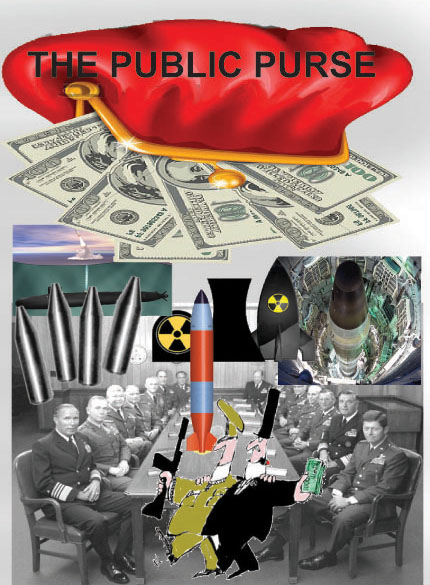
What top Israeli officials — including Prime Minister Benjamin Netanyahu — are quietly backing is not a reduction in American support, but a reorganization of it: shifting billions in resources from State Department–administered foreign aid grants into general Pentagon procurement accounts, industrial partnerships, and sustainment pipelines. The shift will strip away the political and diplomatic oversight mechanisms that make the relationship publicly accountable, moving it from a visible annual aid vote into the opaque machinery of defense acquisition, where oversight is limited and political accountability is minimal. The result would be a defense relationship that is simultaneously deeper and less transparent.
Quincy Institute for Responsible Statecraft, Steven Simon, May 26, 2026
Executive Summary
The United States and Israel are now approaching the renegotiation of their 10-year defense Memorandum of Understanding, or MOU. Israeli officials have said they want to phase out US military grant aid — a position that sounds like a step toward ending US military assistance to Israel. It is not.
What top Israeli officials — including Prime Minister Benjamin Netanyahu — are quietly backing is not a reduction in American support, but a reorganization of it: shifting billions in resources from State Department–administered foreign aid grants into general Pentagon procurement accounts, industrial partnerships, and sustainment pipelines. The shift will strip away the political and diplomatic oversight mechanisms that make the relationship publicly accountable, moving it from a visible annual aid vote into the opaque machinery of defense acquisition, where oversight is limited and political accountability is minimal. The result would be a defense relationship that is simultaneously deeper and less transparent.
Since fiscal year 2019, the United States has provided $3.3 billion per year in Foreign Military Financing, or FMF, grants to Israel, plus an additional $500 million per year for missile defense cooperation. About 25 percent of this FMF grant money has gone toward offshore procurement, or OSP, funds allocated to Israel to spend domestically on its own defense industry and military equipment. Effectively, it is a US subsidy for Israel’s military industrial complex.
This OSP precedent is slated to end with the expiration of the current MOU. This has fueled Israeli proposals to phase out FMF grants altogether, replacing them with a relationship centered on US–Israeli defense integration. This would embed Israeli firms and Israeli–origin intellectual property inside larger Pentagon programs and production. Unlike the foreign assistance process, the military procurement framework would not be subject to the political scrutiny of Congress and the State Department, but would be evaluated on bureaucratic criteria such as cost, readiness, and capability. This shift would likely be justified by reframing US support not as a handout to Israel, but as an investment in American military readiness, industrial capacity, and jobs.
At a time when the US–Israel relationship should be scrutinized in light of Israeli actions that run counter to US interests, such a structural shift would be counterproductive. To avoid this outcome, any procurement-centered relationship should meet these three basic requirements:
- Clear metrics to assess whether Israeli participation in Pentagon programs serves US defense requirements.
- Program-level transparency regarding the existence, scale, cost, and rationale of each procurement program.
- Cross-committee coordination in Congress to ensure visibility and accountability to non-military congressional oversight committees.
The current deal — and why it is running out of road
This brief explains what the shift in US aid for Israel means: where the money actually goes, who controls it, who benefits, and why the standard debate about ending aid misses the consequential change.1……………………………………………………………………………………………………………………………………………………………………
What “ending aid” actually means
…………………………………. ending aid in this context does not mean ending US financial support for Israel’s military and defense sector. It means changing the institutional form through which that support is delivered. The concept, in effect, is not to reduce support for Israel’s military; it is to shift it from the foreign-operations budget and the State Department’s oversight to the Pentagon’s procurement, research and development, industrial base, and sustainment machinery…………………………………………………………………………………………………………………
The new architecture — how money moves in a defense-industrial model
To understand what replaces the grant, it helps to understand how the Pentagon actually spends money on defense cooperation, and why that process looks so different from foreign aid…………………………………………………………………………………………………………………………………………………………………………………………………………………………………………………………………………….
Conclusion — quieter does not mean smaller
The post-2028 US–Israel defense relationship will likely be recast to reduce its political profile. The annual aid vote, one of the most predictably contentious moments in future US foreign-policy debates, may fade away, replaced by procurement decisions that attract little public attention and even less organized opposition. Israeli officials will be able to claim, accurately in formal terms, that Israel no longer receives American aid. American officials will be able to defend the spending as investment in US readiness rather than largesse to a foreign partner…………………………………………………….
For observers trying to understand US–Israel relations, the practical implication is methodological. The aid vote is no longer the right place to look. Instead, the key data will be located in the procurement budget, industrial-base investments, sustainment pipeline, IP licensing arrangements, and workshare provisions. The consequential decisions will be made in those domains.
Annex: Key terms and reference figures………………………………https://quincyinst.org/research/the-disappearing-aid-check-the-future-of-us-israel-defense-support/?ct=t(EMAIL_CAMPAIGN_1_21_2025_13_26_COPY_01)&mc_cid=3131e3a216#h-annex-key-terms-and-reference-figures
Step forward in £4.6 billion Sellafield nuclear decommissioning programme
Hundreds of delegates gathered for an event which saw SMEs meet with
industry leaders to discuss how a £4.6 billion programme of work will be
delivered over the next 15 years. The Decommissioning Nuclear Waste
Partnership Supply Chain Engagement event saw dozens of SMEs meet with DNWP
partners, Sellafield leaders, and the wider supply chain. The full-day
event at Energus, at Lillyhall, near Workington, gave suppliers early
visibility of upcoming opportunities in the decommissioning process. They
had direct access to buyers, project teams and decision-makers, and were
given a clear understanding of how work will flow. The event was organised
by Industrial Solutions Hub (iSH) in collaboration with the BECBC Nuclear
Sector Group.
Business Crack 3rd June 2026, https://businesscrack.co.uk/2026/06/03/step-forward-in-4-6-billion-sellafield-nuclear-decommissioning-programme/
Trump blasts Netanyahu as Iran Talks Stall over Beirut
Juan Cole, 06/02/2026, https://www.juancole.com/2026/06/blasts-netanyahu-beirut.html
Ann Arbor (Informed Comment) – Monday began with a statement issued by the Iranian Ministry of Foreign Affairs cautioning that the United States and Israel, by their egregious violations of the ceasefire concluded on April 8, are jeopardizing the ongoing talks aimed at achieving an armistice. The ministry, which is headed by Abbas Araghchi, underlined that the ceasefire involved a cessation of hostilities on all fronts.
The ministry accused the United States of repeatedly violating the ceasefire by its attacks on commercial Iranian shipping. Moreover, it said, Israel has grossly violated the ceasefire by launching a vicious attack on Lebanon, violating its sovereignty and killing or wounding thousands of Lebanese and displacing two million, while destroying essential infrastructure.
The ministry said that the US has a direct responsibility to cease attacking Iranian shipping and an indirect responsibility to rein in the Israel atrocities, warning that Iran will take measures to act in self-defense to ensure its interests.
The Tasnim news agency, which is close to the Iranian Revolutionary Guards Corps, reported that these violations of the ceasefire, especially the Israeli invasion and devastation of south Lebanon, had led the Iranian side to cease all talks and the exchange of texts through mediators.
The agency said that the Iranian government insists on the end of Israeli operations in Gaza and Lebanon and its complete withdrawal from Lebanon. Otherwise there will be no further dialogue with the United States.
Moreover, the report said, Iran is determined to block the Strait of Hormuz completely, and to activate further fronts, including the Bab al-Mandeb or “Strait of Tears” at the mouth of the Red Sea. The Red Sea has been an alternative route for shipping, including of oil and gas, given the closure of the Persian Gulf.
The official status of these threats is unclear, according to BBC Monitoring .
Israel has sent troops deep into Lebanon and has expelled some 275,000 people from the metropolitan area of the coastal city of Tyre in the south, making threats to level the suburbs of Beirut where Shia Muslims predominate and to bomb the Lebanese capital. Hezbollah has continued to fight back against the Israeli invasion, showering northern Israel with rockets and sometimes managing to kill or wound Israeli troops and to take out Merkava tanks.
Asked about these reports of a halt to negotiations by CNBC’s Eamon Javers, President Donald J. Trump replied , “I don’t care if they’re over, honestly.” In case the message wasn’t clear, he repeated, “I really don’t care. I couldn’t care less.” He complained that the talks had “started to get very boring.”
Trump attempted to intervene in reality by Tweet, saying he would ask Israeli Prime Minister Benjamin Netanyahu “what’s going on with Lebanon.” He thundered, “There will be no Troops going to Beirut, and any Troops that are on their way, have already been turned back.”
He claimed to have spoken to Hezbollah indirectly, saying, “they agreed that all shooting will stop — That Israel will not attack them, and they will not attack Israel.”
Netanyahu remained defiant, boasting of having taken the Crusader castle Beaufort and threatening, “if Hezbollah does not cease attacking our cities and citizens—Israel will attack terror targets in Beirut. This stance of ours remains unchanged. In parallel, the IDF will continue to operate as planned in southern Lebanon.”
Barak Ravid at Axios reported that according to a US official, Trump’s phone call to Netanyahu was explosive, with the American president “pissed off” about Netanyahu’s threat to bomb Beirut. Ravid reports that his source alleged Trump told the prime minister, “You’re fucking crazy. You’d be in prison if it weren’t for me. I’m saving your ass. Everybody hates you now. Everybody hates Israel because of this.”
Trump for his part insisted that the negotiations with Iran were continuing “at a rapid pace.”
Many energy analysts believe that if the closure of the Strait of Hormuz continues through the summer, by September we could see $200 a barrel petroleum and a severe global economic recession. The consequent economic crisis domestically could produce a blue wave, i.e. a big Democratic victory in the midterms, which would hobble Trump in his final two years in the White House.
Israeli Authorities Refuse To Return Massive Trove Of Oct 7 Video. What Are They Hiding?

June 1, 2026, Michelle Witte· The Grayzone, https://scheerpost.com/2026/06/01/israeli-authorities-refuse-to-return-massive-trove-of-oct-7-video-what-are-they-hiding/
Israeli citizens wonder why the state won’t return October 7 footage it confiscated from them. The mother of an Israeli victim says authorities deleted video of her son’s death. Others complain “someone is hiding” the videos.
The Israeli government is still holding a massive trove of video documentation of the Oct. 7 attack captured by individuals and communities caught up in the fighting. One bereaved parent even accuses Israeli authorities of deleting a video of her son’s last moments before returning his phone to her.
According to Israel’s Channel 13, “all the cameras, memory cards and films that documented the atrocities were collected, but two and a half years later, these materials have not been returned to the communities and bereaved families who are desperate for information, and even feel that someone is hiding it from them.”
Soon after Hamas and Palestinian Islamic Jihad’s attack on Israel on Oct. 7, 2023, special units from the IDF, the Israeli intelligence agency Shin Bet and Israel’s investigation unit Lahav 433 collected photo and video documentation of the violence, confiscating cell phones, individual cameras, kibbutz security cameras and more.
“They disconnected what was needed, took it and moved on – that was the last time we saw the materials,” said an Israeli army reservist who participated in the collection mission.
According to the head of the Kfar Aza kibbutz – the site of a number of a series of atrocity hoaxes spun out in the early days after the attack – community members cooperated with investigators at the time. Now, years after the events, these families are wondering why documentation of their loved ones’ fates has yet to be returned to them.
Even Sabine Taasa, who was made an emblem of Israeli victimhood after her husband and one of her sons were killed on Oct. 7, is now clashing with Israeli authorities over footage of that day.
Taasa’s 17-year-old son, Or, was killed on Zikim beach. According to Channel 13, Taasa says she saw a video her son filmed in the moments leading up to his death, but when authorities returned his phone to her, no such video remained. The outlet says this is not an isolated incident.
An IDF probe found that soldiers abandoned civilians hiding in a bathroom there and then left their bodies for a week.
Channel 13 reports that Israeli police claimed Lahav 433 is still investigating the events in kibbutz Kfar Aza and no indictments have yet been filed, so returning evidence at this stage could jeopardize their criminal case. Meanwhile, the IDF rejected all accusations that it is withholding documentation and says it is in the final stages of adopting policies for how this type of evidence will be returned to communities and families.
On October 7, the Israeli government issued video Hannibal Directive orders which led Apache helicopter pilots and tank gunners to take aim at Israel’s own citizens in the Gaza envelope, supposedly to prevent them from being taken hostage. Israeli Brig. Gen. Barak Hiram personally ordered a tank crew to shell a home in Kibbutz Be’eri, knowing it was filled with Israeli citizens who had been taken captive by Hamas fighters seeking to negotiate a way out of the standoff. A dozen Israelis were killed in the strike, leaving behind “a house full of corpses,” according to the lone Israeli survivor. One Israeli tank gunner from an all-female unit similarly revealed that she was ordered to shell Israeli homes without knowing who was inside. An Israeli police investigation subsequently revealed that Israeli helicopters shelled the Nova Electronic Music festival on October 7.
Given Israel’s track record of targeting its own citizens on October 7 and misleading the public about it, the Israeli state might be holding on to as much video as possible to ensure no further evidence of the Israeli army massacring its own citizens is made public.
Israel has demonstrated a keen interest in collecting documentation of the events of October 7 and controlling narratives through careful curation and dissemination. At the same time, it has refused to participate in independent, international investigations of the attack, Israel’s response, or the widely distributed and now widely debunked claims of mass sexual violence by Hamas and other Palestinian militant groups. According to the Israeli state, Israel and Israel alone is justified in and capable of conducting such probes.
However, the state has strangely neglected to launch its own comprehensive special investigation into the apparent massive intelligence failure and military debacle. In fact, the Israeli government has had to be prodded by its own high court to establish a state commission of inquiry into the events, according to reporting by the Times of Israel. The Israeli government now has until July 1 to come up with a “suitable framework” to investigate the events, following years of pressure by the families of Israelis killed that day.
With the Israeli military-intelligence apparatus refusing to return possibly hundreds of hours of footage to its owners, some Israelis who lived through the October 7 attacks are beginning to wonder if they could be hiding something.
Michelle Witte is a writer, editor and broadcaster who previously co-hosted the news radio show, “Political Misfits.”
Trump Finally Admits Aloud: “We Shouldn’t Have Been in Iran”
June 1, 2026 Joshua Scheer, https://scheerpost.com/2026/06/01/trump-finally-admits-aloud-we-shouldnt-have-been-in-iran/
Donald Trump may have delivered the most honest assessment of the Iran War yet — entirely by accident.
In an interview conducted not by a journalist but by his daughter-in-law on Fox News, Trump stumbled into a confession that cuts through months of White House triumphalism, media cheerleading, and endless declarations of victory. After boasting that Iran’s navy was “100% gone,” its air force was “100% gone,” and that the United States had effectively defeated the country militarily, Trump casually admitted something extraordinary:
“We should not have been in Iran.”
There it was. Buried beneath the bluster, threats, and self-congratulation was the truth opponents of the war have been shouting since the first bombs fell.
The problem is that Trump wasn’t offering a reckoning. He wasn’t acknowledging the thousands killed, the billions spent, the global economic disruption, or the dangerous precedent of launching another war based on claims that Iran was racing toward a nuclear weapon despite years of intelligence assessments saying otherwise. Instead, he delivered the admission while simultaneously threatening to “finish it off militarily” if negotiations fail.
This is the defining contradiction of American empire. Leaders admit the wars were mistakes only after they’ve launched them. They acknowledge the disasters while preparing the next escalation. Iraq was a mistake. Afghanistan was a mistake. Libya was a mistake. Yet the machinery that produced those catastrophes continues to operate exactly as designed.
Trump’s interview wasn’t merely a display of contradiction. It was a rare glimpse into a political system so detached from accountability that a president can openly admit a war should never have happened while still insisting it was necessary, successful, and ready to resume at any moment.
For the families burying loved ones, for Americans paying the bill, and for a region left smoldering in the wake of another U.S. intervention, that isn’t leadership.
It’s a confession.
Ukraine’s military has a real Nazi problem
It also desecrates the memory of Nazism’s victims in Ukraine: 1.5 million Jews murdered in the Holocaust, along with millions of Slavs, prisoners of war, Roma, the mentally ill, forced laborers, and countless others consumed by the machinery of racial extermination and exploitation.
In their zeal to deconstruct Russian propaganda, Western elites have tried to hide the fact there are Third Reich extremists among Kyiv’s ranks.
Marta Havryshko, Jun 02, 2026, https://responsiblestatecraft.org/nazis-in-ukraine-military/?mc_cid=044f4b8379
When Vladimir Putin launched his invasion of Ukraine in February 2022, he claimed one of his goals was the country’s “denazification.” The Kremlin still uses this narrative as a cornerstone of its war propaganda.
Both Ukraine and the West reacted by dismissing the claim outright as a cynical abuse of Holocaust history. Politicians, media outlets, academics, and educational institutions rushed to prove that Putin’s argument was fraudulent.
But in their zeal to deconstruct Russian propaganda, Western elites created a propaganda myth of their own: there are no Nazis in Ukraine. Or, if there are, they are supposedly isolated cranks with no influence.
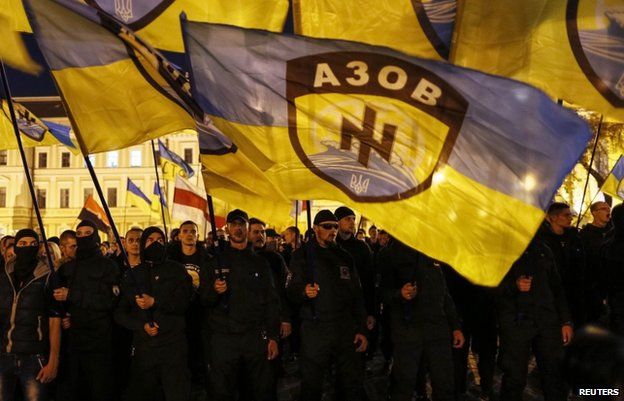
This fiction required the whitewashing of Azov, a unit founded in 2014 by the neo-Nazi group Patriot of Ukraine under the leadership of Andriy Biletsky. Azov became notorious for extremist ideology, Nazi symbolism, and allegations of war crimes in the Donbas. In 2018, the U.S. Congress banned the group from receiving American weapons, funding, or training.
After Russia’s full-scale invasion, that stigma vanished almost overnight. Kyiv repackaged Azov, separating the most radical elements into a new formation, the 3rd Assault Brigade. Western media rebranded and whitewashed it. The language of “de-radicalization” and “depoliticization” became mainstream. Questioning this narrative became taboo and labeled as “Russian propaganda.” The result is a culture of deliberate silence.
Neo-Nazi networks are deeply embedded in parts of Ukraine’s military structure. Their presence is visible in units such as Azov, the Third Assault Brigade, the Russian Volunteer Corps, Bratstvo, the German Volunteer Corps, Karpatska Sich, and others. Yet Ukraine’s Western backers continue to arm, fund, and train these units without meaningful scrutiny.
Even more striking is the normalization of Nazi imagery itself. Official Ukrainian military channels and mainstream media regularly publish images of soldiers wearing swastikas, Waffen-SS insignia, and patches linked to neo-Nazi groups like Combat 18 and Misanthropic Division. This is no longer treated as scandalous. It has been normalized.
Most disturbing of all, some Ukrainian military units have incorporated Nazi-linked symbols into their official insignia.
The far right and Ukraine’s military culture
Many Ukrainian military units using Nazi symbols are led by men shaped by Azov and the far-right milieu around it. For example, there is Oleksandr Kravtsov, the well-known commander of the Vedmedi unit, which was part of Azov. His body is covered in Nazi imagery, including 1488 — references to the white supremacist “14 Words” slogan coined by David Lane and the coded salute “Heil Hitler.” (“H” is the eighth letter of the alphabet.) Tattooed across his chest is the SS motto: “My Honor Is Loyalty.” He turned that slogan into the motto of his own unit. SS lightning bolts became part of its official insignia.
After returning from Russian captivity, Kravtsov’s unit was folded into the Ukrainian military structure — first the 36th Brigade, then the 39th Coastal Defense Brigade. Nothing changed. The SS symbols and motto remained.
Many commanders in the 3rd Assault Brigade also came out of Azov and still hold extremist views. Unsurprisingly, they openly embrace the corresponding symbolism. A subunit of the 3rd Assault Brigade adopted a modified insignia (replacing two grenades with three) of the Dirlewanger SS Brigade — one of the most notorious Nazi formations of World War II. In 2025, the brigade unveiled the emblem publicly at a memorial in Kyiv. No scandal followed.
Azov also normalized the Black Sun — a symbol born in Himmler’s SS cult headquarters at Wewelsburg Castle and now used globally by neo-Nazis and white supremacist terrorists, including the 2019 Christchurch mosque terrorist in New Zealand and the recent San Diego Islamic Center shooter.

After 2022, Black Sun spread rapidly through Ukrainian military culture. It appeared in Azov-linked units such as the Decepticons platoon and the Mortars unit of the 3rd Assault Brigade. Soon it migrated further — into units with no openly ideological profile at all — and became part of the insignia of the 156th Zvaha Battalion and the Unmanned Systems Battalion of the 110th Brigade named after Marko Bezruchko.
Azov mainstreamed another Nazi-linked emblem as well: the Wolfsangel, used historically by several Waffen-SS divisions. Rebranded as the “Idea of the Nation,” it became one of the most recognizable symbols in Ukraine’s wartime military culture. The symbol now appears far beyond Azov itself. The newly created Nachtigall Battalion — named after the Nachtigall Battalion formed by German military intelligence in 1941 — uses the same Wolfsangel-inspired insignia.
Some units within Ukraine’s military do not hide their fascination with the Third Reich’s military culture. For example, the 422nd Regiment of Unmanned Systems calls itself “Luftwaffe” and uses virtually the same eagle as Hitler’s air force. Its commander, Mykola Kolesnyk, regularly appears with the symbol on patches and clothing. The unit even sells merchandise featuring the Nazi eagle — hoodies, mugs, T-shirts, caps, keychains — to fundraise for the war.
Not just aesthetic choices
The use of Nazi symbols in Ukraine’s military is not merely an aesthetic problem. It is moral, political, historical, and legal.
First, it represents a form of historical revisionism and the gradual rehabilitation of Nazism itself — a direct challenge to the postwar Western consensus built on the memory of World War II. Within far-right military culture, Nazi imagery is often wrapped in romanticized narratives about anti-Soviet struggle. In practice this trivializes the sacrifice of the seven million Ukrainians who fought Nazism in the ranks of the Red Army alongside the Western allies (in contrast to the 300,000 who served in various military formations and police units on the side of Nazi Germany).
Second, the problem is not only historical. It is profoundly contemporary. Every SS rune, Black Sun, or Wolfsangel displayed by Ukrainian soldiers hands the Kremlin another propaganda victory. Russian propagandists do not need to invent imaginary Nazis in Kyiv. They simply point to the insignia openly worn by some of Ukraine’s most celebrated military units — including formations branded as “elite,” such as the 3rd Assault Brigade.
Third, there is also a glaring legal contradiction. By openly using Nazi imagery, these units violate Ukraine’s own 2015 memory laws, which explicitly ban the propaganda of the Nazi regime and the public use of its symbols. The law describes such acts as an insult to the memory of millions of victims and have penalties of up to five years in prison.
Yet no one is prosecuted.
Why?
Because the Zelensky government — and President Volodymyr Zelensky himself as commander-in-chief — have made a political bargain with the far right. Since 2022, far-right activists and networks have flooded into the security and defense sector. In conditions of total war and chronic manpower shortages, this alliance became politically convenient, perhaps even inevitable. Now it is becoming entrenched.
The state depends on radicalized military formations for manpower and battlefield effectiveness. The far right, in turn, receives legitimacy, weapons, influence, and institutional protection. What emerged from wartime necessity is evolving into mutual dependence.
Ukraine’s Western partners have made their own bargain. They, too, depend on Ukrainian manpower to weaken Russia. And so they tolerate extremists inside Ukraine’s armed forces as long as those extremists continue fighting. More than that, they remain largely silent about the ideology and symbols involved, because acknowledging them would mean admitting an uncomfortable truth — that the neo-Nazi problem in Ukraine is not simply a Kremlin invention.
Marta Havryshko is a U.S.-based author and researcher focused on Ukrainian nationalism, the far right, and the Russo-Ukrainian War. Havryshko holds a PhD in History from the Ivan Franko National University of Lviv in Ukraine.
The Karaganov Fallacy – Nuclear strike against Europe IS NOT the right answer for Russia
Karaganov advocates preemptive Russian nuclear strikes against a Europe he deems bellicose, banking on American passivity. Scott Ritter believes conventional missiles, not nukes, are the only credible path.
warlike ruminations by some of NATO’s leading military minds do not exist in a vacuum but rather are reflective of a general posture of war preparation being promoted by the NATO alliance itself. Just ask Mark Rutte, the NATO Secretary General, who recently warned that NATO was in a race against time when it came to preparing for an inevitable war with Russia.
the true lesson is that nuclear wars cannot be won, should never be fought, and as such nuclear weapons should be done away altogether to avoid falling into intellectual traps such as the one offered by Karaganov, where their use is deemed possible.
Mon 01 Jun 2026, Scott Ritter, https://forumgeopolitica.com/article/the-karaganov-fallacy
Editor’s Note : After publishing our article “Is 1914 repeating itself? Will war between Europe and Russia finally break out openly?” where we discussed – among others – the nuclear doctrine of the Russian Federeation and also the Karaganov doctrin, Dmitry Orlov published the article «How to survive a Russian tactical nuclear strike». In today’s article Scott Ritter analyses the Karaganov doctrine and argues that nuclear weapons are not the right tools for Russia.
Back in the late 1970’s and early 1980’s, the Wallstreet brokerage firm, E.F. Hutton, came up with one of the most iconic television ad campaigns in history, built around the catch phrase “When E.F. Hutton speaks, people listen.”
Sergei Karaganov is the Russian analog to E.F. Hutton—when Karaganov speaks, people listen. The 73-year old political scientist, who currently heads the Council for Foreign and Defense Policy and serves as the dean of the Faculty of World Economy and International Affairs at Moscow’s Higher School of Economics, has advised both post-Soviet era Russian Presidents, Boris Yeltsin and Vladimir Putin, and his opinion continues to carry weight among the senior-most decision making circles of the Russian government.
Karaganov has, for the past several years, been warning about the growing threat to Russia from NATO, and in particular the European nations of NATO who have constructed a world view which postulates Russia as an existential threat which must be decisively confronted and defeated.
In this Karaganov is not wrong.
The language of the Europeans is self-indicting.
According to a newly published German military strategy, Russia represents “the greatest and most immediate threat for the foreseeable future” to Germany and transatlantic security. The classified strategy concludes by declaring “Russia is laying the groundwork for a military attack on NATO member states.”
Germany’s chief of defense, General Carsten Breuer furthered this argument in a 2025 statement to the media where he noted that “There’s an intent and there’s a buildup of the stocks” by Russia for a possible future attack on Nato’s Baltic state members.
Brueuer and Germany’s defense minister, Boris Pistorious, are using the threat from Russia as an excuse for the rearmament of Germany, with the goal of making the German army the most powerful in Europe by 2029.
Why that date?
According to General Breuer, this is when Russia will attack Europe. “This is what the analysts are assessing,” Breuer said, “in 2029. So we have to be ready by 2029.”
The German analysis is nearly identical to that of their British allies. Former Chief of the General Staff, General Sir Patrick Sanders, who retired in the summer of 2025, has warned that a war with Putin was a “realistic possibility” by 2030. “If Russia stops fighting in Ukraine,” Sanders told the British media, “you get to a position where within a matter of months they will have the capability to conduct a limited attack on a NATO member that we will be responsible for supporting, and that happens by 2030.”
These warlike ruminations by some of NATO’s leading military minds do not exist in a vacuum but rather are reflective of a general posture of war preparation being promoted by the NATO alliance itself. Just ask Mark Rutte, the NATO Secretary General, who recently warned that NATO was in a race against time when it came to preparing for an inevitable war with Russia. “We are Russia’s next target,” Rutte said. “I fear that too many are quietly complacent. Too many don’t feel the urgency. And too many believe that time is on our side. It is not. The time for action is now. Conflict is at our door. Russia has brought war back to Europe. And we must be prepared. Russia has brought war back to Europe. We must be prepared for the scale of war our grandparents and great-grandparents endured.”
The rhetoric of Breuer, Sanders and Rutte lends itself to an argument where the nations of NATO are responding to Russian aggression. But one must not be fooled into believing that aggression is a one-way street. Enter, stage left, Lithuanian Foreign Minister Kestutis Budrys, who recently opined that “We [NATO] must show the Russians that we can break through the small fortress they have built in Kaliningrad. NATO has the means to flatten Russian air defense bases and missile systems if necessary.”
Budrys’ lunacy, which even if successful would amount to little more than the collective suicide of NATO, didn’t appear from a vacuum, but rather echoed similar sentiment expressed by General Chris Donahue of the US Army, who serves as the commander of US forces in Europe. Donahue bragged that Kaliningrad, Russia, is approximately 47 miles wide and surrounded by NATO on all sides. He claimed that NATO and the US Army now have the capability to “take that down from the ground in a timeframe that is unheard of and faster than we’ve ever been able to do.” Donahue went on: “We’ve already planned that and we’ve already developed it.”
In many ways, Donahue’s bluster is far more embarrassing that the pugilistic nonsense espoused by his NATO colleagues, if for no other reason than he more than anyone should know both the extreme limitations of US and NATO power (something demonstrated very publicly with the recent US failed aggression against Iran) and the consequences of any NATO attack on Kaliningrad, which would be immediately fatal to Donahue, his staff, and the entire leadership of NATO, given the inevitability and severity of the anticipated Russian retaliation.
And therein lies the rub. NATO’s jingoistic rhetoric aside, there is no conventional military power in Europe, whether singularly or collectively, which poses an existential threat to Russia. Recent NATO military exercises demonstrated just how inexperienced NATO ground forces were in modern combat operations incorporating drone warfare on any appreciative scale. Imagine for a moment a NATO Brigade running into a Rubicon detachment on the battlefield. The results would be as one-sided as they would be fatal to the defeated party, which would in every scenario imaginable be the NATO forces.
The words of Breuer, Sanders, Rutte, Budrys, and Donahue amplify one universal constant when it comes to NATO today: militarily it is very much a paper tiger, incapable of sustained intensive ground combat at any appreciable level. The warlike verbiage spouted by these mouthpieces of mayhem is simply a desperate plea for relevancy in an effort to mobilize public support for a militarization campaign requiring energizing both populations and industry in a way hitherto fore unimaginable in post-Cold War Europe, and for all sense and purposes impossible to achieve today.
As the fictional Commander, Air Group (CAG) told Tom Cruise’s Maverick in the first Top Gun movie, “Son, your mouth is writing checks your body can’t cash.”
Welcome to the NATO collective today.
While Sergei Karaganov and his fellow Russian hardliners are more than justified in taking extreme umbrage at the warlike posturing Europe is assuming today in opposition to Russia, the reality is Europe poses absolutely no threat whatsoever to Russia as things currently stand, and the probability of Europe overcoming the sizeable political and economic hurdles required to build a military force capable of surviving on a Russian battlefield, let alone prevailing, is slim to none.
More worrisome, however, is the nuclear posturing being done by certain NATO countries to compensate for the alliance’s extreme shortcomings regarding conventional military power projection. This nuclear flexing has taken on an even greater urgency now that President Trump’s hostile ambivalence toward NATO and European security throws into question America’s commitment to fulfilling any hypothetical Article 5 scenario—a stance which simultaneously throws into question the reliability of America’s nuclear umbrella. France and the United Kingdom are working to create a joint nuclear doctrine to offset the loss of America’s nuclear arsenal, and both nations are in active discussions with other NATO members to extend their respective nuclear umbrellas over the Arctic, the Baltics, Poland and Germany.
Sergei Karaganov famously postulated that no American President would be willing to trade Boston for Poznan, meaning that if Russia were to hypothetically attack this unfortunate Polish urban center with a nuclear weapon, the United States would not respond in kind.
This, of course, is the kind of hypothesis that should never be tested and, given the fact that Russia faces no threat of an existential nature from the European collective, has zero justification for even being contemplated being tested.
Russia, together with the other major nuclear weapons states (the US, China, UK and France) co-signed a joint statement in early 2022 which affirmed that a nuclear war cannot be won and must never be fought. The statement went on to declare that “As nuclear use would have far-reaching consequences, we also affirm that nuclear weapons—for as long as they continue to exist—should serve defensive purposes, deter aggression, and prevent war.”
Russia has not officially renounced that joint declaration, which on the surface would indicate that the Karaganov initiative to preemptively use nuclear weapons against Europe has zero viability when it comes to reflecting official Russian policy.
There is, of course, one major problem—Karaganov was instrumental in crafting the 2025 nuclear posture for the Russian Federation, which in part declared that nuclear weapons could come into play in situations where conventional forces are insufficient to deter an opponent or achieve a military objective. So far, the SMO in and of itself does not meet the criteria for preemptive nuclear weapons usage. Whether a large-scale conventional war with NATO would cross this threshold is a separate matter.
But the situation Russia faces today, which Karaganov addresses, involves a nuclear armed power aiding a non-nuclear armed state to launch conventional attacks on Russia that could pose an existential threat. This is, of course, the very definition of what the ongoing proxy conflict between Russia and the collective West over Ukraine is, especially when it comes to the ongoing NATO-backed campaign of drone strikes against strategic Russian targets.
It’s not just Karaganov who is crying foul. Dmitri Polyansky, the Russian Ambassador to the OSCE, noting that the ongoing Ukrainian drone strikes against Russia are only possible with Western military expertise, technology, and intelligence, recently declared that it might already be “too late” to avert a Russian retaliatory strike against European targets directly affiliated with the facilitation of Ukrainian long-range drone strikes against Russia.
But even in this circumstance, nuclear weapons are not necessarily called for, something even Karaganov acknowledges. Conventional missile strikes, using weapons such as the Oreshnik intermediate-range missile, should be mounted against select European targets. But Karaganov then goes further, advocating for the use of nuclear strikes if the conventional missiles don’t “deter Europe.” Here, Karaganov puts value on the need to instill “primal fear” in Europe not by the threat of nuclear weapons, which clearly hasn’t worked, but through their actual use.
In this instance, Karaganov is dead wrong.
The use of nuclear weapons obviates the strategic advantages Russia has accrued by building the World’s largest, most combat capable (and tested) military. It nullifies the escalatory dominance Russia has achieved by deploying the Oreshnik conventional strike system. But worst of all it erases the very doctrinal paradigm that has prevented the world from stumbling down the path of nuclear oblivion—the idea that nuclear wars cannot be won and therefore must never be fought.
The Karaganov doctrine, so to speak, introduced a new paradigm—nuclear wars can, in fact be won, and as such should be fought.
Karaganov proves his thesis by postulating an unproven hypothesis—the US won’t trade Boston for Poznan.
He avoids the uncomfortable question as to whether France or the United Kingdom, singularly or together, would opt to put forward a nuclear response by declaring that Russia would eliminate both these nations and all of Europe if they were to try.
But this begs the question whether a Russian leader would be willing to trade Saint Petersburg or Moscow for London, Berlin and Paris.
Does Karaganov really want to test this hypothesis?
But let’s postulate, just for the sake of argument, that Karaganov’s thesis holds, and that Europe is collectively cowed by a Russian preemptive nuclear strike on Poznan, and the US opts out of sacrificing Boston and doesn’t retaliate.
Then what?
Nuclear war has, to date, been averted by the notion that there can be no winners.
Karaganov’s doctrine flips the script, and declares that there can, in fact, be winners.
But what exactly has been “won”? Decades of deterrence theory will have been washed away, leaving in its stead a massive strategic imbalance that cannot stand. There can be no nuclear deterrence if one side is willing to use nuclear weapons and the other side isn’t. Yes, the United States may likely forego sacrificing Boston or any other American city for a European urban victim of Russian nuclear annihilation. But the United States will need to immediately equalize the nuclear deterrence equation by demonstrating that it, too, can use nuclear weapons, and thus test the hypothesis of whether Russia would be willing to sacrifice Kazan for Tehran.
The answer is likely to be no.
Crisis averted.
Or not.
No longer is the world one where nuclear war cannot be fought, but rather one where nuclear war has become an accepted practice. War gaming and basic game theory hold that once nuclear weapons are used, it is simply a matter of time before matters escalate toward a full nuclear exchange, terminating all life on the planet. This isn’t idle speculation. In 1983 the Pentagon conducted a war game called Proud Prophet, an unscripted event involving the highest levels of the US military and its global warfighting commands, using real-world communication channels, doctrines and secret war plans. The game allowed for the consideration of limited small-scale nuclear strikes, but always ended the same way—global nuclear Armageddon.
Karaganov doesn’t address this issue, with good cause—because no leader, Russian or American, would start a nuclear war in a situation that fell short of manifesting a threat to their respective existential survival, if they knew that no matter what, the result was always the same—everyone dies.
Karaganov has done the world a great service in forcefully postulating the possibility of a winnable limited nuclear war.
Not just because it allows the world to once again embrace the foundational notion that nuclear wars cannot be won, and as such should never be fought.
No, the true lesson is that nuclear wars cannot be won, should never be fought, and as such nuclear weapons should be done away altogether to avoid falling into intellectual traps such as the one offered by Karaganov, where their use is deemed possible.
There is no greater justification for nuclear arms control and disarmament than the scenarios put forward by Karaganov.
And in the present time, when nuclear arms control has been removed from the global diplomatic playbook, the world needs the kind of kick in the seat of the pants that any reasoned reflection on the fallacy of Sergei Karaganov’s nuclear theories brings—without nuclear arms control, our collective demise at the hands of the weapons we refuse to eliminate is all but assured.
1 This Month



26 September – International Day for the Total Elimination of Nuclear Weapons


PLEASE OPPOSE HR 8255 AND S.3639 – bills would accelerate satellite deployment, with no environmental review or safeguards – https://ncstd5li.quorum.us/campaign/169331/
To see nuclear-related stories in greater depth and intensity – go to https://nuclearinformation.wordpress.com
-
Archives
- September 2026 (219)
- August 2026 (330)
- July 2026 (355)
- June 2026 (287)
- May 2026 (306)
- April 2026 (356)
- March 2026 (251)
- February 2026 (267)
- January 2026 (308)
- December 2025 (358)
- November 2025 (359)
- October 2025 (375)
-
Categories
- 1
- 1 NUCLEAR ISSUES
- business and costs
- climate change
- culture and arts
- ENERGY
- environment
- health
- history
- indigenous issues
- Legal
- marketing of nuclear
- media
- opposition to nuclear
- PERSONAL STORIES
- politics
- politics international
- Religion and ethics
- safety
- secrets,lies and civil liberties
- spinbuster
- technology
- Uranium
- wastes
- weapons and war
- Women
- 2 WORLD
- ACTION
- AFRICA
- Atrocities
- AUSTRALIA
- Christina's notes
- Christina's themes
- culture and arts
- Events
- Fuk 2022
- Fuk 2023
- Fukushima 2017
- Fukushima 2018
- fukushima 2019
- Fukushima 2020
- Fukushima 2021
- general
- global warming
- Humour (God we need it)
- Nuclear
- RARE EARTHS
- Reference
- resources – print
- Resources -audiovicual
- Weekly Newsletter
- World
- World Nuclear
- YouTube
-
RSS
Entries RSS
Comments RSS
 nuclear-news