Neocon Dark Money Front Launches Desperate Ad Blitz, as Support for Ukraine Forever War Craters
By Alexander Rubinstein / The Grayzone 23 Aug 23
Defending Democracy Together, a neoconservative outfit led by career chickenhawk scribe Bill Kristol, has launched a new initiative called “Republicans for Ukraine” to transform the 2024 presidential election into a referendum on US funding for the NATO proxy war.
Urging Republicans in Congress to support more funding for Ukraine in the upcoming appropriations bill is also a key item on the agenda…………………………………………………….
Now, as the Ukrainian counteroffensive fails and a majority of Americans declare opposition for the first time to sending more military aid to Ukraine, Kristol is launching a multimillion dollar ad blitz to keep the tanks slogging through the Donbas mud and the dark money flowing into his bank accounts. https://scheerpost.com/2023/08/23/neocon-dark-money-front-launches-desperate-ad-blitz-as-support-for-ukraine-forever-war-craters/
China bans Japanese seafood after Fukushima wastewater release
Water containing radioactive tritium being pumped into Pacific via tunnel from Tepco plant, amid protests from China, South Korea and fishing communities
Guardian, Justin McCurry, 24 Aug 23
Japan has begun discharging more than 1m tonnes of tainted water into the Pacific Ocean from the wrecked Fukushima Daiichi nuclear power plant in a move that has move that prompted China to announce an immediate blanket ban on all seafood imports from Japan and sparked anger in nearby fishing communities.
The plant’s operator, Tokyo Electric Power (Tepco), pumped a small quantity of water from the plant on Thursday, two days after the plan was approved by Japan’s government.
Tepco said the release began at 1:03pm local time (0403 GMT) and it had not identified any abnormalities with the seawater pump or surrounding facilities. Live video showed engineers behind computer screens and an official saying – after a countdown – that the “valves near the seawater transport pumps are opening.”
Monitors from the UN atomic watchdog, which has endorsed the plan, were due to be on site for the procedure, while Tepco workers were scheduled to take water samples later on Thursday.
The discharge, which is expected to take 30 to 40 years, has caused anger in neighbouring countries and concern among fishers that it will destroy their industry as consumers steer clear of seafood caught in and around Fukushima.
On Thursday, China criticised the release, branding it “extremely selfish and irresponsible”.
“The ocean is the common property of all humanity, and forcibly starting the discharge of Fukushima’s nuclear wastewater into the ocean is an extremely selfish and irresponsible act that ignores international public interests,” Beijing’s foreign ministry said in a statement…………………
How to dispose of wastewater that has built up at the site on Japan’s north-east coast has proved a diplomatic headache for the government, despite support for its approach from the UN’s nuclear watchdog, the International Atomic Energy Agency (IAEA)…………………………
Critics of the discharge say a lack of long-term data means it is impossible to say with certainty that tritium poses no threat to human health or the marine environment. Greenpeace said the radiological risks had not been fully assessed, and that the biological impacts of tritium, carbon-14, strontium-90 and iodine-129 – which will be released as part of the discharge – “have been ignored”…………………………
Hong Kong’s chief executive, John Lee, said releasing the water into the ocean was “irresponsible”, adding that the city would activate import controls on Japanese seafood from regions including Fukushima and Tokyo from Thursday. The ban will cover live, frozen, refrigerated, and dried seafood, as well as sea salt and seaweed.
South Korea, once an outspoken critic of the plans, has said that it accepts the science behind the discharge, but has stopped short of publicly supporting Japan’s approach amid concerns over food safety among the South Korean public……………………
Japanese students urge end to nuclear weapons in 1st visit to U.N. Geneva in 4 years
Japan Today 23 Aug 23
A group of Japanese high school students called for the abolition of nuclear weapons on Tuesday as they visited the U.N. office in Geneva as peace messengers for the first time in four years after the COVID-19 pandemic halted any trips.
The 22 female students from 16 prefectures, aged 15 to 18, submitted some 625,000 signatures that they had collected since 2020 to push for the abolition of nuclear weapons and attended the U.N. conference on disarmament, dedicated to a discussion on the elimination of nuclear weapons.
The members are selected each year to convey the messages of the two Japanese cities of Hiroshima and Nagasaki, which were devastated by U.S. atomic bombs in the final days of World War II.
“The peace maintained by the presence of nuclear weapons is not sustainable,” said Koharu Osawa, a 16-year-old student from Nagasaki during a meeting with Carolyne-Melanie Regimbal, chief of service of the U.N. Office for Disarmament Affairs’ Geneva Office.
Noting that “Nuclear weapons continue to be tremendous risks to our society,” Regimbal said that “Japan has a long-standing commitment to peace, disarmament but also youth leadership,” adding, “The U.N. remains determined to find solutions” with the peace messenger initiative………………………………….
The Peace Messenger initiative dates back to 1998, when India and Pakistan conducted nuclear tests, and since then more than 2,620,000 signatures have been collected and delivered to the United Nations https://japantoday.com/category/national/japan-students-urge-end-to-nukes-in-1st-visit-to-u.n.-geneva-in-4-yrs
French Winter Power Twice as Pricey as Germany’s on Nuclear Woes

By Todd Gillespie, April 19, 2023 https://www.bloomberg.com/news/articles/2023-04-19/french-winter-power-twice-as-pricey-as-germany-s-on-nuclear-woes?leadSource=uverify%20wall#xj4y7vzkg
France’s weakened nuclear power output means the cost of its electricity for next winter is more than twice as expensive as Germany’s, as concerns over the health of the country’s reactors persist.
The “massive” gap of nearly €250 ($273) per megawatt-hour between French and German prices is because traders are pricing in more risk as they await updates on Electricite de France SA’s struggles with its aging atomic fleet, according to analysts at Engie SA’s EnergyScan. “No participants want to risk being short next winter,” they wrote.
French power for the first quarter of 2024 is trading at €416 per megawatt-hour, more than double Germany’s rate of €169. Normally a power exporter, France’s atomic generation has been gradually returning to service but still remains below historical averages.
France, which relies on nuclear energy for most of its electricity, is expected to remain heavily dependent on power imports during the winter months to meet its demand. Meanwhile, Germany closed its last nuclear plants Saturday after years of political tension over phasing out the technology, but is still very reliant on polluting coal-fired power.
French nuclear availability was at 62% on Wednesday, according to data compiled by Bloomberg. Nuclear output on Wednesday was above its level for this time last year after weeks of historic lows.
— With assistance by Josefine Fokuhl and Francois De Beaupuy
The Fukushima nuclear plant will start releasing treated wastewater. Here’s what you need to know.
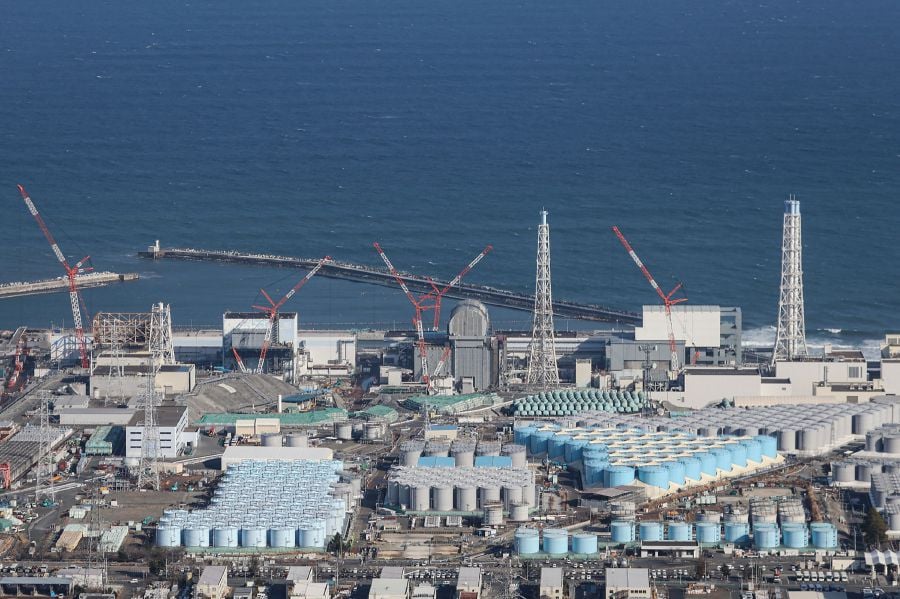
The Canadian Press, Mari Yamaguchi, The Associated Press 23 Aug 23,
TOKYO (AP) — Japanese officials plan to start discharging treated radioactive wastewater from the damaged Fukushima Daiichi nuclear power plant into the Pacific Ocean on Thursday, a contentious step more than 12 years after a massive earthquake and tsunami set off a battle against ever-increasing amounts of radioactive water at the plant.
The government and plant operator say the release is an unavoidable part of its decommissioning and will be safely carried out, but the plan faces opposition in and outside Japan. Here is a look at the controversy.
WHY IS THERE SO MUCH WASTEWATER?
The March 2011 earthquake and tsunami destroyed the plant’s cooling systems, causing three reactors to melt. Highly contaminated cooling water applied to the damaged reactors has leaked continuously to building basements and mixed with groundwater.
The plant operator, Tokyo Electric Power Company Holdings (TEPCO), has taken steps to limit the amount of groundwater and rainwater entering the reactor area, and has reduced the increase in contaminated water to about 100 tons a day, 1/5 of the initial amount. The water is collected and partly recycled as cooling water after treatment, with the rest stored in around 1,000 tanks, which are already filled to 98% of their 1.37 million-ton capacity.
WHY IS TEPCO RELEASING THE WATER NOW?
The government and TEPCO say they need to make room for the plant’s decommissioning and prevent accidental leaks from the tanks.
Japan has obtained support from the International Atomic Energy Agency to improve the transparency and credibility of the release and ensure it meets international safety standards. The government has also stepped up a campaign promoting the plan’s safety at home and through diplomatic channels.
WHAT’S IN THE TREATED WATER’?
The water is being treated by what’s called an Advanced Liquid Processing System, which can reduce the amounts of more than 60 selected radionuclides to government-set releasable levels, except for tritium, which officials say is safe for humans if consumed in small amounts.
About 70% of the water held in the tanks still contains cesium, strontium, carbon-14 and other radionuclides exceeding government-set levels. It will be retreated until the concentrations meet those limits, then diluted by more than 100 times its volume of seawater before it is released. That will bring it way below international safety limits, but its radioactivity won’t be zero.
HOW SAFE IS IT?
IAEA concluded in a report that the plan, if conducted as designed, will have negligible impact on the environment and human health. IAEA chief Rafael Grossi visited the plant and said he was satisfied with preparations.
Japan’s government says the release of tritium into the sea is a routine practice by nuclear plants around the world and that the amount will be several times lower than from plants in China and South Korea.
Scientists generally support the IAEA’s conclusion, while some call for more attention to dozens of low-dose radionuclides that remain in the water, saying data on their long-term effects on the environment and marine life are insufficient.
HOW WILL IT BE RELEASED?
TEPCO executive Junichi Matsumoto says the release will begin with the least radioactive water to ensure safety. After samples are analyzed in final testing, the water will be transported through a thin black pipe to a coastal area where it will be diluted with hundreds of times its volume of seawater.
The diluted water will enter an undersea tunnel and be released a few minutes later from a point 1 kilometer (0.6 mile) off the coast. The release will be gradual and will continue for decades until the decommissioning of the plant is finished, TEPCO officials say. Matsumoto said the slow release will further reduce the environmental impact.
Final preparation for the release began Tuesday when just 1 ton of water was sent for dilution with 1,200 tons of seawater, and the mixture was to be kept in the primary pool for two days for final sampling to ensure safety, Matsumoto said. A batch of 460 tons will be sent to the mixing pool Thursday for the actual discharge.
The company plans to release 31,200 tons of treated water by the end of March 2024, which would empty only 10 tanks because of the continued production of wastewater at the plant. The pace will later pick up.
WHY ARE PEOPLE WORRIED?
Fukushima’s badly hit fisheries, tourism and economy are still recovering from the disaster. Fisheries groups worry about a further damage to the reputation of their seafood. Fukushima’s current catch is only about one-fifth its pre-disaster level due to a decline in the fishing population and smaller catch sizes.
The head of the National Federation of Fisheries Cooperatives, Masanobu Sakamoto, said on Monday that “scientific safety and the sense of safety are different.”
Groups in South Korea and China have also raised concerns, turning the release into a political and diplomatic issue. China has stepped up radiation testing of fishery and agricultural products from Fukushima and nine other prefectures, halting exports at customs for weeks, Fisheries Agency officials say.
WHAT IF SOMETHING GOES WRONG?
The Japanese government says potential risks from the release of treated water are limited to reputational damage resulting from rumors, rather than scientific study. It has allocated 80 billion yen ($550 million) to support fisheries and seafood processing and combat potential reputation damage. TEPCO has also promised to deal with reputational damage claims.
More nuclear challenges await Japan after Fukushima water release
By Kiyoshi Takenaka, TOKYO, Aug 24 (Reuters) https://www.reuters.com/world/asia-pacific/more-nuclear-challenges-await-japan-after-fukushima-water-release-2023-08-24/ Twelve years after the Fukushima nuclear disaster, Japan has started to release treated radioactive water into the sea, a key step in the process of decommissioning the stricken plant, but much tougher tasks lie ahead, such as molten fuel removal.
Here are the challenges facing the government and plant operator Tokyo Electric Power Co (Tepco) (9501.T) as they try to draw a line by the middle of the century under the world’s worst nuclear accident since Chornobyl.
MOLTEN FUEL REMOVAL
Tepco has described the effort to remove highly radioactive fuel debris from reactor cores as an “unprecedented and difficult challenge never attempted anywhere in the world”.
Trial-based retrieval at the No.2 reactor, the first at the plant to go through such a step, has been delayed twice from an initially scheduled date of 2021, and is now set for a six-month period starting in October.
At Three Mile Island (TMI), the U.S. nuclear plant in Pennsylvania that partly melted down in 1979 after a failure, fuel debris was kept under water during retrieval work, providing a shield against radiation.
That was the worst nuclear plant accident before the 1986 Chornobyl tragedy in Ukraine, then part of the Soviet Union.
Japan and Tepco plan to remove molten fuel while it is exposed to air because it is difficult to fill the badly damaged reactor cores with water.
But that will also make it hard to protect workers and retrieval gear from strong radiation.
The Fukushima plant suffered triple meltdowns, compared to the single fuel core meltdown at Three Mile Island, which means the debris retrieval operation will be much larger and more complicated this time around.
The retrieval will be done by a remotely controlled, 22-metre-long (72-foot) robot arm. The initial stage aims to extract only a few grammes of fuel debris, although the total molten fuel at the plant is estimated to be 880 metric tonnes.
RADIOACTIVE SOIL
The 2011 accident spewed radiation into the air, which eventually contaminated the soil. Part of that tainted soil is stored at an interim site more than four times as big as New York’s Central Park.
But the law requires the soil stored at the interim site, located next to the tsunami-wrecked power plant, to be moved out of Fukushima within 30 years from when it began operating in 2015.
More than a quarter of that interval has elapsed with no clear sign the government is nearer to securing permanent storage, though the environment ministry says the earliest the search for specific locations will start is 2025.
BALLOONING COSTS
In 2016, the government doubled to 21.5 trillion yen ($148.60 billion) its estimate of the costs of responding to the Fukushima disaster, including compensation, decommissioning and decontamination efforts.
About 12.1 trillion yen had been spent on such activities by March 2022, Japan’s audit panel, which reviews government expenditures, has said.
That represents an expenditure of more than half of the government’s estimate, even before really tough tasks such as fuel debris retrieval have begun, in turns raising concerns about cost overruns.
Tepco’s continuing payouts to the victims hits its bottom line.
In 2019, a private think tank, the Japan Center for Economic Research, said compensation, decommissioning and decontamination costs were expected to reach 41 trillion yen in a scenario in which Fukushima water was diluted and discharged into the sea.
($1 = 144.6800 yen)
For the sake of Suffolk, Nuclear Free Local Authorities urge Centrica to ‘Say Non to Sizewell C’

Sizewell C is also a site presenting unique challenges. It is located on the Suffolk Heritage Coast, facing the increasing threat of storm surges……………
The Chairs of the Nuclear Free Local Authorities (NFLA) Steering Committee and the NFLA English Forum have written to the Chief Executive of Centrica, which owns British Gas, urging him ‘for the sake of our planet, the people, fauna and flora of Suffolk, the wallets of your hard-pressed electricity customers, and your own company bottom-line’ to say NON to Sizewell C.
The Times reported in July that Chief Executive Chris O’Shea was considering taking a stake in the project and Councillors O’Neill and Blackburn in their letter point out the pitfalls of investment ‘which would bring with it clear financial, ESG and reputational risks for Centrica’.
EDF Energy, now wholly owned by the French state, is currently building a similar plant at Hinkley Point C in Somerset – its history has not been a happy one with the project hugely behind schedule and massively over budget. In addition, Sizewell C will utilise the same EPR reactor as Hinkley Point C, a reactor design with a chequered safety and reliability record. A reactor in China was involved in an accident and is currently again shutdown (Taishan-1) and in Finland a second one only came online after the operator was forced to carry out repairs after a succession of equipment failures (Olkiluoto-3).
Sizewell C is also a site presenting unique challenges. It is located on the Suffolk Heritage Coast, facing the increasing threat of storm surges and coastal erosion, and with climate change modelling suggesting it would become inundated and isolated; there are several sites of scientific interest nearby; and the county is under increasing water stress with fears that there will be insufficient fresh water to meet the needs of the plant as well as local people.
The Councillors point out that several prospective investors who manage large pension funds have clearly indicated that ‘they will not be dipping their financial toe into the radioactive water’ of Sizewell C. Pension managers at The People’s Pension; Nest; BT; BBC; Tesco; and Pearson have all, in correspondence seen by campaigners at Stop Sizewell C, indicated they will not be backing Sizewell C, whilst the Daily Mail reported that Nat West and BT told the paper they would also not be investing and Legal and General’s Nigel Wilson told the BBC’s Today programme: “We are not big fans of HS2 and Sizewell C”.
Councillor O’Neill believes this to be sage advice:
“At a current projected cost of £32.7 billion, Hinkley Point C’s budget is fast approaching twice its first estimate at the time of financial close, and there is no reason to believe that Sizewell C will be delivered any more quickly or any more cheaply as the construction of large nuclear power plants in the UK is a litany of projects being delivered late and vastly over budget.”
Councillor David Blackburn, Chair of the NFLAs English Forum, is a co-signatory to the letter. He is urging opponents of the project to also contact Centrica to ask them not to invest:
“It would be far wiser for Centrica to direct every available penny into the proven renewable technologies that we already have now – these would generate power and heat far more quickly and more cheaply, and generate for them a more immediate financial return, than any further investment in this monstrous nuclear boondoggle.
“The NFLAs are pleased to back the campaign launched by Stop Sizewell C asking supporters to send an email directly to Mr O’Shea asking him not to invest in Sizewell C.
“You can take this direct action in just a few clicks by going to the site at https://action.stopsizewellc.org/centrica
The role of nuclear in the UK’s energy mix.
In 2022, nuclear power provided 13.9% of total electricity supplied in the UK. However, as the table below [on original] illustrates, its contribution has fallen significantly since
the 1990s, when it provided around a quarter of the UK’s total
electricity supply.
Since 1995 there have been eight nuclear plant
closures, with no new plants coming online, reducing installed nuclear
capacity reducing by more than a quarter.
Declining nuclear capacity has
been (more than) compensated for by the rise of renewable energy, whose
share of electricity generation rose from 3% in 2000 to 42% in 2022.
The chief scientist of Greenpeace UK, Dr Doug Parr, said that the nuclear
industry was making “speculative claims” regarding the proposed
benefits of SMRs relative to conventional nuclear power. He said that
“SMRs have no track record, but initial indications are that the familiar
problems of cost overruns and delays will be repeated”.
In addition to these concerns, Steve Thomas, an emeritus professor of energy policy at the
University of Greenwich, suggests that the focus on SMRs will divert time
and resources away from energy efficiency and renewables which he believes
are the “answers” to net zero electricity generation.
Professor Thomas’s position is in line with that of the Green Party, the Liberal
Democrats, and the Scottish National Party. The co-leader of the Green
Party Adrian Ramsey has described nuclear as an “expensive
distraction”, arguing that renewable energy technologies and energy
efficiency are “cleaner and cheaper solutions that can be delivered far
quicker than nuclear ever can”.
Wera Hobhouse, the Liberal Democrat
energy and climate change spokesperson, has also criticised the expense of
nuclear power relative to renewables. Referring to the Nuclear Energy
(Financing) Act 2022, she argued it was “madness” that the government
had “recently passed a new law that will allow them to add levies to
energy bills to fund new nuclear plants”.
Scotland’s last remaining
nuclear power plant in Torness is due to close in 2028 and SNP energy
spokesperson Alan Brown has said that the UK government should be focussing
its efforts on Scotland’s “renewable energy potential” rather than
attempting to build more nuclear power stations.
House of Lords Library 23rd Aug 2023
French nuclear watchdog ASN issues first lifespan extension to 40-year-old reactor

French nuclear watchdog ASN issued a decision allowing for the continued
operation of state-owned utility EDF’s Tricastin 1 nuclear reactor in
southern France, the first lifetime extension granted to a French reactor
after 40 years of operation.
In a decision published on Aug. 10 and seen by
Reuters on Tuesday, ASN granted the reactor an extension until its next
review, so for another ten years. Some 32 of France’s fleet of 56 reactors
are up for their fourth ten-yearly inspection this decade, leaving French
energy production reliant on securing a swathe of reactor extensions for
another ten years.
Reuters 22nd Aug 2023
Ukraine likely to fail in key counteroffensive aim, says US intelligence

Roland Oliphant, Telegraph, Fri, 18 Aug 2023, https://www.sott.net/article/483699-Ukraine-likely-to-fail-in-key-counteroffensive-aim-says-US-intelligence
Ukraine’s counter-offensive will likely fail in its key objective to cut Russia’s land bridge to Crimea this year, according to a US intelligence assessment briefed to members of Congress.
Instead, Ukraine’s attack is expected to stop some way short of the key city of Melitopol, the Washington Post reported, citing anonymous officials familiar with the assessment.
The reported assessment, which The Telegraph could not immediately verify, could foreshadow mutual recriminations between members of the pro-Ukraine alliance over the offensive’s slow progress.
Ukraine launched a long-planned counter-offensive in June. Its main objective was to reach the sea of Azov and sever Russia’s land bridge to the annexed Black Sea Crimean peninsula.
Ukraine and its allies hoped newly supplied Western equipment such as Leopard tanks and Bradley fighting vehicles would help achieve a breakthrough. But the assault immediately ran into stronger than anticipated Russian resistance and has struggled to make progress.
In an effort to reduce losses, analysts said Ukraine has now switched back to the strategy of smaller assaults and strikes on supply lines that eventually led to success in the southern Kherson region last year.
Melitopol, about 50 miles south of the current front line, is often called the “gateway” to Crimea and sits astride two roads and a railway controlling access to the peninsula. To reach it, the Ukrainians would have to puncture three layers of reinforced defensive lines and minefields, and bypass or capture several heavily fortified towns and villages en route.
Playing down tensions
In public, Ukrainian and Western officials generally seek to play down tensions over the slow progress of the fighting.
Dmytro Kuleba, the Ukrainian foreign minister, said on Thursday that Ukraine does not feel under pressure from Western allies to deliver quicker results.
But mutual recriminations have begun.
Volodymyr Zelensky, the president of Ukraine, said in July that the operation was originally planned for spring but delayed for months because of insufficient weapons systems and munitions. That delay in turn gave the Russians time to dig in and sow minefields, he said.
Other critics have accused Western governments of hypocrisy for expecting Ukraine to achieve a combined-arms-style breakthrough without air superiority or long-range precision missiles to hit supply lines, minimum requirements for any similar Nato operation.
No ‘panaceas’
US and other Western officials have denied decisions on arms supplies have hampered the offensive.
A senior official in Joe Biden’s administration told the Washington Post the main issue remains piercing the Russian defensive lines and that there was “no evidence” F-16 fighters or longer-range missile systems such as ATACMS would have been a “panacea” to that problem.
Late last month, a German military intelligence report blamed slow progress on Ukraine’s generals splitting Western-trained brigades into small units to assault objectives, which it said negated advantages in force and firepower.
It said an “operational doctrine” particularly entrenched in senior officers with combat experience meant Nato training was not being put into practice.
The Biden administration gave the green light to European countries to provide F16 fighters and associated training to Ukrainian pilots and crews in May, following months of Ukrainian lobbying.
The United States on Friday formally assured Denmark and the Netherlands that it would give permission for F-16s to be exported to Ukraine when training is complete, but that is not expected to be until early next year.
It has so far rebuffed Ukrainian requests for ATACMS precision missiles.
EDF Warns of French Nuclear Output Cuts in Weekend Heat Wave

Bloomberg, By Francois De Beaupuy, August 22, 2023
Electricite de France SA will probably have to reduce nuclear output over the coming weekend as a heat wave affecting a large part of the country warms rivers used for cooling some of its reactors.
Due to the high temperatures forecast on Rhone river, production restrictions are likely to affect production at its Tricastin power plant — where two of its four 900-megawatt reactors are already………….(Subscribers only) more https://www.bloomberg.com/news/articles/2023-08-21/edf-warns-of-french-nuclear-output-cuts-in-weekend-heat-wave#xj4y7vzkg
Japan’s nuclear wastewater – should we be worried?
August 22, 2023 https://www.nst.com.my/opinion/leaders/2023/08/945792/nst-leader-japans-nuclear-wastewater
FUKUSHIMA is a dreaded word in the region because what happens there doesn’t stay there. There in Japan on March 11, 2011, an earthquake and tsunami, in that order, knocked out the Fukushima Daiichi nuclear-power plant, releasing untreated radioactive water into the sea.
Given the state of the nuclear plant technology then — or even now — there wasn’t the time for the radioactive elements to self-destruct. The human mind, including the Japanese ones, for some reason didn’t perceive that calamities can happen all at once.
The Fukushima disaster is such a tale of instantaneous conjunction of calamities. On a visit to the disaster zone on Sunday, Japanese Prime Minister Fumio Kishida was quoted by news agency AFP as saying that he was refraining from “commenting on a concrete timing of the release into the ocean at this point in time”, leaving ample room for a prime ministerial hint that it will be soon.
Some 500 Olympic-size swimming pools of wastewater, accumulated over 12 years after the disaster, are expected to be released into the Pacific Ocean. The fact that it would be a slow release over 10 years registered no effect in the region’s dread meter.
The region is on dread-watch, but much of it is coated with diplomatic niceties. China has been the most vociferous in opposing the release of the wastewater into the ocean. In China, dread comes mixed with geopolitical anger, given that Tokyo is a tango partner of Washington.
If a taste of Chinese animus is needed, here is one quote from a Beijing official, gleefully circulated by the Western media: Japan is treating the sea as its sewer. An interesting take, we must say, now that all nations without exception are treating the seas as their sewer.
How many marine lives were destroyed or how many people have ingested radioactive materials through seafood after the accident 12 years ago is hard to tell. Nuclear literature tells us if the water isn’t treated properly, dangerous isotopes can have devastating effects, including DNA-damaging ones. Should we fear? Yes and no. Start with yes.
The Tokyo Electric Power Company (Tepco), the operator of the crippled nuclear plant, and Japanese regulators stand accused of negligence, notwithstanding the earthquake and tsunami. Now that Tepco and the government are saying the 1.34 million tonnes of wastewater planned to be released into the Pacific Ocean is safe, many in Japan don’t believe them. Both are victims of trust deficit.
Kishida, though he wasn’t prime minister when disaster struck in 2011, is in need of reputation management advice. Not just to repair the trust deficit at home, but also abroad.
China has banned seafood from Fukushima and considering a wider ban. Others in the region are beginning to be infected by China’s isotope fear, not because of Beijing’s geopolitics, but because of the nightmarish outcome of radioactive contamination. If the dread grows, it will cripple more than Fukushima.
Now for the no, our second response to Japan’s release of the treated wastewater into the ocean. The world shouldn’t fear because the Japanese guarantee that the dangerous radioactive elements have been filtered out and comes stamped with the approval of the United Nations’ International Atomic Energy Agency
Unless, of course, if the world has reasons to believe that the IAEA, too, comes branded with a trust deficit.
Biden’s rival, Robert F. Kennedy Junior, labels F-16s for Ukraine ‘a disaster for humanity’

21vAug 23 , https://www.rt.com/news/581543-kennedy-ukraine-f16-delivery/1
Supplying US-made fighter jets to Kiev would only benefit the defense industry, RFK Jr. says
The looming delivery of US-made F-16 fighter jets to Ukraine will not prevent the “collapse” of the country’s military and will only benefit the military-industrial complex, Democrat presidential hopeful Robert F. Kennedy Junior has claimed.
The Ukrainian conflict should be resolved through negotiations, RFK Jr. argued in a thread on social media platform X (formerly Twitter), stating that supplying F-16s to Kiev was a “great decision for the defense industry, but a disaster for Ukraine and humanity.”
“F-16s won’t stop the collapse of the Ukrainian military (which some experts say is imminent). These planes require a lot of training and maintenance. This isn’t the movies,” Kennedy stressed.
The presidential hopeful has long-opposed the enduring Western aid to Ukraine, spearheaded by Washington, arguing that the US should admit its “failure” in the country and focus on domestic issues instead. Kennedy’s criticism of the fighter-jet delivery comes after Washington enabled its European allies to re-export older planes to Ukraine, and hours before the move was officially announced by Denmark and the Netherlands.
The upcoming delivery was heralded by Dutch PM Mark Rutte on Sunday as he hosted Ukrainian President Vladimir Zelensky at a military airbase in Eindhoven.
“Today we can announce that the Netherlands and Denmark commit to the transfer of F-16 aircraft to Ukraine and the Ukrainian Air Force, including cooperation with the United States and other partners once the conditions for such a transfer have been met,” Rutte said at a press conference.
Simultaneously, the Danish Ministry of Defence released a statement confirming its pledge to provide Kiev with F-16s from its inventory, once certain “conditions” are met. The conditions “include, but are not limited to, successfully selected, tested and trained Ukrainian F-16 personnel as well as necessary authorizations, infrastructure and logistics,” it said.
Kiev has long-demanded modern aircraft, as well as other, increasingly sophisticated weaponry, from its Western backers, arguing the planes would help it turn the tide of the conflict with Russia, which has been going on since February 2022. Moscow has repeatedly urged the collective West to stop the military deliveries, arguing they would only prolong the hostilities rather than change their ultimate outcome.
Japanese fishing industry leader is “greatly concerned” over the pending disharge of Fukushima radioactive water into the ocean.

The leader of a Japanese fisheries industry group told officials on Monday
he was “greatly concerned” about the discharge of treated radioactive water
set to be released into the sea from the wrecked Fukushima nuclear plant.
The government is expected to decide soon, perhaps within days, when to
start releasing the water, equivalent to the contents of 500 Olympic-size
swimming pools, despite objections at home and abroad to the plan.
Reuters 21st Aug 2023
Most ‘experts’ pushing for endless conflict in Ukraine share a common benefactor.

the top 50 think tanks received over a billion dollars from the US government and its defense contractors and manufacturers, including some of the biggest beneficiaries of weapons production today ‘for Ukraine’. The top recipients of this funding include the Atlantic Council, German Marshall Fund of the United States, Brookings Institution, Heritage Foundation, Center for Strategic and International Studies, New America Foundation, RAND Corporation, Center for a New American Security, Council on Foreign Relations, and the Stimson Center.
A whopping 85% of media quotes on US military involvement come from someone paid by the defense industry
rachelmarsden.com 20 Aug 23
Experts with important-sounding titles linked to academic-sounding entities have been shaping hearts and minds in the press, both at home and abroad, in favor of endless conflict in Ukraine. Guess what deep-pocketed benefactor lurks beneath the surface?
During the Iraq War, the Pentagon backed retired generals to make the rounds of TV and radio shows as ‘military analysts’ to promote the Bush administration’s agenda in the Persian Gulf. It was like inviting Ronald McDonald on a program to debate and discuss the merit of Big Macs. You could almost see the strings attached to the puppets, linked to the military-industrial complex that benefited from war without an off-ramp.
Fast forward 20 years, and the sales tactics have drastically changed. The generals have been replaced by various experts with academic credentials, typically linked to one or more ‘think tanks’. Far from the neutral academic centers of intellectual integrity that the names suggest, these entities are little more than laundromats for discreet special interests. I should know – I used to be a director of one.
Every Wednesday, some of the highest-ranking figures of the Bush administration would come to our Washington, DC office to deliver their main agenda points for the week, requesting assistance in placing and promoting them to both grassroots activists sympathetic to the cause and to the general public. The experts within the think tank were hired based on political litmus tests, no doubt to ensure that their views aligned with the organization’s. When they no longer do, you’re either fired or you leave.
The donors, many of whom were well-known millionaires and billionaires driven by a passion for certain issues, would come straight out and ask for bang for their buck in exchange for the opening of their wallets. In some cases, an entire project or department would be mounted at the think tank with the understanding that it would be fully funded by a single donor. These rich, influential folks typically had business or investment interests that benefited from shaping the establishment narrative in their favor, and they wanted to do so without leaving any footprints. What better way than to have it all fronted by a shiny veneer of expert credibility?
So while the generals of the Iraq War era had all the subtlety of a sledgehammer in representing the interests of the military-industrial complex, the new salesmen of endless armed conflict in Ukraine have overwhelmingly adopted the more subtle model. A study published in 2020 found that the top 50 think tanks received over a billion dollars from the US government and its defense contractors and manufacturers, including some of the biggest beneficiaries of weapons production today ‘for Ukraine’. The top recipients of this funding include the Atlantic Council, German Marshall Fund of the United States, Brookings Institution, Heritage Foundation, Center for Strategic and International Studies, New America Foundation, RAND Corporation, Center for a New American Security, Council on Foreign Relations, and the Stimson Center.
Some of these black boxes are more ideologically-driven than others. The Heritage Foundation, for example, leans overwhelmingly neoconservative and interventionist. Others, like the Atlantic Council and German Marshall Fund, are effectively force multipliers for NATO talking points. But the RAND Corporation also houses systems analysts and scientists specializing in space and computing. The fact that not all of these entities – or even the people who work within some of them – can be tossed into the same basket and labeled mere parrots for the special interests of their organization’s benefactors helps to muddy the waters.
In an analysis published in June of media coverage related to US military involvement in Ukraine, the Quincy Institute for Responsible Statecraft found that, when a think tank is cited regarding the issue, 85% of the time it’s a think tank with “financial backing from the defense industry.” Taken at face value, this risks being interpreted by the general public as expert ‘consensus’ on the need for US taxpayers to continue flooding Ukraine with weapons, unaware that it’s really just a bunch of Pentagon-backed actors agreeing with each other about the need to pursue the most profitable course of action on behalf of their War Inc. sugar daddies. Just like when climate scientists, who have parlayed climate change into endless funding and a perpetual justification for their existence, aren’t going to kill their cash cow by arguing that the climate can’t be controlled by man and that throwing cash at the issue – or at them – is futile.
Many of the Ukraine think tank experts are quick to attack analysis and information published on platforms they don’t like – such as RT – as ‘Russian-backed’. You’d have to be living under a rock these days to not know that RT is linked to Russia. No transparency issues there.
But there is far less transparency around their own organizations’ financing. Where is their insistence on being above board about the use of defense industry cash to influence not just the general public but the course of the conflict itself? Around a third of top foreign policy think tanks don’t disclose this Pentagon funding, according to the Quincy Institute. Nor is it unheard of for these experts to springboard from these establishment-friendly platforms and the public notoriety they provide, right into public office – where they can translate the same agenda that they promoted into actionable policy. Isn’t it important for voters to consider the powerful hidden hand who helped to get them there?
1 This Month
23-25 October – on Zoom – World BEYOND War’s annual global conferenc


Shut down the radiation-damaged Heysham nuclear reactors now
To see nuclear-related stories in greater depth and intensity – go to https://nuclearinformation.wordpress.com

Say No to NASA’s Reckless Nuclear Reactor on the Moon
Say No to NASA’s Reckless Nuclear Reactor on the Moon

-
Archives
- October 2026 (199)
- September 2026 (339)
- August 2026 (330)
- July 2026 (355)
- June 2026 (287)
- May 2026 (306)
- April 2026 (356)
- March 2026 (251)
- February 2026 (267)
- January 2026 (308)
- December 2025 (358)
- November 2025 (359)
-
Categories
- 1
- 1 NUCLEAR ISSUES
- business and costs
- climate change
- culture and arts
- ENERGY
- environment
- health
- history
- indigenous issues
- Legal
- marketing of nuclear
- media
- opposition to nuclear
- PERSONAL STORIES
- politics
- politics international
- Religion and ethics
- safety
- secrets,lies and civil liberties
- spinbuster
- technology
- Uranium
- wastes
- weapons and war
- Women
- 2 WORLD
- ACTION
- AFRICA
- Atrocities
- AUSTRALIA
- Christina's notes
- Christina's themes
- culture and arts
- Events
- Fuk 2022
- Fuk 2023
- Fukushima 2017
- Fukushima 2018
- fukushima 2019
- Fukushima 2020
- Fukushima 2021
- general
- global warming
- Humour (God we need it)
- Nuclear
- RARE EARTHS
- Reference
- resources – print
- Resources -audiovicual
- Weekly Newsletter
- World
- World Nuclear
- YouTube
-
RSS
Entries RSS
Comments RSS

